Our Three Step Process

THE PROOF LAYER™ | LAYER 5
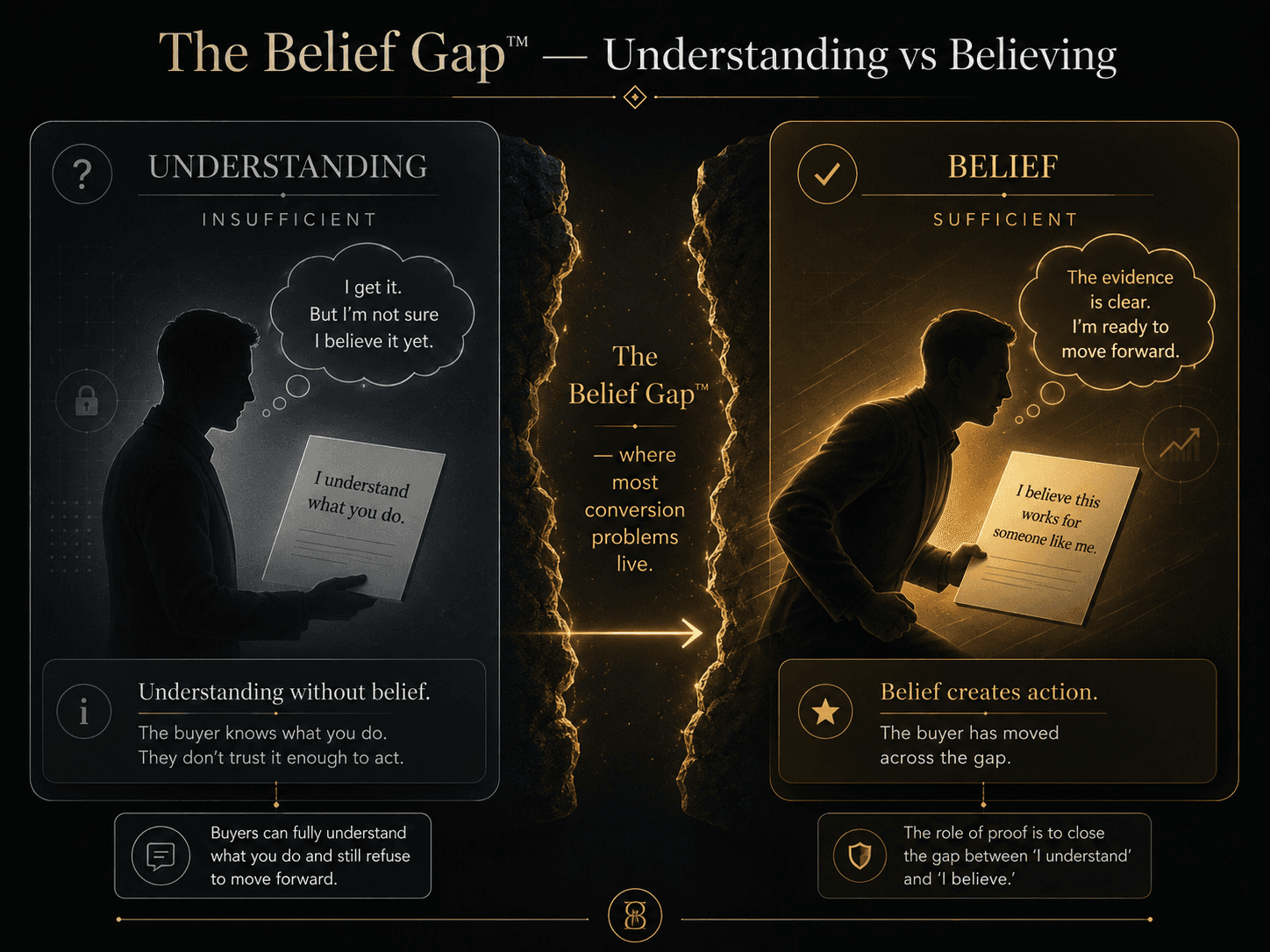
“The Belief Gap™ — Understanding vs Believing” Concept: A split-screen comparison showing two buyer states.  Left side (Understanding — Insufficient): A buyer silhouette holding a document labeled “I understand what you do.” The silhouette is still, unmoving. Thought bubble: “I get it. But I'm not sure I believe it yet.” The background is cool grey — correct but unconvincing. Label: “Understanding without belief. The buyer knows what you do. They don't trust it enough to act.”  Right side (Belief — Sufficient): The same buyer silhouette, now with a document labeled “I believe this works for someone like me.” The silhouette is leaning forward, ready to act. Thought bubble: “The evidence is clear. I'm ready to move forward.” The background is warm gold — confident and action-oriented. Label: “Belief creates action. The buyer has moved across the gap.”  Between them, a jagged gap labeled: “The Belief Gap™ — where most conversion problems live.”  Style: Dark charcoal background. Left side: cool grey, correct but static. Right side: warm gold/amber, confident and dynamic. The gap is emphasized with a subtle glow.  Interaction: Hovering the left side reveals: “Buyers can fully understand what you do and still refuse to move forward. Understanding and belief are different things.” Hovering the right side reveals: “The role of proof is to close the gap between ‘I understand’ and ‘I believe.’” A slider transitions from “Understanding” to “Belief.”

Our Three Step Process

THE PROOF LAYER™ | LAYER 5

“The Belief Gap™ — Understanding vs Believing” Concept: A split-screen comparison showing two buyer states.  Left side (Understanding — Insufficient): A buyer silhouette holding a document labeled “I understand what you do.” The silhouette is still, unmoving. Thought bubble: “I get it. But I'm not sure I believe it yet.” The background is cool grey — correct but unconvincing. Label: “Understanding without belief. The buyer knows what you do. They don't trust it enough to act.”  Right side (Belief — Sufficient): The same buyer silhouette, now with a document labeled “I believe this works for someone like me.” The silhouette is leaning forward, ready to act. Thought bubble: “The evidence is clear. I'm ready to move forward.” The background is warm gold — confident and action-oriented. Label: “Belief creates action. The buyer has moved across the gap.”  Between them, a jagged gap labeled: “The Belief Gap™ — where most conversion problems live.”  Style: Dark charcoal background. Left side: cool grey, correct but static. Right side: warm gold/amber, confident and dynamic. The gap is emphasized with a subtle glow.  Interaction: Hovering the left side reveals: “Buyers can fully understand what you do and still refuse to move forward. Understanding and belief are different things.” Hovering the right side reveals: “The role of proof is to close the gap between ‘I understand’ and ‘I believe.’” A slider transitions from “Understanding” to “Belief.”

Trust Is Earned, Not Claimed.


Every business wants trust.

Every buyer wants certainty.

The challenge is that trust doesn't exist automatically.

Trust must be built.

And most businesses attempt to build trust in the wrong way.

They make bigger claims.

Use stronger promises.

Add more guarantees.

Write more persuasive copy.

Yet scepticism remains.

Because trust is not created by what you say about yourself.

Trust is created by what buyers can verify for themselves.

That distinction changes everything.


The Trust Problem

Imagine a stranger walks up to you and says:

"I'm trustworthy."

Would you believe them?

Probably not.

Not because they're lying.

Because trust doesn't work that way.

Trust is earned through evidence.

Consistency.

Demonstration.

Proof.

Business is no different.

Every visitor arrives carrying uncertainty.

Questions such as:

Will this work?

Can I trust them?

Has this worked before?

Is this different?

Am I making a mistake?

The stronger the uncertainty, the harder action becomes.

The role of proof is to reduce that uncertainty.


The Belief Gap™

One of the biggest mistakes founders make is assuming that understanding creates action.

It doesn't.

A buyer can fully understand:

  • what you do

  • what you sell

  • what problem you solve

And still refuse to move forward.

Why?

Because understanding and belief are different things.

This creates what we call:


The Belief Gap™

The space between:

"I understand."

And:

"I believe."

Most conversion problems live somewhere inside that gap.

——


Proof Is Not Decoration™

Many businesses treat proof like decoration.

Testimonials are added because they're expected.

Case studies are buried at the bottom of pages.

Results are hidden inside PDFs nobody reads.

Proof becomes an accessory.

Instead of an asset.

Strong businesses understand something different.

Proof is not decoration.

Proof is architecture.

Because proof changes how buyers evaluate risk.

——


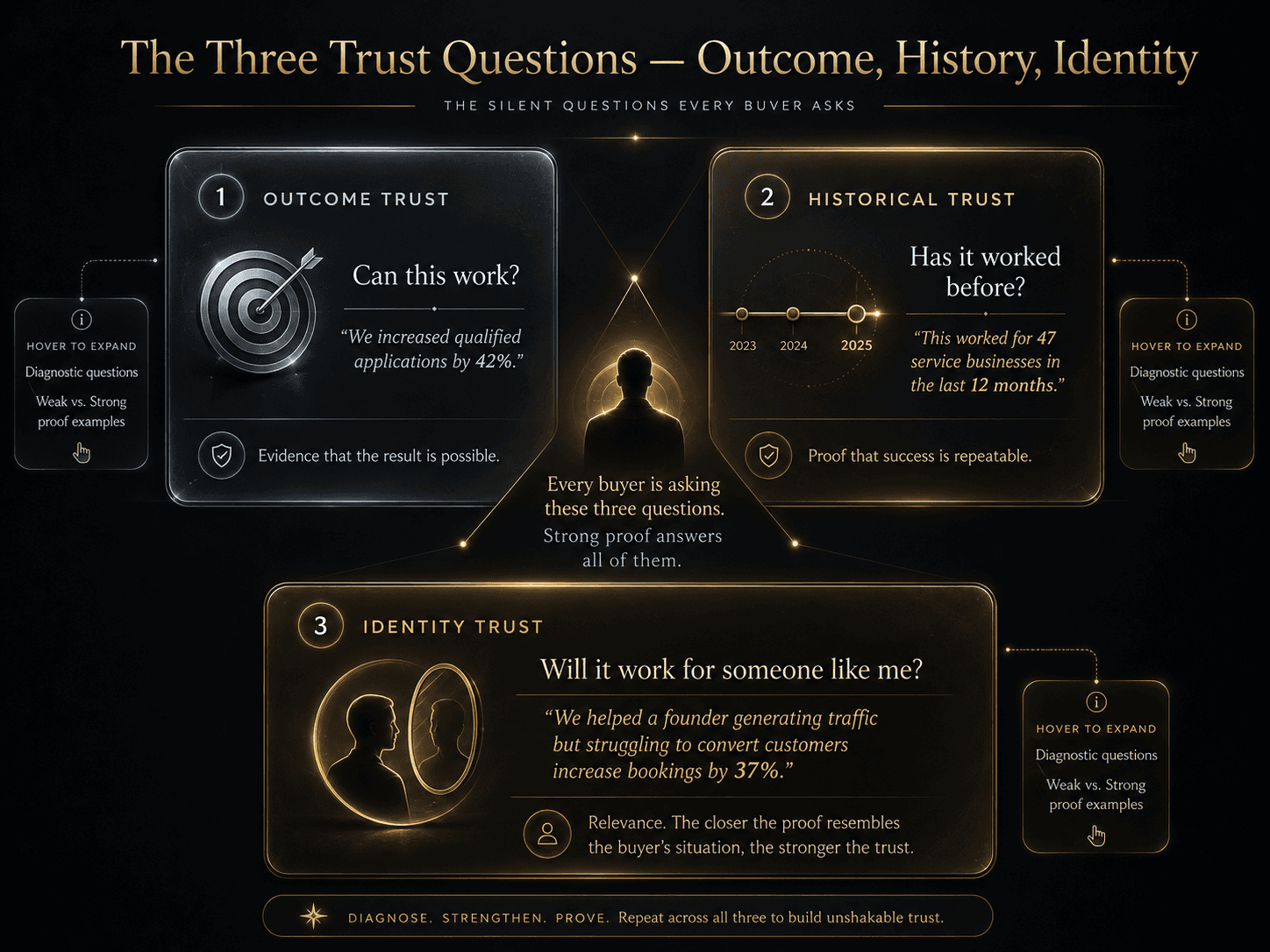
Every Buyer Is Asking Three Questions

Whether consciously or unconsciously, buyers want answers to three questions.


Question One

Can this work?

This is outcome trust.

The buyer wants evidence that the result is possible.


Question Two

Has it worked before?

This is historical trust.

The buyer wants proof that success is repeatable.


Question Three

Will it work for someone like me?

This is identity trust.

The buyer wants relevance.

Not generic success stories.

Relevant success stories.

The closer the proof resembles the buyer's situation, the stronger the trust becomes.

——


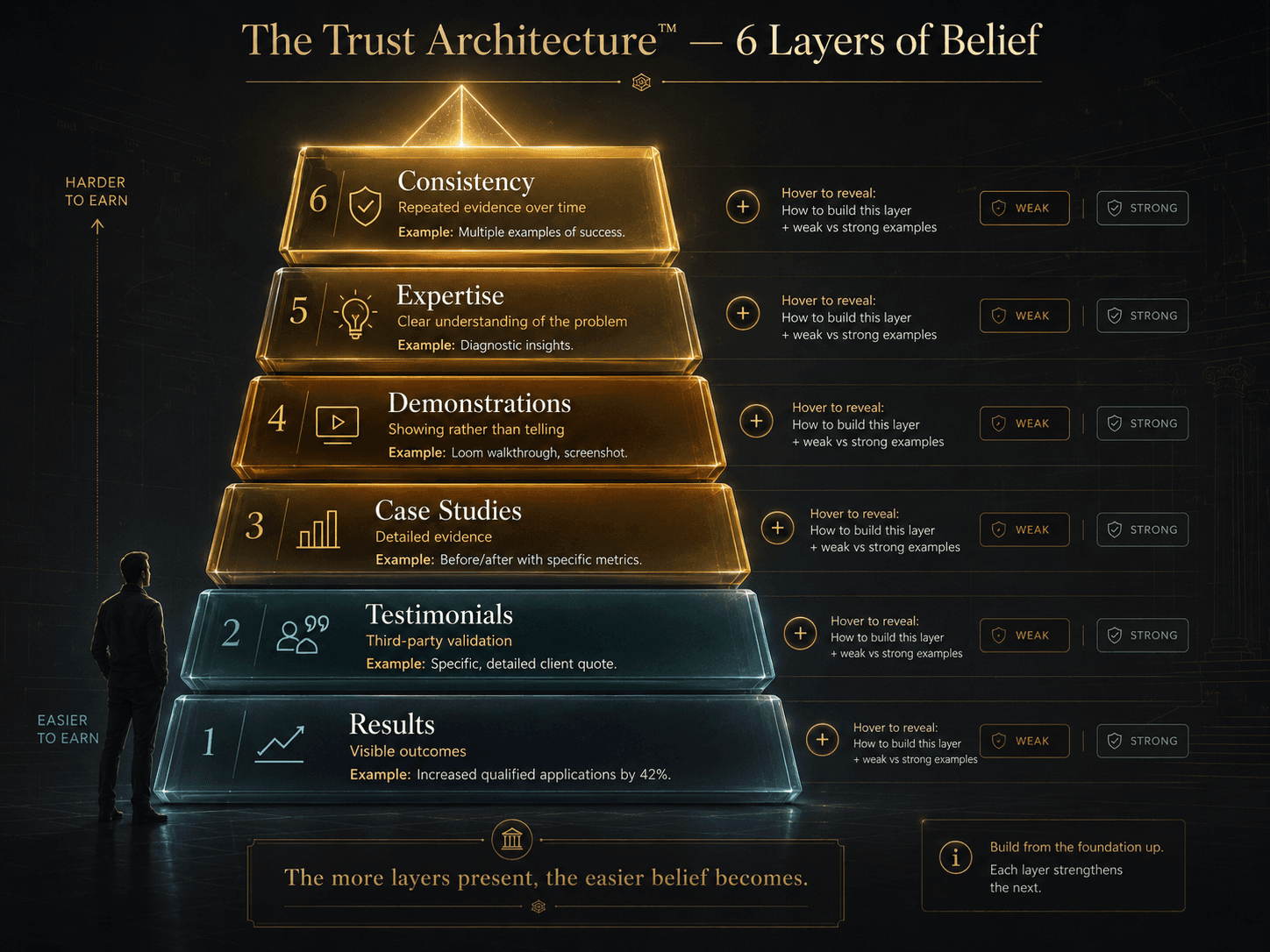
The Trust Architecture™

Inside the Funnel Operating System™, trust is built through layers.

Not through a single testimonial.

Strong trust architecture often includes:


Results

Visible outcomes.

Testimonials

Third-party validation.

Case Studies

Detailed evidence.

Demonstrations

Showing rather than telling.

Expertise

Clear understanding of the problem.

Consistency

Repeated evidence over time.

The more layers present, the easier belief becomes.

——


Why Testimonials Often Fail

Most testimonials sound like this:

"Great service."

"Highly recommended."

"Amazing experience."

Nice.

But weak.

Why?

Because they don't remove uncertainty.

Strong testimonials answer concerns.

Example:

"We were getting traffic but couldn't figure out why conversions were so low. Within three weeks we identified two major bottlenecks and increased booked calls by 37%."

Now trust increases.

Because uncertainty decreases.

Specificity builds belief.

Generic praise creates very little movement.

——


The Evidence Principle™

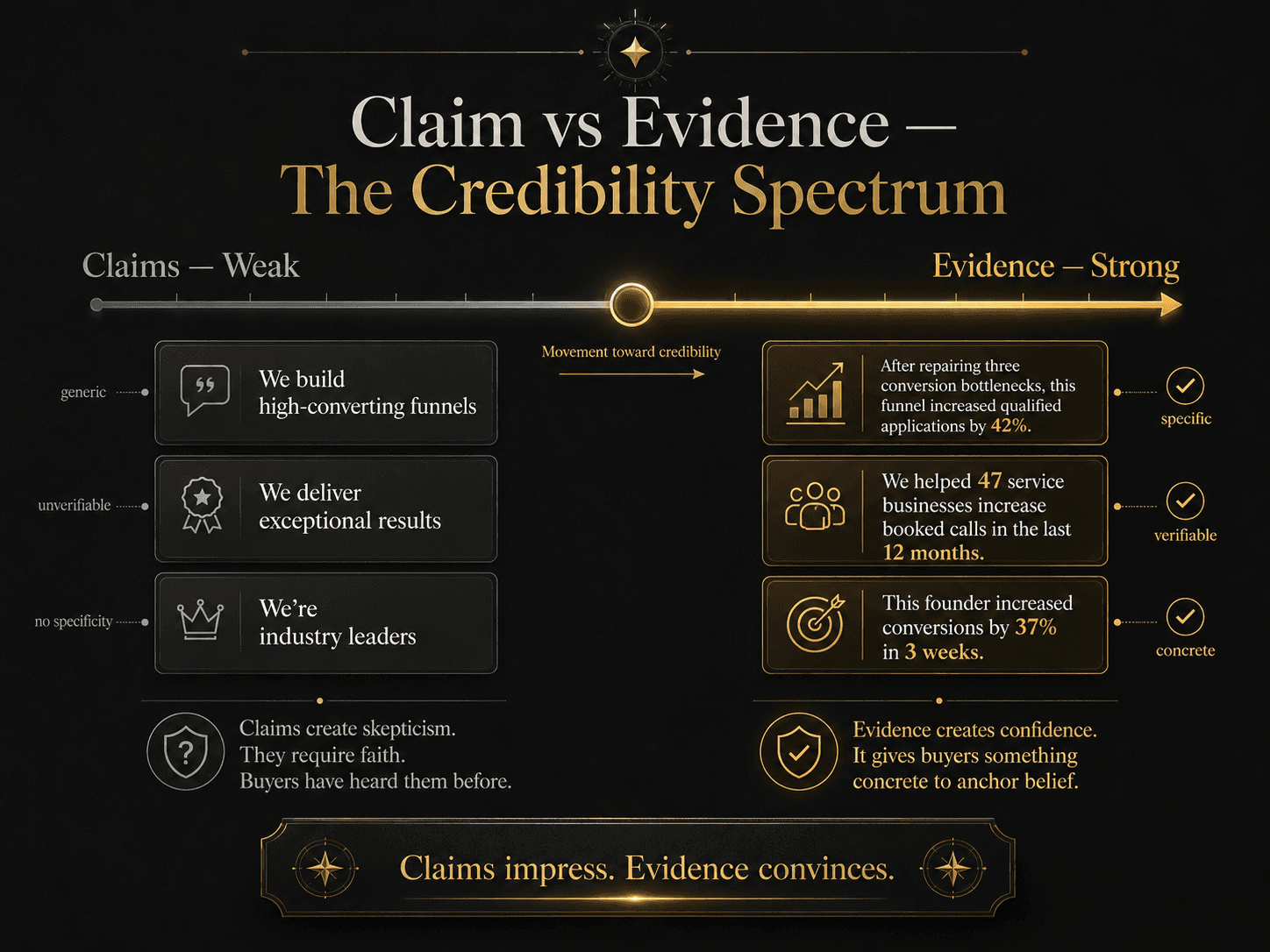
Claims create skepticism.

Evidence creates confidence.

Let's compare.

Claim:

"We build high-converting funnels."

Evidence:

"After repairing three conversion bottlenecks, this funnel increased qualified applications by 42%."

The second feels stronger because it gives the buyer something concrete.

Evidence anchors belief.

Claims require faith.

——


Why Buyers Say "I'll Think About It"

Most founders hear:

"I'll think about it."

And assume:

The buyer isn't interested.

Sometimes.

But often the real issue is uncertainty.

The buyer hasn't reached belief yet.

They're still evaluating risk.

Still looking for confidence.

Still searching for proof.

This is why trust sits between interest and action.

Without trust, momentum stalls.

——


Diagnostic Observation™ #07

Trust is not claimed.

Trust is earned.

And evidence earns trust faster than promises.


Quick Self-Test

Review your page, funnel, or offer.

Can buyers quickly find evidence that:

This works.

This has worked before.

This can work for someone like them.

If not, your Proof Layer may be limiting growth.

——


Common Symptoms Of A Weak Proof Layer

  • Long sales cycles

  • Heavy skepticism

  • Price objections

  • Low conversion rates

  • Buyers delaying decisions

  • Frequent "I'll think about it" responses

These are often trust problems.

Not offer problems.

——


Recommended Resources


Trust Architecture™ Checklist

Build stronger belief systems.

[Download Resource]


Proof Audit™

Identify missing trust elements.

[Download Resource]


Testimonial Framework™

Collect higher-quality proof.

[Download Resource]


Case Study Builder™

Create evidence-rich success stories.

[Download Resource]


Risk Reversal Worksheet™

Reduce buyer uncertainty.

[Download Resource]

——


Final Thought

Most businesses spend their time making bigger promises.

The strongest businesses spend their time providing better evidence.

Because buyers don't move when claims become louder.

They move when doubt becomes smaller.

Trust reduces doubt.

Evidence builds trust.

And trust creates action.

Which means every conversion eventually arrives at the same question:

Have you made belief easier than skepticism?

Because trust is the bridge between understanding and action.

And every bridge must be strong enough to cross.


Next Layer → The Journey Layer™

Why Growth Is Lost Between Steps
Join our newsletter list

Sign up to get the most recent blog articles in your email every week.

Share this post to the social medias

Trust Is Earned, Not Claimed.


Every business wants trust.

Every buyer wants certainty.

The challenge is that trust doesn't exist automatically.

Trust must be built.

And most businesses attempt to build trust in the wrong way.

They make bigger claims.

Use stronger promises.

Add more guarantees.

Write more persuasive copy.

Yet scepticism remains.

Because trust is not created by what you say about yourself.

Trust is created by what buyers can verify for themselves.

That distinction changes everything.


The Trust Problem

Imagine a stranger walks up to you and says:

"I'm trustworthy."

Would you believe them?

Probably not.

Not because they're lying.

Because trust doesn't work that way.

Trust is earned through evidence.

Consistency.

Demonstration.

Proof.

Business is no different.

Every visitor arrives carrying uncertainty.

Questions such as:

Will this work?

Can I trust them?

Has this worked before?

Is this different?

Am I making a mistake?

The stronger the uncertainty, the harder action becomes.

The role of proof is to reduce that uncertainty.


The Belief Gap™

One of the biggest mistakes founders make is assuming that understanding creates action.

It doesn't.

A buyer can fully understand:

  • what you do

  • what you sell

  • what problem you solve

And still refuse to move forward.

Why?

Because understanding and belief are different things.

This creates what we call:


The Belief Gap™

The space between:

"I understand."

And:

"I believe."

Most conversion problems live somewhere inside that gap.

——


Proof Is Not Decoration™

Many businesses treat proof like decoration.

Testimonials are added because they're expected.

Case studies are buried at the bottom of pages.

Results are hidden inside PDFs nobody reads.

Proof becomes an accessory.

Instead of an asset.

Strong businesses understand something different.

Proof is not decoration.

Proof is architecture.

Because proof changes how buyers evaluate risk.

——


Every Buyer Is Asking Three Questions

Whether consciously or unconsciously, buyers want answers to three questions.


Question One

Can this work?

This is outcome trust.

The buyer wants evidence that the result is possible.


Question Two

Has it worked before?

This is historical trust.

The buyer wants proof that success is repeatable.


Question Three

Will it work for someone like me?

This is identity trust.

The buyer wants relevance.

Not generic success stories.

Relevant success stories.

The closer the proof resembles the buyer's situation, the stronger the trust becomes.

——


The Trust Architecture™

Inside the Funnel Operating System™, trust is built through layers.

Not through a single testimonial.

Strong trust architecture often includes:


Results

Visible outcomes.

Testimonials

Third-party validation.

Case Studies

Detailed evidence.

Demonstrations

Showing rather than telling.

Expertise

Clear understanding of the problem.

Consistency

Repeated evidence over time.

The more layers present, the easier belief becomes.

——


Why Testimonials Often Fail

Most testimonials sound like this:

"Great service."

"Highly recommended."

"Amazing experience."

Nice.

But weak.

Why?

Because they don't remove uncertainty.

Strong testimonials answer concerns.

Example:

"We were getting traffic but couldn't figure out why conversions were so low. Within three weeks we identified two major bottlenecks and increased booked calls by 37%."

Now trust increases.

Because uncertainty decreases.

Specificity builds belief.

Generic praise creates very little movement.

——


The Evidence Principle™

Claims create skepticism.

Evidence creates confidence.

Let's compare.

Claim:

"We build high-converting funnels."

Evidence:

"After repairing three conversion bottlenecks, this funnel increased qualified applications by 42%."

The second feels stronger because it gives the buyer something concrete.

Evidence anchors belief.

Claims require faith.

——


Why Buyers Say "I'll Think About It"

Most founders hear:

"I'll think about it."

And assume:

The buyer isn't interested.

Sometimes.

But often the real issue is uncertainty.

The buyer hasn't reached belief yet.

They're still evaluating risk.

Still looking for confidence.

Still searching for proof.

This is why trust sits between interest and action.

Without trust, momentum stalls.

——


Diagnostic Observation™ #07

Trust is not claimed.

Trust is earned.

And evidence earns trust faster than promises.


Quick Self-Test

Review your page, funnel, or offer.

Can buyers quickly find evidence that:

This works.

This has worked before.

This can work for someone like them.

If not, your Proof Layer may be limiting growth.

——


Common Symptoms Of A Weak Proof Layer

  • Long sales cycles

  • Heavy skepticism

  • Price objections

  • Low conversion rates

  • Buyers delaying decisions

  • Frequent "I'll think about it" responses

These are often trust problems.

Not offer problems.

——


Recommended Resources


Trust Architecture™ Checklist

Build stronger belief systems.

[Download Resource]


Proof Audit™

Identify missing trust elements.

[Download Resource]


Testimonial Framework™

Collect higher-quality proof.

[Download Resource]


Case Study Builder™

Create evidence-rich success stories.

[Download Resource]


Risk Reversal Worksheet™

Reduce buyer uncertainty.

[Download Resource]

——


Final Thought

Most businesses spend their time making bigger promises.

The strongest businesses spend their time providing better evidence.

Because buyers don't move when claims become louder.

They move when doubt becomes smaller.

Trust reduces doubt.

Evidence builds trust.

And trust creates action.

Which means every conversion eventually arrives at the same question:

Have you made belief easier than skepticism?

Because trust is the bridge between understanding and action.

And every bridge must be strong enough to cross.


Next Layer → The Journey Layer™

Why Growth Is Lost Between Steps
Join our newsletter list

Sign up to get the most recent blog articles in your email every week.

Share this post to the social medias

“The Three Trust Questions — Outcome, History, Identity” Concept: A minimalist, 3-panel grid or triangle. Each panel represents one trust question a buyer is silently asking:  Panel 1 (Outcome Trust): “Can this work?” — Icon: target/achievement — Example: “We increased qualified applications by 42%.” — Cool grey/blue — Label: “Evidence that the result is possible.”  Panel 2 (Historical Trust): “Has it worked before?” — Icon: timeline/history — Example: “This worked for 47 service businesses in the last 12 months.” — Warm amber — Label: “Proof that success is repeatable.”  Panel 3 (Identity Trust): “Will it work for someone like me?” — Icon: person/mirror — Example: “We helped a founder generating traffic but struggling to convert customers increase bookings by 37%.” — Glowing bright gold — Label: “Relevance. The closer the proof resembles the buyer's situation, the stronger the trust.”  At the center: a small silhouette with a label: “Every buyer is asking these three questions. Strong proof answers all of them.”  Style: Glass-morphism, dark background. Each panel is a translucent card with gold foil text. The layout feels like a high-end trust diagnostic.  Interaction: Hovering any panel expands a detailed explanation of that trust question, including diagnostic questions and weak/strong proof examples. Clicking the panel reveals a worksheet for auditing that trust layer in the user's own business.
“Claim vs Evidence — The Credibility Spectrum” Concept: A horizontal, elegant spectrum visualization. The left side represents “Claims,” the right side represents “Evidence.”  Left side (Claims — Weak): Examples in desaturated grey: “We build high-converting funnels,” “We deliver exceptional results,” “We're industry leaders.” Label: “Claims create skepticism. They require faith. Buyers have heard them before.”  Right side (Evidence — Strong): Examples in warm gold: “After repairing three conversion bottlenecks, this funnel increased qualified applications by 42%,” “We helped 47 service businesses increase booked calls in the last 12 months,” “This founder increased conversions by 37% in 3 weeks.” Label: “Evidence creates confidence. It gives buyers something concrete to anchor belief.”  A marker shows where most proof falls (left side) and where strong proof belongs (right side). A label: “Claims impress. Evidence convinces.”  Style: Architectural spectrum meets luxury UI. Dark background, gradient from desaturated grey to bright gold. Thin gold connecting lines.  Interaction: Hovering any claim example reveals why it fails (generic, unverifiable, no specificity). Hovering any evidence example reveals why it works (specific, verifiable, concrete). A slider moves a marker along the spectrum to show how a claim can be reframed as evidence.
“The Trust Architecture™ — 6 Layers of Belief” Concept: A vertical, 6-layer pyramid or stack. Each layer represents one component of strong trust architecture:  Layer 1 (Base — Results): “Visible outcomes” — Example: “Increased qualified applications by 42%” — Cool grey/blue  Layer 2 (Testimonials): “Third-party validation” — Example: Specific, detailed client quote — Soft teal  Layer 3 (Case Studies): “Detailed evidence” — Example: Before/after with specific metrics — Warm amber  Layer 4 (Demonstrations): “Showing rather than telling” — Example: Loom walkthrough, screenshot — Deep orange  Layer 5 (Expertise): “Clear understanding of the problem” — Example: Diagnostic insights — Dark gold  Layer 6 (Top — Consistency): “Repeated evidence over time” — Example: Multiple examples of success — Glowing bright gold  A small silhouette stands beside the stack. A label: “The more layers present, the easier belief becomes.”  Style: Architectural pyramid meets luxury UI. Dark background, glass-morphism, gradient from cool grey/blue to bright gold. Thin gold connecting lines.  Interaction: Hovering any layer expands a detailed explanation of that trust component, including how to build it and weak/strong examples. Clicking the layer reveals a worksheet for auditing that component in the user's own business.
“The Three Trust Questions — Outcome, History, Identity” Concept: A minimalist, 3-panel grid or triangle. Each panel represents one trust question a buyer is silently asking:  Panel 1 (Outcome Trust): “Can this work?” — Icon: target/achievement — Example: “We increased qualified applications by 42%.” — Cool grey/blue — Label: “Evidence that the result is possible.”  Panel 2 (Historical Trust): “Has it worked before?” — Icon: timeline/history — Example: “This worked for 47 service businesses in the last 12 months.” — Warm amber — Label: “Proof that success is repeatable.”  Panel 3 (Identity Trust): “Will it work for someone like me?” — Icon: person/mirror — Example: “We helped a founder generating traffic but struggling to convert customers increase bookings by 37%.” — Glowing bright gold — Label: “Relevance. The closer the proof resembles the buyer's situation, the stronger the trust.”  At the center: a small silhouette with a label: “Every buyer is asking these three questions. Strong proof answers all of them.”  Style: Glass-morphism, dark background. Each panel is a translucent card with gold foil text. The layout feels like a high-end trust diagnostic.  Interaction: Hovering any panel expands a detailed explanation of that trust question, including diagnostic questions and weak/strong proof examples. Clicking the panel reveals a worksheet for auditing that trust layer in the user's own business.
“Claim vs Evidence — The Credibility Spectrum” Concept: A horizontal, elegant spectrum visualization. The left side represents “Claims,” the right side represents “Evidence.”  Left side (Claims — Weak): Examples in desaturated grey: “We build high-converting funnels,” “We deliver exceptional results,” “We're industry leaders.” Label: “Claims create skepticism. They require faith. Buyers have heard them before.”  Right side (Evidence — Strong): Examples in warm gold: “After repairing three conversion bottlenecks, this funnel increased qualified applications by 42%,” “We helped 47 service businesses increase booked calls in the last 12 months,” “This founder increased conversions by 37% in 3 weeks.” Label: “Evidence creates confidence. It gives buyers something concrete to anchor belief.”  A marker shows where most proof falls (left side) and where strong proof belongs (right side). A label: “Claims impress. Evidence convinces.”  Style: Architectural spectrum meets luxury UI. Dark background, gradient from desaturated grey to bright gold. Thin gold connecting lines.  Interaction: Hovering any claim example reveals why it fails (generic, unverifiable, no specificity). Hovering any evidence example reveals why it works (specific, verifiable, concrete). A slider moves a marker along the spectrum to show how a claim can be reframed as evidence.
“The Trust Architecture™ — 6 Layers of Belief” Concept: A vertical, 6-layer pyramid or stack. Each layer represents one component of strong trust architecture:  Layer 1 (Base — Results): “Visible outcomes” — Example: “Increased qualified applications by 42%” — Cool grey/blue  Layer 2 (Testimonials): “Third-party validation” — Example: Specific, detailed client quote — Soft teal  Layer 3 (Case Studies): “Detailed evidence” — Example: Before/after with specific metrics — Warm amber  Layer 4 (Demonstrations): “Showing rather than telling” — Example: Loom walkthrough, screenshot — Deep orange  Layer 5 (Expertise): “Clear understanding of the problem” — Example: Diagnostic insights — Dark gold  Layer 6 (Top — Consistency): “Repeated evidence over time” — Example: Multiple examples of success — Glowing bright gold  A small silhouette stands beside the stack. A label: “The more layers present, the easier belief becomes.”  Style: Architectural pyramid meets luxury UI. Dark background, glass-morphism, gradient from cool grey/blue to bright gold. Thin gold connecting lines.  Interaction: Hovering any layer expands a detailed explanation of that trust component, including how to build it and weak/strong examples. Clicking the layer reveals a worksheet for auditing that component in the user's own business.

Other Projects

Other Case Studies

Check our other project case studies with detailed explanations
Other Projects

Other Case Studies

Check our other project case studies with detailed explanations
Create a free website with Framer, the website builder loved by startups, designers and agencies.