Our Three Step Process
THE BUYER LAYER™ | LAYER 1
Our Three Step Process
THE BUYER LAYER™ | LAYER 1
Why Most Businesses Understand Markets But Not Buyers
Most businesses don't struggle because they lack marketing knowledge.
They struggle because they misunderstand the person they're trying to help.
At first, this sounds surprising.
After all, most founders can describe their target market.
They know the industry.
They know the niche.
They know the demographics.
They know the job titles.
They know the company size.
They know the category.
And that's exactly the problem.
Categories are not buyers.
People are.
The difference may sound small.
It isn't.
Because categories rarely buy.
People do.
And people don't buy because they belong to a demographic.
People buy because something inside their life is creating pressure.
That pressure is where growth begins.
——
The Market Trap™
Ask most businesses who they serve.
You'll hear answers like:
Agency owners
Coaches
Consultants
SaaS founders
Small business owners
E-commerce brands
These descriptions sound useful.
But they create a dangerous illusion.
Because none of those descriptions tell us:
what happened today
what frustrated them yesterday
what keeps them awake at night
what they fear might happen next
Those are the things that drive decisions.
Not labels.
Pressure.
A market helps you find people.
Pressure helps you move them.
——
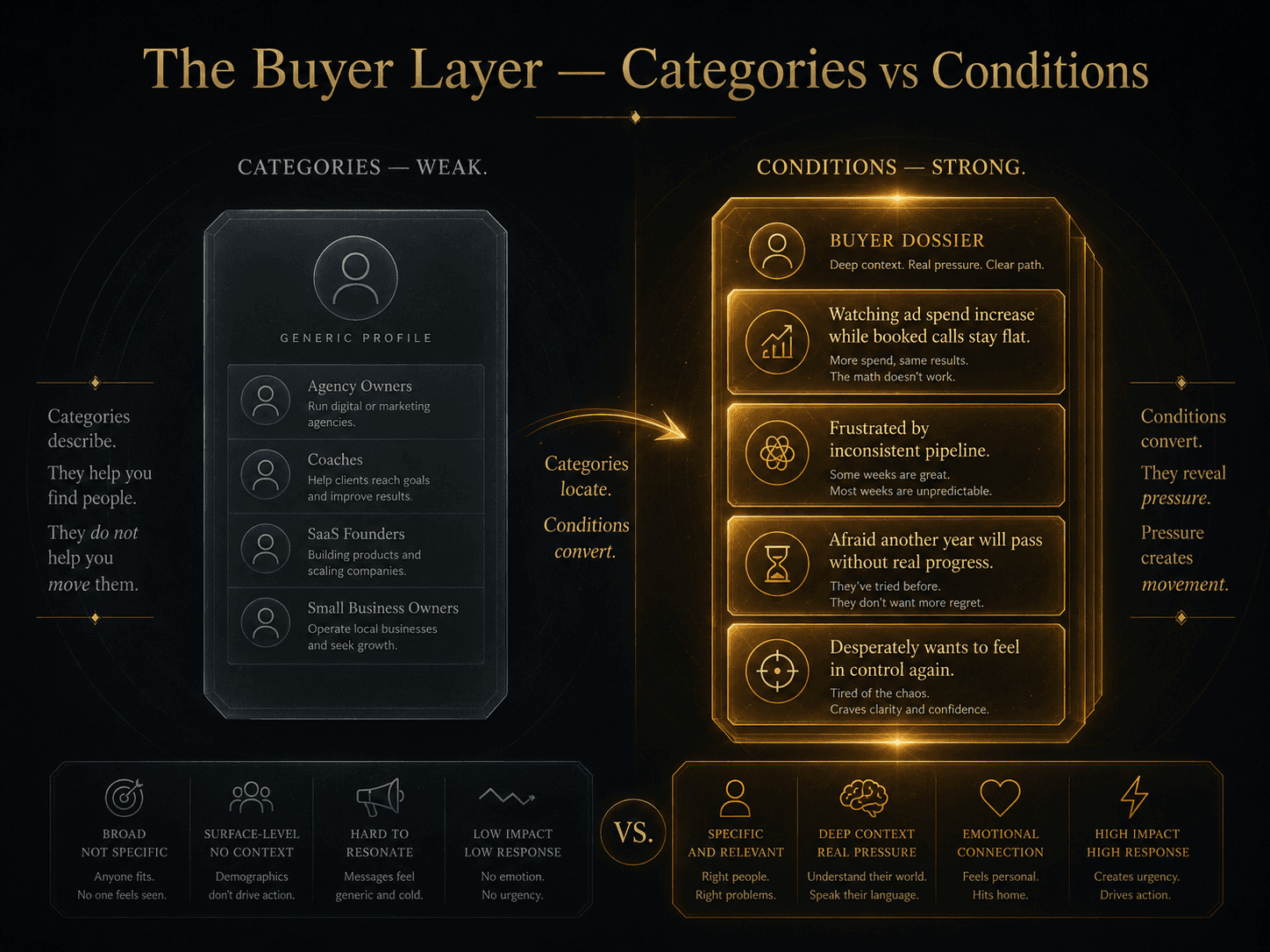
Categories Describe
Conditions Convert
Let's compare two examples.
Example One:
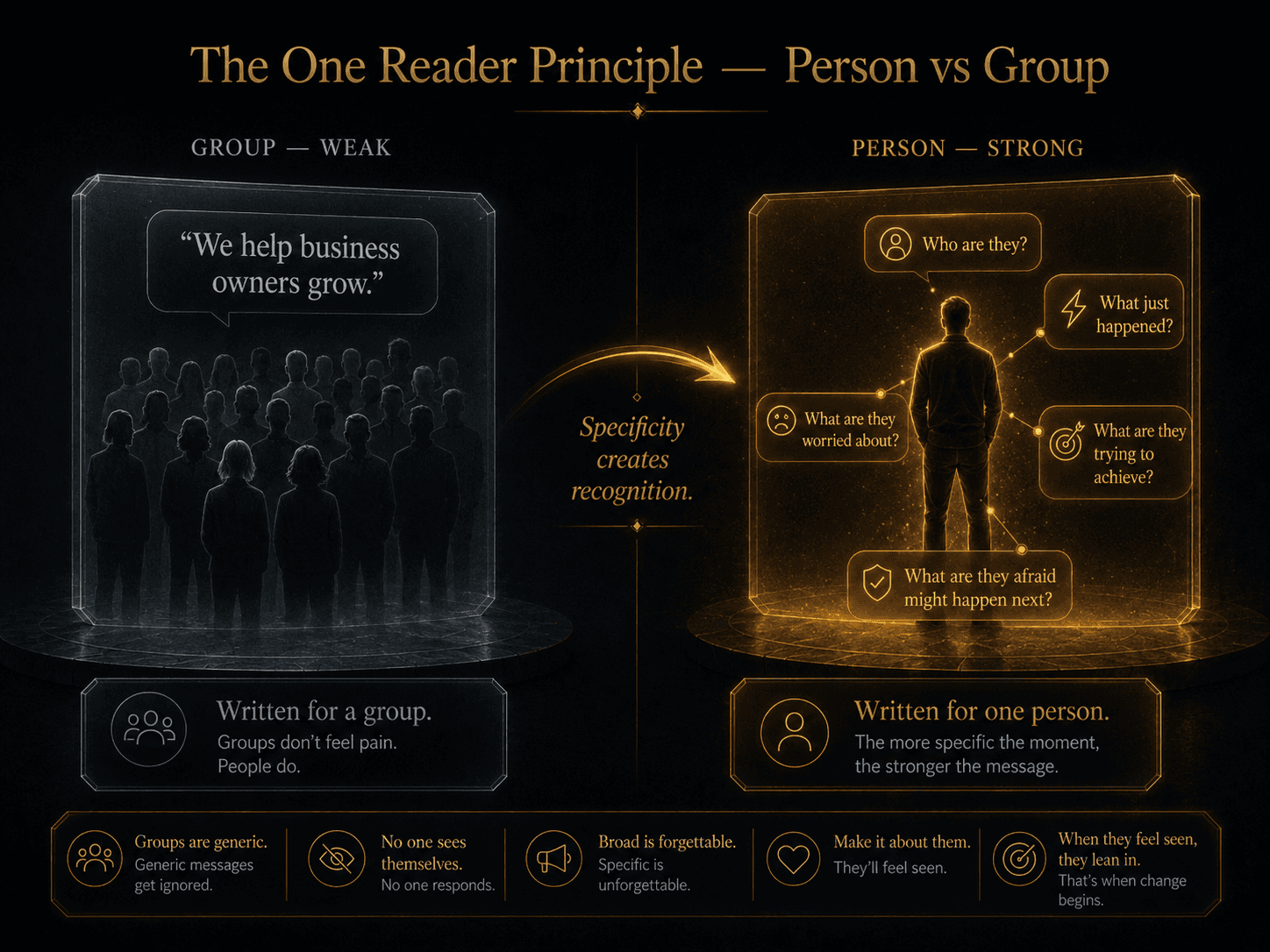
"We help agency owners grow."
Nothing technically wrong.
But nothing memorable either.
Now compare it to:
"We help agency owners who are watching ad spend increase while booked calls stay flat."
Immediately different.
Why?
Because the second example identifies a condition.
A live problem.
A current frustration.
A real moment.
The buyer doesn't think:
"That's an agency."
The buyer thinks:
"That's exactly what's happening."
Recognition begins.
And recognition changes everything.
——
The Pressure Principle™
People rarely buy because they're interested.
They buy because pressure exists.
Pressure to stop pain.
Pressure to avoid loss.
Pressure to remove frustration.
Pressure to create a better future.
Pressure to protect identity.
Pressure to regain control.
This is why understanding pressure matters more than understanding demographics.
Because pressure creates movement.
And movement creates decisions.
——
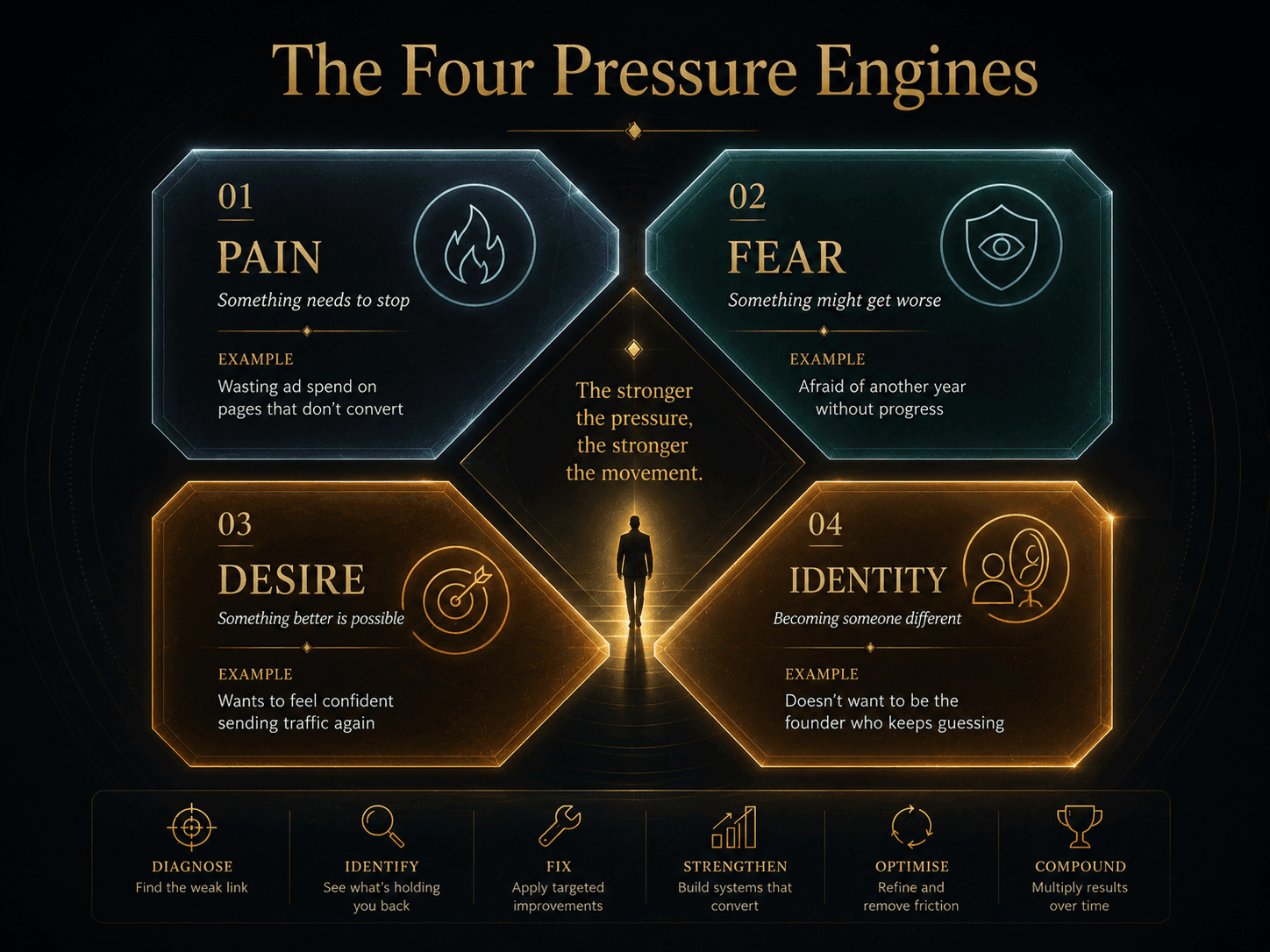
The Four Pressure Engines™
When we study buyers, we repeatedly find four forces driving behaviour.
Pain
Something needs to stop.
The buyer wants relief.
Fear
Something might get worse.
The buyer wants protection.
Desire
Something better is possible.
The buyer wants progress.
Identity
The buyer wants to become someone different.
Or avoid becoming someone they don't want to be.
Every buying decision contains some combination of these four forces.
The stronger the pressure.
The stronger the movement.
——
Why Buyer Research Usually Fails
Most businesses collect information.
Very few collect understanding.
They gather:
age
location
revenue
company size
industry
Useful?
Sometimes.
Enough?
Rarely.
Because demographics explain who the buyer is.
Pressure explains why they act.
And why always matters more than who.
——
The Black File Protocol™
Inside the Funnel Operating System™, we use a framework called The Black File Protocol™.
Its purpose is simple:
Move beyond demographics.
Understand the human.
The Black File helps uncover:
Current frustration
Hidden fear
Desired outcome
Failed attempts
Internal resistance
Objections
Trust requirements
Identity pressures
Because stronger understanding creates stronger decisions.
——
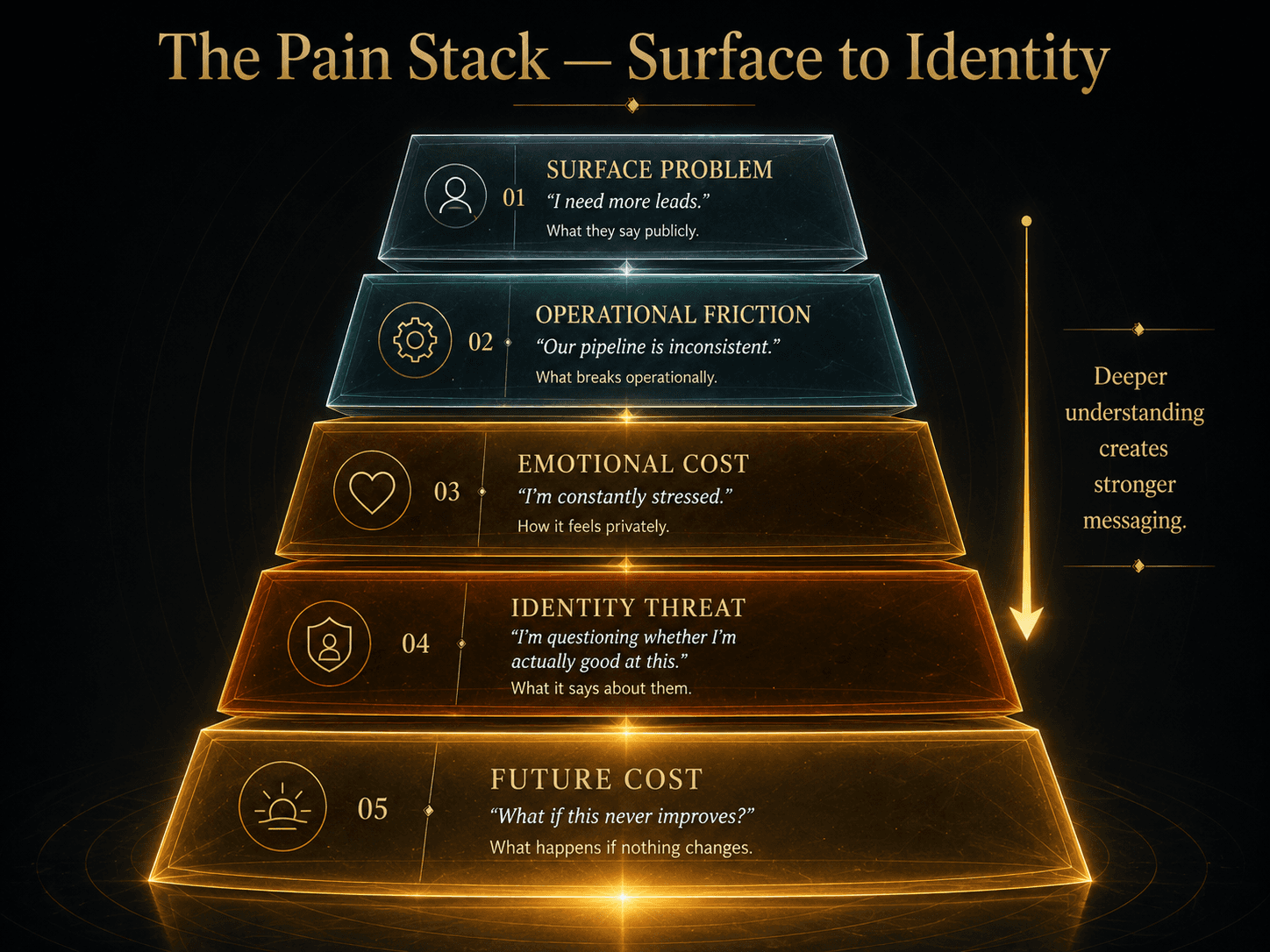
The Pain Stack™
Most founders stop research too early.
They identify:
The problem.
But not the depth.
Example:
Surface Problem:
"I need more leads."
That sounds useful.
Until you go deeper.
Operational Friction:
"Our pipeline is inconsistent."
Emotional Cost:
"I'm constantly stressed."
Identity Threat:
"I'm starting to question whether I'm actually good at this."
Future Cost:
"What if this never improves?"
Now we're getting closer.
Because deeper understanding creates stronger messaging.
——
Most Businesses Understand Markets
Few Understand Pressure
This may be the most important idea in this article.
Markets explain where buyers exist.
Pressure explains why buyers move.
The strongest businesses don't obsess over demographics.
They obsess over pressure.
Because pressure determines:
attention
relevance
desire
urgency
conversion
And without pressure, even great marketing struggles.
——
Diagnostic Observation™ #03
Most businesses understand markets.
Few understand pressure.
Pressure converts.
Quick Self-Test
Can you clearly answer:
What frustrates your buyer daily?
What have they already tried?
What are they afraid will happen next?
What outcome are they desperately hoping for?
What would success mean to them personally?
If you struggle answering these questions, your Buyer Layer may be limiting growth.
——
Common Symptoms Of A Weak Buyer Layer
Generic messaging
Weak engagement
Low resonance
Poor lead quality
Weak conversion rates
Prospects saying:
"Interesting..."
"I'll think about it."
"Not right now."
These symptoms often appear elsewhere in the business.
But they frequently originate here.
Inside the Buyer Layer.
——
Recommended Resources
Black File Protocol™
Build a complete buyer dossier.
[Download Resource]
Pain Stack Builder™
Move from surface pain to identity-level pressure.
[Download Resource]
Voice Of Customer Research Template™
Collect real buyer language.
[Download Resource]
Buyer Precision Check™
Determine whether you're speaking to a category or a condition.
[Download Resource]
Write-To-One Grid™
Turn research into conversion-focused messaging.
[Download Resource]
——
Final Thought
Most businesses try to improve copy.
The strongest businesses improve understanding.
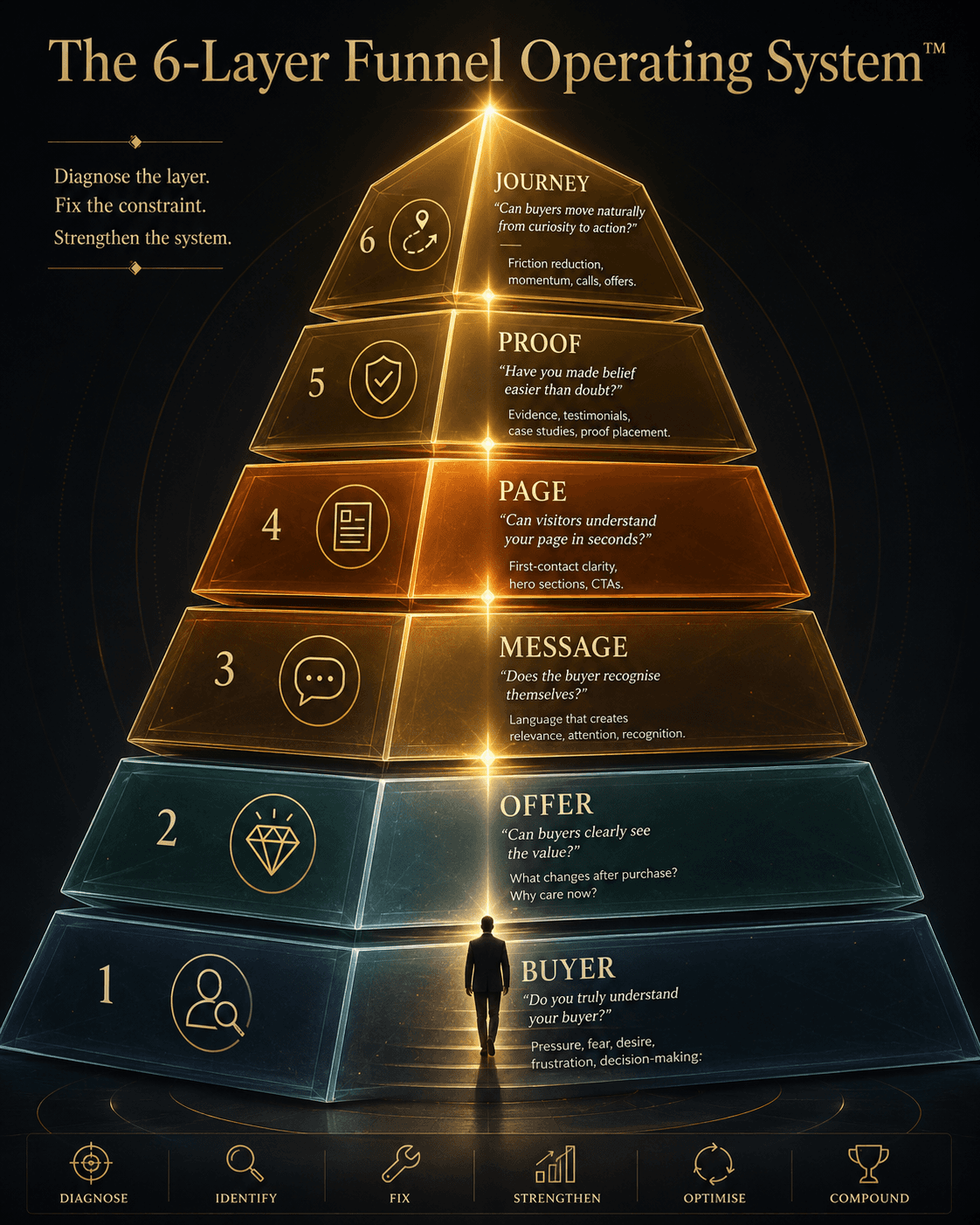
Because every funnel begins with a buyer.
Every offer serves a buyer.
Every message speaks to a buyer.
Every page exists for a buyer.
Every proof element reassures a buyer.
Every journey moves a buyer.
Which means every growth problem eventually leads back to the same question:
Do we truly understand the person we're trying to help?
Because understanding creates everything else.
And everything else starts here.
Next Layer → The Offer Layer™
Why Good Products Die Behind Weak Offers
Why Most Businesses Understand Markets But Not Buyers
Most businesses don't struggle because they lack marketing knowledge.
They struggle because they misunderstand the person they're trying to help.
At first, this sounds surprising.
After all, most founders can describe their target market.
They know the industry.
They know the niche.
They know the demographics.
They know the job titles.
They know the company size.
They know the category.
And that's exactly the problem.
Categories are not buyers.
People are.
The difference may sound small.
It isn't.
Because categories rarely buy.
People do.
And people don't buy because they belong to a demographic.
People buy because something inside their life is creating pressure.
That pressure is where growth begins.
——
The Market Trap™
Ask most businesses who they serve.
You'll hear answers like:
Agency owners
Coaches
Consultants
SaaS founders
Small business owners
E-commerce brands
These descriptions sound useful.
But they create a dangerous illusion.
Because none of those descriptions tell us:
what happened today
what frustrated them yesterday
what keeps them awake at night
what they fear might happen next
Those are the things that drive decisions.
Not labels.
Pressure.
A market helps you find people.
Pressure helps you move them.
——
Categories Describe
Conditions Convert
Let's compare two examples.
Example One:
"We help agency owners grow."
Nothing technically wrong.
But nothing memorable either.
Now compare it to:
"We help agency owners who are watching ad spend increase while booked calls stay flat."
Immediately different.
Why?
Because the second example identifies a condition.
A live problem.
A current frustration.
A real moment.
The buyer doesn't think:
"That's an agency."
The buyer thinks:
"That's exactly what's happening."
Recognition begins.
And recognition changes everything.
——
The Pressure Principle™
People rarely buy because they're interested.
They buy because pressure exists.
Pressure to stop pain.
Pressure to avoid loss.
Pressure to remove frustration.
Pressure to create a better future.
Pressure to protect identity.
Pressure to regain control.
This is why understanding pressure matters more than understanding demographics.
Because pressure creates movement.
And movement creates decisions.
——
The Four Pressure Engines™
When we study buyers, we repeatedly find four forces driving behaviour.
Pain
Something needs to stop.
The buyer wants relief.
Fear
Something might get worse.
The buyer wants protection.
Desire
Something better is possible.
The buyer wants progress.
Identity
The buyer wants to become someone different.
Or avoid becoming someone they don't want to be.
Every buying decision contains some combination of these four forces.
The stronger the pressure.
The stronger the movement.
——
Why Buyer Research Usually Fails
Most businesses collect information.
Very few collect understanding.
They gather:
age
location
revenue
company size
industry
Useful?
Sometimes.
Enough?
Rarely.
Because demographics explain who the buyer is.
Pressure explains why they act.
And why always matters more than who.
——
The Black File Protocol™
Inside the Funnel Operating System™, we use a framework called The Black File Protocol™.
Its purpose is simple:
Move beyond demographics.
Understand the human.
The Black File helps uncover:
Current frustration
Hidden fear
Desired outcome
Failed attempts
Internal resistance
Objections
Trust requirements
Identity pressures
Because stronger understanding creates stronger decisions.
——
The Pain Stack™
Most founders stop research too early.
They identify:
The problem.
But not the depth.
Example:
Surface Problem:
"I need more leads."
That sounds useful.
Until you go deeper.
Operational Friction:
"Our pipeline is inconsistent."
Emotional Cost:
"I'm constantly stressed."
Identity Threat:
"I'm starting to question whether I'm actually good at this."
Future Cost:
"What if this never improves?"
Now we're getting closer.
Because deeper understanding creates stronger messaging.
——
Most Businesses Understand Markets
Few Understand Pressure
This may be the most important idea in this article.
Markets explain where buyers exist.
Pressure explains why buyers move.
The strongest businesses don't obsess over demographics.
They obsess over pressure.
Because pressure determines:
attention
relevance
desire
urgency
conversion
And without pressure, even great marketing struggles.
——
Diagnostic Observation™ #03
Most businesses understand markets.
Few understand pressure.
Pressure converts.
Quick Self-Test
Can you clearly answer:
What frustrates your buyer daily?
What have they already tried?
What are they afraid will happen next?
What outcome are they desperately hoping for?
What would success mean to them personally?
If you struggle answering these questions, your Buyer Layer may be limiting growth.
——
Common Symptoms Of A Weak Buyer Layer
Generic messaging
Weak engagement
Low resonance
Poor lead quality
Weak conversion rates
Prospects saying:
"Interesting..."
"I'll think about it."
"Not right now."
These symptoms often appear elsewhere in the business.
But they frequently originate here.
Inside the Buyer Layer.
——
Recommended Resources
Black File Protocol™
Build a complete buyer dossier.
[Download Resource]
Pain Stack Builder™
Move from surface pain to identity-level pressure.
[Download Resource]
Voice Of Customer Research Template™
Collect real buyer language.
[Download Resource]
Buyer Precision Check™
Determine whether you're speaking to a category or a condition.
[Download Resource]
Write-To-One Grid™
Turn research into conversion-focused messaging.
[Download Resource]
——
Final Thought
Most businesses try to improve copy.
The strongest businesses improve understanding.
Because every funnel begins with a buyer.
Every offer serves a buyer.
Every message speaks to a buyer.
Every page exists for a buyer.
Every proof element reassures a buyer.
Every journey moves a buyer.
Which means every growth problem eventually leads back to the same question:
Do we truly understand the person we're trying to help?
Because understanding creates everything else.
And everything else starts here.
Next Layer → The Offer Layer™
Why Good Products Die Behind Weak Offers
![“The Black File Protocol — Buyer Dossier” Concept: A minimalist, interactive buyer dossier template. The interface shows a elegant document with the following fields: Header: “The Black File Protocol™ — Buyer Dossier” Section 1 — Current Frustration: “What hurts right now?” — [Text field] Section 2 — Hidden Fear: “What are they privately afraid might be true?” — [Text field] Section 3 — Desired Outcome: “What do they desperately want?” — [Text field] Section 4 — Failed Attempts: “What have they already tried that disappointed them?” — [Text field] Section 5 — Internal Resistance: “What objection are they hiding behind?” — [Text field] Section 6 — Identity Pressure: “Who are they trying to become?” — [Text field] Section 7 — Trust Requirements: “What proof would actually convince them?” — [Text field] Bottom: A “Generate Buyer Summary” button that compiles the answers into a single buyer profile. A “Download Dossier” button. Style: Luxury UI meets interactive dossier. Dark background, gold borders, clean typography. Feels like a serious buyer-intelligence instrument. Interaction: The user fills out each section based on their buyer research. The tool compiles the answers into a complete buyer dossier. A “Load Example” button shows a completed dossier for a sample buyer.](https://framerusercontent.com/images/Wud1fcP9YhnR4uRNXsWWDrAHWw.png?width=1448&height=1086)
Other Projects
Other Case Studies
Check our other project case studies with detailed explanations

Other Projects
Other Case Studies
Check our other project case studies with detailed explanations