Our Three Step Process
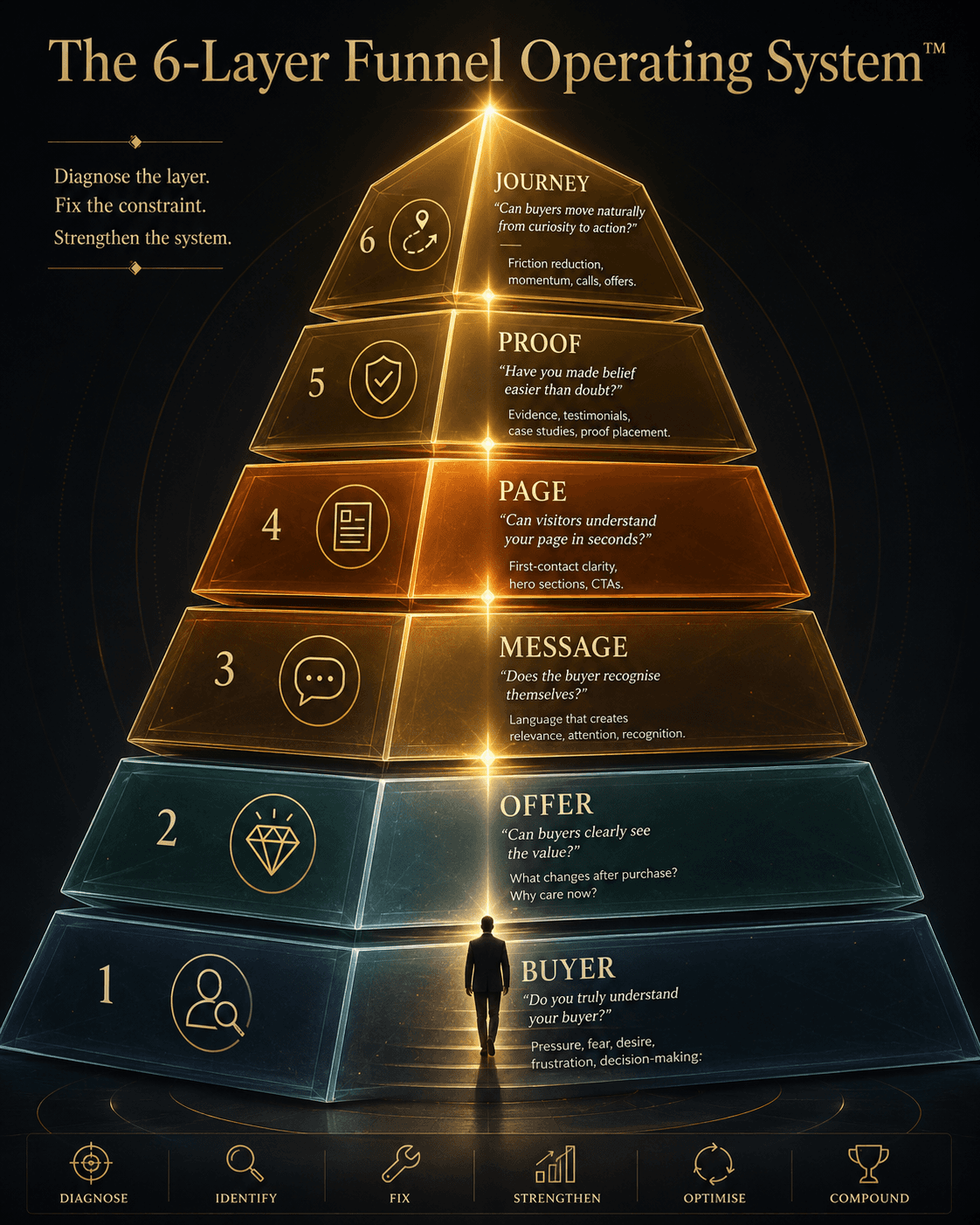
THE OFFER LAYER™ | LAYER 2

Our Three Step Process
THE OFFER LAYER™ | LAYER 2
Why Good Products Die Behind Weak Offers
Most founders think they're selling a product.
They're not.
Most consultants think they're selling a service.
They're not.
Most agencies think they're selling deliverables.
They're not.
The market never experiences your product directly.
The market experiences your offer.
And if the offer is weak, vague, forgettable, or difficult to understand, even excellent products struggle to gain traction.
This is one of the most expensive misunderstandings in business.
Because founders often spend months improving the product while the real problem remains untouched.
The value exists.
The buyer simply can't see it.
——
The Invisible Value Problem
Imagine standing in front of a beautiful landscape covered in thick fog.
The landscape hasn't disappeared.
It's still there.
You just can't see it.
Offers work the same way.
Many businesses create genuine value.
The problem is that value remains hidden.
The founder understands it.
The buyer doesn't.
This is what we call:
——
Offer Fog™
Offer Fog™ exists whenever buyers struggle to understand:
What they get
Why it matters
What changes afterward
Why they should care now
And when buyers can't clearly see value, desire never forms.
Buyers Don't Buy Products
They Buy Movement
One of the most important principles inside the Funnel Operating System™ is this:
People rarely buy the thing.
They buy what the thing makes possible.
Nobody buys:
coaching
funnels
software
consulting
audits
templates
for their own sake.
People buy:
clarity
confidence
certainty
growth
momentum
freedom
The product is simply the vehicle.
The future is the destination.
Strong offers make the destination visible.
Weak offers focus only on the vehicle.
The Future Test™
Ask yourself:
Can buyers clearly picture life after working with you?
If not, your offer may be invisible.
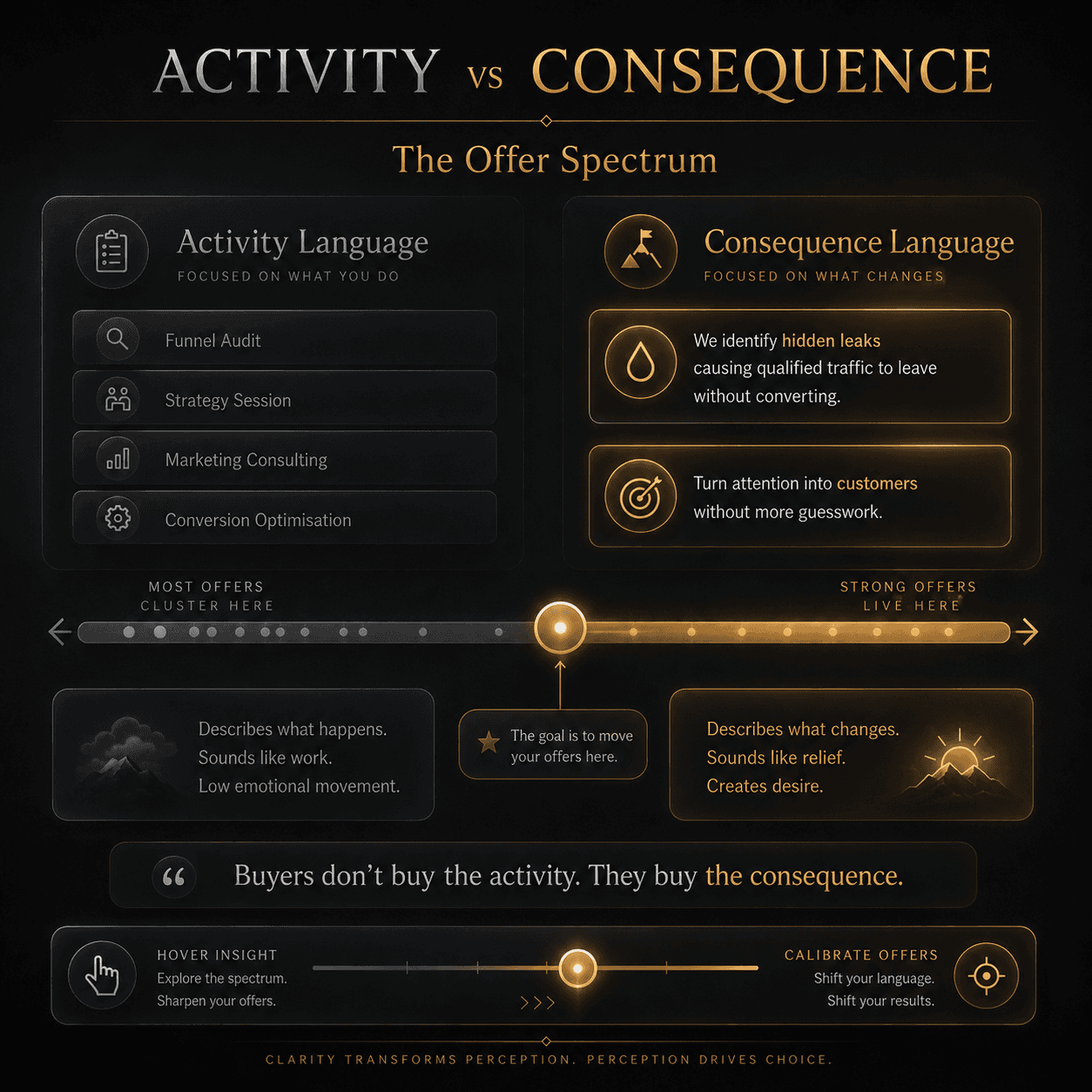
Most offers describe activity.
Examples:
Funnel Audit
Strategy Session
Marketing Consulting
Conversion Optimisation
Those describe what happens.
Not what changes.
Buyers care far more about the change.
Activity Versus Consequence
Let's compare.
Weak:
"We provide landing page audits."
Stronger:
"We identify the hidden leaks causing qualified traffic to leave without converting."
Same service.
Completely different perception.
The first describes activity.
The second describes consequence.
One sounds like work.
The other sounds like relief.
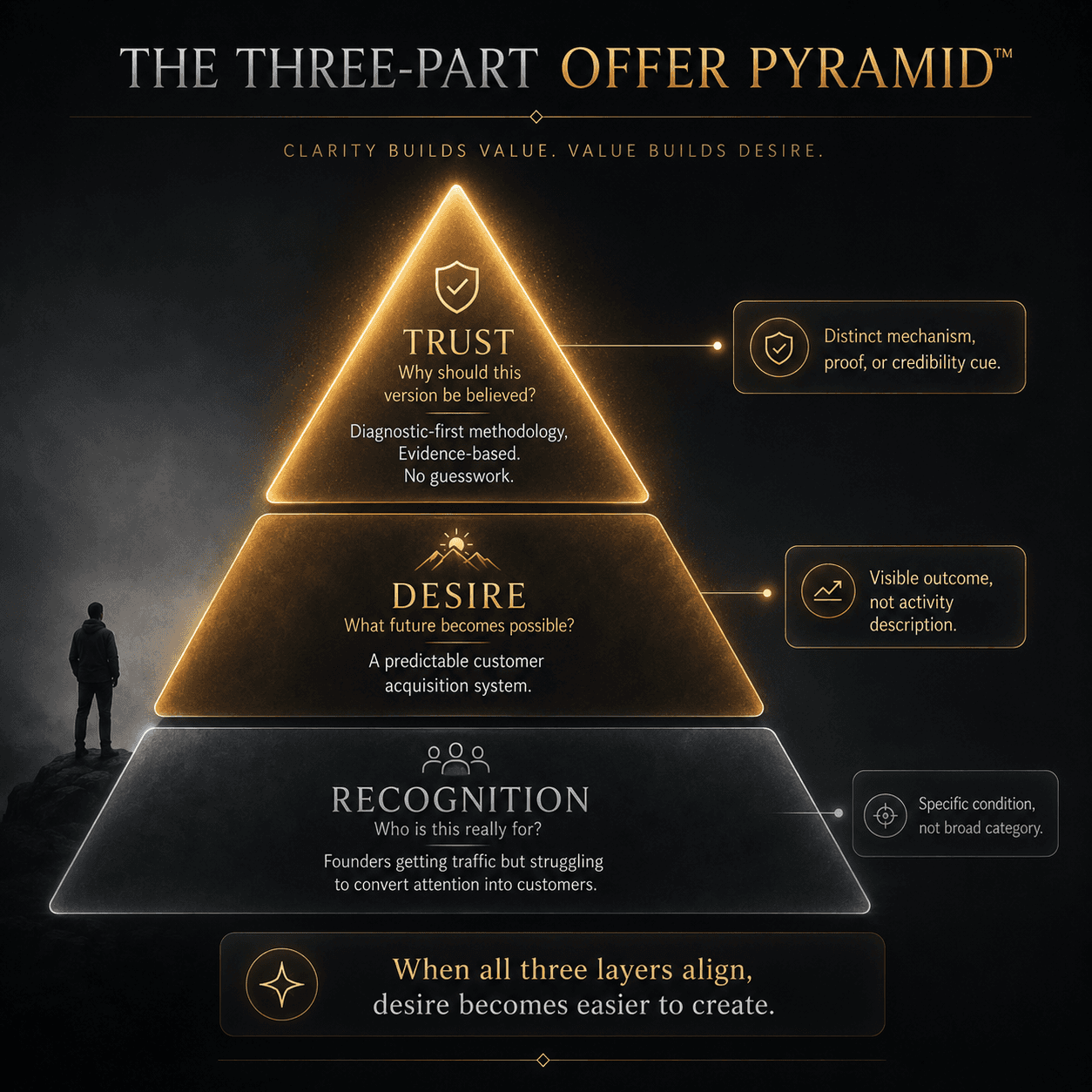
The Three-Part Offer Pyramid™
Every strong offer survives three tests.
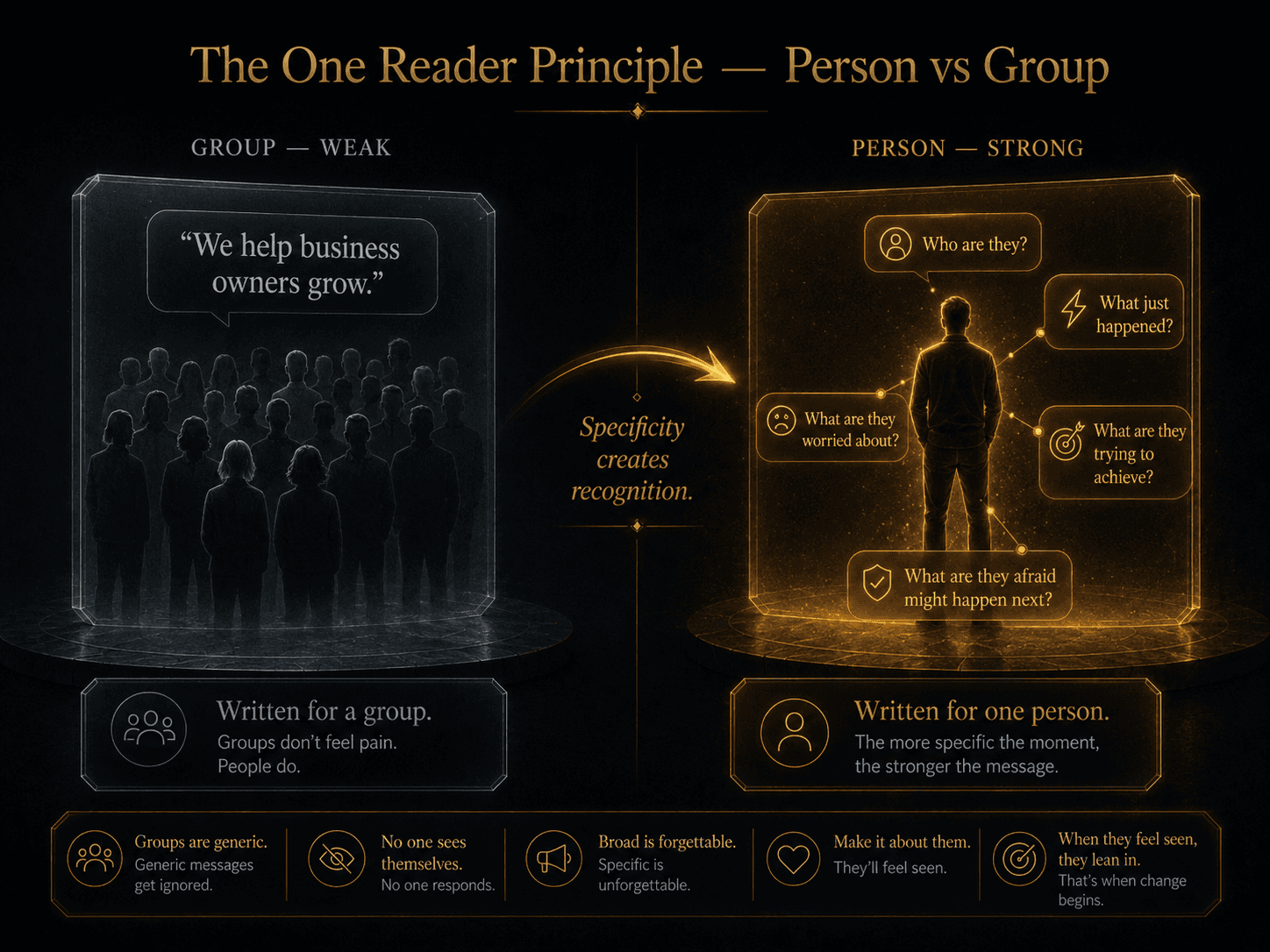
Recognition
Who is this really for?
The more specific the condition, the stronger the recognition.
Weak:
Business owners.
Strong:
Founders getting traffic but struggling to convert attention into customers.
Desire
What future becomes possible?
Weak:
Marketing strategy.
Strong:
A predictable customer acquisition system.
Trust
Why should this version be believed?
The market has heard generic promises before.
Trust comes from distinct mechanisms, evidence, and credibility.
When all three layers align, desire becomes easier to create.
The Offer Line Builder™
A useful formula:
For [WHO]
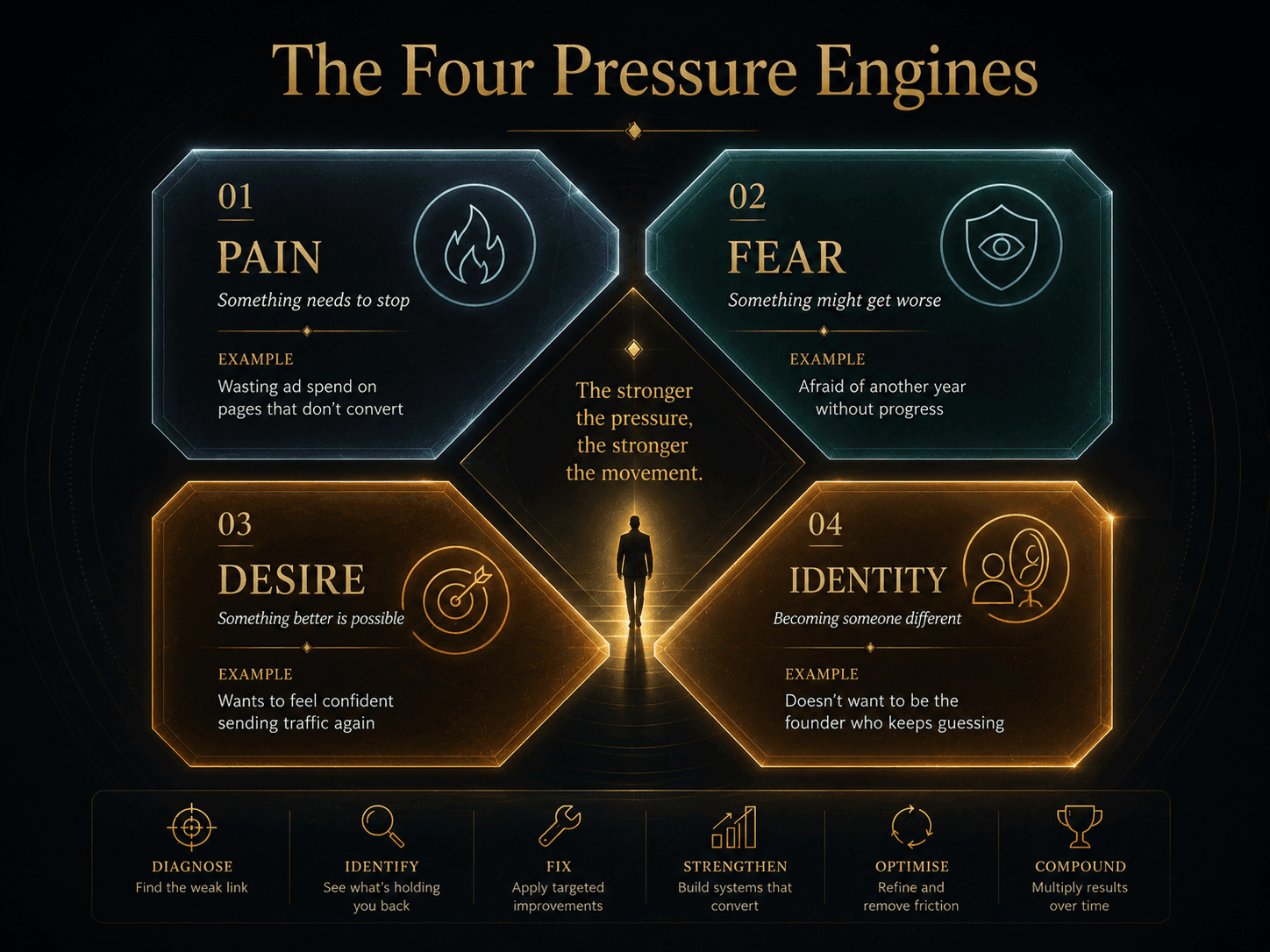
Who [CURRENT PRESSURE]
[OFFER / METHOD]
Helps them achieve [RESULT]
Through [MECHANISM]
Without [OBJECTION OR RISK]
Example:
For founders generating attention but struggling to convert it into customers,
The Funnel Operating System™ helps identify growth constraints and strengthen weak layers through a diagnostic-first methodology,
Without relying on more traffic, more tools, or more guesswork.
Notice how much clearer the outcome becomes.
Why Price Objections Often Lie
One of the biggest mistakes founders make is assuming:
"No sales means the price is too high."
Sometimes that's true.
Often it isn't.
Buyers rarely object to price when value feels obvious.
Price objections frequently signal:
weak desire
weak positioning
weak visibility
weak trust
Not necessarily expensive pricing.
Because expensive is relative.
Invisible value feels expensive.
Visible value feels justified.
Diagnostic Observation™ #04
Good products die behind weak offers every day.
Not because they're bad.
Because they're invisible.
Quick Self-Test
Can your buyer clearly answer:
What do you do?
What changes afterward?
Why does it matter?
Why should they care now?
Why is your approach different?
In under ten seconds?
If not, Offer Fog™ may be limiting growth.
Common Symptoms Of A Weak Offer Layer
Low conversion rates
Price objections
Long sales cycles
Weak urgency
Generic positioning
Buyers saying:
"Interesting..."
"Let me think about it."
"How is this different?"
These are often offer symptoms.
Not traffic symptoms.
——
Recommended Resources
Offer Fog™ Diagnostic
Identify hidden offer weaknesses.
[Download Resource]
Offer Line Builder™
Build a clear, compelling offer statement.
[Download Resource]
Offer Stress Test™
Pressure-test recognition, desire, and trust.
[Download Resource]
Offer Positioning Reframe Tool™
Turn activities into consequences.
[Download Resource]
Offer Swipe Vault™
Study high-performing offers across industries.
[Download Resource]
——
Final Thought
Most founders spend their time improving the product.
The strongest founders spend their time improving how the value is understood.
Because buyers cannot desire what they cannot see.
And they cannot buy what they do not desire.
Which means every strong funnel eventually leads back to the same question:
Can the buyer clearly see the future you're offering?
Because desire creates movement.
And movement starts here.
Next Layer → The Message Layer™
Recognition Comes Before Persuasion™
Why Good Products Die Behind Weak Offers
Most founders think they're selling a product.
They're not.
Most consultants think they're selling a service.
They're not.
Most agencies think they're selling deliverables.
They're not.
The market never experiences your product directly.
The market experiences your offer.
And if the offer is weak, vague, forgettable, or difficult to understand, even excellent products struggle to gain traction.
This is one of the most expensive misunderstandings in business.
Because founders often spend months improving the product while the real problem remains untouched.
The value exists.
The buyer simply can't see it.
——
The Invisible Value Problem
Imagine standing in front of a beautiful landscape covered in thick fog.
The landscape hasn't disappeared.
It's still there.
You just can't see it.
Offers work the same way.
Many businesses create genuine value.
The problem is that value remains hidden.
The founder understands it.
The buyer doesn't.
This is what we call:
——
Offer Fog™
Offer Fog™ exists whenever buyers struggle to understand:
What they get
Why it matters
What changes afterward
Why they should care now
And when buyers can't clearly see value, desire never forms.
Buyers Don't Buy Products
They Buy Movement
One of the most important principles inside the Funnel Operating System™ is this:
People rarely buy the thing.
They buy what the thing makes possible.
Nobody buys:
coaching
funnels
software
consulting
audits
templates
for their own sake.
People buy:
clarity
confidence
certainty
growth
momentum
freedom
The product is simply the vehicle.
The future is the destination.
Strong offers make the destination visible.
Weak offers focus only on the vehicle.
The Future Test™
Ask yourself:
Can buyers clearly picture life after working with you?
If not, your offer may be invisible.
Most offers describe activity.
Examples:
Funnel Audit
Strategy Session
Marketing Consulting
Conversion Optimisation
Those describe what happens.
Not what changes.
Buyers care far more about the change.
Activity Versus Consequence
Let's compare.
Weak:
"We provide landing page audits."
Stronger:
"We identify the hidden leaks causing qualified traffic to leave without converting."
Same service.
Completely different perception.
The first describes activity.
The second describes consequence.
One sounds like work.
The other sounds like relief.
The Three-Part Offer Pyramid™
Every strong offer survives three tests.
Recognition
Who is this really for?
The more specific the condition, the stronger the recognition.
Weak:
Business owners.
Strong:
Founders getting traffic but struggling to convert attention into customers.
Desire
What future becomes possible?
Weak:
Marketing strategy.
Strong:
A predictable customer acquisition system.
Trust
Why should this version be believed?
The market has heard generic promises before.
Trust comes from distinct mechanisms, evidence, and credibility.
When all three layers align, desire becomes easier to create.
The Offer Line Builder™
A useful formula:
For [WHO]
Who [CURRENT PRESSURE]
[OFFER / METHOD]
Helps them achieve [RESULT]
Through [MECHANISM]
Without [OBJECTION OR RISK]
Example:
For founders generating attention but struggling to convert it into customers,
The Funnel Operating System™ helps identify growth constraints and strengthen weak layers through a diagnostic-first methodology,
Without relying on more traffic, more tools, or more guesswork.
Notice how much clearer the outcome becomes.
Why Price Objections Often Lie
One of the biggest mistakes founders make is assuming:
"No sales means the price is too high."
Sometimes that's true.
Often it isn't.
Buyers rarely object to price when value feels obvious.
Price objections frequently signal:
weak desire
weak positioning
weak visibility
weak trust
Not necessarily expensive pricing.
Because expensive is relative.
Invisible value feels expensive.
Visible value feels justified.
Diagnostic Observation™ #04
Good products die behind weak offers every day.
Not because they're bad.
Because they're invisible.
Quick Self-Test
Can your buyer clearly answer:
What do you do?
What changes afterward?
Why does it matter?
Why should they care now?
Why is your approach different?
In under ten seconds?
If not, Offer Fog™ may be limiting growth.
Common Symptoms Of A Weak Offer Layer
Low conversion rates
Price objections
Long sales cycles
Weak urgency
Generic positioning
Buyers saying:
"Interesting..."
"Let me think about it."
"How is this different?"
These are often offer symptoms.
Not traffic symptoms.
——
Recommended Resources
Offer Fog™ Diagnostic
Identify hidden offer weaknesses.
[Download Resource]
Offer Line Builder™
Build a clear, compelling offer statement.
[Download Resource]
Offer Stress Test™
Pressure-test recognition, desire, and trust.
[Download Resource]
Offer Positioning Reframe Tool™
Turn activities into consequences.
[Download Resource]
Offer Swipe Vault™
Study high-performing offers across industries.
[Download Resource]
——
Final Thought
Most founders spend their time improving the product.
The strongest founders spend their time improving how the value is understood.
Because buyers cannot desire what they cannot see.
And they cannot buy what they do not desire.
Which means every strong funnel eventually leads back to the same question:
Can the buyer clearly see the future you're offering?
Because desire creates movement.
And movement starts here.
Next Layer → The Message Layer™
Recognition Comes Before Persuasion™
![“The Offer Line Builder™ — Interactive Tool” Concept: A minimalist, interactive offer builder. The interface shows a formula with fillable fields: The Formula: “For [WHO] who [CURRENT PRESSURE], [OFFER/METHOD] helps them achieve [RESULT] through [MECHANISM] without [OBJECTION OR RISK].” Fillable fields: WHO: [Text field] — Example: “founders generating attention but struggling to convert it into customers” CURRENT PRESSURE: [Text field] — Example: “watching ad spend increase while booked calls stay flat” OFFER/METHOD: [Text field] — Example: “The Funnel Operating System™” RESULT: [Text field] — Example: “identify growth constraints and strengthen weak layers” MECHANISM: [Text field] — Example: “a diagnostic-first methodology” OBJECTION OR RISK: [Text field] — Example: “more traffic, more tools, or more guesswork” Below the fields: A live preview of the complete offer line, updating as the user types. A “Copy Offer Line” button and a “Save to Swipe File” button. Style: Luxury UI meets interactive builder. Dark background, gold input fields, clean typography. Feels like a serious offer-engineering instrument. Interaction: The user fills out each field. The offer line preview updates in real-time. Clicking “Copy Offer Line” copies the result. A “Load Example” button populates the fields with a sample offer.](https://framerusercontent.com/images/8tlnWwHQ5AmcR84RKm7cxMxlCco.png?width=1254&height=1254)
Other Projects
Other Case Studies
Check our other project case studies with detailed explanations
Other Projects
Other Case Studies
Check our other project case studies with detailed explanations