Our Three Step Process
May 25, 2026
Chap 2 | Resource 3 | The Voice-of-Customer Extraction System™
Our Three Step Process
May 25, 2026
Chap 2 | Resource 3 | The Voice-of-Customer Extraction System™
The Voice-of-Customer Extraction System™ A practical buyer-language research worksheet for finding real customer phrases, decoding emotional patterns, and translating raw buyer language into high-conversion headlines, hooks, CTAs, proof, and objection handling.
Prefer Audio Or Video?
The Voice-of-Customer Extraction System™ is also available as:
🎧 A guided audio walkthrough explaining emotional language extraction, buyer phrasing, and messaging realism
🎥 A practical video breakdown with live research examples, pattern analysis, and messaging translation demonstrationsChoose the format that fits how you learn best.
[Listen To The Audio Walkthrough] (coming soon)
[Watch The Video Breakdown] (coming soon)
——
Why Most Marketing Language Feels Artificial
Most marketing copy sounds like marketing.
That is the problem.
It sounds:
over-polished
emotionally sanitised
strategically correct
painfully generic
too clean to feel real
too abstract to create recognition
The buyer reads it and instantly feels distance.
Not recognition.
This happens because most marketers invent language instead of discovering it.
They sit in empty documents trying to “sound persuasive.”
Meanwhile, the market has already revealed:
the pain
the frustration
the objections
the emotional tension
the hidden fear
the failed attempts
the exact wording buyers naturally use
They simply were not listening carefully enough.
That is what The Voice-of-Customer Extraction System™ is designed to solve.
It helps you stop inventing polished marketing language from inside your own head and start extracting real buyer language from the market.
Because the strongest copy often does not sound like marketing.
It sounds like the buyer finally seeing their own situation written clearly.
——
What This Resource Helps You Do
The Voice-of-Customer Extraction System™ helps you find, sort, decode, and translate real buyer language into stronger conversion copy.
Use it to:
collect raw buyer phrases
identify repeated emotional patterns
extract frustration language
find resistance and objection language
uncover identity tension
capture desire language
identify future-fear language
turn raw phrases into headlines
build stronger hooks
improve CTA language
strengthen proof sections
make page copy sound more human
avoid artificial, over-polished messaging
This is not about copying buyer language blindly.
It is about finding emotional truth, preserving the pressure, and translating it into copy that feels clear, sharp, and commercially useful.
The goal is not to sound messy.
The goal is to sound real.
——
The Market Is Already Writing The Copy™
This is one of the most important principles in modern conversion psychology:
Buyers constantly reveal emotional truth accidentally.
Especially when they:
complain
vent
explain frustration
leave reviews
describe failed attempts
ask questions
compare options
express doubt
justify hesitation
explain why something disappointed them
And they usually reveal it in language that feels more believable, more emotional, and more human than most marketing copy ever does.
That matters enormously.
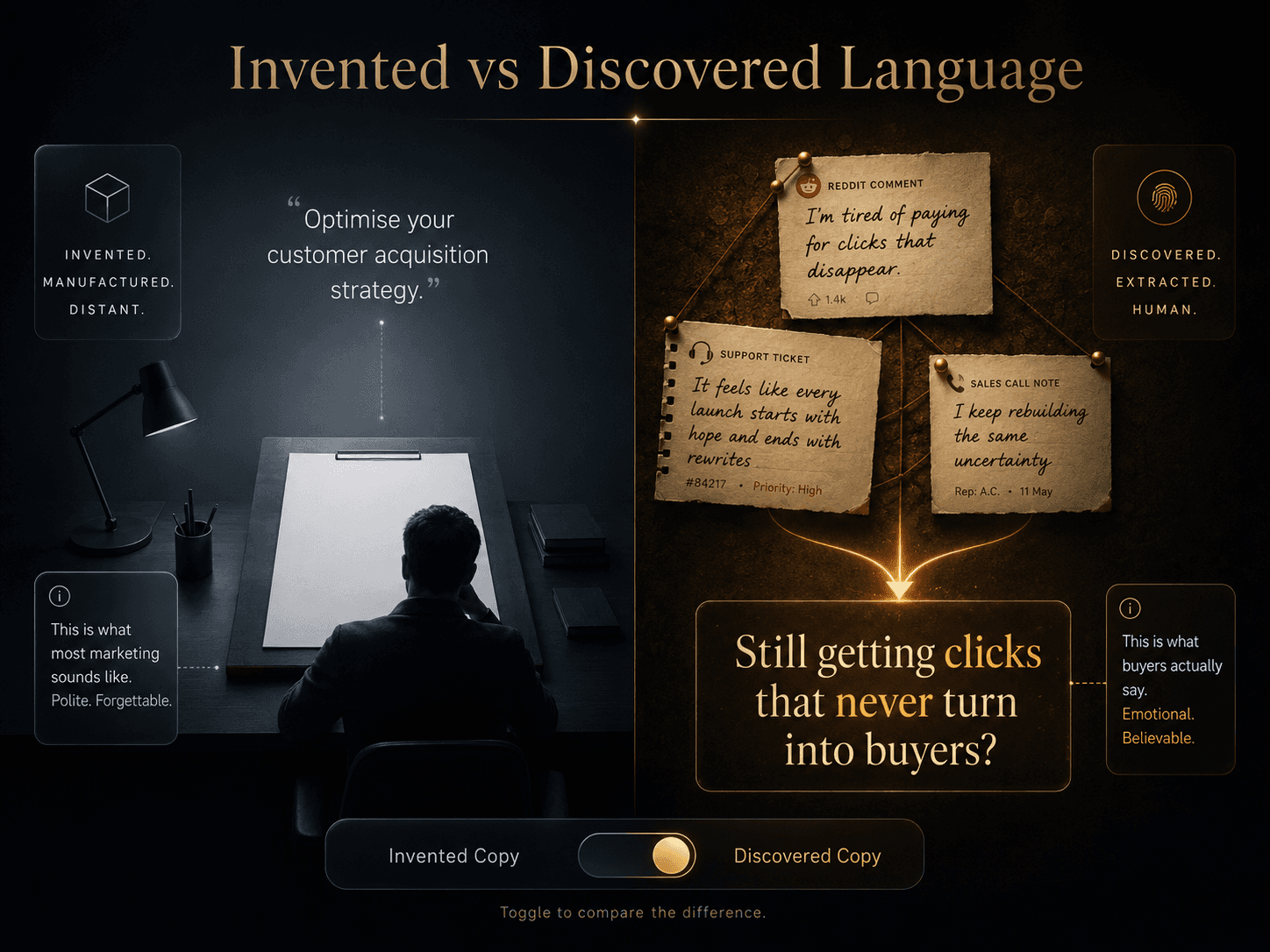
Because buyers trust language that sounds discovered more than language that sounds manufactured.
——
Invented Marketing Language™
Weak example:
“Optimise your customer acquisition strategy.”
Technically correct.
Emotionally dead.
It sounds like a company talking about a business topic.
Not like a buyer describing a real problem.
——
Real Buyer Language™
Stronger example:
“I’m tired of paying for clicks that disappear without turning into buyers.”
Now the message feels:
lived-in
emotionally grounded
recognisable
believable
specific
closer to the buyer’s reality
That creates trust faster.
Not because the sentence is more dramatic.
Because it feels more true.
——
The Emotional Language Principle™
Emotionally loaded phrasing creates:
recognition
believability
continuation
emotional pull
stronger buyer contact
Why?
Because it sounds human.
Real buyers rarely speak like polished brand guidelines.
They say things like:
“I’m tired of…”
“It feels like…”
“I keep…”
“Every time I…”
“I thought this would…”
“I’m worried that…”
“I don’t want to keep…”
“I should be further along by now…”
Those phrases contain pressure.
And pressure creates movement.
——
Low-Emotion Language™
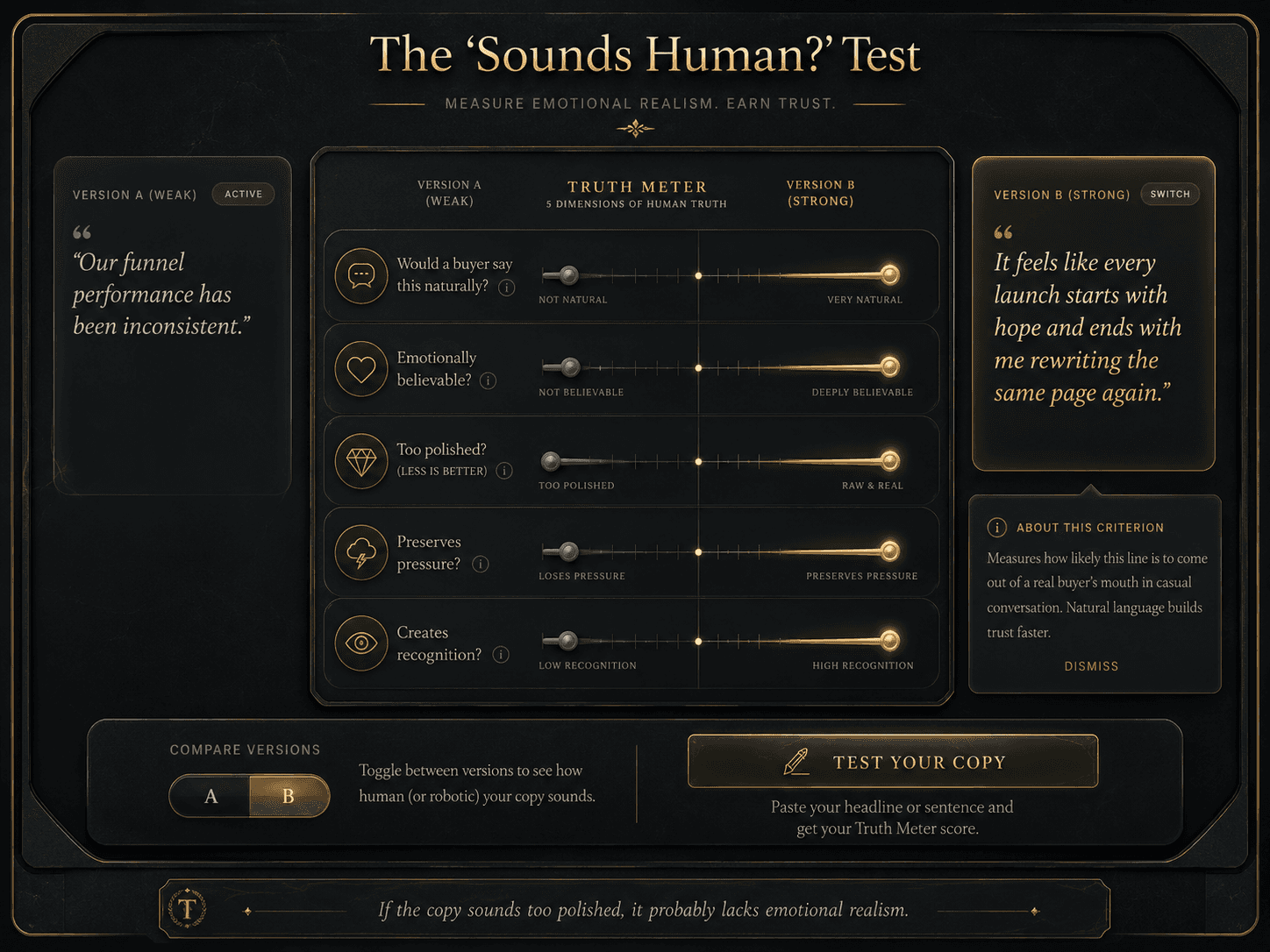
“Our funnel performance has been inconsistent.”
Professional.
Clear.
But emotionally weak.
High-Emotion Language™
“It feels like every launch starts with hope and ends with me rewriting the same page again.”
Now the message feels real.
It carries:
frustration
repetition
disappointment
emotional fatigue
a lived pattern
That emotional realism matters massively.
The Core Rule
Preserve the emotional shape of the buyer’s phrase before polishing it.
You can clean the grammar.
You can sharpen the delivery.
You can make it more concise.
But do not remove the pressure.
If you remove the pressure, you remove the recognition.
Where The Best Buyer Language Actually Lives™
Great voice-of-customer data usually comes from emotionally unfiltered environments.
That is important.
People reveal deeper truth when they are:
frustrated
disappointed
confused
comparing options
emotionally reactive
trying to explain what went wrong
asking for help
warning others
reviewing what failed
You are not merely collecting words.
You are collecting pressure signals.
Useful VOC Sources
Use sources such as:
Reddit threads
YouTube comments
Amazon reviews
support tickets
onboarding forms
sales calls
Facebook groups
Discord communities
competitor reviews
one-star reviews
DMs
email replies
survey responses
testimonials
discovery calls
intake forms
sales objections
customer interviews
Each source gives you a different kind of signal.
——
What Each Source Is Useful For
Reddit Threads
Best for:
raw frustration
emotional honesty
scepticism
failed attempts
private fears
unfiltered objections
Reddit is useful because people often speak more bluntly when they are not trying to impress anyone.
YouTube Comments
Best for:
immediate reactions
questions
misunderstandings
emotional resonance
objections
“this is exactly me” comments
YouTube comments often reveal what people are trying to understand or what they feel seen by.
Amazon Reviews
Best for:
expectation gaps
desire language
disappointment
before/after contrast
emotional benefits
unmet promises
Look especially at three-star and one-star reviews.
They often show what buyers wanted but did not receive.
Support Tickets
Best for:
recurring friction
confusion points
repeated complaints
product/service gaps
exact wording around difficulty
Support tickets reveal where reality does not match expectation.
Sales Calls
Best for:
objections
hesitation
buying triggers
emotional urgency
proof needs
decision criteria
Sales calls show what buyers need to believe before they move.
DMs And Email Replies
Best for:
private language
emotional honesty
hesitation
urgency
buyer questions
context behind the problem
Private replies often reveal softer, more honest language than public comments.
Competitor Reviews
Best for:
market gaps
unmet needs
distrust triggers
buyer expectations
language around disappointment
Competitor reviews help you see what the market is tired of.
One-Star Reviews
Best for:
anger
failed expectations
broken promises
resistance language
trust collapse
language around disappointment
One-star reviews can be emotionally intense, so use them carefully.
Do not copy anger blindly.
Extract the pattern underneath it.
——
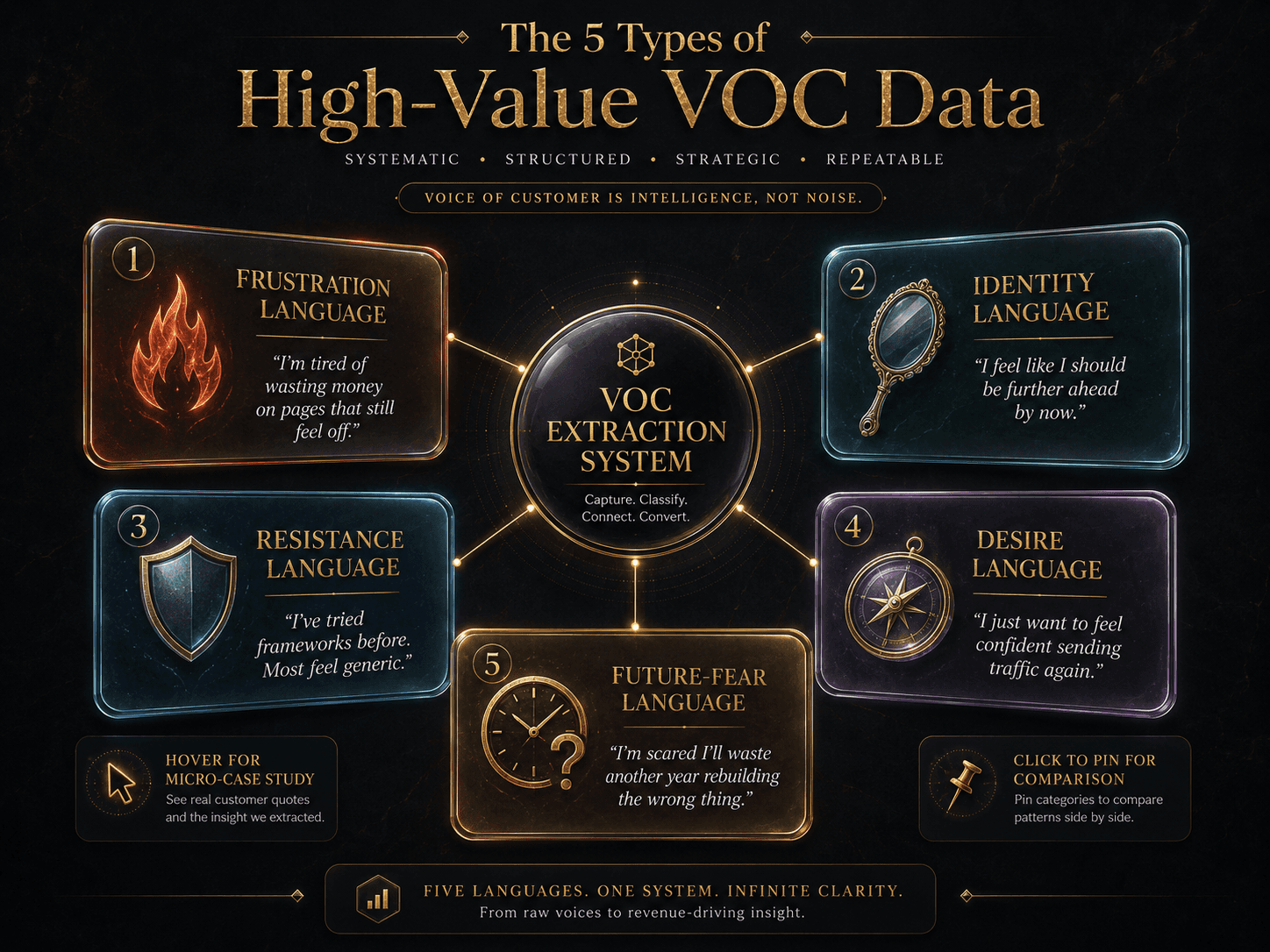
The 5 Types Of High-Value VOC Data™
Not all buyer language carries equal strategic value.
Some phrases are interesting but useless.
Others can become headlines, hooks, CTAs, proof cues, or objection-handling sections almost immediately.
These five categories are especially powerful.
—
1. Frustration Language™
What It Reveals
Frustration language reveals live pressure.
It shows what the buyer is tired of tolerating.
Phrases To Look For
Look for phrases like:
“I’m tired of…”
“Nothing seems to…”
“Every time I try…”
“I keep wasting…”
“I’m sick of…”
“I don’t understand why…”
“I keep fixing this but…”
Examples
“I’m tired of rewriting the same page every month.”
“I keep paying for clicks that do not turn into buyers.”
“Every launch feels like starting from scratch again.”
“Nothing seems to make the page feel clear enough.”
Why This Matters
Frustration language creates immediate emotional relevance.
It tells you what the hook should interrupt.
Fill This In
Frustration phrase I found:
What the buyer is tired of:
The repeated pattern behind the frustration:
Possible hook from this phrase:
—
2. Identity Language™
What It Reveals
Identity language reveals self-image tension.
This is where the buyer’s problem starts affecting how they see themselves.
Phrases To Look For
Look for phrases like:
“I should be further ahead by now.”
“I’m embarrassed this still isn’t clear.”
“I feel like I’m guessing.”
“Maybe I’m just not good at this.”
“I thought I would have figured this out by now.”
“It makes me feel behind.”
“I don’t feel confident sending people there.”
Examples
“I feel like I should know how to explain this by now.”
“It is embarrassing how many times I have changed the headline.”
“The page looks fine, but I still do not trust it.”
“I feel like I am guessing every time I rewrite it.”
Why This Matters
Identity language creates deep psychological recognition.
It helps the copy speak to what the problem seems to mean about the buyer.
Use this carefully.
One accurate identity line can be powerful.
Too much can feel heavy-handed.
Fill This In
Identity phrase I found:
What this problem seems to say about the buyer:
The identity tension underneath it:
Possible deeper resonance line:
—
3. Resistance Language™
What It Reveals
Resistance language reveals distrust and scepticism.
It shows what the buyer no longer wants to hear.
Phrases To Look For
Look for phrases like:
“I’ve tried frameworks before.”
“Most advice feels generic.”
“I don’t want another template.”
“This sounds like every other promise.”
“I’m sceptical because…”
“I do not trust…”
“I have already tried…”
Examples
“I do not want another plug-and-play funnel template.”
“Most advice sounds good but does not fix the actual problem.”
“I have tried rewriting headlines, but it never changes much.”
“I am tired of people saying ‘just improve your messaging’ without showing what that means.”
Why This Matters
Resistance language helps you avoid triggering distrust accidentally.
It also tells you what the page must handle before the buyer can believe.
Fill This In
Resistance phrase I found:
What the buyer no longer trusts:
What the page must avoid sounding like:
Possible objection-handling line:
—
4. Desire Language™
What It Reveals
Desire language reveals the emotionally meaningful outcome.
Not just what the buyer wants in practical terms.
What they want to feel, regain, become, or stop worrying about.
Phrases To Look For
Look for phrases like:
“I just want to…”
“I wish I could…”
“I want to finally…”
“I would love to feel…”
“I want buyers to…”
“I want to stop…”
“I want to know that…”
Examples
“I just want to feel confident sending traffic again.”
“I want the page to finally sound like the value is real.”
“I want buyers to instantly get it.”
“I want to stop second-guessing every sentence.”
“I want to know the message is strong enough before I spend more.”
Why This Matters
Good desire language feels specific, human, and emotionally grounded.
It helps create better CTAs, outcome sections, and offer framing.
Fill This In
Desire phrase I found:
The practical outcome they want:
The emotional relief they want:
Possible CTA from this phrase:
—
5. Future-Fear Language™
What It Reveals
Future-fear language reveals anticipated consequence.
It shows what the buyer worries will continue if nothing changes.
Phrases To Look For
Look for phrases like:
“I’m scared I’ll…”
“I don’t want to keep…”
“I’m worried this will…”
“If this keeps happening…”
“I do not want another year of…”
“I’m afraid I’ll waste…”
“What if this never…”
Examples
“I’m scared I’ll waste another year rebuilding the wrong thing.”
“I do not want to keep guessing forever.”
“I’m worried the problem is deeper than the page itself.”
“If this keeps happening, I’ll keep spending money without knowing what is broken.”
Why This Matters
Future-fear language creates urgency, attention, and emotional openness.
It helps you write cost-of-inaction copy without fake scarcity.
Fill This In
Future-fear phrase I found:
The future they are afraid of:
The pattern they do not want to repeat:
Possible urgency line:
——
The VOC Capture Worksheet™
Use this section when collecting raw buyer language.
Do not edit the phrases yet.
Capture them exactly first.
Source
Where did this phrase come from?
Examples:
Reddit, YouTube comment, review, DM, sales call, support ticket, survey, intake form, competitor review.
Source:
Exact Phrase
Copy the phrase exactly.
Do not polish it yet.
Exact phrase:
Context
What was the buyer talking about?
Context:
VOC Category
Which category does this phrase belong to?
Choose one:
Frustration Language™
Identity Language™
Resistance Language™
Desire Language™
Future-Fear Language™
Other
Category:
Emotion Behind The Phrase
What emotion is underneath it?
Examples:
Frustration, anxiety, embarrassment, doubt, resentment, hope, desire, fear, exhaustion, distrust.
Emotion:
What This Reveals
What does this phrase show about the buyer?
It reveals:
Copy Potential
Could this phrase become:
a headline?
a hook?
a bullet?
a CTA?
proof framing?
objection handling?
offer positioning?
Copy potential:
—-
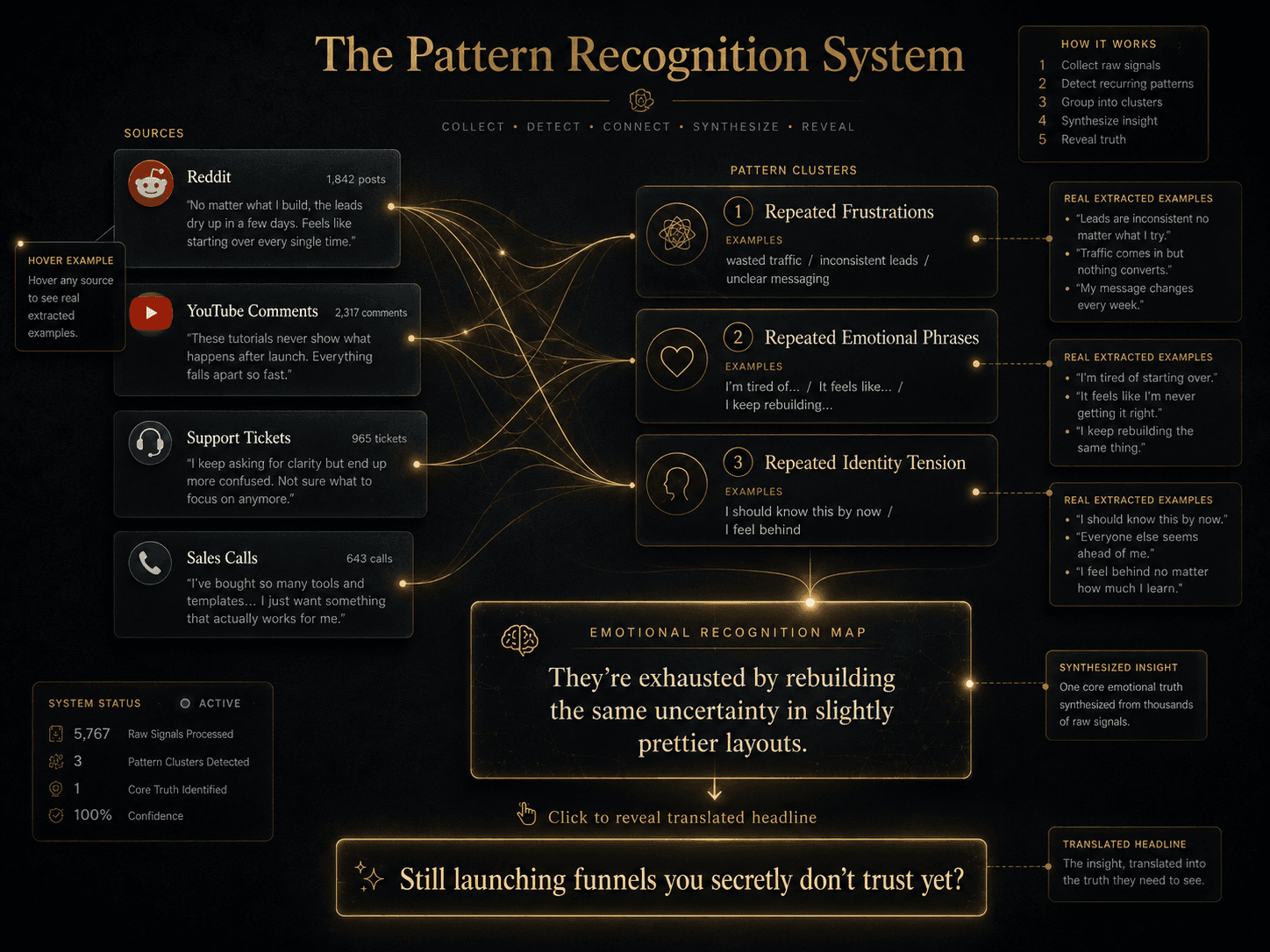
The Pattern Recognition System™
Elite copywriters are not merely writers.
They are pattern detectors.
This is critical.
One emotional phrase may be interesting.
Repeated emotional phrases indicate psychological significance.
The job is not to collect random quotes.
The job is to find repeated pressure.
Look For Repeated Frustrations™
Ask:
What keeps appearing repeatedly?
Examples:
wasted traffic
inconsistent leads
unclear messaging
distrust of funnels
emotional fatigue
weak conversion
repeated hesitation
underperforming launches
Repeated pain reveals core pressure.
Look For Repeated Emotional Phrases™
Ask:
What words keep showing up?
Examples:
“I’m tired of…”
“It feels like…”
“I keep rebuilding…”
“I don’t know why…”
“I thought this would…”
“I’m worried that…”
Repeated emotional language reveals recognition triggers.
Look For Repeated Failed Attempts™
Ask:
What have they already tried?
Examples:
redesigning repeatedly
changing templates constantly
trying “proven frameworks”
rewriting headlines endlessly
buying more traffic
copying competitors
simplifying the message but making it weaker
Failed-attempt loops reveal scepticism and emotional exhaustion.
Look For Repeated Identity Tension™
Ask:
What does the problem seem to say about them?
Examples:
“I should know this by now.”
“I feel behind.”
“I’m second-guessing everything.”
“I feel like I’m guessing.”
“I’m embarrassed this still isn’t clear.”
Identity tension often creates the deepest emotional leverage.
——
The Phrase Strength Scorecard™
Not every phrase deserves to become copy.
Use this scorecard to identify the strongest buyer language.
Score each phrase from 1 to 5.
1 = weak
2 = slightly useful
3 = usable
4 = strong
5 = highly valuable
Phrase To Score
Exact phrase:
Emotional Intensity
Does the phrase carry emotional charge?
Score: ___ / 5
Specificity
Does the phrase describe a specific situation, pain, objection, or desire?
Score: ___ / 5
Repetition
Have you seen this idea or phrase repeated across multiple sources?
Score: ___ / 5
Buyer Relevance
Does this phrase clearly relate to the buyer you want to reach?
Score: ___ / 5
Copy Potential
Could this phrase become a hook, headline, CTA, bullet, proof cue, or objection-handling line?
Score: ___ / 5
Total Phrase Score
Total: ___ / 25
——
What The Score Means
21–25: High-Value VOC
This phrase is highly useful.
It may be strong enough to shape headline, hook, CTA, or proof language.
16–20: Strong Signal
This phrase is useful.
It may need sharpening, but it carries real messaging value.
10–15: Usable But Not Strong
This phrase may support the research, but it is probably not the main copy angle.
0–9: Weak Signal
This phrase is either too generic, too vague, or not relevant enough.
Do not build your messaging around it.
—-
Weak Copy vs VOC-Based Copy™
Use these examples to see how real buyer language creates stronger messaging.
Example 1: Funnel Conversion
Weak copy:
“Improve your landing page conversions.”
Technically clear.
Emotionally interchangeable.
VOC-based version:
“Still getting clicks but quietly hesitating every time you look at the page?”
Now the buyer feels:
recognition
emotional realism
familiarity
pressure
Because the language feels closer to lived experience.
Example 2: Messaging
Weak copy:
“Scale your business with better messaging.”
VOC-based version:
“Tired of rewriting the same headline every month and still feeling unsure whether the page actually lands?”
The second version sounds human.
That matters enormously.
Example 3: SaaS Activation
Weak copy:
“Improve user onboarding and increase activation.”
VOC-based version:
“Users are signing up, clicking around once, and disappearing before they ever feel the product’s value.”
The second version shows the actual moment where the problem happens.
Example 4: Ecommerce Conversion
Weak copy:
“Boost product page performance.”
VOC-based version:
“Your ads are getting the clicks, but the product page still is not creating enough trust to carry the sale.”
The second version shows the commercial pressure behind the problem.
Example 5: Coaching Or Consulting
Weak copy:
“Get more clients with stronger positioning.”
VOC-based version:
“Your content gets attention, but when buyers reach the page, they still cannot feel why you are the obvious choice.”
The second version creates a more specific recognition moment.
Example 6: Agency Growth
Weak copy:
“Build a predictable lead generation system.”
VOC-based version:
“Tired of starting every month wondering whether enough qualified conversations will actually show up?”
The second version speaks to the private pressure behind inconsistent pipeline.
——
The “That’s Exactly My Situation” Effect™
Strong VOC creates recognition acceleration.
The buyer suddenly feels:
“This person understands what this actually feels like.”
That moment matters enormously psychologically.
Because recognition reduces resistance.
And reduced resistance increases continuation.
This is why emotionally accurate language often outperforms creative marketing.
Creative copy may impress the writer.
Accurate copy moves the buyer.
The Recognition Test
Read the line and ask:
Would the buyer say:
“That sounds nice.”
Or:
“That is exactly what is happening.”
If the buyer says, “That sounds nice,” the language may still be too polished.
If the buyer says, “That is exactly what is happening,” the language is working.
That is the standard.
Not cleverness.
Recognition.
——
The VOC Translation Layer™
Raw buyer language should directly shape the page.
If the research does not change the copy, it is only research theatre.
Use each type of VOC data for a specific purpose.
Frustration Language™ → Hooks And Problem Bullets
Use frustration language to interrupt attention and name the repeated pain.
Example raw phrase:
“I’m tired of rewriting this page every month.”
Hook translation:
“Tired of rewriting the same page every month and still not trusting it?”
Identity Language™ → Deeper Resonance And Positioning
Use identity language to speak to what the problem seems to mean about the buyer.
Example raw phrase:
“I feel like I should know how to explain this by now.”
Resonance translation:
“The frustrating part is not only that the page feels unclear. It is that you feel like this should be easier to explain by now.”
Resistance Language™ → Objection Handling
Use resistance language to avoid triggering distrust and handle scepticism directly.
Example raw phrase:
“I don’t want another plug-and-play template.”
Objection-handling translation:
“This is not another plug-and-play template. It is a diagnostic system for finding where your buyer loses belief.”
Desire Language™ → Outcomes And CTAs
Use desire language to shape the desired movement.
Example raw phrase:
“I just want to feel confident sending traffic again.”
CTA translation:
“Get The Clarity To Send Traffic With Confidence.”
Future-Fear Language™ → Urgency And Cost-Of-Inaction Copy
Use future-fear language to show why delay matters.
Example raw phrase:
“I’m scared I’ll waste another year rebuilding the wrong thing.”
Urgency translation:
“Before you spend another year rebuilding the same uncertainty, diagnose the real leak.”
Example Translation™
Here is how raw buyer language becomes conversion copy.
——
Raw Buyer Language™
“I’m tired of rebuilding funnels that still feel unfinished every time I launch them.”
What It Reveals
This phrase reveals:
frustration
repeated failed attempts
emotional fatigue
hesitation
lack of trust
launch anxiety
unfinished-message tension
Headline Translation™
“Still Launching Funnels You Secretly Don’t Trust Yet?”
Subheadline Translation™
“If every launch ends with another round of doubt, the problem may not be effort. It may be that the buyer pressure, proof, and message sequence were never clear enough to begin with.”
CTA Translation™
“Show Me The Missing Conversion Gaps.”
Proof Translation™
“See The Before/After Funnel Rebuild.”
Why This Works
The funnel feels emotionally connected because the language originated from real pressure.
It does not sound invented.
It sounds recognised.
——
More Translation Examples
Example 1
Raw buyer language:
“I keep changing the headline, but nothing really changes.”
What it reveals:
failed attempts
frustration
surface-level fixing
deeper diagnosis needed
Headline translation:
“Still Rewriting The Headline When The Real Leak Is Deeper?”
CTA translation:
“Find The Real Message Leak.”
Proof angle:
“Before/after breakdown showing what changed beyond the headline.”
Example 2
Raw buyer language:
“I do not know if people understand what I actually do.”
What it reveals:
clarity anxiety
positioning weakness
fear of being misunderstood
identity tension
Headline translation:
“If Buyers Still Don’t Understand The Value, The Page Is Not Clear Enough Yet.”
CTA translation:
“Clarify The Buyer Message.”
Proof angle:
“Side-by-side example showing unclear positioning rewritten into buyer-relevant language.”
Example 3
Raw buyer language:
“I feel like I am paying for traffic just to learn that the page still does not work.”
What it reveals:
wasted spend
operational friction
frustration
distrust of the page
cost of delay
Headline translation:
“Stop Paying For Traffic Before You Know The Page Can Hold Belief.”
CTA translation:
“Diagnose The Page Before Scaling Traffic.”
Proof angle:
“Page audit showing where belief collapsed before the CTA.”
——
The VOC Collection Workflow™
Use this process to turn raw research into conversion assets.
Step 1: Collect Raw Buyer Language
Do not edit yet.
Do not polish yet.
Do not summarise too early.
Copy the buyer’s words exactly.
Raw language carries emotional signal.
Step 2: Highlight Emotional Phrases
Look for:
frustration phrases
identity phrases
resistance phrases
desire phrases
future-fear phrases
repeated objections
failed-attempt language
Highlight anything that feels emotionally charged or unusually specific.
Step 3: Group Recurring Patterns
Group phrases into categories such as:
distrust
exhaustion
hesitation
overwhelm
uncertainty
embarrassment
wasted money
weak conversion
failed attempts
desire for confidence
Patterns matter more than isolated phrases.
Step 4: Identify What Hurts, Repeats, Resists, And Wants
Ask:
What hurts?
What keeps repeating?
What do buyers resist?
What do buyers want emotionally?
What do buyers fear will continue?
Step 5: Translate Insights Into Conversion Assets
Turn the strongest VOC into:
headlines
hooks
subheadlines
proof cues
CTA language
problem bullets
objection handling
offer positioning
page structure
This is where research becomes conversion copy.
——
Final VOC Output™
By the end of this workflow, you should have:
20 raw buyer phrases
5 strongest frustration phrases
5 strongest desire phrases
5 strongest objection or resistance phrases
5 hook-ready phrases
3 headline directions
3 CTA directions
3 proof angles
1 primary emotional pattern
1 primary resistance pattern
1 strongest private thought
That is enough to materially sharpen almost any weak page.
VOC Landmines™
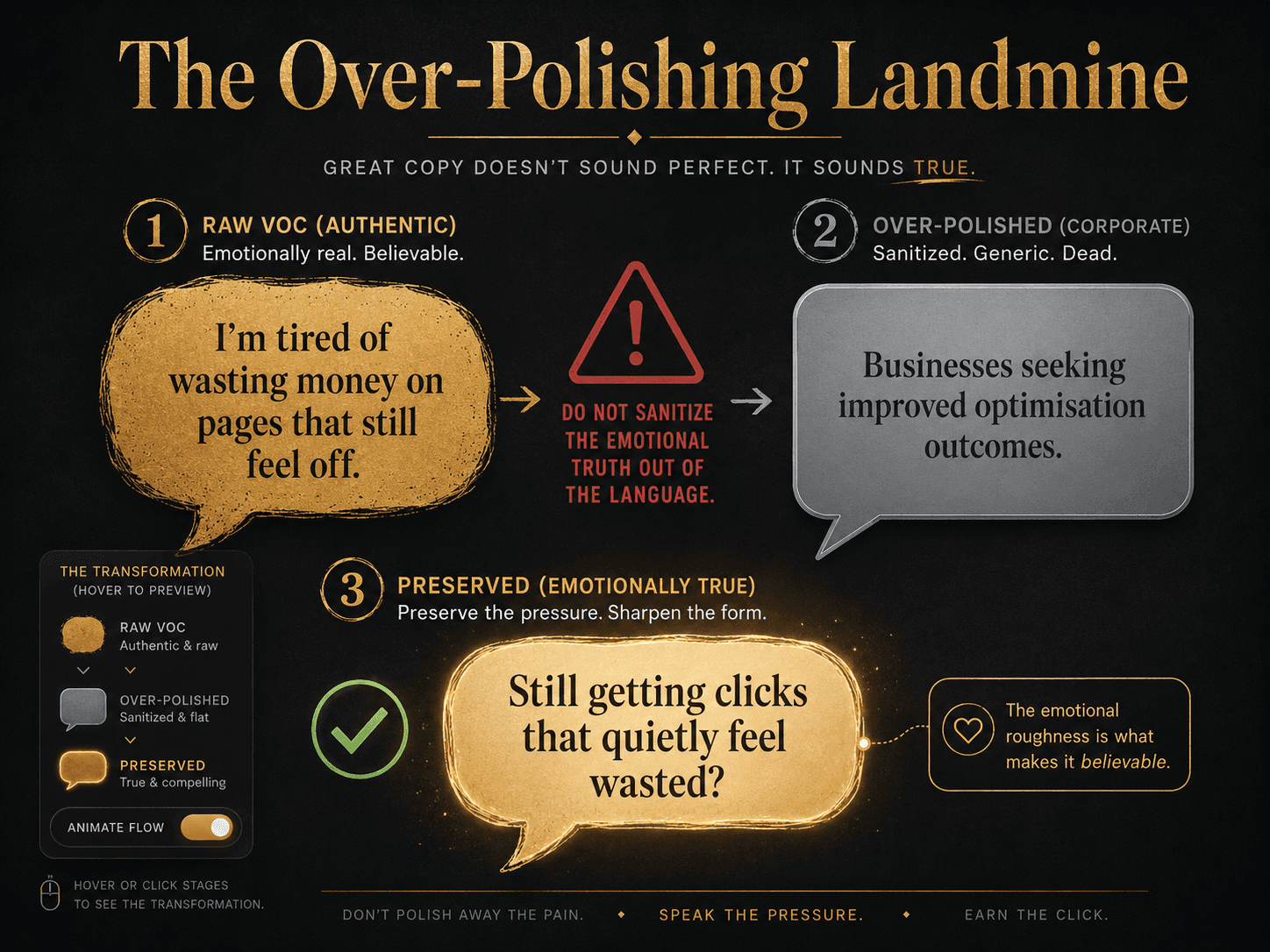
One of the biggest mistakes marketers make is over-polishing buyer language.
They take emotionally real phrasing and rewrite it into corporate mush.
That destroys the value of the research.
Example
Original buyer language:
“I’m tired of wasting money on pages that still feel off.”
Over-polished rewrite:
“Businesses seeking improved optimisation outcomes.”
Disaster.
The emotional realism vanished completely.
The buyer disappeared from the sentence.
Important Rule
Clean the grammar if needed.
Do not clean out the pressure.
That emotional roughness is often what makes the line believable.
The goal is not to make the sentence sound messy.
The goal is to avoid sanitising the truth out of it.
—-
Common VOC Landmines
Avoid these mistakes:
turning emotional language into corporate language
replacing buyer phrases with abstract strategy words
smoothing out all frustration
removing specificity
over-polishing pain
changing “I’m tired of…” into “seeking improvement”
converting lived experience into business jargon
summarising when the exact phrase is stronger
using VOC as decoration instead of direction
If the phrase becomes cleaner but weaker, you have over-polished it.
——
The “Sounds Human?” Test™
Read your copy out loud and ask:
Would a real buyer naturally say this?
Does this sound emotionally believable?
Does this feel too polished?
Does this preserve pressure?
Does this create recognition?
Would the buyer actually say this when frustrated?
Does this sound like the buyer’s world?
Does this sound like marketing pretending to understand?
If the answer feels uncertain, the copy probably still lacks emotional realism.
Good VOC-based copy should not sound like a committee wrote it.
It should sound like someone listened.
——
The Private Conversation Filter™
The best buyer language often sounds like something said privately.
Not publicly.
Ask:
“Would this sound believable if overheard in a private conversation?”
If yes, you are usually getting closer to emotionally accurate messaging.
——
Public Language vs Private Language
Public language:
“I want to improve my conversion rate.”
Private language:
“I’m tired of spending money on traffic when I still do not trust the page.”
Public language:
“I need clearer positioning.”
Private language:
“I hate that people still do not understand what I actually do.”
Public language:
“I want better sales calls.”
Private language:
“I’m tired of calls that feel good but end with ‘I’ll think about it.’”
Private language usually contains more pressure.
And pressure creates stronger copy.
——
The Biggest VOC Mistake™
Most marketers collect information.
But ignore emotion.
They focus on what buyers say.
Instead of how buyers emotionally experience what they say.
That distinction changes copy quality dramatically.
Do not only collect what buyers say.
Decode how they emotionally experience what they say.
Because emotionally loaded language creates recognition.
And recognition creates:
trust
attention
continuation
belief
movement
Information tells you the topic.
Emotion tells you the message.
——
Using AI To Accelerate VOC Analysis™
AI becomes dramatically more powerful when paired with authentic buyer language.
You can use any capable AI tool to organise, cluster, and translate VOC research.
If you are using Funnels By Maris Spalins™, the prompts are designed to work especially well with the frameworks, principles, and buyer psychology systems explored throughout The $100M Funnel Playbook.
AI can help you:
organise research data
identify emotional patterns
cluster repeated objections
extract identity language
identify recurring frustrations
translate VOC into headlines and hooks
simplify messy research
pressure-test messaging realism
But the rule is simple:
Do not use AI to invent voice-of-customer data.
Use AI to analyse real voice-of-customer data.
AI can organise the signal.
It should not fabricate the signal.
——
VOC Analysis AI Prompt™
Use this prompt after you have collected real buyer language.
Act as a conversion strategist trained in voice-of-customer research, buyer psychology, and high-conversion messaging.
Analyse the buyer language below.
Do not invent quotes.
Do not fabricate buyer language.
Use only the phrases provided.
Please extract and organise the research into five categories:
Frustration Language™
Identity Language™
Resistance Language™
Desire Language™
Future-Fear Language™
For each category, give me:
the strongest exact phrases
the emotional pattern behind the phrases
what this reveals about the buyer
how this could influence page copy
Then score the strongest phrases from 1 to 5 on:
emotional intensity
specificity
repetition
buyer relevance
copy potential
After that, generate:
5 hook ideas
5 headline ideas
3 CTA directions
3 proof angles
3 objection-handling angles
1 primary emotional pattern
1 primary resistance pattern
Keep the language human, sharp, and emotionally grounded.
Preserve the pressure.
Do not over-polish the buyer’s words.
Here is the buyer language:
[paste buyer language]
——
Quick VOC Extraction Exercise™
Use this when you want to quickly turn buyer language into copy.
One Repeated Buyer Frustration:
One Emotional Phrase Buyers Keep Using:
One Identity Tension:
One Resistance Phrase:
One Desire Phrasev
One Future Fear:
One Private Thought:
One Headline Built From This Language:
One Hook Built From This Language:
One CTA Built From This Language:
One Proof Angle Built From This Language:
——
The VOC To Page Copy Bridge™
Once you have collected and scored the strongest phrases, translate them into page copy.
Headline
Use frustration language, identity language, or future-fear language.
My headline:
Opening Hook
Use the strongest emotional phrase or private thought.
My opening hook:
Problem Bullets
Use repeated frustrations and operational friction.
My problem bullets:
Deeper Resonance Line
Use identity language carefully.
My deeper resonance line:
Objection Section
Use resistance language.
My objection-handling angle:
CTA
Use desire language or the desired relief.
My CTA:
CTA Microcopy
Use reassurance, proof need, or future cost.
My CTA microcopy:
Proof Cue
Use proof expectations, resistance language, or failed-attempt language.
My proof cue:
——
Final VOC Extraction Worksheet™
Complete this before rewriting the page.
Target Buyer:
Offer Or Page Being Improved:
Main VOC Sources Used:
Total Raw Phrases Collected:
Top 5 Frustration Phrases
Top 5 Desire Phrases
Top 5 Resistance Or Objection Phrases
Top 5 Identity Or Private-Thought Phrases
Strongest Emotional Pattern:
Strongest Resistance Pattern:
Strongest Future Fear:
Strongest Desired Relief:
Best Hook-Ready Phrase:
Best Headline Direction:
Best CTA Direction:
Best Proof Angle:
——
The 30-Minute VOC Extraction Process™
Use this when you need to improve one page quickly.
Minutes 0–5: Choose One Buyer And One Page
Do not research everyone.
Choose one buyer and one page section.
Buyer:
Page section:
Minutes 5–10: Collect Raw Phrases
Pull language from comments, reviews, calls, DMs, forms, or support messages.
Do not edit yet.
Collect at least 10–20 raw phrases.
Minutes 10–15: Sort The Phrases
Sort them into:
frustration
identity
resistance
desire
future fear
Write the strongest phrase from each category.
Frustration:
Identity:
Resistance:
Desire:
Future fear:
Minutes 15–20: Score The Strongest Phrases
Use the Phrase Strength Scorecard.
Choose the phrases with the highest emotional intensity, specificity, repetition, relevance, and copy potential.
Best phrase:
Why it is strong:
Minutes 20–25: Translate Into Copy
Turn the strongest phrases into:
one hook
one headline
one CTA
one proof cue
Hook:
Headline:
CTA:
Proof cue:
Minutes 25–30: Humanise And Tighten
Read the copy out loud.
Ask:
Does this still sound like the buyer?
Did I over-polish it?
Did I preserve the pressure?
Would this create recognition?
Would the buyer say, “That is exactly it”?
Final version:
——
Final Principle™
The strongest copy often sounds less like marketing and more like the buyer talking to themselves.
That is why real emotional language matters so much.
Buyers trust recognition.
Not polished abstraction.
The deeper your understanding of:
frustration
emotional phrasing
identity tension
future fear
resistance
lived experience
The less your messaging feels manufactured.
And the more it feels:
personally relevant
emotionally accurate
human
believable
difficult to ignore
That is the real power of The Voice-of-Customer Extraction System™.
Collect 20 raw phrases.
Do not rewrite them yet.
Sort them first.
Score them.
Then translate the strongest five into copy assets.
Do not invent the buyer’s language.
Find it.
Decode it.
Preserve the pressure.
Then turn it into messaging the buyer can feel.
That is how copy stops sounding artificial and starts sounding recognised.
——
From:
The $100M Funnel Playbook. Book I: Foundation Buyer Psychology, Offer Clarity, and the Page Architecture Behind High-Converting Funnels
By Maris Spalins.
——
Copyright Notice
© 2026 The $100M Funnel Playbook / Winyourclients / Maris Spalins. All rights reserved.
This resource, including the frameworks, terminology, examples, scorecards, templates, prompts, methods, and written explanations, is original intellectual property created for The $100M Funnel Playbook. Book I: Foundation — Buyer Psychology, Offer Clarity, And The Page Architecture Behind High-Converting Funnels and published through Winyourclients.
No part of this resource may be copied, reproduced, screenshotted, republished, redistributed, sold, adapted, uploaded, scraped, stored in a database, included in training data, used to train artificial intelligence systems, or used to create derivative commercial or educational materials without prior written permission.
Limited reference, quotation, or sharing is only permitted where the source is clearly and visibly credited.
Any permitted reference must include at least one of the following source credits:
The $100M Funnel Playbook by Maris Spalins
or
Winyourclients — www.winyourclients.com
or
Maris Spalins / Winyourclients
Screenshots, excerpts, summaries, or redistributed versions must not remove, hide, alter, crop out, or obscure the original source, author name, book title, website name, or copyright notice.
This resource is provided for personal learning and implementation only. It is not licensed for resale, republishing, redistribution, AI training, template cloning, course creation, consulting delivery, or commercial reuse without written permission from Maris Spalins or Winyourclients.
For permission requests, licensing, citation approval, or commercial usage enquiries, contact:
Winyourclients
www.winyourclients.com
or
Email directly to Jacob on: help@winyourclients.com
The Voice-of-Customer Extraction System™ A practical buyer-language research worksheet for finding real customer phrases, decoding emotional patterns, and translating raw buyer language into high-conversion headlines, hooks, CTAs, proof, and objection handling.
Prefer Audio Or Video?
The Voice-of-Customer Extraction System™ is also available as:
🎧 A guided audio walkthrough explaining emotional language extraction, buyer phrasing, and messaging realism
🎥 A practical video breakdown with live research examples, pattern analysis, and messaging translation demonstrationsChoose the format that fits how you learn best.
[Listen To The Audio Walkthrough] (coming soon)
[Watch The Video Breakdown] (coming soon)
——
Why Most Marketing Language Feels Artificial
Most marketing copy sounds like marketing.
That is the problem.
It sounds:
over-polished
emotionally sanitised
strategically correct
painfully generic
too clean to feel real
too abstract to create recognition
The buyer reads it and instantly feels distance.
Not recognition.
This happens because most marketers invent language instead of discovering it.
They sit in empty documents trying to “sound persuasive.”
Meanwhile, the market has already revealed:
the pain
the frustration
the objections
the emotional tension
the hidden fear
the failed attempts
the exact wording buyers naturally use
They simply were not listening carefully enough.
That is what The Voice-of-Customer Extraction System™ is designed to solve.
It helps you stop inventing polished marketing language from inside your own head and start extracting real buyer language from the market.
Because the strongest copy often does not sound like marketing.
It sounds like the buyer finally seeing their own situation written clearly.
——
What This Resource Helps You Do
The Voice-of-Customer Extraction System™ helps you find, sort, decode, and translate real buyer language into stronger conversion copy.
Use it to:
collect raw buyer phrases
identify repeated emotional patterns
extract frustration language
find resistance and objection language
uncover identity tension
capture desire language
identify future-fear language
turn raw phrases into headlines
build stronger hooks
improve CTA language
strengthen proof sections
make page copy sound more human
avoid artificial, over-polished messaging
This is not about copying buyer language blindly.
It is about finding emotional truth, preserving the pressure, and translating it into copy that feels clear, sharp, and commercially useful.
The goal is not to sound messy.
The goal is to sound real.
——
The Market Is Already Writing The Copy™
This is one of the most important principles in modern conversion psychology:
Buyers constantly reveal emotional truth accidentally.
Especially when they:
complain
vent
explain frustration
leave reviews
describe failed attempts
ask questions
compare options
express doubt
justify hesitation
explain why something disappointed them
And they usually reveal it in language that feels more believable, more emotional, and more human than most marketing copy ever does.
That matters enormously.
Because buyers trust language that sounds discovered more than language that sounds manufactured.
——
Invented Marketing Language™
Weak example:
“Optimise your customer acquisition strategy.”
Technically correct.
Emotionally dead.
It sounds like a company talking about a business topic.
Not like a buyer describing a real problem.
——
Real Buyer Language™
Stronger example:
“I’m tired of paying for clicks that disappear without turning into buyers.”
Now the message feels:
lived-in
emotionally grounded
recognisable
believable
specific
closer to the buyer’s reality
That creates trust faster.
Not because the sentence is more dramatic.
Because it feels more true.
——
The Emotional Language Principle™
Emotionally loaded phrasing creates:
recognition
believability
continuation
emotional pull
stronger buyer contact
Why?
Because it sounds human.
Real buyers rarely speak like polished brand guidelines.
They say things like:
“I’m tired of…”
“It feels like…”
“I keep…”
“Every time I…”
“I thought this would…”
“I’m worried that…”
“I don’t want to keep…”
“I should be further along by now…”
Those phrases contain pressure.
And pressure creates movement.
——
Low-Emotion Language™
“Our funnel performance has been inconsistent.”
Professional.
Clear.
But emotionally weak.
High-Emotion Language™
“It feels like every launch starts with hope and ends with me rewriting the same page again.”
Now the message feels real.
It carries:
frustration
repetition
disappointment
emotional fatigue
a lived pattern
That emotional realism matters massively.
The Core Rule
Preserve the emotional shape of the buyer’s phrase before polishing it.
You can clean the grammar.
You can sharpen the delivery.
You can make it more concise.
But do not remove the pressure.
If you remove the pressure, you remove the recognition.
Where The Best Buyer Language Actually Lives™
Great voice-of-customer data usually comes from emotionally unfiltered environments.
That is important.
People reveal deeper truth when they are:
frustrated
disappointed
confused
comparing options
emotionally reactive
trying to explain what went wrong
asking for help
warning others
reviewing what failed
You are not merely collecting words.
You are collecting pressure signals.
Useful VOC Sources
Use sources such as:
Reddit threads
YouTube comments
Amazon reviews
support tickets
onboarding forms
sales calls
Facebook groups
Discord communities
competitor reviews
one-star reviews
DMs
email replies
survey responses
testimonials
discovery calls
intake forms
sales objections
customer interviews
Each source gives you a different kind of signal.
——
What Each Source Is Useful For
Reddit Threads
Best for:
raw frustration
emotional honesty
scepticism
failed attempts
private fears
unfiltered objections
Reddit is useful because people often speak more bluntly when they are not trying to impress anyone.
YouTube Comments
Best for:
immediate reactions
questions
misunderstandings
emotional resonance
objections
“this is exactly me” comments
YouTube comments often reveal what people are trying to understand or what they feel seen by.
Amazon Reviews
Best for:
expectation gaps
desire language
disappointment
before/after contrast
emotional benefits
unmet promises
Look especially at three-star and one-star reviews.
They often show what buyers wanted but did not receive.
Support Tickets
Best for:
recurring friction
confusion points
repeated complaints
product/service gaps
exact wording around difficulty
Support tickets reveal where reality does not match expectation.
Sales Calls
Best for:
objections
hesitation
buying triggers
emotional urgency
proof needs
decision criteria
Sales calls show what buyers need to believe before they move.
DMs And Email Replies
Best for:
private language
emotional honesty
hesitation
urgency
buyer questions
context behind the problem
Private replies often reveal softer, more honest language than public comments.
Competitor Reviews
Best for:
market gaps
unmet needs
distrust triggers
buyer expectations
language around disappointment
Competitor reviews help you see what the market is tired of.
One-Star Reviews
Best for:
anger
failed expectations
broken promises
resistance language
trust collapse
language around disappointment
One-star reviews can be emotionally intense, so use them carefully.
Do not copy anger blindly.
Extract the pattern underneath it.
——
The 5 Types Of High-Value VOC Data™
Not all buyer language carries equal strategic value.
Some phrases are interesting but useless.
Others can become headlines, hooks, CTAs, proof cues, or objection-handling sections almost immediately.
These five categories are especially powerful.
—
1. Frustration Language™
What It Reveals
Frustration language reveals live pressure.
It shows what the buyer is tired of tolerating.
Phrases To Look For
Look for phrases like:
“I’m tired of…”
“Nothing seems to…”
“Every time I try…”
“I keep wasting…”
“I’m sick of…”
“I don’t understand why…”
“I keep fixing this but…”
Examples
“I’m tired of rewriting the same page every month.”
“I keep paying for clicks that do not turn into buyers.”
“Every launch feels like starting from scratch again.”
“Nothing seems to make the page feel clear enough.”
Why This Matters
Frustration language creates immediate emotional relevance.
It tells you what the hook should interrupt.
Fill This In
Frustration phrase I found:
What the buyer is tired of:
The repeated pattern behind the frustration:
Possible hook from this phrase:
—
2. Identity Language™
What It Reveals
Identity language reveals self-image tension.
This is where the buyer’s problem starts affecting how they see themselves.
Phrases To Look For
Look for phrases like:
“I should be further ahead by now.”
“I’m embarrassed this still isn’t clear.”
“I feel like I’m guessing.”
“Maybe I’m just not good at this.”
“I thought I would have figured this out by now.”
“It makes me feel behind.”
“I don’t feel confident sending people there.”
Examples
“I feel like I should know how to explain this by now.”
“It is embarrassing how many times I have changed the headline.”
“The page looks fine, but I still do not trust it.”
“I feel like I am guessing every time I rewrite it.”
Why This Matters
Identity language creates deep psychological recognition.
It helps the copy speak to what the problem seems to mean about the buyer.
Use this carefully.
One accurate identity line can be powerful.
Too much can feel heavy-handed.
Fill This In
Identity phrase I found:
What this problem seems to say about the buyer:
The identity tension underneath it:
Possible deeper resonance line:
—
3. Resistance Language™
What It Reveals
Resistance language reveals distrust and scepticism.
It shows what the buyer no longer wants to hear.
Phrases To Look For
Look for phrases like:
“I’ve tried frameworks before.”
“Most advice feels generic.”
“I don’t want another template.”
“This sounds like every other promise.”
“I’m sceptical because…”
“I do not trust…”
“I have already tried…”
Examples
“I do not want another plug-and-play funnel template.”
“Most advice sounds good but does not fix the actual problem.”
“I have tried rewriting headlines, but it never changes much.”
“I am tired of people saying ‘just improve your messaging’ without showing what that means.”
Why This Matters
Resistance language helps you avoid triggering distrust accidentally.
It also tells you what the page must handle before the buyer can believe.
Fill This In
Resistance phrase I found:
What the buyer no longer trusts:
What the page must avoid sounding like:
Possible objection-handling line:
—
4. Desire Language™
What It Reveals
Desire language reveals the emotionally meaningful outcome.
Not just what the buyer wants in practical terms.
What they want to feel, regain, become, or stop worrying about.
Phrases To Look For
Look for phrases like:
“I just want to…”
“I wish I could…”
“I want to finally…”
“I would love to feel…”
“I want buyers to…”
“I want to stop…”
“I want to know that…”
Examples
“I just want to feel confident sending traffic again.”
“I want the page to finally sound like the value is real.”
“I want buyers to instantly get it.”
“I want to stop second-guessing every sentence.”
“I want to know the message is strong enough before I spend more.”
Why This Matters
Good desire language feels specific, human, and emotionally grounded.
It helps create better CTAs, outcome sections, and offer framing.
Fill This In
Desire phrase I found:
The practical outcome they want:
The emotional relief they want:
Possible CTA from this phrase:
—
5. Future-Fear Language™
What It Reveals
Future-fear language reveals anticipated consequence.
It shows what the buyer worries will continue if nothing changes.
Phrases To Look For
Look for phrases like:
“I’m scared I’ll…”
“I don’t want to keep…”
“I’m worried this will…”
“If this keeps happening…”
“I do not want another year of…”
“I’m afraid I’ll waste…”
“What if this never…”
Examples
“I’m scared I’ll waste another year rebuilding the wrong thing.”
“I do not want to keep guessing forever.”
“I’m worried the problem is deeper than the page itself.”
“If this keeps happening, I’ll keep spending money without knowing what is broken.”
Why This Matters
Future-fear language creates urgency, attention, and emotional openness.
It helps you write cost-of-inaction copy without fake scarcity.
Fill This In
Future-fear phrase I found:
The future they are afraid of:
The pattern they do not want to repeat:
Possible urgency line:
——
The VOC Capture Worksheet™
Use this section when collecting raw buyer language.
Do not edit the phrases yet.
Capture them exactly first.
Source
Where did this phrase come from?
Examples:
Reddit, YouTube comment, review, DM, sales call, support ticket, survey, intake form, competitor review.
Source:
Exact Phrase
Copy the phrase exactly.
Do not polish it yet.
Exact phrase:
Context
What was the buyer talking about?
Context:
VOC Category
Which category does this phrase belong to?
Choose one:
Frustration Language™
Identity Language™
Resistance Language™
Desire Language™
Future-Fear Language™
Other
Category:
Emotion Behind The Phrase
What emotion is underneath it?
Examples:
Frustration, anxiety, embarrassment, doubt, resentment, hope, desire, fear, exhaustion, distrust.
Emotion:
What This Reveals
What does this phrase show about the buyer?
It reveals:
Copy Potential
Could this phrase become:
a headline?
a hook?
a bullet?
a CTA?
proof framing?
objection handling?
offer positioning?
Copy potential:
—-
The Pattern Recognition System™
Elite copywriters are not merely writers.
They are pattern detectors.
This is critical.
One emotional phrase may be interesting.
Repeated emotional phrases indicate psychological significance.
The job is not to collect random quotes.
The job is to find repeated pressure.
Look For Repeated Frustrations™
Ask:
What keeps appearing repeatedly?
Examples:
wasted traffic
inconsistent leads
unclear messaging
distrust of funnels
emotional fatigue
weak conversion
repeated hesitation
underperforming launches
Repeated pain reveals core pressure.
Look For Repeated Emotional Phrases™
Ask:
What words keep showing up?
Examples:
“I’m tired of…”
“It feels like…”
“I keep rebuilding…”
“I don’t know why…”
“I thought this would…”
“I’m worried that…”
Repeated emotional language reveals recognition triggers.
Look For Repeated Failed Attempts™
Ask:
What have they already tried?
Examples:
redesigning repeatedly
changing templates constantly
trying “proven frameworks”
rewriting headlines endlessly
buying more traffic
copying competitors
simplifying the message but making it weaker
Failed-attempt loops reveal scepticism and emotional exhaustion.
Look For Repeated Identity Tension™
Ask:
What does the problem seem to say about them?
Examples:
“I should know this by now.”
“I feel behind.”
“I’m second-guessing everything.”
“I feel like I’m guessing.”
“I’m embarrassed this still isn’t clear.”
Identity tension often creates the deepest emotional leverage.
——
The Phrase Strength Scorecard™
Not every phrase deserves to become copy.
Use this scorecard to identify the strongest buyer language.
Score each phrase from 1 to 5.
1 = weak
2 = slightly useful
3 = usable
4 = strong
5 = highly valuable
Phrase To Score
Exact phrase:
Emotional Intensity
Does the phrase carry emotional charge?
Score: ___ / 5
Specificity
Does the phrase describe a specific situation, pain, objection, or desire?
Score: ___ / 5
Repetition
Have you seen this idea or phrase repeated across multiple sources?
Score: ___ / 5
Buyer Relevance
Does this phrase clearly relate to the buyer you want to reach?
Score: ___ / 5
Copy Potential
Could this phrase become a hook, headline, CTA, bullet, proof cue, or objection-handling line?
Score: ___ / 5
Total Phrase Score
Total: ___ / 25
——
What The Score Means
21–25: High-Value VOC
This phrase is highly useful.
It may be strong enough to shape headline, hook, CTA, or proof language.
16–20: Strong Signal
This phrase is useful.
It may need sharpening, but it carries real messaging value.
10–15: Usable But Not Strong
This phrase may support the research, but it is probably not the main copy angle.
0–9: Weak Signal
This phrase is either too generic, too vague, or not relevant enough.
Do not build your messaging around it.
—-
Weak Copy vs VOC-Based Copy™
Use these examples to see how real buyer language creates stronger messaging.
Example 1: Funnel Conversion
Weak copy:
“Improve your landing page conversions.”
Technically clear.
Emotionally interchangeable.
VOC-based version:
“Still getting clicks but quietly hesitating every time you look at the page?”
Now the buyer feels:
recognition
emotional realism
familiarity
pressure
Because the language feels closer to lived experience.
Example 2: Messaging
Weak copy:
“Scale your business with better messaging.”
VOC-based version:
“Tired of rewriting the same headline every month and still feeling unsure whether the page actually lands?”
The second version sounds human.
That matters enormously.
Example 3: SaaS Activation
Weak copy:
“Improve user onboarding and increase activation.”
VOC-based version:
“Users are signing up, clicking around once, and disappearing before they ever feel the product’s value.”
The second version shows the actual moment where the problem happens.
Example 4: Ecommerce Conversion
Weak copy:
“Boost product page performance.”
VOC-based version:
“Your ads are getting the clicks, but the product page still is not creating enough trust to carry the sale.”
The second version shows the commercial pressure behind the problem.
Example 5: Coaching Or Consulting
Weak copy:
“Get more clients with stronger positioning.”
VOC-based version:
“Your content gets attention, but when buyers reach the page, they still cannot feel why you are the obvious choice.”
The second version creates a more specific recognition moment.
Example 6: Agency Growth
Weak copy:
“Build a predictable lead generation system.”
VOC-based version:
“Tired of starting every month wondering whether enough qualified conversations will actually show up?”
The second version speaks to the private pressure behind inconsistent pipeline.
——
The “That’s Exactly My Situation” Effect™
Strong VOC creates recognition acceleration.
The buyer suddenly feels:
“This person understands what this actually feels like.”
That moment matters enormously psychologically.
Because recognition reduces resistance.
And reduced resistance increases continuation.
This is why emotionally accurate language often outperforms creative marketing.
Creative copy may impress the writer.
Accurate copy moves the buyer.
The Recognition Test
Read the line and ask:
Would the buyer say:
“That sounds nice.”
Or:
“That is exactly what is happening.”
If the buyer says, “That sounds nice,” the language may still be too polished.
If the buyer says, “That is exactly what is happening,” the language is working.
That is the standard.
Not cleverness.
Recognition.
——
The VOC Translation Layer™
Raw buyer language should directly shape the page.
If the research does not change the copy, it is only research theatre.
Use each type of VOC data for a specific purpose.
Frustration Language™ → Hooks And Problem Bullets
Use frustration language to interrupt attention and name the repeated pain.
Example raw phrase:
“I’m tired of rewriting this page every month.”
Hook translation:
“Tired of rewriting the same page every month and still not trusting it?”
Identity Language™ → Deeper Resonance And Positioning
Use identity language to speak to what the problem seems to mean about the buyer.
Example raw phrase:
“I feel like I should know how to explain this by now.”
Resonance translation:
“The frustrating part is not only that the page feels unclear. It is that you feel like this should be easier to explain by now.”
Resistance Language™ → Objection Handling
Use resistance language to avoid triggering distrust and handle scepticism directly.
Example raw phrase:
“I don’t want another plug-and-play template.”
Objection-handling translation:
“This is not another plug-and-play template. It is a diagnostic system for finding where your buyer loses belief.”
Desire Language™ → Outcomes And CTAs
Use desire language to shape the desired movement.
Example raw phrase:
“I just want to feel confident sending traffic again.”
CTA translation:
“Get The Clarity To Send Traffic With Confidence.”
Future-Fear Language™ → Urgency And Cost-Of-Inaction Copy
Use future-fear language to show why delay matters.
Example raw phrase:
“I’m scared I’ll waste another year rebuilding the wrong thing.”
Urgency translation:
“Before you spend another year rebuilding the same uncertainty, diagnose the real leak.”
Example Translation™
Here is how raw buyer language becomes conversion copy.
——
Raw Buyer Language™
“I’m tired of rebuilding funnels that still feel unfinished every time I launch them.”
What It Reveals
This phrase reveals:
frustration
repeated failed attempts
emotional fatigue
hesitation
lack of trust
launch anxiety
unfinished-message tension
Headline Translation™
“Still Launching Funnels You Secretly Don’t Trust Yet?”
Subheadline Translation™
“If every launch ends with another round of doubt, the problem may not be effort. It may be that the buyer pressure, proof, and message sequence were never clear enough to begin with.”
CTA Translation™
“Show Me The Missing Conversion Gaps.”
Proof Translation™
“See The Before/After Funnel Rebuild.”
Why This Works
The funnel feels emotionally connected because the language originated from real pressure.
It does not sound invented.
It sounds recognised.
——
More Translation Examples
Example 1
Raw buyer language:
“I keep changing the headline, but nothing really changes.”
What it reveals:
failed attempts
frustration
surface-level fixing
deeper diagnosis needed
Headline translation:
“Still Rewriting The Headline When The Real Leak Is Deeper?”
CTA translation:
“Find The Real Message Leak.”
Proof angle:
“Before/after breakdown showing what changed beyond the headline.”
Example 2
Raw buyer language:
“I do not know if people understand what I actually do.”
What it reveals:
clarity anxiety
positioning weakness
fear of being misunderstood
identity tension
Headline translation:
“If Buyers Still Don’t Understand The Value, The Page Is Not Clear Enough Yet.”
CTA translation:
“Clarify The Buyer Message.”
Proof angle:
“Side-by-side example showing unclear positioning rewritten into buyer-relevant language.”
Example 3
Raw buyer language:
“I feel like I am paying for traffic just to learn that the page still does not work.”
What it reveals:
wasted spend
operational friction
frustration
distrust of the page
cost of delay
Headline translation:
“Stop Paying For Traffic Before You Know The Page Can Hold Belief.”
CTA translation:
“Diagnose The Page Before Scaling Traffic.”
Proof angle:
“Page audit showing where belief collapsed before the CTA.”
——
The VOC Collection Workflow™
Use this process to turn raw research into conversion assets.
Step 1: Collect Raw Buyer Language
Do not edit yet.
Do not polish yet.
Do not summarise too early.
Copy the buyer’s words exactly.
Raw language carries emotional signal.
Step 2: Highlight Emotional Phrases
Look for:
frustration phrases
identity phrases
resistance phrases
desire phrases
future-fear phrases
repeated objections
failed-attempt language
Highlight anything that feels emotionally charged or unusually specific.
Step 3: Group Recurring Patterns
Group phrases into categories such as:
distrust
exhaustion
hesitation
overwhelm
uncertainty
embarrassment
wasted money
weak conversion
failed attempts
desire for confidence
Patterns matter more than isolated phrases.
Step 4: Identify What Hurts, Repeats, Resists, And Wants
Ask:
What hurts?
What keeps repeating?
What do buyers resist?
What do buyers want emotionally?
What do buyers fear will continue?
Step 5: Translate Insights Into Conversion Assets
Turn the strongest VOC into:
headlines
hooks
subheadlines
proof cues
CTA language
problem bullets
objection handling
offer positioning
page structure
This is where research becomes conversion copy.
——
Final VOC Output™
By the end of this workflow, you should have:
20 raw buyer phrases
5 strongest frustration phrases
5 strongest desire phrases
5 strongest objection or resistance phrases
5 hook-ready phrases
3 headline directions
3 CTA directions
3 proof angles
1 primary emotional pattern
1 primary resistance pattern
1 strongest private thought
That is enough to materially sharpen almost any weak page.
VOC Landmines™
One of the biggest mistakes marketers make is over-polishing buyer language.
They take emotionally real phrasing and rewrite it into corporate mush.
That destroys the value of the research.
Example
Original buyer language:
“I’m tired of wasting money on pages that still feel off.”
Over-polished rewrite:
“Businesses seeking improved optimisation outcomes.”
Disaster.
The emotional realism vanished completely.
The buyer disappeared from the sentence.
Important Rule
Clean the grammar if needed.
Do not clean out the pressure.
That emotional roughness is often what makes the line believable.
The goal is not to make the sentence sound messy.
The goal is to avoid sanitising the truth out of it.
—-
Common VOC Landmines
Avoid these mistakes:
turning emotional language into corporate language
replacing buyer phrases with abstract strategy words
smoothing out all frustration
removing specificity
over-polishing pain
changing “I’m tired of…” into “seeking improvement”
converting lived experience into business jargon
summarising when the exact phrase is stronger
using VOC as decoration instead of direction
If the phrase becomes cleaner but weaker, you have over-polished it.
——
The “Sounds Human?” Test™
Read your copy out loud and ask:
Would a real buyer naturally say this?
Does this sound emotionally believable?
Does this feel too polished?
Does this preserve pressure?
Does this create recognition?
Would the buyer actually say this when frustrated?
Does this sound like the buyer’s world?
Does this sound like marketing pretending to understand?
If the answer feels uncertain, the copy probably still lacks emotional realism.
Good VOC-based copy should not sound like a committee wrote it.
It should sound like someone listened.
——
The Private Conversation Filter™
The best buyer language often sounds like something said privately.
Not publicly.
Ask:
“Would this sound believable if overheard in a private conversation?”
If yes, you are usually getting closer to emotionally accurate messaging.
——
Public Language vs Private Language
Public language:
“I want to improve my conversion rate.”
Private language:
“I’m tired of spending money on traffic when I still do not trust the page.”
Public language:
“I need clearer positioning.”
Private language:
“I hate that people still do not understand what I actually do.”
Public language:
“I want better sales calls.”
Private language:
“I’m tired of calls that feel good but end with ‘I’ll think about it.’”
Private language usually contains more pressure.
And pressure creates stronger copy.
——
The Biggest VOC Mistake™
Most marketers collect information.
But ignore emotion.
They focus on what buyers say.
Instead of how buyers emotionally experience what they say.
That distinction changes copy quality dramatically.
Do not only collect what buyers say.
Decode how they emotionally experience what they say.
Because emotionally loaded language creates recognition.
And recognition creates:
trust
attention
continuation
belief
movement
Information tells you the topic.
Emotion tells you the message.
——
Using AI To Accelerate VOC Analysis™
AI becomes dramatically more powerful when paired with authentic buyer language.
You can use any capable AI tool to organise, cluster, and translate VOC research.
If you are using Funnels By Maris Spalins™, the prompts are designed to work especially well with the frameworks, principles, and buyer psychology systems explored throughout The $100M Funnel Playbook.
AI can help you:
organise research data
identify emotional patterns
cluster repeated objections
extract identity language
identify recurring frustrations
translate VOC into headlines and hooks
simplify messy research
pressure-test messaging realism
But the rule is simple:
Do not use AI to invent voice-of-customer data.
Use AI to analyse real voice-of-customer data.
AI can organise the signal.
It should not fabricate the signal.
——
VOC Analysis AI Prompt™
Use this prompt after you have collected real buyer language.
Act as a conversion strategist trained in voice-of-customer research, buyer psychology, and high-conversion messaging.
Analyse the buyer language below.
Do not invent quotes.
Do not fabricate buyer language.
Use only the phrases provided.
Please extract and organise the research into five categories:
Frustration Language™
Identity Language™
Resistance Language™
Desire Language™
Future-Fear Language™
For each category, give me:
the strongest exact phrases
the emotional pattern behind the phrases
what this reveals about the buyer
how this could influence page copy
Then score the strongest phrases from 1 to 5 on:
emotional intensity
specificity
repetition
buyer relevance
copy potential
After that, generate:
5 hook ideas
5 headline ideas
3 CTA directions
3 proof angles
3 objection-handling angles
1 primary emotional pattern
1 primary resistance pattern
Keep the language human, sharp, and emotionally grounded.
Preserve the pressure.
Do not over-polish the buyer’s words.
Here is the buyer language:
[paste buyer language]
——
Quick VOC Extraction Exercise™
Use this when you want to quickly turn buyer language into copy.
One Repeated Buyer Frustration:
One Emotional Phrase Buyers Keep Using:
One Identity Tension:
One Resistance Phrase:
One Desire Phrasev
One Future Fear:
One Private Thought:
One Headline Built From This Language:
One Hook Built From This Language:
One CTA Built From This Language:
One Proof Angle Built From This Language:
——
The VOC To Page Copy Bridge™
Once you have collected and scored the strongest phrases, translate them into page copy.
Headline
Use frustration language, identity language, or future-fear language.
My headline:
Opening Hook
Use the strongest emotional phrase or private thought.
My opening hook:
Problem Bullets
Use repeated frustrations and operational friction.
My problem bullets:
Deeper Resonance Line
Use identity language carefully.
My deeper resonance line:
Objection Section
Use resistance language.
My objection-handling angle:
CTA
Use desire language or the desired relief.
My CTA:
CTA Microcopy
Use reassurance, proof need, or future cost.
My CTA microcopy:
Proof Cue
Use proof expectations, resistance language, or failed-attempt language.
My proof cue:
——
Final VOC Extraction Worksheet™
Complete this before rewriting the page.
Target Buyer:
Offer Or Page Being Improved:
Main VOC Sources Used:
Total Raw Phrases Collected:
Top 5 Frustration Phrases
Top 5 Desire Phrases
Top 5 Resistance Or Objection Phrases
Top 5 Identity Or Private-Thought Phrases
Strongest Emotional Pattern:
Strongest Resistance Pattern:
Strongest Future Fear:
Strongest Desired Relief:
Best Hook-Ready Phrase:
Best Headline Direction:
Best CTA Direction:
Best Proof Angle:
——
The 30-Minute VOC Extraction Process™
Use this when you need to improve one page quickly.
Minutes 0–5: Choose One Buyer And One Page
Do not research everyone.
Choose one buyer and one page section.
Buyer:
Page section:
Minutes 5–10: Collect Raw Phrases
Pull language from comments, reviews, calls, DMs, forms, or support messages.
Do not edit yet.
Collect at least 10–20 raw phrases.
Minutes 10–15: Sort The Phrases
Sort them into:
frustration
identity
resistance
desire
future fear
Write the strongest phrase from each category.
Frustration:
Identity:
Resistance:
Desire:
Future fear:
Minutes 15–20: Score The Strongest Phrases
Use the Phrase Strength Scorecard.
Choose the phrases with the highest emotional intensity, specificity, repetition, relevance, and copy potential.
Best phrase:
Why it is strong:
Minutes 20–25: Translate Into Copy
Turn the strongest phrases into:
one hook
one headline
one CTA
one proof cue
Hook:
Headline:
CTA:
Proof cue:
Minutes 25–30: Humanise And Tighten
Read the copy out loud.
Ask:
Does this still sound like the buyer?
Did I over-polish it?
Did I preserve the pressure?
Would this create recognition?
Would the buyer say, “That is exactly it”?
Final version:
——
Final Principle™
The strongest copy often sounds less like marketing and more like the buyer talking to themselves.
That is why real emotional language matters so much.
Buyers trust recognition.
Not polished abstraction.
The deeper your understanding of:
frustration
emotional phrasing
identity tension
future fear
resistance
lived experience
The less your messaging feels manufactured.
And the more it feels:
personally relevant
emotionally accurate
human
believable
difficult to ignore
That is the real power of The Voice-of-Customer Extraction System™.
Collect 20 raw phrases.
Do not rewrite them yet.
Sort them first.
Score them.
Then translate the strongest five into copy assets.
Do not invent the buyer’s language.
Find it.
Decode it.
Preserve the pressure.
Then turn it into messaging the buyer can feel.
That is how copy stops sounding artificial and starts sounding recognised.
——
From:
The $100M Funnel Playbook. Book I: Foundation Buyer Psychology, Offer Clarity, and the Page Architecture Behind High-Converting Funnels
By Maris Spalins.
——
Copyright Notice
© 2026 The $100M Funnel Playbook / Winyourclients / Maris Spalins. All rights reserved.
This resource, including the frameworks, terminology, examples, scorecards, templates, prompts, methods, and written explanations, is original intellectual property created for The $100M Funnel Playbook. Book I: Foundation — Buyer Psychology, Offer Clarity, And The Page Architecture Behind High-Converting Funnels and published through Winyourclients.
No part of this resource may be copied, reproduced, screenshotted, republished, redistributed, sold, adapted, uploaded, scraped, stored in a database, included in training data, used to train artificial intelligence systems, or used to create derivative commercial or educational materials without prior written permission.
Limited reference, quotation, or sharing is only permitted where the source is clearly and visibly credited.
Any permitted reference must include at least one of the following source credits:
The $100M Funnel Playbook by Maris Spalins
or
Winyourclients — www.winyourclients.com
or
Maris Spalins / Winyourclients
Screenshots, excerpts, summaries, or redistributed versions must not remove, hide, alter, crop out, or obscure the original source, author name, book title, website name, or copyright notice.
This resource is provided for personal learning and implementation only. It is not licensed for resale, republishing, redistribution, AI training, template cloning, course creation, consulting delivery, or commercial reuse without written permission from Maris Spalins or Winyourclients.
For permission requests, licensing, citation approval, or commercial usage enquiries, contact:
Winyourclients
www.winyourclients.com
or
Email directly to Jacob on: help@winyourclients.com
Other Blogs
Other Blogs
Check our other project Blogs with useful insight and information for your businesses
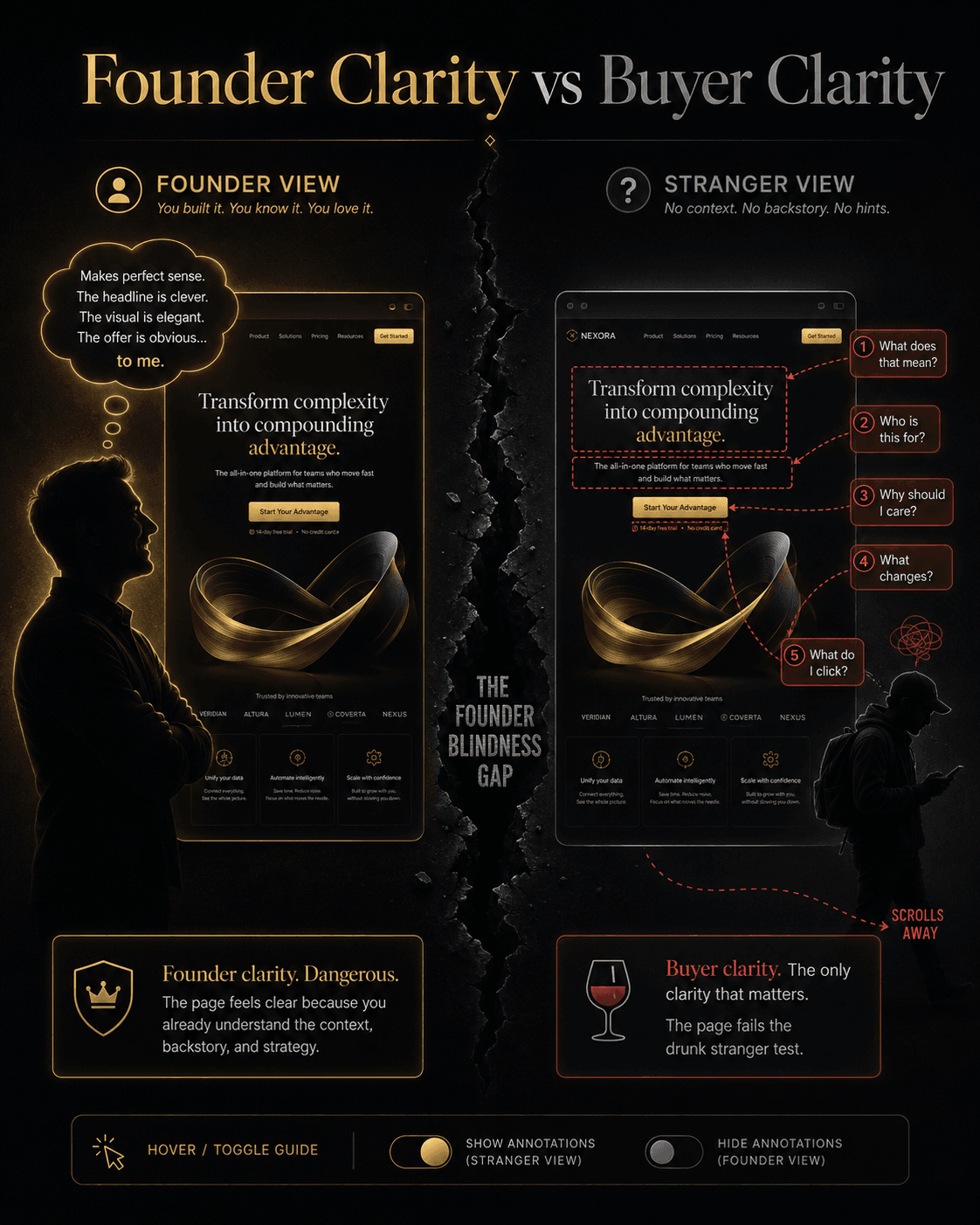
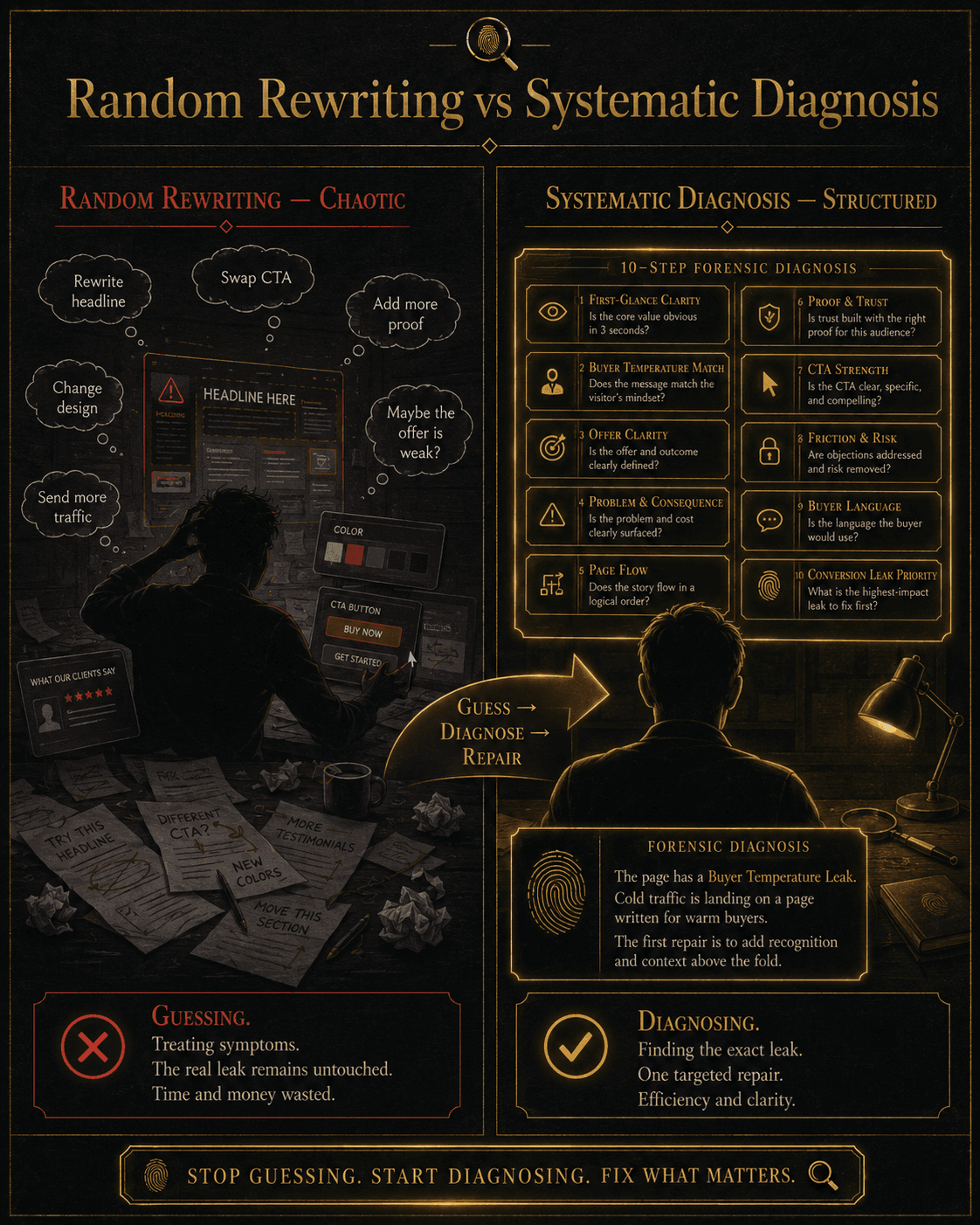
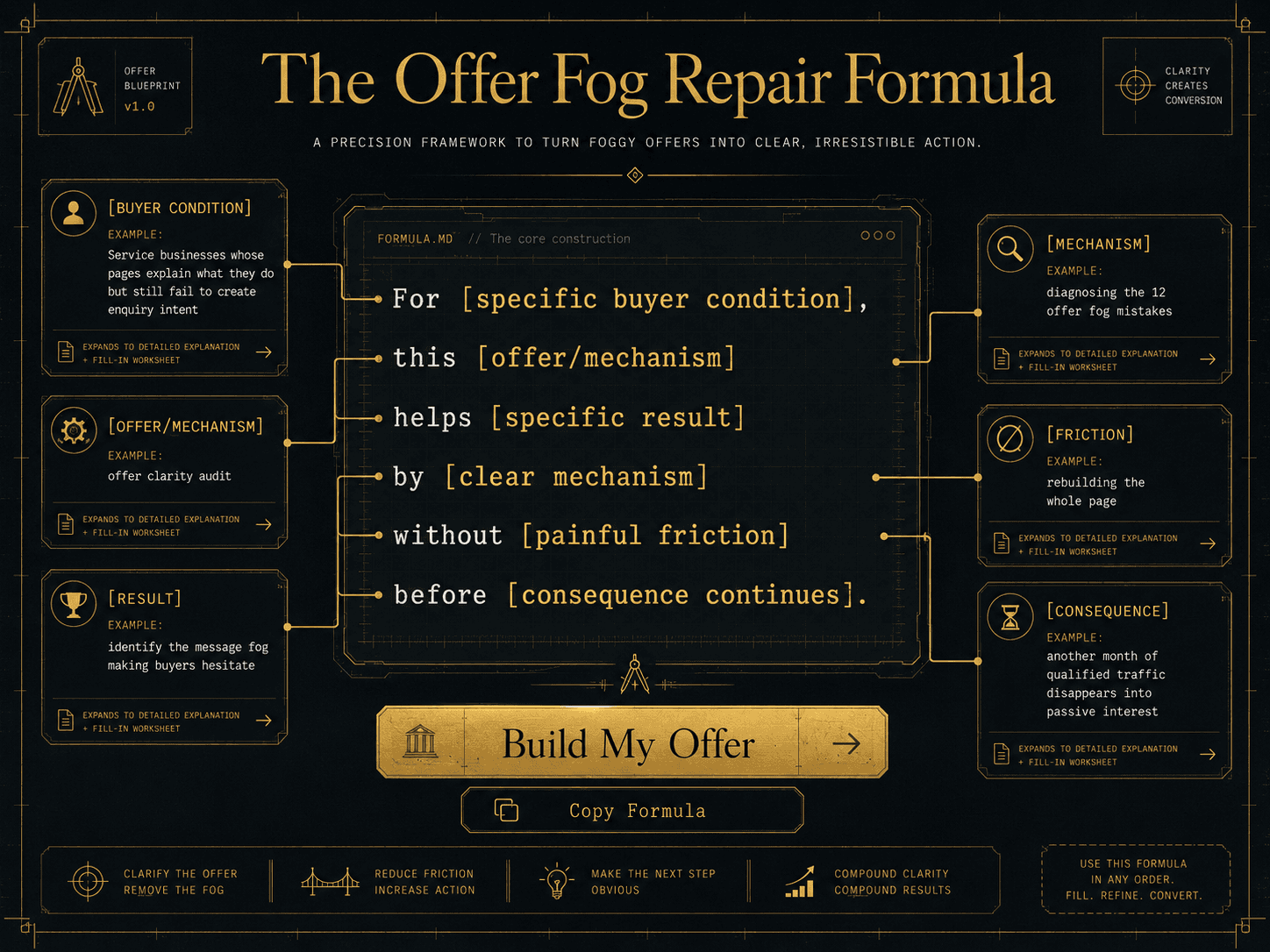
Other Blogs
Other Blogs
Check our other project Blogs with useful insight and information for your businesses