Our Three Step Process
May 26, 2026
Chap 5 | Resource 4 | The Visual Proof Swipe Vault™
Our Three Step Process
May 26, 2026
Chap 5 | Resource 4 | The Visual Proof Swipe Vault™
The Visual Proof Swipe Vault™ A practical collection of proof captions, framing structures, and trust-building language patterns designed to make screenshots, testimonials, and results feel more believable, emotionally weighted, and easier for buyers to trust.
Prefer Audio Or Video?
The Visual Proof Swipe Vault™ is also available as:
🎧 A guided audio walkthrough explaining proof framing, screenshot captions, proof-wall headers, scepticism-reducing lines, emotional proof captions, and CTA-supporting proof language.
🎥 A practical video breakdown with real proof-framing examples, before/after captions, screenshot labels, testimonial intros, proof-wall headers, and visual proof swipe patterns.Choose the format that fits how you learn best.
[Listen To The Audio Walkthrough] (coming soon)
[Watch The Video Breakdown] (coming soon)
——
Why Strong Proof Still Needs Framing
Strong proof is not only about what the buyer sees.
It is also about how the proof is framed.
The same screenshot can feel:
powerful
weak
believable
confusing
emotionally compelling
easy to ignore
trustworthy
staged
specific
vague
depending on the surrounding language.
That matters.
Because buyers do not always know what they are looking at immediately.
A screenshot may show movement, but without context, the buyer may not understand why it matters.
A testimonial may contain a useful result, but without setup, the emotional shift may feel flat.
A dashboard may show improvement, but without a label, the buyer may not know what changed.
A before/after image may show contrast, but without framing, the buyer may miss the significance.
Proof does not always explain itself.
That is why framing matters.
The right caption helps the buyer understand:
what changed
why it matters
why the result feels believable
what emotional shift happened
what doubt the proof reduces
why this result deserves attention
Weak proof framing makes evidence feel like marketing.
Strong proof framing makes evidence feel easier to inspect.
That is the difference.
What This Resource Helps You Do
The Visual Proof Swipe Vault™ helps you frame proof so screenshots, testimonials, videos, results, dashboards, and before/after assets feel clearer, more specific, and more believable.
Use this when:
your proof exists but still feels flat
screenshots get ignored
testimonials feel emotionally weak
your page feels polished but unconvincing
buyers still hesitate despite visible results
your proof lacks context
your captions sound generic
your visuals need stronger trust framing
your proof feels impressive to you but unclear to buyers
your page has results but not enough belief movement
your proof assets need stronger labels, captions, or setup
your CTA needs evidence-backed reassurance
your proof wall feels like clutter instead of conviction
This is not a collection of clever lines.
This is a proof-framing system.
The goal is simple:
Make your evidence easier to understand, harder to dismiss, and psychologically stronger without relying on hype.
The Core Principle™
Frame proof like evidence.
Not advertising.
That is the shift.
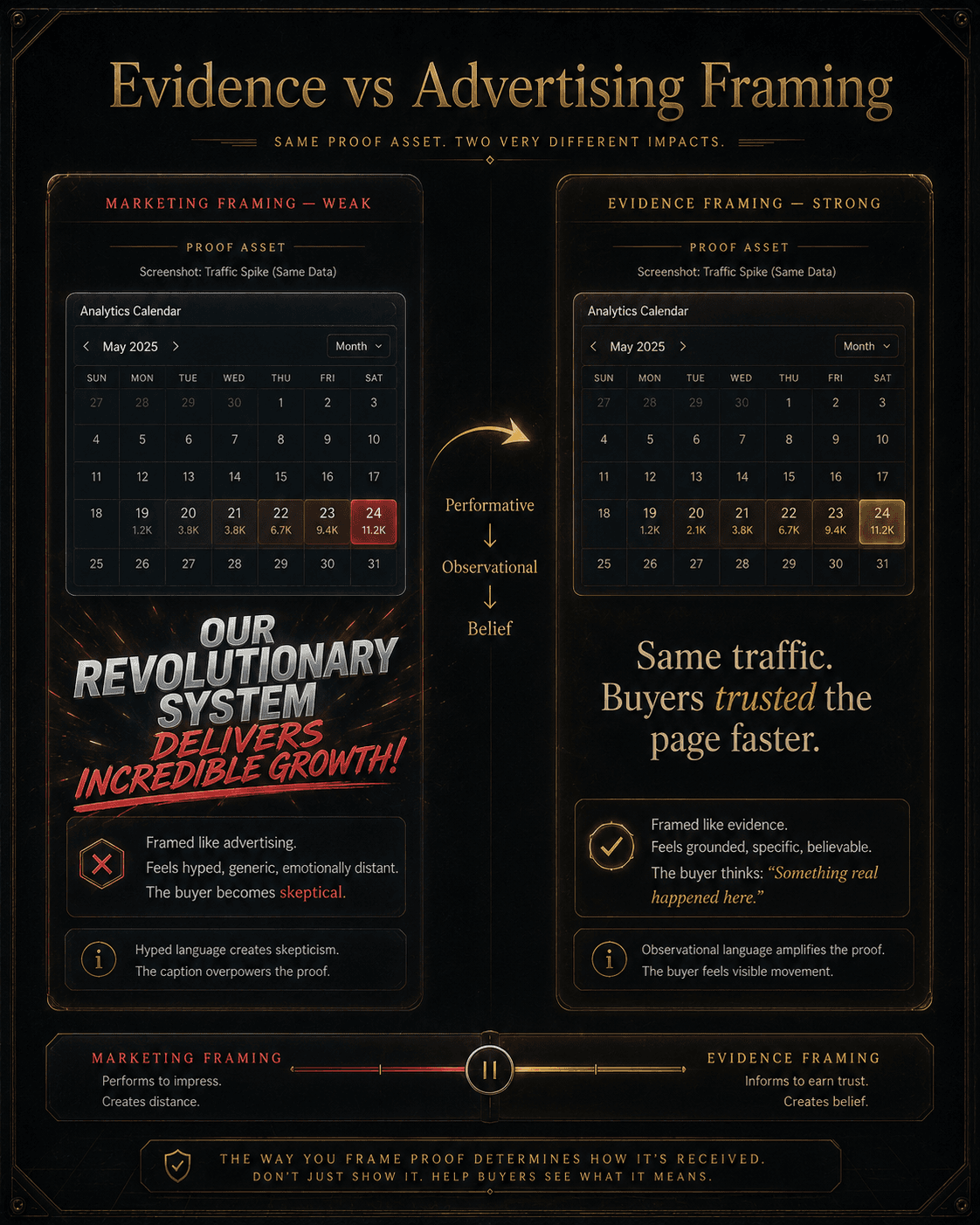
Weak proof framing sounds performative.
Strong proof framing sounds observational.
Weak framing tries to impress the buyer.
Strong framing helps the buyer understand what happened.
Weak framing exaggerates.
Strong framing clarifies.
Weak framing screams:
“Look how amazing this is.”
Strong framing calmly says:
“Here is what changed.”
That is why proof framing works best when it feels clear, grounded, specific, and honest.
The caption should make the proof easier to believe.
Not bigger than it really is.
The Biggest Mistake Most Businesses Make™
Most businesses frame proof like marketing.
Strong proof should feel closer to evidence than advertising.
Huge difference.
Weak framing sounds performative.
Strong framing sounds observational.
Weak Proof Framing Example
“Our revolutionary system delivers incredible growth.”
This feels:
hyped
generic
exaggerated
emotionally distant
difficult to inspect
The buyer has to trust the seller’s excitement.
That is weak.
Stronger Proof Framing Example
“Same traffic. Buyers trusted the page faster.”
Now the buyer feels visible movement.
The line is shorter.
Calmer.
More specific.
More believable.
It tells the buyer what changed without overselling the result.
That changes believability immediately.
The Most Important Rule In This Resource™
The framing should amplify the proof.
Not overpower it.
If the caption feels louder than the evidence itself, trust weakens.
Strong proof framing usually feels:
calm
clear
specific
grounded
observational
buyer-relevant
emotionally accurate
tied to the actual result
The proof should still be the hero.
The caption should help the buyer understand why it matters.
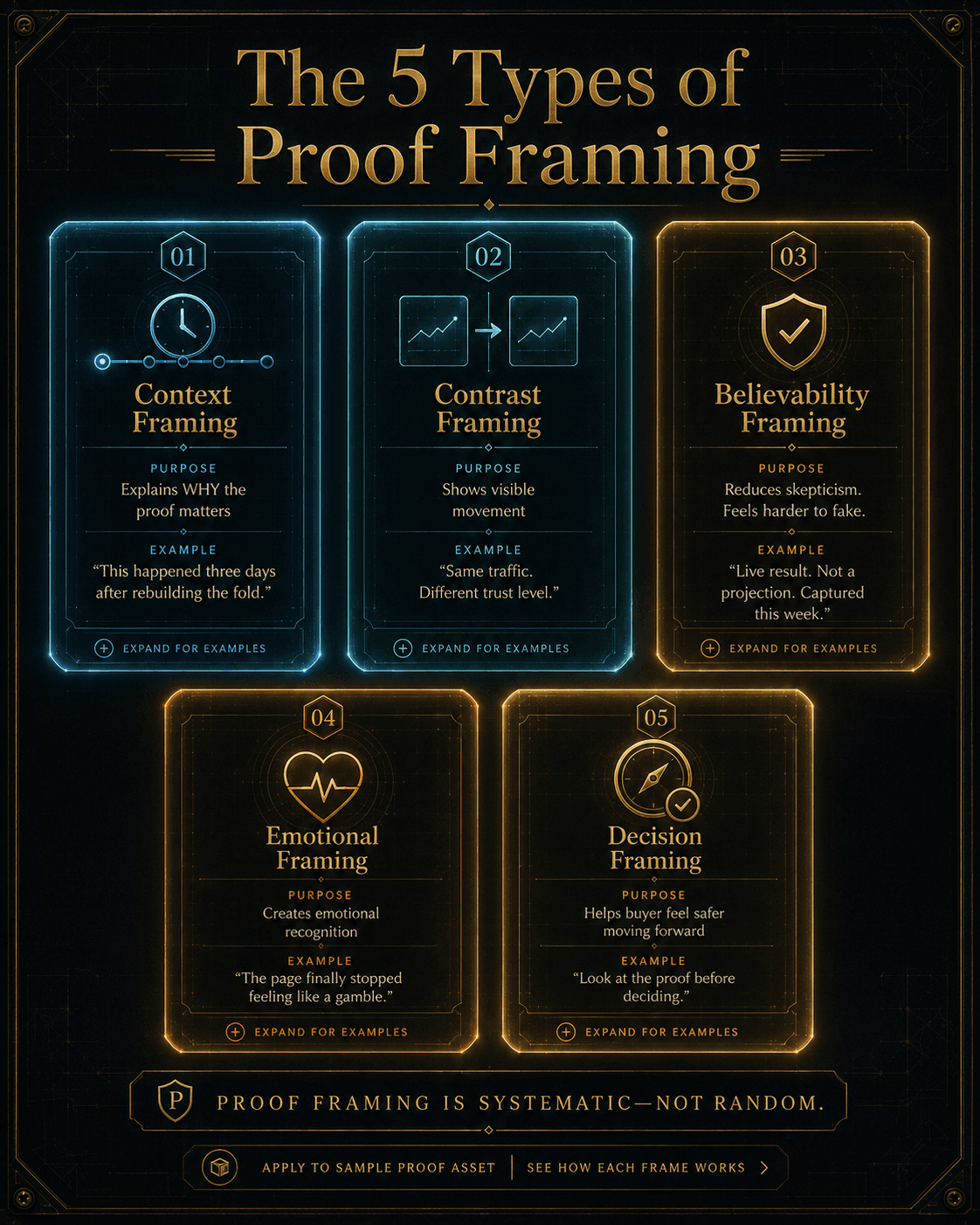
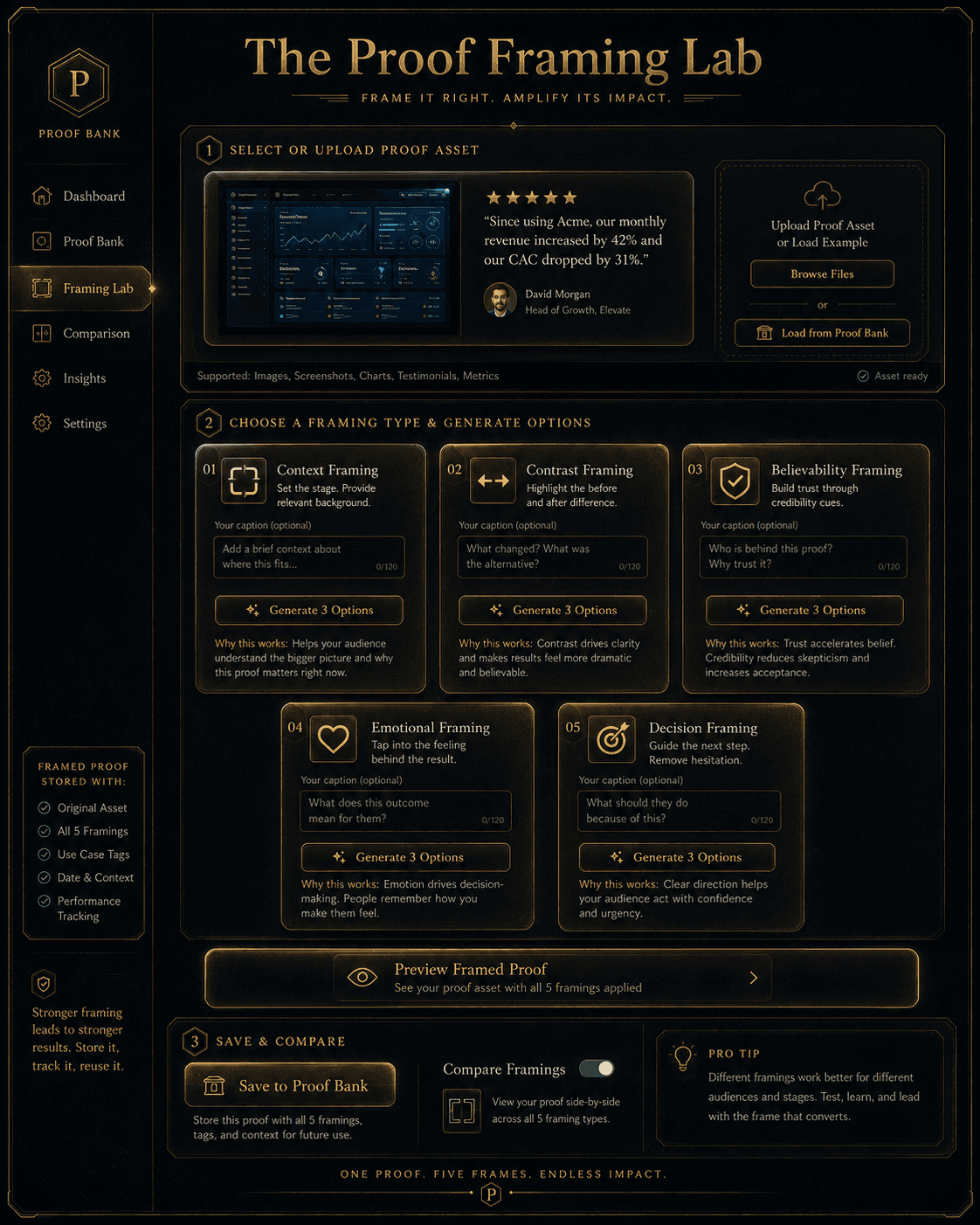
The 5 Types Of Proof Framing™
This framework helps you understand what kind of emotional reaction each proof caption should create.
The five proof-framing types are:
Context Framing™
Contrast Framing™
Believability Framing™
Emotional Framing™
Decision Framing™
Each type does a different job.
Do not use captions randomly.
Use them based on the doubt you want to reduce.
Type 1: Context Framing™
What It Does
Context framing explains why the proof matters.
Without context, many screenshots lose impact.
The buyer may see the visual, but not understand the significance.
Context tells them:
when this happened
what changed before it happened
what situation produced the result
why this proof is relevant
what claim the proof supports
Context turns proof from a random asset into meaningful evidence.
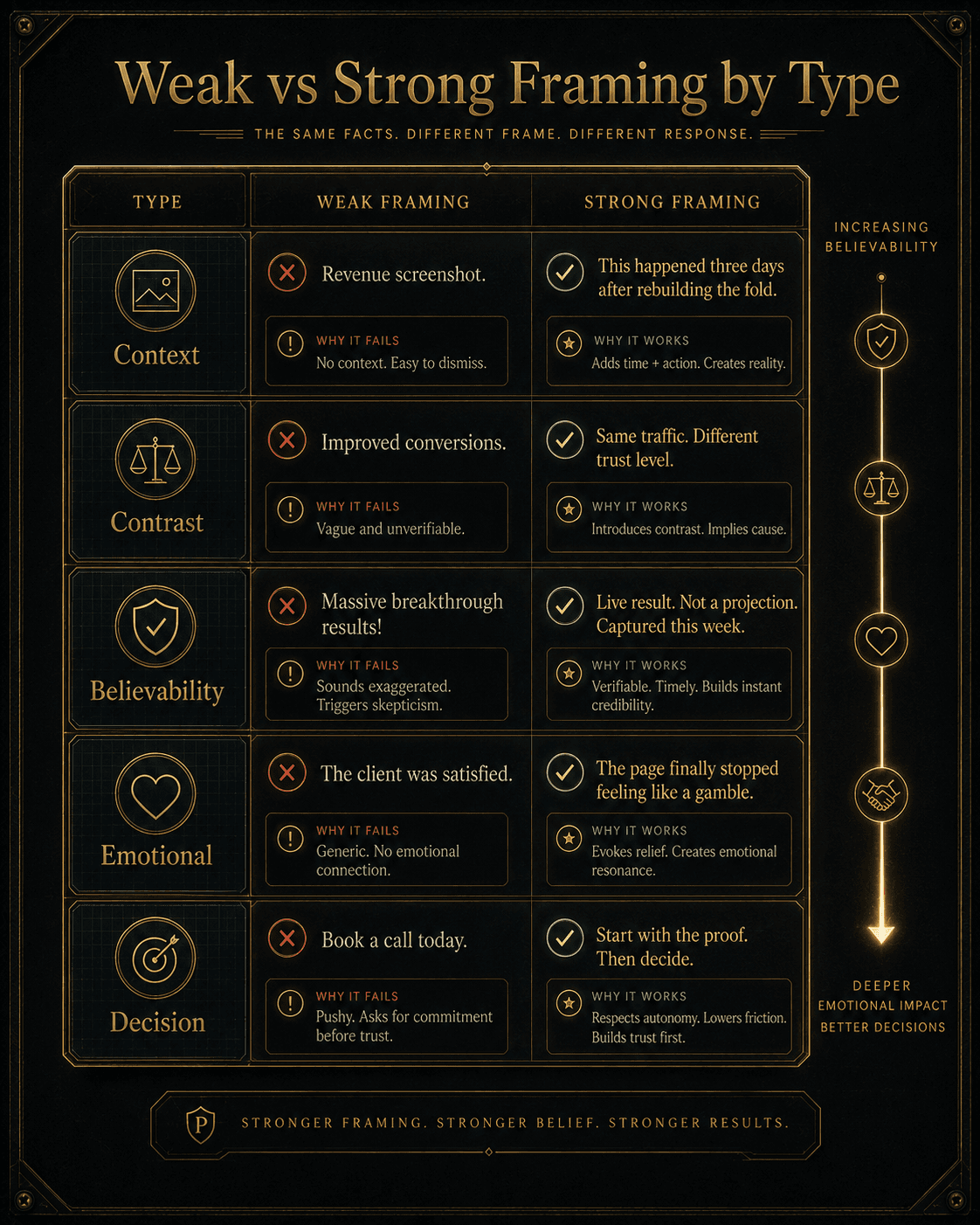
Weak Context Framing
“Revenue screenshot.”
This creates almost no emotional orientation.
The buyer does not know:
when it happened
why it matters
what caused it
whether it is relevant
what they are supposed to notice
The proof may be real, but the meaning is weak.
Strong Context Framing
“This happened three days after rebuilding the fold.”
Now the buyer understands timing and relevance.
The proof has a story.
The result feels connected to an action.
That creates belief movement.
Strong Context Lines
Use or adapt these:
Shortly after launch.
First week after deployment.
Same offer. Different positioning.
Before more traffic was added.
Organic only.
This happened before scaling ads.
The page finally started pulling its weight.
This was the moment trust improved.
No redesign. Just stronger proof and positioning.
What changed after the rewrite.
Captured after the proof stack went live.
Same page. Stronger first screen.
After the offer became easier to understand.
Before the campaign was scaled.
The first visible signal after the page changed.
This was the result after the message became clearer.
The shift started here.
The proof appeared before the explanation was needed.
One change created visible movement.
This is what happened after the page stopped relying on claims alone.
These lines increase meaning.
They help the buyer understand why the proof deserves attention.
Context Framing Worksheet
What proof asset are you framing?
What happened before this proof appeared?
When did this result happen?
What changed before the result appeared?
Why does this proof matter?
Write your context frame:
Type 2: Contrast Framing™
What It Does
Contrast is one of the strongest trust accelerators psychologically.
The buyer quickly sees movement.
Contrast framing shows the gap between:
before and after
old and new
confusion and clarity
traffic and trust
claim and evidence
effort and result
hesitation and movement
Contrast makes proof easier to process because the buyer can see what changed.
Weak Contrast Framing
“Improved conversions.”
Flat.
Vague.
Unclear.
The buyer does not feel the movement.
Strong Contrast Framing
“Same traffic. Different trust level.”
Now the shift becomes emotionally visible.
The buyer understands that the result did not come from simply adding more traffic.
Something changed in belief.
That is stronger.
Strong Contrast Lines
Use or adapt these:
Before the rewrite vs after the rewrite.
Cold traffic. Warmer decisions.
Same audience. Faster trust.
The traffic stayed the same. The hesitation didn’t.
The offer did not change. The clarity did.
Less explanation. More belief.
The page stopped leaking attention here.
This is where the buying resistance dropped.
The result changed before the ad spend did.
The scroll started turning into calls.
Same product. Clearer proof. Faster belief.
More trust from the same traffic.
The page stopped sounding useful and started feeling believable.
From passive interest to visible movement.
From “maybe later” to booked calls.
The message became easier to believe.
Buyers stopped needing so much explanation.
The proof carried what the copy used to over-explain.
The hesitation was visible before. The movement was visible after.
Same offer. Stronger reason to trust it.
Contrast increases certainty.
It helps the buyer see the difference faster.
Contrast Framing Worksheet
What was the before-state?
What was the after-state?
What stayed the same?
What changed?
Why does that contrast matter to the buyer?
Write your contrast frame:
Type 3: Believability Framing™
What It Does
Believability framing reduces scepticism.
It makes the proof feel harder to fake.
This matters because buyers have seen too much polished proof that turned out to be empty.
They have seen:
fake-looking dashboards
over-designed testimonial cards
exaggerated result claims
suspicious screenshots
generic praise with no context
“massive breakthrough” claims with no grounding
Believability framing makes proof feel more real by adding grounding details.
These details can include:
timing
source
context
rawness
native format
realistic scope
permission-safe specificity
what was or was not added
The goal is to lower the buyer’s resistance.
Weak Believability Framing
“Massive breakthrough results!”
This feels salesy.
It asks the buyer to believe the seller’s excitement instead of inspecting the evidence.
Strong Believability Framing
“Captured during the first week after launch.”
Now the result feels grounded.
The buyer understands when it happened.
That makes the proof easier to trust.
Strong Believability Lines
Use or adapt these:
Live result. Not a projection.
Captured this week.
Screenshot taken immediately after deployment.
No paid traffic added.
This came from the same offer.
Raw client screenshot.
Recorded directly after implementation.
Unedited client response.
This was not expected this quickly.
The reaction came before the explanation did.
Pulled from the actual dashboard.
Captured before the campaign was scaled.
Same funnel. Clearer proof structure.
This came from the first version after the rewrite.
Real client message, shared with permission.
No new offer. Just clearer belief architecture.
This was the first visible signal.
Not a mockup. Not a projection.
Captured in the moment, before it became a case study.
The result looked like this before it was polished into a story.
These lines reduce buyer resistance.
They help the proof feel more grounded, real, and inspectable.
Believability Framing Worksheet
What makes this proof real?
What timing, context, source, or native detail can be mentioned?
What should you avoid exaggerating?
What could make this feel harder to fake?
Write your believability frame:
Type 4: Emotional Framing™
What It Does
Strong proof often contains emotion.
That matters because buyers trust human reactions faster than polished marketing language.
Emotional framing helps the buyer understand what the result felt like.
Not just what happened.
It can reveal:
relief
clarity
confidence
reduced stress
less hesitation
restored momentum
trust returning
fear dropping
randomness disappearing
the decision feeling safer
Emotion makes proof more memorable.
It helps the buyer feel the transformation.
Weak Emotional Framing
“The client was satisfied.”
Emotionally dead.
It says something positive happened, but the buyer feels almost nothing.
Strong Emotional Framing
“The page finally stopped feeling like a gamble.”
Now the buyer feels relief.
The proof becomes emotionally recognisable.
That creates belief.
Strong Emotional Framing Lines
Use or adapt these:
This is when the frustration finally broke.
Buyers finally understood the value faster.
The page stopped sounding smart and started selling clearly.
This is where the hesitation disappeared.
The page finally felt trustworthy.
What changed was not the traffic. It was belief.
The message became easier to trust.
This is where things stopped feeling random.
The page finally created movement.
This is what clarity looked like after deployment.
The offer stopped feeling hard to explain.
The decision started feeling safer.
The proof made the promise feel real.
Buyers stopped needing to be convinced so hard.
This was the moment the page felt less risky.
The result finally matched the promise.
The invisible doubt became visible movement.
The page stopped asking for belief and started earning it.
This is where confidence replaced guessing.
The buyer’s uncertainty had less room to grow.
Emotion increases memorability.
It gives proof weight beyond the visible asset.
Emotional Framing Worksheet
What emotion does this proof show?
What frustration disappeared?
What relief appeared?
What buyer feeling does this proof make recognisable?
Write your emotional frame:
Type 5: Decision Framing™
What It Does
Decision framing helps buyers feel safer moving forward.
The proof becomes decision support.
This is especially useful near CTAs, booking prompts, application buttons, demos, checkout sections, and final conversion moments.
Decision framing reduces pressure.
It tells the buyer:
“You do not have to believe blindly. Look at the evidence first.”
That lowers resistance.
And reduced pressure often increases buying comfort.
Weak Decision Framing
“Book a call today.”
Low trust momentum.
This may create action, but it does not create reassurance.
Strong Decision Framing
“Start with the proof. Then decide.”
Now the buyer feels lower pressure.
The page is not forcing a leap.
It is inviting inspection.
That increases trust.
Strong Decision Framing Lines
Use or adapt these:
Look at the proof before deciding.
Evidence first. Decision second.
See what changed before making the call.
The proof is here. The next move is yours.
No pitch. Just the process and evidence.
Judge the result, not the promise.
Start with what buyers actually saw.
This is the asset buyers trusted first.
Review the evidence before the explanation.
One screen. One shift. One clearer decision.
See the proof before you book.
Inspect the result first.
Decide after the evidence.
Watch what changed, then choose the next step.
No pressure. Start with the proof.
The result is easier to believe when you can see it.
Let the evidence do the heavy lifting.
Start with what happened.
Look at the shift before you judge the offer.
Proof first. Promise second.
This framing reduces pressure.
And reduced pressure often increases buying comfort.
Decision Framing Worksheet
Where will this proof appear?
Above Fold / Offer Reveal / Objection Section / Near CTA / Proof Wall / Other
What decision is the buyer considering?
What hesitation needs to be reduced?
How can the proof make the next step feel safer?
Write your decision frame:
Screenshot Caption Swipe Vault™
Use these when placing screenshots on a page.
Adapt every line to the actual result.
Do not imply a result the screenshot cannot honestly support.
Screenshot Captions
Booked without paid ads.
This came from one message change.
Shortly after launch.
Organic only. Monday morning.
Same offer. Sharper message. Different result.
No redesign. No new funnel. Just stronger proof and positioning.
This was the week belief finally caught up.
One asset. Multiple booked calls.
The result hit before the excuses did.
This is what “it worked” actually looked like.
Captured after the page stopped over-explaining.
Same traffic. More visible trust.
The first proof signal after deployment.
What changed when the message became clearer.
The buyer response after the proof was moved closer.
The page started earning belief before the sales call.
This screenshot shows the shift words alone could not carry.
The proof finally matched the claim.
Visible movement from the same offer.
This is where uncertainty started dropping.
Performance / Dashboard Label Swipe Vault™
Use these around metrics, dashboards, analytics, performance graphs, conversion data, and result snapshots.
Performance / Dashboard Labels
Collected this week.
Booked this month.
Day 5 result.
Seven-day snapshot.
First real proof signal.
What changed after the rewrite.
Revenue after deployment.
Booked after install.
Three-hour spike.
Live result, not a projection.
Conversion movement after proof repositioning.
Qualified enquiries after the new fold went live.
First visible lift after the page changed.
Before scaling.
After the proof stack was added.
Same source. Stronger response.
The result after clarity improved.
Not a forecast. Captured in the account.
Movement after the promise became easier to believe.
What trust looked like in the dashboard.
Calendar / Booked Call Label Swipe Vault™
Use these around calendar screenshots, booking proof, consultation requests, pipeline movement, inbound enquiries, or appointment results.
Calendar / Booked Call Labels
Calls booked from a clearer message.
Booked before the week ended.
The page finally started pulling its weight.
This is what the right message does.
Not more traffic. Better conversion.
From quiet pipeline to visible movement.
What a stronger first screen can do.
Cold leads. Warmer calendar.
The scroll became calls.
Result, not theory.
Same audience. More booked conversations.
The trust gap started closing here.
Buyers stopped hesitating before booking.
Proof moved closer. Action followed.
From page visitors to real conversations.
The calendar moved after the doubt dropped.
This is what belief movement looked like.
The offer became easier to act on.
Qualified calls from the same traffic.
The page stopped leaking serious buyers.
Before / After Caption Swipe Vault™
Use these for side-by-side comparisons, page rewrites, message changes, proof stack changes, dashboard shifts, buyer response improvements, and conversion contrasts.
Before / After Captions
Before: clear offer. Weak trust. After: clearer proof. Faster belief.
Same product. Stronger first impression.
Before the buyer had to imagine. After, they could inspect.
From vague promise to visible proof.
The offer did not change. The belief structure did.
Before: too much explanation. After: clearer evidence.
From polished but passive to proof-led and persuasive.
The page stopped relying on claims alone.
Before: interest. After: movement.
From “this sounds useful” to “this looks real.”
Same result. Stronger framing.
Before: unclear reason to trust. After: visible reason to continue.
The message became easier to believe.
From decorative proof to decision support.
Before the proof was buried. After it supported the claim directly.
Less doubt between the promise and the evidence.
The gap between claim and proof finally closed.
From soft praise to specific transformation.
Before: buyers hesitated. After: buyers understood faster.
The shift became visible.
Testimonial Intro Line Swipe Vault™
Use these before testimonials to give the buyer emotional context.
These lines help the reader understand what kind of transformation the testimonial is about before they read it.
Testimonial Intro Lines
Jamie was sceptical. Then this happened.
Before this, the offer looked fine and sold soft.
She did not need more traffic. She needed proof that sold.
He almost delayed again. Good thing he did not.
This was the moment the page stopped feeling like a gamble.
What changed was not the audience. It was belief.
This result did not come from louder copy. It came from clearer proof.
Same business. Different page. Faster trust.
What happened after the proof stack went live:
This is the part buyers care about most: what changed.
The hesitation was real. So was the shift.
Before the result, there was doubt.
This is what changed after the page became easier to trust.
The first win was not more traffic. It was less resistance.
Here is what happened when the offer stopped relying on explanation alone.
The buyer finally saw what the promise meant.
The page did not need to shout louder. It needed to prove faster.
This is what relief sounded like.
The transformation started with a clearer reason to believe.
A small shift in proof created a different buying conversation.
Social Proof Fragment Swipe Vault™
Use these around DMs, comments, Slack messages, WhatsApp screenshots, email replies, community comments, or spontaneous customer reactions.
Social Proof Fragment Labels
Sent before we asked for a testimonial.
Raw reaction after the change went live.
This was the first message after launch.
The response came before the case study.
Unprompted feedback.
The kind of message generic testimonials never capture.
This is what buyer recognition sounded like.
A small message with a big signal.
Captured in the moment.
This was not written for marketing. That is why it matters.
The reaction was immediate.
Real words. Real timing.
This is what changed in their own language.
The proof was already hiding in the message thread.
A spontaneous signal of trust.
No script. Just the reaction.
This is the kind of proof that feels harder to fake.
The emotional shift appeared here first.
The result showed up in the reply.
Proof does not always arrive as a polished testimonial.
Proof Wall Header Swipe Vault™
Use these above testimonial clusters, screenshot walls, proof sections, result collections, or social proof blocks.
Proof Wall Headers
Proof That Makes The Promise Easier To Believe
Real Signals From Real Results
What Changed After The Proof Stack Went Live
Results Buyers Could Actually Inspect
Less Claim. More Evidence.
The Page Started Earning Trust Here
Evidence From The Work, Not Just Praise About It
The Result Became Visible
Proof That Shows The Pattern
Screenshots, Reactions, And Results That Made The Promise Harder To Dismiss
Where The Claim Ends And The Evidence Starts
What Buyers Saw Before They Believed
Results With Context
Proof That Reduces Doubt, Not Just Adds Noise
The Evidence Behind The Promise
Proof That Feels Closer To Reality Than Advertising
Trust Signals With A Job To Do
The Pattern Behind The Result
What Happened After The Page Became Easier To Trust
Belief Built From Evidence
CTA-Supporting Proof Line Swipe Vault™
Use these near CTAs, booking buttons, download prompts, application sections, demo sections, checkout areas, or final decision points.
CTA-Supporting Proof Lines
No pitch. Just the proof and process.
See exactly what changed.
Used to book real calls, not just collect compliments.
This is the asset buyers trusted first.
Look at the proof before you decide.
One screen. One shift. One clearer decision.
The result is easier to believe when you can see it.
Start with the proof. Then judge the promise.
Evidence first. Decision second.
The proof is here. The next move is yours.
Review the shift before you book.
See the result before the conversation.
Start where trust starts.
Inspect the evidence before taking the next step.
Let the proof answer the first doubt.
You do not need to guess. Start with what changed.
The result is visible. The decision is yours.
See what made the promise believable.
No pressure. Just proof first.
The safest next step is to inspect the evidence.
Scepticism-Reducing Proof Lines™
Use these when buyers may distrust the result, doubt the screenshot, or assume the proof is staged.
Scepticism-Reducing Lines
This was captured before the result became a case study.
No new traffic source was added.
The offer stayed the same.
This came from the first week after deployment.
The screenshot is raw because raw is easier to trust.
Shared with permission.
The context matters: this happened after the proof was moved closer to the claim.
This was not the biggest win. It was the first visible signal.
The result was small enough to be believable and strong enough to matter.
This was the moment the pattern started.
Not a mockup.
Not a projection.
Not a polished ad asset.
Just the result in its native environment.
The value is in the timing.
The proof worked because it was inspectable.
The buyer could see the shift without needing another paragraph.
This did not need hype. It needed context.
The screenshot was useful because it showed movement.
The proof became stronger when the framing became calmer.
Emotional Recognition Line Swipe Vault™
Use these when you want proof to feel more human, emotionally weighted, and recognisable.
Emotional Recognition Lines
This is where the frustration finally had an answer.
The result mattered because the doubt had been expensive.
The page stopped feeling like a gamble.
The buyer finally had something real to trust.
The offer stopped feeling invisible.
The proof made the decision feel safer.
The message finally met the buyer where they were.
The uncertainty started losing weight.
The page felt less like a pitch and more like evidence.
Buyers did not need louder claims. They needed clearer proof.
The result gave the promise something to stand on.
This was the moment belief started catching up.
The decision became easier when the result became visible.
The buyer no longer had to imagine everything.
The proof carried the trust the copy could not force.
This is where hesitation started turning into movement.
The result felt real enough to inspect.
The page stopped asking for blind trust.
The emotional shift was relief.
Proof made the next step feel less risky.
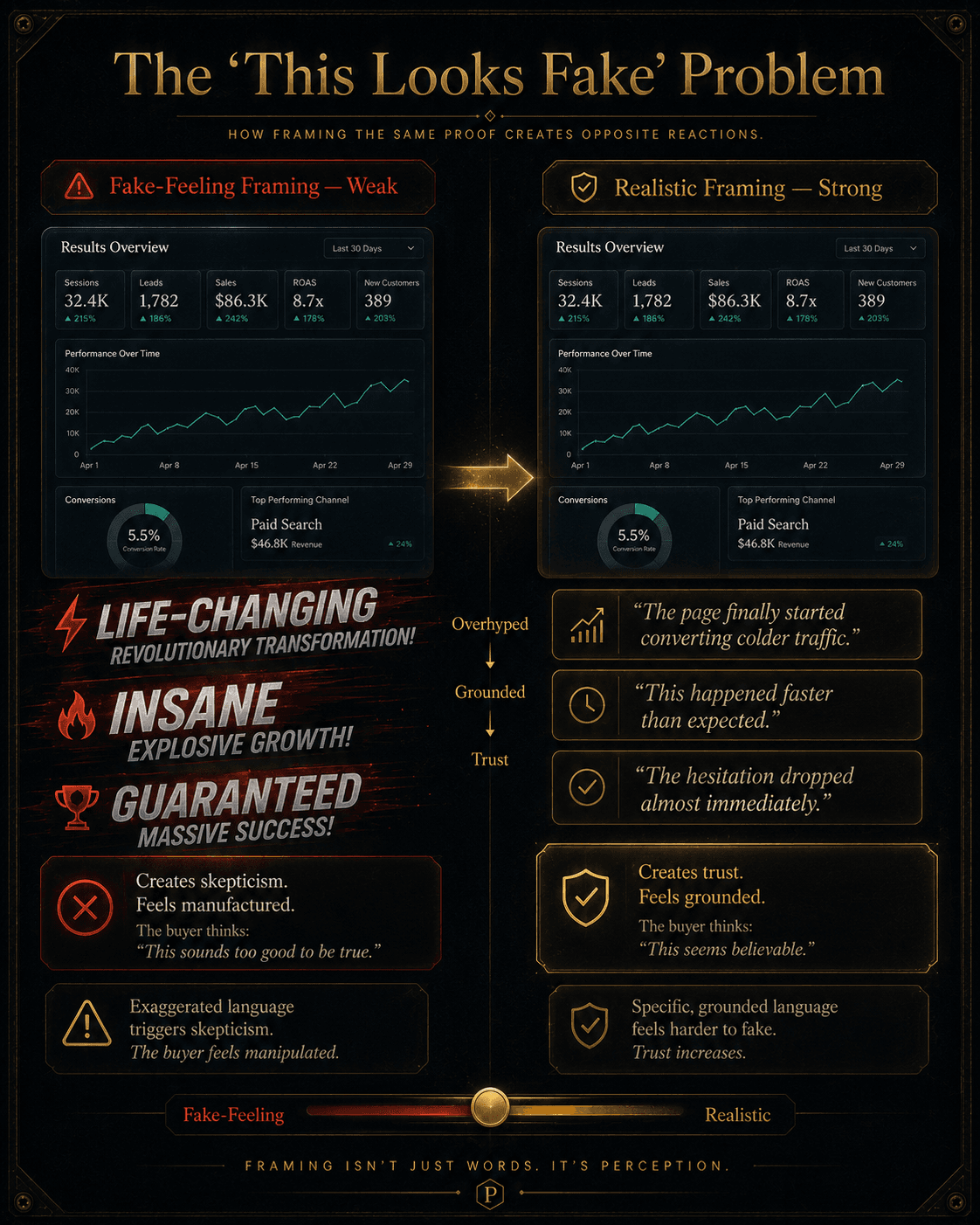
The “This Looks Fake” Problem™
Some proof technically contains results but still feels manufactured.
Usually because the framing sounds too polished, too exaggerated, or too perfect.
That is dangerous.
Because fake-feeling proof does not reduce scepticism.
It increases it.
The buyer may think:
“This sounds staged.”
“This feels edited.”
“This looks too perfect.”
“This does not feel like something that really happened.”
That can damage trust.
Weak Fake-Feeling Framing
Avoid lines like:
Life-changing revolutionary transformation!
Insane explosive growth!
Guaranteed massive success!
Our secret system generated unbelievable results!
The ultimate breakthrough every founder needs!
We completely transformed everything overnight!
Massive growth in record time!
These results will shock you!
This changes the game forever!
The most powerful proof you will ever see!
These create scepticism.
They are too loud.
Too vague.
Too self-congratulatory.
They make the buyer feel sold to.
Strong Realistic Framing
Use grounded lines like:
The page finally started converting colder traffic.
This happened faster than expected.
The hesitation dropped almost immediately.
This was the first week the calendar moved consistently.
The first signal was small, but clear.
Same traffic. Stronger belief.
The buyer response changed before the offer did.
The proof became easier to trust once the context was visible.
This was the moment the page stopped feeling theoretical.
The result was specific enough to matter.
These feel grounded.
That matters enormously.
The Buyer Language Advantage™
The strongest proof captions often sound closer to how buyers naturally speak.
Not how businesses speak internally.
Internal language often sounds abstract.
Buyer language sounds recognisable.
Internal language makes the page feel corporate.
Buyer language makes the page feel human.
Weak Internal Language
“Conversion optimisation increased.”
This may be technically accurate.
But it feels distant.
Strong Buyer Language
“Buyers stopped hesitating before booking.”
Now the buyer feels recognition.
That creates faster belief.
Buyer Language Rewrite Examples
Weak:
“Improved funnel performance.”
Strong:
“The page started turning interest into booked calls.”
Weak:
“Enhanced customer confidence.”
Strong:
“Buyers trusted the next step faster.”
Weak:
“Optimised conversion architecture.”
Strong:
“The page stopped leaking serious buyers.”
Weak:
“Improved message-market alignment.”
Strong:
“The right buyers finally understood why the offer mattered.”
Weak:
“Increased engagement metrics.”
Strong:
“People stopped skimming and started responding.”
Buyer language creates emotional clarity.
Use it wherever possible.
The Screenshot Inspection Rule™
One of the strongest diagnostics in this resource is simple.
Ask:
“Would someone naturally pause to inspect this proof more closely?”
If yes, the proof likely contains:
visible tension
visible movement
consequence
specificity
emotional weight
inspectable evidence
a result the buyer cares about
That is good.
If not, the proof may feel emotionally flat or unclear.
A strong screenshot does not merely appear on the page.
It invites inspection.
The buyer wants to look closer because the proof feels meaningful.
That is a trust signal.
Screenshot Inspection Worksheet
Would someone naturally pause to inspect this proof?
Yes / No / Unsure
What would they notice first?
What visible movement exists?
What consequence does the proof show?
What makes this asset worth inspecting?
What caption would make inspection easier?
The Proof + Caption Formula™
Strong proof framing usually combines three elements:
What changed
Why it matters
Why it feels believable
That is the simplest formula.
Formula
[What changed] + [why it matters] + [why it feels believable]
Example
“Same offer. Sharper first screen. Qualified calls started coming in within the first week.”
That line creates:
contrast
timing
movement
specificity
believability
All together.
More Formula Examples
“Same traffic. Clearer proof. Buyers trusted the next step faster.”
“After the rewrite, the page stopped over-explaining and started producing booked calls from the same audience.”
“Captured in week one after the fold was rebuilt — before any new traffic was added.”
“Before, buyers needed too much explanation. After, the first screen carried more belief.”
“The result was not louder copy. It was clearer evidence placed closer to the claim.”
“Same offer. Less hesitation. More qualified conversations.”
“Raw client response after the new proof stack went live.”
“Buyers did not need a bigger promise. They needed a clearer reason to believe it.”
Proof + Caption Worksheet
What changed?
Why does it matter?
Why does it feel believable?
Write the caption:
The Biggest Swipe Vault Mistake™
Do not blindly copy phrases.
Study:
why the framing works
what emotion it creates
what doubt it reduces
why it feels believable
how it supports the proof asset itself
That is where the real value lives.
A swipe vault is not a shortcut around thinking.
It is a pattern library.
The goal is not to sound clever.
The goal is to make the proof easier to believe.
If the line does not match the actual asset, do not use it.
If the proof does not support the caption, do not exaggerate it.
If the result is small, frame it honestly.
Small and believable is stronger than big and fake.
Proof Framing Quality Check™
Before using any caption, ask:
Does this caption make the proof clearer?
Yes / No
Does it explain why the proof matters?
Yes / No
Does it add believable context?
Yes / No
Does it avoid hype?
Yes / No
Does it feel calm and specific?
Yes / No
Does it match what the proof actually shows?
Yes / No
Does it make the asset easier to inspect?
Yes / No
Does it reduce a real buyer doubt?
Yes / No
If the answer is no, rewrite the caption.
AI Proof Framing Prompt™
Use this prompt to improve proof framing without inventing results.
Prompt
Act as an expert direct-response strategist and landing page conversion specialist.
I am going to give you a proof asset.
Your job is to help me frame it so it feels clearer, more believable, more emotionally relevant, and harder for a sceptical buyer to dismiss.
Do not invent results.
Do not exaggerate.
Do not create claims that the proof cannot honestly support.
First, analyse the proof asset and identify:
What this proof appears to show.
What buyer doubt it could reduce.
What claim it could support.
What context is missing.
What emotional shift it may show.
What makes it believable.
What could make it feel fake or over-polished.
Then generate:
Five context captions.
Five contrast captions.
Five believability captions.
Five emotional framing captions.
Five CTA-supporting decision captions.
Three short labels for the proof asset.
Three proof-wall header options.
Three versions written in natural buyer language.
A warning section explaining what not to imply if the proof does not support it.
Prioritise:
believability
emotional realism
specificity
buyer-language phrasing
trust
clarity
calm confidence
inspectability
Avoid:
hype
exaggerated language
fake urgency
corporate phrasing
overclaiming
manipulative framing
claims not visible in the proof
The goal is to make the proof feel more inspectable, more emotionally relevant, and harder to dismiss.
Here is the proof asset:
[Paste or describe the proof asset here]
Final Proof Framing Worksheet
Use this to frame any proof asset before placing it on the page.
Proof Asset
What is the proof asset?
Asset Type
Screenshot / Testimonial / Video / Dashboard / Calendar / Before-After / DM / Social Proof / Other
Asset type:
What It Shows
What does the proof actually show?
What It Proves
What claim does it support?
Buyer Doubt Reduced
What doubt does this proof reduce?
Context Frame
What context does the buyer need?
Caption:
Contrast Frame
What changed?
Caption:
Believability Frame
What makes this proof feel real?
Caption:
Emotional Frame
What feeling or relief does the proof show?
Caption:
Decision Frame
How can this proof make the next step feel safer?
Caption:
Best Final Caption
Choose the strongest caption:
Why is this the strongest?
Final Execution Challenge™
Take three proof assets from your current business.
For each asset, create:
one context frame
one contrast frame
one emotional frame
one believability frame
one decision-support frame
Then compare the original proof against the framed version.
Ask:
“Does the buyer understand why this matters faster?”
“Does the proof feel more believable?”
“Does the caption reduce doubt without hype?”
“Does the framing make the proof easier to inspect?”
Because proof alone does not always create belief.
Buyers also need help understanding why the evidence matters, what changed, and why the result feels safe enough to trust before making the decision themselves.
——
Final Principle
Proof does not become persuasive just because it exists.
It becomes persuasive when the buyer understands what they are seeing.
That is the job of framing.
A caption is not filler.
A label is not decoration.
A proof header is not just a design element.
Each one should help the buyer understand:
what happened
why it matters
what changed
why it feels real
why it reduces doubt
why the result deserves attention
Weak framing makes proof feel like marketing.
Strong framing makes proof feel like evidence.
That is the shift.
Do not make the caption louder than the proof.
Do not exaggerate what the asset shows.
Do not use hype to compensate for weak evidence.
Instead, make the evidence easier to inspect.
Make the context clearer.
Make the contrast visible.
Make the emotion recognisable.
Make the decision feel safer.
That is what The Visual Proof Swipe Vault™ is designed to help you do.
Because buyers do not only need proof.
They need proof framed in a way that makes belief easier than doubt.
——
From:
The $100M Funnel Playbook. Book I: Foundation Buyer Psychology, Offer Clarity, and the Page Architecture Behind High-Converting Funnels
By Maris Spalins.
——
Copyright Notice
© 2026 The $100M Funnel Playbook / Winyourclients / Maris Spalins. All rights reserved.
This resource, including the frameworks, terminology, examples, scorecards, templates, prompts, methods, and written explanations, is original intellectual property created for The $100M Funnel Playbook. Book I: Foundation — Buyer Psychology, Offer Clarity, And The Page Architecture Behind High-Converting Funnels and published through Winyourclients.
No part of this resource may be copied, reproduced, screenshotted, republished, redistributed, sold, adapted, uploaded, scraped, stored in a database, included in training data, used to train artificial intelligence systems, or used to create derivative commercial or educational materials without prior written permission.
Limited reference, quotation, or sharing is only permitted where the source is clearly and visibly credited.
Any permitted reference must include at least one of the following source credits:
The $100M Funnel Playbook by Maris Spalins
or
Winyourclients — www.winyourclients.com
or
Maris Spalins / Winyourclients
Screenshots, excerpts, summaries, or redistributed versions must not remove, hide, alter, crop out, or obscure the original source, author name, book title, website name, or copyright notice.
This resource is provided for personal learning and implementation only. It is not licensed for resale, republishing, redistribution, AI training, template cloning, course creation, consulting delivery, or commercial reuse without written permission from Maris Spalins or Winyourclients.
For permission requests, licensing, citation approval, or commercial usage enquiries, contact:
Winyourclients
www.winyourclients.com
or
Email directly to Jacob on: help@winyourclients.com
The Visual Proof Swipe Vault™ A practical collection of proof captions, framing structures, and trust-building language patterns designed to make screenshots, testimonials, and results feel more believable, emotionally weighted, and easier for buyers to trust.
Prefer Audio Or Video?
The Visual Proof Swipe Vault™ is also available as:
🎧 A guided audio walkthrough explaining proof framing, screenshot captions, proof-wall headers, scepticism-reducing lines, emotional proof captions, and CTA-supporting proof language.
🎥 A practical video breakdown with real proof-framing examples, before/after captions, screenshot labels, testimonial intros, proof-wall headers, and visual proof swipe patterns.Choose the format that fits how you learn best.
[Listen To The Audio Walkthrough] (coming soon)
[Watch The Video Breakdown] (coming soon)
——
Why Strong Proof Still Needs Framing
Strong proof is not only about what the buyer sees.
It is also about how the proof is framed.
The same screenshot can feel:
powerful
weak
believable
confusing
emotionally compelling
easy to ignore
trustworthy
staged
specific
vague
depending on the surrounding language.
That matters.
Because buyers do not always know what they are looking at immediately.
A screenshot may show movement, but without context, the buyer may not understand why it matters.
A testimonial may contain a useful result, but without setup, the emotional shift may feel flat.
A dashboard may show improvement, but without a label, the buyer may not know what changed.
A before/after image may show contrast, but without framing, the buyer may miss the significance.
Proof does not always explain itself.
That is why framing matters.
The right caption helps the buyer understand:
what changed
why it matters
why the result feels believable
what emotional shift happened
what doubt the proof reduces
why this result deserves attention
Weak proof framing makes evidence feel like marketing.
Strong proof framing makes evidence feel easier to inspect.
That is the difference.
What This Resource Helps You Do
The Visual Proof Swipe Vault™ helps you frame proof so screenshots, testimonials, videos, results, dashboards, and before/after assets feel clearer, more specific, and more believable.
Use this when:
your proof exists but still feels flat
screenshots get ignored
testimonials feel emotionally weak
your page feels polished but unconvincing
buyers still hesitate despite visible results
your proof lacks context
your captions sound generic
your visuals need stronger trust framing
your proof feels impressive to you but unclear to buyers
your page has results but not enough belief movement
your proof assets need stronger labels, captions, or setup
your CTA needs evidence-backed reassurance
your proof wall feels like clutter instead of conviction
This is not a collection of clever lines.
This is a proof-framing system.
The goal is simple:
Make your evidence easier to understand, harder to dismiss, and psychologically stronger without relying on hype.
The Core Principle™
Frame proof like evidence.
Not advertising.
That is the shift.
Weak proof framing sounds performative.
Strong proof framing sounds observational.
Weak framing tries to impress the buyer.
Strong framing helps the buyer understand what happened.
Weak framing exaggerates.
Strong framing clarifies.
Weak framing screams:
“Look how amazing this is.”
Strong framing calmly says:
“Here is what changed.”
That is why proof framing works best when it feels clear, grounded, specific, and honest.
The caption should make the proof easier to believe.
Not bigger than it really is.
The Biggest Mistake Most Businesses Make™
Most businesses frame proof like marketing.
Strong proof should feel closer to evidence than advertising.
Huge difference.
Weak framing sounds performative.
Strong framing sounds observational.
Weak Proof Framing Example
“Our revolutionary system delivers incredible growth.”
This feels:
hyped
generic
exaggerated
emotionally distant
difficult to inspect
The buyer has to trust the seller’s excitement.
That is weak.
Stronger Proof Framing Example
“Same traffic. Buyers trusted the page faster.”
Now the buyer feels visible movement.
The line is shorter.
Calmer.
More specific.
More believable.
It tells the buyer what changed without overselling the result.
That changes believability immediately.
The Most Important Rule In This Resource™
The framing should amplify the proof.
Not overpower it.
If the caption feels louder than the evidence itself, trust weakens.
Strong proof framing usually feels:
calm
clear
specific
grounded
observational
buyer-relevant
emotionally accurate
tied to the actual result
The proof should still be the hero.
The caption should help the buyer understand why it matters.
The 5 Types Of Proof Framing™
This framework helps you understand what kind of emotional reaction each proof caption should create.
The five proof-framing types are:
Context Framing™
Contrast Framing™
Believability Framing™
Emotional Framing™
Decision Framing™
Each type does a different job.
Do not use captions randomly.
Use them based on the doubt you want to reduce.
Type 1: Context Framing™
What It Does
Context framing explains why the proof matters.
Without context, many screenshots lose impact.
The buyer may see the visual, but not understand the significance.
Context tells them:
when this happened
what changed before it happened
what situation produced the result
why this proof is relevant
what claim the proof supports
Context turns proof from a random asset into meaningful evidence.
Weak Context Framing
“Revenue screenshot.”
This creates almost no emotional orientation.
The buyer does not know:
when it happened
why it matters
what caused it
whether it is relevant
what they are supposed to notice
The proof may be real, but the meaning is weak.
Strong Context Framing
“This happened three days after rebuilding the fold.”
Now the buyer understands timing and relevance.
The proof has a story.
The result feels connected to an action.
That creates belief movement.
Strong Context Lines
Use or adapt these:
Shortly after launch.
First week after deployment.
Same offer. Different positioning.
Before more traffic was added.
Organic only.
This happened before scaling ads.
The page finally started pulling its weight.
This was the moment trust improved.
No redesign. Just stronger proof and positioning.
What changed after the rewrite.
Captured after the proof stack went live.
Same page. Stronger first screen.
After the offer became easier to understand.
Before the campaign was scaled.
The first visible signal after the page changed.
This was the result after the message became clearer.
The shift started here.
The proof appeared before the explanation was needed.
One change created visible movement.
This is what happened after the page stopped relying on claims alone.
These lines increase meaning.
They help the buyer understand why the proof deserves attention.
Context Framing Worksheet
What proof asset are you framing?
What happened before this proof appeared?
When did this result happen?
What changed before the result appeared?
Why does this proof matter?
Write your context frame:
Type 2: Contrast Framing™
What It Does
Contrast is one of the strongest trust accelerators psychologically.
The buyer quickly sees movement.
Contrast framing shows the gap between:
before and after
old and new
confusion and clarity
traffic and trust
claim and evidence
effort and result
hesitation and movement
Contrast makes proof easier to process because the buyer can see what changed.
Weak Contrast Framing
“Improved conversions.”
Flat.
Vague.
Unclear.
The buyer does not feel the movement.
Strong Contrast Framing
“Same traffic. Different trust level.”
Now the shift becomes emotionally visible.
The buyer understands that the result did not come from simply adding more traffic.
Something changed in belief.
That is stronger.
Strong Contrast Lines
Use or adapt these:
Before the rewrite vs after the rewrite.
Cold traffic. Warmer decisions.
Same audience. Faster trust.
The traffic stayed the same. The hesitation didn’t.
The offer did not change. The clarity did.
Less explanation. More belief.
The page stopped leaking attention here.
This is where the buying resistance dropped.
The result changed before the ad spend did.
The scroll started turning into calls.
Same product. Clearer proof. Faster belief.
More trust from the same traffic.
The page stopped sounding useful and started feeling believable.
From passive interest to visible movement.
From “maybe later” to booked calls.
The message became easier to believe.
Buyers stopped needing so much explanation.
The proof carried what the copy used to over-explain.
The hesitation was visible before. The movement was visible after.
Same offer. Stronger reason to trust it.
Contrast increases certainty.
It helps the buyer see the difference faster.
Contrast Framing Worksheet
What was the before-state?
What was the after-state?
What stayed the same?
What changed?
Why does that contrast matter to the buyer?
Write your contrast frame:
Type 3: Believability Framing™
What It Does
Believability framing reduces scepticism.
It makes the proof feel harder to fake.
This matters because buyers have seen too much polished proof that turned out to be empty.
They have seen:
fake-looking dashboards
over-designed testimonial cards
exaggerated result claims
suspicious screenshots
generic praise with no context
“massive breakthrough” claims with no grounding
Believability framing makes proof feel more real by adding grounding details.
These details can include:
timing
source
context
rawness
native format
realistic scope
permission-safe specificity
what was or was not added
The goal is to lower the buyer’s resistance.
Weak Believability Framing
“Massive breakthrough results!”
This feels salesy.
It asks the buyer to believe the seller’s excitement instead of inspecting the evidence.
Strong Believability Framing
“Captured during the first week after launch.”
Now the result feels grounded.
The buyer understands when it happened.
That makes the proof easier to trust.
Strong Believability Lines
Use or adapt these:
Live result. Not a projection.
Captured this week.
Screenshot taken immediately after deployment.
No paid traffic added.
This came from the same offer.
Raw client screenshot.
Recorded directly after implementation.
Unedited client response.
This was not expected this quickly.
The reaction came before the explanation did.
Pulled from the actual dashboard.
Captured before the campaign was scaled.
Same funnel. Clearer proof structure.
This came from the first version after the rewrite.
Real client message, shared with permission.
No new offer. Just clearer belief architecture.
This was the first visible signal.
Not a mockup. Not a projection.
Captured in the moment, before it became a case study.
The result looked like this before it was polished into a story.
These lines reduce buyer resistance.
They help the proof feel more grounded, real, and inspectable.
Believability Framing Worksheet
What makes this proof real?
What timing, context, source, or native detail can be mentioned?
What should you avoid exaggerating?
What could make this feel harder to fake?
Write your believability frame:
Type 4: Emotional Framing™
What It Does
Strong proof often contains emotion.
That matters because buyers trust human reactions faster than polished marketing language.
Emotional framing helps the buyer understand what the result felt like.
Not just what happened.
It can reveal:
relief
clarity
confidence
reduced stress
less hesitation
restored momentum
trust returning
fear dropping
randomness disappearing
the decision feeling safer
Emotion makes proof more memorable.
It helps the buyer feel the transformation.
Weak Emotional Framing
“The client was satisfied.”
Emotionally dead.
It says something positive happened, but the buyer feels almost nothing.
Strong Emotional Framing
“The page finally stopped feeling like a gamble.”
Now the buyer feels relief.
The proof becomes emotionally recognisable.
That creates belief.
Strong Emotional Framing Lines
Use or adapt these:
This is when the frustration finally broke.
Buyers finally understood the value faster.
The page stopped sounding smart and started selling clearly.
This is where the hesitation disappeared.
The page finally felt trustworthy.
What changed was not the traffic. It was belief.
The message became easier to trust.
This is where things stopped feeling random.
The page finally created movement.
This is what clarity looked like after deployment.
The offer stopped feeling hard to explain.
The decision started feeling safer.
The proof made the promise feel real.
Buyers stopped needing to be convinced so hard.
This was the moment the page felt less risky.
The result finally matched the promise.
The invisible doubt became visible movement.
The page stopped asking for belief and started earning it.
This is where confidence replaced guessing.
The buyer’s uncertainty had less room to grow.
Emotion increases memorability.
It gives proof weight beyond the visible asset.
Emotional Framing Worksheet
What emotion does this proof show?
What frustration disappeared?
What relief appeared?
What buyer feeling does this proof make recognisable?
Write your emotional frame:
Type 5: Decision Framing™
What It Does
Decision framing helps buyers feel safer moving forward.
The proof becomes decision support.
This is especially useful near CTAs, booking prompts, application buttons, demos, checkout sections, and final conversion moments.
Decision framing reduces pressure.
It tells the buyer:
“You do not have to believe blindly. Look at the evidence first.”
That lowers resistance.
And reduced pressure often increases buying comfort.
Weak Decision Framing
“Book a call today.”
Low trust momentum.
This may create action, but it does not create reassurance.
Strong Decision Framing
“Start with the proof. Then decide.”
Now the buyer feels lower pressure.
The page is not forcing a leap.
It is inviting inspection.
That increases trust.
Strong Decision Framing Lines
Use or adapt these:
Look at the proof before deciding.
Evidence first. Decision second.
See what changed before making the call.
The proof is here. The next move is yours.
No pitch. Just the process and evidence.
Judge the result, not the promise.
Start with what buyers actually saw.
This is the asset buyers trusted first.
Review the evidence before the explanation.
One screen. One shift. One clearer decision.
See the proof before you book.
Inspect the result first.
Decide after the evidence.
Watch what changed, then choose the next step.
No pressure. Start with the proof.
The result is easier to believe when you can see it.
Let the evidence do the heavy lifting.
Start with what happened.
Look at the shift before you judge the offer.
Proof first. Promise second.
This framing reduces pressure.
And reduced pressure often increases buying comfort.
Decision Framing Worksheet
Where will this proof appear?
Above Fold / Offer Reveal / Objection Section / Near CTA / Proof Wall / Other
What decision is the buyer considering?
What hesitation needs to be reduced?
How can the proof make the next step feel safer?
Write your decision frame:
Screenshot Caption Swipe Vault™
Use these when placing screenshots on a page.
Adapt every line to the actual result.
Do not imply a result the screenshot cannot honestly support.
Screenshot Captions
Booked without paid ads.
This came from one message change.
Shortly after launch.
Organic only. Monday morning.
Same offer. Sharper message. Different result.
No redesign. No new funnel. Just stronger proof and positioning.
This was the week belief finally caught up.
One asset. Multiple booked calls.
The result hit before the excuses did.
This is what “it worked” actually looked like.
Captured after the page stopped over-explaining.
Same traffic. More visible trust.
The first proof signal after deployment.
What changed when the message became clearer.
The buyer response after the proof was moved closer.
The page started earning belief before the sales call.
This screenshot shows the shift words alone could not carry.
The proof finally matched the claim.
Visible movement from the same offer.
This is where uncertainty started dropping.
Performance / Dashboard Label Swipe Vault™
Use these around metrics, dashboards, analytics, performance graphs, conversion data, and result snapshots.
Performance / Dashboard Labels
Collected this week.
Booked this month.
Day 5 result.
Seven-day snapshot.
First real proof signal.
What changed after the rewrite.
Revenue after deployment.
Booked after install.
Three-hour spike.
Live result, not a projection.
Conversion movement after proof repositioning.
Qualified enquiries after the new fold went live.
First visible lift after the page changed.
Before scaling.
After the proof stack was added.
Same source. Stronger response.
The result after clarity improved.
Not a forecast. Captured in the account.
Movement after the promise became easier to believe.
What trust looked like in the dashboard.
Calendar / Booked Call Label Swipe Vault™
Use these around calendar screenshots, booking proof, consultation requests, pipeline movement, inbound enquiries, or appointment results.
Calendar / Booked Call Labels
Calls booked from a clearer message.
Booked before the week ended.
The page finally started pulling its weight.
This is what the right message does.
Not more traffic. Better conversion.
From quiet pipeline to visible movement.
What a stronger first screen can do.
Cold leads. Warmer calendar.
The scroll became calls.
Result, not theory.
Same audience. More booked conversations.
The trust gap started closing here.
Buyers stopped hesitating before booking.
Proof moved closer. Action followed.
From page visitors to real conversations.
The calendar moved after the doubt dropped.
This is what belief movement looked like.
The offer became easier to act on.
Qualified calls from the same traffic.
The page stopped leaking serious buyers.
Before / After Caption Swipe Vault™
Use these for side-by-side comparisons, page rewrites, message changes, proof stack changes, dashboard shifts, buyer response improvements, and conversion contrasts.
Before / After Captions
Before: clear offer. Weak trust. After: clearer proof. Faster belief.
Same product. Stronger first impression.
Before the buyer had to imagine. After, they could inspect.
From vague promise to visible proof.
The offer did not change. The belief structure did.
Before: too much explanation. After: clearer evidence.
From polished but passive to proof-led and persuasive.
The page stopped relying on claims alone.
Before: interest. After: movement.
From “this sounds useful” to “this looks real.”
Same result. Stronger framing.
Before: unclear reason to trust. After: visible reason to continue.
The message became easier to believe.
From decorative proof to decision support.
Before the proof was buried. After it supported the claim directly.
Less doubt between the promise and the evidence.
The gap between claim and proof finally closed.
From soft praise to specific transformation.
Before: buyers hesitated. After: buyers understood faster.
The shift became visible.
Testimonial Intro Line Swipe Vault™
Use these before testimonials to give the buyer emotional context.
These lines help the reader understand what kind of transformation the testimonial is about before they read it.
Testimonial Intro Lines
Jamie was sceptical. Then this happened.
Before this, the offer looked fine and sold soft.
She did not need more traffic. She needed proof that sold.
He almost delayed again. Good thing he did not.
This was the moment the page stopped feeling like a gamble.
What changed was not the audience. It was belief.
This result did not come from louder copy. It came from clearer proof.
Same business. Different page. Faster trust.
What happened after the proof stack went live:
This is the part buyers care about most: what changed.
The hesitation was real. So was the shift.
Before the result, there was doubt.
This is what changed after the page became easier to trust.
The first win was not more traffic. It was less resistance.
Here is what happened when the offer stopped relying on explanation alone.
The buyer finally saw what the promise meant.
The page did not need to shout louder. It needed to prove faster.
This is what relief sounded like.
The transformation started with a clearer reason to believe.
A small shift in proof created a different buying conversation.
Social Proof Fragment Swipe Vault™
Use these around DMs, comments, Slack messages, WhatsApp screenshots, email replies, community comments, or spontaneous customer reactions.
Social Proof Fragment Labels
Sent before we asked for a testimonial.
Raw reaction after the change went live.
This was the first message after launch.
The response came before the case study.
Unprompted feedback.
The kind of message generic testimonials never capture.
This is what buyer recognition sounded like.
A small message with a big signal.
Captured in the moment.
This was not written for marketing. That is why it matters.
The reaction was immediate.
Real words. Real timing.
This is what changed in their own language.
The proof was already hiding in the message thread.
A spontaneous signal of trust.
No script. Just the reaction.
This is the kind of proof that feels harder to fake.
The emotional shift appeared here first.
The result showed up in the reply.
Proof does not always arrive as a polished testimonial.
Proof Wall Header Swipe Vault™
Use these above testimonial clusters, screenshot walls, proof sections, result collections, or social proof blocks.
Proof Wall Headers
Proof That Makes The Promise Easier To Believe
Real Signals From Real Results
What Changed After The Proof Stack Went Live
Results Buyers Could Actually Inspect
Less Claim. More Evidence.
The Page Started Earning Trust Here
Evidence From The Work, Not Just Praise About It
The Result Became Visible
Proof That Shows The Pattern
Screenshots, Reactions, And Results That Made The Promise Harder To Dismiss
Where The Claim Ends And The Evidence Starts
What Buyers Saw Before They Believed
Results With Context
Proof That Reduces Doubt, Not Just Adds Noise
The Evidence Behind The Promise
Proof That Feels Closer To Reality Than Advertising
Trust Signals With A Job To Do
The Pattern Behind The Result
What Happened After The Page Became Easier To Trust
Belief Built From Evidence
CTA-Supporting Proof Line Swipe Vault™
Use these near CTAs, booking buttons, download prompts, application sections, demo sections, checkout areas, or final decision points.
CTA-Supporting Proof Lines
No pitch. Just the proof and process.
See exactly what changed.
Used to book real calls, not just collect compliments.
This is the asset buyers trusted first.
Look at the proof before you decide.
One screen. One shift. One clearer decision.
The result is easier to believe when you can see it.
Start with the proof. Then judge the promise.
Evidence first. Decision second.
The proof is here. The next move is yours.
Review the shift before you book.
See the result before the conversation.
Start where trust starts.
Inspect the evidence before taking the next step.
Let the proof answer the first doubt.
You do not need to guess. Start with what changed.
The result is visible. The decision is yours.
See what made the promise believable.
No pressure. Just proof first.
The safest next step is to inspect the evidence.
Scepticism-Reducing Proof Lines™
Use these when buyers may distrust the result, doubt the screenshot, or assume the proof is staged.
Scepticism-Reducing Lines
This was captured before the result became a case study.
No new traffic source was added.
The offer stayed the same.
This came from the first week after deployment.
The screenshot is raw because raw is easier to trust.
Shared with permission.
The context matters: this happened after the proof was moved closer to the claim.
This was not the biggest win. It was the first visible signal.
The result was small enough to be believable and strong enough to matter.
This was the moment the pattern started.
Not a mockup.
Not a projection.
Not a polished ad asset.
Just the result in its native environment.
The value is in the timing.
The proof worked because it was inspectable.
The buyer could see the shift without needing another paragraph.
This did not need hype. It needed context.
The screenshot was useful because it showed movement.
The proof became stronger when the framing became calmer.
Emotional Recognition Line Swipe Vault™
Use these when you want proof to feel more human, emotionally weighted, and recognisable.
Emotional Recognition Lines
This is where the frustration finally had an answer.
The result mattered because the doubt had been expensive.
The page stopped feeling like a gamble.
The buyer finally had something real to trust.
The offer stopped feeling invisible.
The proof made the decision feel safer.
The message finally met the buyer where they were.
The uncertainty started losing weight.
The page felt less like a pitch and more like evidence.
Buyers did not need louder claims. They needed clearer proof.
The result gave the promise something to stand on.
This was the moment belief started catching up.
The decision became easier when the result became visible.
The buyer no longer had to imagine everything.
The proof carried the trust the copy could not force.
This is where hesitation started turning into movement.
The result felt real enough to inspect.
The page stopped asking for blind trust.
The emotional shift was relief.
Proof made the next step feel less risky.
The “This Looks Fake” Problem™
Some proof technically contains results but still feels manufactured.
Usually because the framing sounds too polished, too exaggerated, or too perfect.
That is dangerous.
Because fake-feeling proof does not reduce scepticism.
It increases it.
The buyer may think:
“This sounds staged.”
“This feels edited.”
“This looks too perfect.”
“This does not feel like something that really happened.”
That can damage trust.
Weak Fake-Feeling Framing
Avoid lines like:
Life-changing revolutionary transformation!
Insane explosive growth!
Guaranteed massive success!
Our secret system generated unbelievable results!
The ultimate breakthrough every founder needs!
We completely transformed everything overnight!
Massive growth in record time!
These results will shock you!
This changes the game forever!
The most powerful proof you will ever see!
These create scepticism.
They are too loud.
Too vague.
Too self-congratulatory.
They make the buyer feel sold to.
Strong Realistic Framing
Use grounded lines like:
The page finally started converting colder traffic.
This happened faster than expected.
The hesitation dropped almost immediately.
This was the first week the calendar moved consistently.
The first signal was small, but clear.
Same traffic. Stronger belief.
The buyer response changed before the offer did.
The proof became easier to trust once the context was visible.
This was the moment the page stopped feeling theoretical.
The result was specific enough to matter.
These feel grounded.
That matters enormously.
The Buyer Language Advantage™
The strongest proof captions often sound closer to how buyers naturally speak.
Not how businesses speak internally.
Internal language often sounds abstract.
Buyer language sounds recognisable.
Internal language makes the page feel corporate.
Buyer language makes the page feel human.
Weak Internal Language
“Conversion optimisation increased.”
This may be technically accurate.
But it feels distant.
Strong Buyer Language
“Buyers stopped hesitating before booking.”
Now the buyer feels recognition.
That creates faster belief.
Buyer Language Rewrite Examples
Weak:
“Improved funnel performance.”
Strong:
“The page started turning interest into booked calls.”
Weak:
“Enhanced customer confidence.”
Strong:
“Buyers trusted the next step faster.”
Weak:
“Optimised conversion architecture.”
Strong:
“The page stopped leaking serious buyers.”
Weak:
“Improved message-market alignment.”
Strong:
“The right buyers finally understood why the offer mattered.”
Weak:
“Increased engagement metrics.”
Strong:
“People stopped skimming and started responding.”
Buyer language creates emotional clarity.
Use it wherever possible.
The Screenshot Inspection Rule™
One of the strongest diagnostics in this resource is simple.
Ask:
“Would someone naturally pause to inspect this proof more closely?”
If yes, the proof likely contains:
visible tension
visible movement
consequence
specificity
emotional weight
inspectable evidence
a result the buyer cares about
That is good.
If not, the proof may feel emotionally flat or unclear.
A strong screenshot does not merely appear on the page.
It invites inspection.
The buyer wants to look closer because the proof feels meaningful.
That is a trust signal.
Screenshot Inspection Worksheet
Would someone naturally pause to inspect this proof?
Yes / No / Unsure
What would they notice first?
What visible movement exists?
What consequence does the proof show?
What makes this asset worth inspecting?
What caption would make inspection easier?
The Proof + Caption Formula™
Strong proof framing usually combines three elements:
What changed
Why it matters
Why it feels believable
That is the simplest formula.
Formula
[What changed] + [why it matters] + [why it feels believable]
Example
“Same offer. Sharper first screen. Qualified calls started coming in within the first week.”
That line creates:
contrast
timing
movement
specificity
believability
All together.
More Formula Examples
“Same traffic. Clearer proof. Buyers trusted the next step faster.”
“After the rewrite, the page stopped over-explaining and started producing booked calls from the same audience.”
“Captured in week one after the fold was rebuilt — before any new traffic was added.”
“Before, buyers needed too much explanation. After, the first screen carried more belief.”
“The result was not louder copy. It was clearer evidence placed closer to the claim.”
“Same offer. Less hesitation. More qualified conversations.”
“Raw client response after the new proof stack went live.”
“Buyers did not need a bigger promise. They needed a clearer reason to believe it.”
Proof + Caption Worksheet
What changed?
Why does it matter?
Why does it feel believable?
Write the caption:
The Biggest Swipe Vault Mistake™
Do not blindly copy phrases.
Study:
why the framing works
what emotion it creates
what doubt it reduces
why it feels believable
how it supports the proof asset itself
That is where the real value lives.
A swipe vault is not a shortcut around thinking.
It is a pattern library.
The goal is not to sound clever.
The goal is to make the proof easier to believe.
If the line does not match the actual asset, do not use it.
If the proof does not support the caption, do not exaggerate it.
If the result is small, frame it honestly.
Small and believable is stronger than big and fake.
Proof Framing Quality Check™
Before using any caption, ask:
Does this caption make the proof clearer?
Yes / No
Does it explain why the proof matters?
Yes / No
Does it add believable context?
Yes / No
Does it avoid hype?
Yes / No
Does it feel calm and specific?
Yes / No
Does it match what the proof actually shows?
Yes / No
Does it make the asset easier to inspect?
Yes / No
Does it reduce a real buyer doubt?
Yes / No
If the answer is no, rewrite the caption.
AI Proof Framing Prompt™
Use this prompt to improve proof framing without inventing results.
Prompt
Act as an expert direct-response strategist and landing page conversion specialist.
I am going to give you a proof asset.
Your job is to help me frame it so it feels clearer, more believable, more emotionally relevant, and harder for a sceptical buyer to dismiss.
Do not invent results.
Do not exaggerate.
Do not create claims that the proof cannot honestly support.
First, analyse the proof asset and identify:
What this proof appears to show.
What buyer doubt it could reduce.
What claim it could support.
What context is missing.
What emotional shift it may show.
What makes it believable.
What could make it feel fake or over-polished.
Then generate:
Five context captions.
Five contrast captions.
Five believability captions.
Five emotional framing captions.
Five CTA-supporting decision captions.
Three short labels for the proof asset.
Three proof-wall header options.
Three versions written in natural buyer language.
A warning section explaining what not to imply if the proof does not support it.
Prioritise:
believability
emotional realism
specificity
buyer-language phrasing
trust
clarity
calm confidence
inspectability
Avoid:
hype
exaggerated language
fake urgency
corporate phrasing
overclaiming
manipulative framing
claims not visible in the proof
The goal is to make the proof feel more inspectable, more emotionally relevant, and harder to dismiss.
Here is the proof asset:
[Paste or describe the proof asset here]
Final Proof Framing Worksheet
Use this to frame any proof asset before placing it on the page.
Proof Asset
What is the proof asset?
Asset Type
Screenshot / Testimonial / Video / Dashboard / Calendar / Before-After / DM / Social Proof / Other
Asset type:
What It Shows
What does the proof actually show?
What It Proves
What claim does it support?
Buyer Doubt Reduced
What doubt does this proof reduce?
Context Frame
What context does the buyer need?
Caption:
Contrast Frame
What changed?
Caption:
Believability Frame
What makes this proof feel real?
Caption:
Emotional Frame
What feeling or relief does the proof show?
Caption:
Decision Frame
How can this proof make the next step feel safer?
Caption:
Best Final Caption
Choose the strongest caption:
Why is this the strongest?
Final Execution Challenge™
Take three proof assets from your current business.
For each asset, create:
one context frame
one contrast frame
one emotional frame
one believability frame
one decision-support frame
Then compare the original proof against the framed version.
Ask:
“Does the buyer understand why this matters faster?”
“Does the proof feel more believable?”
“Does the caption reduce doubt without hype?”
“Does the framing make the proof easier to inspect?”
Because proof alone does not always create belief.
Buyers also need help understanding why the evidence matters, what changed, and why the result feels safe enough to trust before making the decision themselves.
——
Final Principle
Proof does not become persuasive just because it exists.
It becomes persuasive when the buyer understands what they are seeing.
That is the job of framing.
A caption is not filler.
A label is not decoration.
A proof header is not just a design element.
Each one should help the buyer understand:
what happened
why it matters
what changed
why it feels real
why it reduces doubt
why the result deserves attention
Weak framing makes proof feel like marketing.
Strong framing makes proof feel like evidence.
That is the shift.
Do not make the caption louder than the proof.
Do not exaggerate what the asset shows.
Do not use hype to compensate for weak evidence.
Instead, make the evidence easier to inspect.
Make the context clearer.
Make the contrast visible.
Make the emotion recognisable.
Make the decision feel safer.
That is what The Visual Proof Swipe Vault™ is designed to help you do.
Because buyers do not only need proof.
They need proof framed in a way that makes belief easier than doubt.
——
From:
The $100M Funnel Playbook. Book I: Foundation Buyer Psychology, Offer Clarity, and the Page Architecture Behind High-Converting Funnels
By Maris Spalins.
——
Copyright Notice
© 2026 The $100M Funnel Playbook / Winyourclients / Maris Spalins. All rights reserved.
This resource, including the frameworks, terminology, examples, scorecards, templates, prompts, methods, and written explanations, is original intellectual property created for The $100M Funnel Playbook. Book I: Foundation — Buyer Psychology, Offer Clarity, And The Page Architecture Behind High-Converting Funnels and published through Winyourclients.
No part of this resource may be copied, reproduced, screenshotted, republished, redistributed, sold, adapted, uploaded, scraped, stored in a database, included in training data, used to train artificial intelligence systems, or used to create derivative commercial or educational materials without prior written permission.
Limited reference, quotation, or sharing is only permitted where the source is clearly and visibly credited.
Any permitted reference must include at least one of the following source credits:
The $100M Funnel Playbook by Maris Spalins
or
Winyourclients — www.winyourclients.com
or
Maris Spalins / Winyourclients
Screenshots, excerpts, summaries, or redistributed versions must not remove, hide, alter, crop out, or obscure the original source, author name, book title, website name, or copyright notice.
This resource is provided for personal learning and implementation only. It is not licensed for resale, republishing, redistribution, AI training, template cloning, course creation, consulting delivery, or commercial reuse without written permission from Maris Spalins or Winyourclients.
For permission requests, licensing, citation approval, or commercial usage enquiries, contact:
Winyourclients
www.winyourclients.com
or
Email directly to Jacob on: help@winyourclients.com
Other Blogs
Other Blogs
Check our other project Blogs with useful insight and information for your businesses
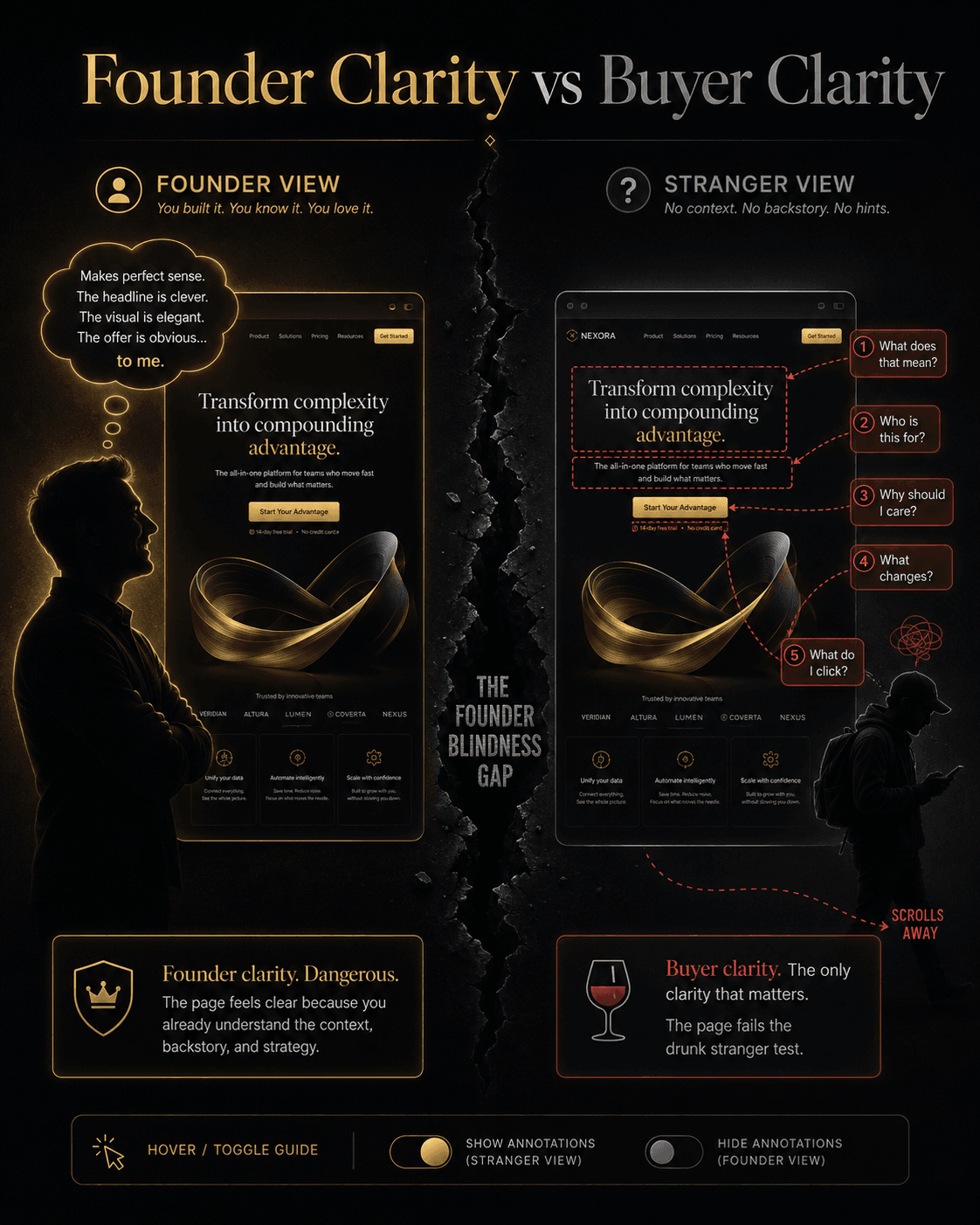

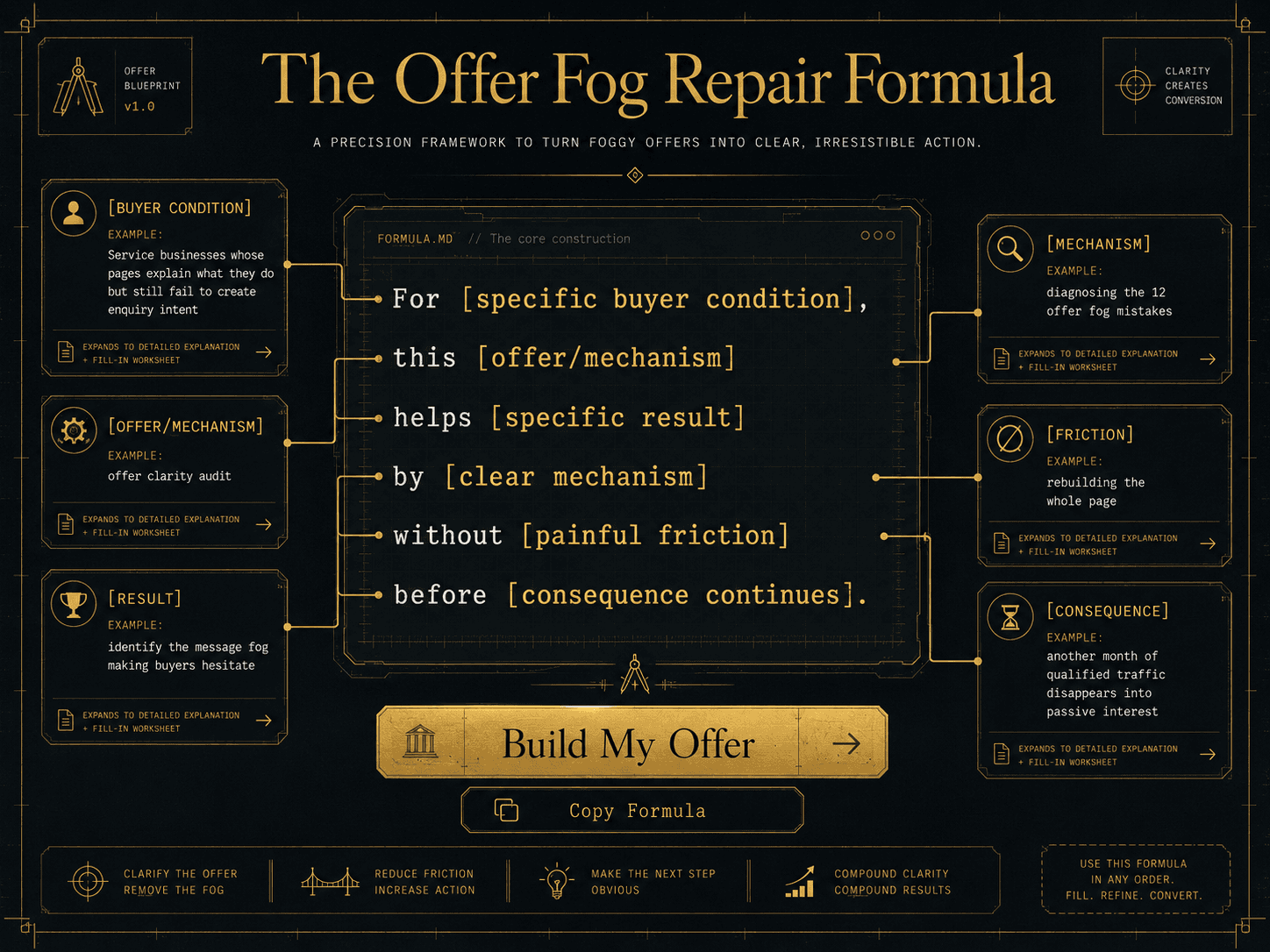
Other Blogs
Other Blogs
Check our other project Blogs with useful insight and information for your businesses