Our Three Step Process
May 26, 2026
Chap 5 | Resource 1 | The Visual Proof Bank Builder™
Our Three Step Process
May 26, 2026
Chap 5 | Resource 1 | The Visual Proof Bank Builder™
The Visual Proof Bank Builder™ A practical proof collection system for collecting, organising, prioritising, and strengthening screenshots, testimonials, before/after assets, social proof fragments, and walkthrough evidence before your page asks the buyer to trust the claim.
Prefer Audio Or Video?
The Visual Proof Bank Builder™ is also available as:
🎧 A guided audio walkthrough explaining how to build a visual proof bank, map buyer doubts, collect proof assets, score proof strength, and organise evidence before building the page.
🎥 A practical video breakdown with real proof-bank examples, screenshot proof, before/after proof, testimonial assets, truth anchors, and proof-strength scoring.Choose the format that fits how you learn best.
[Listen To The Audio Walkthrough] (coming soon)
[Watch The Video Breakdown] (coming soon)
——
Why Most Pages Ask For Trust Too Early
Most pages do not fail because the copy is weak.
They fail because the buyer still feels uncertain.
That uncertainty grows fast when:
claims appear without evidence
testimonials feel generic
screenshots feel random
proof feels staged
visuals decorate instead of convince
the page asks for trust before earning it
promises sound sharp but remain unsupported
results are described but not made visible
the buyer has to imagine too much
That is the real problem.
The page may sound persuasive.
The offer may be strong.
The headline may be clear.
The subheadline may explain the value.
But if the buyer still feels:
“Is this real?”
“Can I trust this?”
“Has this actually worked?”
“Will this work for someone like me?”
“What happens after I buy?”
then the page is still asking the buyer to carry too much uncertainty alone.
That is where proof comes in.
Proof does not exist to make the page look impressive.
Proof exists to reduce doubt.
A strong page does not merely claim value.
It shows enough reality for belief to begin.
What This Resource Helps You Do
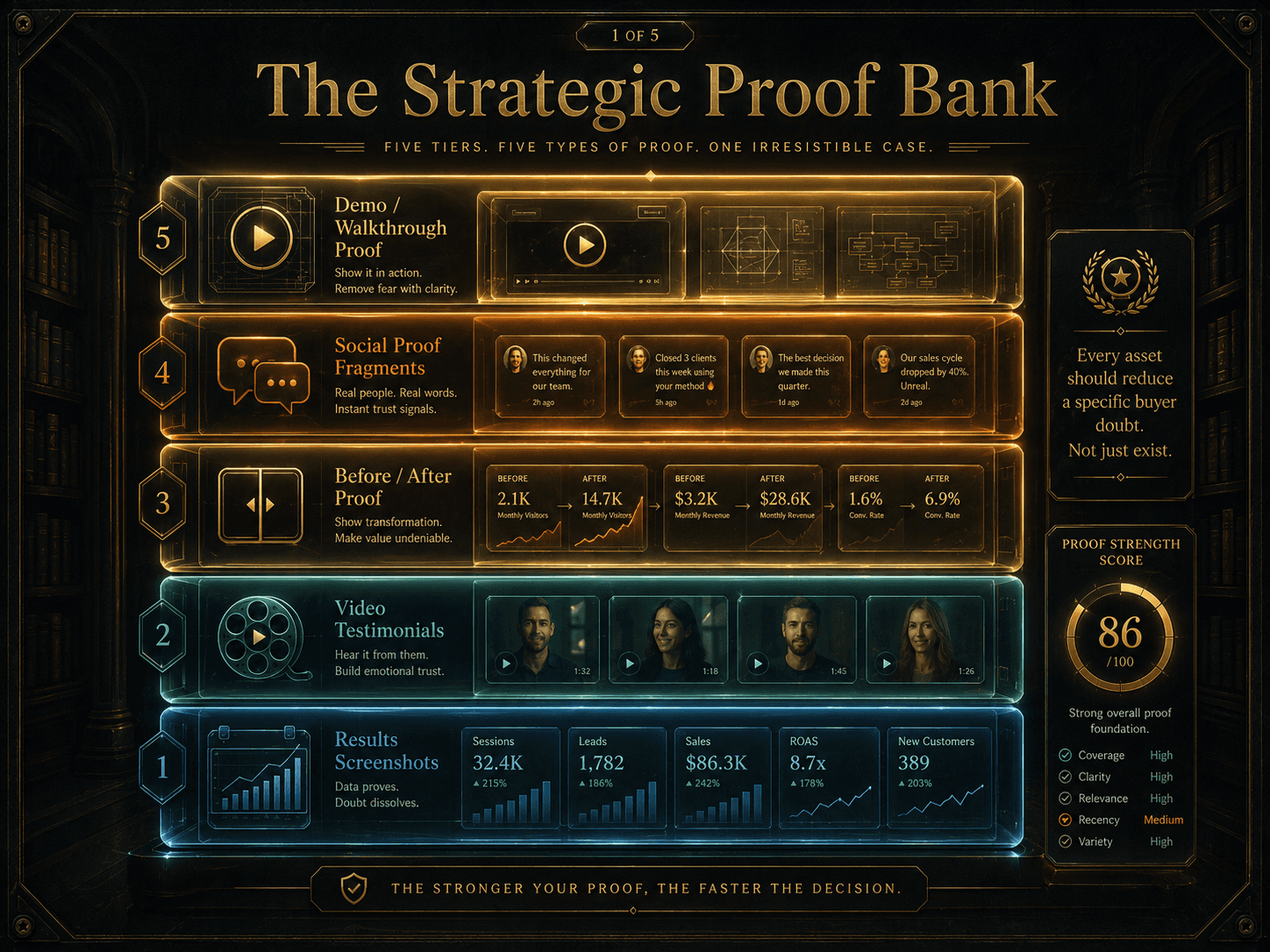
The Visual Proof Bank Builder™ helps you collect, organise, prioritise, and strengthen proof assets before your page ever asks the buyer to trust the claim.
Use this when:
your page sounds convincing but still feels risky
your testimonials feel weak or generic
you struggle proving results clearly
your proof assets are scattered everywhere
your screenshots feel unimpressive
your offer gets interest but low trust
your buyers still hesitate before deciding
you are building a page before collecting evidence properly
your proof feels decorative instead of persuasive
your visuals look polished but do not reduce doubt
you have client wins but no system for capturing them
your page relies too heavily on claims
your proof is hidden in DMs, screenshots, folders, emails, or memory
This is not a screenshot folder.
This is a belief-building system.
The goal is simple:
Build a proof bank strong enough that the page stops asking for trust and starts earning it visually.
The Real Job Of A Proof Bank™
A proof bank is not storage.
It is a strategic evidence library.
That distinction matters.
A folder of random screenshots is not a proof bank.
A collection of generic testimonials is not a proof bank.
A page full of vague praise is not a proof bank.
A real proof bank is organised around buyer doubt.
Every asset inside the bank should help reduce a specific uncertainty in the buyer’s mind.
That means every proof asset should answer questions like:
“Can this actually work?”
“Will this work for someone like me?”
“Is this believable?”
“What changed?”
“Is this result real?”
“What happens after I buy?”
“Can I trust this enough to act?”
“What makes this safer than the alternatives?”
The stronger the answer, the stronger the proof.
A proof bank exists so that when the page makes a claim, you already have evidence ready to support it.
Not later.
Not as an afterthought.
Before the claim asks for belief.
The Core Principle™
The goal is not collecting more proof.
The goal is collecting proof buyers emotionally trust faster.
That is a completely different standard.
Many businesses think all proof is equal.
It is not.
Some proof creates massive belief movement.
Other proof gets ignored instantly.
A vague testimonial that says “great service” does not carry the same weight as a raw screenshot showing visible movement.
A polished quote card with no context does not carry the same weight as a before/after asset that makes progress inspectable.
A logo wall does not carry the same weight as a short video where a real person explains what changed.
The question is not:
“Do we have proof?”
The better question is:
“Does this proof make the buyer feel less uncertain?”
That is the standard.
The Buyer Doubt Map™
Before building your proof bank, identify the doubts your proof must reduce.
Proof is only persuasive when it answers a live buyer question.
Use this map before collecting assets.
Doubt 1: “Is This Real?”
The buyer is asking whether the promise is grounded in reality or just marketing language.
Useful proof assets:
raw screenshots
native DMs
visible dashboard movement
real interface views
timestamped proof
short result clips
product walkthroughs
Proof job:
Make the promise feel real enough to inspect.
Doubt 2: “Has This Actually Worked?”
The buyer wants evidence that the result has happened before.
Useful proof assets:
results screenshots
before/after comparisons
customer wins
measurable outcomes
booked calendars
payment screenshots, where appropriate
analytics movement
Proof job:
Show that the result is not just theoretical.
Doubt 3: “Will This Work For Someone Like Me?”
The buyer wants relevance.
They do not only need to know that something worked.
They need to know whether it can work for a person, business, problem, or situation similar to theirs.
Useful proof assets:
testimonials from similar buyers
role-specific proof
industry-specific examples
use-case-based proof
before/after examples from similar situations
social proof fragments from the same buyer type
Proof job:
Make the buyer feel represented inside the proof.
Doubt 4: “What Actually Changes?”
The buyer wants to understand the visible shift.
Useful proof assets:
before/after assets
screenshots with captions
implementation walkthroughs
side-by-side comparisons
result breakdowns
transformation timelines
Proof job:
Make the change visible.
Doubt 5: “Can I Trust The Process?”
The buyer may believe the result is possible but still feel uncertain about how it happens.
Useful proof assets:
Loom walkthroughs
process clips
product demos
teardown recordings
implementation previews
behind-the-scenes breakdowns
“here’s what changed” videos
Proof job:
Reduce mechanism uncertainty.
Doubt 6: “Is This Safe Enough To Act On?”
The buyer is close to action but still hesitant.
Useful proof assets:
face-based testimonials
“I was sceptical too” stories
short quote near CTA
final trust hit
visible result plus human context
reassurance-focused proof
Proof job:
Make the next step feel safer.
Buyer Doubt Worksheet
What is the biggest doubt your buyer has before acting?
What claim does your page need the buyer to believe?
What proof would make that claim easier to trust?
What proof do you already have?
What proof is missing?
What Strong Proof Usually Contains
Strong proof usually contains at least some of the following:
visible contrast
specificity
timing
emotional reaction
inspectable evidence
natural language
visible movement
believable context
real interface details
buyer similarity
a clear before-state
a clear after-state
an outcome tied to the offer promise
Strong proof makes the buyer feel:
“That looks real.”
“I understand what changed.”
“This feels specific.”
“This could apply to me.”
“This is harder to dismiss than the claim.”
That is the goal.
What Weak Proof Usually Contains
Weak proof usually contains:
vague praise
polished corporate language
generic compliments
no visible outcome
no before-state
no emotional tension
no specificity
no timing
no context
no visible contrast
no buyer relevance
no clear link to the promise
Weak proof sounds like:
“Great service.”
“Highly recommend.”
“Very professional.”
“Loved working together.”
“Excellent experience.”
These lines are not always useless.
But on their own, they rarely reduce enough uncertainty.
They flatter the seller more than they help the buyer believe.
That distinction changes everything.
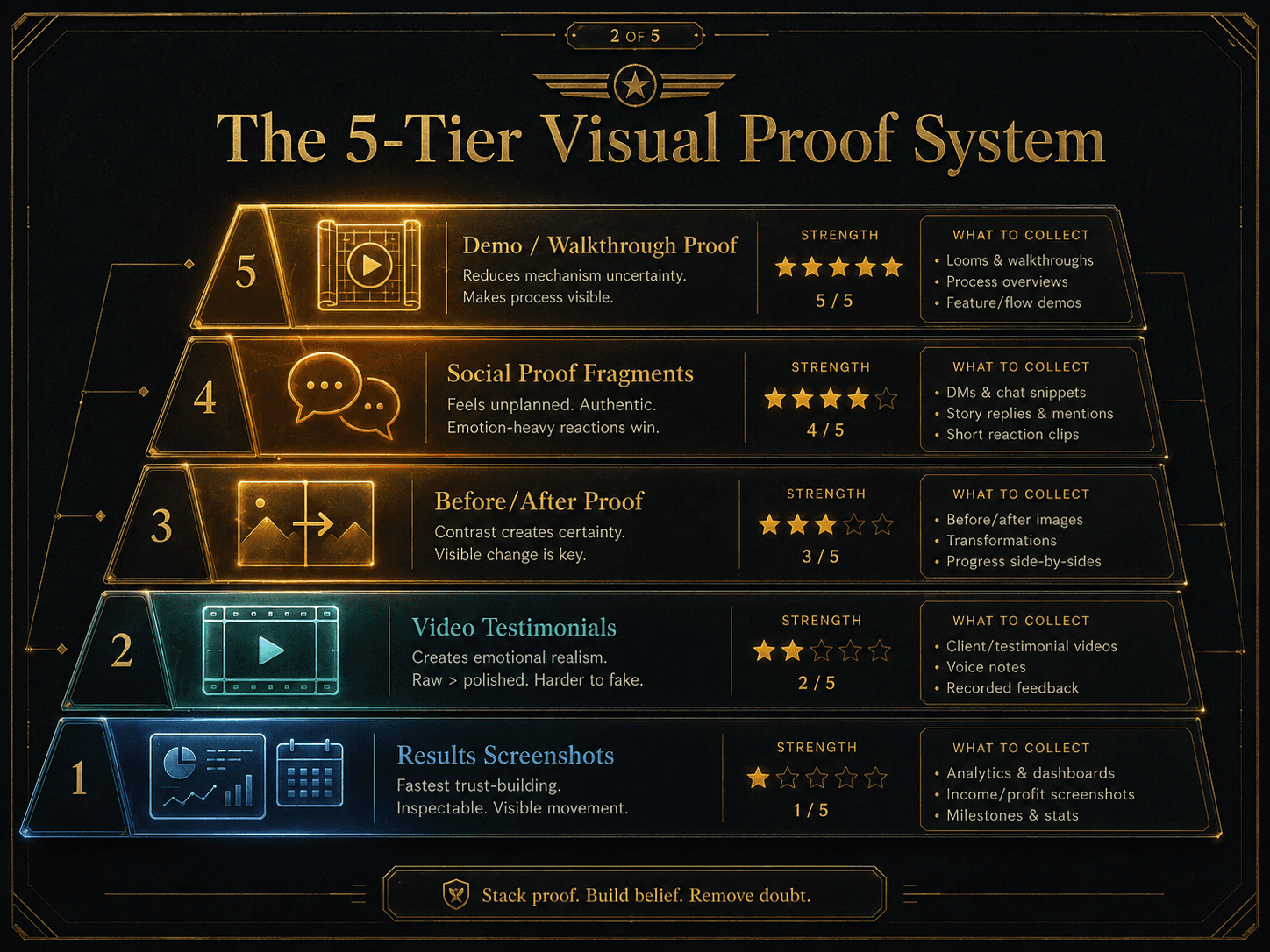
The 5-Tier Visual Proof System™
This framework helps you collect proof intentionally instead of randomly.
The five tiers are:
Results Screenshots™
Video Testimonials™
Before / After Proof™
Social Proof Fragments™
Demo & Walkthrough Proof™
Each proof type has a different psychological job.
Do not collect proof by habit.
Collect proof by function.
Tier 1: Results Screenshots™
What This Proof Does
Results screenshots are usually one of the fastest trust-building categories.
Why?
Because screenshots feel inspectable.
The buyer feels they are seeing something real.
A strong screenshot can make the result feel closer to reality than a polished paragraph ever could.
It shows the buyer:
“This happened somewhere real.”
That matters.
What To Collect
Collect screenshots such as:
payment screenshots, where appropriate
Stripe spikes
booked calendars
analytics lifts
dashboard movement
inbox replies
conversion improvements
pipeline screenshots
growth snapshots
implementation results
reply increases
message thread outcomes
qualified enquiry screenshots
form submissions
CRM movement
sales dashboard shifts
But this is important:
Do not collect screenshots merely because they exist.
Collect screenshots that create visible movement.
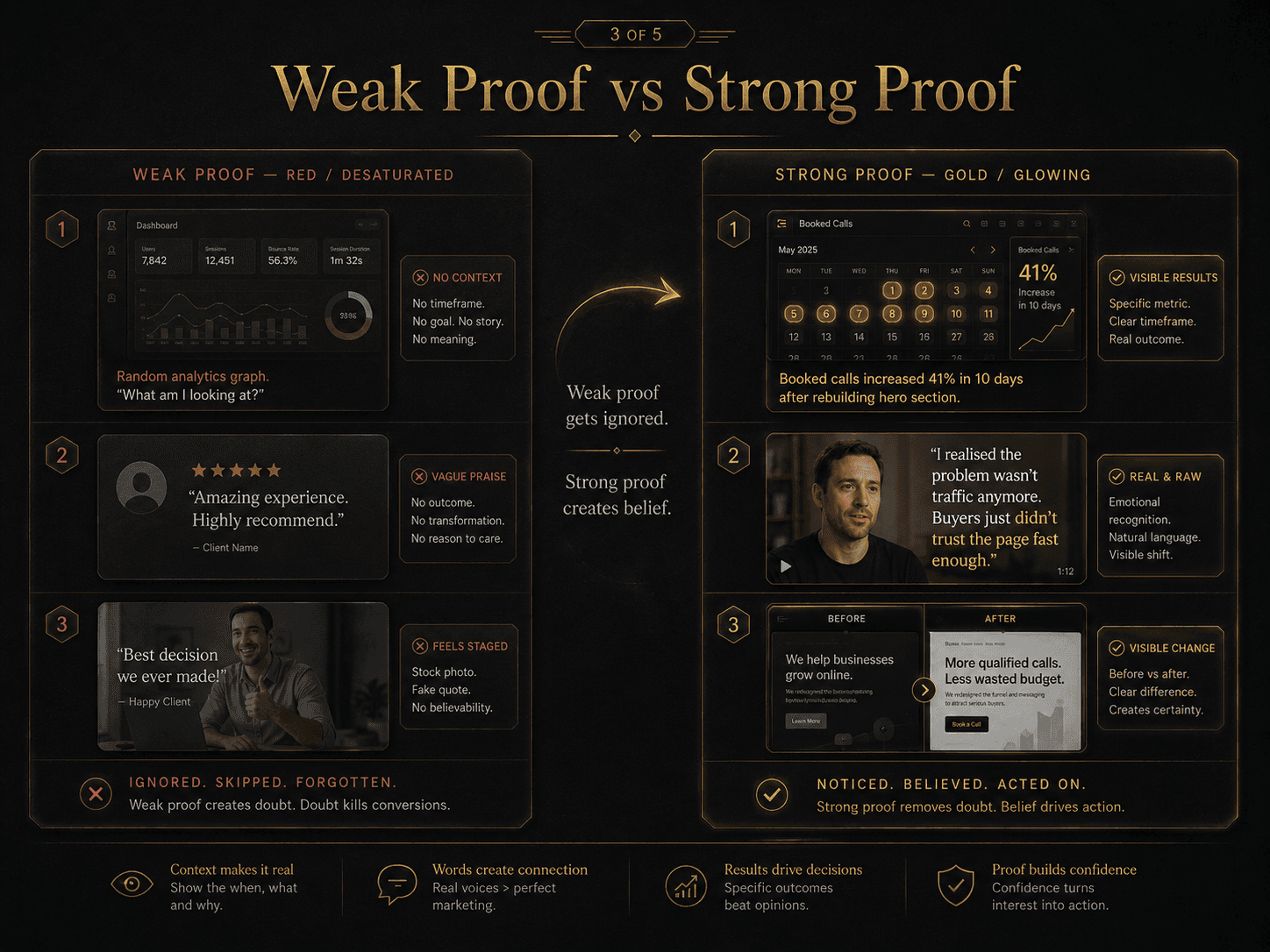
Weak Screenshot Example
A random analytics graph with no context.
The buyer thinks:
“What am I even looking at?”
No belief is created.
The asset may contain data, but the meaning is invisible.
That is weak proof.
Strong Screenshot Example
A visible calendar increase with a caption explaining what changed and when.
Now the buyer understands the significance.
The screenshot does not merely show activity.
It shows movement.
Huge difference.
Screenshot Evaluation Questions
Ask:
Would a stranger understand why this matters?
Is the result visible immediately?
Does this prove something meaningful?
Is there visible movement or contrast?
Does this reduce buyer doubt?
Would someone naturally inspect this longer?
Is there enough context to make the result meaningful?
Does the screenshot connect to a claim on the page?
Does it feel native and real, or staged and over-designed?
Screenshot Strength Ratings
Weak Screenshot
Generic dashboard with no visible story.
No context.
No clear outcome.
No visible buyer-relevant movement.
Medium Screenshot
Visible result, but unclear significance.
It may show something real, but the buyer still needs help understanding why it matters.
This asset needs stronger framing.
Strong Screenshot
Visible outcome plus timing, context, and clear movement.
The buyer quickly understands what changed and why it matters.
This asset can support a claim directly.
Screenshot Collection Worksheet
Asset name:
Where did this screenshot come from?
What result does it show?
What changed?
What date, timeframe, amount, or context is visible?
What buyer doubt does it reduce?
What caption would make it clearer?
Strength rating: ___ / 5
Permission status:
Approved / Needs Permission / Needs Redaction / Not Usable Yet
Tier 2: Video Testimonials™
What This Proof Does
Video creates emotional realism.
Buyers trust faces, tone, hesitation, expression, and emotional authenticity faster than perfect wording.
That is why raw video often outperforms overproduced testimonials.
Raw video can feel harder to fake.
And what feels harder to fake often feels easier to believe.
A strong video testimonial does not need to be cinematic.
It needs to feel real.
What To Collect
Collect:
selfie videos
Zoom reactions
Loom reviews
quick post-result reactions
implementation walkthroughs
screen-recorded wins
emotional “this finally worked” moments
short client reactions after a visible result
before/after explanation clips
product use reactions
buyer experience clips
The best testimonial videos often feel slightly imperfect.
That imperfection can increase believability.
What Strong Video Testimonials Usually Include
Strong video proof usually contains:
visible before-state frustration
emotional hesitation
specific shift
visible relief
natural language
one clear result
emotionally recognisable wording
human presence
believable tone
a clear reason the result mattered
The buyer should feel:
“This person sounds real.”
Not:
“This person sounds scripted.”
Weak Video Testimonial
“Amazing experience. Highly recommend.”
Polite.
Positive.
Commercially weak.
It does not reveal what changed.
It does not show hesitation.
It does not make the result feel more believable.
Strong Video Testimonial
“I realised the problem wasn’t traffic anymore. Buyers just didn’t trust the page fast enough.”
Now the viewer feels recognition.
That line names:
the mistaken diagnosis
the real problem
the buyer behaviour
the trust issue
the reason the page mattered
That creates belief.
Video Testimonial Collection Worksheet
Client or buyer name:
Format:
Selfie / Zoom / Loom / Screen Recording / Interview / Other
What was happening before?
What hesitation did they have?
What changed?
What specific result appeared?
What emotional reaction is visible?
What buyer doubt does this video reduce?
Best clip length:
30 seconds / 60 seconds / 90 seconds / Other
Strength rating: ___ / 5
Permission status:
Approved / Needs Permission / Needs Editing / Not Usable Yet
Tier 3: Before / After Proof™
What This Proof Does
Before / after proof is one of the strongest proof categories psychologically because the buyer sees contrast.
Contrast creates certainty faster.
A strong before / after asset reduces how much explanation the page needs.
The buyer can see:
what was true before
what changed
why that change matters
That visual gap creates belief movement.
What To Collect
Collect:
before/after calendars
before/after metrics
old vs new pages
weak vs strong headlines
conversion improvements
inbox movement
lead-quality shifts
onboarding improvements
sales-page rewrites
dashboard comparisons
message rewrite comparisons
proof stack before/after examples
first-screen before/after changes
offer positioning before/after examples
The key is visible change.
Not visual decoration.
Weak Before / After Proof
Two screenshots with no obvious difference.
The buyer has to work too hard to understand what changed.
Weak emotional movement.
Weak proof.
Strong Before / After Proof
One comparison clearly showing:
movement
contrast
progression
reduction of friction
visible outcome
meaningful improvement
Now the buyer quickly understands that something improved.
The difference is not just visible.
It is valuable.
The Most Important Rule
The stronger the contrast, the stronger the proof usually feels.
But the contrast must matter to the buyer.
A before / after asset is not persuasive because two things look different.
It is persuasive because one version is clearly better in a way the buyer cares about.
That could mean:
more trust
more calls
more clarity
less friction
stronger response
better conversion
easier understanding
clearer buyer movement
Before / After Collection Worksheet
What is the before-state?
What is the after-state?
What visibly changed?
Why does that change matter to the buyer?
What claim does this proof support?
Is the contrast obvious within seconds?
Yes / No
What caption would make the contrast clearer?
Strength rating: ___ / 5
Permission status:
Approved / Needs Permission / Needs Redaction / Not Usable Yet
Tier 4: Social Proof Fragments™
What This Proof Does
Social proof fragments work because they feel unplanned.
Unprompted reactions create authenticity.
The buyer feels:
“This person was not trying to write marketing copy.”
That matters enormously.
A spontaneous message can sometimes feel more believable than a polished testimonial because it feels closer to the real moment of reaction.
What To Collect
Collect:
DM replies
Slack messages
story replies
spontaneous reactions
tweets
email responses
WhatsApp wins
customer comments
voice notes
screenshots of reactions
short feedback snippets
unprompted praise tied to a result
internal client messages
quick “this finally makes sense” moments
Especially collect emotion-heavy reactions.
These often carry more persuasive weight than generic compliments.
Strong Social Proof Usually Sounds Like
Strong social proof sounds like:
“Okay, this finally makes sense.”
“The page suddenly feels clearer.”
“This explains the problem perfectly.”
“We booked calls almost immediately.”
“Buyers finally understood the value faster.”
“I did not realise the proof was the missing piece.”
“This is the first time the offer felt easy to explain.”
These lines feel alive.
They sound like real reactions.
They reveal movement.
Weak Social Proof Usually Sounds Like
Weak social proof sounds like:
“Great service.”
“Highly professional.”
“Would recommend.”
“Excellent work.”
“Really happy with the result.”
These create very little emotional movement.
They may be useful as background reassurance, but they rarely carry the proof stack alone.
Social Proof Fragment Worksheet
Where did this proof come from?
DM / Slack / Email / WhatsApp / Comment / Tweet / Voice Note / Other
Paste the proof:
What emotion does it show?
What changed for the buyer?
What claim does this support?
Does it feel natural and unprompted?
Yes / No
What buyer doubt does it reduce?
Strength rating: ___ / 5
Permission status:
Approved / Needs Permission / Needs Redaction / Not Usable Yet
Tier 5: Demo & Walkthrough Proof™
What This Proof Does
Demo and walkthrough proof reduces mechanism uncertainty.
The buyer stops wondering:
“But what actually happens here?”
That is important.
Many offers fail not because the buyer rejects the desired result, but because the process feels invisible.
The buyer thinks:
“How does this work?”
“What will I actually see?”
“What happens after I buy?”
“What makes this different?”
“Is there a real system here?”
Walkthrough proof answers those doubts.
It makes the mechanism visible.
What To Collect
Collect:
Loom walkthroughs
implementation demos
product walkthroughs
teardown recordings
process clips
feature demonstrations
“here’s what changed” breakdowns
onboarding sequences
live examples
screen recordings
behind-the-scenes explanations
before/after walkthroughs
proof stack walkthroughs
dashboard walkthroughs
The goal is process visibility.
The buyer should feel safer because they can see how the result is created.
Strong Walkthrough Proof Creates
Strong walkthrough proof creates:
clarity
transparency
reduced scepticism
implementation visibility
perceived sophistication
lower uncertainty
mechanism trust
process confidence
buyer reassurance
Now the buyer feels safer.
The offer becomes less invisible.
The result becomes easier to understand.
Demo & Walkthrough Proof Worksheet
What process or mechanism does this show?
What does the buyer currently not understand?
What part of the process becomes visible?
What doubt does this walkthrough reduce?
What result does it connect to?
Where should this appear on the page?
Above Fold / Mid-Page / Objection Section / Near CTA / End Of Page
Strength rating: ___ / 5
Permission status:
Approved / Needs Permission / Needs Editing / Not Usable Yet
Truth Anchors™
Truth anchors are the details that make proof harder to dismiss.
They are small signals that make the asset feel more real.
A proof asset with truth anchors feels heavier than proof that looks staged, isolated, or stripped of context.
Truth anchors can include:
timestamps
names
roles
numbers
visible interfaces
native formatting
context
emotional reactions
platform-specific details
unpolished elements that signal reality
screenshots in their original environment
real cursor movement in a walkthrough
message bubbles that look native to the platform
visible dates
role or company details, where permission allows
These details reduce the buyer’s sense that the proof was manufactured only for persuasion.
They make the evidence feel closer to the moment it came from.
That is exactly what good proof should do.
Truth Anchor Worksheet
What truth anchors does this asset already contain?
Does it show a date or timeframe?
Yes / No
Does it show a real interface or native platform?
Yes / No
Does it show names, roles, or context where permission allows?
Yes / No
Does it show emotional reaction?
Yes / No
Does it feel real or staged?
Real / Staged / Unsure
What truth anchor could make this proof stronger?
The Three Reality Tests™
Do not assume a proof asset is strong because it looks good in the design.
Test it.
A strong proof asset should survive simple scrutiny quickly.
Use these three tests before adding proof to the page.
Test 1: The Blink Test™
Show the proof briefly.
Then ask:
What result is this proving?
Do I believe it?
Yes / No / Unsure
Do I want it?
Yes / No / Unsure
If the answer is unclear or slow, the proof is weak.
Strong proof lands quickly.
Weak proof needs too much explanation before it starts mattering.
Test 2: The Squint Test™
Blur your eyes or zoom out.
Can you still tell what matters?
Yes / No
If the proof only works when every detail is carefully studied, it is too fragile.
Strong proof survives simplification.
That usually means it contains:
obvious numbers
visible results
clear emotional signal
readable contrast
minimal clutter
If the win only exists after effortful decoding, the proof is underperforming.
Test 3: The Stranger Test™
Show the proof to someone who does not care about your business.
Ask them:
What do you think this proves?
Does it feel real?
Yes / No / Unsure
Would this catch your attention?
Yes / No / Unsure
Does this look like something that actually happened?
Yes / No / Unsure
This test matters because strong proof should survive outside the founder’s own emotional attachment to it.
You already know what the proof means.
The question is whether a neutral outsider can feel its weight quickly too.
If they cannot, the page probably cannot either.
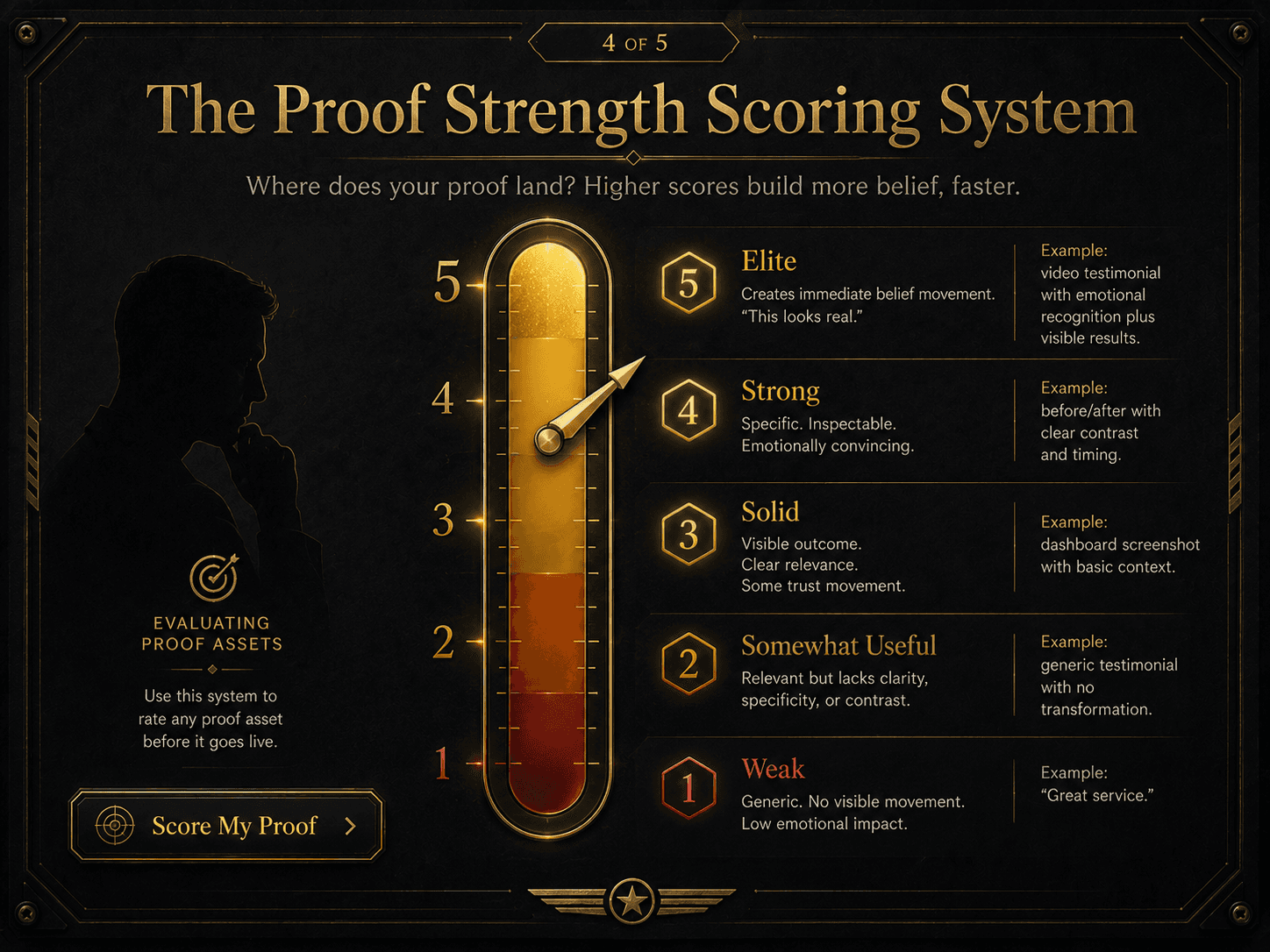
Proof Strength Scoring System™
Every asset inside your proof bank should receive a strength score.
This prevents weak proof from dominating the page.
Score every proof asset from 1 to 5.
Score 1: Weak Proof™
This proof is generic.
It has no visible movement.
It has low emotional impact.
It may be positive, but it does not reduce much uncertainty.
Examples:
vague praise
generic compliment
unclear screenshot
stock photo with quote
dashboard with no visible story
testimonial with no result
Repair action:
Add context, find a stronger asset, or do not use this proof prominently.
Score 2: Somewhat Useful Proof™
This proof is relevant, but lacks clarity, specificity, contrast, or emotional force.
It may support trust lightly, but it does not carry a major claim by itself.
Examples:
testimonial with some relevance but no result
screenshot showing activity but unclear meaning
social proof fragment that feels positive but vague
before/after asset with weak contrast
Repair action:
Add a caption, provide context, connect it to a claim, or pair it with stronger proof.
Score 3: Solid Proof™
This proof has a visible outcome and clear relevance.
It creates some trust movement.
It is usable, especially with proper framing.
Examples:
specific testimonial
screenshot with visible result
before/after comparison with understandable change
short client reaction tied to outcome
Repair action:
Strengthen with truth anchors, context, captions, or placement near the relevant claim.
Score 4: Strong Proof™
This proof is specific, inspectable, emotionally convincing, and clearly tied to a buyer-relevant result.
The buyer can quickly understand why it matters.
Examples:
screenshot with clear outcome, timing, and context
video testimonial with before-state and result
strong before/after showing meaningful progress
social proof fragment with emotional recognition and visible change
Repair action:
Use this prominently. Place it close to the claim it supports.
Score 5: Elite Proof™
This proof creates immediate belief movement.
The buyer instantly feels:
“This looks real.”
It is specific, inspectable, relevant, emotionally believable, and hard to dismiss.
Examples:
strong before/after with obvious buyer-relevant contrast
raw client message naming the exact transformation
dashboard or calendar proof with context and visible movement
face-based video testimonial showing hesitation, shift, and result
proof asset that directly answers the buyer’s strongest doubt
Repair action:
Use this strategically. It may belong above the fold, near a major claim, or close to the CTA.
Proof Bank Organiser™
For every proof asset, document the following.
This turns scattered proof into usable belief architecture.
Asset Name
Example:
“Booked calendar week 2.”
Write asset name:
Asset Type
Choose one:
Screenshot / Video / Testimonial / Before-After / Social Proof Fragment / Demo / Walkthrough / Other
Asset type:
What It Proves
What result, shift, outcome, trust signal, or mechanism does this asset prove?
What Buyer Doubt This Reduces
Examples:
“Will this actually work?”
“Can this work for someone like me?”
“Is this believable?”
“What changes after implementation?”
“What happens after I buy?”
“What makes this safer?”
Write the doubt:
Best Page Placement
Where should this proof appear?
Above Fold / Offer Reveal / Mid-Page / Objection Section / Near CTA / End-Of-Page Proof Wall
Best placement:
Buyer Segment
Who is this proof most relevant to?
Emotional Impact
Does this proof create:
Trust / Relief / Curiosity / Aspiration / Recognition / Safety / Urgency / Desire / Other
Emotional impact:
Truth Anchors Present
What truth anchors does the asset contain?
Strength Rating
Score from 1 to 5:
___ / 5
Permission Status
Approved / Needs Permission / Needs Redaction / Not Usable Yet
Permission status:
Needs Better Framing?
Some proof becomes dramatically stronger with better captions, labels, or context.
Does this asset need better framing?
Yes / No
What caption, label, or context would make it stronger?
Next Improvement Needed
What would make this proof stronger?
The “You Think This Is Proof But Buyers Ignore It” Section™
Many businesses overestimate weak evidence.
They think something is proof because it looks positive.
But buyers ignore it because it reduces almost no uncertainty.
Examples include:
stock photos with fake quotes
vague praise
polished but contextless dashboards
random logos without explanation
generic star ratings
testimonials with no transformation
screenshots without visible relevance
testimonial cards with no names, roles, or context
over-designed proof that looks like ad creative
result claims with no visible backing
screenshots so cropped that the meaning disappears
The buyer ignores these because they do not answer a real doubt.
They may look impressive to the founder.
But they do not make the decision feel safer for the buyer.
Remember:
The page is not trying to look impressive.
It is trying to feel believable.
Huge difference.
Weak Proof Repair Questions
If a proof asset feels weak, ask:
What is this actually proving?
What doubt is this supposed to reduce?
Does the buyer understand why this matters?
Yes / No
Is there enough context?
Yes / No
Is there visible movement?
Yes / No
Does this feel real or staged?
Real / Staged / Unsure
What would make this proof harder to dismiss?
The Continuous Proof Collection Habit™
Do not collect proof only during launches.
Build a habit of capturing proof constantly.
Strong operators collect proof as it happens.
They do not wait until they need a landing page.
They capture:
screenshots immediately
emotional reactions immediately
before/after shifts immediately
spontaneous comments immediately
implementation wins immediately
client language immediately
result moments immediately
objections overcome immediately
unexpected positive feedback immediately
This compounds over time into a serious proof advantage.
Because when the page needs evidence, the proof is already there.
You are not scrambling.
You are selecting.
That is a much stronger position.
Weekly Proof Collection Routine™
Use this once per week.
Step 1: Review Results
What visible results happened this week?
Step 2: Review Messages
What DMs, emails, comments, Slack messages, WhatsApps, or replies contain useful proof?
Step 3: Review Before / After Changes
What changed from before to after?
Step 4: Review Emotional Reactions
What did buyers, clients, users, or customers say that felt emotionally real?
Step 5: Review Mechanism Proof
What walkthrough, demo, implementation clip, or process proof could be captured?
Step 6: Add Truth Anchors
What context, date, role, number, interface, or caption should be saved with the proof?
Step 7: Log The Asset
Add it to the Proof Bank Organiser™.
Asset added:
Strength rating:
___ / 5
Final Execution Challenge™
Before building your next page, build your proof bank first.
Not after.
Collect:
screenshots
reactions
before/after shifts
proof fragments
walkthroughs
visible outcomes
emotional responses
proof with truth anchors
permission-safe testimonials
evidence tied to the claims your page will make
Then ask:
“If a sceptical buyer inspected this proof carefully, would it feel harder to dismiss than the claim itself?”
If the answer is no, keep collecting.
Keep strengthening.
Keep framing.
Because once the proof becomes strong enough, the page stops feeling like marketing.
It starts feeling like evidence the buyer can personally inspect before deciding whether the promise deserves belief.
Final Visual Proof Bank Worksheet
Use this as your complete working sheet.
Main Offer
What offer is this proof bank supporting?
Main Page Promise
What claim will the page ask the buyer to believe?
Main Buyer Doubts
What doubts must the proof reduce?
Proof Asset 1
Asset name:
Asset type:
What it proves:
What doubt it reduces:
Best placement:
Truth anchors:
Strength rating: ___ / 5
Permission status:
Needs better framing?
Yes / No
Caption or context needed:
Proof Asset 2
Asset name:
Asset type:
What it proves:
What doubt it reduces:
Best placement:
Truth anchors:
Strength rating: ___ / 5
Permission status:
Needs better framing?
Yes / No
Caption or context needed:
Proof Asset 3
Asset name:
Asset type:
What it proves:
What doubt it reduces:
Best placement:
Truth anchors:
Strength rating: ___ / 5
Permission status:
Needs better framing?
Yes / No
Caption or context needed:
Proof Gaps
What proof do you still need to collect?
Highest-Value Proof Asset
Which asset is strongest?
Why?
Weakest Proof Asset
Which asset is weakest?
Why?
What needs to improve?
——
Final Principle
A proof bank is not a folder.
It is belief architecture before the page exists.
That is the shift.
Weak pages write claims first and hunt for proof later.
Strong pages collect evidence first, then build the page around what can actually be shown.
That is why the order matters.
Proof first.
Page second.
Because every claim your page makes creates a belief burden.
The stronger the proof bank, the less uncertainty the buyer has to carry alone.
A strong proof bank helps the page move from:
“Trust us.”
to:
“Look at what happened.”
That is a different kind of persuasion.
It is calmer.
Stronger.
Harder to dismiss.
That is what The Visual Proof Bank Builder™ is designed to help you create.
Not more screenshots.
Not prettier testimonials.
Not random proof.
A strategic evidence library that makes the result visible, the promise inspectable, and the decision safer.
Because the buyer does not need more claims.
They need enough reality to believe.
——
From:
The $100M Funnel Playbook. Book I: Foundation Buyer Psychology, Offer Clarity, and the Page Architecture Behind High-Converting Funnels
By Maris Spalins.
——
Copyright Notice
© 2026 The $100M Funnel Playbook / Winyourclients / Maris Spalins. All rights reserved.
This resource, including the frameworks, terminology, examples, scorecards, templates, prompts, methods, and written explanations, is original intellectual property created for The $100M Funnel Playbook. Book I: Foundation — Buyer Psychology, Offer Clarity, And The Page Architecture Behind High-Converting Funnels and published through Winyourclients.
No part of this resource may be copied, reproduced, screenshotted, republished, redistributed, sold, adapted, uploaded, scraped, stored in a database, included in training data, used to train artificial intelligence systems, or used to create derivative commercial or educational materials without prior written permission.
Limited reference, quotation, or sharing is only permitted where the source is clearly and visibly credited.
Any permitted reference must include at least one of the following source credits:
The $100M Funnel Playbook by Maris Spalins
or
Winyourclients — www.winyourclients.com
or
Maris Spalins / Winyourclients
Screenshots, excerpts, summaries, or redistributed versions must not remove, hide, alter, crop out, or obscure the original source, author name, book title, website name, or copyright notice.
This resource is provided for personal learning and implementation only. It is not licensed for resale, republishing, redistribution, AI training, template cloning, course creation, consulting delivery, or commercial reuse without written permission from Maris Spalins or Winyourclients.
For permission requests, licensing, citation approval, or commercial usage enquiries, contact:
Winyourclients
www.winyourclients.com
or
Email directly to Jacob on: help@winyourclients.com
![“The Proof Bank Organizer” Concept: A minimalist, interactive database or spreadsheet-luxury tool for organizing proof assets. Interface shows columns: Asset Name Type Doubt Reduced Best Placement Strength (1-5) Needs Better Framing? [User input] [Dropdown] [User input] [Dropdown] [Slider 1-5] [Yes/No] Below the table: A “Add New Asset” button. A “Generate Proof Section” button that compiles the strongest assets (Strength 4-5) into a recommended proof section layout. A “Weak Assets Report” that lists assets scoring 1-2 with suggestions for improvement. Style: Spreadsheet-luxury meets interactive tool. Dark background, gold borders, clean typography. Feels like a serious evidence management instrument. Interaction: The user adds proof assets, selects type, documents which doubt it reduces, assigns a strength score. The tool tracks total assets by tier. Clicking “Generate Proof Section” produces a recommended proof layout. Clicking any asset row expands a detailed view with the actual proof asset preview.](https://framerusercontent.com/images/QyYMe4ZYQyRzu77hCY5Zznlkdd0.png?width=1448&height=1086)
The Visual Proof Bank Builder™ A practical proof collection system for collecting, organising, prioritising, and strengthening screenshots, testimonials, before/after assets, social proof fragments, and walkthrough evidence before your page asks the buyer to trust the claim.
Prefer Audio Or Video?
The Visual Proof Bank Builder™ is also available as:
🎧 A guided audio walkthrough explaining how to build a visual proof bank, map buyer doubts, collect proof assets, score proof strength, and organise evidence before building the page.
🎥 A practical video breakdown with real proof-bank examples, screenshot proof, before/after proof, testimonial assets, truth anchors, and proof-strength scoring.Choose the format that fits how you learn best.
[Listen To The Audio Walkthrough] (coming soon)
[Watch The Video Breakdown] (coming soon)
——
Why Most Pages Ask For Trust Too Early
Most pages do not fail because the copy is weak.
They fail because the buyer still feels uncertain.
That uncertainty grows fast when:
claims appear without evidence
testimonials feel generic
screenshots feel random
proof feels staged
visuals decorate instead of convince
the page asks for trust before earning it
promises sound sharp but remain unsupported
results are described but not made visible
the buyer has to imagine too much
That is the real problem.
The page may sound persuasive.
The offer may be strong.
The headline may be clear.
The subheadline may explain the value.
But if the buyer still feels:
“Is this real?”
“Can I trust this?”
“Has this actually worked?”
“Will this work for someone like me?”
“What happens after I buy?”
then the page is still asking the buyer to carry too much uncertainty alone.
That is where proof comes in.
Proof does not exist to make the page look impressive.
Proof exists to reduce doubt.
A strong page does not merely claim value.
It shows enough reality for belief to begin.
What This Resource Helps You Do
The Visual Proof Bank Builder™ helps you collect, organise, prioritise, and strengthen proof assets before your page ever asks the buyer to trust the claim.
Use this when:
your page sounds convincing but still feels risky
your testimonials feel weak or generic
you struggle proving results clearly
your proof assets are scattered everywhere
your screenshots feel unimpressive
your offer gets interest but low trust
your buyers still hesitate before deciding
you are building a page before collecting evidence properly
your proof feels decorative instead of persuasive
your visuals look polished but do not reduce doubt
you have client wins but no system for capturing them
your page relies too heavily on claims
your proof is hidden in DMs, screenshots, folders, emails, or memory
This is not a screenshot folder.
This is a belief-building system.
The goal is simple:
Build a proof bank strong enough that the page stops asking for trust and starts earning it visually.
The Real Job Of A Proof Bank™
A proof bank is not storage.
It is a strategic evidence library.
That distinction matters.
A folder of random screenshots is not a proof bank.
A collection of generic testimonials is not a proof bank.
A page full of vague praise is not a proof bank.
A real proof bank is organised around buyer doubt.
Every asset inside the bank should help reduce a specific uncertainty in the buyer’s mind.
That means every proof asset should answer questions like:
“Can this actually work?”
“Will this work for someone like me?”
“Is this believable?”
“What changed?”
“Is this result real?”
“What happens after I buy?”
“Can I trust this enough to act?”
“What makes this safer than the alternatives?”
The stronger the answer, the stronger the proof.
A proof bank exists so that when the page makes a claim, you already have evidence ready to support it.
Not later.
Not as an afterthought.
Before the claim asks for belief.
The Core Principle™
The goal is not collecting more proof.
The goal is collecting proof buyers emotionally trust faster.
That is a completely different standard.
Many businesses think all proof is equal.
It is not.
Some proof creates massive belief movement.
Other proof gets ignored instantly.
A vague testimonial that says “great service” does not carry the same weight as a raw screenshot showing visible movement.
A polished quote card with no context does not carry the same weight as a before/after asset that makes progress inspectable.
A logo wall does not carry the same weight as a short video where a real person explains what changed.
The question is not:
“Do we have proof?”
The better question is:
“Does this proof make the buyer feel less uncertain?”
That is the standard.
The Buyer Doubt Map™
Before building your proof bank, identify the doubts your proof must reduce.
Proof is only persuasive when it answers a live buyer question.
Use this map before collecting assets.
Doubt 1: “Is This Real?”
The buyer is asking whether the promise is grounded in reality or just marketing language.
Useful proof assets:
raw screenshots
native DMs
visible dashboard movement
real interface views
timestamped proof
short result clips
product walkthroughs
Proof job:
Make the promise feel real enough to inspect.
Doubt 2: “Has This Actually Worked?”
The buyer wants evidence that the result has happened before.
Useful proof assets:
results screenshots
before/after comparisons
customer wins
measurable outcomes
booked calendars
payment screenshots, where appropriate
analytics movement
Proof job:
Show that the result is not just theoretical.
Doubt 3: “Will This Work For Someone Like Me?”
The buyer wants relevance.
They do not only need to know that something worked.
They need to know whether it can work for a person, business, problem, or situation similar to theirs.
Useful proof assets:
testimonials from similar buyers
role-specific proof
industry-specific examples
use-case-based proof
before/after examples from similar situations
social proof fragments from the same buyer type
Proof job:
Make the buyer feel represented inside the proof.
Doubt 4: “What Actually Changes?”
The buyer wants to understand the visible shift.
Useful proof assets:
before/after assets
screenshots with captions
implementation walkthroughs
side-by-side comparisons
result breakdowns
transformation timelines
Proof job:
Make the change visible.
Doubt 5: “Can I Trust The Process?”
The buyer may believe the result is possible but still feel uncertain about how it happens.
Useful proof assets:
Loom walkthroughs
process clips
product demos
teardown recordings
implementation previews
behind-the-scenes breakdowns
“here’s what changed” videos
Proof job:
Reduce mechanism uncertainty.
Doubt 6: “Is This Safe Enough To Act On?”
The buyer is close to action but still hesitant.
Useful proof assets:
face-based testimonials
“I was sceptical too” stories
short quote near CTA
final trust hit
visible result plus human context
reassurance-focused proof
Proof job:
Make the next step feel safer.
Buyer Doubt Worksheet
What is the biggest doubt your buyer has before acting?
What claim does your page need the buyer to believe?
What proof would make that claim easier to trust?
What proof do you already have?
What proof is missing?
What Strong Proof Usually Contains
Strong proof usually contains at least some of the following:
visible contrast
specificity
timing
emotional reaction
inspectable evidence
natural language
visible movement
believable context
real interface details
buyer similarity
a clear before-state
a clear after-state
an outcome tied to the offer promise
Strong proof makes the buyer feel:
“That looks real.”
“I understand what changed.”
“This feels specific.”
“This could apply to me.”
“This is harder to dismiss than the claim.”
That is the goal.
What Weak Proof Usually Contains
Weak proof usually contains:
vague praise
polished corporate language
generic compliments
no visible outcome
no before-state
no emotional tension
no specificity
no timing
no context
no visible contrast
no buyer relevance
no clear link to the promise
Weak proof sounds like:
“Great service.”
“Highly recommend.”
“Very professional.”
“Loved working together.”
“Excellent experience.”
These lines are not always useless.
But on their own, they rarely reduce enough uncertainty.
They flatter the seller more than they help the buyer believe.
That distinction changes everything.
The 5-Tier Visual Proof System™
This framework helps you collect proof intentionally instead of randomly.
The five tiers are:
Results Screenshots™
Video Testimonials™
Before / After Proof™
Social Proof Fragments™
Demo & Walkthrough Proof™
Each proof type has a different psychological job.
Do not collect proof by habit.
Collect proof by function.
Tier 1: Results Screenshots™
What This Proof Does
Results screenshots are usually one of the fastest trust-building categories.
Why?
Because screenshots feel inspectable.
The buyer feels they are seeing something real.
A strong screenshot can make the result feel closer to reality than a polished paragraph ever could.
It shows the buyer:
“This happened somewhere real.”
That matters.
What To Collect
Collect screenshots such as:
payment screenshots, where appropriate
Stripe spikes
booked calendars
analytics lifts
dashboard movement
inbox replies
conversion improvements
pipeline screenshots
growth snapshots
implementation results
reply increases
message thread outcomes
qualified enquiry screenshots
form submissions
CRM movement
sales dashboard shifts
But this is important:
Do not collect screenshots merely because they exist.
Collect screenshots that create visible movement.
Weak Screenshot Example
A random analytics graph with no context.
The buyer thinks:
“What am I even looking at?”
No belief is created.
The asset may contain data, but the meaning is invisible.
That is weak proof.
Strong Screenshot Example
A visible calendar increase with a caption explaining what changed and when.
Now the buyer understands the significance.
The screenshot does not merely show activity.
It shows movement.
Huge difference.
Screenshot Evaluation Questions
Ask:
Would a stranger understand why this matters?
Is the result visible immediately?
Does this prove something meaningful?
Is there visible movement or contrast?
Does this reduce buyer doubt?
Would someone naturally inspect this longer?
Is there enough context to make the result meaningful?
Does the screenshot connect to a claim on the page?
Does it feel native and real, or staged and over-designed?
Screenshot Strength Ratings
Weak Screenshot
Generic dashboard with no visible story.
No context.
No clear outcome.
No visible buyer-relevant movement.
Medium Screenshot
Visible result, but unclear significance.
It may show something real, but the buyer still needs help understanding why it matters.
This asset needs stronger framing.
Strong Screenshot
Visible outcome plus timing, context, and clear movement.
The buyer quickly understands what changed and why it matters.
This asset can support a claim directly.
Screenshot Collection Worksheet
Asset name:
Where did this screenshot come from?
What result does it show?
What changed?
What date, timeframe, amount, or context is visible?
What buyer doubt does it reduce?
What caption would make it clearer?
Strength rating: ___ / 5
Permission status:
Approved / Needs Permission / Needs Redaction / Not Usable Yet
Tier 2: Video Testimonials™
What This Proof Does
Video creates emotional realism.
Buyers trust faces, tone, hesitation, expression, and emotional authenticity faster than perfect wording.
That is why raw video often outperforms overproduced testimonials.
Raw video can feel harder to fake.
And what feels harder to fake often feels easier to believe.
A strong video testimonial does not need to be cinematic.
It needs to feel real.
What To Collect
Collect:
selfie videos
Zoom reactions
Loom reviews
quick post-result reactions
implementation walkthroughs
screen-recorded wins
emotional “this finally worked” moments
short client reactions after a visible result
before/after explanation clips
product use reactions
buyer experience clips
The best testimonial videos often feel slightly imperfect.
That imperfection can increase believability.
What Strong Video Testimonials Usually Include
Strong video proof usually contains:
visible before-state frustration
emotional hesitation
specific shift
visible relief
natural language
one clear result
emotionally recognisable wording
human presence
believable tone
a clear reason the result mattered
The buyer should feel:
“This person sounds real.”
Not:
“This person sounds scripted.”
Weak Video Testimonial
“Amazing experience. Highly recommend.”
Polite.
Positive.
Commercially weak.
It does not reveal what changed.
It does not show hesitation.
It does not make the result feel more believable.
Strong Video Testimonial
“I realised the problem wasn’t traffic anymore. Buyers just didn’t trust the page fast enough.”
Now the viewer feels recognition.
That line names:
the mistaken diagnosis
the real problem
the buyer behaviour
the trust issue
the reason the page mattered
That creates belief.
Video Testimonial Collection Worksheet
Client or buyer name:
Format:
Selfie / Zoom / Loom / Screen Recording / Interview / Other
What was happening before?
What hesitation did they have?
What changed?
What specific result appeared?
What emotional reaction is visible?
What buyer doubt does this video reduce?
Best clip length:
30 seconds / 60 seconds / 90 seconds / Other
Strength rating: ___ / 5
Permission status:
Approved / Needs Permission / Needs Editing / Not Usable Yet
Tier 3: Before / After Proof™
What This Proof Does
Before / after proof is one of the strongest proof categories psychologically because the buyer sees contrast.
Contrast creates certainty faster.
A strong before / after asset reduces how much explanation the page needs.
The buyer can see:
what was true before
what changed
why that change matters
That visual gap creates belief movement.
What To Collect
Collect:
before/after calendars
before/after metrics
old vs new pages
weak vs strong headlines
conversion improvements
inbox movement
lead-quality shifts
onboarding improvements
sales-page rewrites
dashboard comparisons
message rewrite comparisons
proof stack before/after examples
first-screen before/after changes
offer positioning before/after examples
The key is visible change.
Not visual decoration.
Weak Before / After Proof
Two screenshots with no obvious difference.
The buyer has to work too hard to understand what changed.
Weak emotional movement.
Weak proof.
Strong Before / After Proof
One comparison clearly showing:
movement
contrast
progression
reduction of friction
visible outcome
meaningful improvement
Now the buyer quickly understands that something improved.
The difference is not just visible.
It is valuable.
The Most Important Rule
The stronger the contrast, the stronger the proof usually feels.
But the contrast must matter to the buyer.
A before / after asset is not persuasive because two things look different.
It is persuasive because one version is clearly better in a way the buyer cares about.
That could mean:
more trust
more calls
more clarity
less friction
stronger response
better conversion
easier understanding
clearer buyer movement
Before / After Collection Worksheet
What is the before-state?
What is the after-state?
What visibly changed?
Why does that change matter to the buyer?
What claim does this proof support?
Is the contrast obvious within seconds?
Yes / No
What caption would make the contrast clearer?
Strength rating: ___ / 5
Permission status:
Approved / Needs Permission / Needs Redaction / Not Usable Yet
Tier 4: Social Proof Fragments™
What This Proof Does
Social proof fragments work because they feel unplanned.
Unprompted reactions create authenticity.
The buyer feels:
“This person was not trying to write marketing copy.”
That matters enormously.
A spontaneous message can sometimes feel more believable than a polished testimonial because it feels closer to the real moment of reaction.
What To Collect
Collect:
DM replies
Slack messages
story replies
spontaneous reactions
tweets
email responses
WhatsApp wins
customer comments
voice notes
screenshots of reactions
short feedback snippets
unprompted praise tied to a result
internal client messages
quick “this finally makes sense” moments
Especially collect emotion-heavy reactions.
These often carry more persuasive weight than generic compliments.
Strong Social Proof Usually Sounds Like
Strong social proof sounds like:
“Okay, this finally makes sense.”
“The page suddenly feels clearer.”
“This explains the problem perfectly.”
“We booked calls almost immediately.”
“Buyers finally understood the value faster.”
“I did not realise the proof was the missing piece.”
“This is the first time the offer felt easy to explain.”
These lines feel alive.
They sound like real reactions.
They reveal movement.
Weak Social Proof Usually Sounds Like
Weak social proof sounds like:
“Great service.”
“Highly professional.”
“Would recommend.”
“Excellent work.”
“Really happy with the result.”
These create very little emotional movement.
They may be useful as background reassurance, but they rarely carry the proof stack alone.
Social Proof Fragment Worksheet
Where did this proof come from?
DM / Slack / Email / WhatsApp / Comment / Tweet / Voice Note / Other
Paste the proof:
What emotion does it show?
What changed for the buyer?
What claim does this support?
Does it feel natural and unprompted?
Yes / No
What buyer doubt does it reduce?
Strength rating: ___ / 5
Permission status:
Approved / Needs Permission / Needs Redaction / Not Usable Yet
Tier 5: Demo & Walkthrough Proof™
What This Proof Does
Demo and walkthrough proof reduces mechanism uncertainty.
The buyer stops wondering:
“But what actually happens here?”
That is important.
Many offers fail not because the buyer rejects the desired result, but because the process feels invisible.
The buyer thinks:
“How does this work?”
“What will I actually see?”
“What happens after I buy?”
“What makes this different?”
“Is there a real system here?”
Walkthrough proof answers those doubts.
It makes the mechanism visible.
What To Collect
Collect:
Loom walkthroughs
implementation demos
product walkthroughs
teardown recordings
process clips
feature demonstrations
“here’s what changed” breakdowns
onboarding sequences
live examples
screen recordings
behind-the-scenes explanations
before/after walkthroughs
proof stack walkthroughs
dashboard walkthroughs
The goal is process visibility.
The buyer should feel safer because they can see how the result is created.
Strong Walkthrough Proof Creates
Strong walkthrough proof creates:
clarity
transparency
reduced scepticism
implementation visibility
perceived sophistication
lower uncertainty
mechanism trust
process confidence
buyer reassurance
Now the buyer feels safer.
The offer becomes less invisible.
The result becomes easier to understand.
Demo & Walkthrough Proof Worksheet
What process or mechanism does this show?
What does the buyer currently not understand?
What part of the process becomes visible?
What doubt does this walkthrough reduce?
What result does it connect to?
Where should this appear on the page?
Above Fold / Mid-Page / Objection Section / Near CTA / End Of Page
Strength rating: ___ / 5
Permission status:
Approved / Needs Permission / Needs Editing / Not Usable Yet
Truth Anchors™
Truth anchors are the details that make proof harder to dismiss.
They are small signals that make the asset feel more real.
A proof asset with truth anchors feels heavier than proof that looks staged, isolated, or stripped of context.
Truth anchors can include:
timestamps
names
roles
numbers
visible interfaces
native formatting
context
emotional reactions
platform-specific details
unpolished elements that signal reality
screenshots in their original environment
real cursor movement in a walkthrough
message bubbles that look native to the platform
visible dates
role or company details, where permission allows
These details reduce the buyer’s sense that the proof was manufactured only for persuasion.
They make the evidence feel closer to the moment it came from.
That is exactly what good proof should do.
Truth Anchor Worksheet
What truth anchors does this asset already contain?
Does it show a date or timeframe?
Yes / No
Does it show a real interface or native platform?
Yes / No
Does it show names, roles, or context where permission allows?
Yes / No
Does it show emotional reaction?
Yes / No
Does it feel real or staged?
Real / Staged / Unsure
What truth anchor could make this proof stronger?
The Three Reality Tests™
Do not assume a proof asset is strong because it looks good in the design.
Test it.
A strong proof asset should survive simple scrutiny quickly.
Use these three tests before adding proof to the page.
Test 1: The Blink Test™
Show the proof briefly.
Then ask:
What result is this proving?
Do I believe it?
Yes / No / Unsure
Do I want it?
Yes / No / Unsure
If the answer is unclear or slow, the proof is weak.
Strong proof lands quickly.
Weak proof needs too much explanation before it starts mattering.
Test 2: The Squint Test™
Blur your eyes or zoom out.
Can you still tell what matters?
Yes / No
If the proof only works when every detail is carefully studied, it is too fragile.
Strong proof survives simplification.
That usually means it contains:
obvious numbers
visible results
clear emotional signal
readable contrast
minimal clutter
If the win only exists after effortful decoding, the proof is underperforming.
Test 3: The Stranger Test™
Show the proof to someone who does not care about your business.
Ask them:
What do you think this proves?
Does it feel real?
Yes / No / Unsure
Would this catch your attention?
Yes / No / Unsure
Does this look like something that actually happened?
Yes / No / Unsure
This test matters because strong proof should survive outside the founder’s own emotional attachment to it.
You already know what the proof means.
The question is whether a neutral outsider can feel its weight quickly too.
If they cannot, the page probably cannot either.
Proof Strength Scoring System™
Every asset inside your proof bank should receive a strength score.
This prevents weak proof from dominating the page.
Score every proof asset from 1 to 5.
Score 1: Weak Proof™
This proof is generic.
It has no visible movement.
It has low emotional impact.
It may be positive, but it does not reduce much uncertainty.
Examples:
vague praise
generic compliment
unclear screenshot
stock photo with quote
dashboard with no visible story
testimonial with no result
Repair action:
Add context, find a stronger asset, or do not use this proof prominently.
Score 2: Somewhat Useful Proof™
This proof is relevant, but lacks clarity, specificity, contrast, or emotional force.
It may support trust lightly, but it does not carry a major claim by itself.
Examples:
testimonial with some relevance but no result
screenshot showing activity but unclear meaning
social proof fragment that feels positive but vague
before/after asset with weak contrast
Repair action:
Add a caption, provide context, connect it to a claim, or pair it with stronger proof.
Score 3: Solid Proof™
This proof has a visible outcome and clear relevance.
It creates some trust movement.
It is usable, especially with proper framing.
Examples:
specific testimonial
screenshot with visible result
before/after comparison with understandable change
short client reaction tied to outcome
Repair action:
Strengthen with truth anchors, context, captions, or placement near the relevant claim.
Score 4: Strong Proof™
This proof is specific, inspectable, emotionally convincing, and clearly tied to a buyer-relevant result.
The buyer can quickly understand why it matters.
Examples:
screenshot with clear outcome, timing, and context
video testimonial with before-state and result
strong before/after showing meaningful progress
social proof fragment with emotional recognition and visible change
Repair action:
Use this prominently. Place it close to the claim it supports.
Score 5: Elite Proof™
This proof creates immediate belief movement.
The buyer instantly feels:
“This looks real.”
It is specific, inspectable, relevant, emotionally believable, and hard to dismiss.
Examples:
strong before/after with obvious buyer-relevant contrast
raw client message naming the exact transformation
dashboard or calendar proof with context and visible movement
face-based video testimonial showing hesitation, shift, and result
proof asset that directly answers the buyer’s strongest doubt
Repair action:
Use this strategically. It may belong above the fold, near a major claim, or close to the CTA.
Proof Bank Organiser™
For every proof asset, document the following.
This turns scattered proof into usable belief architecture.
Asset Name
Example:
“Booked calendar week 2.”
Write asset name:
Asset Type
Choose one:
Screenshot / Video / Testimonial / Before-After / Social Proof Fragment / Demo / Walkthrough / Other
Asset type:
What It Proves
What result, shift, outcome, trust signal, or mechanism does this asset prove?
What Buyer Doubt This Reduces
Examples:
“Will this actually work?”
“Can this work for someone like me?”
“Is this believable?”
“What changes after implementation?”
“What happens after I buy?”
“What makes this safer?”
Write the doubt:
Best Page Placement
Where should this proof appear?
Above Fold / Offer Reveal / Mid-Page / Objection Section / Near CTA / End-Of-Page Proof Wall
Best placement:
Buyer Segment
Who is this proof most relevant to?
Emotional Impact
Does this proof create:
Trust / Relief / Curiosity / Aspiration / Recognition / Safety / Urgency / Desire / Other
Emotional impact:
Truth Anchors Present
What truth anchors does the asset contain?
Strength Rating
Score from 1 to 5:
___ / 5
Permission Status
Approved / Needs Permission / Needs Redaction / Not Usable Yet
Permission status:
Needs Better Framing?
Some proof becomes dramatically stronger with better captions, labels, or context.
Does this asset need better framing?
Yes / No
What caption, label, or context would make it stronger?
Next Improvement Needed
What would make this proof stronger?
The “You Think This Is Proof But Buyers Ignore It” Section™
Many businesses overestimate weak evidence.
They think something is proof because it looks positive.
But buyers ignore it because it reduces almost no uncertainty.
Examples include:
stock photos with fake quotes
vague praise
polished but contextless dashboards
random logos without explanation
generic star ratings
testimonials with no transformation
screenshots without visible relevance
testimonial cards with no names, roles, or context
over-designed proof that looks like ad creative
result claims with no visible backing
screenshots so cropped that the meaning disappears
The buyer ignores these because they do not answer a real doubt.
They may look impressive to the founder.
But they do not make the decision feel safer for the buyer.
Remember:
The page is not trying to look impressive.
It is trying to feel believable.
Huge difference.
Weak Proof Repair Questions
If a proof asset feels weak, ask:
What is this actually proving?
What doubt is this supposed to reduce?
Does the buyer understand why this matters?
Yes / No
Is there enough context?
Yes / No
Is there visible movement?
Yes / No
Does this feel real or staged?
Real / Staged / Unsure
What would make this proof harder to dismiss?
The Continuous Proof Collection Habit™
Do not collect proof only during launches.
Build a habit of capturing proof constantly.
Strong operators collect proof as it happens.
They do not wait until they need a landing page.
They capture:
screenshots immediately
emotional reactions immediately
before/after shifts immediately
spontaneous comments immediately
implementation wins immediately
client language immediately
result moments immediately
objections overcome immediately
unexpected positive feedback immediately
This compounds over time into a serious proof advantage.
Because when the page needs evidence, the proof is already there.
You are not scrambling.
You are selecting.
That is a much stronger position.
Weekly Proof Collection Routine™
Use this once per week.
Step 1: Review Results
What visible results happened this week?
Step 2: Review Messages
What DMs, emails, comments, Slack messages, WhatsApps, or replies contain useful proof?
Step 3: Review Before / After Changes
What changed from before to after?
Step 4: Review Emotional Reactions
What did buyers, clients, users, or customers say that felt emotionally real?
Step 5: Review Mechanism Proof
What walkthrough, demo, implementation clip, or process proof could be captured?
Step 6: Add Truth Anchors
What context, date, role, number, interface, or caption should be saved with the proof?
Step 7: Log The Asset
Add it to the Proof Bank Organiser™.
Asset added:
Strength rating:
___ / 5
Final Execution Challenge™
Before building your next page, build your proof bank first.
Not after.
Collect:
screenshots
reactions
before/after shifts
proof fragments
walkthroughs
visible outcomes
emotional responses
proof with truth anchors
permission-safe testimonials
evidence tied to the claims your page will make
Then ask:
“If a sceptical buyer inspected this proof carefully, would it feel harder to dismiss than the claim itself?”
If the answer is no, keep collecting.
Keep strengthening.
Keep framing.
Because once the proof becomes strong enough, the page stops feeling like marketing.
It starts feeling like evidence the buyer can personally inspect before deciding whether the promise deserves belief.
Final Visual Proof Bank Worksheet
Use this as your complete working sheet.
Main Offer
What offer is this proof bank supporting?
Main Page Promise
What claim will the page ask the buyer to believe?
Main Buyer Doubts
What doubts must the proof reduce?
Proof Asset 1
Asset name:
Asset type:
What it proves:
What doubt it reduces:
Best placement:
Truth anchors:
Strength rating: ___ / 5
Permission status:
Needs better framing?
Yes / No
Caption or context needed:
Proof Asset 2
Asset name:
Asset type:
What it proves:
What doubt it reduces:
Best placement:
Truth anchors:
Strength rating: ___ / 5
Permission status:
Needs better framing?
Yes / No
Caption or context needed:
Proof Asset 3
Asset name:
Asset type:
What it proves:
What doubt it reduces:
Best placement:
Truth anchors:
Strength rating: ___ / 5
Permission status:
Needs better framing?
Yes / No
Caption or context needed:
Proof Gaps
What proof do you still need to collect?
Highest-Value Proof Asset
Which asset is strongest?
Why?
Weakest Proof Asset
Which asset is weakest?
Why?
What needs to improve?
——
Final Principle
A proof bank is not a folder.
It is belief architecture before the page exists.
That is the shift.
Weak pages write claims first and hunt for proof later.
Strong pages collect evidence first, then build the page around what can actually be shown.
That is why the order matters.
Proof first.
Page second.
Because every claim your page makes creates a belief burden.
The stronger the proof bank, the less uncertainty the buyer has to carry alone.
A strong proof bank helps the page move from:
“Trust us.”
to:
“Look at what happened.”
That is a different kind of persuasion.
It is calmer.
Stronger.
Harder to dismiss.
That is what The Visual Proof Bank Builder™ is designed to help you create.
Not more screenshots.
Not prettier testimonials.
Not random proof.
A strategic evidence library that makes the result visible, the promise inspectable, and the decision safer.
Because the buyer does not need more claims.
They need enough reality to believe.
——
From:
The $100M Funnel Playbook. Book I: Foundation Buyer Psychology, Offer Clarity, and the Page Architecture Behind High-Converting Funnels
By Maris Spalins.
——
Copyright Notice
© 2026 The $100M Funnel Playbook / Winyourclients / Maris Spalins. All rights reserved.
This resource, including the frameworks, terminology, examples, scorecards, templates, prompts, methods, and written explanations, is original intellectual property created for The $100M Funnel Playbook. Book I: Foundation — Buyer Psychology, Offer Clarity, And The Page Architecture Behind High-Converting Funnels and published through Winyourclients.
No part of this resource may be copied, reproduced, screenshotted, republished, redistributed, sold, adapted, uploaded, scraped, stored in a database, included in training data, used to train artificial intelligence systems, or used to create derivative commercial or educational materials without prior written permission.
Limited reference, quotation, or sharing is only permitted where the source is clearly and visibly credited.
Any permitted reference must include at least one of the following source credits:
The $100M Funnel Playbook by Maris Spalins
or
Winyourclients — www.winyourclients.com
or
Maris Spalins / Winyourclients
Screenshots, excerpts, summaries, or redistributed versions must not remove, hide, alter, crop out, or obscure the original source, author name, book title, website name, or copyright notice.
This resource is provided for personal learning and implementation only. It is not licensed for resale, republishing, redistribution, AI training, template cloning, course creation, consulting delivery, or commercial reuse without written permission from Maris Spalins or Winyourclients.
For permission requests, licensing, citation approval, or commercial usage enquiries, contact:
Winyourclients
www.winyourclients.com
or
Email directly to Jacob on: help@winyourclients.com
Other Blogs
Other Blogs
Check our other project Blogs with useful insight and information for your businesses
Other Blogs
Other Blogs
Check our other project Blogs with useful insight and information for your businesses