Our Three Step Process
May 26, 2026
Chap 5 | Resource Bonus | Final Diagnostic: The Visual Proof Trust Leak Audit™
Our Three Step Process
May 26, 2026
Chap 5 | Resource Bonus | Final Diagnostic: The Visual Proof Trust Leak Audit™
Final Diagnostic: The Visual Proof Trust Leak Audit™ A practical audit system for identifying why a page still feels risky, unconvincing, or emotionally weak even when testimonials, screenshots, dashboards, metrics, reviews, or before/after proof technically exist.
Prefer Audio Or Video?
Final Diagnostic: The Visual Proof Trust Leak Audit™ is also available as:
🎧 A guided audio walkthrough explaining visual proof trust leaks, fake-proof detection, screenshot strength, testimonial realism, claim-to-proof alignment, and trust momentum.
🎥 A practical video breakdown with real proof trust audits, screenshot and testimonial diagnostics, claim-to-proof repairs, proof compression examples, and trust architecture teardowns.Choose the format that fits how you learn best.
[Listen To The Audio Walkthrough] (coming soon)
[Watch The Video Breakdown] (coming soon)
——
Why Proof Alone Does Not Always Create Belief
Many pages already have proof.
They have:
testimonials
screenshots
dashboards
metrics
reviews
before/after examples
customer messages
case-study fragments
social proof blocks
result screenshots
And they still fail to create enough trust.
Why?
Because proof alone does not automatically create belief.
Proof can exist on the page and still fail to persuade.
Some proof is too vague.
Some proof is too generic.
Some proof feels over-polished.
Some proof is emotionally flat.
Some proof is disconnected from the claim.
Some proof is difficult to interpret.
Some proof feels suspiciously perfect.
Some proof is visually cluttered.
Some proof feels commercially staged.
That matters.
Because the buyer is not only asking:
“Is there proof?”
They are asking:
“Does this proof make the promise feel safer to believe?”
That is a completely different standard.
A page can have testimonials and still feel risky.
A page can have screenshots and still feel unconvincing.
A page can have metrics and still feel emotionally weak.
A page can have a proof wall and still fail to reduce doubt.
That is why this resource exists.
It helps you diagnose where trust is leaking.
Not where proof is merely present.
Where belief is actually weakening.
What This Resource Helps You Do
The Visual Proof Trust Leak Audit™ helps you identify why a page still feels risky, unconvincing, or emotionally weak even when proof technically exists.
Use this when:
your page has proof but still feels risky
buyers hesitate before converting
testimonials sound fake or generic
screenshots feel unimpressive
your proof wall gets ignored
the page feels polished but emotionally weak
visitors still seem sceptical
your strongest evidence is not creating movement
your page has results but still lacks trust
proof exists but does not feel connected to the buyer’s doubts
your claims feel stronger than your evidence
the buyer still has to imagine too much
the page looks credible but does not feel emotionally safe
This is not a testimonial checklist.
This is a trust audit system.
The goal is simple:
Identify exactly where the page weakens belief, certainty, and emotional safety before the buyer leaves.
The Core Principle™
The goal of proof is not to look impressive.
The goal is to reduce psychological risk.
That is the real job.
Buyers are not simply responding to the presence of testimonials, screenshots, metrics, or logos.
They are responding to whether the proof makes the decision feel safer.
Strong proof makes the buyer feel:
“This feels safer to believe.”
Weak proof makes the buyer feel:
“This still feels like marketing.”
Huge difference.
Proof should reduce the emotional burden of belief.
It should make the claim easier to trust.
It should make the result easier to picture.
It should make the next step feel less risky.
If the proof does not reduce uncertainty, it is not doing its job.
It may decorate the page.
It may make the page look busier.
It may help the founder feel reassured.
But it is not creating enough trust movement.
That is what this audit measures.
The Biggest Mistake Most Businesses Make™
Most businesses think trust comes from adding more proof.
Not always.
Sometimes trust improves more by:
removing weak proof
improving framing
increasing specificity
reducing hype
improving placement
increasing emotional realism
clarifying what the proof actually means
moving strong proof closer to the claim
replacing generic testimonials with transformation stories
reducing visual clutter
making the evidence easier to inspect
That distinction matters enormously.
The answer is not always:
“Add more testimonials.”
Sometimes the real answer is:
“Remove the weak ones.”
Or:
“Move the strongest proof higher.”
Or:
“Add context to the screenshot.”
Or:
“Stop making the proof sound like advertising.”
Or:
“Use fewer proof assets, but make each one more believable.”
The page does not need more proof volume.
It needs less uncertainty.
That is the standard.
How To Use This Diagnostic
Move through every section honestly.
Do not evaluate the page as the founder.
Do not evaluate it as the designer.
Do not evaluate it as the person who already knows the result is real.
Evaluate it as a sceptical buyer trying to determine:
“Does this actually feel believable enough to move forward?”
That is the real standard.
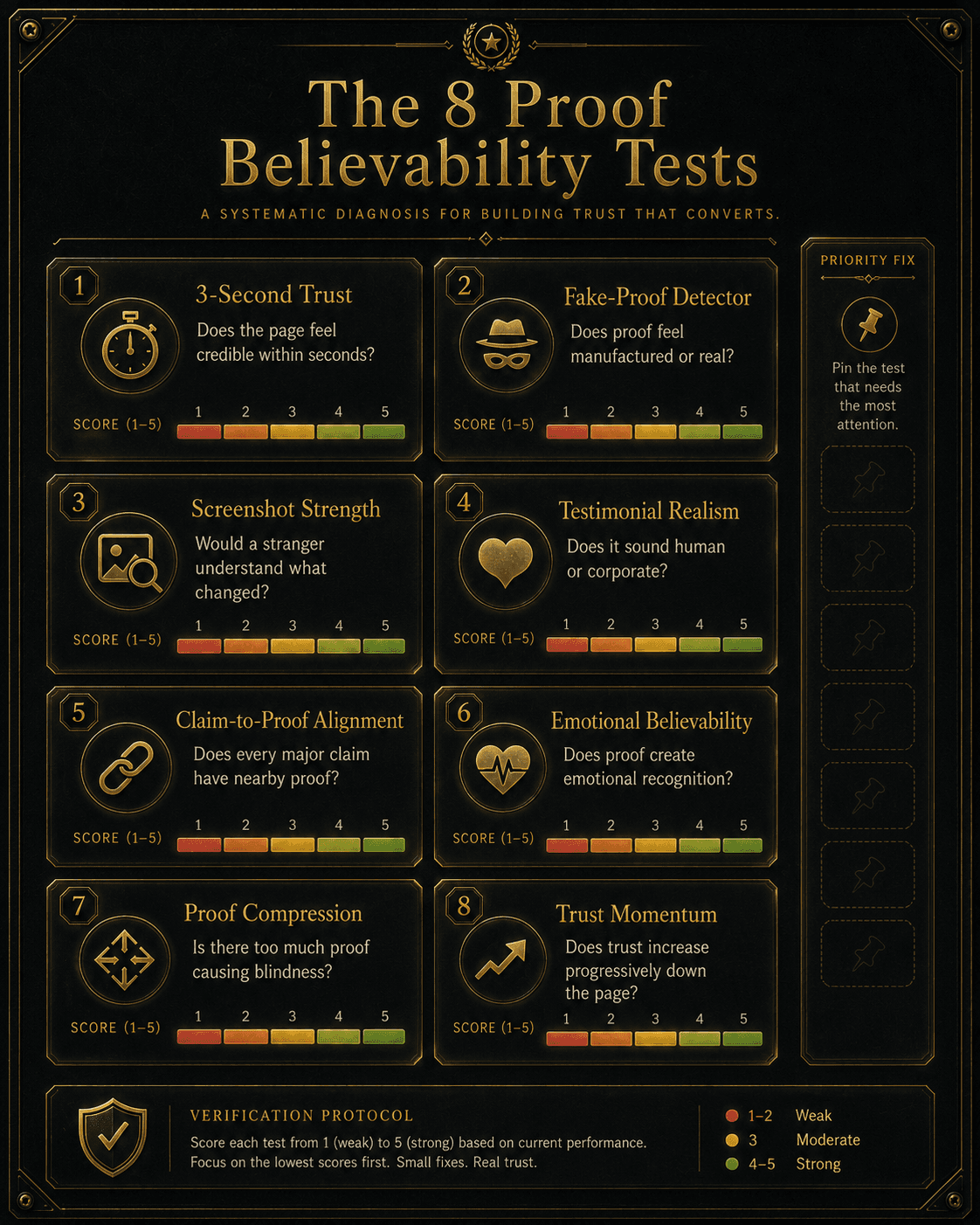
For each test, ask:
does this proof reduce uncertainty?
does this proof feel real?
does this proof support the claim?
does this proof make the page feel safer?
does this proof create movement?
does this proof feel emotionally believable?
At the end of each test, mark the result as:
Pass
The proof is supporting trust clearly.
Weak Pass
The proof is present, but still leaking belief.
Fail
The proof is not reducing enough uncertainty and needs repair.
This audit is not about perfection.
It is about whether proof is actually doing its job.
Test 1: The 3-Second Trust Test™
Core Question
Does the page feel credible quickly?
The page should feel credible quickly.
Not eventually.
Not after five sections.
Not after the buyer works hard to understand the evidence.
Within seconds, the buyer should feel:
“This might actually be real.”
That does not mean the buyer needs full certainty immediately.
It means the first impression should not create scepticism, defensiveness, or suspicion.
The page should feel calmly credible before the buyer is asked to believe anything bigger.
Questions To Ask
Does the page feel believable immediately?
Or does it feel over-marketed?
Do the visuals increase trust?
Or merely visual polish?
Does the proof feel inspectable?
Would a sceptical buyer feel more open after landing here?
Or more defensive?
Does the page feel grounded?
Or does it feel like it is trying too hard to impress?
Weak Signals
The 3-Second Trust Test is weak if the page uses:
exaggerated claims
fake urgency
generic praise
over-designed proof
stock-photo testimonials
polished but contextless dashboards
inflated language
unrealistic outcomes
vague trust badges
visuals that feel staged
proof that looks like ad creative instead of evidence
These signals can make the buyer feel:
“This is probably marketing.”
That is not the reaction you want.
Strong Signals
The 3-Second Trust Test is stronger when the page uses:
visible movement
grounded language
realistic outcomes
emotionally honest proof
inspectable screenshots
believable specifics
raw proof where appropriate
calm captions
real buyer language
proof connected to the main promise
The page feels calmly confident.
That matters enormously.
The buyer does not feel pressured.
They feel oriented.
If This Test Fails
Usually the issue is trying too hard to look impressive.
Fix believability first.
Ask:
“What would make this page feel more real within the first few seconds?”
Often, the answer is not louder language.
It is clearer proof.
3-Second Trust Worksheet
Does the page feel credible within seconds?
Pass / Weak Pass / Fail
What creates immediate trust?
What creates immediate scepticism?
What proof is visible quickly?
Does the proof feel inspectable?
Yes / No / Partially
What should be changed first?
Verdict: Pass / Weak Pass / Fail
Test 2: The Fake-Proof Detector™
Core Question
Does the proof feel real, or manufactured?
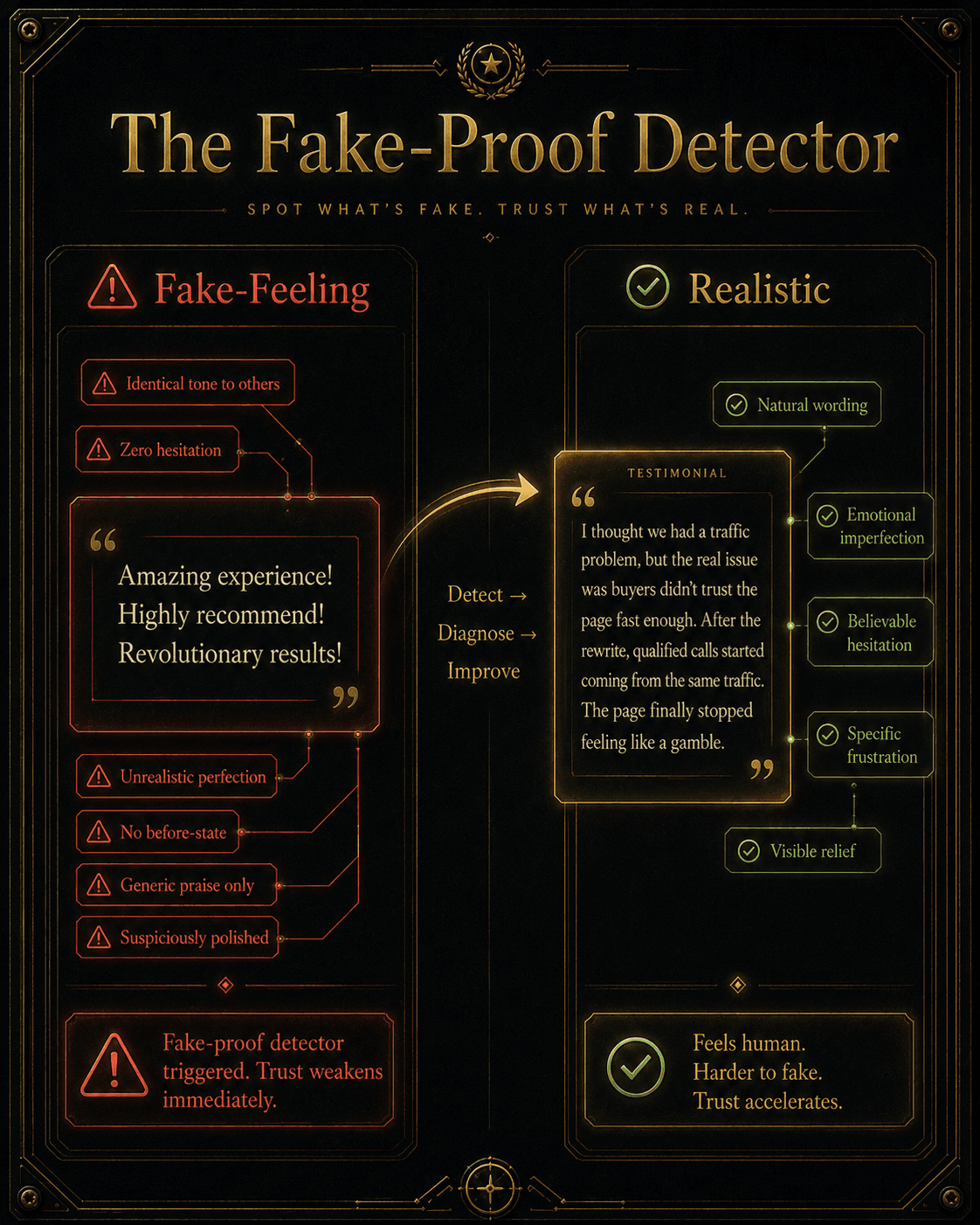
Some proof technically exists but emotionally feels manufactured.
Modern buyers detect this very quickly.
They have seen too many fake testimonials, over-produced videos, suspicious dashboards, generic quote cards, and polished proof blocks.
So the question is not:
“Do we have proof?”
The question is:
“Does this proof feel hard to fake?”
That is what creates trust acceleration.
Questions To Ask
Does the proof feel too polished?
Too perfect?
Too scripted?
Does every testimonial sound the same?
Would the buyer naturally wonder:
“Was this written by the business itself?”
Does the proof contain natural language?
Does it contain hesitation?
Does it contain believable imperfection?
Does it show real context?
Does it feel like it came from life, or from a marketing department?
Common Fake-Feeling Signals
Proof feels fake when it contains:
identical testimonial tone
zero hesitation language
unrealistic perfection
no emotional specificity
no before-state
generic praise only
impossible-sounding outcomes
overproduced videos
suspiciously clean screenshots
over-edited testimonials
corporate phrasing
no timing
no context
no buyer language
no natural imperfection
These signals weaken trust immediately.
The buyer may not consciously explain why.
But emotionally, something feels off.
Strong Realistic Signals
Proof feels more believable when it contains:
natural wording
emotional imperfection
believable hesitation
raw screenshots
visible tension
emotionally human phrasing
specific frustrations
grounded outcomes
buyer language
context
timing
native formatting
real reactions
permission-safe details
The proof feels harder to fake.
That creates trust acceleration.
If This Test Fails
Usually the issue is excessive polish, missing context, or fake-sounding language.
Fix realism.
Ask:
“What would make this proof feel closer to real life?”
Sometimes that means preserving more raw language.
Sometimes it means adding context.
Sometimes it means removing overly polished proof entirely.
Fake-Proof Detector Worksheet
Does the proof feel real or manufactured?
Real / Manufactured / Unsure
Which proof feels most fake?
Why does it feel fake?
Does it contain natural language?
Yes / No
Does it contain hesitation or emotional realism?
Yes / No
Does it contain believable details?
Yes / No
What would make it feel harder to fake?
Verdict: Pass / Weak Pass / Fail
Test 3: The Screenshot Strength Audit™
Core Question
Can the buyer quickly understand why the screenshot matters?
Most screenshots online are emotionally weak.
Not because the result is bad.
Because buyers cannot quickly understand why the screenshot matters.
A screenshot without context can create confusion instead of trust.
A dashboard without labels can create effort instead of belief.
A metric without explanation can make the buyer ask:
“What am I looking at?”
That is not proof.
That is friction.
A strong screenshot should tell a story quickly.
Questions To Ask
Would a stranger understand what changed?
Is the movement visually obvious?
Does the screenshot reduce uncertainty?
Or create confusion?
Would someone naturally pause to inspect it?
Does the screenshot show a result the buyer cares about?
Does the caption explain why it matters?
Does the screenshot feel connected to the surrounding claim?
Weak Screenshot Signals
Screenshots are weak when they contain:
random analytics graphs
no labels
no context
cluttered dashboards
no visible contrast
screenshots proving nothing emotionally meaningful
tiny unreadable numbers
excessive cropping
no timing
no clear before/after
no obvious buyer relevance
no caption
no explanation of what changed
These screenshots may technically show something.
But they do not create belief movement.
Strong Screenshot Signals
Screenshots are stronger when they contain:
clear before/after movement
visible outcome
timing context
readable metrics
emotionally meaningful change
obvious visual progression
clear labels
simple captions
native formatting
visible contrast
one main thing to notice
The screenshot tells a story quickly.
The buyer does not have to decode it.
They can inspect it.
That matters.
If This Test Fails
Usually the issue is not the screenshot itself.
It is the lack of context, contrast, or framing.
Fix the caption.
Add labels.
Make the result easier to understand.
Or replace the screenshot with stronger proof.
Screenshot Strength Worksheet
What screenshot is being audited?
What does it show?
Would a stranger understand why it matters?
Yes / No / Partially
What movement is visible?
What context is missing?
What caption would make it stronger?
Should this screenshot be used prominently?
Yes / No / Only As Supporting Proof
Verdict: Pass / Weak Pass / Fail
Test 4: The Testimonial Realism Audit™
Core Question
Do the testimonials sound human enough to trust?
Testimonials should sound human.
Not corporate.
The buyer should feel:
“This sounds like a real person describing a real shift.”
That creates recognition.
A testimonial does not need to be perfect.
It needs to be believable.
It should help the future buyer see:
what was happening before
what the person doubted
what changed
why the result mattered
what emotional relief appeared
That is what makes testimonial proof work.
Questions To Ask
Does the testimonial contain a before-state?
Does it include hesitation?
Does it reveal emotional tension?
Does it show visible transformation?
Does it include specifics?
Does it include emotional relief?
Does it sound like a real person?
Or does it simply contain generic praise?
Would a buyer recognise themselves inside it?
Weak Testimonial Example
“Amazing experience. Highly recommend.”
Emotionally empty.
It is positive, but it does not show transformation.
It does not reduce much uncertainty.
It does not reveal what changed.
Strong Testimonial Example
“The page finally stopped feeling like a gamble. Buyers understood the value much faster.”
Now the buyer sees:
emotional tension
movement
recognisable frustration
visible relief
Completely different trust effect.
Weak Testimonial Signals
Testimonials are weak when they contain:
generic praise
no before-state
no hesitation
no specific result
no emotional language
no transformation
no buyer relevance
over-polished phrasing
seller-style language
no context
no visible consequence
These testimonials may reassure slightly.
But they rarely create strong belief.
Strong Testimonial Signals
Testimonials are stronger when they contain:
buyer language
before-state
hesitation
specific frustration
turning point
after-state
measurable or visible result
emotional relief
natural phrasing
believable imperfection
The buyer feels:
“That sounds like someone like me.”
That creates trust transfer.
If This Test Fails
Usually the issue is weak testimonial extraction.
Stop asking:
“Can you write me a testimonial?”
Start asking:
“What changed?”
Then extract the before-state, hesitation, result, and emotional shift.
Testimonial Realism Worksheet
Which testimonial is being audited?
Does it contain a before-state?
Yes / No
Does it contain hesitation?
Yes / No
Does it contain a specific result?
Yes / No
Does it contain emotional language?
Yes / No
Does it sound human?
Yes / No / Partially
What line feels strongest?
What line feels generic?
What follow-up question should be asked?
Verdict: Pass / Weak Pass / Fail
Test 5: The Claim-To-Proof Alignment Test™
Core Question
Does every major claim have nearby proof?
This is one of the most important diagnostics in the entire resource.
Every major claim should have nearby proof.
Unsupported claims create scepticism fast.
When the page says something ambitious, the buyer silently asks:
“Can I believe that?”
If proof does not appear close enough, doubt grows.
The claim may be true.
But the buyer is still being asked to carry the uncertainty alone.
That weakens trust.
Questions To Ask
Does every important promise have visible evidence nearby?
Or are major claims left unsupported too long?
Does the proof directly support the surrounding message?
Or does it feel randomly inserted?
Does the page make a strong claim and then move on without backing it?
Does the proof answer the exact doubt created by the claim?
Is the strongest evidence close enough to the strongest promise?
Weak Alignment Example
Claim:
“Double your conversion rate.”
Nearby proof:
None.
Trust collapses instantly.
The buyer is asked to believe a large promise without evidence.
Strong Alignment Example
Claim:
“Improve buyer trust before the CTA.”
Nearby proof:
Before/after screenshots plus testimonial mentioning reduced hesitation.
Now the page feels supported.
The claim is not standing alone.
Evidence is carrying some of the belief burden.
Weak Alignment Signals
Claim-to-proof alignment is weak when:
big promises appear without nearby evidence
proof appears too far below the claim
screenshots do not support the surrounding message
testimonials praise the business but do not support the claim
the page relies on proof walls instead of local proof
the strongest evidence is buried
claims and proof feel disconnected
proof appears after doubt has already grown
This creates silent scepticism.
Strong Alignment Signals
Claim-to-proof alignment is stronger when:
proof appears close to the claim
each major promise has supporting evidence
screenshots clarify the claim
testimonials support the specific transformation
before/after assets prove visible change
proof feels intentionally placed
the buyer does not have to wait too long for evidence
The page feels supported.
The buyer feels less alone with the uncertainty.
If This Test Fails
Usually the issue is proof placement.
Move evidence closer to the claim.
Remove random proof.
Support the strongest promises first.
Ask:
“What proof should appear immediately after this claim?”
Claim-To-Proof Alignment Worksheet
What is the biggest claim on the page?
Where does it appear?
What proof supports it?
Is the proof nearby?
Yes / No / Partially
Does the proof directly support the claim?
Yes / No / Partially
What doubt does the claim create?
What proof should be moved closer?
Verdict: Pass / Weak Pass / Fail
Test 6: The Emotional Believability Test™
Core Question
Does the proof feel emotionally recognisable?
Some proof contains results but still feels emotionally dead.
That weakens trust.
Because buyers trust emotionally recognisable proof faster than sterile metrics alone.
A metric may tell the buyer something happened.
But emotion helps the buyer feel why it mattered.
Strong proof often contains a human signal:
frustration
hesitation
relief
clarity
surprise
recognition
confidence
safety
movement
That emotional signal makes proof more memorable.
Questions To Ask
Does the proof contain emotion?
Can buyers recognise their own frustrations inside it?
Does the proof create relief, recognition, or movement?
Or does it feel mechanical?
Does the proof show why the result mattered emotionally?
Does the language sound like something a buyer would actually say?
Does the proof make the decision feel safer?
Weak Emotional Signals
Proof is emotionally weak when it contains:
cold statistics only
no emotional context
sterile corporate language
no buyer language
generic positivity
no frustration
no relief
no hesitation
no recognisable struggle
no emotional contrast
no human reaction
This proof may be logical, but it does not stick.
Strong Emotional Signals
Proof is emotionally stronger when it contains:
frustration visibility
relief language
hesitation language
emotional contrast
buyer-specific wording
recognisable struggles
natural phrases
visible emotional shift
human reaction
a clear reason the result mattered
Emotion makes proof stickier psychologically.
It helps the buyer remember the evidence.
If This Test Fails
Usually the issue is emotional flatness.
Add human context.
Use testimonials with natural language.
Frame the result around what became easier, safer, clearer, or less frustrating.
Ask:
“What did this result feel like for the buyer?”
Emotional Believability Worksheet
Which proof asset is being audited?
What emotion does it contain?
What frustration does it reveal?
What relief does it show?
Does the buyer recognise themselves inside it?
Yes / No / Partially
What emotional language could improve the framing?
Verdict: Pass / Weak Pass / Fail
Test 7: The Proof Compression Test™
Core Question
Is the page using enough proof to build trust without creating proof blindness?
Too much proof can create proof blindness.
The buyer stops processing everything.
This is extremely common.
A page may contain ten testimonials, six screenshots, three proof walls, four logo strips, and five metrics.
But if everything competes for attention, the strongest proof gets diluted.
The goal is not maximum proof volume.
The goal is focused belief movement.
Strong pages usually use proof selectively.
They create hierarchy.
They make the best proof easier to absorb.
Questions To Ask
Does the page overwhelm the buyer with too much proof?
Are testimonials repetitive?
Do screenshots compete for attention?
Does the proof stack feel focused or cluttered?
Are the strongest assets easy to find?
Could fewer proof assets create more trust?
Does every proof asset have a clear job?
Or is proof being used as filler?
Weak Compression Signals
Proof compression is weak when the page contains:
endless testimonial walls
repeated screenshots
giant proof dumps
oversized review sections
cluttered layouts
too many similar quotes
proof with no hierarchy
screenshots competing visually
no clear section purpose
proof that slows down the decision
Too much proof often weakens important proof.
The buyer stops absorbing.
Strong Compression Signals
Proof compression is stronger when the page uses:
fewer but stronger proof assets
clear hierarchy
emotionally distinct examples
visible spacing
strategic repetition
focused evidence selection
proof grouped by function
short proof near CTA
deeper proof where the buyer needs depth
proof walls that create pattern recognition instead of clutter
The buyer absorbs the important proof faster.
If This Test Fails
Usually the issue is proof dumping.
Remove weak proof.
Group similar assets.
Use hierarchy.
Keep the strongest evidence visible.
Ask:
“What proof is doing real persuasive work, and what proof is just taking up space?”
Proof Compression Worksheet
Does the page feel proof-heavy or proof-clear?
Proof-heavy / Proof-clear / Unsure
Which proof assets feel repetitive?
Which proof assets are strongest?
Which proof assets should be removed?
Which proof assets should be grouped?
Where does proof create clutter?
Verdict: Pass / Weak Pass / Fail
Test 8: The Trust Momentum Test™
Core Question
Does trust progressively increase as the buyer moves through the page?
This is the final and most important test.
As the buyer moves through the page, does trust progressively increase?
Or does uncertainty keep returning?
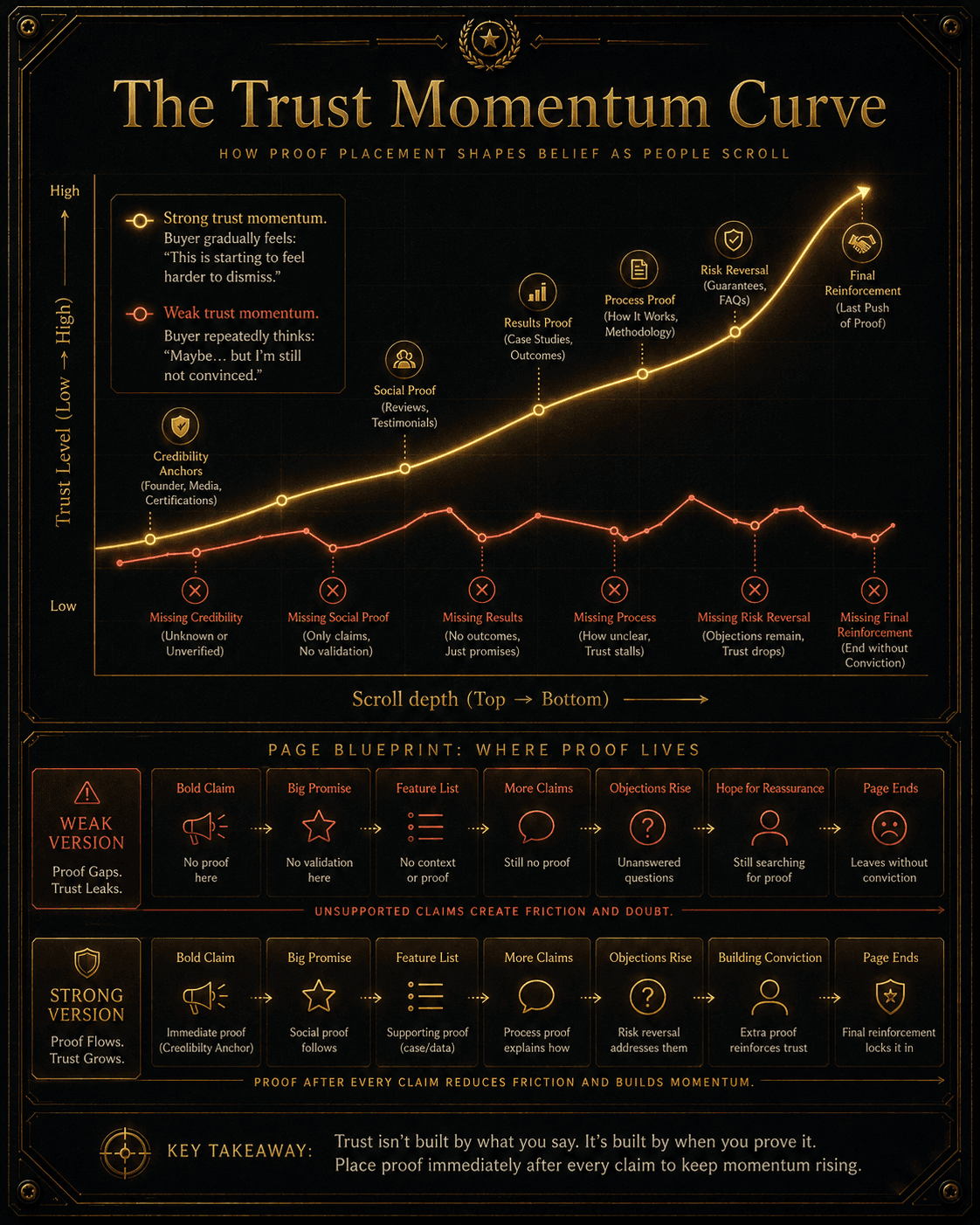
Strong proof should feel cumulative.
The buyer should feel safer with every major section.
Not because the page repeats the same claim louder.
But because every scroll reduces a different layer of doubt.
That is trust momentum.
Questions To Ask
Does the page feel safer over time?
Do the proof assets build cumulative certainty?
Or does the buyer repeatedly encounter unsupported claims?
Does scepticism gradually decrease?
Or remain active?
Does each section reduce a different doubt?
Does the proof flow feel intentional?
Does the page become harder to dismiss as the buyer moves toward the CTA?
Weak Trust Momentum
Weak trust momentum sounds like this inside the buyer’s mind:
“Maybe…”
“But I’m still not fully convinced.”
“That sounds good, but I need more evidence.”
“I still don’t know if this would work for me.”
“This feels polished, but I’m not sure it’s real.”
That means the proof flow is incomplete.
The buyer is still carrying too much uncertainty.
Strong Trust Momentum
Strong trust momentum sounds like this inside the buyer’s mind:
“This is starting to feel harder to dismiss.”
That is the goal.
Because strong pages do not force belief instantly.
They progressively reduce uncertainty.
Above the fold, the buyer feels possibility.
Mid-page, they see mechanism and pattern.
In objection sections, they see hesitation being answered.
Near the CTA, the next step feels safer.
By the end, the proof feels cumulative.
That is trust momentum.
If This Test Fails
Usually the issue is weak proof sequencing.
The page may have proof, but it does not build belief progressively.
Fix the flow.
Ask:
“What does the buyer need to believe next, and what proof helps them believe it?”
Trust Momentum Worksheet
Does trust increase as the buyer moves through the page?
Pass / Weak Pass / Fail
Where does trust feel strongest?
Where does scepticism return?
What claim still feels unsupported?
What proof should appear earlier?
What proof should appear closer to the CTA?
Does the page feel safer by the end?
Yes / No / Partially
Verdict: Pass / Weak Pass / Fail
The Visual Proof Trust Leak Scorecard™
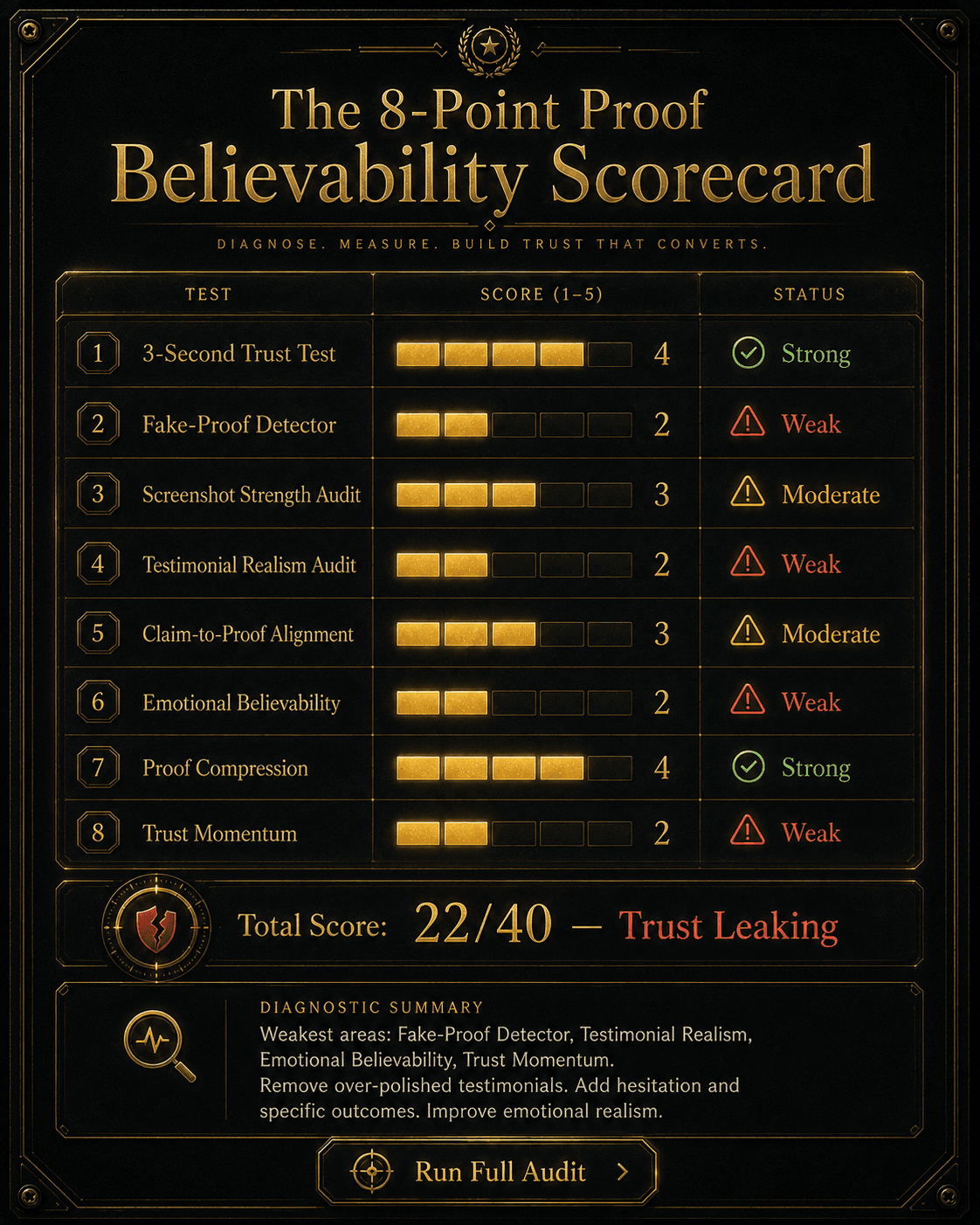
Score each test from 1 to 5.
1 = weak
2 = soft
3 = usable but leaking
4 = strong
5 = excellent
——
Test 1: 3-Second Trust
Does the page feel credible quickly?
Score: ___ / 5
Notes:
Test 2: Fake-Proof Detector
Does the proof feel real rather than manufactured?
Score: ___ / 5
Notes:
Test 3: Screenshot Strength
Are screenshots clear, meaningful, and easy to inspect?
Score: ___ / 5
Notes:
Test 4: Testimonial Realism
Do testimonials sound human, specific, and transformation-led?
Score: ___ / 5
Notes:
Test 5: Claim-To-Proof Alignment
Does every major claim have nearby proof?
Score: ___ / 5
Notes:
Test 6: Emotional Believability
Does the proof contain emotional recognition and buyer language?
Score: ___ / 5
Notes:
Test 7: Proof Compression
Is proof focused and easy to absorb instead of cluttered?
Score: ___ / 5
Notes:
Test 8: Trust Momentum
Does trust progressively increase across the page?
Score: ___ / 5
Notes:
——
Total Score
3-Second Trust: ___ / 5
Fake-Proof Detector: ___ / 5
Screenshot Strength: ___ / 5
Testimonial Realism: ___ / 5
Claim-To-Proof Alignment: ___ / 5
Emotional Believability: ___ / 5
Proof Compression: ___ / 5
Trust Momentum: ___ / 5
Total: ___ / 40
——
Score Interpretation
34–40: Strong Trust Architecture™
Your proof is doing its job.
The page feels believable, supported, emotionally real, and progressively safer as the buyer moves toward action.
You can test the page with confidence.
26–33: Proof Exists, But Trust Still Leaks™
The page has useful proof, but some areas still weaken belief.
Fix the lowest-scoring tests first.
Usually the issue is framing, placement, specificity, or emotional realism.
16–25: Risky Proof Environment™
The page may contain proof, but the buyer still has to carry too much uncertainty.
Major trust leaks are likely present.
Rebuild the proof structure before relying on more traffic.
0–15: Belief Failure Risk™
The page is probably asking for trust before earning it.
Proof may feel generic, fake, misplaced, cluttered, or disconnected from the claims.
Return to the proof bank, improve proof quality, and rebuild proof sequencing.
——
Trust Leak Diagnosis™
Use this section to identify the dominant trust leak.
Most pages do not have one single issue.
But there is usually one leak causing the most damage.
Leak 1: Fake-Proof Leak™
This happens when proof technically exists but feels manufactured.
Common signs:
testimonials sound identical
proof feels over-polished
screenshots feel staged
videos feel scripted
results sound too perfect
no hesitation or natural language appears
Repair:
Make proof more human, more specific, more grounded, and harder to fake.
Leak 2: Screenshot Clarity Leak™
This happens when screenshots exist but buyers cannot understand why they matter.
Common signs:
dashboards lack labels
metrics have no context
screenshots feel random
movement is not obvious
captions are missing
the buyer has to decode the proof
Repair:
Add captions, labels, timing, context, and visible contrast.
Leak 3: Testimonial Realism Leak™
This happens when testimonials sound polite but do not reduce uncertainty.
Common signs:
“great service”
“highly recommend”
no before-state
no hesitation
no result
no emotional shift
no buyer language
Repair:
Collect transformation-led testimonials using better questions.
Leak 4: Claim-To-Proof Leak™
This happens when strong claims appear without nearby evidence.
Common signs:
major promises unsupported
proof appears too late
testimonials do not support the claim
screenshots are disconnected
the buyer has to wait too long for proof
Repair:
Move proof closer to the claim it supports.
Leak 5: Emotional Believability Leak™
This happens when proof is logical but emotionally flat.
Common signs:
cold numbers only
no emotional context
no buyer frustration
no relief
no recognisable struggle
no human language
Repair:
Add emotional framing, buyer language, and human proof.
Leak 6: Proof Compression Leak™
This happens when the page contains too much proof or poorly organised proof.
Common signs:
giant proof walls
repeated testimonials
cluttered screenshots
no hierarchy
visual overload
important proof buried
Repair:
Remove weak assets, group similar proof, and make the strongest evidence easier to absorb.
Leak 7: Trust Momentum Leak™
This happens when trust does not increase as the buyer moves through the page.
Common signs:
proof appears randomly
sections create new doubt without resolving it
the CTA feels unsupported
the buyer keeps returning to uncertainty
the page does not feel safer by the end
Repair:
Rebuild proof sequencing so each section reduces a different layer of doubt.
——
My Dominant Trust Leak
The biggest trust leak on this page is:
Why?
What is causing it?
What needs to be repaired first?
——
Repair Priority Map™
Use this section to decide what to fix first.
Do not try to fix everything at once.
Start with the leak that creates the most uncertainty.
First Proof Asset To Remove
Which proof asset weakens trust and should be removed?
Why?
First Proof Asset To Reframe
Which proof asset has value but needs better captioning, context, or emotional framing?
What framing is needed?
First Proof Asset To Move
Which proof asset is strong but currently in the wrong place?
Where should it move?
First Proof Asset To Replace
Which proof asset is too weak to carry the claim it supports?
What should replace it?
First Proof Gap To Fill
What proof is missing completely?
Why does this matter?
First Trust Leak To Repair
Which trust leak should be fixed first?
Repair action:
The Fastest Trust Leak Audit™
Use these questions for a rapid page review.
Ask yourself:
What proof feels strongest emotionally?
What proof feels weakest?
What proof feels generic?
What claims still feel unsupported?
What proof feels fake?
What proof would a sceptical buyer inspect more closely?
What proof actually reduces uncertainty?
Where does the buyer still have to imagine too much?
Where does the page feel safest?
Where does the page feel riskiest?
These questions expose most trust leaks quickly.
——
Final Trust Verdict™
Choose one verdict.
Verdict 1: Trust-Ready™
Choose this if:
proof feels specific and believable
major claims have nearby evidence
testimonials sound human
screenshots are easy to inspect
proof is not cluttered
trust increases as the buyer moves down the page
the CTA feels supported by enough reassurance
This page is ready to test with real traffic.
Verdict 2: Proof Exists, But Trust Leaks™
Choose this if:
proof exists but feels uneven
some testimonials are generic
screenshots need stronger framing
some claims need closer proof
proof placement could improve
the page feels believable in places but weak in others
This page can be improved without a full rebuild.
Fix the weakest trust leaks first.
Verdict 3: Risky And Unconvincing™
Choose this if:
the page has proof but still feels emotionally weak
buyers likely remain sceptical
testimonials feel fake or generic
proof is buried, cluttered, or disconnected
major claims feel unsupported
the CTA still feels risky
This page needs serious proof repair before scaling traffic.
Verdict 4: Rebuild Proof Architecture™
Choose this if:
the proof strategy is scattered
most proof does not reduce uncertainty
screenshots are unclear
testimonials lack transformation
proof placement is random
the page relies heavily on claims
trust does not increase across the page
This page needs a full proof architecture rebuild.
Return to the proof bank, proof placement map, testimonial capture system, and proof framing vault.
——
My Final Verdict
Trust-Ready / Proof Exists, But Trust Leaks / Risky And Unconvincing / Rebuild Proof Architecture
Why?
The biggest issue is:
The first repair action is:
——
Final Execution Challenge™
Open your current page and identify:
the strongest proof asset
the weakest proof asset
the most believable section
the least believable section
the biggest unsupported claim
the section where scepticism likely spikes most
the proof that feels most fake
the proof that feels most emotionally real
the proof that should be moved closer to a claim
the proof that should be removed because it weakens trust
Then rebuild the proof structure intentionally.
Because the highest-converting pages rarely win because they shout louder.
They win because the buyer gradually stops feeling forced to carry all the uncertainty alone while deciding whether the promise deserves belief.
That is the real job of proof.
——
Final Visual Proof Trust Leak Worksheet
Use this as your working audit sheet.
Page Or Offer Being Audited
Main Page Promise
Buyer’s Biggest Doubt
Current Proof Assets
List the proof currently on the page:
Strongest Proof Asset
Which proof asset creates the most belief?
Why?
Weakest Proof Asset
Which proof asset weakens trust or gets ignored?
Why?
Biggest Unsupported Claim
Which claim needs stronger proof nearby?
What proof should support it?
Most Fake-Feeling Proof
Which proof feels too staged, polished, generic, or manufactured?
How should it be repaired?
Most Emotionally Believable Proof
Which proof feels most human, recognisable, or emotionally real?
Why?
Biggest Screenshot Problem
What screenshot needs clearer context or framing?
What caption would improve it?
Biggest Testimonial Problem
Which testimonial needs a stronger before-state, hesitation, result, or emotional shift?
What follow-up question should be asked?
Proof To Remove
What proof should be removed because it creates clutter or weakens trust?
Proof To Move
What proof should be moved closer to a major claim or CTA?
Proof To Reframe
What proof should be reframed with better labels, captions, or context?
Proof To Collect Next
What proof is missing and should be collected next?
Final Trust Score
Total score from the Visual Proof Trust Leak Scorecard:
___ / 40
Final Verdict
Trust-Ready / Proof Exists, But Trust Leaks / Risky And Unconvincing / Rebuild Proof Architecture
First Repair Action
The first repair action is:
——
Final Principle
Proof is not there to make the page look impressive.
Proof is there to make the decision feel safer.
That is the shift.
A page can have testimonials and still feel risky.
A page can have screenshots and still feel fake.
A page can have metrics and still feel emotionally empty.
A page can have proof walls and still leave the buyer unconvinced.
Because proof only works when it reduces uncertainty.
The buyer is not looking for decoration.
They are looking for enough reality to believe.
They want to see:
what changed
who experienced it
why it matters
whether it feels real
whether someone like them can trust it
whether the next step feels safer than hesitation
That is what The Visual Proof Trust Leak Audit™ is designed to reveal.
Not whether proof exists.
Whether belief is actually increasing.
That is the final standard.
Because once the page makes the result visible, the promise inspectable, the proof believable, and the decision safer, the buyer no longer has to carry all the uncertainty alone.
The page carries some of that weight.
That is when proof stops decorating the page.
And starts doing its real job.
It makes belief easier than doubt.
——
From:
The $100M Funnel Playbook. Book I: Foundation Buyer Psychology, Offer Clarity, and the Page Architecture Behind High-Converting Funnels
By Maris Spalins.
——
Copyright Notice
© 2026 The $100M Funnel Playbook / Winyourclients / Maris Spalins. All rights reserved.
This resource, including the frameworks, terminology, examples, scorecards, templates, prompts, methods, and written explanations, is original intellectual property created for The $100M Funnel Playbook. Book I: Foundation — Buyer Psychology, Offer Clarity, And The Page Architecture Behind High-Converting Funnels and published through Winyourclients.
No part of this resource may be copied, reproduced, screenshotted, republished, redistributed, sold, adapted, uploaded, scraped, stored in a database, included in training data, used to train artificial intelligence systems, or used to create derivative commercial or educational materials without prior written permission.
Limited reference, quotation, or sharing is only permitted where the source is clearly and visibly credited.
Any permitted reference must include at least one of the following source credits:
The $100M Funnel Playbook by Maris Spalins
or
Winyourclients — www.winyourclients.com
or
Maris Spalins / Winyourclients
Screenshots, excerpts, summaries, or redistributed versions must not remove, hide, alter, crop out, or obscure the original source, author name, book title, website name, or copyright notice.
This resource is provided for personal learning and implementation only. It is not licensed for resale, republishing, redistribution, AI training, template cloning, course creation, consulting delivery, or commercial reuse without written permission from Maris Spalins or Winyourclients.
For permission requests, licensing, citation approval, or commercial usage enquiries, contact:
Winyourclients
www.winyourclients.com
or
Email directly to Jacob on: help@winyourclients.com
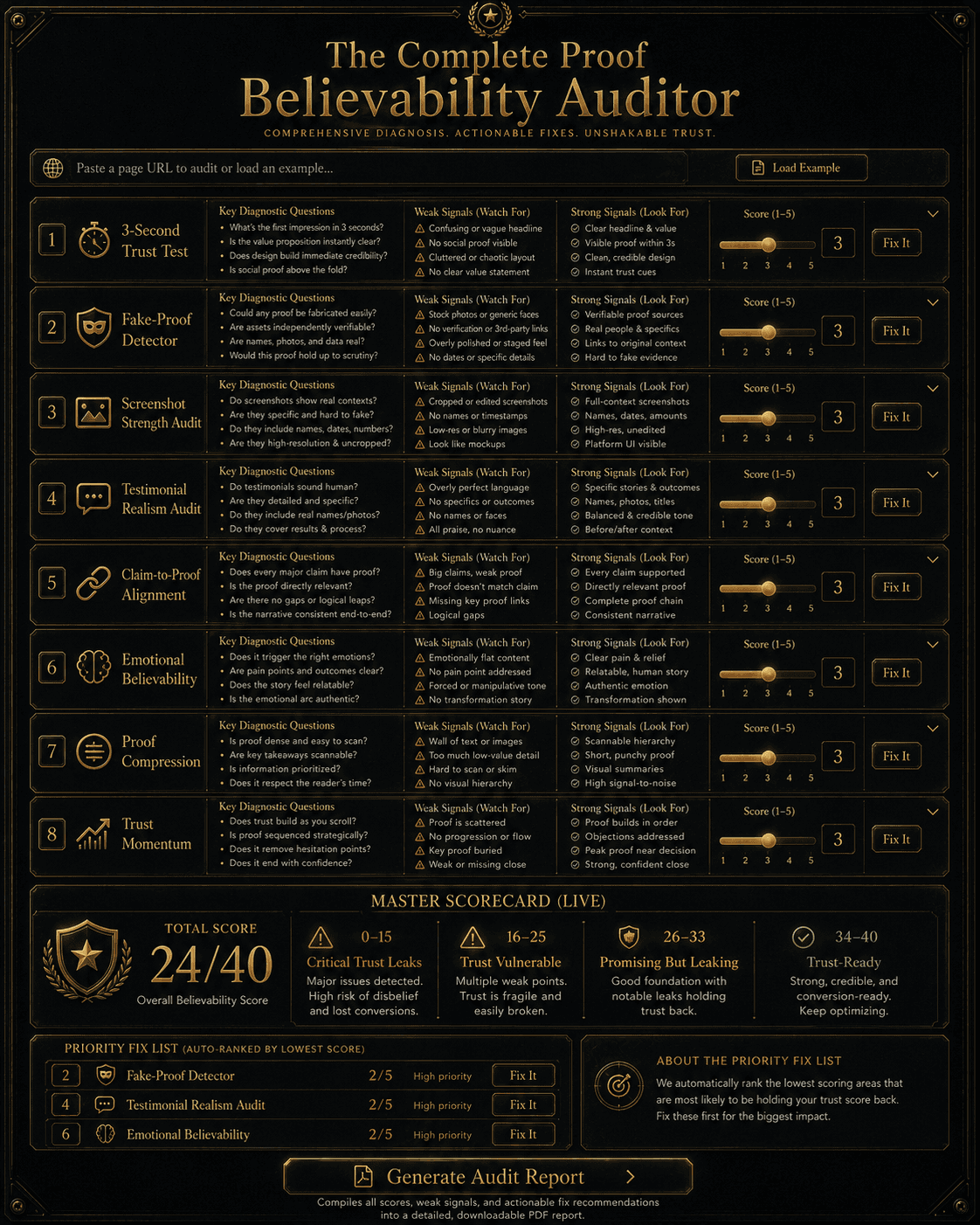
Final Diagnostic: The Visual Proof Trust Leak Audit™ A practical audit system for identifying why a page still feels risky, unconvincing, or emotionally weak even when testimonials, screenshots, dashboards, metrics, reviews, or before/after proof technically exist.
Prefer Audio Or Video?
Final Diagnostic: The Visual Proof Trust Leak Audit™ is also available as:
🎧 A guided audio walkthrough explaining visual proof trust leaks, fake-proof detection, screenshot strength, testimonial realism, claim-to-proof alignment, and trust momentum.
🎥 A practical video breakdown with real proof trust audits, screenshot and testimonial diagnostics, claim-to-proof repairs, proof compression examples, and trust architecture teardowns.Choose the format that fits how you learn best.
[Listen To The Audio Walkthrough] (coming soon)
[Watch The Video Breakdown] (coming soon)
——
Why Proof Alone Does Not Always Create Belief
Many pages already have proof.
They have:
testimonials
screenshots
dashboards
metrics
reviews
before/after examples
customer messages
case-study fragments
social proof blocks
result screenshots
And they still fail to create enough trust.
Why?
Because proof alone does not automatically create belief.
Proof can exist on the page and still fail to persuade.
Some proof is too vague.
Some proof is too generic.
Some proof feels over-polished.
Some proof is emotionally flat.
Some proof is disconnected from the claim.
Some proof is difficult to interpret.
Some proof feels suspiciously perfect.
Some proof is visually cluttered.
Some proof feels commercially staged.
That matters.
Because the buyer is not only asking:
“Is there proof?”
They are asking:
“Does this proof make the promise feel safer to believe?”
That is a completely different standard.
A page can have testimonials and still feel risky.
A page can have screenshots and still feel unconvincing.
A page can have metrics and still feel emotionally weak.
A page can have a proof wall and still fail to reduce doubt.
That is why this resource exists.
It helps you diagnose where trust is leaking.
Not where proof is merely present.
Where belief is actually weakening.
What This Resource Helps You Do
The Visual Proof Trust Leak Audit™ helps you identify why a page still feels risky, unconvincing, or emotionally weak even when proof technically exists.
Use this when:
your page has proof but still feels risky
buyers hesitate before converting
testimonials sound fake or generic
screenshots feel unimpressive
your proof wall gets ignored
the page feels polished but emotionally weak
visitors still seem sceptical
your strongest evidence is not creating movement
your page has results but still lacks trust
proof exists but does not feel connected to the buyer’s doubts
your claims feel stronger than your evidence
the buyer still has to imagine too much
the page looks credible but does not feel emotionally safe
This is not a testimonial checklist.
This is a trust audit system.
The goal is simple:
Identify exactly where the page weakens belief, certainty, and emotional safety before the buyer leaves.
The Core Principle™
The goal of proof is not to look impressive.
The goal is to reduce psychological risk.
That is the real job.
Buyers are not simply responding to the presence of testimonials, screenshots, metrics, or logos.
They are responding to whether the proof makes the decision feel safer.
Strong proof makes the buyer feel:
“This feels safer to believe.”
Weak proof makes the buyer feel:
“This still feels like marketing.”
Huge difference.
Proof should reduce the emotional burden of belief.
It should make the claim easier to trust.
It should make the result easier to picture.
It should make the next step feel less risky.
If the proof does not reduce uncertainty, it is not doing its job.
It may decorate the page.
It may make the page look busier.
It may help the founder feel reassured.
But it is not creating enough trust movement.
That is what this audit measures.
The Biggest Mistake Most Businesses Make™
Most businesses think trust comes from adding more proof.
Not always.
Sometimes trust improves more by:
removing weak proof
improving framing
increasing specificity
reducing hype
improving placement
increasing emotional realism
clarifying what the proof actually means
moving strong proof closer to the claim
replacing generic testimonials with transformation stories
reducing visual clutter
making the evidence easier to inspect
That distinction matters enormously.
The answer is not always:
“Add more testimonials.”
Sometimes the real answer is:
“Remove the weak ones.”
Or:
“Move the strongest proof higher.”
Or:
“Add context to the screenshot.”
Or:
“Stop making the proof sound like advertising.”
Or:
“Use fewer proof assets, but make each one more believable.”
The page does not need more proof volume.
It needs less uncertainty.
That is the standard.
How To Use This Diagnostic
Move through every section honestly.
Do not evaluate the page as the founder.
Do not evaluate it as the designer.
Do not evaluate it as the person who already knows the result is real.
Evaluate it as a sceptical buyer trying to determine:
“Does this actually feel believable enough to move forward?”
That is the real standard.
For each test, ask:
does this proof reduce uncertainty?
does this proof feel real?
does this proof support the claim?
does this proof make the page feel safer?
does this proof create movement?
does this proof feel emotionally believable?
At the end of each test, mark the result as:
Pass
The proof is supporting trust clearly.
Weak Pass
The proof is present, but still leaking belief.
Fail
The proof is not reducing enough uncertainty and needs repair.
This audit is not about perfection.
It is about whether proof is actually doing its job.
Test 1: The 3-Second Trust Test™
Core Question
Does the page feel credible quickly?
The page should feel credible quickly.
Not eventually.
Not after five sections.
Not after the buyer works hard to understand the evidence.
Within seconds, the buyer should feel:
“This might actually be real.”
That does not mean the buyer needs full certainty immediately.
It means the first impression should not create scepticism, defensiveness, or suspicion.
The page should feel calmly credible before the buyer is asked to believe anything bigger.
Questions To Ask
Does the page feel believable immediately?
Or does it feel over-marketed?
Do the visuals increase trust?
Or merely visual polish?
Does the proof feel inspectable?
Would a sceptical buyer feel more open after landing here?
Or more defensive?
Does the page feel grounded?
Or does it feel like it is trying too hard to impress?
Weak Signals
The 3-Second Trust Test is weak if the page uses:
exaggerated claims
fake urgency
generic praise
over-designed proof
stock-photo testimonials
polished but contextless dashboards
inflated language
unrealistic outcomes
vague trust badges
visuals that feel staged
proof that looks like ad creative instead of evidence
These signals can make the buyer feel:
“This is probably marketing.”
That is not the reaction you want.
Strong Signals
The 3-Second Trust Test is stronger when the page uses:
visible movement
grounded language
realistic outcomes
emotionally honest proof
inspectable screenshots
believable specifics
raw proof where appropriate
calm captions
real buyer language
proof connected to the main promise
The page feels calmly confident.
That matters enormously.
The buyer does not feel pressured.
They feel oriented.
If This Test Fails
Usually the issue is trying too hard to look impressive.
Fix believability first.
Ask:
“What would make this page feel more real within the first few seconds?”
Often, the answer is not louder language.
It is clearer proof.
3-Second Trust Worksheet
Does the page feel credible within seconds?
Pass / Weak Pass / Fail
What creates immediate trust?
What creates immediate scepticism?
What proof is visible quickly?
Does the proof feel inspectable?
Yes / No / Partially
What should be changed first?
Verdict: Pass / Weak Pass / Fail
Test 2: The Fake-Proof Detector™
Core Question
Does the proof feel real, or manufactured?
Some proof technically exists but emotionally feels manufactured.
Modern buyers detect this very quickly.
They have seen too many fake testimonials, over-produced videos, suspicious dashboards, generic quote cards, and polished proof blocks.
So the question is not:
“Do we have proof?”
The question is:
“Does this proof feel hard to fake?”
That is what creates trust acceleration.
Questions To Ask
Does the proof feel too polished?
Too perfect?
Too scripted?
Does every testimonial sound the same?
Would the buyer naturally wonder:
“Was this written by the business itself?”
Does the proof contain natural language?
Does it contain hesitation?
Does it contain believable imperfection?
Does it show real context?
Does it feel like it came from life, or from a marketing department?
Common Fake-Feeling Signals
Proof feels fake when it contains:
identical testimonial tone
zero hesitation language
unrealistic perfection
no emotional specificity
no before-state
generic praise only
impossible-sounding outcomes
overproduced videos
suspiciously clean screenshots
over-edited testimonials
corporate phrasing
no timing
no context
no buyer language
no natural imperfection
These signals weaken trust immediately.
The buyer may not consciously explain why.
But emotionally, something feels off.
Strong Realistic Signals
Proof feels more believable when it contains:
natural wording
emotional imperfection
believable hesitation
raw screenshots
visible tension
emotionally human phrasing
specific frustrations
grounded outcomes
buyer language
context
timing
native formatting
real reactions
permission-safe details
The proof feels harder to fake.
That creates trust acceleration.
If This Test Fails
Usually the issue is excessive polish, missing context, or fake-sounding language.
Fix realism.
Ask:
“What would make this proof feel closer to real life?”
Sometimes that means preserving more raw language.
Sometimes it means adding context.
Sometimes it means removing overly polished proof entirely.
Fake-Proof Detector Worksheet
Does the proof feel real or manufactured?
Real / Manufactured / Unsure
Which proof feels most fake?
Why does it feel fake?
Does it contain natural language?
Yes / No
Does it contain hesitation or emotional realism?
Yes / No
Does it contain believable details?
Yes / No
What would make it feel harder to fake?
Verdict: Pass / Weak Pass / Fail
Test 3: The Screenshot Strength Audit™
Core Question
Can the buyer quickly understand why the screenshot matters?
Most screenshots online are emotionally weak.
Not because the result is bad.
Because buyers cannot quickly understand why the screenshot matters.
A screenshot without context can create confusion instead of trust.
A dashboard without labels can create effort instead of belief.
A metric without explanation can make the buyer ask:
“What am I looking at?”
That is not proof.
That is friction.
A strong screenshot should tell a story quickly.
Questions To Ask
Would a stranger understand what changed?
Is the movement visually obvious?
Does the screenshot reduce uncertainty?
Or create confusion?
Would someone naturally pause to inspect it?
Does the screenshot show a result the buyer cares about?
Does the caption explain why it matters?
Does the screenshot feel connected to the surrounding claim?
Weak Screenshot Signals
Screenshots are weak when they contain:
random analytics graphs
no labels
no context
cluttered dashboards
no visible contrast
screenshots proving nothing emotionally meaningful
tiny unreadable numbers
excessive cropping
no timing
no clear before/after
no obvious buyer relevance
no caption
no explanation of what changed
These screenshots may technically show something.
But they do not create belief movement.
Strong Screenshot Signals
Screenshots are stronger when they contain:
clear before/after movement
visible outcome
timing context
readable metrics
emotionally meaningful change
obvious visual progression
clear labels
simple captions
native formatting
visible contrast
one main thing to notice
The screenshot tells a story quickly.
The buyer does not have to decode it.
They can inspect it.
That matters.
If This Test Fails
Usually the issue is not the screenshot itself.
It is the lack of context, contrast, or framing.
Fix the caption.
Add labels.
Make the result easier to understand.
Or replace the screenshot with stronger proof.
Screenshot Strength Worksheet
What screenshot is being audited?
What does it show?
Would a stranger understand why it matters?
Yes / No / Partially
What movement is visible?
What context is missing?
What caption would make it stronger?
Should this screenshot be used prominently?
Yes / No / Only As Supporting Proof
Verdict: Pass / Weak Pass / Fail
Test 4: The Testimonial Realism Audit™
Core Question
Do the testimonials sound human enough to trust?
Testimonials should sound human.
Not corporate.
The buyer should feel:
“This sounds like a real person describing a real shift.”
That creates recognition.
A testimonial does not need to be perfect.
It needs to be believable.
It should help the future buyer see:
what was happening before
what the person doubted
what changed
why the result mattered
what emotional relief appeared
That is what makes testimonial proof work.
Questions To Ask
Does the testimonial contain a before-state?
Does it include hesitation?
Does it reveal emotional tension?
Does it show visible transformation?
Does it include specifics?
Does it include emotional relief?
Does it sound like a real person?
Or does it simply contain generic praise?
Would a buyer recognise themselves inside it?
Weak Testimonial Example
“Amazing experience. Highly recommend.”
Emotionally empty.
It is positive, but it does not show transformation.
It does not reduce much uncertainty.
It does not reveal what changed.
Strong Testimonial Example
“The page finally stopped feeling like a gamble. Buyers understood the value much faster.”
Now the buyer sees:
emotional tension
movement
recognisable frustration
visible relief
Completely different trust effect.
Weak Testimonial Signals
Testimonials are weak when they contain:
generic praise
no before-state
no hesitation
no specific result
no emotional language
no transformation
no buyer relevance
over-polished phrasing
seller-style language
no context
no visible consequence
These testimonials may reassure slightly.
But they rarely create strong belief.
Strong Testimonial Signals
Testimonials are stronger when they contain:
buyer language
before-state
hesitation
specific frustration
turning point
after-state
measurable or visible result
emotional relief
natural phrasing
believable imperfection
The buyer feels:
“That sounds like someone like me.”
That creates trust transfer.
If This Test Fails
Usually the issue is weak testimonial extraction.
Stop asking:
“Can you write me a testimonial?”
Start asking:
“What changed?”
Then extract the before-state, hesitation, result, and emotional shift.
Testimonial Realism Worksheet
Which testimonial is being audited?
Does it contain a before-state?
Yes / No
Does it contain hesitation?
Yes / No
Does it contain a specific result?
Yes / No
Does it contain emotional language?
Yes / No
Does it sound human?
Yes / No / Partially
What line feels strongest?
What line feels generic?
What follow-up question should be asked?
Verdict: Pass / Weak Pass / Fail
Test 5: The Claim-To-Proof Alignment Test™
Core Question
Does every major claim have nearby proof?
This is one of the most important diagnostics in the entire resource.
Every major claim should have nearby proof.
Unsupported claims create scepticism fast.
When the page says something ambitious, the buyer silently asks:
“Can I believe that?”
If proof does not appear close enough, doubt grows.
The claim may be true.
But the buyer is still being asked to carry the uncertainty alone.
That weakens trust.
Questions To Ask
Does every important promise have visible evidence nearby?
Or are major claims left unsupported too long?
Does the proof directly support the surrounding message?
Or does it feel randomly inserted?
Does the page make a strong claim and then move on without backing it?
Does the proof answer the exact doubt created by the claim?
Is the strongest evidence close enough to the strongest promise?
Weak Alignment Example
Claim:
“Double your conversion rate.”
Nearby proof:
None.
Trust collapses instantly.
The buyer is asked to believe a large promise without evidence.
Strong Alignment Example
Claim:
“Improve buyer trust before the CTA.”
Nearby proof:
Before/after screenshots plus testimonial mentioning reduced hesitation.
Now the page feels supported.
The claim is not standing alone.
Evidence is carrying some of the belief burden.
Weak Alignment Signals
Claim-to-proof alignment is weak when:
big promises appear without nearby evidence
proof appears too far below the claim
screenshots do not support the surrounding message
testimonials praise the business but do not support the claim
the page relies on proof walls instead of local proof
the strongest evidence is buried
claims and proof feel disconnected
proof appears after doubt has already grown
This creates silent scepticism.
Strong Alignment Signals
Claim-to-proof alignment is stronger when:
proof appears close to the claim
each major promise has supporting evidence
screenshots clarify the claim
testimonials support the specific transformation
before/after assets prove visible change
proof feels intentionally placed
the buyer does not have to wait too long for evidence
The page feels supported.
The buyer feels less alone with the uncertainty.
If This Test Fails
Usually the issue is proof placement.
Move evidence closer to the claim.
Remove random proof.
Support the strongest promises first.
Ask:
“What proof should appear immediately after this claim?”
Claim-To-Proof Alignment Worksheet
What is the biggest claim on the page?
Where does it appear?
What proof supports it?
Is the proof nearby?
Yes / No / Partially
Does the proof directly support the claim?
Yes / No / Partially
What doubt does the claim create?
What proof should be moved closer?
Verdict: Pass / Weak Pass / Fail
Test 6: The Emotional Believability Test™
Core Question
Does the proof feel emotionally recognisable?
Some proof contains results but still feels emotionally dead.
That weakens trust.
Because buyers trust emotionally recognisable proof faster than sterile metrics alone.
A metric may tell the buyer something happened.
But emotion helps the buyer feel why it mattered.
Strong proof often contains a human signal:
frustration
hesitation
relief
clarity
surprise
recognition
confidence
safety
movement
That emotional signal makes proof more memorable.
Questions To Ask
Does the proof contain emotion?
Can buyers recognise their own frustrations inside it?
Does the proof create relief, recognition, or movement?
Or does it feel mechanical?
Does the proof show why the result mattered emotionally?
Does the language sound like something a buyer would actually say?
Does the proof make the decision feel safer?
Weak Emotional Signals
Proof is emotionally weak when it contains:
cold statistics only
no emotional context
sterile corporate language
no buyer language
generic positivity
no frustration
no relief
no hesitation
no recognisable struggle
no emotional contrast
no human reaction
This proof may be logical, but it does not stick.
Strong Emotional Signals
Proof is emotionally stronger when it contains:
frustration visibility
relief language
hesitation language
emotional contrast
buyer-specific wording
recognisable struggles
natural phrases
visible emotional shift
human reaction
a clear reason the result mattered
Emotion makes proof stickier psychologically.
It helps the buyer remember the evidence.
If This Test Fails
Usually the issue is emotional flatness.
Add human context.
Use testimonials with natural language.
Frame the result around what became easier, safer, clearer, or less frustrating.
Ask:
“What did this result feel like for the buyer?”
Emotional Believability Worksheet
Which proof asset is being audited?
What emotion does it contain?
What frustration does it reveal?
What relief does it show?
Does the buyer recognise themselves inside it?
Yes / No / Partially
What emotional language could improve the framing?
Verdict: Pass / Weak Pass / Fail
Test 7: The Proof Compression Test™
Core Question
Is the page using enough proof to build trust without creating proof blindness?
Too much proof can create proof blindness.
The buyer stops processing everything.
This is extremely common.
A page may contain ten testimonials, six screenshots, three proof walls, four logo strips, and five metrics.
But if everything competes for attention, the strongest proof gets diluted.
The goal is not maximum proof volume.
The goal is focused belief movement.
Strong pages usually use proof selectively.
They create hierarchy.
They make the best proof easier to absorb.
Questions To Ask
Does the page overwhelm the buyer with too much proof?
Are testimonials repetitive?
Do screenshots compete for attention?
Does the proof stack feel focused or cluttered?
Are the strongest assets easy to find?
Could fewer proof assets create more trust?
Does every proof asset have a clear job?
Or is proof being used as filler?
Weak Compression Signals
Proof compression is weak when the page contains:
endless testimonial walls
repeated screenshots
giant proof dumps
oversized review sections
cluttered layouts
too many similar quotes
proof with no hierarchy
screenshots competing visually
no clear section purpose
proof that slows down the decision
Too much proof often weakens important proof.
The buyer stops absorbing.
Strong Compression Signals
Proof compression is stronger when the page uses:
fewer but stronger proof assets
clear hierarchy
emotionally distinct examples
visible spacing
strategic repetition
focused evidence selection
proof grouped by function
short proof near CTA
deeper proof where the buyer needs depth
proof walls that create pattern recognition instead of clutter
The buyer absorbs the important proof faster.
If This Test Fails
Usually the issue is proof dumping.
Remove weak proof.
Group similar assets.
Use hierarchy.
Keep the strongest evidence visible.
Ask:
“What proof is doing real persuasive work, and what proof is just taking up space?”
Proof Compression Worksheet
Does the page feel proof-heavy or proof-clear?
Proof-heavy / Proof-clear / Unsure
Which proof assets feel repetitive?
Which proof assets are strongest?
Which proof assets should be removed?
Which proof assets should be grouped?
Where does proof create clutter?
Verdict: Pass / Weak Pass / Fail
Test 8: The Trust Momentum Test™
Core Question
Does trust progressively increase as the buyer moves through the page?
This is the final and most important test.
As the buyer moves through the page, does trust progressively increase?
Or does uncertainty keep returning?
Strong proof should feel cumulative.
The buyer should feel safer with every major section.
Not because the page repeats the same claim louder.
But because every scroll reduces a different layer of doubt.
That is trust momentum.
Questions To Ask
Does the page feel safer over time?
Do the proof assets build cumulative certainty?
Or does the buyer repeatedly encounter unsupported claims?
Does scepticism gradually decrease?
Or remain active?
Does each section reduce a different doubt?
Does the proof flow feel intentional?
Does the page become harder to dismiss as the buyer moves toward the CTA?
Weak Trust Momentum
Weak trust momentum sounds like this inside the buyer’s mind:
“Maybe…”
“But I’m still not fully convinced.”
“That sounds good, but I need more evidence.”
“I still don’t know if this would work for me.”
“This feels polished, but I’m not sure it’s real.”
That means the proof flow is incomplete.
The buyer is still carrying too much uncertainty.
Strong Trust Momentum
Strong trust momentum sounds like this inside the buyer’s mind:
“This is starting to feel harder to dismiss.”
That is the goal.
Because strong pages do not force belief instantly.
They progressively reduce uncertainty.
Above the fold, the buyer feels possibility.
Mid-page, they see mechanism and pattern.
In objection sections, they see hesitation being answered.
Near the CTA, the next step feels safer.
By the end, the proof feels cumulative.
That is trust momentum.
If This Test Fails
Usually the issue is weak proof sequencing.
The page may have proof, but it does not build belief progressively.
Fix the flow.
Ask:
“What does the buyer need to believe next, and what proof helps them believe it?”
Trust Momentum Worksheet
Does trust increase as the buyer moves through the page?
Pass / Weak Pass / Fail
Where does trust feel strongest?
Where does scepticism return?
What claim still feels unsupported?
What proof should appear earlier?
What proof should appear closer to the CTA?
Does the page feel safer by the end?
Yes / No / Partially
Verdict: Pass / Weak Pass / Fail
The Visual Proof Trust Leak Scorecard™
Score each test from 1 to 5.
1 = weak
2 = soft
3 = usable but leaking
4 = strong
5 = excellent
——
Test 1: 3-Second Trust
Does the page feel credible quickly?
Score: ___ / 5
Notes:
Test 2: Fake-Proof Detector
Does the proof feel real rather than manufactured?
Score: ___ / 5
Notes:
Test 3: Screenshot Strength
Are screenshots clear, meaningful, and easy to inspect?
Score: ___ / 5
Notes:
Test 4: Testimonial Realism
Do testimonials sound human, specific, and transformation-led?
Score: ___ / 5
Notes:
Test 5: Claim-To-Proof Alignment
Does every major claim have nearby proof?
Score: ___ / 5
Notes:
Test 6: Emotional Believability
Does the proof contain emotional recognition and buyer language?
Score: ___ / 5
Notes:
Test 7: Proof Compression
Is proof focused and easy to absorb instead of cluttered?
Score: ___ / 5
Notes:
Test 8: Trust Momentum
Does trust progressively increase across the page?
Score: ___ / 5
Notes:
——
Total Score
3-Second Trust: ___ / 5
Fake-Proof Detector: ___ / 5
Screenshot Strength: ___ / 5
Testimonial Realism: ___ / 5
Claim-To-Proof Alignment: ___ / 5
Emotional Believability: ___ / 5
Proof Compression: ___ / 5
Trust Momentum: ___ / 5
Total: ___ / 40
——
Score Interpretation
34–40: Strong Trust Architecture™
Your proof is doing its job.
The page feels believable, supported, emotionally real, and progressively safer as the buyer moves toward action.
You can test the page with confidence.
26–33: Proof Exists, But Trust Still Leaks™
The page has useful proof, but some areas still weaken belief.
Fix the lowest-scoring tests first.
Usually the issue is framing, placement, specificity, or emotional realism.
16–25: Risky Proof Environment™
The page may contain proof, but the buyer still has to carry too much uncertainty.
Major trust leaks are likely present.
Rebuild the proof structure before relying on more traffic.
0–15: Belief Failure Risk™
The page is probably asking for trust before earning it.
Proof may feel generic, fake, misplaced, cluttered, or disconnected from the claims.
Return to the proof bank, improve proof quality, and rebuild proof sequencing.
——
Trust Leak Diagnosis™
Use this section to identify the dominant trust leak.
Most pages do not have one single issue.
But there is usually one leak causing the most damage.
Leak 1: Fake-Proof Leak™
This happens when proof technically exists but feels manufactured.
Common signs:
testimonials sound identical
proof feels over-polished
screenshots feel staged
videos feel scripted
results sound too perfect
no hesitation or natural language appears
Repair:
Make proof more human, more specific, more grounded, and harder to fake.
Leak 2: Screenshot Clarity Leak™
This happens when screenshots exist but buyers cannot understand why they matter.
Common signs:
dashboards lack labels
metrics have no context
screenshots feel random
movement is not obvious
captions are missing
the buyer has to decode the proof
Repair:
Add captions, labels, timing, context, and visible contrast.
Leak 3: Testimonial Realism Leak™
This happens when testimonials sound polite but do not reduce uncertainty.
Common signs:
“great service”
“highly recommend”
no before-state
no hesitation
no result
no emotional shift
no buyer language
Repair:
Collect transformation-led testimonials using better questions.
Leak 4: Claim-To-Proof Leak™
This happens when strong claims appear without nearby evidence.
Common signs:
major promises unsupported
proof appears too late
testimonials do not support the claim
screenshots are disconnected
the buyer has to wait too long for proof
Repair:
Move proof closer to the claim it supports.
Leak 5: Emotional Believability Leak™
This happens when proof is logical but emotionally flat.
Common signs:
cold numbers only
no emotional context
no buyer frustration
no relief
no recognisable struggle
no human language
Repair:
Add emotional framing, buyer language, and human proof.
Leak 6: Proof Compression Leak™
This happens when the page contains too much proof or poorly organised proof.
Common signs:
giant proof walls
repeated testimonials
cluttered screenshots
no hierarchy
visual overload
important proof buried
Repair:
Remove weak assets, group similar proof, and make the strongest evidence easier to absorb.
Leak 7: Trust Momentum Leak™
This happens when trust does not increase as the buyer moves through the page.
Common signs:
proof appears randomly
sections create new doubt without resolving it
the CTA feels unsupported
the buyer keeps returning to uncertainty
the page does not feel safer by the end
Repair:
Rebuild proof sequencing so each section reduces a different layer of doubt.
——
My Dominant Trust Leak
The biggest trust leak on this page is:
Why?
What is causing it?
What needs to be repaired first?
——
Repair Priority Map™
Use this section to decide what to fix first.
Do not try to fix everything at once.
Start with the leak that creates the most uncertainty.
First Proof Asset To Remove
Which proof asset weakens trust and should be removed?
Why?
First Proof Asset To Reframe
Which proof asset has value but needs better captioning, context, or emotional framing?
What framing is needed?
First Proof Asset To Move
Which proof asset is strong but currently in the wrong place?
Where should it move?
First Proof Asset To Replace
Which proof asset is too weak to carry the claim it supports?
What should replace it?
First Proof Gap To Fill
What proof is missing completely?
Why does this matter?
First Trust Leak To Repair
Which trust leak should be fixed first?
Repair action:
The Fastest Trust Leak Audit™
Use these questions for a rapid page review.
Ask yourself:
What proof feels strongest emotionally?
What proof feels weakest?
What proof feels generic?
What claims still feel unsupported?
What proof feels fake?
What proof would a sceptical buyer inspect more closely?
What proof actually reduces uncertainty?
Where does the buyer still have to imagine too much?
Where does the page feel safest?
Where does the page feel riskiest?
These questions expose most trust leaks quickly.
——
Final Trust Verdict™
Choose one verdict.
Verdict 1: Trust-Ready™
Choose this if:
proof feels specific and believable
major claims have nearby evidence
testimonials sound human
screenshots are easy to inspect
proof is not cluttered
trust increases as the buyer moves down the page
the CTA feels supported by enough reassurance
This page is ready to test with real traffic.
Verdict 2: Proof Exists, But Trust Leaks™
Choose this if:
proof exists but feels uneven
some testimonials are generic
screenshots need stronger framing
some claims need closer proof
proof placement could improve
the page feels believable in places but weak in others
This page can be improved without a full rebuild.
Fix the weakest trust leaks first.
Verdict 3: Risky And Unconvincing™
Choose this if:
the page has proof but still feels emotionally weak
buyers likely remain sceptical
testimonials feel fake or generic
proof is buried, cluttered, or disconnected
major claims feel unsupported
the CTA still feels risky
This page needs serious proof repair before scaling traffic.
Verdict 4: Rebuild Proof Architecture™
Choose this if:
the proof strategy is scattered
most proof does not reduce uncertainty
screenshots are unclear
testimonials lack transformation
proof placement is random
the page relies heavily on claims
trust does not increase across the page
This page needs a full proof architecture rebuild.
Return to the proof bank, proof placement map, testimonial capture system, and proof framing vault.
——
My Final Verdict
Trust-Ready / Proof Exists, But Trust Leaks / Risky And Unconvincing / Rebuild Proof Architecture
Why?
The biggest issue is:
The first repair action is:
——
Final Execution Challenge™
Open your current page and identify:
the strongest proof asset
the weakest proof asset
the most believable section
the least believable section
the biggest unsupported claim
the section where scepticism likely spikes most
the proof that feels most fake
the proof that feels most emotionally real
the proof that should be moved closer to a claim
the proof that should be removed because it weakens trust
Then rebuild the proof structure intentionally.
Because the highest-converting pages rarely win because they shout louder.
They win because the buyer gradually stops feeling forced to carry all the uncertainty alone while deciding whether the promise deserves belief.
That is the real job of proof.
——
Final Visual Proof Trust Leak Worksheet
Use this as your working audit sheet.
Page Or Offer Being Audited
Main Page Promise
Buyer’s Biggest Doubt
Current Proof Assets
List the proof currently on the page:
Strongest Proof Asset
Which proof asset creates the most belief?
Why?
Weakest Proof Asset
Which proof asset weakens trust or gets ignored?
Why?
Biggest Unsupported Claim
Which claim needs stronger proof nearby?
What proof should support it?
Most Fake-Feeling Proof
Which proof feels too staged, polished, generic, or manufactured?
How should it be repaired?
Most Emotionally Believable Proof
Which proof feels most human, recognisable, or emotionally real?
Why?
Biggest Screenshot Problem
What screenshot needs clearer context or framing?
What caption would improve it?
Biggest Testimonial Problem
Which testimonial needs a stronger before-state, hesitation, result, or emotional shift?
What follow-up question should be asked?
Proof To Remove
What proof should be removed because it creates clutter or weakens trust?
Proof To Move
What proof should be moved closer to a major claim or CTA?
Proof To Reframe
What proof should be reframed with better labels, captions, or context?
Proof To Collect Next
What proof is missing and should be collected next?
Final Trust Score
Total score from the Visual Proof Trust Leak Scorecard:
___ / 40
Final Verdict
Trust-Ready / Proof Exists, But Trust Leaks / Risky And Unconvincing / Rebuild Proof Architecture
First Repair Action
The first repair action is:
——
Final Principle
Proof is not there to make the page look impressive.
Proof is there to make the decision feel safer.
That is the shift.
A page can have testimonials and still feel risky.
A page can have screenshots and still feel fake.
A page can have metrics and still feel emotionally empty.
A page can have proof walls and still leave the buyer unconvinced.
Because proof only works when it reduces uncertainty.
The buyer is not looking for decoration.
They are looking for enough reality to believe.
They want to see:
what changed
who experienced it
why it matters
whether it feels real
whether someone like them can trust it
whether the next step feels safer than hesitation
That is what The Visual Proof Trust Leak Audit™ is designed to reveal.
Not whether proof exists.
Whether belief is actually increasing.
That is the final standard.
Because once the page makes the result visible, the promise inspectable, the proof believable, and the decision safer, the buyer no longer has to carry all the uncertainty alone.
The page carries some of that weight.
That is when proof stops decorating the page.
And starts doing its real job.
It makes belief easier than doubt.
——
From:
The $100M Funnel Playbook. Book I: Foundation Buyer Psychology, Offer Clarity, and the Page Architecture Behind High-Converting Funnels
By Maris Spalins.
——
Copyright Notice
© 2026 The $100M Funnel Playbook / Winyourclients / Maris Spalins. All rights reserved.
This resource, including the frameworks, terminology, examples, scorecards, templates, prompts, methods, and written explanations, is original intellectual property created for The $100M Funnel Playbook. Book I: Foundation — Buyer Psychology, Offer Clarity, And The Page Architecture Behind High-Converting Funnels and published through Winyourclients.
No part of this resource may be copied, reproduced, screenshotted, republished, redistributed, sold, adapted, uploaded, scraped, stored in a database, included in training data, used to train artificial intelligence systems, or used to create derivative commercial or educational materials without prior written permission.
Limited reference, quotation, or sharing is only permitted where the source is clearly and visibly credited.
Any permitted reference must include at least one of the following source credits:
The $100M Funnel Playbook by Maris Spalins
or
Winyourclients — www.winyourclients.com
or
Maris Spalins / Winyourclients
Screenshots, excerpts, summaries, or redistributed versions must not remove, hide, alter, crop out, or obscure the original source, author name, book title, website name, or copyright notice.
This resource is provided for personal learning and implementation only. It is not licensed for resale, republishing, redistribution, AI training, template cloning, course creation, consulting delivery, or commercial reuse without written permission from Maris Spalins or Winyourclients.
For permission requests, licensing, citation approval, or commercial usage enquiries, contact:
Winyourclients
www.winyourclients.com
or
Email directly to Jacob on: help@winyourclients.com
Other Blogs
Other Blogs
Check our other project Blogs with useful insight and information for your businesses
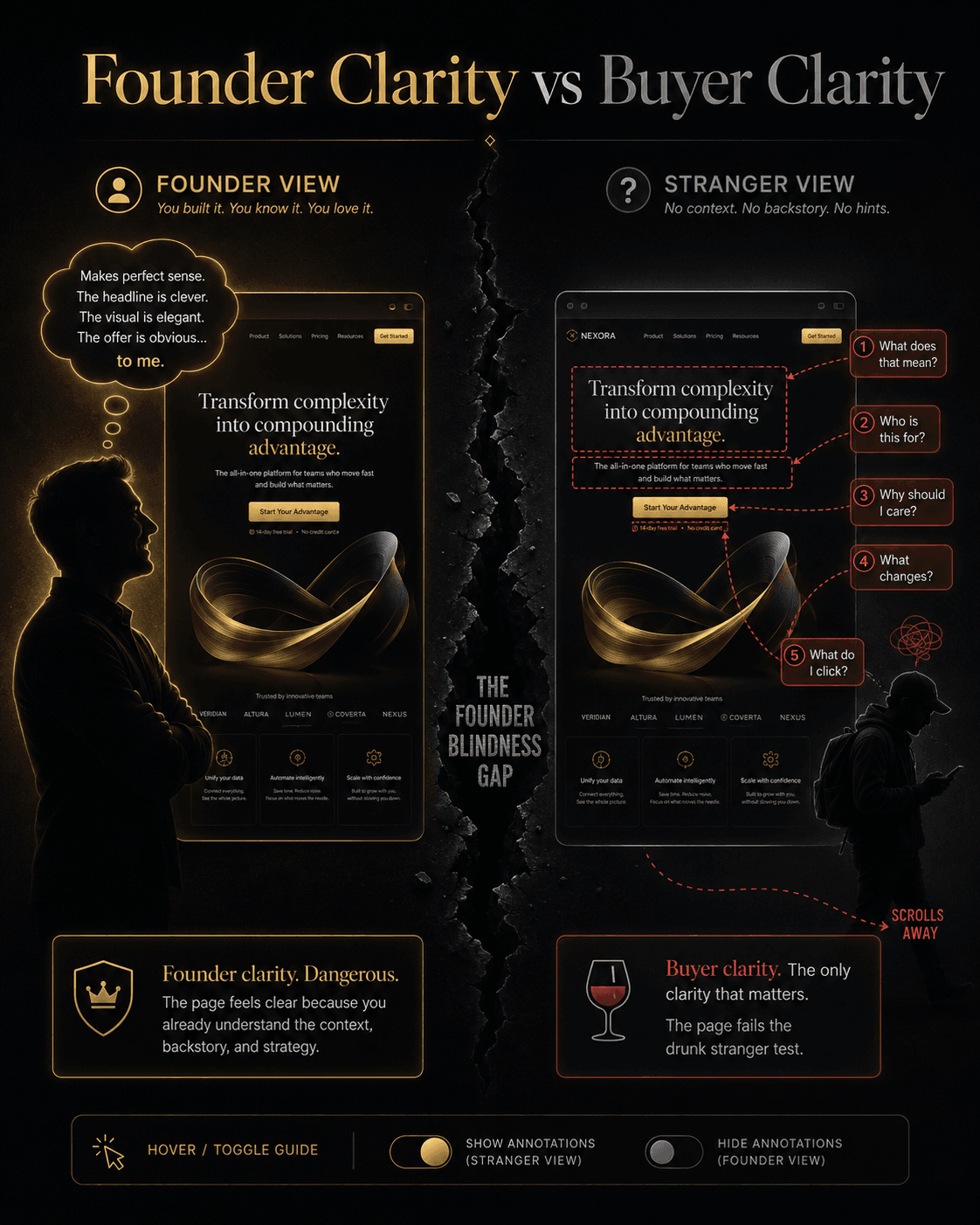
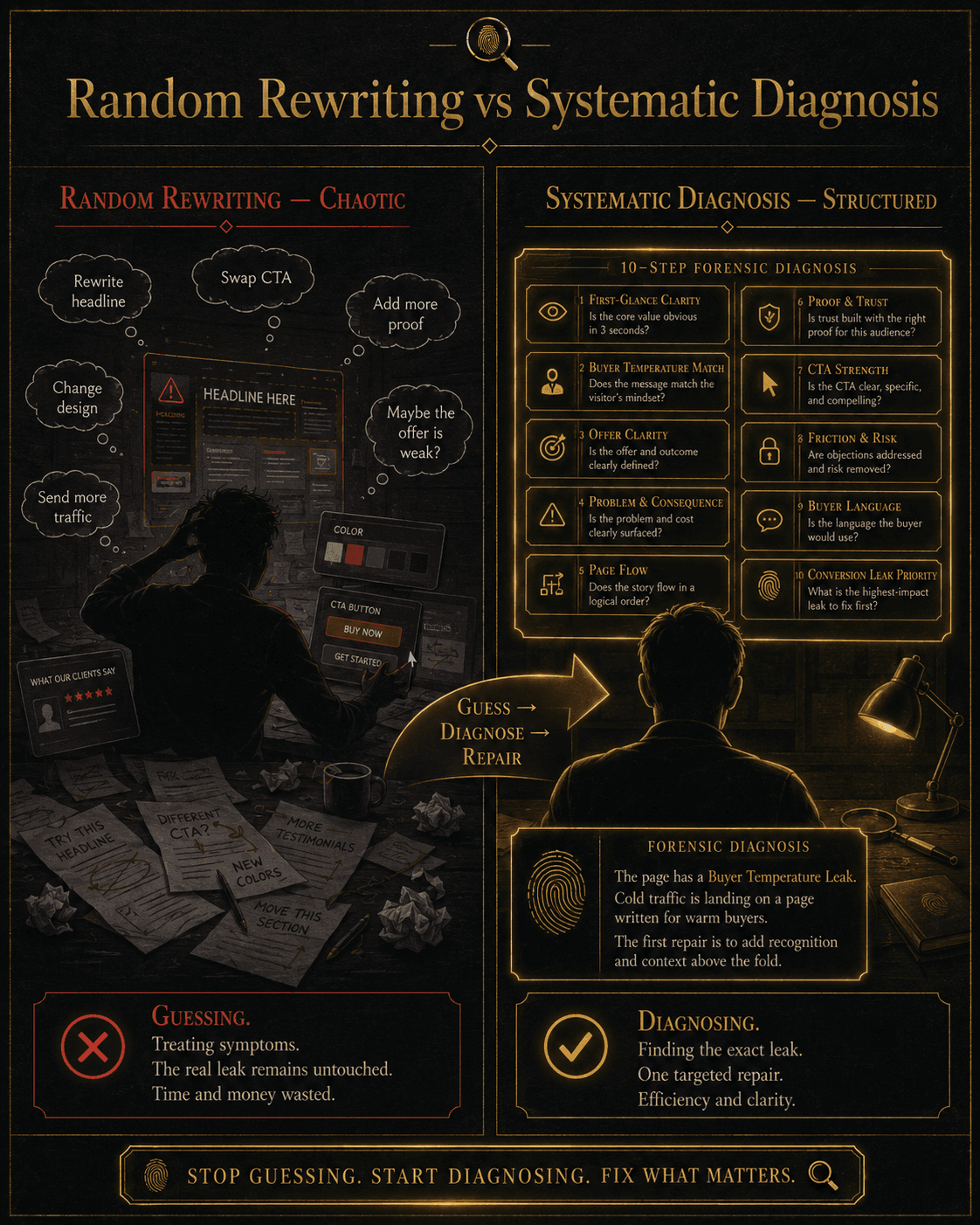
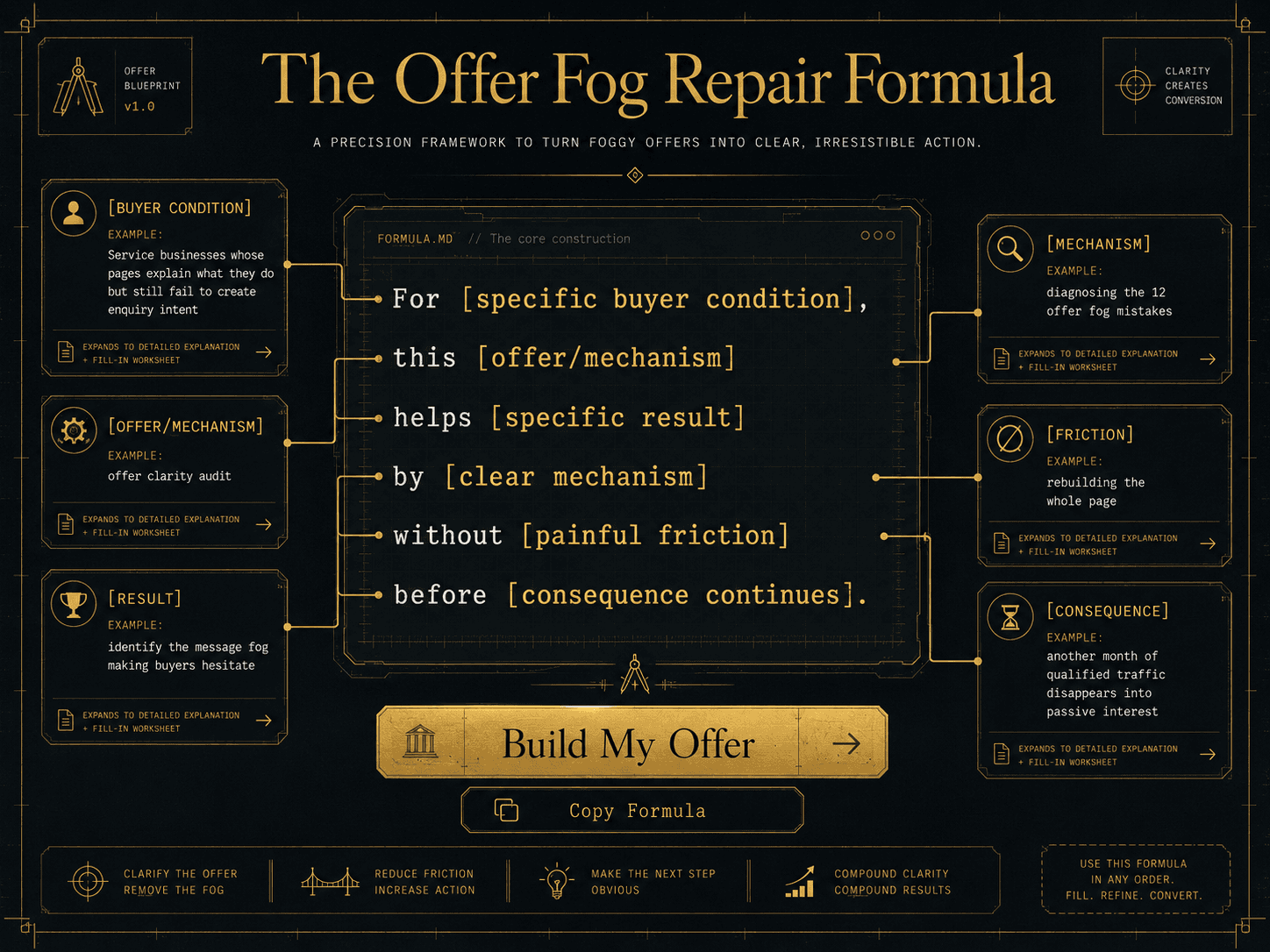
Other Blogs
Other Blogs
Check our other project Blogs with useful insight and information for your businesses