![“The Strong Testimonial Structure Blueprint” Concept: A minimalist, architectural blueprint showing the anatomy of a strong testimonial. The testimonial is broken into 6 color-coded segments: Example testimonial: “I thought we had a traffic problem [Before], but the real issue was that buyers still didn't trust the page fast enough. [Hesitation/Realisation] After rebuilding the fold and proof structure [Mechanism], qualified calls started coming through from the same traffic. [Result] The whole thing finally stopped feeling random. [Emotional Shift]” Color coding: Before = Cool blue Hesitation = Soft teal Mechanism = Warm amber Result = Deep orange Emotional Shift = Bright gold Below the blueprint: A label: “The strongest testimonials follow a believable narrative arc: Frustration → Realisation → Movement → Relief.” Style: Architectural blueprint meets luxury UI. Dark background, gold lines, color-coded segments. Feels like a precision construction guide. Interaction: Hovering any color-coded segment expands an explanation of why that element is psychologically important. Clicking the segment shows 3 alternative examples of that element. A “Build My Testimonial” button opens a template.](https://framerusercontent.com/images/GQdX9EWXqEhHSTtzy8T4iKPQlk.png?width=1448&height=1086)
Our Three Step Process
May 26, 2026
Chap 5 | Resource 3 | The Testimonial Capture Script™
Our Three Step Process
May 26, 2026
Chap 5 | Resource 3 | The Testimonial Capture Script™
The Testimonial Capture Script™ A buyer-belief extraction system for collecting testimonials that reveal the before-state, hesitation, decision moment, visible shift, specific result, and emotional relief buyers need to trust the proof.
Prefer Audio Or Video?
The Testimonial Capture Script™ is also available as:
🎧 A guided audio walkthrough explaining how to capture stronger testimonials, extract before-states, hesitation, decision moments, specific results, and emotional buyer language.
🎥 A practical video breakdown with testimonial request scripts, video testimonial examples, follow-up questions, weak vs strong testimonial repairs, and testimonial scoring.Choose the format that fits how you learn best.
[Listen To The Audio Walkthrough] (coming soon)
[Watch The Video Breakdown] (coming soon)
——
Why Most Testimonials Fail
Most testimonials fail because they sound polite instead of persuasive.
The buyer reads:
“Amazing service.”
“Highly recommend.”
“Great experience.”
“Very professional.”
And feels almost nothing.
Not because testimonials do not work.
Because weak testimonials reduce very little uncertainty.
They flatter the seller.
They do not help the buyer believe.
A buyer who is still uncertain does not need another polite compliment.
They need proof that makes the decision feel safer.
Strong testimonials do something completely different.
They help the buyer see:
the before-state
the hesitation
the emotional tension
the turning point
the visible shift
the result
the emotional relief afterward
That is what creates belief.
A strong testimonial does not merely say:
“This was good.”
It helps the next buyer feel:
“Someone like me had the same problem, the same doubt, the same hesitation, and still experienced the shift I want.”
That is the difference.
What This Resource Helps You Do
The Testimonial Capture Script™ helps you collect testimonials that feel real, specific, emotionally recognisable, and commercially useful.
Use this when:
your testimonials feel generic
buyers still hesitate despite having reviews
proof sounds polished but emotionally weak
clients give vague praise instead of transformation stories
your social proof lacks specificity
your testimonials feel fake or staged
you struggle getting emotionally useful client responses
you want testimonials that actually move decisions
your reviews describe satisfaction but not transformation
your testimonials do not answer buyer objections
your proof does not show what changed
your buyers still feel uncertain after reading your social proof
This is not a review request template.
This is a buyer-belief extraction system.
The goal is simple:
Capture testimonials that reduce doubt faster than generic praise ever could.
The Core Principle™
The goal is not collecting compliments.
The goal is extracting transformation stories.
That is the shift.
A compliment says:
“They liked it.”
A transformation story shows:
“What changed.”
And buyers care far more about what changed than whether someone was generally happy.
Weak testimonial collection asks:
“Can you write me a testimonial?”
Strong testimonial collection asks:
“What was happening before, what made you hesitate, what changed, and what result became visible?”
Those questions produce very different proof.
The first question usually creates praise.
The second creates belief.
The Biggest Testimonial Mistake™
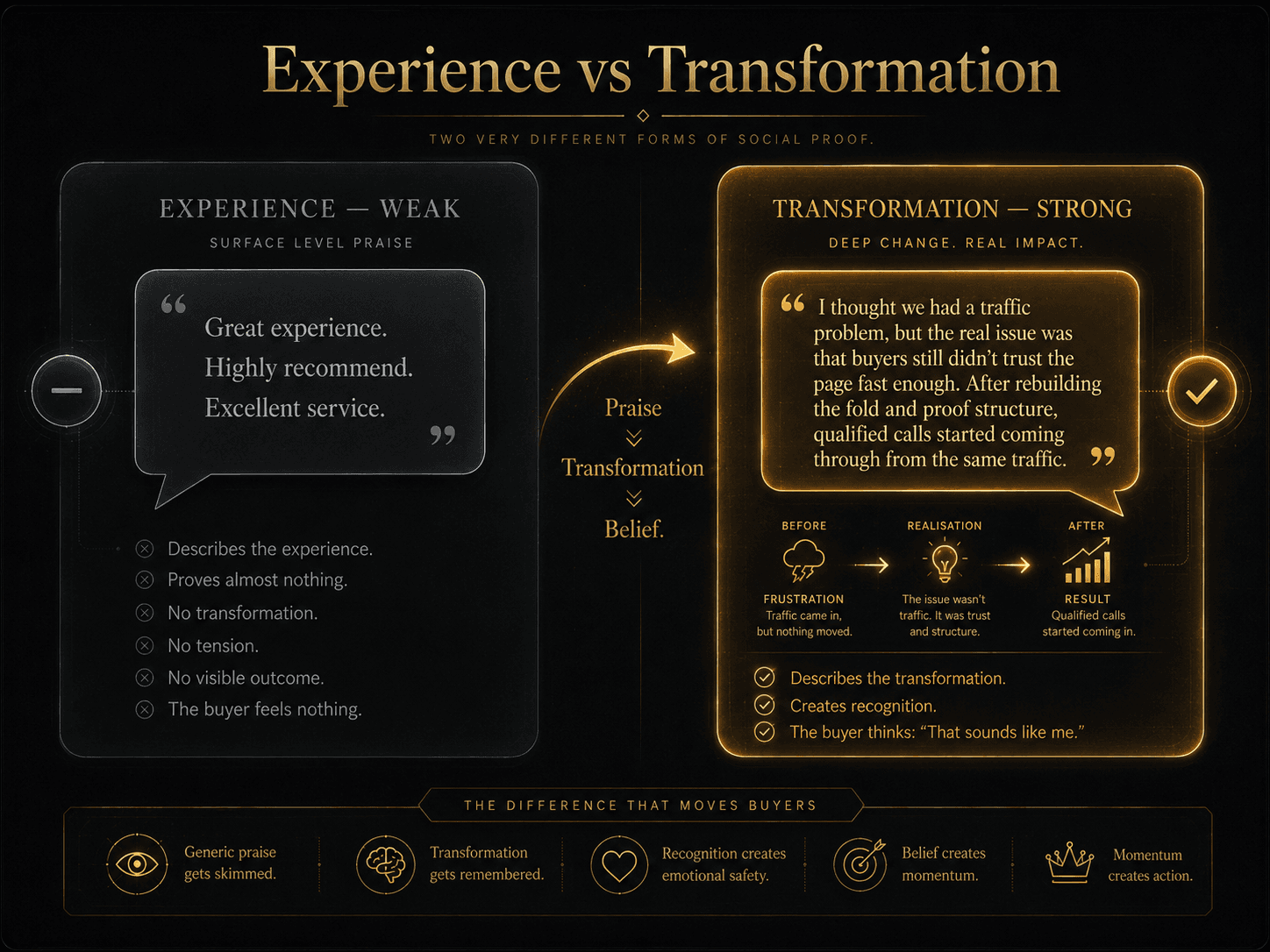
Most testimonials describe the experience.
Strong testimonials describe the transformation.
That difference matters enormously.
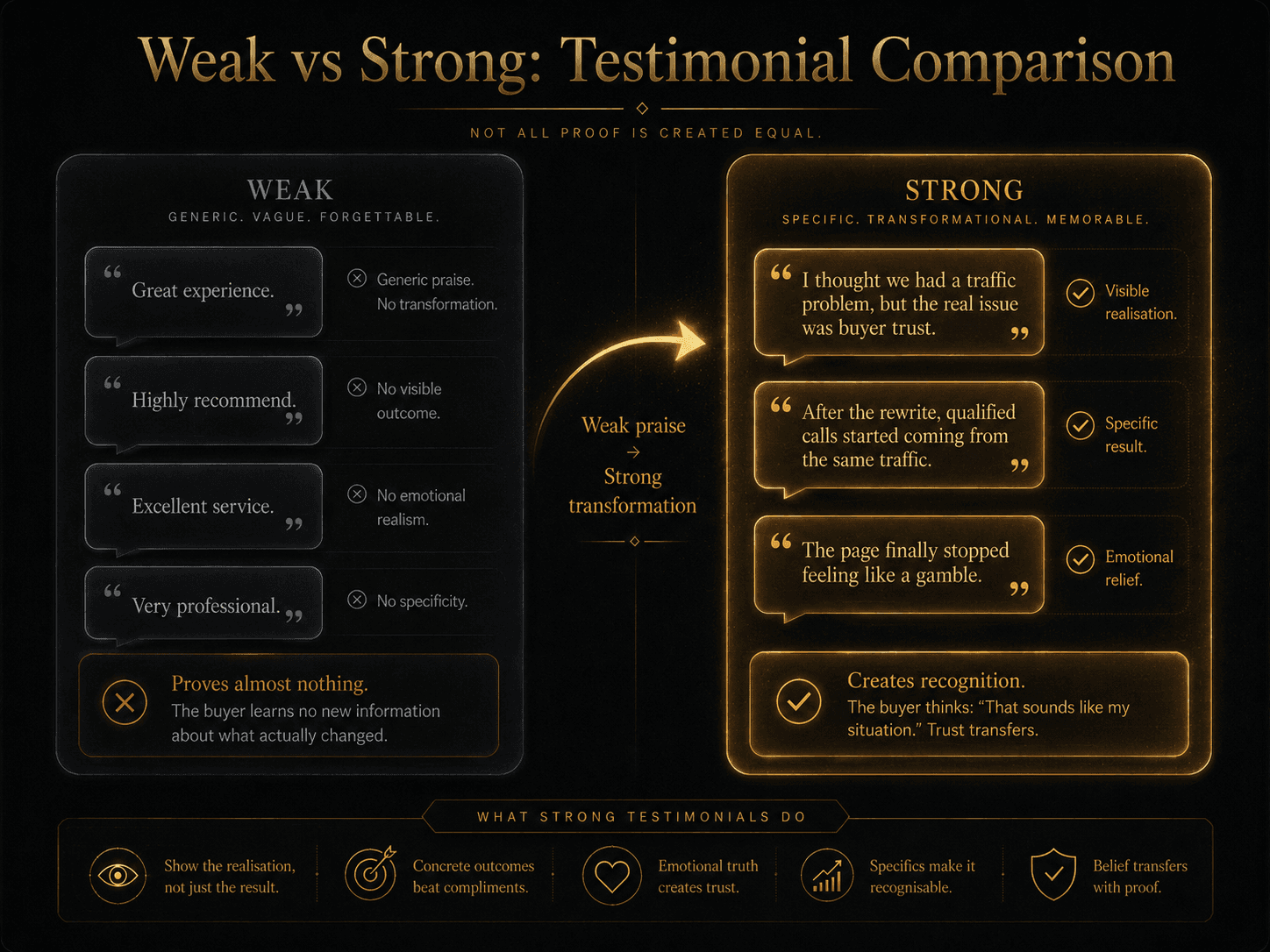
Weak:
“Great to work with.”
Strong:
“I realised the issue wasn’t traffic anymore. Buyers just didn’t trust the page fast enough.”
The second version creates recognition.
Recognition creates belief.
Why?
Because the buyer does not just see praise.
They see a problem they recognise.
They see a diagnosis.
They see a shift.
They see a result.
That is what makes the testimonial persuasive.
What Strong Testimonials Usually Contain
Strong testimonials often include:
a visible before-state
hesitation or scepticism
emotional frustration
a turning point
visible movement
specific outcomes
emotional relief
buyer-language phrasing
natural wording
believable details
a clear reason the result mattered
a situation future buyers can recognise
a result tied to the promise of the page
Strong testimonials help the buyer think:
“That sounds like my situation.”
“That doubt feels familiar.”
“That result is specific.”
“That feels real.”
“That could happen for me.”
That is the job.
What Weak Testimonials Usually Contain
Weak testimonials usually contain:
generic compliments
polite praise
vague positivity
no visible shift
no specificity
no emotional realism
no tension
no meaningful consequence
no before-state
no buyer hesitation
no measurable or visible result
no reason the next buyer should believe the claim
Weak testimonials sound positive but do not carry much persuasive weight.
They say:
“This was good.”
But they do not show:
“What changed.”
That distinction determines whether buyers emotionally trust the proof.
The Testimonial Extraction Framework™
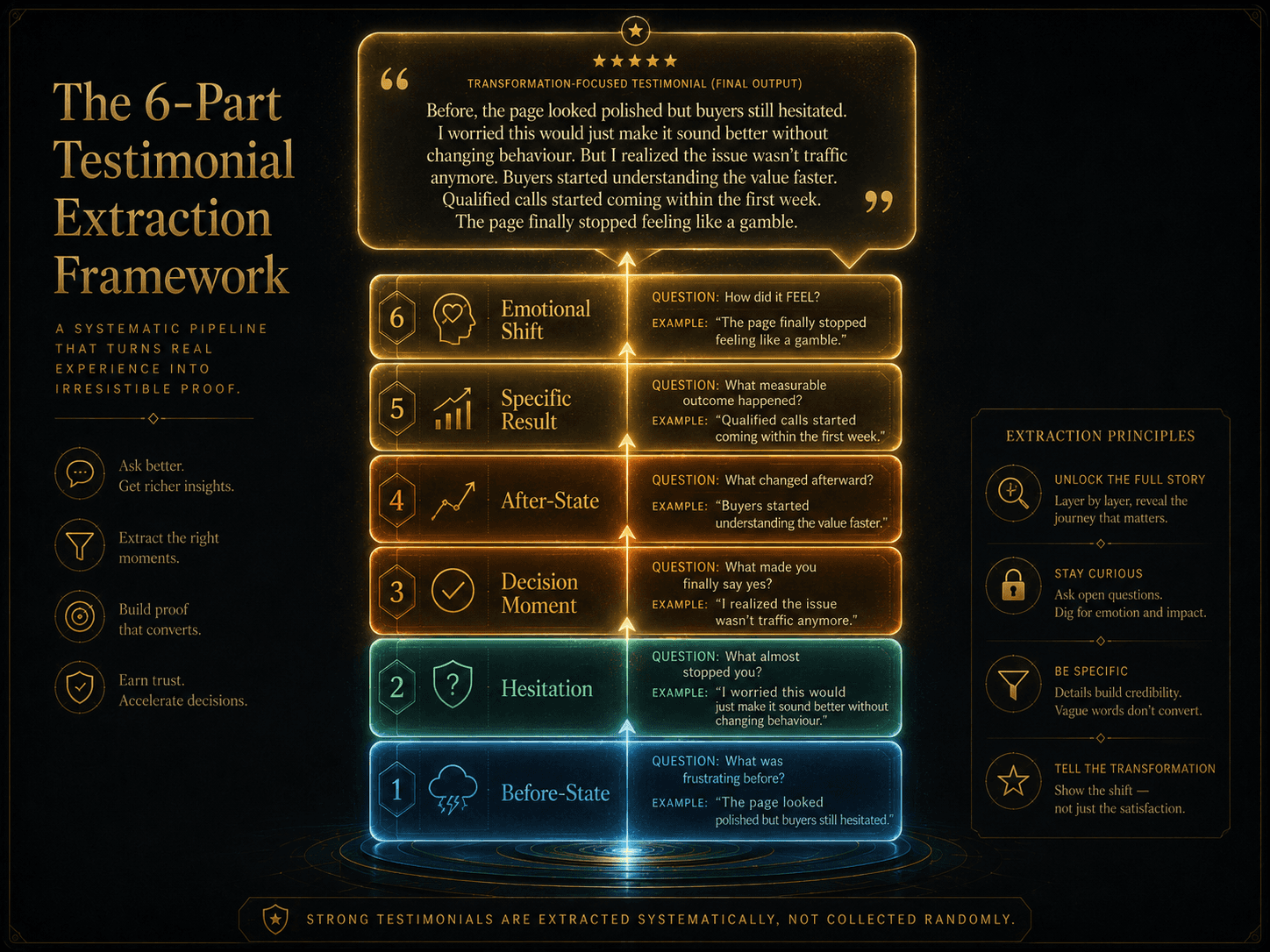
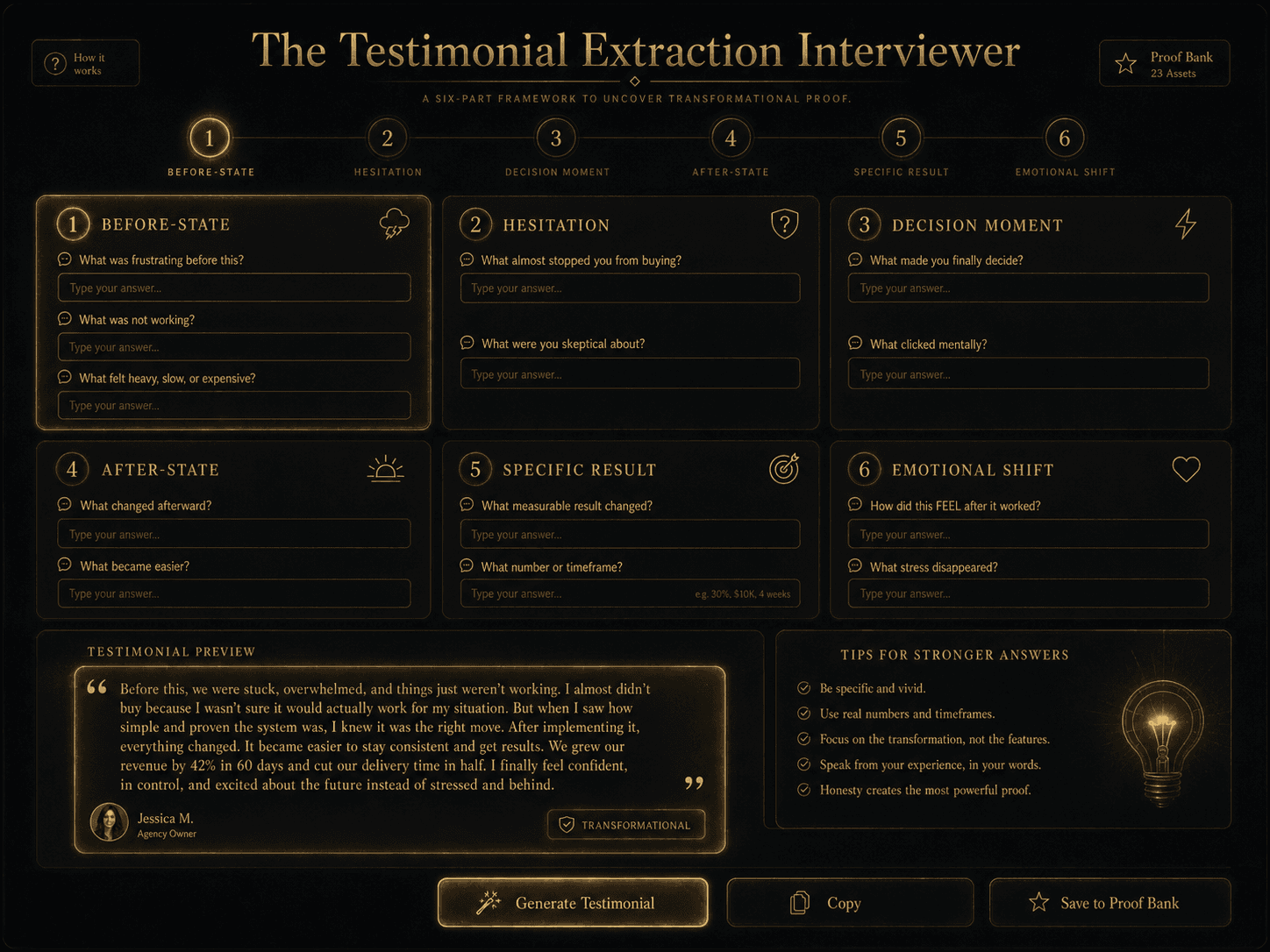
The strongest testimonials usually come from six extraction points:
Before-State™
Hesitation™
Decision Moment™
After-State™
Specific Result™
Emotional Language™
Together, these create a believable testimonial arc.
Not praise.
Proof.
——
Part 1: Extract The Before-State™
Why This Matters
This is one of the most important sections psychologically.
The buyer needs to recognise the old pain.
Without a visible before-state, the transformation feels flat.
The before-state gives the testimonial tension.
It shows what was not working before the solution arrived.
That matters because future buyers often trust testimonials when they recognise the starting point.
They think:
“That is where I am now.”
That recognition creates emotional entry.
Weak Before-State
“Things were okay.”
This is emotionally useless.
It gives the buyer nothing to recognise.
No frustration.
No tension.
No urgency.
No problem worth solving.
Strong Before-State
“The page looked polished but buyers still hesitated before booking.”
Now the buyer can see the tension.
The testimonial has a real starting point.
The future buyer recognises the pain.
That is much stronger.
Questions To Ask
Ask:
What was frustrating before this?
What was not working?
What felt heavy, slow, confusing, or expensive?
What problem kept repeating?
What made you start looking for help?
What did you try before?
What was costing you time, money, energy, or confidence?
What felt stuck?
What did you wish was easier?
What did you keep noticing that bothered you?
The goal is specific frustration.
Not surface-level summaries.
Before-State Worksheet
What was happening before?
What felt frustrating, heavy, slow, confusing, or expensive?
What problem kept repeating?
What did the client or buyer try before?
What line from the client describes the old pain best?
Part 2: Extract The Hesitation™
Why This Matters
This section is massively underrated.
Future buyers trust testimonials more when they see realistic scepticism.
Why?
Because the buyer thinks:
“Okay… this person had the same doubts I currently have.”
That creates trust transfer.
A testimonial with no hesitation can feel too clean.
Too perfect.
Too manufactured.
But a testimonial that admits doubt feels human.
It mirrors the buyer’s internal resistance.
That makes the proof stronger.
Weak Hesitation
“I knew this would work.”
This is not very believable.
Most real buyers have some doubt.
They wonder whether the solution will work for them.
They wonder whether the result is real.
They wonder whether they will regret the decision.
Pretending hesitation did not exist can weaken the testimonial.
Strong Hesitation
“I worried this would just make the page sound better without actually changing buyer behaviour.”
Now the testimonial feels human.
It names a real fear.
It sounds like the kind of private doubt a future buyer may already have.
That is powerful.
Questions To Ask
Ask:
What almost stopped you from buying?
What were you sceptical about?
What felt risky?
What uncertainty did you have?
What made you hesitate initially?
What were you afraid might happen?
What did you not want to waste money on again?
What made you think twice?
What did you need to believe before saying yes?
This creates emotional realism.
Hesitation Worksheet
What almost stopped them from buying?
What were they sceptical about?
What felt risky?
What fear or uncertainty did they carry?
What hesitation line would future buyers recognise?
Part 3: Extract The Decision Moment™
Why This Matters
The buyer should understand why the person finally said yes.
This section often reveals the actual buying trigger.
That is extremely valuable.
The decision moment shows what shifted internally before action happened.
It reveals the logic, realisation, pressure, or emotional clarity that made the buyer move forward.
This is useful not only for testimonials.
It often gives you future copy angles too.
Weak Decision Moment
“I decided to try it.”
No emotional movement.
No insight.
No reason.
No buying trigger.
Strong Decision Moment
“I realised the issue wasn’t traffic anymore. The page simply wasn’t building trust fast enough.”
Now the buyer understands the logic behind the purchase.
The testimonial reveals a realisation.
That makes it more persuasive.
Questions To Ask
Ask:
What made you finally decide?
What clicked mentally?
What convinced you to move forward?
What realisation changed the decision?
What made the problem feel urgent enough to solve?
What did you understand differently before saying yes?
What made this feel like the right next step?
What made waiting feel more costly than moving?
This often reveals excellent future messaging.
Decision Moment Worksheet
What made them finally decide?
What clicked mentally?
What realisation changed the decision?
What made the problem feel worth solving now?
What buying trigger does this reveal?
Part 4: Extract The After-State™
Why This Matters
This is where the transformation becomes visible.
Most weak testimonials fail because the after-state feels unclear.
The buyer reads:
“Things improved.”
But does not know what improved, how it changed, or why it mattered.
A strong after-state makes the shift tangible.
It shows what became easier, clearer, faster, safer, calmer, or more profitable after the solution.
Weak After-State
“Things improved.”
Too vague.
The buyer cannot picture the change.
No belief movement.
Strong After-State
“Buyers started understanding the value faster and the sales calls immediately felt less resistant.”
Now the shift feels real.
The testimonial shows a visible change in buyer behaviour.
That creates belief.
Questions To Ask
Ask:
What changed afterward?
What became easier?
What improved first?
What felt different emotionally?
What surprised you most?
What stopped being frustrating?
What started happening that was not happening before?
What felt clearer?
What felt lighter?
What did you notice on calls, messages, sales, or responses?
This creates movement.
After-State Worksheet
What changed afterward?
What became easier?
What improved first?
What stopped being frustrating?
What line best captures the visible shift?
Part 5: Extract The Specific Result™
Why This Matters
Specificity creates believability.
Even small specifics often increase trust dramatically.
A testimonial does not always need a huge number.
But it does need something concrete enough to reduce scepticism.
That could be:
a number
a timeframe
a visible change
a repeated outcome
a behavioural shift
a clearer decision
a measurable improvement
a specific moment where the result appeared
Specificity makes the proof feel grounded.
Weak Result
“Got better results.”
Weak emotional impact.
No concrete movement.
No visible outcome.
The buyer is still being asked to imagine too much.
Strong Result
“Qualified calls started coming in within the first week after the rewrite.”
Now the result feels grounded.
There is a result.
There is a timeframe.
There is a visible outcome.
That reduces scepticism.
Questions To Ask
Ask:
What measurable result changed?
What happened faster?
What became more consistent?
What visible outcome appeared?
What number, timeframe, or movement can you mention?
What did you notice first?
What improved compared with before?
What specific result would matter most to someone considering this?
What result surprised you?
What outcome can we describe honestly and accurately?
Specificity reduces scepticism.
Specific Result Worksheet
What specific result appeared?
Is there a number?
Is there a timeframe?
Is there visible movement?
What result can be stated honestly without exaggeration?
Part 6: Extract Emotional Language™
Why This Matters
This is where testimonials become commercially powerful.
The best testimonials often contain raw buyer language.
Not marketing language.
Not seller language.
Not polished corporate language.
Buyer language.
This matters because emotional language helps future buyers feel the proof.
It gives the testimonial life.
It makes the shift recognisable.
It turns the result from a statistic into an experience.
Weak Emotional Language
“Excellent implementation.”
This feels corporate.
It may be positive, but it does not create emotional movement.
Strong Emotional Language
“The page finally stopped feeling like a gamble.”
Now the buyer feels emotion.
That sentence carries relief, uncertainty, trust, and decision safety.
Huge difference psychologically.
Questions To Ask
Ask:
How did this feel after it worked?
What emotional shift happened?
What stress disappeared?
What finally became clearer?
What changed mentally?
What made you feel relieved?
What stopped feeling risky?
What did you finally understand?
What did this make possible emotionally?
What phrase would you naturally use to describe the shift?
This creates emotional resonance.
Emotional Language Worksheet
What emotional shift happened?
What stress disappeared?
What finally became clearer?
What phrase did the buyer use naturally?
What line feels most emotionally recognisable?
——
Text / Email Testimonial Request Script™
Use this when asking a client or buyer for a written testimonial.
Do not ask for generic praise.
Ask for the story of what changed.
Version 1: Short Request
Hey [Name],
Would you be open to sending me a short testimonial about your experience?
The most useful version is not polished praise — it is simply what changed.
A few prompts, in case helpful:
What was happening before?
What made you hesitate or feel unsure?
What made you decide to move forward?
What changed afterward?
What specific result or shift stood out?
How did it feel once that changed?
Raw and honest is better than polished.
Even short answers are useful.
Thank you.
Version 2: More Guided Request
Hey [Name],
I’m collecting a few honest testimonials and wanted to ask if you would be open to sharing your experience.
The strongest version is not “great service” or “highly recommend.”
It is more useful if it explains what changed.
Could you answer these in your own words?
What was frustrating or not working before?
What were you sceptical or unsure about before starting?
What made you decide this was worth trying?
What changed after we worked together?
What specific result, movement, or improvement did you notice?
What felt different emotionally afterward?
Who do you think this would be most useful for?
No need to make it sound polished.
Natural wording is better.
Thank you.
Version 3: Very Casual DM Request
Hey [Name], quick favour.
Would you mind sending me a few honest lines about what changed after [specific work/result]?
Not looking for polished praise.
More useful would be:
what was frustrating before
what you were unsure about
what changed afterward
what result or shift stood out
how it felt once things improved
Raw language is perfect.
Thank you.
——
Video Testimonial Request Script™
Use this when asking for a short video testimonial.
The goal is not studio quality.
The goal is emotional realism.
Version 1: Short Video Request
Hey [Name],
Would you be open to sending a quick 30–60 second selfie video about what changed after [specific work/result]?
Nothing polished needed.
Just answer naturally:
What was the problem before?
What were you unsure about?
What changed after?
What result or shift stood out most?
Who would you recommend this to?
No script needed.
Real is better than perfect.
Thank you.
Version 2: Guided Video Request
Hey [Name],
Would you be open to recording a short video testimonial?
It does not need to be polished at all. A simple selfie video is perfect.
The best structure is:
Before: What was frustrating or not working?
Hesitation: What were you unsure about before starting?
Decision: What made you finally move forward?
After: What changed?
Result: What specific outcome appeared?
Feeling: How did it feel afterward?
30–90 seconds is completely fine.
Natural wording is better than scripted wording.
Thank you.
Follow-Up Question Bank™
Use these when a client gives a vague response.
Do not accept weak praise too quickly.
Gently dig for the transformation underneath it.
When They Say: “It was great.”
Ask:
What specifically made it great?
What changed after?
What became easier?
What part stood out most?
When They Say: “Really professional.”
Ask:
What did that professionalism help you feel or achieve?
Did it make the process clearer, easier, safer, or faster?
What did you trust more because of it?
When They Say: “Highly recommend.”
Ask:
Who would you recommend it to specifically?
What problem would they need to have?
What would they get out of it?
When They Say: “We got better results.”
Ask:
What result changed?
How quickly did you notice it?
Was there a number, timeframe, or visible shift?
What did that result make possible?
When They Say: “Things felt clearer.”
Ask:
What became clearer?
What was confusing before?
How did that clarity affect the next step?
What changed in your confidence or decision-making?
When They Say: “It helped a lot.”
Ask:
What did it help with most?
What was difficult before?
What changed after?
What would have stayed frustrating without it?
The Strong Testimonial Structure™
The strongest testimonials usually follow this flow:
Before → Hesitation → Decision → After → Specific Result → Emotional Shift
This creates a believable narrative arc.
And narrative increases trust retention.
The buyer can follow the journey.
They can understand the starting pain.
They can see the doubt.
They can understand the decision.
They can recognise the shift.
They can believe the result.
They can feel the relief.
That is why this structure works.
Testimonial Structure Worksheet
Before:
Hesitation:
Decision:
After:
Specific Result:
Emotional Shift:
Example Of A Weak Testimonial
“Great experience. Highly recommend.”
This proves almost nothing.
No transformation.
No tension.
No visible outcome.
No buyer recognition.
No specificity.
No belief movement.
It is polite.
But commercially weak.
Example Of A Strong Testimonial
“I thought we had a traffic problem, but the real issue was that buyers still didn’t trust the page fast enough. After rebuilding the fold and proof structure, qualified calls started coming through from the same traffic. The whole thing finally stopped feeling random.”
Now the buyer sees:
frustration
realisation
mechanism
movement
emotional relief
Completely different psychological effect.
This testimonial does more than praise the service.
It helps future buyers recognise the problem, understand the shift, and believe the result.
The Video Testimonial Advantage™
Video testimonials often outperform written testimonials because humans trust:
tone
facial expression
hesitation
emotion
natural pauses
visible relief
conversational language
the feeling of a real person speaking
Especially when the video feels slightly imperfect.
Raw often feels more believable than polished.
That does not mean the video should be unclear, messy, or unusable.
It means the video should feel human.
A slightly imperfect selfie video can sometimes carry more trust than a studio-quality testimonial that feels rehearsed.
The Best Video Testimonials Usually Feel
The best video testimonials usually feel:
conversational
emotionally honest
unscripted
specific
slightly imperfect
low-production
grounded
buyer-led
clear enough to understand
natural enough to believe
Too much polish can accidentally create scepticism.
The buyer may feel:
“This was produced.”
Instead of:
“This happened.”
That distinction matters.
The “This Sounds Fake” Problem™
Some testimonials technically contain results but still feel manufactured.
That is dangerous.
Because proof that feels fake can damage trust.
Common causes include:
excessive polish
unrealistic perfection
no hesitation
no before-state
no emotional realism
no specifics
over-scripted language
obvious marketing phrasing
too much seller editing
no believable detail
exaggerated results
language the buyer would never naturally use
Strong testimonials usually feel harder to fake.
That matters enormously.
The buyer does not need a perfect quote.
They need a believable one.
Fake-Sounding Testimonial Diagnosis
Ask:
Does this testimonial sound like a real person?
Yes / No / Unsure
Does it contain a before-state?
Yes / No
Does it contain hesitation?
Yes / No
Does it contain a specific result?
Yes / No
Does it contain natural language?
Yes / No
Does it feel over-polished?
Yes / No
Does it reduce a real buyer doubt?
Yes / No
What would make it feel more believable?
Testimonial Collection Channels Most People Ignore™
Some of the strongest proof already exists inside:
DMs
Slack messages
onboarding calls
voice notes
email replies
support chats
Loom reactions
spontaneous comments
screenshots from clients
WhatsApp messages
post-call messages
sales call follow-ups
customer support replies
social media comments
private community messages
Capture these immediately.
Because spontaneous reactions often feel more believable than formal testimonials.
A client message sent in the moment of emotional movement may be stronger than a polished review requested three weeks later.
The “Collect Proof Immediately” Rule™
The best proof moments usually happen right after emotional movement.
That means you should capture proof immediately after:
a win
a breakthrough
a result
an emotional reaction
a realisation
a visible shift
a successful call
a strong message
a moment of relief
a customer says “this finally makes sense”
Do not wait weeks later.
Emotion fades fast.
Specificity fades fast.
The exact wording fades fast.
Capture the proof while it is still alive.
The Testimonial Cleanup Rule™
Do not over-edit testimonials.
Clean grammar if necessary.
Remove obvious confusion if needed.
Fix small readability issues where appropriate.
But preserve:
natural language
emotion
imperfection
buyer phrasing
hesitation
personality
specificity
the original meaning
Do not make every testimonial sound like your brand voice.
That destroys trust.
The testimonial should sound like the buyer.
Not like your marketing team.
Imperfection often increases believability.
Permission-Safe Testimonial Use™
Before publishing testimonials, make sure you have permission to use the relevant details.
Confirm permission before using:
full names
faces
company names
screenshots
private messages
voice notes
video clips
revenue numbers
client dashboards
sensitive business details
identifiable buyer information
When needed, redact sensitive information.
Strong proof does not need unethical exposure.
It needs enough truth to be believable while respecting privacy.
A testimonial is stronger when it is both persuasive and permission-safe.
——
Testimonial Strength Scorecard™
Score each testimonial from 1 to 5 in each category.
1 = weak
2 = soft
3 = usable
4 = strong
5 = excellent
Before-State
Does the testimonial show what was happening before?
Score: ___ / 5
Notes:
Hesitation
Does it include realistic doubt, scepticism, or uncertainty?
Score: ___ / 5
Notes:
Decision Moment
Does it explain what made the person move forward?
Score: ___ / 5
Notes:
After-State
Does it show what changed afterward?
Score: ___ / 5
Notes:
Specific Result
Does it include a number, timeframe, visible movement, or concrete outcome?
Score: ___ / 5
Notes:
Emotional Language
Does it contain natural, emotionally recognisable buyer language?
Score: ___ / 5
Notes:
Believability
Does it feel real, specific, and hard to fake?
Score: ___ / 5
Notes:
Total Score
Before-State: ___ / 5
Hesitation: ___ / 5
Decision Moment: ___ / 5
After-State: ___ / 5
Specific Result: ___ / 5
Emotional Language: ___ / 5
Believability: ___ / 5
Total: ___ / 35
——
Score Interpretation
30–35: Elite Testimonial™
This testimonial creates strong belief movement.
It contains transformation, specificity, emotional realism, and believability.
Use it prominently.
24–29: Strong Testimonial™
This testimonial is useful and persuasive.
It may need light trimming, better framing, or stronger placement, but it already reduces doubt.
16–23: Usable But Soft™
This testimonial has value, but it is missing one or more persuasive elements.
Follow up with better questions.
0–15: Generic Praise Risk™
This testimonial is too vague, too polished, or too weak to carry major proof.
Do not rely on it as primary evidence.
Ask better follow-up questions or collect stronger proof.
——
Final Testimonial Builder Worksheet
Use this to turn a raw response into a stronger testimonial.
Raw Testimonial
Paste the raw testimonial here:
Before-State
What problem, frustration, or situation existed before?
Hesitation
What doubt, fear, or scepticism did the buyer have?
Decision Moment
What made them move forward?
After-State
What changed afterward?
Specific Result
What measurable or visible result appeared?
Emotional Shift
What felt different emotionally?
Strongest Buyer-Language Phrase
What phrase should be preserved exactly?
Cleaned Testimonial Draft
Rewrite lightly while preserving natural language:
Permission Status
Approved / Needs Permission / Needs Redaction / Not Usable Yet
Notes:
Best Placement
Where should this testimonial appear?
Above Fold / Offer Reveal / Objection Section / Near CTA / Proof Wall / Case Study / Other
Why?
——
Final Execution Challenge
Message three past clients today.
Do not ask for praise.
Ask:
what changed
what frustrated them before
what they hesitated about
what shifted afterward
what result became visible
what emotionally improved
Then compare those responses against your current testimonials.
Ask:
“Which version would make a future buyer feel safer?”
Because the strongest testimonials do not merely say:
“This was good.”
They quietly help future buyers feel:
“This feels safer to believe because someone like me already experienced the shift I want.”
That is the standard.
——
Final Principle
Testimonials are not there to flatter the seller.
They are there to reduce uncertainty for the next buyer.
That is the shift.
A weak testimonial says:
“They liked it.”
A strong testimonial shows:
“What changed.”
It reveals the before-state.
It admits the hesitation.
It explains the decision moment.
It shows the after-state.
It grounds the result.
It preserves emotional language.
And because of that, it creates belief.
The buyer does not need more generic praise.
They need proof that feels human enough, specific enough, and recognisable enough to trust.
That is what The Testimonial Capture Script™ is designed to extract.
Not polite compliments.
Not polished applause.
Transformation stories.
Because when the right buyer sees someone else move from the same uncertainty to a visible result, the decision starts feeling safer.
And once the decision feels safer, belief starts moving.
——
From:
The $100M Funnel Playbook. Book I: Foundation Buyer Psychology, Offer Clarity, and the Page Architecture Behind High-Converting Funnels
By Maris Spalins.
——
Copyright Notice
© 2026 The $100M Funnel Playbook / Winyourclients / Maris Spalins. All rights reserved.
This resource, including the frameworks, terminology, examples, scorecards, templates, prompts, methods, and written explanations, is original intellectual property created for The $100M Funnel Playbook. Book I: Foundation — Buyer Psychology, Offer Clarity, And The Page Architecture Behind High-Converting Funnels and published through Winyourclients.
No part of this resource may be copied, reproduced, screenshotted, republished, redistributed, sold, adapted, uploaded, scraped, stored in a database, included in training data, used to train artificial intelligence systems, or used to create derivative commercial or educational materials without prior written permission.
Limited reference, quotation, or sharing is only permitted where the source is clearly and visibly credited.
Any permitted reference must include at least one of the following source credits:
The $100M Funnel Playbook by Maris Spalins
or
Winyourclients — www.winyourclients.com
or
Maris Spalins / Winyourclients
Screenshots, excerpts, summaries, or redistributed versions must not remove, hide, alter, crop out, or obscure the original source, author name, book title, website name, or copyright notice.
This resource is provided for personal learning and implementation only. It is not licensed for resale, republishing, redistribution, AI training, template cloning, course creation, consulting delivery, or commercial reuse without written permission from Maris Spalins or Winyourclients.
For permission requests, licensing, citation approval, or commercial usage enquiries, contact:
Winyourclients
www.winyourclients.com
or
Email directly to Jacob on: help@winyourclients.com
The Testimonial Capture Script™ A buyer-belief extraction system for collecting testimonials that reveal the before-state, hesitation, decision moment, visible shift, specific result, and emotional relief buyers need to trust the proof.
Prefer Audio Or Video?
The Testimonial Capture Script™ is also available as:
🎧 A guided audio walkthrough explaining how to capture stronger testimonials, extract before-states, hesitation, decision moments, specific results, and emotional buyer language.
🎥 A practical video breakdown with testimonial request scripts, video testimonial examples, follow-up questions, weak vs strong testimonial repairs, and testimonial scoring.Choose the format that fits how you learn best.
[Listen To The Audio Walkthrough] (coming soon)
[Watch The Video Breakdown] (coming soon)
——
Why Most Testimonials Fail
Most testimonials fail because they sound polite instead of persuasive.
The buyer reads:
“Amazing service.”
“Highly recommend.”
“Great experience.”
“Very professional.”
And feels almost nothing.
Not because testimonials do not work.
Because weak testimonials reduce very little uncertainty.
They flatter the seller.
They do not help the buyer believe.
A buyer who is still uncertain does not need another polite compliment.
They need proof that makes the decision feel safer.
Strong testimonials do something completely different.
They help the buyer see:
the before-state
the hesitation
the emotional tension
the turning point
the visible shift
the result
the emotional relief afterward
That is what creates belief.
A strong testimonial does not merely say:
“This was good.”
It helps the next buyer feel:
“Someone like me had the same problem, the same doubt, the same hesitation, and still experienced the shift I want.”
That is the difference.
What This Resource Helps You Do
The Testimonial Capture Script™ helps you collect testimonials that feel real, specific, emotionally recognisable, and commercially useful.
Use this when:
your testimonials feel generic
buyers still hesitate despite having reviews
proof sounds polished but emotionally weak
clients give vague praise instead of transformation stories
your social proof lacks specificity
your testimonials feel fake or staged
you struggle getting emotionally useful client responses
you want testimonials that actually move decisions
your reviews describe satisfaction but not transformation
your testimonials do not answer buyer objections
your proof does not show what changed
your buyers still feel uncertain after reading your social proof
This is not a review request template.
This is a buyer-belief extraction system.
The goal is simple:
Capture testimonials that reduce doubt faster than generic praise ever could.
The Core Principle™
The goal is not collecting compliments.
The goal is extracting transformation stories.
That is the shift.
A compliment says:
“They liked it.”
A transformation story shows:
“What changed.”
And buyers care far more about what changed than whether someone was generally happy.
Weak testimonial collection asks:
“Can you write me a testimonial?”
Strong testimonial collection asks:
“What was happening before, what made you hesitate, what changed, and what result became visible?”
Those questions produce very different proof.
The first question usually creates praise.
The second creates belief.
The Biggest Testimonial Mistake™
Most testimonials describe the experience.
Strong testimonials describe the transformation.
That difference matters enormously.
Weak:
“Great to work with.”
Strong:
“I realised the issue wasn’t traffic anymore. Buyers just didn’t trust the page fast enough.”
The second version creates recognition.
Recognition creates belief.
Why?
Because the buyer does not just see praise.
They see a problem they recognise.
They see a diagnosis.
They see a shift.
They see a result.
That is what makes the testimonial persuasive.
What Strong Testimonials Usually Contain
Strong testimonials often include:
a visible before-state
hesitation or scepticism
emotional frustration
a turning point
visible movement
specific outcomes
emotional relief
buyer-language phrasing
natural wording
believable details
a clear reason the result mattered
a situation future buyers can recognise
a result tied to the promise of the page
Strong testimonials help the buyer think:
“That sounds like my situation.”
“That doubt feels familiar.”
“That result is specific.”
“That feels real.”
“That could happen for me.”
That is the job.
What Weak Testimonials Usually Contain
Weak testimonials usually contain:
generic compliments
polite praise
vague positivity
no visible shift
no specificity
no emotional realism
no tension
no meaningful consequence
no before-state
no buyer hesitation
no measurable or visible result
no reason the next buyer should believe the claim
Weak testimonials sound positive but do not carry much persuasive weight.
They say:
“This was good.”
But they do not show:
“What changed.”
That distinction determines whether buyers emotionally trust the proof.
The Testimonial Extraction Framework™
The strongest testimonials usually come from six extraction points:
Before-State™
Hesitation™
Decision Moment™
After-State™
Specific Result™
Emotional Language™
Together, these create a believable testimonial arc.
Not praise.
Proof.
——
Part 1: Extract The Before-State™
Why This Matters
This is one of the most important sections psychologically.
The buyer needs to recognise the old pain.
Without a visible before-state, the transformation feels flat.
The before-state gives the testimonial tension.
It shows what was not working before the solution arrived.
That matters because future buyers often trust testimonials when they recognise the starting point.
They think:
“That is where I am now.”
That recognition creates emotional entry.
Weak Before-State
“Things were okay.”
This is emotionally useless.
It gives the buyer nothing to recognise.
No frustration.
No tension.
No urgency.
No problem worth solving.
Strong Before-State
“The page looked polished but buyers still hesitated before booking.”
Now the buyer can see the tension.
The testimonial has a real starting point.
The future buyer recognises the pain.
That is much stronger.
Questions To Ask
Ask:
What was frustrating before this?
What was not working?
What felt heavy, slow, confusing, or expensive?
What problem kept repeating?
What made you start looking for help?
What did you try before?
What was costing you time, money, energy, or confidence?
What felt stuck?
What did you wish was easier?
What did you keep noticing that bothered you?
The goal is specific frustration.
Not surface-level summaries.
Before-State Worksheet
What was happening before?
What felt frustrating, heavy, slow, confusing, or expensive?
What problem kept repeating?
What did the client or buyer try before?
What line from the client describes the old pain best?
Part 2: Extract The Hesitation™
Why This Matters
This section is massively underrated.
Future buyers trust testimonials more when they see realistic scepticism.
Why?
Because the buyer thinks:
“Okay… this person had the same doubts I currently have.”
That creates trust transfer.
A testimonial with no hesitation can feel too clean.
Too perfect.
Too manufactured.
But a testimonial that admits doubt feels human.
It mirrors the buyer’s internal resistance.
That makes the proof stronger.
Weak Hesitation
“I knew this would work.”
This is not very believable.
Most real buyers have some doubt.
They wonder whether the solution will work for them.
They wonder whether the result is real.
They wonder whether they will regret the decision.
Pretending hesitation did not exist can weaken the testimonial.
Strong Hesitation
“I worried this would just make the page sound better without actually changing buyer behaviour.”
Now the testimonial feels human.
It names a real fear.
It sounds like the kind of private doubt a future buyer may already have.
That is powerful.
Questions To Ask
Ask:
What almost stopped you from buying?
What were you sceptical about?
What felt risky?
What uncertainty did you have?
What made you hesitate initially?
What were you afraid might happen?
What did you not want to waste money on again?
What made you think twice?
What did you need to believe before saying yes?
This creates emotional realism.
Hesitation Worksheet
What almost stopped them from buying?
What were they sceptical about?
What felt risky?
What fear or uncertainty did they carry?
What hesitation line would future buyers recognise?
Part 3: Extract The Decision Moment™
Why This Matters
The buyer should understand why the person finally said yes.
This section often reveals the actual buying trigger.
That is extremely valuable.
The decision moment shows what shifted internally before action happened.
It reveals the logic, realisation, pressure, or emotional clarity that made the buyer move forward.
This is useful not only for testimonials.
It often gives you future copy angles too.
Weak Decision Moment
“I decided to try it.”
No emotional movement.
No insight.
No reason.
No buying trigger.
Strong Decision Moment
“I realised the issue wasn’t traffic anymore. The page simply wasn’t building trust fast enough.”
Now the buyer understands the logic behind the purchase.
The testimonial reveals a realisation.
That makes it more persuasive.
Questions To Ask
Ask:
What made you finally decide?
What clicked mentally?
What convinced you to move forward?
What realisation changed the decision?
What made the problem feel urgent enough to solve?
What did you understand differently before saying yes?
What made this feel like the right next step?
What made waiting feel more costly than moving?
This often reveals excellent future messaging.
Decision Moment Worksheet
What made them finally decide?
What clicked mentally?
What realisation changed the decision?
What made the problem feel worth solving now?
What buying trigger does this reveal?
Part 4: Extract The After-State™
Why This Matters
This is where the transformation becomes visible.
Most weak testimonials fail because the after-state feels unclear.
The buyer reads:
“Things improved.”
But does not know what improved, how it changed, or why it mattered.
A strong after-state makes the shift tangible.
It shows what became easier, clearer, faster, safer, calmer, or more profitable after the solution.
Weak After-State
“Things improved.”
Too vague.
The buyer cannot picture the change.
No belief movement.
Strong After-State
“Buyers started understanding the value faster and the sales calls immediately felt less resistant.”
Now the shift feels real.
The testimonial shows a visible change in buyer behaviour.
That creates belief.
Questions To Ask
Ask:
What changed afterward?
What became easier?
What improved first?
What felt different emotionally?
What surprised you most?
What stopped being frustrating?
What started happening that was not happening before?
What felt clearer?
What felt lighter?
What did you notice on calls, messages, sales, or responses?
This creates movement.
After-State Worksheet
What changed afterward?
What became easier?
What improved first?
What stopped being frustrating?
What line best captures the visible shift?
Part 5: Extract The Specific Result™
Why This Matters
Specificity creates believability.
Even small specifics often increase trust dramatically.
A testimonial does not always need a huge number.
But it does need something concrete enough to reduce scepticism.
That could be:
a number
a timeframe
a visible change
a repeated outcome
a behavioural shift
a clearer decision
a measurable improvement
a specific moment where the result appeared
Specificity makes the proof feel grounded.
Weak Result
“Got better results.”
Weak emotional impact.
No concrete movement.
No visible outcome.
The buyer is still being asked to imagine too much.
Strong Result
“Qualified calls started coming in within the first week after the rewrite.”
Now the result feels grounded.
There is a result.
There is a timeframe.
There is a visible outcome.
That reduces scepticism.
Questions To Ask
Ask:
What measurable result changed?
What happened faster?
What became more consistent?
What visible outcome appeared?
What number, timeframe, or movement can you mention?
What did you notice first?
What improved compared with before?
What specific result would matter most to someone considering this?
What result surprised you?
What outcome can we describe honestly and accurately?
Specificity reduces scepticism.
Specific Result Worksheet
What specific result appeared?
Is there a number?
Is there a timeframe?
Is there visible movement?
What result can be stated honestly without exaggeration?
Part 6: Extract Emotional Language™
Why This Matters
This is where testimonials become commercially powerful.
The best testimonials often contain raw buyer language.
Not marketing language.
Not seller language.
Not polished corporate language.
Buyer language.
This matters because emotional language helps future buyers feel the proof.
It gives the testimonial life.
It makes the shift recognisable.
It turns the result from a statistic into an experience.
Weak Emotional Language
“Excellent implementation.”
This feels corporate.
It may be positive, but it does not create emotional movement.
Strong Emotional Language
“The page finally stopped feeling like a gamble.”
Now the buyer feels emotion.
That sentence carries relief, uncertainty, trust, and decision safety.
Huge difference psychologically.
Questions To Ask
Ask:
How did this feel after it worked?
What emotional shift happened?
What stress disappeared?
What finally became clearer?
What changed mentally?
What made you feel relieved?
What stopped feeling risky?
What did you finally understand?
What did this make possible emotionally?
What phrase would you naturally use to describe the shift?
This creates emotional resonance.
Emotional Language Worksheet
What emotional shift happened?
What stress disappeared?
What finally became clearer?
What phrase did the buyer use naturally?
What line feels most emotionally recognisable?
——
Text / Email Testimonial Request Script™
Use this when asking a client or buyer for a written testimonial.
Do not ask for generic praise.
Ask for the story of what changed.
Version 1: Short Request
Hey [Name],
Would you be open to sending me a short testimonial about your experience?
The most useful version is not polished praise — it is simply what changed.
A few prompts, in case helpful:
What was happening before?
What made you hesitate or feel unsure?
What made you decide to move forward?
What changed afterward?
What specific result or shift stood out?
How did it feel once that changed?
Raw and honest is better than polished.
Even short answers are useful.
Thank you.
Version 2: More Guided Request
Hey [Name],
I’m collecting a few honest testimonials and wanted to ask if you would be open to sharing your experience.
The strongest version is not “great service” or “highly recommend.”
It is more useful if it explains what changed.
Could you answer these in your own words?
What was frustrating or not working before?
What were you sceptical or unsure about before starting?
What made you decide this was worth trying?
What changed after we worked together?
What specific result, movement, or improvement did you notice?
What felt different emotionally afterward?
Who do you think this would be most useful for?
No need to make it sound polished.
Natural wording is better.
Thank you.
Version 3: Very Casual DM Request
Hey [Name], quick favour.
Would you mind sending me a few honest lines about what changed after [specific work/result]?
Not looking for polished praise.
More useful would be:
what was frustrating before
what you were unsure about
what changed afterward
what result or shift stood out
how it felt once things improved
Raw language is perfect.
Thank you.
——
Video Testimonial Request Script™
Use this when asking for a short video testimonial.
The goal is not studio quality.
The goal is emotional realism.
Version 1: Short Video Request
Hey [Name],
Would you be open to sending a quick 30–60 second selfie video about what changed after [specific work/result]?
Nothing polished needed.
Just answer naturally:
What was the problem before?
What were you unsure about?
What changed after?
What result or shift stood out most?
Who would you recommend this to?
No script needed.
Real is better than perfect.
Thank you.
Version 2: Guided Video Request
Hey [Name],
Would you be open to recording a short video testimonial?
It does not need to be polished at all. A simple selfie video is perfect.
The best structure is:
Before: What was frustrating or not working?
Hesitation: What were you unsure about before starting?
Decision: What made you finally move forward?
After: What changed?
Result: What specific outcome appeared?
Feeling: How did it feel afterward?
30–90 seconds is completely fine.
Natural wording is better than scripted wording.
Thank you.
Follow-Up Question Bank™
Use these when a client gives a vague response.
Do not accept weak praise too quickly.
Gently dig for the transformation underneath it.
When They Say: “It was great.”
Ask:
What specifically made it great?
What changed after?
What became easier?
What part stood out most?
When They Say: “Really professional.”
Ask:
What did that professionalism help you feel or achieve?
Did it make the process clearer, easier, safer, or faster?
What did you trust more because of it?
When They Say: “Highly recommend.”
Ask:
Who would you recommend it to specifically?
What problem would they need to have?
What would they get out of it?
When They Say: “We got better results.”
Ask:
What result changed?
How quickly did you notice it?
Was there a number, timeframe, or visible shift?
What did that result make possible?
When They Say: “Things felt clearer.”
Ask:
What became clearer?
What was confusing before?
How did that clarity affect the next step?
What changed in your confidence or decision-making?
When They Say: “It helped a lot.”
Ask:
What did it help with most?
What was difficult before?
What changed after?
What would have stayed frustrating without it?
The Strong Testimonial Structure™
The strongest testimonials usually follow this flow:
Before → Hesitation → Decision → After → Specific Result → Emotional Shift
This creates a believable narrative arc.
And narrative increases trust retention.
The buyer can follow the journey.
They can understand the starting pain.
They can see the doubt.
They can understand the decision.
They can recognise the shift.
They can believe the result.
They can feel the relief.
That is why this structure works.
Testimonial Structure Worksheet
Before:
Hesitation:
Decision:
After:
Specific Result:
Emotional Shift:
Example Of A Weak Testimonial
“Great experience. Highly recommend.”
This proves almost nothing.
No transformation.
No tension.
No visible outcome.
No buyer recognition.
No specificity.
No belief movement.
It is polite.
But commercially weak.
Example Of A Strong Testimonial
“I thought we had a traffic problem, but the real issue was that buyers still didn’t trust the page fast enough. After rebuilding the fold and proof structure, qualified calls started coming through from the same traffic. The whole thing finally stopped feeling random.”
Now the buyer sees:
frustration
realisation
mechanism
movement
emotional relief
Completely different psychological effect.
This testimonial does more than praise the service.
It helps future buyers recognise the problem, understand the shift, and believe the result.
The Video Testimonial Advantage™
Video testimonials often outperform written testimonials because humans trust:
tone
facial expression
hesitation
emotion
natural pauses
visible relief
conversational language
the feeling of a real person speaking
Especially when the video feels slightly imperfect.
Raw often feels more believable than polished.
That does not mean the video should be unclear, messy, or unusable.
It means the video should feel human.
A slightly imperfect selfie video can sometimes carry more trust than a studio-quality testimonial that feels rehearsed.
The Best Video Testimonials Usually Feel
The best video testimonials usually feel:
conversational
emotionally honest
unscripted
specific
slightly imperfect
low-production
grounded
buyer-led
clear enough to understand
natural enough to believe
Too much polish can accidentally create scepticism.
The buyer may feel:
“This was produced.”
Instead of:
“This happened.”
That distinction matters.
The “This Sounds Fake” Problem™
Some testimonials technically contain results but still feel manufactured.
That is dangerous.
Because proof that feels fake can damage trust.
Common causes include:
excessive polish
unrealistic perfection
no hesitation
no before-state
no emotional realism
no specifics
over-scripted language
obvious marketing phrasing
too much seller editing
no believable detail
exaggerated results
language the buyer would never naturally use
Strong testimonials usually feel harder to fake.
That matters enormously.
The buyer does not need a perfect quote.
They need a believable one.
Fake-Sounding Testimonial Diagnosis
Ask:
Does this testimonial sound like a real person?
Yes / No / Unsure
Does it contain a before-state?
Yes / No
Does it contain hesitation?
Yes / No
Does it contain a specific result?
Yes / No
Does it contain natural language?
Yes / No
Does it feel over-polished?
Yes / No
Does it reduce a real buyer doubt?
Yes / No
What would make it feel more believable?
Testimonial Collection Channels Most People Ignore™
Some of the strongest proof already exists inside:
DMs
Slack messages
onboarding calls
voice notes
email replies
support chats
Loom reactions
spontaneous comments
screenshots from clients
WhatsApp messages
post-call messages
sales call follow-ups
customer support replies
social media comments
private community messages
Capture these immediately.
Because spontaneous reactions often feel more believable than formal testimonials.
A client message sent in the moment of emotional movement may be stronger than a polished review requested three weeks later.
The “Collect Proof Immediately” Rule™
The best proof moments usually happen right after emotional movement.
That means you should capture proof immediately after:
a win
a breakthrough
a result
an emotional reaction
a realisation
a visible shift
a successful call
a strong message
a moment of relief
a customer says “this finally makes sense”
Do not wait weeks later.
Emotion fades fast.
Specificity fades fast.
The exact wording fades fast.
Capture the proof while it is still alive.
The Testimonial Cleanup Rule™
Do not over-edit testimonials.
Clean grammar if necessary.
Remove obvious confusion if needed.
Fix small readability issues where appropriate.
But preserve:
natural language
emotion
imperfection
buyer phrasing
hesitation
personality
specificity
the original meaning
Do not make every testimonial sound like your brand voice.
That destroys trust.
The testimonial should sound like the buyer.
Not like your marketing team.
Imperfection often increases believability.
Permission-Safe Testimonial Use™
Before publishing testimonials, make sure you have permission to use the relevant details.
Confirm permission before using:
full names
faces
company names
screenshots
private messages
voice notes
video clips
revenue numbers
client dashboards
sensitive business details
identifiable buyer information
When needed, redact sensitive information.
Strong proof does not need unethical exposure.
It needs enough truth to be believable while respecting privacy.
A testimonial is stronger when it is both persuasive and permission-safe.
——
Testimonial Strength Scorecard™
Score each testimonial from 1 to 5 in each category.
1 = weak
2 = soft
3 = usable
4 = strong
5 = excellent
Before-State
Does the testimonial show what was happening before?
Score: ___ / 5
Notes:
Hesitation
Does it include realistic doubt, scepticism, or uncertainty?
Score: ___ / 5
Notes:
Decision Moment
Does it explain what made the person move forward?
Score: ___ / 5
Notes:
After-State
Does it show what changed afterward?
Score: ___ / 5
Notes:
Specific Result
Does it include a number, timeframe, visible movement, or concrete outcome?
Score: ___ / 5
Notes:
Emotional Language
Does it contain natural, emotionally recognisable buyer language?
Score: ___ / 5
Notes:
Believability
Does it feel real, specific, and hard to fake?
Score: ___ / 5
Notes:
Total Score
Before-State: ___ / 5
Hesitation: ___ / 5
Decision Moment: ___ / 5
After-State: ___ / 5
Specific Result: ___ / 5
Emotional Language: ___ / 5
Believability: ___ / 5
Total: ___ / 35
——
Score Interpretation
30–35: Elite Testimonial™
This testimonial creates strong belief movement.
It contains transformation, specificity, emotional realism, and believability.
Use it prominently.
24–29: Strong Testimonial™
This testimonial is useful and persuasive.
It may need light trimming, better framing, or stronger placement, but it already reduces doubt.
16–23: Usable But Soft™
This testimonial has value, but it is missing one or more persuasive elements.
Follow up with better questions.
0–15: Generic Praise Risk™
This testimonial is too vague, too polished, or too weak to carry major proof.
Do not rely on it as primary evidence.
Ask better follow-up questions or collect stronger proof.
——
Final Testimonial Builder Worksheet
Use this to turn a raw response into a stronger testimonial.
Raw Testimonial
Paste the raw testimonial here:
Before-State
What problem, frustration, or situation existed before?
Hesitation
What doubt, fear, or scepticism did the buyer have?
Decision Moment
What made them move forward?
After-State
What changed afterward?
Specific Result
What measurable or visible result appeared?
Emotional Shift
What felt different emotionally?
Strongest Buyer-Language Phrase
What phrase should be preserved exactly?
Cleaned Testimonial Draft
Rewrite lightly while preserving natural language:
Permission Status
Approved / Needs Permission / Needs Redaction / Not Usable Yet
Notes:
Best Placement
Where should this testimonial appear?
Above Fold / Offer Reveal / Objection Section / Near CTA / Proof Wall / Case Study / Other
Why?
——
Final Execution Challenge
Message three past clients today.
Do not ask for praise.
Ask:
what changed
what frustrated them before
what they hesitated about
what shifted afterward
what result became visible
what emotionally improved
Then compare those responses against your current testimonials.
Ask:
“Which version would make a future buyer feel safer?”
Because the strongest testimonials do not merely say:
“This was good.”
They quietly help future buyers feel:
“This feels safer to believe because someone like me already experienced the shift I want.”
That is the standard.
——
Final Principle
Testimonials are not there to flatter the seller.
They are there to reduce uncertainty for the next buyer.
That is the shift.
A weak testimonial says:
“They liked it.”
A strong testimonial shows:
“What changed.”
It reveals the before-state.
It admits the hesitation.
It explains the decision moment.
It shows the after-state.
It grounds the result.
It preserves emotional language.
And because of that, it creates belief.
The buyer does not need more generic praise.
They need proof that feels human enough, specific enough, and recognisable enough to trust.
That is what The Testimonial Capture Script™ is designed to extract.
Not polite compliments.
Not polished applause.
Transformation stories.
Because when the right buyer sees someone else move from the same uncertainty to a visible result, the decision starts feeling safer.
And once the decision feels safer, belief starts moving.
——
From:
The $100M Funnel Playbook. Book I: Foundation Buyer Psychology, Offer Clarity, and the Page Architecture Behind High-Converting Funnels
By Maris Spalins.
——
Copyright Notice
© 2026 The $100M Funnel Playbook / Winyourclients / Maris Spalins. All rights reserved.
This resource, including the frameworks, terminology, examples, scorecards, templates, prompts, methods, and written explanations, is original intellectual property created for The $100M Funnel Playbook. Book I: Foundation — Buyer Psychology, Offer Clarity, And The Page Architecture Behind High-Converting Funnels and published through Winyourclients.
No part of this resource may be copied, reproduced, screenshotted, republished, redistributed, sold, adapted, uploaded, scraped, stored in a database, included in training data, used to train artificial intelligence systems, or used to create derivative commercial or educational materials without prior written permission.
Limited reference, quotation, or sharing is only permitted where the source is clearly and visibly credited.
Any permitted reference must include at least one of the following source credits:
The $100M Funnel Playbook by Maris Spalins
or
Winyourclients — www.winyourclients.com
or
Maris Spalins / Winyourclients
Screenshots, excerpts, summaries, or redistributed versions must not remove, hide, alter, crop out, or obscure the original source, author name, book title, website name, or copyright notice.
This resource is provided for personal learning and implementation only. It is not licensed for resale, republishing, redistribution, AI training, template cloning, course creation, consulting delivery, or commercial reuse without written permission from Maris Spalins or Winyourclients.
For permission requests, licensing, citation approval, or commercial usage enquiries, contact:
Winyourclients
www.winyourclients.com
or
Email directly to Jacob on: help@winyourclients.com
Other Blogs
Other Blogs
Check our other project Blogs with useful insight and information for your businesses
Other Blogs
Other Blogs
Check our other project Blogs with useful insight and information for your businesses