Our Three Step Process
May 26, 2026
Chap 4 | Resource 6 | The Scroll-Stop Diagnostic Worksheet™
Our Three Step Process
May 26, 2026
Chap 4 | Resource 6 | The Scroll-Stop Diagnostic Worksheet™
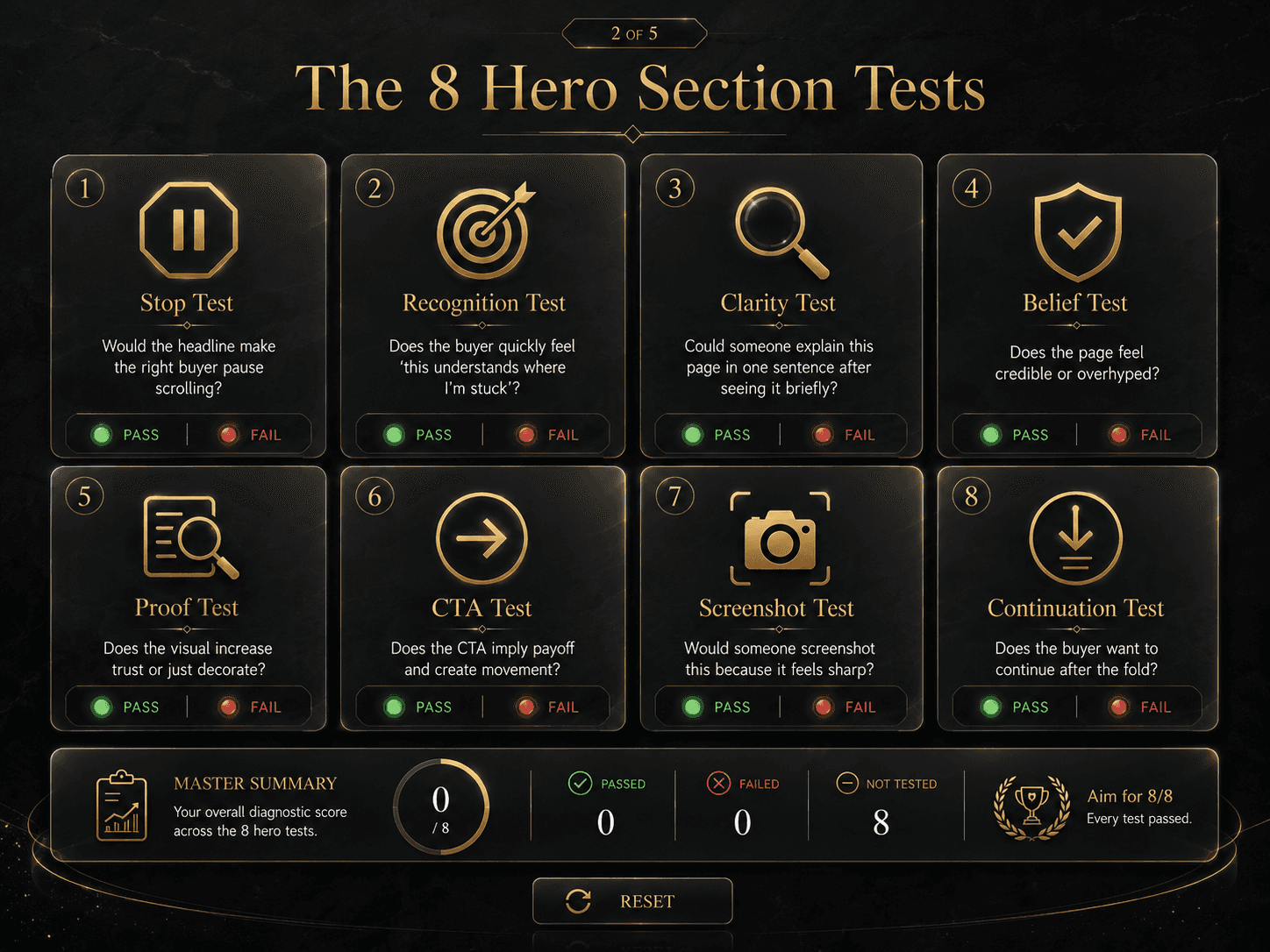
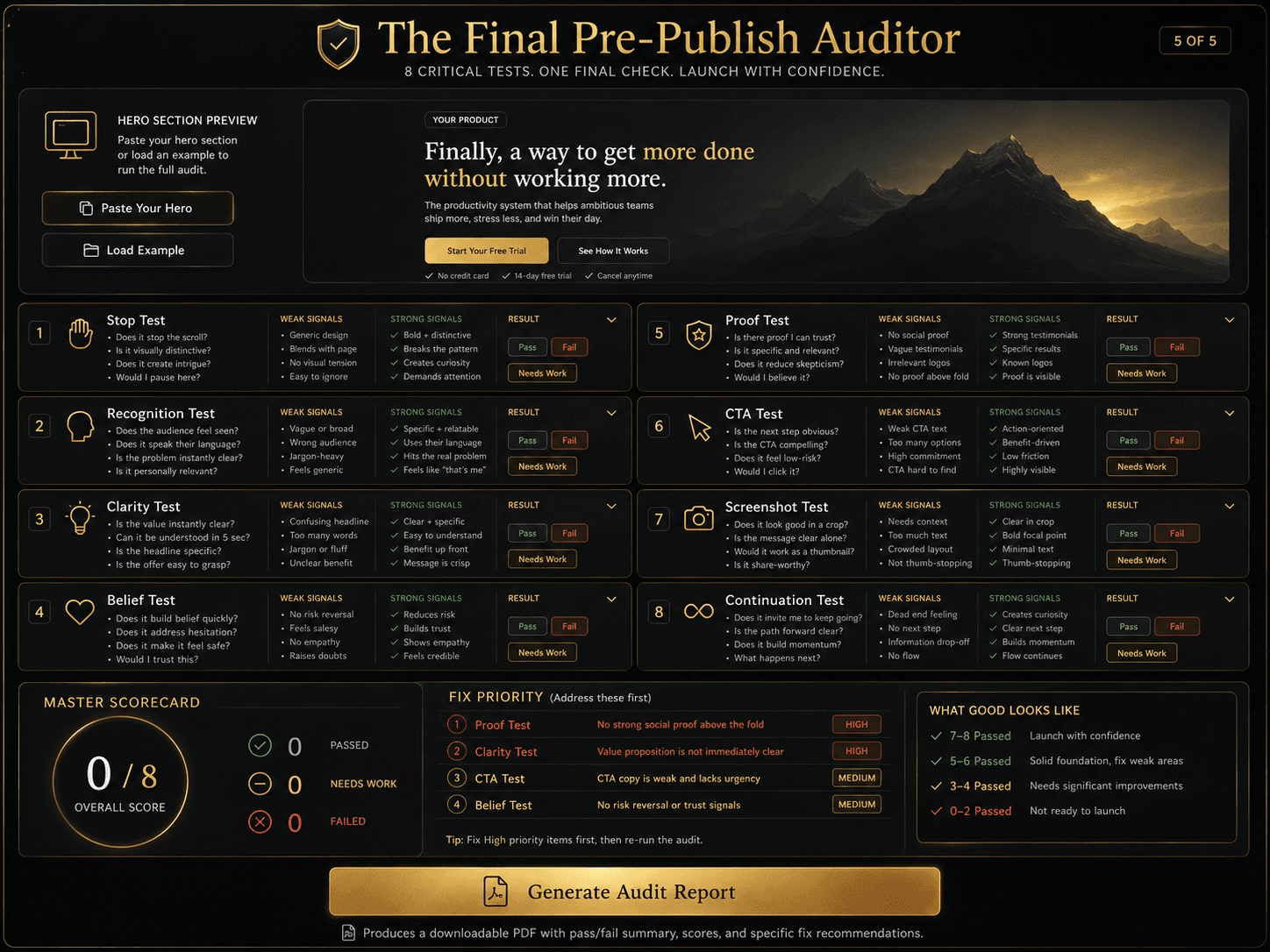
The Scroll-Stop Diagnostic Worksheet™ A final pre-publish inspection system for testing whether your hero section creates enough attention, recognition, clarity, belief, proof, CTA movement, memorability, and continuation to earn the scroll.
Prefer Audio Or Video?
The Scroll-Stop Diagnostic Worksheet™ is also available as:
🎧 A guided audio walkthrough explaining the final scroll-stop diagnostic, attention interruption, recognition, belief, proof, CTA movement, and continuation.
🎥 A practical video breakdown with real pre-publish hero checks, scroll-stop tests, mobile inspection, screenshot-test examples, and publish/sharpen/rebuild verdicts.Choose the format that fits how you learn best.
[Listen To The Audio Walkthrough] (coming soon)
[Watch The Video Breakdown] (coming soon)
——
Why Most Hero Sections Fail Quietly
Most hero sections fail quietly.
Not because the product is bad.
Not because the traffic is always wrong.
Not because the founder lacks effort.
They fail because the first screen never creates enough attention, recognition, trust, clarity, or emotional movement to stop the visitor from leaving.
The buyer lands on the page.
They glance for a few seconds.
They feel no strong reason to continue.
Then they disappear.
That is how the fold loses.
Not always dramatically.
Not always visibly.
Often, the page simply creates no strong enough reason to stay.
The hero section may look clean.
It may feel visually polished.
It may use professional language.
It may even explain the offer.
But if the buyer does not quickly feel:
this is relevant
this is clear
this understands my problem
this might be believable
this is worth continuing with
this has a next step I understand
then the first screen has failed to earn the scroll.
That is what this resource exists to catch before you publish.
What This Resource Helps You Do
The Scroll-Stop Diagnostic Worksheet™ helps you inspect your hero section before it goes live.
Use this when:
the page feels visually polished but weak
bounce rates are high
visitors are not scrolling
the hero section feels forgettable
the message sounds generic
the CTA gets ignored
your first screen lacks tension
the page fails to create momentum quickly
the headline feels safe but not sharp
the proof visual looks attractive but does not persuade
the page explains the offer but does not create movement
you are about to publish and want one final inspection pass
This is not a copywriting checklist.
It is a real-world attention diagnostic.
The goal is simple:
Determine whether your hero section creates enough clarity, contrast, belief, and curiosity to stop the visitor from mentally checking out.
Before You Start: The Real Attention Environment
Your hero section is not being judged in a calm room.
It is competing against:
distraction
fatigue
scepticism
short attention spans
open browser tabs
notifications
other offers
low patience
previous disappointment
mental overload
comparison
the buyer’s instinct to leave quickly
That means the fold has only seconds to prove that staying is worth it.
That is the standard.
Not:
“Does this look nice?”
Not:
“Do I personally like this headline?”
Not:
“Does the layout feel polished?”
The real question is:
“Would the right buyer feel enough relevance and momentum to keep going?”
That is what this resource measures.
When To Use This Diagnostic
Use this worksheet after you have already built or rewritten the hero section.
It is designed as a final inspection pass before publishing.
Use it after you have worked through:
the buyer
the contrast
the headline
the subheadline
the proof visual
the CTA
the microcopy
the mobile version
the first-screen structure
This resource should feel like the final gate.
Before the page goes live, the hero section must prove that it can interrupt attention, create recognition, build belief, and earn continuation.
If it cannot do that, do not publish yet.
Sharpen the fold first.
How To Use This Resource
Move through each diagnostic section honestly.
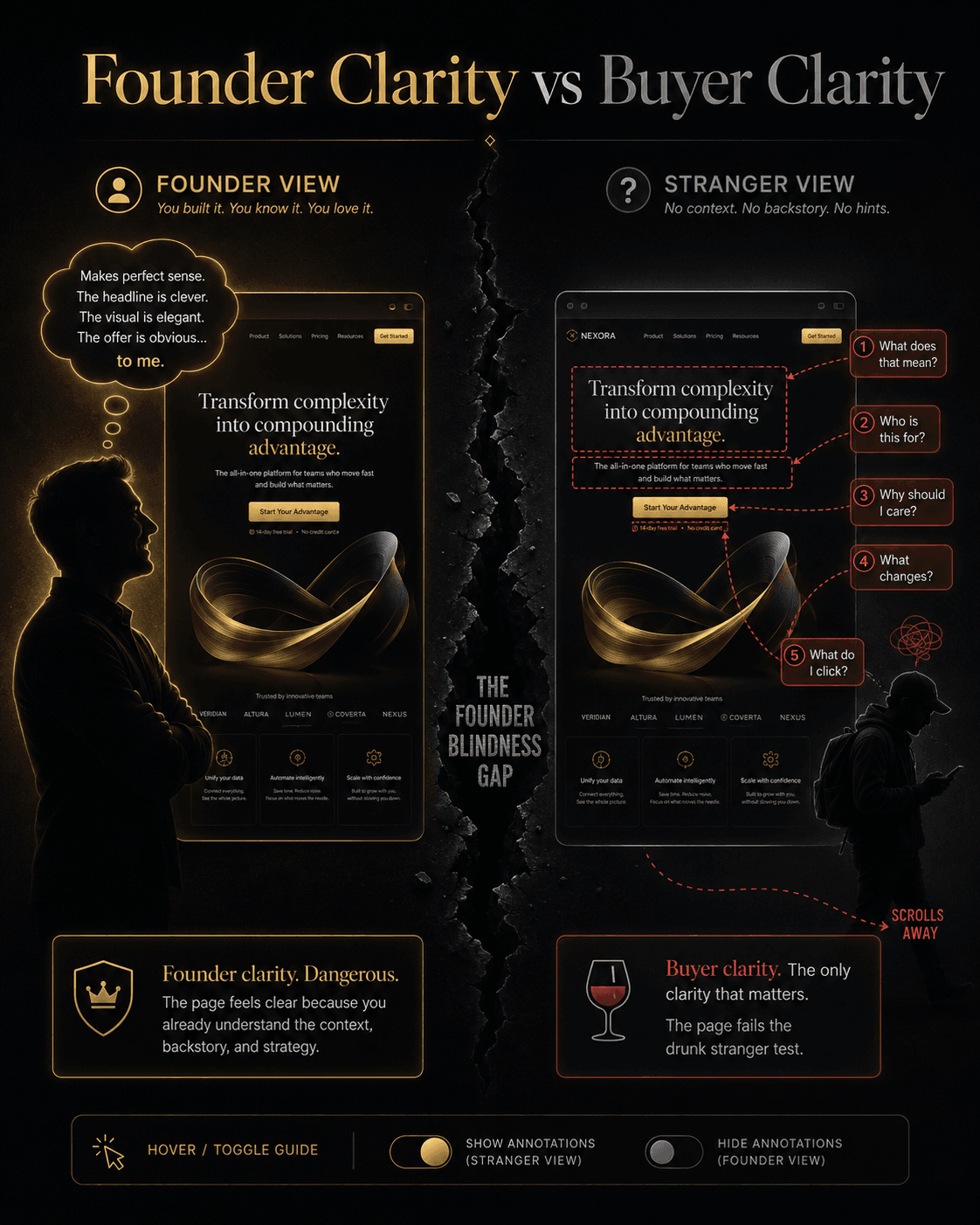
Do not evaluate the hero section as the founder.
Do not evaluate it as the designer.
Do not evaluate it as the person who already understands the offer.
Evaluate it as a distracted buyer with limited patience.
For each test:
identify weakness
identify friction
identify emotional flatness
identify attention leaks
identify what needs to be improved before publishing
For every test, choose one verdict:
Pass
The section is strong enough to support the scroll.
Weak Pass
The section works, but it is still leaking some attention, clarity, belief, or movement.
Fail
The section is not ready. It needs to be fixed before publishing.
This is not about perfection.
It is about whether the first screen creates enough force to earn the next moment of attention.
Current Hero Section Capture
Before testing, write down the current version.
Do not audit from memory.
Capture what the buyer actually sees.
Page Or Offer
What page are you testing?
Target Buyer
Who is this hero section meant to stop?
Current Headline
Paste the headline:
Current Subheadline
Paste the subheadline:
Current Visual
Describe the visual, proof asset, screenshot, video, product view, or image above the fold:
Current CTA
Paste the CTA:
Current Microcopy
Paste the microcopy, or write “missing”:
Desired Visitor Action
What do you want the visitor to do next?
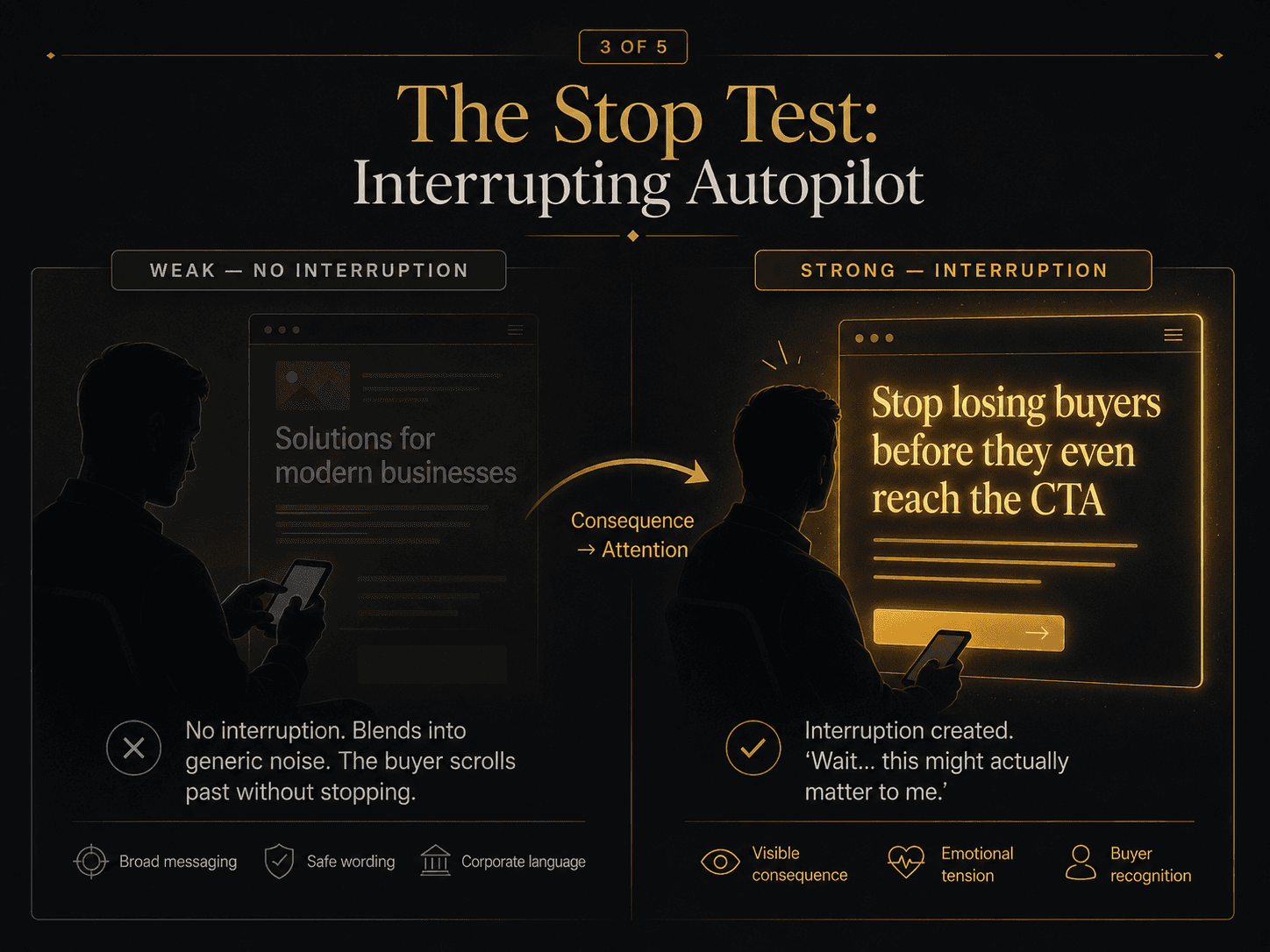
Test 1: The Stop Test™
Core Question
Does the first screen interrupt autopilot?
The first responsibility of the fold is to interrupt autopilot.
The buyer is not waiting patiently.
They are scanning.
They are filtering.
They are ready to leave.
The hero section must create a moment where the right buyer feels:
“Wait… this might actually matter to me.”
Without that interruption, the rest of the page never gets a chance.
The Stop Test measures whether the first screen creates enough immediate relevance, tension, or curiosity to slow the buyer down.
Questions To Ask
Would the headline make the right buyer pause?
Does the message create immediate relevance?
Does it interrupt the buyer’s current mental pattern?
Does the first screen feel specific enough to matter?
Or does it blend into generic internet noise?
Would someone scrolling quickly stop here naturally?
Or would they instantly move on?
Weak Signals
The Stop Test is weak if the hero uses:
broad messaging
safe wording
corporate language
low emotional intensity
generic promises
vague category language
no visible consequence
no sharp buyer condition
Weak examples:
“Solutions for modern businesses.”
“Innovative growth systems.”
“Marketing that helps you grow.”
“Digital strategy for ambitious brands.”
These may sound acceptable.
But they do not emotionally stop the reader.
They sound like many other pages.
And what sounds like everything else gets filtered out.
Strong Signals
The Stop Test is stronger when the message creates interruption.
Examples:
“Stop losing buyers before they even reach the CTA.”
“Your first screen is weaker than you think.”
“Fix the fold before wasting money on more traffic.”
“Your page is not being ignored because the market is cold. It is being ignored because the first screen is weak.”
Now the message creates friction in the buyer’s mind.
It interrupts.
It creates a reason to keep reading.
If This Fails
Usually the issue is:
weak consequence visibility
broad positioning
low emotional contrast
generic language
weak buyer recognition
no real tension
no sharp first-line relevance
Fix the tension first.
Ask:
“What would make the right buyer stop because this feels uncomfortably relevant?”
Stop Test Worksheet
Does the headline interrupt autopilot?
Pass / Weak Pass / Fail
What makes the buyer stop?
What feels too safe or generic?
What consequence or tension could make the first line stronger?
Verdict: Pass / Weak Pass / Fail
Test 2: The Recognition Test™
Core Question
Does the right buyer feel seen?
The buyer should quickly feel:
“This page understands where I am stuck.”
That feeling creates attention retention.
Without recognition, the fold feels emotionally distant.
The buyer may understand the category, but still feel no personal relevance.
That is not enough.
A strong hero section does not merely name a market.
It names a situation.
A buying condition.
A frustration.
A pressure point.
A live problem.
That is what creates recognition.
Questions To Ask
Does the buyer recognise their frustration quickly?
Does the page identify their actual situation?
Does the headline or subheadline speak to a buying condition?
Or does the messaging speak too broadly?
Would the wrong audience also think this page is for them?
If yes, the positioning is probably too vague.
Does the right buyer feel personally addressed?
Or merely included in a broad category?
Weak Signals
Recognition is weak when the hero relies on:
“For businesses”
“For founders”
“For brands”
“For entrepreneurs”
“For modern companies”
category-only positioning
no visible frustration
no buyer condition
no emotional specificity
These phrases may identify a market.
But they do not create enough recognition.
The buyer does not feel seen.
They feel grouped.
That is weaker.
Strong Signals
Recognition is stronger when the page names the buyer’s actual situation.
Examples:
“For founders whose pages look polished but still fail to create trust.”
“For service businesses attracting traffic but struggling to create movement above the fold.”
“For coaches getting attention from content but still not enough serious enquiries.”
“For SaaS founders losing trial users before onboarding creates enough trust.”
Now the buyer feels recognised.
The message becomes more personal.
The page feels more relevant.
If This Fails
Usually the issue is weak audience specificity.
Fix the buying condition.
Not just the demographic.
Do not only ask:
“Who are they?”
Ask:
“What situation are they in?”
That is the sharper question.
Recognition Test Worksheet
Does the right buyer feel seen?
Pass / Weak Pass / Fail
Who does the current hero speak to?
Is this a category or a buying condition?
Category / Buying Condition
What specific situation should be named more clearly?
Would the wrong audience also think this is for them?
Yes / No
Verdict: Pass / Weak Pass / Fail
Test 3: The Clarity Test™
Core Question
Can the buyer understand the first screen quickly?
The fold should feel fast to understand.
If the visitor needs to decode, reread, or interpret, clarity is leaking.
The buyer should not need to work hard to understand:
what this is
who it helps
what changes
why it matters
what to do next
Clarity is not about saying everything.
It is about making the right thing obvious fast enough.
Questions To Ask
Could someone explain this page in one sentence after seeing it briefly?
Does the hero communicate one strong idea?
Or does it present too many competing ideas?
Does the subheadline improve understanding or create more mental load?
Does the first screen feel easy to scan?
Could the page lose 30% of its words and become stronger?
Often, yes.
Does the buyer need to reread the section to understand the value?
Weak Signals
Clarity is weak when the hero uses:
long explanations
layered messaging
jargon
too many promises
vague abstractions
bloated subheadlines
multiple audience types
too many ideas above the fold
clever wording that delays understanding
A hero section that says too much often makes the buyer understand less.
That is the danger.
Strong Signals
Clarity is stronger when the hero uses:
compressed messaging
one visible promise
one emotional direction
fast readability
easy scanning
clear hierarchy
simple wording
a subheadline that clarifies instead of overexplaining
The page feels light enough to process quickly.
The buyer feels:
“I get it.”
That matters.
If This Fails
Usually the issue is trying to explain too much too early.
Fix compression.
Ask:
“What can be removed so the value lands faster?”
The fold should not carry the whole business.
It should carry the first reason to continue.
Clarity Test Worksheet
Can the buyer understand the first screen quickly?
Pass / Weak Pass / Fail
What is the main idea of the hero section?
What ideas are competing for attention?
What words or phrases create mental drag?
What 30% could be removed or compressed?
Verdict: Pass / Weak Pass / Fail
Test 4: The Belief Test™
Core Question
Does the buyer believe the promise could actually work?
The buyer should not only understand the promise.
They should believe:
“This might actually work.”
That is a different psychological threshold.
A clear hero can still fail if it is not believable.
The buyer may think:
“I understand what they are saying.”
But also:
“I do not believe it yet.”
That gap matters.
Belief is what turns attention into continuation.
Questions To Ask
Does the hero section feel credible?
Or exaggerated?
Does the wording create calm confidence?
Or sales pressure?
Would a sceptical buyer trust this more after reading?
Or less?
Does the hero include or point toward proof?
Does the mechanism make the promise easier to believe?
Does the language feel grounded?
Or inflated?
Weak Signals
Belief is weak when the hero uses:
hype
inflated promises
unrealistic claims
fake urgency
no proof
vague superiority language
exaggerated transformation language
claims the buyer cannot inspect
confidence without evidence
“overnight” improvement language
Trying to sound impressive often reduces trust.
The buyer does not need louder claims.
They need more believable ones.
Strong Signals
Belief is stronger when the hero uses:
specificity
grounded language
visible proof
inspectable evidence
realistic outcomes
clear mechanisms
calm confidence
believable scope
proof-led visual direction
The page feels trustworthy.
It does not beg for belief.
It earns it.
If This Fails
Usually the issue is trying to sound impressive instead of believable.
Fix specificity and proof.
Ask:
“What would make this promise feel more real?”
Belief Test Worksheet
Does the promise feel believable?
Pass / Weak Pass / Fail
What claim feels hardest to believe?
What proof supports the promise?
What mechanism makes the result believable?
What wording feels exaggerated or vague?
Verdict: Pass / Weak Pass / Fail
Test 5: The Proof Test™
Core Question
Does the visual increase certainty?
Proof should increase certainty.
Not decoration.
Most hero visuals fail because they look attractive but prove nothing.
A visual above the fold should not merely fill space.
It should help the buyer believe the promise faster.
It should make the result easier to picture.
It should create inspection behaviour.
That matters.
When the buyer wants to look closer, belief has started to form.
Questions To Ask
Does the visual increase trust?
Does it make the promise easier to believe?
Does it help the buyer picture the result?
Could the visual be replaced with something more inspectable?
Would the buyer naturally look closer at it?
Does it prove, simulate, or intensify the outcome?
Or is it only aesthetic?
Weak Signals
Proof is weak when the hero uses:
stock photography
random lifestyle imagery
decorative illustrations
meaningless graphics
vague mockups
staged team photos
abstract visuals
fake-looking dashboards
visuals that do not connect to the promise
These may make the page look better.
But they do not necessarily make the promise feel more real.
Strong Signals
Proof is stronger when the hero uses:
before-and-after comparisons
dashboards
screenshots
visible metrics
customer proof
testimonials
real product interaction
proof assets
teardown visuals
product interface previews
visual evidence of movement
real buyer responses
The visual feels evidence-based.
The buyer can inspect it.
That is the difference.
If This Fails
Usually the issue is design-first thinking.
Fix proof-first thinking.
Ask:
“What can we show that makes the result feel real?”
Proof Test Worksheet
Does the visual increase certainty?
Pass / Weak Pass / Fail
What visual is currently being used?
What does it actually prove?
Does it create inspection behaviour?
Yes / No
What stronger proof asset could replace it?
Verdict: Pass / Weak Pass / Fail
Test 6: The CTA Test™
Core Question
Does the CTA create movement?
The CTA should create movement.
Not hesitation.
The visitor should quickly understand:
what happens next
why clicking matters
what payoff exists
whether the action feels easy enough
A CTA is not just a button.
It is the first visible handoff between attention and action.
If the hero earns attention but the CTA gives that attention nowhere clear to go, momentum leaks.
Questions To Ask
Does the CTA imply a meaningful outcome?
Does the next step feel easy enough to take now?
Does the CTA feel specific?
Or generic?
Does the microcopy reduce friction and uncertainty?
Does the buyer understand what happens after clicking?
Does the action match the buyer’s current trust level?
Does the CTA feel connected to the promise?
Weak Signals
CTA movement is weak when the hero uses:
Submit
Learn More
Contact Us
Get Started
Click Here
no microcopy
unclear next step
vague payoff
high-friction action too early
button language disconnected from the promise
These CTAs may function mechanically.
But they do not create enough movement psychologically.
Strong Signals
CTA movement is stronger when the button creates direction and payoff.
Examples:
“See The Hero Rewrite”
“Fix My First Screen”
“Get The Fold Blueprint”
“Watch The Breakdown”
“Claim The Hero Audit”
“Download The Hero Canvas”
Now the CTA creates direction.
The buyer understands what they are moving toward.
If This Fails
Usually the issue is low perceived payoff.
Fix specificity and action clarity.
Ask:
“What does the buyer get, see, fix, watch, download, or understand after clicking?”
CTA Test Worksheet
Does the CTA create movement?
Pass / Weak Pass / Fail
What is the current CTA?
What does the buyer get after clicking?
What payoff does the CTA imply?
What hesitation might stop the click?
What microcopy could reduce that hesitation?
Verdict: Pass / Weak Pass / Fail
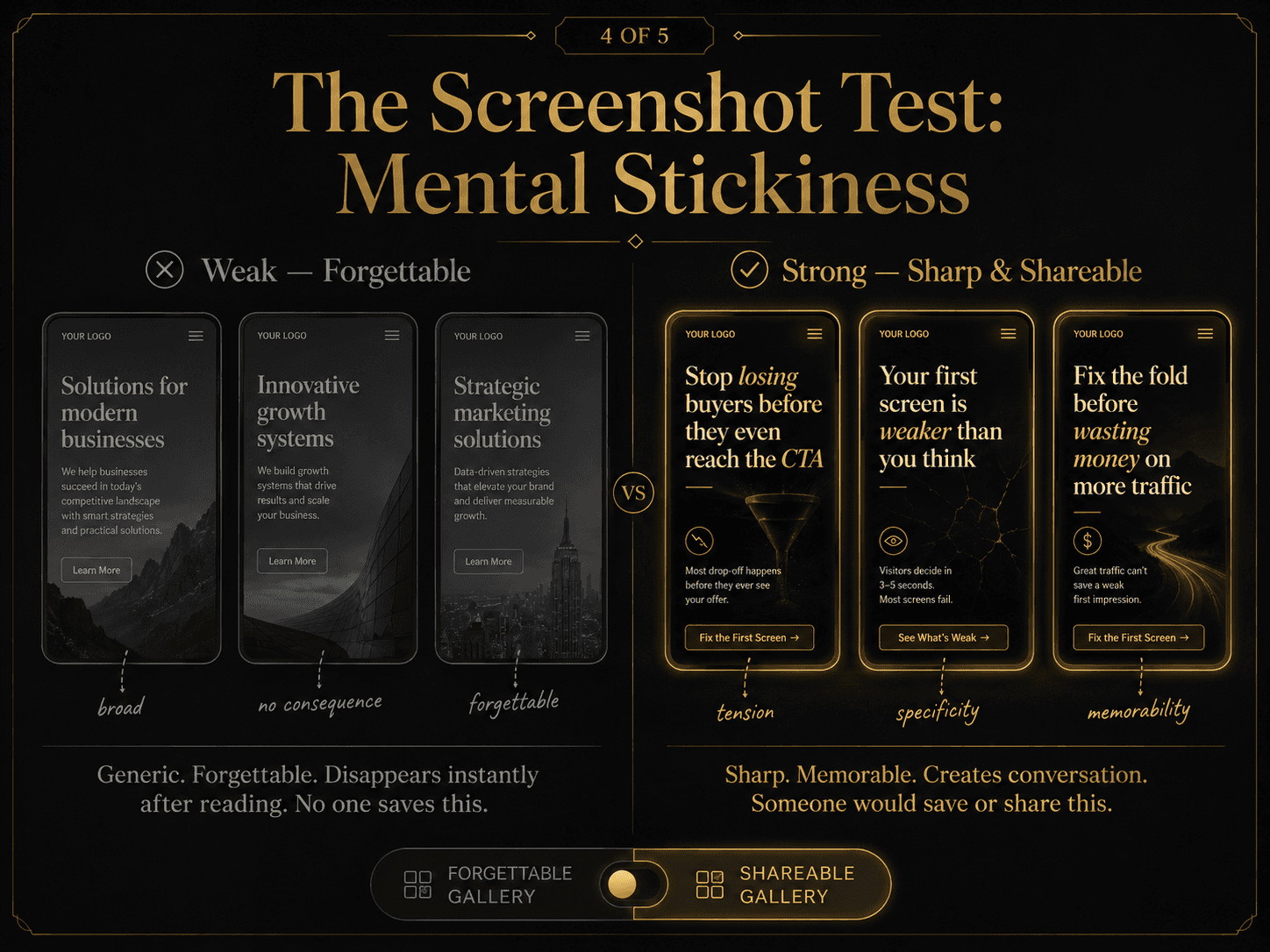
Test 7: The Screenshot Test™
Core Question
Would someone screenshot this because the messaging feels sharp?
This is one of the strongest diagnostics in this entire resource.
Ask:
“Would someone screenshot this because the messaging feels sharp?”
Strong first screens create:
memorability
conversation
sharing
emotional reactions
return attention
mental stickiness
Weak hero sections disappear instantly after reading.
The Screenshot Test is not really about screenshots.
It is about whether the positioning is sharp enough to be remembered.
A screenshot is just evidence that the message created a reaction.
Questions To Ask
Would someone save this line?
Would the buyer remember it later?
Does the hero contain a sharp idea?
Does it express the problem in a way that feels fresh but clear?
Does the message create a reaction?
Would someone say, “That is exactly it”?
Does the first screen feel memorable?
Or forgettable?
Weak Signals
The Screenshot Test is weak when the hero uses:
generic phrasing
safe wording
corporate language
forgettable structure
vague positioning
familiar claims
no emotional edge
no memorable contrast
A technically correct hero can still be forgettable.
And forgettable rarely earns strong continuation.
Strong Signals
The Screenshot Test is stronger when the hero uses:
emotionally sharp phrasing
visible tension
compressed clarity
strong positioning
memorable contrast
buyer language
a fresh diagnosis
a recognisable truth
The page creates mental stickiness.
The buyer feels something worth remembering.
If This Fails
Usually the issue is weak positioning or safe language.
Fix memorability through sharper contrast, buyer language, and stronger consequence.
Ask:
“What would make the right buyer think, ‘That is painfully accurate’?”
Screenshot Test Worksheet
Would someone screenshot this because the messaging feels sharp?
Pass / Weak Pass / Fail
What line is most memorable?
What line is most forgettable?
What buyer truth could be made sharper?
What phrase could create stronger mental stickiness?
Verdict: Pass / Weak Pass / Fail
Test 8: The Continuation Test™
Core Question
After seeing the fold, does the visitor want to continue?
This is the final and most important question.
After seeing the fold, does the visitor want to continue?
Because the fold is not trying to close the sale.
It is trying to earn the next moment of attention.
That is the job.
A strong hero makes the buyer feel:
“I need to see more.”
Not:
“I understand the category.”
Not:
“This looks professional.”
Not:
“That was nicely written.”
Those are weaker outcomes.
The real outcome is continuation.
Questions To Ask
Does the hero create forward momentum?
Or does it emotionally stall?
Would the buyer naturally scroll?
Or mentally disengage?
Does the page create curiosity, recognition, or emotional movement?
Does the hero make the next section feel necessary?
Does the buyer feel enough reason to keep going?
Does staying feel more valuable than leaving?
Weak Signals
Continuation is weak when the hero has:
emotional flatness
no tension
low relevance
weak clarity
overexplaining
no momentum
no curiosity
no proof direction
no strong next step
no reason to scroll
The page may be understandable.
But it does not pull.
Strong Signals
Continuation is stronger when the buyer feels:
“I need to see more.”
That is the goal.
The page does not need to answer every question above the fold.
It needs to open the right questions.
It needs to make continuation feel useful.
If This Fails
Usually the issue is weak forward pull.
Fix the reason to continue.
Ask:
“What should the buyer want to see next?”
Continuation Test Worksheet
Does the visitor want to continue?
Pass / Weak Pass / Fail
Why would the buyer keep scrolling?
What curiosity does the hero create?
What proof, explanation, or next section does the buyer now want to see?
Where does the hero emotionally stall?
Verdict: Pass / Weak Pass / Fail
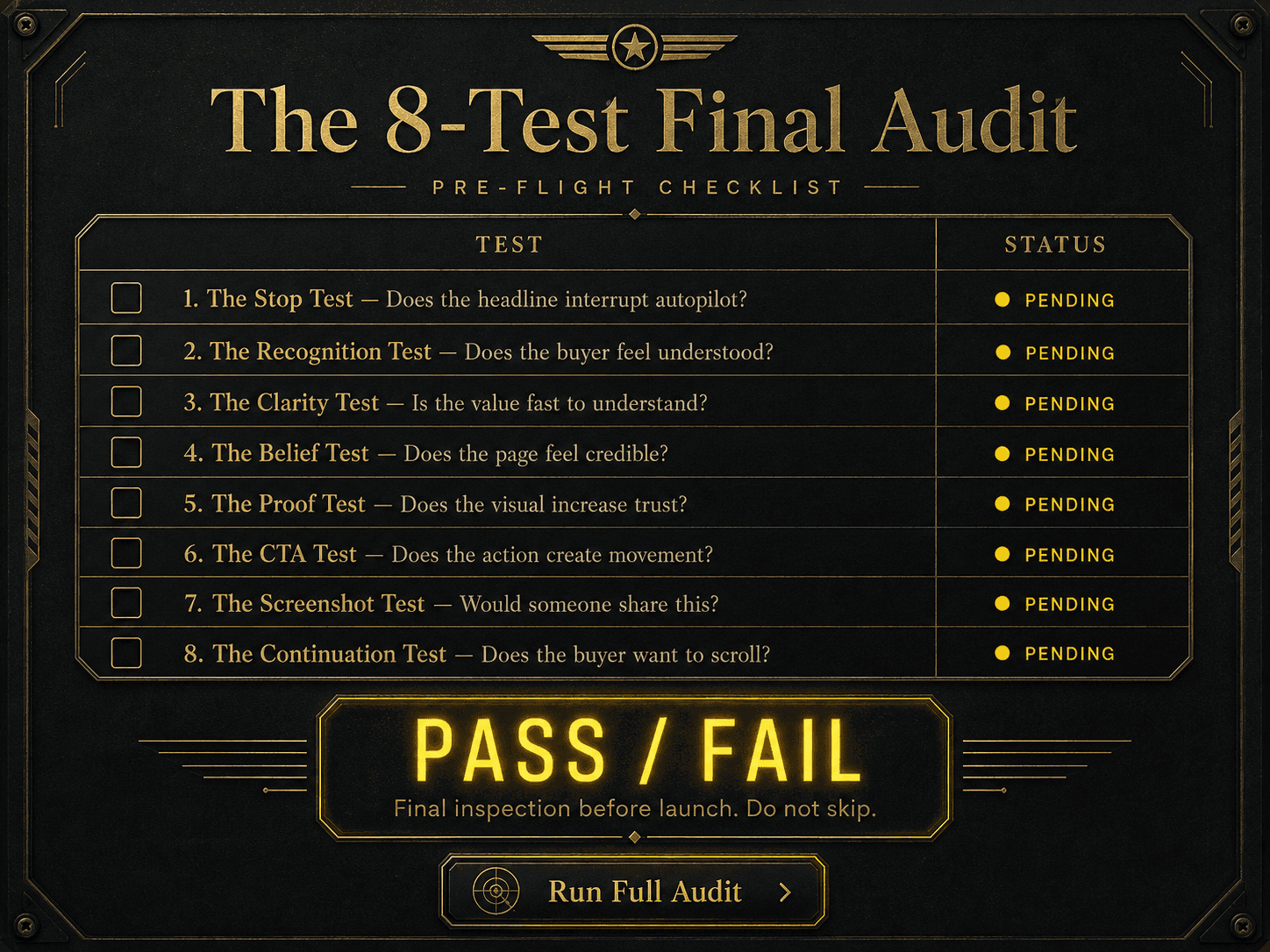
The Scroll-Stop Scorecard™
Mark each test as Pass, Weak Pass, or Fail.
The Stop Test: Pass / Weak Pass / Fail
The Recognition Test: Pass / Weak Pass / Fail
The Clarity Test: Pass / Weak Pass / Fail
The Belief Test: Pass / Weak Pass / Fail
The Proof Test: Pass / Weak Pass / Fail
The CTA Test: Pass / Weak Pass / Fail
The Screenshot Test: Pass / Weak Pass / Fail
The Continuation Test: Pass / Weak Pass / Fail
Count Your Results
Number of Passes: ___
Number of Weak Passes: ___
Number of Fails: ___
Final Verdict: Publish, Sharpen, Or Rebuild™
Use this section to decide what happens next.
Verdict 1: Publish / Test In Market
Choose this verdict if:
most tests are Pass
no critical test fails
the CTA is clear
the proof feels believable
the buyer can understand the value quickly
the hero creates continuation
This does not mean the hero is perfect.
It means it is strong enough to test with real traffic.
Verdict 2: Sharpen Before Publishing
Choose this verdict if:
several tests are Weak Pass
the hero is understandable but still soft
the message lacks some tension
the CTA could be stronger
the proof could be more inspectable
the headline is clear but not memorable
This means the structure is usable, but the first screen still needs sharpening.
Fix the weakest tests before publishing.
Verdict 3: Rebuild The Hero
Choose this verdict if:
multiple tests fail
the buyer would not stop
the message feels generic
the proof does not build belief
the CTA feels passive
the hero lacks recognition
the page feels polished but emotionally flat
This means the hero is not ready.
Do not publish yet.
Return to The Hero Section Build Canvas™ and rebuild the inputs.
My Final Verdict
Publish / Sharpen / Rebuild
Why?
The weakest test is:
The first thing I need to fix is:
The 5-Second Buyer Simulation™
Use this final exercise before publishing.
Imagine the right buyer lands on the page for five seconds.
They are distracted.
They are sceptical.
They are half-ready to leave.
They do not know your business.
They do not care about your internal explanation.
They only care whether the first screen feels relevant enough to continue.
Now ask:
Within five seconds, would they understand what this is?
Yes / No
Would they feel this is for them?
Yes / No
Would they feel the problem matters?
Yes / No
Would they believe the promise might be real?
Yes / No
Would they know what to do next?
Yes / No
Would they want to keep scrolling?
Yes / No
If any answer is no, the hero still has a leak.
Mobile Final Check™
Before publishing, check the hero section on mobile.
Desktop can flatter weak heroes.
Mobile exposes them.
Ask:
Does the headline still hit quickly?
Yes / No
Is the subheadline easy to read?
Yes / No
Is the CTA visible early?
Yes / No
Does the proof appear early enough?
Yes / No
Does the section feel clean and fast?
Yes / No
Is there too much spacing, text, or visual clutter?
Yes / No
Can the buyer understand the value without excessive scrolling?
Yes / No
If the mobile version feels heavy, fix it before publishing.
The buyer does not care that the desktop version looked good in the design file.
The Biggest Mistake In Hero Sections™
The biggest mistake in hero sections is trying to say too much.
That creates mental drag.
The founder wants to explain everything.
The buyer wants to understand enough to continue.
Those are different needs.
A strong hero section does less, but does it more clearly.
It creates:
recognition
contrast
trust
movement
continuation
quickly.
That is why it works.
The hero section is not the place to carry the whole page.
It is the place to earn permission for the rest of the page to work.
Final Pre-Publish Challenge™
Before publishing your hero section, ask:
“If a distracted buyer landed here for five seconds, would they feel enough relevance and momentum to continue?”
If the answer is uncertain, keep sharpening.
Because the first screen determines whether the rest of the page ever gets the opportunity to persuade at all.
Do not publish a hero section just because it looks finished.
Publish it when it passes the real attention test.
Final Scroll-Stop Worksheet
Use this as your final working version.
Current Hero
Headline:
Subheadline:
Visual:
CTA:
Microcopy:
Diagnostic Verdicts
Stop Test:
Pass / Weak Pass / Fail
Recognition Test:
Pass / Weak Pass / Fail
Clarity Test:
Pass / Weak Pass / Fail
Belief Test:
Pass / Weak Pass / Fail
Proof Test:
Pass / Weak Pass / Fail
CTA Test:
Pass / Weak Pass / Fail
Screenshot Test:
Pass / Weak Pass / Fail
Continuation Test:
Pass / Weak Pass / Fail
Weakest Area
The weakest area is:
Main Attention Leak
The main attention leak is:
First Fix
The first fix I need to make is:
Revised Hero
Headline:
Subheadline:
Visual:
CTA:
Microcopy:
Final Verdict
Publish / Sharpen / Rebuild
Why?
——
Final Principle
A hero section is not finished because it looks polished.
It is finished when it earns continuation.
That is the standard.
The fold must interrupt attention, create recognition, compress clarity, build belief, support the promise with proof, direct action, and make the buyer want to keep going.
If it cannot do that, the rest of the page is already fighting uphill.
The hero section does not need to close the sale.
It needs to stop the buyer from mentally checking out.
It needs to make staying feel more valuable than leaving.
That is what The Scroll-Stop Diagnostic Worksheet™ is designed to measure.
Because the fold does not get unlimited patience.
It gets a few seconds.
And in those few seconds, the buyer is asking:
“Is this worth my attention?”
Your hero section must answer:
“Yes.”
Clearly.
Specifically.
Believably.
Fast.
——
From:
The $100M Funnel Playbook. Book I: Foundation Buyer Psychology, Offer Clarity, and the Page Architecture Behind High-Converting Funnels
By Maris Spalins.
——
Copyright Notice
© 2026 The $100M Funnel Playbook / Winyourclients / Maris Spalins. All rights reserved.
This resource, including the frameworks, terminology, examples, scorecards, templates, prompts, methods, and written explanations, is original intellectual property created for The $100M Funnel Playbook. Book I: Foundation — Buyer Psychology, Offer Clarity, And The Page Architecture Behind High-Converting Funnels and published through Winyourclients.
No part of this resource may be copied, reproduced, screenshotted, republished, redistributed, sold, adapted, uploaded, scraped, stored in a database, included in training data, used to train artificial intelligence systems, or used to create derivative commercial or educational materials without prior written permission.
Limited reference, quotation, or sharing is only permitted where the source is clearly and visibly credited.
Any permitted reference must include at least one of the following source credits:
The $100M Funnel Playbook by Maris Spalins
or
Winyourclients — www.winyourclients.com
or
Maris Spalins / Winyourclients
Screenshots, excerpts, summaries, or redistributed versions must not remove, hide, alter, crop out, or obscure the original source, author name, book title, website name, or copyright notice.
This resource is provided for personal learning and implementation only. It is not licensed for resale, republishing, redistribution, AI training, template cloning, course creation, consulting delivery, or commercial reuse without written permission from Maris Spalins or Winyourclients.
For permission requests, licensing, citation approval, or commercial usage enquiries, contact:
Winyourclients
www.winyourclients.com
or
Email directly to Jacob on: help@winyourclients.com
The Scroll-Stop Diagnostic Worksheet™ A final pre-publish inspection system for testing whether your hero section creates enough attention, recognition, clarity, belief, proof, CTA movement, memorability, and continuation to earn the scroll.
Prefer Audio Or Video?
The Scroll-Stop Diagnostic Worksheet™ is also available as:
🎧 A guided audio walkthrough explaining the final scroll-stop diagnostic, attention interruption, recognition, belief, proof, CTA movement, and continuation.
🎥 A practical video breakdown with real pre-publish hero checks, scroll-stop tests, mobile inspection, screenshot-test examples, and publish/sharpen/rebuild verdicts.Choose the format that fits how you learn best.
[Listen To The Audio Walkthrough] (coming soon)
[Watch The Video Breakdown] (coming soon)
——
Why Most Hero Sections Fail Quietly
Most hero sections fail quietly.
Not because the product is bad.
Not because the traffic is always wrong.
Not because the founder lacks effort.
They fail because the first screen never creates enough attention, recognition, trust, clarity, or emotional movement to stop the visitor from leaving.
The buyer lands on the page.
They glance for a few seconds.
They feel no strong reason to continue.
Then they disappear.
That is how the fold loses.
Not always dramatically.
Not always visibly.
Often, the page simply creates no strong enough reason to stay.
The hero section may look clean.
It may feel visually polished.
It may use professional language.
It may even explain the offer.
But if the buyer does not quickly feel:
this is relevant
this is clear
this understands my problem
this might be believable
this is worth continuing with
this has a next step I understand
then the first screen has failed to earn the scroll.
That is what this resource exists to catch before you publish.
What This Resource Helps You Do
The Scroll-Stop Diagnostic Worksheet™ helps you inspect your hero section before it goes live.
Use this when:
the page feels visually polished but weak
bounce rates are high
visitors are not scrolling
the hero section feels forgettable
the message sounds generic
the CTA gets ignored
your first screen lacks tension
the page fails to create momentum quickly
the headline feels safe but not sharp
the proof visual looks attractive but does not persuade
the page explains the offer but does not create movement
you are about to publish and want one final inspection pass
This is not a copywriting checklist.
It is a real-world attention diagnostic.
The goal is simple:
Determine whether your hero section creates enough clarity, contrast, belief, and curiosity to stop the visitor from mentally checking out.
Before You Start: The Real Attention Environment
Your hero section is not being judged in a calm room.
It is competing against:
distraction
fatigue
scepticism
short attention spans
open browser tabs
notifications
other offers
low patience
previous disappointment
mental overload
comparison
the buyer’s instinct to leave quickly
That means the fold has only seconds to prove that staying is worth it.
That is the standard.
Not:
“Does this look nice?”
Not:
“Do I personally like this headline?”
Not:
“Does the layout feel polished?”
The real question is:
“Would the right buyer feel enough relevance and momentum to keep going?”
That is what this resource measures.
When To Use This Diagnostic
Use this worksheet after you have already built or rewritten the hero section.
It is designed as a final inspection pass before publishing.
Use it after you have worked through:
the buyer
the contrast
the headline
the subheadline
the proof visual
the CTA
the microcopy
the mobile version
the first-screen structure
This resource should feel like the final gate.
Before the page goes live, the hero section must prove that it can interrupt attention, create recognition, build belief, and earn continuation.
If it cannot do that, do not publish yet.
Sharpen the fold first.
How To Use This Resource
Move through each diagnostic section honestly.
Do not evaluate the hero section as the founder.
Do not evaluate it as the designer.
Do not evaluate it as the person who already understands the offer.
Evaluate it as a distracted buyer with limited patience.
For each test:
identify weakness
identify friction
identify emotional flatness
identify attention leaks
identify what needs to be improved before publishing
For every test, choose one verdict:
Pass
The section is strong enough to support the scroll.
Weak Pass
The section works, but it is still leaking some attention, clarity, belief, or movement.
Fail
The section is not ready. It needs to be fixed before publishing.
This is not about perfection.
It is about whether the first screen creates enough force to earn the next moment of attention.
Current Hero Section Capture
Before testing, write down the current version.
Do not audit from memory.
Capture what the buyer actually sees.
Page Or Offer
What page are you testing?
Target Buyer
Who is this hero section meant to stop?
Current Headline
Paste the headline:
Current Subheadline
Paste the subheadline:
Current Visual
Describe the visual, proof asset, screenshot, video, product view, or image above the fold:
Current CTA
Paste the CTA:
Current Microcopy
Paste the microcopy, or write “missing”:
Desired Visitor Action
What do you want the visitor to do next?
Test 1: The Stop Test™
Core Question
Does the first screen interrupt autopilot?
The first responsibility of the fold is to interrupt autopilot.
The buyer is not waiting patiently.
They are scanning.
They are filtering.
They are ready to leave.
The hero section must create a moment where the right buyer feels:
“Wait… this might actually matter to me.”
Without that interruption, the rest of the page never gets a chance.
The Stop Test measures whether the first screen creates enough immediate relevance, tension, or curiosity to slow the buyer down.
Questions To Ask
Would the headline make the right buyer pause?
Does the message create immediate relevance?
Does it interrupt the buyer’s current mental pattern?
Does the first screen feel specific enough to matter?
Or does it blend into generic internet noise?
Would someone scrolling quickly stop here naturally?
Or would they instantly move on?
Weak Signals
The Stop Test is weak if the hero uses:
broad messaging
safe wording
corporate language
low emotional intensity
generic promises
vague category language
no visible consequence
no sharp buyer condition
Weak examples:
“Solutions for modern businesses.”
“Innovative growth systems.”
“Marketing that helps you grow.”
“Digital strategy for ambitious brands.”
These may sound acceptable.
But they do not emotionally stop the reader.
They sound like many other pages.
And what sounds like everything else gets filtered out.
Strong Signals
The Stop Test is stronger when the message creates interruption.
Examples:
“Stop losing buyers before they even reach the CTA.”
“Your first screen is weaker than you think.”
“Fix the fold before wasting money on more traffic.”
“Your page is not being ignored because the market is cold. It is being ignored because the first screen is weak.”
Now the message creates friction in the buyer’s mind.
It interrupts.
It creates a reason to keep reading.
If This Fails
Usually the issue is:
weak consequence visibility
broad positioning
low emotional contrast
generic language
weak buyer recognition
no real tension
no sharp first-line relevance
Fix the tension first.
Ask:
“What would make the right buyer stop because this feels uncomfortably relevant?”
Stop Test Worksheet
Does the headline interrupt autopilot?
Pass / Weak Pass / Fail
What makes the buyer stop?
What feels too safe or generic?
What consequence or tension could make the first line stronger?
Verdict: Pass / Weak Pass / Fail
Test 2: The Recognition Test™
Core Question
Does the right buyer feel seen?
The buyer should quickly feel:
“This page understands where I am stuck.”
That feeling creates attention retention.
Without recognition, the fold feels emotionally distant.
The buyer may understand the category, but still feel no personal relevance.
That is not enough.
A strong hero section does not merely name a market.
It names a situation.
A buying condition.
A frustration.
A pressure point.
A live problem.
That is what creates recognition.
Questions To Ask
Does the buyer recognise their frustration quickly?
Does the page identify their actual situation?
Does the headline or subheadline speak to a buying condition?
Or does the messaging speak too broadly?
Would the wrong audience also think this page is for them?
If yes, the positioning is probably too vague.
Does the right buyer feel personally addressed?
Or merely included in a broad category?
Weak Signals
Recognition is weak when the hero relies on:
“For businesses”
“For founders”
“For brands”
“For entrepreneurs”
“For modern companies”
category-only positioning
no visible frustration
no buyer condition
no emotional specificity
These phrases may identify a market.
But they do not create enough recognition.
The buyer does not feel seen.
They feel grouped.
That is weaker.
Strong Signals
Recognition is stronger when the page names the buyer’s actual situation.
Examples:
“For founders whose pages look polished but still fail to create trust.”
“For service businesses attracting traffic but struggling to create movement above the fold.”
“For coaches getting attention from content but still not enough serious enquiries.”
“For SaaS founders losing trial users before onboarding creates enough trust.”
Now the buyer feels recognised.
The message becomes more personal.
The page feels more relevant.
If This Fails
Usually the issue is weak audience specificity.
Fix the buying condition.
Not just the demographic.
Do not only ask:
“Who are they?”
Ask:
“What situation are they in?”
That is the sharper question.
Recognition Test Worksheet
Does the right buyer feel seen?
Pass / Weak Pass / Fail
Who does the current hero speak to?
Is this a category or a buying condition?
Category / Buying Condition
What specific situation should be named more clearly?
Would the wrong audience also think this is for them?
Yes / No
Verdict: Pass / Weak Pass / Fail
Test 3: The Clarity Test™
Core Question
Can the buyer understand the first screen quickly?
The fold should feel fast to understand.
If the visitor needs to decode, reread, or interpret, clarity is leaking.
The buyer should not need to work hard to understand:
what this is
who it helps
what changes
why it matters
what to do next
Clarity is not about saying everything.
It is about making the right thing obvious fast enough.
Questions To Ask
Could someone explain this page in one sentence after seeing it briefly?
Does the hero communicate one strong idea?
Or does it present too many competing ideas?
Does the subheadline improve understanding or create more mental load?
Does the first screen feel easy to scan?
Could the page lose 30% of its words and become stronger?
Often, yes.
Does the buyer need to reread the section to understand the value?
Weak Signals
Clarity is weak when the hero uses:
long explanations
layered messaging
jargon
too many promises
vague abstractions
bloated subheadlines
multiple audience types
too many ideas above the fold
clever wording that delays understanding
A hero section that says too much often makes the buyer understand less.
That is the danger.
Strong Signals
Clarity is stronger when the hero uses:
compressed messaging
one visible promise
one emotional direction
fast readability
easy scanning
clear hierarchy
simple wording
a subheadline that clarifies instead of overexplaining
The page feels light enough to process quickly.
The buyer feels:
“I get it.”
That matters.
If This Fails
Usually the issue is trying to explain too much too early.
Fix compression.
Ask:
“What can be removed so the value lands faster?”
The fold should not carry the whole business.
It should carry the first reason to continue.
Clarity Test Worksheet
Can the buyer understand the first screen quickly?
Pass / Weak Pass / Fail
What is the main idea of the hero section?
What ideas are competing for attention?
What words or phrases create mental drag?
What 30% could be removed or compressed?
Verdict: Pass / Weak Pass / Fail
Test 4: The Belief Test™
Core Question
Does the buyer believe the promise could actually work?
The buyer should not only understand the promise.
They should believe:
“This might actually work.”
That is a different psychological threshold.
A clear hero can still fail if it is not believable.
The buyer may think:
“I understand what they are saying.”
But also:
“I do not believe it yet.”
That gap matters.
Belief is what turns attention into continuation.
Questions To Ask
Does the hero section feel credible?
Or exaggerated?
Does the wording create calm confidence?
Or sales pressure?
Would a sceptical buyer trust this more after reading?
Or less?
Does the hero include or point toward proof?
Does the mechanism make the promise easier to believe?
Does the language feel grounded?
Or inflated?
Weak Signals
Belief is weak when the hero uses:
hype
inflated promises
unrealistic claims
fake urgency
no proof
vague superiority language
exaggerated transformation language
claims the buyer cannot inspect
confidence without evidence
“overnight” improvement language
Trying to sound impressive often reduces trust.
The buyer does not need louder claims.
They need more believable ones.
Strong Signals
Belief is stronger when the hero uses:
specificity
grounded language
visible proof
inspectable evidence
realistic outcomes
clear mechanisms
calm confidence
believable scope
proof-led visual direction
The page feels trustworthy.
It does not beg for belief.
It earns it.
If This Fails
Usually the issue is trying to sound impressive instead of believable.
Fix specificity and proof.
Ask:
“What would make this promise feel more real?”
Belief Test Worksheet
Does the promise feel believable?
Pass / Weak Pass / Fail
What claim feels hardest to believe?
What proof supports the promise?
What mechanism makes the result believable?
What wording feels exaggerated or vague?
Verdict: Pass / Weak Pass / Fail
Test 5: The Proof Test™
Core Question
Does the visual increase certainty?
Proof should increase certainty.
Not decoration.
Most hero visuals fail because they look attractive but prove nothing.
A visual above the fold should not merely fill space.
It should help the buyer believe the promise faster.
It should make the result easier to picture.
It should create inspection behaviour.
That matters.
When the buyer wants to look closer, belief has started to form.
Questions To Ask
Does the visual increase trust?
Does it make the promise easier to believe?
Does it help the buyer picture the result?
Could the visual be replaced with something more inspectable?
Would the buyer naturally look closer at it?
Does it prove, simulate, or intensify the outcome?
Or is it only aesthetic?
Weak Signals
Proof is weak when the hero uses:
stock photography
random lifestyle imagery
decorative illustrations
meaningless graphics
vague mockups
staged team photos
abstract visuals
fake-looking dashboards
visuals that do not connect to the promise
These may make the page look better.
But they do not necessarily make the promise feel more real.
Strong Signals
Proof is stronger when the hero uses:
before-and-after comparisons
dashboards
screenshots
visible metrics
customer proof
testimonials
real product interaction
proof assets
teardown visuals
product interface previews
visual evidence of movement
real buyer responses
The visual feels evidence-based.
The buyer can inspect it.
That is the difference.
If This Fails
Usually the issue is design-first thinking.
Fix proof-first thinking.
Ask:
“What can we show that makes the result feel real?”
Proof Test Worksheet
Does the visual increase certainty?
Pass / Weak Pass / Fail
What visual is currently being used?
What does it actually prove?
Does it create inspection behaviour?
Yes / No
What stronger proof asset could replace it?
Verdict: Pass / Weak Pass / Fail
Test 6: The CTA Test™
Core Question
Does the CTA create movement?
The CTA should create movement.
Not hesitation.
The visitor should quickly understand:
what happens next
why clicking matters
what payoff exists
whether the action feels easy enough
A CTA is not just a button.
It is the first visible handoff between attention and action.
If the hero earns attention but the CTA gives that attention nowhere clear to go, momentum leaks.
Questions To Ask
Does the CTA imply a meaningful outcome?
Does the next step feel easy enough to take now?
Does the CTA feel specific?
Or generic?
Does the microcopy reduce friction and uncertainty?
Does the buyer understand what happens after clicking?
Does the action match the buyer’s current trust level?
Does the CTA feel connected to the promise?
Weak Signals
CTA movement is weak when the hero uses:
Submit
Learn More
Contact Us
Get Started
Click Here
no microcopy
unclear next step
vague payoff
high-friction action too early
button language disconnected from the promise
These CTAs may function mechanically.
But they do not create enough movement psychologically.
Strong Signals
CTA movement is stronger when the button creates direction and payoff.
Examples:
“See The Hero Rewrite”
“Fix My First Screen”
“Get The Fold Blueprint”
“Watch The Breakdown”
“Claim The Hero Audit”
“Download The Hero Canvas”
Now the CTA creates direction.
The buyer understands what they are moving toward.
If This Fails
Usually the issue is low perceived payoff.
Fix specificity and action clarity.
Ask:
“What does the buyer get, see, fix, watch, download, or understand after clicking?”
CTA Test Worksheet
Does the CTA create movement?
Pass / Weak Pass / Fail
What is the current CTA?
What does the buyer get after clicking?
What payoff does the CTA imply?
What hesitation might stop the click?
What microcopy could reduce that hesitation?
Verdict: Pass / Weak Pass / Fail
Test 7: The Screenshot Test™
Core Question
Would someone screenshot this because the messaging feels sharp?
This is one of the strongest diagnostics in this entire resource.
Ask:
“Would someone screenshot this because the messaging feels sharp?”
Strong first screens create:
memorability
conversation
sharing
emotional reactions
return attention
mental stickiness
Weak hero sections disappear instantly after reading.
The Screenshot Test is not really about screenshots.
It is about whether the positioning is sharp enough to be remembered.
A screenshot is just evidence that the message created a reaction.
Questions To Ask
Would someone save this line?
Would the buyer remember it later?
Does the hero contain a sharp idea?
Does it express the problem in a way that feels fresh but clear?
Does the message create a reaction?
Would someone say, “That is exactly it”?
Does the first screen feel memorable?
Or forgettable?
Weak Signals
The Screenshot Test is weak when the hero uses:
generic phrasing
safe wording
corporate language
forgettable structure
vague positioning
familiar claims
no emotional edge
no memorable contrast
A technically correct hero can still be forgettable.
And forgettable rarely earns strong continuation.
Strong Signals
The Screenshot Test is stronger when the hero uses:
emotionally sharp phrasing
visible tension
compressed clarity
strong positioning
memorable contrast
buyer language
a fresh diagnosis
a recognisable truth
The page creates mental stickiness.
The buyer feels something worth remembering.
If This Fails
Usually the issue is weak positioning or safe language.
Fix memorability through sharper contrast, buyer language, and stronger consequence.
Ask:
“What would make the right buyer think, ‘That is painfully accurate’?”
Screenshot Test Worksheet
Would someone screenshot this because the messaging feels sharp?
Pass / Weak Pass / Fail
What line is most memorable?
What line is most forgettable?
What buyer truth could be made sharper?
What phrase could create stronger mental stickiness?
Verdict: Pass / Weak Pass / Fail
Test 8: The Continuation Test™
Core Question
After seeing the fold, does the visitor want to continue?
This is the final and most important question.
After seeing the fold, does the visitor want to continue?
Because the fold is not trying to close the sale.
It is trying to earn the next moment of attention.
That is the job.
A strong hero makes the buyer feel:
“I need to see more.”
Not:
“I understand the category.”
Not:
“This looks professional.”
Not:
“That was nicely written.”
Those are weaker outcomes.
The real outcome is continuation.
Questions To Ask
Does the hero create forward momentum?
Or does it emotionally stall?
Would the buyer naturally scroll?
Or mentally disengage?
Does the page create curiosity, recognition, or emotional movement?
Does the hero make the next section feel necessary?
Does the buyer feel enough reason to keep going?
Does staying feel more valuable than leaving?
Weak Signals
Continuation is weak when the hero has:
emotional flatness
no tension
low relevance
weak clarity
overexplaining
no momentum
no curiosity
no proof direction
no strong next step
no reason to scroll
The page may be understandable.
But it does not pull.
Strong Signals
Continuation is stronger when the buyer feels:
“I need to see more.”
That is the goal.
The page does not need to answer every question above the fold.
It needs to open the right questions.
It needs to make continuation feel useful.
If This Fails
Usually the issue is weak forward pull.
Fix the reason to continue.
Ask:
“What should the buyer want to see next?”
Continuation Test Worksheet
Does the visitor want to continue?
Pass / Weak Pass / Fail
Why would the buyer keep scrolling?
What curiosity does the hero create?
What proof, explanation, or next section does the buyer now want to see?
Where does the hero emotionally stall?
Verdict: Pass / Weak Pass / Fail
The Scroll-Stop Scorecard™
Mark each test as Pass, Weak Pass, or Fail.
The Stop Test: Pass / Weak Pass / Fail
The Recognition Test: Pass / Weak Pass / Fail
The Clarity Test: Pass / Weak Pass / Fail
The Belief Test: Pass / Weak Pass / Fail
The Proof Test: Pass / Weak Pass / Fail
The CTA Test: Pass / Weak Pass / Fail
The Screenshot Test: Pass / Weak Pass / Fail
The Continuation Test: Pass / Weak Pass / Fail
Count Your Results
Number of Passes: ___
Number of Weak Passes: ___
Number of Fails: ___
Final Verdict: Publish, Sharpen, Or Rebuild™
Use this section to decide what happens next.
Verdict 1: Publish / Test In Market
Choose this verdict if:
most tests are Pass
no critical test fails
the CTA is clear
the proof feels believable
the buyer can understand the value quickly
the hero creates continuation
This does not mean the hero is perfect.
It means it is strong enough to test with real traffic.
Verdict 2: Sharpen Before Publishing
Choose this verdict if:
several tests are Weak Pass
the hero is understandable but still soft
the message lacks some tension
the CTA could be stronger
the proof could be more inspectable
the headline is clear but not memorable
This means the structure is usable, but the first screen still needs sharpening.
Fix the weakest tests before publishing.
Verdict 3: Rebuild The Hero
Choose this verdict if:
multiple tests fail
the buyer would not stop
the message feels generic
the proof does not build belief
the CTA feels passive
the hero lacks recognition
the page feels polished but emotionally flat
This means the hero is not ready.
Do not publish yet.
Return to The Hero Section Build Canvas™ and rebuild the inputs.
My Final Verdict
Publish / Sharpen / Rebuild
Why?
The weakest test is:
The first thing I need to fix is:
The 5-Second Buyer Simulation™
Use this final exercise before publishing.
Imagine the right buyer lands on the page for five seconds.
They are distracted.
They are sceptical.
They are half-ready to leave.
They do not know your business.
They do not care about your internal explanation.
They only care whether the first screen feels relevant enough to continue.
Now ask:
Within five seconds, would they understand what this is?
Yes / No
Would they feel this is for them?
Yes / No
Would they feel the problem matters?
Yes / No
Would they believe the promise might be real?
Yes / No
Would they know what to do next?
Yes / No
Would they want to keep scrolling?
Yes / No
If any answer is no, the hero still has a leak.
Mobile Final Check™
Before publishing, check the hero section on mobile.
Desktop can flatter weak heroes.
Mobile exposes them.
Ask:
Does the headline still hit quickly?
Yes / No
Is the subheadline easy to read?
Yes / No
Is the CTA visible early?
Yes / No
Does the proof appear early enough?
Yes / No
Does the section feel clean and fast?
Yes / No
Is there too much spacing, text, or visual clutter?
Yes / No
Can the buyer understand the value without excessive scrolling?
Yes / No
If the mobile version feels heavy, fix it before publishing.
The buyer does not care that the desktop version looked good in the design file.
The Biggest Mistake In Hero Sections™
The biggest mistake in hero sections is trying to say too much.
That creates mental drag.
The founder wants to explain everything.
The buyer wants to understand enough to continue.
Those are different needs.
A strong hero section does less, but does it more clearly.
It creates:
recognition
contrast
trust
movement
continuation
quickly.
That is why it works.
The hero section is not the place to carry the whole page.
It is the place to earn permission for the rest of the page to work.
Final Pre-Publish Challenge™
Before publishing your hero section, ask:
“If a distracted buyer landed here for five seconds, would they feel enough relevance and momentum to continue?”
If the answer is uncertain, keep sharpening.
Because the first screen determines whether the rest of the page ever gets the opportunity to persuade at all.
Do not publish a hero section just because it looks finished.
Publish it when it passes the real attention test.
Final Scroll-Stop Worksheet
Use this as your final working version.
Current Hero
Headline:
Subheadline:
Visual:
CTA:
Microcopy:
Diagnostic Verdicts
Stop Test:
Pass / Weak Pass / Fail
Recognition Test:
Pass / Weak Pass / Fail
Clarity Test:
Pass / Weak Pass / Fail
Belief Test:
Pass / Weak Pass / Fail
Proof Test:
Pass / Weak Pass / Fail
CTA Test:
Pass / Weak Pass / Fail
Screenshot Test:
Pass / Weak Pass / Fail
Continuation Test:
Pass / Weak Pass / Fail
Weakest Area
The weakest area is:
Main Attention Leak
The main attention leak is:
First Fix
The first fix I need to make is:
Revised Hero
Headline:
Subheadline:
Visual:
CTA:
Microcopy:
Final Verdict
Publish / Sharpen / Rebuild
Why?
——
Final Principle
A hero section is not finished because it looks polished.
It is finished when it earns continuation.
That is the standard.
The fold must interrupt attention, create recognition, compress clarity, build belief, support the promise with proof, direct action, and make the buyer want to keep going.
If it cannot do that, the rest of the page is already fighting uphill.
The hero section does not need to close the sale.
It needs to stop the buyer from mentally checking out.
It needs to make staying feel more valuable than leaving.
That is what The Scroll-Stop Diagnostic Worksheet™ is designed to measure.
Because the fold does not get unlimited patience.
It gets a few seconds.
And in those few seconds, the buyer is asking:
“Is this worth my attention?”
Your hero section must answer:
“Yes.”
Clearly.
Specifically.
Believably.
Fast.
——
From:
The $100M Funnel Playbook. Book I: Foundation Buyer Psychology, Offer Clarity, and the Page Architecture Behind High-Converting Funnels
By Maris Spalins.
——
Copyright Notice
© 2026 The $100M Funnel Playbook / Winyourclients / Maris Spalins. All rights reserved.
This resource, including the frameworks, terminology, examples, scorecards, templates, prompts, methods, and written explanations, is original intellectual property created for The $100M Funnel Playbook. Book I: Foundation — Buyer Psychology, Offer Clarity, And The Page Architecture Behind High-Converting Funnels and published through Winyourclients.
No part of this resource may be copied, reproduced, screenshotted, republished, redistributed, sold, adapted, uploaded, scraped, stored in a database, included in training data, used to train artificial intelligence systems, or used to create derivative commercial or educational materials without prior written permission.
Limited reference, quotation, or sharing is only permitted where the source is clearly and visibly credited.
Any permitted reference must include at least one of the following source credits:
The $100M Funnel Playbook by Maris Spalins
or
Winyourclients — www.winyourclients.com
or
Maris Spalins / Winyourclients
Screenshots, excerpts, summaries, or redistributed versions must not remove, hide, alter, crop out, or obscure the original source, author name, book title, website name, or copyright notice.
This resource is provided for personal learning and implementation only. It is not licensed for resale, republishing, redistribution, AI training, template cloning, course creation, consulting delivery, or commercial reuse without written permission from Maris Spalins or Winyourclients.
For permission requests, licensing, citation approval, or commercial usage enquiries, contact:
Winyourclients
www.winyourclients.com
or
Email directly to Jacob on: help@winyourclients.com
Other Blogs
Other Blogs
Check our other project Blogs with useful insight and information for your businesses
Other Blogs
Other Blogs
Check our other project Blogs with useful insight and information for your businesses