Our Three Step Process
May 25, 2026
Chap 2 | Resource 6 | The Psychological Deployment Model™
Our Three Step Process
May 25, 2026
Chap 2 | Resource 6 | The Psychological Deployment Model™
The Psychological Deployment Model™ A funnel sequencing worksheet for deploying buyer psychology in the right order, so attention, recognition, curiosity, belief, trust, and action build naturally instead of feeling pushy, chaotic, or emotionally off.
Prefer Audio Or Video?
The Psychological Deployment Model™ is also available as:
🎧 A guided audio walkthrough explaining funnel sequencing, emotional progression, and buyer-state psychology
🎥 A practical video breakdown with real funnel sequence examples, emotional timing analysis, and deployment teardownsChoose the format that fits how you learn best.
[Listen To The Audio Walkthrough] (coming soon)
[Watch The Video Breakdown] (coming soon)
——
Why Some Funnels Feel Smooth And Others Feel Pushy, Chaotic, Or Emotionally Off
Most funnels do not fail because the messaging itself is terrible.
They fail because the psychology is deployed at the wrong moment.
This is one of the most overlooked conversion problems in modern marketing.
A funnel may contain:
strong insights
strong proof
strong offers
strong hooks
strong buyer research
strong emotional language
But the emotional sequence can still feel unnatural.
Examples:
urgency appears before trust
proof arrives after doubt hardens
identity pressure appears before relevance exists
CTAs demand commitment before belief exists
emotional intensity spikes too early
the offer appears before the buyer understands the problem
desire appears before diagnosis
The result?
The funnel feels:
emotionally disjointed
psychologically rushed
subtly manipulative
difficult to trust
pushy without meaning to be pushy
intense without being persuasive
Good ingredients do not guarantee a good sequence.
That is exactly what The Psychological Deployment Model™ is designed to solve.
It helps you place the right buyer psychology in the right order, so the funnel feels guided instead of forced.
——
What This Resource Helps You Do
The Psychological Deployment Model™ helps you sequence buyer psychology across the funnel.
Use it to:
identify where your funnel feels rushed
find emotional jumps that create resistance
detect proof that appears too late
fix CTAs that ask for commitment too early
sequence pressure, proof, identity, desire, and trust correctly
map each funnel section to the buyer’s current psychological state
make your funnel feel smoother, clearer, and more believable
build conversion momentum naturally instead of forcing action
This resource is not only about what to say.
It is about when to say it.
Because conversion is not information transfer.
It is emotional progression.
The buyer must be moved through the right psychological states in the right order.
That is what creates trust, momentum, and action.
——
The Buyer State Principle™
Buyers do not remain psychologically static throughout the funnel.
Their emotional state evolves.
This is critical.
A cold buyer landing on the page does not need:
aggressive urgency
heavy commitment
deep technical proof
hard closing language
a high-pressure CTA
identity-level confrontation
a full offer breakdown before relevance exists
They first need:
relevance
recognition
clarity
emotional safety
curiosity
a reason to continue
This means different buyer states require different messaging deployment.
Strong funnels understand this.
Weak funnels ignore it completely.
——
Why This Matters
Many funnels accidentally deploy late-stage persuasion to early-stage buyers.
That creates:
resistance
distrust
emotional overload
continuation collapse
premature scepticism
CTA avoidance
Because psychologically, the buyer has not reached that emotional stage yet.
They have not built enough relevance.
They have not built enough belief.
They have not built enough trust.
They have not built enough readiness.
So the ask feels too early.
Funnels should feel like guided progression.
Not emotional ambush.
——
The Core Rule
Never ask for a psychological state you have not built yet.
Do not ask for commitment before belief.
Do not ask for urgency before trust.
Do not ask for identity-level pressure before recognition.
Do not ask for action before the buyer understands why the action matters.
Do not ask for a high-friction step when the buyer only has low-friction curiosity.
The page must earn each psychological state before moving to the next one.
That is the discipline.
——
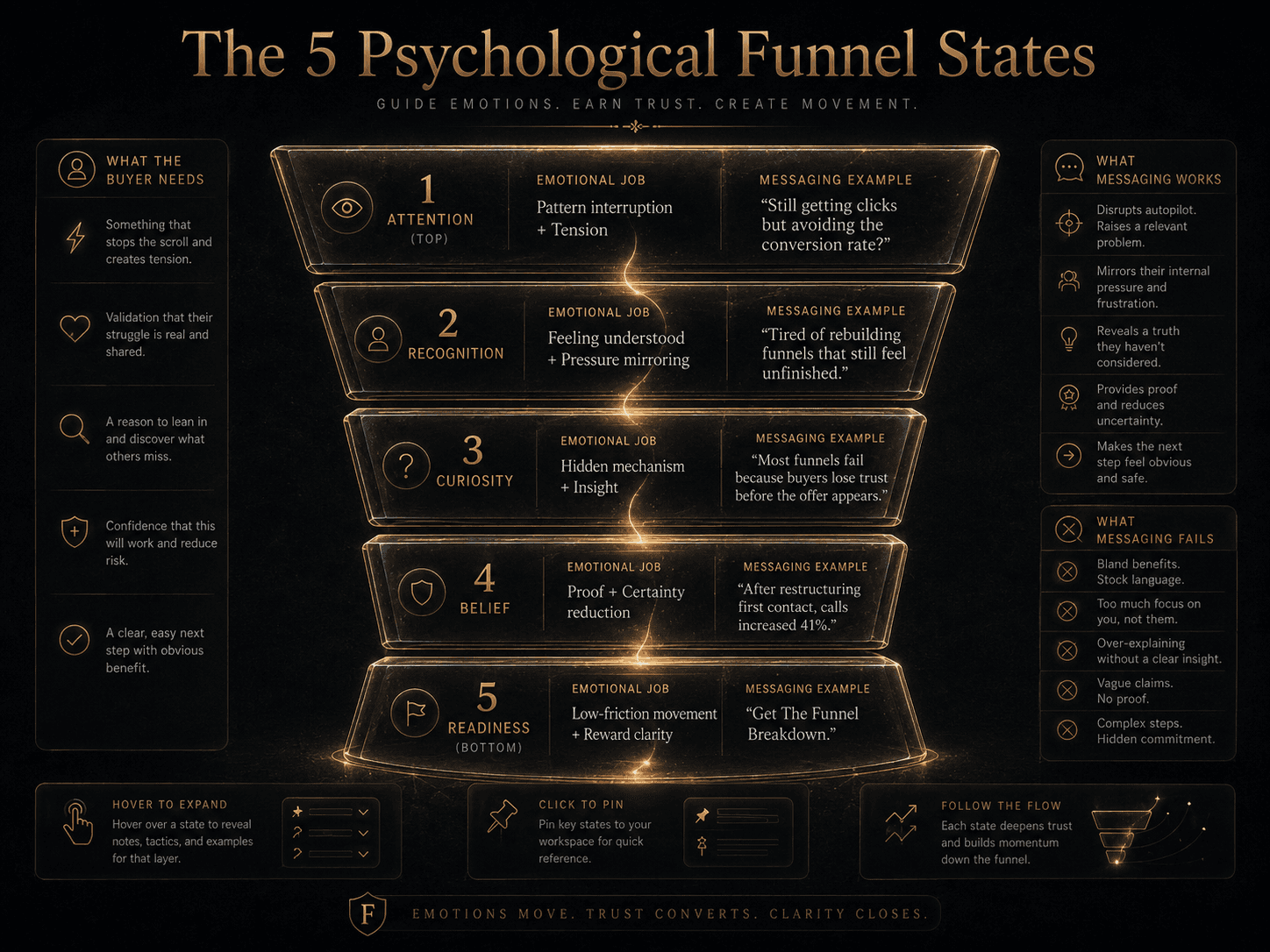
The 5 Psychological Funnel States™
Most strong funnels guide buyers through five psychological states.
The five states are:
Attention™
Recognition™
Curiosity™
Belief™
Readiness™
Each state has a different job.
Each state needs a different kind of messaging.
Each state prepares the buyer for the next one.
—
State 1: Attention™
Primary Need
Pattern interruption.
At this stage, the buyer is:
distracted
sceptical
scanning quickly
filtering aggressively
deciding whether the page deserves more than a few seconds
The funnel must earn the next few seconds.
Attention is not the same as trust.
A shocking line may get attention while damaging trust.
A strong attention line interrupts without creating unnecessary resistance.
The Buyer Is Asking
“Is there any reason to keep reading?”
“Is this relevant enough to stop for?”
“Is this different from everything else I have seen?”
“Does this touch something I already care about?”
Messaging That Works Here
Use:
tension
specificity
consequence
curiosity
recognisable pressure
a broken belief
a sharp buyer moment
Messaging That Fails Here
Avoid:
vague welcome language
generic ambition language
corporate introductions
heavy proof before relevance
hard CTAs
overdramatic fear
hype
Weak Example
“Welcome to our website.”
Emotionally invisible.
No tension.
No relevance.
No reason to continue.
Stronger Example
“Still Getting Clicks But Quietly Avoiding Looking At The Conversion Rate?”
Now the funnel creates:
recognition
interruption
tension
curiosity
a reason to continue
Fill This In
What attention line currently opens the funnel?
What pressure, pattern, or tension should interrupt the buyer?
What would make the buyer pause for the next few seconds?
Attention Audit Question
Does this section earn the next few seconds without triggering distrust?
Yes / No
If no, rewrite it.
—
State 2: Recognition™
Primary Need
Feeling understood.
The buyer now asks:
“Is this actually meant for someone like me?”
This stage is where relevance becomes personal.
Attention made them pause.
Recognition makes them feel seen.
Without recognition, curiosity becomes weak.
The buyer may keep reading, but they will not feel pulled.
The Buyer Is Asking
“Is this my problem?”
“Does this understand my situation?”
“Does this sound like what I have been dealing with?”
“Is this page speaking to me, or just to a broad market?”
Messaging That Works Here
Use:
frustration language
emotional realism
identity recognition
pressure mirroring
specific pain
live buyer moments
voice-of-customer phrasing
Messaging That Fails Here
Avoid:
broad market labels
generic pain points
shallow “you want growth” language
polished-but-empty copy
language that could apply to everyone
Example
“Tired of rebuilding funnels that still feel unfinished every time traffic hits them?”
Now the buyer feels recognised.
The line reflects:
repeated effort
frustration
unfinished confidence
live pressure
emotional reality
That lowers resistance.
Fill This In
What specific buyer moment should the page recognise?
What phrase would make the buyer think, “That is exactly it”?
What frustration should be mirrored here?
Recognition Audit Question
Does this section make the right buyer feel specifically understood?
Yes / No
If no, the page may still be too broad.
—
State 3: Curiosity™
Primary Need
Understanding what is actually causing the problem.
The buyer now wants:
explanation
insight
diagnosis
hidden mechanism
clarity
a new way to understand the issue
This is where hooks, diagnosis, and mechanism framing become powerful.
But curiosity should not be random mystery.
It should be curiosity about the buyer’s actual problem.
The Buyer Is Asking
“Why is this happening?”
“What am I missing?”
“What is the real cause?”
“Why have my previous fixes not worked?”
“What do I need to understand before I can fix this?”
Messaging That Works Here
Use:
hidden-problem framing
consequence
insight revelation
mechanism explanation
broken belief
diagnostic language
“why this happens” copy
Messaging That Fails Here
Avoid:
random mystery
clickbait
cleverness without clarity
technical explanation too early
proof before the buyer cares
solution dumping before diagnosis
Example
“Most funnels do not fail because of traffic.
They fail because buyers quietly lose trust before the offer even appears.”
Now curiosity deepens naturally.
The buyer wants to know:
“Where is trust being lost?”
That creates movement.
Fill This In
What hidden cause should the funnel reveal?
What wrong belief does the buyer currently have?
What explanation would make them want to keep reading?
Curiosity Audit Question
Does this section make the buyer want to understand the mechanism behind the problem?
Yes / No
If no, the page may be jumping too quickly from pain to offer.
—
State 4: Belief™
Primary Need
Proof and certainty reduction.
The buyer now asks:
“Why should I believe this?”
At this stage, curiosity is not enough.
The buyer needs evidence.
The claim must become believable.
The mechanism must feel credible.
The promise must feel supported.
The Buyer Is Asking
“Can I trust this?”
“Where is the proof?”
“Does this actually work?”
“Is this relevant to my situation?”
“What makes this different from everything else I have tried?”
Messaging That Works Here
Use:
before/after examples
quantified proof
screenshots
process visibility
grounded case studies
mechanism explanation
relevant testimonials
proof matched to the buyer’s doubt
Proof should arrive after curiosity begins, but before doubt hardens.
That timing matters.
Messaging That Fails Here
Avoid:
vague proof
unsupported claims
proof buried too late
irrelevant credibility
inflated numbers without context
testimonials that do not match the buyer’s concern
Example
“After restructuring the first-contact sequence, booked calls increased by 41% without increasing traffic spend.”
Now the claim feels more believable.
The proof is specific.
The result is clear.
The mechanism is implied.
The buyer feels safer continuing.
Fill This In
What claim does the buyer need to believe?
What doubt is likely forming here?
What proof would reduce that doubt?
Where should that proof appear?
Belief Audit Question
Does proof arrive before doubt hardens?
Yes / No
If no, proof needs to move earlier or become more specific.
—
State 5: Readiness™
Primary Need
Low-friction movement.
Now the buyer asks:
“What happens next?”
This stage requires:
clarity
movement
simplicity
reassurance
emotional safety
low-pressure action
next-step confidence
The CTA should feel like the natural next step.
Not a sudden demand.
The Buyer Is Asking
“What should I do now?”
“Is this easy?”
“What happens after I click?”
“Is this risky?”
“Am I ready for this level of commitment?”
“Does this next step feel worth it?”
Messaging That Works Here
Use:
clear CTAs
reward visibility
easy continuation
low-friction next steps
CTA microcopy
reassurance
action clarity
Messaging That Fails Here
Avoid:
vague CTAs
heavy commitment too early
unclear next steps
pressure without reassurance
administrative button language
high-friction asks for cold buyers
Weak CTA
“Apply Now.”
Emotionally heavy.
Especially if the buyer is not yet ready.
Stronger CTA
“Get The Funnel Breakdown.”
Now the action feels:
lighter
safer
more specific
more natural
connected to the buyer’s curiosity
Readiness Checklist
Before asking for action, has the page created:
clarity?
relevance?
recognition?
curiosity?
belief?
trust?
next-step safety?
If not, the CTA may be premature.
Fill This In
What is the current CTA?
What level of commitment does it ask for?
What would feel like a more natural next step?
What reassurance should appear near the CTA?
Readiness Audit Question
Does the CTA feel emotionally earned?
Yes / No
If no, either lower the friction or strengthen the preceding sequence.
——
The Biggest Funnel Sequencing Mistake™
Funnels often ask for commitment before belief exists.
This creates immediate resistance.
A premature CTA does not just ask too early.
It reveals that the page has not earned the ask.
Broken Sequence Example
A cold buyer lands on the page.
Immediately sees:
“BOOK YOUR STRATEGY CALL NOW.”
No relevance.
No trust.
No proof.
No tension.
No recognition.
No belief.
The buyer has not emotionally progressed far enough for that ask.
That creates psychological recoil.
They may not consciously think:
“This CTA is premature.”
They simply feel:
“Too soon.”
And they leave.
Stronger Sequence
Attention
→ Recognition
→ Curiosity
→ Belief
→ Readiness
This progression feels natural.
That matters enormously.
The buyer is not forced.
They are guided.
——
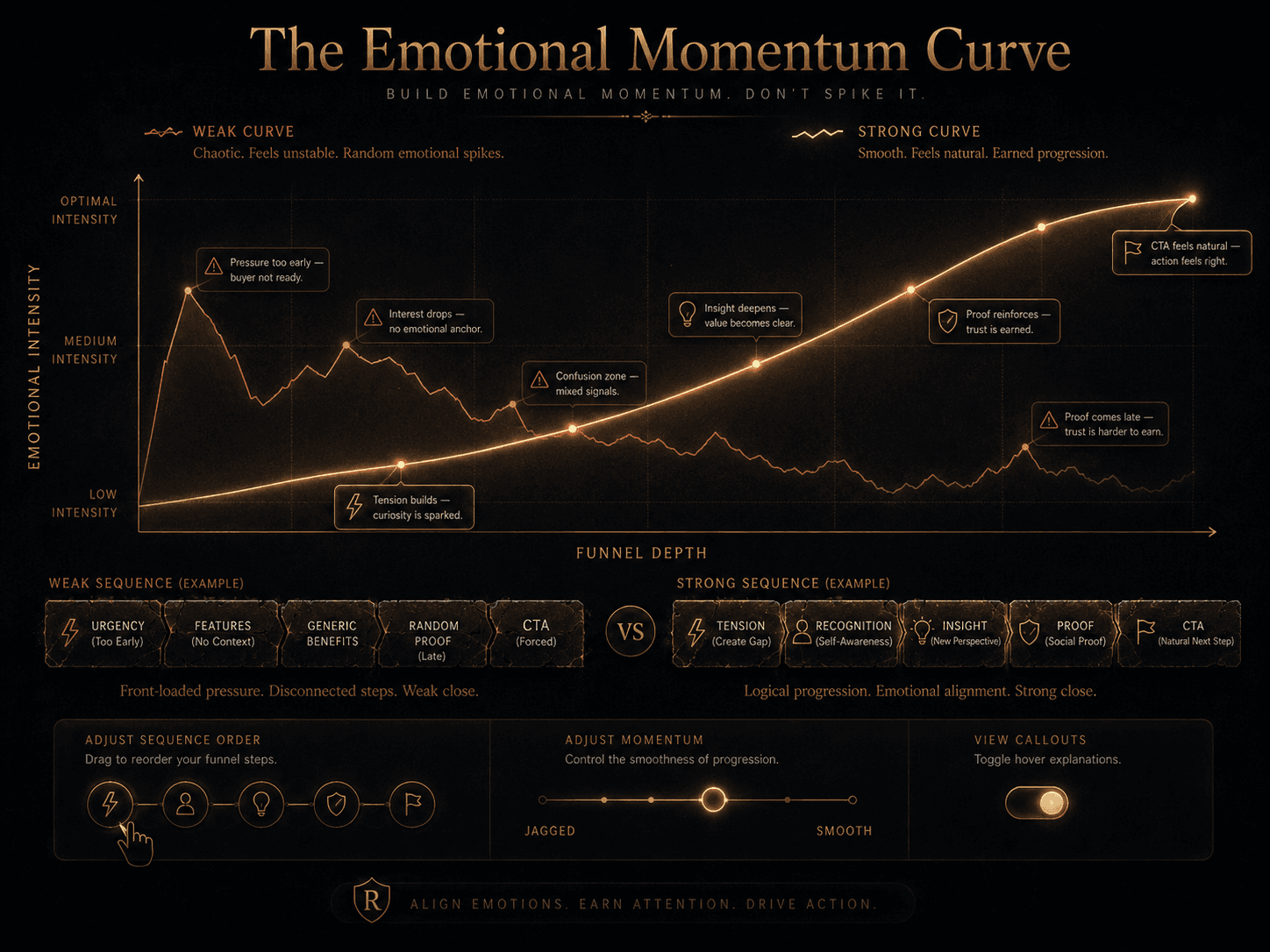
The Emotional Momentum Curve™
Strong funnels build emotional intensity gradually.
Weak funnels create random emotional spikes.
This is one of the biggest hidden differences between smooth funnels and chaotic funnels.
Weak Momentum Curve™
A weak momentum curve often looks like this:
aggressive urgency immediately
emotional overload too early
hard CTA before trust
proof arriving randomly
identity pressure before recognition
emotional tone constantly shifting
big promise before diagnosis
weak reassurance before action
The funnel feels unstable.
Even if individual sections sound strong.
Stronger Momentum Curve™
A stronger momentum curve looks like this:
tension first
recognition second
insight third
proof fourth
action fifth
The buyer experiences:
Attention
→ Recognition
→ Curiosity
→ Belief
→ Readiness
Now emotional progression feels earned.
That increases trust.
Momentum Curve Audit
Ask:
Does the page build intensity gradually?
Yes / No
Does each section prepare the next?
Yes / No
Does proof arrive before the CTA?
Yes / No
Does the CTA feel earned?
Yes / No
Does the emotional tone stay consistent?
Yes / No
If the answer is “No” several times, the funnel may have a momentum curve problem.
The Emotional Weight Principle™
Heavy emotional pressure requires proper buildup.
This is extremely important.
Identity tension, future fear, and deep emotional pressure deployed too early can feel:
manipulative
dramatic
unsafe
invasive
emotionally excessive
Strong funnels escalate gradually.
They do not emotionally ambush the buyer.
Bad Deployment Example
Headline:
“If you do not fix this now, your business may collapse.”
Way too heavy too early.
The buyer emotionally withdraws.
The page has not earned that level of pressure.
Stronger Deployment
Headline:
“Most funnels quietly lose trust before the sales argument even begins.”
Now the tension feels:
measured
grounded
believable
relevant
safe enough to continue
That preserves momentum.
Emotional Weight Rule
The deeper the emotional insight, the more carefully it must be placed.
Surface pressure can appear early.
Identity tension usually needs recognition first.
Future fear needs enough context to feel honest.
Urgency needs trust before it can feel safe.
Proof needs to appear before doubt hardens.
The heavier the emotional weight, the more important the buildup.
——
Deploying Pressure, Proof, Identity, Desire, And Trust™
Different emotional forces belong at different moments.
Use this map to deploy them correctly.
Pressure™
Best Timing
Pressure should appear early enough to create tension.
But not so early that it feels emotionally aggressive.
Pressure works best after basic relevance begins.
Wrong Timing
Pressure is wrong when it appears before the buyer understands the context.
Example:
“You are wasting money every day.”
Too blunt if the buyer does not yet feel seen.
Better Deployment
“If traffic is landing but belief is not forming, the page may be leaking trust before the offer gets judged.”
This creates pressure without aggression.
Repair Rule
Make pressure specific before making it intense.
Proof™
Best Timing
Proof should appear after curiosity begins, but before doubt hardens.
The buyer must first care enough for proof to matter.
But proof cannot arrive so late that scepticism has already taken over.
Wrong Timing
Proof is wrong when it is buried at the bottom after several strong claims.
The buyer has already been asked to believe too much.
Better Deployment
Place proof near the first major claim.
Example:
“See the before-and-after page breakdown showing where trust collapsed and what changed.”
Repair Rule
Match proof to the claim closest to it.
Identity Tension™
Best Timing
Identity tension should usually appear after recognition exists.
The buyer must feel understood before deeper self-image pressure is introduced.
Wrong Timing
Identity tension is wrong when it appears before clarity.
Example:
“Your weak messaging is keeping you stuck.”
Too direct.
Too early.
Likely to trigger defensiveness.
Better Deployment
“The frustrating part is not just that the page underperforms. It is that you know the offer is stronger than the message currently makes it feel.”
This is deeper, but safer.
Repair Rule
Use identity tension as recognition, not accusation.
Desire™
Best Timing
Desire can appear throughout the funnel progressively.
Early desire should be light.
Later desire can become more specific.
Desire sustains movement.
Wrong Timing
Desire is wrong when the page jumps into the dream outcome before the buyer feels understood.
Example:
“Imagine scaling effortlessly with total confidence.”
Too soon if the pain has not been diagnosed.
Better Deployment
“Get the clarity to send traffic with confidence instead of low-level doubt.”
This desire is grounded in the buyer’s current pressure.
Repair Rule
Anchor desire in the problem the buyer already recognises.
Trust™
Best Timing
Trust should build continuously.
Not appear suddenly at the end.
Trust is created through:
specificity
proof
grounded tone
emotional congruence
clear next steps
believable claims
matched CTA pressure
Wrong Timing
Trust is wrong when the page tries to create it only with a logo strip or testimonials near the bottom.
That is too late.
Better Deployment
Build trust from the first line through clear, specific, believable messaging.
Then reinforce it with proof.
Repair Rule
Do not treat trust as a section.
Treat trust as a progression.
——
Weak Sequence vs Strong Sequence™
Use these examples to see how the same funnel can feel weak or strong depending on deployment.
Example 1: Funnel Audit Offer
Weak Funnel™
Headline:
“Scale Faster.”
CTA:
“Apply Now.”
Proof:
Buried halfway down.
Buyer experience:
emotionally thin
vague
premature
low trust
weak continuation
Stronger Funnel™
Headline:
“Still Sending Traffic To Funnels You Quietly Don’t Trust Yet?”
Hook:
“Most conversion problems begin long before the offer itself.”
Proof:
“See the before-and-after breakdown showing where belief collapsed.”
CTA:
“Get The Funnel Breakdown.”
Buyer experience:
recognised
guided
reassured
emotionally progressed
That sequence feels natural.
Example 2: SaaS Onboarding
Weak Funnel™
Headline:
“Improve User Activation.”
CTA:
“Start Free Trial.”
Proof:
Generic customer logos.
Buyer experience:
clear but shallow
little pressure
weak diagnosis
premature action
Stronger Funnel™
Headline:
“Users Are Signing Up, Clicking Around Once, And Disappearing Before They Feel The Product’s Value.”
Hook:
“Low activation is not always a product problem. Sometimes users never reach the moment where the value becomes obvious.”
Proof:
“See the onboarding sequence breakdown that increased activation by improving the first-value path.”
CTA:
“See The Activation Breakdown.”
Buyer experience:
specific
diagnostic
believable
lower-friction
Example 3: Coaching Or Consulting
Weak Funnel™
Headline:
“Get More Clients Online.”
CTA:
“Book A Call.”
Proof:
“10+ years of experience.”
Buyer experience:
broad
familiar
low recognition
no clear reason to act
Stronger Funnel™
Headline:
“Your Content Gets Attention, But Buyers Still Do Not Feel Why You Are The Obvious Choice.”
Hook:
“The problem may not be visibility. It may be that your page creates interest without enough trust to justify the next step.”
Proof:
“See the before-and-after positioning breakdown.”
CTA:
“Find The Trust Gap.”
Buyer experience:
recognised
clearer
more relevant
safer to continue
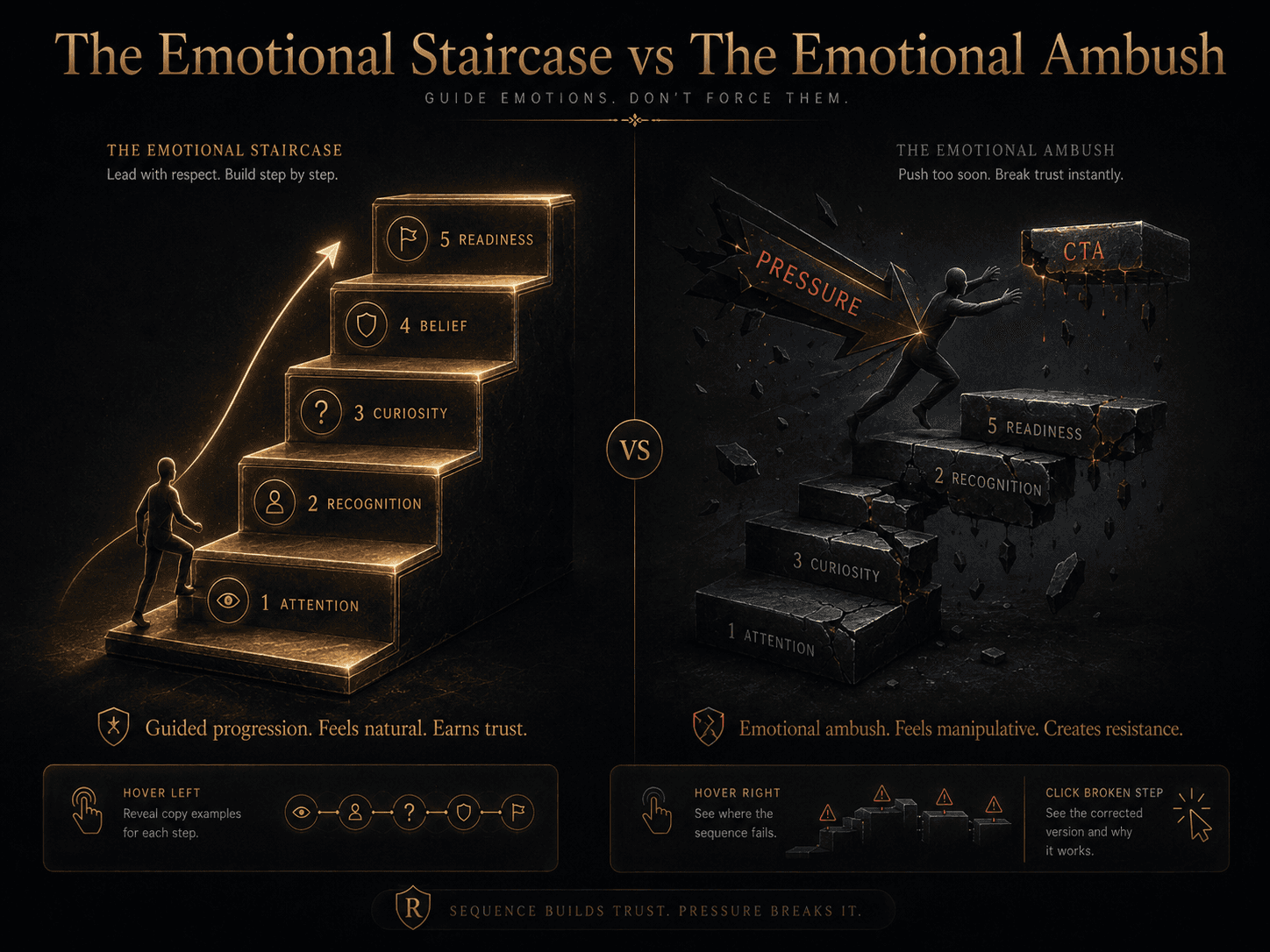
The Emotional Staircase Model™
Strong funnels feel like walking upstairs gradually.
Weak funnels feel like being shoved upward emotionally before the buyer is ready.
That distinction explains why some funnels feel trustworthy and others feel manipulative.
A staircase has steps.
Each step prepares the next one.
The buyer should move from:
Attention
to Recognition
to Curiosity
to Belief
to Readiness
without feeling forced.
Broken Staircase Example
The funnel jumps from:
Attention → Action
The buyer thinks:
“Too soon.”
Or:
Attention → Identity Threat
The buyer thinks:
“This feels intense.”
Or:
Recognition → CTA
The buyer thinks:
“I understand the problem, but I do not trust the solution yet.”
These are emotional jumps.
And emotional jumps create resistance.
Strong Staircase Example
Attention:
“This page names the problem.”
Recognition:
“This feels like my situation.”
Curiosity:
“Now I want to understand why this is happening.”
Belief:
“This explanation and proof make sense.”
Readiness:
“This next step feels reasonable.”
That is smooth funnel psychology.
The “This Feels Smooth” Effect™
Buyers rarely say:
“This funnel has strong emotional sequencing.”
Instead they say:
“This makes sense.”
“This feels clearer.”
“This feels believable.”
“This feels different.”
“This feels like it understands the problem.”
“This feels easy to follow.”
That emotional smoothness comes from correct psychological deployment.
The buyer does not feel pushed.
They feel guided.
——
The Deployment Audit Scorecard™
Use this scorecard to assess the psychological sequence of your funnel.
Score each area from 1 to 5.
1 = weak or missing
2 = present but poorly deployed
3 = usable
4 = strong
5 = smooth, natural, and buyer-aligned
Attention Timing
Does the funnel earn attention without using hype or manipulation?
Score: ___ / 5
Recognition Strength
Does the buyer feel specifically understood before the page asks for deeper attention?
Score: ___ / 5
Curiosity Development
Does the funnel create a clear reason to understand the diagnosis or mechanism?
Score: ___ / 5
Proof Timing
Does proof arrive after curiosity begins, but before doubt hardens?
Score: ___ / 5
CTA Readiness
Does the CTA appear only after enough clarity, relevance, belief, and trust exist?
Score: ___ / 5
Trust Progression
Does trust build continuously throughout the funnel?
Score: ___ / 5
Emotional Congruence
Does the emotional tone stay aligned with the buyer’s state?
Score: ___ / 5
Sequence Smoothness
Does each section prepare the next section naturally?
Score: ___ / 5
Total Deployment Score
Total: ___ / 40
What Your Score Means
34–40: Strong Psychological Deployment
Your funnel sequence is smooth, coherent, and likely to feel natural to the buyer.
The psychology is being deployed in the right order.
26–33: Good But Needs Tightening
The funnel has a working sequence, but some emotional jumps or timing issues may remain.
Review the lowest-scoring sections.
16–25: Sequencing Problems Likely
Your funnel may contain good messaging, but the emotional order is probably weakening trust or momentum.
Look for premature CTAs, late proof, or pressure too early.
0–15: High Risk Of Emotional Recoil
The funnel likely feels pushy, fragmented, or psychologically rushed.
Do not only rewrite the words.
Repair the sequence.
——
The Deployment Audit™
Review your funnel and ask:
Does pressure appear too early?
Yes / No
Does proof arrive too late?
Yes / No
Does the CTA feel emotionally earned?
Yes / No
Does the sequence escalate naturally?
Yes / No
Does trust build progressively?
Yes / No
Does the emotional tone stay congruent?
Yes / No
Does the buyer feel guided instead of pressured?
Yes / No
Does each section prepare the next?
Yes / No
Does the page skip recognition?
Yes / No
Does the page ask for action before belief?
Yes / No
If several answers reveal problems, the deployment structure likely needs repair.
——
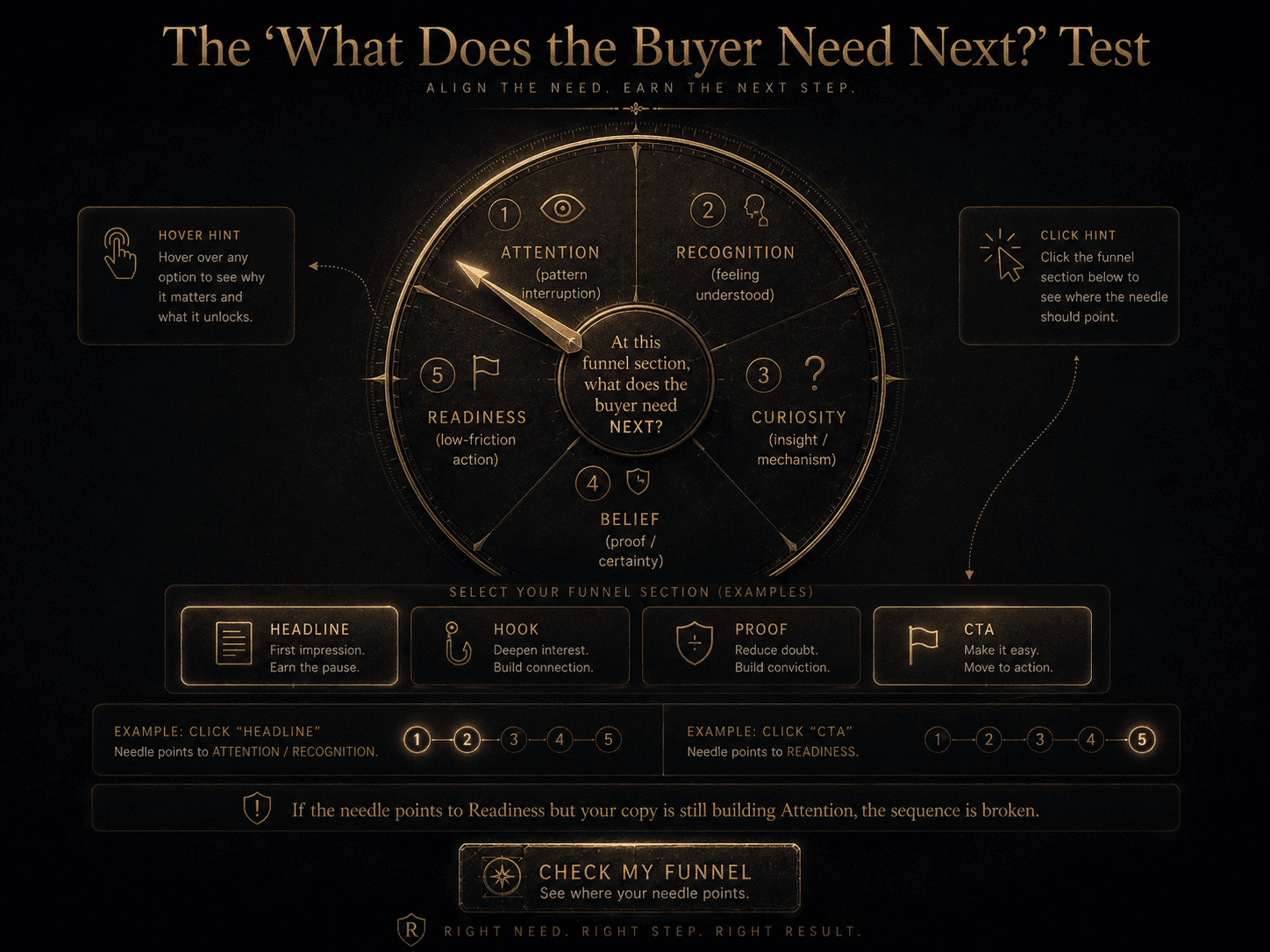
The “What Does The Buyer Need Right Now?” Test™
This may be the most important sequencing question in the entire framework.
At every section, ask:
“What psychological condition does the buyer need next?”
Not:
“What else can I say?”
That distinction changes funnel architecture dramatically.
The weak question is:
“What else can I add?”
The stronger question is:
“What must the buyer experience before the next section can work?”
That is a completely different level of funnel thinking.
Section-By-Section Test
For each section of your page, ask:
What does the buyer need right now?
What psychological state should this section create?
What would be premature here?
What should the next section prepare them for?
The Emotional Skipping Problem™
Many funnels try skipping recognition and belief to force action immediately.
This usually creates:
hesitation
distrust
emotional disconnect
CTA resistance
low continuation
Buyers need progression.
Not pressure overload.
Common Emotional Skips
Skipping Recognition
The funnel gets attention but never makes the buyer feel seen.
Buyer reaction:
“This is interesting, but not really about me.”
Repair:
Add specific buyer language, frustration, or live pressure.
Skipping Curiosity
The funnel names the pain but never explains what is causing it.
Buyer reaction:
“Okay, but why should I keep reading?”
Repair:
Introduce a hidden cause, broken belief, or diagnosis.
Skipping Belief
The funnel creates interest but does not prove enough.
Buyer reaction:
“This sounds good, but I do not fully trust it.”
Repair:
Add proof, mechanism, examples, or specificity before the CTA.
Skipping Trust
The funnel makes claims but does not make the buyer feel safe.
Buyer reaction:
“This feels like marketing.”
Repair:
Use grounded tone, matched proof, clear next steps, and emotional congruence.
Skipping Readiness
The funnel asks for action before the next step feels natural.
Buyer reaction:
“Too soon.”
Repair:
Lower the friction or strengthen the sequence before the CTA.
——
Using AI For Psychological Deployment™
AI becomes dramatically more useful when paired with buyer-state psychology.
You can use any capable AI tool to analyse funnel sequencing and detect emotional timing failures.
If you are using Funnels By Maris Spalins™, the prompts are designed to work especially well with the frameworks, principles, and buyer psychology systems explored throughout The $100M Funnel Playbook.
AI can help you:
analyse funnel sequencing
identify emotional timing failures
detect premature pressure
improve trust progression
optimise CTA timing
strengthen momentum curves
identify emotional incongruence
pressure-test funnel flow
find skipped buyer states
suggest smoother deployment order
But the rule remains:
Do not use AI only to rewrite sections.
Use AI to check whether the sequence makes psychological sense.
Psychological Deployment AI Prompt™
Use this prompt to audit the flow of a funnel or landing page.
Act as a conversion strategist trained in buyer psychology, funnel sequencing, and emotional deployment.
Audit the following funnel copy for psychological sequencing.
The target buyer is:
[insert buyer]
The funnel goal is:
[insert goal]
The current page or funnel copy is:
[paste copy]
Analyse the funnel across these five psychological states:
Attention™
Recognition™
Curiosity™
Belief™
Readiness™
For each state, tell me:
whether the state is present
where it appears in the funnel
whether it appears too early, too late, or in the right place
what the buyer likely feels at that point
what is missing
what should be rewritten or moved
Then identify:
the biggest emotional jump
any premature CTA pressure
proof that arrives too late
pressure that appears too early
identity tension used before recognition
desire before diagnosis
skipped buyer states
emotional incongruence
sections that feel pushy, chaotic, or disconnected
Then recommend a stronger sequence using:
Attention → Recognition → Curiosity → Belief → Readiness
After that, rewrite:
the headline
the hook
one proof cue
one CTA
one CTA microcopy line
Keep the tone grounded, specific, and psychologically natural.
The goal is not louder persuasion.
The goal is smoother buyer progression.
——
Quick Deployment Exercise™
Use this when your funnel feels slightly pushy, chaotic, or emotionally off.
My Funnel’s Current Sequence
Write the current order of the page sections:
My Funnel’s Biggest Emotional Jump
Where does the funnel move too fast?
One Place Where Pressure Appears Too Early
One Place Where Proof Arrives Too Late
One CTA That Feels Premature
One Buyer State That Is Missing
Attention / Recognition / Curiosity / Belief / Readiness
Explain:
One Trust Gap
Where does the buyer need more reassurance?
One Sequence Improvement
What should move, change, or be rewritten?
The Psychological Deployment Worksheet™
Complete this before rebuilding the funnel.
Target Buyer
Funnel Or Page Being Audited
Funnel Goal
Buyer Temperature
Cold / Warm / Hot
——
Current Main CTA
Desired Buyer Action
State 1: Attention
Current section or line creating attention:
Does it earn attention safely?
Yes / No
What needs improving?
State 2: Recognition
Current section or line creating recognition:
Does the buyer feel specifically understood?
Yes / No
What needs improving?
State 3: Curiosity
Current section or line creating curiosity:
Does the buyer understand why the problem is happening?
Yes / No
What needs improving?
State 4: Belief
Current proof or belief-building section:
Does proof arrive before doubt hardens?
Yes / No
What needs improving?
State 5: Readiness
Current CTA or action section:
Does the CTA feel emotionally earned?
Yes / No
What needs improving?
——
Revised Funnel Sequence
Attention section:
Recognition section:
Curiosity section:
Belief section:
Readiness section:
The 30-Minute Psychological Deployment Audit™
Use this process before rewriting a full funnel.
Minutes 0–5: Map The Current Sequence
Write the current section order.
Current sequence:
Now label each section:
Attention / Recognition / Curiosity / Belief / Readiness
Minutes 5–10: Find The Biggest Emotional Jump
Look for where the page asks for too much too soon.
Biggest emotional jump:
Why it creates resistance:
Minutes 10–15: Check Proof Timing
Find the first major claim.
First major claim:
Where proof currently appears:
Should proof appear earlier?
Yes / No
Better proof placement:
Minutes 15–20: Check CTA Timing
Current CTA:
Buyer state when CTA appears:
Does the CTA match readiness?
Yes / No
Better CTA or placement:
Minutes 20–25: Repair The Sequence
Rewrite the order:
Attention:
Recognition:
Curiosity:
Belief:
Readiness:
Minutes 25–30: Smooth The Emotional Progression
Ask:
Does each section prepare the next?
Does pressure build gradually?
Does proof arrive before doubt hardens?
Does trust build continuously?
Does the CTA feel like the natural next step?
Final sequence improvement:
——
The Biggest Deployment Mistake™
Most marketers ask:
“What should I say?”
Strong marketers ask:
“What should the buyer psychologically experience next?”
That is a completely different level of funnel thinking.
Because conversion is not information transfer.
It is emotional progression.
The buyer should not feel like the page is throwing messages at them.
The buyer should feel like the page is guiding them from confusion to clarity, from hesitation to belief, and from belief to action.
That is the purpose of psychological deployment.
——
Final Principle™
The strongest funnels do not merely contain good messaging.
They deploy the right psychology, at the right moment, with the right emotional weight.
That means:
attention before pressure
recognition before persuasion
curiosity before proof
belief before action
trust before commitment
clarity before urgency
proof before high-friction CTAs
emotional safety before identity tension
Funnels that respect psychological progression create momentum.
Funnels that ignore it create resistance.
That is what The Psychological Deployment Model™ is designed to help you master.
Take one page.
Map every section to one of the five buyer states.
Find the first place where the emotional jump feels too large.
Then repair the sequence.
Do not only ask:
“What should I say?”
Ask:
“What does the buyer need to experience next?”
That question changes everything.
——
From:
The $100M Funnel Playbook. Book I: Foundation Buyer Psychology, Offer Clarity, and the Page Architecture Behind High-Converting Funnels
By Maris Spalins.
——
Copyright Notice
© 2026 The $100M Funnel Playbook / Winyourclients / Maris Spalins. All rights reserved.
This resource, including the frameworks, terminology, examples, scorecards, templates, prompts, methods, and written explanations, is original intellectual property created for The $100M Funnel Playbook. Book I: Foundation — Buyer Psychology, Offer Clarity, And The Page Architecture Behind High-Converting Funnels and published through Winyourclients.
No part of this resource may be copied, reproduced, screenshotted, republished, redistributed, sold, adapted, uploaded, scraped, stored in a database, included in training data, used to train artificial intelligence systems, or used to create derivative commercial or educational materials without prior written permission.
Limited reference, quotation, or sharing is only permitted where the source is clearly and visibly credited.
Any permitted reference must include at least one of the following source credits:
The $100M Funnel Playbook by Maris Spalins
or
Winyourclients — www.winyourclients.com
or
Maris Spalins / Winyourclients
Screenshots, excerpts, summaries, or redistributed versions must not remove, hide, alter, crop out, or obscure the original source, author name, book title, website name, or copyright notice.
This resource is provided for personal learning and implementation only. It is not licensed for resale, republishing, redistribution, AI training, template cloning, course creation, consulting delivery, or commercial reuse without written permission from Maris Spalins or Winyourclients.
For permission requests, licensing, citation approval, or commercial usage enquiries, contact:
Winyourclients
www.winyourclients.com
or
Email directly to Jacob on: help@winyourclients.com
The Psychological Deployment Model™ A funnel sequencing worksheet for deploying buyer psychology in the right order, so attention, recognition, curiosity, belief, trust, and action build naturally instead of feeling pushy, chaotic, or emotionally off.
Prefer Audio Or Video?
The Psychological Deployment Model™ is also available as:
🎧 A guided audio walkthrough explaining funnel sequencing, emotional progression, and buyer-state psychology
🎥 A practical video breakdown with real funnel sequence examples, emotional timing analysis, and deployment teardownsChoose the format that fits how you learn best.
[Listen To The Audio Walkthrough] (coming soon)
[Watch The Video Breakdown] (coming soon)
——
Why Some Funnels Feel Smooth And Others Feel Pushy, Chaotic, Or Emotionally Off
Most funnels do not fail because the messaging itself is terrible.
They fail because the psychology is deployed at the wrong moment.
This is one of the most overlooked conversion problems in modern marketing.
A funnel may contain:
strong insights
strong proof
strong offers
strong hooks
strong buyer research
strong emotional language
But the emotional sequence can still feel unnatural.
Examples:
urgency appears before trust
proof arrives after doubt hardens
identity pressure appears before relevance exists
CTAs demand commitment before belief exists
emotional intensity spikes too early
the offer appears before the buyer understands the problem
desire appears before diagnosis
The result?
The funnel feels:
emotionally disjointed
psychologically rushed
subtly manipulative
difficult to trust
pushy without meaning to be pushy
intense without being persuasive
Good ingredients do not guarantee a good sequence.
That is exactly what The Psychological Deployment Model™ is designed to solve.
It helps you place the right buyer psychology in the right order, so the funnel feels guided instead of forced.
——
What This Resource Helps You Do
The Psychological Deployment Model™ helps you sequence buyer psychology across the funnel.
Use it to:
identify where your funnel feels rushed
find emotional jumps that create resistance
detect proof that appears too late
fix CTAs that ask for commitment too early
sequence pressure, proof, identity, desire, and trust correctly
map each funnel section to the buyer’s current psychological state
make your funnel feel smoother, clearer, and more believable
build conversion momentum naturally instead of forcing action
This resource is not only about what to say.
It is about when to say it.
Because conversion is not information transfer.
It is emotional progression.
The buyer must be moved through the right psychological states in the right order.
That is what creates trust, momentum, and action.
——
The Buyer State Principle™
Buyers do not remain psychologically static throughout the funnel.
Their emotional state evolves.
This is critical.
A cold buyer landing on the page does not need:
aggressive urgency
heavy commitment
deep technical proof
hard closing language
a high-pressure CTA
identity-level confrontation
a full offer breakdown before relevance exists
They first need:
relevance
recognition
clarity
emotional safety
curiosity
a reason to continue
This means different buyer states require different messaging deployment.
Strong funnels understand this.
Weak funnels ignore it completely.
——
Why This Matters
Many funnels accidentally deploy late-stage persuasion to early-stage buyers.
That creates:
resistance
distrust
emotional overload
continuation collapse
premature scepticism
CTA avoidance
Because psychologically, the buyer has not reached that emotional stage yet.
They have not built enough relevance.
They have not built enough belief.
They have not built enough trust.
They have not built enough readiness.
So the ask feels too early.
Funnels should feel like guided progression.
Not emotional ambush.
——
The Core Rule
Never ask for a psychological state you have not built yet.
Do not ask for commitment before belief.
Do not ask for urgency before trust.
Do not ask for identity-level pressure before recognition.
Do not ask for action before the buyer understands why the action matters.
Do not ask for a high-friction step when the buyer only has low-friction curiosity.
The page must earn each psychological state before moving to the next one.
That is the discipline.
——
The 5 Psychological Funnel States™
Most strong funnels guide buyers through five psychological states.
The five states are:
Attention™
Recognition™
Curiosity™
Belief™
Readiness™
Each state has a different job.
Each state needs a different kind of messaging.
Each state prepares the buyer for the next one.
—
State 1: Attention™
Primary Need
Pattern interruption.
At this stage, the buyer is:
distracted
sceptical
scanning quickly
filtering aggressively
deciding whether the page deserves more than a few seconds
The funnel must earn the next few seconds.
Attention is not the same as trust.
A shocking line may get attention while damaging trust.
A strong attention line interrupts without creating unnecessary resistance.
The Buyer Is Asking
“Is there any reason to keep reading?”
“Is this relevant enough to stop for?”
“Is this different from everything else I have seen?”
“Does this touch something I already care about?”
Messaging That Works Here
Use:
tension
specificity
consequence
curiosity
recognisable pressure
a broken belief
a sharp buyer moment
Messaging That Fails Here
Avoid:
vague welcome language
generic ambition language
corporate introductions
heavy proof before relevance
hard CTAs
overdramatic fear
hype
Weak Example
“Welcome to our website.”
Emotionally invisible.
No tension.
No relevance.
No reason to continue.
Stronger Example
“Still Getting Clicks But Quietly Avoiding Looking At The Conversion Rate?”
Now the funnel creates:
recognition
interruption
tension
curiosity
a reason to continue
Fill This In
What attention line currently opens the funnel?
What pressure, pattern, or tension should interrupt the buyer?
What would make the buyer pause for the next few seconds?
Attention Audit Question
Does this section earn the next few seconds without triggering distrust?
Yes / No
If no, rewrite it.
—
State 2: Recognition™
Primary Need
Feeling understood.
The buyer now asks:
“Is this actually meant for someone like me?”
This stage is where relevance becomes personal.
Attention made them pause.
Recognition makes them feel seen.
Without recognition, curiosity becomes weak.
The buyer may keep reading, but they will not feel pulled.
The Buyer Is Asking
“Is this my problem?”
“Does this understand my situation?”
“Does this sound like what I have been dealing with?”
“Is this page speaking to me, or just to a broad market?”
Messaging That Works Here
Use:
frustration language
emotional realism
identity recognition
pressure mirroring
specific pain
live buyer moments
voice-of-customer phrasing
Messaging That Fails Here
Avoid:
broad market labels
generic pain points
shallow “you want growth” language
polished-but-empty copy
language that could apply to everyone
Example
“Tired of rebuilding funnels that still feel unfinished every time traffic hits them?”
Now the buyer feels recognised.
The line reflects:
repeated effort
frustration
unfinished confidence
live pressure
emotional reality
That lowers resistance.
Fill This In
What specific buyer moment should the page recognise?
What phrase would make the buyer think, “That is exactly it”?
What frustration should be mirrored here?
Recognition Audit Question
Does this section make the right buyer feel specifically understood?
Yes / No
If no, the page may still be too broad.
—
State 3: Curiosity™
Primary Need
Understanding what is actually causing the problem.
The buyer now wants:
explanation
insight
diagnosis
hidden mechanism
clarity
a new way to understand the issue
This is where hooks, diagnosis, and mechanism framing become powerful.
But curiosity should not be random mystery.
It should be curiosity about the buyer’s actual problem.
The Buyer Is Asking
“Why is this happening?”
“What am I missing?”
“What is the real cause?”
“Why have my previous fixes not worked?”
“What do I need to understand before I can fix this?”
Messaging That Works Here
Use:
hidden-problem framing
consequence
insight revelation
mechanism explanation
broken belief
diagnostic language
“why this happens” copy
Messaging That Fails Here
Avoid:
random mystery
clickbait
cleverness without clarity
technical explanation too early
proof before the buyer cares
solution dumping before diagnosis
Example
“Most funnels do not fail because of traffic.
They fail because buyers quietly lose trust before the offer even appears.”
Now curiosity deepens naturally.
The buyer wants to know:
“Where is trust being lost?”
That creates movement.
Fill This In
What hidden cause should the funnel reveal?
What wrong belief does the buyer currently have?
What explanation would make them want to keep reading?
Curiosity Audit Question
Does this section make the buyer want to understand the mechanism behind the problem?
Yes / No
If no, the page may be jumping too quickly from pain to offer.
—
State 4: Belief™
Primary Need
Proof and certainty reduction.
The buyer now asks:
“Why should I believe this?”
At this stage, curiosity is not enough.
The buyer needs evidence.
The claim must become believable.
The mechanism must feel credible.
The promise must feel supported.
The Buyer Is Asking
“Can I trust this?”
“Where is the proof?”
“Does this actually work?”
“Is this relevant to my situation?”
“What makes this different from everything else I have tried?”
Messaging That Works Here
Use:
before/after examples
quantified proof
screenshots
process visibility
grounded case studies
mechanism explanation
relevant testimonials
proof matched to the buyer’s doubt
Proof should arrive after curiosity begins, but before doubt hardens.
That timing matters.
Messaging That Fails Here
Avoid:
vague proof
unsupported claims
proof buried too late
irrelevant credibility
inflated numbers without context
testimonials that do not match the buyer’s concern
Example
“After restructuring the first-contact sequence, booked calls increased by 41% without increasing traffic spend.”
Now the claim feels more believable.
The proof is specific.
The result is clear.
The mechanism is implied.
The buyer feels safer continuing.
Fill This In
What claim does the buyer need to believe?
What doubt is likely forming here?
What proof would reduce that doubt?
Where should that proof appear?
Belief Audit Question
Does proof arrive before doubt hardens?
Yes / No
If no, proof needs to move earlier or become more specific.
—
State 5: Readiness™
Primary Need
Low-friction movement.
Now the buyer asks:
“What happens next?”
This stage requires:
clarity
movement
simplicity
reassurance
emotional safety
low-pressure action
next-step confidence
The CTA should feel like the natural next step.
Not a sudden demand.
The Buyer Is Asking
“What should I do now?”
“Is this easy?”
“What happens after I click?”
“Is this risky?”
“Am I ready for this level of commitment?”
“Does this next step feel worth it?”
Messaging That Works Here
Use:
clear CTAs
reward visibility
easy continuation
low-friction next steps
CTA microcopy
reassurance
action clarity
Messaging That Fails Here
Avoid:
vague CTAs
heavy commitment too early
unclear next steps
pressure without reassurance
administrative button language
high-friction asks for cold buyers
Weak CTA
“Apply Now.”
Emotionally heavy.
Especially if the buyer is not yet ready.
Stronger CTA
“Get The Funnel Breakdown.”
Now the action feels:
lighter
safer
more specific
more natural
connected to the buyer’s curiosity
Readiness Checklist
Before asking for action, has the page created:
clarity?
relevance?
recognition?
curiosity?
belief?
trust?
next-step safety?
If not, the CTA may be premature.
Fill This In
What is the current CTA?
What level of commitment does it ask for?
What would feel like a more natural next step?
What reassurance should appear near the CTA?
Readiness Audit Question
Does the CTA feel emotionally earned?
Yes / No
If no, either lower the friction or strengthen the preceding sequence.
——
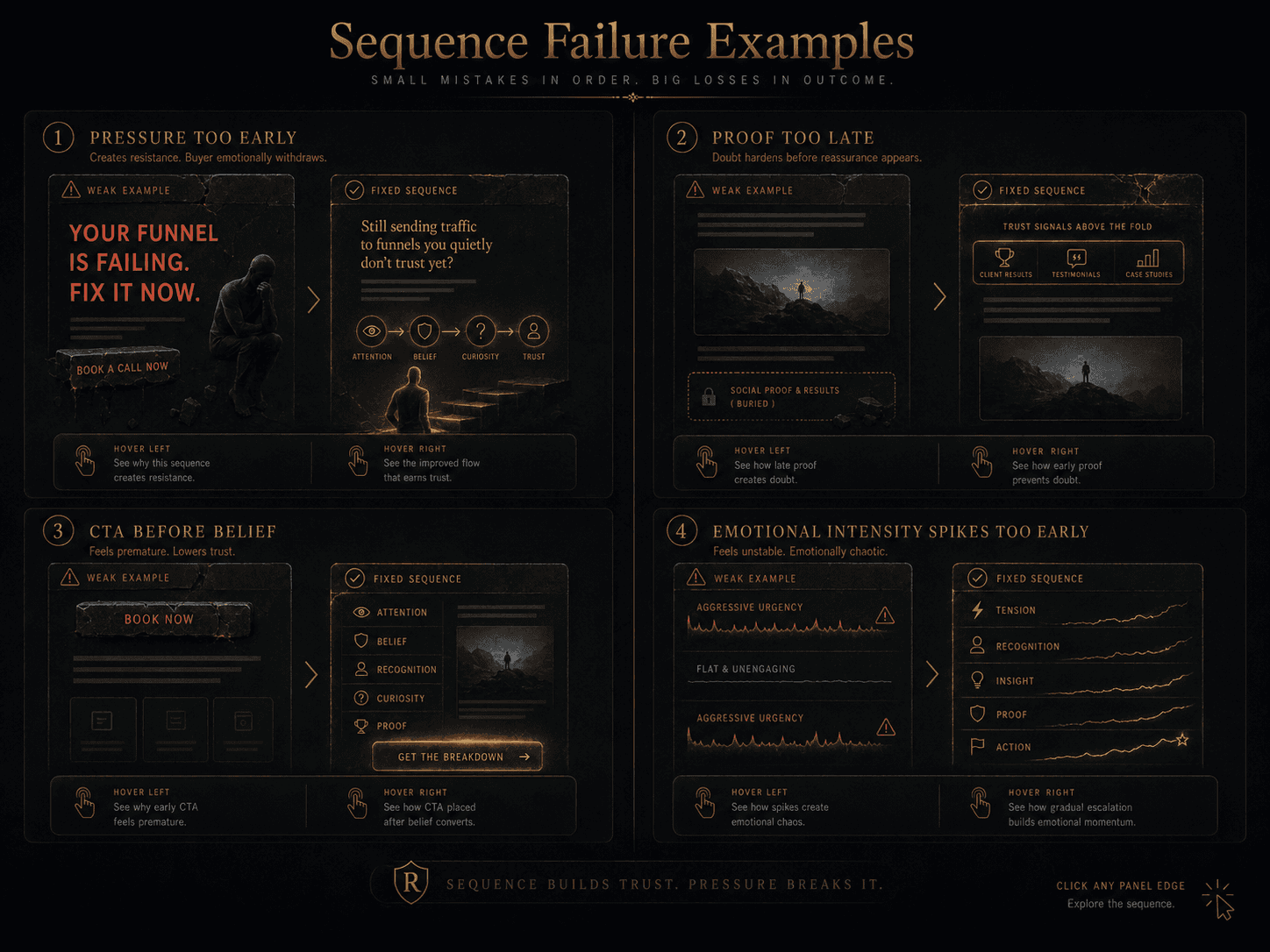
The Biggest Funnel Sequencing Mistake™
Funnels often ask for commitment before belief exists.
This creates immediate resistance.
A premature CTA does not just ask too early.
It reveals that the page has not earned the ask.
Broken Sequence Example
A cold buyer lands on the page.
Immediately sees:
“BOOK YOUR STRATEGY CALL NOW.”
No relevance.
No trust.
No proof.
No tension.
No recognition.
No belief.
The buyer has not emotionally progressed far enough for that ask.
That creates psychological recoil.
They may not consciously think:
“This CTA is premature.”
They simply feel:
“Too soon.”
And they leave.
Stronger Sequence
Attention
→ Recognition
→ Curiosity
→ Belief
→ Readiness
This progression feels natural.
That matters enormously.
The buyer is not forced.
They are guided.
——
The Emotional Momentum Curve™
Strong funnels build emotional intensity gradually.
Weak funnels create random emotional spikes.
This is one of the biggest hidden differences between smooth funnels and chaotic funnels.
Weak Momentum Curve™
A weak momentum curve often looks like this:
aggressive urgency immediately
emotional overload too early
hard CTA before trust
proof arriving randomly
identity pressure before recognition
emotional tone constantly shifting
big promise before diagnosis
weak reassurance before action
The funnel feels unstable.
Even if individual sections sound strong.
Stronger Momentum Curve™
A stronger momentum curve looks like this:
tension first
recognition second
insight third
proof fourth
action fifth
The buyer experiences:
Attention
→ Recognition
→ Curiosity
→ Belief
→ Readiness
Now emotional progression feels earned.
That increases trust.
Momentum Curve Audit
Ask:
Does the page build intensity gradually?
Yes / No
Does each section prepare the next?
Yes / No
Does proof arrive before the CTA?
Yes / No
Does the CTA feel earned?
Yes / No
Does the emotional tone stay consistent?
Yes / No
If the answer is “No” several times, the funnel may have a momentum curve problem.
The Emotional Weight Principle™
Heavy emotional pressure requires proper buildup.
This is extremely important.
Identity tension, future fear, and deep emotional pressure deployed too early can feel:
manipulative
dramatic
unsafe
invasive
emotionally excessive
Strong funnels escalate gradually.
They do not emotionally ambush the buyer.
Bad Deployment Example
Headline:
“If you do not fix this now, your business may collapse.”
Way too heavy too early.
The buyer emotionally withdraws.
The page has not earned that level of pressure.
Stronger Deployment
Headline:
“Most funnels quietly lose trust before the sales argument even begins.”
Now the tension feels:
measured
grounded
believable
relevant
safe enough to continue
That preserves momentum.
Emotional Weight Rule
The deeper the emotional insight, the more carefully it must be placed.
Surface pressure can appear early.
Identity tension usually needs recognition first.
Future fear needs enough context to feel honest.
Urgency needs trust before it can feel safe.
Proof needs to appear before doubt hardens.
The heavier the emotional weight, the more important the buildup.
——
Deploying Pressure, Proof, Identity, Desire, And Trust™
Different emotional forces belong at different moments.
Use this map to deploy them correctly.
Pressure™
Best Timing
Pressure should appear early enough to create tension.
But not so early that it feels emotionally aggressive.
Pressure works best after basic relevance begins.
Wrong Timing
Pressure is wrong when it appears before the buyer understands the context.
Example:
“You are wasting money every day.”
Too blunt if the buyer does not yet feel seen.
Better Deployment
“If traffic is landing but belief is not forming, the page may be leaking trust before the offer gets judged.”
This creates pressure without aggression.
Repair Rule
Make pressure specific before making it intense.
Proof™
Best Timing
Proof should appear after curiosity begins, but before doubt hardens.
The buyer must first care enough for proof to matter.
But proof cannot arrive so late that scepticism has already taken over.
Wrong Timing
Proof is wrong when it is buried at the bottom after several strong claims.
The buyer has already been asked to believe too much.
Better Deployment
Place proof near the first major claim.
Example:
“See the before-and-after page breakdown showing where trust collapsed and what changed.”
Repair Rule
Match proof to the claim closest to it.
Identity Tension™
Best Timing
Identity tension should usually appear after recognition exists.
The buyer must feel understood before deeper self-image pressure is introduced.
Wrong Timing
Identity tension is wrong when it appears before clarity.
Example:
“Your weak messaging is keeping you stuck.”
Too direct.
Too early.
Likely to trigger defensiveness.
Better Deployment
“The frustrating part is not just that the page underperforms. It is that you know the offer is stronger than the message currently makes it feel.”
This is deeper, but safer.
Repair Rule
Use identity tension as recognition, not accusation.
Desire™
Best Timing
Desire can appear throughout the funnel progressively.
Early desire should be light.
Later desire can become more specific.
Desire sustains movement.
Wrong Timing
Desire is wrong when the page jumps into the dream outcome before the buyer feels understood.
Example:
“Imagine scaling effortlessly with total confidence.”
Too soon if the pain has not been diagnosed.
Better Deployment
“Get the clarity to send traffic with confidence instead of low-level doubt.”
This desire is grounded in the buyer’s current pressure.
Repair Rule
Anchor desire in the problem the buyer already recognises.
Trust™
Best Timing
Trust should build continuously.
Not appear suddenly at the end.
Trust is created through:
specificity
proof
grounded tone
emotional congruence
clear next steps
believable claims
matched CTA pressure
Wrong Timing
Trust is wrong when the page tries to create it only with a logo strip or testimonials near the bottom.
That is too late.
Better Deployment
Build trust from the first line through clear, specific, believable messaging.
Then reinforce it with proof.
Repair Rule
Do not treat trust as a section.
Treat trust as a progression.
——
Weak Sequence vs Strong Sequence™
Use these examples to see how the same funnel can feel weak or strong depending on deployment.
Example 1: Funnel Audit Offer
Weak Funnel™
Headline:
“Scale Faster.”
CTA:
“Apply Now.”
Proof:
Buried halfway down.
Buyer experience:
emotionally thin
vague
premature
low trust
weak continuation
Stronger Funnel™
Headline:
“Still Sending Traffic To Funnels You Quietly Don’t Trust Yet?”
Hook:
“Most conversion problems begin long before the offer itself.”
Proof:
“See the before-and-after breakdown showing where belief collapsed.”
CTA:
“Get The Funnel Breakdown.”
Buyer experience:
recognised
guided
reassured
emotionally progressed
That sequence feels natural.
Example 2: SaaS Onboarding
Weak Funnel™
Headline:
“Improve User Activation.”
CTA:
“Start Free Trial.”
Proof:
Generic customer logos.
Buyer experience:
clear but shallow
little pressure
weak diagnosis
premature action
Stronger Funnel™
Headline:
“Users Are Signing Up, Clicking Around Once, And Disappearing Before They Feel The Product’s Value.”
Hook:
“Low activation is not always a product problem. Sometimes users never reach the moment where the value becomes obvious.”
Proof:
“See the onboarding sequence breakdown that increased activation by improving the first-value path.”
CTA:
“See The Activation Breakdown.”
Buyer experience:
specific
diagnostic
believable
lower-friction
Example 3: Coaching Or Consulting
Weak Funnel™
Headline:
“Get More Clients Online.”
CTA:
“Book A Call.”
Proof:
“10+ years of experience.”
Buyer experience:
broad
familiar
low recognition
no clear reason to act
Stronger Funnel™
Headline:
“Your Content Gets Attention, But Buyers Still Do Not Feel Why You Are The Obvious Choice.”
Hook:
“The problem may not be visibility. It may be that your page creates interest without enough trust to justify the next step.”
Proof:
“See the before-and-after positioning breakdown.”
CTA:
“Find The Trust Gap.”
Buyer experience:
recognised
clearer
more relevant
safer to continue
The Emotional Staircase Model™
Strong funnels feel like walking upstairs gradually.
Weak funnels feel like being shoved upward emotionally before the buyer is ready.
That distinction explains why some funnels feel trustworthy and others feel manipulative.
A staircase has steps.
Each step prepares the next one.
The buyer should move from:
Attention
to Recognition
to Curiosity
to Belief
to Readiness
without feeling forced.
Broken Staircase Example
The funnel jumps from:
Attention → Action
The buyer thinks:
“Too soon.”
Or:
Attention → Identity Threat
The buyer thinks:
“This feels intense.”
Or:
Recognition → CTA
The buyer thinks:
“I understand the problem, but I do not trust the solution yet.”
These are emotional jumps.
And emotional jumps create resistance.
Strong Staircase Example
Attention:
“This page names the problem.”
Recognition:
“This feels like my situation.”
Curiosity:
“Now I want to understand why this is happening.”
Belief:
“This explanation and proof make sense.”
Readiness:
“This next step feels reasonable.”
That is smooth funnel psychology.
The “This Feels Smooth” Effect™
Buyers rarely say:
“This funnel has strong emotional sequencing.”
Instead they say:
“This makes sense.”
“This feels clearer.”
“This feels believable.”
“This feels different.”
“This feels like it understands the problem.”
“This feels easy to follow.”
That emotional smoothness comes from correct psychological deployment.
The buyer does not feel pushed.
They feel guided.
——
The Deployment Audit Scorecard™
Use this scorecard to assess the psychological sequence of your funnel.
Score each area from 1 to 5.
1 = weak or missing
2 = present but poorly deployed
3 = usable
4 = strong
5 = smooth, natural, and buyer-aligned
Attention Timing
Does the funnel earn attention without using hype or manipulation?
Score: ___ / 5
Recognition Strength
Does the buyer feel specifically understood before the page asks for deeper attention?
Score: ___ / 5
Curiosity Development
Does the funnel create a clear reason to understand the diagnosis or mechanism?
Score: ___ / 5
Proof Timing
Does proof arrive after curiosity begins, but before doubt hardens?
Score: ___ / 5
CTA Readiness
Does the CTA appear only after enough clarity, relevance, belief, and trust exist?
Score: ___ / 5
Trust Progression
Does trust build continuously throughout the funnel?
Score: ___ / 5
Emotional Congruence
Does the emotional tone stay aligned with the buyer’s state?
Score: ___ / 5
Sequence Smoothness
Does each section prepare the next section naturally?
Score: ___ / 5
Total Deployment Score
Total: ___ / 40
What Your Score Means
34–40: Strong Psychological Deployment
Your funnel sequence is smooth, coherent, and likely to feel natural to the buyer.
The psychology is being deployed in the right order.
26–33: Good But Needs Tightening
The funnel has a working sequence, but some emotional jumps or timing issues may remain.
Review the lowest-scoring sections.
16–25: Sequencing Problems Likely
Your funnel may contain good messaging, but the emotional order is probably weakening trust or momentum.
Look for premature CTAs, late proof, or pressure too early.
0–15: High Risk Of Emotional Recoil
The funnel likely feels pushy, fragmented, or psychologically rushed.
Do not only rewrite the words.
Repair the sequence.
——
The Deployment Audit™
Review your funnel and ask:
Does pressure appear too early?
Yes / No
Does proof arrive too late?
Yes / No
Does the CTA feel emotionally earned?
Yes / No
Does the sequence escalate naturally?
Yes / No
Does trust build progressively?
Yes / No
Does the emotional tone stay congruent?
Yes / No
Does the buyer feel guided instead of pressured?
Yes / No
Does each section prepare the next?
Yes / No
Does the page skip recognition?
Yes / No
Does the page ask for action before belief?
Yes / No
If several answers reveal problems, the deployment structure likely needs repair.
——
The “What Does The Buyer Need Right Now?” Test™
This may be the most important sequencing question in the entire framework.
At every section, ask:
“What psychological condition does the buyer need next?”
Not:
“What else can I say?”
That distinction changes funnel architecture dramatically.
The weak question is:
“What else can I add?”
The stronger question is:
“What must the buyer experience before the next section can work?”
That is a completely different level of funnel thinking.
Section-By-Section Test
For each section of your page, ask:
What does the buyer need right now?
What psychological state should this section create?
What would be premature here?
What should the next section prepare them for?
The Emotional Skipping Problem™
Many funnels try skipping recognition and belief to force action immediately.
This usually creates:
hesitation
distrust
emotional disconnect
CTA resistance
low continuation
Buyers need progression.
Not pressure overload.
Common Emotional Skips
Skipping Recognition
The funnel gets attention but never makes the buyer feel seen.
Buyer reaction:
“This is interesting, but not really about me.”
Repair:
Add specific buyer language, frustration, or live pressure.
Skipping Curiosity
The funnel names the pain but never explains what is causing it.
Buyer reaction:
“Okay, but why should I keep reading?”
Repair:
Introduce a hidden cause, broken belief, or diagnosis.
Skipping Belief
The funnel creates interest but does not prove enough.
Buyer reaction:
“This sounds good, but I do not fully trust it.”
Repair:
Add proof, mechanism, examples, or specificity before the CTA.
Skipping Trust
The funnel makes claims but does not make the buyer feel safe.
Buyer reaction:
“This feels like marketing.”
Repair:
Use grounded tone, matched proof, clear next steps, and emotional congruence.
Skipping Readiness
The funnel asks for action before the next step feels natural.
Buyer reaction:
“Too soon.”
Repair:
Lower the friction or strengthen the sequence before the CTA.
——
Using AI For Psychological Deployment™
AI becomes dramatically more useful when paired with buyer-state psychology.
You can use any capable AI tool to analyse funnel sequencing and detect emotional timing failures.
If you are using Funnels By Maris Spalins™, the prompts are designed to work especially well with the frameworks, principles, and buyer psychology systems explored throughout The $100M Funnel Playbook.
AI can help you:
analyse funnel sequencing
identify emotional timing failures
detect premature pressure
improve trust progression
optimise CTA timing
strengthen momentum curves
identify emotional incongruence
pressure-test funnel flow
find skipped buyer states
suggest smoother deployment order
But the rule remains:
Do not use AI only to rewrite sections.
Use AI to check whether the sequence makes psychological sense.
Psychological Deployment AI Prompt™
Use this prompt to audit the flow of a funnel or landing page.
Act as a conversion strategist trained in buyer psychology, funnel sequencing, and emotional deployment.
Audit the following funnel copy for psychological sequencing.
The target buyer is:
[insert buyer]
The funnel goal is:
[insert goal]
The current page or funnel copy is:
[paste copy]
Analyse the funnel across these five psychological states:
Attention™
Recognition™
Curiosity™
Belief™
Readiness™
For each state, tell me:
whether the state is present
where it appears in the funnel
whether it appears too early, too late, or in the right place
what the buyer likely feels at that point
what is missing
what should be rewritten or moved
Then identify:
the biggest emotional jump
any premature CTA pressure
proof that arrives too late
pressure that appears too early
identity tension used before recognition
desire before diagnosis
skipped buyer states
emotional incongruence
sections that feel pushy, chaotic, or disconnected
Then recommend a stronger sequence using:
Attention → Recognition → Curiosity → Belief → Readiness
After that, rewrite:
the headline
the hook
one proof cue
one CTA
one CTA microcopy line
Keep the tone grounded, specific, and psychologically natural.
The goal is not louder persuasion.
The goal is smoother buyer progression.
——
Quick Deployment Exercise™
Use this when your funnel feels slightly pushy, chaotic, or emotionally off.
My Funnel’s Current Sequence
Write the current order of the page sections:
My Funnel’s Biggest Emotional Jump
Where does the funnel move too fast?
One Place Where Pressure Appears Too Early
One Place Where Proof Arrives Too Late
One CTA That Feels Premature
One Buyer State That Is Missing
Attention / Recognition / Curiosity / Belief / Readiness
Explain:
One Trust Gap
Where does the buyer need more reassurance?
One Sequence Improvement
What should move, change, or be rewritten?
The Psychological Deployment Worksheet™
Complete this before rebuilding the funnel.
Target Buyer
Funnel Or Page Being Audited
Funnel Goal
Buyer Temperature
Cold / Warm / Hot
——
Current Main CTA
Desired Buyer Action
State 1: Attention
Current section or line creating attention:
Does it earn attention safely?
Yes / No
What needs improving?
State 2: Recognition
Current section or line creating recognition:
Does the buyer feel specifically understood?
Yes / No
What needs improving?
State 3: Curiosity
Current section or line creating curiosity:
Does the buyer understand why the problem is happening?
Yes / No
What needs improving?
State 4: Belief
Current proof or belief-building section:
Does proof arrive before doubt hardens?
Yes / No
What needs improving?
State 5: Readiness
Current CTA or action section:
Does the CTA feel emotionally earned?
Yes / No
What needs improving?
——
Revised Funnel Sequence
Attention section:
Recognition section:
Curiosity section:
Belief section:
Readiness section:
The 30-Minute Psychological Deployment Audit™
Use this process before rewriting a full funnel.
Minutes 0–5: Map The Current Sequence
Write the current section order.
Current sequence:
Now label each section:
Attention / Recognition / Curiosity / Belief / Readiness
Minutes 5–10: Find The Biggest Emotional Jump
Look for where the page asks for too much too soon.
Biggest emotional jump:
Why it creates resistance:
Minutes 10–15: Check Proof Timing
Find the first major claim.
First major claim:
Where proof currently appears:
Should proof appear earlier?
Yes / No
Better proof placement:
Minutes 15–20: Check CTA Timing
Current CTA:
Buyer state when CTA appears:
Does the CTA match readiness?
Yes / No
Better CTA or placement:
Minutes 20–25: Repair The Sequence
Rewrite the order:
Attention:
Recognition:
Curiosity:
Belief:
Readiness:
Minutes 25–30: Smooth The Emotional Progression
Ask:
Does each section prepare the next?
Does pressure build gradually?
Does proof arrive before doubt hardens?
Does trust build continuously?
Does the CTA feel like the natural next step?
Final sequence improvement:
——
The Biggest Deployment Mistake™
Most marketers ask:
“What should I say?”
Strong marketers ask:
“What should the buyer psychologically experience next?”
That is a completely different level of funnel thinking.
Because conversion is not information transfer.
It is emotional progression.
The buyer should not feel like the page is throwing messages at them.
The buyer should feel like the page is guiding them from confusion to clarity, from hesitation to belief, and from belief to action.
That is the purpose of psychological deployment.
——
Final Principle™
The strongest funnels do not merely contain good messaging.
They deploy the right psychology, at the right moment, with the right emotional weight.
That means:
attention before pressure
recognition before persuasion
curiosity before proof
belief before action
trust before commitment
clarity before urgency
proof before high-friction CTAs
emotional safety before identity tension
Funnels that respect psychological progression create momentum.
Funnels that ignore it create resistance.
That is what The Psychological Deployment Model™ is designed to help you master.
Take one page.
Map every section to one of the five buyer states.
Find the first place where the emotional jump feels too large.
Then repair the sequence.
Do not only ask:
“What should I say?”
Ask:
“What does the buyer need to experience next?”
That question changes everything.
——
From:
The $100M Funnel Playbook. Book I: Foundation Buyer Psychology, Offer Clarity, and the Page Architecture Behind High-Converting Funnels
By Maris Spalins.
——
Copyright Notice
© 2026 The $100M Funnel Playbook / Winyourclients / Maris Spalins. All rights reserved.
This resource, including the frameworks, terminology, examples, scorecards, templates, prompts, methods, and written explanations, is original intellectual property created for The $100M Funnel Playbook. Book I: Foundation — Buyer Psychology, Offer Clarity, And The Page Architecture Behind High-Converting Funnels and published through Winyourclients.
No part of this resource may be copied, reproduced, screenshotted, republished, redistributed, sold, adapted, uploaded, scraped, stored in a database, included in training data, used to train artificial intelligence systems, or used to create derivative commercial or educational materials without prior written permission.
Limited reference, quotation, or sharing is only permitted where the source is clearly and visibly credited.
Any permitted reference must include at least one of the following source credits:
The $100M Funnel Playbook by Maris Spalins
or
Winyourclients — www.winyourclients.com
or
Maris Spalins / Winyourclients
Screenshots, excerpts, summaries, or redistributed versions must not remove, hide, alter, crop out, or obscure the original source, author name, book title, website name, or copyright notice.
This resource is provided for personal learning and implementation only. It is not licensed for resale, republishing, redistribution, AI training, template cloning, course creation, consulting delivery, or commercial reuse without written permission from Maris Spalins or Winyourclients.
For permission requests, licensing, citation approval, or commercial usage enquiries, contact:
Winyourclients
www.winyourclients.com
or
Email directly to Jacob on: help@winyourclients.com
Other Blogs
Other Blogs
Check our other project Blogs with useful insight and information for your businesses
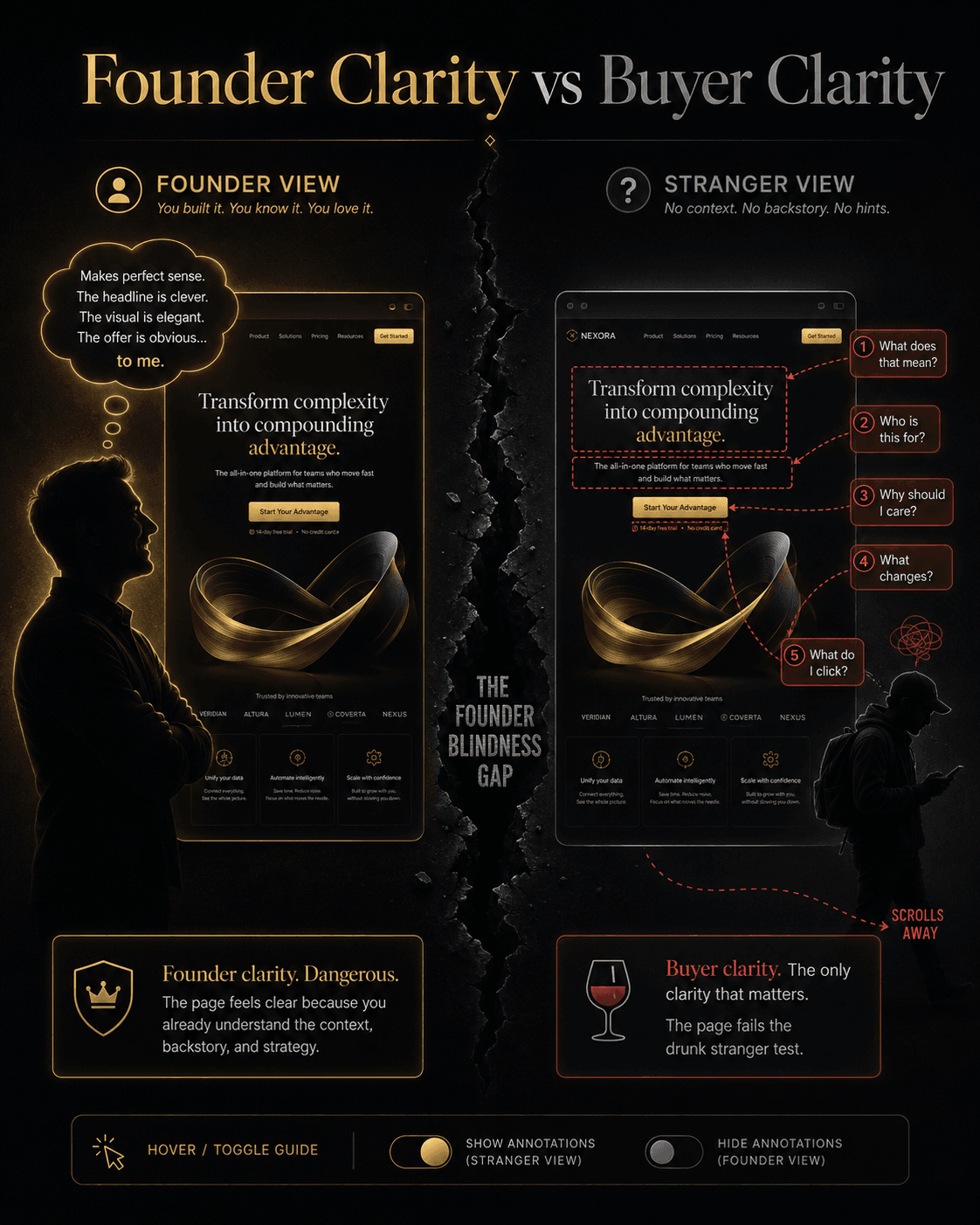

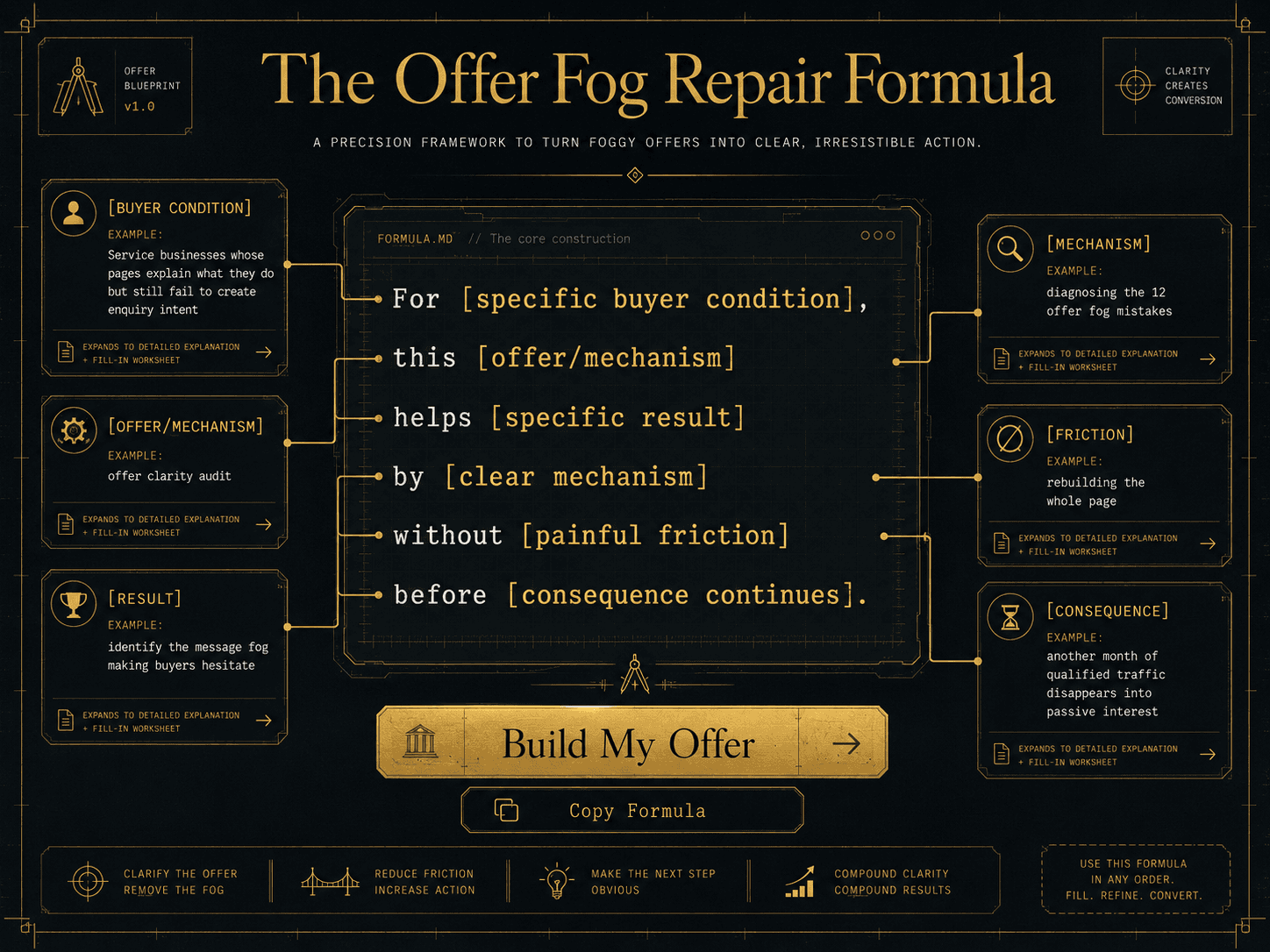
Other Blogs
Other Blogs
Check our other project Blogs with useful insight and information for your businesses