Our Three Step Process
May 26, 2026
Chap 5 | Resource 2 | The Proof Placement Map™
Our Three Step Process
May 26, 2026
Chap 5 | Resource 2 | The Proof Placement Map™
The Proof Placement Map™ A belief sequencing worksheet for placing proof where buyer doubt rises — above the fold, around the offer reveal, inside objection sections, near the CTA, and at the end of the page.
Prefer Audio Or Video?
The Proof Placement Map™ is also available as:
🎧 A guided audio walkthrough explaining proof placement, buyer doubt sequencing, claim-to-proof mapping, proof gaps, and CTA-area reassurance.
🎥 A practical video breakdown with real proof-placement examples, page proof-flow audits, proof gap diagnosis, and before/after proof sequencing.Choose the format that fits how you learn best.
[Listen To The Audio Walkthrough] (coming soon)
[Watch The Video Breakdown] (coming soon)
——
Why Most Pages Still Feel Risky Even With Proof
Most pages do not lack proof.
They lack proof sequencing.
The screenshots exist.
The testimonials exist.
The results exist.
The client messages exist.
The case studies exist.
The problem is not always absence.
The problem is placement.
The proof appears:
too late
too early
disconnected from the claim
emotionally misplaced
visually overwhelming
weakly framed
randomly stacked without psychological purpose
buried below the moment where doubt first appears
And because of that, the buyer still hesitates.
The page may contain proof, but the buyer does not experience that proof at the right moment.
That matters.
Because buyers do not read a page as one complete argument.
They experience it in stages.
First, they ask:
“Is this worth my attention?”
Then:
“Is this claim believable?”
Then:
“Would this work for someone like me?”
Then:
“What if this fails?”
Then:
“Can I trust this enough to act?”
Each stage creates a different kind of doubt.
And each kind of doubt needs a different kind of proof.
That is why this resource exists.
It helps you place the right proof at the exact moment the buyer begins questioning the claim.
Because trust is rarely built all at once.
It is built layer by layer as uncertainty rises.
——
What This Resource Helps You Do
The Proof Placement Map™ helps you place proof where buyer doubt rises, so the page earns trust progressively instead of overwhelming visitors with random testimonials and screenshots.
Use this when:
your page has proof but still feels risky
visitors read the page but do not convert
testimonials feel ignored
screenshots feel random
the page sounds believable in some places but weak in others
your strongest evidence is buried too low
buyers still hesitate near the CTA
your proof feels cluttered instead of persuasive
major claims appear without nearby evidence
your page relies too heavily on one proof wall
proof exists but does not feel connected to the buyer’s doubts
the page does not feel safer as the buyer scrolls
This is not a page layout guide.
This is a belief sequencing system.
The goal is simple:
Place the right proof at the exact moment the buyer begins questioning the claim.
——
The Core Principle™
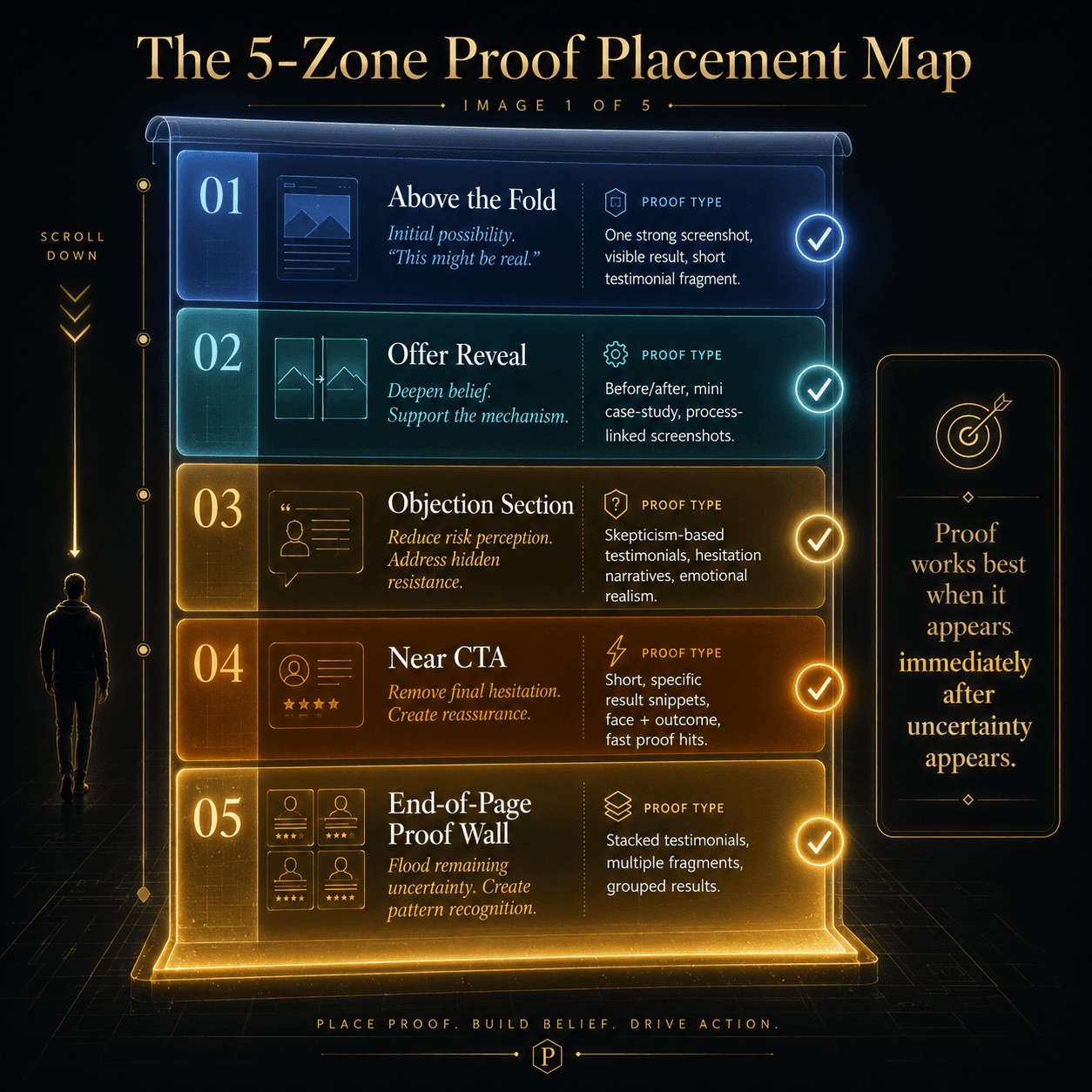
Proof works best when it appears immediately after uncertainty appears.
Not ten sections later.
Not after the buyer has already started doubting.
Not hidden at the bottom of the page.
Not isolated in a giant testimonial wall.
Immediately after uncertainty appears.
That is the rule.
The longer a claim exists without evidence, the more space doubt has to grow.
And the more doubt grows, the harder proof has to work when it finally appears.
That is why placement matters almost as much as the proof itself.
A strong proof asset placed too late can lose power.
A strong testimonial placed in the wrong emotional moment can get ignored.
A strong screenshot disconnected from the claim it supports can feel random.
Proof does not only need to be strong.
It needs to be timely.
The right proof in the wrong place becomes weaker.
The right proof in the right place becomes belief architecture.
——
The Biggest Mistake: Proof Dumping™
The biggest mistake most pages make is proof dumping.
Proof dumping means filling the page with:
endless testimonials
random screenshots
giant proof walls
logos everywhere
metrics without context
stacked praise with no psychological structure
screenshots that prove nothing specific
case studies disconnected from nearby claims
generic quotes repeated in different sections
The founder thinks:
“We have added proof.”
But the buyer experiences:
“Why am I seeing this here?”
Or worse:
“I do not know what this is supposed to prove.”
That creates proof blindness.
The buyer becomes numb.
Strong proof placement is not volume.
It is timing.
The question is not:
“How much proof can we add?”
The better question is:
“What doubt is rising here, and what proof would reduce it fastest?”
That question changes everything.
——
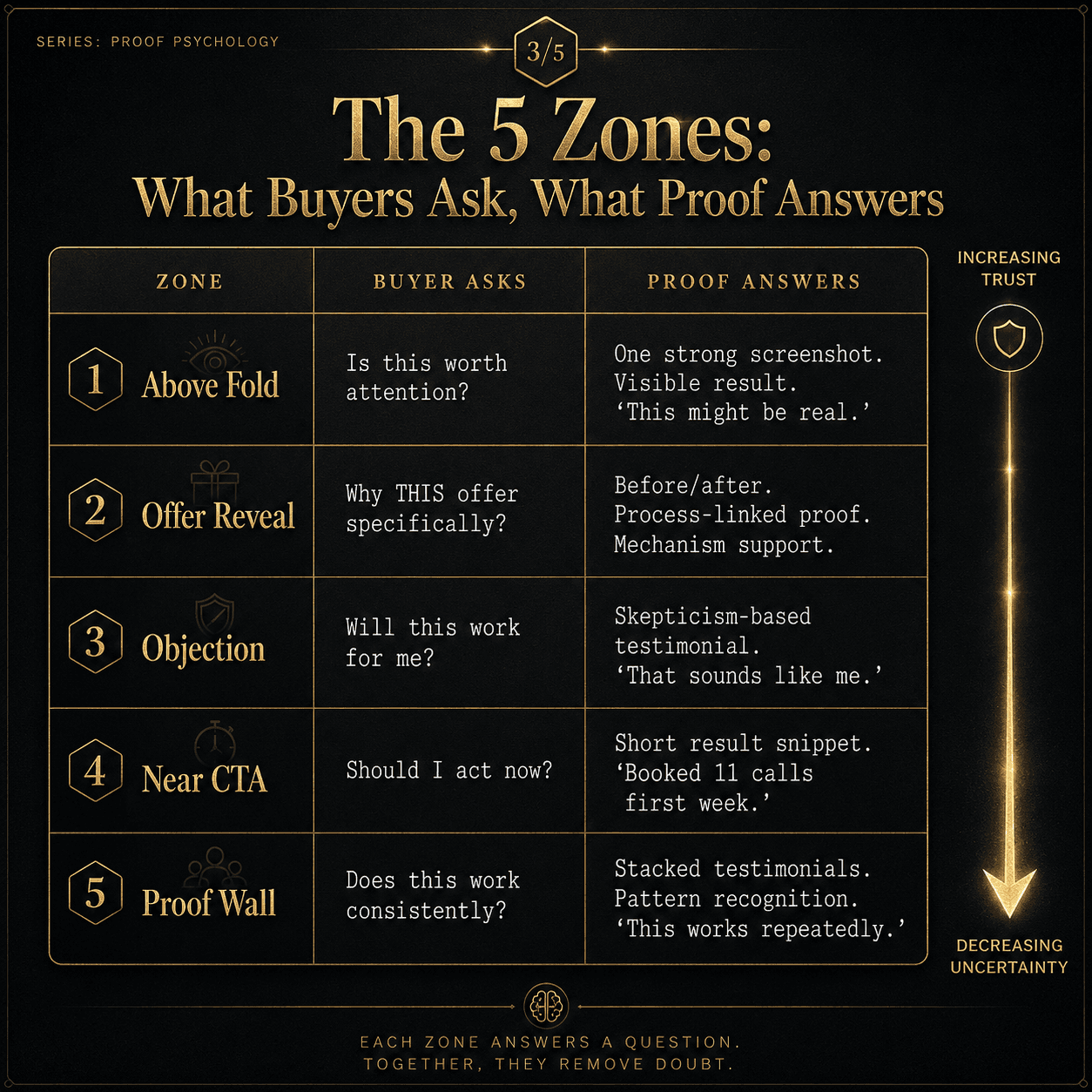
The 5-Zone Proof Placement System™
This framework maps buyer psychology across the page.
Each section creates different emotional questions.
Your proof should answer those questions progressively.
The five zones are:
Above The Fold™
The Offer Reveal Section™
The Objection Section™
Near The CTA™
The End-Of-Page Proof Wall™
Each zone has a different psychological job.
Do not treat them the same.
——
Zone 1: Above The Fold™
Buyer Question
“Is this even worth paying attention to?”
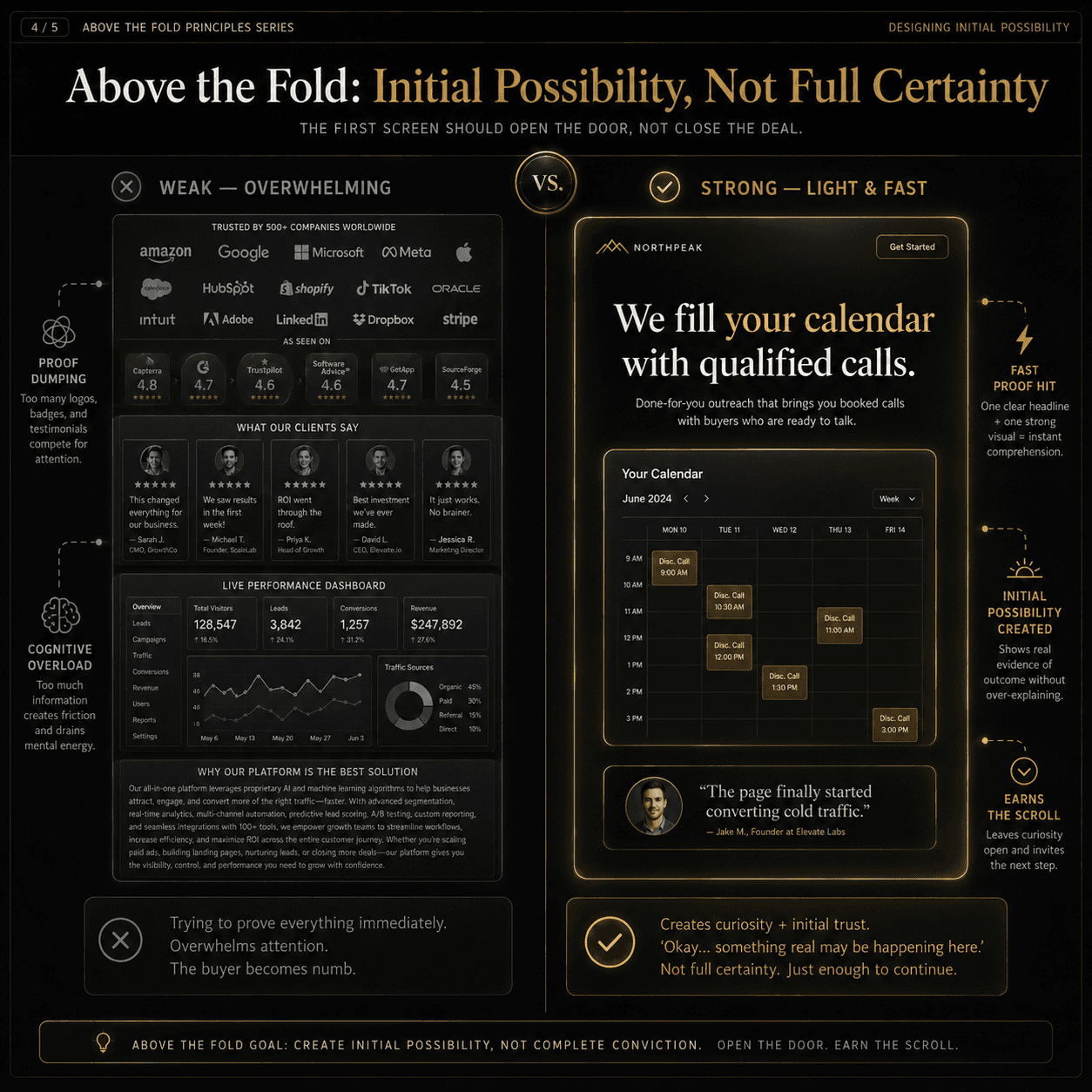
Above the fold, the buyer has not committed attention yet.
They are still deciding whether the page deserves another few seconds.
The psychological job here is not full certainty.
The job is initial possibility.
The buyer should feel:
“This might actually be real.”
That is enough.
Above-the-fold proof should support the headline without overwhelming the first screen.
It should make the promise feel believable enough to earn the scroll.
Not prove the entire business case.
Not show every testimonial.
Not create visual clutter.
Just make the promise feel more real than words alone can make it.
Best Proof Types For Above The Fold
Use:
one strong screenshot
one visible result
one stat-backed outcome
one face-based testimonial snippet
one visual proof asset
one trust indicator with context
one short reaction line
one compact before/after asset
one product or process preview
one proof-backed visual tied directly to the headline
Keep this section:
light
fast
inspectable
directly connected to the promise
The buyer should not have to study the proof for long.
They should understand the signal quickly.
Weak Above-The-Fold Proof
Weak above-the-fold proof includes:
giant logo walls
meaningless badges
generic “trusted by” strips
stock-style testimonials
proof requiring too much explanation
visuals that decorate but do not support the promise
screenshots with no obvious result
metrics with no context
These often feel decorative.
Not convincing.
They may make the page look credible at first glance, but they do not always create belief movement.
Strong Above-The-Fold Proof
Strong above-the-fold proof includes:
visible booked calendar
clear before/after comparison
dashboard movement
visible result screenshot
emotionally sharp testimonial fragment
product result preview
proof asset that directly intensifies the headline
The buyer quickly feels:
“Okay… something real may be happening here.”
That is the win.
What Above-The-Fold Proof Should Not Do
Above-the-fold proof should not try to prove everything immediately.
That overwhelms attention.
The fold should create:
curiosity
initial trust
visible possibility
enough believability to keep scrolling
Not full certainty.
The buyer does not need the whole case yet.
They need a reason to continue.
Zone 1 Worksheet
What is the main headline claim above the fold?
What doubt appears immediately after that claim?
What proof currently supports the headline?
Does the proof make the promise feel more real?
Yes / No / Partially
Is the proof easy to understand within seconds?
Yes / No / Partially
What stronger proof could appear above the fold?
Zone 2: The Offer Reveal Section™
Buyer Question
“Why should I believe this offer specifically?”
By the offer reveal section, the buyer has moved beyond initial attention.
They are now evaluating the promise more seriously.
They want to know whether this offer has substance.
They are asking:
What exactly is being offered?
Why should I believe this works?
What makes this different?
What result does this create?
Is this just another marketing claim?
What proof supports this mechanism?
This is where the page must deepen belief.
The proof here should support the mechanism, process, transformation, or specific value of the offer.
Best Proof Types For Offer Reveal
Use:
before/after proof
mini case-study visuals
result snapshots
process-linked screenshots
implementation examples
outcome comparisons
mechanism-specific proof
“here’s what changed” visuals
screenshots that show the result of the method
testimonial clips that mention the offer’s process
walkthrough snippets that reveal how the result was created
The buyer should now feel:
“This is not just a marketing claim.”
The proof should make the offer feel more specific, grounded, and believable.
Weak Offer-Reveal Proof
Weak proof in this section includes:
testimonials disconnected from the promise
generic praise
screenshots with no context
visuals proving nothing specific
proof that supports the brand but not the offer
quotes that flatter the seller but do not explain transformation
The buyer still feels uncertain because the proof does not answer the right question.
Strong Offer-Reveal Proof
Strong proof in this section sounds or looks like:
“Here’s what changed after the rewrite.”
“Booked calls increased after the fold changed.”
“Same offer. Different proof structure.”
“Before: unclear value. After: clearer buyer response.”
“Here is what the new positioning changed in the buyer’s behaviour.”
Now the proof supports the actual mechanism.
That matters enormously.
The buyer is not just seeing that something good happened.
They are seeing why the offer may be responsible for the shift.
The Most Important Rule In This Section
If the page makes a strong claim, proof should appear close to that claim.
Never let a large promise sit unsupported for too long.
Because unsupported claims create scepticism acceleration.
The bigger the claim, the closer the proof should be.
Zone 2 Worksheet
What offer claim appears in this section?
What mechanism, process, or transformation is being explained?
What proof currently supports that mechanism?
Is the proof close enough to the claim?
Yes / No / Partially
Does the proof show why this offer works?
Yes / No / Partially
What proof should be added or moved closer?
Zone 3: The Objection Section™
Buyer Question
“Will this work for me?”
This is where hidden resistance rises.
The buyer may already understand the offer.
They may even believe it works in general.
But now their doubt becomes personal.
They begin thinking:
Will this work for me?
What if my situation is different?
What if this fails?
What if I waste time or money again?
What if I have tried similar things before?
What if I regret this?
What if the proof does not apply to my situation?
This section exists to reduce risk perception.
The proof here should not only show success.
It should show hesitation, doubt, fear, scepticism, or resistance being overcome.
This is where emotional realism matters most.
Best Proof Types For Objection Sections
Use:
scepticism-based testimonials
hesitation-focused testimonials
buyer-story proof
transformation narratives
proof tied to past failure
face-based testimonials
emotionally honest proof
“I was doubtful too” proof
proof from buyers in similar situations
before/after stories with a clear turning point
testimonial clips that mention initial resistance
This proof should make the buyer feel:
“That sounds like me.”
That creates trust transfer.
Strong Objection-Handling Proof Usually Includes
Strong objection-handling proof usually contains:
doubt before buying
fear or hesitation
visible frustration
emotional resistance
clear turning point
believable outcome
buyer similarity
grounded language
specific result
reassurance without hype
The more the proof mirrors the buyer’s private doubt, the more powerful it becomes.
Weak Objection Proof
Weak objection proof sounds like:
“Amazing service.”
“Highly recommend.”
“Very professional.”
“Loved the experience.”
This reduces almost no uncertainty.
It is pleasant.
But it does not answer the buyer’s real objection.
Strong Objection Proof
Strong objection proof sounds like:
“I thought this would just make the page sound better. I didn’t expect buyers to trust the offer faster.”
This is stronger because it contains:
scepticism
expectation
surprise
specific shift
buyer behaviour
trust outcome
Now the buyer feels recognition.
Huge psychological difference.
Zone 3 Worksheet
What objection is likely rising here?
What is the buyer afraid of?
What proof currently answers that objection?
Does the proof include hesitation, doubt, or resistance?
Yes / No / Partially
Does the proof make the buyer feel represented?
Yes / No / Partially
What stronger objection-handling proof is needed?
Zone 4: Near The CTA™
Buyer Question
“Can I trust this enough to act now?”
Near the CTA, final hesitation appears.
The buyer is close to action, but still scanning for reassurance.
They may not need more education.
They may not need a long case study.
They need one more reason to feel safe moving forward.
This section exists to remove the final excuse to delay.
The proof here should be:
short
specific
fast to absorb
emotionally calming
directly tied to the action
close to the buyer’s final hesitation
Near the CTA, proof should reduce hesitation.
Not create more reading.
That distinction matters enormously.
Best Proof Types Near The CTA
Use:
short testimonials
visible result snippets
face + result combinations
screenshot fragments
fast proof hits
mini before/after visuals
emotionally calming proof
short scepticism-to-result quotes
one final trust signal
proof that reinforces the exact next step
The buyer should feel:
“I’ve probably seen enough to trust this.”
That is the goal.
Weak CTA-Area Proof
Weak CTA-area proof includes:
giant testimonial paragraphs
complicated proof stacks
unrelated case studies
overloaded visuals
proof that takes too long to understand
proof that opens new questions instead of reducing hesitation
proof that distracts from the action
Too much friction near the decision point creates stalling.
The buyer should not be forced into heavy analysis right before clicking.
Strong CTA-Area Proof
Strong CTA-area proof sounds or looks like:
“Booked 11 calls in the first week.”
“The page finally started converting cold traffic.”
“Same traffic. Higher trust.”
“I was sceptical too. Then the first qualified enquiry came through.”
“Clearer proof. Easier decision.”
Short.
Specific.
Fast to absorb.
That is what works near the CTA.
The CTA-Proof Rule™
Near the CTA, proof should reduce hesitation.
Not create more reading.
The closer the buyer gets to action, the lighter and more specific proof should become.
If the proof near the CTA creates cognitive overload, it is working against the decision.
Zone 4 Worksheet
What action does the CTA ask the buyer to take?
What hesitation appears immediately before that action?
What proof currently supports the CTA?
Is the proof short enough to absorb quickly?
Yes / No / Partially
Does the proof make the click feel safer?
Yes / No / Partially
What final trust hit should appear near the CTA?
Zone 5: The End-Of-Page Proof Wall™
Buyer Question
“Does this work in more than one case?”
At this point, the buyer is almost emotionally decided.
But remaining doubt still exists.
Some buyers reach the end of the page because they are interested but not fully convinced.
They want more reassurance.
They want pattern.
They want repetition.
They want evidence that this is not one isolated success.
This section exists to flood remaining uncertainty.
But it must do that without creating clutter.
A proof wall should not be a dumping ground.
It should create pattern recognition.
Best Proof Types For End-Of-Page
Use:
stacked testimonials
screenshot walls
multiple proof fragments
faces + quotes
mini case studies
grouped results
repeated patterns of success
varied buyer examples
social proof clusters
proof grouped by outcome, buyer type, or objection
This creates volume-based certainty.
The buyer feels:
“This works in more than one situation.”
Weak Proof Walls
Weak proof walls contain:
repetitive praise
generic testimonials
no specificity
walls of text
visual clutter
too many similar quotes
testimonials with no transformation
screenshots with no labels
logos without context
proof that feels visually overwhelming
This creates proof blindness.
The buyer stops processing.
Strong Proof Walls
Strong proof walls create pattern recognition.
The buyer repeatedly sees:
similar transformations
repeated outcomes
recurring emotional shifts
believable consistency
different people reaching related results
proof tied to the same core promise
That compounds trust.
The buyer should not feel buried under evidence.
They should feel surrounded by enough patterns to reduce remaining doubt.
Zone 5 Worksheet
What remaining doubt might still exist at the end of the page?
What proof currently appears at the end?
Does the proof wall create pattern recognition?
Yes / No / Partially
Are the proof assets grouped clearly?
Yes / No / Partially
Does the proof wall feel convincing or cluttered?
Convincing / Cluttered / Unsure
What proof should be removed, grouped, or reframed?
Claim-To-Proof Mapping Worksheet™
Every major claim should have nearby proof.
Use this worksheet to identify unsupported claims.
Claim 1
What claim does the page make?
Where does it appear?
Above Fold / Offer Reveal / Objection Section / Near CTA / End Page
What doubt does this claim create?
What proof supports it?
Is the proof close enough?
Yes / No
What needs to change?
Claim 2
What claim does the page make?
Where does it appear?
Above Fold / Offer Reveal / Objection Section / Near CTA / End Page
What doubt does this claim create?
What proof supports it?
Is the proof close enough?
Yes / No
What needs to change?
Claim 3
What claim does the page make?
Where does it appear?
Above Fold / Offer Reveal / Objection Section / Near CTA / End Page
What doubt does this claim create?
What proof supports it?
Is the proof close enough?
Yes / No
What needs to change?
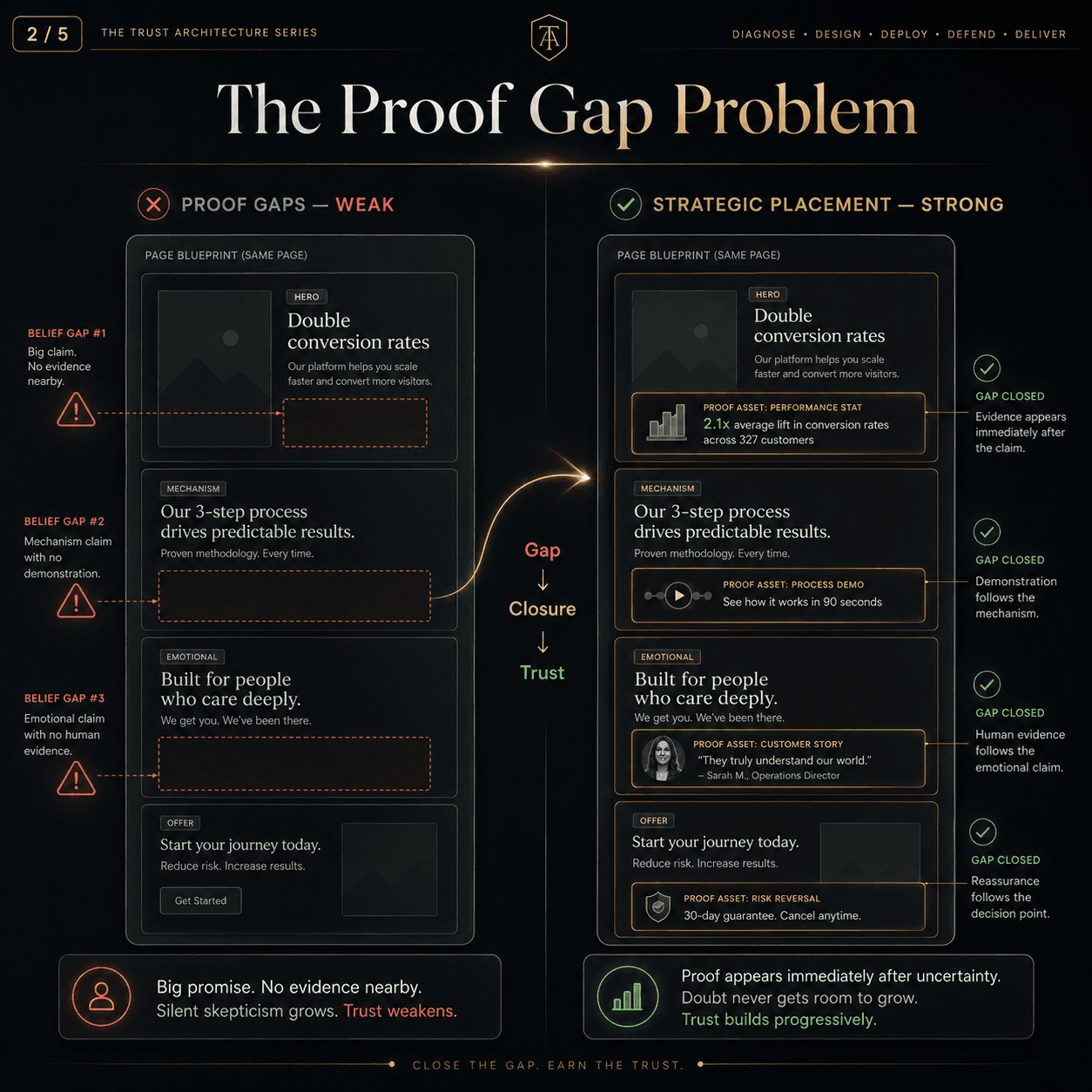
The Proof Gap Diagnosis™
Many pages unintentionally create belief gaps.
A proof gap happens when the page makes a major claim but no nearby proof supports it.
This creates silent scepticism.
The buyer may not consciously say:
“I do not believe this.”
But doubt begins to rise.
And if the page keeps moving without answering that doubt, trust weakens.
Common Proof Gap 1: Big Promise With No Evidence
Example:
“Double conversion rates.”
But no proof appears nearby.
No screenshot.
No case study.
No before/after.
No visible result.
Trust weakens instantly.
The buyer is asked to believe too much too soon.
Common Proof Gap 2: Mechanism With No Demonstration
Example:
“We rebuilt the positioning.”
But there is no visible example.
No before/after.
No teardown.
No screenshot showing the difference.
No buyer response after the change.
The buyer cannot inspect the mechanism.
Belief weakens.
Common Proof Gap 3: Emotional Claim With No Human Evidence
Example:
“Buyers trusted the page faster.”
But there is no testimonial proving that shift.
No buyer quote.
No reaction.
No face.
No emotional proof.
Again, belief weakens.
The claim may sound good, but the buyer cannot feel it through evidence.
Common Proof Gap 4: CTA With No Final Reassurance
Example:
The page asks the buyer to book a call, buy, apply, download, or enquire.
But there is no nearby proof making that decision feel safer.
No final quote.
No result snippet.
No microcopy.
No reassurance.
The buyer hesitates.
Proof Gap Worksheet
Where does the page make a major claim?
What proof appears nearby?
Is there a gap between the claim and the proof?
Yes / No
What doubt could grow in that gap?
What proof should be moved closer?
The Too Much Proof Problem™
Yes, this exists too.
More proof does not always create more trust.
Too much proof can:
overwhelm attention
slow the page down
reduce clarity
create cognitive fatigue
weaken important proof through overexposure
make the page feel cluttered
bury the strongest assets
create proof blindness
The goal is not maximum proof volume.
The goal is strategic proof sequencing.
One strong asset placed at the right moment can do more than ten random testimonials stacked together.
Proof should support the page’s argument.
Not suffocate it.
Too Much Proof Diagnosis
Ask:
Does this proof section feel easy to scan?
Yes / No
Are the strongest proof assets clearly visible?
Yes / No
Is the buyer being asked to process too much?
Yes / No
Are several proof assets saying the same thing?
Yes / No
Could fewer assets create more belief?
Yes / No
What proof should be removed or moved?
The “This Looks Fake” Problem™
Some proof technically exists but still feels manufactured.
That is dangerous.
Because proof that looks fake can damage trust more than no proof at all.
Common causes include:
overly polished testimonials
generic praise
no visible specificity
no emotional realism
no timing
no visible tension
no context
fake-looking screenshots
over-designed proof cards
testimonial language that sounds edited by the seller
screenshots cropped so heavily they lose reality
results with no native environment
Strong proof usually feels harder to fake.
That is why raw often outperforms polished.
Not because ugly is persuasive.
Because reality is persuasive.
Fake-Looking Proof Diagnosis
Ask:
Does this proof feel real or staged?
Real / Staged / Unsure
Does it contain truth anchors?
Yes / No
Does it show timing, context, names, roles, native formatting, or visible interface details where permission allows?
Yes / No
Does the language sound natural?
Yes / No
Does the proof feel over-designed?
Yes / No
What would make this proof feel more real?
The Fastest Proof Placement Audit™
Use these questions while reviewing your page.
They expose most proof-placement problems quickly.
Ask:
Where does buyer doubt rise?
What proof appears immediately after?
Is the proof reducing uncertainty or merely decorating the page?
Does the proof directly support the nearby claim?
Yes / No
Does the proof feel inspectable?
Yes / No
Does the buyer feel progressively safer moving down the page?
Yes / No
Where is the strongest proof currently buried too low?
Where does the page make the buyer wait too long for evidence?
What proof should be moved, removed, or reframed?
Proof Placement Scorecard™
Score each area from 1 to 5.
1 = weak
2 = soft
3 = usable but leaking
4 = strong
5 = strategically placed and belief-building
Proof Timing
Does proof appear close to the moment doubt rises?
Score: ___ / 5
Notes:
Claim Alignment
Does the proof directly support the nearby claim?
Score: ___ / 5
Notes:
Emotional Fit
Does the proof match the buyer’s emotional state in that section?
Score: ___ / 5
Notes:
Inspectability
Can the buyer quickly understand what the proof is showing?
Score: ___ / 5
Notes:
Belief Movement
Does the proof make the page feel safer, more credible, or harder to dismiss?
Score: ___ / 5
Notes:
Visual Load
Is the amount of proof easy to process rather than overwhelming?
Score: ___ / 5
Notes:
Total Score
Proof Timing: ___ / 5
Claim Alignment: ___ / 5
Emotional Fit: ___ / 5
Inspectability: ___ / 5
Belief Movement: ___ / 5
Visual Load: ___ / 5
Total: ___ / 30
——
Score Interpretation
26–30: Strong Proof Sequencing™
The proof is placed strategically.
It appears where doubt rises, supports nearby claims, and helps trust build progressively.
20–25: Strong But Leaking™
The proof is useful, but one or two placements are weakening belief movement.
Fix the lowest-scoring area first.
13–19: Proof Present But Poorly Sequenced™
The page has evidence, but it may be too disconnected, too late, too cluttered, or too weakly framed to reduce uncertainty properly.
Re-map the proof flow.
0–12: Proof Dumping Risk™
The page likely contains proof without a strong psychological sequence.
The buyer may feel overwhelmed, unconvinced, or unsupported at key decision points.
Rebuild the proof placement strategy.
——
Final Page Proof Flow Worksheet
Use this to map your full proof sequence.
Page Promise
What is the main promise of the page?
Buyer’s Biggest Doubt
What is the buyer most uncertain about?
Zone 1: Above The Fold
Buyer question:
“Is this worth paying attention to?”
Proof asset:
What it proves:
What doubt it reduces:
Needs improvement?
Yes / No
Zone 2: Offer Reveal
Buyer question:
“Why should I believe this offer specifically?”
Proof asset:
What it proves:
What doubt it reduces:
Needs improvement?
Yes / No
Zone 3: Objection Section
Buyer question:
“Will this work for me?”
Proof asset:
What it proves:
What doubt it reduces:
Needs improvement?
Yes / No
Zone 4: Near The CTA
Buyer question:
“Can I trust this enough to act now?”
Proof asset:
What it proves:
What doubt it reduces:
Needs improvement?
Yes / No
Zone 5: End-Of-Page Proof Wall
Buyer question:
“Does this work in more than one case?”
Proof asset or proof cluster:
What it proves:
What doubt it reduces:
Needs improvement?
Yes / No
Proof Assets To Move
Which proof assets are currently in the wrong place?
Proof Assets To Remove
Which proof assets create clutter, confusion, or weak belief movement?
Proof Assets To Reframe
Which proof assets need better captions, labels, or context?
Proof Gaps To Fill
What proof is missing?
Final Execution Challenge™
Open your current page and identify:
where the biggest claims appear
where scepticism likely rises
where trust weakens
where the buyer may hesitate
where proof currently feels disconnected
where the strongest evidence is buried too low
where proof creates clutter instead of clarity
where a major claim is unsupported
Then rebuild the proof flow intentionally.
Because proof is not random decoration layered onto the page later.
It is structured uncertainty reduction.
And when proof appears at the exact moment doubt begins rising, the page stops feeling like a persuasive argument.
It starts feeling like evidence the buyer can safely move toward without carrying all the uncertainty alone.
——
Final Principle
Proof is not only something you collect.
It is something you place.
That is the shift.
Weak pages stack proof randomly and hope the buyer feels reassured.
Strong pages place proof where doubt is about to rise.
They do not make big claims and leave them unsupported.
They do not bury the strongest evidence below the moment of hesitation.
They do not overload the buyer with proof volume when one sharp asset would work better.
They sequence proof so trust builds progressively.
Above the fold, proof creates possibility.
Around the offer reveal, proof deepens belief.
Inside objection sections, proof reduces risk.
Near the CTA, proof makes the next step feel safer.
At the end of the page, proof shows repeatability.
That is belief architecture.
That is what The Proof Placement Map™ is designed to build.
Because trust is not usually created in one dramatic moment.
It is built layer by layer as uncertainty is answered.
And when the right proof appears at the right moment, the buyer no longer has to carry doubt alone.
The page carries some of that weight for them.
That is when proof stops decorating the page and starts doing its real job.
——
From:
The $100M Funnel Playbook. Book I: Foundation Buyer Psychology, Offer Clarity, and the Page Architecture Behind High-Converting Funnels
By Maris Spalins.
——
Copyright Notice
© 2026 The $100M Funnel Playbook / Winyourclients / Maris Spalins. All rights reserved.
This resource, including the frameworks, terminology, examples, scorecards, templates, prompts, methods, and written explanations, is original intellectual property created for The $100M Funnel Playbook. Book I: Foundation — Buyer Psychology, Offer Clarity, And The Page Architecture Behind High-Converting Funnels and published through Winyourclients.
No part of this resource may be copied, reproduced, screenshotted, republished, redistributed, sold, adapted, uploaded, scraped, stored in a database, included in training data, used to train artificial intelligence systems, or used to create derivative commercial or educational materials without prior written permission.
Limited reference, quotation, or sharing is only permitted where the source is clearly and visibly credited.
Any permitted reference must include at least one of the following source credits:
The $100M Funnel Playbook by Maris Spalins
or
Winyourclients — www.winyourclients.com
or
Maris Spalins / Winyourclients
Screenshots, excerpts, summaries, or redistributed versions must not remove, hide, alter, crop out, or obscure the original source, author name, book title, website name, or copyright notice.
This resource is provided for personal learning and implementation only. It is not licensed for resale, republishing, redistribution, AI training, template cloning, course creation, consulting delivery, or commercial reuse without written permission from Maris Spalins or Winyourclients.
For permission requests, licensing, citation approval, or commercial usage enquiries, contact:
Winyourclients
www.winyourclients.com
or
Email directly to Jacob on: help@winyourclients.com

The Proof Placement Map™ A belief sequencing worksheet for placing proof where buyer doubt rises — above the fold, around the offer reveal, inside objection sections, near the CTA, and at the end of the page.
Prefer Audio Or Video?
The Proof Placement Map™ is also available as:
🎧 A guided audio walkthrough explaining proof placement, buyer doubt sequencing, claim-to-proof mapping, proof gaps, and CTA-area reassurance.
🎥 A practical video breakdown with real proof-placement examples, page proof-flow audits, proof gap diagnosis, and before/after proof sequencing.Choose the format that fits how you learn best.
[Listen To The Audio Walkthrough] (coming soon)
[Watch The Video Breakdown] (coming soon)
——
Why Most Pages Still Feel Risky Even With Proof
Most pages do not lack proof.
They lack proof sequencing.
The screenshots exist.
The testimonials exist.
The results exist.
The client messages exist.
The case studies exist.
The problem is not always absence.
The problem is placement.
The proof appears:
too late
too early
disconnected from the claim
emotionally misplaced
visually overwhelming
weakly framed
randomly stacked without psychological purpose
buried below the moment where doubt first appears
And because of that, the buyer still hesitates.
The page may contain proof, but the buyer does not experience that proof at the right moment.
That matters.
Because buyers do not read a page as one complete argument.
They experience it in stages.
First, they ask:
“Is this worth my attention?”
Then:
“Is this claim believable?”
Then:
“Would this work for someone like me?”
Then:
“What if this fails?”
Then:
“Can I trust this enough to act?”
Each stage creates a different kind of doubt.
And each kind of doubt needs a different kind of proof.
That is why this resource exists.
It helps you place the right proof at the exact moment the buyer begins questioning the claim.
Because trust is rarely built all at once.
It is built layer by layer as uncertainty rises.
——
What This Resource Helps You Do
The Proof Placement Map™ helps you place proof where buyer doubt rises, so the page earns trust progressively instead of overwhelming visitors with random testimonials and screenshots.
Use this when:
your page has proof but still feels risky
visitors read the page but do not convert
testimonials feel ignored
screenshots feel random
the page sounds believable in some places but weak in others
your strongest evidence is buried too low
buyers still hesitate near the CTA
your proof feels cluttered instead of persuasive
major claims appear without nearby evidence
your page relies too heavily on one proof wall
proof exists but does not feel connected to the buyer’s doubts
the page does not feel safer as the buyer scrolls
This is not a page layout guide.
This is a belief sequencing system.
The goal is simple:
Place the right proof at the exact moment the buyer begins questioning the claim.
——
The Core Principle™
Proof works best when it appears immediately after uncertainty appears.
Not ten sections later.
Not after the buyer has already started doubting.
Not hidden at the bottom of the page.
Not isolated in a giant testimonial wall.
Immediately after uncertainty appears.
That is the rule.
The longer a claim exists without evidence, the more space doubt has to grow.
And the more doubt grows, the harder proof has to work when it finally appears.
That is why placement matters almost as much as the proof itself.
A strong proof asset placed too late can lose power.
A strong testimonial placed in the wrong emotional moment can get ignored.
A strong screenshot disconnected from the claim it supports can feel random.
Proof does not only need to be strong.
It needs to be timely.
The right proof in the wrong place becomes weaker.
The right proof in the right place becomes belief architecture.
——
The Biggest Mistake: Proof Dumping™
The biggest mistake most pages make is proof dumping.
Proof dumping means filling the page with:
endless testimonials
random screenshots
giant proof walls
logos everywhere
metrics without context
stacked praise with no psychological structure
screenshots that prove nothing specific
case studies disconnected from nearby claims
generic quotes repeated in different sections
The founder thinks:
“We have added proof.”
But the buyer experiences:
“Why am I seeing this here?”
Or worse:
“I do not know what this is supposed to prove.”
That creates proof blindness.
The buyer becomes numb.
Strong proof placement is not volume.
It is timing.
The question is not:
“How much proof can we add?”
The better question is:
“What doubt is rising here, and what proof would reduce it fastest?”
That question changes everything.
——
The 5-Zone Proof Placement System™
This framework maps buyer psychology across the page.
Each section creates different emotional questions.
Your proof should answer those questions progressively.
The five zones are:
Above The Fold™
The Offer Reveal Section™
The Objection Section™
Near The CTA™
The End-Of-Page Proof Wall™
Each zone has a different psychological job.
Do not treat them the same.
——
Zone 1: Above The Fold™
Buyer Question
“Is this even worth paying attention to?”
Above the fold, the buyer has not committed attention yet.
They are still deciding whether the page deserves another few seconds.
The psychological job here is not full certainty.
The job is initial possibility.
The buyer should feel:
“This might actually be real.”
That is enough.
Above-the-fold proof should support the headline without overwhelming the first screen.
It should make the promise feel believable enough to earn the scroll.
Not prove the entire business case.
Not show every testimonial.
Not create visual clutter.
Just make the promise feel more real than words alone can make it.
Best Proof Types For Above The Fold
Use:
one strong screenshot
one visible result
one stat-backed outcome
one face-based testimonial snippet
one visual proof asset
one trust indicator with context
one short reaction line
one compact before/after asset
one product or process preview
one proof-backed visual tied directly to the headline
Keep this section:
light
fast
inspectable
directly connected to the promise
The buyer should not have to study the proof for long.
They should understand the signal quickly.
Weak Above-The-Fold Proof
Weak above-the-fold proof includes:
giant logo walls
meaningless badges
generic “trusted by” strips
stock-style testimonials
proof requiring too much explanation
visuals that decorate but do not support the promise
screenshots with no obvious result
metrics with no context
These often feel decorative.
Not convincing.
They may make the page look credible at first glance, but they do not always create belief movement.
Strong Above-The-Fold Proof
Strong above-the-fold proof includes:
visible booked calendar
clear before/after comparison
dashboard movement
visible result screenshot
emotionally sharp testimonial fragment
product result preview
proof asset that directly intensifies the headline
The buyer quickly feels:
“Okay… something real may be happening here.”
That is the win.
What Above-The-Fold Proof Should Not Do
Above-the-fold proof should not try to prove everything immediately.
That overwhelms attention.
The fold should create:
curiosity
initial trust
visible possibility
enough believability to keep scrolling
Not full certainty.
The buyer does not need the whole case yet.
They need a reason to continue.
Zone 1 Worksheet
What is the main headline claim above the fold?
What doubt appears immediately after that claim?
What proof currently supports the headline?
Does the proof make the promise feel more real?
Yes / No / Partially
Is the proof easy to understand within seconds?
Yes / No / Partially
What stronger proof could appear above the fold?
Zone 2: The Offer Reveal Section™
Buyer Question
“Why should I believe this offer specifically?”
By the offer reveal section, the buyer has moved beyond initial attention.
They are now evaluating the promise more seriously.
They want to know whether this offer has substance.
They are asking:
What exactly is being offered?
Why should I believe this works?
What makes this different?
What result does this create?
Is this just another marketing claim?
What proof supports this mechanism?
This is where the page must deepen belief.
The proof here should support the mechanism, process, transformation, or specific value of the offer.
Best Proof Types For Offer Reveal
Use:
before/after proof
mini case-study visuals
result snapshots
process-linked screenshots
implementation examples
outcome comparisons
mechanism-specific proof
“here’s what changed” visuals
screenshots that show the result of the method
testimonial clips that mention the offer’s process
walkthrough snippets that reveal how the result was created
The buyer should now feel:
“This is not just a marketing claim.”
The proof should make the offer feel more specific, grounded, and believable.
Weak Offer-Reveal Proof
Weak proof in this section includes:
testimonials disconnected from the promise
generic praise
screenshots with no context
visuals proving nothing specific
proof that supports the brand but not the offer
quotes that flatter the seller but do not explain transformation
The buyer still feels uncertain because the proof does not answer the right question.
Strong Offer-Reveal Proof
Strong proof in this section sounds or looks like:
“Here’s what changed after the rewrite.”
“Booked calls increased after the fold changed.”
“Same offer. Different proof structure.”
“Before: unclear value. After: clearer buyer response.”
“Here is what the new positioning changed in the buyer’s behaviour.”
Now the proof supports the actual mechanism.
That matters enormously.
The buyer is not just seeing that something good happened.
They are seeing why the offer may be responsible for the shift.
The Most Important Rule In This Section
If the page makes a strong claim, proof should appear close to that claim.
Never let a large promise sit unsupported for too long.
Because unsupported claims create scepticism acceleration.
The bigger the claim, the closer the proof should be.
Zone 2 Worksheet
What offer claim appears in this section?
What mechanism, process, or transformation is being explained?
What proof currently supports that mechanism?
Is the proof close enough to the claim?
Yes / No / Partially
Does the proof show why this offer works?
Yes / No / Partially
What proof should be added or moved closer?
Zone 3: The Objection Section™
Buyer Question
“Will this work for me?”
This is where hidden resistance rises.
The buyer may already understand the offer.
They may even believe it works in general.
But now their doubt becomes personal.
They begin thinking:
Will this work for me?
What if my situation is different?
What if this fails?
What if I waste time or money again?
What if I have tried similar things before?
What if I regret this?
What if the proof does not apply to my situation?
This section exists to reduce risk perception.
The proof here should not only show success.
It should show hesitation, doubt, fear, scepticism, or resistance being overcome.
This is where emotional realism matters most.
Best Proof Types For Objection Sections
Use:
scepticism-based testimonials
hesitation-focused testimonials
buyer-story proof
transformation narratives
proof tied to past failure
face-based testimonials
emotionally honest proof
“I was doubtful too” proof
proof from buyers in similar situations
before/after stories with a clear turning point
testimonial clips that mention initial resistance
This proof should make the buyer feel:
“That sounds like me.”
That creates trust transfer.
Strong Objection-Handling Proof Usually Includes
Strong objection-handling proof usually contains:
doubt before buying
fear or hesitation
visible frustration
emotional resistance
clear turning point
believable outcome
buyer similarity
grounded language
specific result
reassurance without hype
The more the proof mirrors the buyer’s private doubt, the more powerful it becomes.
Weak Objection Proof
Weak objection proof sounds like:
“Amazing service.”
“Highly recommend.”
“Very professional.”
“Loved the experience.”
This reduces almost no uncertainty.
It is pleasant.
But it does not answer the buyer’s real objection.
Strong Objection Proof
Strong objection proof sounds like:
“I thought this would just make the page sound better. I didn’t expect buyers to trust the offer faster.”
This is stronger because it contains:
scepticism
expectation
surprise
specific shift
buyer behaviour
trust outcome
Now the buyer feels recognition.
Huge psychological difference.
Zone 3 Worksheet
What objection is likely rising here?
What is the buyer afraid of?
What proof currently answers that objection?
Does the proof include hesitation, doubt, or resistance?
Yes / No / Partially
Does the proof make the buyer feel represented?
Yes / No / Partially
What stronger objection-handling proof is needed?
Zone 4: Near The CTA™
Buyer Question
“Can I trust this enough to act now?”
Near the CTA, final hesitation appears.
The buyer is close to action, but still scanning for reassurance.
They may not need more education.
They may not need a long case study.
They need one more reason to feel safe moving forward.
This section exists to remove the final excuse to delay.
The proof here should be:
short
specific
fast to absorb
emotionally calming
directly tied to the action
close to the buyer’s final hesitation
Near the CTA, proof should reduce hesitation.
Not create more reading.
That distinction matters enormously.
Best Proof Types Near The CTA
Use:
short testimonials
visible result snippets
face + result combinations
screenshot fragments
fast proof hits
mini before/after visuals
emotionally calming proof
short scepticism-to-result quotes
one final trust signal
proof that reinforces the exact next step
The buyer should feel:
“I’ve probably seen enough to trust this.”
That is the goal.
Weak CTA-Area Proof
Weak CTA-area proof includes:
giant testimonial paragraphs
complicated proof stacks
unrelated case studies
overloaded visuals
proof that takes too long to understand
proof that opens new questions instead of reducing hesitation
proof that distracts from the action
Too much friction near the decision point creates stalling.
The buyer should not be forced into heavy analysis right before clicking.
Strong CTA-Area Proof
Strong CTA-area proof sounds or looks like:
“Booked 11 calls in the first week.”
“The page finally started converting cold traffic.”
“Same traffic. Higher trust.”
“I was sceptical too. Then the first qualified enquiry came through.”
“Clearer proof. Easier decision.”
Short.
Specific.
Fast to absorb.
That is what works near the CTA.
The CTA-Proof Rule™
Near the CTA, proof should reduce hesitation.
Not create more reading.
The closer the buyer gets to action, the lighter and more specific proof should become.
If the proof near the CTA creates cognitive overload, it is working against the decision.
Zone 4 Worksheet
What action does the CTA ask the buyer to take?
What hesitation appears immediately before that action?
What proof currently supports the CTA?
Is the proof short enough to absorb quickly?
Yes / No / Partially
Does the proof make the click feel safer?
Yes / No / Partially
What final trust hit should appear near the CTA?
Zone 5: The End-Of-Page Proof Wall™
Buyer Question
“Does this work in more than one case?”
At this point, the buyer is almost emotionally decided.
But remaining doubt still exists.
Some buyers reach the end of the page because they are interested but not fully convinced.
They want more reassurance.
They want pattern.
They want repetition.
They want evidence that this is not one isolated success.
This section exists to flood remaining uncertainty.
But it must do that without creating clutter.
A proof wall should not be a dumping ground.
It should create pattern recognition.
Best Proof Types For End-Of-Page
Use:
stacked testimonials
screenshot walls
multiple proof fragments
faces + quotes
mini case studies
grouped results
repeated patterns of success
varied buyer examples
social proof clusters
proof grouped by outcome, buyer type, or objection
This creates volume-based certainty.
The buyer feels:
“This works in more than one situation.”
Weak Proof Walls
Weak proof walls contain:
repetitive praise
generic testimonials
no specificity
walls of text
visual clutter
too many similar quotes
testimonials with no transformation
screenshots with no labels
logos without context
proof that feels visually overwhelming
This creates proof blindness.
The buyer stops processing.
Strong Proof Walls
Strong proof walls create pattern recognition.
The buyer repeatedly sees:
similar transformations
repeated outcomes
recurring emotional shifts
believable consistency
different people reaching related results
proof tied to the same core promise
That compounds trust.
The buyer should not feel buried under evidence.
They should feel surrounded by enough patterns to reduce remaining doubt.
Zone 5 Worksheet
What remaining doubt might still exist at the end of the page?
What proof currently appears at the end?
Does the proof wall create pattern recognition?
Yes / No / Partially
Are the proof assets grouped clearly?
Yes / No / Partially
Does the proof wall feel convincing or cluttered?
Convincing / Cluttered / Unsure
What proof should be removed, grouped, or reframed?
Claim-To-Proof Mapping Worksheet™
Every major claim should have nearby proof.
Use this worksheet to identify unsupported claims.
Claim 1
What claim does the page make?
Where does it appear?
Above Fold / Offer Reveal / Objection Section / Near CTA / End Page
What doubt does this claim create?
What proof supports it?
Is the proof close enough?
Yes / No
What needs to change?
Claim 2
What claim does the page make?
Where does it appear?
Above Fold / Offer Reveal / Objection Section / Near CTA / End Page
What doubt does this claim create?
What proof supports it?
Is the proof close enough?
Yes / No
What needs to change?
Claim 3
What claim does the page make?
Where does it appear?
Above Fold / Offer Reveal / Objection Section / Near CTA / End Page
What doubt does this claim create?
What proof supports it?
Is the proof close enough?
Yes / No
What needs to change?
The Proof Gap Diagnosis™
Many pages unintentionally create belief gaps.
A proof gap happens when the page makes a major claim but no nearby proof supports it.
This creates silent scepticism.
The buyer may not consciously say:
“I do not believe this.”
But doubt begins to rise.
And if the page keeps moving without answering that doubt, trust weakens.
Common Proof Gap 1: Big Promise With No Evidence
Example:
“Double conversion rates.”
But no proof appears nearby.
No screenshot.
No case study.
No before/after.
No visible result.
Trust weakens instantly.
The buyer is asked to believe too much too soon.
Common Proof Gap 2: Mechanism With No Demonstration
Example:
“We rebuilt the positioning.”
But there is no visible example.
No before/after.
No teardown.
No screenshot showing the difference.
No buyer response after the change.
The buyer cannot inspect the mechanism.
Belief weakens.
Common Proof Gap 3: Emotional Claim With No Human Evidence
Example:
“Buyers trusted the page faster.”
But there is no testimonial proving that shift.
No buyer quote.
No reaction.
No face.
No emotional proof.
Again, belief weakens.
The claim may sound good, but the buyer cannot feel it through evidence.
Common Proof Gap 4: CTA With No Final Reassurance
Example:
The page asks the buyer to book a call, buy, apply, download, or enquire.
But there is no nearby proof making that decision feel safer.
No final quote.
No result snippet.
No microcopy.
No reassurance.
The buyer hesitates.
Proof Gap Worksheet
Where does the page make a major claim?
What proof appears nearby?
Is there a gap between the claim and the proof?
Yes / No
What doubt could grow in that gap?
What proof should be moved closer?
The Too Much Proof Problem™
Yes, this exists too.
More proof does not always create more trust.
Too much proof can:
overwhelm attention
slow the page down
reduce clarity
create cognitive fatigue
weaken important proof through overexposure
make the page feel cluttered
bury the strongest assets
create proof blindness
The goal is not maximum proof volume.
The goal is strategic proof sequencing.
One strong asset placed at the right moment can do more than ten random testimonials stacked together.
Proof should support the page’s argument.
Not suffocate it.
Too Much Proof Diagnosis
Ask:
Does this proof section feel easy to scan?
Yes / No
Are the strongest proof assets clearly visible?
Yes / No
Is the buyer being asked to process too much?
Yes / No
Are several proof assets saying the same thing?
Yes / No
Could fewer assets create more belief?
Yes / No
What proof should be removed or moved?
The “This Looks Fake” Problem™
Some proof technically exists but still feels manufactured.
That is dangerous.
Because proof that looks fake can damage trust more than no proof at all.
Common causes include:
overly polished testimonials
generic praise
no visible specificity
no emotional realism
no timing
no visible tension
no context
fake-looking screenshots
over-designed proof cards
testimonial language that sounds edited by the seller
screenshots cropped so heavily they lose reality
results with no native environment
Strong proof usually feels harder to fake.
That is why raw often outperforms polished.
Not because ugly is persuasive.
Because reality is persuasive.
Fake-Looking Proof Diagnosis
Ask:
Does this proof feel real or staged?
Real / Staged / Unsure
Does it contain truth anchors?
Yes / No
Does it show timing, context, names, roles, native formatting, or visible interface details where permission allows?
Yes / No
Does the language sound natural?
Yes / No
Does the proof feel over-designed?
Yes / No
What would make this proof feel more real?
The Fastest Proof Placement Audit™
Use these questions while reviewing your page.
They expose most proof-placement problems quickly.
Ask:
Where does buyer doubt rise?
What proof appears immediately after?
Is the proof reducing uncertainty or merely decorating the page?
Does the proof directly support the nearby claim?
Yes / No
Does the proof feel inspectable?
Yes / No
Does the buyer feel progressively safer moving down the page?
Yes / No
Where is the strongest proof currently buried too low?
Where does the page make the buyer wait too long for evidence?
What proof should be moved, removed, or reframed?
Proof Placement Scorecard™
Score each area from 1 to 5.
1 = weak
2 = soft
3 = usable but leaking
4 = strong
5 = strategically placed and belief-building
Proof Timing
Does proof appear close to the moment doubt rises?
Score: ___ / 5
Notes:
Claim Alignment
Does the proof directly support the nearby claim?
Score: ___ / 5
Notes:
Emotional Fit
Does the proof match the buyer’s emotional state in that section?
Score: ___ / 5
Notes:
Inspectability
Can the buyer quickly understand what the proof is showing?
Score: ___ / 5
Notes:
Belief Movement
Does the proof make the page feel safer, more credible, or harder to dismiss?
Score: ___ / 5
Notes:
Visual Load
Is the amount of proof easy to process rather than overwhelming?
Score: ___ / 5
Notes:
Total Score
Proof Timing: ___ / 5
Claim Alignment: ___ / 5
Emotional Fit: ___ / 5
Inspectability: ___ / 5
Belief Movement: ___ / 5
Visual Load: ___ / 5
Total: ___ / 30
——
Score Interpretation
26–30: Strong Proof Sequencing™
The proof is placed strategically.
It appears where doubt rises, supports nearby claims, and helps trust build progressively.
20–25: Strong But Leaking™
The proof is useful, but one or two placements are weakening belief movement.
Fix the lowest-scoring area first.
13–19: Proof Present But Poorly Sequenced™
The page has evidence, but it may be too disconnected, too late, too cluttered, or too weakly framed to reduce uncertainty properly.
Re-map the proof flow.
0–12: Proof Dumping Risk™
The page likely contains proof without a strong psychological sequence.
The buyer may feel overwhelmed, unconvinced, or unsupported at key decision points.
Rebuild the proof placement strategy.
——
Final Page Proof Flow Worksheet
Use this to map your full proof sequence.
Page Promise
What is the main promise of the page?
Buyer’s Biggest Doubt
What is the buyer most uncertain about?
Zone 1: Above The Fold
Buyer question:
“Is this worth paying attention to?”
Proof asset:
What it proves:
What doubt it reduces:
Needs improvement?
Yes / No
Zone 2: Offer Reveal
Buyer question:
“Why should I believe this offer specifically?”
Proof asset:
What it proves:
What doubt it reduces:
Needs improvement?
Yes / No
Zone 3: Objection Section
Buyer question:
“Will this work for me?”
Proof asset:
What it proves:
What doubt it reduces:
Needs improvement?
Yes / No
Zone 4: Near The CTA
Buyer question:
“Can I trust this enough to act now?”
Proof asset:
What it proves:
What doubt it reduces:
Needs improvement?
Yes / No
Zone 5: End-Of-Page Proof Wall
Buyer question:
“Does this work in more than one case?”
Proof asset or proof cluster:
What it proves:
What doubt it reduces:
Needs improvement?
Yes / No
Proof Assets To Move
Which proof assets are currently in the wrong place?
Proof Assets To Remove
Which proof assets create clutter, confusion, or weak belief movement?
Proof Assets To Reframe
Which proof assets need better captions, labels, or context?
Proof Gaps To Fill
What proof is missing?
Final Execution Challenge™
Open your current page and identify:
where the biggest claims appear
where scepticism likely rises
where trust weakens
where the buyer may hesitate
where proof currently feels disconnected
where the strongest evidence is buried too low
where proof creates clutter instead of clarity
where a major claim is unsupported
Then rebuild the proof flow intentionally.
Because proof is not random decoration layered onto the page later.
It is structured uncertainty reduction.
And when proof appears at the exact moment doubt begins rising, the page stops feeling like a persuasive argument.
It starts feeling like evidence the buyer can safely move toward without carrying all the uncertainty alone.
——
Final Principle
Proof is not only something you collect.
It is something you place.
That is the shift.
Weak pages stack proof randomly and hope the buyer feels reassured.
Strong pages place proof where doubt is about to rise.
They do not make big claims and leave them unsupported.
They do not bury the strongest evidence below the moment of hesitation.
They do not overload the buyer with proof volume when one sharp asset would work better.
They sequence proof so trust builds progressively.
Above the fold, proof creates possibility.
Around the offer reveal, proof deepens belief.
Inside objection sections, proof reduces risk.
Near the CTA, proof makes the next step feel safer.
At the end of the page, proof shows repeatability.
That is belief architecture.
That is what The Proof Placement Map™ is designed to build.
Because trust is not usually created in one dramatic moment.
It is built layer by layer as uncertainty is answered.
And when the right proof appears at the right moment, the buyer no longer has to carry doubt alone.
The page carries some of that weight for them.
That is when proof stops decorating the page and starts doing its real job.
——
From:
The $100M Funnel Playbook. Book I: Foundation Buyer Psychology, Offer Clarity, and the Page Architecture Behind High-Converting Funnels
By Maris Spalins.
——
Copyright Notice
© 2026 The $100M Funnel Playbook / Winyourclients / Maris Spalins. All rights reserved.
This resource, including the frameworks, terminology, examples, scorecards, templates, prompts, methods, and written explanations, is original intellectual property created for The $100M Funnel Playbook. Book I: Foundation — Buyer Psychology, Offer Clarity, And The Page Architecture Behind High-Converting Funnels and published through Winyourclients.
No part of this resource may be copied, reproduced, screenshotted, republished, redistributed, sold, adapted, uploaded, scraped, stored in a database, included in training data, used to train artificial intelligence systems, or used to create derivative commercial or educational materials without prior written permission.
Limited reference, quotation, or sharing is only permitted where the source is clearly and visibly credited.
Any permitted reference must include at least one of the following source credits:
The $100M Funnel Playbook by Maris Spalins
or
Winyourclients — www.winyourclients.com
or
Maris Spalins / Winyourclients
Screenshots, excerpts, summaries, or redistributed versions must not remove, hide, alter, crop out, or obscure the original source, author name, book title, website name, or copyright notice.
This resource is provided for personal learning and implementation only. It is not licensed for resale, republishing, redistribution, AI training, template cloning, course creation, consulting delivery, or commercial reuse without written permission from Maris Spalins or Winyourclients.
For permission requests, licensing, citation approval, or commercial usage enquiries, contact:
Winyourclients
www.winyourclients.com
or
Email directly to Jacob on: help@winyourclients.com
Other Blogs
Other Blogs
Check our other project Blogs with useful insight and information for your businesses
Other Blogs
Other Blogs
Check our other project Blogs with useful insight and information for your businesses