Our Three Step Process
May 25, 2026
Chap 2 | Resource 2 | The Pain Stack Builder™
Our Three Step Process
May 25, 2026
Chap 2 | Resource 2 | The Pain Stack Builder™
The Pain Stack Builder™ A five-layer pressure mapping worksheet for turning surface buyer problems into emotionally precise headlines, hooks, CTAs, and page copy that creates real buyer recognition.
Prefer Audio Or Video?
The Pain Stack Builder™ is also available as:
🎧 A guided audio walkthrough explaining emotional pressure, identity tension, and layered buyer psychology
🎥 A practical video breakdown with real pain-stack examples, messaging rewrites, and depth-building exercisesChoose the format that fits how you learn best.
[Listen To The Audio Walkthrough] (coming soon)
[Watch The Video Breakdown] (coming soon)
——
Why Most Pain-Based Copy Still Feels Weak
Most marketing copy talks about problems.
Very little copy talks about pressure.
That distinction changes everything.
Weak copy usually says things like:
“Need more leads?”
“Want better conversions?”
“Struggling with messaging?”
“Trying to grow your business?”
“Ready to improve your funnel?”
Technically understandable.
Emotionally forgettable.
Because buyers do not experience problems as neat marketing summaries.
They experience:
frustration
pressure
uncertainty
embarrassment
exhaustion
self-doubt
identity tension
future fear
That is why so much copy sounds correct but powerless.
It names the visible problem.
But it does not expose the emotional chain reaction underneath it.
That is what The Pain Stack Builder™ is designed to uncover.
It helps you move from polite problem language to emotionally precise messaging that makes the buyer feel recognised.
——
What This Resource Helps You Do
The Pain Stack Builder™ helps you deepen shallow buyer pain into usable messaging pressure.
Use it to create:
sharper headlines
stronger hooks
more emotionally accurate subheadlines
better problem sections
stronger CTA angles
deeper objection handling
more relevant proof framing
more urgent page copy without fake scarcity
This resource is not about making copy more dramatic.
It is about making it more accurate.
The goal is not to exaggerate the buyer’s pain.
The goal is to understand how deep the problem actually goes.
Because shallow pain creates shallow relevance.
And shallow relevance creates forgettable copy.
——
Problems vs Pressure™
Most buyers describe the polite version of the issue first.
Not the truth underneath it.
That is why the first version of the problem is rarely enough.
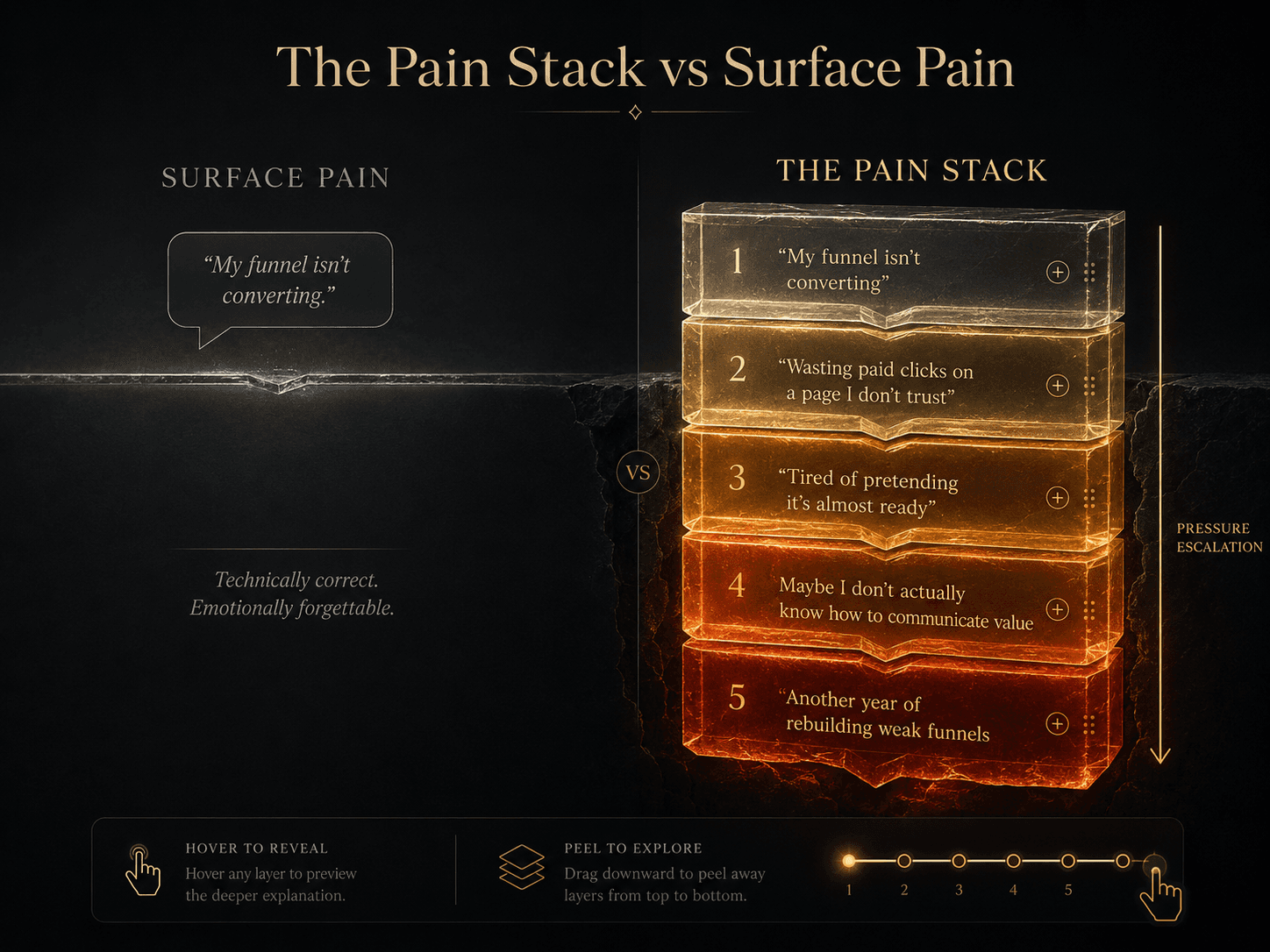
Surface Problem™
“My funnel is not converting.”
Clear.
But emotionally shallow.
It tells you what is happening at the surface.
It does not yet tell you what the problem is costing, how it feels, what it threatens, or why the buyer now cares enough to act.
Pressure™
“I keep sending paid traffic to a page I secretly do not trust, and every weak result makes me second-guess my own judgement more.”
Now the problem feels:
emotionally loaded
recognisable
psychologically real
commercially expensive
harder to ignore
The second version creates movement because it exposes pressure.
Not just category-level pain.
That is the difference.
Surface problems create awareness.
Pressure creates urgency.
Why This Matters™
Surface pain creates awareness.
Deep pressure creates urgency.
And urgency comes from:
operational cost
emotional cost
identity tension
accumulated frustration
future consequence
This is where strong messaging separates itself from generic copywriting.
The buyer does not move because the page says something technically true.
The buyer moves because the page names something they are already feeling — but have not seen clearly expressed yet.
That is recognition.
And recognition is where stronger messaging begins.
——
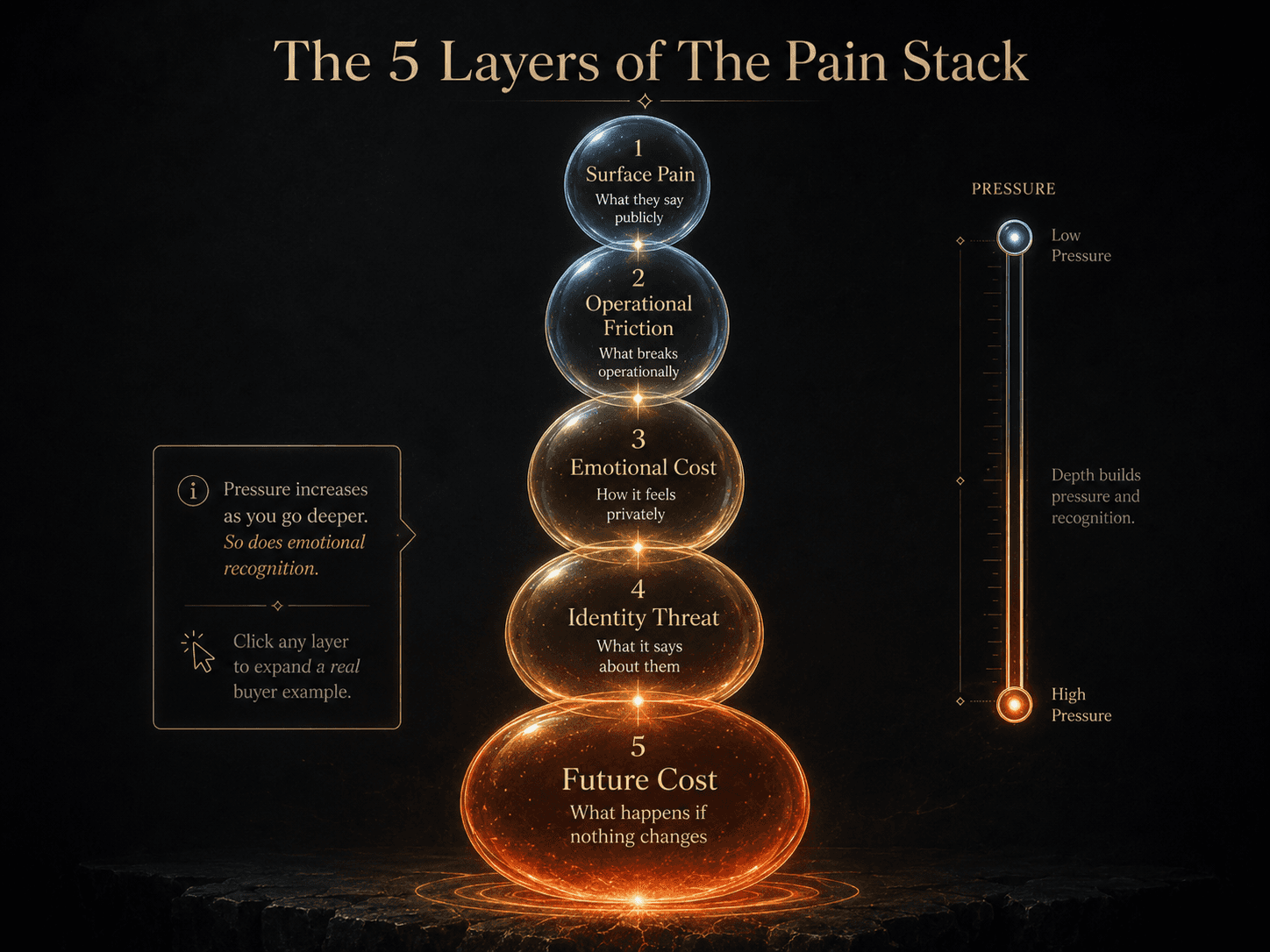
The 5 Layers Of The Pain Stack™
Every meaningful buyer problem usually exists across five psychological layers.
The deeper you go, the more useful the messaging becomes.
The five layers are:
Surface Pain™
Operational Friction™
Emotional Cost™
Identity Threat™
Future Cost™
Each layer reveals a different kind of pressure.
Together, they help you build messaging that feels:
sharper
more human
more emotionally accurate
more difficult to ignore
——
Layer 1: Surface Pain™
Core Question
What do they say publicly?
This is the polite version of the problem.
It is usually the first thing the buyer admits.
It is also the layer most weak copy stops at.
Examples
The buyer may say:
“I need more leads.”
“My funnel is not converting.”
“I need stronger messaging.”
“My launches keep underperforming.”
“My page is not working.”
“I need better copy.”
“I need clearer positioning.”
This layer creates basic recognition.
But not yet emotional depth.
Why This Layer Matters
You still need surface pain.
Surface pain helps the buyer recognise the category of the problem.
It gives the page orientation.
It helps the buyer understand:
“This is about the kind of problem I have.”
But if your messaging stops here, it usually feels broad and interchangeable.
Surface pain is the entrance.
Not the whole argument.
Fill This In
The buyer says the problem is:
The polite version of the problem is:
The public problem they would admit is:
The broad category of the problem is:
Use This Layer For
Use Surface Pain™ for:
page orientation
SEO-friendly phrasing
category clarity
basic headline context
simple offer explanation
But do not stop here.
Surface pain helps the buyer understand.
Deeper pressure helps the buyer care.
——
Layer 2: Operational Friction™
Core Question
What is this problem creating operationally?
Now we move from the polite problem into real-world consequences.
Operational friction shows what the problem is doing to the buyer’s time, money, workflow, decision-making, or momentum.
Operational Friction Can Include
wasted ad spend
lost time
stalled launches
weak sales calls
poor conversion
delayed decisions
repeated rewrites
inconsistent pipeline
too many unqualified leads
low trust before the CTA
constant second-guessing
more effort without more movement
Example
Surface Problem:
“My page is not converting.”
Operational Friction:
“I keep wasting paid clicks on a page that still cannot hold belief long enough to generate action.”
Now the problem feels more expensive.
More active.
More urgent.
The buyer is not just dealing with “low conversion.”
They are watching money and momentum leak through the page.
Why This Layer Matters
Operational friction creates visible consequence.
It shows the cost of the problem in practical terms.
The buyer starts to feel:
“This is not just annoying. This is costing me.”
That increases pressure dramatically.
Fill This In
This problem is costing the buyer:
This problem is wasting:
This problem is slowing down:
This problem is creating friction in:
The practical consequence is:
Use This Layer For
Use Operational Friction™ for:
problem bullets
first-scroll copy
stakes
cost-of-inaction messaging
offer framing
urgency
diagnostic sections
Operational friction makes the problem feel tangible.
——
Layer 3: Emotional Cost™
Core Question
How does this problem make them feel privately?
This is where the pain becomes more human.
The buyer may not say this openly.
But they feel it.
Emotional Cost Can Include
frustration
anxiety
shame
embarrassment
exhaustion
resentment
irritation
self-doubt
emotional fatigue
low-level dread
loss of confidence
Example
Operational Friction:
“The page keeps underperforming.”
Emotional Cost:
“I am tired of pretending the funnel is almost ready when deep down I still do not trust it.”
Now the copy starts feeling emotionally accurate.
The problem is no longer only about conversion.
It is about what the repeated underperformance is doing to the buyer internally.
Why This Layer Matters
Emotion creates recognition.
Buyers rarely move because of logic alone.
They move because unresolved emotional pressure becomes difficult to tolerate.
When copy names the emotional cost accurately, the buyer feels:
“This person understands what this is actually like.”
That feeling creates attention.
Important Note
Do not exaggerate emotional cost.
Do not invent drama.
Do not force intensity where it does not exist.
Extract emotional cost from real buyer language.
The strongest emotional copy does not sound theatrical.
It sounds true.
Fill This In
This problem makes the buyer feel:
The private emotional cost is:
They are tired of feeling:
They may not admit it publicly, but this creates:
Use This Layer For
Use Emotional Cost™ for:
emotionally accurate hooks
opening paragraphs
problem expansion
buyer recognition
deeper resonance
empathy sections
Emotional cost makes the message feel personal.
——
Layer 4: Identity Threat™
Core Question
What does this problem seem to say about them?
This is one of the deepest conversion layers.
Because people protect identity harder than logic.
The buyer is not only dealing with a practical problem.
They are also dealing with what the problem seems to imply about them.
Identity Threat Can Sound Like
“Maybe I am behind.”
“Maybe I should be better at this by now.”
“Maybe I am not as capable as I thought.”
“Maybe everyone else understands something I still do not.”
“Maybe I do not know how to communicate value clearly.”
“Maybe my judgement is weaker than I thought.”
“Maybe this business is not as strong as it looks from the outside.”
This is where copy starts sounding dangerously accurate.
Not because it is aggressive.
Because it touches the meaning underneath the problem.
Example
Emotional Cost:
“I feel frustrated.”
Identity Threat:
“I am starting to wonder whether I actually know how to communicate value clearly at all.”
Now the problem affects self-image.
That changes the emotional intensity completely.
The issue is no longer just:
“The page is not converting.”
It becomes:
“What does this say about my ability to explain what I do?”
That is a much deeper pressure point.
Why Identity Threat Is So Powerful
Most meaningful buyer problems eventually become identity problems.
A founder does not only want better copy.
They want to stop feeling like someone who still cannot explain the value clearly.
A coach does not only want more calls.
They want to stop feeling like people like their content but do not trust them enough to buy.
A SaaS founder does not only want better activation.
They want to stop wondering whether people like the idea but do not find the product valuable enough to keep using.
Identity threat creates emotional force.
Use it carefully.
Use it respectfully.
Use it with precision.
Fill This In
This problem makes the buyer wonder:
This problem seems to say:
The identity threat underneath the problem is:
They do not want to remain the kind of person who:
They want to become the kind of person who:
Use This Layer For
Use Identity Threat™ for:
deeper page messaging
premium positioning
transformation copy
belief-shift sections
closing arguments
identity-based hooks
high-intent sales pages
Identity threat is powerful.
Do not overuse it.
One accurate line can carry more force than five dramatic paragraphs.
——
Layer 5: Future Cost™
Core Question
What happens if nothing changes?
This layer activates future consequence.
And future consequence creates movement.
Most buyers delay action because the future cost still feels abstract.
Strong messaging makes future pain visible, concrete, and emotionally immediate.
Without fake scarcity.
Future Cost Can Include
more wasted spend
another failed launch
more lost time
weaker confidence
more hesitation
competitors moving faster
another year of guessing
more traffic sent into a weak page
more content that gets attention but not trust
more sales calls that feel promising but go nowhere
Example
Identity Threat:
“I feel like I am still guessing.”
Future Cost:
“If this keeps going, I will waste another year rebuilding pages without ever fixing the real problem underneath them.”
Now the buyer feels trajectory risk.
The future becomes more visible.
And when the future cost becomes visible, urgency becomes more honest.
Why This Layer Matters
Future cost is not fake scarcity.
It is the natural consequence of the current problem continuing.
The point is not to scare the buyer artificially.
The point is to show the real cost of delay.
If nothing changes, what keeps repeating?
That is the question.
Fill This In
If nothing changes, the buyer will keep:
The future cost is:
The repeated pattern they fear is:
The longer-term consequence is:
The cost of delay is:
Use This Layer For
Use Future Cost™ for:
urgency
closing sections
CTA support
objection handling
cost-of-inaction copy
decision-point copy
final page arguments
Future cost makes action feel more important without relying on fake pressure.
——
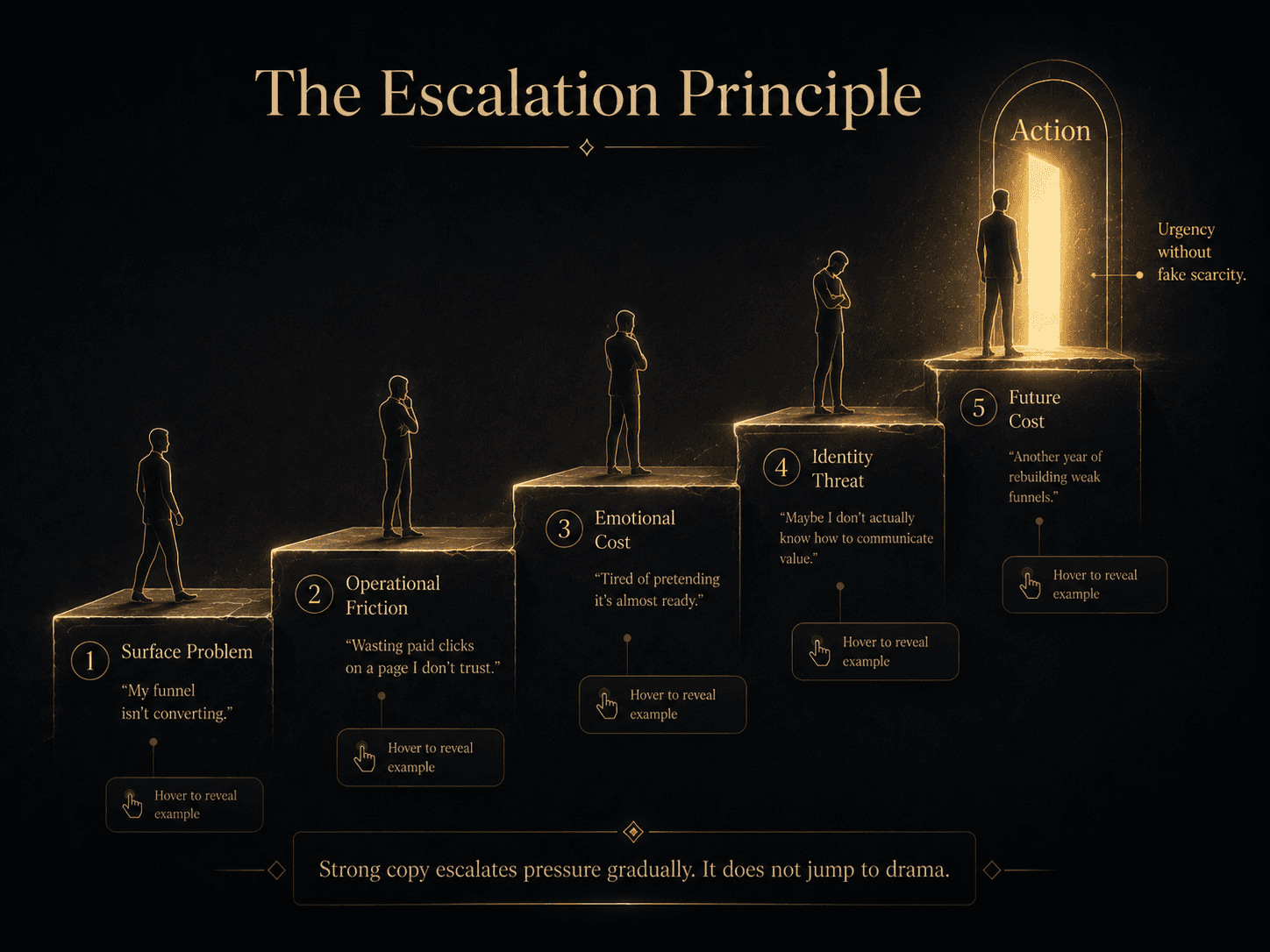
The Escalation Principle™
Strong copy usually deepens pressure progressively.
It does not immediately jump into dramatic emotional intensity.
That feels manipulative.
Instead, strong messaging escalates gradually.
Like this:
Surface Problem → Operational Friction → Emotional Cost → Identity Threat → Future Cost
This progression feels:
natural
believable
grounded
emotionally honest
psychologically realistic
The page should not begin by attacking the buyer’s deepest fear.
It should guide them there carefully.
Start with the problem they recognise.
Then show what it costs.
Then show how it feels.
Then show what it starts meaning.
Then show what continues if nothing changes.
That is how pressure builds without melodrama.
——
Weak Pain vs Deep Pain™
Use these examples to see the difference between shallow problem language and deeper pressure-based messaging.
Example 1: Funnel Conversion
Weak Pain:
“Your funnel is not converting.”
Deeper Version:
“Every weak launch quietly reinforces the fear that the page still does not communicate the value clearly enough to justify the clicks.”
Why it works:
The deeper version touches operational pain, emotional pressure, identity tension, and future concern.
Example 2: Messaging
Weak Pain:
“You need better messaging.”
Deeper Version:
“You are tired of rewriting the page every month and still feeling hesitant to send serious traffic to it.”
Why it works:
The deeper version names the repeated behaviour and the emotional hesitation underneath it.
Example 3: Agency Pipeline
Weak Pain:
“You need more leads.”
Deeper Version:
“You are tired of starting every month wondering whether enough qualified conversations will show up.”
Why it works:
The deeper version turns a broad lead problem into a recognisable business pressure.
Example 4: SaaS Activation
Weak Pain:
“Your onboarding needs improvement.”
Deeper Version:
“Users are signing up, clicking around once, and disappearing before they ever feel the product’s value.”
Why it works:
The deeper version creates a visible moment of failure.
Example 5: Ecommerce Conversion
Weak Pain:
“You need more sales.”
Deeper Version:
“Your ads are getting the clicks, but the product page is not creating enough trust to carry the sale.”
Why it works:
The deeper version separates traffic from conversion and shows where the pressure lives.
Example 6: Coaching Sales
Weak Pain:
“You need more clients.”
Deeper Version:
“You are having calls that feel promising in the moment, then watching the buyer disappear into ‘I’ll think about it.’”
Why it works:
The deeper version captures a repeated emotional moment coaches recognise instantly.
——
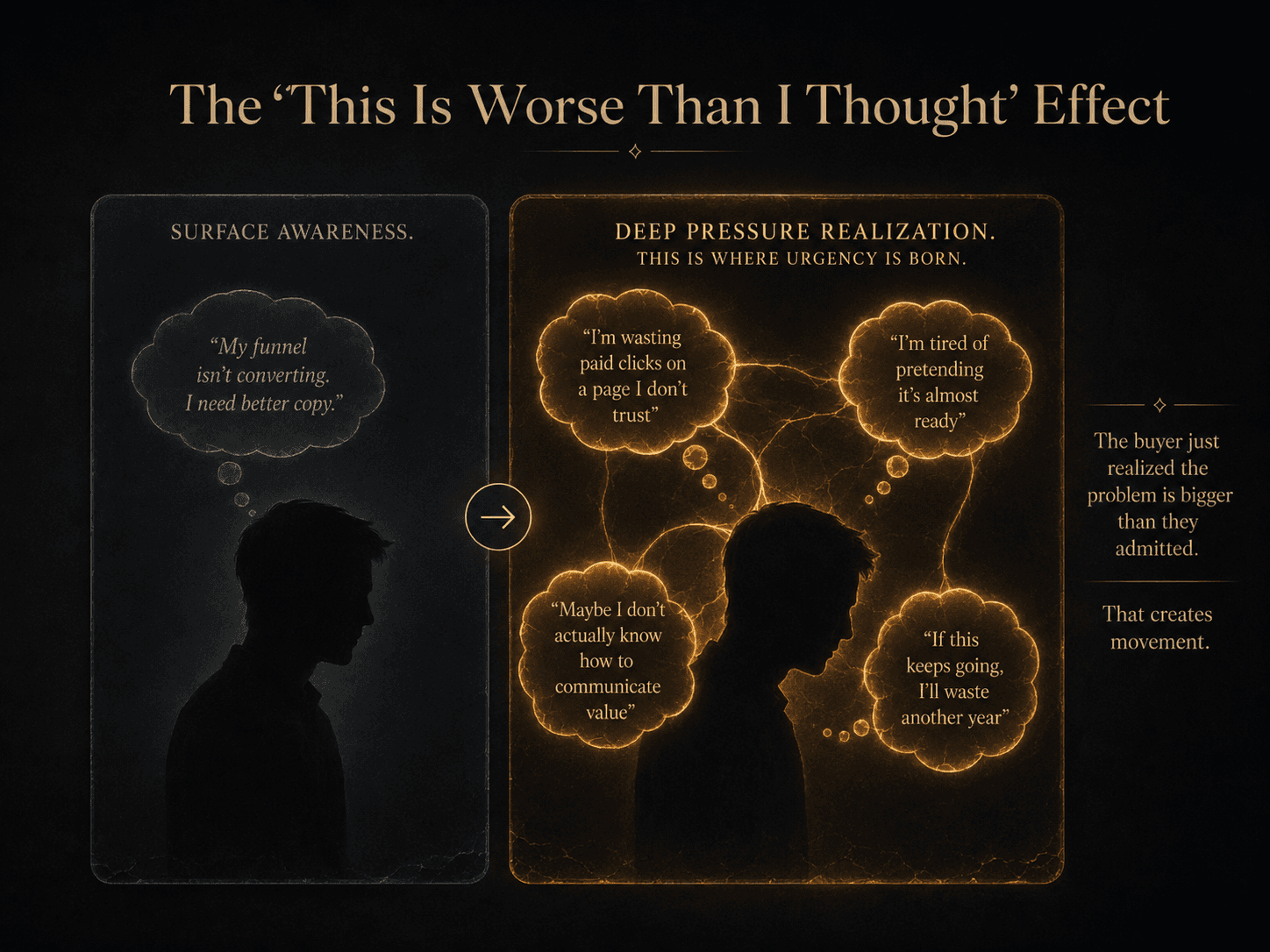
The “This Is Worse Than I Thought” Effect™
One of the strongest moments in copy happens when the buyer suddenly realises:
“This problem is affecting more than I admitted.”
That realisation increases:
urgency
attention
emotional openness
willingness to continue
desire for diagnosis
Because now the problem no longer feels isolated.
It feels:
expensive
personal
active
connected to a larger pattern
This is why deep pain work matters.
The goal is not to scare the buyer artificially.
The goal is to reveal the true cost they may already be feeling but have not clearly named.
Good copy does not invent the pressure.
It makes the existing pressure visible.
——
The Future Cost Engine™
Future cost is one of the most underused forces in copy.
Weak future framing sounds like:
“Improve results.”
“Get more leads.”
“Increase growth.”
“Scale faster.”
“Boost performance.”
Emotionally soft.
Too vague.
Too abstract.
Stronger future cost makes the continuation of the problem visible.
——
Future Cost Template
Use this structure:
“If this keeps happening, you will keep ______ while ______.”
Example:
“If this keeps happening, you will keep rebuilding the same uncertainty in slightly prettier layouts.”
Another example:
“If this keeps happening, you will keep sending paid clicks into a page that still cannot hold belief.”
Another example:
“If this keeps happening, you will keep mistaking traffic problems for messaging problems.”
Future cost works when it shows what delay actually preserves.
Not what the buyer loses in theory.
What they keep tolerating in practice.
——
The Pressure Translation Layer™
The Pain Stack should directly influence the page.
If the stack does not change the copy, it is only research theatre.
Each pain layer should translate into a different part of the page.
Surface Pain™ → Headline Context
Use this to orient the buyer.
Example:
“If your funnel is not converting…”
This makes the page category clear.
Operational Friction™ → Problem Bullets
Use this to show the practical cost.
Example:
“You are paying for traffic, but the page is not holding belief long enough to create action.”
This makes the problem tangible.
Emotional Cost™ → Opening Section
Use this to make the buyer feel recognised.
Example:
“The frustrating part is not only that the page is underperforming. It is that you keep fixing pieces of it without knowing what is actually broken.”
This makes the copy feel human.
Identity Threat™ → Deeper Resonance
Use this carefully to show what the problem seems to mean.
Example:
“At some point, the page stops feeling like a page problem and starts making you question your own judgement.”
This creates depth.
Future Cost™ → Urgency And CTA Support
Use this to show why delay matters.
Example:
“Before you send another campaign into the same uncertainty, diagnose where belief is collapsing.”
This creates movement.
——
Full Pain Stack Example™
Here is how one surface problem becomes a full messaging system.
Surface Problem™
“My page is not converting.”
Operational Friction™
Paid traffic is landing, but the page is not holding attention or belief long enough to generate action.
The buyer is wasting clicks and delaying confident scaling.
Emotional Cost™
They feel frustrated, hesitant, and tired of calling the page “almost ready” when they still do not trust it.
Identity Threat™
They are starting to wonder whether the problem is not the page, but their ability to judge what clear messaging actually looks like.
Future Cost™
If nothing changes, they will keep sending traffic into a page that quietly leaks trust before the offer gets a fair chance.
Headline Built From The Stack
“Still Sending Paid Traffic To A Page You Quietly Do Not Trust?”
Subheadline Built From The Stack
“If cold visitors land, hesitate, and disappear before belief forms, the problem may not be traffic. It may be the psychological pressure your page fails to create.”
Problem Bullets Built From The Stack
Paid clicks keep landing, but trust does not form fast enough.
The page looks finished, but something still feels weak.
Every underperforming campaign makes the message harder to trust.
The real leak may be happening before the buyer even reaches the offer.
CTA Built From The Stack
“Find The Conversion Leak.”
CTA Microcopy Built From The Stack
“Diagnose where belief is breaking before you spend more on traffic.”
——
Building A Full Pain Stack™
Use this process to build your own stack.
Step 1: Identify The Surface Problem
What does the buyer say is wrong?
Write the public version.
Surface problem:
Step 2: Identify The Operational Friction
What does this problem break, delay, waste, or complicate?
Operational friction:
Step 3: Identify The Emotional Cost
How does this problem make the buyer feel privately?
Emotional cost:
Step 4: Identify The Identity Threat
What does this problem seem to say about them?
Identity threat:
Step 5: Identify The Future Cost
What happens if nothing changes?
Future cost:
Step 6: Translate The Stack Into Copy
Use the stack to create:
headlines
hooks
subheadlines
problem bullets
proof angles
CTA language
objection handling
Do not let the Pain Stack stay in your notes.
Move it onto the page.
——
Final Pain Stack Output™
By the end, you should have:
one complete five-layer Pain Stack
three headline angles
three hook angles
three problem bullets
one future-cost line
one CTA direction
one proof need
one objection-handling angle
This gives you enough pressure-based material to strengthen almost any weak page.
——
The Pain Stack Extraction Process™
You can extract deeper pain from real buyer language.
Useful sources include:
sales calls
reviews
support tickets
Reddit threads
YouTube comments
DMs
intake forms
competitor reviews
discovery calls
testimonials
one-star reviews
customer surveys
Listen for:
frustration language
shame language
hesitation
future fear
identity tension
repeated emotional patterns
failed attempts
phrases that sound like private thoughts
The deeper the emotional realism, the stronger the messaging becomes.
But keep this grounded.
Do not invent emotional pain.
Find it.
Then translate it.
——
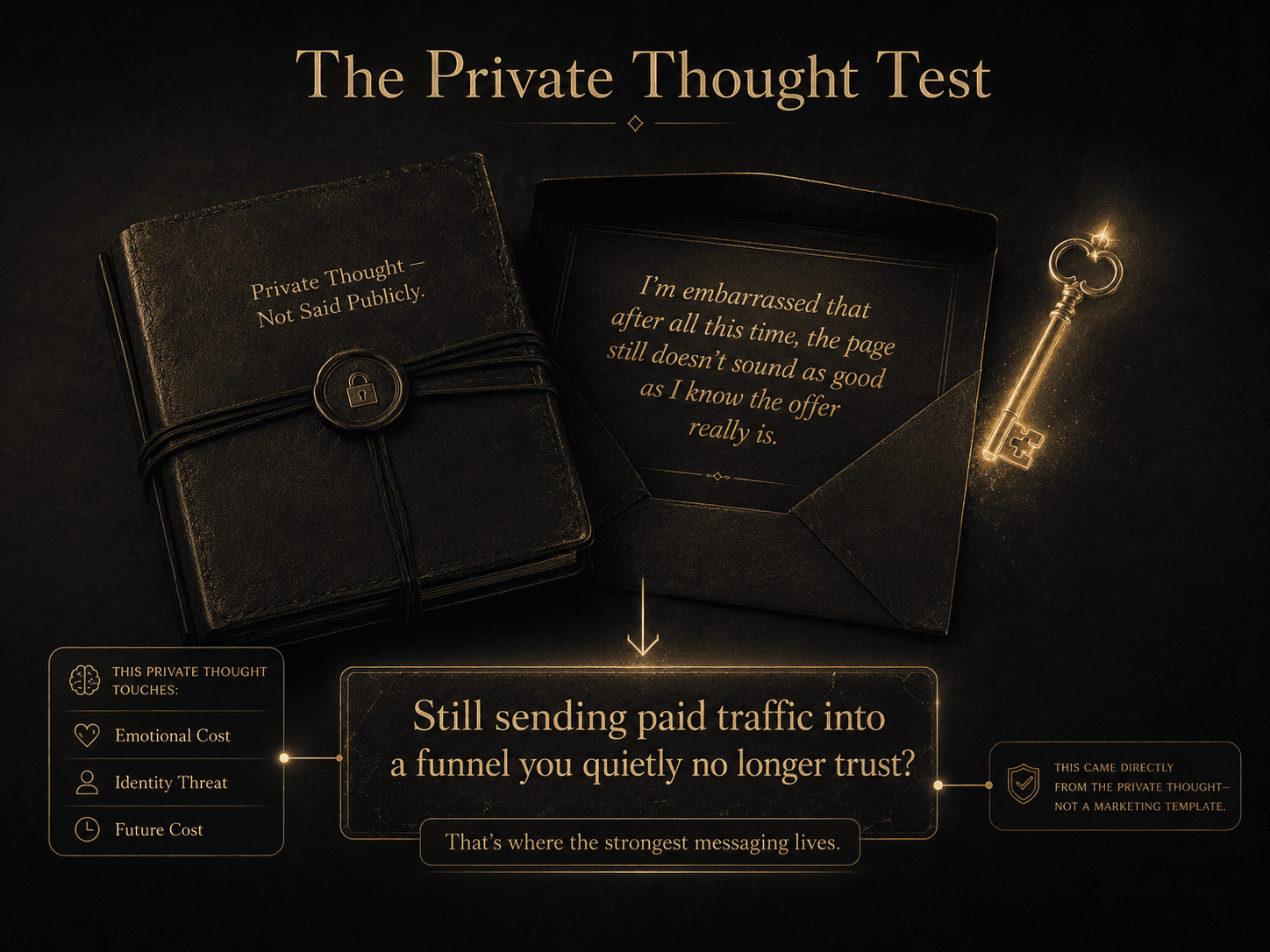
The Private Thought Test™
Ask this question:
“What is the thought the buyer would admit privately but not publicly?”
That answer often reveals the strongest emotional pressure in the entire stack.
Examples:
Public statement:
“My page is not converting.”
Private thought:
“Maybe I do not actually know how to explain why people should care.”
Public statement:
“I need more leads.”
Private thought:
“I hate that I am still relying on referrals and hoping enough people show up each month.”
Public statement:
“I need better onboarding.”
Private thought:
“Maybe people like the idea, but the product is not valuable enough for them to stick.”
Public statement:
“My ads are not profitable.”
Private thought:
“What if the ads are not the issue? What if the page is losing the sale?”
Fill This In
The buyer publicly says:
The private thought underneath is:
The emotional pressure inside that thought is:
A headline inspired by this private thought is:
Pain Stack Scorecard™
Use this to check how deep your messaging currently goes.
Score each section from 1 to 5.
1 = missing or very weak
2 = shallow
3 = present but not strong
4 = clear and useful
5 = emotionally precise and copy-ready
Surface Pain Clarity: ___ / 5
Operational Friction: ___ / 5
Emotional Cost: ___ / 5
Identity Threat: ___ / 5
Future Cost: ___ / 5
Total Pain Stack Score: ___ / 25
——
What Your Score Means
22–25: Strong Pain Stack
You have enough depth to create emotionally precise messaging.
Begin translating the stack into copy.
17–21: Useful But Needs Sharpening
The stack is usable, but one or two layers are weak.
Strengthen the lowest-scoring layers before rewriting the page.
10–16: Shallow Pressure
The copy may sound clear, but it probably will not create enough recognition.
Go deeper into emotional cost, identity threat, or future cost.
0–9: Surface-Level Messaging
The pain is too shallow.
You are likely writing from the polite problem, not the real pressure.
Do not write the page yet.
Gather more buyer language and rebuild the stack.
——
Using AI To Build Deeper Pain Stacks™
AI becomes dramatically more useful when paired with real buyer psychology and real buyer language.
You can use any capable AI tool to organise, deepen, and translate your Pain Stack.
If you are using Funnels By Maris Spalins™, the prompts are designed to work especially well with the frameworks, principles, and buyer psychology systems explored throughout The $100M Funnel Playbook.
AI can help you:
deepen shallow pain statements
identify identity tension
expose future consequence
translate pain into messaging
strengthen emotional specificity
identify weak phrasing
generate pressure-based headline variations
pressure-test messaging depth
But the rule is simple:
Do not use AI to invent emotional pain.
Use AI to organise and sharpen real buyer evidence.
——
Pain Stack AI Prompt™
Use this prompt after you have collected buyer language or identified a buyer problem.
Act as a conversion strategist trained in buyer psychology and pressure-based messaging.
Build a Pain Stack for the following buyer problem:
Surface problem:
[insert problem]
Target buyer:
[insert buyer]
Available buyer language or research:
[paste buyer language]
Build the stack across five layers:
Surface Pain™ — what the buyer says publicly.
Operational Friction™ — what the problem costs in time, money, workflow, or momentum.
Emotional Cost™ — how the problem feels privately.
Identity Threat™ — what the problem seems to say about the buyer.
Future Cost™ — what happens if nothing changes.
For each layer, give me:
the strongest insight
exact buyer language where available
what this means psychologically
how it could influence the copy
Then generate:
three headline angles
three hook angles
three problem bullets
one future-cost line
one CTA direction
one proof need
Do not exaggerate.
Do not invent buyer quotes.
Do not fabricate emotional pain.
Use only the research provided and reasonable psychological inference.
——
The Biggest Pain Stack Mistake™
Most people stop at the polite problem.
They identify the symptom.
But not the emotional chain reaction underneath it.
They know:
“The page is not converting.”
But not:
what that is costing operationally
how it feels emotionally
what it makes the buyer question about themselves
what future the buyer fears if it continues
That is why so much copy feels technically acceptable but emotionally weak.
Because shallow pain creates shallow relevance.
And shallow relevance creates forgettable copy.
The goal is not to make the copy darker.
The goal is to make it deeper.
More accurate.
More recognisable.
More connected to the buyer’s actual reality.
——
Quick Pain Stack Rebuild Exercise™
Use this when your copy feels flat, vague, or too polite.
My Buyer
Surface Problem
What do they say publicly?
Operational Friction
What does this problem cost, waste, delay, or complicate?
Emotional Cost
How does this make them feel privately?
Identity Threat
What does this problem seem to say about them?
Future Cost
What happens if nothing changes?
Strongest Private Thought
What would they admit privately but not publicly?
Headline Angle
What headline could come from this stack?
Hook Angle
What opening hook could come from this stack?
CTA Angle
What action would feel relevant to this pressure?
Proof Need
What evidence would reduce doubt?
Objection-Handling Angle
What scepticism should the page address?
——
The Pain Stack To Page Copy Bridge™
Once the stack is complete, translate it into page copy.
Headline
Use Surface Pain™, Operational Friction™, or Hidden Pressure.
My headline:
Opening Hook
Use Emotional Cost™ or the strongest Private Thought.
My opening hook:
Problem Bullets
Use Operational Friction™.
My problem bullets:
Deeper Resonance Line
Use Identity Threat™ carefully.
My deeper resonance line:
Future-Cost Line
Use Future Cost™.
My future-cost line:
CTA
Use the desired relief or next diagnostic step.
My CTA:
CTA Microcopy
Use the future cost or reassurance.
My CTA microcopy:
——
Final Principle™
Buyers rarely move because of the visible problem alone.
They move because of:
what the problem is costing operationally
how it feels emotionally
what it threatens psychologically
what it starts meaning about them
what future it seems to create
The deeper the pressure becomes, the stronger recognition becomes.
And recognition is what makes messaging feel personal, sharp, and difficult to ignore.
That is what The Pain Stack Builder™ is designed to help you uncover.
Take one weak headline today.
Rebuild it through all five Pain Stack layers.
Then compare the original version to the pressure-based version.
You will feel the difference immediately.
Surface copy informs.
Pressure-based copy creates recognition.
And recognition is where real buyer movement begins.
——
From:
The $100M Funnel Playbook. Book I: Foundation Buyer Psychology, Offer Clarity, and the Page Architecture Behind High-Converting Funnels
By Maris Spalins.
——
Copyright Notice
© 2026 The $100M Funnel Playbook / Winyourclients / Maris Spalins. All rights reserved.
This resource, including the frameworks, terminology, examples, scorecards, templates, prompts, methods, and written explanations, is original intellectual property created for The $100M Funnel Playbook. Book I: Foundation — Buyer Psychology, Offer Clarity, And The Page Architecture Behind High-Converting Funnels and published through Winyourclients.
No part of this resource may be copied, reproduced, screenshotted, republished, redistributed, sold, adapted, uploaded, scraped, stored in a database, included in training data, used to train artificial intelligence systems, or used to create derivative commercial or educational materials without prior written permission.
Limited reference, quotation, or sharing is only permitted where the source is clearly and visibly credited.
Any permitted reference must include at least one of the following source credits:
The $100M Funnel Playbook by Maris Spalins
or
Winyourclients — www.winyourclients.com
or
Maris Spalins / Winyourclients
Screenshots, excerpts, summaries, or redistributed versions must not remove, hide, alter, crop out, or obscure the original source, author name, book title, website name, or copyright notice.
This resource is provided for personal learning and implementation only. It is not licensed for resale, republishing, redistribution, AI training, template cloning, course creation, consulting delivery, or commercial reuse without written permission from Maris Spalins or Winyourclients.
For permission requests, licensing, citation approval, or commercial usage enquiries, contact:
Winyourclients
www.winyourclients.com
or
Email directly to Jacob on: help@winyourclients.com
The Pain Stack Builder™ A five-layer pressure mapping worksheet for turning surface buyer problems into emotionally precise headlines, hooks, CTAs, and page copy that creates real buyer recognition.
Prefer Audio Or Video?
The Pain Stack Builder™ is also available as:
🎧 A guided audio walkthrough explaining emotional pressure, identity tension, and layered buyer psychology
🎥 A practical video breakdown with real pain-stack examples, messaging rewrites, and depth-building exercisesChoose the format that fits how you learn best.
[Listen To The Audio Walkthrough] (coming soon)
[Watch The Video Breakdown] (coming soon)
——
Why Most Pain-Based Copy Still Feels Weak
Most marketing copy talks about problems.
Very little copy talks about pressure.
That distinction changes everything.
Weak copy usually says things like:
“Need more leads?”
“Want better conversions?”
“Struggling with messaging?”
“Trying to grow your business?”
“Ready to improve your funnel?”
Technically understandable.
Emotionally forgettable.
Because buyers do not experience problems as neat marketing summaries.
They experience:
frustration
pressure
uncertainty
embarrassment
exhaustion
self-doubt
identity tension
future fear
That is why so much copy sounds correct but powerless.
It names the visible problem.
But it does not expose the emotional chain reaction underneath it.
That is what The Pain Stack Builder™ is designed to uncover.
It helps you move from polite problem language to emotionally precise messaging that makes the buyer feel recognised.
——
What This Resource Helps You Do
The Pain Stack Builder™ helps you deepen shallow buyer pain into usable messaging pressure.
Use it to create:
sharper headlines
stronger hooks
more emotionally accurate subheadlines
better problem sections
stronger CTA angles
deeper objection handling
more relevant proof framing
more urgent page copy without fake scarcity
This resource is not about making copy more dramatic.
It is about making it more accurate.
The goal is not to exaggerate the buyer’s pain.
The goal is to understand how deep the problem actually goes.
Because shallow pain creates shallow relevance.
And shallow relevance creates forgettable copy.
——
Problems vs Pressure™
Most buyers describe the polite version of the issue first.
Not the truth underneath it.
That is why the first version of the problem is rarely enough.
Surface Problem™
“My funnel is not converting.”
Clear.
But emotionally shallow.
It tells you what is happening at the surface.
It does not yet tell you what the problem is costing, how it feels, what it threatens, or why the buyer now cares enough to act.
Pressure™
“I keep sending paid traffic to a page I secretly do not trust, and every weak result makes me second-guess my own judgement more.”
Now the problem feels:
emotionally loaded
recognisable
psychologically real
commercially expensive
harder to ignore
The second version creates movement because it exposes pressure.
Not just category-level pain.
That is the difference.
Surface problems create awareness.
Pressure creates urgency.
Why This Matters™
Surface pain creates awareness.
Deep pressure creates urgency.
And urgency comes from:
operational cost
emotional cost
identity tension
accumulated frustration
future consequence
This is where strong messaging separates itself from generic copywriting.
The buyer does not move because the page says something technically true.
The buyer moves because the page names something they are already feeling — but have not seen clearly expressed yet.
That is recognition.
And recognition is where stronger messaging begins.
——
The 5 Layers Of The Pain Stack™
Every meaningful buyer problem usually exists across five psychological layers.
The deeper you go, the more useful the messaging becomes.
The five layers are:
Surface Pain™
Operational Friction™
Emotional Cost™
Identity Threat™
Future Cost™
Each layer reveals a different kind of pressure.
Together, they help you build messaging that feels:
sharper
more human
more emotionally accurate
more difficult to ignore
——
Layer 1: Surface Pain™
Core Question
What do they say publicly?
This is the polite version of the problem.
It is usually the first thing the buyer admits.
It is also the layer most weak copy stops at.
Examples
The buyer may say:
“I need more leads.”
“My funnel is not converting.”
“I need stronger messaging.”
“My launches keep underperforming.”
“My page is not working.”
“I need better copy.”
“I need clearer positioning.”
This layer creates basic recognition.
But not yet emotional depth.
Why This Layer Matters
You still need surface pain.
Surface pain helps the buyer recognise the category of the problem.
It gives the page orientation.
It helps the buyer understand:
“This is about the kind of problem I have.”
But if your messaging stops here, it usually feels broad and interchangeable.
Surface pain is the entrance.
Not the whole argument.
Fill This In
The buyer says the problem is:
The polite version of the problem is:
The public problem they would admit is:
The broad category of the problem is:
Use This Layer For
Use Surface Pain™ for:
page orientation
SEO-friendly phrasing
category clarity
basic headline context
simple offer explanation
But do not stop here.
Surface pain helps the buyer understand.
Deeper pressure helps the buyer care.
——
Layer 2: Operational Friction™
Core Question
What is this problem creating operationally?
Now we move from the polite problem into real-world consequences.
Operational friction shows what the problem is doing to the buyer’s time, money, workflow, decision-making, or momentum.
Operational Friction Can Include
wasted ad spend
lost time
stalled launches
weak sales calls
poor conversion
delayed decisions
repeated rewrites
inconsistent pipeline
too many unqualified leads
low trust before the CTA
constant second-guessing
more effort without more movement
Example
Surface Problem:
“My page is not converting.”
Operational Friction:
“I keep wasting paid clicks on a page that still cannot hold belief long enough to generate action.”
Now the problem feels more expensive.
More active.
More urgent.
The buyer is not just dealing with “low conversion.”
They are watching money and momentum leak through the page.
Why This Layer Matters
Operational friction creates visible consequence.
It shows the cost of the problem in practical terms.
The buyer starts to feel:
“This is not just annoying. This is costing me.”
That increases pressure dramatically.
Fill This In
This problem is costing the buyer:
This problem is wasting:
This problem is slowing down:
This problem is creating friction in:
The practical consequence is:
Use This Layer For
Use Operational Friction™ for:
problem bullets
first-scroll copy
stakes
cost-of-inaction messaging
offer framing
urgency
diagnostic sections
Operational friction makes the problem feel tangible.
——
Layer 3: Emotional Cost™
Core Question
How does this problem make them feel privately?
This is where the pain becomes more human.
The buyer may not say this openly.
But they feel it.
Emotional Cost Can Include
frustration
anxiety
shame
embarrassment
exhaustion
resentment
irritation
self-doubt
emotional fatigue
low-level dread
loss of confidence
Example
Operational Friction:
“The page keeps underperforming.”
Emotional Cost:
“I am tired of pretending the funnel is almost ready when deep down I still do not trust it.”
Now the copy starts feeling emotionally accurate.
The problem is no longer only about conversion.
It is about what the repeated underperformance is doing to the buyer internally.
Why This Layer Matters
Emotion creates recognition.
Buyers rarely move because of logic alone.
They move because unresolved emotional pressure becomes difficult to tolerate.
When copy names the emotional cost accurately, the buyer feels:
“This person understands what this is actually like.”
That feeling creates attention.
Important Note
Do not exaggerate emotional cost.
Do not invent drama.
Do not force intensity where it does not exist.
Extract emotional cost from real buyer language.
The strongest emotional copy does not sound theatrical.
It sounds true.
Fill This In
This problem makes the buyer feel:
The private emotional cost is:
They are tired of feeling:
They may not admit it publicly, but this creates:
Use This Layer For
Use Emotional Cost™ for:
emotionally accurate hooks
opening paragraphs
problem expansion
buyer recognition
deeper resonance
empathy sections
Emotional cost makes the message feel personal.
——
Layer 4: Identity Threat™
Core Question
What does this problem seem to say about them?
This is one of the deepest conversion layers.
Because people protect identity harder than logic.
The buyer is not only dealing with a practical problem.
They are also dealing with what the problem seems to imply about them.
Identity Threat Can Sound Like
“Maybe I am behind.”
“Maybe I should be better at this by now.”
“Maybe I am not as capable as I thought.”
“Maybe everyone else understands something I still do not.”
“Maybe I do not know how to communicate value clearly.”
“Maybe my judgement is weaker than I thought.”
“Maybe this business is not as strong as it looks from the outside.”
This is where copy starts sounding dangerously accurate.
Not because it is aggressive.
Because it touches the meaning underneath the problem.
Example
Emotional Cost:
“I feel frustrated.”
Identity Threat:
“I am starting to wonder whether I actually know how to communicate value clearly at all.”
Now the problem affects self-image.
That changes the emotional intensity completely.
The issue is no longer just:
“The page is not converting.”
It becomes:
“What does this say about my ability to explain what I do?”
That is a much deeper pressure point.
Why Identity Threat Is So Powerful
Most meaningful buyer problems eventually become identity problems.
A founder does not only want better copy.
They want to stop feeling like someone who still cannot explain the value clearly.
A coach does not only want more calls.
They want to stop feeling like people like their content but do not trust them enough to buy.
A SaaS founder does not only want better activation.
They want to stop wondering whether people like the idea but do not find the product valuable enough to keep using.
Identity threat creates emotional force.
Use it carefully.
Use it respectfully.
Use it with precision.
Fill This In
This problem makes the buyer wonder:
This problem seems to say:
The identity threat underneath the problem is:
They do not want to remain the kind of person who:
They want to become the kind of person who:
Use This Layer For
Use Identity Threat™ for:
deeper page messaging
premium positioning
transformation copy
belief-shift sections
closing arguments
identity-based hooks
high-intent sales pages
Identity threat is powerful.
Do not overuse it.
One accurate line can carry more force than five dramatic paragraphs.
——
Layer 5: Future Cost™
Core Question
What happens if nothing changes?
This layer activates future consequence.
And future consequence creates movement.
Most buyers delay action because the future cost still feels abstract.
Strong messaging makes future pain visible, concrete, and emotionally immediate.
Without fake scarcity.
Future Cost Can Include
more wasted spend
another failed launch
more lost time
weaker confidence
more hesitation
competitors moving faster
another year of guessing
more traffic sent into a weak page
more content that gets attention but not trust
more sales calls that feel promising but go nowhere
Example
Identity Threat:
“I feel like I am still guessing.”
Future Cost:
“If this keeps going, I will waste another year rebuilding pages without ever fixing the real problem underneath them.”
Now the buyer feels trajectory risk.
The future becomes more visible.
And when the future cost becomes visible, urgency becomes more honest.
Why This Layer Matters
Future cost is not fake scarcity.
It is the natural consequence of the current problem continuing.
The point is not to scare the buyer artificially.
The point is to show the real cost of delay.
If nothing changes, what keeps repeating?
That is the question.
Fill This In
If nothing changes, the buyer will keep:
The future cost is:
The repeated pattern they fear is:
The longer-term consequence is:
The cost of delay is:
Use This Layer For
Use Future Cost™ for:
urgency
closing sections
CTA support
objection handling
cost-of-inaction copy
decision-point copy
final page arguments
Future cost makes action feel more important without relying on fake pressure.
——
The Escalation Principle™
Strong copy usually deepens pressure progressively.
It does not immediately jump into dramatic emotional intensity.
That feels manipulative.
Instead, strong messaging escalates gradually.
Like this:
Surface Problem → Operational Friction → Emotional Cost → Identity Threat → Future Cost
This progression feels:
natural
believable
grounded
emotionally honest
psychologically realistic
The page should not begin by attacking the buyer’s deepest fear.
It should guide them there carefully.
Start with the problem they recognise.
Then show what it costs.
Then show how it feels.
Then show what it starts meaning.
Then show what continues if nothing changes.
That is how pressure builds without melodrama.
——
Weak Pain vs Deep Pain™
Use these examples to see the difference between shallow problem language and deeper pressure-based messaging.
Example 1: Funnel Conversion
Weak Pain:
“Your funnel is not converting.”
Deeper Version:
“Every weak launch quietly reinforces the fear that the page still does not communicate the value clearly enough to justify the clicks.”
Why it works:
The deeper version touches operational pain, emotional pressure, identity tension, and future concern.
Example 2: Messaging
Weak Pain:
“You need better messaging.”
Deeper Version:
“You are tired of rewriting the page every month and still feeling hesitant to send serious traffic to it.”
Why it works:
The deeper version names the repeated behaviour and the emotional hesitation underneath it.
Example 3: Agency Pipeline
Weak Pain:
“You need more leads.”
Deeper Version:
“You are tired of starting every month wondering whether enough qualified conversations will show up.”
Why it works:
The deeper version turns a broad lead problem into a recognisable business pressure.
Example 4: SaaS Activation
Weak Pain:
“Your onboarding needs improvement.”
Deeper Version:
“Users are signing up, clicking around once, and disappearing before they ever feel the product’s value.”
Why it works:
The deeper version creates a visible moment of failure.
Example 5: Ecommerce Conversion
Weak Pain:
“You need more sales.”
Deeper Version:
“Your ads are getting the clicks, but the product page is not creating enough trust to carry the sale.”
Why it works:
The deeper version separates traffic from conversion and shows where the pressure lives.
Example 6: Coaching Sales
Weak Pain:
“You need more clients.”
Deeper Version:
“You are having calls that feel promising in the moment, then watching the buyer disappear into ‘I’ll think about it.’”
Why it works:
The deeper version captures a repeated emotional moment coaches recognise instantly.
——
The “This Is Worse Than I Thought” Effect™
One of the strongest moments in copy happens when the buyer suddenly realises:
“This problem is affecting more than I admitted.”
That realisation increases:
urgency
attention
emotional openness
willingness to continue
desire for diagnosis
Because now the problem no longer feels isolated.
It feels:
expensive
personal
active
connected to a larger pattern
This is why deep pain work matters.
The goal is not to scare the buyer artificially.
The goal is to reveal the true cost they may already be feeling but have not clearly named.
Good copy does not invent the pressure.
It makes the existing pressure visible.
——
The Future Cost Engine™
Future cost is one of the most underused forces in copy.
Weak future framing sounds like:
“Improve results.”
“Get more leads.”
“Increase growth.”
“Scale faster.”
“Boost performance.”
Emotionally soft.
Too vague.
Too abstract.
Stronger future cost makes the continuation of the problem visible.
——
Future Cost Template
Use this structure:
“If this keeps happening, you will keep ______ while ______.”
Example:
“If this keeps happening, you will keep rebuilding the same uncertainty in slightly prettier layouts.”
Another example:
“If this keeps happening, you will keep sending paid clicks into a page that still cannot hold belief.”
Another example:
“If this keeps happening, you will keep mistaking traffic problems for messaging problems.”
Future cost works when it shows what delay actually preserves.
Not what the buyer loses in theory.
What they keep tolerating in practice.
——
The Pressure Translation Layer™
The Pain Stack should directly influence the page.
If the stack does not change the copy, it is only research theatre.
Each pain layer should translate into a different part of the page.
Surface Pain™ → Headline Context
Use this to orient the buyer.
Example:
“If your funnel is not converting…”
This makes the page category clear.
Operational Friction™ → Problem Bullets
Use this to show the practical cost.
Example:
“You are paying for traffic, but the page is not holding belief long enough to create action.”
This makes the problem tangible.
Emotional Cost™ → Opening Section
Use this to make the buyer feel recognised.
Example:
“The frustrating part is not only that the page is underperforming. It is that you keep fixing pieces of it without knowing what is actually broken.”
This makes the copy feel human.
Identity Threat™ → Deeper Resonance
Use this carefully to show what the problem seems to mean.
Example:
“At some point, the page stops feeling like a page problem and starts making you question your own judgement.”
This creates depth.
Future Cost™ → Urgency And CTA Support
Use this to show why delay matters.
Example:
“Before you send another campaign into the same uncertainty, diagnose where belief is collapsing.”
This creates movement.
——
Full Pain Stack Example™
Here is how one surface problem becomes a full messaging system.
Surface Problem™
“My page is not converting.”
Operational Friction™
Paid traffic is landing, but the page is not holding attention or belief long enough to generate action.
The buyer is wasting clicks and delaying confident scaling.
Emotional Cost™
They feel frustrated, hesitant, and tired of calling the page “almost ready” when they still do not trust it.
Identity Threat™
They are starting to wonder whether the problem is not the page, but their ability to judge what clear messaging actually looks like.
Future Cost™
If nothing changes, they will keep sending traffic into a page that quietly leaks trust before the offer gets a fair chance.
Headline Built From The Stack
“Still Sending Paid Traffic To A Page You Quietly Do Not Trust?”
Subheadline Built From The Stack
“If cold visitors land, hesitate, and disappear before belief forms, the problem may not be traffic. It may be the psychological pressure your page fails to create.”
Problem Bullets Built From The Stack
Paid clicks keep landing, but trust does not form fast enough.
The page looks finished, but something still feels weak.
Every underperforming campaign makes the message harder to trust.
The real leak may be happening before the buyer even reaches the offer.
CTA Built From The Stack
“Find The Conversion Leak.”
CTA Microcopy Built From The Stack
“Diagnose where belief is breaking before you spend more on traffic.”
——
Building A Full Pain Stack™
Use this process to build your own stack.
Step 1: Identify The Surface Problem
What does the buyer say is wrong?
Write the public version.
Surface problem:
Step 2: Identify The Operational Friction
What does this problem break, delay, waste, or complicate?
Operational friction:
Step 3: Identify The Emotional Cost
How does this problem make the buyer feel privately?
Emotional cost:
Step 4: Identify The Identity Threat
What does this problem seem to say about them?
Identity threat:
Step 5: Identify The Future Cost
What happens if nothing changes?
Future cost:
Step 6: Translate The Stack Into Copy
Use the stack to create:
headlines
hooks
subheadlines
problem bullets
proof angles
CTA language
objection handling
Do not let the Pain Stack stay in your notes.
Move it onto the page.
——
Final Pain Stack Output™
By the end, you should have:
one complete five-layer Pain Stack
three headline angles
three hook angles
three problem bullets
one future-cost line
one CTA direction
one proof need
one objection-handling angle
This gives you enough pressure-based material to strengthen almost any weak page.
——
The Pain Stack Extraction Process™
You can extract deeper pain from real buyer language.
Useful sources include:
sales calls
reviews
support tickets
Reddit threads
YouTube comments
DMs
intake forms
competitor reviews
discovery calls
testimonials
one-star reviews
customer surveys
Listen for:
frustration language
shame language
hesitation
future fear
identity tension
repeated emotional patterns
failed attempts
phrases that sound like private thoughts
The deeper the emotional realism, the stronger the messaging becomes.
But keep this grounded.
Do not invent emotional pain.
Find it.
Then translate it.
——
The Private Thought Test™
Ask this question:
“What is the thought the buyer would admit privately but not publicly?”
That answer often reveals the strongest emotional pressure in the entire stack.
Examples:
Public statement:
“My page is not converting.”
Private thought:
“Maybe I do not actually know how to explain why people should care.”
Public statement:
“I need more leads.”
Private thought:
“I hate that I am still relying on referrals and hoping enough people show up each month.”
Public statement:
“I need better onboarding.”
Private thought:
“Maybe people like the idea, but the product is not valuable enough for them to stick.”
Public statement:
“My ads are not profitable.”
Private thought:
“What if the ads are not the issue? What if the page is losing the sale?”
Fill This In
The buyer publicly says:
The private thought underneath is:
The emotional pressure inside that thought is:
A headline inspired by this private thought is:
Pain Stack Scorecard™
Use this to check how deep your messaging currently goes.
Score each section from 1 to 5.
1 = missing or very weak
2 = shallow
3 = present but not strong
4 = clear and useful
5 = emotionally precise and copy-ready
Surface Pain Clarity: ___ / 5
Operational Friction: ___ / 5
Emotional Cost: ___ / 5
Identity Threat: ___ / 5
Future Cost: ___ / 5
Total Pain Stack Score: ___ / 25
——
What Your Score Means
22–25: Strong Pain Stack
You have enough depth to create emotionally precise messaging.
Begin translating the stack into copy.
17–21: Useful But Needs Sharpening
The stack is usable, but one or two layers are weak.
Strengthen the lowest-scoring layers before rewriting the page.
10–16: Shallow Pressure
The copy may sound clear, but it probably will not create enough recognition.
Go deeper into emotional cost, identity threat, or future cost.
0–9: Surface-Level Messaging
The pain is too shallow.
You are likely writing from the polite problem, not the real pressure.
Do not write the page yet.
Gather more buyer language and rebuild the stack.
——
Using AI To Build Deeper Pain Stacks™
AI becomes dramatically more useful when paired with real buyer psychology and real buyer language.
You can use any capable AI tool to organise, deepen, and translate your Pain Stack.
If you are using Funnels By Maris Spalins™, the prompts are designed to work especially well with the frameworks, principles, and buyer psychology systems explored throughout The $100M Funnel Playbook.
AI can help you:
deepen shallow pain statements
identify identity tension
expose future consequence
translate pain into messaging
strengthen emotional specificity
identify weak phrasing
generate pressure-based headline variations
pressure-test messaging depth
But the rule is simple:
Do not use AI to invent emotional pain.
Use AI to organise and sharpen real buyer evidence.
——
Pain Stack AI Prompt™
Use this prompt after you have collected buyer language or identified a buyer problem.
Act as a conversion strategist trained in buyer psychology and pressure-based messaging.
Build a Pain Stack for the following buyer problem:
Surface problem:
[insert problem]
Target buyer:
[insert buyer]
Available buyer language or research:
[paste buyer language]
Build the stack across five layers:
Surface Pain™ — what the buyer says publicly.
Operational Friction™ — what the problem costs in time, money, workflow, or momentum.
Emotional Cost™ — how the problem feels privately.
Identity Threat™ — what the problem seems to say about the buyer.
Future Cost™ — what happens if nothing changes.
For each layer, give me:
the strongest insight
exact buyer language where available
what this means psychologically
how it could influence the copy
Then generate:
three headline angles
three hook angles
three problem bullets
one future-cost line
one CTA direction
one proof need
Do not exaggerate.
Do not invent buyer quotes.
Do not fabricate emotional pain.
Use only the research provided and reasonable psychological inference.
——
The Biggest Pain Stack Mistake™
Most people stop at the polite problem.
They identify the symptom.
But not the emotional chain reaction underneath it.
They know:
“The page is not converting.”
But not:
what that is costing operationally
how it feels emotionally
what it makes the buyer question about themselves
what future the buyer fears if it continues
That is why so much copy feels technically acceptable but emotionally weak.
Because shallow pain creates shallow relevance.
And shallow relevance creates forgettable copy.
The goal is not to make the copy darker.
The goal is to make it deeper.
More accurate.
More recognisable.
More connected to the buyer’s actual reality.
——
Quick Pain Stack Rebuild Exercise™
Use this when your copy feels flat, vague, or too polite.
My Buyer
Surface Problem
What do they say publicly?
Operational Friction
What does this problem cost, waste, delay, or complicate?
Emotional Cost
How does this make them feel privately?
Identity Threat
What does this problem seem to say about them?
Future Cost
What happens if nothing changes?
Strongest Private Thought
What would they admit privately but not publicly?
Headline Angle
What headline could come from this stack?
Hook Angle
What opening hook could come from this stack?
CTA Angle
What action would feel relevant to this pressure?
Proof Need
What evidence would reduce doubt?
Objection-Handling Angle
What scepticism should the page address?
——
The Pain Stack To Page Copy Bridge™
Once the stack is complete, translate it into page copy.
Headline
Use Surface Pain™, Operational Friction™, or Hidden Pressure.
My headline:
Opening Hook
Use Emotional Cost™ or the strongest Private Thought.
My opening hook:
Problem Bullets
Use Operational Friction™.
My problem bullets:
Deeper Resonance Line
Use Identity Threat™ carefully.
My deeper resonance line:
Future-Cost Line
Use Future Cost™.
My future-cost line:
CTA
Use the desired relief or next diagnostic step.
My CTA:
CTA Microcopy
Use the future cost or reassurance.
My CTA microcopy:
——
Final Principle™
Buyers rarely move because of the visible problem alone.
They move because of:
what the problem is costing operationally
how it feels emotionally
what it threatens psychologically
what it starts meaning about them
what future it seems to create
The deeper the pressure becomes, the stronger recognition becomes.
And recognition is what makes messaging feel personal, sharp, and difficult to ignore.
That is what The Pain Stack Builder™ is designed to help you uncover.
Take one weak headline today.
Rebuild it through all five Pain Stack layers.
Then compare the original version to the pressure-based version.
You will feel the difference immediately.
Surface copy informs.
Pressure-based copy creates recognition.
And recognition is where real buyer movement begins.
——
From:
The $100M Funnel Playbook. Book I: Foundation Buyer Psychology, Offer Clarity, and the Page Architecture Behind High-Converting Funnels
By Maris Spalins.
——
Copyright Notice
© 2026 The $100M Funnel Playbook / Winyourclients / Maris Spalins. All rights reserved.
This resource, including the frameworks, terminology, examples, scorecards, templates, prompts, methods, and written explanations, is original intellectual property created for The $100M Funnel Playbook. Book I: Foundation — Buyer Psychology, Offer Clarity, And The Page Architecture Behind High-Converting Funnels and published through Winyourclients.
No part of this resource may be copied, reproduced, screenshotted, republished, redistributed, sold, adapted, uploaded, scraped, stored in a database, included in training data, used to train artificial intelligence systems, or used to create derivative commercial or educational materials without prior written permission.
Limited reference, quotation, or sharing is only permitted where the source is clearly and visibly credited.
Any permitted reference must include at least one of the following source credits:
The $100M Funnel Playbook by Maris Spalins
or
Winyourclients — www.winyourclients.com
or
Maris Spalins / Winyourclients
Screenshots, excerpts, summaries, or redistributed versions must not remove, hide, alter, crop out, or obscure the original source, author name, book title, website name, or copyright notice.
This resource is provided for personal learning and implementation only. It is not licensed for resale, republishing, redistribution, AI training, template cloning, course creation, consulting delivery, or commercial reuse without written permission from Maris Spalins or Winyourclients.
For permission requests, licensing, citation approval, or commercial usage enquiries, contact:
Winyourclients
www.winyourclients.com
or
Email directly to Jacob on: help@winyourclients.com
Other Blogs
Other Blogs
Check our other project Blogs with useful insight and information for your businesses
Other Blogs
Other Blogs
Check our other project Blogs with useful insight and information for your businesses