Our Three Step Process
May 26, 2026
Chap 3 | Resource 2 | The Offer vs Positioning Reframe Tool™
Our Three Step Process
May 26, 2026
Chap 3 | Resource 2 | The Offer vs Positioning Reframe Tool™
The Offer Positioning Reframe Tool™ A four-step positioning worksheet for turning flat service descriptions into consequence-driven offer language that creates buyer relevance, urgency, and perceived value.
Prefer Audio Or Video?
The Offer Positioning Reframe Tool™ is also available as:
🎧 A guided audio walkthrough explaining activity-based positioning, consequence-driven offers, buyer relevance, and offer reframing.
🎥 A practical video breakdown with real offer examples, positioning rewrites, before/after reframes, and consequence-driven offer transformations.Choose the format that fits how you learn best.
[Listen To The Audio Walkthrough] (coming soon)
[Watch The Video Breakdown] (coming soon)
——
Why Most Offers Sound Technically Correct But Commercially Weak
Most weak offers are not always unclear.
They are under-positioned.
They may describe the service accurately.
They may explain what the business does.
They may even sound professional.
But they still fail to create enough buyer reaction because the language describes the activity instead of the consequence.
That is the core problem.
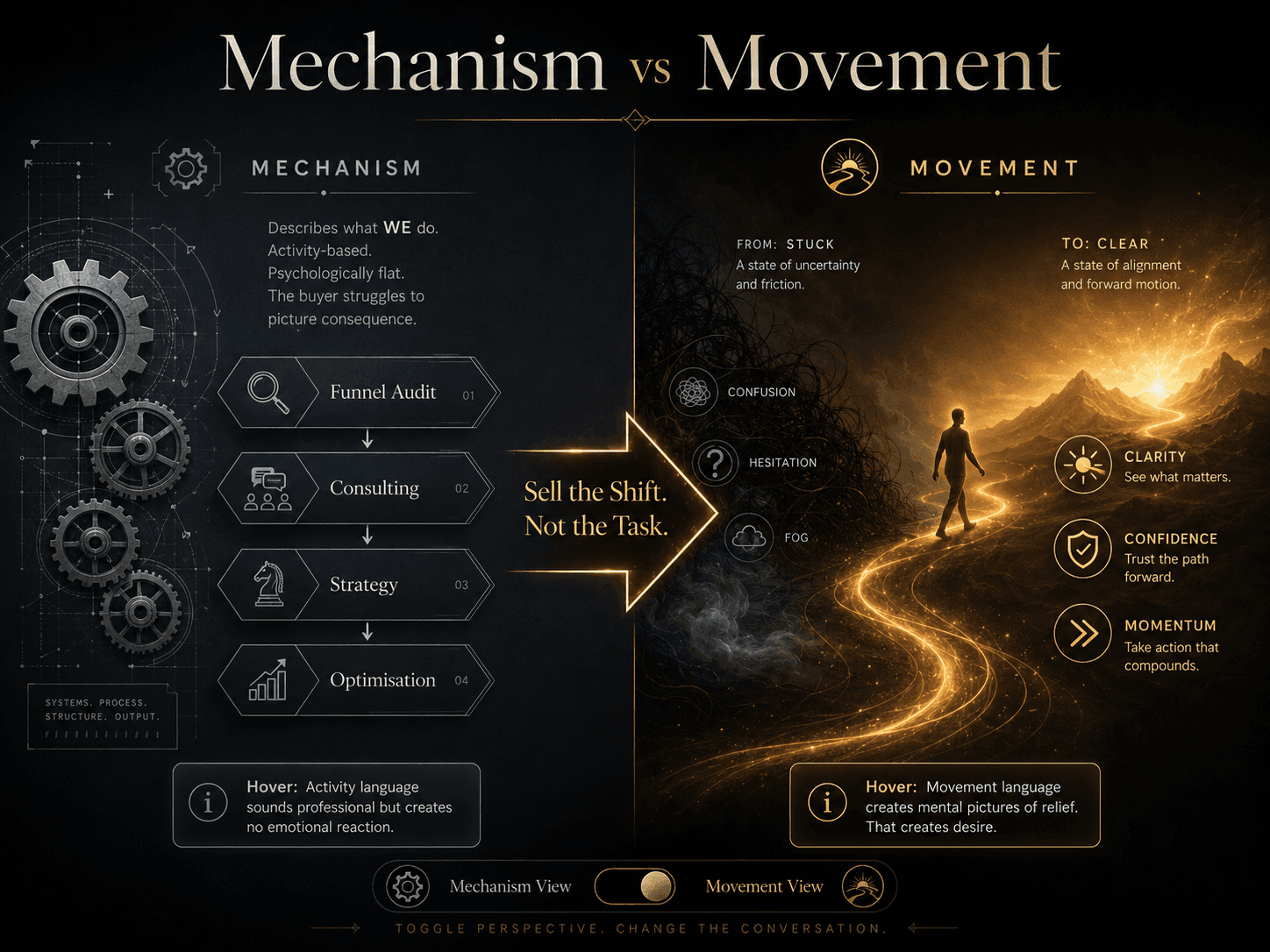
Most businesses accidentally describe the mechanism instead of the movement.
They say things like:
“We run funnel audits.”
“We provide consulting.”
“We do paid ads.”
“We help with positioning.”
“We offer strategic optimisation.”
“We build websites.”
“We create content strategies.”
These statements are not necessarily wrong.
But psychologically, they create very little emotional reaction.
Why?
Because the buyer still cannot clearly feel:
“Why does this actually matter to me?”
That question is everything.
If the buyer cannot feel why the offer matters, the offer becomes easy to ignore.
The service may be useful.
The delivery may be strong.
The method may be valuable.
But if the language stays trapped at the activity level, the buyer has to do too much interpretation.
And buyers do not usually reward mental effort.
They move toward offers that make the value easier to understand, easier to picture, and easier to want.
That is what this resource helps you fix.
——
What This Resource Helps You Do
The Offer Positioning Reframe Tool™ helps you turn flat service descriptions into sharper, consequence-driven positioning.
Use it to:
turn activity language into buyer-relevant meaning
make the offer feel more commercially valuable
increase perceived urgency
create stronger consequence visibility
show the buyer why the offer matters now
move from process language to movement language
make the offer easier to understand and remember
strengthen buyer recognition
stop sounding like generic market wallpaper
create positioning that feels specific, relevant, and harder to confuse
The goal is not to make the offer sound louder.
The goal is to make the buyer feel the consequence of the offer more clearly.
Because buyers rarely emotionally buy tasks.
They buy movement.
They buy relief.
They buy certainty.
They buy speed.
They buy clarity.
They buy confidence.
They buy momentum.
They buy status movement.
They buy a believable shift from frustration to control.
——
The Buyer Does Not Buy The Task™
This is one of the most important principles in offer positioning.
Buyers rarely care deeply about:
the process
the service category
the operational activity
the deliverables themselves
the internal mechanics of your work
They care about what changes after the work is done.
They do not really want a funnel audit.
They want to stop wasting traffic on a page that silently kills trust.
They do not really want conversion optimisation.
They want buyers to stop hesitating before purchasing.
They do not really want consulting.
They want clarity, certainty, and a stronger path forward.
They do not really want a positioning session.
They want language that finally makes the offer easier to understand, easier to trust, and easier to say yes to.
They do not really want paid ads.
They want a predictable way to turn attention into demand.
This distinction changes everything.
Because if you describe the task, the buyer understands what you do.
But if you describe the movement, the buyer starts to feel why it matters.
——
Activity-Based Positioning vs Consequence-Driven Positioning™
Most weak offers are trapped in activity-based positioning.
Activity-based positioning describes what the business does.
Consequence-driven positioning describes what changes for the buyer because of it.
That difference is enormous.
——
Activity-Based Positioning™
Activity-based positioning sounds like this:
“We build systems.”
“We improve performance.”
“We offer strategic solutions.”
“We optimise customer journeys.”
“We create content strategies.”
“We run funnel audits.”
“We provide growth consulting.”
This language may sound professional.
But it often feels emotionally flat.
The buyer understands the service category, but they cannot clearly picture the consequence.
And what the brain cannot picture clearly, it struggles to value emotionally.
——
Consequence-Driven Positioning™
Consequence-driven positioning sounds like this:
“We identify where buyers lose trust before they reach the CTA.”
“We turn silent audiences into booked inbound sales conversations.”
“We find the offer fog making useful work sound forgettable.”
“We rebuild landing pages that create stronger buyer certainty before hesitation kills conversion momentum.”
“We help service businesses stop paying for traffic that lands interested and leaves unconvinced.”
This language works harder because it shows:
the problem
the pressure
the consequence
the movement
the reason to care
That is what positioning is supposed to do.
It turns the service into meaning.
——
The Activity-To-Consequence Shift™
Weak positioning says:
“Here is the thing we do.”
Strong positioning says:
“Here is what changes in your life, business, or situation after this solves the problem.”
That is the shift.
The service itself may not change.
But the buyer’s ability to value it changes dramatically.
A raw service description tells the buyer what happens operationally.
A positioned offer tells the buyer why that operation matters commercially, emotionally, or strategically.
That is the difference between a task and an offer with force.
——
The Core Reframe Question
Every offer statement should survive this question:
“Why should the buyer care?”
Not generally.
Not intellectually.
Emotionally.
If the answer is weak, abstract, delayed, or generic, the positioning still needs work.
The buyer should not need to translate the value for themselves.
The positioning should do that work.
——
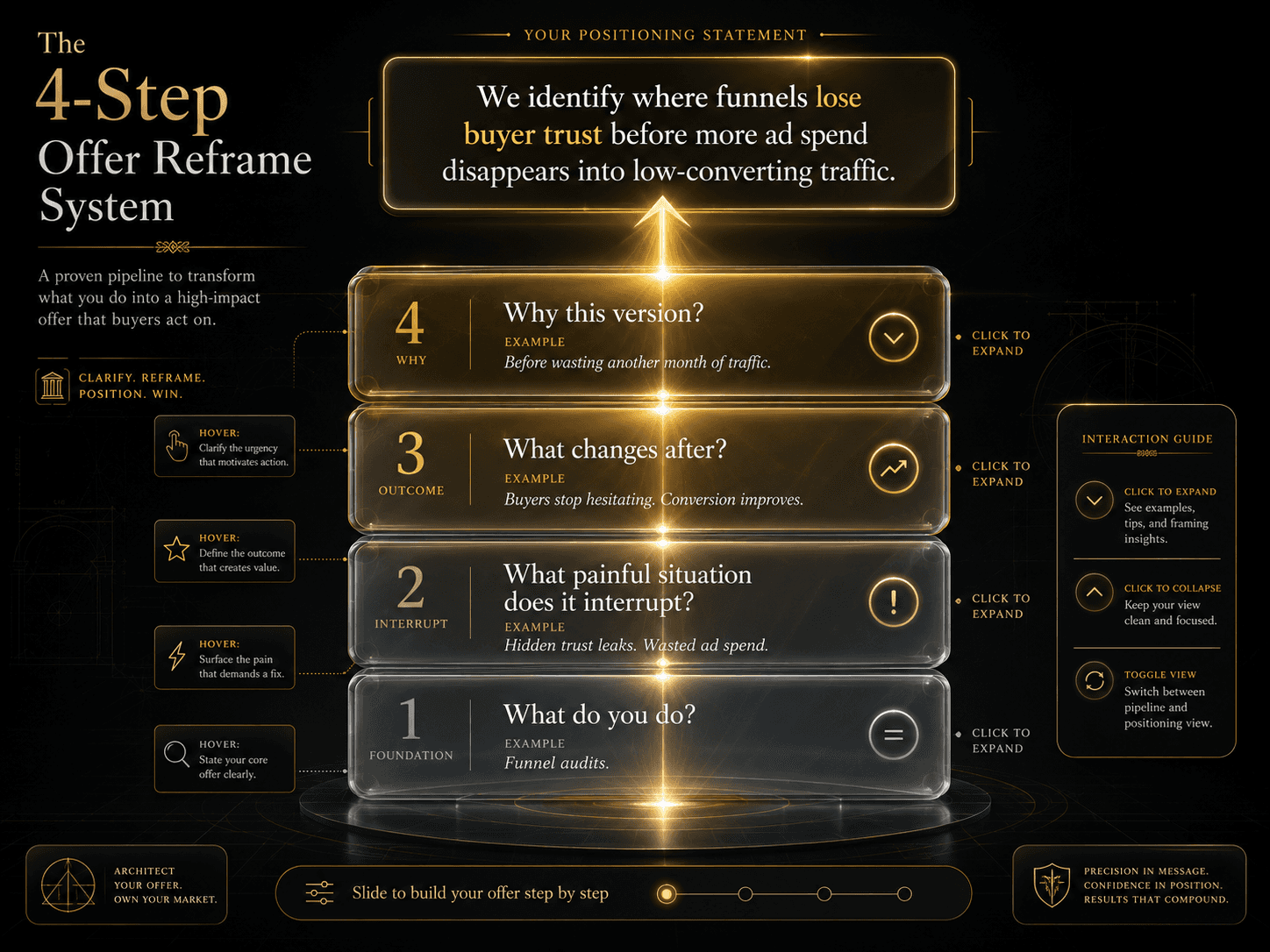
The 4-Step Offer Reframe System™
This system transforms activity statements into consequence-driven positioning.
The four steps are:
What do you do?
What problem does it interrupt?
What changes after?
Why this version?
Each step adds a different layer of buyer relevance.
Step 1 gives the base service.
Step 2 adds tension.
Step 3 creates movement.
Step 4 adds distinctiveness.
Together, they turn the offer from a service description into a buyer-relevant positioning line.
Step 1: What Do You Do?™
Start With The Base Service
This is the raw operational layer.
It answers the simple question:
“What is the thing?”
Examples:
funnel audit
paid ads
messaging strategy
offer positioning
sales page rewrite
creative direction
SEO optimisation
content strategy
CRM setup
AI automation
brand audit
landing page design
This layer is necessary.
But it is not enough.
It tells the buyer the category.
It does not yet tell them why the category matters.
Important: Do Not Stop Here™
Most businesses stop at Step 1.
That is exactly why they sound generic.
The buyer may understand the category, but they do not emotionally feel the consequence yet.
A base service tells the buyer what you do.
It does not automatically tell them:
why it matters
why it matters now
what painful situation it interrupts
what changes after
why your version is different
why they should choose it over alternatives
That is why Step 1 is only the starting point.
Not the final positioning.
Step 1 Diagnostic Question
Ask:
“Is this only describing the service category?”
If yes, you are still at the activity layer.
Step 1 Fill-In
What do you do?
What is the base service or delivery format?
What category would the buyer place this in?
What do most competitors call this?
What is too generic about this description?
——
Step 2: What Problem Does It Interrupt?™
Add Tension
Now you introduce buyer pressure.
The question becomes:
“What painful situation does this service actually interrupt?”
This is where the offer begins becoming relevant.
Because the buyer does not only want to know what you do.
They want to know what problem your work stops, reduces, prevents, clarifies, or fixes.
Examples
A funnel audit may interrupt:
hidden trust leaks
weak clarity
conversion hesitation
wasted ad spend
buyers dropping before the CTA
a page that looks polished but fails to create belief
Messaging strategy may interrupt:
buyer confusion
weak positioning
low trust
invisible value
vague promises
content that gets attention but not enquiries
Paid ads may interrupt:
inconsistent lead flow
dependence on referrals
unpredictable acquisition
slow demand creation
an empty pipeline
lack of visibility in front of qualified buyers
Offer positioning may interrupt:
service language that sounds useful but forgettable
buyers comparing purely on price
vague value
weak differentiation
a strong service trapped behind a soft offer
Now the service begins connecting to live buyer pressure.
That matters enormously.
Because pressure creates relevance.
Step 2 Diagnostic Question
Ask:
“What painful situation does this offer interrupt?”
If the answer is vague, the offer will still feel soft.
Step 2 Fill-In
The problem this service interrupts is:
The buyer is currently frustrated by:
The situation this work stops, reduces, or clarifies is:
The cost of leaving this unresolved is:
The buyer should care because:
Step 3: What Changes After?™
Create Movement
Now the offer begins pointing to the after-state.
This is where the buyer starts to feel the result.
Ask:
“What becomes easier, clearer, safer, faster, more profitable, or less stressful after this works?”
This is where perceived value rises.
Because the buyer can finally picture the movement.
Examples Of Resulting Shifts
After the work is done:
buyers understand the offer faster
leads become better-fit
conversion rates improve
trust builds earlier
the funnel stops leaking momentum
the business feels easier to scale
the offer becomes easier to remember
the sales process feels less exhausting
the page feels easier to trust
the buyer sees what is actually blocking action
the next step feels safer
the sales call starts with more belief already built
the founder stops guessing where the leak is
Now the positioning creates visible consequence.
And visible consequence creates desire.
Step 3 Diagnostic Question
Ask:
“What changes for the buyer after this works?”
If the answer sounds like a deliverable, keep going.
You are looking for movement.
Not just output.
Step 3 Fill-In
After this works, the buyer can:
After this works, the buyer stops:
After this works, the buyer understands:
After this works, the buyer feels:
After this works, the business becomes:
The clearest resulting shift is:
Step 4: Why This Version?™
Add Distinctiveness
This is the distinctiveness layer.
Without this step, the offer may still sound generic.
The buyer may understand the problem and want the result, but still wonder:
“Why this version?”
“Why this approach?”
“Why this instead of another provider?”
“Why should I trust this method?”
That is why Step 4 matters.
It gives the offer shape, specificity, and memorability.
Questions To Ask
Ask:
Why does this approach feel more specific than alternatives?
Why does this method feel safer?
Why is this version more credible?
Why is this more useful now?
What does this avoid?
What does this find that generic alternatives miss?
What makes this version easier to trust?
What makes this version harder to confuse?
Examples Of Distinctive Advantage
The offer may become stronger because it works:
without rebuilding the whole funnel
before wasting more traffic
without relying on hype
without adding more complexity
before another month disappears
without endless testing
using buyer-language positioning
by identifying hidden trust leaks
by focusing on the offer layer first
by finding where buyer certainty collapses
by turning vague service language into a clearer buying reason
by separating traffic problems from message problems
This creates identity, specificity, and memorability.
Now the positioning feels sharper.
Step 4 Diagnostic Question
Ask:
“Why is this version more specific, credible, or valuable than the generic alternative?”
If you cannot answer that clearly, the offer still risks sounding interchangeable.
Step 4 Fill-In
This version is different because:
This version avoids:
This version finds or fixes:
This version is more useful now because:
This version is safer, easier, faster, or sharper because:
The distinctive advantage is:
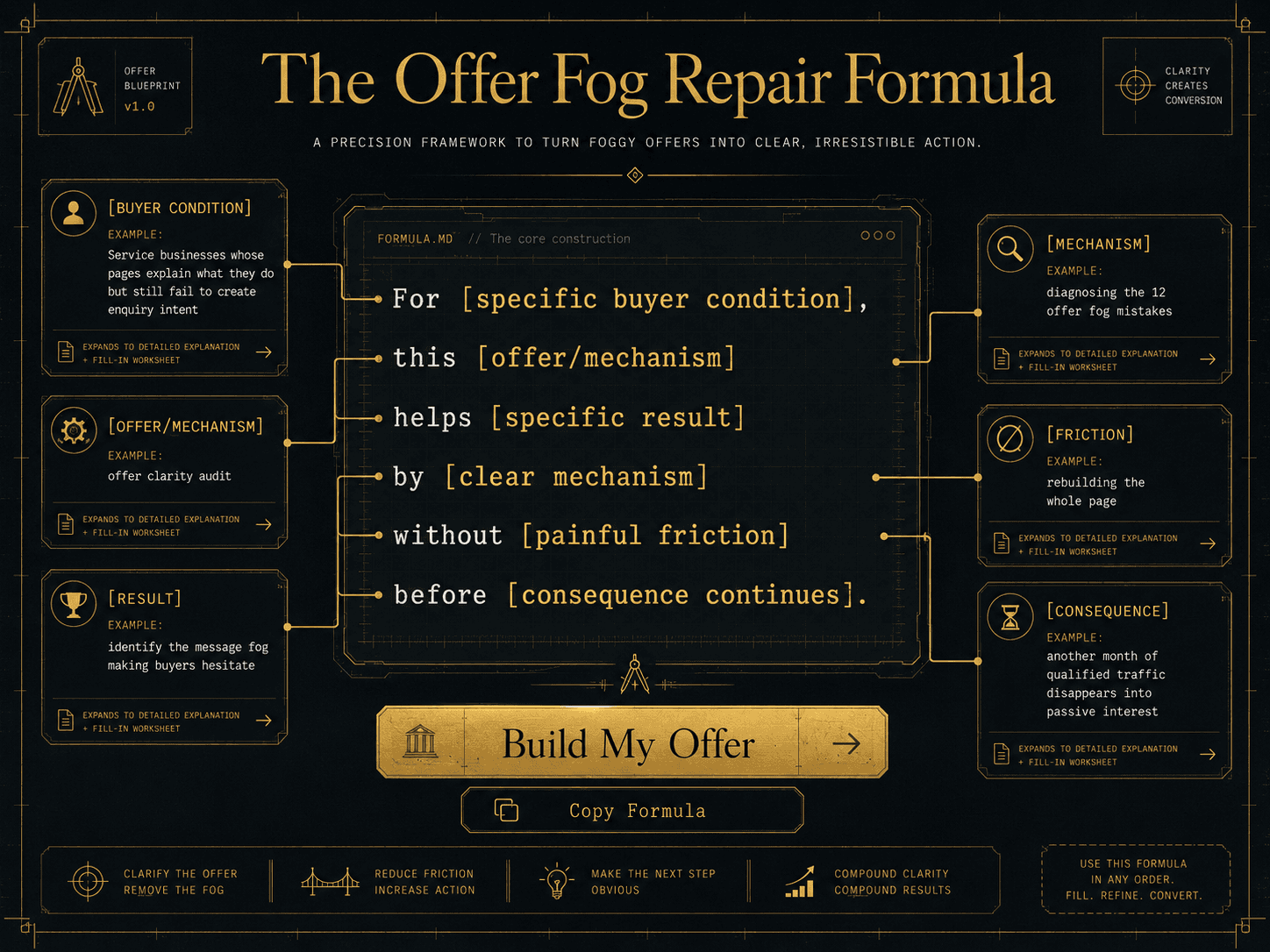
The Complete Reframe Formula™
Use this structure to transform activity into commercial meaning.
Base Service → Interrupted Problem → Resulting Shift → Distinctive Advantage
Or in plain English:
We do [BASE SERVICE] to interrupt [PAINFUL PROBLEM], so the buyer can [RESULTING SHIFT], through [DISTINCTIVE ADVANTAGE].
This formula helps the offer move from:
“What we do.”
To:
“Why this matters.”
Formula Fill-In
Base service:
Interrupted problem:
Resulting shift:
Distinctive advantage:
First Reframed Version
We do _________________________________________
to interrupt _________________________________________
so the buyer can _________________________________________
through _________________________________________.
Sharper Positioning Line
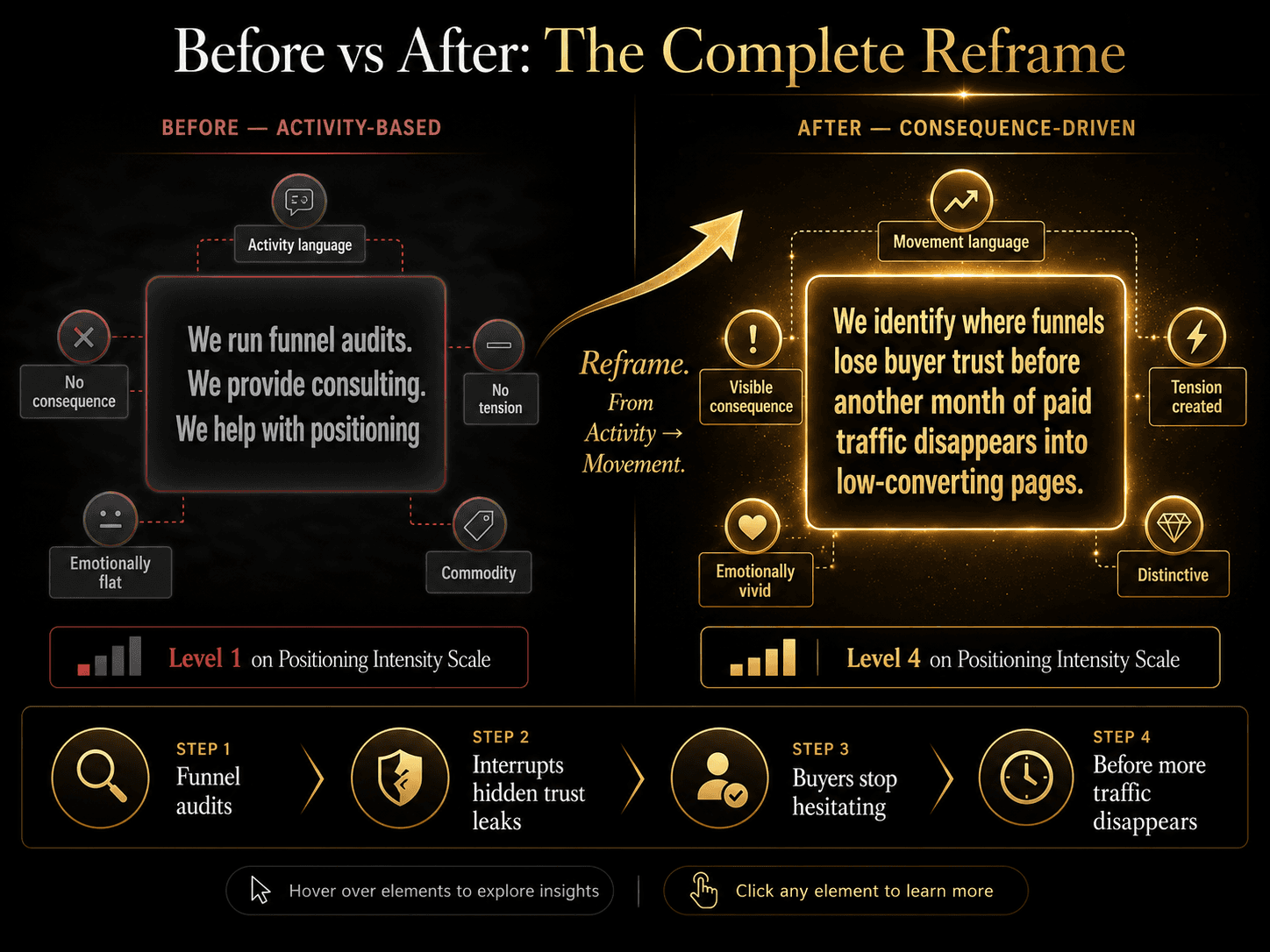
Before vs After Reframe Examples
Use these examples to understand the difference between activity language and consequence-driven positioning.
Example 1: Agency
Before
“We run funnel audits.”
Emotionally flat.
Generic.
Forgettable.
After
“We identify where funnels lose buyer trust before more ad spend disappears into low-converting traffic.”
Now the buyer feels:
consequence
tension
visibility
urgency
movement
a reason to care
The service is no longer just an audit.
It is a way to find where money is leaking through broken trust.
Example 2: Coaching
Before
“I help coaches grow online.”
Broad.
Weak.
Invisible.
After
“We help coaches turn scattered authority content into inbound sales conversations with buyers already pre-sold on their value.”
Now the buyer can picture the transformation.
The positioning shows:
the buyer
the current issue
the desired movement
the commercial outcome
the emotional value of being pre-sold
Example 3: SaaS
Before
“We help SaaS companies scale.”
Meaningless.
Too broad.
Easy to ignore.
After
“We help SaaS founders under £50k/month turn cold traffic into qualified demos before another quarter disappears into weak onboarding funnels.”
Now the offer creates:
audience specificity
time pressure
consequence
a clear result
a specific failure point
The buyer can see who it is for and why it matters now.
Example 4: Copywriter
Before
“I write landing pages.”
Commodity language.
The buyer understands the service but feels very little.
After
“We rebuild landing pages that create stronger buyer certainty before hesitation kills conversion momentum.”
Now the positioning feels commercially meaningful.
The buyer can feel:
the problem
the desired shift
the psychological mechanism
the reason the landing page matters
Example 5: Consultant
Before
“I offer business strategy consulting.”
Broad.
Polite.
Forgettable.
After
“We help service founders turn scattered decisions into a clearer growth direction before another quarter disappears into reactive work.”
Now the offer creates a sharper buyer picture.
It shows:
the current chaos
the cost of delay
the result
the movement from reactive to directed
Example 6: Ecommerce
Before
“We improve product pages.”
Clear, but basic.
After
“We rebuild product pages so the product feels wanted before the buyer starts comparing price, shipping, or cheaper alternatives.”
Now the positioning points to buyer psychology.
It shows that the page is not only there to inform.
It has to create desire before comparison behaviour takes over.
Example 7: Freelancer
Before
“I help freelancers get clients.”
Common.
Overused.
Low distinctiveness.
After
“We help ghostwriting freelancers turn vague positioning into a one-line buying reason that attracts better-fit retainers without constant pitching.”
Now the positioning has:
a specific buyer
a specific problem
a specific result
a reduced objection
a clearer commercial promise
Example 8: AI Automation
Before
“We build AI automations for businesses.”
Clear, but generic.
After
“We build AI workflows that remove repetitive admin from the sales process before your team loses another week chasing updates, follow-ups, and manual handovers.”
Now the offer feels more concrete.
The buyer sees:
the wasted time
the operational friction
the specific use case
the resulting relief
the reason to act
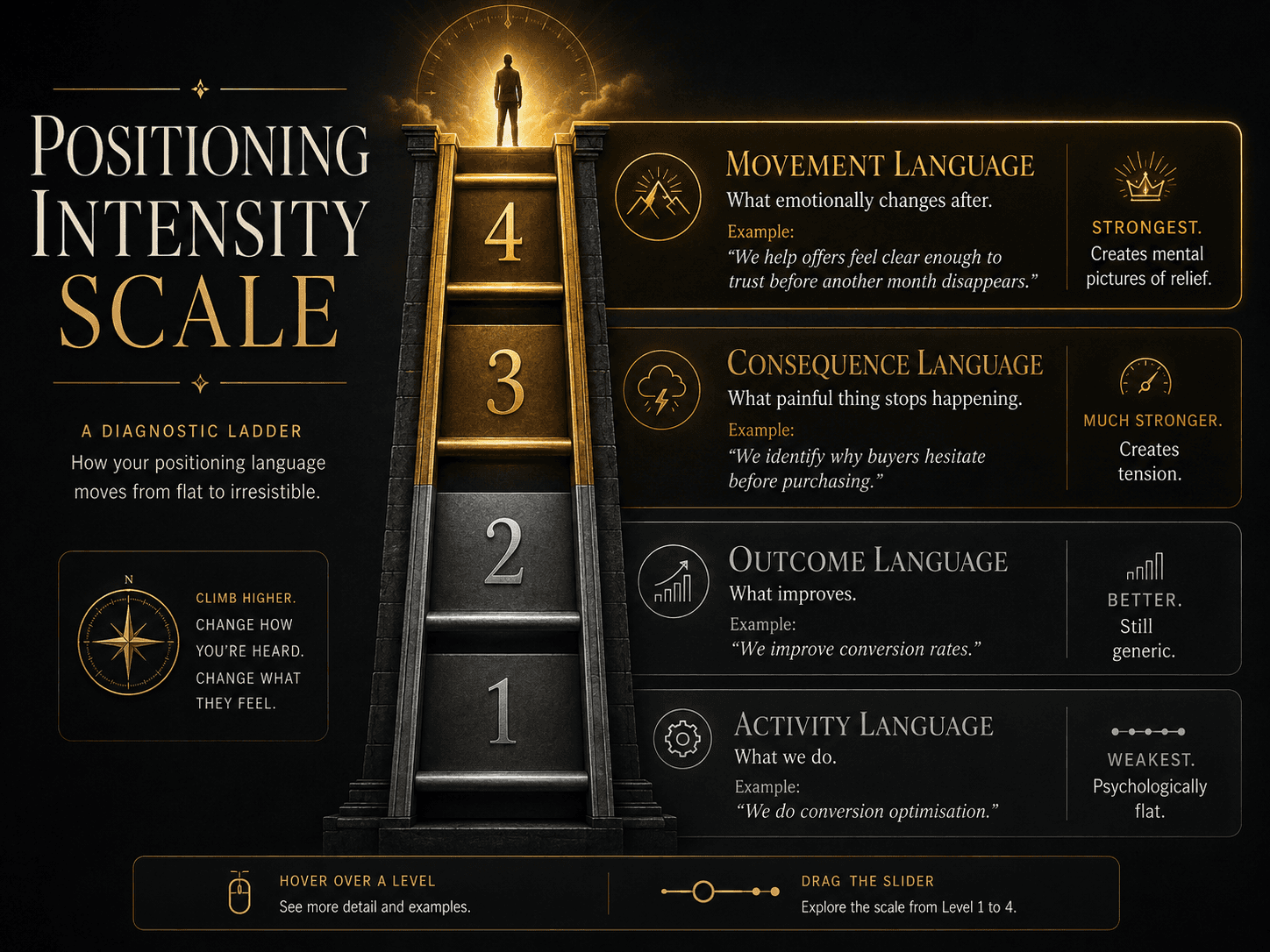
The Positioning Intensity Scale™
Use this scale to diagnose how strong your current positioning is.
Level 1: Activity Language™
What It Says
“What we do.”
This is the weakest level.
Example:
“We do conversion optimisation.”
The buyer understands the activity, but not the consequence.
Level 2: Outcome Language™
What It Says
“What improves.”
This is better, but often still broad.
Example:
“We improve conversion rates.”
The buyer understands the improvement, but may not yet feel the problem strongly.
Level 3: Consequence Language™
What It Says
“What painful thing stops happening.”
This is much stronger.
Example:
“We identify why buyers hesitate before purchasing.”
Now the buyer sees the failure point.
The offer begins to feel more valuable.
Level 4: Movement Language™
What It Says
“What emotionally or commercially changes after.”
This is the strongest level.
Example:
“We help offers feel clear enough to trust before another month disappears into low-converting traffic.”
Now the positioning creates psychological movement.
The buyer can feel the shift.
This is where strong positioning lives.
Positioning Intensity Score
Current positioning level:
Level 1 / Level 2 / Level 3 / Level 4
Why?
What would move this one level higher?
The Biggest Reframe Mistake™
Many businesses try to sound more premium by becoming more vague.
This is a huge mistake.
Examples:
“Transformative growth solutions”
“Elite strategic consulting”
“Premium performance systems”
“Scalable business optimisation”
“Bespoke commercial strategy”
“High-level growth architecture”
“World-class performance transformation”
These phrases may sound expensive.
But emotionally, they are often empty.
The buyer cannot see anything.
And invisible value creates weak demand.
Premium positioning is not vague.
Premium positioning is precise.
It makes the value feel clearer, sharper, and more consequential.
Premium Vagueness Check
Ask:
“Does this sound premium because it is actually specific, or does it sound premium because it is abstract?”
If the answer is abstract, rewrite it.
Good Positioning Creates Mental Pictures
The strongest positioning creates instant visualisation.
The buyer should quickly picture:
the problem
the tension
the consequence
the after-state
the reason this matters now
The more visible the shift feels, the easier the offer becomes to want.
A strong positioning line does not merely sound good.
It gives the buyer’s mind something concrete to hold.
That is why consequence matters.
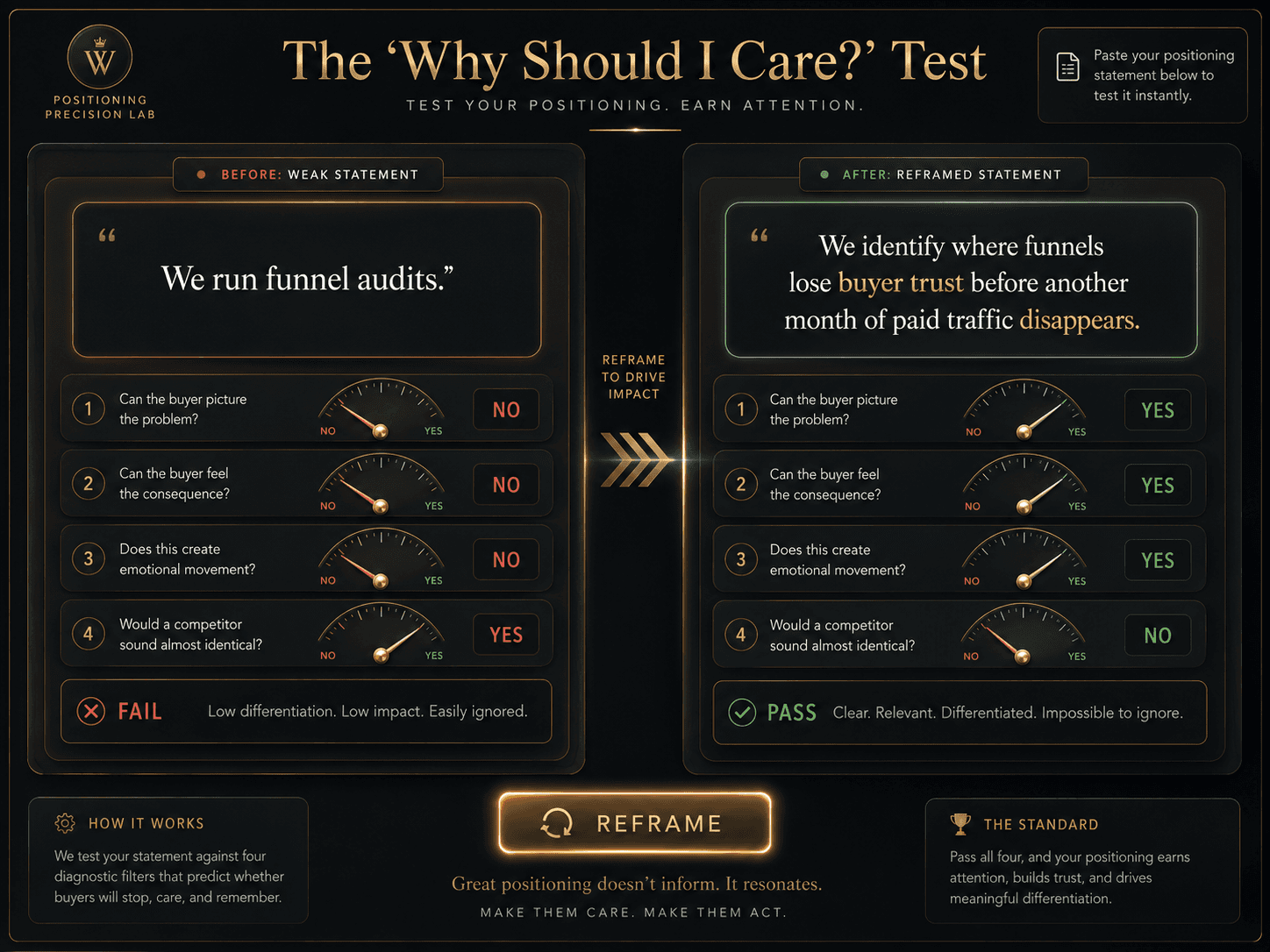
The “Why Should I Care?” Test™
Every positioning statement should survive this question:
“Why should the buyer care emotionally?”
If the answer feels weak, abstract, delayed, or generic, the positioning still needs work.
Test Your Positioning
Write your current positioning line:
Now answer:
Why should the buyer care?
Why should they care now?
What changes for them?
What painful thing stops happening?
What does this help them move toward?
What makes this version distinct?
If these answers are stronger than the positioning line itself, rewrite the positioning line using the answers.
The Offer Positioning Reframe Worksheet™
Use this full worksheet to rebuild your offer from activity into consequence.
Current Offer Statement
Write the offer as it currently appears:
Step 1: Base Service
What do you do?
What is the delivery format?
What does the buyer currently think this is?
Step 2: Interrupted Problem
What painful situation does this interrupt?
What friction does this remove?
What cost does this reduce?
What hesitation does this clarify?
Step 3: Resulting Shift
What changes after the work is done?
What becomes easier?
What becomes clearer?
What becomes safer?
What becomes more profitable, stable, or trustworthy?
Step 4: Distinctive Advantage
Why this version?
What makes the approach more specific?
What does this version avoid?
What does this version find or fix that generic alternatives miss?
What phrase, mechanism, or frame makes this more memorable?
Final Positioned Offer
Write your sharper positioning line:
Compression Check
Can this be said in one breath?
Yes / No
Is the buyer obvious?
Yes / No
Is the problem visible?
Yes / No
Is the consequence clear?
Yes / No
Is the movement desirable?
Yes / No
Is the version distinct?
Yes / No
Using AI For Offer Reframing
AI can help you reframe an offer quickly, but only if you ask for diagnosis first.
Do not ask:
“Make this sound better.”
That usually creates polished but generic copy.
Ask AI to identify whether the offer is activity-based or consequence-driven.
Then ask it to rebuild the offer through the four reframe layers.
AI Offer Reframe Prompt™
Use this prompt:
Act as a high-level offer strategist, buyer psychology analyst, and funnel operator.
I will give you:
my current offer statement
what I actually do
who I help
what painful situation they are in
what changes after the work is done
what makes my version different
Your job is to diagnose whether the offer sounds activity-based or consequence-driven.
My current offer statement is:
[paste offer]
What I actually do is:
[insert base service]
Who I help:
[insert target buyer]
The painful situation they are in:
[insert current pressure]
What changes after the work is done:
[insert resulting shift]
What makes my version different:
[insert distinctive advantage]
Analyse the offer across these four layers:
Base service
Interrupted problem
Resulting shift
Distinctive advantage
For each layer:
identify what is present
identify what is missing
explain where the positioning feels weak
explain whether the buyer can feel why it matters
suggest a sharper alternative
Then score the current positioning using this scale:
Level 1: Activity Language
Level 2: Outcome Language
Level 3: Consequence Language
Level 4: Movement Language
After that, rewrite the offer into:
A clearer positioning version
A more consequence-driven version
A more emotionally visible version
A cleaner premium version
A shorter compressed version
A more distinctive version
Then explain:
which version creates the strongest buyer recognition
which version creates the clearest mental picture
which version feels most commercially valuable
which version is safest from hype
which version is easiest to remember
Do not add fake hype.
Do not make the offer vague to sound premium.
Prioritise clarity, consequence, memorability, buyer relevance, and commercial visibility.
Final Reframe Challenge™
Take your current offer statement.
Do not use a hypothetical offer.
Use the one you actually publish, pitch, or say to buyers.
Then rebuild it using all four layers.
Step 1: What Do You Do?
Base service:
Step 2: What Painful Situation Does It Interrupt?
Interrupted problem:
Step 3: What Changes After?
Resulting shift:
Step 4: Why Does This Version Feel More Valuable Or Distinct?
Distinctive advantage:
Final Sharp Positioning Line
Write one clear, consequence-driven positioning line:
Final Test
Does it describe activity or consequence?
Activity / Consequence
Does it create a mental picture?
Yes / No
Does it answer “why should I care?”
Yes / No
Does it feel specific enough to remember?
Yes / No
Does it avoid fake hype?
Yes / No
Does it feel commercially visible?
Yes / No
——
Final Principle
Most buyers do not emotionally buy the task.
They buy the movement.
They buy what changes after the task works.
That is why weak positioning describes the activity, while strong positioning makes the consequence visible.
The service may be real.
The work may be useful.
The method may be strong.
But if the buyer cannot feel why it matters, the offer remains easy to ignore.
The job of positioning is to turn:
“What we do.”
Into:
“Why this matters to you now.”
That is what The Offer Positioning Reframe Tool™ is designed to help you do.
Not by adding hype.
Not by sounding clever.
Not by becoming vague and “premium.”
But by making the offer clearer, more consequential, more specific, more memorable, and more commercially alive.
Because the market rarely ignores offers simply because they are bad.
It ignores them because the value never became vivid enough to emotionally matter before attention disappeared.
——
From:
The $100M Funnel Playbook. Book I: Foundation Buyer Psychology, Offer Clarity, and the Page Architecture Behind High-Converting Funnels
By Maris Spalins.
——
Copyright Notice
© 2026 The $100M Funnel Playbook / Winyourclients / Maris Spalins. All rights reserved.
This resource, including the frameworks, terminology, examples, scorecards, templates, prompts, methods, and written explanations, is original intellectual property created for The $100M Funnel Playbook. Book I: Foundation — Buyer Psychology, Offer Clarity, And The Page Architecture Behind High-Converting Funnels and published through Winyourclients.
No part of this resource may be copied, reproduced, screenshotted, republished, redistributed, sold, adapted, uploaded, scraped, stored in a database, included in training data, used to train artificial intelligence systems, or used to create derivative commercial or educational materials without prior written permission.
Limited reference, quotation, or sharing is only permitted where the source is clearly and visibly credited.
Any permitted reference must include at least one of the following source credits:
The $100M Funnel Playbook by Maris Spalins
or
Winyourclients — www.winyourclients.com
or
Maris Spalins / Winyourclients
Screenshots, excerpts, summaries, or redistributed versions must not remove, hide, alter, crop out, or obscure the original source, author name, book title, website name, or copyright notice.
This resource is provided for personal learning and implementation only. It is not licensed for resale, republishing, redistribution, AI training, template cloning, course creation, consulting delivery, or commercial reuse without written permission from Maris Spalins or Winyourclients.
For permission requests, licensing, citation approval, or commercial usage enquiries, contact:
Winyourclients
www.winyourclients.com
or
Email directly to Jacob on: help@winyourclients.com
The Offer Positioning Reframe Tool™ A four-step positioning worksheet for turning flat service descriptions into consequence-driven offer language that creates buyer relevance, urgency, and perceived value.
Prefer Audio Or Video?
The Offer Positioning Reframe Tool™ is also available as:
🎧 A guided audio walkthrough explaining activity-based positioning, consequence-driven offers, buyer relevance, and offer reframing.
🎥 A practical video breakdown with real offer examples, positioning rewrites, before/after reframes, and consequence-driven offer transformations.Choose the format that fits how you learn best.
[Listen To The Audio Walkthrough] (coming soon)
[Watch The Video Breakdown] (coming soon)
——
Why Most Offers Sound Technically Correct But Commercially Weak
Most weak offers are not always unclear.
They are under-positioned.
They may describe the service accurately.
They may explain what the business does.
They may even sound professional.
But they still fail to create enough buyer reaction because the language describes the activity instead of the consequence.
That is the core problem.
Most businesses accidentally describe the mechanism instead of the movement.
They say things like:
“We run funnel audits.”
“We provide consulting.”
“We do paid ads.”
“We help with positioning.”
“We offer strategic optimisation.”
“We build websites.”
“We create content strategies.”
These statements are not necessarily wrong.
But psychologically, they create very little emotional reaction.
Why?
Because the buyer still cannot clearly feel:
“Why does this actually matter to me?”
That question is everything.
If the buyer cannot feel why the offer matters, the offer becomes easy to ignore.
The service may be useful.
The delivery may be strong.
The method may be valuable.
But if the language stays trapped at the activity level, the buyer has to do too much interpretation.
And buyers do not usually reward mental effort.
They move toward offers that make the value easier to understand, easier to picture, and easier to want.
That is what this resource helps you fix.
——
What This Resource Helps You Do
The Offer Positioning Reframe Tool™ helps you turn flat service descriptions into sharper, consequence-driven positioning.
Use it to:
turn activity language into buyer-relevant meaning
make the offer feel more commercially valuable
increase perceived urgency
create stronger consequence visibility
show the buyer why the offer matters now
move from process language to movement language
make the offer easier to understand and remember
strengthen buyer recognition
stop sounding like generic market wallpaper
create positioning that feels specific, relevant, and harder to confuse
The goal is not to make the offer sound louder.
The goal is to make the buyer feel the consequence of the offer more clearly.
Because buyers rarely emotionally buy tasks.
They buy movement.
They buy relief.
They buy certainty.
They buy speed.
They buy clarity.
They buy confidence.
They buy momentum.
They buy status movement.
They buy a believable shift from frustration to control.
——
The Buyer Does Not Buy The Task™
This is one of the most important principles in offer positioning.
Buyers rarely care deeply about:
the process
the service category
the operational activity
the deliverables themselves
the internal mechanics of your work
They care about what changes after the work is done.
They do not really want a funnel audit.
They want to stop wasting traffic on a page that silently kills trust.
They do not really want conversion optimisation.
They want buyers to stop hesitating before purchasing.
They do not really want consulting.
They want clarity, certainty, and a stronger path forward.
They do not really want a positioning session.
They want language that finally makes the offer easier to understand, easier to trust, and easier to say yes to.
They do not really want paid ads.
They want a predictable way to turn attention into demand.
This distinction changes everything.
Because if you describe the task, the buyer understands what you do.
But if you describe the movement, the buyer starts to feel why it matters.
——
Activity-Based Positioning vs Consequence-Driven Positioning™
Most weak offers are trapped in activity-based positioning.
Activity-based positioning describes what the business does.
Consequence-driven positioning describes what changes for the buyer because of it.
That difference is enormous.
——
Activity-Based Positioning™
Activity-based positioning sounds like this:
“We build systems.”
“We improve performance.”
“We offer strategic solutions.”
“We optimise customer journeys.”
“We create content strategies.”
“We run funnel audits.”
“We provide growth consulting.”
This language may sound professional.
But it often feels emotionally flat.
The buyer understands the service category, but they cannot clearly picture the consequence.
And what the brain cannot picture clearly, it struggles to value emotionally.
——
Consequence-Driven Positioning™
Consequence-driven positioning sounds like this:
“We identify where buyers lose trust before they reach the CTA.”
“We turn silent audiences into booked inbound sales conversations.”
“We find the offer fog making useful work sound forgettable.”
“We rebuild landing pages that create stronger buyer certainty before hesitation kills conversion momentum.”
“We help service businesses stop paying for traffic that lands interested and leaves unconvinced.”
This language works harder because it shows:
the problem
the pressure
the consequence
the movement
the reason to care
That is what positioning is supposed to do.
It turns the service into meaning.
——
The Activity-To-Consequence Shift™
Weak positioning says:
“Here is the thing we do.”
Strong positioning says:
“Here is what changes in your life, business, or situation after this solves the problem.”
That is the shift.
The service itself may not change.
But the buyer’s ability to value it changes dramatically.
A raw service description tells the buyer what happens operationally.
A positioned offer tells the buyer why that operation matters commercially, emotionally, or strategically.
That is the difference between a task and an offer with force.
——
The Core Reframe Question
Every offer statement should survive this question:
“Why should the buyer care?”
Not generally.
Not intellectually.
Emotionally.
If the answer is weak, abstract, delayed, or generic, the positioning still needs work.
The buyer should not need to translate the value for themselves.
The positioning should do that work.
——
The 4-Step Offer Reframe System™
This system transforms activity statements into consequence-driven positioning.
The four steps are:
What do you do?
What problem does it interrupt?
What changes after?
Why this version?
Each step adds a different layer of buyer relevance.
Step 1 gives the base service.
Step 2 adds tension.
Step 3 creates movement.
Step 4 adds distinctiveness.
Together, they turn the offer from a service description into a buyer-relevant positioning line.
Step 1: What Do You Do?™
Start With The Base Service
This is the raw operational layer.
It answers the simple question:
“What is the thing?”
Examples:
funnel audit
paid ads
messaging strategy
offer positioning
sales page rewrite
creative direction
SEO optimisation
content strategy
CRM setup
AI automation
brand audit
landing page design
This layer is necessary.
But it is not enough.
It tells the buyer the category.
It does not yet tell them why the category matters.
Important: Do Not Stop Here™
Most businesses stop at Step 1.
That is exactly why they sound generic.
The buyer may understand the category, but they do not emotionally feel the consequence yet.
A base service tells the buyer what you do.
It does not automatically tell them:
why it matters
why it matters now
what painful situation it interrupts
what changes after
why your version is different
why they should choose it over alternatives
That is why Step 1 is only the starting point.
Not the final positioning.
Step 1 Diagnostic Question
Ask:
“Is this only describing the service category?”
If yes, you are still at the activity layer.
Step 1 Fill-In
What do you do?
What is the base service or delivery format?
What category would the buyer place this in?
What do most competitors call this?
What is too generic about this description?
——
Step 2: What Problem Does It Interrupt?™
Add Tension
Now you introduce buyer pressure.
The question becomes:
“What painful situation does this service actually interrupt?”
This is where the offer begins becoming relevant.
Because the buyer does not only want to know what you do.
They want to know what problem your work stops, reduces, prevents, clarifies, or fixes.
Examples
A funnel audit may interrupt:
hidden trust leaks
weak clarity
conversion hesitation
wasted ad spend
buyers dropping before the CTA
a page that looks polished but fails to create belief
Messaging strategy may interrupt:
buyer confusion
weak positioning
low trust
invisible value
vague promises
content that gets attention but not enquiries
Paid ads may interrupt:
inconsistent lead flow
dependence on referrals
unpredictable acquisition
slow demand creation
an empty pipeline
lack of visibility in front of qualified buyers
Offer positioning may interrupt:
service language that sounds useful but forgettable
buyers comparing purely on price
vague value
weak differentiation
a strong service trapped behind a soft offer
Now the service begins connecting to live buyer pressure.
That matters enormously.
Because pressure creates relevance.
Step 2 Diagnostic Question
Ask:
“What painful situation does this offer interrupt?”
If the answer is vague, the offer will still feel soft.
Step 2 Fill-In
The problem this service interrupts is:
The buyer is currently frustrated by:
The situation this work stops, reduces, or clarifies is:
The cost of leaving this unresolved is:
The buyer should care because:
Step 3: What Changes After?™
Create Movement
Now the offer begins pointing to the after-state.
This is where the buyer starts to feel the result.
Ask:
“What becomes easier, clearer, safer, faster, more profitable, or less stressful after this works?”
This is where perceived value rises.
Because the buyer can finally picture the movement.
Examples Of Resulting Shifts
After the work is done:
buyers understand the offer faster
leads become better-fit
conversion rates improve
trust builds earlier
the funnel stops leaking momentum
the business feels easier to scale
the offer becomes easier to remember
the sales process feels less exhausting
the page feels easier to trust
the buyer sees what is actually blocking action
the next step feels safer
the sales call starts with more belief already built
the founder stops guessing where the leak is
Now the positioning creates visible consequence.
And visible consequence creates desire.
Step 3 Diagnostic Question
Ask:
“What changes for the buyer after this works?”
If the answer sounds like a deliverable, keep going.
You are looking for movement.
Not just output.
Step 3 Fill-In
After this works, the buyer can:
After this works, the buyer stops:
After this works, the buyer understands:
After this works, the buyer feels:
After this works, the business becomes:
The clearest resulting shift is:
Step 4: Why This Version?™
Add Distinctiveness
This is the distinctiveness layer.
Without this step, the offer may still sound generic.
The buyer may understand the problem and want the result, but still wonder:
“Why this version?”
“Why this approach?”
“Why this instead of another provider?”
“Why should I trust this method?”
That is why Step 4 matters.
It gives the offer shape, specificity, and memorability.
Questions To Ask
Ask:
Why does this approach feel more specific than alternatives?
Why does this method feel safer?
Why is this version more credible?
Why is this more useful now?
What does this avoid?
What does this find that generic alternatives miss?
What makes this version easier to trust?
What makes this version harder to confuse?
Examples Of Distinctive Advantage
The offer may become stronger because it works:
without rebuilding the whole funnel
before wasting more traffic
without relying on hype
without adding more complexity
before another month disappears
without endless testing
using buyer-language positioning
by identifying hidden trust leaks
by focusing on the offer layer first
by finding where buyer certainty collapses
by turning vague service language into a clearer buying reason
by separating traffic problems from message problems
This creates identity, specificity, and memorability.
Now the positioning feels sharper.
Step 4 Diagnostic Question
Ask:
“Why is this version more specific, credible, or valuable than the generic alternative?”
If you cannot answer that clearly, the offer still risks sounding interchangeable.
Step 4 Fill-In
This version is different because:
This version avoids:
This version finds or fixes:
This version is more useful now because:
This version is safer, easier, faster, or sharper because:
The distinctive advantage is:
The Complete Reframe Formula™
Use this structure to transform activity into commercial meaning.
Base Service → Interrupted Problem → Resulting Shift → Distinctive Advantage
Or in plain English:
We do [BASE SERVICE] to interrupt [PAINFUL PROBLEM], so the buyer can [RESULTING SHIFT], through [DISTINCTIVE ADVANTAGE].
This formula helps the offer move from:
“What we do.”
To:
“Why this matters.”
Formula Fill-In
Base service:
Interrupted problem:
Resulting shift:
Distinctive advantage:
First Reframed Version
We do _________________________________________
to interrupt _________________________________________
so the buyer can _________________________________________
through _________________________________________.
Sharper Positioning Line
Before vs After Reframe Examples
Use these examples to understand the difference between activity language and consequence-driven positioning.
Example 1: Agency
Before
“We run funnel audits.”
Emotionally flat.
Generic.
Forgettable.
After
“We identify where funnels lose buyer trust before more ad spend disappears into low-converting traffic.”
Now the buyer feels:
consequence
tension
visibility
urgency
movement
a reason to care
The service is no longer just an audit.
It is a way to find where money is leaking through broken trust.
Example 2: Coaching
Before
“I help coaches grow online.”
Broad.
Weak.
Invisible.
After
“We help coaches turn scattered authority content into inbound sales conversations with buyers already pre-sold on their value.”
Now the buyer can picture the transformation.
The positioning shows:
the buyer
the current issue
the desired movement
the commercial outcome
the emotional value of being pre-sold
Example 3: SaaS
Before
“We help SaaS companies scale.”
Meaningless.
Too broad.
Easy to ignore.
After
“We help SaaS founders under £50k/month turn cold traffic into qualified demos before another quarter disappears into weak onboarding funnels.”
Now the offer creates:
audience specificity
time pressure
consequence
a clear result
a specific failure point
The buyer can see who it is for and why it matters now.
Example 4: Copywriter
Before
“I write landing pages.”
Commodity language.
The buyer understands the service but feels very little.
After
“We rebuild landing pages that create stronger buyer certainty before hesitation kills conversion momentum.”
Now the positioning feels commercially meaningful.
The buyer can feel:
the problem
the desired shift
the psychological mechanism
the reason the landing page matters
Example 5: Consultant
Before
“I offer business strategy consulting.”
Broad.
Polite.
Forgettable.
After
“We help service founders turn scattered decisions into a clearer growth direction before another quarter disappears into reactive work.”
Now the offer creates a sharper buyer picture.
It shows:
the current chaos
the cost of delay
the result
the movement from reactive to directed
Example 6: Ecommerce
Before
“We improve product pages.”
Clear, but basic.
After
“We rebuild product pages so the product feels wanted before the buyer starts comparing price, shipping, or cheaper alternatives.”
Now the positioning points to buyer psychology.
It shows that the page is not only there to inform.
It has to create desire before comparison behaviour takes over.
Example 7: Freelancer
Before
“I help freelancers get clients.”
Common.
Overused.
Low distinctiveness.
After
“We help ghostwriting freelancers turn vague positioning into a one-line buying reason that attracts better-fit retainers without constant pitching.”
Now the positioning has:
a specific buyer
a specific problem
a specific result
a reduced objection
a clearer commercial promise
Example 8: AI Automation
Before
“We build AI automations for businesses.”
Clear, but generic.
After
“We build AI workflows that remove repetitive admin from the sales process before your team loses another week chasing updates, follow-ups, and manual handovers.”
Now the offer feels more concrete.
The buyer sees:
the wasted time
the operational friction
the specific use case
the resulting relief
the reason to act
The Positioning Intensity Scale™
Use this scale to diagnose how strong your current positioning is.
Level 1: Activity Language™
What It Says
“What we do.”
This is the weakest level.
Example:
“We do conversion optimisation.”
The buyer understands the activity, but not the consequence.
Level 2: Outcome Language™
What It Says
“What improves.”
This is better, but often still broad.
Example:
“We improve conversion rates.”
The buyer understands the improvement, but may not yet feel the problem strongly.
Level 3: Consequence Language™
What It Says
“What painful thing stops happening.”
This is much stronger.
Example:
“We identify why buyers hesitate before purchasing.”
Now the buyer sees the failure point.
The offer begins to feel more valuable.
Level 4: Movement Language™
What It Says
“What emotionally or commercially changes after.”
This is the strongest level.
Example:
“We help offers feel clear enough to trust before another month disappears into low-converting traffic.”
Now the positioning creates psychological movement.
The buyer can feel the shift.
This is where strong positioning lives.
Positioning Intensity Score
Current positioning level:
Level 1 / Level 2 / Level 3 / Level 4
Why?
What would move this one level higher?
The Biggest Reframe Mistake™
Many businesses try to sound more premium by becoming more vague.
This is a huge mistake.
Examples:
“Transformative growth solutions”
“Elite strategic consulting”
“Premium performance systems”
“Scalable business optimisation”
“Bespoke commercial strategy”
“High-level growth architecture”
“World-class performance transformation”
These phrases may sound expensive.
But emotionally, they are often empty.
The buyer cannot see anything.
And invisible value creates weak demand.
Premium positioning is not vague.
Premium positioning is precise.
It makes the value feel clearer, sharper, and more consequential.
Premium Vagueness Check
Ask:
“Does this sound premium because it is actually specific, or does it sound premium because it is abstract?”
If the answer is abstract, rewrite it.
Good Positioning Creates Mental Pictures
The strongest positioning creates instant visualisation.
The buyer should quickly picture:
the problem
the tension
the consequence
the after-state
the reason this matters now
The more visible the shift feels, the easier the offer becomes to want.
A strong positioning line does not merely sound good.
It gives the buyer’s mind something concrete to hold.
That is why consequence matters.
The “Why Should I Care?” Test™
Every positioning statement should survive this question:
“Why should the buyer care emotionally?”
If the answer feels weak, abstract, delayed, or generic, the positioning still needs work.
Test Your Positioning
Write your current positioning line:
Now answer:
Why should the buyer care?
Why should they care now?
What changes for them?
What painful thing stops happening?
What does this help them move toward?
What makes this version distinct?
If these answers are stronger than the positioning line itself, rewrite the positioning line using the answers.
The Offer Positioning Reframe Worksheet™
Use this full worksheet to rebuild your offer from activity into consequence.
Current Offer Statement
Write the offer as it currently appears:
Step 1: Base Service
What do you do?
What is the delivery format?
What does the buyer currently think this is?
Step 2: Interrupted Problem
What painful situation does this interrupt?
What friction does this remove?
What cost does this reduce?
What hesitation does this clarify?
Step 3: Resulting Shift
What changes after the work is done?
What becomes easier?
What becomes clearer?
What becomes safer?
What becomes more profitable, stable, or trustworthy?
Step 4: Distinctive Advantage
Why this version?
What makes the approach more specific?
What does this version avoid?
What does this version find or fix that generic alternatives miss?
What phrase, mechanism, or frame makes this more memorable?
Final Positioned Offer
Write your sharper positioning line:
Compression Check
Can this be said in one breath?
Yes / No
Is the buyer obvious?
Yes / No
Is the problem visible?
Yes / No
Is the consequence clear?
Yes / No
Is the movement desirable?
Yes / No
Is the version distinct?
Yes / No
Using AI For Offer Reframing
AI can help you reframe an offer quickly, but only if you ask for diagnosis first.
Do not ask:
“Make this sound better.”
That usually creates polished but generic copy.
Ask AI to identify whether the offer is activity-based or consequence-driven.
Then ask it to rebuild the offer through the four reframe layers.
AI Offer Reframe Prompt™
Use this prompt:
Act as a high-level offer strategist, buyer psychology analyst, and funnel operator.
I will give you:
my current offer statement
what I actually do
who I help
what painful situation they are in
what changes after the work is done
what makes my version different
Your job is to diagnose whether the offer sounds activity-based or consequence-driven.
My current offer statement is:
[paste offer]
What I actually do is:
[insert base service]
Who I help:
[insert target buyer]
The painful situation they are in:
[insert current pressure]
What changes after the work is done:
[insert resulting shift]
What makes my version different:
[insert distinctive advantage]
Analyse the offer across these four layers:
Base service
Interrupted problem
Resulting shift
Distinctive advantage
For each layer:
identify what is present
identify what is missing
explain where the positioning feels weak
explain whether the buyer can feel why it matters
suggest a sharper alternative
Then score the current positioning using this scale:
Level 1: Activity Language
Level 2: Outcome Language
Level 3: Consequence Language
Level 4: Movement Language
After that, rewrite the offer into:
A clearer positioning version
A more consequence-driven version
A more emotionally visible version
A cleaner premium version
A shorter compressed version
A more distinctive version
Then explain:
which version creates the strongest buyer recognition
which version creates the clearest mental picture
which version feels most commercially valuable
which version is safest from hype
which version is easiest to remember
Do not add fake hype.
Do not make the offer vague to sound premium.
Prioritise clarity, consequence, memorability, buyer relevance, and commercial visibility.
Final Reframe Challenge™
Take your current offer statement.
Do not use a hypothetical offer.
Use the one you actually publish, pitch, or say to buyers.
Then rebuild it using all four layers.
Step 1: What Do You Do?
Base service:
Step 2: What Painful Situation Does It Interrupt?
Interrupted problem:
Step 3: What Changes After?
Resulting shift:
Step 4: Why Does This Version Feel More Valuable Or Distinct?
Distinctive advantage:
Final Sharp Positioning Line
Write one clear, consequence-driven positioning line:
Final Test
Does it describe activity or consequence?
Activity / Consequence
Does it create a mental picture?
Yes / No
Does it answer “why should I care?”
Yes / No
Does it feel specific enough to remember?
Yes / No
Does it avoid fake hype?
Yes / No
Does it feel commercially visible?
Yes / No
——
Final Principle
Most buyers do not emotionally buy the task.
They buy the movement.
They buy what changes after the task works.
That is why weak positioning describes the activity, while strong positioning makes the consequence visible.
The service may be real.
The work may be useful.
The method may be strong.
But if the buyer cannot feel why it matters, the offer remains easy to ignore.
The job of positioning is to turn:
“What we do.”
Into:
“Why this matters to you now.”
That is what The Offer Positioning Reframe Tool™ is designed to help you do.
Not by adding hype.
Not by sounding clever.
Not by becoming vague and “premium.”
But by making the offer clearer, more consequential, more specific, more memorable, and more commercially alive.
Because the market rarely ignores offers simply because they are bad.
It ignores them because the value never became vivid enough to emotionally matter before attention disappeared.
——
From:
The $100M Funnel Playbook. Book I: Foundation Buyer Psychology, Offer Clarity, and the Page Architecture Behind High-Converting Funnels
By Maris Spalins.
——
Copyright Notice
© 2026 The $100M Funnel Playbook / Winyourclients / Maris Spalins. All rights reserved.
This resource, including the frameworks, terminology, examples, scorecards, templates, prompts, methods, and written explanations, is original intellectual property created for The $100M Funnel Playbook. Book I: Foundation — Buyer Psychology, Offer Clarity, And The Page Architecture Behind High-Converting Funnels and published through Winyourclients.
No part of this resource may be copied, reproduced, screenshotted, republished, redistributed, sold, adapted, uploaded, scraped, stored in a database, included in training data, used to train artificial intelligence systems, or used to create derivative commercial or educational materials without prior written permission.
Limited reference, quotation, or sharing is only permitted where the source is clearly and visibly credited.
Any permitted reference must include at least one of the following source credits:
The $100M Funnel Playbook by Maris Spalins
or
Winyourclients — www.winyourclients.com
or
Maris Spalins / Winyourclients
Screenshots, excerpts, summaries, or redistributed versions must not remove, hide, alter, crop out, or obscure the original source, author name, book title, website name, or copyright notice.
This resource is provided for personal learning and implementation only. It is not licensed for resale, republishing, redistribution, AI training, template cloning, course creation, consulting delivery, or commercial reuse without written permission from Maris Spalins or Winyourclients.
For permission requests, licensing, citation approval, or commercial usage enquiries, contact:
Winyourclients
www.winyourclients.com
or
Email directly to Jacob on: help@winyourclients.com
Other Blogs
Other Blogs
Check our other project Blogs with useful insight and information for your businesses

Other Blogs
Other Blogs
Check our other project Blogs with useful insight and information for your businesses