Our Three Step Process
May 26, 2026
Chap 3 | Resource 6 | The Offer Swipe Vault™
Our Three Step Process
May 26, 2026
Chap 3 | Resource 6 | The Offer Swipe Vault™
The Offer Swipe Vault™ A structured offer breakdown library for studying the clarity, consequence, specificity, distinctiveness, and movement patterns that make strong positioning easier to recognise and build.
Prefer Audio Or Video?
The Offer Swipe Vault™ is also available as:
🎧 A guided audio walkthrough explaining offer swipe analysis, positioning patterns, clarity, consequence, specificity, distinctiveness, and movement.
🎥 A practical video breakdown with real offer swipe examples, weak vs strong positioning teardowns, market wallpaper diagnosis, buyer-language rewrites, and AI swipe analysis.Choose the format that fits how you learn best.
[Listen To The Audio Walkthrough] (coming soon)
[Watch The Video Breakdown] (coming soon)
——
Why Most People Use Swipe Files Wrong
Most people use swipe files incorrectly.
They collect headlines.
They save landing pages.
They screenshot offer lines.
They bookmark ads.
They copy phrases.
But they never understand why the examples work.
That creates copying.
Not skill development.
The goal is not to imitate language mechanically.
The goal is to train your brain to recognise the structure underneath strong positioning.
You are not studying offers so you can steal sentences.
You are studying offers so you can see:
clarity
tension
specificity
emotional movement
consequence
buyer psychology
positioning sharpness
memorability
commercial force
Once you understand the pattern underneath the words, you stop needing to copy.
You start seeing commercial structure itself.
That is the real purpose of The Offer Swipe Vault™.
What This Resource Helps You Do
The Offer Swipe Vault™ helps you study real offer structures, positioning patterns, and commercial sharpness in action.
Use it to learn how to identify:
what makes offers feel valuable
what creates immediate clarity
what creates urgency without hype
what increases perceived sophistication
what makes positioning memorable
what creates stronger buyer recognition
what makes one offer feel sharp and another feel generic
what creates consequence visibility
what makes an offer easier to trust
what makes language feel commercially alive instead of decorative
This is not a random swipe file.
This is a structured learning system.
Because most founders do not struggle because they lack effort.
They struggle because they lack pattern recognition.
They have not trained their eyes to instantly notice:
weak positioning
hidden fog
soft language
invisible consequence
generic framing
weak urgency
low emotional movement
market wallpaper
activity language
vague value
Once you can see strong positioning clearly, you can build it intentionally.
The Real Purpose Of This Vault™
This vault exists to train commercial perception.
Commercial perception means the ability to see why one offer creates movement and another disappears.
It means noticing:
why one sentence feels forgettable
why another instantly creates tension
why some offers feel expensive
why others feel generic
why certain positioning creates trust quickly
why some language creates urgency naturally
why some offers feel specific while others feel like category noise
why one line makes the buyer care and another makes them skim
That awareness changes everything downstream.
You stop asking:
“Do I like this line?”
And start asking:
“What is this line doing psychologically?”
That is the difference between collecting swipes and building skill.
The Core Principle
Strong marketers do not merely collect copy.
They study structure.
The words matter.
But the structure underneath the words matters more.
A strong offer line usually contains some combination of:
a specific buyer
a visible problem
a painful consequence
a clear movement
a distinct mechanism
a believable result
a memorable frame
a reason to care now
A weak offer usually hides behind:
broad claims
generic benefits
vague positivity
category labels
consultant language
operational descriptions
clever phrasing without consequence
features with no emotional movement
The goal of this vault is to help you see those patterns faster.
Because once you can see the structure, you can rebuild weak offers with far more control.
How To Use This Resource
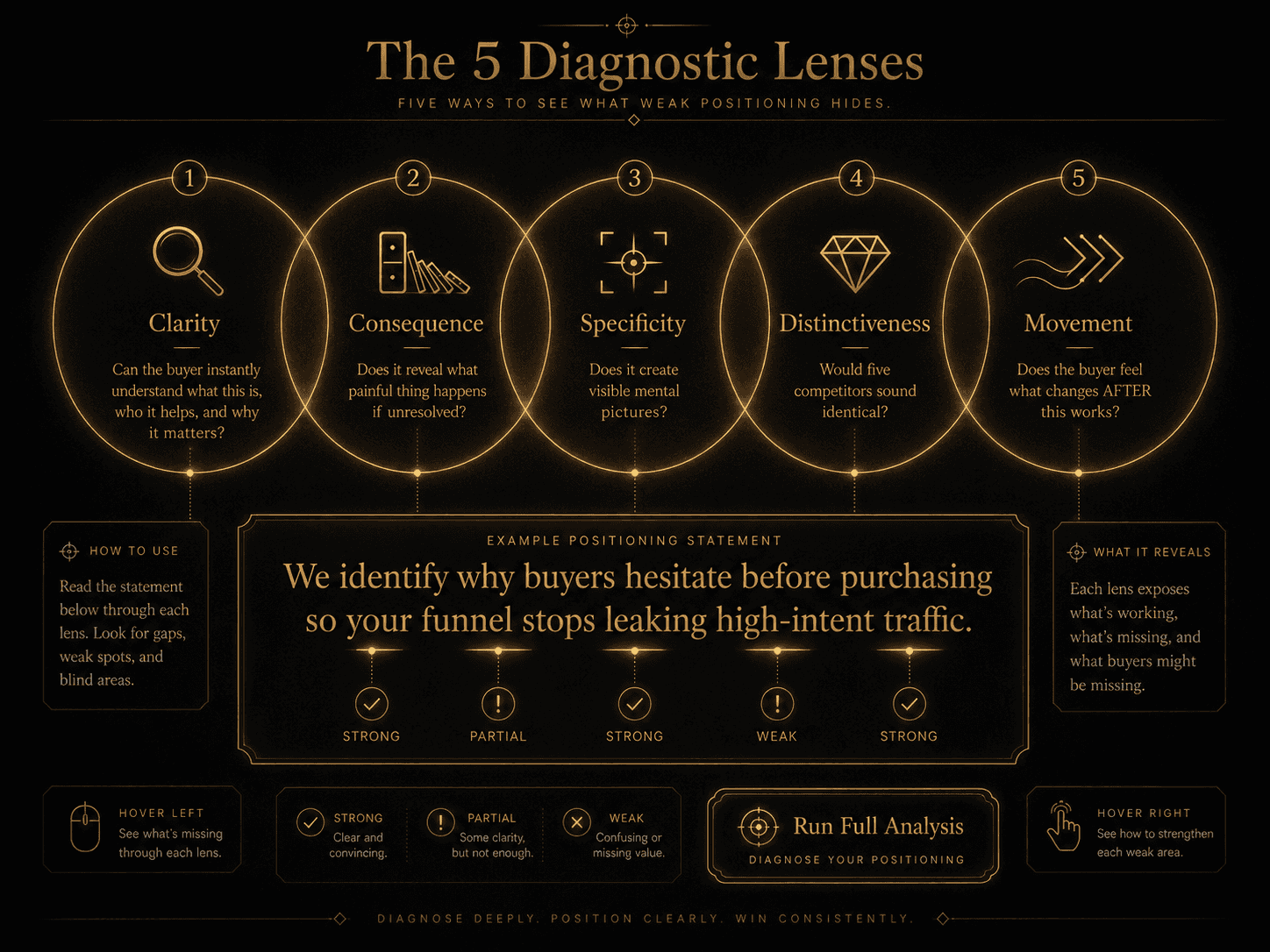
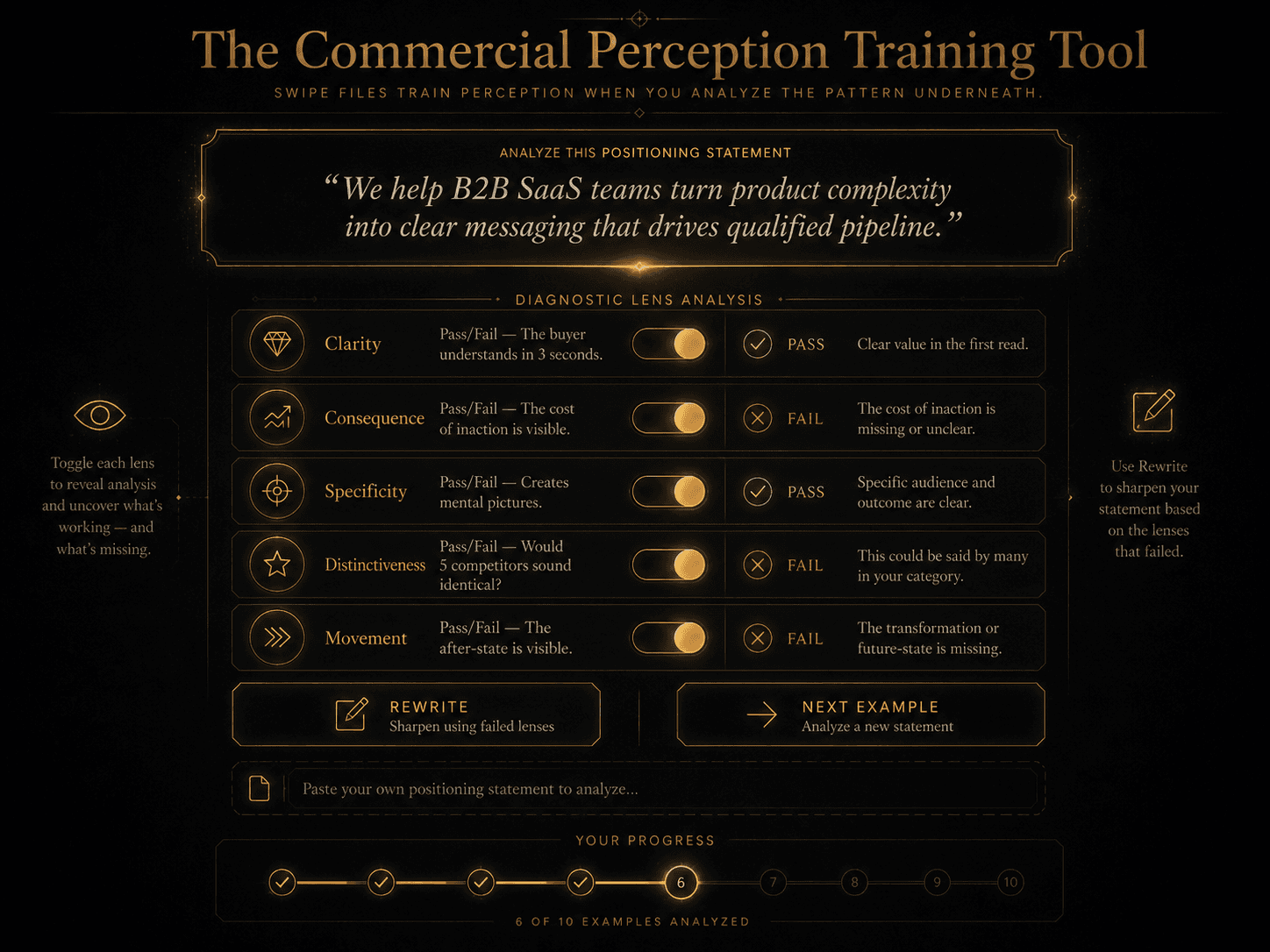
Every swipe example inside this vault should be analysed through five lenses.
Do not only ask:
“Do I like this?”
That question is too shallow.
Ask:
“What is this doing to the buyer’s perception?”
Use these five lenses every time.
Clarity
Consequence
Specificity
Distinctiveness
Movement
Together, these lenses help you diagnose why an offer feels sharp, weak, generic, forgettable, or commercially valuable.
The 5 Swipe Analysis Lenses™
Lens 1: Clarity™
Core Question
Can the buyer instantly understand what this is, who it helps, and why it matters?
Or does the offer require mental decoding?
Clarity is the first test.
If the buyer cannot quickly understand the offer, they will not stay long enough to appreciate the deeper value.
A clear offer does not make the buyer work hard.
It gives them immediate orientation.
Clarity Diagnostic Questions
Ask:
What is being sold?
Who is it for?
What problem does it solve?
Why does it matter?
Could the buyer explain it back after reading it once?
Does the offer create orientation within seconds?
If the answer is no, the offer has clarity friction.
Weak Clarity Example
“We provide strategic growth solutions.”
The buyer may understand that this is business-related.
But they cannot clearly see:
what kind of growth
for whom
through what mechanism
against what problem
with what outcome
It sounds polished, but it is foggy.
Stronger Clarity Example
“We help service businesses fix the offer fog making qualified buyers hesitate before enquiring.”
Now the buyer can see:
who it is for
what problem exists
what is being fixed
why it matters commercially
That is clarity.
Lens 2: Consequence™
Core Question
Does the offer reveal what painful thing happens if this problem remains unresolved?
Strong offers expose stakes.
Weak offers describe services.
Consequence is what makes the buyer feel that the problem matters.
Without consequence, the offer may be understandable but easy to postpone.
The buyer may think:
“That sounds useful.”
But they do not feel:
“I need to deal with this.”
That difference matters.
Consequence Diagnostic Questions
Ask:
What happens if the buyer ignores this?
What keeps leaking?
What becomes more expensive?
What gets delayed?
What trust is lost?
What opportunity disappears?
What emotional or commercial cost becomes visible?
If the offer does not reveal consequence, urgency stays weak.
Weak Consequence Example
“We improve your landing page.”
This describes a service.
But it does not reveal what the weak page is costing the buyer.
Stronger Consequence Example
“We find where the landing page loses buyer trust before another month of paid traffic disappears into hesitation.”
Now the buyer feels:
trust loss
wasted traffic
time pressure
commercial leakage
a reason to care
That is consequence.
Lens 3: Specificity™
Core Question
Does the language create visible mental pictures?
Or does it hide behind broad marketing terminology?
Specificity gives the buyer something to hold.
Generic language disappears.
The more specific the offer is, the easier it becomes to understand, remember, and trust.
Specificity can appear in:
the buyer
the problem
the mechanism
the result
the context
the moment of failure
the cost of delay
the emotional condition
Specificity Diagnostic Questions
Ask:
Can the buyer picture the problem?
Can they picture the result?
Can they picture where the failure happens?
Does the offer name a specific buyer condition?
Does it use language the buyer would recognise?
Does it avoid vague positivity?
If the answer is no, the offer needs sharper detail.
Weak Specificity Example
“We help brands grow online.”
This is too broad.
The buyer cannot picture anything specific.
Stronger Specificity Example
“We help ecommerce brands turn product-page clicks into buyer intent before shoppers default to cheaper alternatives.”
Now the buyer can picture:
ecommerce brands
product-page clicks
buyer intent
price comparison
lost purchase momentum
That is specificity.
Lens 4: Distinctiveness™
Core Question
Would five competitors sound identical?
Or does this positioning feel recognisable and memorable?
Distinctiveness is not about being strange.
It is about having enough shape that the buyer can separate the offer from the market.
Weak offers blend into market wallpaper.
Strong offers create identity.
They give the buyer a phrase, mechanism, or problem frame they can remember.
Distinctiveness Diagnostic Questions
Ask:
If the logo disappeared, would this still feel recognisable?
Could five competitors say the same line?
Is there a specific mechanism?
Is there a named problem?
Is there a distinctive buyer condition?
Does the offer feel owned?
Does it sound like a category or a point of view?
If the answer is weak, the offer needs more positioning shape.
Weak Distinctiveness Example
“Done-for-you marketing systems.”
This could belong to thousands of providers.
It has no clear identity.
Stronger Distinctiveness Example
“Offer Fog Elimination™ for service businesses whose value sounds useful but forgettable.”
Now the offer has:
a named problem
a specific buyer condition
a clearer frame
stronger memory
That is distinctiveness.
Lens 5: Movement™
Core Question
Does the buyer clearly feel what changes after this works?
Or does the offer remain static and operational?
Movement is what makes the offer feel alive.
A weak offer tells the buyer what the service is.
A strong offer helps the buyer feel the shift.
Movement can be:
from confused to clear
from ignored to trusted
from passive attention to buyer intent
from traffic leakage to conversion momentum
from vague offer to clear buying reason
from hesitation to confidence
from scattered effort to focused demand
If the buyer cannot feel the movement, the offer remains flat.
Movement Diagnostic Questions
Ask:
What changes after this works?
What becomes easier?
What becomes clearer?
What becomes more trusted?
What becomes more profitable?
What emotional state improves?
Does the buyer feel the before-and-after?
If not, the offer needs stronger movement.
Weak Movement Example
“We optimise customer journeys.”
This is operational.
It does not show what changes emotionally or commercially.
Stronger Movement Example
“We stop buyers from dropping off before they trust the offer.”
Now the buyer can feel:
the before-state
the failure point
the buyer behaviour
the desired movement
That is movement.
——
The Swipe Breakdown Library™
Use the following examples to train pattern recognition.
Do not copy them mechanically.
Study what changes between the weak version and the stronger version.
Each example includes:
weak version
why it fails
stronger version
why it works
pattern to learn
adaptation prompt
Swipe Example 1: Agency Positioning
Weak Version
“We help businesses scale through strategic marketing solutions.”
Why It Fails
This looks professional, but it is emotionally empty.
Problems:
broad audience
vague result
no consequence
no mechanism clarity
completely interchangeable
no specific buyer pressure
no emotional movement
The buyer remembers nothing.
It sounds like market wallpaper.
Stronger Version
“We identify why buyers hesitate before purchasing so your funnel stops leaking high-intent traffic.”
Why It Works
Now the positioning creates:
visible friction
emotional consequence
clearer mechanism
stronger specificity
immediate commercial relevance
a clear reason to care
The difference is not better wording.
The difference is better psychological visibility.
Pattern To Learn
Strong positioning often names the specific failure point that is silently costing the buyer money, trust, or momentum.
Adaptation Prompt
What specific failure point does your offer identify, remove, or repair?
Write it here:
Swipe Example 2: Coaching Positioning
Weak Version
“I help entrepreneurs unlock their potential.”
Why It Fails
This is generic self-improvement language.
Problems:
no visible result
no pressure
no buying condition
no concrete transformation
no emotional specificity
no reason to trust this version
The buyer may understand the sentiment, but they cannot picture the value.
Stronger Version
“We help founders whose businesses look successful externally but still feel operationally chaotic underneath.”
Why It Works
Now the buyer feels recognition.
This line identifies:
a specific emotional contradiction
a visible outer state
a private inner pressure
a buyer condition
a deeper reason to pay attention
That changes attention completely.
Pattern To Learn
Strong positioning often reveals the contrast between how things look publicly and how they feel privately.
Adaptation Prompt
What private pressure does your buyer carry that is not obvious from the outside?
Write it here:
Swipe Example 3: SaaS Positioning
Weak Version
“All-in-one customer engagement platform.”
Why It Fails
This is category language.
Problems:
no emotional consequence
no buyer condition
no urgency
no visible failure point
no specific result
no reason to care now
It may describe the product category, but it does not create buyer attention.
Stronger Version
“Stop losing trial users because onboarding fails to create trust before confusion sets in.”
Why It Works
Now the problem becomes visible.
The line shows:
trial users leaving
onboarding as the failure point
trust as the missing condition
confusion as the emotional blocker
a clear consequence
Visible problems create buying attention.
Pattern To Learn
Strong SaaS positioning often connects product friction to buyer trust, confusion, activation, or lost momentum.
Adaptation Prompt
Where does your buyer lose trust, clarity, activation, or momentum?
Write it here:
Swipe Example 4: Funnel Offer
Weak Version
“We optimise conversion systems.”
Why It Fails
This is corporate fog.
Problems:
no movement
no visible buyer behaviour
no consequence
no mechanism clarity
no emotional specificity
The buyer cannot picture what changes.
Stronger Version
“We rebuild landing pages that create buyer certainty before hesitation kills the sale.”
Why It Works
Now the buyer can picture the conversion problem emotionally.
The line shows:
the object being rebuilt
the emotional target: buyer certainty
the failure point: hesitation
the consequence: lost sale
Huge difference.
Pattern To Learn
Strong funnel offers often name the emotional state required for conversion.
Adaptation Prompt
What emotional state must your buyer reach before they act?
Write it here:
Swipe Example 5: Ecommerce Offer
Weak Version
“We create better product pages.”
Why It Fails
This is clear, but basic.
Problems:
no specific buyer condition
no visible consequence
no emotional buying reason
no comparison pressure
no urgency
The buyer understands the service, but the value feels soft.
Stronger Version
“We rebuild product pages so shoppers feel desire and trust before they start comparing price, shipping, or cheaper alternatives.”
Why It Works
Now the offer shows:
the page’s emotional job
desire and trust as the goal
comparison behaviour as the risk
a clearer buying sequence
a reason the work matters
The offer becomes more commercially meaningful.
Pattern To Learn
Strong ecommerce positioning often focuses on what must happen before comparison, hesitation, or abandonment begins.
Adaptation Prompt
What must your buyer feel before they start comparing, hesitating, or leaving?
Write it here:
Swipe Example 6: Freelancer Offer
Weak Version
“I help freelancers get more clients.”
Why It Fails
This is too common.
Problems:
broad audience
generic result
no mechanism
no buying condition
no distinctiveness
no emotional specificity
The line is understandable, but forgettable.
Stronger Version
“We help ghostwriting freelancers turn vague positioning into a one-line buying reason that attracts better-fit retainers without constant pitching.”
Why It Works
Now the offer has:
specific buyer
specific problem
visible result
reduced objection
mechanism clarity
stronger commercial outcome
The buyer can picture the shift.
Pattern To Learn
Strong freelancer positioning often gets stronger when it names the specific kind of client, the positioning problem, and the unwanted effort being reduced.
Adaptation Prompt
What unwanted effort does your offer reduce for the buyer?
Write it here:
Swipe Example 7: Consultant Offer
Weak Version
“I provide business strategy consulting.”
Why It Fails
This is too broad.
Problems:
no buyer condition
no emotional tension
no visible transformation
no distinct mechanism
no specific consequence
It describes the activity, but not the movement.
Stronger Version
“We help service founders stuck in reactive decision-making turn scattered priorities into a clearer growth direction through a pressure-based strategy audit.”
Why It Works
Now the positioning creates:
recognisable buyer condition
operational pain
emotional relief
clear movement
distinct mechanism
more credible value
The buyer can see the before-and-after.
Pattern To Learn
Strong consulting positioning often becomes sharper when it moves from “advice” to the specific decision pressure the buyer wants resolved.
Adaptation Prompt
What decision pressure does your offer help the buyer resolve?
Write it here:
Swipe Example 8: AI Automation Offer
Weak Version
“We build AI automations for businesses.”
Why It Fails
This is understandable but generic.
Problems:
broad audience
no specific use case
no consequence
no workflow pain
no business movement
no emotional relief
The buyer understands the category but not the value.
Stronger Version
“We build AI workflows that remove repetitive admin from the sales process before your team loses another week chasing updates, follow-ups, and manual handovers.”
Why It Works
Now the offer shows:
specific use case
repetitive admin as the pain
sales process as the context
lost time as the consequence
team relief as the movement
a clear reason to act
The offer becomes much more concrete.
Pattern To Learn
Strong AI positioning becomes sharper when it names the specific workflow pain being removed instead of selling AI as a category.
Adaptation Prompt
What repeated workflow pain does your offer remove?
Write it here:
Swipe Example 9: Creator Offer
Weak Version
“I help creators grow their audience.”
Why It Fails
This is generic.
Problems:
broad promise
no buyer intent
no monetisation movement
no emotional tension
no distinct mechanism
The buyer has heard it before.
Stronger Version
“We help creators turn passive attention into buyer intent so their audience stops consuming and starts converting.”
Why It Works
Now the offer shows:
the current state: passive attention
the desired movement: buyer intent
the commercial shift: consuming to converting
a sharper reason to care
This creates stronger positioning.
Pattern To Learn
Strong creator positioning often becomes more valuable when it moves beyond audience growth and into buyer intent.
Adaptation Prompt
Where does your buyer have attention but not enough intent?
Write it here:
Swipe Example 10: Local Service Offer
Weak Version
“We provide professional home renovation services.”
Why It Fails
This is clear but generic.
Problems:
no specific buyer anxiety
no trust-building angle
no emotional consequence
no distinctiveness
no reason to choose this provider
The buyer understands the service, but still has no reason to trust this version more.
Stronger Version
“We help homeowners renovate without the usual contractor chaos, unclear timelines, and budget surprises.”
Why It Works
Now the offer speaks directly to buyer fear.
It shows:
the specific buyer
the emotional risk
the problem with alternatives
the promise of reduced chaos
a clearer reason to trust
The offer becomes more buyer-relevant.
Pattern To Learn
Strong local service positioning often wins by naming the buyer’s distrust of the category and showing what will feel safer this time.
Adaptation Prompt
What does your buyer already distrust about your category?
Write it here:
What Strong Offers Usually Do
Strong offers usually create:
visible tension
fast clarity
consequence
specific friction
emotional relevance
distinctiveness
movement
buyer recognition
trust
memorability
They make the buyer think:
“I understand this.”
“I can see why this matters.”
“This feels specific.”
“This feels different.”
“This describes something I actually experience.”
“That is the problem.”
“That is the shift I want.”
Strong offers do not merely sound better.
They create better buyer recognition.
——
What Weak Offers Usually Do
Weak offers usually rely on:
broad abstractions
generic benefits
category labels
vague positivity
consultant language
operational descriptions
overused promises
polished but empty phrasing
deliverables without consequence
mechanisms without clarity
They make the buyer think:
“I have heard this before.”
“This could mean anything.”
“This sounds like everyone else.”
“I understand the category, but I do not feel why it matters.”
That distinction is the entire game.
——
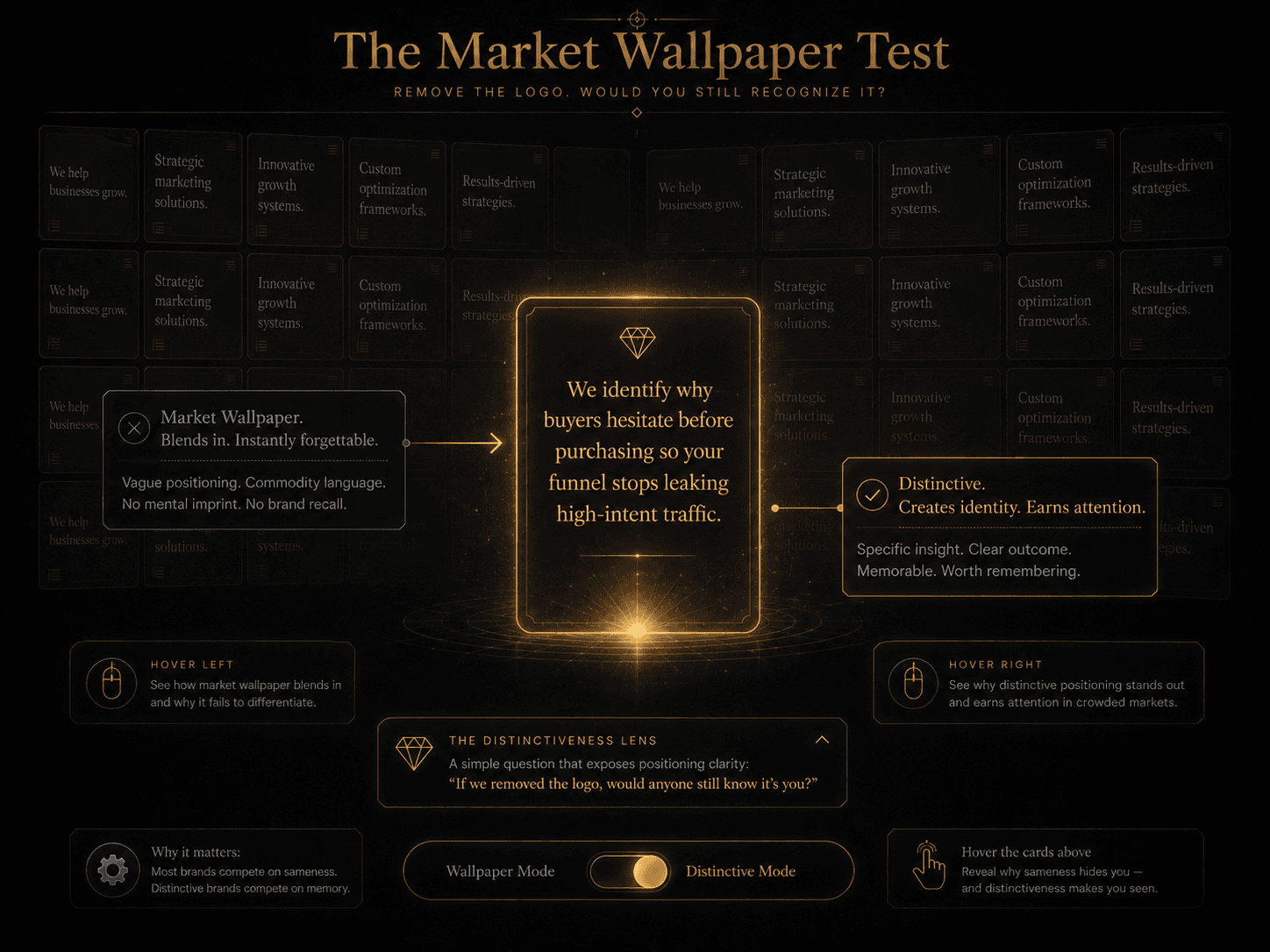
The Market Wallpaper Test™
One of the most important tests in this entire resource is simple.
Ask:
“If I removed the logo, would this still feel recognisable?”
If the answer is no, the positioning likely blends into market wallpaper.
Market wallpaper is language the buyer has seen so many times that the brain stops assigning value to it.
Examples:
“strategic growth solutions”
“done-for-you marketing”
“premium consulting”
“custom systems”
“results-driven strategy”
“high-converting funnels”
“full-service support”
These phrases may not be false.
But they are familiar.
And familiar without specificity becomes invisible.
Strong offers create identity.
Not merely information.
——
Market Wallpaper Worksheet
Write your current offer line:
Now remove your brand name or logo.
Would it still feel recognisable?
Yes / No / Partially
Could five competitors say the same thing?
Yes / No / Partially
What phrase feels like market wallpaper?
What specific buyer condition, problem, mechanism, or consequence could make it more recognisable?
Rewrite it with more identity:
——
The Screenshot Test
Another useful diagnostic is the Screenshot Test™.
Ask:
“Would someone screenshot this because the positioning feels sharp?”
This matters because strong positioning creates:
memorability
sharing
conversation
return attention
internal repetition
buyer recognition
Weak positioning disappears instantly after reading.
A buyer screenshots, saves, shares, or remembers a line when it creates a reaction.
That reaction may be:
“That is exactly it.”
“That is sharp.”
“That feels expensive.”
“That explains the problem.”
“That is the line I needed.”
“That sounds different.”
“That creates trust fast.”
The screenshot is not the goal.
The reaction is the goal.
Screenshot Test Worksheet
Would someone screenshot or save your offer line?
Yes / No / Maybe
Why?
What reaction does the line currently create?
What reaction should it create?
What needs to become sharper?
Clarity / Consequence / Specificity / Distinctiveness / Movement
Rewrite the line:
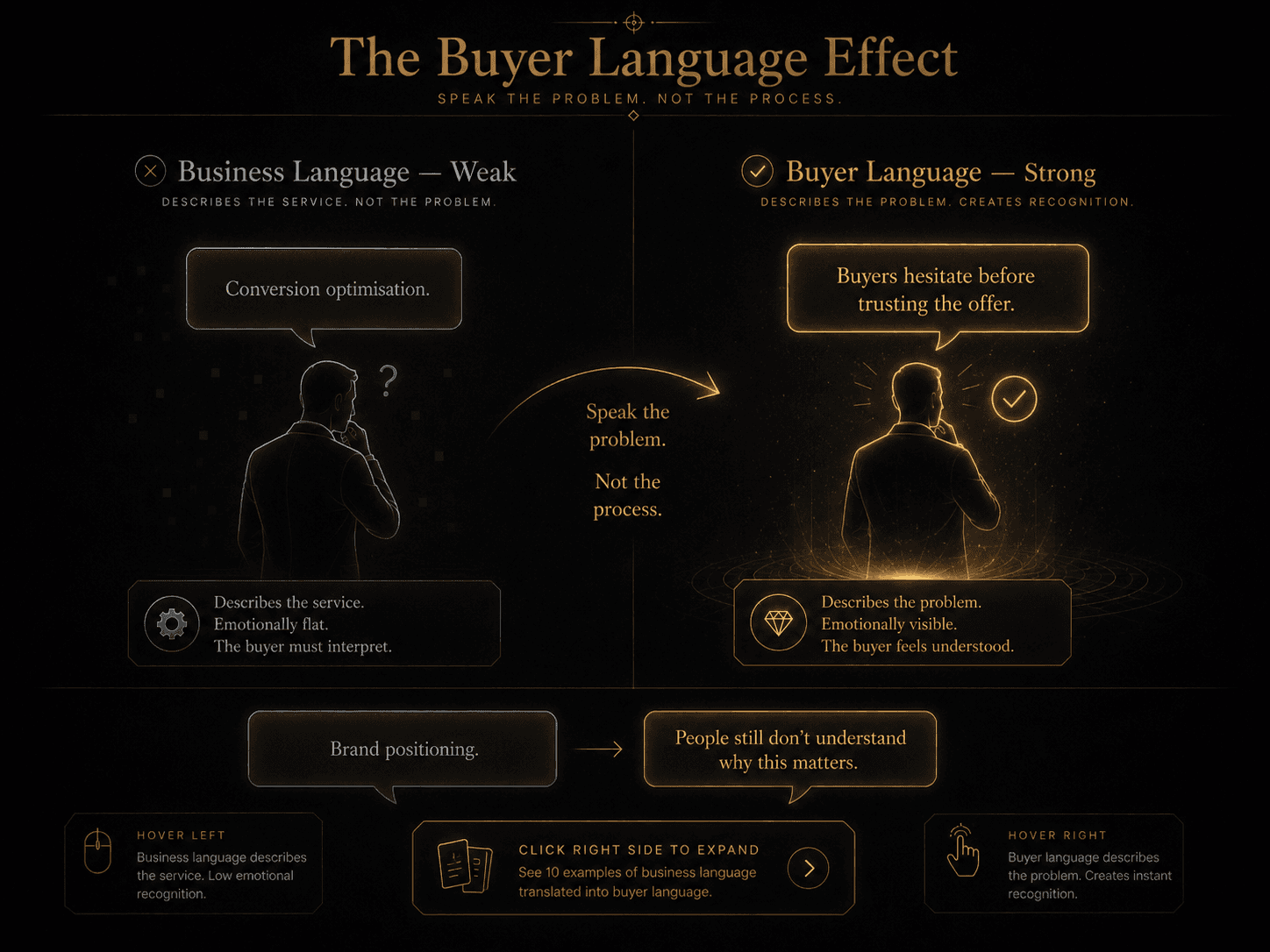
The Buyer Language Effect™
One pattern you will notice repeatedly:
Strong offers often sound closer to how buyers internally describe the problem.
Weak offers sound closer to how businesses internally describe the service.
That difference matters enormously.
The seller says:
“Conversion optimisation.”
The buyer thinks:
“People hesitate before trusting the offer.”
The seller says:
“Brand positioning.”
The buyer thinks:
“People still do not understand why this matters.”
The seller says:
“Customer journey optimisation.”
The buyer thinks:
“Buyers keep dropping off before they feel ready.”
The seller says:
“Content strategy.”
The buyer thinks:
“People consume my content but do not enquire.”
The second version creates recognition faster.
Why?
Because it starts closer to the buyer’s internal language.
Buyer language feels more real because it reflects the thought already happening in the buyer’s mind.
That is why strong offers often feel strangely obvious after you read them.
They do not feel invented.
They feel uncovered.
Buyer Language Worksheet
What do you currently call the service?
How would the buyer describe the problem privately?
What phrase would the buyer actually say?
What phrase would they never say?
Rewrite the offer using buyer language:
The Biggest Swipe-File Mistake™
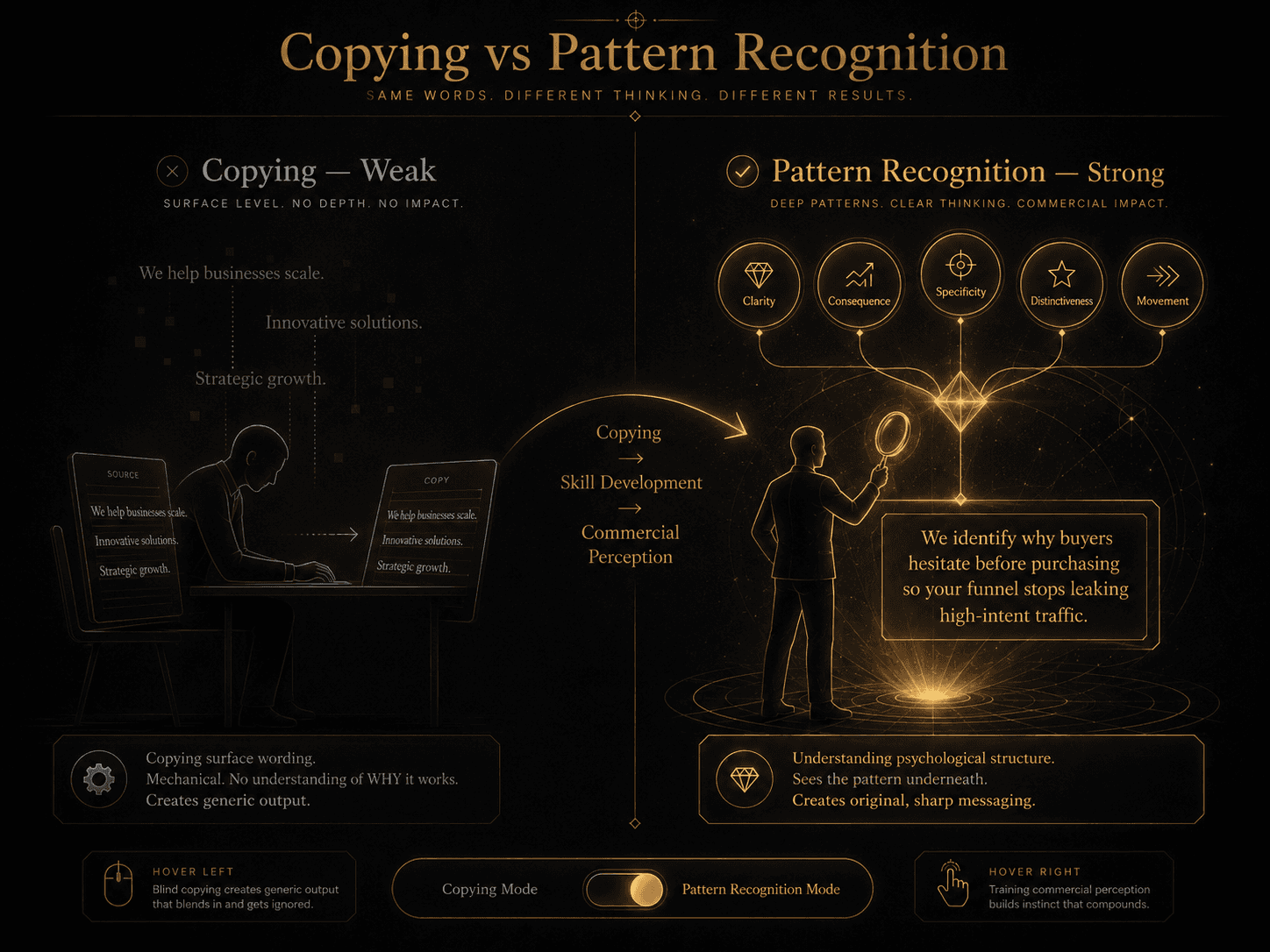
The biggest swipe-file mistake is blind copying.
Huge mistake.
You should never copy surface wording mechanically.
When you copy without understanding, you borrow words without borrowing the structure that made them work.
That creates imitation.
Not skill.
Instead, study:
emotional structure
tension creation
consequence visibility
compression
specificity
buyer recognition
positioning movement
mechanism clarity
memory
trust progression
The pattern matters more than the sentence itself.
A swipe file should not make you dependent on other people’s wording.
It should make you sharper at seeing why language works.
Build Your Own Swipe Library
As you study offers, save examples that create immediate reactions like:
“That feels sharp.”
“That feels expensive.”
“That creates tension.”
“That instantly makes sense.”
“That sounds different.”
“That creates trust fast.”
“That feels specific.”
“That makes the problem obvious.”
“That makes me want to know more.”
Then ask:
“Why did this create that reaction?”
That question builds commercial instinct.
Do not only collect the line.
Collect the reason the line works.
Sources For Your Swipe Library
Build your swipe vault from:
landing pages
ads
sales pages
homepage headers
VSL openings
email subject lines
product pages
offer statements
pricing pages
social posts
webinar titles
lead magnet titles
CTAs
sales call positioning lines
proposal openings
founder bios
The more examples you study through the five lenses, the sharper your eye becomes.
——
Swipe Analysis Worksheet™
Use this worksheet for every swipe you save.
Swipe Source
Where did you find this example?
Original Swipe
Paste the offer, headline, or positioning line:
First Reaction
What did you feel when you read it?
Sharp / Clear / Expensive / Generic / Forgettable / Trustworthy / Urgent / Confusing / Other
Explain:
Lens 1: Clarity
Can the buyer understand it quickly?
Score: ___ / 5
Why?
Lens 2: Consequence
Does it show what happens if the problem remains unresolved?
Score: ___ / 5
Why?
Lens 3: Specificity
Does it create a visible mental picture?
Score: ___ / 5
Why?
Lens 4: Distinctiveness
Would it still feel recognisable without the logo?
Score: ___ / 5
Why?
Lens 5: Movement
Does the buyer feel what changes after this works?
Score: ___ / 5
Why?
Pattern Identified
What pattern makes this offer strong or weak?
What I Can Learn From This
What should I adapt from the structure?
What I Should Not Copy
What should I avoid copying mechanically?
My Adapted Version
Rewrite the pattern for your own offer:
Swipe Vault Scorecard™
Score each swipe example out of 25.
Clarity: ___ / 5
Consequence: ___ / 5
Specificity: ___ / 5
Distinctiveness: ___ / 5
Movement: ___ / 5
Total: ___ / 25
——
Score Interpretation
21–25: Strong Swipe™
This example has strong commercial structure.
Study it carefully.
Identify the pattern underneath the sentence.
16–20: Useful Swipe™
The example has some strong elements, but may still contain weakness.
Study what works and what could be improved.
10–15: Average Swipe™
The example may be usable, but it does not create strong positioning movement.
Use it as a diagnostic exercise.
0–9: Weak Swipe™
This example likely contains market wallpaper, vague language, weak consequence, low specificity, or poor movement.
Use it to train your eye for what not to write.
——
The Highest Level Of Swipe Training™
Eventually, you stop collecting words.
You start recognising psychological structures.
That is the real goal.
At that point, you can build stronger positioning intentionally instead of guessing emotionally.
You begin to see:
where clarity appears
where consequence appears
where specificity appears
where distinctiveness appears
where movement appears
where the buyer feels recognised
where the offer creates trust
where the sentence becomes memorable
where the positioning stops sounding generic
That is when the swipe vault becomes powerful.
Not because you have more examples.
Because your perception has changed.
——
Using AI To Analyse Swipe Examples
AI can help you use swipe files properly, but only if you ask it to analyse the structure underneath the language.
Do not ask:
“Make me something like this.”
That usually creates imitation.
Ask:
“Why does this work?”
Then ask:
“How can I adapt the structure without copying the surface wording?”
That is the correct use of AI here.
——
AI Swipe Analysis Prompt™
Use this prompt:
Act as a high-level offer strategist, buyer psychology analyst, and conversion copywriter.
Analyse this offer positioning example and explain what makes it psychologically strong or weak.
Here is the offer, headline, or positioning line:
[paste swipe example]
My business is:
[insert business]
My target buyer is:
[insert buyer]
My offer is:
[insert offer]
Analyse the swipe through these five lenses:
Clarity
Consequence
Specificity
Distinctiveness
Movement
For each lens:
give a score from 1 to 5
explain what is strong
explain what is weak
identify the exact words or structure creating the effect
explain how a buyer would likely interpret it
identify what makes it memorable or forgettable
Then explain:
what makes the example psychologically strong or weak
whether the language creates tension
whether the language creates buyer recognition
whether the language creates consequence visibility
whether the offer sounds like buyer language or business language
whether the line risks becoming market wallpaper
what pattern I should study
what I should avoid copying mechanically
Then rewrite the example into:
A stronger version
A more compressed version
A more premium but still clear version
A more emotionally visible version
A version adapted to my business without copying the original wording
Then explain which version is strongest and why.
Do not add hype.
Do not imitate the wording mechanically.
Do not make the offer vague to sound premium.
Prioritise clarity, buyer psychology, consequence visibility, specificity, distinctiveness, movement, and commercial sharpness.
——
Final Execution Challenge™
Build your own swipe vault using:
landing pages
ads
sales pages
homepage headers
VSL openings
email subject lines
offer statements
product pages
CTAs
pricing sections
proposal openings
Then analyse every example using the five diagnostic lenses:
Clarity
Consequence
Specificity
Distinctiveness
Movement
Do not ask:
“Do I like this?”
Ask:
“Why does this create emotional movement faster than weaker positioning?”
That question changes everything.
Because strong marketers eventually stop seeing copy.
They start seeing psychological structure, buyer perception, and commercial tension hidden underneath the language itself.
——
Final Swipe Vault Builder
Use this template to build your own structured swipe vault.
Swipe 1
Source:
Original line:
Why it caught my attention:
Clarity score: ___ / 5
Consequence score: ___ / 5
Specificity score: ___ / 5
Distinctiveness score: ___ / 5
Movement score: ___ / 5
Pattern learned:
Adapted version for my offer:
Swipe 2
Source:
Original line:
Why it caught my attention:
Clarity score: ___ / 5
Consequence score: ___ / 5
Specificity score: ___ / 5
Distinctiveness score: ___ / 5
Movement score: ___ / 5
Pattern learned:
Adapted version for my offer:
Swipe 3
Source:
Original line:
Why it caught my attention:
Clarity score: ___ / 5
Consequence score: ___ / 5
Specificity score: ___ / 5
Distinctiveness score: ___ / 5
Movement score: ___ / 5
Pattern learned:
Adapted version for my offer:
——
Final Principle
The point of a swipe vault is not to copy better words.
It is to train better perception.
Weak marketers see headlines.
Strong marketers see structure.
They see where the offer creates clarity.
They see where the consequence appears.
They see how specificity creates trust.
They see how distinctiveness creates memory.
They see how movement creates desire.
They see why one line feels sharp and another dissolves into market wallpaper.
That is what The Offer Swipe Vault™ is designed to build.
Not imitation.
Recognition.
Not copying.
Pattern awareness.
Not surface-level inspiration.
Commercial instinct.
Because once you can see strong positioning clearly, you can build it intentionally.
And once you can build it intentionally, your offers stop depending on random cleverness.
They start carrying structure.
Clarity.
Consequence.
Specificity.
Distinctiveness.
Movement.
That is when copy stops being a collection of words and becomes a system for shaping buyer perception.
——
From:
The $100M Funnel Playbook. Book I: Foundation Buyer Psychology, Offer Clarity, and the Page Architecture Behind High-Converting Funnels
By Maris Spalins.
——
Copyright Notice
© 2026 The $100M Funnel Playbook / Winyourclients / Maris Spalins. All rights reserved.
This resource, including the frameworks, terminology, examples, scorecards, templates, prompts, methods, and written explanations, is original intellectual property created for The $100M Funnel Playbook. Book I: Foundation — Buyer Psychology, Offer Clarity, And The Page Architecture Behind High-Converting Funnels and published through Winyourclients.
No part of this resource may be copied, reproduced, screenshotted, republished, redistributed, sold, adapted, uploaded, scraped, stored in a database, included in training data, used to train artificial intelligence systems, or used to create derivative commercial or educational materials without prior written permission.
Limited reference, quotation, or sharing is only permitted where the source is clearly and visibly credited.
Any permitted reference must include at least one of the following source credits:
The $100M Funnel Playbook by Maris Spalins
or
Winyourclients — www.winyourclients.com
or
Maris Spalins / Winyourclients
Screenshots, excerpts, summaries, or redistributed versions must not remove, hide, alter, crop out, or obscure the original source, author name, book title, website name, or copyright notice.
This resource is provided for personal learning and implementation only. It is not licensed for resale, republishing, redistribution, AI training, template cloning, course creation, consulting delivery, or commercial reuse without written permission from Maris Spalins or Winyourclients.
For permission requests, licensing, citation approval, or commercial usage enquiries, contact:
Winyourclients
www.winyourclients.com
or
Email directly to Jacob on: help@winyourclients.com
The Offer Swipe Vault™ A structured offer breakdown library for studying the clarity, consequence, specificity, distinctiveness, and movement patterns that make strong positioning easier to recognise and build.
Prefer Audio Or Video?
The Offer Swipe Vault™ is also available as:
🎧 A guided audio walkthrough explaining offer swipe analysis, positioning patterns, clarity, consequence, specificity, distinctiveness, and movement.
🎥 A practical video breakdown with real offer swipe examples, weak vs strong positioning teardowns, market wallpaper diagnosis, buyer-language rewrites, and AI swipe analysis.Choose the format that fits how you learn best.
[Listen To The Audio Walkthrough] (coming soon)
[Watch The Video Breakdown] (coming soon)
——
Why Most People Use Swipe Files Wrong
Most people use swipe files incorrectly.
They collect headlines.
They save landing pages.
They screenshot offer lines.
They bookmark ads.
They copy phrases.
But they never understand why the examples work.
That creates copying.
Not skill development.
The goal is not to imitate language mechanically.
The goal is to train your brain to recognise the structure underneath strong positioning.
You are not studying offers so you can steal sentences.
You are studying offers so you can see:
clarity
tension
specificity
emotional movement
consequence
buyer psychology
positioning sharpness
memorability
commercial force
Once you understand the pattern underneath the words, you stop needing to copy.
You start seeing commercial structure itself.
That is the real purpose of The Offer Swipe Vault™.
What This Resource Helps You Do
The Offer Swipe Vault™ helps you study real offer structures, positioning patterns, and commercial sharpness in action.
Use it to learn how to identify:
what makes offers feel valuable
what creates immediate clarity
what creates urgency without hype
what increases perceived sophistication
what makes positioning memorable
what creates stronger buyer recognition
what makes one offer feel sharp and another feel generic
what creates consequence visibility
what makes an offer easier to trust
what makes language feel commercially alive instead of decorative
This is not a random swipe file.
This is a structured learning system.
Because most founders do not struggle because they lack effort.
They struggle because they lack pattern recognition.
They have not trained their eyes to instantly notice:
weak positioning
hidden fog
soft language
invisible consequence
generic framing
weak urgency
low emotional movement
market wallpaper
activity language
vague value
Once you can see strong positioning clearly, you can build it intentionally.
The Real Purpose Of This Vault™
This vault exists to train commercial perception.
Commercial perception means the ability to see why one offer creates movement and another disappears.
It means noticing:
why one sentence feels forgettable
why another instantly creates tension
why some offers feel expensive
why others feel generic
why certain positioning creates trust quickly
why some language creates urgency naturally
why some offers feel specific while others feel like category noise
why one line makes the buyer care and another makes them skim
That awareness changes everything downstream.
You stop asking:
“Do I like this line?”
And start asking:
“What is this line doing psychologically?”
That is the difference between collecting swipes and building skill.
The Core Principle
Strong marketers do not merely collect copy.
They study structure.
The words matter.
But the structure underneath the words matters more.
A strong offer line usually contains some combination of:
a specific buyer
a visible problem
a painful consequence
a clear movement
a distinct mechanism
a believable result
a memorable frame
a reason to care now
A weak offer usually hides behind:
broad claims
generic benefits
vague positivity
category labels
consultant language
operational descriptions
clever phrasing without consequence
features with no emotional movement
The goal of this vault is to help you see those patterns faster.
Because once you can see the structure, you can rebuild weak offers with far more control.
How To Use This Resource
Every swipe example inside this vault should be analysed through five lenses.
Do not only ask:
“Do I like this?”
That question is too shallow.
Ask:
“What is this doing to the buyer’s perception?”
Use these five lenses every time.
Clarity
Consequence
Specificity
Distinctiveness
Movement
Together, these lenses help you diagnose why an offer feels sharp, weak, generic, forgettable, or commercially valuable.
The 5 Swipe Analysis Lenses™
Lens 1: Clarity™
Core Question
Can the buyer instantly understand what this is, who it helps, and why it matters?
Or does the offer require mental decoding?
Clarity is the first test.
If the buyer cannot quickly understand the offer, they will not stay long enough to appreciate the deeper value.
A clear offer does not make the buyer work hard.
It gives them immediate orientation.
Clarity Diagnostic Questions
Ask:
What is being sold?
Who is it for?
What problem does it solve?
Why does it matter?
Could the buyer explain it back after reading it once?
Does the offer create orientation within seconds?
If the answer is no, the offer has clarity friction.
Weak Clarity Example
“We provide strategic growth solutions.”
The buyer may understand that this is business-related.
But they cannot clearly see:
what kind of growth
for whom
through what mechanism
against what problem
with what outcome
It sounds polished, but it is foggy.
Stronger Clarity Example
“We help service businesses fix the offer fog making qualified buyers hesitate before enquiring.”
Now the buyer can see:
who it is for
what problem exists
what is being fixed
why it matters commercially
That is clarity.
Lens 2: Consequence™
Core Question
Does the offer reveal what painful thing happens if this problem remains unresolved?
Strong offers expose stakes.
Weak offers describe services.
Consequence is what makes the buyer feel that the problem matters.
Without consequence, the offer may be understandable but easy to postpone.
The buyer may think:
“That sounds useful.”
But they do not feel:
“I need to deal with this.”
That difference matters.
Consequence Diagnostic Questions
Ask:
What happens if the buyer ignores this?
What keeps leaking?
What becomes more expensive?
What gets delayed?
What trust is lost?
What opportunity disappears?
What emotional or commercial cost becomes visible?
If the offer does not reveal consequence, urgency stays weak.
Weak Consequence Example
“We improve your landing page.”
This describes a service.
But it does not reveal what the weak page is costing the buyer.
Stronger Consequence Example
“We find where the landing page loses buyer trust before another month of paid traffic disappears into hesitation.”
Now the buyer feels:
trust loss
wasted traffic
time pressure
commercial leakage
a reason to care
That is consequence.
Lens 3: Specificity™
Core Question
Does the language create visible mental pictures?
Or does it hide behind broad marketing terminology?
Specificity gives the buyer something to hold.
Generic language disappears.
The more specific the offer is, the easier it becomes to understand, remember, and trust.
Specificity can appear in:
the buyer
the problem
the mechanism
the result
the context
the moment of failure
the cost of delay
the emotional condition
Specificity Diagnostic Questions
Ask:
Can the buyer picture the problem?
Can they picture the result?
Can they picture where the failure happens?
Does the offer name a specific buyer condition?
Does it use language the buyer would recognise?
Does it avoid vague positivity?
If the answer is no, the offer needs sharper detail.
Weak Specificity Example
“We help brands grow online.”
This is too broad.
The buyer cannot picture anything specific.
Stronger Specificity Example
“We help ecommerce brands turn product-page clicks into buyer intent before shoppers default to cheaper alternatives.”
Now the buyer can picture:
ecommerce brands
product-page clicks
buyer intent
price comparison
lost purchase momentum
That is specificity.
Lens 4: Distinctiveness™
Core Question
Would five competitors sound identical?
Or does this positioning feel recognisable and memorable?
Distinctiveness is not about being strange.
It is about having enough shape that the buyer can separate the offer from the market.
Weak offers blend into market wallpaper.
Strong offers create identity.
They give the buyer a phrase, mechanism, or problem frame they can remember.
Distinctiveness Diagnostic Questions
Ask:
If the logo disappeared, would this still feel recognisable?
Could five competitors say the same line?
Is there a specific mechanism?
Is there a named problem?
Is there a distinctive buyer condition?
Does the offer feel owned?
Does it sound like a category or a point of view?
If the answer is weak, the offer needs more positioning shape.
Weak Distinctiveness Example
“Done-for-you marketing systems.”
This could belong to thousands of providers.
It has no clear identity.
Stronger Distinctiveness Example
“Offer Fog Elimination™ for service businesses whose value sounds useful but forgettable.”
Now the offer has:
a named problem
a specific buyer condition
a clearer frame
stronger memory
That is distinctiveness.
Lens 5: Movement™
Core Question
Does the buyer clearly feel what changes after this works?
Or does the offer remain static and operational?
Movement is what makes the offer feel alive.
A weak offer tells the buyer what the service is.
A strong offer helps the buyer feel the shift.
Movement can be:
from confused to clear
from ignored to trusted
from passive attention to buyer intent
from traffic leakage to conversion momentum
from vague offer to clear buying reason
from hesitation to confidence
from scattered effort to focused demand
If the buyer cannot feel the movement, the offer remains flat.
Movement Diagnostic Questions
Ask:
What changes after this works?
What becomes easier?
What becomes clearer?
What becomes more trusted?
What becomes more profitable?
What emotional state improves?
Does the buyer feel the before-and-after?
If not, the offer needs stronger movement.
Weak Movement Example
“We optimise customer journeys.”
This is operational.
It does not show what changes emotionally or commercially.
Stronger Movement Example
“We stop buyers from dropping off before they trust the offer.”
Now the buyer can feel:
the before-state
the failure point
the buyer behaviour
the desired movement
That is movement.
——
The Swipe Breakdown Library™
Use the following examples to train pattern recognition.
Do not copy them mechanically.
Study what changes between the weak version and the stronger version.
Each example includes:
weak version
why it fails
stronger version
why it works
pattern to learn
adaptation prompt
Swipe Example 1: Agency Positioning
Weak Version
“We help businesses scale through strategic marketing solutions.”
Why It Fails
This looks professional, but it is emotionally empty.
Problems:
broad audience
vague result
no consequence
no mechanism clarity
completely interchangeable
no specific buyer pressure
no emotional movement
The buyer remembers nothing.
It sounds like market wallpaper.
Stronger Version
“We identify why buyers hesitate before purchasing so your funnel stops leaking high-intent traffic.”
Why It Works
Now the positioning creates:
visible friction
emotional consequence
clearer mechanism
stronger specificity
immediate commercial relevance
a clear reason to care
The difference is not better wording.
The difference is better psychological visibility.
Pattern To Learn
Strong positioning often names the specific failure point that is silently costing the buyer money, trust, or momentum.
Adaptation Prompt
What specific failure point does your offer identify, remove, or repair?
Write it here:
Swipe Example 2: Coaching Positioning
Weak Version
“I help entrepreneurs unlock their potential.”
Why It Fails
This is generic self-improvement language.
Problems:
no visible result
no pressure
no buying condition
no concrete transformation
no emotional specificity
no reason to trust this version
The buyer may understand the sentiment, but they cannot picture the value.
Stronger Version
“We help founders whose businesses look successful externally but still feel operationally chaotic underneath.”
Why It Works
Now the buyer feels recognition.
This line identifies:
a specific emotional contradiction
a visible outer state
a private inner pressure
a buyer condition
a deeper reason to pay attention
That changes attention completely.
Pattern To Learn
Strong positioning often reveals the contrast between how things look publicly and how they feel privately.
Adaptation Prompt
What private pressure does your buyer carry that is not obvious from the outside?
Write it here:
Swipe Example 3: SaaS Positioning
Weak Version
“All-in-one customer engagement platform.”
Why It Fails
This is category language.
Problems:
no emotional consequence
no buyer condition
no urgency
no visible failure point
no specific result
no reason to care now
It may describe the product category, but it does not create buyer attention.
Stronger Version
“Stop losing trial users because onboarding fails to create trust before confusion sets in.”
Why It Works
Now the problem becomes visible.
The line shows:
trial users leaving
onboarding as the failure point
trust as the missing condition
confusion as the emotional blocker
a clear consequence
Visible problems create buying attention.
Pattern To Learn
Strong SaaS positioning often connects product friction to buyer trust, confusion, activation, or lost momentum.
Adaptation Prompt
Where does your buyer lose trust, clarity, activation, or momentum?
Write it here:
Swipe Example 4: Funnel Offer
Weak Version
“We optimise conversion systems.”
Why It Fails
This is corporate fog.
Problems:
no movement
no visible buyer behaviour
no consequence
no mechanism clarity
no emotional specificity
The buyer cannot picture what changes.
Stronger Version
“We rebuild landing pages that create buyer certainty before hesitation kills the sale.”
Why It Works
Now the buyer can picture the conversion problem emotionally.
The line shows:
the object being rebuilt
the emotional target: buyer certainty
the failure point: hesitation
the consequence: lost sale
Huge difference.
Pattern To Learn
Strong funnel offers often name the emotional state required for conversion.
Adaptation Prompt
What emotional state must your buyer reach before they act?
Write it here:
Swipe Example 5: Ecommerce Offer
Weak Version
“We create better product pages.”
Why It Fails
This is clear, but basic.
Problems:
no specific buyer condition
no visible consequence
no emotional buying reason
no comparison pressure
no urgency
The buyer understands the service, but the value feels soft.
Stronger Version
“We rebuild product pages so shoppers feel desire and trust before they start comparing price, shipping, or cheaper alternatives.”
Why It Works
Now the offer shows:
the page’s emotional job
desire and trust as the goal
comparison behaviour as the risk
a clearer buying sequence
a reason the work matters
The offer becomes more commercially meaningful.
Pattern To Learn
Strong ecommerce positioning often focuses on what must happen before comparison, hesitation, or abandonment begins.
Adaptation Prompt
What must your buyer feel before they start comparing, hesitating, or leaving?
Write it here:
Swipe Example 6: Freelancer Offer
Weak Version
“I help freelancers get more clients.”
Why It Fails
This is too common.
Problems:
broad audience
generic result
no mechanism
no buying condition
no distinctiveness
no emotional specificity
The line is understandable, but forgettable.
Stronger Version
“We help ghostwriting freelancers turn vague positioning into a one-line buying reason that attracts better-fit retainers without constant pitching.”
Why It Works
Now the offer has:
specific buyer
specific problem
visible result
reduced objection
mechanism clarity
stronger commercial outcome
The buyer can picture the shift.
Pattern To Learn
Strong freelancer positioning often gets stronger when it names the specific kind of client, the positioning problem, and the unwanted effort being reduced.
Adaptation Prompt
What unwanted effort does your offer reduce for the buyer?
Write it here:
Swipe Example 7: Consultant Offer
Weak Version
“I provide business strategy consulting.”
Why It Fails
This is too broad.
Problems:
no buyer condition
no emotional tension
no visible transformation
no distinct mechanism
no specific consequence
It describes the activity, but not the movement.
Stronger Version
“We help service founders stuck in reactive decision-making turn scattered priorities into a clearer growth direction through a pressure-based strategy audit.”
Why It Works
Now the positioning creates:
recognisable buyer condition
operational pain
emotional relief
clear movement
distinct mechanism
more credible value
The buyer can see the before-and-after.
Pattern To Learn
Strong consulting positioning often becomes sharper when it moves from “advice” to the specific decision pressure the buyer wants resolved.
Adaptation Prompt
What decision pressure does your offer help the buyer resolve?
Write it here:
Swipe Example 8: AI Automation Offer
Weak Version
“We build AI automations for businesses.”
Why It Fails
This is understandable but generic.
Problems:
broad audience
no specific use case
no consequence
no workflow pain
no business movement
no emotional relief
The buyer understands the category but not the value.
Stronger Version
“We build AI workflows that remove repetitive admin from the sales process before your team loses another week chasing updates, follow-ups, and manual handovers.”
Why It Works
Now the offer shows:
specific use case
repetitive admin as the pain
sales process as the context
lost time as the consequence
team relief as the movement
a clear reason to act
The offer becomes much more concrete.
Pattern To Learn
Strong AI positioning becomes sharper when it names the specific workflow pain being removed instead of selling AI as a category.
Adaptation Prompt
What repeated workflow pain does your offer remove?
Write it here:
Swipe Example 9: Creator Offer
Weak Version
“I help creators grow their audience.”
Why It Fails
This is generic.
Problems:
broad promise
no buyer intent
no monetisation movement
no emotional tension
no distinct mechanism
The buyer has heard it before.
Stronger Version
“We help creators turn passive attention into buyer intent so their audience stops consuming and starts converting.”
Why It Works
Now the offer shows:
the current state: passive attention
the desired movement: buyer intent
the commercial shift: consuming to converting
a sharper reason to care
This creates stronger positioning.
Pattern To Learn
Strong creator positioning often becomes more valuable when it moves beyond audience growth and into buyer intent.
Adaptation Prompt
Where does your buyer have attention but not enough intent?
Write it here:
Swipe Example 10: Local Service Offer
Weak Version
“We provide professional home renovation services.”
Why It Fails
This is clear but generic.
Problems:
no specific buyer anxiety
no trust-building angle
no emotional consequence
no distinctiveness
no reason to choose this provider
The buyer understands the service, but still has no reason to trust this version more.
Stronger Version
“We help homeowners renovate without the usual contractor chaos, unclear timelines, and budget surprises.”
Why It Works
Now the offer speaks directly to buyer fear.
It shows:
the specific buyer
the emotional risk
the problem with alternatives
the promise of reduced chaos
a clearer reason to trust
The offer becomes more buyer-relevant.
Pattern To Learn
Strong local service positioning often wins by naming the buyer’s distrust of the category and showing what will feel safer this time.
Adaptation Prompt
What does your buyer already distrust about your category?
Write it here:
What Strong Offers Usually Do
Strong offers usually create:
visible tension
fast clarity
consequence
specific friction
emotional relevance
distinctiveness
movement
buyer recognition
trust
memorability
They make the buyer think:
“I understand this.”
“I can see why this matters.”
“This feels specific.”
“This feels different.”
“This describes something I actually experience.”
“That is the problem.”
“That is the shift I want.”
Strong offers do not merely sound better.
They create better buyer recognition.
——
What Weak Offers Usually Do
Weak offers usually rely on:
broad abstractions
generic benefits
category labels
vague positivity
consultant language
operational descriptions
overused promises
polished but empty phrasing
deliverables without consequence
mechanisms without clarity
They make the buyer think:
“I have heard this before.”
“This could mean anything.”
“This sounds like everyone else.”
“I understand the category, but I do not feel why it matters.”
That distinction is the entire game.
——
The Market Wallpaper Test™
One of the most important tests in this entire resource is simple.
Ask:
“If I removed the logo, would this still feel recognisable?”
If the answer is no, the positioning likely blends into market wallpaper.
Market wallpaper is language the buyer has seen so many times that the brain stops assigning value to it.
Examples:
“strategic growth solutions”
“done-for-you marketing”
“premium consulting”
“custom systems”
“results-driven strategy”
“high-converting funnels”
“full-service support”
These phrases may not be false.
But they are familiar.
And familiar without specificity becomes invisible.
Strong offers create identity.
Not merely information.
——
Market Wallpaper Worksheet
Write your current offer line:
Now remove your brand name or logo.
Would it still feel recognisable?
Yes / No / Partially
Could five competitors say the same thing?
Yes / No / Partially
What phrase feels like market wallpaper?
What specific buyer condition, problem, mechanism, or consequence could make it more recognisable?
Rewrite it with more identity:
——
The Screenshot Test
Another useful diagnostic is the Screenshot Test™.
Ask:
“Would someone screenshot this because the positioning feels sharp?”
This matters because strong positioning creates:
memorability
sharing
conversation
return attention
internal repetition
buyer recognition
Weak positioning disappears instantly after reading.
A buyer screenshots, saves, shares, or remembers a line when it creates a reaction.
That reaction may be:
“That is exactly it.”
“That is sharp.”
“That feels expensive.”
“That explains the problem.”
“That is the line I needed.”
“That sounds different.”
“That creates trust fast.”
The screenshot is not the goal.
The reaction is the goal.
Screenshot Test Worksheet
Would someone screenshot or save your offer line?
Yes / No / Maybe
Why?
What reaction does the line currently create?
What reaction should it create?
What needs to become sharper?
Clarity / Consequence / Specificity / Distinctiveness / Movement
Rewrite the line:
The Buyer Language Effect™
One pattern you will notice repeatedly:
Strong offers often sound closer to how buyers internally describe the problem.
Weak offers sound closer to how businesses internally describe the service.
That difference matters enormously.
The seller says:
“Conversion optimisation.”
The buyer thinks:
“People hesitate before trusting the offer.”
The seller says:
“Brand positioning.”
The buyer thinks:
“People still do not understand why this matters.”
The seller says:
“Customer journey optimisation.”
The buyer thinks:
“Buyers keep dropping off before they feel ready.”
The seller says:
“Content strategy.”
The buyer thinks:
“People consume my content but do not enquire.”
The second version creates recognition faster.
Why?
Because it starts closer to the buyer’s internal language.
Buyer language feels more real because it reflects the thought already happening in the buyer’s mind.
That is why strong offers often feel strangely obvious after you read them.
They do not feel invented.
They feel uncovered.
Buyer Language Worksheet
What do you currently call the service?
How would the buyer describe the problem privately?
What phrase would the buyer actually say?
What phrase would they never say?
Rewrite the offer using buyer language:
The Biggest Swipe-File Mistake™
The biggest swipe-file mistake is blind copying.
Huge mistake.
You should never copy surface wording mechanically.
When you copy without understanding, you borrow words without borrowing the structure that made them work.
That creates imitation.
Not skill.
Instead, study:
emotional structure
tension creation
consequence visibility
compression
specificity
buyer recognition
positioning movement
mechanism clarity
memory
trust progression
The pattern matters more than the sentence itself.
A swipe file should not make you dependent on other people’s wording.
It should make you sharper at seeing why language works.
Build Your Own Swipe Library
As you study offers, save examples that create immediate reactions like:
“That feels sharp.”
“That feels expensive.”
“That creates tension.”
“That instantly makes sense.”
“That sounds different.”
“That creates trust fast.”
“That feels specific.”
“That makes the problem obvious.”
“That makes me want to know more.”
Then ask:
“Why did this create that reaction?”
That question builds commercial instinct.
Do not only collect the line.
Collect the reason the line works.
Sources For Your Swipe Library
Build your swipe vault from:
landing pages
ads
sales pages
homepage headers
VSL openings
email subject lines
product pages
offer statements
pricing pages
social posts
webinar titles
lead magnet titles
CTAs
sales call positioning lines
proposal openings
founder bios
The more examples you study through the five lenses, the sharper your eye becomes.
——
Swipe Analysis Worksheet™
Use this worksheet for every swipe you save.
Swipe Source
Where did you find this example?
Original Swipe
Paste the offer, headline, or positioning line:
First Reaction
What did you feel when you read it?
Sharp / Clear / Expensive / Generic / Forgettable / Trustworthy / Urgent / Confusing / Other
Explain:
Lens 1: Clarity
Can the buyer understand it quickly?
Score: ___ / 5
Why?
Lens 2: Consequence
Does it show what happens if the problem remains unresolved?
Score: ___ / 5
Why?
Lens 3: Specificity
Does it create a visible mental picture?
Score: ___ / 5
Why?
Lens 4: Distinctiveness
Would it still feel recognisable without the logo?
Score: ___ / 5
Why?
Lens 5: Movement
Does the buyer feel what changes after this works?
Score: ___ / 5
Why?
Pattern Identified
What pattern makes this offer strong or weak?
What I Can Learn From This
What should I adapt from the structure?
What I Should Not Copy
What should I avoid copying mechanically?
My Adapted Version
Rewrite the pattern for your own offer:
Swipe Vault Scorecard™
Score each swipe example out of 25.
Clarity: ___ / 5
Consequence: ___ / 5
Specificity: ___ / 5
Distinctiveness: ___ / 5
Movement: ___ / 5
Total: ___ / 25
——
Score Interpretation
21–25: Strong Swipe™
This example has strong commercial structure.
Study it carefully.
Identify the pattern underneath the sentence.
16–20: Useful Swipe™
The example has some strong elements, but may still contain weakness.
Study what works and what could be improved.
10–15: Average Swipe™
The example may be usable, but it does not create strong positioning movement.
Use it as a diagnostic exercise.
0–9: Weak Swipe™
This example likely contains market wallpaper, vague language, weak consequence, low specificity, or poor movement.
Use it to train your eye for what not to write.
——
The Highest Level Of Swipe Training™
Eventually, you stop collecting words.
You start recognising psychological structures.
That is the real goal.
At that point, you can build stronger positioning intentionally instead of guessing emotionally.
You begin to see:
where clarity appears
where consequence appears
where specificity appears
where distinctiveness appears
where movement appears
where the buyer feels recognised
where the offer creates trust
where the sentence becomes memorable
where the positioning stops sounding generic
That is when the swipe vault becomes powerful.
Not because you have more examples.
Because your perception has changed.
——
Using AI To Analyse Swipe Examples
AI can help you use swipe files properly, but only if you ask it to analyse the structure underneath the language.
Do not ask:
“Make me something like this.”
That usually creates imitation.
Ask:
“Why does this work?”
Then ask:
“How can I adapt the structure without copying the surface wording?”
That is the correct use of AI here.
——
AI Swipe Analysis Prompt™
Use this prompt:
Act as a high-level offer strategist, buyer psychology analyst, and conversion copywriter.
Analyse this offer positioning example and explain what makes it psychologically strong or weak.
Here is the offer, headline, or positioning line:
[paste swipe example]
My business is:
[insert business]
My target buyer is:
[insert buyer]
My offer is:
[insert offer]
Analyse the swipe through these five lenses:
Clarity
Consequence
Specificity
Distinctiveness
Movement
For each lens:
give a score from 1 to 5
explain what is strong
explain what is weak
identify the exact words or structure creating the effect
explain how a buyer would likely interpret it
identify what makes it memorable or forgettable
Then explain:
what makes the example psychologically strong or weak
whether the language creates tension
whether the language creates buyer recognition
whether the language creates consequence visibility
whether the offer sounds like buyer language or business language
whether the line risks becoming market wallpaper
what pattern I should study
what I should avoid copying mechanically
Then rewrite the example into:
A stronger version
A more compressed version
A more premium but still clear version
A more emotionally visible version
A version adapted to my business without copying the original wording
Then explain which version is strongest and why.
Do not add hype.
Do not imitate the wording mechanically.
Do not make the offer vague to sound premium.
Prioritise clarity, buyer psychology, consequence visibility, specificity, distinctiveness, movement, and commercial sharpness.
——
Final Execution Challenge™
Build your own swipe vault using:
landing pages
ads
sales pages
homepage headers
VSL openings
email subject lines
offer statements
product pages
CTAs
pricing sections
proposal openings
Then analyse every example using the five diagnostic lenses:
Clarity
Consequence
Specificity
Distinctiveness
Movement
Do not ask:
“Do I like this?”
Ask:
“Why does this create emotional movement faster than weaker positioning?”
That question changes everything.
Because strong marketers eventually stop seeing copy.
They start seeing psychological structure, buyer perception, and commercial tension hidden underneath the language itself.
——
Final Swipe Vault Builder
Use this template to build your own structured swipe vault.
Swipe 1
Source:
Original line:
Why it caught my attention:
Clarity score: ___ / 5
Consequence score: ___ / 5
Specificity score: ___ / 5
Distinctiveness score: ___ / 5
Movement score: ___ / 5
Pattern learned:
Adapted version for my offer:
Swipe 2
Source:
Original line:
Why it caught my attention:
Clarity score: ___ / 5
Consequence score: ___ / 5
Specificity score: ___ / 5
Distinctiveness score: ___ / 5
Movement score: ___ / 5
Pattern learned:
Adapted version for my offer:
Swipe 3
Source:
Original line:
Why it caught my attention:
Clarity score: ___ / 5
Consequence score: ___ / 5
Specificity score: ___ / 5
Distinctiveness score: ___ / 5
Movement score: ___ / 5
Pattern learned:
Adapted version for my offer:
——
Final Principle
The point of a swipe vault is not to copy better words.
It is to train better perception.
Weak marketers see headlines.
Strong marketers see structure.
They see where the offer creates clarity.
They see where the consequence appears.
They see how specificity creates trust.
They see how distinctiveness creates memory.
They see how movement creates desire.
They see why one line feels sharp and another dissolves into market wallpaper.
That is what The Offer Swipe Vault™ is designed to build.
Not imitation.
Recognition.
Not copying.
Pattern awareness.
Not surface-level inspiration.
Commercial instinct.
Because once you can see strong positioning clearly, you can build it intentionally.
And once you can build it intentionally, your offers stop depending on random cleverness.
They start carrying structure.
Clarity.
Consequence.
Specificity.
Distinctiveness.
Movement.
That is when copy stops being a collection of words and becomes a system for shaping buyer perception.
——
From:
The $100M Funnel Playbook. Book I: Foundation Buyer Psychology, Offer Clarity, and the Page Architecture Behind High-Converting Funnels
By Maris Spalins.
——
Copyright Notice
© 2026 The $100M Funnel Playbook / Winyourclients / Maris Spalins. All rights reserved.
This resource, including the frameworks, terminology, examples, scorecards, templates, prompts, methods, and written explanations, is original intellectual property created for The $100M Funnel Playbook. Book I: Foundation — Buyer Psychology, Offer Clarity, And The Page Architecture Behind High-Converting Funnels and published through Winyourclients.
No part of this resource may be copied, reproduced, screenshotted, republished, redistributed, sold, adapted, uploaded, scraped, stored in a database, included in training data, used to train artificial intelligence systems, or used to create derivative commercial or educational materials without prior written permission.
Limited reference, quotation, or sharing is only permitted where the source is clearly and visibly credited.
Any permitted reference must include at least one of the following source credits:
The $100M Funnel Playbook by Maris Spalins
or
Winyourclients — www.winyourclients.com
or
Maris Spalins / Winyourclients
Screenshots, excerpts, summaries, or redistributed versions must not remove, hide, alter, crop out, or obscure the original source, author name, book title, website name, or copyright notice.
This resource is provided for personal learning and implementation only. It is not licensed for resale, republishing, redistribution, AI training, template cloning, course creation, consulting delivery, or commercial reuse without written permission from Maris Spalins or Winyourclients.
For permission requests, licensing, citation approval, or commercial usage enquiries, contact:
Winyourclients
www.winyourclients.com
or
Email directly to Jacob on: help@winyourclients.com
Other Blogs
Other Blogs
Check our other project Blogs with useful insight and information for your businesses
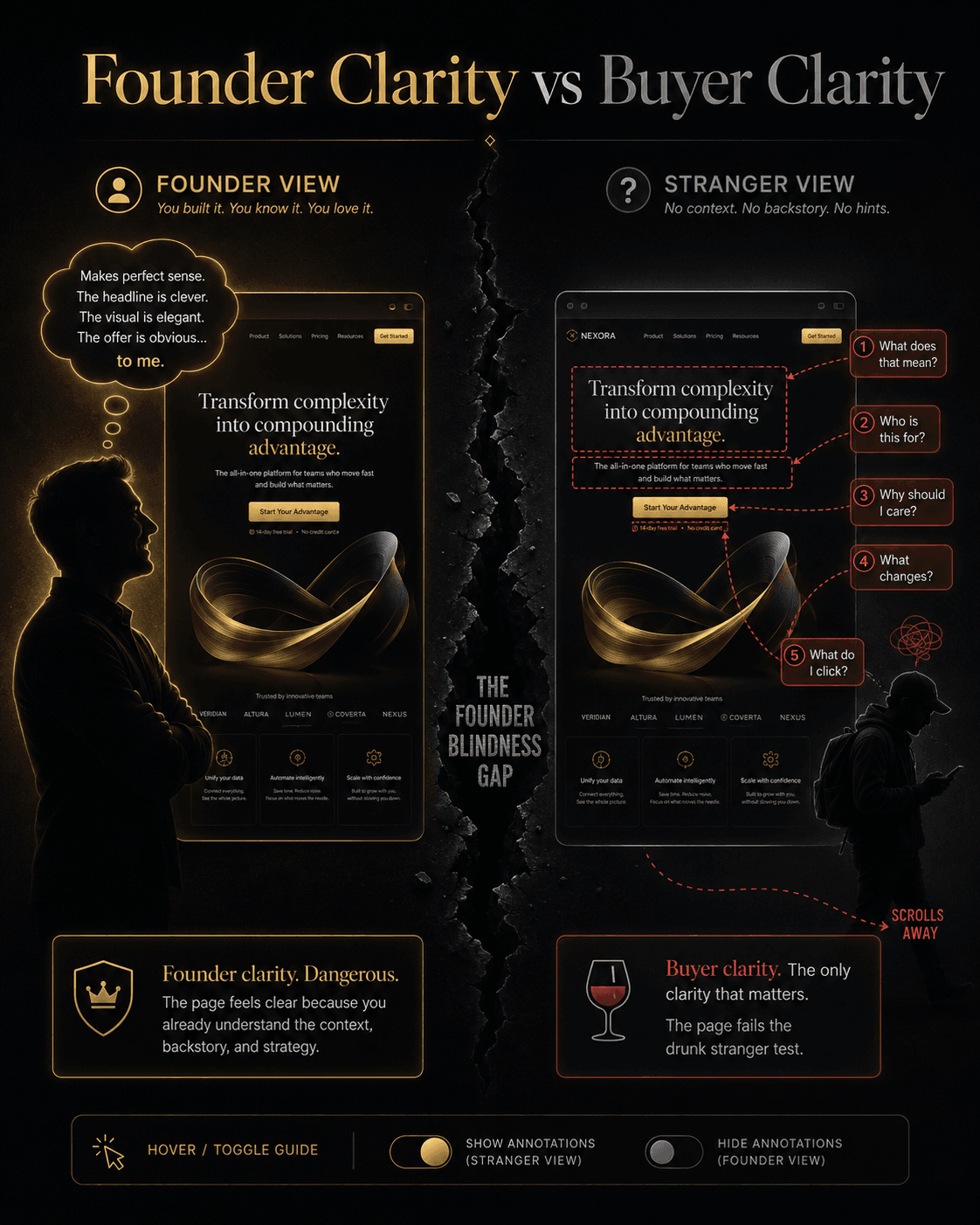
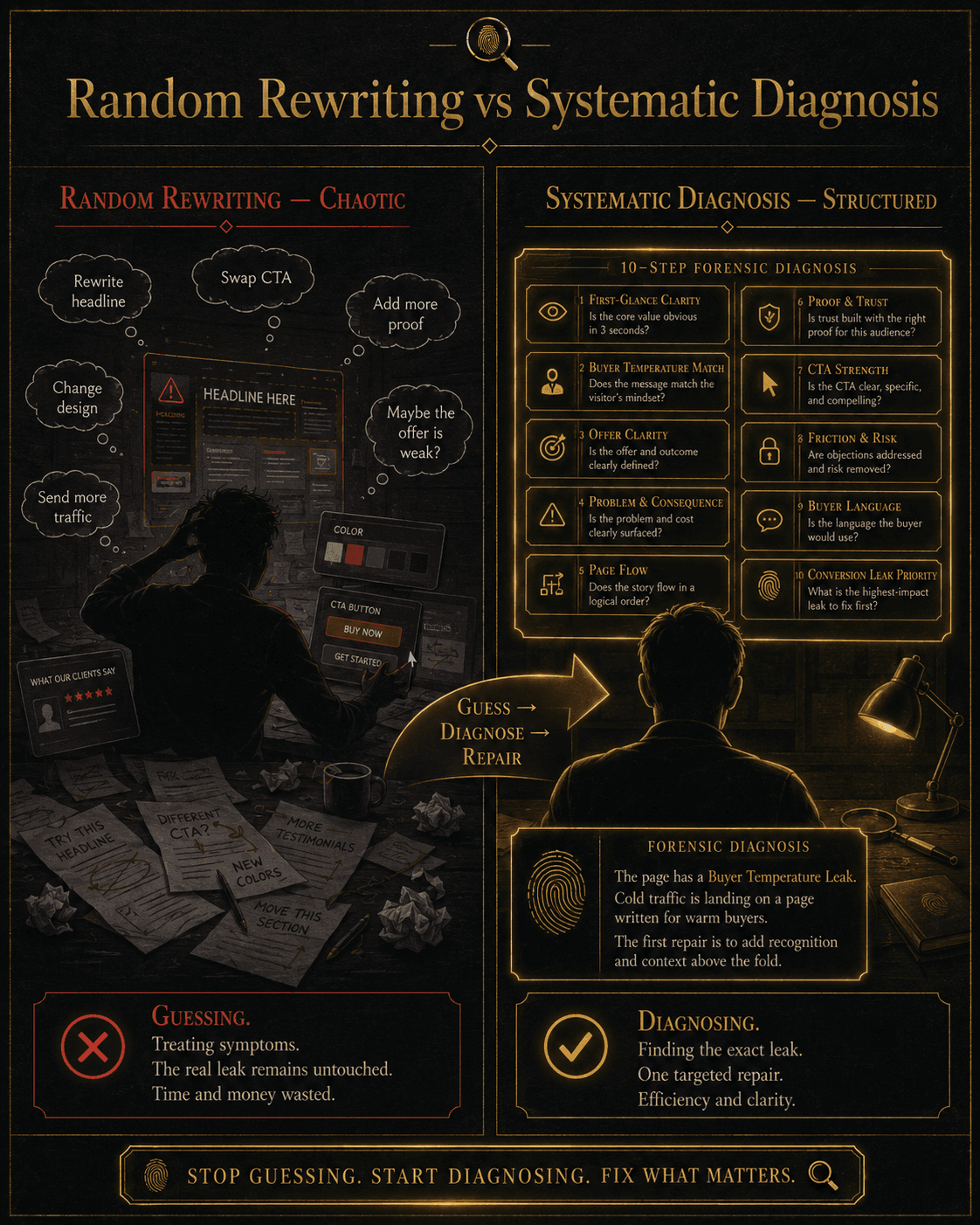
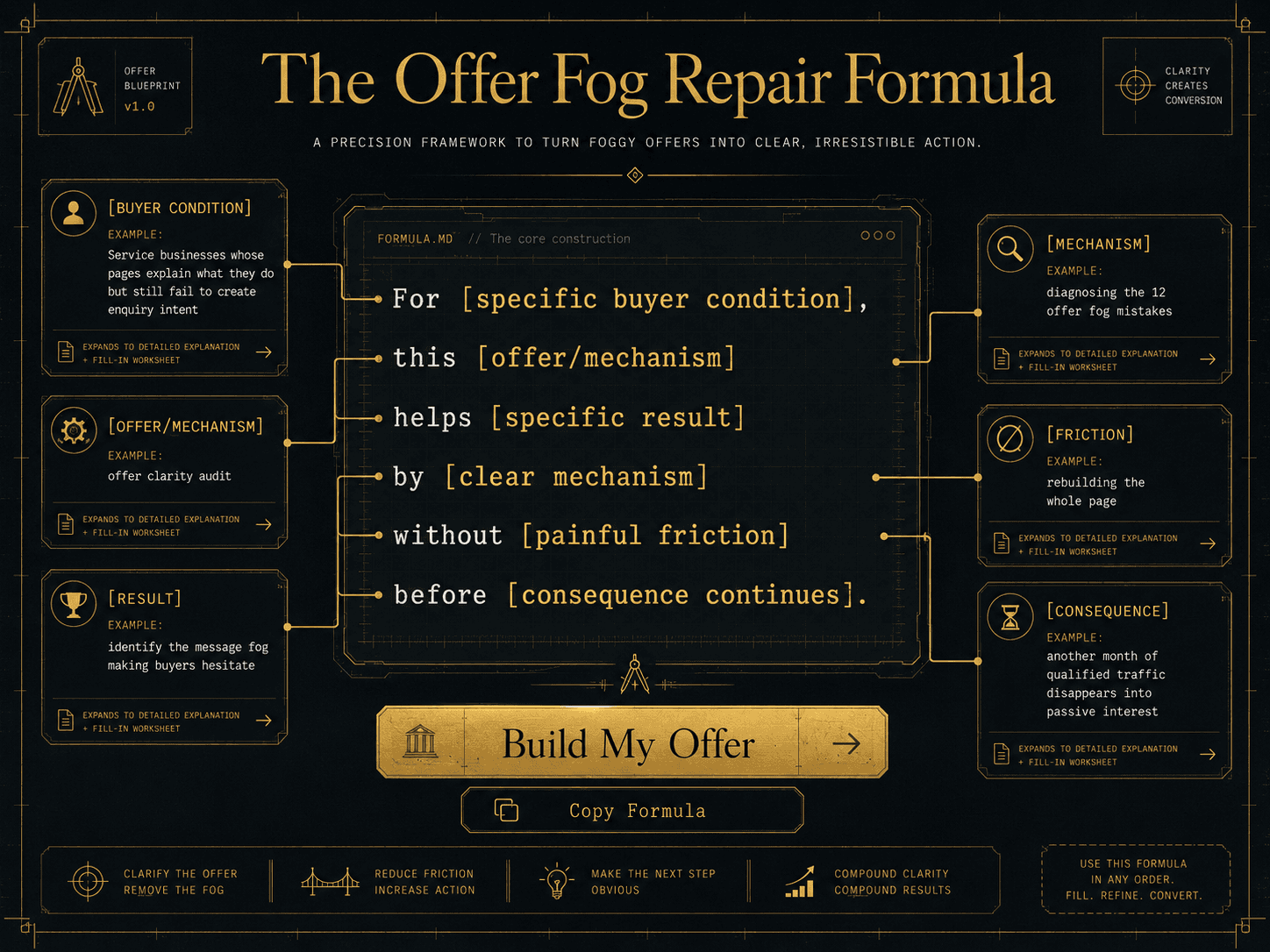
Other Blogs
Other Blogs
Check our other project Blogs with useful insight and information for your businesses