Our Three Step Process
May 26, 2026
Chap 3 | Resource 5 | The Offer Stress-Test Scorecard™
Our Three Step Process
May 26, 2026
Chap 3 | Resource 5 | The Offer Stress-Test Scorecard™
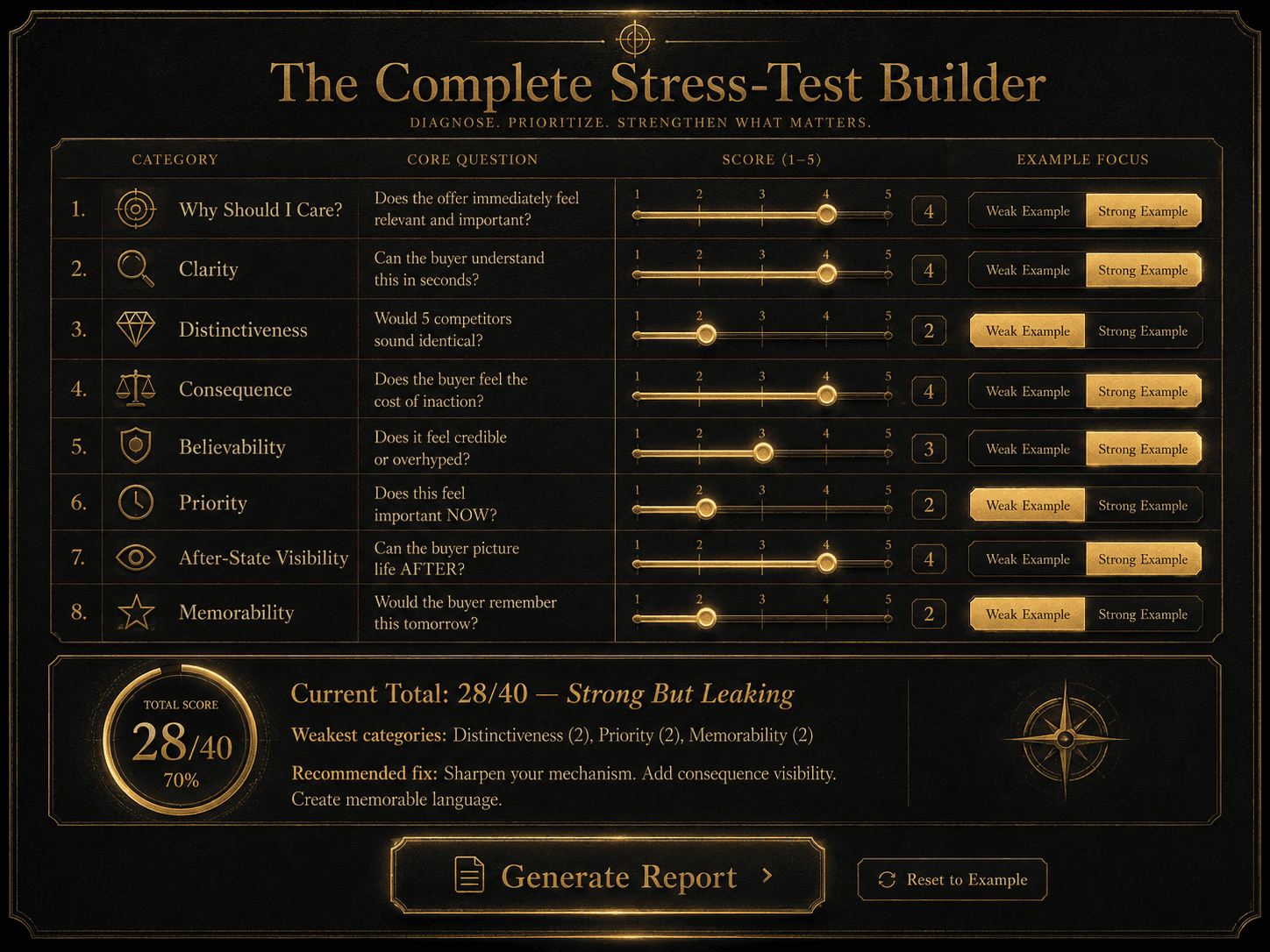
The Offer Stress-Test Scorecard™ An eight-part market-readiness scorecard for testing whether your offer is clear, relevant, distinct, believable, urgent, memorable, and strong enough to survive real buyer scrutiny.
Prefer Audio Or Video?
The Offer Stress-Test Scorecard™ is also available as:
🎧 A guided audio walkthrough explaining offer stress-testing, market pressure, buyer scrutiny, urgency, memorability, and commercial readiness.
🎥 A practical video breakdown with real offer stress tests, scorecard examples, failure-type diagnosis, and before/after offer repairs.Choose the format that fits how you learn best.
[Listen To The Audio Walkthrough] (coming soon)
[Watch The Video Breakdown] (coming soon)
——
Why Offers Collapse Under Market Pressure
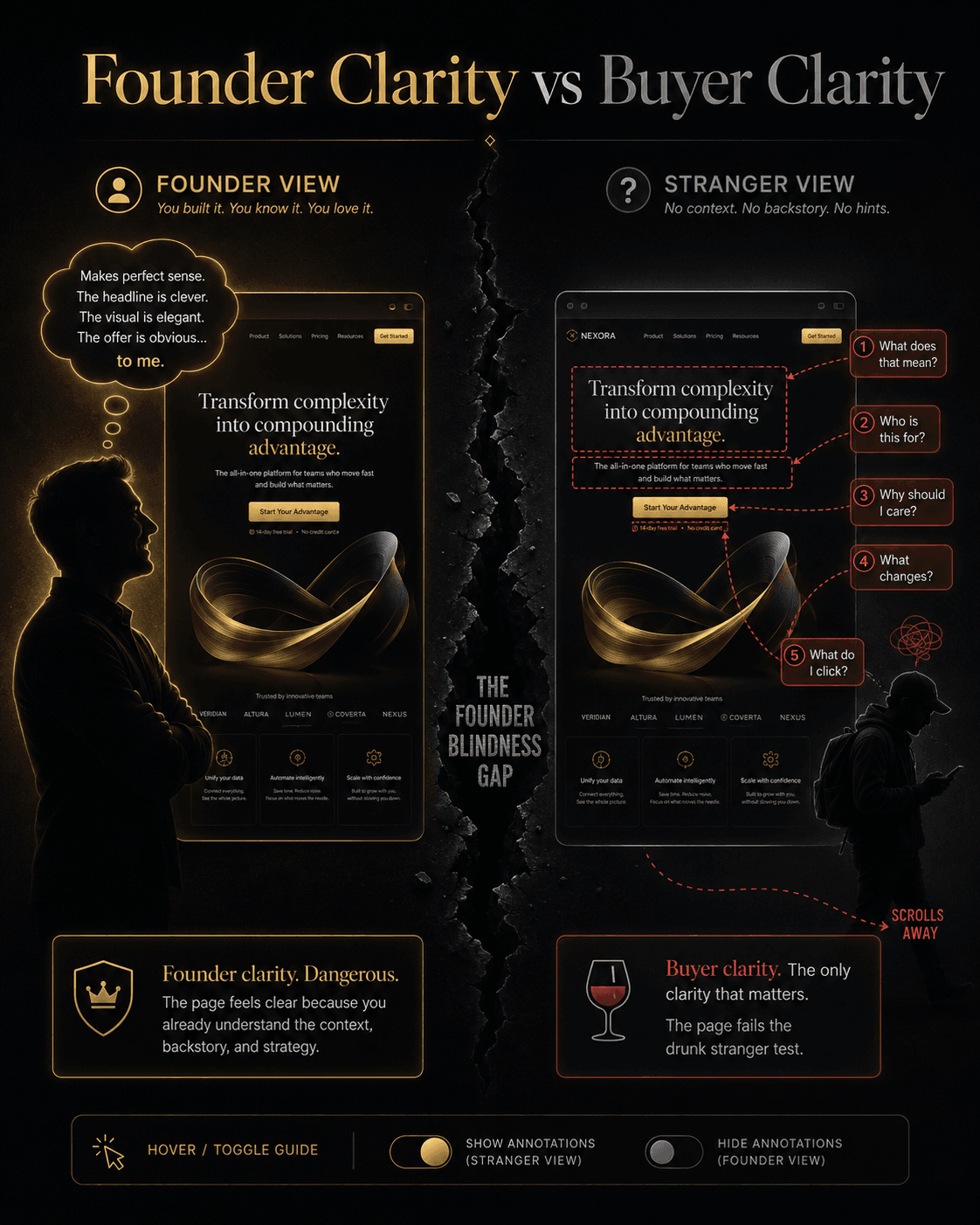
Most offers sound good inside the founder’s head.
That is the problem.
Inside the founder’s head, the offer has context.
The founder understands the service.
The founder understands the value.
The founder understands the mechanism.
The founder understands the backstory.
The founder understands why the offer matters.
But the market does not receive all of that context.
The market receives the offer as it is presented.
And when real buyers touch it, the cracks appear quickly.
Buyers hesitate.
Traffic clicks but does not convert.
Sales calls drag.
Objections repeat.
Leads ghost.
Pricing pressure appears.
Competitors sound interchangeable.
People say “interesting” and then disappear.
The problem is often not the funnel first.
It is that the offer was never stress-tested properly.
It was never forced to survive real buyer friction.
It was never tested against scepticism, distraction, urgency, trust, memory, comparison, and prioritisation.
That is why this scorecard exists.
Weak offers collapse under market pressure.
Strong offers survive scrutiny.
What This Resource Helps You Do
The Offer Stress-Test Scorecard™ helps you pressure-test your offer before the market punishes the weakness.
Use it to test whether buyers will:
understand it
trust it
remember it
want it
prioritise it
believe it
act on it
feel the consequence of ignoring it
see the after-state clearly
recognise why this version is different
The goal is not to make you feel confident.
The goal is to find the real commercial leaks.
Because weak scores are not failure.
Weak scores are direction.
They show you exactly where the offer needs repair before you send more traffic, build more pages, write more ads, or push harder on sales calls.
What The Offer Stress-Test Scorecard™ Actually Does
The Offer Stress-Test Scorecard™ evaluates whether your offer can survive real buyer psychology.
Not founder enthusiasm.
Not internal belief.
Not “I know this is valuable.”
Real buyer psychology.
The scorecard exposes:
hidden weakness
soft positioning
low urgency
generic messaging
weak distinctiveness
low perceived value
weak trust architecture
invisible consequences
poor emotional movement
unclear after-state visibility
weak memorability
before the market exposes those problems more painfully.
This is not a confidence exercise.
This is commercial diagnostics.
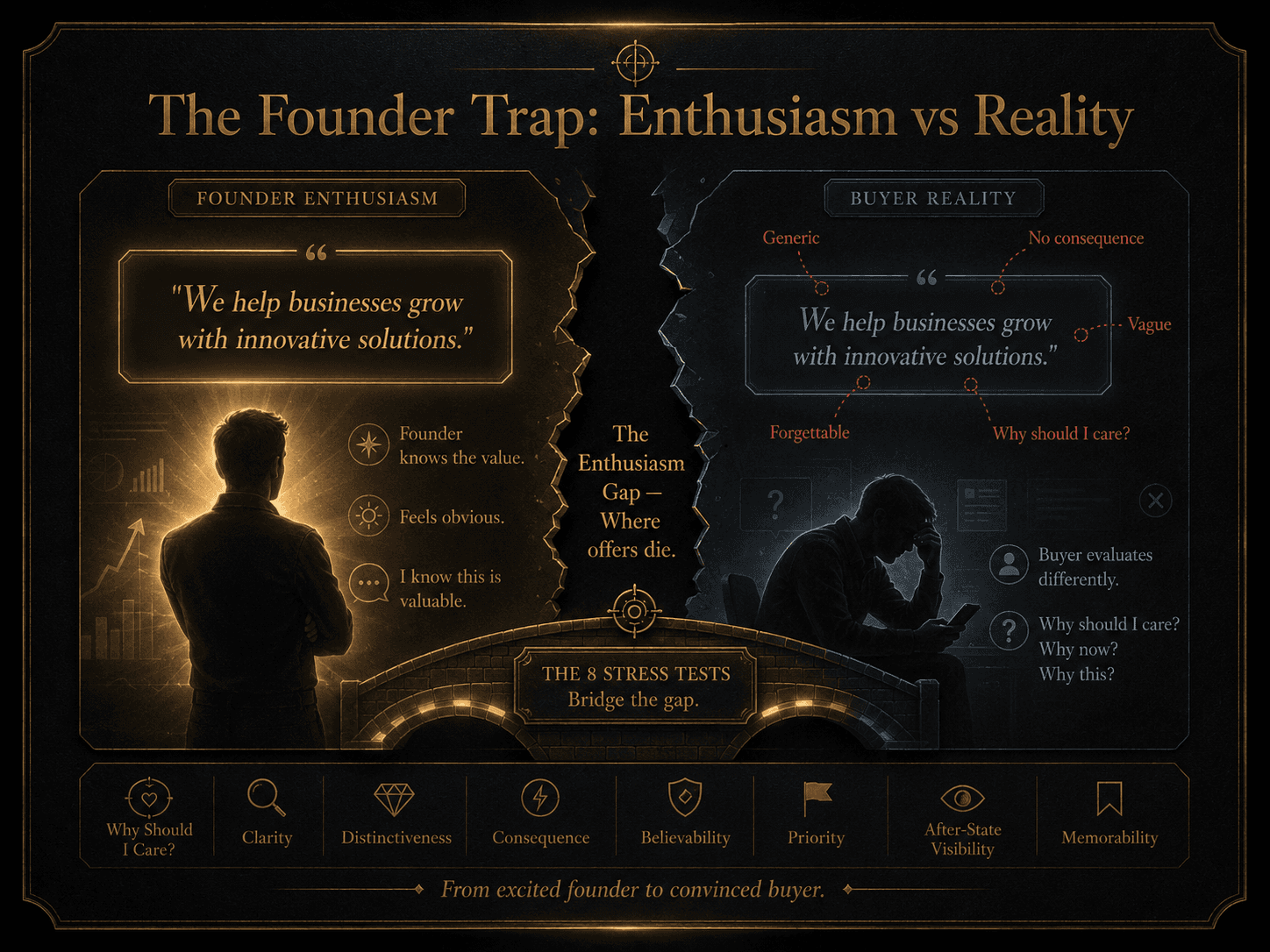
Founder Enthusiasm vs Buyer Scrutiny™
Founders often evaluate offers emotionally.
They think:
“I know this is valuable.”
“I know this works.”
“I know the service is strong.”
“I know the buyer needs this.”
But buyers evaluate offers differently.
They ask:
“Why should I care?”
“Why now?”
“Why this?”
“Why trust this?”
“Why prioritise this over everything else competing for my attention?”
“Why should I believe this will work for someone like me?”
That difference is massive.
The market is not grading effort.
The market is grading:
clarity
relevance
trust
specificity
perceived consequence
urgency
memorability
emotional visibility
That is why an offer can feel strong internally and still fail externally.
The founder sees the full value.
The buyer only sees what the offer makes visible.
Before You Start: Write Your Current Offer
Do not stress-test a cleaned-up version in your head.
Write the exact version the market currently sees.
This could be from your:
landing page
website hero section
sales page
LinkedIn profile
pitch deck
proposal
ad
email
DM
sales call script
product page
Current Offer Statement
Write your current offer here:
Market Context
Where is this offer currently being used?
Landing page / Website / Sales page / Ad / Email / Proposal / Sales call / LinkedIn / Product page / Other
Explain:
Target Buyer
Who is the offer meant for?
Desired Buyer Action
What do you want the buyer to do after seeing this offer?
Current Performance Symptoms
What is currently happening?
Buyers hesitate / Traffic clicks but does not convert / Sales calls drag / Leads ghost / Pricing pressure appears / Objections repeat / Buyers compare you with competitors / Other
Explain:
Current Offer Confidence
Before scoring, how strong do you currently believe the offer is?
Score: ___ / 10
Why?
How To Use This Scorecard
You will score each category from 1 to 5.
1 = extremely weak
2 = weak
3 = usable but leaking
4 = strong
5 = extremely strong
Be brutally honest.
This scorecard is not designed to protect your ego.
It is designed to protect your funnel from carrying a weak offer into the market.
Weak scores are useful.
They reveal the real leak.
After each test, mark the offer as:
Pass / Weak Pass / Fail
Then write the repair action.
The goal is not to score perfectly.
The goal is to know what to fix first.
——
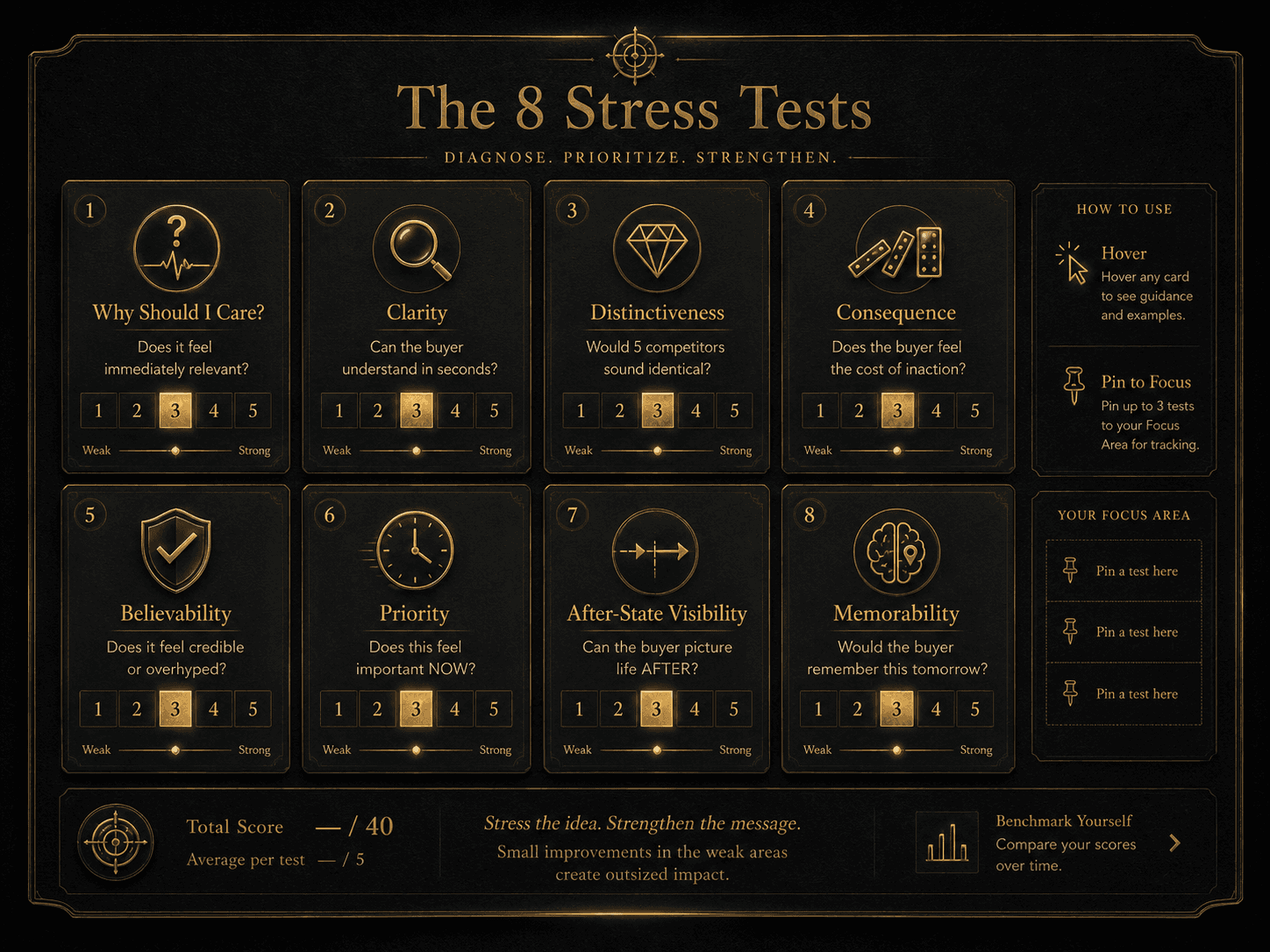
The 8 Offer Stress Tests™
The Offer Stress-Test Scorecard™ tests your offer across eight buyer-pressure points.
The “Why Should I Care?” Test™
The Clarity Test™
The Distinctiveness Test™
The Consequence Test™
The Believability Test™
The Priority Test™
The After-State Visibility Test™
The Memory Test™
Each one reveals a different type of market weakness.
—-
Stress Test 1: The “Why Should I Care?” Test™
Core Question
Does the offer immediately feel relevant and important?
Or does it feel optional, generic, or emotionally flat?
This is the first pressure test.
Before the buyer evaluates the details, they need to feel that the offer matters.
If the offer does not create relevance, the buyer does not give the rest of the page enough attention.
Weak offers create low emotional interruption.
Strong offers make the buyer feel:
“This matters.”
Weak Example
“We help businesses optimise growth.”
This has:
no tension
no consequence
no urgency
no specific buyer pressure
no emotional reason to care
It may sound professional.
But it does not interrupt the buyer.
Strong Example
“We identify why buyers lose trust before another month of paid traffic disappears.”
Now the problem feels active.
The buyer can feel:
waste
trust loss
time pressure
commercial leakage
a reason to care
Score
Score 1–2:
The offer has low emotional relevance.
Score 3:
The offer is moderately understandable but urgency is weak.
Score 4–5:
The offer immediately feels important, relevant, and commercially meaningful.
Your score: ___ / 5
Status: Pass / Weak Pass / Fail
Fix Action
If this score is weak, sharpen the buyer problem.
Ask:
Why should the buyer care?
What is currently costing them?
What pain, risk, waste, delay, or frustration does this interrupt?
What makes this problem emotionally or commercially important?
What would make the buyer think, “This is exactly what I need to fix”?
Repair Notes
What needs to become more relevant?
What should the buyer care about more quickly?
—-
Stress Test 2: The Clarity Test™
Core Question
Can the buyer understand what this is, who it is for, and why it matters within seconds?
Weak clarity creates mental friction.
And confused buyers rarely convert.
The buyer should not need to decode the offer.
They should not need three paragraphs before the value begins to make sense.
Clarity does not mean oversimplifying the offer.
It means making the value easier to orient around.
Weak Example
“Strategic conversion acceleration.”
This is corporate fog.
It sounds serious, but the buyer cannot clearly picture:
what it is
who it helps
what problem it solves
what changes after buying
Strong Example
“We rebuild landing pages that create stronger buyer certainty before hesitation kills conversions.”
Now the buyer can picture:
the object being improved
the buyer psychology problem
the consequence
the result
The offer becomes easier to understand.
Score
Score 1–2:
The offer feels confusing, abstract, or overly polished.
Score 3:
The offer is understandable but still broad.
Score 4–5:
The offer is clear, specific, and quickly understandable.
Your score: ___ / 5
Status: Pass / Weak Pass / Fail
Fix Action
If this score is weak, simplify the offer line.
Ask:
What is this?
Who is it for?
What problem does it solve?
What changes after it works?
What words are creating fog?
What phrase could a buyer repeat back clearly?
Repair Notes
What part is unclear?
What needs to be simplified?
——
Stress Test 3: The Distinctiveness Test™
Core Question
Would five competitors sound nearly identical?
If yes, you likely have a commodity problem.
Weak offers blend into market wallpaper.
Strong offers create recognisable positioning.
The buyer needs a reason to remember this offer as different from the generic alternatives they have already seen.
Distinctiveness does not mean being weird.
It means being specific enough to be remembered.
Weak Example
“Done-for-you growth systems.”
This is forgettable.
It could belong to hundreds of businesses.
The buyer cannot tell what makes this version specific or worth remembering.
Strong Example
“We diagnose hidden trust leaks causing high-intent buyers to hesitate before the CTA.”
Now the mechanism feels specific.
The buyer can see:
the failure point
the buyer behaviour
the mechanism
the commercial implication
That creates distinction.
Score
Score 1–2:
The offer is highly interchangeable.
Score 3:
The offer has some uniqueness but still feels familiar.
Score 4–5:
The offer feels distinct, specific, and memorable.
Your score: ___ / 5
Status: Pass / Weak Pass / Fail
Fix Action
If this score is weak, strengthen the mechanism or the failure point.
Ask:
What makes this version different?
What do we diagnose, fix, remove, map, rebuild, or clarify?
What problem do competitors describe too vaguely?
What phrase could we own?
What makes this offer harder to confuse?
Repair Notes
What sounds too generic?
What specific mechanism or failure point can make this more distinct?
——
Stress Test 4: The Consequence Test™
Core Question
Does the buyer clearly feel the cost of not solving this?
Weak offers explain features.
Strong offers expose consequences.
This matters because buyers often delay useful things.
They act when the cost of delay becomes visible enough.
The offer should help the buyer feel what keeps leaking, breaking, slowing down, or becoming more expensive if nothing changes.
Weak Example
“We improve messaging.”
This is operational.
It may be useful, but the buyer does not yet feel the cost of weak messaging.
Strong Example
“Fix the positioning gaps silently killing buyer trust before another launch underperforms.”
Now the buyer feels:
loss
risk
urgency
trust damage
launch consequence
The problem becomes harder to ignore.
Score
Score 1–2:
The offer has low emotional consequence.
Score 3:
Some tension exists but urgency is weak.
Score 4–5:
The cost of inaction feels visible.
Your score: ___ / 5
Status: Pass / Weak Pass / Fail
Fix Action
If this score is weak, expose the cost of inaction.
Ask:
What happens if the buyer ignores this?
What keeps leaking?
What becomes more expensive?
What risk increases?
What opportunity keeps disappearing?
What frustration keeps repeating?
What consequence is currently hidden?
Repair Notes
What cost of inaction is currently invisible?
What consequence needs to be made clearer?
——
Stress Test 5: The Believability Test™
Core Question
Does the offer feel credible?
Or does it sound overhyped, inflated, or unrealistic?
Strong offers create certainty.
Weak offers create scepticism.
A buyer does not only ask:
“Do I want this?”
They also ask:
“Do I believe this?”
If the offer feels exaggerated, the buyer’s defences rise.
If the offer feels grounded and specific, trust becomes easier.
Weak Example
“Explode your revenue instantly.”
This creates trust collapse.
It sounds inflated, vague, and unrealistic.
Even if the offer is valuable, the claim weakens believability.
Strong Example
“Identify where buyer certainty breaks before scaling more traffic into weak conversion systems.”
This feels:
grounded
specific
believable
commercially relevant
free from exaggerated hype
The buyer can understand what is being diagnosed.
That creates trust.
Score
Score 1–2:
The offer feels exaggerated, vague, or hard to believe.
Score 3:
The offer is partially believable but still needs grounding.
Score 4–5:
The offer feels specific, grounded, and trustworthy.
Your score: ___ / 5
Status: Pass / Weak Pass / Fail
Fix Action
If this score is weak, reduce hype and increase specificity.
Ask:
What claim feels too inflated?
What can be made more specific?
What proof or mechanism supports the promise?
What wording would a sceptical buyer believe?
What can we say more precisely instead of more loudly?
Repair Notes
What feels hard to believe?
What can make the offer more grounded?
——
Stress Test 6: The Priority Test™
Core Question
Does this feel important enough to act on now?
Or does it feel like a nice-to-have?
This is critical.
Because many offers sound useful without feeling urgent.
The buyer may agree with the offer.
They may like it.
They may understand it.
They may even bookmark it.
But if it does not feel important enough, they postpone.
Useful gets saved.
Urgent gets acted on.
Weak Example
“Improve your brand messaging.”
This sounds optional.
It may be valuable, but the buyer does not feel why it should move up the priority list.
Strong Example
“Stop sending paid traffic into messaging that still fails to communicate why buyers should trust the offer.”
Now the buyer feels immediate commercial leakage.
The offer becomes harder to postpone.
Score
Score 1–2:
The offer feels low priority.
Score 3:
The offer has some importance, but urgency is weak.
Score 4–5:
The offer feels commercially dangerous to ignore.
Your score: ___ / 5
Status: Pass / Weak Pass / Fail
Fix Action
If this score is weak, add timing, leakage, or current pressure.
Ask:
Why should this matter now?
What gets worse if they wait?
What is currently being wasted?
What becomes more expensive with delay?
What does the buyer keep tolerating?
What makes this more than a nice-to-have?
Repair Notes
Why does this matter now?
What makes postponing costly?
Stress Test 7: The After-State Visibility Test™
Core Question
Can the buyer clearly picture life, business, or results after this works?
Weak offers describe the process.
Strong offers create future visibility.
The buyer should be able to imagine what changes after they say yes.
If the after-state is invisible, desire stays weak.
Weak Example
“Conversion optimisation support.”
This is invisible.
The buyer cannot picture what changes after the support works.
Strong Example
“Create landing pages buyers understand fast enough to trust before attention disappears.”
Now the after-state becomes visible.
The buyer can picture:
faster understanding
stronger trust
reduced attention loss
improved conversion momentum
That creates desire.
Score
Score 1–2:
The transformation is hard to picture.
Score 3:
Some movement exists but could be sharper.
Score 4–5:
The buyer can clearly visualise the shift.
Your score: ___ / 5
Status: Pass / Weak Pass / Fail
Fix Action
If this score is weak, make the result more visible.
Ask:
What changes after this works?
What becomes easier?
What becomes clearer?
What becomes safer?
What does the buyer stop struggling with?
What result can they actually picture?
What emotional relief becomes available?
Repair Notes
What after-state is currently unclear?
What visible shift should be added?
——
Stress Test 8: The Memory Test™
Core Question
Would the buyer remember this tomorrow?
Or would it dissolve into generic marketing noise?
Memory matters enormously.
Because remembered offers create return attention.
The buyer may not act the first time they see the offer.
But if the offer is memorable, it can return inside their mind later.
If the offer is generic, it disappears.
Weak Example
“Full-service strategic marketing solutions.”
Instantly forgettable.
It has no specific frame, mechanism, problem, or emotional hook.
Strong Example
“Offer Fog Elimination™ for funnels buyers understand but still do not trust.”
Now the language creates identity and recall.
The buyer can remember the problem.
They can remember the phrase.
They can remember the distinction.
That creates commercial advantage.
Score
Score 1–2:
The offer is forgettable.
Score 3:
The offer has some memorability.
Score 4–5:
The offer is distinct and mentally sticky.
Your score: ___ / 5
Status: Pass / Weak Pass / Fail
Fix Action
If this score is weak, strengthen the phrase, frame, or named mechanism.
Ask:
What phrase could the buyer remember?
What problem can be named more sharply?
What mechanism can be made more specific?
What line would be easier to repeat?
What makes the offer mentally sticky without becoming gimmicky?
Repair Notes
What makes the offer forgettable?
What phrase, frame, or mechanism could make it more memorable?
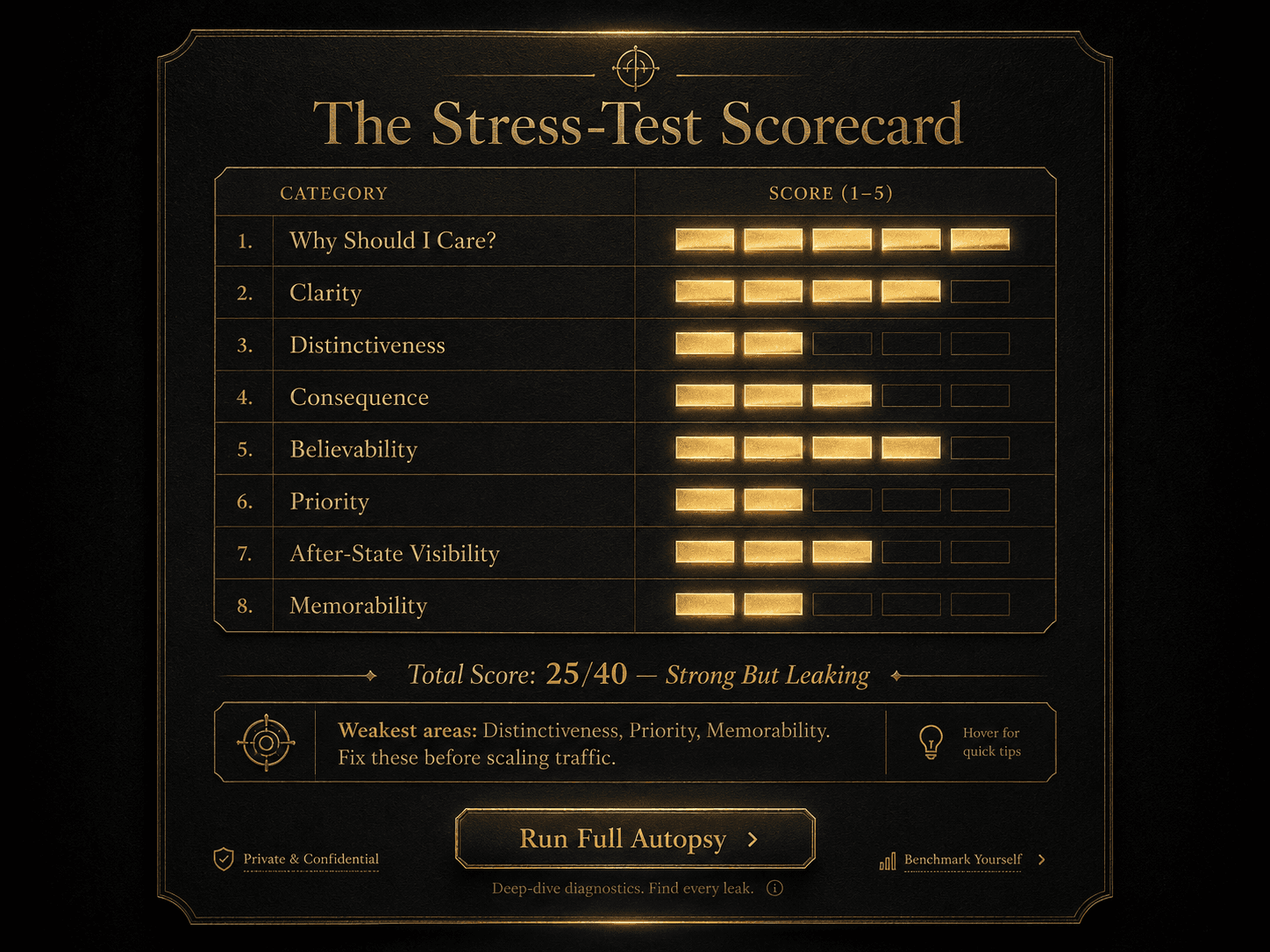
The Complete Offer Stress-Test Scorecard™
Score each category from 1 to 5.
Why Should I Care?: ___ / 5
Clarity: ___ / 5
Distinctiveness: ___ / 5
Consequence: ___ / 5
Believability: ___ / 5
Priority: ___ / 5
After-State Visibility: ___ / 5
Memorability: ___ / 5
Total Score: ___ / 40
——
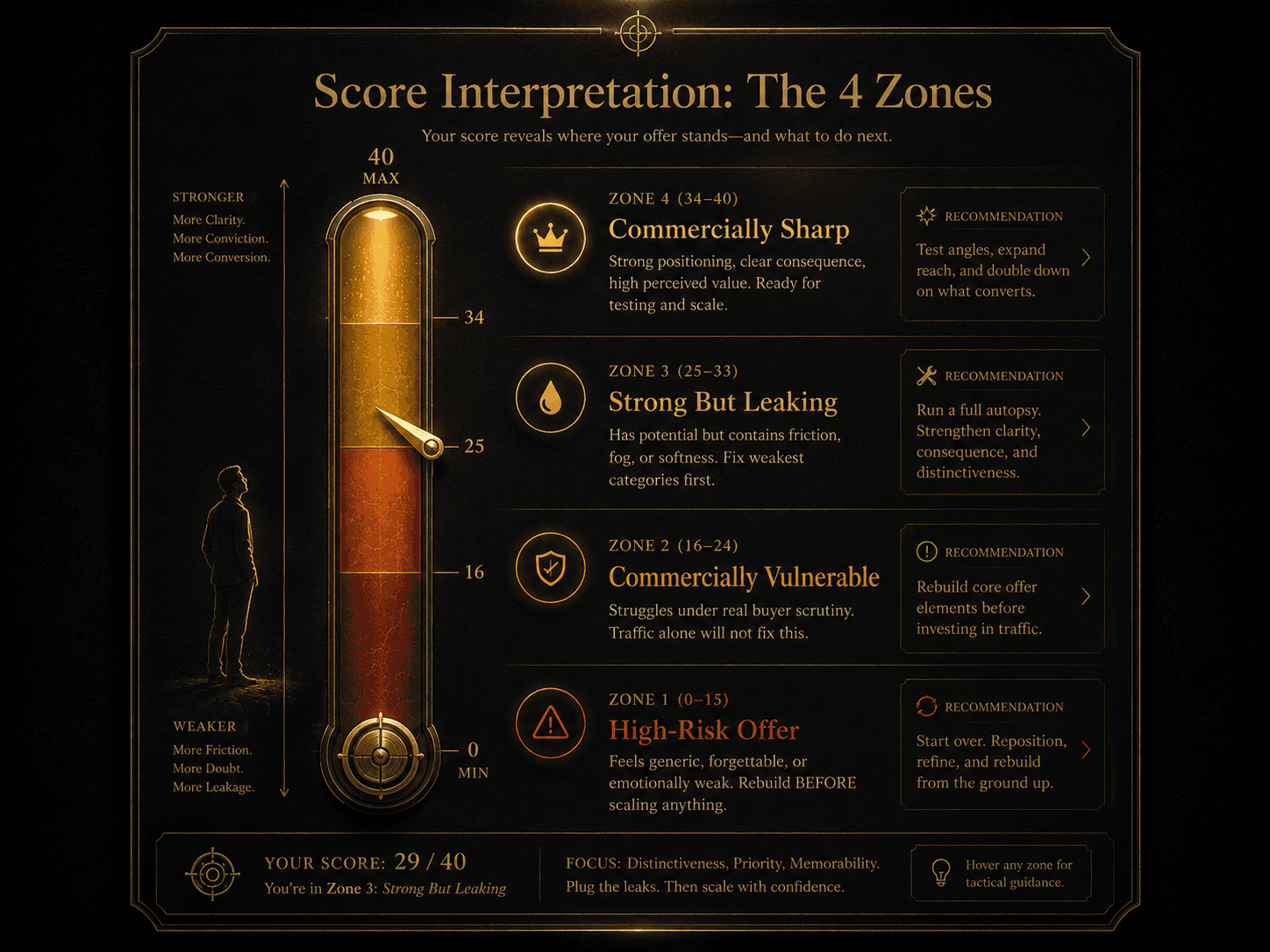
Score Interpretation
34–40: Commercially Sharp Offer™
The offer likely has strong positioning, clear consequence, high perceived value, and strong buyer relevance.
The buyer can understand it, feel why it matters, believe the mechanism, picture the result, and remember the offer.
This offer is ready for testing and scale.
25–33: Strong But Leaking™
The offer has potential, but still contains friction, fog, or softness reducing conversion efficiency.
Do not rebuild everything.
Find the lowest-scoring tests and repair those first.
16–24: Commercially Vulnerable™
The offer likely struggles under real buyer scrutiny.
The buyer may understand parts of it, but the offer is not yet strong enough across relevance, urgency, trust, consequence, or memorability.
Traffic alone will not fix this.
Repair the offer before scaling.
0–15: High-Risk Offer™
The offer probably feels generic, forgettable, unclear, low-priority, or emotionally weak.
Do not scale anything yet.
Do not blame the funnel first.
Do not buy more traffic first.
Rebuild the offer before pushing it harder into the market.
——
Failure Type Diagnosis
Use your lowest scores to identify the dominant failure type.
Relevance Failure
Low score in:
Why Should I Care?
What it means:
The buyer does not feel the offer matters enough.
Symptoms:
low emotional interruption
weak buyer relevance
generic problem framing
no immediate sense of importance
Repair:
Sharpen the buyer problem and show why it matters.
Clarity Failure
Low score in:
Clarity
What it means:
The buyer cannot understand the offer quickly enough.
Symptoms:
abstract language
confusing wording
too much jargon
unclear buyer
unclear result
Repair:
Simplify the offer line and make the value easier to orient around.
Commodity Failure
Low score in:
Distinctiveness
What it means:
The offer sounds too similar to competitors.
Symptoms:
generic phrases
familiar promises
interchangeable mechanism
weak owned language
low memorability
Repair:
Sharpen the mechanism, failure point, or proprietary frame.
Consequence Failure
Low score in:
Consequence
What it means:
The buyer does not feel the cost of inaction.
Symptoms:
weak urgency
low emotional pressure
no visible leakage
no risk of delay
feature-led messaging
Repair:
Expose the commercial, emotional, or operational cost of leaving the problem unresolved.
Believability Failure
Low score in:
Believability
What it means:
The offer feels inflated, vague, unrealistic, or unsupported.
Symptoms:
exaggerated claims
hype language
vague promises
weak mechanism
low trust
Repair:
Reduce hype, increase specificity, and make the mechanism more grounded.
Priority Failure
Low score in:
Priority
What it means:
The offer feels useful but easy to postpone.
Symptoms:
nice-to-have positioning
weak timing
no current pressure
no cost of waiting
low urgency
Repair:
Show why the problem matters now and what delay continues to cost.
After-State Failure
Low score in:
After-State Visibility
What it means:
The buyer cannot picture what changes after the offer works.
Symptoms:
process-heavy language
invisible transformation
vague result
unclear buyer movement
weak desire
Repair:
Make the result more visible, concrete, and emotionally meaningful.
Memory Failure
Low score in:
Memorability
What it means:
The offer disappears into generic market noise.
Symptoms:
forgettable phrasing
no named problem
no sticky mechanism
no specific frame
hard to repeat
Repair:
Create a more memorable phrase, frame, mechanism, or problem name.
——
My Dominant Failure Type
My lowest score is in:
My dominant failure type is:
Relevance / Clarity / Commodity / Consequence / Believability / Priority / After-State / Memory
The reason this matters is:
The first repair I need to make is:
Offer Repair Priority Map
Use this map to decide what to fix first.
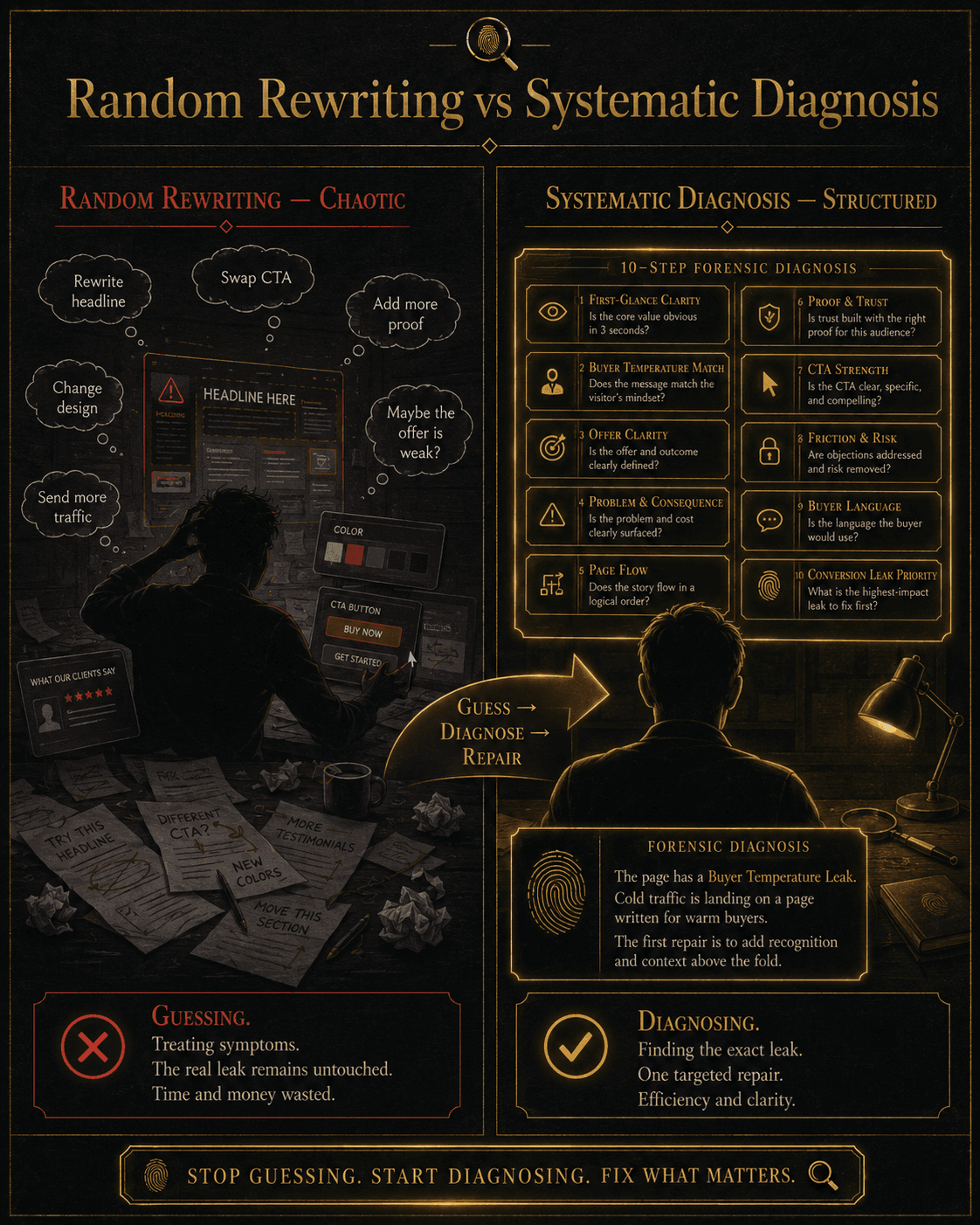
Do not repair randomly.
Repair the lowest-scoring pressure point first.
If “Why Should I Care?” Is Weak
Fix:
Buyer relevance.
Repair action:
Make the painful problem more specific, live, and commercially meaningful.
If Clarity Is Weak
Fix:
Orientation.
Repair action:
Simplify the offer line so the buyer understands what it is, who it is for, and why it matters within seconds.
If Distinctiveness Is Weak
Fix:
Mechanism or positioning frame.
Repair action:
Make the offer harder to confuse by naming the specific failure point, method, or buyer condition.
If Consequence Is Weak
Fix:
Cost of inaction.
Repair action:
Show what keeps leaking, breaking, slowing down, or becoming more expensive if the buyer does not act.
If Believability Is Weak
Fix:
Trust.
Repair action:
Remove inflated claims and replace them with grounded specificity, mechanism clarity, and realistic language.
If Priority Is Weak
Fix:
Reason to act now.
Repair action:
Show timing, urgency, leakage, repeated frustration, or cost of postponement.
If After-State Visibility Is Weak
Fix:
Desire.
Repair action:
Make the future state clearer, more concrete, and easier to picture.
If Memorability Is Weak
Fix:
Recall.
Repair action:
Create a sharper phrase, named problem, named mechanism, or more repeatable positioning line.
——
The Traffic Magnification Warning
Most founders test ads before testing the offer.
Huge mistake.
Because paid traffic magnifies existing weakness.
Traffic does not fix weak clarity.
It exposes it faster.
Traffic does not fix weak consequence.
It makes the lack of urgency more expensive.
Traffic does not fix generic positioning.
It shows you how quickly buyers compare you with everyone else.
Traffic does not fix weak believability.
It sends more sceptical people into the same trust gap.
Traffic does not fix a low-priority offer.
It simply proves that people can click, understand, and still postpone.
That is why the offer must be stress-tested before scale.
More traffic poured into a weak offer is not growth.
It is accelerated leakage.
What Strong Offers Actually Do
Strong offers create:
instant relevance
emotional visibility
recognisable consequence
perceived specificity
commercial tension
future movement
memorability
trust
buyer certainty
urgency without fake scarcity
desire without hype
clarity without oversimplification
They do this without manipulation.
Without exaggerated promises.
Without pretending the outcome is guaranteed.
Without adding noise.
That is the goal.
A strong offer helps the buyer think:
“I understand this.”
“I can see why it matters.”
“I can feel what happens if I ignore it.”
“I can picture the result.”
“I can see why this version is different.”
“I believe this enough to take the next step.”
That is market readiness.
——
Before vs After Stress-Test Example
Weak Offer
“We help businesses improve conversion through strategic optimisation.”
This offer is weak because:
Why Should I Care?
Low. The buyer does not feel an immediate reason to care.
Clarity:
Moderate. It is understandable, but broad.
Distinctiveness:
Weak. Many competitors could say this.
Consequence:
Weak. The cost of inaction is invisible.
Believability:
Moderate. It does not sound ridiculous, but it lacks specificity.
Priority:
Weak. It sounds useful but easy to delay.
After-State Visibility:
Weak. The buyer cannot picture the result clearly.
Memorability:
Weak. The offer is forgettable.
Stronger Offer
“We identify where buyer trust breaks before the CTA, so service businesses stop sending qualified traffic into pages that visitors understand but still do not trust enough to act on.”
This offer is stronger because:
Why Should I Care?
The buyer can feel commercial leakage.
Clarity:
The failure point is clearer.
Distinctiveness:
The phrase “buyer trust breaks before the CTA” gives the offer more shape.
Consequence:
Qualified traffic is being wasted.
Believability:
The promise is grounded in diagnosis, not hype.
Priority:
The offer feels more urgent because traffic is already being wasted.
After-State Visibility:
The buyer can picture a page that earns action more effectively.
Memorability:
The offer has a clearer frame.
This is not louder copy.
It is sharper positioning.
Using AI For Offer Stress-Testing
AI can be useful when it is used as a diagnostic operator.
Do not ask:
“Make this offer better.”
That usually creates polished generic copy.
Ask AI to stress-test the offer against real buyer psychology.
Then ask it to repair the weakest scores.
——
AI Offer Stress-Test Prompt™
Use this prompt:
Act as a brutally honest offer strategist, buyer psychology analyst, and funnel operator.
Stress-test my offer against real buyer scrutiny.
My current offer is:
[paste offer]
My target buyer is:
[insert buyer]
The current market context is:
[landing page, ad, sales page, email, sales call, profile, proposal, etc.]
The action I want the buyer to take is:
[insert action]
Evaluate the offer across these eight categories:
Why Should I Care?
Clarity
Distinctiveness
Consequence
Believability
Priority
After-State Visibility
Memorability
For each category:
give a score from 1 to 5
mark it as Pass, Weak Pass, or Fail
explain the weakness clearly
identify the exact wording causing the weakness
explain what the buyer may fail to understand, feel, trust, or remember
identify the likely market symptom this weakness may create
provide one clear repair action
rewrite that weak area into a sharper version
Then calculate the total score out of 40.
Interpret the score using this scale:
34–40: Commercially Sharp
25–33: Strong But Leaking
16–24: Commercially Vulnerable
0–15: High-Risk Offer
Then identify the dominant failure type:
Relevance Failure
Clarity Failure
Commodity Failure
Consequence Failure
Believability Failure
Priority Failure
After-State Failure
Memory Failure
After that, generate:
A sharper clarity-led version
A sharper consequence-led version
A sharper distinctiveness-led version
A more believable grounded version
A shorter compressed version
The strongest final version
Then explain:
which version creates the strongest buyer relevance
which version creates the clearest mental picture
which version feels most urgent
which version feels most believable
which version is most memorable
which version is safest from hype
Do not use hype.
Do not invent fake proof.
Do not exaggerate the result.
Do not make the offer vague to sound premium.
Prioritise clarity, specificity, commercial sharpness, buyer psychology, consequence visibility, trust, and memorability.
——
Final Execution Challenge™
Run your real offer through every stress-test category.
Not the improved version.
Not the version in your head.
The real version buyers currently see.
Score it honestly across:
why should I care?
clarity
distinctiveness
consequence
believability
priority
after-state visibility
memorability
Then ask:
“Would this still feel commercially important if the logo disappeared?”
If the answer is no, the offer probably still depends on branding, design, explanation, founder confidence, or sales effort instead of sharp positioning.
That means it needs repair.
Do not panic.
Do not add more bonuses.
Do not rewrite everything at once.
Find the weakest score.
Fix that first.
Then test again.
0000
Final Stress-Test Worksheet
Current Offer
Test 1: Why Should I Care?
Score: ___ / 5
Status: Pass / Weak Pass / Fail
Fix needed:
Test 2: Clarity
Score: ___ / 5
Status: Pass / Weak Pass / Fail
Fix needed:
Test 3: Distinctiveness
Score: ___ / 5
Status: Pass / Weak Pass / Fail
Fix needed:
Test 4: Consequence
Score: ___ / 5
Status: Pass / Weak Pass / Fail
Fix needed:
Test 5: Believability
Score: ___ / 5
Status: Pass / Weak Pass / Fail
Fix needed:
Test 6: Priority
Score: ___ / 5
Status: Pass / Weak Pass / Fail
Fix needed:
Test 7: After-State Visibility
Score: ___ / 5
Status: Pass / Weak Pass / Fail
Fix needed:
Test 8: Memorability
Score: ___ / 5
Status: Pass / Weak Pass / Fail
Fix needed:
Total Score
___ / 40
Dominant Failure Type
First Repair Priority
Rebuilt Offer
Write the improved version:
——
Final Principle™
Weak offers collapse under market pressure.
Strong offers survive scrutiny.
That is the difference.
A weak offer may sound good inside the founder’s head, but the market does not evaluate the offer with the founder’s context.
The market evaluates what is visible.
Is it clear?
Is it relevant?
Is it distinct?
Is it believable?
Is it urgent?
Is it memorable?
Does the buyer care?
Can they picture the after-state?
Do they feel the cost of ignoring it?
That is what matters.
A funnel cannot permanently rescue an offer that cannot survive buyer scrutiny.
The hook will strain.
The page will overexplain.
The CTA will feel heavier.
The sales call will drag.
Proof will have to work too hard.
Traffic will expose the weakness faster.
That is why the offer must be stress-tested before it is scaled.
Not to make it louder.
To make it sharper.
Clearer.
More credible.
More relevant.
More commercially alive.
Because sharp positioning allows funnels to breathe easier, convert cleaner, and survive real market pressure without constantly needing more persuasion layered on top.
That is the purpose of The Offer Stress-Test Scorecard™.
——
From:
The $100M Funnel Playbook. Book I: Foundation Buyer Psychology, Offer Clarity, and the Page Architecture Behind High-Converting Funnels
By Maris Spalins.
——
Copyright Notice
© 2026 The $100M Funnel Playbook / Winyourclients / Maris Spalins. All rights reserved.
This resource, including the frameworks, terminology, examples, scorecards, templates, prompts, methods, and written explanations, is original intellectual property created for The $100M Funnel Playbook. Book I: Foundation — Buyer Psychology, Offer Clarity, And The Page Architecture Behind High-Converting Funnels and published through Winyourclients.
No part of this resource may be copied, reproduced, screenshotted, republished, redistributed, sold, adapted, uploaded, scraped, stored in a database, included in training data, used to train artificial intelligence systems, or used to create derivative commercial or educational materials without prior written permission.
Limited reference, quotation, or sharing is only permitted where the source is clearly and visibly credited.
Any permitted reference must include at least one of the following source credits:
The $100M Funnel Playbook by Maris Spalins
or
Winyourclients — www.winyourclients.com
or
Maris Spalins / Winyourclients
Screenshots, excerpts, summaries, or redistributed versions must not remove, hide, alter, crop out, or obscure the original source, author name, book title, website name, or copyright notice.
This resource is provided for personal learning and implementation only. It is not licensed for resale, republishing, redistribution, AI training, template cloning, course creation, consulting delivery, or commercial reuse without written permission from Maris Spalins or Winyourclients.
For permission requests, licensing, citation approval, or commercial usage enquiries, contact:
Winyourclients
www.winyourclients.com
or
Email directly to Jacob on: help@winyourclients.com
The Offer Stress-Test Scorecard™ An eight-part market-readiness scorecard for testing whether your offer is clear, relevant, distinct, believable, urgent, memorable, and strong enough to survive real buyer scrutiny.
Prefer Audio Or Video?
The Offer Stress-Test Scorecard™ is also available as:
🎧 A guided audio walkthrough explaining offer stress-testing, market pressure, buyer scrutiny, urgency, memorability, and commercial readiness.
🎥 A practical video breakdown with real offer stress tests, scorecard examples, failure-type diagnosis, and before/after offer repairs.Choose the format that fits how you learn best.
[Listen To The Audio Walkthrough] (coming soon)
[Watch The Video Breakdown] (coming soon)
——
Why Offers Collapse Under Market Pressure
Most offers sound good inside the founder’s head.
That is the problem.
Inside the founder’s head, the offer has context.
The founder understands the service.
The founder understands the value.
The founder understands the mechanism.
The founder understands the backstory.
The founder understands why the offer matters.
But the market does not receive all of that context.
The market receives the offer as it is presented.
And when real buyers touch it, the cracks appear quickly.
Buyers hesitate.
Traffic clicks but does not convert.
Sales calls drag.
Objections repeat.
Leads ghost.
Pricing pressure appears.
Competitors sound interchangeable.
People say “interesting” and then disappear.
The problem is often not the funnel first.
It is that the offer was never stress-tested properly.
It was never forced to survive real buyer friction.
It was never tested against scepticism, distraction, urgency, trust, memory, comparison, and prioritisation.
That is why this scorecard exists.
Weak offers collapse under market pressure.
Strong offers survive scrutiny.
What This Resource Helps You Do
The Offer Stress-Test Scorecard™ helps you pressure-test your offer before the market punishes the weakness.
Use it to test whether buyers will:
understand it
trust it
remember it
want it
prioritise it
believe it
act on it
feel the consequence of ignoring it
see the after-state clearly
recognise why this version is different
The goal is not to make you feel confident.
The goal is to find the real commercial leaks.
Because weak scores are not failure.
Weak scores are direction.
They show you exactly where the offer needs repair before you send more traffic, build more pages, write more ads, or push harder on sales calls.
What The Offer Stress-Test Scorecard™ Actually Does
The Offer Stress-Test Scorecard™ evaluates whether your offer can survive real buyer psychology.
Not founder enthusiasm.
Not internal belief.
Not “I know this is valuable.”
Real buyer psychology.
The scorecard exposes:
hidden weakness
soft positioning
low urgency
generic messaging
weak distinctiveness
low perceived value
weak trust architecture
invisible consequences
poor emotional movement
unclear after-state visibility
weak memorability
before the market exposes those problems more painfully.
This is not a confidence exercise.
This is commercial diagnostics.
Founder Enthusiasm vs Buyer Scrutiny™
Founders often evaluate offers emotionally.
They think:
“I know this is valuable.”
“I know this works.”
“I know the service is strong.”
“I know the buyer needs this.”
But buyers evaluate offers differently.
They ask:
“Why should I care?”
“Why now?”
“Why this?”
“Why trust this?”
“Why prioritise this over everything else competing for my attention?”
“Why should I believe this will work for someone like me?”
That difference is massive.
The market is not grading effort.
The market is grading:
clarity
relevance
trust
specificity
perceived consequence
urgency
memorability
emotional visibility
That is why an offer can feel strong internally and still fail externally.
The founder sees the full value.
The buyer only sees what the offer makes visible.
Before You Start: Write Your Current Offer
Do not stress-test a cleaned-up version in your head.
Write the exact version the market currently sees.
This could be from your:
landing page
website hero section
sales page
LinkedIn profile
pitch deck
proposal
ad
email
DM
sales call script
product page
Current Offer Statement
Write your current offer here:
Market Context
Where is this offer currently being used?
Landing page / Website / Sales page / Ad / Email / Proposal / Sales call / LinkedIn / Product page / Other
Explain:
Target Buyer
Who is the offer meant for?
Desired Buyer Action
What do you want the buyer to do after seeing this offer?
Current Performance Symptoms
What is currently happening?
Buyers hesitate / Traffic clicks but does not convert / Sales calls drag / Leads ghost / Pricing pressure appears / Objections repeat / Buyers compare you with competitors / Other
Explain:
Current Offer Confidence
Before scoring, how strong do you currently believe the offer is?
Score: ___ / 10
Why?
How To Use This Scorecard
You will score each category from 1 to 5.
1 = extremely weak
2 = weak
3 = usable but leaking
4 = strong
5 = extremely strong
Be brutally honest.
This scorecard is not designed to protect your ego.
It is designed to protect your funnel from carrying a weak offer into the market.
Weak scores are useful.
They reveal the real leak.
After each test, mark the offer as:
Pass / Weak Pass / Fail
Then write the repair action.
The goal is not to score perfectly.
The goal is to know what to fix first.
——
The 8 Offer Stress Tests™
The Offer Stress-Test Scorecard™ tests your offer across eight buyer-pressure points.
The “Why Should I Care?” Test™
The Clarity Test™
The Distinctiveness Test™
The Consequence Test™
The Believability Test™
The Priority Test™
The After-State Visibility Test™
The Memory Test™
Each one reveals a different type of market weakness.
—-
Stress Test 1: The “Why Should I Care?” Test™
Core Question
Does the offer immediately feel relevant and important?
Or does it feel optional, generic, or emotionally flat?
This is the first pressure test.
Before the buyer evaluates the details, they need to feel that the offer matters.
If the offer does not create relevance, the buyer does not give the rest of the page enough attention.
Weak offers create low emotional interruption.
Strong offers make the buyer feel:
“This matters.”
Weak Example
“We help businesses optimise growth.”
This has:
no tension
no consequence
no urgency
no specific buyer pressure
no emotional reason to care
It may sound professional.
But it does not interrupt the buyer.
Strong Example
“We identify why buyers lose trust before another month of paid traffic disappears.”
Now the problem feels active.
The buyer can feel:
waste
trust loss
time pressure
commercial leakage
a reason to care
Score
Score 1–2:
The offer has low emotional relevance.
Score 3:
The offer is moderately understandable but urgency is weak.
Score 4–5:
The offer immediately feels important, relevant, and commercially meaningful.
Your score: ___ / 5
Status: Pass / Weak Pass / Fail
Fix Action
If this score is weak, sharpen the buyer problem.
Ask:
Why should the buyer care?
What is currently costing them?
What pain, risk, waste, delay, or frustration does this interrupt?
What makes this problem emotionally or commercially important?
What would make the buyer think, “This is exactly what I need to fix”?
Repair Notes
What needs to become more relevant?
What should the buyer care about more quickly?
—-
Stress Test 2: The Clarity Test™
Core Question
Can the buyer understand what this is, who it is for, and why it matters within seconds?
Weak clarity creates mental friction.
And confused buyers rarely convert.
The buyer should not need to decode the offer.
They should not need three paragraphs before the value begins to make sense.
Clarity does not mean oversimplifying the offer.
It means making the value easier to orient around.
Weak Example
“Strategic conversion acceleration.”
This is corporate fog.
It sounds serious, but the buyer cannot clearly picture:
what it is
who it helps
what problem it solves
what changes after buying
Strong Example
“We rebuild landing pages that create stronger buyer certainty before hesitation kills conversions.”
Now the buyer can picture:
the object being improved
the buyer psychology problem
the consequence
the result
The offer becomes easier to understand.
Score
Score 1–2:
The offer feels confusing, abstract, or overly polished.
Score 3:
The offer is understandable but still broad.
Score 4–5:
The offer is clear, specific, and quickly understandable.
Your score: ___ / 5
Status: Pass / Weak Pass / Fail
Fix Action
If this score is weak, simplify the offer line.
Ask:
What is this?
Who is it for?
What problem does it solve?
What changes after it works?
What words are creating fog?
What phrase could a buyer repeat back clearly?
Repair Notes
What part is unclear?
What needs to be simplified?
——
Stress Test 3: The Distinctiveness Test™
Core Question
Would five competitors sound nearly identical?
If yes, you likely have a commodity problem.
Weak offers blend into market wallpaper.
Strong offers create recognisable positioning.
The buyer needs a reason to remember this offer as different from the generic alternatives they have already seen.
Distinctiveness does not mean being weird.
It means being specific enough to be remembered.
Weak Example
“Done-for-you growth systems.”
This is forgettable.
It could belong to hundreds of businesses.
The buyer cannot tell what makes this version specific or worth remembering.
Strong Example
“We diagnose hidden trust leaks causing high-intent buyers to hesitate before the CTA.”
Now the mechanism feels specific.
The buyer can see:
the failure point
the buyer behaviour
the mechanism
the commercial implication
That creates distinction.
Score
Score 1–2:
The offer is highly interchangeable.
Score 3:
The offer has some uniqueness but still feels familiar.
Score 4–5:
The offer feels distinct, specific, and memorable.
Your score: ___ / 5
Status: Pass / Weak Pass / Fail
Fix Action
If this score is weak, strengthen the mechanism or the failure point.
Ask:
What makes this version different?
What do we diagnose, fix, remove, map, rebuild, or clarify?
What problem do competitors describe too vaguely?
What phrase could we own?
What makes this offer harder to confuse?
Repair Notes
What sounds too generic?
What specific mechanism or failure point can make this more distinct?
——
Stress Test 4: The Consequence Test™
Core Question
Does the buyer clearly feel the cost of not solving this?
Weak offers explain features.
Strong offers expose consequences.
This matters because buyers often delay useful things.
They act when the cost of delay becomes visible enough.
The offer should help the buyer feel what keeps leaking, breaking, slowing down, or becoming more expensive if nothing changes.
Weak Example
“We improve messaging.”
This is operational.
It may be useful, but the buyer does not yet feel the cost of weak messaging.
Strong Example
“Fix the positioning gaps silently killing buyer trust before another launch underperforms.”
Now the buyer feels:
loss
risk
urgency
trust damage
launch consequence
The problem becomes harder to ignore.
Score
Score 1–2:
The offer has low emotional consequence.
Score 3:
Some tension exists but urgency is weak.
Score 4–5:
The cost of inaction feels visible.
Your score: ___ / 5
Status: Pass / Weak Pass / Fail
Fix Action
If this score is weak, expose the cost of inaction.
Ask:
What happens if the buyer ignores this?
What keeps leaking?
What becomes more expensive?
What risk increases?
What opportunity keeps disappearing?
What frustration keeps repeating?
What consequence is currently hidden?
Repair Notes
What cost of inaction is currently invisible?
What consequence needs to be made clearer?
——
Stress Test 5: The Believability Test™
Core Question
Does the offer feel credible?
Or does it sound overhyped, inflated, or unrealistic?
Strong offers create certainty.
Weak offers create scepticism.
A buyer does not only ask:
“Do I want this?”
They also ask:
“Do I believe this?”
If the offer feels exaggerated, the buyer’s defences rise.
If the offer feels grounded and specific, trust becomes easier.
Weak Example
“Explode your revenue instantly.”
This creates trust collapse.
It sounds inflated, vague, and unrealistic.
Even if the offer is valuable, the claim weakens believability.
Strong Example
“Identify where buyer certainty breaks before scaling more traffic into weak conversion systems.”
This feels:
grounded
specific
believable
commercially relevant
free from exaggerated hype
The buyer can understand what is being diagnosed.
That creates trust.
Score
Score 1–2:
The offer feels exaggerated, vague, or hard to believe.
Score 3:
The offer is partially believable but still needs grounding.
Score 4–5:
The offer feels specific, grounded, and trustworthy.
Your score: ___ / 5
Status: Pass / Weak Pass / Fail
Fix Action
If this score is weak, reduce hype and increase specificity.
Ask:
What claim feels too inflated?
What can be made more specific?
What proof or mechanism supports the promise?
What wording would a sceptical buyer believe?
What can we say more precisely instead of more loudly?
Repair Notes
What feels hard to believe?
What can make the offer more grounded?
——
Stress Test 6: The Priority Test™
Core Question
Does this feel important enough to act on now?
Or does it feel like a nice-to-have?
This is critical.
Because many offers sound useful without feeling urgent.
The buyer may agree with the offer.
They may like it.
They may understand it.
They may even bookmark it.
But if it does not feel important enough, they postpone.
Useful gets saved.
Urgent gets acted on.
Weak Example
“Improve your brand messaging.”
This sounds optional.
It may be valuable, but the buyer does not feel why it should move up the priority list.
Strong Example
“Stop sending paid traffic into messaging that still fails to communicate why buyers should trust the offer.”
Now the buyer feels immediate commercial leakage.
The offer becomes harder to postpone.
Score
Score 1–2:
The offer feels low priority.
Score 3:
The offer has some importance, but urgency is weak.
Score 4–5:
The offer feels commercially dangerous to ignore.
Your score: ___ / 5
Status: Pass / Weak Pass / Fail
Fix Action
If this score is weak, add timing, leakage, or current pressure.
Ask:
Why should this matter now?
What gets worse if they wait?
What is currently being wasted?
What becomes more expensive with delay?
What does the buyer keep tolerating?
What makes this more than a nice-to-have?
Repair Notes
Why does this matter now?
What makes postponing costly?
Stress Test 7: The After-State Visibility Test™
Core Question
Can the buyer clearly picture life, business, or results after this works?
Weak offers describe the process.
Strong offers create future visibility.
The buyer should be able to imagine what changes after they say yes.
If the after-state is invisible, desire stays weak.
Weak Example
“Conversion optimisation support.”
This is invisible.
The buyer cannot picture what changes after the support works.
Strong Example
“Create landing pages buyers understand fast enough to trust before attention disappears.”
Now the after-state becomes visible.
The buyer can picture:
faster understanding
stronger trust
reduced attention loss
improved conversion momentum
That creates desire.
Score
Score 1–2:
The transformation is hard to picture.
Score 3:
Some movement exists but could be sharper.
Score 4–5:
The buyer can clearly visualise the shift.
Your score: ___ / 5
Status: Pass / Weak Pass / Fail
Fix Action
If this score is weak, make the result more visible.
Ask:
What changes after this works?
What becomes easier?
What becomes clearer?
What becomes safer?
What does the buyer stop struggling with?
What result can they actually picture?
What emotional relief becomes available?
Repair Notes
What after-state is currently unclear?
What visible shift should be added?
——
Stress Test 8: The Memory Test™
Core Question
Would the buyer remember this tomorrow?
Or would it dissolve into generic marketing noise?
Memory matters enormously.
Because remembered offers create return attention.
The buyer may not act the first time they see the offer.
But if the offer is memorable, it can return inside their mind later.
If the offer is generic, it disappears.
Weak Example
“Full-service strategic marketing solutions.”
Instantly forgettable.
It has no specific frame, mechanism, problem, or emotional hook.
Strong Example
“Offer Fog Elimination™ for funnels buyers understand but still do not trust.”
Now the language creates identity and recall.
The buyer can remember the problem.
They can remember the phrase.
They can remember the distinction.
That creates commercial advantage.
Score
Score 1–2:
The offer is forgettable.
Score 3:
The offer has some memorability.
Score 4–5:
The offer is distinct and mentally sticky.
Your score: ___ / 5
Status: Pass / Weak Pass / Fail
Fix Action
If this score is weak, strengthen the phrase, frame, or named mechanism.
Ask:
What phrase could the buyer remember?
What problem can be named more sharply?
What mechanism can be made more specific?
What line would be easier to repeat?
What makes the offer mentally sticky without becoming gimmicky?
Repair Notes
What makes the offer forgettable?
What phrase, frame, or mechanism could make it more memorable?
The Complete Offer Stress-Test Scorecard™
Score each category from 1 to 5.
Why Should I Care?: ___ / 5
Clarity: ___ / 5
Distinctiveness: ___ / 5
Consequence: ___ / 5
Believability: ___ / 5
Priority: ___ / 5
After-State Visibility: ___ / 5
Memorability: ___ / 5
Total Score: ___ / 40
——
Score Interpretation
34–40: Commercially Sharp Offer™
The offer likely has strong positioning, clear consequence, high perceived value, and strong buyer relevance.
The buyer can understand it, feel why it matters, believe the mechanism, picture the result, and remember the offer.
This offer is ready for testing and scale.
25–33: Strong But Leaking™
The offer has potential, but still contains friction, fog, or softness reducing conversion efficiency.
Do not rebuild everything.
Find the lowest-scoring tests and repair those first.
16–24: Commercially Vulnerable™
The offer likely struggles under real buyer scrutiny.
The buyer may understand parts of it, but the offer is not yet strong enough across relevance, urgency, trust, consequence, or memorability.
Traffic alone will not fix this.
Repair the offer before scaling.
0–15: High-Risk Offer™
The offer probably feels generic, forgettable, unclear, low-priority, or emotionally weak.
Do not scale anything yet.
Do not blame the funnel first.
Do not buy more traffic first.
Rebuild the offer before pushing it harder into the market.
——
Failure Type Diagnosis
Use your lowest scores to identify the dominant failure type.
Relevance Failure
Low score in:
Why Should I Care?
What it means:
The buyer does not feel the offer matters enough.
Symptoms:
low emotional interruption
weak buyer relevance
generic problem framing
no immediate sense of importance
Repair:
Sharpen the buyer problem and show why it matters.
Clarity Failure
Low score in:
Clarity
What it means:
The buyer cannot understand the offer quickly enough.
Symptoms:
abstract language
confusing wording
too much jargon
unclear buyer
unclear result
Repair:
Simplify the offer line and make the value easier to orient around.
Commodity Failure
Low score in:
Distinctiveness
What it means:
The offer sounds too similar to competitors.
Symptoms:
generic phrases
familiar promises
interchangeable mechanism
weak owned language
low memorability
Repair:
Sharpen the mechanism, failure point, or proprietary frame.
Consequence Failure
Low score in:
Consequence
What it means:
The buyer does not feel the cost of inaction.
Symptoms:
weak urgency
low emotional pressure
no visible leakage
no risk of delay
feature-led messaging
Repair:
Expose the commercial, emotional, or operational cost of leaving the problem unresolved.
Believability Failure
Low score in:
Believability
What it means:
The offer feels inflated, vague, unrealistic, or unsupported.
Symptoms:
exaggerated claims
hype language
vague promises
weak mechanism
low trust
Repair:
Reduce hype, increase specificity, and make the mechanism more grounded.
Priority Failure
Low score in:
Priority
What it means:
The offer feels useful but easy to postpone.
Symptoms:
nice-to-have positioning
weak timing
no current pressure
no cost of waiting
low urgency
Repair:
Show why the problem matters now and what delay continues to cost.
After-State Failure
Low score in:
After-State Visibility
What it means:
The buyer cannot picture what changes after the offer works.
Symptoms:
process-heavy language
invisible transformation
vague result
unclear buyer movement
weak desire
Repair:
Make the result more visible, concrete, and emotionally meaningful.
Memory Failure
Low score in:
Memorability
What it means:
The offer disappears into generic market noise.
Symptoms:
forgettable phrasing
no named problem
no sticky mechanism
no specific frame
hard to repeat
Repair:
Create a more memorable phrase, frame, mechanism, or problem name.
——
My Dominant Failure Type
My lowest score is in:
My dominant failure type is:
Relevance / Clarity / Commodity / Consequence / Believability / Priority / After-State / Memory
The reason this matters is:
The first repair I need to make is:
Offer Repair Priority Map
Use this map to decide what to fix first.
Do not repair randomly.
Repair the lowest-scoring pressure point first.
If “Why Should I Care?” Is Weak
Fix:
Buyer relevance.
Repair action:
Make the painful problem more specific, live, and commercially meaningful.
If Clarity Is Weak
Fix:
Orientation.
Repair action:
Simplify the offer line so the buyer understands what it is, who it is for, and why it matters within seconds.
If Distinctiveness Is Weak
Fix:
Mechanism or positioning frame.
Repair action:
Make the offer harder to confuse by naming the specific failure point, method, or buyer condition.
If Consequence Is Weak
Fix:
Cost of inaction.
Repair action:
Show what keeps leaking, breaking, slowing down, or becoming more expensive if the buyer does not act.
If Believability Is Weak
Fix:
Trust.
Repair action:
Remove inflated claims and replace them with grounded specificity, mechanism clarity, and realistic language.
If Priority Is Weak
Fix:
Reason to act now.
Repair action:
Show timing, urgency, leakage, repeated frustration, or cost of postponement.
If After-State Visibility Is Weak
Fix:
Desire.
Repair action:
Make the future state clearer, more concrete, and easier to picture.
If Memorability Is Weak
Fix:
Recall.
Repair action:
Create a sharper phrase, named problem, named mechanism, or more repeatable positioning line.
——
The Traffic Magnification Warning
Most founders test ads before testing the offer.
Huge mistake.
Because paid traffic magnifies existing weakness.
Traffic does not fix weak clarity.
It exposes it faster.
Traffic does not fix weak consequence.
It makes the lack of urgency more expensive.
Traffic does not fix generic positioning.
It shows you how quickly buyers compare you with everyone else.
Traffic does not fix weak believability.
It sends more sceptical people into the same trust gap.
Traffic does not fix a low-priority offer.
It simply proves that people can click, understand, and still postpone.
That is why the offer must be stress-tested before scale.
More traffic poured into a weak offer is not growth.
It is accelerated leakage.
What Strong Offers Actually Do
Strong offers create:
instant relevance
emotional visibility
recognisable consequence
perceived specificity
commercial tension
future movement
memorability
trust
buyer certainty
urgency without fake scarcity
desire without hype
clarity without oversimplification
They do this without manipulation.
Without exaggerated promises.
Without pretending the outcome is guaranteed.
Without adding noise.
That is the goal.
A strong offer helps the buyer think:
“I understand this.”
“I can see why it matters.”
“I can feel what happens if I ignore it.”
“I can picture the result.”
“I can see why this version is different.”
“I believe this enough to take the next step.”
That is market readiness.
——
Before vs After Stress-Test Example
Weak Offer
“We help businesses improve conversion through strategic optimisation.”
This offer is weak because:
Why Should I Care?
Low. The buyer does not feel an immediate reason to care.
Clarity:
Moderate. It is understandable, but broad.
Distinctiveness:
Weak. Many competitors could say this.
Consequence:
Weak. The cost of inaction is invisible.
Believability:
Moderate. It does not sound ridiculous, but it lacks specificity.
Priority:
Weak. It sounds useful but easy to delay.
After-State Visibility:
Weak. The buyer cannot picture the result clearly.
Memorability:
Weak. The offer is forgettable.
Stronger Offer
“We identify where buyer trust breaks before the CTA, so service businesses stop sending qualified traffic into pages that visitors understand but still do not trust enough to act on.”
This offer is stronger because:
Why Should I Care?
The buyer can feel commercial leakage.
Clarity:
The failure point is clearer.
Distinctiveness:
The phrase “buyer trust breaks before the CTA” gives the offer more shape.
Consequence:
Qualified traffic is being wasted.
Believability:
The promise is grounded in diagnosis, not hype.
Priority:
The offer feels more urgent because traffic is already being wasted.
After-State Visibility:
The buyer can picture a page that earns action more effectively.
Memorability:
The offer has a clearer frame.
This is not louder copy.
It is sharper positioning.
Using AI For Offer Stress-Testing
AI can be useful when it is used as a diagnostic operator.
Do not ask:
“Make this offer better.”
That usually creates polished generic copy.
Ask AI to stress-test the offer against real buyer psychology.
Then ask it to repair the weakest scores.
——
AI Offer Stress-Test Prompt™
Use this prompt:
Act as a brutally honest offer strategist, buyer psychology analyst, and funnel operator.
Stress-test my offer against real buyer scrutiny.
My current offer is:
[paste offer]
My target buyer is:
[insert buyer]
The current market context is:
[landing page, ad, sales page, email, sales call, profile, proposal, etc.]
The action I want the buyer to take is:
[insert action]
Evaluate the offer across these eight categories:
Why Should I Care?
Clarity
Distinctiveness
Consequence
Believability
Priority
After-State Visibility
Memorability
For each category:
give a score from 1 to 5
mark it as Pass, Weak Pass, or Fail
explain the weakness clearly
identify the exact wording causing the weakness
explain what the buyer may fail to understand, feel, trust, or remember
identify the likely market symptom this weakness may create
provide one clear repair action
rewrite that weak area into a sharper version
Then calculate the total score out of 40.
Interpret the score using this scale:
34–40: Commercially Sharp
25–33: Strong But Leaking
16–24: Commercially Vulnerable
0–15: High-Risk Offer
Then identify the dominant failure type:
Relevance Failure
Clarity Failure
Commodity Failure
Consequence Failure
Believability Failure
Priority Failure
After-State Failure
Memory Failure
After that, generate:
A sharper clarity-led version
A sharper consequence-led version
A sharper distinctiveness-led version
A more believable grounded version
A shorter compressed version
The strongest final version
Then explain:
which version creates the strongest buyer relevance
which version creates the clearest mental picture
which version feels most urgent
which version feels most believable
which version is most memorable
which version is safest from hype
Do not use hype.
Do not invent fake proof.
Do not exaggerate the result.
Do not make the offer vague to sound premium.
Prioritise clarity, specificity, commercial sharpness, buyer psychology, consequence visibility, trust, and memorability.
——
Final Execution Challenge™
Run your real offer through every stress-test category.
Not the improved version.
Not the version in your head.
The real version buyers currently see.
Score it honestly across:
why should I care?
clarity
distinctiveness
consequence
believability
priority
after-state visibility
memorability
Then ask:
“Would this still feel commercially important if the logo disappeared?”
If the answer is no, the offer probably still depends on branding, design, explanation, founder confidence, or sales effort instead of sharp positioning.
That means it needs repair.
Do not panic.
Do not add more bonuses.
Do not rewrite everything at once.
Find the weakest score.
Fix that first.
Then test again.
0000
Final Stress-Test Worksheet
Current Offer
Test 1: Why Should I Care?
Score: ___ / 5
Status: Pass / Weak Pass / Fail
Fix needed:
Test 2: Clarity
Score: ___ / 5
Status: Pass / Weak Pass / Fail
Fix needed:
Test 3: Distinctiveness
Score: ___ / 5
Status: Pass / Weak Pass / Fail
Fix needed:
Test 4: Consequence
Score: ___ / 5
Status: Pass / Weak Pass / Fail
Fix needed:
Test 5: Believability
Score: ___ / 5
Status: Pass / Weak Pass / Fail
Fix needed:
Test 6: Priority
Score: ___ / 5
Status: Pass / Weak Pass / Fail
Fix needed:
Test 7: After-State Visibility
Score: ___ / 5
Status: Pass / Weak Pass / Fail
Fix needed:
Test 8: Memorability
Score: ___ / 5
Status: Pass / Weak Pass / Fail
Fix needed:
Total Score
___ / 40
Dominant Failure Type
First Repair Priority
Rebuilt Offer
Write the improved version:
——
Final Principle™
Weak offers collapse under market pressure.
Strong offers survive scrutiny.
That is the difference.
A weak offer may sound good inside the founder’s head, but the market does not evaluate the offer with the founder’s context.
The market evaluates what is visible.
Is it clear?
Is it relevant?
Is it distinct?
Is it believable?
Is it urgent?
Is it memorable?
Does the buyer care?
Can they picture the after-state?
Do they feel the cost of ignoring it?
That is what matters.
A funnel cannot permanently rescue an offer that cannot survive buyer scrutiny.
The hook will strain.
The page will overexplain.
The CTA will feel heavier.
The sales call will drag.
Proof will have to work too hard.
Traffic will expose the weakness faster.
That is why the offer must be stress-tested before it is scaled.
Not to make it louder.
To make it sharper.
Clearer.
More credible.
More relevant.
More commercially alive.
Because sharp positioning allows funnels to breathe easier, convert cleaner, and survive real market pressure without constantly needing more persuasion layered on top.
That is the purpose of The Offer Stress-Test Scorecard™.
——
From:
The $100M Funnel Playbook. Book I: Foundation Buyer Psychology, Offer Clarity, and the Page Architecture Behind High-Converting Funnels
By Maris Spalins.
——
Copyright Notice
© 2026 The $100M Funnel Playbook / Winyourclients / Maris Spalins. All rights reserved.
This resource, including the frameworks, terminology, examples, scorecards, templates, prompts, methods, and written explanations, is original intellectual property created for The $100M Funnel Playbook. Book I: Foundation — Buyer Psychology, Offer Clarity, And The Page Architecture Behind High-Converting Funnels and published through Winyourclients.
No part of this resource may be copied, reproduced, screenshotted, republished, redistributed, sold, adapted, uploaded, scraped, stored in a database, included in training data, used to train artificial intelligence systems, or used to create derivative commercial or educational materials without prior written permission.
Limited reference, quotation, or sharing is only permitted where the source is clearly and visibly credited.
Any permitted reference must include at least one of the following source credits:
The $100M Funnel Playbook by Maris Spalins
or
Winyourclients — www.winyourclients.com
or
Maris Spalins / Winyourclients
Screenshots, excerpts, summaries, or redistributed versions must not remove, hide, alter, crop out, or obscure the original source, author name, book title, website name, or copyright notice.
This resource is provided for personal learning and implementation only. It is not licensed for resale, republishing, redistribution, AI training, template cloning, course creation, consulting delivery, or commercial reuse without written permission from Maris Spalins or Winyourclients.
For permission requests, licensing, citation approval, or commercial usage enquiries, contact:
Winyourclients
www.winyourclients.com
or
Email directly to Jacob on: help@winyourclients.com
Other Blogs
Other Blogs
Check our other project Blogs with useful insight and information for your businesses
Other Blogs
Other Blogs
Check our other project Blogs with useful insight and information for your businesses