Our Three Step Process
May 26, 2026
Chap 3 | Bonus Resource | The Offer Pyramid™
Our Three Step Process
May 26, 2026
Chap 3 | Bonus Resource | The Offer Pyramid™
The Offer Pyramid™ A five-layer offer architecture worksheet for organising pain, result, mechanism, value multipliers, and future identity into a clear psychological progression that increases perceived value.
Prefer Audio Or Video?
The Offer Pyramid™ is also available as:
🎧 A guided audio walkthrough explaining offer hierarchy, perceived value, value multipliers, mechanism clarity, and future-identity positioning.
🎥 A practical video breakdown with real offer pyramid examples, value-layer audits, bonus-stack repairs, and offer architecture rebuilds.Choose the format that fits how you learn best.
[Listen To The Audio Walkthrough] (coming soon)
[Watch The Video Breakdown] (coming soon)
——
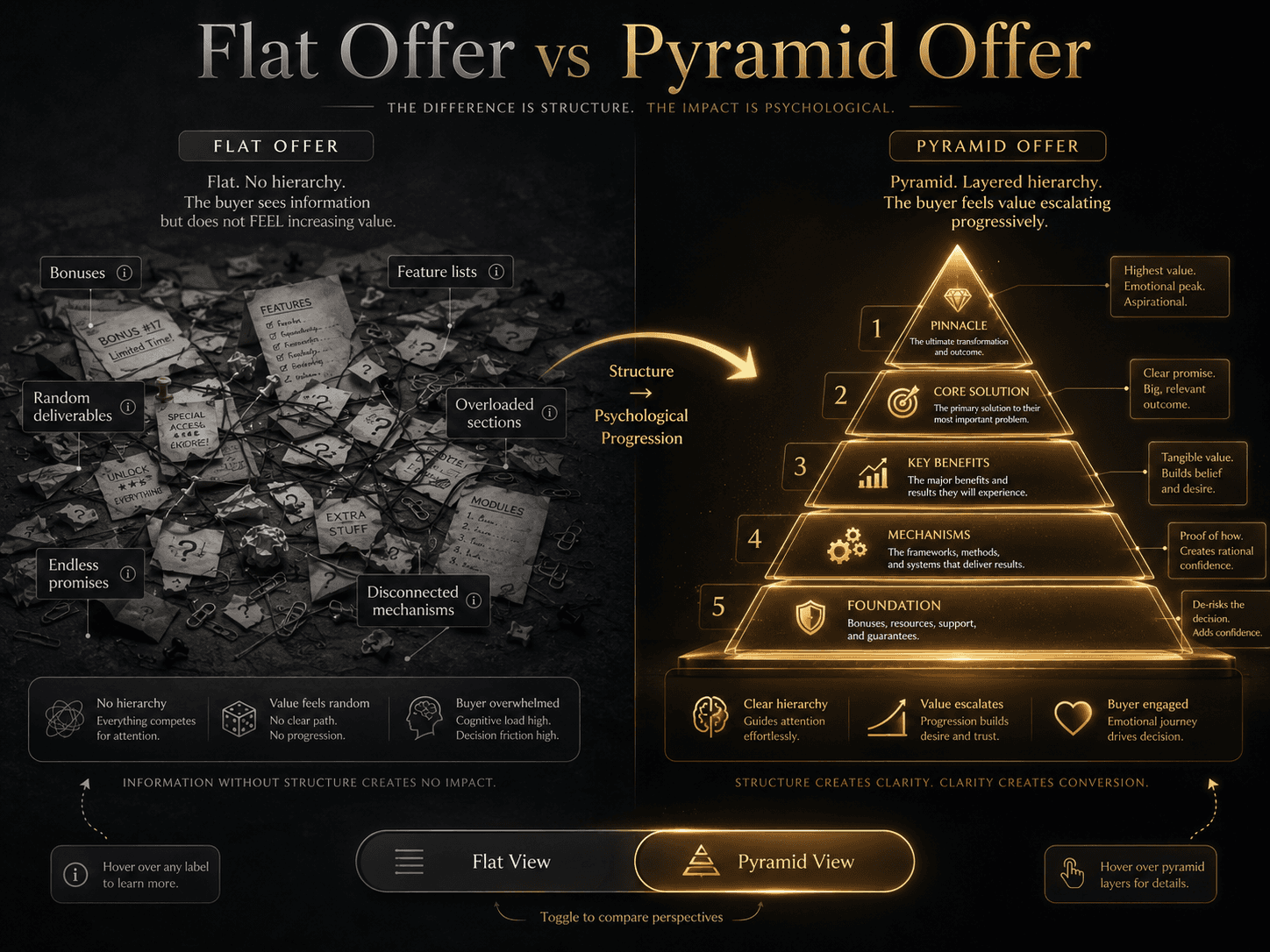
Why Most Offers Feel Commercially Flat
Most offers do not fail because they contain too little information.
They fail because the information has no hierarchy.
The buyer sees:
features
bonuses
promises
deliverables
mechanisms
support
resources
outcomes
But everything is presented at the same emotional level.
No progression.
No increasing value perception.
No emotional escalation.
No deeper reason to keep caring.
That is why some offers feel strangely flat even when the actual service is strong.
The buyer sees many parts, but they do not feel the value building.
That distinction matters.
More information does not automatically create more perceived value.
More bonuses do not automatically create more desire.
More deliverables do not automatically create more trust.
A strong offer is not a random pile of services, bonuses, promises, and mechanisms.
A strong offer is structured psychologically.
It helps the buyer move through value in the right order.
First, they feel the problem.
Then, they see the result.
Then, they understand the mechanism.
Then, they feel the offer becoming complete.
Then, they connect the offer to the future version of themselves they want to become.
That is what The Offer Pyramid™ helps you build.
What This Resource Helps You Do
The Offer Pyramid™ helps you organise your offer into clear value layers that progressively increase perceived importance, emotional relevance, trust, certainty, and buying desire.
Use it to:
structure your offer more clearly
organise value instead of dumping information
make the core problem more visible
make the result easier to picture
make the mechanism more distinct
turn bonuses into real value multipliers
remove unnecessary offer noise
create stronger perceived completeness
connect the offer to a believable future identity
make the buyer feel increasing certainty as they move through the offer
The goal is not to add more.
The goal is to structure better.
Because perceived value is not created by volume alone.
It is created by clarity, hierarchy, movement, and psychological progression.
What The Offer Pyramid™ Actually Is
The Offer Pyramid™ is a layered value-construction framework.
Its purpose is simple:
Increase perceived value progressively.
Instead of dumping everything at once, the pyramid organises value into ascending psychological layers.
Each layer answers a deeper buyer question.
Each layer makes the next one more meaningful.
Each layer helps the buyer feel that the offer is not just useful, but increasingly important.
This creates:
momentum
emotional escalation
stronger perceived sophistication
clearer buying logic
stronger trust progression
greater perceived completeness
stronger desire to act
Without this structure, many offers feel flat.
Even when the actual service is strong.
The Core Principle™
Perceived value is psychological progression.
The buyer should not feel like they are being shown a random collection of deliverables.
They should feel the offer becoming more relevant, more believable, more complete, and more personally meaningful as they move through it.
That is the real purpose of the pyramid.
It turns the offer from:
“Here are all the things included.”
Into:
“Here is why this matters, how it works, why it feels complete, and what it helps you become.”
That is a very different buyer experience.
Why Random Offer Stacking Fails
Many businesses try to increase perceived value by adding more:
more bonuses
more features
more deliverables
more modules
more calls
more templates
more promises
more complexity
But more is not always more valuable.
Sometimes more creates confusion.
Sometimes more weakens the core promise.
Sometimes more makes the buyer work harder to understand what matters.
Sometimes more makes the offer feel desperate.
The issue is not always a lack of value.
The issue is a lack of structure.
A strong offer does not simply list value.
It layers value.
That is what makes the buyer feel:
“This solves something bigger than I first realised.”
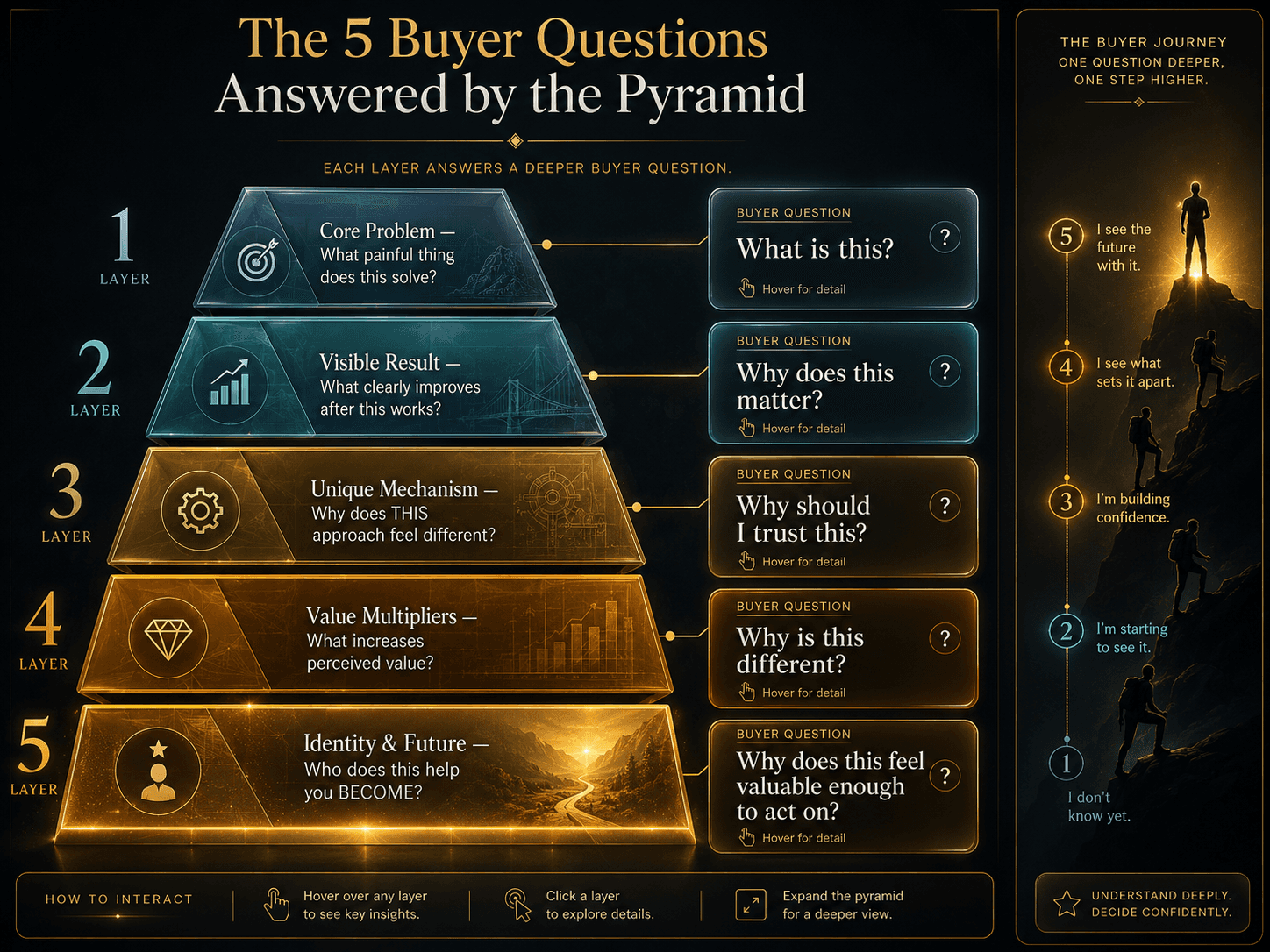
The Buyer’s 5 Natural Offer Questions™
Whether consciously or subconsciously, the buyer is asking five questions as they evaluate an offer.
Question 1: What Is This?
The buyer needs orientation.
They need to understand the basic offer quickly.
If this question is not answered, confusion takes over.
Question 2: Why Does This Matter?
The buyer needs relevance.
They need to feel why the offer connects to a real problem, pressure, frustration, cost, or desired improvement.
If this question is not answered, the offer feels optional.
Question 3: Why Should I Trust This?
The buyer needs credibility.
They need to understand why this version could work.
If this question is not answered, scepticism stays high.
Question 4: Why Is This Different?
The buyer needs distinction.
They need a reason to separate this offer from generic alternatives.
If this question is not answered, the offer becomes a commodity.
Question 5: Why Is This Valuable Enough To Act On?
The buyer needs perceived importance.
They need to feel that the offer is valuable enough, relevant enough, and urgent enough to move now instead of postponing.
If this question is not answered, the offer may be understood but delayed.
How The Offer Pyramid™ Answers These Questions
The pyramid answers these questions progressively.
Core Problem answers:
“Why does this matter?”
Visible Result answers:
“What improves after this works?”
Unique Mechanism answers:
“Why should I trust this version?”
Value Multipliers answer:
“Why does this feel complete?”
Identity & Future Layer answers:
“What does this help me become?”
That progression is what makes the offer feel stronger as the buyer moves through it.
Before You Start: Offer Inventory Worksheet
Before building the pyramid, list what is currently inside your offer.
Do not organise it yet.
Just capture the raw material.
Current Offer Name
Core Service
What is the main thing you sell?
Main Buyer
Who is this for?
Core Problem
What painful problem does this solve?
Visible Result
What result does the buyer get?
Mechanism
How does your offer create the result?
Deliverables
What is included?
Bonuses Or Extras
What additional resources, templates, tools, calls, prompts, audits, or support do you include?
Proof Or Trust Elements
What helps the buyer believe the offer?
Future Identity
Who does this help the buyer become?
Current Problem
Does the offer currently feel like a structured progression or a random stack of information?
Structured progression / Random stack
Why?
——
The 5 Layers Of The Offer Pyramid™
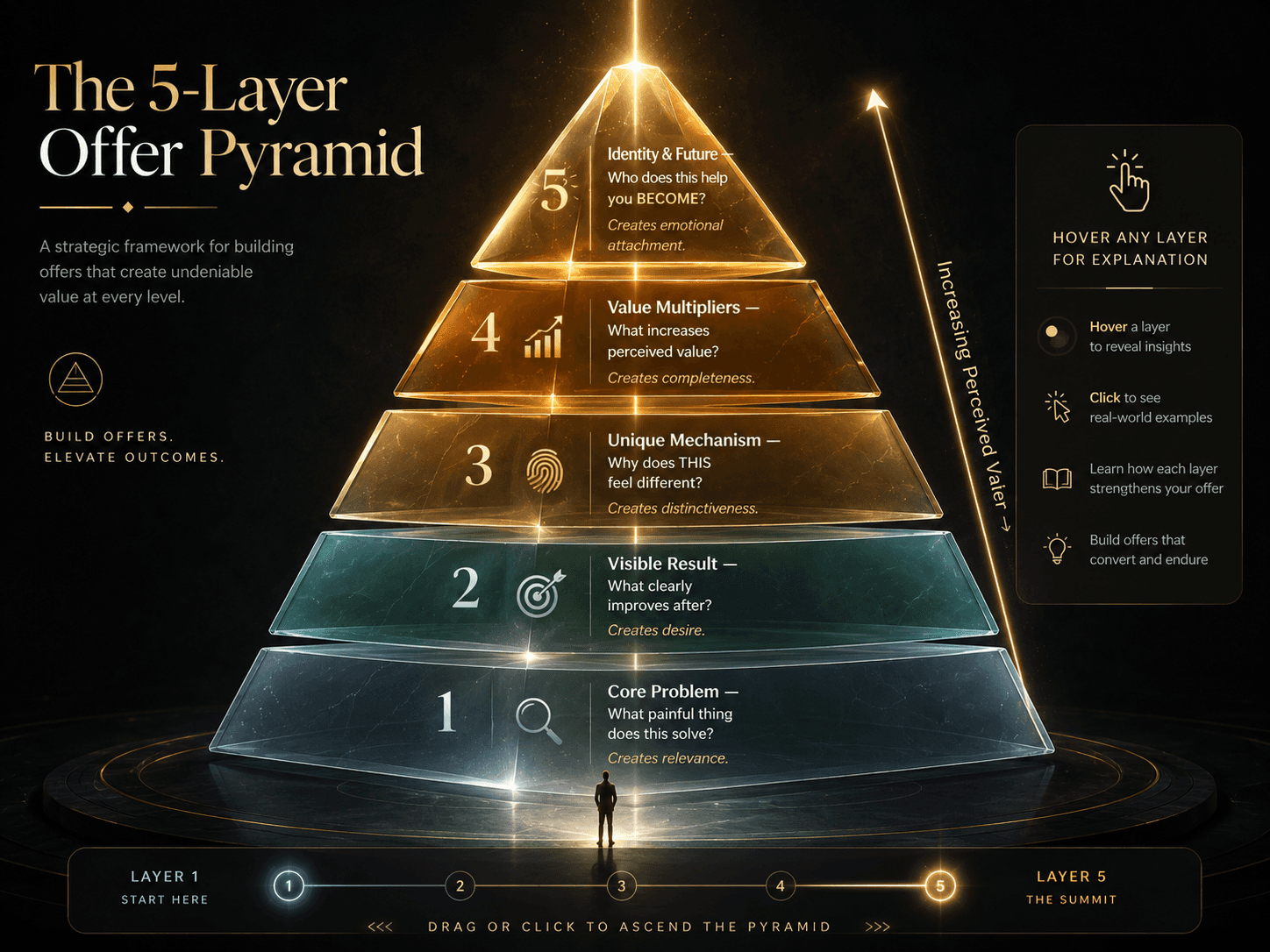
The Offer Pyramid™ has five layers.
Each layer plays a different psychological role.
Layer 1: Core Problem™
Purpose
Creates relevance.
Buyer Question
“What painful thing does this solve?”
This is the foundation of the pyramid.
Without clear pain visibility, nothing above it matters.
The buyer must quickly feel the problem as real, relevant, and worth solving.
They need to feel:
friction
loss
consequence
instability
pressure
emotional cost
commercial cost
urgency
If the problem is weak, the entire offer weakens.
Because without relevance, the pyramid collapses immediately.
Strong Core Problem Examples
funnels leaking buyer trust
offers sounding useful but forgettable
traffic failing to convert
content generating attention but not buying intent
leads arriving but not closing
buyers hesitating before the CTA
product pages creating clicks but not desire
sales calls starting with low trust
strong services hidden behind vague positioning
audiences consuming content but not enquiring
Each of these problems creates a clearer mental picture.
The buyer can feel what is going wrong.
That is what Layer 1 must do.
Weak Foundation Example
“We help businesses grow.”
This is weak because it has:
no visible pressure
no emotional tension
no specific problem
no consequence
no buyer condition
It is too broad to create urgency.
Strong Foundation Example
“We identify why buyers lose certainty before the CTA.”
This is stronger because the problem feels active, visible, and commercially expensive.
The buyer can picture the failure point.
They can feel why it matters.
Core Problem Diagnostic
Ask:
“Does the buyer immediately feel why this problem matters emotionally or financially?”
If not, the pyramid starts weak.
Layer 1 Worksheet
What painful thing does this offer solve?
What is the buyer currently frustrated by?
What is leaking, breaking, slowing down, or becoming harder?
What is the cost of leaving this unsolved?
What does the buyer secretly worry this problem means?
What makes this problem urgent or emotionally relevant?
Write your Core Problem layer:
Layer 1 Score
Score your Core Problem clarity from 1 to 5.
1 = vague
2 = weak
3 = understandable but soft
4 = clear
5 = clear, specific, and emotionally relevant
Your score: ___ / 5
Layer 2: Visible Result™
Purpose
Creates desire.
Buyer Question
“What clearly improves after this works?”
Once the buyer feels the problem, they need to see movement.
This layer introduces the after-state.
The result must feel visible.
Not corporate.
Not abstract.
Not buried inside deliverables.
The buyer should be able to picture what changes.
Strong Visible Result Examples
stronger buyer trust
higher demo conversion
more qualified inbound leads
clearer positioning
easier sales conversations
less hesitation before purchase
stronger conversion momentum
better-fit enquiries
fewer wasted calls
clearer buyer intent
a page that communicates value faster
content that creates demand instead of silent consumption
an offer the buyer can understand, remember, and repeat
The result should feel concrete enough to want.
Concrete creates desire.
Weak Result Example
“Improved performance.”
This is weak because the buyer cannot picture the after-state.
Improved how?
Where?
For whom?
What changes?
What becomes easier?
What becomes more valuable?
The result is too abstract.
Strong Result Example
“Buyers understand the value fast enough to stop bouncing before the CTA.”
This is stronger because the shift feels concrete.
The buyer can picture:
faster understanding
reduced bounce
more trust before the CTA
improved conversion momentum
That is visible movement.
Visible Result Diagnostic
Ask:
“Can the buyer mentally picture the after-state clearly?”
If not, the value remains emotionally weak.
Layer 2 Worksheet
What clearly improves after this works?
What does the buyer stop struggling with?
What becomes easier?
What becomes clearer?
What becomes safer or less risky?
What becomes more profitable, trusted, or stable?
What emotional relief does the buyer feel?
Write your Visible Result layer:
Layer 2 Score
Score your Visible Result from 1 to 5.
1 = vague
2 = weak
3 = understandable but not vivid
4 = visible
5 = vivid, desirable, and commercially meaningful
Your score: ___ / 5
Layer 3: Unique Mechanism™
Purpose
Creates distinctiveness and trust.
Buyer Question
“Why does this approach feel different?”
This is where commodity offers separate from memorable offers.
A visible result may create desire.
But the buyer still needs a reason to believe this version can create that result.
That is the role of the mechanism.
The mechanism gives the offer shape.
It makes the promise feel more specific, credible, and memorable.
Weak Mechanisms Sound Like
proven systems
strategic solutions
custom frameworks
optimisation methods
tailored strategy
growth process
high-converting methodology
performance framework
premium implementation system
These phrases dissolve into market wallpaper.
They may sound professional, but they do not give the buyer a specific reason to trust the offer.
Strong Mechanisms Create Specificity
Strong mechanisms sound more like:
Offer Fog Elimination™
Buyer Trust Leak Analysis™
Emotional Conversion Mapping™
Positioning Compression Framework™
Demand Friction Diagnostics™
Buyer-Language Offer Rebuild™
CTA Resistance Mapping™
Sales-Page Hesitation Analysis™
Message-To-Proof Alignment Audit™
Conversion Depth Mapping™
Now the offer feels identifiable.
Distinctiveness creates memory.
Memory increases perceived sophistication.
Do Not Confuse Complexity With Distinctiveness™
Complicated language does not create premium perception.
Usually, it creates confusion.
The mechanism should feel:
simple enough to understand
specific enough to remember
sharp enough to distinguish
credible enough to trust
useful enough to believe
That balance matters enormously.
A strong mechanism does not need to sound magical.
It needs to sound specific enough to be real.
Unique Mechanism Diagnostic
Ask:
“Does the mechanism make the offer easier to trust, or harder to understand?”
If the mechanism creates confusion, it is too complicated.
If it sounds like everyone else, it is too generic.
If it clearly explains how the result is created, it is doing its job.
Layer 3 Worksheet
What is the method, mechanism, or approach behind the offer?
What does your mechanism diagnose, rebuild, remove, clarify, map, install, repair, or improve?
What specific failure point does it focus on?
What does this mechanism see that generic alternatives miss?
What makes the mechanism memorable?
What makes the mechanism credible?
What makes the mechanism simple enough to understand?
Write your Unique Mechanism layer:
Layer 3 Score
Score your Unique Mechanism from 1 to 5.
1 = generic
2 = weak
3 = understandable but familiar
4 = distinct
5 = specific, memorable, and credible
Your score: ___ / 5
Layer 4: Value Multipliers™
Purpose
Creates perceived completeness and implementation certainty.
Buyer Question
“What increases the value beyond the core service?”
This is where supporting value enters.
Value multipliers can include:
templates
audits
swipe files
diagnostics
frameworks
implementation tools
AI prompts
review systems
live walkthroughs
checklists
scorecards
onboarding support
teardown videos
office hours
examples
worksheets
follow-up reviews
These elements can increase perceived value.
But only when they support the core outcome.
That is critical.
Bonuses should support the core promise.
Not distract from it.
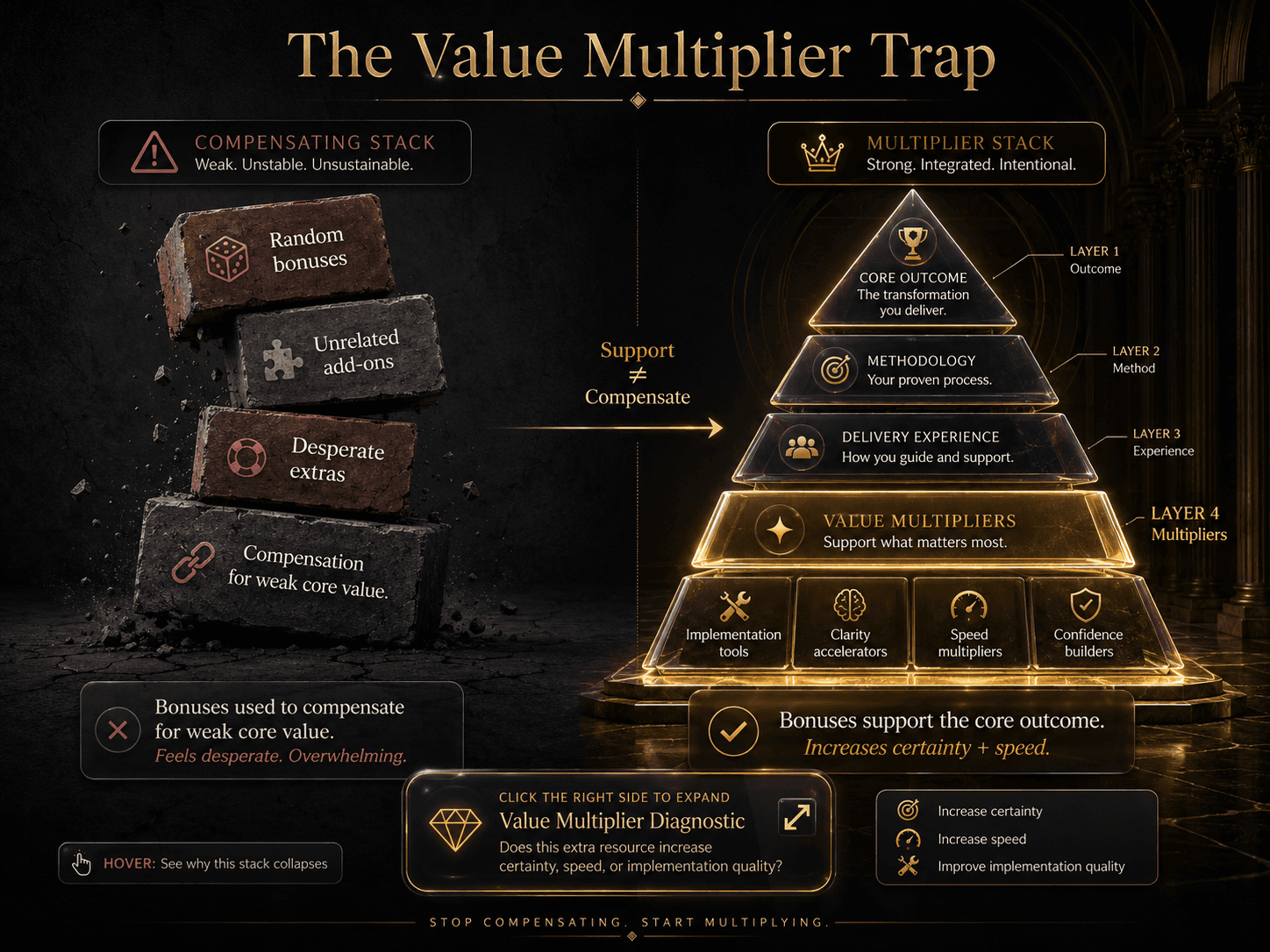
Weak Bonuses vs Strong Value Multipliers
Weak offers use bonuses to compensate for weak core value.
Strong offers use value multipliers to increase certainty and implementation speed.
Huge difference.
A weak bonus stack feels random.
A strong value multiplier stack feels intentional.
The buyer should feel:
“This helps me get the result faster, clearer, or with less risk.”
Not:
“They are adding more things because the core offer is not strong enough.”
Weak Bonus Stack
A weak bonus stack includes random unrelated add-ons.
It may feel like:
filler
desperation
noise
distraction
artificial value inflation
Example:
A funnel audit offer that includes unrelated social media templates, mindset PDFs, and random productivity tools.
These may be useful somewhere else.
But inside this offer, they weaken the focus.
Strong Value Multiplier Stack
A strong value multiplier stack includes resources that strengthen:
clarity
speed
confidence
execution
trust
implementation quality
result certainty
buyer readiness
Example:
A funnel audit offer that includes:
buyer trust leak scorecard
offer clarity worksheet
CTA resistance checklist
before/after page teardown
implementation priority map
follow-up review
Now the ecosystem feels intentional.
Every piece supports the result.
Value Multiplier Filter™
Every value multiplier should pass at least one of these tests.
Does it increase:
certainty?
speed?
trust?
clarity?
implementation quality?
buyer confidence?
perceived completeness?
decision safety?
time-to-result?
ease of execution?
If not, it may simply be noise.
Layer 4 Worksheet
List every bonus, resource, template, tool, or support element currently inside the offer.
For each one, answer:
What does this help the buyer do?
Does it support the core result?
Yes / No
Does it increase certainty?
Yes / No
Does it increase speed?
Yes / No
Does it increase implementation quality?
Yes / No
Does it reduce risk or confusion?
Yes / No
Does it strengthen perceived completeness?
Yes / No
Should it stay, be reframed, or be removed?
Stay / Reframe / Remove
Value Multiplier Stack
Value Multiplier 1:
Purpose:
Value Multiplier 2:
Purpose:
Value Multiplier 3:
Purpose:
Value Multiplier 4:
Purpose:
Value Multiplier 5:
Purpose:
Write Your Value Multipliers Layer
Layer 4 Score
Score your Value Multipliers from 1 to 5.
1 = random or distracting
2 = weak
3 = useful but not well organised
4 = supportive
5 = intentional, complete, and result-supporting
Your score: ___ / 5
Layer 5: Identity & Future Layer™
Purpose
Creates emotional attachment.
Buyer Question
“Who does this help me become?”
This is the highest emotional layer of the pyramid.
Not every offer reaches this layer strongly.
But premium offers often do.
Because humans do not merely buy solutions.
They buy future versions of themselves.
They buy the feeling of becoming:
clearer
more trusted
more certain
more capable
more in control
more commercially sharp
more respected
more confident
less reactive
less invisible
less dependent on guesswork
The identity layer connects the offer to a meaningful future state.
Not in a fake motivational way.
In a grounded, believable way.
Strong Identity & Future Examples
operating with certainty instead of constant hesitation
becoming a founder buyers trust faster
building offers that feel commercially sharp
creating demand without sounding generic
scaling without emotional chaos
communicating value with authority
selling from clarity instead of explanation
leading buyers through trust instead of pressure
becoming the kind of business people understand, remember, and recommend
Now the offer connects to identity.
This creates deeper emotional attachment.
——
The Biggest Mistake At The Top Of The Pyramid™
The biggest mistake is fake transformation language.
Examples:
“Become unstoppable.”
“Unlock your highest self.”
“Dominate effortlessly.”
“Become limitless.”
“Manifest your empire.”
“Crush your industry overnight.”
This language feels emotionally unserious.
It may sound dramatic.
But it usually weakens trust.
Strong identity positioning feels grounded, specific, and believable.
——
Grounded Identity Beats Inflated Transformation™
A strong identity layer does not exaggerate.
It helps the buyer see a believable future version of themselves.
Weak identity language says:
“Become unstoppable.”
Strong identity language says:
“Build offers that buyers understand, remember, and trust before the sales call even starts.”
The second version is stronger because it feels real.
The buyer can imagine it.
They can believe it.
They can want it.
That is what the identity layer should do.
——
Identity & Future Diagnostic
Ask:
“Does this future identity feel grounded and believable, or inflated and fake?”
If it sounds like a motivational poster, rewrite it.
If it connects to a real future state the buyer wants, keep sharpening it.
Layer 5 Worksheet
Who does this offer help the buyer become?
What does the buyer stop feeling after this works?
What does the buyer start feeling instead?
What new standard does this help them operate from?
What future version of themselves becomes more believable?
What identity shift is grounded, specific, and real?
Write your Identity & Future layer:
Layer 5 Score
Score your Identity & Future Layer from 1 to 5.
1 = missing or fake
2 = weak
3 = present but generic
4 = grounded and relevant
5 = grounded, specific, believable, and emotionally powerful
Your score: ___ / 5
——
The Complete Offer Pyramid™
Use this summary to check the full structure.
Layer 1: Core Problem
Purpose: Creates relevance.
Buyer question: “What painful thing does this solve?”
Layer 2: Visible Result
Purpose: Creates desire.
Buyer question: “What clearly improves after this works?”
Layer 3: Unique Mechanism
Purpose: Creates distinctiveness and trust.
Buyer question: “Why does this approach feel different?”
Layer 4: Value Multipliers
Purpose: Creates perceived completeness and implementation certainty.
Buyer question: “What increases the value beyond the core service?”
Layer 5: Identity & Future Layer
Purpose: Creates emotional attachment.
Buyer question: “Who does this help me become?”
——
Complete Offer Pyramid Worksheet
Layer 1: Core Problem
The painful thing this solves:
Why this matters:
Layer 2: Visible Result
What clearly improves after this works:
The after-state the buyer can picture:
Layer 3: Unique Mechanism
The specific mechanism behind the result:
Why this approach feels different:
Layer 4: Value Multipliers
The supporting resources, tools, or elements that increase certainty and implementation:
Why these feel complete rather than random:
Layer 5: Identity & Future Layer
Who this helps the buyer become:
The grounded future state this offer supports:
——
Final Pyramid Statement
Write the complete value progression in one clean paragraph.
This offer helps:
solve:
so they can:
through:
with:
and become:
The “This Feels Complete” Effect™
When the pyramid is built correctly, the buyer begins feeling:
“This feels well thought-out.”
That reaction matters enormously.
Because structured value creates trust.
And trust increases conversion willingness.
The buyer does not only evaluate the individual parts.
They evaluate the feeling of the whole offer.
Does it feel coherent?
Does it feel intentional?
Does it feel complete?
Does it feel like the offer was built around their actual problem?
Does it feel like the seller understands the path from pain to result?
That is the “This Feels Complete” Effect™.
It happens when each layer supports the next.
The core problem creates relevance.
The visible result creates desire.
The unique mechanism creates trust.
The value multipliers create certainty.
The identity layer creates emotional attachment.
Together, they create a stronger offer experience.
Offer Pyramid Scorecard™
Score each layer from 1 to 5.
Core Problem: ___ / 5
Visible Result: ___ / 5
Unique Mechanism: ___ / 5
Value Multipliers: ___ / 5
Identity & Future Layer: ___ / 5
Total Score: ___ / 25
——
Score Interpretation
21–25: Strong Offer Architecture™
The offer has clear psychological progression.
The buyer can feel the problem, picture the result, understand the mechanism, see the supporting value, and connect the offer to a believable future identity.
This is strong offer architecture.
16–20: Promising But Uneven™
The offer has useful value, but one or two layers need sharpening.
Find the weakest layer and improve it before adding more bonuses, features, or promises.
10–15: Flat Value Structure™
The offer may contain useful parts, but the value does not yet build progressively.
The buyer sees information, but may not feel increasing importance, trust, or desire.
Rebuild the hierarchy.
0–9: Random Stack Risk™
The offer likely feels like a pile of services, deliverables, or claims.
Do not add more.
Structure better.
Clarify the problem, result, mechanism, supporting value, and future identity.
——
Hierarchy Check™
Ask these questions after building your pyramid.
Does each layer make the next layer more valuable?
Yes / No
Does the offer feel like progression instead of information overload?
Yes / No
Does the buyer feel increasing clarity?
Yes / No
Does the buyer feel increasing trust?
Yes / No
Does the buyer feel increasing desire?
Yes / No
Does every bonus support the core outcome?
Yes / No
Does the identity layer feel grounded and believable?
Yes / No
Does the offer feel complete without feeling bloated?
Yes / No
——
Biggest Offer Pyramid Mistakes™
Mistake 1: Adding More Instead Of Structuring Better
Many businesses respond to weak conversion by adding more.
More bonuses.
More promises.
More features.
More complexity.
Huge mistake.
Perceived value is not created by volume alone.
It is created by clarity, hierarchy, movement, and psychological structure.
Mistake 2: Starting With Deliverables Instead Of Pain
If the buyer does not feel the problem, the deliverables have nothing to attach to.
Pain creates relevance.
Without relevance, the rest of the offer feels like information.
Mistake 3: Using Bonuses To Rescue A Weak Core Offer
Bonuses cannot save a weak offer foundation.
If the core problem, result, and mechanism are unclear, more bonuses only create more noise.
Fix the core offer first.
Mistake 4: Making The Mechanism Complicated To Sound Premium
Complexity does not create trust.
Clarity creates trust.
Specificity creates trust.
A mechanism should help the buyer understand why this works, not make them feel stupid for not understanding it.
Mistake 5: Using Fake Identity Language
Inflated transformation language weakens serious offers.
The identity layer should feel grounded, believable, and specific.
Not theatrical.
——
Using AI To Build Your Offer Pyramid
AI can help you organise the offer, but only if you ask it to build hierarchy instead of random copy.
Do not ask AI:
“Make my offer more valuable.”
That usually leads to more features, more bonuses, and more inflated language.
Ask it to map the offer into the five psychological layers.
Then ask it to find where the progression is weak.
——
AI Offer Pyramid Prompt™
Use this prompt:
Act as a high-level offer strategist, buyer psychology analyst, and funnel operator.
Help me build a complete Offer Pyramid™ for my business.
My business is:
[insert business]
My offer is:
[insert offer]
My target buyer is:
[insert buyer]
The painful problem they are dealing with is:
[insert core problem]
The visible result I create is:
[insert result]
My mechanism or method is:
[insert mechanism]
My current bonuses, resources, deliverables, or support elements are:
[insert value multipliers]
The future identity or future state I want the offer to support is:
[insert future identity]
Organise the offer into these five layers:
Core Problem
Visible Result
Unique Mechanism
Value Multipliers
Identity & Future Layer
For each layer:
explain what is currently strong
identify what is weak or missing
identify where the value feels vague
identify where the hierarchy feels flat
identify where the buyer may lose interest or trust
rewrite the layer to make it clearer, sharper, and more psychologically useful
Then identify:
weak emotional visibility
generic positioning
weak hierarchy
unnecessary complexity
low perceived value areas
random bonuses or distracting extras
inflated identity language
missing trust-building elements
Suggest:
stronger core problem framing
a more visible result
a sharper mechanism
a better value multiplier structure
a stronger but grounded identity layer
a clearer order for presenting the offer
Then give me:
A clean Offer Pyramid summary
A sharper offer architecture
A simplified version for a landing page
A compressed version for a sales page section
A warning about what to remove or simplify
Do not use hype.
Do not add fake bonuses.
Do not inflate the identity layer.
Do not make the mechanism complicated just to sound premium.
Prioritise clarity, specificity, hierarchy, psychological progression, perceived value, and believable buyer desire.
——
Final Execution Challenge™
Take your current offer.
Map it fully into the five Offer Pyramid™ layers.
Do not skip the weak parts.
Do not hide behind bonuses.
Do not add more before you organise what already exists.
Map:
Core Problem
Visible Result
Unique Mechanism
Value Multipliers
Identity & Future Layer
Then ask:
“Does the perceived value increase progressively, or does this still feel like random information stacked together?”
If the answer is random information, rebuild the hierarchy.
Clarify the problem.
Make the result visible.
Sharpen the mechanism.
Remove weak bonuses.
Strengthen value multipliers.
Ground the identity layer.
Then rewrite the offer so the buyer feels the value building.
——
Final Pyramid Audit
Current Offer
Layer 1: Core Problem
Score: ___ / 5
What needs fixing?
Layer 2: Visible Result
Score: ___ / 5
What needs fixing?
Layer 3: Unique Mechanism
Score: ___ / 5
What needs fixing?
Layer 4: Value Multipliers
Score: ___ / 5
What needs fixing?
Layer 5: Identity & Future Layer
Score: ___ / 5
What needs fixing?
Total Score
___ / 25
Biggest Weak Layer
The weakest layer is:
Core Problem / Visible Result / Unique Mechanism / Value Multipliers / Identity & Future Layer
Why?
First Fix
The first thing I need to fix is:
Rebuilt Offer Pyramid
Write the improved pyramid below:
——
Final Principle™
Strong offers are not random collections of deliverables.
They are carefully structured psychological experiences.
The buyer should not merely see more things.
They should feel increasing clarity, certainty, trust, and emotional buying desire as they move through the offer.
That is what The Offer Pyramid™ creates.
It organises the offer into value layers.
The core problem creates relevance.
The visible result creates desire.
The unique mechanism creates trust and distinction.
The value multipliers create completeness and certainty.
The identity layer creates deeper emotional attachment.
Together, those layers help the buyer feel:
“This solves something bigger than I first realised.”
That is the real purpose of offer architecture.
Not to add more noise.
Not to inflate the promise.
Not to bury the buyer under bonuses.
But to structure the value so clearly that the offer becomes easier to understand, easier to trust, easier to want, and harder to ignore.
Because strong offers are not merely built from what is included.
They are built from how the buyer experiences the value.
——
From:
The $100M Funnel Playbook. Book I: Foundation Buyer Psychology, Offer Clarity, and the Page Architecture Behind High-Converting Funnels
By Maris Spalins.
——
Copyright Notice
© 2026 The $100M Funnel Playbook / Winyourclients / Maris Spalins. All rights reserved.
This resource, including the frameworks, terminology, examples, scorecards, templates, prompts, methods, and written explanations, is original intellectual property created for The $100M Funnel Playbook. Book I: Foundation — Buyer Psychology, Offer Clarity, And The Page Architecture Behind High-Converting Funnels and published through Winyourclients.
No part of this resource may be copied, reproduced, screenshotted, republished, redistributed, sold, adapted, uploaded, scraped, stored in a database, included in training data, used to train artificial intelligence systems, or used to create derivative commercial or educational materials without prior written permission.
Limited reference, quotation, or sharing is only permitted where the source is clearly and visibly credited.
Any permitted reference must include at least one of the following source credits:
The $100M Funnel Playbook by Maris Spalins
or
Winyourclients — www.winyourclients.com
or
Maris Spalins / Winyourclients
Screenshots, excerpts, summaries, or redistributed versions must not remove, hide, alter, crop out, or obscure the original source, author name, book title, website name, or copyright notice.
This resource is provided for personal learning and implementation only. It is not licensed for resale, republishing, redistribution, AI training, template cloning, course creation, consulting delivery, or commercial reuse without written permission from Maris Spalins or Winyourclients.
For permission requests, licensing, citation approval, or commercial usage enquiries, contact:
Winyourclients
www.winyourclients.com
or
Email directly to Jacob on: help@winyourclients.com
![“The Complete Offer Pyramid Builder” Concept: A minimalist, interactive 5-layer pyramid builder tool. Each layer is a text field where the user can input their offer’s content: Layer 1 (Base): Core Problem — [User input field] — “What painful thing does this solve?” Layer 2: Visible Result — [User input field] — “What clearly improves after this works?” Layer 3: Unique Mechanism — [User input field] — “Why does THIS approach feel different?” Layer 4: Value Multipliers — [User input field] — “What increases perceived value?” Layer 5 (Top): Identity & Future — [User input field] — “Who does this help you BECOME?” As the user fills in each layer, the pyramid visually builds from bottom to top. The final output is a complete Offer Pyramid statement. Below the pyramid, diagnostic feedback appears: “Layer 1 clear? ✓ Layer 2 visible? ✓ Layer 3 distinct? ⚠ Needs specificity. Layer 4 supportive? ✓ Layer 5 grounded? ⚠ Avoid hype language.” Style: Luxury UI meets interactive tool. Dark background, gold pyramid outlines, clean input fields with placeholder text. Feels like a serious offer architecture instrument. Interaction: The user types into each layer. The pyramid fills progressively. Diagnostic feedback updates in real-time. A “Generate Offer Statement” button compiles the 5 layers into a single, sharp offer positioning paragraph. A “Save & Export” button allows download.](https://framerusercontent.com/images/TKMVr109W5NuFzBk5eVjQS4T4.png?width=1448&height=1086)
The Offer Pyramid™ A five-layer offer architecture worksheet for organising pain, result, mechanism, value multipliers, and future identity into a clear psychological progression that increases perceived value.
Prefer Audio Or Video?
The Offer Pyramid™ is also available as:
🎧 A guided audio walkthrough explaining offer hierarchy, perceived value, value multipliers, mechanism clarity, and future-identity positioning.
🎥 A practical video breakdown with real offer pyramid examples, value-layer audits, bonus-stack repairs, and offer architecture rebuilds.Choose the format that fits how you learn best.
[Listen To The Audio Walkthrough] (coming soon)
[Watch The Video Breakdown] (coming soon)
——
Why Most Offers Feel Commercially Flat
Most offers do not fail because they contain too little information.
They fail because the information has no hierarchy.
The buyer sees:
features
bonuses
promises
deliverables
mechanisms
support
resources
outcomes
But everything is presented at the same emotional level.
No progression.
No increasing value perception.
No emotional escalation.
No deeper reason to keep caring.
That is why some offers feel strangely flat even when the actual service is strong.
The buyer sees many parts, but they do not feel the value building.
That distinction matters.
More information does not automatically create more perceived value.
More bonuses do not automatically create more desire.
More deliverables do not automatically create more trust.
A strong offer is not a random pile of services, bonuses, promises, and mechanisms.
A strong offer is structured psychologically.
It helps the buyer move through value in the right order.
First, they feel the problem.
Then, they see the result.
Then, they understand the mechanism.
Then, they feel the offer becoming complete.
Then, they connect the offer to the future version of themselves they want to become.
That is what The Offer Pyramid™ helps you build.
What This Resource Helps You Do
The Offer Pyramid™ helps you organise your offer into clear value layers that progressively increase perceived importance, emotional relevance, trust, certainty, and buying desire.
Use it to:
structure your offer more clearly
organise value instead of dumping information
make the core problem more visible
make the result easier to picture
make the mechanism more distinct
turn bonuses into real value multipliers
remove unnecessary offer noise
create stronger perceived completeness
connect the offer to a believable future identity
make the buyer feel increasing certainty as they move through the offer
The goal is not to add more.
The goal is to structure better.
Because perceived value is not created by volume alone.
It is created by clarity, hierarchy, movement, and psychological progression.
What The Offer Pyramid™ Actually Is
The Offer Pyramid™ is a layered value-construction framework.
Its purpose is simple:
Increase perceived value progressively.
Instead of dumping everything at once, the pyramid organises value into ascending psychological layers.
Each layer answers a deeper buyer question.
Each layer makes the next one more meaningful.
Each layer helps the buyer feel that the offer is not just useful, but increasingly important.
This creates:
momentum
emotional escalation
stronger perceived sophistication
clearer buying logic
stronger trust progression
greater perceived completeness
stronger desire to act
Without this structure, many offers feel flat.
Even when the actual service is strong.
The Core Principle™
Perceived value is psychological progression.
The buyer should not feel like they are being shown a random collection of deliverables.
They should feel the offer becoming more relevant, more believable, more complete, and more personally meaningful as they move through it.
That is the real purpose of the pyramid.
It turns the offer from:
“Here are all the things included.”
Into:
“Here is why this matters, how it works, why it feels complete, and what it helps you become.”
That is a very different buyer experience.
Why Random Offer Stacking Fails
Many businesses try to increase perceived value by adding more:
more bonuses
more features
more deliverables
more modules
more calls
more templates
more promises
more complexity
But more is not always more valuable.
Sometimes more creates confusion.
Sometimes more weakens the core promise.
Sometimes more makes the buyer work harder to understand what matters.
Sometimes more makes the offer feel desperate.
The issue is not always a lack of value.
The issue is a lack of structure.
A strong offer does not simply list value.
It layers value.
That is what makes the buyer feel:
“This solves something bigger than I first realised.”
The Buyer’s 5 Natural Offer Questions™
Whether consciously or subconsciously, the buyer is asking five questions as they evaluate an offer.
Question 1: What Is This?
The buyer needs orientation.
They need to understand the basic offer quickly.
If this question is not answered, confusion takes over.
Question 2: Why Does This Matter?
The buyer needs relevance.
They need to feel why the offer connects to a real problem, pressure, frustration, cost, or desired improvement.
If this question is not answered, the offer feels optional.
Question 3: Why Should I Trust This?
The buyer needs credibility.
They need to understand why this version could work.
If this question is not answered, scepticism stays high.
Question 4: Why Is This Different?
The buyer needs distinction.
They need a reason to separate this offer from generic alternatives.
If this question is not answered, the offer becomes a commodity.
Question 5: Why Is This Valuable Enough To Act On?
The buyer needs perceived importance.
They need to feel that the offer is valuable enough, relevant enough, and urgent enough to move now instead of postponing.
If this question is not answered, the offer may be understood but delayed.
How The Offer Pyramid™ Answers These Questions
The pyramid answers these questions progressively.
Core Problem answers:
“Why does this matter?”
Visible Result answers:
“What improves after this works?”
Unique Mechanism answers:
“Why should I trust this version?”
Value Multipliers answer:
“Why does this feel complete?”
Identity & Future Layer answers:
“What does this help me become?”
That progression is what makes the offer feel stronger as the buyer moves through it.
Before You Start: Offer Inventory Worksheet
Before building the pyramid, list what is currently inside your offer.
Do not organise it yet.
Just capture the raw material.
Current Offer Name
Core Service
What is the main thing you sell?
Main Buyer
Who is this for?
Core Problem
What painful problem does this solve?
Visible Result
What result does the buyer get?
Mechanism
How does your offer create the result?
Deliverables
What is included?
Bonuses Or Extras
What additional resources, templates, tools, calls, prompts, audits, or support do you include?
Proof Or Trust Elements
What helps the buyer believe the offer?
Future Identity
Who does this help the buyer become?
Current Problem
Does the offer currently feel like a structured progression or a random stack of information?
Structured progression / Random stack
Why?
——
The 5 Layers Of The Offer Pyramid™
The Offer Pyramid™ has five layers.
Each layer plays a different psychological role.
Layer 1: Core Problem™
Purpose
Creates relevance.
Buyer Question
“What painful thing does this solve?”
This is the foundation of the pyramid.
Without clear pain visibility, nothing above it matters.
The buyer must quickly feel the problem as real, relevant, and worth solving.
They need to feel:
friction
loss
consequence
instability
pressure
emotional cost
commercial cost
urgency
If the problem is weak, the entire offer weakens.
Because without relevance, the pyramid collapses immediately.
Strong Core Problem Examples
funnels leaking buyer trust
offers sounding useful but forgettable
traffic failing to convert
content generating attention but not buying intent
leads arriving but not closing
buyers hesitating before the CTA
product pages creating clicks but not desire
sales calls starting with low trust
strong services hidden behind vague positioning
audiences consuming content but not enquiring
Each of these problems creates a clearer mental picture.
The buyer can feel what is going wrong.
That is what Layer 1 must do.
Weak Foundation Example
“We help businesses grow.”
This is weak because it has:
no visible pressure
no emotional tension
no specific problem
no consequence
no buyer condition
It is too broad to create urgency.
Strong Foundation Example
“We identify why buyers lose certainty before the CTA.”
This is stronger because the problem feels active, visible, and commercially expensive.
The buyer can picture the failure point.
They can feel why it matters.
Core Problem Diagnostic
Ask:
“Does the buyer immediately feel why this problem matters emotionally or financially?”
If not, the pyramid starts weak.
Layer 1 Worksheet
What painful thing does this offer solve?
What is the buyer currently frustrated by?
What is leaking, breaking, slowing down, or becoming harder?
What is the cost of leaving this unsolved?
What does the buyer secretly worry this problem means?
What makes this problem urgent or emotionally relevant?
Write your Core Problem layer:
Layer 1 Score
Score your Core Problem clarity from 1 to 5.
1 = vague
2 = weak
3 = understandable but soft
4 = clear
5 = clear, specific, and emotionally relevant
Your score: ___ / 5
Layer 2: Visible Result™
Purpose
Creates desire.
Buyer Question
“What clearly improves after this works?”
Once the buyer feels the problem, they need to see movement.
This layer introduces the after-state.
The result must feel visible.
Not corporate.
Not abstract.
Not buried inside deliverables.
The buyer should be able to picture what changes.
Strong Visible Result Examples
stronger buyer trust
higher demo conversion
more qualified inbound leads
clearer positioning
easier sales conversations
less hesitation before purchase
stronger conversion momentum
better-fit enquiries
fewer wasted calls
clearer buyer intent
a page that communicates value faster
content that creates demand instead of silent consumption
an offer the buyer can understand, remember, and repeat
The result should feel concrete enough to want.
Concrete creates desire.
Weak Result Example
“Improved performance.”
This is weak because the buyer cannot picture the after-state.
Improved how?
Where?
For whom?
What changes?
What becomes easier?
What becomes more valuable?
The result is too abstract.
Strong Result Example
“Buyers understand the value fast enough to stop bouncing before the CTA.”
This is stronger because the shift feels concrete.
The buyer can picture:
faster understanding
reduced bounce
more trust before the CTA
improved conversion momentum
That is visible movement.
Visible Result Diagnostic
Ask:
“Can the buyer mentally picture the after-state clearly?”
If not, the value remains emotionally weak.
Layer 2 Worksheet
What clearly improves after this works?
What does the buyer stop struggling with?
What becomes easier?
What becomes clearer?
What becomes safer or less risky?
What becomes more profitable, trusted, or stable?
What emotional relief does the buyer feel?
Write your Visible Result layer:
Layer 2 Score
Score your Visible Result from 1 to 5.
1 = vague
2 = weak
3 = understandable but not vivid
4 = visible
5 = vivid, desirable, and commercially meaningful
Your score: ___ / 5
Layer 3: Unique Mechanism™
Purpose
Creates distinctiveness and trust.
Buyer Question
“Why does this approach feel different?”
This is where commodity offers separate from memorable offers.
A visible result may create desire.
But the buyer still needs a reason to believe this version can create that result.
That is the role of the mechanism.
The mechanism gives the offer shape.
It makes the promise feel more specific, credible, and memorable.
Weak Mechanisms Sound Like
proven systems
strategic solutions
custom frameworks
optimisation methods
tailored strategy
growth process
high-converting methodology
performance framework
premium implementation system
These phrases dissolve into market wallpaper.
They may sound professional, but they do not give the buyer a specific reason to trust the offer.
Strong Mechanisms Create Specificity
Strong mechanisms sound more like:
Offer Fog Elimination™
Buyer Trust Leak Analysis™
Emotional Conversion Mapping™
Positioning Compression Framework™
Demand Friction Diagnostics™
Buyer-Language Offer Rebuild™
CTA Resistance Mapping™
Sales-Page Hesitation Analysis™
Message-To-Proof Alignment Audit™
Conversion Depth Mapping™
Now the offer feels identifiable.
Distinctiveness creates memory.
Memory increases perceived sophistication.
Do Not Confuse Complexity With Distinctiveness™
Complicated language does not create premium perception.
Usually, it creates confusion.
The mechanism should feel:
simple enough to understand
specific enough to remember
sharp enough to distinguish
credible enough to trust
useful enough to believe
That balance matters enormously.
A strong mechanism does not need to sound magical.
It needs to sound specific enough to be real.
Unique Mechanism Diagnostic
Ask:
“Does the mechanism make the offer easier to trust, or harder to understand?”
If the mechanism creates confusion, it is too complicated.
If it sounds like everyone else, it is too generic.
If it clearly explains how the result is created, it is doing its job.
Layer 3 Worksheet
What is the method, mechanism, or approach behind the offer?
What does your mechanism diagnose, rebuild, remove, clarify, map, install, repair, or improve?
What specific failure point does it focus on?
What does this mechanism see that generic alternatives miss?
What makes the mechanism memorable?
What makes the mechanism credible?
What makes the mechanism simple enough to understand?
Write your Unique Mechanism layer:
Layer 3 Score
Score your Unique Mechanism from 1 to 5.
1 = generic
2 = weak
3 = understandable but familiar
4 = distinct
5 = specific, memorable, and credible
Your score: ___ / 5
Layer 4: Value Multipliers™
Purpose
Creates perceived completeness and implementation certainty.
Buyer Question
“What increases the value beyond the core service?”
This is where supporting value enters.
Value multipliers can include:
templates
audits
swipe files
diagnostics
frameworks
implementation tools
AI prompts
review systems
live walkthroughs
checklists
scorecards
onboarding support
teardown videos
office hours
examples
worksheets
follow-up reviews
These elements can increase perceived value.
But only when they support the core outcome.
That is critical.
Bonuses should support the core promise.
Not distract from it.
Weak Bonuses vs Strong Value Multipliers
Weak offers use bonuses to compensate for weak core value.
Strong offers use value multipliers to increase certainty and implementation speed.
Huge difference.
A weak bonus stack feels random.
A strong value multiplier stack feels intentional.
The buyer should feel:
“This helps me get the result faster, clearer, or with less risk.”
Not:
“They are adding more things because the core offer is not strong enough.”
Weak Bonus Stack
A weak bonus stack includes random unrelated add-ons.
It may feel like:
filler
desperation
noise
distraction
artificial value inflation
Example:
A funnel audit offer that includes unrelated social media templates, mindset PDFs, and random productivity tools.
These may be useful somewhere else.
But inside this offer, they weaken the focus.
Strong Value Multiplier Stack
A strong value multiplier stack includes resources that strengthen:
clarity
speed
confidence
execution
trust
implementation quality
result certainty
buyer readiness
Example:
A funnel audit offer that includes:
buyer trust leak scorecard
offer clarity worksheet
CTA resistance checklist
before/after page teardown
implementation priority map
follow-up review
Now the ecosystem feels intentional.
Every piece supports the result.
Value Multiplier Filter™
Every value multiplier should pass at least one of these tests.
Does it increase:
certainty?
speed?
trust?
clarity?
implementation quality?
buyer confidence?
perceived completeness?
decision safety?
time-to-result?
ease of execution?
If not, it may simply be noise.
Layer 4 Worksheet
List every bonus, resource, template, tool, or support element currently inside the offer.
For each one, answer:
What does this help the buyer do?
Does it support the core result?
Yes / No
Does it increase certainty?
Yes / No
Does it increase speed?
Yes / No
Does it increase implementation quality?
Yes / No
Does it reduce risk or confusion?
Yes / No
Does it strengthen perceived completeness?
Yes / No
Should it stay, be reframed, or be removed?
Stay / Reframe / Remove
Value Multiplier Stack
Value Multiplier 1:
Purpose:
Value Multiplier 2:
Purpose:
Value Multiplier 3:
Purpose:
Value Multiplier 4:
Purpose:
Value Multiplier 5:
Purpose:
Write Your Value Multipliers Layer
Layer 4 Score
Score your Value Multipliers from 1 to 5.
1 = random or distracting
2 = weak
3 = useful but not well organised
4 = supportive
5 = intentional, complete, and result-supporting
Your score: ___ / 5
Layer 5: Identity & Future Layer™
Purpose
Creates emotional attachment.
Buyer Question
“Who does this help me become?”
This is the highest emotional layer of the pyramid.
Not every offer reaches this layer strongly.
But premium offers often do.
Because humans do not merely buy solutions.
They buy future versions of themselves.
They buy the feeling of becoming:
clearer
more trusted
more certain
more capable
more in control
more commercially sharp
more respected
more confident
less reactive
less invisible
less dependent on guesswork
The identity layer connects the offer to a meaningful future state.
Not in a fake motivational way.
In a grounded, believable way.
Strong Identity & Future Examples
operating with certainty instead of constant hesitation
becoming a founder buyers trust faster
building offers that feel commercially sharp
creating demand without sounding generic
scaling without emotional chaos
communicating value with authority
selling from clarity instead of explanation
leading buyers through trust instead of pressure
becoming the kind of business people understand, remember, and recommend
Now the offer connects to identity.
This creates deeper emotional attachment.
——
The Biggest Mistake At The Top Of The Pyramid™
The biggest mistake is fake transformation language.
Examples:
“Become unstoppable.”
“Unlock your highest self.”
“Dominate effortlessly.”
“Become limitless.”
“Manifest your empire.”
“Crush your industry overnight.”
This language feels emotionally unserious.
It may sound dramatic.
But it usually weakens trust.
Strong identity positioning feels grounded, specific, and believable.
——
Grounded Identity Beats Inflated Transformation™
A strong identity layer does not exaggerate.
It helps the buyer see a believable future version of themselves.
Weak identity language says:
“Become unstoppable.”
Strong identity language says:
“Build offers that buyers understand, remember, and trust before the sales call even starts.”
The second version is stronger because it feels real.
The buyer can imagine it.
They can believe it.
They can want it.
That is what the identity layer should do.
——
Identity & Future Diagnostic
Ask:
“Does this future identity feel grounded and believable, or inflated and fake?”
If it sounds like a motivational poster, rewrite it.
If it connects to a real future state the buyer wants, keep sharpening it.
Layer 5 Worksheet
Who does this offer help the buyer become?
What does the buyer stop feeling after this works?
What does the buyer start feeling instead?
What new standard does this help them operate from?
What future version of themselves becomes more believable?
What identity shift is grounded, specific, and real?
Write your Identity & Future layer:
Layer 5 Score
Score your Identity & Future Layer from 1 to 5.
1 = missing or fake
2 = weak
3 = present but generic
4 = grounded and relevant
5 = grounded, specific, believable, and emotionally powerful
Your score: ___ / 5
——
The Complete Offer Pyramid™
Use this summary to check the full structure.
Layer 1: Core Problem
Purpose: Creates relevance.
Buyer question: “What painful thing does this solve?”
Layer 2: Visible Result
Purpose: Creates desire.
Buyer question: “What clearly improves after this works?”
Layer 3: Unique Mechanism
Purpose: Creates distinctiveness and trust.
Buyer question: “Why does this approach feel different?”
Layer 4: Value Multipliers
Purpose: Creates perceived completeness and implementation certainty.
Buyer question: “What increases the value beyond the core service?”
Layer 5: Identity & Future Layer
Purpose: Creates emotional attachment.
Buyer question: “Who does this help me become?”
——
Complete Offer Pyramid Worksheet
Layer 1: Core Problem
The painful thing this solves:
Why this matters:
Layer 2: Visible Result
What clearly improves after this works:
The after-state the buyer can picture:
Layer 3: Unique Mechanism
The specific mechanism behind the result:
Why this approach feels different:
Layer 4: Value Multipliers
The supporting resources, tools, or elements that increase certainty and implementation:
Why these feel complete rather than random:
Layer 5: Identity & Future Layer
Who this helps the buyer become:
The grounded future state this offer supports:
——
Final Pyramid Statement
Write the complete value progression in one clean paragraph.
This offer helps:
solve:
so they can:
through:
with:
and become:
The “This Feels Complete” Effect™
When the pyramid is built correctly, the buyer begins feeling:
“This feels well thought-out.”
That reaction matters enormously.
Because structured value creates trust.
And trust increases conversion willingness.
The buyer does not only evaluate the individual parts.
They evaluate the feeling of the whole offer.
Does it feel coherent?
Does it feel intentional?
Does it feel complete?
Does it feel like the offer was built around their actual problem?
Does it feel like the seller understands the path from pain to result?
That is the “This Feels Complete” Effect™.
It happens when each layer supports the next.
The core problem creates relevance.
The visible result creates desire.
The unique mechanism creates trust.
The value multipliers create certainty.
The identity layer creates emotional attachment.
Together, they create a stronger offer experience.
Offer Pyramid Scorecard™
Score each layer from 1 to 5.
Core Problem: ___ / 5
Visible Result: ___ / 5
Unique Mechanism: ___ / 5
Value Multipliers: ___ / 5
Identity & Future Layer: ___ / 5
Total Score: ___ / 25
——
Score Interpretation
21–25: Strong Offer Architecture™
The offer has clear psychological progression.
The buyer can feel the problem, picture the result, understand the mechanism, see the supporting value, and connect the offer to a believable future identity.
This is strong offer architecture.
16–20: Promising But Uneven™
The offer has useful value, but one or two layers need sharpening.
Find the weakest layer and improve it before adding more bonuses, features, or promises.
10–15: Flat Value Structure™
The offer may contain useful parts, but the value does not yet build progressively.
The buyer sees information, but may not feel increasing importance, trust, or desire.
Rebuild the hierarchy.
0–9: Random Stack Risk™
The offer likely feels like a pile of services, deliverables, or claims.
Do not add more.
Structure better.
Clarify the problem, result, mechanism, supporting value, and future identity.
——
Hierarchy Check™
Ask these questions after building your pyramid.
Does each layer make the next layer more valuable?
Yes / No
Does the offer feel like progression instead of information overload?
Yes / No
Does the buyer feel increasing clarity?
Yes / No
Does the buyer feel increasing trust?
Yes / No
Does the buyer feel increasing desire?
Yes / No
Does every bonus support the core outcome?
Yes / No
Does the identity layer feel grounded and believable?
Yes / No
Does the offer feel complete without feeling bloated?
Yes / No
——
Biggest Offer Pyramid Mistakes™
Mistake 1: Adding More Instead Of Structuring Better
Many businesses respond to weak conversion by adding more.
More bonuses.
More promises.
More features.
More complexity.
Huge mistake.
Perceived value is not created by volume alone.
It is created by clarity, hierarchy, movement, and psychological structure.
Mistake 2: Starting With Deliverables Instead Of Pain
If the buyer does not feel the problem, the deliverables have nothing to attach to.
Pain creates relevance.
Without relevance, the rest of the offer feels like information.
Mistake 3: Using Bonuses To Rescue A Weak Core Offer
Bonuses cannot save a weak offer foundation.
If the core problem, result, and mechanism are unclear, more bonuses only create more noise.
Fix the core offer first.
Mistake 4: Making The Mechanism Complicated To Sound Premium
Complexity does not create trust.
Clarity creates trust.
Specificity creates trust.
A mechanism should help the buyer understand why this works, not make them feel stupid for not understanding it.
Mistake 5: Using Fake Identity Language
Inflated transformation language weakens serious offers.
The identity layer should feel grounded, believable, and specific.
Not theatrical.
——
Using AI To Build Your Offer Pyramid
AI can help you organise the offer, but only if you ask it to build hierarchy instead of random copy.
Do not ask AI:
“Make my offer more valuable.”
That usually leads to more features, more bonuses, and more inflated language.
Ask it to map the offer into the five psychological layers.
Then ask it to find where the progression is weak.
——
AI Offer Pyramid Prompt™
Use this prompt:
Act as a high-level offer strategist, buyer psychology analyst, and funnel operator.
Help me build a complete Offer Pyramid™ for my business.
My business is:
[insert business]
My offer is:
[insert offer]
My target buyer is:
[insert buyer]
The painful problem they are dealing with is:
[insert core problem]
The visible result I create is:
[insert result]
My mechanism or method is:
[insert mechanism]
My current bonuses, resources, deliverables, or support elements are:
[insert value multipliers]
The future identity or future state I want the offer to support is:
[insert future identity]
Organise the offer into these five layers:
Core Problem
Visible Result
Unique Mechanism
Value Multipliers
Identity & Future Layer
For each layer:
explain what is currently strong
identify what is weak or missing
identify where the value feels vague
identify where the hierarchy feels flat
identify where the buyer may lose interest or trust
rewrite the layer to make it clearer, sharper, and more psychologically useful
Then identify:
weak emotional visibility
generic positioning
weak hierarchy
unnecessary complexity
low perceived value areas
random bonuses or distracting extras
inflated identity language
missing trust-building elements
Suggest:
stronger core problem framing
a more visible result
a sharper mechanism
a better value multiplier structure
a stronger but grounded identity layer
a clearer order for presenting the offer
Then give me:
A clean Offer Pyramid summary
A sharper offer architecture
A simplified version for a landing page
A compressed version for a sales page section
A warning about what to remove or simplify
Do not use hype.
Do not add fake bonuses.
Do not inflate the identity layer.
Do not make the mechanism complicated just to sound premium.
Prioritise clarity, specificity, hierarchy, psychological progression, perceived value, and believable buyer desire.
——
Final Execution Challenge™
Take your current offer.
Map it fully into the five Offer Pyramid™ layers.
Do not skip the weak parts.
Do not hide behind bonuses.
Do not add more before you organise what already exists.
Map:
Core Problem
Visible Result
Unique Mechanism
Value Multipliers
Identity & Future Layer
Then ask:
“Does the perceived value increase progressively, or does this still feel like random information stacked together?”
If the answer is random information, rebuild the hierarchy.
Clarify the problem.
Make the result visible.
Sharpen the mechanism.
Remove weak bonuses.
Strengthen value multipliers.
Ground the identity layer.
Then rewrite the offer so the buyer feels the value building.
——
Final Pyramid Audit
Current Offer
Layer 1: Core Problem
Score: ___ / 5
What needs fixing?
Layer 2: Visible Result
Score: ___ / 5
What needs fixing?
Layer 3: Unique Mechanism
Score: ___ / 5
What needs fixing?
Layer 4: Value Multipliers
Score: ___ / 5
What needs fixing?
Layer 5: Identity & Future Layer
Score: ___ / 5
What needs fixing?
Total Score
___ / 25
Biggest Weak Layer
The weakest layer is:
Core Problem / Visible Result / Unique Mechanism / Value Multipliers / Identity & Future Layer
Why?
First Fix
The first thing I need to fix is:
Rebuilt Offer Pyramid
Write the improved pyramid below:
——
Final Principle™
Strong offers are not random collections of deliverables.
They are carefully structured psychological experiences.
The buyer should not merely see more things.
They should feel increasing clarity, certainty, trust, and emotional buying desire as they move through the offer.
That is what The Offer Pyramid™ creates.
It organises the offer into value layers.
The core problem creates relevance.
The visible result creates desire.
The unique mechanism creates trust and distinction.
The value multipliers create completeness and certainty.
The identity layer creates deeper emotional attachment.
Together, those layers help the buyer feel:
“This solves something bigger than I first realised.”
That is the real purpose of offer architecture.
Not to add more noise.
Not to inflate the promise.
Not to bury the buyer under bonuses.
But to structure the value so clearly that the offer becomes easier to understand, easier to trust, easier to want, and harder to ignore.
Because strong offers are not merely built from what is included.
They are built from how the buyer experiences the value.
——
From:
The $100M Funnel Playbook. Book I: Foundation Buyer Psychology, Offer Clarity, and the Page Architecture Behind High-Converting Funnels
By Maris Spalins.
——
Copyright Notice
© 2026 The $100M Funnel Playbook / Winyourclients / Maris Spalins. All rights reserved.
This resource, including the frameworks, terminology, examples, scorecards, templates, prompts, methods, and written explanations, is original intellectual property created for The $100M Funnel Playbook. Book I: Foundation — Buyer Psychology, Offer Clarity, And The Page Architecture Behind High-Converting Funnels and published through Winyourclients.
No part of this resource may be copied, reproduced, screenshotted, republished, redistributed, sold, adapted, uploaded, scraped, stored in a database, included in training data, used to train artificial intelligence systems, or used to create derivative commercial or educational materials without prior written permission.
Limited reference, quotation, or sharing is only permitted where the source is clearly and visibly credited.
Any permitted reference must include at least one of the following source credits:
The $100M Funnel Playbook by Maris Spalins
or
Winyourclients — www.winyourclients.com
or
Maris Spalins / Winyourclients
Screenshots, excerpts, summaries, or redistributed versions must not remove, hide, alter, crop out, or obscure the original source, author name, book title, website name, or copyright notice.
This resource is provided for personal learning and implementation only. It is not licensed for resale, republishing, redistribution, AI training, template cloning, course creation, consulting delivery, or commercial reuse without written permission from Maris Spalins or Winyourclients.
For permission requests, licensing, citation approval, or commercial usage enquiries, contact:
Winyourclients
www.winyourclients.com
or
Email directly to Jacob on: help@winyourclients.com
Other Blogs
Other Blogs
Check our other project Blogs with useful insight and information for your businesses
Other Blogs
Other Blogs
Check our other project Blogs with useful insight and information for your businesses