Our Three Step Process
May 26, 2026
Chap 3 | Resource 1 |The Offer Fog Diagnostic System™
Our Three Step Process
May 26, 2026
Chap 3 | Resource 1 |The Offer Fog Diagnostic System™
The Offer Fog Diagnostic™ A five-part offer audit for finding the clarity, specificity, tension, consequence, and distinctiveness leaks that make valuable work feel forgettable.
Prefer Audio Or Video?
The Offer Fog Diagnostic System™ is also available as:
🎧 A guided audio walkthrough explaining offer fog, offer clarity, specificity, tension, consequence, and distinctiveness.
🎥 A practical video breakdown with real offer examples, offer fog audits, before/after rewrites, and offer clarity repairs.Choose the format that fits how you learn best.
[Listen To The Audio Walkthrough] (coming soon)
[Watch The Video Breakdown] (coming soon)
——
Why Most Offers Die Quietly
Most offers do not fail because the service is bad.
They fail because the value never becomes clear enough, specific enough, urgent enough, or emotionally visible enough in the buyer’s mind.
The buyer reads the page.
They understand the category.
They may even nod politely.
Then five seconds later, the offer disappears from memory.
No friction.
No desire.
No urgency.
No mental picture.
No reason to act.
That is offer fog.
Offer fog is what happens when valuable work is wrapped in vague, bloodless, forgettable language.
The offer may technically make sense.
But emotionally, nothing lands.
The buyer does not feel:
why this matters
why this is different
why this solves something important
why they should care now
what actually changes after buying
why this is worth choosing over alternatives
So the offer becomes commercially invisible.
Not because people hate it.
Because they never emotionally register it deeply enough to care.
That is what this resource helps you diagnose.
What This Resource Helps You Do
The Offer Fog Diagnostic™ helps you find where your offer becomes vague, forgettable, soft, safe, or commercially invisible.
Use it to diagnose:
weak clarity
low specificity
low-tension language
invisible consequences
generic promises
buyer confusion
urgency leaks
weak distinctiveness
service language with no felt value
offers that sound useful but easy to postpone
The goal is not to make your offer louder.
The goal is to make the value easier to see, feel, remember, and want.
Because buyers do not move because an offer exists.
They move when the offer creates a clear enough mental picture of the shift.
What Offer Fog Actually Is
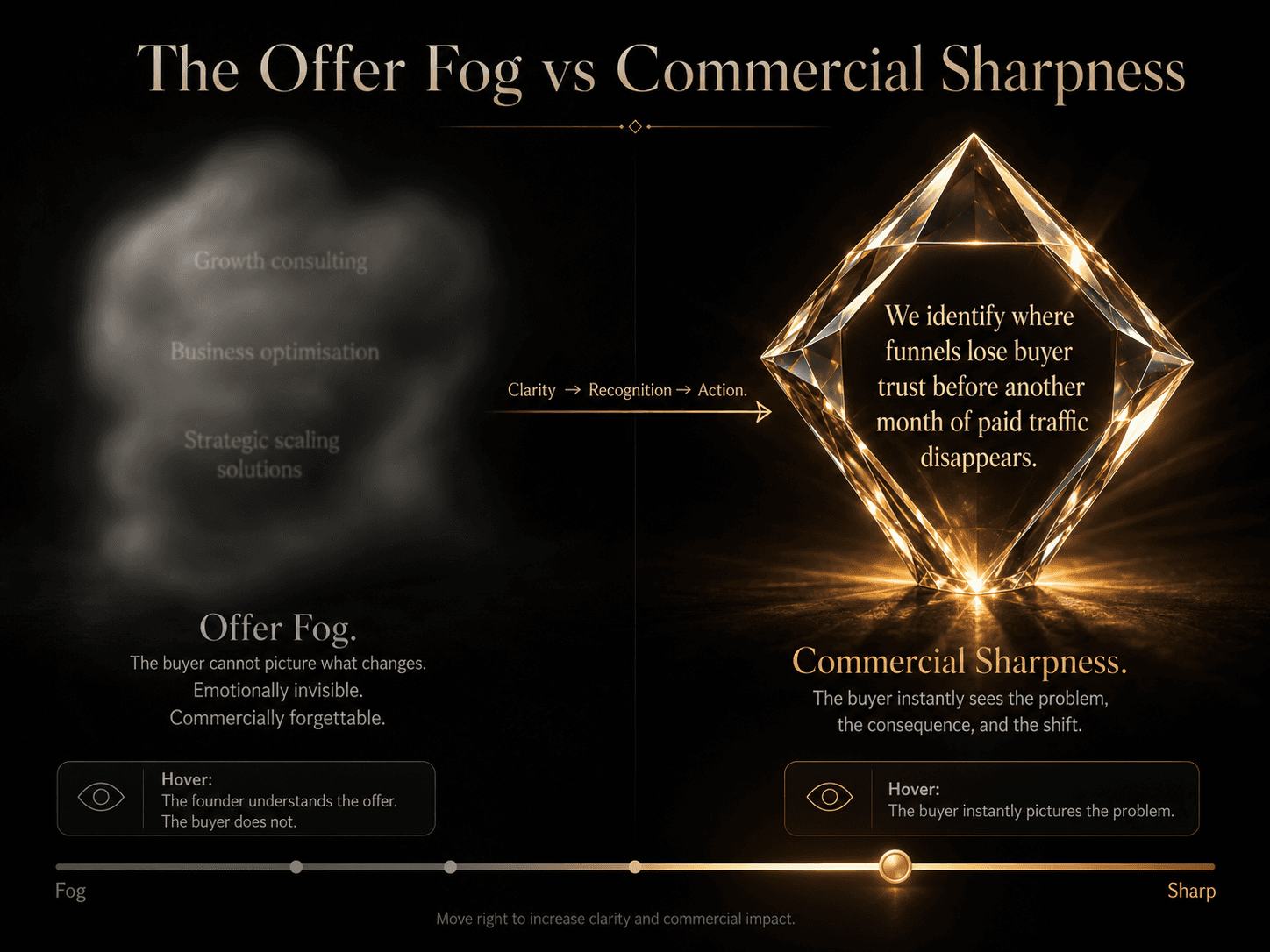
Offer fog happens when the buyer cannot quickly feel what the offer changes.
The offer may explain the service.
But it does not make the buyer feel the value.
That distinction matters.
A foggy offer may tell the buyer:
what you do
what service you provide
what process you use
what category you belong to
But it fails to make the buyer feel:
what pain it interrupts
what result becomes possible
what risk is reduced
what frustration gets removed
what future becomes easier
what makes this version different
That is why foggy offers feel strangely lifeless.
They may be clear at a category level.
But they are weak at a value level.
The buyer understands the words.
But they do not feel the reason to care.
The Most Dangerous Part About Offer Fog
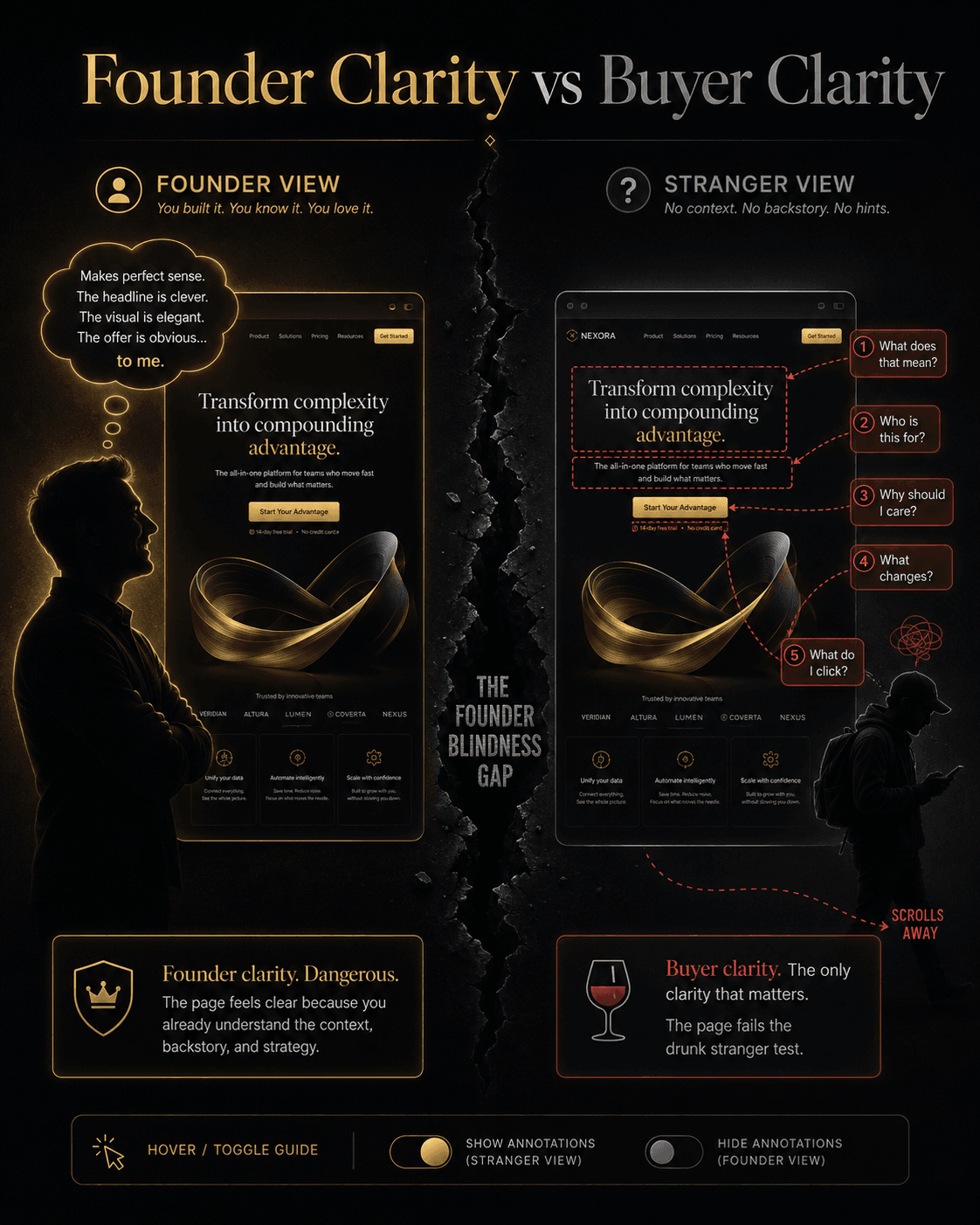
Most founders cannot see their own offer fog.
Why?
Because they already understand:
the service
the process
the method
the jargon
the mechanism
the delivery
the background context
the value behind the work
The buyer does not.
The buyer only sees what the page gives them.
And if the page gives them a blurry wall of vague claims, safe language, broad promises, generic outcomes, and low emotional visibility, the buyer does not fill in the missing value.
They move on.
This is why founders often think:
“But the offer makes sense.”
Maybe it does to you.
That does not mean it lands for the buyer.
The buyer is not inside your head.
They are inside their own pressure, their own doubts, their own timeline, their own alternatives, and their own decision fatigue.
Your offer has to survive there.
Signs Your Offer Has Offer Fog
Your offer may have fog if buyers:
ask confused questions
hesitate constantly
say “interesting” but do not move
disappear after calls
compare you purely on price
fail to repeat your value clearly
struggle explaining what you do to others
consume your content but do not enquire
seem to understand the service but still feel no urgency
ask for more information because the value is not clear enough
treat your offer like a commodity
postpone action even when the problem is real
These are not always traffic problems.
They are often offer problems.
Because strong offers create mental pictures.
Weak offers create mental effort.
And the brain avoids mental effort.
The Core Principle™
Clear offers reduce decision friction.
Foggy offers increase cognitive load.
The buyer should not need three paragraphs, two calls, and a strategy session just to understand why the offer matters.
If the buyer has to work too hard to understand the value, the offer is already leaking energy.
That does not mean the offer must be simplistic.
It means the value must become visible quickly.
A strong offer helps the buyer understand:
what this is
who it is for
what problem it interrupts
what changes after buying
why this version is different
why acting now makes sense
A foggy offer leaves those questions half-answered.
And half-answered offers rarely create strong action.
Before You Start: Write Your Current Offer
Do not audit the offer in your head.
Write the exact offer statement as it currently appears on your page, profile, pitch deck, proposal, ad, or landing page.
Current Offer Statement
Write your current offer here:
Target Buyer
Who is this offer meant for?
Current Buyer Pressure
What live frustration, problem, or pressure is the buyer dealing with right now?
Desired Buyer Action
What do you want the buyer to do after seeing this offer?
Current Offer Confidence
Before scoring, how strong do you currently believe the offer is?
Score: ___ / 10
Why?
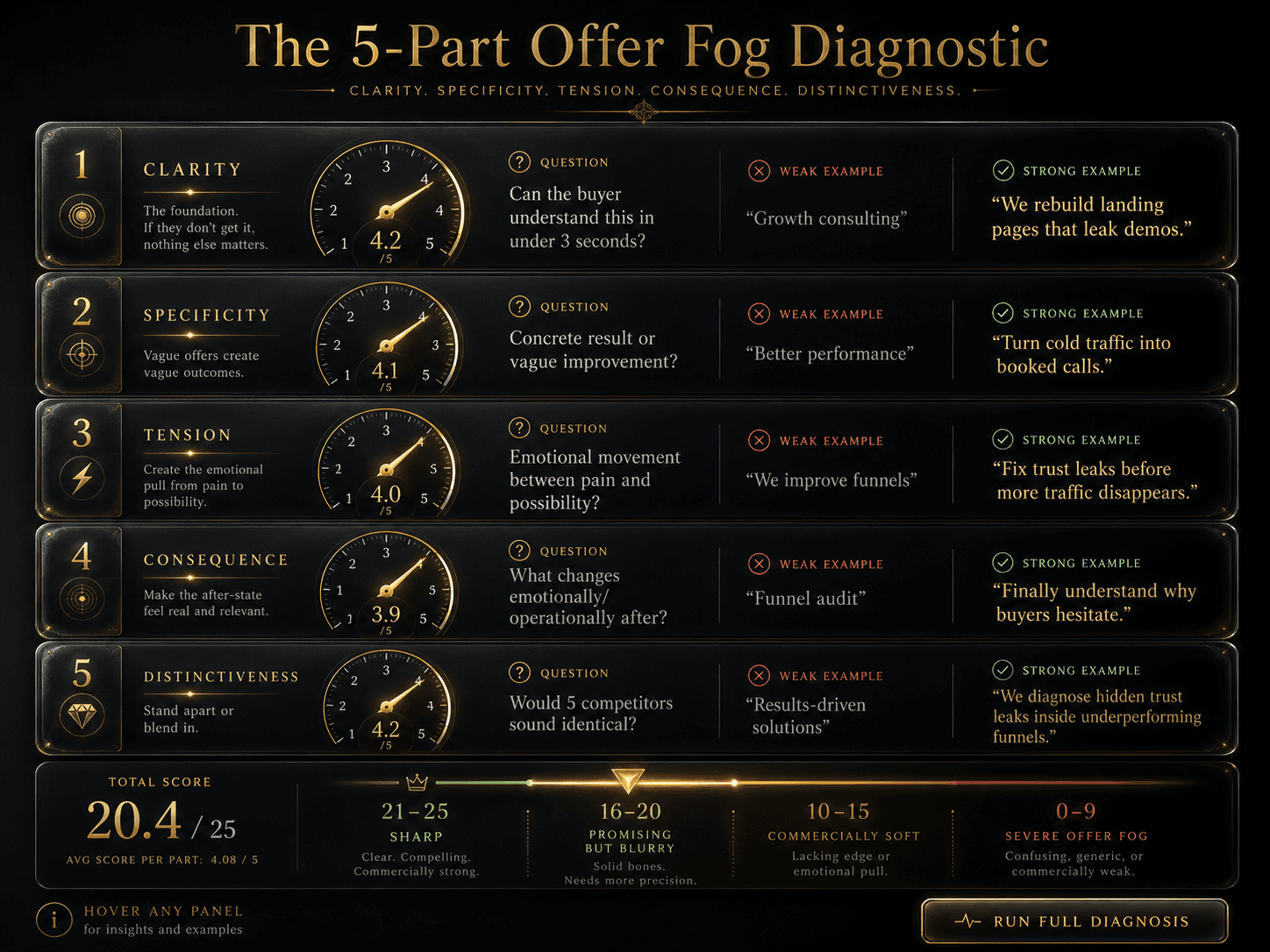
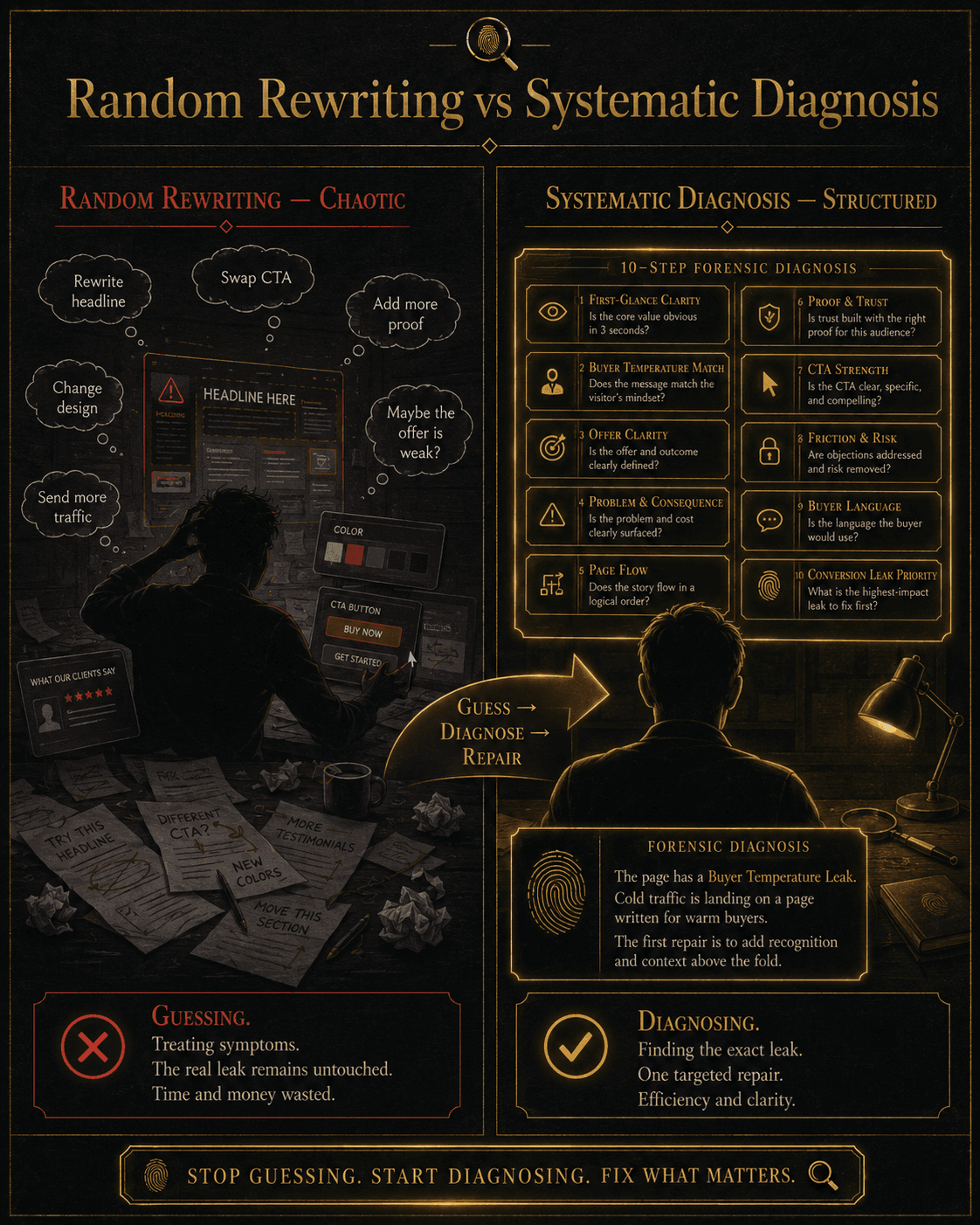
The 5-Part Offer Fog Diagnostic™
This diagnostic evaluates your offer across five critical clarity layers.
Each layer reveals where the offer becomes weaker psychologically.
You will score each category from 1 to 5.
1 = extremely weak
2 = weak
3 = usable but needs sharpening
4 = strong
5 = extremely sharp
The five diagnostic layers are:
Clarity Check™
Specificity Check™
Tension Check™
Consequence Check™
Distinctiveness Check™
Part 1: Clarity Check™
Core Question
Can the buyer understand what this is in under three seconds?
This is the first survival test.
Not:
“Can they eventually figure it out?”
But:
“Can they understand it immediately?”
If the buyer cannot quickly understand what the offer is, they will not stay long enough to appreciate the deeper value.
Clarity comes before persuasion.
Weak Clarity Sounds Like
“Growth consulting”
“Business optimisation”
“Strategic scaling solutions”
“Done-for-you systems”
“Performance marketing support”
“Tailored business strategy”
“Conversion solutions”
“Brand growth services”
These phrases may sound professional.
But mentally, they are often empty.
The buyer cannot picture anything concrete.
They do not know exactly what is being fixed, changed, improved, removed, accelerated, or made easier.
Strong Clarity Sounds Like
“We rebuild SaaS landing pages that leak demo requests after the first scroll.”
“We help coaches turn silent audiences into booked inbound calls.”
“We identify where funnels lose trust before more ad spend gets wasted.”
“We turn vague service offers into sharper buying reasons cold buyers can understand quickly.”
“We fix the message and page flow making qualified traffic hesitate after the click.”
Now the buyer can picture the problem.
That matters enormously.
The offer gives the mind something to hold.
Clarity Score
Score 1–2:
The offer feels abstract, corporate, broad, or unclear.
Score 3:
The offer is understandable but still generic.
Score 4–5:
The buyer instantly understands:
what this is
who it helps
what problem it addresses
why it might matter
Your score: ___ / 5
Clarity Fix Action
If clarity is weak, replace service labels with visible problems, specific situations, or consequence-driven descriptions.
Instead of only naming the service, name what the service changes.
Ask:
What exactly is this?
Who is it for?
What problem does it address?
What situation does it improve?
What does the buyer instantly understand after reading it?
Clarity Rewrite
Current unclear version:
Clearer version:
Part 2: Specificity Check™
Core Question
Does the offer promise a concrete result or a vague improvement?
Specificity gives the buyer something to picture.
Vague improvement creates low emotional reaction because the buyer cannot clearly see the after-state.
If the after-state is not visible, desire stays weak.
Weak Specificity Sounds Like
“Better performance”
“Improved marketing”
“More visibility”
“Higher growth”
“Stronger results”
“Better systems”
“More engagement”
“Improved conversion”
“More authority”
These phrases may be positive.
But they are too broad to create a strong mental picture.
The buyer cannot see what changes.
Strong Specificity Sounds Like
“Turn cold traffic into qualified booked calls.”
“Identify why the sales page loses momentum before the CTA.”
“Reduce no-show rates from discovery calls.”
“Increase demo requests without increasing ad spend.”
“Turn vague positioning into a clear reason for serious buyers to enquire.”
“Find the trust gaps making qualified visitors hesitate before booking.”
Now the result becomes visible.
Visibility creates desire.
Specificity Score
Score 1–2:
The result feels broad, fluffy, or immeasurable.
Score 3:
The result exists but still lacks vividness.
Score 4–5:
The buyer can clearly picture what changes after the work is done.
Your score: ___ / 5
Specificity Fix Action
Replace abstract improvements with visible shifts, specific outcomes, or measurable movement.
Ask:
What changes after the buyer uses this?
What becomes easier?
What becomes clearer?
What improves in the buyer’s business or life?
What result can they picture?
What would make the buyer think, “I want that”?
Specificity Rewrite
Current vague result:
Specific result:
Part 3: Tension Check™
Core Question
Does the offer create emotional movement between current pain and future possibility?
Weak offers describe services.
Strong offers expose tension.
Tension is the gap between where the buyer is now and what they want instead.
Without tension, the offer may sound useful but not urgent.
And useful is often easy to postpone.
Weak Tension Sounds Like
“We improve funnel performance.”
“We optimise conversion systems.”
“We help you grow.”
“We improve your brand visibility.”
“We support your marketing strategy.”
“We help you create better content.”
These lines are not always wrong.
They are just emotionally flat.
They describe activity without making the buyer feel the cost of staying where they are.
Strong Tension Sounds Like
“Find out why your funnel keeps stalling before another month of traffic disappears.”
“Fix the trust leaks causing buyers to hesitate right before conversion.”
“Stop sending paid traffic into a page that still feels emotionally unclear.”
“Turn attention into buyer intent before another launch disappears into polite interest.”
“Find the offer fog making useful work sound forgettable before more traffic exposes the same weakness.”
Now the buyer feels consequence.
Consequence creates attention.
Tension Score
Score 1–2:
The offer feels emotionally flat.
Score 3:
Some tension exists but it lacks urgency.
Score 4–5:
The buyer clearly feels the cost of leaving this unresolved.
Your score: ___ / 5
Tension Fix Action
Reveal the live pressure inside the problem.
Look for:
friction
cost
delay
leakage
uncertainty
lost momentum
hidden consequences
repeated frustration
avoidable waste
Make the problem feel active.
Not dramatic.
Active.
Tension Rewrite
Current flat version:
Tension-based version:
Part 4: Consequence Check™
Core Question
Does the offer imply what changes emotionally, operationally, or financially after action?
Weak offers explain the service.
Strong offers imply life after the service.
The buyer wants to understand the movement.
They are silently asking:
“What changes if I say yes?”
If your offer does not answer that, it stays static.
Weak Consequence Sounds Like
“Funnel audit.”
“Messaging consultation.”
“Strategy call.”
“Brand review.”
“Growth session.”
“Sales page teardown.”
“Positioning workshop.”
These are delivery formats.
They do not yet tell the buyer what changes after the work is done.
Strong Consequence Sounds Like
“See exactly where your offer loses trust before wasting another quarter rebuilding the wrong thing.”
“Finally understand why buyers hesitate even when traffic is already landing.”
“Find the message gaps making strong work sound ordinary before another campaign goes live.”
“Leave with a clearer offer line your buyer can understand, want, and repeat.”
“Identify whether your funnel problem is traffic, trust, or the message underneath it.”
Now the offer creates movement.
The buyer starts mentally imagining relief.
That changes everything psychologically.
Consequence Score
Score 1–2:
The offer feels static.
Score 3:
Some movement exists but feels weak.
Score 4–5:
The buyer can emotionally picture the after-state.
Your score: ___ / 5
Consequence Fix Action
Answer:
“What becomes easier, clearer, safer, faster, more profitable, or less risky after this?”
Ask:
What does the buyer stop worrying about?
What do they finally understand?
What decision becomes easier?
What waste is reduced?
What risk becomes clearer?
What movement becomes possible?
Consequence Rewrite
Current static version:
Consequence-driven version:
Part 5: Distinctiveness Check™
Core Question
Would five competitors sound almost identical?
If yes, you have a commodity problem.
Distinctiveness does not mean being different for the sake of being different.
It means the offer has enough specific shape that the buyer can remember it, repeat it, and separate it from the market noise.
Weak Distinctiveness Sounds Like
“Results-driven solutions”
“Custom strategies”
“Done-for-you growth”
“High-converting systems”
“Tailored support”
“Strategic marketing”
“Premium consulting”
“Full-service growth partner”
These phrases are market wallpaper.
They are familiar.
They are forgettable.
They do not give the buyer a reason to remember you.
Strong Distinctiveness Sounds Like
“We identify where buyer certainty collapses before the CTA.”
“We rebuild offers suffering from offer fog.”
“We turn passive attention into buyer intent.”
“We diagnose hidden trust leaks inside underperforming funnels.”
“We rebuild the offer line making useful work sound forgettable.”
“We find the exact point where qualified buyers stop believing the next step is worth taking.”
Now the offer feels recognisable.
Distinctiveness creates memory.
Memory creates commercial advantage.
Distinctiveness Score
Score 1–2:
The offer sounds interchangeable.
Score 3:
Some uniqueness exists but still feels familiar.
Score 4–5:
The offer feels identifiable, specific, and difficult to confuse with competitors.
Your score: ___ / 5
Distinctiveness Fix Action
Introduce:
mechanism
language ownership
sharper consequence
proprietary framing
clearer problem articulation
a specific buyer condition
a specific failure point
a memorable named problem
Ask:
What does this offer solve that competitors usually describe too broadly?
What is the specific failure point?
What language can you own?
What mechanism makes this version more credible?
What would make the offer harder to confuse?
Distinctiveness Rewrite
Current generic version:
More distinctive version:
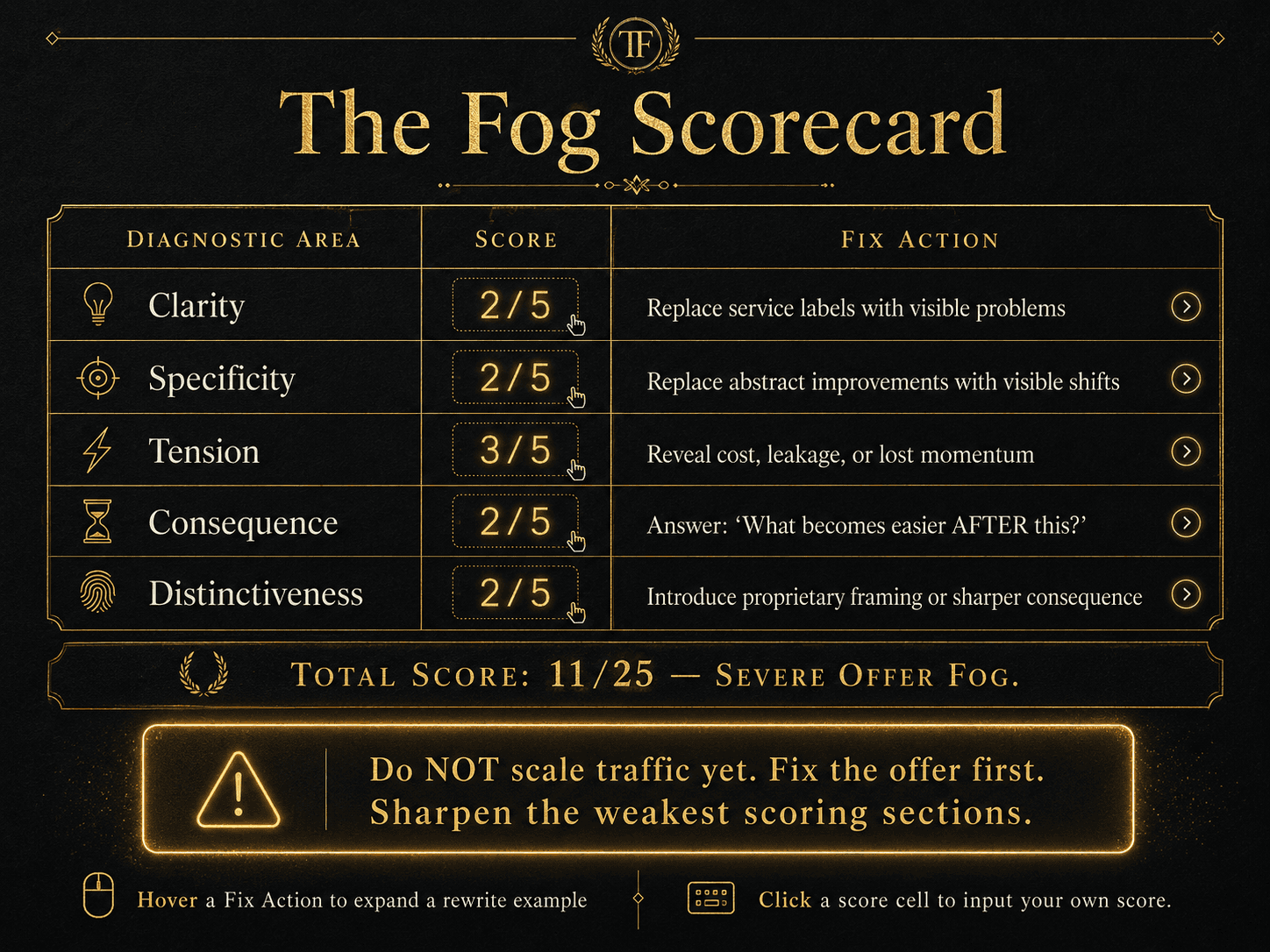
The Offer Fog Scorecard™
Score each area from 1 to 5.
Clarity: ___ / 5
Specificity: ___ / 5
Tension: ___ / 5
Consequence: ___ / 5
Distinctiveness: ___ / 5
Total Score: ___ / 25
Score Interpretation
21–25: Sharp Offer™
The value feels visible, specific, and commercially meaningful.
The buyer can understand what the offer is, feel why it matters, picture the shift, and remember why this version is different.
The offer is ready for traffic, testing, and scaling.
16–20: Promising But Blurry™
The offer has strength, but it still contains fog pockets that reduce urgency, clarity, or memorability.
The buyer may understand the value, but not feel it strongly enough yet.
Sharpen the weakest scoring sections first.
10–15: Commercially Soft™
The offer sounds useful but not emotionally important enough.
Buyers may understand it without strongly wanting it.
This is dangerous because the offer may receive polite interest without real movement.
Go back to specificity, tension, and consequence.
0–9: Severe Offer Fog™
The value remains unclear, forgettable, generic, or emotionally invisible.
Do not scale traffic yet.
Do not fix the CTA first.
Do not rewrite the whole page first.
Fix the offer first.
Fog Type Diagnosis™
After scoring, identify the dominant type of fog.
Your offer may suffer from one major fog type or several at once.
Clarity Fog™
The buyer cannot quickly understand what the offer is.
Symptoms:
abstract language
unclear service
too much jargon
no obvious buyer
no visible problem
Fix:
Make the offer easier to understand in one sentence.
Result Fog™
The buyer cannot clearly picture what changes after buying.
Symptoms:
vague outcomes
broad promises
unclear after-state
too much process language
little visible movement
Fix:
Make the result concrete, visible, and desirable.
Tension Fog™
The buyer does not feel the cost of staying where they are.
Symptoms:
soft pain
weak urgency
little consequence
no live pressure
useful but easy to postpone
Fix:
Show the active friction, leakage, cost, delay, or uncertainty.
Consequence Fog™
The buyer understands the service but does not feel the emotional, operational, or financial shift.
Symptoms:
offer feels static
no before/after movement
unclear relief
no sense of what becomes easier
no emotional payoff
Fix:
Show what changes after action.
Commodity Fog™
The offer sounds like too many other offers in the market.
Symptoms:
generic language
familiar phrases
interchangeable promises
weak mechanism
no owned language
easy to confuse with competitors
Fix:
Sharpen the mechanism, failure point, buyer condition, or proprietary frame.
My Dominant Fog Type
My offer currently suffers most from:
Clarity Fog / Result Fog / Tension Fog / Consequence Fog / Commodity Fog
Why?
The first fog type I need to fix is:
The Offer Fog Mistakes Checklist™
Use this checklist to catch the most common causes of weak offer language.
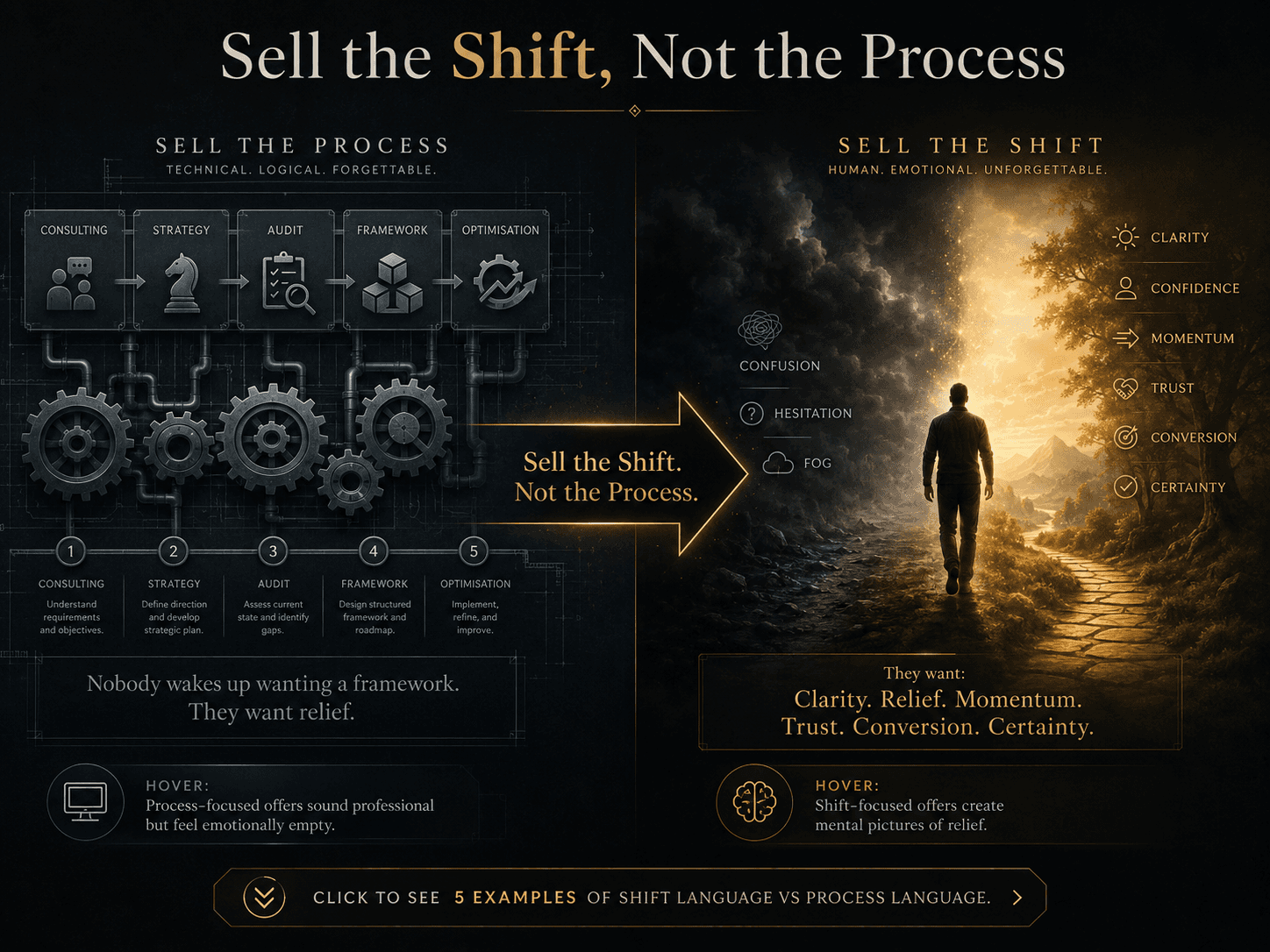
Mistake 1: Selling The Process Instead Of The Prize
Nobody wakes up wanting:
consulting
strategy
optimisation
frameworks
audits
workshops
teardowns
support
They want:
clarity
relief
momentum
confidence
demand
trust
conversion
certainty
better-fit leads
less chaos
a stronger reason for buyers to act
Describe the shift.
Not just the service.
Check:
Does my offer sell the process or the prize?
Process / Prize
Fix:
Mistake 2: Talking About What You Do Instead Of What They Get
The page is not there to celebrate your method.
It is there to help the buyer understand why the method matters to them.
The buyer cares about:
the result
the relief
the reduction in risk
the difference after the work is done
the movement from current pressure to desired state
Check:
Does my offer lead with what I do or what the buyer gets?
What I do / What they get
Fix:
Mistake 3: Being Too Soft
Weak offers get acknowledged.
Strong offers get remembered.
If the language feels too careful, too broad, too polite, or too safe, the buyer’s brain does not assign urgency to it.
That does not mean use fake hype.
It means stop hiding the real consequence.
Check:
Is my offer too soft to create a reaction?
Yes / No
Fix:
Mistake 4: Ignoring Timing And Reason To Act
Timing shapes urgency.
Not always through false scarcity.
Through relevance.
The buyer wants to know:
why this matters now
what keeps leaking if they wait
what becomes harder if the problem remains unresolved
whether this solves a live problem or a someday problem
how soon the shift begins
A clear reason to act makes the offer easier to picture.
And what is easier to picture is easier to want.
Check:
Does my offer give the buyer a reason to act now?
Yes / No
Fix:
Mistake 5: Sounding Like Everyone Else
If five competitors could say the same line, the offer is too generic.
Common fog phrases include:
“tailored solutions”
“growth strategy”
“high-converting systems”
“done-for-you support”
“premium service”
“results-driven approach”
“helping brands scale”
These phrases do not create memory.
Check:
Could five competitors say my offer almost exactly?
Yes / No
Fix:
Mistake 6: Making The Buyer Do The Translation
A weak offer forces the buyer to translate:
“So what does this mean for me?”
That is dangerous.
The buyer should not need to infer the value.
The offer should make it visible.
Check:
Does my offer make the buyer work too hard to understand the value?
Yes / No
Fix:
Before vs After Examples
Use these examples to see the difference between foggy offer language and commercially sharper offer language.
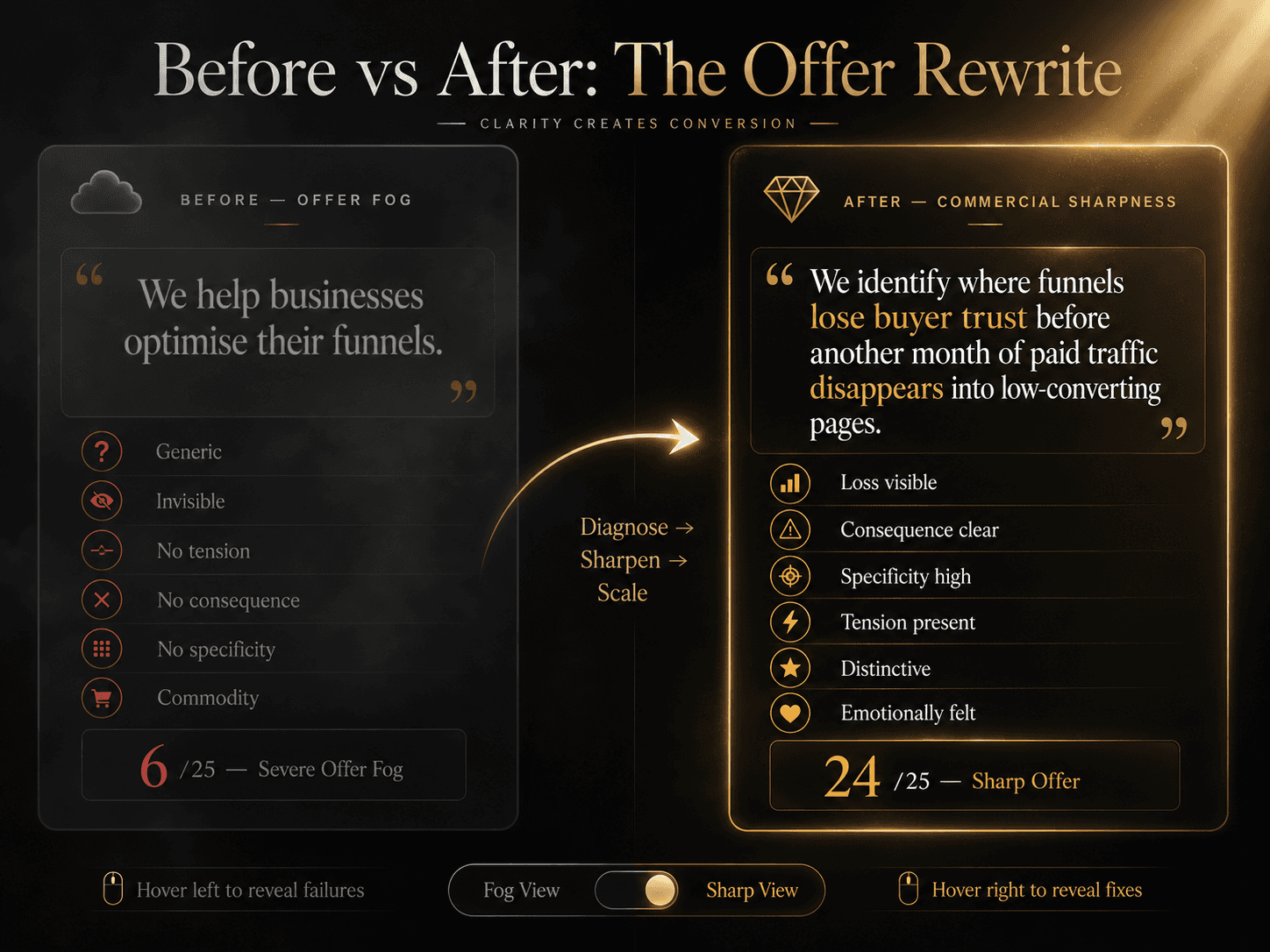
Example 1: Funnel Optimisation
Before
“We help businesses optimise their funnels.”
Generic.
Invisible.
No tension.
No consequence.
No specificity.
After
“We identify where funnels lose buyer trust before another month of paid traffic disappears into low-converting pages.”
Now the buyer feels:
loss
consequence
visibility
specificity
urgency
buyer trust as the core failure point
That is the difference between information and commercial sharpness.
Example 2: Coaching
Before
“I help coaches get more clients.”
Clear, but broad.
The buyer has heard this too many times.
After
“I help coaches turn silent audiences into booked inbound calls by sharpening the offer message buyers already want to trust.”
Now the buyer can picture:
the current problem
the desired movement
the mechanism
the commercial shift
The offer becomes more specific and more desirable.
Example 3: SaaS
Before
“We help SaaS companies improve conversions.”
Understandable, but generic.
After
“We help SaaS teams find the onboarding trust gaps causing trial users to click around once, hesitate, and disappear before they reach value.”
Now the offer has:
a specific buyer
a specific failure point
a behavioural pattern
a visible consequence
a clearer reason to care
Example 4: Agency
Before
“We generate leads for service businesses.”
Clear, but commoditised.
After
“We rebuild the page and offer layer making qualified traffic hesitate, so service businesses stop paying for attention that never turns into serious enquiries.”
Now the offer is harder to confuse.
It names:
the page layer
the offer layer
qualified traffic
hesitation
wasted attention
serious enquiries
That creates a sharper mental picture.
——
My Before vs After Rewrite
Before
Write your current offer:
What Makes It Foggy?
Clarity issue:
Specificity issue:
Tension issue:
Consequence issue:
Distinctiveness issue:
After
Write the sharper version:
——
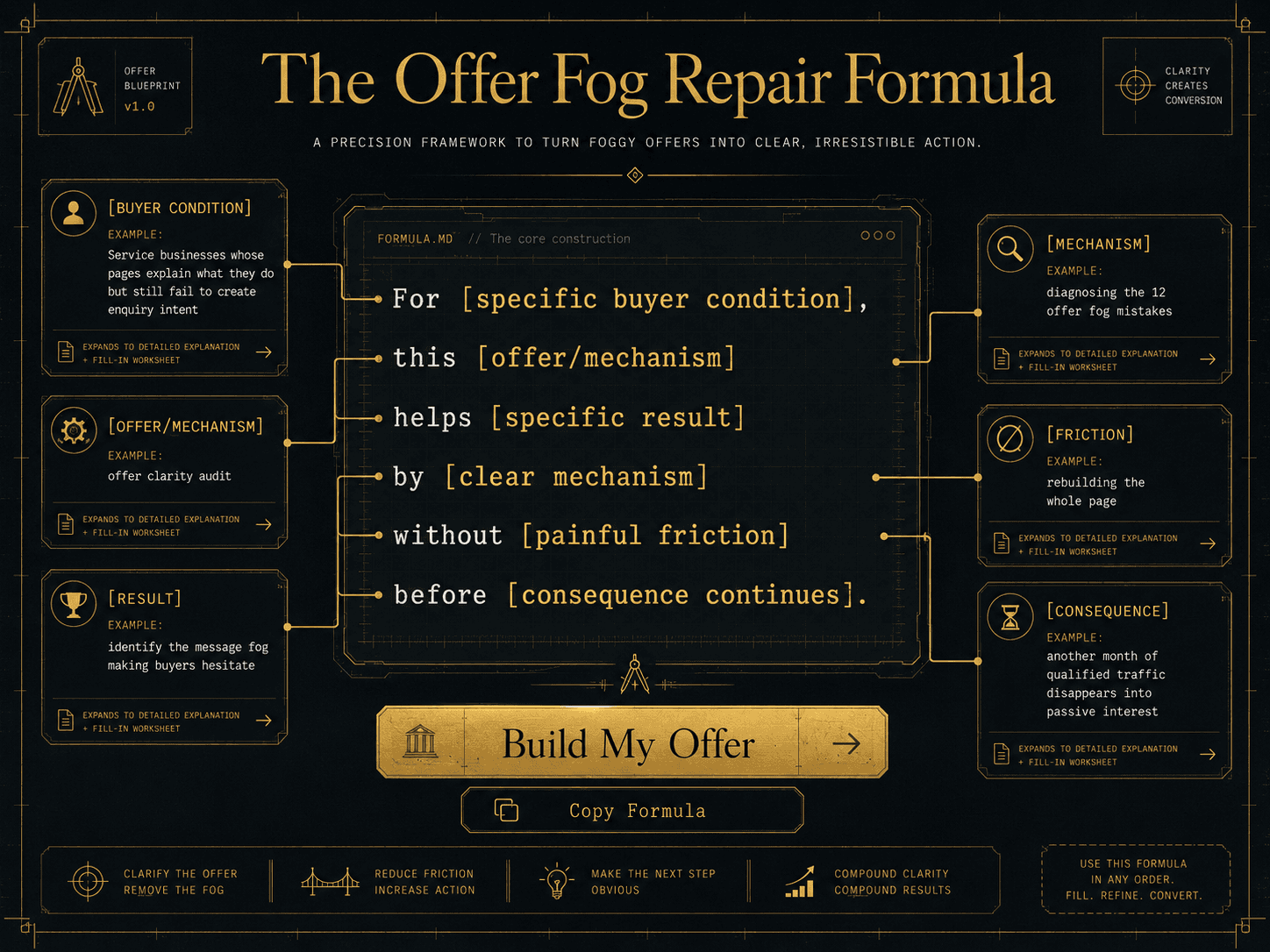
The Offer Fog Rewrite Formula™
Use this simple formula to rebuild a foggy offer:
We help [specific buyer] fix [specific problem or pressure] so they can [visible result or movement] without [major friction, risk, or objection].
Formula Fill-In
Specific buyer:
Specific problem or pressure:
Visible result or movement:
Major friction, risk, or objection:
Rebuilt Offer
We help _________________________________________
fix _________________________________________
so they can _________________________________________
without _________________________________________.
Stronger Version
Using AI To Diagnose Offer Fog
AI can be useful here, but only if you use it diagnostically.
Do not ask AI:
“Make this offer better.”
That usually creates generic improvement.
Ask it to diagnose the fog first.
Then ask it to rewrite based on the weakest scores.
AI Offer Fog Diagnostic Prompt™
Use this prompt:
Act as a high-level offer strategist, funnel operator, and buyer psychology analyst.
Diagnose whether this offer suffers from offer fog.
My business is:
[insert business]
My target buyer is:
[insert buyer]
My current offer is:
[paste offer]
The buyer’s current pressure is:
[insert pressure]
The desired buyer action is:
[insert action]
Audit the offer across these five categories:
Clarity
Specificity
Tension
Consequence
Distinctiveness
For each category:
score it from 1 to 5
explain why the score is weak or strong
identify the exact phrase causing fog
explain what the buyer may fail to understand or feel
provide one fix action
Then identify the dominant fog type:
Clarity Fog
Result Fog
Tension Fog
Consequence Fog
Commodity Fog
After that, rewrite the offer into a sharper version.
Create 3 stronger alternative variations:
A clarity-led version
A tension-led version
A distinctiveness-led version
Then explain:
which version creates the strongest buyer recognition
which version creates the clearest mental picture
which version feels most urgent
which version is safest from hype
where the rewrite may still be vague or overpromised
Do not give me random better copy.
Give me sharper diagnosis first.
The goal is to make the offer clearer, more specific, more emotionally visible, and commercially harder to ignore without exaggeration.
——
Final Execution Challenge™
Take one real offer.
Not a hypothetical one.
Run it honestly through all five diagnostic categories:
clarity
specificity
tension
consequence
distinctiveness
Then rewrite the offer completely using the weakest-score fix actions.
Do not stop after “better wording.”
Push until the value becomes:
visually clear
emotionally felt
specific enough to picture
urgent enough to matter
distinct enough to remember
commercially difficult to ignore
Because most funnels do not struggle from traffic problems first.
They struggle because the value never becomes vivid enough to matter emotionally before the buyer leaves.
Fix that, and the entire funnel starts breathing differently.
——
Final Principle™
Most offers do not fail because the work is worthless.
They fail because the buyer cannot feel the value fast enough.
That is offer fog.
A foggy offer makes the whole funnel overwork.
The hook has to fight harder.
The page has to explain too much.
The CTA feels heavier.
Proof has to rescue what the offer failed to establish.
A clear offer does the opposite.
It makes everything underneath it easier.
The buyer can understand the value, picture the shift, feel the consequence, and remember why this version matters.
That is the purpose of The Offer Fog Diagnostic™.
Not to make the offer louder.
To make it clearer.
Sharper.
More specific.
More felt.
More commercially alive.
Because once the offer becomes vivid enough to matter, the funnel finally has something worth carrying.
——
From:
The $100M Funnel Playbook. Book I: Foundation Buyer Psychology, Offer Clarity, and the Page Architecture Behind High-Converting Funnels
By Maris Spalins.
——
Copyright Notice
© 2026 The $100M Funnel Playbook / Winyourclients / Maris Spalins. All rights reserved.
This resource, including the frameworks, terminology, examples, scorecards, templates, prompts, methods, and written explanations, is original intellectual property created for The $100M Funnel Playbook. Book I: Foundation — Buyer Psychology, Offer Clarity, And The Page Architecture Behind High-Converting Funnels and published through Winyourclients.
No part of this resource may be copied, reproduced, screenshotted, republished, redistributed, sold, adapted, uploaded, scraped, stored in a database, included in training data, used to train artificial intelligence systems, or used to create derivative commercial or educational materials without prior written permission.
Limited reference, quotation, or sharing is only permitted where the source is clearly and visibly credited.
Any permitted reference must include at least one of the following source credits:
The $100M Funnel Playbook by Maris Spalins
or
Winyourclients — www.winyourclients.com
or
Maris Spalins / Winyourclients
Screenshots, excerpts, summaries, or redistributed versions must not remove, hide, alter, crop out, or obscure the original source, author name, book title, website name, or copyright notice.
This resource is provided for personal learning and implementation only. It is not licensed for resale, republishing, redistribution, AI training, template cloning, course creation, consulting delivery, or commercial reuse without written permission from Maris Spalins or Winyourclients.
For permission requests, licensing, citation approval, or commercial usage enquiries, contact:
Winyourclients
www.winyourclients.com
or
Email directly to Jacob on: help@winyourclients.com
The Offer Fog Diagnostic™ A five-part offer audit for finding the clarity, specificity, tension, consequence, and distinctiveness leaks that make valuable work feel forgettable.
Prefer Audio Or Video?
The Offer Fog Diagnostic System™ is also available as:
🎧 A guided audio walkthrough explaining offer fog, offer clarity, specificity, tension, consequence, and distinctiveness.
🎥 A practical video breakdown with real offer examples, offer fog audits, before/after rewrites, and offer clarity repairs.Choose the format that fits how you learn best.
[Listen To The Audio Walkthrough] (coming soon)
[Watch The Video Breakdown] (coming soon)
——
Why Most Offers Die Quietly
Most offers do not fail because the service is bad.
They fail because the value never becomes clear enough, specific enough, urgent enough, or emotionally visible enough in the buyer’s mind.
The buyer reads the page.
They understand the category.
They may even nod politely.
Then five seconds later, the offer disappears from memory.
No friction.
No desire.
No urgency.
No mental picture.
No reason to act.
That is offer fog.
Offer fog is what happens when valuable work is wrapped in vague, bloodless, forgettable language.
The offer may technically make sense.
But emotionally, nothing lands.
The buyer does not feel:
why this matters
why this is different
why this solves something important
why they should care now
what actually changes after buying
why this is worth choosing over alternatives
So the offer becomes commercially invisible.
Not because people hate it.
Because they never emotionally register it deeply enough to care.
That is what this resource helps you diagnose.
What This Resource Helps You Do
The Offer Fog Diagnostic™ helps you find where your offer becomes vague, forgettable, soft, safe, or commercially invisible.
Use it to diagnose:
weak clarity
low specificity
low-tension language
invisible consequences
generic promises
buyer confusion
urgency leaks
weak distinctiveness
service language with no felt value
offers that sound useful but easy to postpone
The goal is not to make your offer louder.
The goal is to make the value easier to see, feel, remember, and want.
Because buyers do not move because an offer exists.
They move when the offer creates a clear enough mental picture of the shift.
What Offer Fog Actually Is
Offer fog happens when the buyer cannot quickly feel what the offer changes.
The offer may explain the service.
But it does not make the buyer feel the value.
That distinction matters.
A foggy offer may tell the buyer:
what you do
what service you provide
what process you use
what category you belong to
But it fails to make the buyer feel:
what pain it interrupts
what result becomes possible
what risk is reduced
what frustration gets removed
what future becomes easier
what makes this version different
That is why foggy offers feel strangely lifeless.
They may be clear at a category level.
But they are weak at a value level.
The buyer understands the words.
But they do not feel the reason to care.
The Most Dangerous Part About Offer Fog
Most founders cannot see their own offer fog.
Why?
Because they already understand:
the service
the process
the method
the jargon
the mechanism
the delivery
the background context
the value behind the work
The buyer does not.
The buyer only sees what the page gives them.
And if the page gives them a blurry wall of vague claims, safe language, broad promises, generic outcomes, and low emotional visibility, the buyer does not fill in the missing value.
They move on.
This is why founders often think:
“But the offer makes sense.”
Maybe it does to you.
That does not mean it lands for the buyer.
The buyer is not inside your head.
They are inside their own pressure, their own doubts, their own timeline, their own alternatives, and their own decision fatigue.
Your offer has to survive there.
Signs Your Offer Has Offer Fog
Your offer may have fog if buyers:
ask confused questions
hesitate constantly
say “interesting” but do not move
disappear after calls
compare you purely on price
fail to repeat your value clearly
struggle explaining what you do to others
consume your content but do not enquire
seem to understand the service but still feel no urgency
ask for more information because the value is not clear enough
treat your offer like a commodity
postpone action even when the problem is real
These are not always traffic problems.
They are often offer problems.
Because strong offers create mental pictures.
Weak offers create mental effort.
And the brain avoids mental effort.
The Core Principle™
Clear offers reduce decision friction.
Foggy offers increase cognitive load.
The buyer should not need three paragraphs, two calls, and a strategy session just to understand why the offer matters.
If the buyer has to work too hard to understand the value, the offer is already leaking energy.
That does not mean the offer must be simplistic.
It means the value must become visible quickly.
A strong offer helps the buyer understand:
what this is
who it is for
what problem it interrupts
what changes after buying
why this version is different
why acting now makes sense
A foggy offer leaves those questions half-answered.
And half-answered offers rarely create strong action.
Before You Start: Write Your Current Offer
Do not audit the offer in your head.
Write the exact offer statement as it currently appears on your page, profile, pitch deck, proposal, ad, or landing page.
Current Offer Statement
Write your current offer here:
Target Buyer
Who is this offer meant for?
Current Buyer Pressure
What live frustration, problem, or pressure is the buyer dealing with right now?
Desired Buyer Action
What do you want the buyer to do after seeing this offer?
Current Offer Confidence
Before scoring, how strong do you currently believe the offer is?
Score: ___ / 10
Why?
The 5-Part Offer Fog Diagnostic™
This diagnostic evaluates your offer across five critical clarity layers.
Each layer reveals where the offer becomes weaker psychologically.
You will score each category from 1 to 5.
1 = extremely weak
2 = weak
3 = usable but needs sharpening
4 = strong
5 = extremely sharp
The five diagnostic layers are:
Clarity Check™
Specificity Check™
Tension Check™
Consequence Check™
Distinctiveness Check™
Part 1: Clarity Check™
Core Question
Can the buyer understand what this is in under three seconds?
This is the first survival test.
Not:
“Can they eventually figure it out?”
But:
“Can they understand it immediately?”
If the buyer cannot quickly understand what the offer is, they will not stay long enough to appreciate the deeper value.
Clarity comes before persuasion.
Weak Clarity Sounds Like
“Growth consulting”
“Business optimisation”
“Strategic scaling solutions”
“Done-for-you systems”
“Performance marketing support”
“Tailored business strategy”
“Conversion solutions”
“Brand growth services”
These phrases may sound professional.
But mentally, they are often empty.
The buyer cannot picture anything concrete.
They do not know exactly what is being fixed, changed, improved, removed, accelerated, or made easier.
Strong Clarity Sounds Like
“We rebuild SaaS landing pages that leak demo requests after the first scroll.”
“We help coaches turn silent audiences into booked inbound calls.”
“We identify where funnels lose trust before more ad spend gets wasted.”
“We turn vague service offers into sharper buying reasons cold buyers can understand quickly.”
“We fix the message and page flow making qualified traffic hesitate after the click.”
Now the buyer can picture the problem.
That matters enormously.
The offer gives the mind something to hold.
Clarity Score
Score 1–2:
The offer feels abstract, corporate, broad, or unclear.
Score 3:
The offer is understandable but still generic.
Score 4–5:
The buyer instantly understands:
what this is
who it helps
what problem it addresses
why it might matter
Your score: ___ / 5
Clarity Fix Action
If clarity is weak, replace service labels with visible problems, specific situations, or consequence-driven descriptions.
Instead of only naming the service, name what the service changes.
Ask:
What exactly is this?
Who is it for?
What problem does it address?
What situation does it improve?
What does the buyer instantly understand after reading it?
Clarity Rewrite
Current unclear version:
Clearer version:
Part 2: Specificity Check™
Core Question
Does the offer promise a concrete result or a vague improvement?
Specificity gives the buyer something to picture.
Vague improvement creates low emotional reaction because the buyer cannot clearly see the after-state.
If the after-state is not visible, desire stays weak.
Weak Specificity Sounds Like
“Better performance”
“Improved marketing”
“More visibility”
“Higher growth”
“Stronger results”
“Better systems”
“More engagement”
“Improved conversion”
“More authority”
These phrases may be positive.
But they are too broad to create a strong mental picture.
The buyer cannot see what changes.
Strong Specificity Sounds Like
“Turn cold traffic into qualified booked calls.”
“Identify why the sales page loses momentum before the CTA.”
“Reduce no-show rates from discovery calls.”
“Increase demo requests without increasing ad spend.”
“Turn vague positioning into a clear reason for serious buyers to enquire.”
“Find the trust gaps making qualified visitors hesitate before booking.”
Now the result becomes visible.
Visibility creates desire.
Specificity Score
Score 1–2:
The result feels broad, fluffy, or immeasurable.
Score 3:
The result exists but still lacks vividness.
Score 4–5:
The buyer can clearly picture what changes after the work is done.
Your score: ___ / 5
Specificity Fix Action
Replace abstract improvements with visible shifts, specific outcomes, or measurable movement.
Ask:
What changes after the buyer uses this?
What becomes easier?
What becomes clearer?
What improves in the buyer’s business or life?
What result can they picture?
What would make the buyer think, “I want that”?
Specificity Rewrite
Current vague result:
Specific result:
Part 3: Tension Check™
Core Question
Does the offer create emotional movement between current pain and future possibility?
Weak offers describe services.
Strong offers expose tension.
Tension is the gap between where the buyer is now and what they want instead.
Without tension, the offer may sound useful but not urgent.
And useful is often easy to postpone.
Weak Tension Sounds Like
“We improve funnel performance.”
“We optimise conversion systems.”
“We help you grow.”
“We improve your brand visibility.”
“We support your marketing strategy.”
“We help you create better content.”
These lines are not always wrong.
They are just emotionally flat.
They describe activity without making the buyer feel the cost of staying where they are.
Strong Tension Sounds Like
“Find out why your funnel keeps stalling before another month of traffic disappears.”
“Fix the trust leaks causing buyers to hesitate right before conversion.”
“Stop sending paid traffic into a page that still feels emotionally unclear.”
“Turn attention into buyer intent before another launch disappears into polite interest.”
“Find the offer fog making useful work sound forgettable before more traffic exposes the same weakness.”
Now the buyer feels consequence.
Consequence creates attention.
Tension Score
Score 1–2:
The offer feels emotionally flat.
Score 3:
Some tension exists but it lacks urgency.
Score 4–5:
The buyer clearly feels the cost of leaving this unresolved.
Your score: ___ / 5
Tension Fix Action
Reveal the live pressure inside the problem.
Look for:
friction
cost
delay
leakage
uncertainty
lost momentum
hidden consequences
repeated frustration
avoidable waste
Make the problem feel active.
Not dramatic.
Active.
Tension Rewrite
Current flat version:
Tension-based version:
Part 4: Consequence Check™
Core Question
Does the offer imply what changes emotionally, operationally, or financially after action?
Weak offers explain the service.
Strong offers imply life after the service.
The buyer wants to understand the movement.
They are silently asking:
“What changes if I say yes?”
If your offer does not answer that, it stays static.
Weak Consequence Sounds Like
“Funnel audit.”
“Messaging consultation.”
“Strategy call.”
“Brand review.”
“Growth session.”
“Sales page teardown.”
“Positioning workshop.”
These are delivery formats.
They do not yet tell the buyer what changes after the work is done.
Strong Consequence Sounds Like
“See exactly where your offer loses trust before wasting another quarter rebuilding the wrong thing.”
“Finally understand why buyers hesitate even when traffic is already landing.”
“Find the message gaps making strong work sound ordinary before another campaign goes live.”
“Leave with a clearer offer line your buyer can understand, want, and repeat.”
“Identify whether your funnel problem is traffic, trust, or the message underneath it.”
Now the offer creates movement.
The buyer starts mentally imagining relief.
That changes everything psychologically.
Consequence Score
Score 1–2:
The offer feels static.
Score 3:
Some movement exists but feels weak.
Score 4–5:
The buyer can emotionally picture the after-state.
Your score: ___ / 5
Consequence Fix Action
Answer:
“What becomes easier, clearer, safer, faster, more profitable, or less risky after this?”
Ask:
What does the buyer stop worrying about?
What do they finally understand?
What decision becomes easier?
What waste is reduced?
What risk becomes clearer?
What movement becomes possible?
Consequence Rewrite
Current static version:
Consequence-driven version:
Part 5: Distinctiveness Check™
Core Question
Would five competitors sound almost identical?
If yes, you have a commodity problem.
Distinctiveness does not mean being different for the sake of being different.
It means the offer has enough specific shape that the buyer can remember it, repeat it, and separate it from the market noise.
Weak Distinctiveness Sounds Like
“Results-driven solutions”
“Custom strategies”
“Done-for-you growth”
“High-converting systems”
“Tailored support”
“Strategic marketing”
“Premium consulting”
“Full-service growth partner”
These phrases are market wallpaper.
They are familiar.
They are forgettable.
They do not give the buyer a reason to remember you.
Strong Distinctiveness Sounds Like
“We identify where buyer certainty collapses before the CTA.”
“We rebuild offers suffering from offer fog.”
“We turn passive attention into buyer intent.”
“We diagnose hidden trust leaks inside underperforming funnels.”
“We rebuild the offer line making useful work sound forgettable.”
“We find the exact point where qualified buyers stop believing the next step is worth taking.”
Now the offer feels recognisable.
Distinctiveness creates memory.
Memory creates commercial advantage.
Distinctiveness Score
Score 1–2:
The offer sounds interchangeable.
Score 3:
Some uniqueness exists but still feels familiar.
Score 4–5:
The offer feels identifiable, specific, and difficult to confuse with competitors.
Your score: ___ / 5
Distinctiveness Fix Action
Introduce:
mechanism
language ownership
sharper consequence
proprietary framing
clearer problem articulation
a specific buyer condition
a specific failure point
a memorable named problem
Ask:
What does this offer solve that competitors usually describe too broadly?
What is the specific failure point?
What language can you own?
What mechanism makes this version more credible?
What would make the offer harder to confuse?
Distinctiveness Rewrite
Current generic version:
More distinctive version:
The Offer Fog Scorecard™
Score each area from 1 to 5.
Clarity: ___ / 5
Specificity: ___ / 5
Tension: ___ / 5
Consequence: ___ / 5
Distinctiveness: ___ / 5
Total Score: ___ / 25
Score Interpretation
21–25: Sharp Offer™
The value feels visible, specific, and commercially meaningful.
The buyer can understand what the offer is, feel why it matters, picture the shift, and remember why this version is different.
The offer is ready for traffic, testing, and scaling.
16–20: Promising But Blurry™
The offer has strength, but it still contains fog pockets that reduce urgency, clarity, or memorability.
The buyer may understand the value, but not feel it strongly enough yet.
Sharpen the weakest scoring sections first.
10–15: Commercially Soft™
The offer sounds useful but not emotionally important enough.
Buyers may understand it without strongly wanting it.
This is dangerous because the offer may receive polite interest without real movement.
Go back to specificity, tension, and consequence.
0–9: Severe Offer Fog™
The value remains unclear, forgettable, generic, or emotionally invisible.
Do not scale traffic yet.
Do not fix the CTA first.
Do not rewrite the whole page first.
Fix the offer first.
Fog Type Diagnosis™
After scoring, identify the dominant type of fog.
Your offer may suffer from one major fog type or several at once.
Clarity Fog™
The buyer cannot quickly understand what the offer is.
Symptoms:
abstract language
unclear service
too much jargon
no obvious buyer
no visible problem
Fix:
Make the offer easier to understand in one sentence.
Result Fog™
The buyer cannot clearly picture what changes after buying.
Symptoms:
vague outcomes
broad promises
unclear after-state
too much process language
little visible movement
Fix:
Make the result concrete, visible, and desirable.
Tension Fog™
The buyer does not feel the cost of staying where they are.
Symptoms:
soft pain
weak urgency
little consequence
no live pressure
useful but easy to postpone
Fix:
Show the active friction, leakage, cost, delay, or uncertainty.
Consequence Fog™
The buyer understands the service but does not feel the emotional, operational, or financial shift.
Symptoms:
offer feels static
no before/after movement
unclear relief
no sense of what becomes easier
no emotional payoff
Fix:
Show what changes after action.
Commodity Fog™
The offer sounds like too many other offers in the market.
Symptoms:
generic language
familiar phrases
interchangeable promises
weak mechanism
no owned language
easy to confuse with competitors
Fix:
Sharpen the mechanism, failure point, buyer condition, or proprietary frame.
My Dominant Fog Type
My offer currently suffers most from:
Clarity Fog / Result Fog / Tension Fog / Consequence Fog / Commodity Fog
Why?
The first fog type I need to fix is:
The Offer Fog Mistakes Checklist™
Use this checklist to catch the most common causes of weak offer language.
Mistake 1: Selling The Process Instead Of The Prize
Nobody wakes up wanting:
consulting
strategy
optimisation
frameworks
audits
workshops
teardowns
support
They want:
clarity
relief
momentum
confidence
demand
trust
conversion
certainty
better-fit leads
less chaos
a stronger reason for buyers to act
Describe the shift.
Not just the service.
Check:
Does my offer sell the process or the prize?
Process / Prize
Fix:
Mistake 2: Talking About What You Do Instead Of What They Get
The page is not there to celebrate your method.
It is there to help the buyer understand why the method matters to them.
The buyer cares about:
the result
the relief
the reduction in risk
the difference after the work is done
the movement from current pressure to desired state
Check:
Does my offer lead with what I do or what the buyer gets?
What I do / What they get
Fix:
Mistake 3: Being Too Soft
Weak offers get acknowledged.
Strong offers get remembered.
If the language feels too careful, too broad, too polite, or too safe, the buyer’s brain does not assign urgency to it.
That does not mean use fake hype.
It means stop hiding the real consequence.
Check:
Is my offer too soft to create a reaction?
Yes / No
Fix:
Mistake 4: Ignoring Timing And Reason To Act
Timing shapes urgency.
Not always through false scarcity.
Through relevance.
The buyer wants to know:
why this matters now
what keeps leaking if they wait
what becomes harder if the problem remains unresolved
whether this solves a live problem or a someday problem
how soon the shift begins
A clear reason to act makes the offer easier to picture.
And what is easier to picture is easier to want.
Check:
Does my offer give the buyer a reason to act now?
Yes / No
Fix:
Mistake 5: Sounding Like Everyone Else
If five competitors could say the same line, the offer is too generic.
Common fog phrases include:
“tailored solutions”
“growth strategy”
“high-converting systems”
“done-for-you support”
“premium service”
“results-driven approach”
“helping brands scale”
These phrases do not create memory.
Check:
Could five competitors say my offer almost exactly?
Yes / No
Fix:
Mistake 6: Making The Buyer Do The Translation
A weak offer forces the buyer to translate:
“So what does this mean for me?”
That is dangerous.
The buyer should not need to infer the value.
The offer should make it visible.
Check:
Does my offer make the buyer work too hard to understand the value?
Yes / No
Fix:
Before vs After Examples
Use these examples to see the difference between foggy offer language and commercially sharper offer language.
Example 1: Funnel Optimisation
Before
“We help businesses optimise their funnels.”
Generic.
Invisible.
No tension.
No consequence.
No specificity.
After
“We identify where funnels lose buyer trust before another month of paid traffic disappears into low-converting pages.”
Now the buyer feels:
loss
consequence
visibility
specificity
urgency
buyer trust as the core failure point
That is the difference between information and commercial sharpness.
Example 2: Coaching
Before
“I help coaches get more clients.”
Clear, but broad.
The buyer has heard this too many times.
After
“I help coaches turn silent audiences into booked inbound calls by sharpening the offer message buyers already want to trust.”
Now the buyer can picture:
the current problem
the desired movement
the mechanism
the commercial shift
The offer becomes more specific and more desirable.
Example 3: SaaS
Before
“We help SaaS companies improve conversions.”
Understandable, but generic.
After
“We help SaaS teams find the onboarding trust gaps causing trial users to click around once, hesitate, and disappear before they reach value.”
Now the offer has:
a specific buyer
a specific failure point
a behavioural pattern
a visible consequence
a clearer reason to care
Example 4: Agency
Before
“We generate leads for service businesses.”
Clear, but commoditised.
After
“We rebuild the page and offer layer making qualified traffic hesitate, so service businesses stop paying for attention that never turns into serious enquiries.”
Now the offer is harder to confuse.
It names:
the page layer
the offer layer
qualified traffic
hesitation
wasted attention
serious enquiries
That creates a sharper mental picture.
——
My Before vs After Rewrite
Before
Write your current offer:
What Makes It Foggy?
Clarity issue:
Specificity issue:
Tension issue:
Consequence issue:
Distinctiveness issue:
After
Write the sharper version:
——
The Offer Fog Rewrite Formula™
Use this simple formula to rebuild a foggy offer:
We help [specific buyer] fix [specific problem or pressure] so they can [visible result or movement] without [major friction, risk, or objection].
Formula Fill-In
Specific buyer:
Specific problem or pressure:
Visible result or movement:
Major friction, risk, or objection:
Rebuilt Offer
We help _________________________________________
fix _________________________________________
so they can _________________________________________
without _________________________________________.
Stronger Version
Using AI To Diagnose Offer Fog
AI can be useful here, but only if you use it diagnostically.
Do not ask AI:
“Make this offer better.”
That usually creates generic improvement.
Ask it to diagnose the fog first.
Then ask it to rewrite based on the weakest scores.
AI Offer Fog Diagnostic Prompt™
Use this prompt:
Act as a high-level offer strategist, funnel operator, and buyer psychology analyst.
Diagnose whether this offer suffers from offer fog.
My business is:
[insert business]
My target buyer is:
[insert buyer]
My current offer is:
[paste offer]
The buyer’s current pressure is:
[insert pressure]
The desired buyer action is:
[insert action]
Audit the offer across these five categories:
Clarity
Specificity
Tension
Consequence
Distinctiveness
For each category:
score it from 1 to 5
explain why the score is weak or strong
identify the exact phrase causing fog
explain what the buyer may fail to understand or feel
provide one fix action
Then identify the dominant fog type:
Clarity Fog
Result Fog
Tension Fog
Consequence Fog
Commodity Fog
After that, rewrite the offer into a sharper version.
Create 3 stronger alternative variations:
A clarity-led version
A tension-led version
A distinctiveness-led version
Then explain:
which version creates the strongest buyer recognition
which version creates the clearest mental picture
which version feels most urgent
which version is safest from hype
where the rewrite may still be vague or overpromised
Do not give me random better copy.
Give me sharper diagnosis first.
The goal is to make the offer clearer, more specific, more emotionally visible, and commercially harder to ignore without exaggeration.
——
Final Execution Challenge™
Take one real offer.
Not a hypothetical one.
Run it honestly through all five diagnostic categories:
clarity
specificity
tension
consequence
distinctiveness
Then rewrite the offer completely using the weakest-score fix actions.
Do not stop after “better wording.”
Push until the value becomes:
visually clear
emotionally felt
specific enough to picture
urgent enough to matter
distinct enough to remember
commercially difficult to ignore
Because most funnels do not struggle from traffic problems first.
They struggle because the value never becomes vivid enough to matter emotionally before the buyer leaves.
Fix that, and the entire funnel starts breathing differently.
——
Final Principle™
Most offers do not fail because the work is worthless.
They fail because the buyer cannot feel the value fast enough.
That is offer fog.
A foggy offer makes the whole funnel overwork.
The hook has to fight harder.
The page has to explain too much.
The CTA feels heavier.
Proof has to rescue what the offer failed to establish.
A clear offer does the opposite.
It makes everything underneath it easier.
The buyer can understand the value, picture the shift, feel the consequence, and remember why this version matters.
That is the purpose of The Offer Fog Diagnostic™.
Not to make the offer louder.
To make it clearer.
Sharper.
More specific.
More felt.
More commercially alive.
Because once the offer becomes vivid enough to matter, the funnel finally has something worth carrying.
——
From:
The $100M Funnel Playbook. Book I: Foundation Buyer Psychology, Offer Clarity, and the Page Architecture Behind High-Converting Funnels
By Maris Spalins.
——
Copyright Notice
© 2026 The $100M Funnel Playbook / Winyourclients / Maris Spalins. All rights reserved.
This resource, including the frameworks, terminology, examples, scorecards, templates, prompts, methods, and written explanations, is original intellectual property created for The $100M Funnel Playbook. Book I: Foundation — Buyer Psychology, Offer Clarity, And The Page Architecture Behind High-Converting Funnels and published through Winyourclients.
No part of this resource may be copied, reproduced, screenshotted, republished, redistributed, sold, adapted, uploaded, scraped, stored in a database, included in training data, used to train artificial intelligence systems, or used to create derivative commercial or educational materials without prior written permission.
Limited reference, quotation, or sharing is only permitted where the source is clearly and visibly credited.
Any permitted reference must include at least one of the following source credits:
The $100M Funnel Playbook by Maris Spalins
or
Winyourclients — www.winyourclients.com
or
Maris Spalins / Winyourclients
Screenshots, excerpts, summaries, or redistributed versions must not remove, hide, alter, crop out, or obscure the original source, author name, book title, website name, or copyright notice.
This resource is provided for personal learning and implementation only. It is not licensed for resale, republishing, redistribution, AI training, template cloning, course creation, consulting delivery, or commercial reuse without written permission from Maris Spalins or Winyourclients.
For permission requests, licensing, citation approval, or commercial usage enquiries, contact:
Winyourclients
www.winyourclients.com
or
Email directly to Jacob on: help@winyourclients.com
Other Blogs
Other Blogs
Check our other project Blogs with useful insight and information for your businesses
Other Blogs
Other Blogs
Check our other project Blogs with useful insight and information for your businesses