Our Three Step Process
May 26, 2026
Chap 3 | Resource 4 | The Offer Compression System
Our Three Step Process
May 26, 2026
Chap 3 | Resource 4 | The Offer Compression System
The Offer Compression System™ A five-layer positioning tool for turning long, confusing, low-converting offers into sharper messaging buyers can understand, remember, and care about faster.
Prefer Audio Or Video?
The Offer Compression System™ is also available as:
🎧 A guided audio walkthrough explaining offer compression, dead-word removal, problem/result/mechanism compression, and the 3-second offer test.
🎥 A practical video breakdown with real offer compression examples, before/after rewrites, scorecards, and compressed offer-line builds.Choose the format that fits how you learn best.
[Listen To The Audio Walkthrough] (coming soon)
[Watch The Video Breakdown] (coming soon)
——
Why Most Offers Take Too Long To Land
Most offers do not fail because the service is weak.
They fail because the value takes too long to understand.
The buyer lands on the page and immediately feels:
too many words
too much explanation
too much complexity
too much jargon
too much thinking required
too much context before the value becomes clear
And attention disappears before the value becomes emotionally obvious.
That is the problem this resource helps you fix.
Modern buyers do not reward long explanations.
They reward fast clarity.
Not shallow clarity.
Not dumbed-down messaging.
Not empty simplicity.
Fast clarity.
The buyer should be able to understand what the offer is, who it is for, what problem it solves, why it matters, and what changes after buying without needing to decode the message.
If the buyer has to work too hard to understand the value, the offer is already leaking attention.
And leaked attention rarely turns into action.
What This Resource Helps You Do
The Offer Compression System™ helps you compress bloated, confusing, or over-explained offer language into sharper, more commercially visible messaging.
Use it to:
reduce cognitive overload
tighten positioning
remove weak language
compress value into faster understanding
create stronger emotional clarity
sharpen headlines and offer statements
increase memorability
explain your value in seconds instead of paragraphs
remove jargon that slows buyer comprehension
make the offer easier to repeat
make the buyer feel the consequence faster
The goal is not to make the offer shorter for the sake of being short.
The goal is to make the value register faster.
Because the longer it takes the buyer to understand the value, the weaker the emotional impact becomes.
What Offer Compression Actually Is
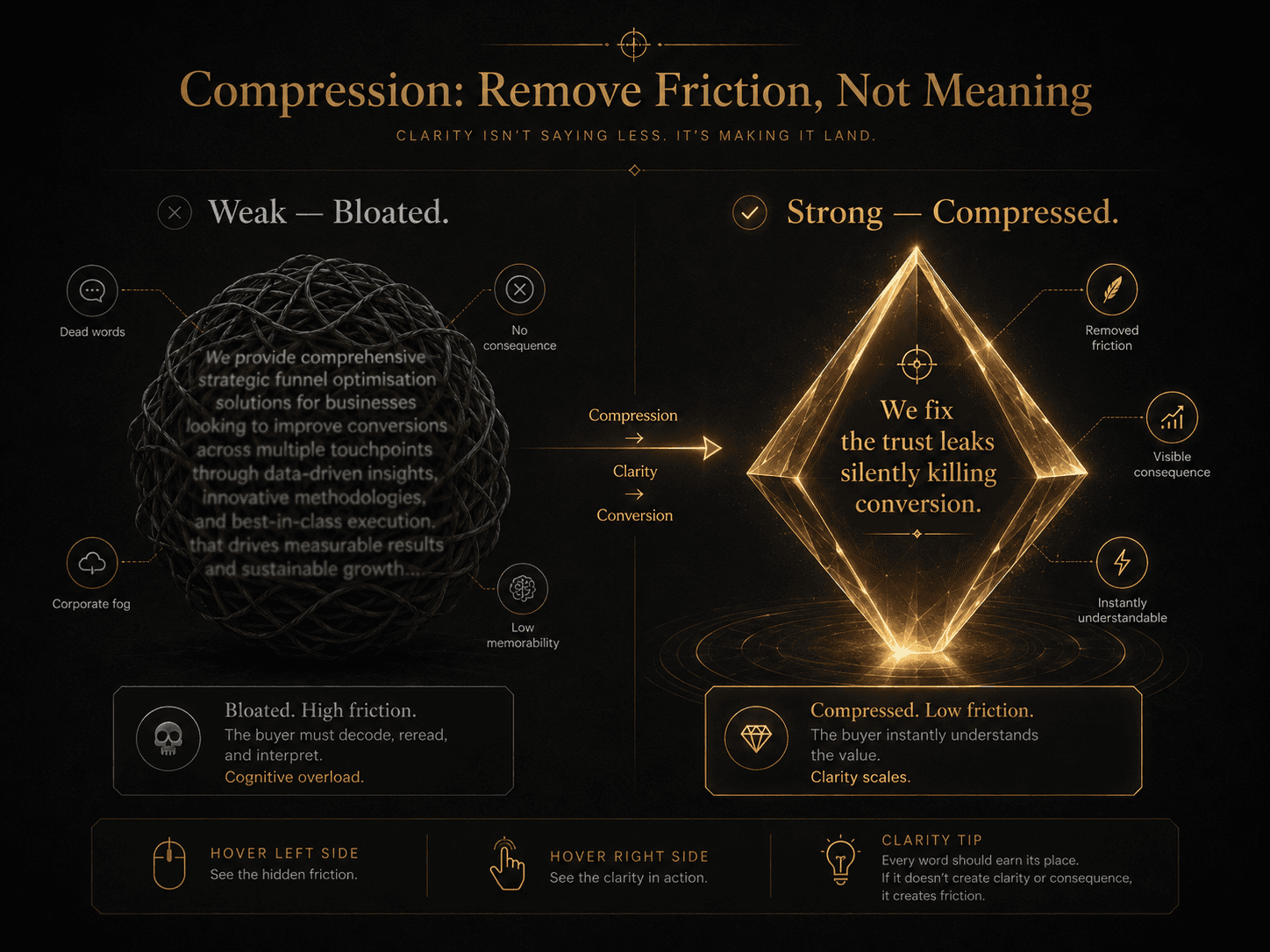
Offer compression is the process of reducing unnecessary explanation while increasing clarity, consequence, and emotional visibility.
This is not the same as “making copy shorter.”
That distinction matters enormously.
Weak shortening removes meaning.
Strong compression removes friction.
Weak shortening cuts words until the offer becomes thin.
Strong compression removes the words that slow understanding and keeps the words that create recognition, consequence, desire, and trust.
The goal is not:
“Say less.”
The goal is:
“Make the value land faster.”
That is the difference.
A compressed offer should feel:
easier to understand
sharper to repeat
faster to trust
clearer to remember
more commercially visible
more emotionally direct
Compression is not minimalism.
Compression is precision.
——
The Core Principle™
Clarity scales.
Complexity leaks attention.
The buyer should not need multiple paragraphs, several rereads, long explanations, sales calls, or context decoding just to understand why the offer matters.
The longer it takes the brain to understand the value, the lower the emotional impact becomes.
Why?
Because confusion drains attention.
And drained attention kills conversion.
A strong compressed offer helps the buyer quickly understand:
the problem
the consequence
the value
the shift
why it matters
who it is for
why this version is relevant
That creates immediate orientation.
Weak communication creates mental drag.
And mental drag makes the offer feel heavier than it should.
——
The Faster-To-Trust Principle™
Compressed offers feel faster to trust.
Not because they are simplistic.
Because the buyer can orient quickly.
When the buyer understands the problem, consequence, value, and shift faster, they can begin evaluating the offer sooner.
They do not waste their first few seconds trying to decode what you mean.
They can use those seconds to feel:
“This is relevant.”
“This is clear.”
“This might matter.”
“This is worth reading.”
That is the advantage of compression.
It gives the buyer a faster path into trust.
A bloated offer delays trust because it forces the buyer to interpret the message before they can value it.
A compressed offer accelerates trust because it makes the value easier to see.
——
Before You Start: Write Your Current Offer
Do not compress the offer in your head.
Write the exact version buyers currently see.
This could be from your:
landing page
website hero section
sales page
LinkedIn profile
ad
email
proposal
pitch deck
product page
sales call script
Current Offer Statement
Write your current offer here:
Current Offer Context
Where is this offer currently used?
Landing page / Website / Sales page / Ad / Email / Proposal / LinkedIn / Product page / Sales call / Other
Explain:
Current Problem
What feels too long, unclear, confusing, or hard to explain?
Current Word Count
How many words does your current offer statement use?
Word count: _______
Current Understanding Test
If someone saw this for three seconds, what would they understand?
——
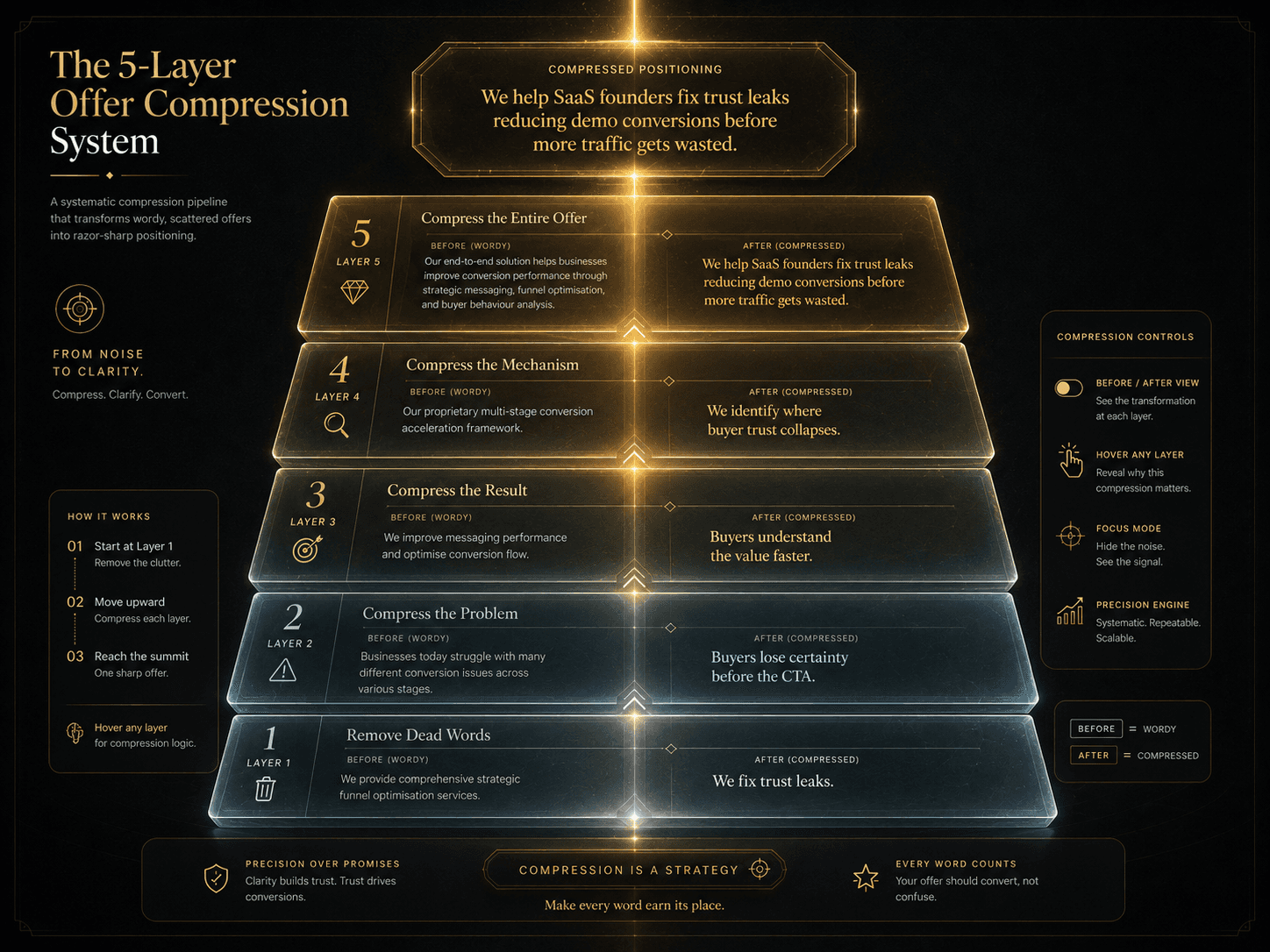
The 5-Layer Offer Compression System™
This framework helps you compress bloated positioning into commercially sharper messaging.
The five layers are:
Remove Dead Words™
Compress The Problem™
Compress The Result™
Compress The Mechanism™
Compress The Entire Offer™
Each layer removes a different type of friction.
Dead words create fog.
Uncompressed problems create delay.
Uncompressed results weaken desire.
Over-explained mechanisms reduce trust.
Uncompressed offers drain attention.
The goal is to make the value easier to understand without making it weaker.
Layer 1: Remove Dead Words™
What This Layer Does
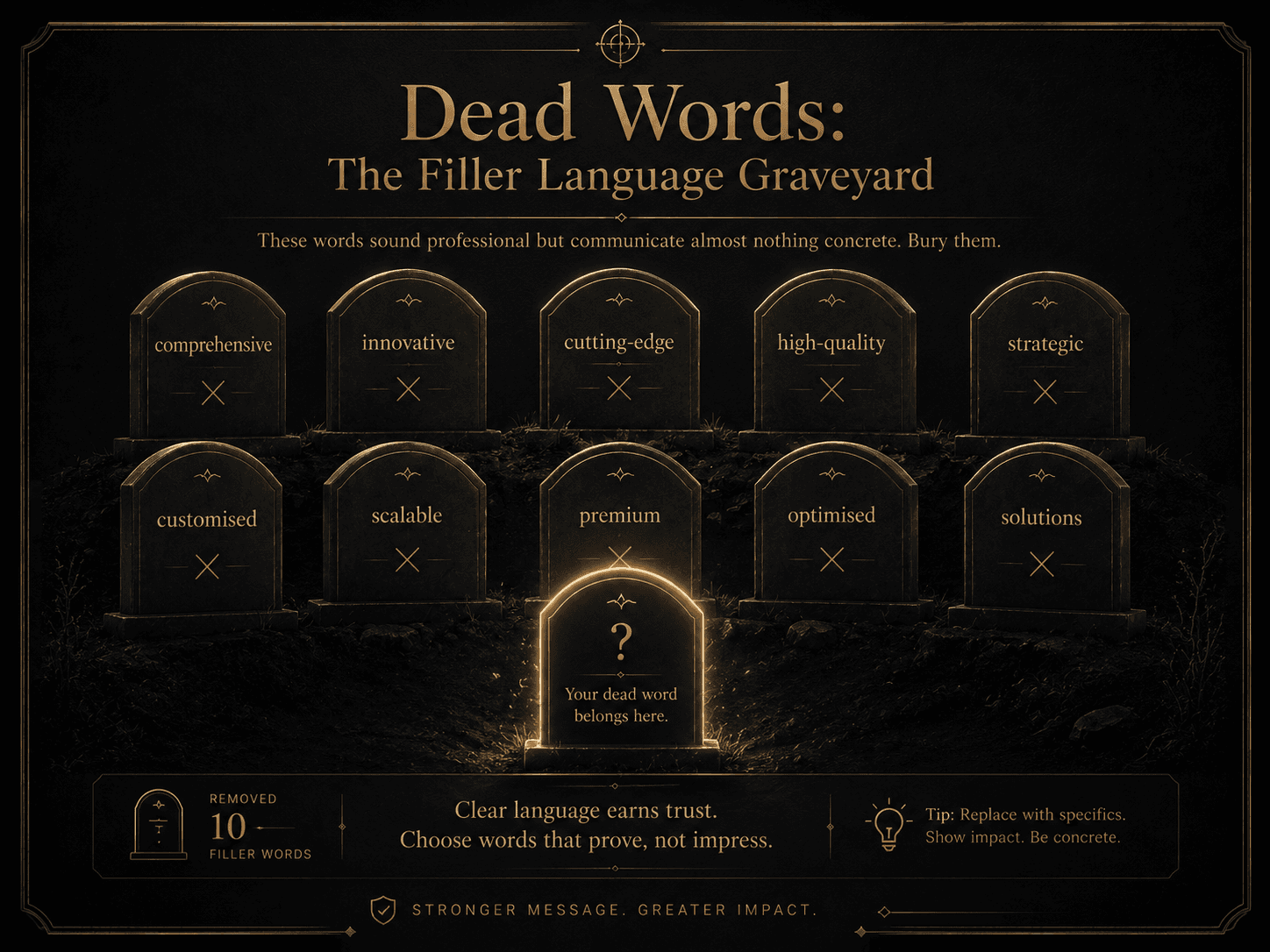
Most offers contain low-value filler language.
These words may sound professional, but they often communicate almost nothing concrete.
They slow the buyer down without making the offer clearer.
Dead words are not always grammatically wrong.
They are commercially weak.
They take up space without increasing clarity, specificity, consequence, trust, or desire.
Common Dead Words
Watch for words like:
comprehensive
innovative
cutting-edge
high-quality
strategic
customised
scalable
premium
optimised
tailored
world-class
full-service
results-driven
transformative
best-in-class
end-to-end
holistic
bespoke
next-generation
These words are not always forbidden.
But they must earn their place.
If they do not make the offer clearer, sharper, more specific, or more believable, they are probably dead weight.
Weak Example
“We provide comprehensive strategic funnel optimisation services.”
This sounds professional.
But it creates corporate fog.
The buyer cannot clearly see:
the problem
the consequence
the result
the buyer
the failure point
the emotional reason to care
It sounds like an offer.
But it does not create a strong mental picture.
Compressed Version
“We fix the trust leaks silently killing conversion.”
Now the value feels more visible.
The buyer can picture:
trust leaks
lost conversion
a specific failure point
a commercially meaningful problem
This is not just shorter.
It is clearer.
That is compression.
Compression Rule™
If a word does not increase clarity, specificity, or consequence, remove it.
Every word should do a job.
A word can stay if it helps the buyer:
understand faster
feel the problem
picture the result
trust the mechanism
remember the offer
feel why it matters
If it does none of those, cut it.
Layer 1 Exercise: Dead Word Audit
Paste your current offer statement:
Now highlight every word that sounds:
generic
corporate
replaceable
vague
inflated
decorative
over-polished
List the dead words here:
Now remove at least 30% of the weakest words.
Shorter version:
Layer 1 Score
Score your current offer from 1 to 5.
1 = overloaded with dead words
2 = too much filler
3 = some useful language, but still bloated
4 = mostly clean
5 = sharp, specific, and low-friction
Your score: ___ / 5
Layer 2: Compress The Problem™
What This Layer Does
Most businesses explain too much context before they name the real problem.
The buyer does not need the full story first.
They need fast recognition.
The problem should land quickly.
If the problem takes too long to explain, the buyer may leave before they realise the offer is relevant.
Problem compression forces you to find the sharpest version of the real tension.
Not the broadest explanation.
The sharpest recognition.
Weak Example
“Businesses today struggle with many different conversion issues across various stages of the customer journey.”
This is mentally exhausting.
It may be true, but it is too broad.
The buyer cannot quickly feel the specific pain.
There is no clean point of recognition.
Compressed Version
“Buyers lose certainty before the CTA.”
This is stronger because it is:
fast
clear
visible
specific
emotionally easier to recognise
The problem now has a shape.
The buyer can picture where the failure happens.
The Problem Compression Question™
Ask:
“What is the shortest possible version of the real problem?”
Not:
“What is the most complete explanation?”
Not:
“What sounds most sophisticated?”
But:
“What is the shortest version the right buyer would immediately recognise?”
That is the goal.
Layer 2 Exercise: 20 / 10 / 5 Problem Compression
Write the buyer problem in 20 words:
Now write it in 10 words:
Now write it in 5 words:
The 5-word version usually exposes the real core tension.
Now write the sharpest version of the problem:
Layer 2 Score
Score your problem compression from 1 to 5.
1 = broad and hard to recognise
2 = too much context
3 = understandable but still soft
4 = clear and specific
5 = sharp, short, and instantly recognisable
Your score: ___ / 5
Layer 3: Compress The Result™
What This Layer Does
Most offers describe activities.
Strong offers compress the visible shift.
A result should not require a long explanation before the buyer understands why it matters.
The buyer should quickly see what becomes better, easier, clearer, safer, faster, more profitable, or more trusted after the offer works.
If the result is vague, desire stays weak.
If the result is compressed well, the buyer can picture the after-state faster.
Weak Example
“We improve messaging performance and optimise conversion flow.”
This sounds useful, but the emotional visibility is low.
The buyer cannot clearly picture what changes.
Compressed Version
“Buyers understand the value faster.”
Now the result becomes immediately understandable.
It is simple.
It is visible.
It shows movement.
The buyer can feel why that matters.
The Result Compression Rule™
The buyer should picture what changes within seconds.
Not after explanation.
Not after a call.
Not after reading three sections.
Within seconds.
The result should feel visible enough to want.
Layer 3 Exercise: Result Compression
Answer this:
What becomes easier after this works?
What becomes clearer?
What becomes faster?
What becomes safer or less risky?
What becomes more profitable, trusted, or stable?
Now compress the result into one sharp sentence:
Now compress it again into the shortest clear version:
Layer 3 Score
Score your result compression from 1 to 5.
1 = vague result
2 = too much explanation
3 = understandable but not vivid
4 = clear and visible
5 = short, vivid, and desirable
Your score: ___ / 5
Layer 4: Compress The Mechanism™
What This Layer Does
Most mechanisms become overexplained.
Founders often think complexity creates trust.
Usually, the opposite happens.
Complexity often lowers trust because complicated offers feel:
harder to understand
harder to believe
harder to act on
harder to repeat
harder to remember
A strong mechanism should give the offer credibility.
Not confusion.
The buyer should understand the approach quickly enough to think:
“That sounds specific enough to be real.”
Weak Example
“Our proprietary multi-stage conversion acceleration framework improves customer journey optimisation.”
This sounds sophisticated.
But emotionally, it is dead.
The buyer cannot quickly understand what the mechanism actually does.
It feels over-engineered.
Compressed Version
“We identify where buyer trust collapses.”
Now the mechanism feels:
specific
clear
believable
easier to remember
easier to trust
The buyer can picture what the method looks for.
That is what strong mechanism compression does.
The Mechanism Rule™
The mechanism should feel specific enough to remember, but simple enough to explain quickly.
That is the balance.
Too generic, and it sounds like everyone else.
Too complex, and the buyer loses trust.
The mechanism should make the offer easier to believe.
Not harder to understand.
Layer 4 Exercise: Mechanism Compression
Describe your mechanism in one sentence:
Now reduce that sentence by 50%:
Now reduce it again while keeping the meaning:
What specific action does your mechanism perform?
Diagnoses / Removes / Rebuilds / Clarifies / Maps / Repairs / Installs / Identifies / Compresses / Other
Explain:
Final compressed mechanism:
Layer 4 Score
Score your mechanism compression from 1 to 5.
1 = confusing or over-engineered
2 = generic or bloated
3 = understandable but still heavy
4 = clear and specific
5 = specific, memorable, and easy to explain
Your score: ___ / 5
Layer 5: Compress The Entire Offer™
What This Layer Does
Now you combine the problem, result, mechanism, and consequence into one compressed positioning statement.
This is where the offer becomes commercially usable.
The goal is not to include every detail.
The goal is to give the buyer enough meaning to understand, remember, and care.
A compressed offer should answer:
Who is this for?
What painful problem does it stop?
How does it work?
What visible result does it create?
Why does it matter?
The Offer Compression Formula™
Use this formula:
We help [specific buyer] stop [painful problem] by [specific mechanism] so they can [visible result].
This formula works because it forces the offer to include the essentials:
buyer
problem
mechanism
result
It prevents the offer from drifting into vague service language.
Weak Version
“We provide comprehensive funnel optimisation solutions for businesses looking to improve conversions.”
This is weak because it is:
generic
slow
forgettable
vague
full of dead words
low in consequence
hard to picture
Compressed Version
“We help SaaS founders fix the trust leaks reducing demo conversions before more traffic gets wasted.”
Now the offer feels:
faster
sharper
more specific
easier to remember
emotionally visible
commercially meaningful
That is the difference.
The compressed version does not merely say less.
It makes the value land faster.
Layer 5 Exercise: Full Offer Compression
Specific buyer:
Painful problem:
Specific mechanism:
Visible result:
Consequence or reason it matters:
Now fill in the formula:
We help _________________________________________
stop _________________________________________
by _________________________________________
so they can _________________________________________.
First Compressed Version
Second Compressed Version
Make it sharper:
Third Compressed Version
Make it even clearer:
Layer 5 Score
Score your full offer compression from 1 to 5.
1 = still too long or unclear
2 = shorter but weak
3 = understandable but not sharp
4 = clear and commercially useful
5 = sharp, memorable, and fast to understand
Your score: ___ / 5
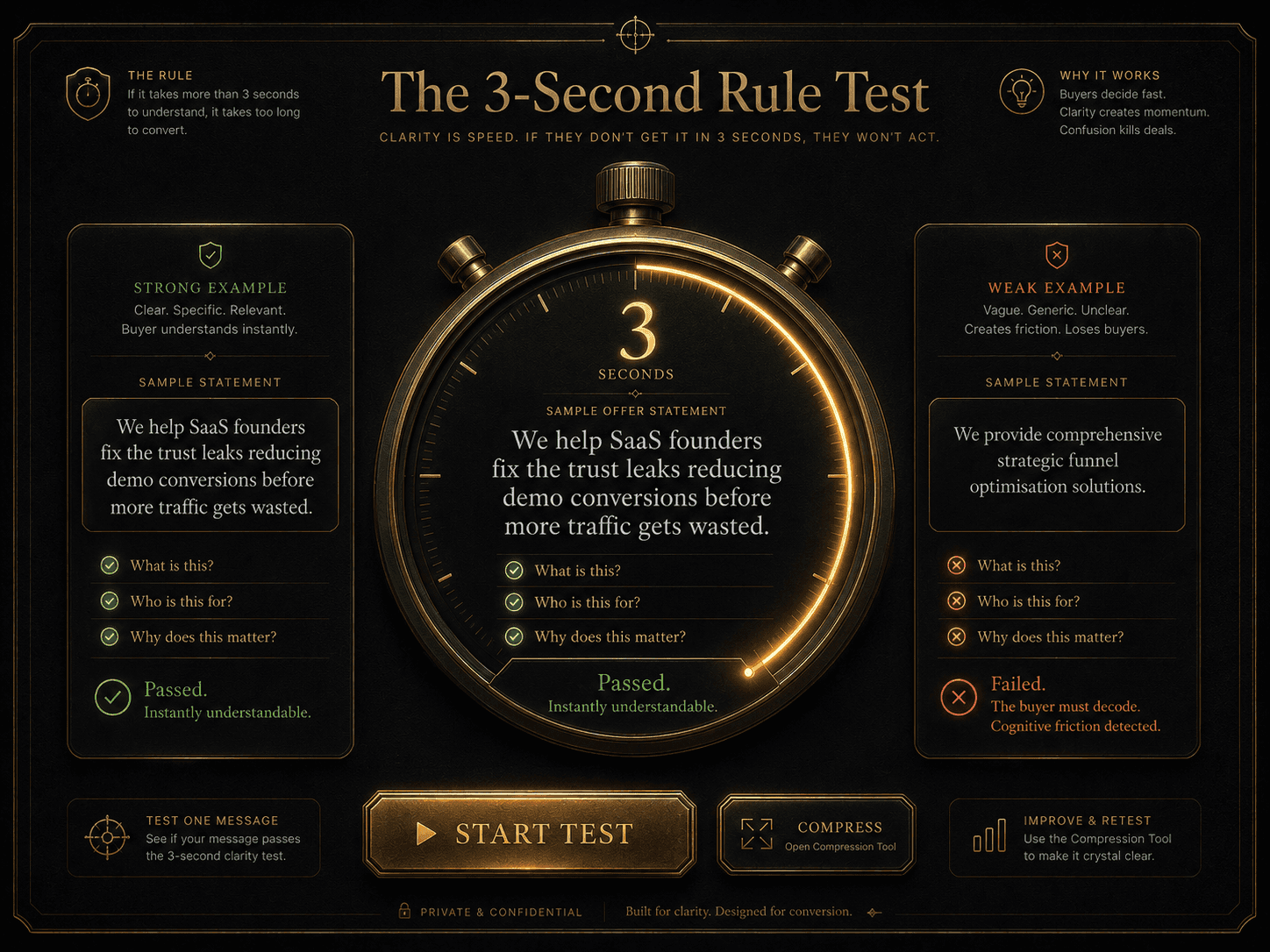
The 3-Second Rule™
Your offer should survive a 3-second understanding test.
Meaning:
A distracted buyer should quickly understand:
what this is
who it helps
why it matters
If the buyer must decode, reread, or interpret the offer, it still contains compression failure.
This does not mean every detail must be understood in three seconds.
It means the core value must be clear enough to earn the next three seconds.
The offer does not need to close the buyer immediately.
It needs to orient them immediately.
That is the point.
The 3-Second Understanding Test™
Show your compressed offer to someone unfamiliar with your business.
Then ask:
“What do you think this offer actually helps with?”
If they hesitate, simplify.
If they paraphrase incorrectly, compress harder.
If they understand the category but not the value, sharpen the consequence.
If they understand the value but cannot remember it, sharpen the phrase.
If they instantly understand, the compression is working.
3-Second Test Worksheet
Compressed offer being tested:
Who tested it?
What did they think it meant?
Did they understand it correctly?
Yes / No / Partially
Where did they hesitate?
What did they misunderstand?
What needs to be compressed further?
——
The Biggest Compression Mistake™
Many founders think more explanation creates more value.
Usually, the opposite happens.
More explanation often creates:
more friction
more confusion
more cognitive fatigue
weaker memorability
slower emotional recognition
lower emotional impact
more buyer effort
Explanation has a place.
But explanation should come after orientation.
If the buyer does not understand the core value quickly, more explanation may only make the offer feel heavier.
Clarity scales.
Complexity leaks attention.
——
The “Too Smart To Convert” Problem™
Some offers sound intelligent but convert poorly.
Why?
Because they prioritise sounding sophisticated instead of being understood quickly.
They use:
layered abstractions
corporate language
consultant jargon
vague strategic terminology
over-engineered mechanisms
intellectual phrasing
complex frameworks before simple relevance
The buyer should never need translation.
If the offer sounds clever but the buyer cannot repeat it, it is not compressed enough.
If the offer sounds premium but the buyer cannot picture the value, it is not compressed enough.
If the offer sounds sophisticated but the buyer still asks, “What does that actually mean?”, it is not compressed enough.
Smart language is only useful when it makes the value clearer.
If it makes the value slower to understand, it is working against conversion.
——
Too Smart To Convert Check™
Ask:
Does this offer sound intelligent but hard to understand?
Yes / No
Does it use jargon the buyer would not naturally use?
Yes / No
Does it require explanation before the value lands?
Yes / No
Does it sound more impressive to the founder than useful to the buyer?
Yes / No
Could a buyer repeat it accurately tomorrow?
Yes / No
What needs simplifying?
——
Before vs After Compression Examples
Use these examples to see how compression creates faster understanding.
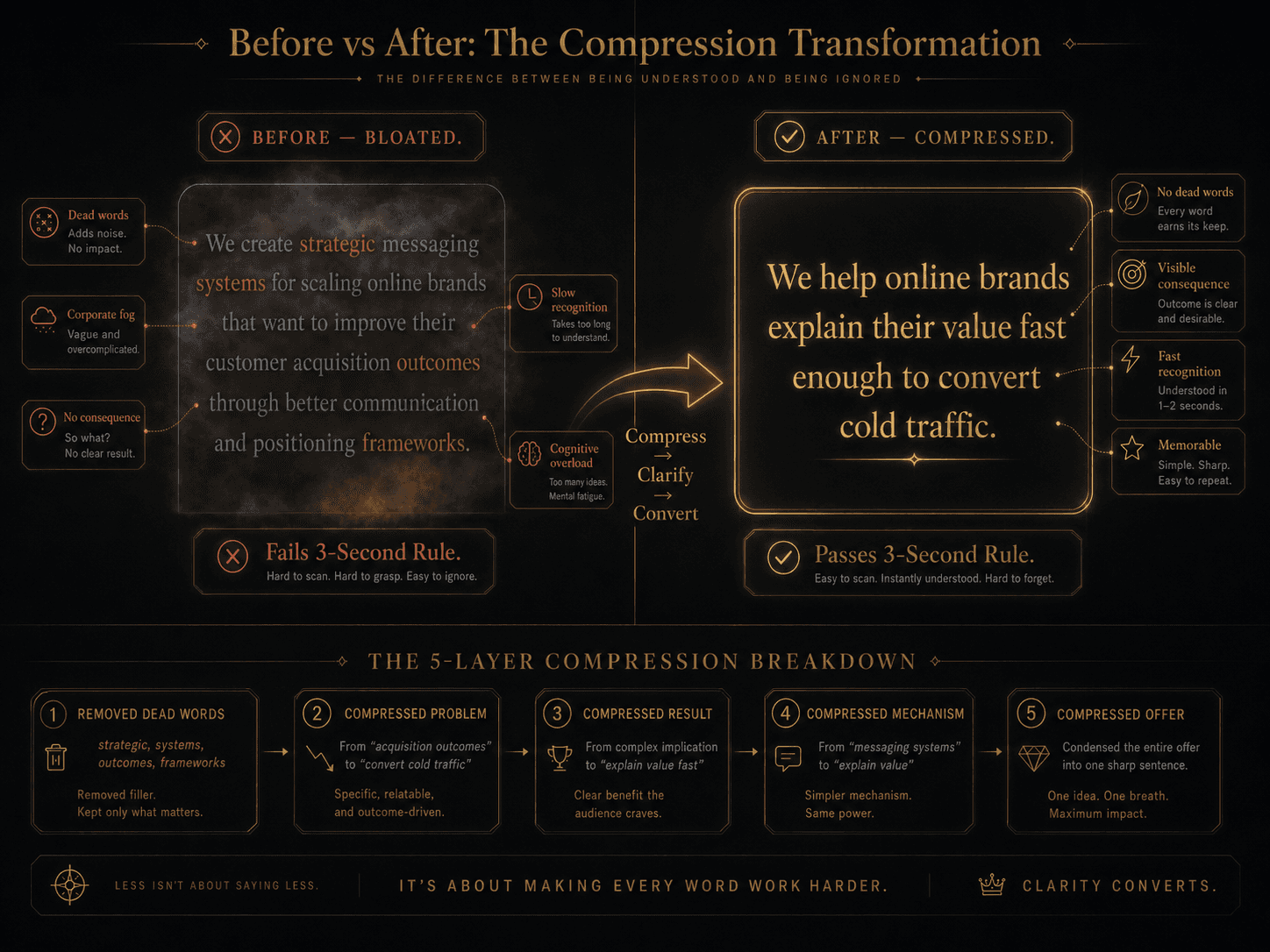
Example 1: Online Brand Messaging
Before
“We create strategic messaging systems for scaling online brands.”
This sounds polished, but the value is slow.
The buyer does not immediately see the practical shift.
After
“We help online brands explain their value fast enough to convert cold traffic.”
Now the value feels:
faster
clearer
more specific
more commercially useful
The buyer can picture what changes.
Example 2: Customer Acquisition
Before
“We optimise customer acquisition journeys.”
This is broad and abstract.
The buyer cannot feel the consequence.
After
“We stop buyers from dropping off before they trust the offer.”
Now the consequence becomes visible.
The buyer can picture the failure point.
Example 3: Funnel Audit
Before
“We provide a comprehensive funnel audit for businesses seeking stronger digital performance.”
This sounds professional, but it is heavy.
After
“We find the trust leaks making qualified traffic hesitate before the CTA.”
Now the offer is sharper.
It names the problem, buyer behaviour, and failure point.
Example 4: Coaching Offer
Before
“I help coaches improve their online presence and grow their business through strategic content.”
This is understandable, but generic.
After
“I help coaches turn silent audiences into serious enquiries.”
Now the value is compressed.
The buyer can instantly understand the shift.
Example 5: SaaS Offer
Before
“We help SaaS companies improve user onboarding and customer acquisition through data-driven optimisation.”
This contains value, but too much of it is buried.
After
“We help SaaS teams find why trial users disappear before reaching value.”
Now the problem is clearer.
The mechanism is implied.
The result is easier to understand.
The Offer Compression Scorecard™
Score each layer from 1 to 5.
Dead Word Removal: ___ / 5
Problem Compression: ___ / 5
Result Compression: ___ / 5
Mechanism Compression: ___ / 5
Full Offer Compression: ___ / 5
Total Score: ___ / 25
——
Score Interpretation
21–25: Sharply Compressed Offer™
The offer is clear, fast, specific, and easy to understand.
The buyer can quickly recognise the problem, picture the value, and remember the message.
This is strong compression.
16–20: Clear But Still Heavy™
The offer has strong material, but some friction remains.
The value is understandable, but could land faster.
Remove dead words, tighten the problem, or simplify the mechanism.
10–15: Slow-To-Land Offer™
The offer may contain value, but it takes too much effort to understand.
The buyer may need to reread, interpret, or wait too long for the point.
Compress before scaling.
0–9: Severe Compression Failure™
The offer is too bloated, vague, confusing, or mentally heavy.
The value is not landing fast enough.
Do not add more explanation.
Cut friction.
Rebuild the offer around fast clarity.
Compression Repair Map™
Use your lowest score to decide what to fix first.
If Dead Word Removal Is Weak
Problem:
The offer is full of filler language.
Repair:
Remove generic, corporate, replaceable words.
Keep only words that increase clarity, specificity, consequence, trust, or desire.
If Problem Compression Is Weak
Problem:
The buyer cannot quickly recognise the pain.
Repair:
Find the shortest recognisable version of the real problem.
Use the 20 / 10 / 5 word exercise.
If Result Compression Is Weak
Problem:
The buyer cannot picture the after-state.
Repair:
Compress the result into one visible shift.
Show what becomes easier, clearer, safer, faster, or more valuable.
If Mechanism Compression Is Weak
Problem:
The method feels generic, confusing, or over-engineered.
Repair:
Describe what the mechanism actually does in simple, specific language.
If Full Offer Compression Is Weak
Problem:
The offer still takes too long to understand.
Repair:
Use the compression formula and test it with a real person.
Keep rewriting until the buyer can understand it in seconds.
Using AI To Compress Offers
AI can help with compression, but only if you ask it to remove friction rather than simply shorten the copy.
Do not ask:
“Make this shorter.”
That may remove meaning.
Ask AI to compress the offer while increasing clarity, consequence, specificity, emotional visibility, and memorability.
AI Offer Compression Prompt™
Use this prompt:
Act as a high-level positioning strategist, offer strategist, and conversion copywriter.
Your task is to compress my offer into clearer, sharper, more emotionally visible messaging.
My current offer is:
[paste offer]
My target buyer is:
[insert buyer]
The problem they are facing is:
[insert problem]
The result I create is:
[insert result]
My mechanism or method is:
[insert mechanism]
The action I want the buyer to take is:
[insert desired action]
Analyse the offer for:
dead words
weak clarity
over-explanation
corporate language
jargon
low consequence visibility
weak memorability
cognitive overload
slow emotional recognition
unclear problem
vague result
overcomplicated mechanism
Then compress the offer through these five layers:
Remove dead words
Compress the problem
Compress the result
Compress the mechanism
Compress the full offer
For each layer:
identify what is currently too long, vague, or heavy
explain why it creates friction
rewrite it into a sharper version
preserve meaning while reducing unnecessary words
increase clarity, specificity, and emotional visibility
Then create:
A 20-word version
A 10-word version
A 5-word problem statement
A headline version
A landing-page intro version
A short positioning version
A CTA-supporting version
A final compressed offer statement
Then explain:
which version is clearest
which version is most memorable
which version creates the strongest buyer recognition
which version feels most commercially useful
which version is safest from hype
which words should be removed permanently
Do not use hype.
Do not make the offer vague to sound premium.
Do not remove meaning just to make it shorter.
Prioritise clarity, speed, specificity, consequence, emotional visibility, and memorability.
——
Final Execution Challenge™
Take your current offer.
Now compress it repeatedly until:
the value becomes instantly understandable
the consequence becomes visible
the language becomes cleaner
the positioning becomes memorable
the explanation becomes shorter
the emotional clarity becomes stronger
the buyer can repeat the offer accurately
the offer can survive the 3-second test
Do not stop at the first better version.
Compression usually improves through rounds.
Round 1 removes dead words.
Round 2 sharpens the problem.
Round 3 sharpens the result.
Round 4 simplifies the mechanism.
Round 5 compresses the full offer into a line buyers can understand and remember.
That is the work.
Because modern buyers rarely reject offers simply because they are bad.
They reject them because the value took too long to emotionally register before attention disappeared.
——
Final Compression Worksheet
Current Offer
Dead Words To Remove
Compressed Problem
20 words:
10 words:
5 words:
Final problem:
Compressed Result
What becomes easier, clearer, safer, faster, or more valuable?
Final result:
Compressed Mechanism
What does the mechanism actually do?
Final mechanism:
Full Compressed Offer
Use the formula:
We help [specific buyer] stop [painful problem] by [specific mechanism] so they can [visible result].
Final version:
3-Second Test Result
Did the buyer understand it quickly?
Yes / No / Partially
What did they say it meant?
What still needs compression?
——
Final Principle™
Modern buyers do not reward long explanations.
They reward fast clarity.
That does not mean shallow messaging.
It means the value must become clear before attention disappears.
Most offers do not need more words.
They need sharper words.
They need fewer dead phrases.
They need cleaner problem recognition.
They need a more visible result.
They need a mechanism that feels specific without becoming complicated.
They need an offer line that gives the buyer immediate orientation.
That is what The Offer Compression System™ is designed to create.
Not shorter copy for the sake of short copy.
Sharper value.
Faster understanding.
Cleaner positioning.
Stronger memory.
Less cognitive load.
More emotional clarity.
Because the buyer should never have to work hard to understand why the offer matters.
If the value is real, compression helps it surface faster.
And when value surfaces faster, the whole funnel breathes easier.
——
From:
The $100M Funnel Playbook. Book I: Foundation Buyer Psychology, Offer Clarity, and the Page Architecture Behind High-Converting Funnels
By Maris Spalins.
——
Copyright Notice
© 2026 The $100M Funnel Playbook / Winyourclients / Maris Spalins. All rights reserved.
This resource, including the frameworks, terminology, examples, scorecards, templates, prompts, methods, and written explanations, is original intellectual property created for The $100M Funnel Playbook. Book I: Foundation — Buyer Psychology, Offer Clarity, And The Page Architecture Behind High-Converting Funnels and published through Winyourclients.
No part of this resource may be copied, reproduced, screenshotted, republished, redistributed, sold, adapted, uploaded, scraped, stored in a database, included in training data, used to train artificial intelligence systems, or used to create derivative commercial or educational materials without prior written permission.
Limited reference, quotation, or sharing is only permitted where the source is clearly and visibly credited.
Any permitted reference must include at least one of the following source credits:
The $100M Funnel Playbook by Maris Spalins
or
Winyourclients — www.winyourclients.com
or
Maris Spalins / Winyourclients
Screenshots, excerpts, summaries, or redistributed versions must not remove, hide, alter, crop out, or obscure the original source, author name, book title, website name, or copyright notice.
This resource is provided for personal learning and implementation only. It is not licensed for resale, republishing, redistribution, AI training, template cloning, course creation, consulting delivery, or commercial reuse without written permission from Maris Spalins or Winyourclients.
For permission requests, licensing, citation approval, or commercial usage enquiries, contact:
Winyourclients
www.winyourclients.com
or
Email directly to Jacob on: help@winyourclients.com
The Offer Compression System™ A five-layer positioning tool for turning long, confusing, low-converting offers into sharper messaging buyers can understand, remember, and care about faster.
Prefer Audio Or Video?
The Offer Compression System™ is also available as:
🎧 A guided audio walkthrough explaining offer compression, dead-word removal, problem/result/mechanism compression, and the 3-second offer test.
🎥 A practical video breakdown with real offer compression examples, before/after rewrites, scorecards, and compressed offer-line builds.Choose the format that fits how you learn best.
[Listen To The Audio Walkthrough] (coming soon)
[Watch The Video Breakdown] (coming soon)
——
Why Most Offers Take Too Long To Land
Most offers do not fail because the service is weak.
They fail because the value takes too long to understand.
The buyer lands on the page and immediately feels:
too many words
too much explanation
too much complexity
too much jargon
too much thinking required
too much context before the value becomes clear
And attention disappears before the value becomes emotionally obvious.
That is the problem this resource helps you fix.
Modern buyers do not reward long explanations.
They reward fast clarity.
Not shallow clarity.
Not dumbed-down messaging.
Not empty simplicity.
Fast clarity.
The buyer should be able to understand what the offer is, who it is for, what problem it solves, why it matters, and what changes after buying without needing to decode the message.
If the buyer has to work too hard to understand the value, the offer is already leaking attention.
And leaked attention rarely turns into action.
What This Resource Helps You Do
The Offer Compression System™ helps you compress bloated, confusing, or over-explained offer language into sharper, more commercially visible messaging.
Use it to:
reduce cognitive overload
tighten positioning
remove weak language
compress value into faster understanding
create stronger emotional clarity
sharpen headlines and offer statements
increase memorability
explain your value in seconds instead of paragraphs
remove jargon that slows buyer comprehension
make the offer easier to repeat
make the buyer feel the consequence faster
The goal is not to make the offer shorter for the sake of being short.
The goal is to make the value register faster.
Because the longer it takes the buyer to understand the value, the weaker the emotional impact becomes.
What Offer Compression Actually Is
Offer compression is the process of reducing unnecessary explanation while increasing clarity, consequence, and emotional visibility.
This is not the same as “making copy shorter.”
That distinction matters enormously.
Weak shortening removes meaning.
Strong compression removes friction.
Weak shortening cuts words until the offer becomes thin.
Strong compression removes the words that slow understanding and keeps the words that create recognition, consequence, desire, and trust.
The goal is not:
“Say less.”
The goal is:
“Make the value land faster.”
That is the difference.
A compressed offer should feel:
easier to understand
sharper to repeat
faster to trust
clearer to remember
more commercially visible
more emotionally direct
Compression is not minimalism.
Compression is precision.
——
The Core Principle™
Clarity scales.
Complexity leaks attention.
The buyer should not need multiple paragraphs, several rereads, long explanations, sales calls, or context decoding just to understand why the offer matters.
The longer it takes the brain to understand the value, the lower the emotional impact becomes.
Why?
Because confusion drains attention.
And drained attention kills conversion.
A strong compressed offer helps the buyer quickly understand:
the problem
the consequence
the value
the shift
why it matters
who it is for
why this version is relevant
That creates immediate orientation.
Weak communication creates mental drag.
And mental drag makes the offer feel heavier than it should.
——
The Faster-To-Trust Principle™
Compressed offers feel faster to trust.
Not because they are simplistic.
Because the buyer can orient quickly.
When the buyer understands the problem, consequence, value, and shift faster, they can begin evaluating the offer sooner.
They do not waste their first few seconds trying to decode what you mean.
They can use those seconds to feel:
“This is relevant.”
“This is clear.”
“This might matter.”
“This is worth reading.”
That is the advantage of compression.
It gives the buyer a faster path into trust.
A bloated offer delays trust because it forces the buyer to interpret the message before they can value it.
A compressed offer accelerates trust because it makes the value easier to see.
——
Before You Start: Write Your Current Offer
Do not compress the offer in your head.
Write the exact version buyers currently see.
This could be from your:
landing page
website hero section
sales page
LinkedIn profile
ad
email
proposal
pitch deck
product page
sales call script
Current Offer Statement
Write your current offer here:
Current Offer Context
Where is this offer currently used?
Landing page / Website / Sales page / Ad / Email / Proposal / LinkedIn / Product page / Sales call / Other
Explain:
Current Problem
What feels too long, unclear, confusing, or hard to explain?
Current Word Count
How many words does your current offer statement use?
Word count: _______
Current Understanding Test
If someone saw this for three seconds, what would they understand?
——
The 5-Layer Offer Compression System™
This framework helps you compress bloated positioning into commercially sharper messaging.
The five layers are:
Remove Dead Words™
Compress The Problem™
Compress The Result™
Compress The Mechanism™
Compress The Entire Offer™
Each layer removes a different type of friction.
Dead words create fog.
Uncompressed problems create delay.
Uncompressed results weaken desire.
Over-explained mechanisms reduce trust.
Uncompressed offers drain attention.
The goal is to make the value easier to understand without making it weaker.
Layer 1: Remove Dead Words™
What This Layer Does
Most offers contain low-value filler language.
These words may sound professional, but they often communicate almost nothing concrete.
They slow the buyer down without making the offer clearer.
Dead words are not always grammatically wrong.
They are commercially weak.
They take up space without increasing clarity, specificity, consequence, trust, or desire.
Common Dead Words
Watch for words like:
comprehensive
innovative
cutting-edge
high-quality
strategic
customised
scalable
premium
optimised
tailored
world-class
full-service
results-driven
transformative
best-in-class
end-to-end
holistic
bespoke
next-generation
These words are not always forbidden.
But they must earn their place.
If they do not make the offer clearer, sharper, more specific, or more believable, they are probably dead weight.
Weak Example
“We provide comprehensive strategic funnel optimisation services.”
This sounds professional.
But it creates corporate fog.
The buyer cannot clearly see:
the problem
the consequence
the result
the buyer
the failure point
the emotional reason to care
It sounds like an offer.
But it does not create a strong mental picture.
Compressed Version
“We fix the trust leaks silently killing conversion.”
Now the value feels more visible.
The buyer can picture:
trust leaks
lost conversion
a specific failure point
a commercially meaningful problem
This is not just shorter.
It is clearer.
That is compression.
Compression Rule™
If a word does not increase clarity, specificity, or consequence, remove it.
Every word should do a job.
A word can stay if it helps the buyer:
understand faster
feel the problem
picture the result
trust the mechanism
remember the offer
feel why it matters
If it does none of those, cut it.
Layer 1 Exercise: Dead Word Audit
Paste your current offer statement:
Now highlight every word that sounds:
generic
corporate
replaceable
vague
inflated
decorative
over-polished
List the dead words here:
Now remove at least 30% of the weakest words.
Shorter version:
Layer 1 Score
Score your current offer from 1 to 5.
1 = overloaded with dead words
2 = too much filler
3 = some useful language, but still bloated
4 = mostly clean
5 = sharp, specific, and low-friction
Your score: ___ / 5
Layer 2: Compress The Problem™
What This Layer Does
Most businesses explain too much context before they name the real problem.
The buyer does not need the full story first.
They need fast recognition.
The problem should land quickly.
If the problem takes too long to explain, the buyer may leave before they realise the offer is relevant.
Problem compression forces you to find the sharpest version of the real tension.
Not the broadest explanation.
The sharpest recognition.
Weak Example
“Businesses today struggle with many different conversion issues across various stages of the customer journey.”
This is mentally exhausting.
It may be true, but it is too broad.
The buyer cannot quickly feel the specific pain.
There is no clean point of recognition.
Compressed Version
“Buyers lose certainty before the CTA.”
This is stronger because it is:
fast
clear
visible
specific
emotionally easier to recognise
The problem now has a shape.
The buyer can picture where the failure happens.
The Problem Compression Question™
Ask:
“What is the shortest possible version of the real problem?”
Not:
“What is the most complete explanation?”
Not:
“What sounds most sophisticated?”
But:
“What is the shortest version the right buyer would immediately recognise?”
That is the goal.
Layer 2 Exercise: 20 / 10 / 5 Problem Compression
Write the buyer problem in 20 words:
Now write it in 10 words:
Now write it in 5 words:
The 5-word version usually exposes the real core tension.
Now write the sharpest version of the problem:
Layer 2 Score
Score your problem compression from 1 to 5.
1 = broad and hard to recognise
2 = too much context
3 = understandable but still soft
4 = clear and specific
5 = sharp, short, and instantly recognisable
Your score: ___ / 5
Layer 3: Compress The Result™
What This Layer Does
Most offers describe activities.
Strong offers compress the visible shift.
A result should not require a long explanation before the buyer understands why it matters.
The buyer should quickly see what becomes better, easier, clearer, safer, faster, more profitable, or more trusted after the offer works.
If the result is vague, desire stays weak.
If the result is compressed well, the buyer can picture the after-state faster.
Weak Example
“We improve messaging performance and optimise conversion flow.”
This sounds useful, but the emotional visibility is low.
The buyer cannot clearly picture what changes.
Compressed Version
“Buyers understand the value faster.”
Now the result becomes immediately understandable.
It is simple.
It is visible.
It shows movement.
The buyer can feel why that matters.
The Result Compression Rule™
The buyer should picture what changes within seconds.
Not after explanation.
Not after a call.
Not after reading three sections.
Within seconds.
The result should feel visible enough to want.
Layer 3 Exercise: Result Compression
Answer this:
What becomes easier after this works?
What becomes clearer?
What becomes faster?
What becomes safer or less risky?
What becomes more profitable, trusted, or stable?
Now compress the result into one sharp sentence:
Now compress it again into the shortest clear version:
Layer 3 Score
Score your result compression from 1 to 5.
1 = vague result
2 = too much explanation
3 = understandable but not vivid
4 = clear and visible
5 = short, vivid, and desirable
Your score: ___ / 5
Layer 4: Compress The Mechanism™
What This Layer Does
Most mechanisms become overexplained.
Founders often think complexity creates trust.
Usually, the opposite happens.
Complexity often lowers trust because complicated offers feel:
harder to understand
harder to believe
harder to act on
harder to repeat
harder to remember
A strong mechanism should give the offer credibility.
Not confusion.
The buyer should understand the approach quickly enough to think:
“That sounds specific enough to be real.”
Weak Example
“Our proprietary multi-stage conversion acceleration framework improves customer journey optimisation.”
This sounds sophisticated.
But emotionally, it is dead.
The buyer cannot quickly understand what the mechanism actually does.
It feels over-engineered.
Compressed Version
“We identify where buyer trust collapses.”
Now the mechanism feels:
specific
clear
believable
easier to remember
easier to trust
The buyer can picture what the method looks for.
That is what strong mechanism compression does.
The Mechanism Rule™
The mechanism should feel specific enough to remember, but simple enough to explain quickly.
That is the balance.
Too generic, and it sounds like everyone else.
Too complex, and the buyer loses trust.
The mechanism should make the offer easier to believe.
Not harder to understand.
Layer 4 Exercise: Mechanism Compression
Describe your mechanism in one sentence:
Now reduce that sentence by 50%:
Now reduce it again while keeping the meaning:
What specific action does your mechanism perform?
Diagnoses / Removes / Rebuilds / Clarifies / Maps / Repairs / Installs / Identifies / Compresses / Other
Explain:
Final compressed mechanism:
Layer 4 Score
Score your mechanism compression from 1 to 5.
1 = confusing or over-engineered
2 = generic or bloated
3 = understandable but still heavy
4 = clear and specific
5 = specific, memorable, and easy to explain
Your score: ___ / 5
Layer 5: Compress The Entire Offer™
What This Layer Does
Now you combine the problem, result, mechanism, and consequence into one compressed positioning statement.
This is where the offer becomes commercially usable.
The goal is not to include every detail.
The goal is to give the buyer enough meaning to understand, remember, and care.
A compressed offer should answer:
Who is this for?
What painful problem does it stop?
How does it work?
What visible result does it create?
Why does it matter?
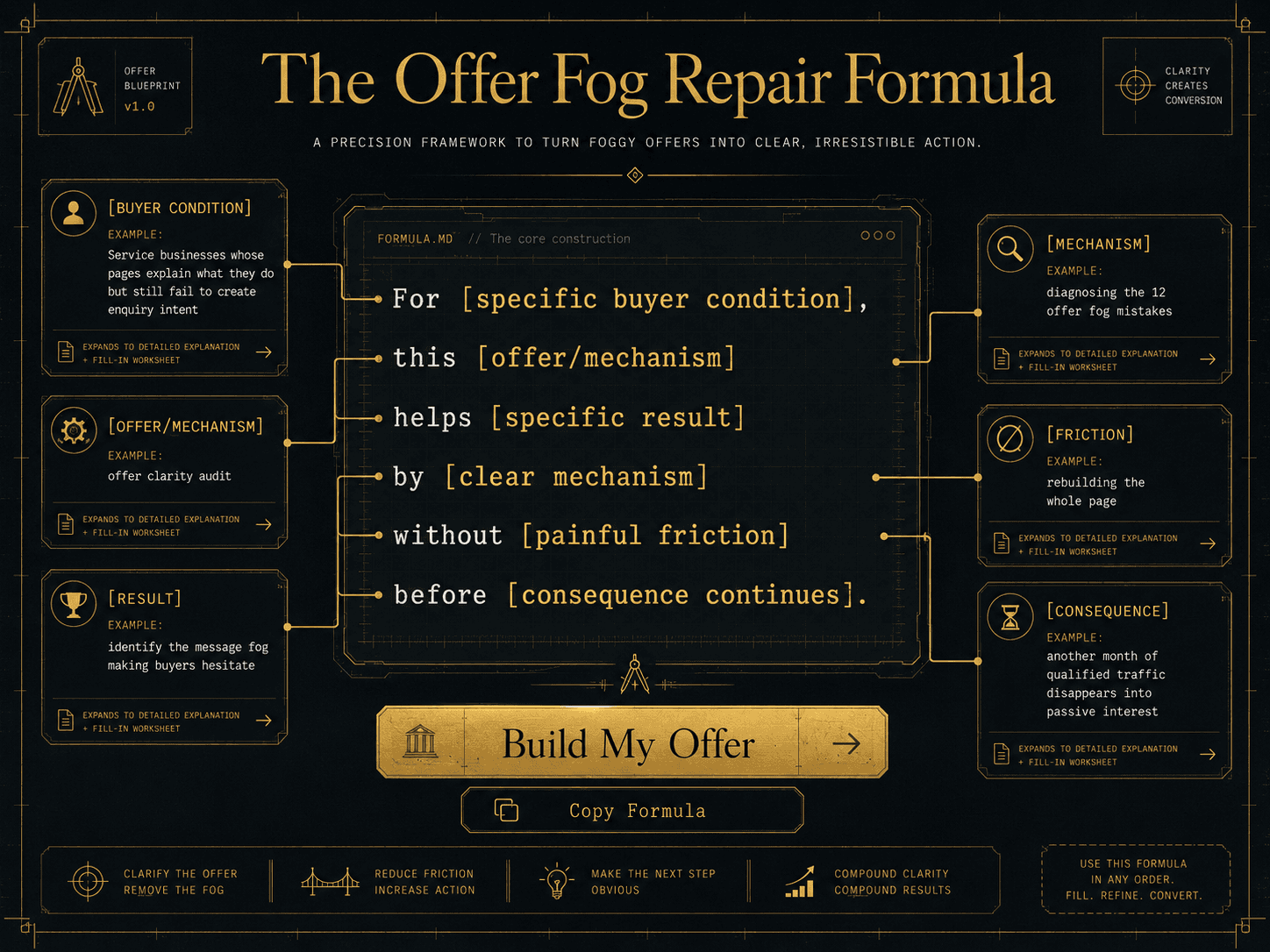
The Offer Compression Formula™
Use this formula:
We help [specific buyer] stop [painful problem] by [specific mechanism] so they can [visible result].
This formula works because it forces the offer to include the essentials:
buyer
problem
mechanism
result
It prevents the offer from drifting into vague service language.
Weak Version
“We provide comprehensive funnel optimisation solutions for businesses looking to improve conversions.”
This is weak because it is:
generic
slow
forgettable
vague
full of dead words
low in consequence
hard to picture
Compressed Version
“We help SaaS founders fix the trust leaks reducing demo conversions before more traffic gets wasted.”
Now the offer feels:
faster
sharper
more specific
easier to remember
emotionally visible
commercially meaningful
That is the difference.
The compressed version does not merely say less.
It makes the value land faster.
Layer 5 Exercise: Full Offer Compression
Specific buyer:
Painful problem:
Specific mechanism:
Visible result:
Consequence or reason it matters:
Now fill in the formula:
We help _________________________________________
stop _________________________________________
by _________________________________________
so they can _________________________________________.
First Compressed Version
Second Compressed Version
Make it sharper:
Third Compressed Version
Make it even clearer:
Layer 5 Score
Score your full offer compression from 1 to 5.
1 = still too long or unclear
2 = shorter but weak
3 = understandable but not sharp
4 = clear and commercially useful
5 = sharp, memorable, and fast to understand
Your score: ___ / 5
The 3-Second Rule™
Your offer should survive a 3-second understanding test.
Meaning:
A distracted buyer should quickly understand:
what this is
who it helps
why it matters
If the buyer must decode, reread, or interpret the offer, it still contains compression failure.
This does not mean every detail must be understood in three seconds.
It means the core value must be clear enough to earn the next three seconds.
The offer does not need to close the buyer immediately.
It needs to orient them immediately.
That is the point.
The 3-Second Understanding Test™
Show your compressed offer to someone unfamiliar with your business.
Then ask:
“What do you think this offer actually helps with?”
If they hesitate, simplify.
If they paraphrase incorrectly, compress harder.
If they understand the category but not the value, sharpen the consequence.
If they understand the value but cannot remember it, sharpen the phrase.
If they instantly understand, the compression is working.
3-Second Test Worksheet
Compressed offer being tested:
Who tested it?
What did they think it meant?
Did they understand it correctly?
Yes / No / Partially
Where did they hesitate?
What did they misunderstand?
What needs to be compressed further?
——
The Biggest Compression Mistake™
Many founders think more explanation creates more value.
Usually, the opposite happens.
More explanation often creates:
more friction
more confusion
more cognitive fatigue
weaker memorability
slower emotional recognition
lower emotional impact
more buyer effort
Explanation has a place.
But explanation should come after orientation.
If the buyer does not understand the core value quickly, more explanation may only make the offer feel heavier.
Clarity scales.
Complexity leaks attention.
——
The “Too Smart To Convert” Problem™
Some offers sound intelligent but convert poorly.
Why?
Because they prioritise sounding sophisticated instead of being understood quickly.
They use:
layered abstractions
corporate language
consultant jargon
vague strategic terminology
over-engineered mechanisms
intellectual phrasing
complex frameworks before simple relevance
The buyer should never need translation.
If the offer sounds clever but the buyer cannot repeat it, it is not compressed enough.
If the offer sounds premium but the buyer cannot picture the value, it is not compressed enough.
If the offer sounds sophisticated but the buyer still asks, “What does that actually mean?”, it is not compressed enough.
Smart language is only useful when it makes the value clearer.
If it makes the value slower to understand, it is working against conversion.
——
Too Smart To Convert Check™
Ask:
Does this offer sound intelligent but hard to understand?
Yes / No
Does it use jargon the buyer would not naturally use?
Yes / No
Does it require explanation before the value lands?
Yes / No
Does it sound more impressive to the founder than useful to the buyer?
Yes / No
Could a buyer repeat it accurately tomorrow?
Yes / No
What needs simplifying?
——
Before vs After Compression Examples
Use these examples to see how compression creates faster understanding.
Example 1: Online Brand Messaging
Before
“We create strategic messaging systems for scaling online brands.”
This sounds polished, but the value is slow.
The buyer does not immediately see the practical shift.
After
“We help online brands explain their value fast enough to convert cold traffic.”
Now the value feels:
faster
clearer
more specific
more commercially useful
The buyer can picture what changes.
Example 2: Customer Acquisition
Before
“We optimise customer acquisition journeys.”
This is broad and abstract.
The buyer cannot feel the consequence.
After
“We stop buyers from dropping off before they trust the offer.”
Now the consequence becomes visible.
The buyer can picture the failure point.
Example 3: Funnel Audit
Before
“We provide a comprehensive funnel audit for businesses seeking stronger digital performance.”
This sounds professional, but it is heavy.
After
“We find the trust leaks making qualified traffic hesitate before the CTA.”
Now the offer is sharper.
It names the problem, buyer behaviour, and failure point.
Example 4: Coaching Offer
Before
“I help coaches improve their online presence and grow their business through strategic content.”
This is understandable, but generic.
After
“I help coaches turn silent audiences into serious enquiries.”
Now the value is compressed.
The buyer can instantly understand the shift.
Example 5: SaaS Offer
Before
“We help SaaS companies improve user onboarding and customer acquisition through data-driven optimisation.”
This contains value, but too much of it is buried.
After
“We help SaaS teams find why trial users disappear before reaching value.”
Now the problem is clearer.
The mechanism is implied.
The result is easier to understand.
The Offer Compression Scorecard™
Score each layer from 1 to 5.
Dead Word Removal: ___ / 5
Problem Compression: ___ / 5
Result Compression: ___ / 5
Mechanism Compression: ___ / 5
Full Offer Compression: ___ / 5
Total Score: ___ / 25
——
Score Interpretation
21–25: Sharply Compressed Offer™
The offer is clear, fast, specific, and easy to understand.
The buyer can quickly recognise the problem, picture the value, and remember the message.
This is strong compression.
16–20: Clear But Still Heavy™
The offer has strong material, but some friction remains.
The value is understandable, but could land faster.
Remove dead words, tighten the problem, or simplify the mechanism.
10–15: Slow-To-Land Offer™
The offer may contain value, but it takes too much effort to understand.
The buyer may need to reread, interpret, or wait too long for the point.
Compress before scaling.
0–9: Severe Compression Failure™
The offer is too bloated, vague, confusing, or mentally heavy.
The value is not landing fast enough.
Do not add more explanation.
Cut friction.
Rebuild the offer around fast clarity.
Compression Repair Map™
Use your lowest score to decide what to fix first.
If Dead Word Removal Is Weak
Problem:
The offer is full of filler language.
Repair:
Remove generic, corporate, replaceable words.
Keep only words that increase clarity, specificity, consequence, trust, or desire.
If Problem Compression Is Weak
Problem:
The buyer cannot quickly recognise the pain.
Repair:
Find the shortest recognisable version of the real problem.
Use the 20 / 10 / 5 word exercise.
If Result Compression Is Weak
Problem:
The buyer cannot picture the after-state.
Repair:
Compress the result into one visible shift.
Show what becomes easier, clearer, safer, faster, or more valuable.
If Mechanism Compression Is Weak
Problem:
The method feels generic, confusing, or over-engineered.
Repair:
Describe what the mechanism actually does in simple, specific language.
If Full Offer Compression Is Weak
Problem:
The offer still takes too long to understand.
Repair:
Use the compression formula and test it with a real person.
Keep rewriting until the buyer can understand it in seconds.
Using AI To Compress Offers
AI can help with compression, but only if you ask it to remove friction rather than simply shorten the copy.
Do not ask:
“Make this shorter.”
That may remove meaning.
Ask AI to compress the offer while increasing clarity, consequence, specificity, emotional visibility, and memorability.
AI Offer Compression Prompt™
Use this prompt:
Act as a high-level positioning strategist, offer strategist, and conversion copywriter.
Your task is to compress my offer into clearer, sharper, more emotionally visible messaging.
My current offer is:
[paste offer]
My target buyer is:
[insert buyer]
The problem they are facing is:
[insert problem]
The result I create is:
[insert result]
My mechanism or method is:
[insert mechanism]
The action I want the buyer to take is:
[insert desired action]
Analyse the offer for:
dead words
weak clarity
over-explanation
corporate language
jargon
low consequence visibility
weak memorability
cognitive overload
slow emotional recognition
unclear problem
vague result
overcomplicated mechanism
Then compress the offer through these five layers:
Remove dead words
Compress the problem
Compress the result
Compress the mechanism
Compress the full offer
For each layer:
identify what is currently too long, vague, or heavy
explain why it creates friction
rewrite it into a sharper version
preserve meaning while reducing unnecessary words
increase clarity, specificity, and emotional visibility
Then create:
A 20-word version
A 10-word version
A 5-word problem statement
A headline version
A landing-page intro version
A short positioning version
A CTA-supporting version
A final compressed offer statement
Then explain:
which version is clearest
which version is most memorable
which version creates the strongest buyer recognition
which version feels most commercially useful
which version is safest from hype
which words should be removed permanently
Do not use hype.
Do not make the offer vague to sound premium.
Do not remove meaning just to make it shorter.
Prioritise clarity, speed, specificity, consequence, emotional visibility, and memorability.
——
Final Execution Challenge™
Take your current offer.
Now compress it repeatedly until:
the value becomes instantly understandable
the consequence becomes visible
the language becomes cleaner
the positioning becomes memorable
the explanation becomes shorter
the emotional clarity becomes stronger
the buyer can repeat the offer accurately
the offer can survive the 3-second test
Do not stop at the first better version.
Compression usually improves through rounds.
Round 1 removes dead words.
Round 2 sharpens the problem.
Round 3 sharpens the result.
Round 4 simplifies the mechanism.
Round 5 compresses the full offer into a line buyers can understand and remember.
That is the work.
Because modern buyers rarely reject offers simply because they are bad.
They reject them because the value took too long to emotionally register before attention disappeared.
——
Final Compression Worksheet
Current Offer
Dead Words To Remove
Compressed Problem
20 words:
10 words:
5 words:
Final problem:
Compressed Result
What becomes easier, clearer, safer, faster, or more valuable?
Final result:
Compressed Mechanism
What does the mechanism actually do?
Final mechanism:
Full Compressed Offer
Use the formula:
We help [specific buyer] stop [painful problem] by [specific mechanism] so they can [visible result].
Final version:
3-Second Test Result
Did the buyer understand it quickly?
Yes / No / Partially
What did they say it meant?
What still needs compression?
——
Final Principle™
Modern buyers do not reward long explanations.
They reward fast clarity.
That does not mean shallow messaging.
It means the value must become clear before attention disappears.
Most offers do not need more words.
They need sharper words.
They need fewer dead phrases.
They need cleaner problem recognition.
They need a more visible result.
They need a mechanism that feels specific without becoming complicated.
They need an offer line that gives the buyer immediate orientation.
That is what The Offer Compression System™ is designed to create.
Not shorter copy for the sake of short copy.
Sharper value.
Faster understanding.
Cleaner positioning.
Stronger memory.
Less cognitive load.
More emotional clarity.
Because the buyer should never have to work hard to understand why the offer matters.
If the value is real, compression helps it surface faster.
And when value surfaces faster, the whole funnel breathes easier.
——
From:
The $100M Funnel Playbook. Book I: Foundation Buyer Psychology, Offer Clarity, and the Page Architecture Behind High-Converting Funnels
By Maris Spalins.
——
Copyright Notice
© 2026 The $100M Funnel Playbook / Winyourclients / Maris Spalins. All rights reserved.
This resource, including the frameworks, terminology, examples, scorecards, templates, prompts, methods, and written explanations, is original intellectual property created for The $100M Funnel Playbook. Book I: Foundation — Buyer Psychology, Offer Clarity, And The Page Architecture Behind High-Converting Funnels and published through Winyourclients.
No part of this resource may be copied, reproduced, screenshotted, republished, redistributed, sold, adapted, uploaded, scraped, stored in a database, included in training data, used to train artificial intelligence systems, or used to create derivative commercial or educational materials without prior written permission.
Limited reference, quotation, or sharing is only permitted where the source is clearly and visibly credited.
Any permitted reference must include at least one of the following source credits:
The $100M Funnel Playbook by Maris Spalins
or
Winyourclients — www.winyourclients.com
or
Maris Spalins / Winyourclients
Screenshots, excerpts, summaries, or redistributed versions must not remove, hide, alter, crop out, or obscure the original source, author name, book title, website name, or copyright notice.
This resource is provided for personal learning and implementation only. It is not licensed for resale, republishing, redistribution, AI training, template cloning, course creation, consulting delivery, or commercial reuse without written permission from Maris Spalins or Winyourclients.
For permission requests, licensing, citation approval, or commercial usage enquiries, contact:
Winyourclients
www.winyourclients.com
or
Email directly to Jacob on: help@winyourclients.com
Other Blogs
Other Blogs
Check our other project Blogs with useful insight and information for your businesses
Other Blogs
Other Blogs
Check our other project Blogs with useful insight and information for your businesses