Our Three Step Process
May 25, 2026
Chap 1 | Resource 3 | The Niche Messaging Matrix™
Our Three Step Process
May 25, 2026
Chap 1 | Resource 3 | The Niche Messaging Matrix™
The Niche Messaging Matrix™ How to turn broad, generic copy into buyer-specific messaging that creates recognition, relevance, emotional pull, and stronger funnel momentum.
Prefer Audio Or Video?
The Niche Messaging Matrix™ is also available as:
🎧 A guided audio walkthrough explaining buyer psychology and message-market alignment
🎥 A video breakdown with real-world messaging transformations and niche positioning examples
Choose the format that fits how you learn best.
[Listen To The Audio Walkthrough] (coming soon)
[Watch The Video Breakdown] (coming soon)
——
Why Generic Messaging Quietly Kills Funnels
Most messaging fails for one simple reason:
It sounds like it could be for everyone.
And when messaging sounds like it is for everyone, it emotionally connects with no one.
This is one of the biggest silent conversion killers in marketing.
The offer may be strong.
The funnel may look polished.
The traffic may even be decent.
But the buyer lands on the page and feels:
“This feels generic.”
That reaction is deadly.
Because buyers continue reading when they feel recognised.
Not when they feel vaguely targeted.
Weak messaging usually sounds:
broad
corporate
emotionally distant
overly polished
interchangeable with competitors
Strong messaging feels:
specific
emotionally familiar
psychologically relevant
identity-aware
uncomfortably accurate
That is what this framework is designed to help you build.
It helps you move from generic copy to buyer-specific messaging that makes the right person feel:
“This is about me.”
——
What This Resource Helps You Do
The Niche Messaging Matrix™ helps you create messaging that feels personally relevant to the buyer.
Use it to diagnose and repair:
vague headlines
generic positioning
broad audience language
weak emotional relevance
interchangeable offer copy
low-recognition messaging
founder-first language
copy that explains but does not connect
This resource is not about sounding clever.
It is about sounding recognised.
The question is not:
“Does this copy sound good?”
The better question is:
“Would the right buyer feel personally seen by this message?”
That is the standard.
Because strong messaging does not merely describe the offer.
It enters the buyer’s world.
——
The Self-Relevance Principle™
Human attention is naturally self-centred.
People pay attention to:
their problems
their frustrations
their fears
their goals
their identity
their stalled outcomes
their repeated disappointments
their desired transformation
This means buyers are constantly filtering messaging through one subconscious question:
“Is this relevant to me?”
Strong messaging answers:
“Yes.”
Weak messaging answers:
“Maybe.”
That tiny difference changes conversion dramatically.
A buyer does not continue because your page sounds impressive.
They continue because the message feels connected to something they already care about.
That is self-relevance.
——
The Recognition Standard™
Strong messaging should make the right buyer feel named, seen, or understood.
Not merely included.
There is a difference.
Included means:
“This could apply to me.”
Recognised means:
“This sounds exactly like what I am dealing with.”
Generic messaging includes people.
Specific messaging recognises them.
Hyper-relevant messaging makes them feel exposed in the right way.
That is where emotional pull begins.
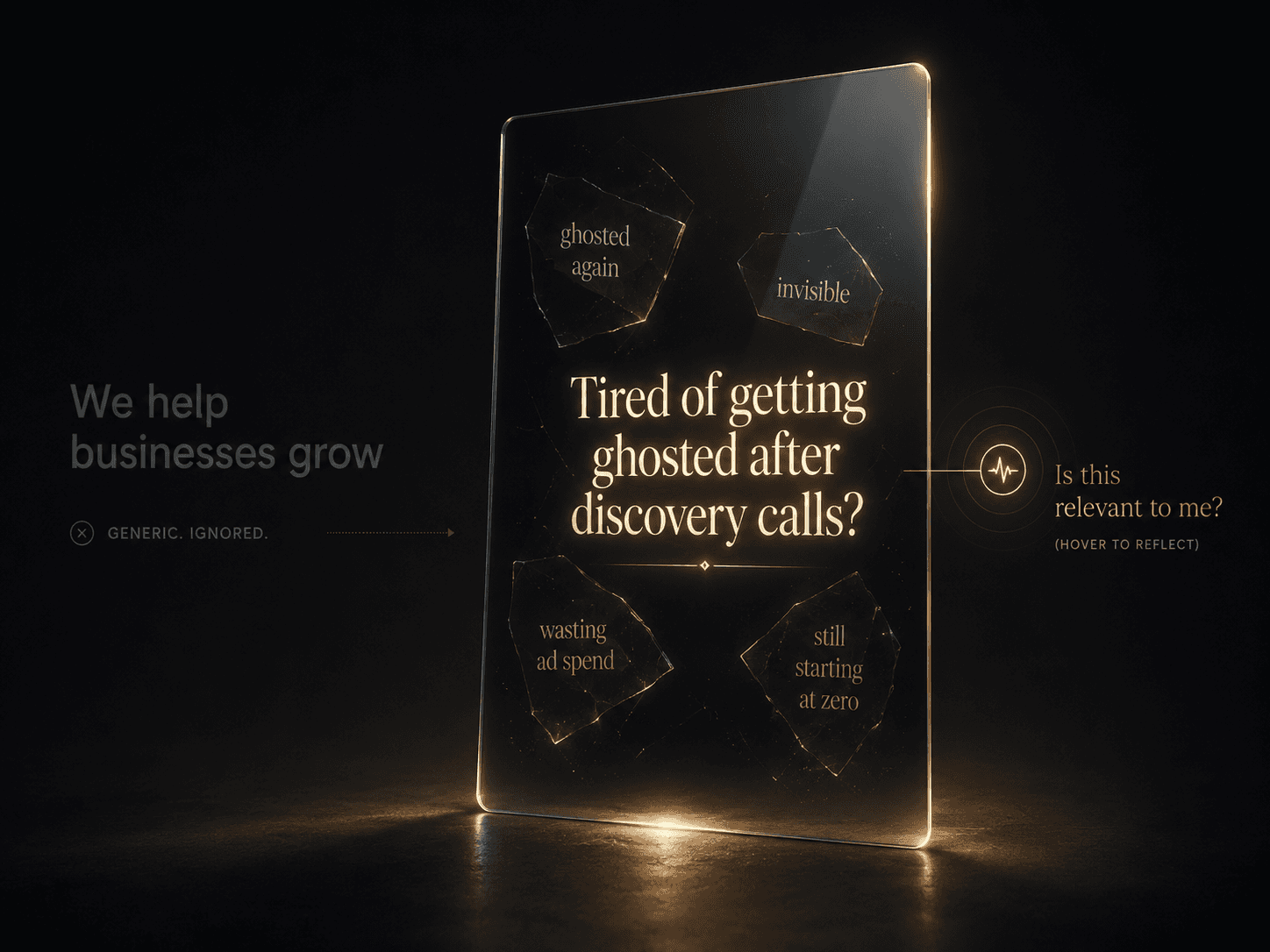
Example Of Low Self-Relevance™
Weak message:
“We help businesses scale using innovative digital systems.”
Who exactly is this for?
Almost anyone.
Which means emotionally, it reaches no one deeply.
The message may be understandable.
But it is not memorable.
It does not enter a specific buyer’s world.
It does not name a specific pain.
It does not create emotional recognition.
It does not make the buyer feel:
“This is about me.”
That is low self-relevance.
Example Of High Self-Relevance™
Stronger message:
“Tired of getting ghosted after discovery calls?”
Now the buyer immediately thinks:
“That keeps happening to me.”
That creates:
emotional recognition
attention
tension
relevance
continuation
The message enters the buyer’s world instead of forcing the buyer to interpret yours.
That is the real power of strong messaging.
It does not simply say what you do.
It reflects what the buyer is experiencing.
——
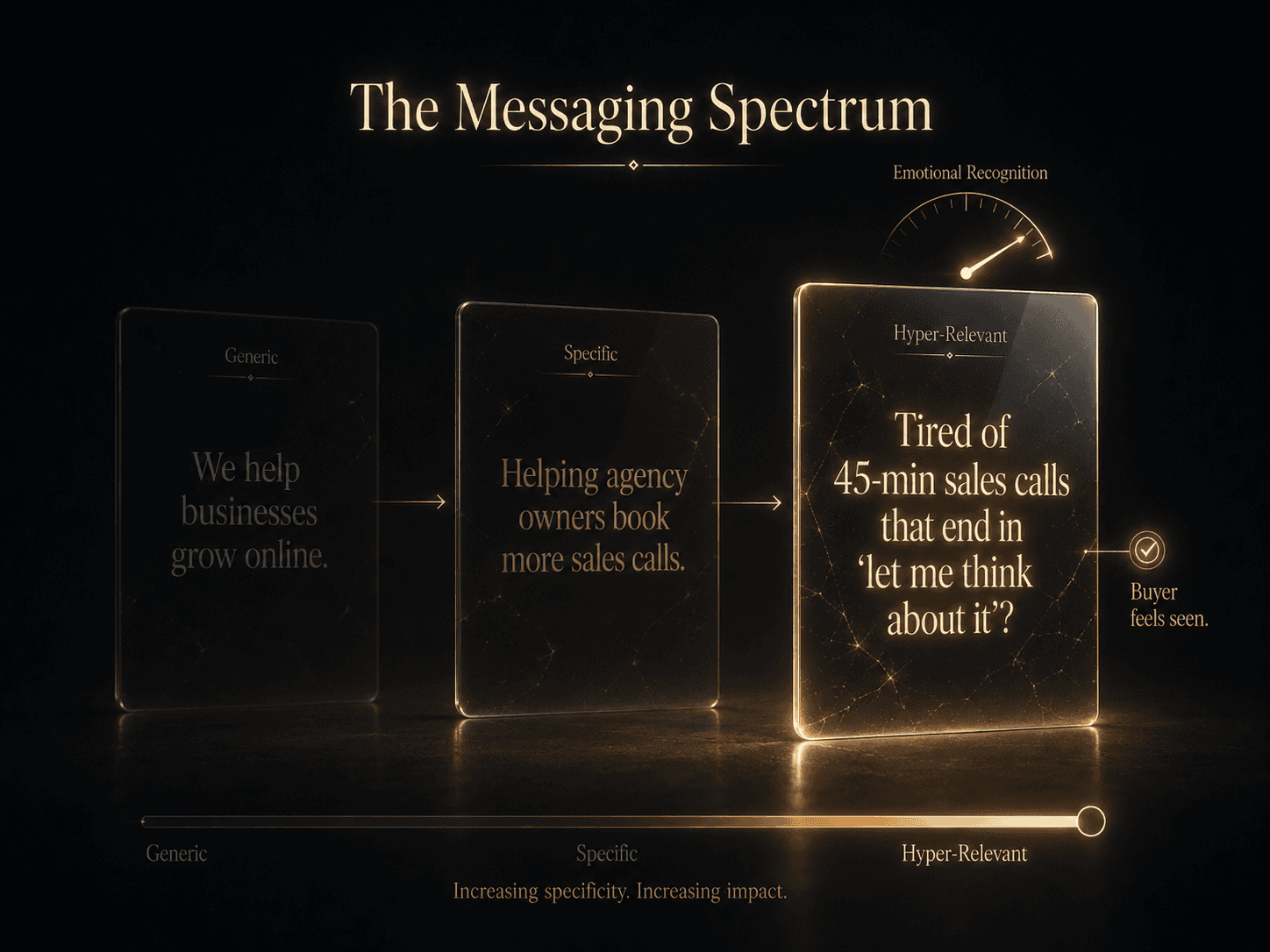
The Messaging Spectrum™
Most messaging exists on a spectrum:
Generic → Specific → Hyper-Relevant
Understanding this changes everything.
The goal is not just to be clear.
The goal is to be clear in a way that feels personally relevant to the right buyer.
1. Generic Messaging™
Generic messaging is broad, safe, and emotionally weak.
Example:
“We help businesses grow online.”
This is technically understandable.
But emotionally forgettable.
The audience is vague.
The pain is vague.
The outcome is vague.
The situation is vague.
Nothing in the message creates sharp recognition.
Generic messaging usually feels comfortable to write because it avoids exclusion.
But that is exactly why it fails.
If the message does not exclude the wrong buyer, it usually does not strongly attract the right one.
Generic Messaging Score: 1 / 5
2. Specific Messaging™
Specific messaging is clearer, sharper, and more outcome-oriented.
Example:
“Helping agency owners book more qualified sales calls.”
This is better.
Now the audience becomes visible.
The outcome becomes clearer.
The buyer can begin to recognise whether the message is relevant.
But it can still go deeper.
Specific messaging tells the buyer what the offer is for.
Hyper-relevant messaging makes the buyer feel understood.
Specific Messaging Score: 3 / 5
3. Hyper-Relevant Messaging™
Hyper-relevant messaging is emotionally recognisable, pain-specific, and identity-aware.
Example:
“Tired of spending 45 minutes on sales calls just to get ghosted afterward?”
Now the buyer feels:
“This person understands my situation.”
That creates psychological pull.
The message is no longer just explaining the offer.
It is reflecting the buyer’s lived experience.
That is why hyper-relevant messaging is powerful.
It does not only communicate.
It connects.
Hyper-Relevant Messaging Score: 5 / 5
——
The Messaging Spectrum Scorecard™
Use this to score your current headline, subheadline, or opening copy.
Score 1: Generic
The message could apply to almost anyone.
The buyer understands the words but does not feel personally recognised.
Score 2: Slightly Specific
The message names a broad category, but the emotional relevance is still weak.
The buyer may understand who it is for, but it does not feel especially sharp.
Score 3: Specific
The message names a clear audience, outcome, or pain point.
The buyer can see relevance, but the copy may still lack emotional depth.
Score 4: Highly Relevant
The message reflects a specific buyer situation, frustration, or desired outcome.
The right buyer is likely to feel recognised.
Score 5: Hyper-Relevant
The message feels uncomfortably accurate to the right buyer.
It captures the buyer’s pain, language, identity, situation, or hidden frustration in a way that creates immediate emotional pull.
Current Messaging Score: ___ / 5
——
Hyper-Relevance Can Use Different Angles
Hyper-relevant messaging does not always have to be aggressive.
It does not always have to be pain-led.
It can be built around different angles.
Pain-Led
“Tired of getting ghosted after discovery calls?”
Desire-Led
“Book more qualified calls without chasing referrals every month.”
Identity-Led
“For agency owners who are done sounding like every other ‘growth partner’ online.”
Situation-Led
“Users are signing up, clicking around once, and disappearing before they activate.”
Friction-Led
“Still spending hours manually following up with leads who never reply?”
The angle depends on the buyer, the market, the offer, and the level of awareness.
The principle stays the same:
Make the buyer recognise themselves quickly.
——
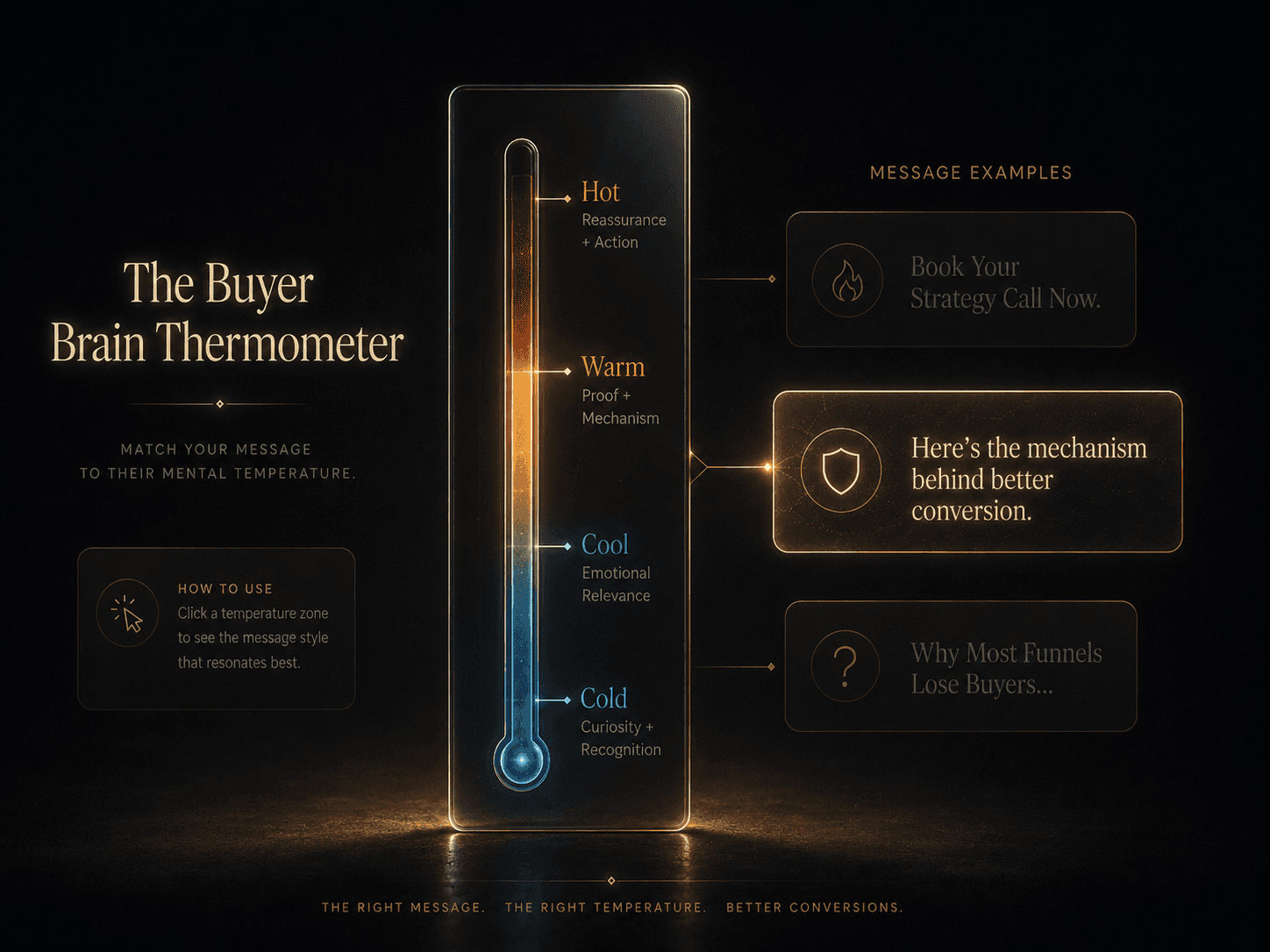
Buyer Temperature Messaging™
Different buyers require different messaging.
One of the biggest messaging mistakes is speaking to cold buyers, warm buyers, and hot buyers the exact same way.
That destroys alignment.
Different temperature, different treatment.
Cold Buyers™
Cold buyers are not ready for heavy pressure.
They may not know you.
They may not fully understand the problem.
They may not trust the category.
They may not be actively looking for your solution yet.
Cold buyers need:
curiosity
recognition
emotional relevance
clear problem framing
low-friction continuation
Cold buyers are not ready for:
hard closes
aggressive CTAs
long technical explanations
heavy commitment
pressure before relevance
Weak cold messaging:
“Book Your Free Strategy Call Now.”
Too aggressive too early.
Stronger cold messaging:
“Why Most Funnels Lose Buyers Before The Offer Even Appears.”
Now the buyer becomes curious before being pressured.
That sequence matters psychologically.
Cold messaging should make the buyer care enough to continue.
Not force them to act before they are ready.
Warm Buyers™
Warm buyers already understand the category.
They may know the problem.
They may want the outcome.
They may have seen your content before.
They may already be comparing options.
Warm buyers need:
proof
differentiation
mechanism
specificity
credibility
trust
They are asking:
“Why this?”
“Why you?”
“Why should I believe this will work for me?”
Warm messaging should reduce uncertainty.
It should make the promise feel more believable.
It should explain why this approach is different, why it works, and why the buyer should trust it.
Weak warm messaging:
“Grow your business with better marketing.”
Stronger warm messaging:
“See the 4 hero-section leaks that made one service funnel lose qualified buyers before the CTA.”
Warm buyers need more than attention.
They need reasons to believe.
Hot Buyers™
Hot buyers already want the outcome.
They may already trust you.
They may already understand the offer.
They may simply need the next step to feel clear, safe, and worth taking.
Hot buyers need:
reassurance
speed
clarity
reduced friction
clear CTA
risk reduction
next-step confidence
They are asking:
“What do I do next?”
“What happens after I click?”
“Is this safe?”
“Is now the right time?”
Weak hot messaging:
“Contact us.”
Stronger hot messaging:
“Get My 10-Minute Funnel Leak Breakdown.”
Hot messaging should make action feel obvious.
Not complicated.
Not vague.
Not risky.
Obvious.
—-
The Buyer Temperature Messaging Map™
Use this map before writing headlines, subheadlines, CTAs, and page sections.
Cold Buyer
Primary Need:
Recognition and curiosity.
Main Question:
“Why should I care?”
Messaging Should Focus On:
pain
tension
relevance
curiosity
low-friction continuation
Best CTA Style:
Soft, curiosity-driven, low commitment.
Example CTA:
“Show Me The Funnel Leaks.”
Warm Buyer
Primary Need:
Belief and proof.
Main Question:
“Why should I believe this?”
Messaging Should Focus On:
mechanism
proof
case studies
comparison
specificity
credibility
Best CTA Style:
Value-led, proof-aware, diagnostic.
Example CTA:
“Get My Funnel Breakdown.”
Hot Buyer
Primary Need:
Action confidence.
Main Question:
“What do I do next?”
Messaging Should Focus On:
reassurance
speed
next step
outcome
reduced friction
what happens after the click
Best CTA Style:
Direct, specific, reward-visible.
Example CTA:
“Book My 15-Minute Strategy Review.”
——
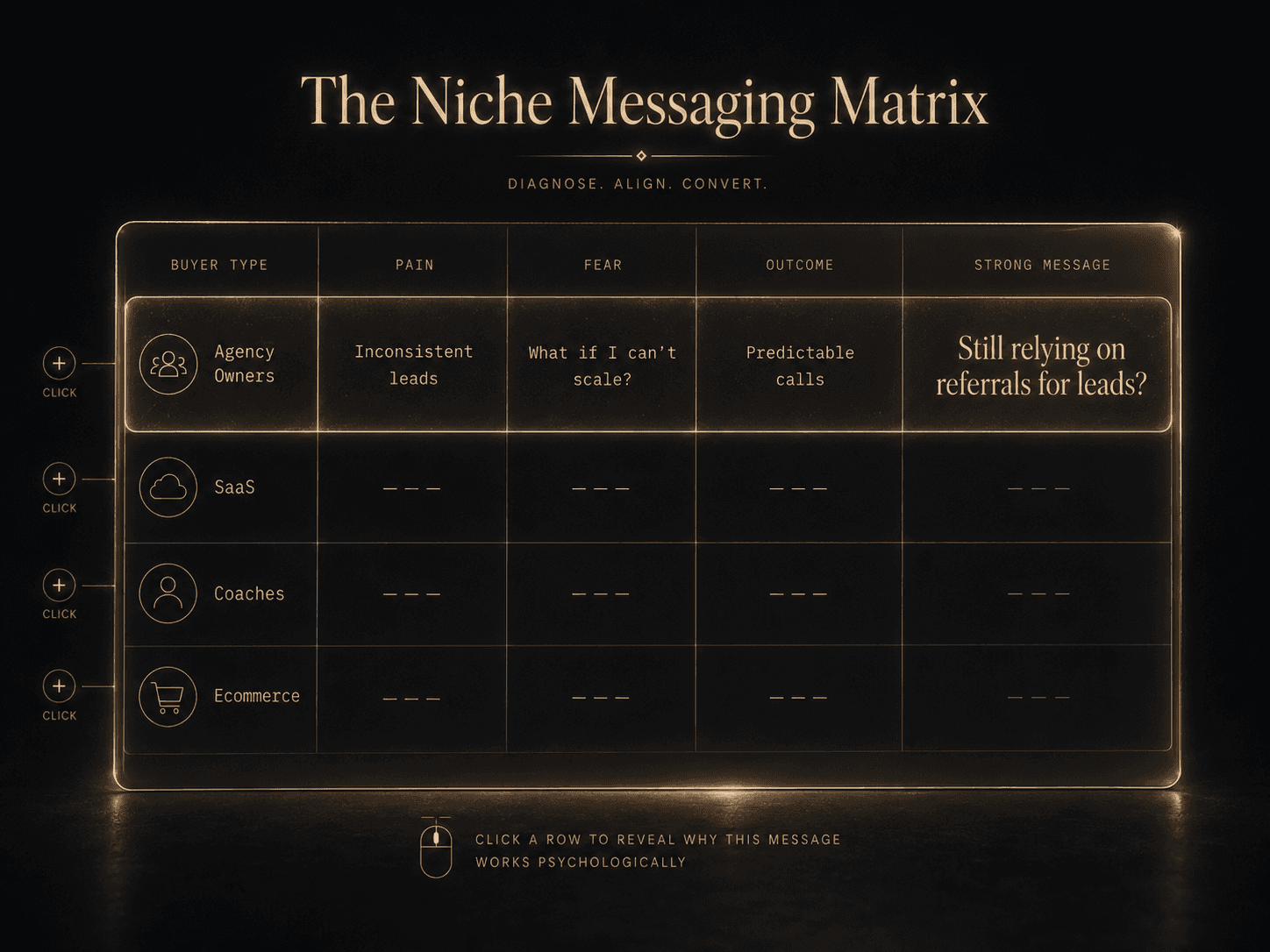
The Niche Messaging Matrix™
The Niche Messaging Matrix™ helps you align:
buyer type
emotional pain
desired outcome
hidden fear
buyer language
objections
messaging angle
CTA direction
Instead of writing broad copy that sounds interchangeable.
Use it to make your messaging sharper, more relevant, and more emotionally recognisable.
——
Niche Messaging Matrix Examples
Agency Owner
Buyer Type:
Agency owner
What They Fear:
Inconsistent leads, unstable pipeline, relying too much on referrals.
What They Want:
Predictable booked calls.
What They Are Tired Of:
Starting every month wondering where the next client will come from.
Hidden Fear:
“What if this agency never becomes predictable?”
Weak Messaging:
“Scale your agency.”
Strong Messaging:
“Still relying on referrals for leads?”
CTA Angle:
“Show Me The Lead Flow Leaks.”
SaaS Founder
Buyer Type:
SaaS founder
What They Fear:
Low activation, churn, users signing up but not adopting the product.
What They Want:
Better onboarding and more active users.
What They Are Tired Of:
Watching users sign up, click around once, and disappear.
Hidden Fear:
“What if people like the idea but do not actually use the product?”
Weak Messaging:
“Improve conversions.”
Strong Messaging:
“Users signing up but disappearing after Day 1?”
CTA Angle:
“Find My Activation Leaks.”
Coach
Buyer Type:
Coach
What They Fear:
No trust, weak authority, leads who seem interested but never commit.
What They Want:
More qualified calls and committed clients.
What They Are Tired Of:
Having discovery calls that end with “I’ll think about it.”
Hidden Fear:
“What if people like my content but do not see me as the obvious choice?”
Weak Messaging:
“Grow your coaching business.”
Strong Messaging:
“Tired of discovery calls that never convert?”
CTA Angle:
“Get My Call Conversion Breakdown.”
Ecommerce Brand
Buyer Type:
Ecommerce brand owner
What They Fear:
High CPA, wasted ad spend, low profit margins.
What They Want:
Profitable acquisition and stronger product-page conversion.
What They Are Tired Of:
Ads getting clicks but not enough buyers.
Hidden Fear:
“What if the traffic is not the problem — what if the page is?”
Weak Messaging:
“Increase sales.”
Strong Messaging:
“Ads getting clicks but barely breaking even?”
CTA Angle:
“Find My Product Page Leaks.”
Consultant
Buyer Type:
Consultant
What They Fear:
Unstable pipeline, weak differentiation, inconsistent client acquisition.
What They Want:
Consistent clients and stronger positioning.
What They Are Tired Of:
Restarting their business development from zero every month.
Hidden Fear:
“What if I look like every other consultant in my market?”
Weak Messaging:
“Scale your consulting.”
Strong Messaging:
“Still starting every month at zero?”
CTA Angle:
“Clarify My Positioning.”
Creator
Buyer Type:
Creator
What They Fear:
Low engagement, invisible content, weak monetisation.
What They Want:
Audience growth, stronger attention, and profitable offers.
What They Are Tired Of:
Posting consistently and still feeling ignored.
Hidden Fear:
“What if my content is good but nobody cares enough to act?”
Weak Messaging:
“Grow your audience.”
Strong Messaging:
“Posting every day and still feeling invisible?”
CTA Angle:
“Find My Content Conversion Gap.”
——
What Strong Messaging Actually Does™
Strong messaging does not simply sound good.
It performs specific psychological jobs.
Strong messaging:
reflects buyer reality
names emotional pain
creates recognition
reduces interpretation effort
makes the buyer feel understood
makes the offer feel more relevant
creates a reason to continue
Weak messaging:
sounds broad
hides behind abstraction
avoids specificity
creates emotional distance
sounds interchangeable
makes the buyer work too hard to find relevance
This is why strong messaging often feels slightly uncomfortable.
Because specificity creates exposure.
And exposure creates relevance.
When your messaging becomes more specific, the wrong buyer may feel less included.
That is not always a problem.
That is often the point.
——
The Four Questions Strong Messaging Must Answer
Before writing or rewriting a headline, ask these four questions.
1. What is happening in the buyer’s world?
What situation are they currently dealing with?
2. What are they tired of?
What repeated frustration keeps showing up?
3. What outcome do they want?
What would feel like progress, relief, or success?
4. What language would they actually use?
How would they describe the problem without polished marketing language?
If your message does not answer these questions, it will probably drift back into generic copy.
——
Identity-Based Messaging™
People do not only buy outcomes.
They also buy identity alignment.
Buyers respond to messaging that reflects:
their tribe
their frustrations
their worldview
their industry language
their internal struggles
their repeated conversations
their specific situation
This is why insider language often converts well.
But it has to be real.
Identity-based messaging should feel like insider recognition.
Not fake slang.
Not forced cleverness.
Not pretending to be part of a world you do not understand.
The buyer can feel the difference.
Example Of Generic Language™
“We help businesses improve lead generation.”
This is clear enough.
But it has no strong identity.
No specific world.
No emotional familiarity.
No insider recognition.
Example Of Identity Language™
“Tired of hearing ‘looks good, let me think about it’ at the end of every sales call?”
That line feels familiar to people who live that experience repeatedly.
It creates emotional recognition instantly.
The buyer does not have to decode the message.
They recognise the moment.
And recognition creates continuation.
——
Before And After Messaging Transformations™
Use these examples to see how generic messaging becomes more specific and then hyper-relevant.
Example 1: Agency
Generic:
“We help agencies grow.”
Specific:
“We help agency owners book more qualified sales calls.”
Hyper-Relevant:
“Still relying on referrals to keep your agency pipeline alive?”
Why it works:
The hyper-relevant version names the real-world dependency and the quiet anxiety behind the problem.
Example 2: Funnel Conversion
Generic:
“We help companies optimise growth systems.”
Specific:
“We help businesses improve funnel conversion.”
Hyper-Relevant:
“Still losing qualified buyers before they even reach your offer?”
Why it works:
The hyper-relevant version creates a visible conversion problem and gives the buyer a reason to continue.
Example 3: Creator
Generic:
“Helping creators grow their audience.”
Specific:
“Helping creators turn content into leads.”
Hyper-Relevant:
“Posting every day and still feeling invisible?”
Why it works:
The hyper-relevant version captures the emotional frustration behind low content performance.
Example 4: SaaS
Generic:
“We improve user onboarding.”
Specific:
“We help SaaS teams increase product activation.”
Hyper-Relevant:
“Users signing up, clicking once, and disappearing before they activate?”
Why it works:
The hyper-relevant version describes the exact behavioural pattern the founder is worried about.
Example 5: Ecommerce
Generic:
“We help ecommerce brands increase revenue.”
Specific:
“We help ecommerce brands improve product-page conversion.”
Hyper-Relevant:
“Your ads are getting clicks. Your product page is losing the sale.”
Why it works:
The hyper-relevant version creates a clear contrast between traffic and conversion.
Example 6: Coach
Generic:
“We help coaches get more clients.”
Specific:
“We help coaches book more qualified discovery calls.”
Hyper-Relevant:
“Tired of calls that feel promising until they end with ‘I’ll think about it’?”
Why it works:
The hyper-relevant version captures a repeated emotional moment coaches recognise instantly.
——
How To Build Your Messaging Matrix™
Use this process to create sharper messaging for any offer.
Step 1: Define The Buyer™
Do not start with:
“Business owners.”
Too broad.
Instead, define the buyer more clearly.
Examples:
agency owners
SaaS founders
fitness coaches
ecommerce brands
consultants
creators
course sellers
service providers
property developers
local business owners
The narrower the audience clarity, the stronger the messaging precision.
Fill this in:
My buyer is:
More specifically, they are:
They are currently trying to:
Step 2: Define Their Pain™
Ask:
What frustrates them repeatedly?
Examples:
ghosted leads
inconsistent revenue
wasted ad spend
low conversions
no trust
unstable pipeline
weak activation
poor retention
invisible content
Pain creates emotional pull.
But the pain must be specific enough to feel real.
Fill this in:
Their repeated frustration is:
The moment where this frustration shows up is:
The emotional cost is:
Step 3: Define Their Desired Outcome™
What do they actually want?
Not vague goals.
Specific outcomes.
Examples:
booked calls
predictable leads
lower CPA
higher activation
recurring clients
more qualified enquiries
higher conversion
better retention
clearer positioning
Specificity creates believability.
Fill this in:
Their desired outcome is:
They would feel progress if:
The visible result they want is:
Step 4: Define Their Hidden Fear™
What quietly worries them?
Examples:
“What if this never scales?”
“What if I am wasting money?”
“What if competitors are ahead?”
“What if my offer is not good enough?”
“What if people like the idea but do not buy?”
“What if I look the same as everyone else?”
“What if I keep doing everything right and still do not grow?”
Strong messaging often acknowledges hidden fears indirectly.
You do not always need to say the fear out loud.
But you do need to understand it.
Fill this in:
Their hidden fear is:
They would probably never say this publicly, but they worry that:
This fear affects their buying decision because:
Step 5: Define Their Language™
This is critical.
How do they describe the problem?
Not how marketers describe it.
Not how consultants describe it.
Not how internal teams describe it.
How does the buyer actually say it?
Use:
sales calls
Reddit
YouTube comments
reviews
support tickets
forums
client messages
testimonials
discovery calls
DMs
emails
competitor reviews
The buyer’s exact words often outperform polished copywriting.
Fill this in:
One phrase my buyer would actually say:
Another phrase they might use:
A phrase I should avoid because it sounds too polished:
——
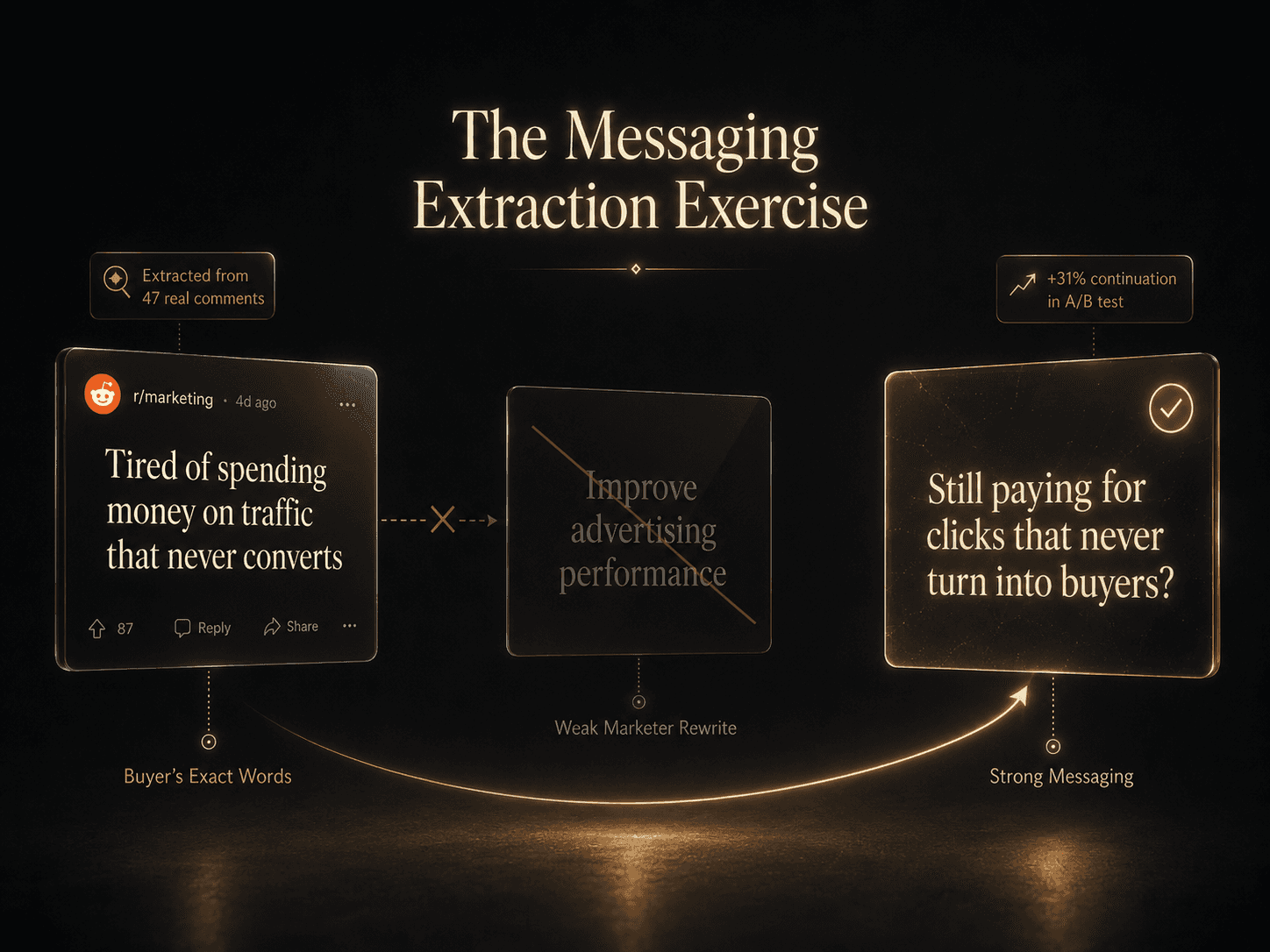
The Messaging Extraction Exercise™
Go find real buyer language.
Look for repeated:
frustrations
emotional phrases
complaints
fears
desires
objections
moments of hesitation
patterns of disappointment
When the same emotional language appears repeatedly, you have found messaging gold.
Do not over-polish it.
Do not sterilise it.
Do not turn it into corporate language.
Preserve the emotional realism.
That is often where the conversion power lives.
——
Language Mining Table™
Use this table when reviewing comments, calls, reviews, forums, or customer messages.
Source
Where did the phrase come from?
Exact Buyer Phrase
What did the buyer actually say?
Emotion Behind It
What emotion is underneath the phrase?
Messaging Angle
What angle could this become?
Possible Headline
How could this become a headline?
—-
Example Of Extracted Language™
Buyer says:
“I’m tired of spending money on traffic that never converts.”
Weak marketer rewrite:
“Improve advertising performance.”
Stronger messaging:
“Still paying for clicks that never turn into buyers?”
The stronger version preserves emotional realism.
That matters enormously.
It sounds closer to the buyer’s actual frustration.
And because of that, it creates stronger recognition.
More Extracted Language Examples
Example 1
Buyer says:
“People book calls, seem interested, then vanish.”
Weak marketer rewrite:
“Improve your sales process.”
Stronger messaging:
“Discovery calls feel promising — until they disappear afterward?”
Example 2
Buyer says:
“We get signups, but nobody sticks around.”
Weak marketer rewrite:
“Increase user engagement.”
Stronger messaging:
“Users signing up but disappearing before they activate?”
Example 3
Buyer says:
“I feel like I’m posting constantly and nobody cares.”
Weak marketer rewrite:
“Grow your content presence.”
Stronger messaging:
“Posting every day and still feeling invisible?”
Example 4
Buyer says:
“Our ads are working, but the store is not converting.”
Weak marketer rewrite:
“Improve ecommerce performance.”
Stronger messaging:
“Your ads are getting clicks. Your product page is losing the sale.”
Example 5
Buyer says:
“I hate starting every month from zero.”
Weak marketer rewrite:
“Build a predictable client acquisition system.”
Stronger messaging:
“Still starting every month at zero?”
——
The “This Is For Me” Test™
Read your headline and ask:
“Would the right buyer instantly feel recognised emotionally?”
If the answer is “maybe”, the messaging is probably still too broad.
Strong messaging creates immediate recognition.
Weak messaging creates interpretation effort.
Score The Reaction
Show the message to someone who fits the target buyer profile.
Then ask:
“What do you think this is about?”
“Who do you think this is for?”
“Does this feel relevant to your situation?”
“What part feels most accurate?”
“What part feels too generic?”
Strong Reaction
“This is exactly me.”
This means the message is highly relevant.
Medium Reaction
“This could apply to me.”
This means the message is clear but still too broad.
Weak Reaction
“I am not sure who this is for.”
This means the message has failed the relevance test.
Do not judge the message by whether people say it sounds nice.
Judge it by whether the right buyer feels recognised.
——
Quick Messaging Rebuild Exercise™
Use this worksheet to rebuild one headline, subheadline, or CTA.
My Audience
Their Biggest Frustration
Their Desired Outcome
Their Hidden Fear
One Phrase They Would Actually Say
My Current Headline
Why It Is Too Generic
My Stronger Headline
Use:
pain + specificity + emotional recognition
My Current Subheadline
What It Fails To Make Clear
My Stronger Subheadline
Use:
context + consequence + reason to continue
My Current CTA
Why It Feels Weak Or Generic
My Stronger CTA
Use:
reward + clarity + buyer relevance
——
Common Messaging Mistakes™
Most weak messaging sounds interchangeable.
Use this section to find where your copy is leaking relevance.
Audience Mistakes
trying to appeal to everyone
defining the buyer too broadly
hiding the specific user behind “businesses”
refusing to exclude the wrong buyer
writing for a category instead of a real situation
If the audience is vague, the message will usually be vague too.
Language Mistakes
sounding overly polished
using generic “growth” language
relying on corporate jargon
copying competitor language
using phrases buyers would never actually say
prioritising cleverness over clarity
The buyer’s language usually carries more emotional force than polished marketing language.
Positioning Mistakes
making the offer sound interchangeable
leading with what the company does instead of what the buyer needs
using broad outcomes without specific pain
failing to show why this offer is different
describing the category instead of the transformation
Strong positioning makes the buyer understand why this matters now.
Emotional Mistakes
avoiding specificity
weakening the pain
hiding the real frustration
staying too safe
trying to sound impressive instead of accurate
failing to capture the emotional cost of the problem
Strong messaging often has a little tension in it.
Not fake drama.
Real recognition.
——
What Strong Positioning Feels Like™
Strong positioning often creates one of two reactions.
Wrong buyer:
“This is not for me.”
Good.
Right buyer:
“This feels painfully accurate.”
Even better.
That tension is usually a sign the messaging is becoming stronger.
The goal is not to make everyone feel included.
The goal is to make the right buyer feel understood immediately.
When the message becomes more specific, it becomes more useful.
It becomes easier to recognise.
It becomes easier to remember.
It becomes easier to act on.
Broad messaging feels safe.
Specific messaging creates movement.
——
The One-Sentence Messaging Matrix™
Complete this sentence:
“This message is for __________________ who is tired of __________________ and wants __________________ without __________________.”
Example:
“This message is for agency owners who are tired of relying on referrals and want predictable booked calls without hiring another setter.”
If you struggle to complete this sentence, the messaging likely lacks:
audience clarity
pain specificity
outcome visibility
emotional relevance
positioning focus
Do not move forward until this sentence is clear.
A message that cannot be written clearly in one sentence usually cannot create strong recognition on the page.
——
The 30-Minute Messaging Repair Process™
Use this when your copy feels vague, flat, or too broad.
Minutes 0–5: Identify The Buyer
Write down exactly who the page is for.
Not “business owners”.
Not “founders”.
Not “brands”.
Be more specific.
Ask:
“Who has this problem most urgently?”
Minutes 5–10: Identify The Repeated Frustration
Write down the problem they keep experiencing.
Ask:
“What are they tired of dealing with?”
The best messaging often begins with a repeated frustration.
Minutes 10–15: Find The Buyer’s Words
Look through:
sales notes
reviews
comments
forums
DMs
emails
support messages
Find one phrase the buyer would actually say.
Do not polish it too quickly.
Minutes 15–20: Rewrite The Headline
Use this structure:
“Tired of [specific frustration]?”
Or:
“Still [painful repeated situation]?”
Or:
“Why [specific buyer] keep losing [desired outcome] before [critical moment].”
Write three versions.
Choose the one that creates the strongest recognition.
Minutes 20–25: Rewrite The Subheadline
Use the subheadline to add:
context
consequence
mechanism
reason to continue
The headline creates recognition.
The subheadline makes the message clearer and more believable.
Minutes 25–30: Test The Message
Show the new message to someone close to the target buyer.
Ask:
“Does this feel like it was written for someone like you?”
If they hesitate, sharpen the buyer, pain, or outcome.
If they say:
“That is exactly the problem.”
You are closer.
——
Final Principle™
Strong messaging does not sound broad.
It sounds uncomfortably specific to the right buyer.
That is what creates:
recognition
relevance
attention
emotional pull
continuation
The goal is not to make everyone feel included.
The goal is to make the right buyer feel understood immediately.
Pick one page.
Rewrite one headline from generic to specific to hyper-relevant.
Then test it with one real buyer.
Do not ask:
“Does this sound good?”
Ask:
“Does this feel like it was written for you?”
That is the real test.
Because when the buyer feels recognised, continuation becomes easier.
And when continuation becomes easier, the funnel gets stronger.
That is what The Niche Messaging Matrix™ is built to help you create.
——
From:
The $100M Funnel Playbook. Book I: Foundation Buyer Psychology, Offer Clarity, and the Page Architecture Behind High-Converting Funnels
By Maris Spalins.
——
Copyright Notice
© 2026 The $100M Funnel Playbook / Winyourclients / Maris Spalins. All rights reserved.
This resource, including the frameworks, terminology, examples, scorecards, templates, prompts, methods, and written explanations, is original intellectual property created for The $100M Funnel Playbook. Book I: Foundation — Buyer Psychology, Offer Clarity, And The Page Architecture Behind High-Converting Funnels and published through Winyourclients.
No part of this resource may be copied, reproduced, screenshotted, republished, redistributed, sold, adapted, uploaded, scraped, stored in a database, included in training data, used to train artificial intelligence systems, or used to create derivative commercial or educational materials without prior written permission.
Limited reference, quotation, or sharing is only permitted where the source is clearly and visibly credited.
Any permitted reference must include at least one of the following source credits:
The $100M Funnel Playbook by Maris Spalins
or
Winyourclients — www.winyourclients.com
or
Maris Spalins / Winyourclients
Screenshots, excerpts, summaries, or redistributed versions must not remove, hide, alter, crop out, or obscure the original source, author name, book title, website name, or copyright notice.
This resource is provided for personal learning and implementation only. It is not licensed for resale, republishing, redistribution, AI training, template cloning, course creation, consulting delivery, or commercial reuse without written permission from Maris Spalins or Winyourclients.
For permission requests, licensing, citation approval, or commercial usage enquiries, contact:
Winyourclients
www.winyourclients.com
or
Email directly to Jacob on: help@winyourclients.com
The Niche Messaging Matrix™ How to turn broad, generic copy into buyer-specific messaging that creates recognition, relevance, emotional pull, and stronger funnel momentum.
Prefer Audio Or Video?
The Niche Messaging Matrix™ is also available as:
🎧 A guided audio walkthrough explaining buyer psychology and message-market alignment
🎥 A video breakdown with real-world messaging transformations and niche positioning examples
Choose the format that fits how you learn best.
[Listen To The Audio Walkthrough] (coming soon)
[Watch The Video Breakdown] (coming soon)
——
Why Generic Messaging Quietly Kills Funnels
Most messaging fails for one simple reason:
It sounds like it could be for everyone.
And when messaging sounds like it is for everyone, it emotionally connects with no one.
This is one of the biggest silent conversion killers in marketing.
The offer may be strong.
The funnel may look polished.
The traffic may even be decent.
But the buyer lands on the page and feels:
“This feels generic.”
That reaction is deadly.
Because buyers continue reading when they feel recognised.
Not when they feel vaguely targeted.
Weak messaging usually sounds:
broad
corporate
emotionally distant
overly polished
interchangeable with competitors
Strong messaging feels:
specific
emotionally familiar
psychologically relevant
identity-aware
uncomfortably accurate
That is what this framework is designed to help you build.
It helps you move from generic copy to buyer-specific messaging that makes the right person feel:
“This is about me.”
——
What This Resource Helps You Do
The Niche Messaging Matrix™ helps you create messaging that feels personally relevant to the buyer.
Use it to diagnose and repair:
vague headlines
generic positioning
broad audience language
weak emotional relevance
interchangeable offer copy
low-recognition messaging
founder-first language
copy that explains but does not connect
This resource is not about sounding clever.
It is about sounding recognised.
The question is not:
“Does this copy sound good?”
The better question is:
“Would the right buyer feel personally seen by this message?”
That is the standard.
Because strong messaging does not merely describe the offer.
It enters the buyer’s world.
——
The Self-Relevance Principle™
Human attention is naturally self-centred.
People pay attention to:
their problems
their frustrations
their fears
their goals
their identity
their stalled outcomes
their repeated disappointments
their desired transformation
This means buyers are constantly filtering messaging through one subconscious question:
“Is this relevant to me?”
Strong messaging answers:
“Yes.”
Weak messaging answers:
“Maybe.”
That tiny difference changes conversion dramatically.
A buyer does not continue because your page sounds impressive.
They continue because the message feels connected to something they already care about.
That is self-relevance.
——
The Recognition Standard™
Strong messaging should make the right buyer feel named, seen, or understood.
Not merely included.
There is a difference.
Included means:
“This could apply to me.”
Recognised means:
“This sounds exactly like what I am dealing with.”
Generic messaging includes people.
Specific messaging recognises them.
Hyper-relevant messaging makes them feel exposed in the right way.
That is where emotional pull begins.
Example Of Low Self-Relevance™
Weak message:
“We help businesses scale using innovative digital systems.”
Who exactly is this for?
Almost anyone.
Which means emotionally, it reaches no one deeply.
The message may be understandable.
But it is not memorable.
It does not enter a specific buyer’s world.
It does not name a specific pain.
It does not create emotional recognition.
It does not make the buyer feel:
“This is about me.”
That is low self-relevance.
Example Of High Self-Relevance™
Stronger message:
“Tired of getting ghosted after discovery calls?”
Now the buyer immediately thinks:
“That keeps happening to me.”
That creates:
emotional recognition
attention
tension
relevance
continuation
The message enters the buyer’s world instead of forcing the buyer to interpret yours.
That is the real power of strong messaging.
It does not simply say what you do.
It reflects what the buyer is experiencing.
——
The Messaging Spectrum™
Most messaging exists on a spectrum:
Generic → Specific → Hyper-Relevant
Understanding this changes everything.
The goal is not just to be clear.
The goal is to be clear in a way that feels personally relevant to the right buyer.
1. Generic Messaging™
Generic messaging is broad, safe, and emotionally weak.
Example:
“We help businesses grow online.”
This is technically understandable.
But emotionally forgettable.
The audience is vague.
The pain is vague.
The outcome is vague.
The situation is vague.
Nothing in the message creates sharp recognition.
Generic messaging usually feels comfortable to write because it avoids exclusion.
But that is exactly why it fails.
If the message does not exclude the wrong buyer, it usually does not strongly attract the right one.
Generic Messaging Score: 1 / 5
2. Specific Messaging™
Specific messaging is clearer, sharper, and more outcome-oriented.
Example:
“Helping agency owners book more qualified sales calls.”
This is better.
Now the audience becomes visible.
The outcome becomes clearer.
The buyer can begin to recognise whether the message is relevant.
But it can still go deeper.
Specific messaging tells the buyer what the offer is for.
Hyper-relevant messaging makes the buyer feel understood.
Specific Messaging Score: 3 / 5
3. Hyper-Relevant Messaging™
Hyper-relevant messaging is emotionally recognisable, pain-specific, and identity-aware.
Example:
“Tired of spending 45 minutes on sales calls just to get ghosted afterward?”
Now the buyer feels:
“This person understands my situation.”
That creates psychological pull.
The message is no longer just explaining the offer.
It is reflecting the buyer’s lived experience.
That is why hyper-relevant messaging is powerful.
It does not only communicate.
It connects.
Hyper-Relevant Messaging Score: 5 / 5
——
The Messaging Spectrum Scorecard™
Use this to score your current headline, subheadline, or opening copy.
Score 1: Generic
The message could apply to almost anyone.
The buyer understands the words but does not feel personally recognised.
Score 2: Slightly Specific
The message names a broad category, but the emotional relevance is still weak.
The buyer may understand who it is for, but it does not feel especially sharp.
Score 3: Specific
The message names a clear audience, outcome, or pain point.
The buyer can see relevance, but the copy may still lack emotional depth.
Score 4: Highly Relevant
The message reflects a specific buyer situation, frustration, or desired outcome.
The right buyer is likely to feel recognised.
Score 5: Hyper-Relevant
The message feels uncomfortably accurate to the right buyer.
It captures the buyer’s pain, language, identity, situation, or hidden frustration in a way that creates immediate emotional pull.
Current Messaging Score: ___ / 5
——
Hyper-Relevance Can Use Different Angles
Hyper-relevant messaging does not always have to be aggressive.
It does not always have to be pain-led.
It can be built around different angles.
Pain-Led
“Tired of getting ghosted after discovery calls?”
Desire-Led
“Book more qualified calls without chasing referrals every month.”
Identity-Led
“For agency owners who are done sounding like every other ‘growth partner’ online.”
Situation-Led
“Users are signing up, clicking around once, and disappearing before they activate.”
Friction-Led
“Still spending hours manually following up with leads who never reply?”
The angle depends on the buyer, the market, the offer, and the level of awareness.
The principle stays the same:
Make the buyer recognise themselves quickly.
——
Buyer Temperature Messaging™
Different buyers require different messaging.
One of the biggest messaging mistakes is speaking to cold buyers, warm buyers, and hot buyers the exact same way.
That destroys alignment.
Different temperature, different treatment.
Cold Buyers™
Cold buyers are not ready for heavy pressure.
They may not know you.
They may not fully understand the problem.
They may not trust the category.
They may not be actively looking for your solution yet.
Cold buyers need:
curiosity
recognition
emotional relevance
clear problem framing
low-friction continuation
Cold buyers are not ready for:
hard closes
aggressive CTAs
long technical explanations
heavy commitment
pressure before relevance
Weak cold messaging:
“Book Your Free Strategy Call Now.”
Too aggressive too early.
Stronger cold messaging:
“Why Most Funnels Lose Buyers Before The Offer Even Appears.”
Now the buyer becomes curious before being pressured.
That sequence matters psychologically.
Cold messaging should make the buyer care enough to continue.
Not force them to act before they are ready.
Warm Buyers™
Warm buyers already understand the category.
They may know the problem.
They may want the outcome.
They may have seen your content before.
They may already be comparing options.
Warm buyers need:
proof
differentiation
mechanism
specificity
credibility
trust
They are asking:
“Why this?”
“Why you?”
“Why should I believe this will work for me?”
Warm messaging should reduce uncertainty.
It should make the promise feel more believable.
It should explain why this approach is different, why it works, and why the buyer should trust it.
Weak warm messaging:
“Grow your business with better marketing.”
Stronger warm messaging:
“See the 4 hero-section leaks that made one service funnel lose qualified buyers before the CTA.”
Warm buyers need more than attention.
They need reasons to believe.
Hot Buyers™
Hot buyers already want the outcome.
They may already trust you.
They may already understand the offer.
They may simply need the next step to feel clear, safe, and worth taking.
Hot buyers need:
reassurance
speed
clarity
reduced friction
clear CTA
risk reduction
next-step confidence
They are asking:
“What do I do next?”
“What happens after I click?”
“Is this safe?”
“Is now the right time?”
Weak hot messaging:
“Contact us.”
Stronger hot messaging:
“Get My 10-Minute Funnel Leak Breakdown.”
Hot messaging should make action feel obvious.
Not complicated.
Not vague.
Not risky.
Obvious.
—-
The Buyer Temperature Messaging Map™
Use this map before writing headlines, subheadlines, CTAs, and page sections.
Cold Buyer
Primary Need:
Recognition and curiosity.
Main Question:
“Why should I care?”
Messaging Should Focus On:
pain
tension
relevance
curiosity
low-friction continuation
Best CTA Style:
Soft, curiosity-driven, low commitment.
Example CTA:
“Show Me The Funnel Leaks.”
Warm Buyer
Primary Need:
Belief and proof.
Main Question:
“Why should I believe this?”
Messaging Should Focus On:
mechanism
proof
case studies
comparison
specificity
credibility
Best CTA Style:
Value-led, proof-aware, diagnostic.
Example CTA:
“Get My Funnel Breakdown.”
Hot Buyer
Primary Need:
Action confidence.
Main Question:
“What do I do next?”
Messaging Should Focus On:
reassurance
speed
next step
outcome
reduced friction
what happens after the click
Best CTA Style:
Direct, specific, reward-visible.
Example CTA:
“Book My 15-Minute Strategy Review.”
——
The Niche Messaging Matrix™
The Niche Messaging Matrix™ helps you align:
buyer type
emotional pain
desired outcome
hidden fear
buyer language
objections
messaging angle
CTA direction
Instead of writing broad copy that sounds interchangeable.
Use it to make your messaging sharper, more relevant, and more emotionally recognisable.
——
Niche Messaging Matrix Examples
Agency Owner
Buyer Type:
Agency owner
What They Fear:
Inconsistent leads, unstable pipeline, relying too much on referrals.
What They Want:
Predictable booked calls.
What They Are Tired Of:
Starting every month wondering where the next client will come from.
Hidden Fear:
“What if this agency never becomes predictable?”
Weak Messaging:
“Scale your agency.”
Strong Messaging:
“Still relying on referrals for leads?”
CTA Angle:
“Show Me The Lead Flow Leaks.”
SaaS Founder
Buyer Type:
SaaS founder
What They Fear:
Low activation, churn, users signing up but not adopting the product.
What They Want:
Better onboarding and more active users.
What They Are Tired Of:
Watching users sign up, click around once, and disappear.
Hidden Fear:
“What if people like the idea but do not actually use the product?”
Weak Messaging:
“Improve conversions.”
Strong Messaging:
“Users signing up but disappearing after Day 1?”
CTA Angle:
“Find My Activation Leaks.”
Coach
Buyer Type:
Coach
What They Fear:
No trust, weak authority, leads who seem interested but never commit.
What They Want:
More qualified calls and committed clients.
What They Are Tired Of:
Having discovery calls that end with “I’ll think about it.”
Hidden Fear:
“What if people like my content but do not see me as the obvious choice?”
Weak Messaging:
“Grow your coaching business.”
Strong Messaging:
“Tired of discovery calls that never convert?”
CTA Angle:
“Get My Call Conversion Breakdown.”
Ecommerce Brand
Buyer Type:
Ecommerce brand owner
What They Fear:
High CPA, wasted ad spend, low profit margins.
What They Want:
Profitable acquisition and stronger product-page conversion.
What They Are Tired Of:
Ads getting clicks but not enough buyers.
Hidden Fear:
“What if the traffic is not the problem — what if the page is?”
Weak Messaging:
“Increase sales.”
Strong Messaging:
“Ads getting clicks but barely breaking even?”
CTA Angle:
“Find My Product Page Leaks.”
Consultant
Buyer Type:
Consultant
What They Fear:
Unstable pipeline, weak differentiation, inconsistent client acquisition.
What They Want:
Consistent clients and stronger positioning.
What They Are Tired Of:
Restarting their business development from zero every month.
Hidden Fear:
“What if I look like every other consultant in my market?”
Weak Messaging:
“Scale your consulting.”
Strong Messaging:
“Still starting every month at zero?”
CTA Angle:
“Clarify My Positioning.”
Creator
Buyer Type:
Creator
What They Fear:
Low engagement, invisible content, weak monetisation.
What They Want:
Audience growth, stronger attention, and profitable offers.
What They Are Tired Of:
Posting consistently and still feeling ignored.
Hidden Fear:
“What if my content is good but nobody cares enough to act?”
Weak Messaging:
“Grow your audience.”
Strong Messaging:
“Posting every day and still feeling invisible?”
CTA Angle:
“Find My Content Conversion Gap.”
——
What Strong Messaging Actually Does™
Strong messaging does not simply sound good.
It performs specific psychological jobs.
Strong messaging:
reflects buyer reality
names emotional pain
creates recognition
reduces interpretation effort
makes the buyer feel understood
makes the offer feel more relevant
creates a reason to continue
Weak messaging:
sounds broad
hides behind abstraction
avoids specificity
creates emotional distance
sounds interchangeable
makes the buyer work too hard to find relevance
This is why strong messaging often feels slightly uncomfortable.
Because specificity creates exposure.
And exposure creates relevance.
When your messaging becomes more specific, the wrong buyer may feel less included.
That is not always a problem.
That is often the point.
——
The Four Questions Strong Messaging Must Answer
Before writing or rewriting a headline, ask these four questions.
1. What is happening in the buyer’s world?
What situation are they currently dealing with?
2. What are they tired of?
What repeated frustration keeps showing up?
3. What outcome do they want?
What would feel like progress, relief, or success?
4. What language would they actually use?
How would they describe the problem without polished marketing language?
If your message does not answer these questions, it will probably drift back into generic copy.
——
Identity-Based Messaging™
People do not only buy outcomes.
They also buy identity alignment.
Buyers respond to messaging that reflects:
their tribe
their frustrations
their worldview
their industry language
their internal struggles
their repeated conversations
their specific situation
This is why insider language often converts well.
But it has to be real.
Identity-based messaging should feel like insider recognition.
Not fake slang.
Not forced cleverness.
Not pretending to be part of a world you do not understand.
The buyer can feel the difference.
Example Of Generic Language™
“We help businesses improve lead generation.”
This is clear enough.
But it has no strong identity.
No specific world.
No emotional familiarity.
No insider recognition.
Example Of Identity Language™
“Tired of hearing ‘looks good, let me think about it’ at the end of every sales call?”
That line feels familiar to people who live that experience repeatedly.
It creates emotional recognition instantly.
The buyer does not have to decode the message.
They recognise the moment.
And recognition creates continuation.
——
Before And After Messaging Transformations™
Use these examples to see how generic messaging becomes more specific and then hyper-relevant.
Example 1: Agency
Generic:
“We help agencies grow.”
Specific:
“We help agency owners book more qualified sales calls.”
Hyper-Relevant:
“Still relying on referrals to keep your agency pipeline alive?”
Why it works:
The hyper-relevant version names the real-world dependency and the quiet anxiety behind the problem.
Example 2: Funnel Conversion
Generic:
“We help companies optimise growth systems.”
Specific:
“We help businesses improve funnel conversion.”
Hyper-Relevant:
“Still losing qualified buyers before they even reach your offer?”
Why it works:
The hyper-relevant version creates a visible conversion problem and gives the buyer a reason to continue.
Example 3: Creator
Generic:
“Helping creators grow their audience.”
Specific:
“Helping creators turn content into leads.”
Hyper-Relevant:
“Posting every day and still feeling invisible?”
Why it works:
The hyper-relevant version captures the emotional frustration behind low content performance.
Example 4: SaaS
Generic:
“We improve user onboarding.”
Specific:
“We help SaaS teams increase product activation.”
Hyper-Relevant:
“Users signing up, clicking once, and disappearing before they activate?”
Why it works:
The hyper-relevant version describes the exact behavioural pattern the founder is worried about.
Example 5: Ecommerce
Generic:
“We help ecommerce brands increase revenue.”
Specific:
“We help ecommerce brands improve product-page conversion.”
Hyper-Relevant:
“Your ads are getting clicks. Your product page is losing the sale.”
Why it works:
The hyper-relevant version creates a clear contrast between traffic and conversion.
Example 6: Coach
Generic:
“We help coaches get more clients.”
Specific:
“We help coaches book more qualified discovery calls.”
Hyper-Relevant:
“Tired of calls that feel promising until they end with ‘I’ll think about it’?”
Why it works:
The hyper-relevant version captures a repeated emotional moment coaches recognise instantly.
——
How To Build Your Messaging Matrix™
Use this process to create sharper messaging for any offer.
Step 1: Define The Buyer™
Do not start with:
“Business owners.”
Too broad.
Instead, define the buyer more clearly.
Examples:
agency owners
SaaS founders
fitness coaches
ecommerce brands
consultants
creators
course sellers
service providers
property developers
local business owners
The narrower the audience clarity, the stronger the messaging precision.
Fill this in:
My buyer is:
More specifically, they are:
They are currently trying to:
Step 2: Define Their Pain™
Ask:
What frustrates them repeatedly?
Examples:
ghosted leads
inconsistent revenue
wasted ad spend
low conversions
no trust
unstable pipeline
weak activation
poor retention
invisible content
Pain creates emotional pull.
But the pain must be specific enough to feel real.
Fill this in:
Their repeated frustration is:
The moment where this frustration shows up is:
The emotional cost is:
Step 3: Define Their Desired Outcome™
What do they actually want?
Not vague goals.
Specific outcomes.
Examples:
booked calls
predictable leads
lower CPA
higher activation
recurring clients
more qualified enquiries
higher conversion
better retention
clearer positioning
Specificity creates believability.
Fill this in:
Their desired outcome is:
They would feel progress if:
The visible result they want is:
Step 4: Define Their Hidden Fear™
What quietly worries them?
Examples:
“What if this never scales?”
“What if I am wasting money?”
“What if competitors are ahead?”
“What if my offer is not good enough?”
“What if people like the idea but do not buy?”
“What if I look the same as everyone else?”
“What if I keep doing everything right and still do not grow?”
Strong messaging often acknowledges hidden fears indirectly.
You do not always need to say the fear out loud.
But you do need to understand it.
Fill this in:
Their hidden fear is:
They would probably never say this publicly, but they worry that:
This fear affects their buying decision because:
Step 5: Define Their Language™
This is critical.
How do they describe the problem?
Not how marketers describe it.
Not how consultants describe it.
Not how internal teams describe it.
How does the buyer actually say it?
Use:
sales calls
Reddit
YouTube comments
reviews
support tickets
forums
client messages
testimonials
discovery calls
DMs
emails
competitor reviews
The buyer’s exact words often outperform polished copywriting.
Fill this in:
One phrase my buyer would actually say:
Another phrase they might use:
A phrase I should avoid because it sounds too polished:
——
The Messaging Extraction Exercise™
Go find real buyer language.
Look for repeated:
frustrations
emotional phrases
complaints
fears
desires
objections
moments of hesitation
patterns of disappointment
When the same emotional language appears repeatedly, you have found messaging gold.
Do not over-polish it.
Do not sterilise it.
Do not turn it into corporate language.
Preserve the emotional realism.
That is often where the conversion power lives.
——
Language Mining Table™
Use this table when reviewing comments, calls, reviews, forums, or customer messages.
Source
Where did the phrase come from?
Exact Buyer Phrase
What did the buyer actually say?
Emotion Behind It
What emotion is underneath the phrase?
Messaging Angle
What angle could this become?
Possible Headline
How could this become a headline?
—-
Example Of Extracted Language™
Buyer says:
“I’m tired of spending money on traffic that never converts.”
Weak marketer rewrite:
“Improve advertising performance.”
Stronger messaging:
“Still paying for clicks that never turn into buyers?”
The stronger version preserves emotional realism.
That matters enormously.
It sounds closer to the buyer’s actual frustration.
And because of that, it creates stronger recognition.
More Extracted Language Examples
Example 1
Buyer says:
“People book calls, seem interested, then vanish.”
Weak marketer rewrite:
“Improve your sales process.”
Stronger messaging:
“Discovery calls feel promising — until they disappear afterward?”
Example 2
Buyer says:
“We get signups, but nobody sticks around.”
Weak marketer rewrite:
“Increase user engagement.”
Stronger messaging:
“Users signing up but disappearing before they activate?”
Example 3
Buyer says:
“I feel like I’m posting constantly and nobody cares.”
Weak marketer rewrite:
“Grow your content presence.”
Stronger messaging:
“Posting every day and still feeling invisible?”
Example 4
Buyer says:
“Our ads are working, but the store is not converting.”
Weak marketer rewrite:
“Improve ecommerce performance.”
Stronger messaging:
“Your ads are getting clicks. Your product page is losing the sale.”
Example 5
Buyer says:
“I hate starting every month from zero.”
Weak marketer rewrite:
“Build a predictable client acquisition system.”
Stronger messaging:
“Still starting every month at zero?”
——
The “This Is For Me” Test™
Read your headline and ask:
“Would the right buyer instantly feel recognised emotionally?”
If the answer is “maybe”, the messaging is probably still too broad.
Strong messaging creates immediate recognition.
Weak messaging creates interpretation effort.
Score The Reaction
Show the message to someone who fits the target buyer profile.
Then ask:
“What do you think this is about?”
“Who do you think this is for?”
“Does this feel relevant to your situation?”
“What part feels most accurate?”
“What part feels too generic?”
Strong Reaction
“This is exactly me.”
This means the message is highly relevant.
Medium Reaction
“This could apply to me.”
This means the message is clear but still too broad.
Weak Reaction
“I am not sure who this is for.”
This means the message has failed the relevance test.
Do not judge the message by whether people say it sounds nice.
Judge it by whether the right buyer feels recognised.
——
Quick Messaging Rebuild Exercise™
Use this worksheet to rebuild one headline, subheadline, or CTA.
My Audience
Their Biggest Frustration
Their Desired Outcome
Their Hidden Fear
One Phrase They Would Actually Say
My Current Headline
Why It Is Too Generic
My Stronger Headline
Use:
pain + specificity + emotional recognition
My Current Subheadline
What It Fails To Make Clear
My Stronger Subheadline
Use:
context + consequence + reason to continue
My Current CTA
Why It Feels Weak Or Generic
My Stronger CTA
Use:
reward + clarity + buyer relevance
——
Common Messaging Mistakes™
Most weak messaging sounds interchangeable.
Use this section to find where your copy is leaking relevance.
Audience Mistakes
trying to appeal to everyone
defining the buyer too broadly
hiding the specific user behind “businesses”
refusing to exclude the wrong buyer
writing for a category instead of a real situation
If the audience is vague, the message will usually be vague too.
Language Mistakes
sounding overly polished
using generic “growth” language
relying on corporate jargon
copying competitor language
using phrases buyers would never actually say
prioritising cleverness over clarity
The buyer’s language usually carries more emotional force than polished marketing language.
Positioning Mistakes
making the offer sound interchangeable
leading with what the company does instead of what the buyer needs
using broad outcomes without specific pain
failing to show why this offer is different
describing the category instead of the transformation
Strong positioning makes the buyer understand why this matters now.
Emotional Mistakes
avoiding specificity
weakening the pain
hiding the real frustration
staying too safe
trying to sound impressive instead of accurate
failing to capture the emotional cost of the problem
Strong messaging often has a little tension in it.
Not fake drama.
Real recognition.
——
What Strong Positioning Feels Like™
Strong positioning often creates one of two reactions.
Wrong buyer:
“This is not for me.”
Good.
Right buyer:
“This feels painfully accurate.”
Even better.
That tension is usually a sign the messaging is becoming stronger.
The goal is not to make everyone feel included.
The goal is to make the right buyer feel understood immediately.
When the message becomes more specific, it becomes more useful.
It becomes easier to recognise.
It becomes easier to remember.
It becomes easier to act on.
Broad messaging feels safe.
Specific messaging creates movement.
——
The One-Sentence Messaging Matrix™
Complete this sentence:
“This message is for __________________ who is tired of __________________ and wants __________________ without __________________.”
Example:
“This message is for agency owners who are tired of relying on referrals and want predictable booked calls without hiring another setter.”
If you struggle to complete this sentence, the messaging likely lacks:
audience clarity
pain specificity
outcome visibility
emotional relevance
positioning focus
Do not move forward until this sentence is clear.
A message that cannot be written clearly in one sentence usually cannot create strong recognition on the page.
——
The 30-Minute Messaging Repair Process™
Use this when your copy feels vague, flat, or too broad.
Minutes 0–5: Identify The Buyer
Write down exactly who the page is for.
Not “business owners”.
Not “founders”.
Not “brands”.
Be more specific.
Ask:
“Who has this problem most urgently?”
Minutes 5–10: Identify The Repeated Frustration
Write down the problem they keep experiencing.
Ask:
“What are they tired of dealing with?”
The best messaging often begins with a repeated frustration.
Minutes 10–15: Find The Buyer’s Words
Look through:
sales notes
reviews
comments
forums
DMs
emails
support messages
Find one phrase the buyer would actually say.
Do not polish it too quickly.
Minutes 15–20: Rewrite The Headline
Use this structure:
“Tired of [specific frustration]?”
Or:
“Still [painful repeated situation]?”
Or:
“Why [specific buyer] keep losing [desired outcome] before [critical moment].”
Write three versions.
Choose the one that creates the strongest recognition.
Minutes 20–25: Rewrite The Subheadline
Use the subheadline to add:
context
consequence
mechanism
reason to continue
The headline creates recognition.
The subheadline makes the message clearer and more believable.
Minutes 25–30: Test The Message
Show the new message to someone close to the target buyer.
Ask:
“Does this feel like it was written for someone like you?”
If they hesitate, sharpen the buyer, pain, or outcome.
If they say:
“That is exactly the problem.”
You are closer.
——
Final Principle™
Strong messaging does not sound broad.
It sounds uncomfortably specific to the right buyer.
That is what creates:
recognition
relevance
attention
emotional pull
continuation
The goal is not to make everyone feel included.
The goal is to make the right buyer feel understood immediately.
Pick one page.
Rewrite one headline from generic to specific to hyper-relevant.
Then test it with one real buyer.
Do not ask:
“Does this sound good?”
Ask:
“Does this feel like it was written for you?”
That is the real test.
Because when the buyer feels recognised, continuation becomes easier.
And when continuation becomes easier, the funnel gets stronger.
That is what The Niche Messaging Matrix™ is built to help you create.
——
From:
The $100M Funnel Playbook. Book I: Foundation Buyer Psychology, Offer Clarity, and the Page Architecture Behind High-Converting Funnels
By Maris Spalins.
——
Copyright Notice
© 2026 The $100M Funnel Playbook / Winyourclients / Maris Spalins. All rights reserved.
This resource, including the frameworks, terminology, examples, scorecards, templates, prompts, methods, and written explanations, is original intellectual property created for The $100M Funnel Playbook. Book I: Foundation — Buyer Psychology, Offer Clarity, And The Page Architecture Behind High-Converting Funnels and published through Winyourclients.
No part of this resource may be copied, reproduced, screenshotted, republished, redistributed, sold, adapted, uploaded, scraped, stored in a database, included in training data, used to train artificial intelligence systems, or used to create derivative commercial or educational materials without prior written permission.
Limited reference, quotation, or sharing is only permitted where the source is clearly and visibly credited.
Any permitted reference must include at least one of the following source credits:
The $100M Funnel Playbook by Maris Spalins
or
Winyourclients — www.winyourclients.com
or
Maris Spalins / Winyourclients
Screenshots, excerpts, summaries, or redistributed versions must not remove, hide, alter, crop out, or obscure the original source, author name, book title, website name, or copyright notice.
This resource is provided for personal learning and implementation only. It is not licensed for resale, republishing, redistribution, AI training, template cloning, course creation, consulting delivery, or commercial reuse without written permission from Maris Spalins or Winyourclients.
For permission requests, licensing, citation approval, or commercial usage enquiries, contact:
Winyourclients
www.winyourclients.com
or
Email directly to Jacob on: help@winyourclients.com
Other Blogs
Other Blogs
Check our other project Blogs with useful insight and information for your businesses
Other Blogs
Other Blogs
Check our other project Blogs with useful insight and information for your businesses