Our Three Step Process
May 25, 2026
Chap 2 | Resource 4 | The Message Translation Grid™
Our Three Step Process
May 25, 2026
Chap 2 | Resource 4 | The Message Translation Grid™
The Message Translation Grid™ A funnel messaging worksheet for turning buyer psychology, pain, voice-of-customer language, objections, and proof needs into headlines, hooks, CTAs, proof sections, and emotionally coherent page copy.
Prefer Audio Or Video?
The Message Translation Grid™ is also available as:
🎧 A guided audio walkthrough explaining emotional translation, funnel psychology, and messaging deployment
🎥 A practical video breakdown with real buyer insights translated into headlines, hooks, proof sections, and CTA examplesChoose the format that fits how you learn best.
[Listen To The Audio Walkthrough] (coming soon)
[Watch The Video Breakdown] (coming soon)
——
Why Great Research Still Produces Weak Copy
This is one of the biggest hidden problems in marketing.
People collect:
customer interviews
reviews
voice-of-customer data
emotional insights
objections
buyer frustrations
pain points
failed attempts
proof needs
And still end up with copy that feels:
generic
disconnected
emotionally flat
strategically weak
randomly intense
poorly sequenced
hard to believe
Why?
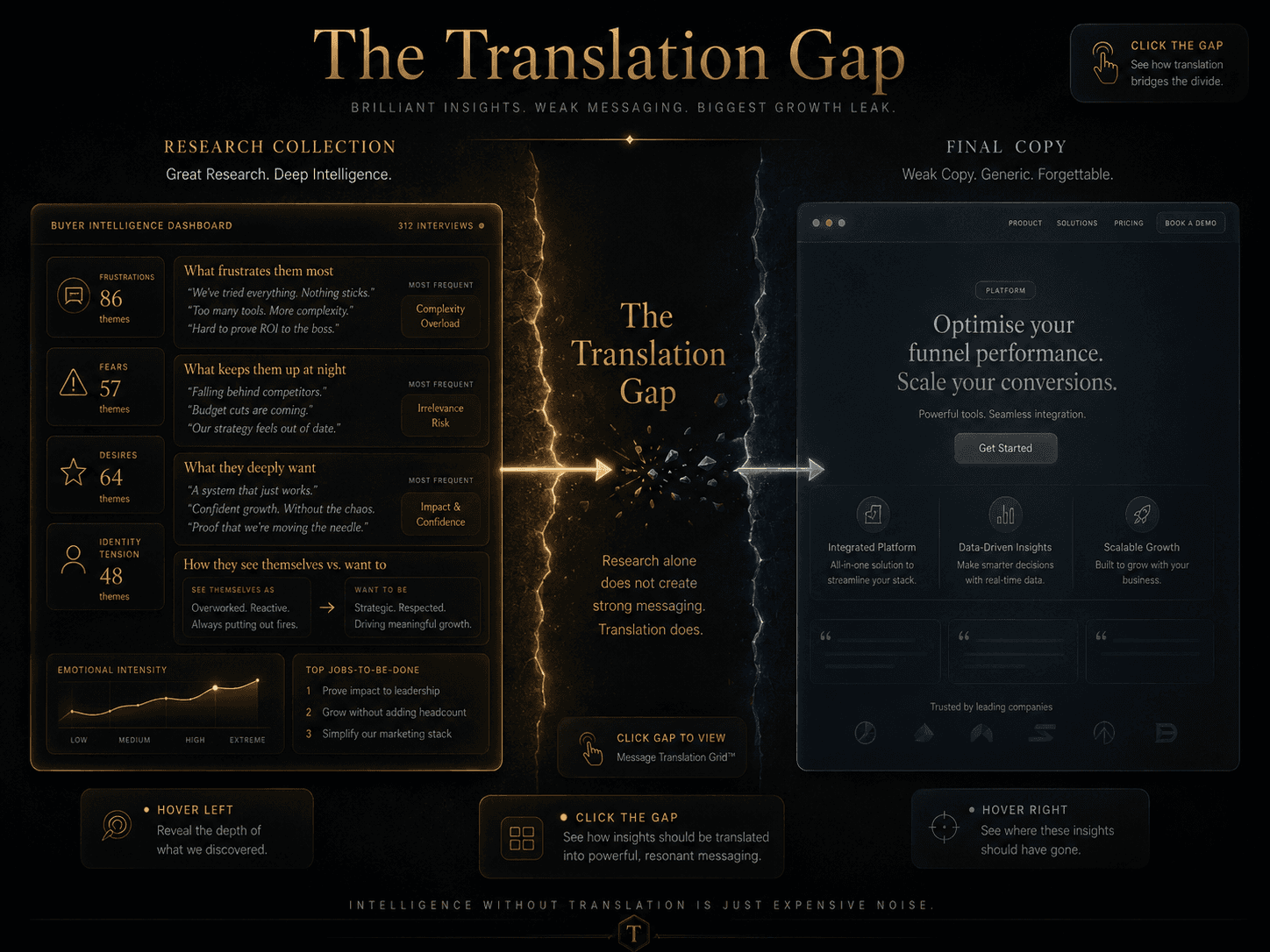
Because research alone does not create strong messaging.
Translation does.
That distinction matters enormously.
Research is what you know.
Translation is what the buyer feels on the page.
Most marketers gather buyer intelligence but never learn how to deploy it correctly inside the funnel.
So the final messaging becomes random emotional dumping.
Pressure appears in the wrong places.
Proof arrives too late.
Identity language shows up before clarity.
The CTA feels disconnected from the emotional buildup.
Objections are handled after the buyer has already emotionally left.
The funnel becomes psychologically fragmented.
That is exactly what The Message Translation Grid™ is designed to solve.
It helps you turn buyer psychology into clear, structured, emotionally coherent funnel messaging.
——
What This Resource Helps You Do
The Message Translation Grid™ helps you take buyer research and place it into the correct parts of the funnel.
Use it to turn:
buyer pain into hooks
buyer pressure into headlines
buyer desire into CTAs
buyer resistance into objection handling
buyer proof needs into trust sections
buyer identity tension into deeper resonance
buyer language into page copy
buyer psychology into funnel structure
The goal is not to throw every emotional insight onto the page.
The goal is to deploy each insight where it belongs.
Because strong funnels are not emotional storage containers.
They are emotional progression systems.
——
The Translation Principle™
Different emotional insights belong in different parts of the funnel.
This is critical.
Not every insight belongs:
in the headline
in the CTA
in the proof section
in the hook
in the objection block
in the offer section
Strong messaging deploys psychology intentionally.
Weak messaging throws emotional information everywhere randomly.
That creates:
confusion
emotional overload
weak sequencing
broken momentum
trust gaps
premature CTAs
copy that feels intense but not persuasive
Every insight needs a job.
Every page section needs the right emotional weight.
That is the core rule.
——
Bad Translation Example™
Buyer fear:
“I’m worried my funnel still feels untrustworthy.”
Bad deployment:
CTA button:
“Are You Secretly Losing Trust?”
Wrong location.
Too heavy.
Too emotionally awkward.
Too much pressure for a button.
That emotional insight belongs earlier in the funnel.
Not inside the CTA.
——
Stronger Translation™
Headline:
“Still Sending Traffic To A Funnel You Quietly Don’t Trust Yet?”
Proof section:
“See The Before/After Funnel Rebuild.”
CTA:
“Get My Funnel Breakdown.”
Now the emotional sequence feels:
natural
coherent
psychologically aligned
easier to follow
less forced
The fear creates relevance.
The proof reduces uncertainty.
The CTA offers movement.
That is proper translation.
——
More Bad Translation Examples™
Bad Translation 1: Identity Tension Too Early
Buyer insight:
“I feel like I should be further ahead by now.”
Bad headline:
“Are You Embarrassed By How Far Behind You Are?”
Too aggressive.
Too exposed.
Too early.
The buyer has not yet felt safe enough for that level of emotional intensity.
Better placement:
Use this insight later in the page, after clarity and relevance have already been established.
Stronger line:
“The frustrating part is not just that the page is underperforming. It is that you know the offer is stronger than the message currently makes it feel.”
Bad Translation 2: Proof Need Hidden Too Late
Buyer insight:
“I do not trust another framework unless I can see what actually changes.”
Bad deployment:
Proof appears only at the very bottom of the page.
Too late.
Doubt hardens before reassurance appears.
Better placement:
Bring proof closer to the first major claim.
Stronger proof cue:
“See the before-and-after message breakdown, including what changed and why the original version was leaking belief.”
Bad Translation 3: Desire Before Diagnosis
Buyer insight:
“I want to feel confident sending traffic again.”
Bad opening:
“Imagine scaling your funnel with total confidence.”
Too soon.
The buyer may not yet feel understood.
Better sequence:
First name the hesitation.
Then offer the desired shift.
Stronger sequence:
“Still hesitating before sending traffic to a page that looks finished but does not feel trustworthy yet? The goal is not another prettier version. The goal is the clarity to know where belief is being won or lost before the next click arrives.”
——
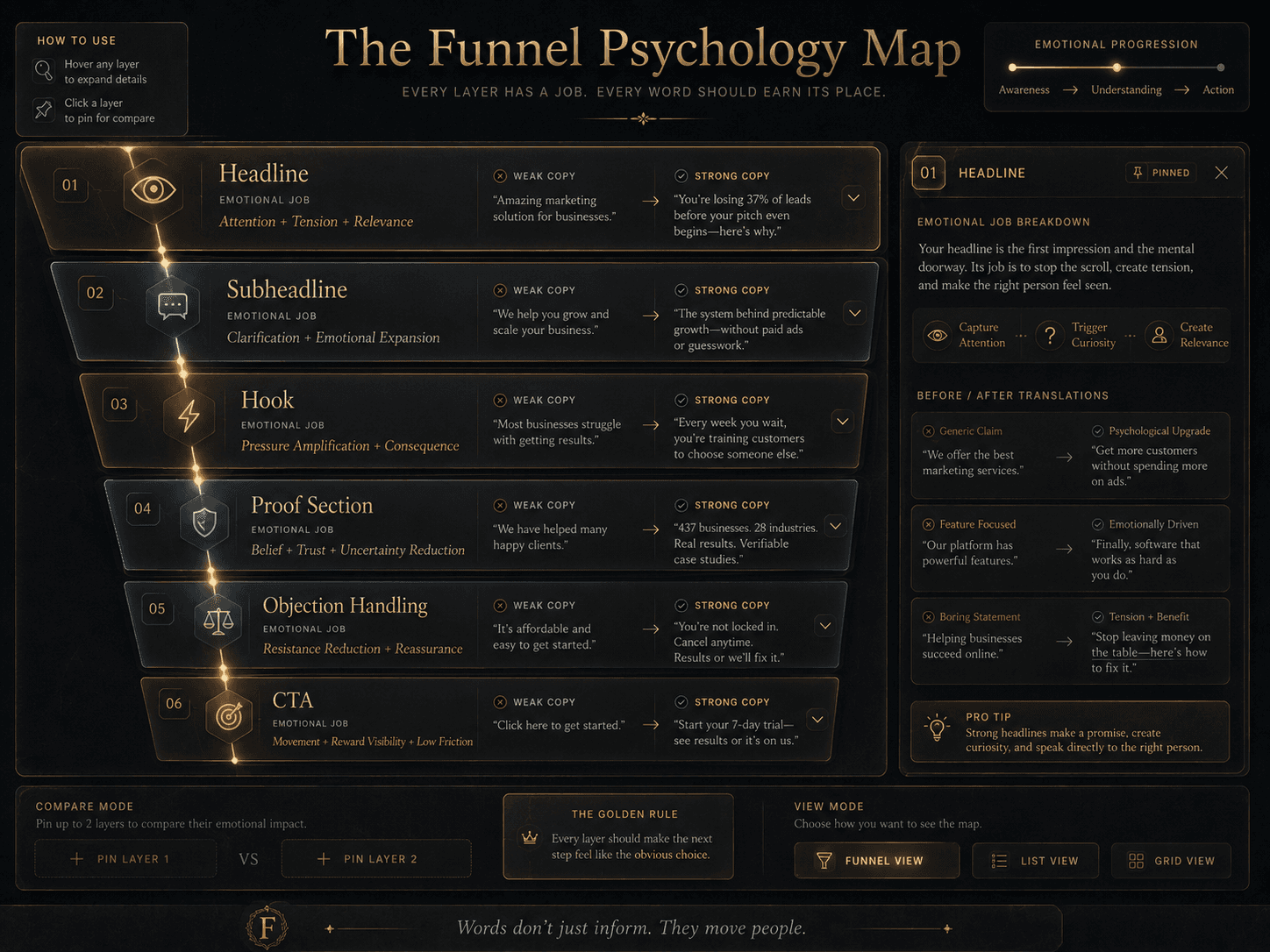
The Funnel Psychology Map™
Each funnel component has a different emotional job.
Understanding this changes messaging quality dramatically.
Headline™
Primary Role
The headline creates:
attention
relevance
tension
recognition
continuation
The headline should interrupt, recognise, or provoke curiosity.
It should usually translate the strongest live pressure, broken belief, or recognisable moment.
Good Headline Inputs
Use buyer insights such as:
open wound
live pressure
visible consequence
broken belief
strong VOC phrase
recognisable moment
future concern
Headline Example
Buyer insight:
“I keep getting traffic, but I still do not trust the page.”
Headline:
“Still Sending Traffic To A Page You Quietly Don’t Trust?”
Subheadline™
Primary Role
The subheadline creates:
clarification
emotional expansion
payoff visibility
mechanism framing
stronger context
continuation support
The subheadline should deepen understanding after the headline creates attention.
It should answer:
What is this about?
Who is it for?
Why does it matter?
What will this help me understand or do?
Good Subheadline Inputs
Use buyer insights such as:
surface problem
operational friction
desired shift
mechanism
pain stack
promise clarification
Subheadline Example
“If cold traffic lands, hesitates, and disappears before belief forms, the problem may not be traffic. It may be the psychological sequence your page is failing to create.”
Hook™
Primary Role
The hook creates:
emotional engagement
pattern interruption
pressure amplification
consequence visibility
continuation pull
The hook creates movement.
It should make the buyer feel:
“This is about the exact situation I am in.”
Good Hook Inputs
Use buyer insights such as:
frustration language
private thought
failed attempts
repeated pattern
emotional cost
future fear
Hook Example
“You have changed the headline, cleaned up the layout, and adjusted the CTA. But if belief still collapses before the buyer reaches the offer, the real leak was never cosmetic.”
Offer Section™
Primary Role
The offer section creates:
value framing
mechanism clarity
transformation
belief-building
perceived relevance
decision confidence
The offer section should show how the solution addresses the actual buyer pressure.
It should not simply list features.
It should explain what changes and why that change matters.
Good Offer Section Inputs
Use buyer insights such as:
desired outcome
broken belief
proof need
mechanism
operational friction
identity gap
resistance point
Offer Section Example
“This is not a cosmetic rewrite. It is a buyer-pressure diagnosis that shows where your page loses attention, relevance, belief, trust, or action — so you can fix the sequence instead of guessing at the wording.”
Proof Section™
Primary Role
The proof section creates:
belief
trust
uncertainty reduction
scepticism management
credibility
reassurance
Proof stabilises emotional momentum.
It should appear close to the claims it supports.
Proof that arrives too late often loses power because doubt has already hardened.
Good Proof Inputs
Use buyer insights such as:
proof threshold
resistance language
failed attempts
scepticism
claims that need support
before/after contrast
Proof Section Example
“See the before-and-after rewrite, what changed, and why the original version was leaking belief before the CTA.”
Objection Handling™
Primary Role
Objection handling creates:
resistance reduction
fear neutralisation
distrust management
misunderstanding clarification
reassurance
Weak objection handling argues.
Strong objection handling reassures.
The buyer should feel understood, not cornered.
Good Objection Inputs
Use buyer insights such as:
resistance language
regret history
failed attempts
distrust triggers
hidden fear
“I’ve tried this before” language
Objection Handling Example
“If you are tired of generic funnel advice that sounds impressive but changes nothing operationally, you are not alone. This is designed to show where the buyer’s belief actually breaks — not give you another vague list of best practices.”
CTA™
Primary Role
The CTA creates:
movement
reward visibility
low-friction continuation
next-step clarity
action confidence
The CTA should feel natural.
Not forced.
It should translate the buyer’s desired next emotional state, not just the business’s desired action.
Good CTA Inputs
Use buyer insights such as:
desired relief
next diagnostic step
curiosity
low-friction movement
proof need
outcome language
CTA Example
Weak:
“Submit.”
Stronger:
“Show Me The Missing Funnel Gaps.”
Better CTAs make the click feel like progress.
Not admin.
——
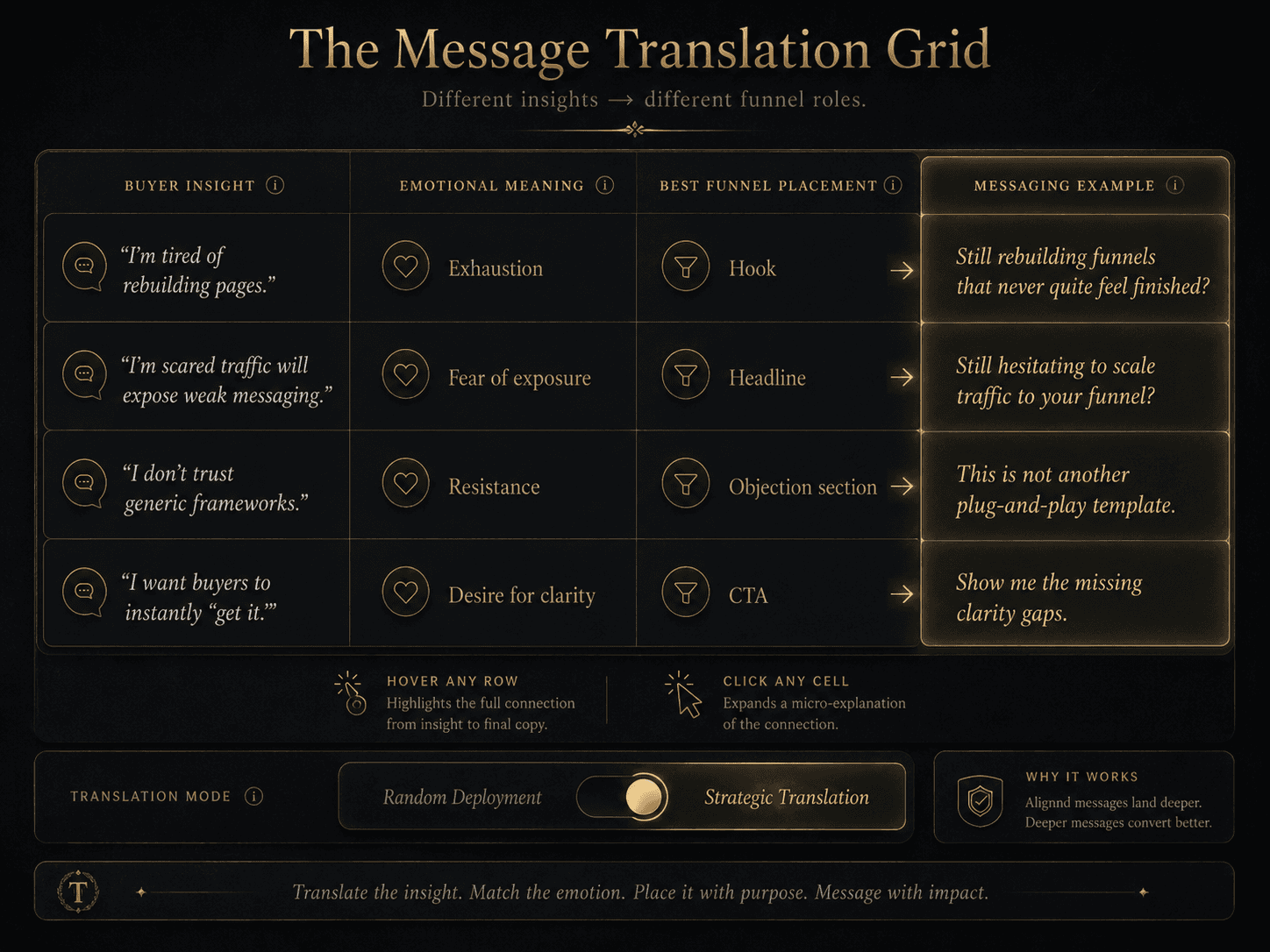
The Message Translation Grid™
Use this grid to deploy buyer psychology intentionally instead of randomly.
For each buyer insight, identify what it means emotionally, where it belongs in the funnel, and how it should be translated into copy.
Buyer Insight
What did the buyer say, feel, fear, want, resist, or reveal?
Buyer insight:
Source
Where did this insight come from?
Examples:
Black File, Pain Stack, VOC research, sales call, review, DM, survey, support ticket, objection, testimonial.
Source:
Emotional Type
What kind of emotional insight is this?
Choose one:
frustration
fear
identity tension
desire
resistance
future concern
proof need
operational friction
hidden belief
private thought
Emotional type:
Buyer Meaning
What does this insight actually mean psychologically?
Buyer meaning:
Best Funnel Placement
Where does this insight belong?
Choose one:
headline
subheadline
hook
offer section
proof section
objection handling
CTA
CTA microcopy
closing section
Best funnel placement:
Weak Translation
How would this insight sound if translated badly?
Weak translation:
Strong Translation
How can this insight be translated accurately and naturally?
Strong translation:
Final Page Copy
What final line, section, CTA, proof cue, or paragraph will appear on the page?
Final page copy:
Why It Belongs There
Why does this insight belong in this part of the funnel?
Reason:
Translation Rules By Funnel Section™
Use these rules to decide where each buyer insight belongs.
Translating Pressure Into Headlines™
Headlines work best when they translate:
live pressure
emotional friction
visible consequence
broken belief
recognisable moments
future concern
identity tension used carefully
They do not work as well when they simply describe generic categories.
Weak Headline™
“Improve Your Funnel Performance.”
Technically clear.
Emotionally interchangeable.
Pressure-Translated Headline™
“Still Getting Clicks But Quietly Avoiding Looking At The Conversion Rate?”
Now the pressure feels:
human
specific
recognisable
emotionally active
Why This Works
The stronger version:
mirrors internal experience
creates recognition
exposes tension
increases continuation
feels closer to real buyer pressure
That creates emotional pull naturally.
Translating Resistance Into Objection Handling™
Most objection handling fails because it argues logically.
But resistance is often emotional.
The buyer may not only be asking:
“Does this work?”
They may also be thinking:
“I have tried things like this before.”
“I do not trust another generic framework.”
“I do not want another promise that sounds good but changes nothing.”
“I do not know if this applies to my situation.”
“I have seen too many inflated claims.”
That resistance needs to be handled with empathy and specificity.
Weak Objection Handling™
“Our framework is proven to work.”
Corporate.
Flat.
Emotionally weak.
Stronger Translation™
“If you are tired of generic funnel advice that sounds impressive but changes nothing operationally, you are not alone.”
Now the buyer feels understood.
Not sold to.
That lowers resistance.
Translating Desire Into CTA Language™
Desire should shape the emotional reward behind the click.
Weak CTAs often ignore buyer motivation completely.
They describe the action the business wants.
Not the progress the buyer wants.
Weak CTA™
“Submit.”
Emotionally dead.
Administrative.
Low reward visibility.
Desire-Translated CTA™
“Show Me The Missing Funnel Gaps.”
Now the CTA feels like movement toward relief.
That changes click psychology dramatically.
CTA Rule
The CTA should translate the buyer’s desired next emotional state.
Examples:
clarity
relief
diagnosis
confidence
certainty
control
progress
proof
A good CTA makes the buyer feel:
“This click helps me move forward.”
Translating Future Fear Into Hooks™
Future fear works best early enough to create tension, but not so aggressively that it feels manipulative.
Future fear should reveal consequence.
Not manufacture panic.
Weak Future Framing™
“Improve your business growth.”
Too vague.
Too abstract.
Too soft.
Stronger Future Translation™
“If this keeps going, you may spend another year rebuilding symptoms instead of fixing the real conversion problem underneath them.”
Now the buyer feels trajectory risk.
That increases urgency naturally.
The line works because it does not invent fear.
It reveals the cost of the current pattern continuing.
Translating Proof Needs Into Trust Sections™
Proof should not be random.
Proof should answer the buyer’s current doubt.
If the buyer distrusts generic frameworks, proof should show specificity.
If the buyer worries the page will not work for their situation, proof should show relevant examples.
If the buyer fears exaggerated claims, proof should be grounded, specific, and believable.
Weak Proof Translation™
“Trusted by ambitious founders.”
Too broad.
Too easy to ignore.
Stronger Proof Translation™
“See the before-and-after message rewrite, including what changed, why the original version was leaking belief, and how the stronger version creates clearer buyer recognition.”
Now the proof supports a specific claim.
That makes it more believable.
Translating Identity Tension Into Deeper Resonance™
Identity tension is powerful, but it must be placed carefully.
If used too early, it may feel aggressive.
If used accurately after clarity and relevance exist, it can create strong recognition.
Weak Identity Translation™
“You are behind because your messaging is weak.”
Too harsh.
Too blunt.
Too likely to trigger defensiveness.
Stronger Identity Translation™
“The frustrating part is not just that the page is underperforming. It is that you know the offer is stronger than the message currently makes it feel.”
This preserves the pressure without attacking the buyer.
That is the standard.
Weak Translation vs Strong Translation™
Use these examples to understand how good research gets destroyed or strengthened during translation.
Example 1: Overwhelm
Buyer insight:
“They feel overwhelmed rebuilding the funnel repeatedly.”
Weak translation:
“Solutions designed for scalability and optimisation.”
Research completely lost.
Strong translation:
“Tired of redesigning the funnel every month while the real problem still stays hidden underneath it?”
Now the messaging preserves:
pressure
emotional realism
frustration
failed attempt history
recognition
Example 2: Distrust Of Gurus
Buyer insight:
“They distrust gurus.”
Weak translation:
“Our proven methodology delivers exceptional results.”
Terrible translation.
It sounds exactly like the kind of thing the buyer distrusts.
Strong translation:
“You do not need another hype-heavy funnel framework that collapses the second real traffic hits the page.”
Now the resistance is acknowledged.
Not ignored.
Example 3: Fear Of Wasting Traffic
Buyer insight:
“They are afraid paid traffic will expose weak messaging.”
Weak translation:
“Drive better traffic outcomes with improved conversion assets.”
Too corporate.
Too distant.
Strong translation:
“Still hesitating to scale traffic because the page does not feel strong enough to carry the click?”
Now the message feels closer to the buyer’s actual pressure.
Example 4: Desire For Clarity
Buyer insight:
“They want buyers to instantly get it.”
Weak translation:
“Clarify your value proposition.”
Clear, but flat.
Strong translation:
“Make the offer obvious enough that cold buyers understand why it matters before doubt takes over.”
Now the desire becomes more concrete.
Example 5: Proof Need
Buyer insight:
“They need to see what actually changes before they trust the framework.”
Weak translation:
“Proven system for better results.”
Too vague.
Too generic.
Strong translation:
“See the before-and-after page breakdown, including the exact lines that were leaking belief and the replacements that made the message clearer.”
Now the proof is tied to the buyer’s doubt.
——
The Sequence Layer™
Strong messaging is not only about what you say.
It is also about when you say it.
This is critical.
A powerful insight in the wrong place can weaken the funnel.
A strong proof point shown too late can lose its effect.
A CTA shown before belief forms can feel premature.
Identity tension before clarity can feel confusing or heavy.
The sequence matters.
Stronger Sequencing™
A strong funnel usually follows this emotional progression:
Attention → Relevance → Pressure → Curiosity → Belief → Trust → Action
Funnels should feel like guided progression.
Not emotional chaos.
1. Attention
The buyer notices the page.
Useful inputs:
recognisable moment
open wound
sharp pressure
specific pain
curiosity
broken belief
Common sections:
headline
first line
hero section
2. Relevance
The buyer realises:
“This is about me.”
Useful inputs:
surface problem
buyer category
live condition
emotional familiarity
VOC language
Common sections:
subheadline
first-scroll copy
opening paragraph
3. Pressure
The buyer feels the problem matters.
Useful inputs:
operational friction
emotional cost
failed attempts
future cost
private thought
Common sections:
hook
problem section
bullets
stakes section
4. Curiosity
The buyer wants to understand the diagnosis or mechanism.
Useful inputs:
broken belief
new explanation
hidden cause
unusual diagnosis
“why this is happening” framing
Common sections:
mechanism section
educational bridge
offer introduction
5. Belief
The buyer starts believing the solution could make sense.
Useful inputs:
mechanism clarity
offer logic
process explanation
before/after framing
proof direction
Common sections:
offer section
framework section
proof-adjacent explanation
6. Trust
The buyer feels safer continuing.
Useful inputs:
proof
testimonials
case studies
credibility cues
specificity
grounded claims
objection handling
Common sections:
proof section
FAQ
objections
trust blocks
7. Action
The buyer feels ready to move.
Useful inputs:
desire language
low-friction step
clear next action
reassurance
CTA microcopy
risk reduction
Common sections:
CTA
booking section
lead magnet form
checkout
final close
——
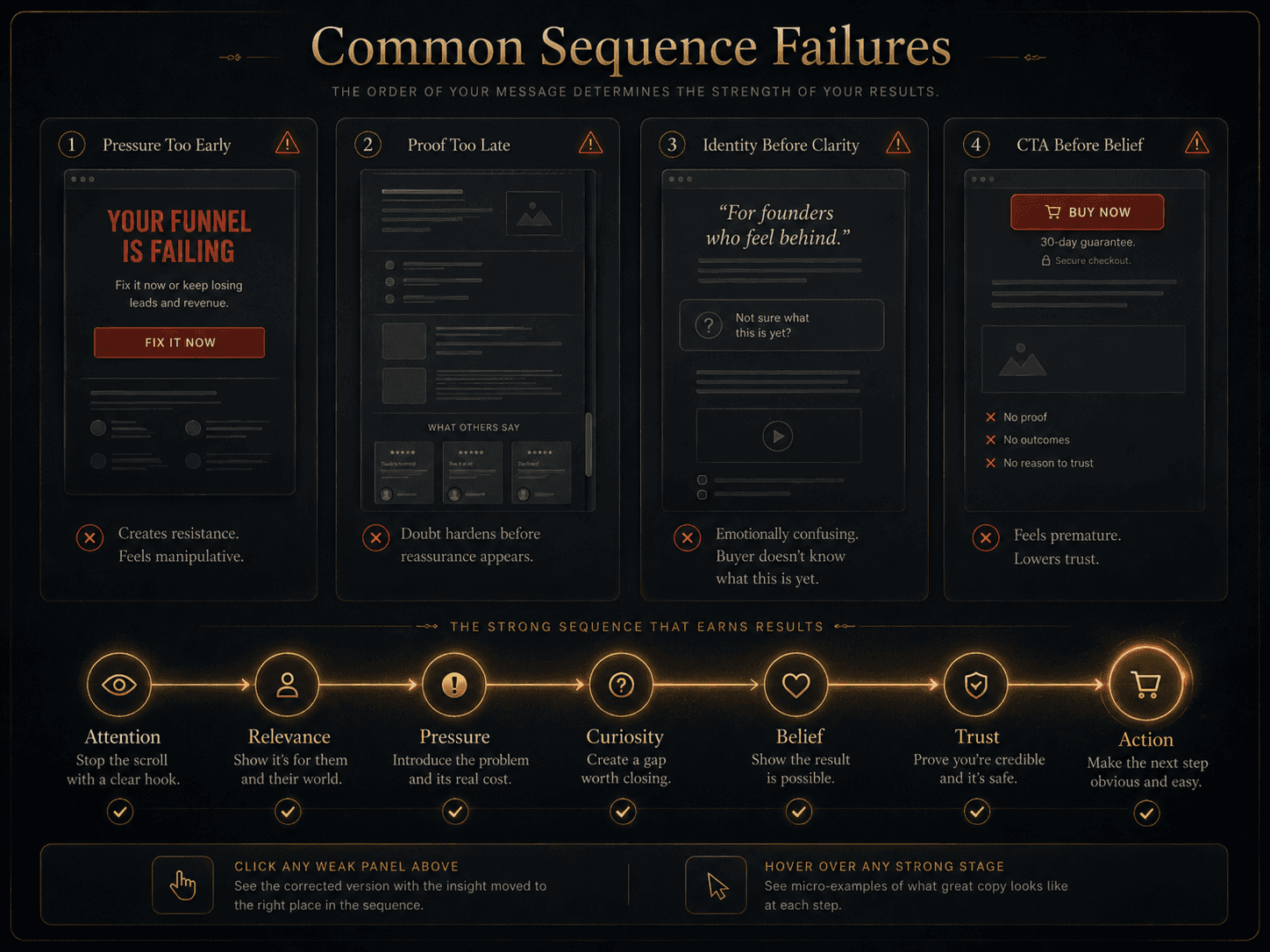
Common Sequence Failures™
Use this section to diagnose messaging that feels disconnected.
Pressure Too Early
The page pushes into heavy emotional language before the buyer has enough clarity.
Result:
The message can feel manipulative or confusing.
Fix:
Start with recognisable pressure, then deepen gradually.
Proof Too Late
The page makes strong claims early but delays proof until the bottom.
Result:
Doubt hardens before reassurance appears.
Fix:
Place proof near the claim it supports.
Identity Tension Before Clarity
The page touches deep self-image pressure before the buyer understands the context.
Result:
The copy may feel intense, vague, or emotionally heavy.
Fix:
Create clarity first. Then deepen into identity tension carefully.
CTA Before Belief
The page asks for action before the buyer has enough reason to trust the next step.
Result:
The CTA feels premature.
Fix:
Build relevance, pressure, belief, and trust before asking for action.
Desire Before Diagnosis
The page jumps into the dream outcome before the buyer feels understood.
Result:
The promise feels thin or generic.
Fix:
Diagnose the current problem first. Then show the desired shift.
Emotion Without Structure
The page contains powerful lines, but they do not build in a clear order.
Result:
The funnel feels intense but scattered.
Fix:
Arrange the emotional sequence intentionally.
Attention. Relevance. Pressure. Curiosity. Belief. Trust. Action.
——
The Emotion-To-Structure Workflow™
Use this workflow to turn raw buyer insight into structured page copy.
Step 1: Identify The Buyer Insight
What did the buyer reveal?
Buyer insight:
Step 2: Classify The Emotional Type
Choose the emotional type:
fear
frustration
identity tension
desire
resistance
future concern
proof need
operational friction
hidden belief
Emotional type:
Step 3: Assign The Insight To The Correct Funnel Role
Where does this insight belong?
Examples:
tension → headline or hook
resistance → objection section
proof expectation → proof section
desire → CTA
broken belief → mechanism section
operational friction → problem bullets
identity tension → deeper resonance section
Best placement:
Step 4: Translate The Insight Naturally
Do not over-polish the language.
Preserve emotional realism.
Weak translation:
Stronger translation:
Step 5: Pressure-Test The Sequence
Ask:
“Does this emotional progression feel psychologically natural?”
If not, rearrange.
The right line in the wrong place is still a problem.
——
Final Translation Output™
By the end of this workflow, you should have:
one translated headline
one translated subheadline
one translated hook
one translated offer explanation
three proof cues
three objection-handling lines
three CTA options
one revised emotional sequence
one congruence check
This gives you enough structure to rebuild a weak page with far more psychological coherence.
——
The Messaging Congruence Principle™
Strong funnels feel psychologically coherent.
Weak funnels feel emotionally fragmented.
A funnel can have:
a sharp headline
a generic proof section
a flat CTA
a disconnected offer explanation
objection handling that sounds like legal defence
That mismatch weakens trust subconsciously.
The buyer may not know why the page feels off.
They just feel it.
Weak Congruence Example
Headline:
“Still Sending Traffic To A Funnel You Quietly Don’t Trust Yet?”
Proof:
“Trusted by businesses worldwide.”
CTA:
“Submit.”
This creates emotional mismatch.
The headline is specific and pressure-based.
The proof is vague.
The CTA is dead.
The funnel does not feel like one emotional world.
Stronger Congruence Example
Headline:
“Still Sending Traffic To A Funnel You Quietly Don’t Trust Yet?”
Proof:
“See the before-and-after funnel breakdown showing where belief collapsed and what changed.”
CTA:
“Get My Funnel Breakdown.”
Now the sections feel connected.
The same emotional world carries through:
hesitation
diagnosis
proof
movement
That alignment matters enormously.
——
The “This Feels Connected” Effect™
Buyers rarely think:
“This funnel has strong emotional congruence.”
Instead, they feel:
“This somehow feels clearer.”
Or:
“This feels more believable.”
Or:
“This feels like it understands the problem.”
That emotional coherence increases:
trust
continuation
conversion momentum
belief
action confidence
without the buyer consciously realising why.
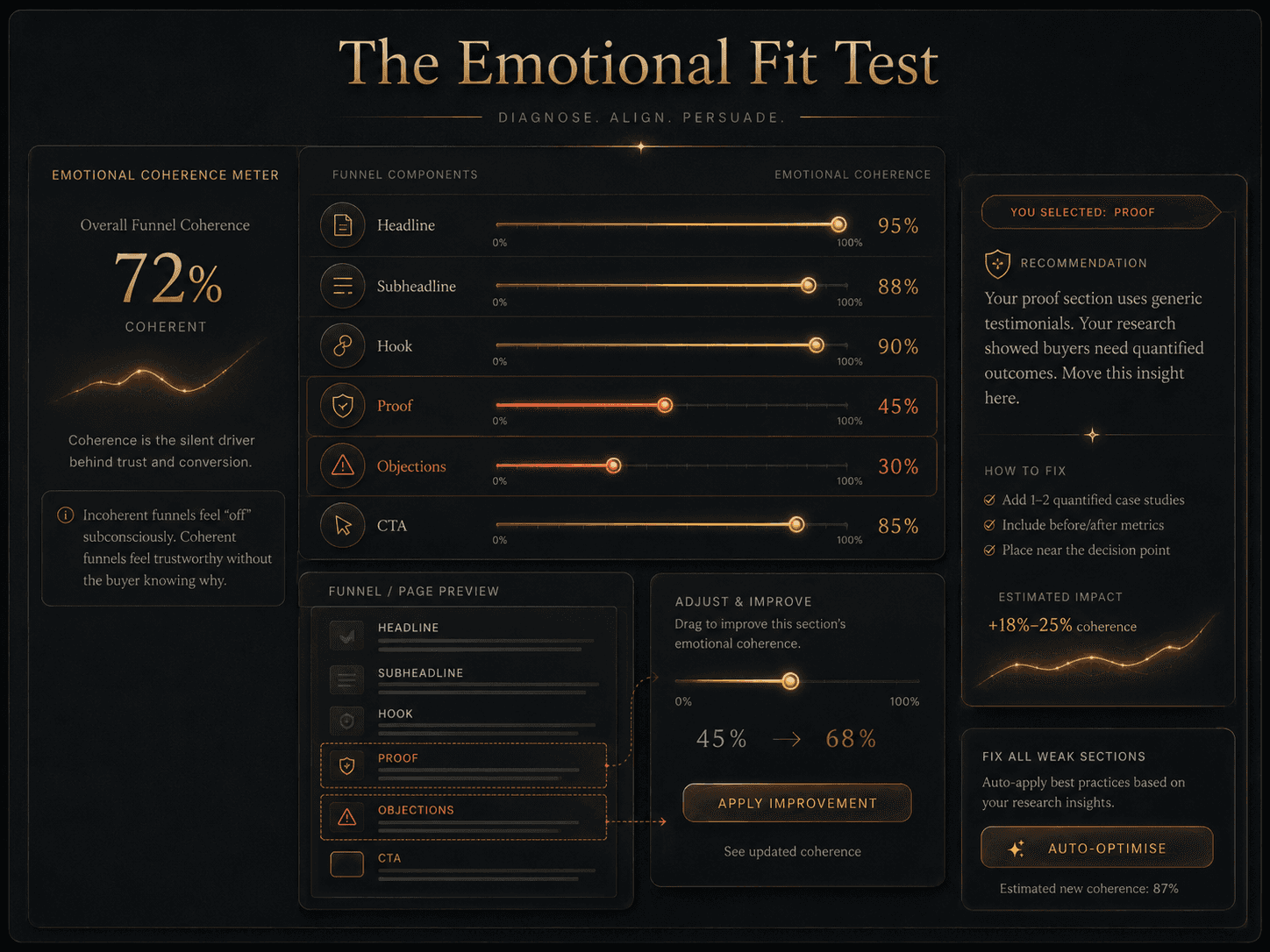
The Emotional Fit Test™
Ask this before placing any buyer insight into the funnel:
“Does this emotional insight belong naturally in this part of the funnel?”
If not, the sequence probably needs restructuring.
Emotional Fit Questions
Ask:
Is this too intense for the headline?
Is this too vague for the CTA?
Is this proof arriving too late?
Is this objection handled before it becomes resistance?
Does the CTA match the emotional buildup?
Does the proof support the claim near it?
Does the page jump to desire before diagnosis?
Does identity tension appear before clarity?
Does the emotional sequence feel natural?
Does this section feel connected to the section before it?
This simple audit can dramatically improve funnel coherence.
——
Message Translation Scorecard™
Use this scorecard to assess whether your buyer research has been translated properly.
Score each area from 1 to 5.
1 = weak or missing
2 = present but shallow
3 = usable
4 = strong
5 = highly aligned and copy-ready
Headline Translation
Does the headline translate live pressure, relevance, curiosity, or a recognisable buyer moment?
Score: ___ / 5
Subheadline Translation
Does the subheadline clarify the promise, deepen understanding, and support continuation?
Score: ___ / 5
Hook Translation
Does the hook create emotional engagement without becoming manipulative?
Score: ___ / 5
Offer Translation
Does the offer section translate buyer pressure into value, mechanism, and transformation?
Score: ___ / 5
Proof Translation
Does the proof section answer the buyer’s actual doubt?
Score: ___ / 5
Objection Translation
Does objection handling address emotional resistance, not just logical concerns?
Score: ___ / 5
CTA Translation
Does the CTA feel like movement toward the buyer’s desired next state?
Score: ___ / 5
Sequence Coherence
Does the emotional progression feel natural from attention to action?
Score: ___ / 5
Total Translation Score
Total: ___ / 40
——
What Your Score Means
34–40: Strong Translation
Your buyer research is being deployed well across the funnel.
The page should feel coherent, specific, and psychologically aligned.
26–33: Good But Needs Tightening
The translation is mostly working, but some sections may feel disconnected or underdeveloped.
Review the lowest-scoring sections.
16–25: Fragmented Translation
You may have good insights, but they are not being placed or translated effectively.
The page may feel uneven or emotionally inconsistent.
0–15: Research Not Yet Deployed
The research is probably still sitting in your notes.
The page is likely relying on generic copy, weak structure, or emotional guessing.
Return to the grid and rebuild the sequence.
——
Using AI For Message Translation™
AI becomes dramatically more useful when paired with accurate buyer psychology.
You can use any capable AI tool to classify, translate, and pressure-test buyer insights.
If you are using Funnels By Maris Spalins™, the prompts are designed to work especially well with the frameworks, principles, and buyer psychology systems explored throughout The $100M Funnel Playbook.
AI can help you:
translate VOC into headlines
turn pain into hooks
deploy objections strategically
improve emotional sequencing
identify weak translation
strengthen CTA alignment
simplify overcomplicated messaging
pressure-test funnel coherence
But the rule remains:
Do not use AI to invent buyer psychology.
Use AI to organise, translate, and pressure-test real buyer intelligence.
——
Message Translation AI Prompt™
Use this prompt after you have collected buyer insights, pain stack notes, or VOC language.
Act as a conversion strategist trained in buyer psychology, voice-of-customer analysis, and funnel messaging structure.
Analyse the buyer insights below and translate them into funnel copy using The Message Translation Grid™.
Do not invent buyer quotes.
Do not fabricate proof.
Use only the buyer insights provided.
For each insight, identify:
The emotional type.
The psychological meaning.
The best funnel placement.
The weak translation risk.
A stronger page-ready translation.
Why it belongs in that section.
Then build:
one headline
one subheadline
one opening hook
one offer explanation
three proof cues
three objection-handling lines
three CTA options
one CTA microcopy line
one recommended emotional sequence
After that, audit the full sequence for:
pressure too early
proof too late
identity tension before clarity
CTA before belief
desire before diagnosis
emotional fragmentation
weak congruence
Keep the language emotionally accurate, clear, and grounded.
Preserve buyer pressure without over-polishing it.
Here are the buyer insights:
[paste buyer insights]
——
Quick Message Translation Exercise™
Use this when you want to turn one buyer insight into usable copy.
Buyer Insight:
Source:
Emotional Meaning:
Emotional Type:
Best Funnel Placement:
Weak Translation:
Stronger Translation:
Final Page Copy:
Why It Belongs There:
What Section Comes Before It?:
What Section Comes After It?:
Does The Sequence Feel Natural?
Yes / No
——
The Full Message Translation Worksheet™
Complete this after building your Black File, Pain Stack, and VOC research.
Target Buyer:
Offer Or Page Being Improved:
Primary Buyer Pressure:
Primary Broken Belief:
Primary Desired Shift:
Primary Resistance Point:
Primary Proof Need:
——
Headline Translation
Buyer insight used:
Final headline:
Why this headline fits:
Subheadline Translation
Buyer insight used:
Final subheadline:
Why this subheadline fits:
Hook Translation
Buyer insight used:
Final hook:
Why this hook fits:
Offer Translation
Buyer insight used:
Final offer explanation:
Why this offer explanation fits:
Proof Translation
Buyer insight used:
Final proof cue:
Why this proof cue fits:
Objection Translation
Buyer insight used:
Final objection-handling line:
Why this objection line fits:
CTA Translation
Buyer insight used:
Final CTA:
Why this CTA fits:
CTA Microcopy
Buyer hesitation addressed:
Final CTA microcopy:
Why this microcopy fits:
Emotional Sequence Audit
Does the page move through this sequence?
Attention → Relevance → Pressure → Curiosity → Belief → Trust → Action
Yes / No
If no, where does the sequence break?
What needs to move?
What needs to be rewritten?
——
The 30-Minute Message Translation Process™
Use this when you want to improve one weak page section quickly.
Minutes 0–5: Choose Five Buyer Insights
Pull five insights from your Black File, Pain Stack, or VOC research.
Insight 1:
Insight 2:
Insight 3:
Insight 4:
Insight 5:
Minutes 5–10: Classify Each Insight
Label each insight as:
pressure
fear
desire
resistance
proof need
identity tension
future concern
operational friction
Minutes 10–15: Assign Funnel Placement
Decide where each insight belongs.
Headline:
Hook:
Proof:
Objection:
CTA:
Minutes 15–20: Translate Each Insight
Write the first version.
Do not over-polish.
Preserve emotional realism.
Headline translation:
Hook translation:
Proof translation:
Objection translation:
CTA translation:
Minutes 20–25: Check Emotional Fit
Ask:
Does this belong here?
Is this too intense?
Is this too vague?
Is proof arriving at the right point?
Does the CTA match the emotional buildup?
What needs to change?
Minutes 25–30: Create The Final Sequence
Write the final sequence:
Headline:
Subheadline:
Hook:
Proof cue:
Objection line:
CTA:
CTA microcopy:
——
Final Principle™
Research becomes powerful only when it changes the emotional structure of the messaging.
That means:
pressure must be placed intentionally
proof must arrive strategically
resistance must be handled naturally
desire must shape movement
emotional sequence must feel coherent
buyer language must survive translation
CTAs must feel connected to the emotional buildup
the page must feel like one psychological world
The strongest funnels do not merely contain good insights.
They deploy those insights in the right place, at the right time, with the right emotional weight.
That is what The Message Translation Grid™ is designed to help you build.
Take five buyer insights.
Place each one into the correct funnel section before writing the page.
Then translate them.
Then check the sequence.
That is how buyer psychology becomes page copy.
And that is how research turns into messaging the buyer can actually feel.
——
From:
The $100M Funnel Playbook. Book I: Foundation Buyer Psychology, Offer Clarity, and the Page Architecture Behind High-Converting Funnels
By Maris Spalins.
——
Copyright Notice
© 2026 The $100M Funnel Playbook / Winyourclients / Maris Spalins. All rights reserved.
This resource, including the frameworks, terminology, examples, scorecards, templates, prompts, methods, and written explanations, is original intellectual property created for The $100M Funnel Playbook. Book I: Foundation — Buyer Psychology, Offer Clarity, And The Page Architecture Behind High-Converting Funnels and published through Winyourclients.
No part of this resource may be copied, reproduced, screenshotted, republished, redistributed, sold, adapted, uploaded, scraped, stored in a database, included in training data, used to train artificial intelligence systems, or used to create derivative commercial or educational materials without prior written permission.
Limited reference, quotation, or sharing is only permitted where the source is clearly and visibly credited.
Any permitted reference must include at least one of the following source credits:
The $100M Funnel Playbook by Maris Spalins
or
Winyourclients — www.winyourclients.com
or
Maris Spalins / Winyourclients
Screenshots, excerpts, summaries, or redistributed versions must not remove, hide, alter, crop out, or obscure the original source, author name, book title, website name, or copyright notice.
This resource is provided for personal learning and implementation only. It is not licensed for resale, republishing, redistribution, AI training, template cloning, course creation, consulting delivery, or commercial reuse without written permission from Maris Spalins or Winyourclients.
For permission requests, licensing, citation approval, or commercial usage enquiries, contact:
Winyourclients
www.winyourclients.com
or
Email directly to Jacob on: help@winyourclients.com
The Message Translation Grid™ A funnel messaging worksheet for turning buyer psychology, pain, voice-of-customer language, objections, and proof needs into headlines, hooks, CTAs, proof sections, and emotionally coherent page copy.
Prefer Audio Or Video?
The Message Translation Grid™ is also available as:
🎧 A guided audio walkthrough explaining emotional translation, funnel psychology, and messaging deployment
🎥 A practical video breakdown with real buyer insights translated into headlines, hooks, proof sections, and CTA examplesChoose the format that fits how you learn best.
[Listen To The Audio Walkthrough] (coming soon)
[Watch The Video Breakdown] (coming soon)
——
Why Great Research Still Produces Weak Copy
This is one of the biggest hidden problems in marketing.
People collect:
customer interviews
reviews
voice-of-customer data
emotional insights
objections
buyer frustrations
pain points
failed attempts
proof needs
And still end up with copy that feels:
generic
disconnected
emotionally flat
strategically weak
randomly intense
poorly sequenced
hard to believe
Why?
Because research alone does not create strong messaging.
Translation does.
That distinction matters enormously.
Research is what you know.
Translation is what the buyer feels on the page.
Most marketers gather buyer intelligence but never learn how to deploy it correctly inside the funnel.
So the final messaging becomes random emotional dumping.
Pressure appears in the wrong places.
Proof arrives too late.
Identity language shows up before clarity.
The CTA feels disconnected from the emotional buildup.
Objections are handled after the buyer has already emotionally left.
The funnel becomes psychologically fragmented.
That is exactly what The Message Translation Grid™ is designed to solve.
It helps you turn buyer psychology into clear, structured, emotionally coherent funnel messaging.
——
What This Resource Helps You Do
The Message Translation Grid™ helps you take buyer research and place it into the correct parts of the funnel.
Use it to turn:
buyer pain into hooks
buyer pressure into headlines
buyer desire into CTAs
buyer resistance into objection handling
buyer proof needs into trust sections
buyer identity tension into deeper resonance
buyer language into page copy
buyer psychology into funnel structure
The goal is not to throw every emotional insight onto the page.
The goal is to deploy each insight where it belongs.
Because strong funnels are not emotional storage containers.
They are emotional progression systems.
——
The Translation Principle™
Different emotional insights belong in different parts of the funnel.
This is critical.
Not every insight belongs:
in the headline
in the CTA
in the proof section
in the hook
in the objection block
in the offer section
Strong messaging deploys psychology intentionally.
Weak messaging throws emotional information everywhere randomly.
That creates:
confusion
emotional overload
weak sequencing
broken momentum
trust gaps
premature CTAs
copy that feels intense but not persuasive
Every insight needs a job.
Every page section needs the right emotional weight.
That is the core rule.
——
Bad Translation Example™
Buyer fear:
“I’m worried my funnel still feels untrustworthy.”
Bad deployment:
CTA button:
“Are You Secretly Losing Trust?”
Wrong location.
Too heavy.
Too emotionally awkward.
Too much pressure for a button.
That emotional insight belongs earlier in the funnel.
Not inside the CTA.
——
Stronger Translation™
Headline:
“Still Sending Traffic To A Funnel You Quietly Don’t Trust Yet?”
Proof section:
“See The Before/After Funnel Rebuild.”
CTA:
“Get My Funnel Breakdown.”
Now the emotional sequence feels:
natural
coherent
psychologically aligned
easier to follow
less forced
The fear creates relevance.
The proof reduces uncertainty.
The CTA offers movement.
That is proper translation.
——
More Bad Translation Examples™
Bad Translation 1: Identity Tension Too Early
Buyer insight:
“I feel like I should be further ahead by now.”
Bad headline:
“Are You Embarrassed By How Far Behind You Are?”
Too aggressive.
Too exposed.
Too early.
The buyer has not yet felt safe enough for that level of emotional intensity.
Better placement:
Use this insight later in the page, after clarity and relevance have already been established.
Stronger line:
“The frustrating part is not just that the page is underperforming. It is that you know the offer is stronger than the message currently makes it feel.”
Bad Translation 2: Proof Need Hidden Too Late
Buyer insight:
“I do not trust another framework unless I can see what actually changes.”
Bad deployment:
Proof appears only at the very bottom of the page.
Too late.
Doubt hardens before reassurance appears.
Better placement:
Bring proof closer to the first major claim.
Stronger proof cue:
“See the before-and-after message breakdown, including what changed and why the original version was leaking belief.”
Bad Translation 3: Desire Before Diagnosis
Buyer insight:
“I want to feel confident sending traffic again.”
Bad opening:
“Imagine scaling your funnel with total confidence.”
Too soon.
The buyer may not yet feel understood.
Better sequence:
First name the hesitation.
Then offer the desired shift.
Stronger sequence:
“Still hesitating before sending traffic to a page that looks finished but does not feel trustworthy yet? The goal is not another prettier version. The goal is the clarity to know where belief is being won or lost before the next click arrives.”
——
The Funnel Psychology Map™
Each funnel component has a different emotional job.
Understanding this changes messaging quality dramatically.
Headline™
Primary Role
The headline creates:
attention
relevance
tension
recognition
continuation
The headline should interrupt, recognise, or provoke curiosity.
It should usually translate the strongest live pressure, broken belief, or recognisable moment.
Good Headline Inputs
Use buyer insights such as:
open wound
live pressure
visible consequence
broken belief
strong VOC phrase
recognisable moment
future concern
Headline Example
Buyer insight:
“I keep getting traffic, but I still do not trust the page.”
Headline:
“Still Sending Traffic To A Page You Quietly Don’t Trust?”
Subheadline™
Primary Role
The subheadline creates:
clarification
emotional expansion
payoff visibility
mechanism framing
stronger context
continuation support
The subheadline should deepen understanding after the headline creates attention.
It should answer:
What is this about?
Who is it for?
Why does it matter?
What will this help me understand or do?
Good Subheadline Inputs
Use buyer insights such as:
surface problem
operational friction
desired shift
mechanism
pain stack
promise clarification
Subheadline Example
“If cold traffic lands, hesitates, and disappears before belief forms, the problem may not be traffic. It may be the psychological sequence your page is failing to create.”
Hook™
Primary Role
The hook creates:
emotional engagement
pattern interruption
pressure amplification
consequence visibility
continuation pull
The hook creates movement.
It should make the buyer feel:
“This is about the exact situation I am in.”
Good Hook Inputs
Use buyer insights such as:
frustration language
private thought
failed attempts
repeated pattern
emotional cost
future fear
Hook Example
“You have changed the headline, cleaned up the layout, and adjusted the CTA. But if belief still collapses before the buyer reaches the offer, the real leak was never cosmetic.”
Offer Section™
Primary Role
The offer section creates:
value framing
mechanism clarity
transformation
belief-building
perceived relevance
decision confidence
The offer section should show how the solution addresses the actual buyer pressure.
It should not simply list features.
It should explain what changes and why that change matters.
Good Offer Section Inputs
Use buyer insights such as:
desired outcome
broken belief
proof need
mechanism
operational friction
identity gap
resistance point
Offer Section Example
“This is not a cosmetic rewrite. It is a buyer-pressure diagnosis that shows where your page loses attention, relevance, belief, trust, or action — so you can fix the sequence instead of guessing at the wording.”
Proof Section™
Primary Role
The proof section creates:
belief
trust
uncertainty reduction
scepticism management
credibility
reassurance
Proof stabilises emotional momentum.
It should appear close to the claims it supports.
Proof that arrives too late often loses power because doubt has already hardened.
Good Proof Inputs
Use buyer insights such as:
proof threshold
resistance language
failed attempts
scepticism
claims that need support
before/after contrast
Proof Section Example
“See the before-and-after rewrite, what changed, and why the original version was leaking belief before the CTA.”
Objection Handling™
Primary Role
Objection handling creates:
resistance reduction
fear neutralisation
distrust management
misunderstanding clarification
reassurance
Weak objection handling argues.
Strong objection handling reassures.
The buyer should feel understood, not cornered.
Good Objection Inputs
Use buyer insights such as:
resistance language
regret history
failed attempts
distrust triggers
hidden fear
“I’ve tried this before” language
Objection Handling Example
“If you are tired of generic funnel advice that sounds impressive but changes nothing operationally, you are not alone. This is designed to show where the buyer’s belief actually breaks — not give you another vague list of best practices.”
CTA™
Primary Role
The CTA creates:
movement
reward visibility
low-friction continuation
next-step clarity
action confidence
The CTA should feel natural.
Not forced.
It should translate the buyer’s desired next emotional state, not just the business’s desired action.
Good CTA Inputs
Use buyer insights such as:
desired relief
next diagnostic step
curiosity
low-friction movement
proof need
outcome language
CTA Example
Weak:
“Submit.”
Stronger:
“Show Me The Missing Funnel Gaps.”
Better CTAs make the click feel like progress.
Not admin.
——
The Message Translation Grid™
Use this grid to deploy buyer psychology intentionally instead of randomly.
For each buyer insight, identify what it means emotionally, where it belongs in the funnel, and how it should be translated into copy.
Buyer Insight
What did the buyer say, feel, fear, want, resist, or reveal?
Buyer insight:
Source
Where did this insight come from?
Examples:
Black File, Pain Stack, VOC research, sales call, review, DM, survey, support ticket, objection, testimonial.
Source:
Emotional Type
What kind of emotional insight is this?
Choose one:
frustration
fear
identity tension
desire
resistance
future concern
proof need
operational friction
hidden belief
private thought
Emotional type:
Buyer Meaning
What does this insight actually mean psychologically?
Buyer meaning:
Best Funnel Placement
Where does this insight belong?
Choose one:
headline
subheadline
hook
offer section
proof section
objection handling
CTA
CTA microcopy
closing section
Best funnel placement:
Weak Translation
How would this insight sound if translated badly?
Weak translation:
Strong Translation
How can this insight be translated accurately and naturally?
Strong translation:
Final Page Copy
What final line, section, CTA, proof cue, or paragraph will appear on the page?
Final page copy:
Why It Belongs There
Why does this insight belong in this part of the funnel?
Reason:
Translation Rules By Funnel Section™
Use these rules to decide where each buyer insight belongs.
Translating Pressure Into Headlines™
Headlines work best when they translate:
live pressure
emotional friction
visible consequence
broken belief
recognisable moments
future concern
identity tension used carefully
They do not work as well when they simply describe generic categories.
Weak Headline™
“Improve Your Funnel Performance.”
Technically clear.
Emotionally interchangeable.
Pressure-Translated Headline™
“Still Getting Clicks But Quietly Avoiding Looking At The Conversion Rate?”
Now the pressure feels:
human
specific
recognisable
emotionally active
Why This Works
The stronger version:
mirrors internal experience
creates recognition
exposes tension
increases continuation
feels closer to real buyer pressure
That creates emotional pull naturally.
Translating Resistance Into Objection Handling™
Most objection handling fails because it argues logically.
But resistance is often emotional.
The buyer may not only be asking:
“Does this work?”
They may also be thinking:
“I have tried things like this before.”
“I do not trust another generic framework.”
“I do not want another promise that sounds good but changes nothing.”
“I do not know if this applies to my situation.”
“I have seen too many inflated claims.”
That resistance needs to be handled with empathy and specificity.
Weak Objection Handling™
“Our framework is proven to work.”
Corporate.
Flat.
Emotionally weak.
Stronger Translation™
“If you are tired of generic funnel advice that sounds impressive but changes nothing operationally, you are not alone.”
Now the buyer feels understood.
Not sold to.
That lowers resistance.
Translating Desire Into CTA Language™
Desire should shape the emotional reward behind the click.
Weak CTAs often ignore buyer motivation completely.
They describe the action the business wants.
Not the progress the buyer wants.
Weak CTA™
“Submit.”
Emotionally dead.
Administrative.
Low reward visibility.
Desire-Translated CTA™
“Show Me The Missing Funnel Gaps.”
Now the CTA feels like movement toward relief.
That changes click psychology dramatically.
CTA Rule
The CTA should translate the buyer’s desired next emotional state.
Examples:
clarity
relief
diagnosis
confidence
certainty
control
progress
proof
A good CTA makes the buyer feel:
“This click helps me move forward.”
Translating Future Fear Into Hooks™
Future fear works best early enough to create tension, but not so aggressively that it feels manipulative.
Future fear should reveal consequence.
Not manufacture panic.
Weak Future Framing™
“Improve your business growth.”
Too vague.
Too abstract.
Too soft.
Stronger Future Translation™
“If this keeps going, you may spend another year rebuilding symptoms instead of fixing the real conversion problem underneath them.”
Now the buyer feels trajectory risk.
That increases urgency naturally.
The line works because it does not invent fear.
It reveals the cost of the current pattern continuing.
Translating Proof Needs Into Trust Sections™
Proof should not be random.
Proof should answer the buyer’s current doubt.
If the buyer distrusts generic frameworks, proof should show specificity.
If the buyer worries the page will not work for their situation, proof should show relevant examples.
If the buyer fears exaggerated claims, proof should be grounded, specific, and believable.
Weak Proof Translation™
“Trusted by ambitious founders.”
Too broad.
Too easy to ignore.
Stronger Proof Translation™
“See the before-and-after message rewrite, including what changed, why the original version was leaking belief, and how the stronger version creates clearer buyer recognition.”
Now the proof supports a specific claim.
That makes it more believable.
Translating Identity Tension Into Deeper Resonance™
Identity tension is powerful, but it must be placed carefully.
If used too early, it may feel aggressive.
If used accurately after clarity and relevance exist, it can create strong recognition.
Weak Identity Translation™
“You are behind because your messaging is weak.”
Too harsh.
Too blunt.
Too likely to trigger defensiveness.
Stronger Identity Translation™
“The frustrating part is not just that the page is underperforming. It is that you know the offer is stronger than the message currently makes it feel.”
This preserves the pressure without attacking the buyer.
That is the standard.
Weak Translation vs Strong Translation™
Use these examples to understand how good research gets destroyed or strengthened during translation.
Example 1: Overwhelm
Buyer insight:
“They feel overwhelmed rebuilding the funnel repeatedly.”
Weak translation:
“Solutions designed for scalability and optimisation.”
Research completely lost.
Strong translation:
“Tired of redesigning the funnel every month while the real problem still stays hidden underneath it?”
Now the messaging preserves:
pressure
emotional realism
frustration
failed attempt history
recognition
Example 2: Distrust Of Gurus
Buyer insight:
“They distrust gurus.”
Weak translation:
“Our proven methodology delivers exceptional results.”
Terrible translation.
It sounds exactly like the kind of thing the buyer distrusts.
Strong translation:
“You do not need another hype-heavy funnel framework that collapses the second real traffic hits the page.”
Now the resistance is acknowledged.
Not ignored.
Example 3: Fear Of Wasting Traffic
Buyer insight:
“They are afraid paid traffic will expose weak messaging.”
Weak translation:
“Drive better traffic outcomes with improved conversion assets.”
Too corporate.
Too distant.
Strong translation:
“Still hesitating to scale traffic because the page does not feel strong enough to carry the click?”
Now the message feels closer to the buyer’s actual pressure.
Example 4: Desire For Clarity
Buyer insight:
“They want buyers to instantly get it.”
Weak translation:
“Clarify your value proposition.”
Clear, but flat.
Strong translation:
“Make the offer obvious enough that cold buyers understand why it matters before doubt takes over.”
Now the desire becomes more concrete.
Example 5: Proof Need
Buyer insight:
“They need to see what actually changes before they trust the framework.”
Weak translation:
“Proven system for better results.”
Too vague.
Too generic.
Strong translation:
“See the before-and-after page breakdown, including the exact lines that were leaking belief and the replacements that made the message clearer.”
Now the proof is tied to the buyer’s doubt.
——
The Sequence Layer™
Strong messaging is not only about what you say.
It is also about when you say it.
This is critical.
A powerful insight in the wrong place can weaken the funnel.
A strong proof point shown too late can lose its effect.
A CTA shown before belief forms can feel premature.
Identity tension before clarity can feel confusing or heavy.
The sequence matters.
Stronger Sequencing™
A strong funnel usually follows this emotional progression:
Attention → Relevance → Pressure → Curiosity → Belief → Trust → Action
Funnels should feel like guided progression.
Not emotional chaos.
1. Attention
The buyer notices the page.
Useful inputs:
recognisable moment
open wound
sharp pressure
specific pain
curiosity
broken belief
Common sections:
headline
first line
hero section
2. Relevance
The buyer realises:
“This is about me.”
Useful inputs:
surface problem
buyer category
live condition
emotional familiarity
VOC language
Common sections:
subheadline
first-scroll copy
opening paragraph
3. Pressure
The buyer feels the problem matters.
Useful inputs:
operational friction
emotional cost
failed attempts
future cost
private thought
Common sections:
hook
problem section
bullets
stakes section
4. Curiosity
The buyer wants to understand the diagnosis or mechanism.
Useful inputs:
broken belief
new explanation
hidden cause
unusual diagnosis
“why this is happening” framing
Common sections:
mechanism section
educational bridge
offer introduction
5. Belief
The buyer starts believing the solution could make sense.
Useful inputs:
mechanism clarity
offer logic
process explanation
before/after framing
proof direction
Common sections:
offer section
framework section
proof-adjacent explanation
6. Trust
The buyer feels safer continuing.
Useful inputs:
proof
testimonials
case studies
credibility cues
specificity
grounded claims
objection handling
Common sections:
proof section
FAQ
objections
trust blocks
7. Action
The buyer feels ready to move.
Useful inputs:
desire language
low-friction step
clear next action
reassurance
CTA microcopy
risk reduction
Common sections:
CTA
booking section
lead magnet form
checkout
final close
——
Common Sequence Failures™
Use this section to diagnose messaging that feels disconnected.
Pressure Too Early
The page pushes into heavy emotional language before the buyer has enough clarity.
Result:
The message can feel manipulative or confusing.
Fix:
Start with recognisable pressure, then deepen gradually.
Proof Too Late
The page makes strong claims early but delays proof until the bottom.
Result:
Doubt hardens before reassurance appears.
Fix:
Place proof near the claim it supports.
Identity Tension Before Clarity
The page touches deep self-image pressure before the buyer understands the context.
Result:
The copy may feel intense, vague, or emotionally heavy.
Fix:
Create clarity first. Then deepen into identity tension carefully.
CTA Before Belief
The page asks for action before the buyer has enough reason to trust the next step.
Result:
The CTA feels premature.
Fix:
Build relevance, pressure, belief, and trust before asking for action.
Desire Before Diagnosis
The page jumps into the dream outcome before the buyer feels understood.
Result:
The promise feels thin or generic.
Fix:
Diagnose the current problem first. Then show the desired shift.
Emotion Without Structure
The page contains powerful lines, but they do not build in a clear order.
Result:
The funnel feels intense but scattered.
Fix:
Arrange the emotional sequence intentionally.
Attention. Relevance. Pressure. Curiosity. Belief. Trust. Action.
——
The Emotion-To-Structure Workflow™
Use this workflow to turn raw buyer insight into structured page copy.
Step 1: Identify The Buyer Insight
What did the buyer reveal?
Buyer insight:
Step 2: Classify The Emotional Type
Choose the emotional type:
fear
frustration
identity tension
desire
resistance
future concern
proof need
operational friction
hidden belief
Emotional type:
Step 3: Assign The Insight To The Correct Funnel Role
Where does this insight belong?
Examples:
tension → headline or hook
resistance → objection section
proof expectation → proof section
desire → CTA
broken belief → mechanism section
operational friction → problem bullets
identity tension → deeper resonance section
Best placement:
Step 4: Translate The Insight Naturally
Do not over-polish the language.
Preserve emotional realism.
Weak translation:
Stronger translation:
Step 5: Pressure-Test The Sequence
Ask:
“Does this emotional progression feel psychologically natural?”
If not, rearrange.
The right line in the wrong place is still a problem.
——
Final Translation Output™
By the end of this workflow, you should have:
one translated headline
one translated subheadline
one translated hook
one translated offer explanation
three proof cues
three objection-handling lines
three CTA options
one revised emotional sequence
one congruence check
This gives you enough structure to rebuild a weak page with far more psychological coherence.
——
The Messaging Congruence Principle™
Strong funnels feel psychologically coherent.
Weak funnels feel emotionally fragmented.
A funnel can have:
a sharp headline
a generic proof section
a flat CTA
a disconnected offer explanation
objection handling that sounds like legal defence
That mismatch weakens trust subconsciously.
The buyer may not know why the page feels off.
They just feel it.
Weak Congruence Example
Headline:
“Still Sending Traffic To A Funnel You Quietly Don’t Trust Yet?”
Proof:
“Trusted by businesses worldwide.”
CTA:
“Submit.”
This creates emotional mismatch.
The headline is specific and pressure-based.
The proof is vague.
The CTA is dead.
The funnel does not feel like one emotional world.
Stronger Congruence Example
Headline:
“Still Sending Traffic To A Funnel You Quietly Don’t Trust Yet?”
Proof:
“See the before-and-after funnel breakdown showing where belief collapsed and what changed.”
CTA:
“Get My Funnel Breakdown.”
Now the sections feel connected.
The same emotional world carries through:
hesitation
diagnosis
proof
movement
That alignment matters enormously.
——
The “This Feels Connected” Effect™
Buyers rarely think:
“This funnel has strong emotional congruence.”
Instead, they feel:
“This somehow feels clearer.”
Or:
“This feels more believable.”
Or:
“This feels like it understands the problem.”
That emotional coherence increases:
trust
continuation
conversion momentum
belief
action confidence
without the buyer consciously realising why.
The Emotional Fit Test™
Ask this before placing any buyer insight into the funnel:
“Does this emotional insight belong naturally in this part of the funnel?”
If not, the sequence probably needs restructuring.
Emotional Fit Questions
Ask:
Is this too intense for the headline?
Is this too vague for the CTA?
Is this proof arriving too late?
Is this objection handled before it becomes resistance?
Does the CTA match the emotional buildup?
Does the proof support the claim near it?
Does the page jump to desire before diagnosis?
Does identity tension appear before clarity?
Does the emotional sequence feel natural?
Does this section feel connected to the section before it?
This simple audit can dramatically improve funnel coherence.
——
Message Translation Scorecard™
Use this scorecard to assess whether your buyer research has been translated properly.
Score each area from 1 to 5.
1 = weak or missing
2 = present but shallow
3 = usable
4 = strong
5 = highly aligned and copy-ready
Headline Translation
Does the headline translate live pressure, relevance, curiosity, or a recognisable buyer moment?
Score: ___ / 5
Subheadline Translation
Does the subheadline clarify the promise, deepen understanding, and support continuation?
Score: ___ / 5
Hook Translation
Does the hook create emotional engagement without becoming manipulative?
Score: ___ / 5
Offer Translation
Does the offer section translate buyer pressure into value, mechanism, and transformation?
Score: ___ / 5
Proof Translation
Does the proof section answer the buyer’s actual doubt?
Score: ___ / 5
Objection Translation
Does objection handling address emotional resistance, not just logical concerns?
Score: ___ / 5
CTA Translation
Does the CTA feel like movement toward the buyer’s desired next state?
Score: ___ / 5
Sequence Coherence
Does the emotional progression feel natural from attention to action?
Score: ___ / 5
Total Translation Score
Total: ___ / 40
——
What Your Score Means
34–40: Strong Translation
Your buyer research is being deployed well across the funnel.
The page should feel coherent, specific, and psychologically aligned.
26–33: Good But Needs Tightening
The translation is mostly working, but some sections may feel disconnected or underdeveloped.
Review the lowest-scoring sections.
16–25: Fragmented Translation
You may have good insights, but they are not being placed or translated effectively.
The page may feel uneven or emotionally inconsistent.
0–15: Research Not Yet Deployed
The research is probably still sitting in your notes.
The page is likely relying on generic copy, weak structure, or emotional guessing.
Return to the grid and rebuild the sequence.
——
Using AI For Message Translation™
AI becomes dramatically more useful when paired with accurate buyer psychology.
You can use any capable AI tool to classify, translate, and pressure-test buyer insights.
If you are using Funnels By Maris Spalins™, the prompts are designed to work especially well with the frameworks, principles, and buyer psychology systems explored throughout The $100M Funnel Playbook.
AI can help you:
translate VOC into headlines
turn pain into hooks
deploy objections strategically
improve emotional sequencing
identify weak translation
strengthen CTA alignment
simplify overcomplicated messaging
pressure-test funnel coherence
But the rule remains:
Do not use AI to invent buyer psychology.
Use AI to organise, translate, and pressure-test real buyer intelligence.
——
Message Translation AI Prompt™
Use this prompt after you have collected buyer insights, pain stack notes, or VOC language.
Act as a conversion strategist trained in buyer psychology, voice-of-customer analysis, and funnel messaging structure.
Analyse the buyer insights below and translate them into funnel copy using The Message Translation Grid™.
Do not invent buyer quotes.
Do not fabricate proof.
Use only the buyer insights provided.
For each insight, identify:
The emotional type.
The psychological meaning.
The best funnel placement.
The weak translation risk.
A stronger page-ready translation.
Why it belongs in that section.
Then build:
one headline
one subheadline
one opening hook
one offer explanation
three proof cues
three objection-handling lines
three CTA options
one CTA microcopy line
one recommended emotional sequence
After that, audit the full sequence for:
pressure too early
proof too late
identity tension before clarity
CTA before belief
desire before diagnosis
emotional fragmentation
weak congruence
Keep the language emotionally accurate, clear, and grounded.
Preserve buyer pressure without over-polishing it.
Here are the buyer insights:
[paste buyer insights]
——
Quick Message Translation Exercise™
Use this when you want to turn one buyer insight into usable copy.
Buyer Insight:
Source:
Emotional Meaning:
Emotional Type:
Best Funnel Placement:
Weak Translation:
Stronger Translation:
Final Page Copy:
Why It Belongs There:
What Section Comes Before It?:
What Section Comes After It?:
Does The Sequence Feel Natural?
Yes / No
——
The Full Message Translation Worksheet™
Complete this after building your Black File, Pain Stack, and VOC research.
Target Buyer:
Offer Or Page Being Improved:
Primary Buyer Pressure:
Primary Broken Belief:
Primary Desired Shift:
Primary Resistance Point:
Primary Proof Need:
——
Headline Translation
Buyer insight used:
Final headline:
Why this headline fits:
Subheadline Translation
Buyer insight used:
Final subheadline:
Why this subheadline fits:
Hook Translation
Buyer insight used:
Final hook:
Why this hook fits:
Offer Translation
Buyer insight used:
Final offer explanation:
Why this offer explanation fits:
Proof Translation
Buyer insight used:
Final proof cue:
Why this proof cue fits:
Objection Translation
Buyer insight used:
Final objection-handling line:
Why this objection line fits:
CTA Translation
Buyer insight used:
Final CTA:
Why this CTA fits:
CTA Microcopy
Buyer hesitation addressed:
Final CTA microcopy:
Why this microcopy fits:
Emotional Sequence Audit
Does the page move through this sequence?
Attention → Relevance → Pressure → Curiosity → Belief → Trust → Action
Yes / No
If no, where does the sequence break?
What needs to move?
What needs to be rewritten?
——
The 30-Minute Message Translation Process™
Use this when you want to improve one weak page section quickly.
Minutes 0–5: Choose Five Buyer Insights
Pull five insights from your Black File, Pain Stack, or VOC research.
Insight 1:
Insight 2:
Insight 3:
Insight 4:
Insight 5:
Minutes 5–10: Classify Each Insight
Label each insight as:
pressure
fear
desire
resistance
proof need
identity tension
future concern
operational friction
Minutes 10–15: Assign Funnel Placement
Decide where each insight belongs.
Headline:
Hook:
Proof:
Objection:
CTA:
Minutes 15–20: Translate Each Insight
Write the first version.
Do not over-polish.
Preserve emotional realism.
Headline translation:
Hook translation:
Proof translation:
Objection translation:
CTA translation:
Minutes 20–25: Check Emotional Fit
Ask:
Does this belong here?
Is this too intense?
Is this too vague?
Is proof arriving at the right point?
Does the CTA match the emotional buildup?
What needs to change?
Minutes 25–30: Create The Final Sequence
Write the final sequence:
Headline:
Subheadline:
Hook:
Proof cue:
Objection line:
CTA:
CTA microcopy:
——
Final Principle™
Research becomes powerful only when it changes the emotional structure of the messaging.
That means:
pressure must be placed intentionally
proof must arrive strategically
resistance must be handled naturally
desire must shape movement
emotional sequence must feel coherent
buyer language must survive translation
CTAs must feel connected to the emotional buildup
the page must feel like one psychological world
The strongest funnels do not merely contain good insights.
They deploy those insights in the right place, at the right time, with the right emotional weight.
That is what The Message Translation Grid™ is designed to help you build.
Take five buyer insights.
Place each one into the correct funnel section before writing the page.
Then translate them.
Then check the sequence.
That is how buyer psychology becomes page copy.
And that is how research turns into messaging the buyer can actually feel.
——
From:
The $100M Funnel Playbook. Book I: Foundation Buyer Psychology, Offer Clarity, and the Page Architecture Behind High-Converting Funnels
By Maris Spalins.
——
Copyright Notice
© 2026 The $100M Funnel Playbook / Winyourclients / Maris Spalins. All rights reserved.
This resource, including the frameworks, terminology, examples, scorecards, templates, prompts, methods, and written explanations, is original intellectual property created for The $100M Funnel Playbook. Book I: Foundation — Buyer Psychology, Offer Clarity, And The Page Architecture Behind High-Converting Funnels and published through Winyourclients.
No part of this resource may be copied, reproduced, screenshotted, republished, redistributed, sold, adapted, uploaded, scraped, stored in a database, included in training data, used to train artificial intelligence systems, or used to create derivative commercial or educational materials without prior written permission.
Limited reference, quotation, or sharing is only permitted where the source is clearly and visibly credited.
Any permitted reference must include at least one of the following source credits:
The $100M Funnel Playbook by Maris Spalins
or
Winyourclients — www.winyourclients.com
or
Maris Spalins / Winyourclients
Screenshots, excerpts, summaries, or redistributed versions must not remove, hide, alter, crop out, or obscure the original source, author name, book title, website name, or copyright notice.
This resource is provided for personal learning and implementation only. It is not licensed for resale, republishing, redistribution, AI training, template cloning, course creation, consulting delivery, or commercial reuse without written permission from Maris Spalins or Winyourclients.
For permission requests, licensing, citation approval, or commercial usage enquiries, contact:
Winyourclients
www.winyourclients.com
or
Email directly to Jacob on: help@winyourclients.com
Other Blogs
Other Blogs
Check our other project Blogs with useful insight and information for your businesses
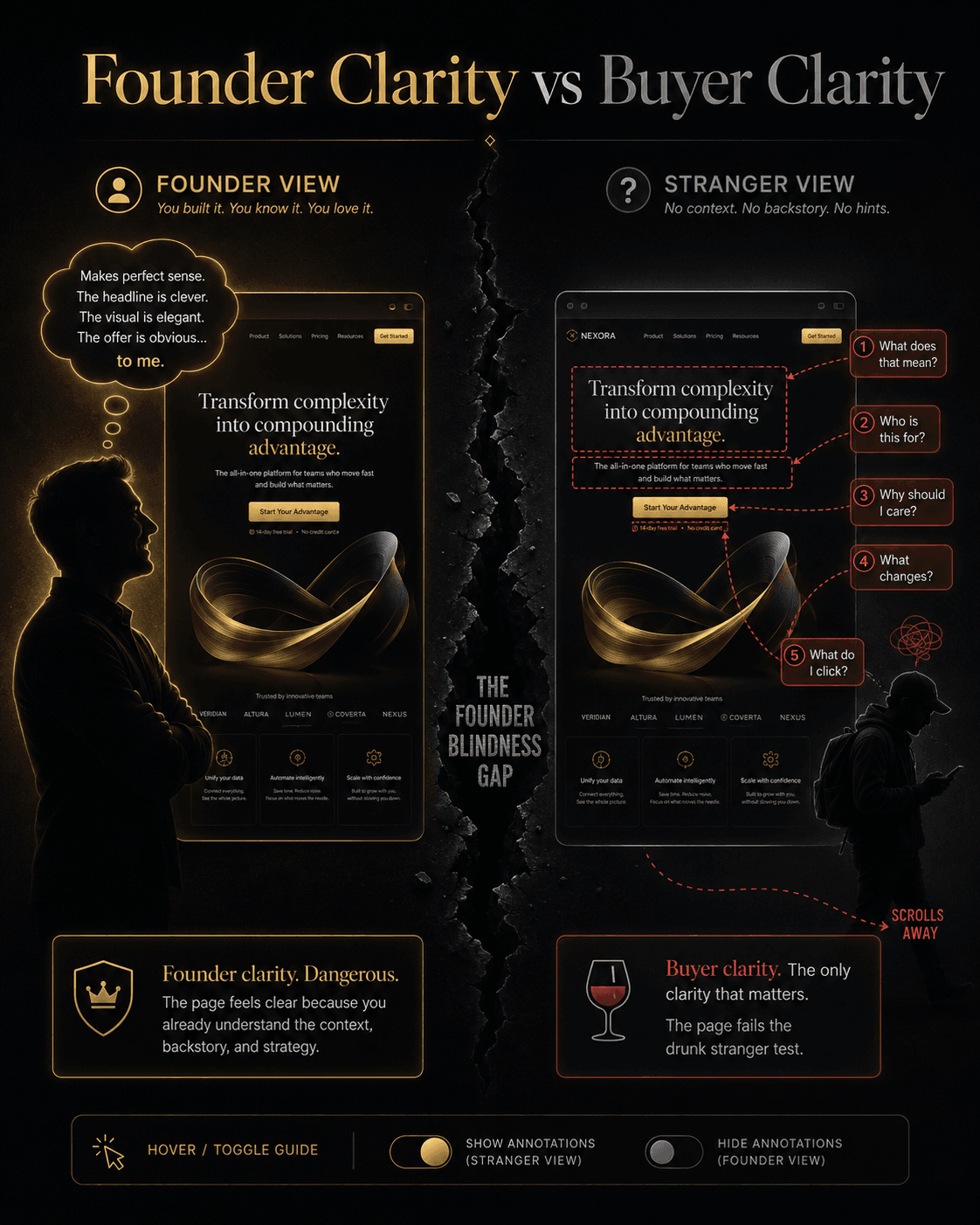
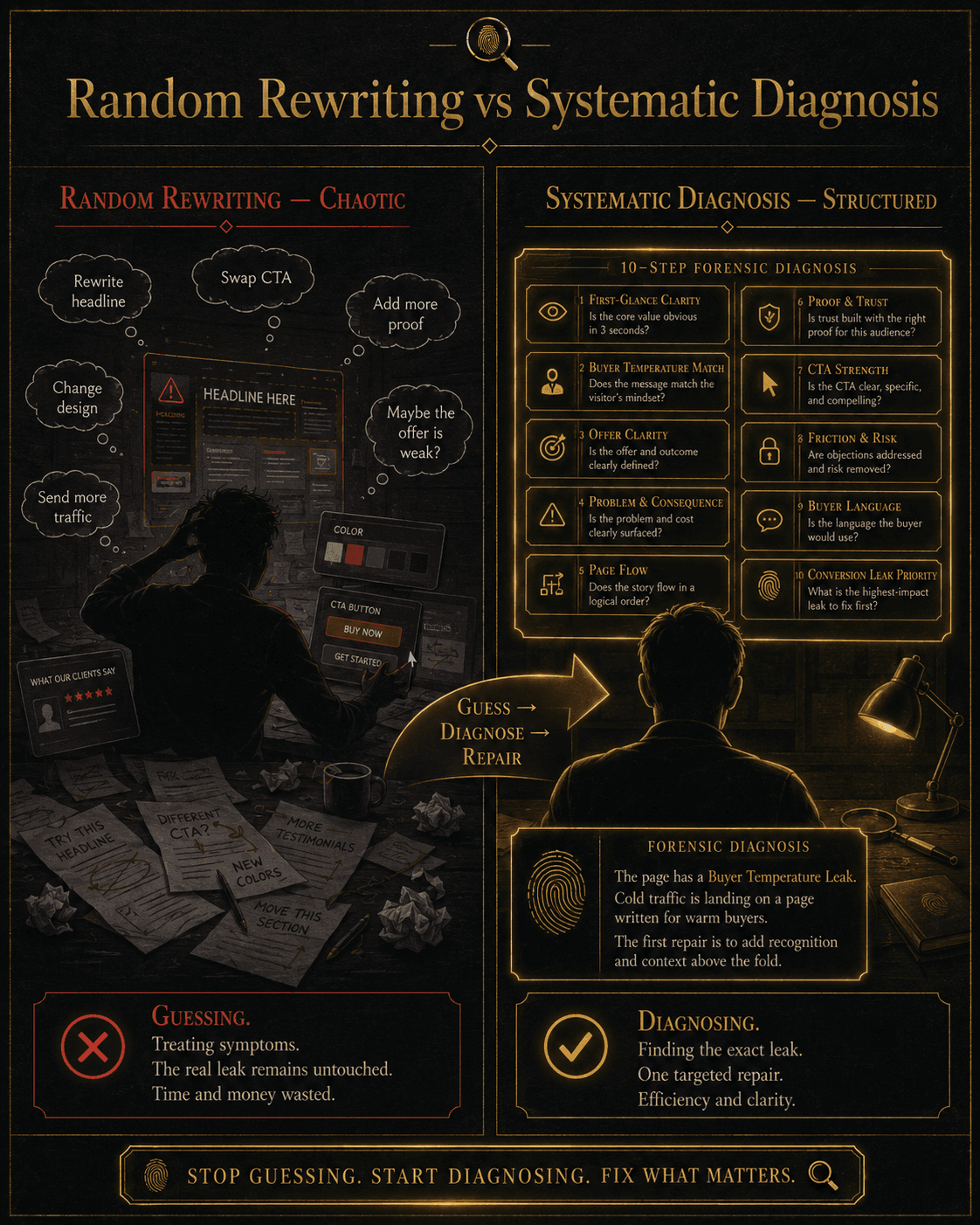
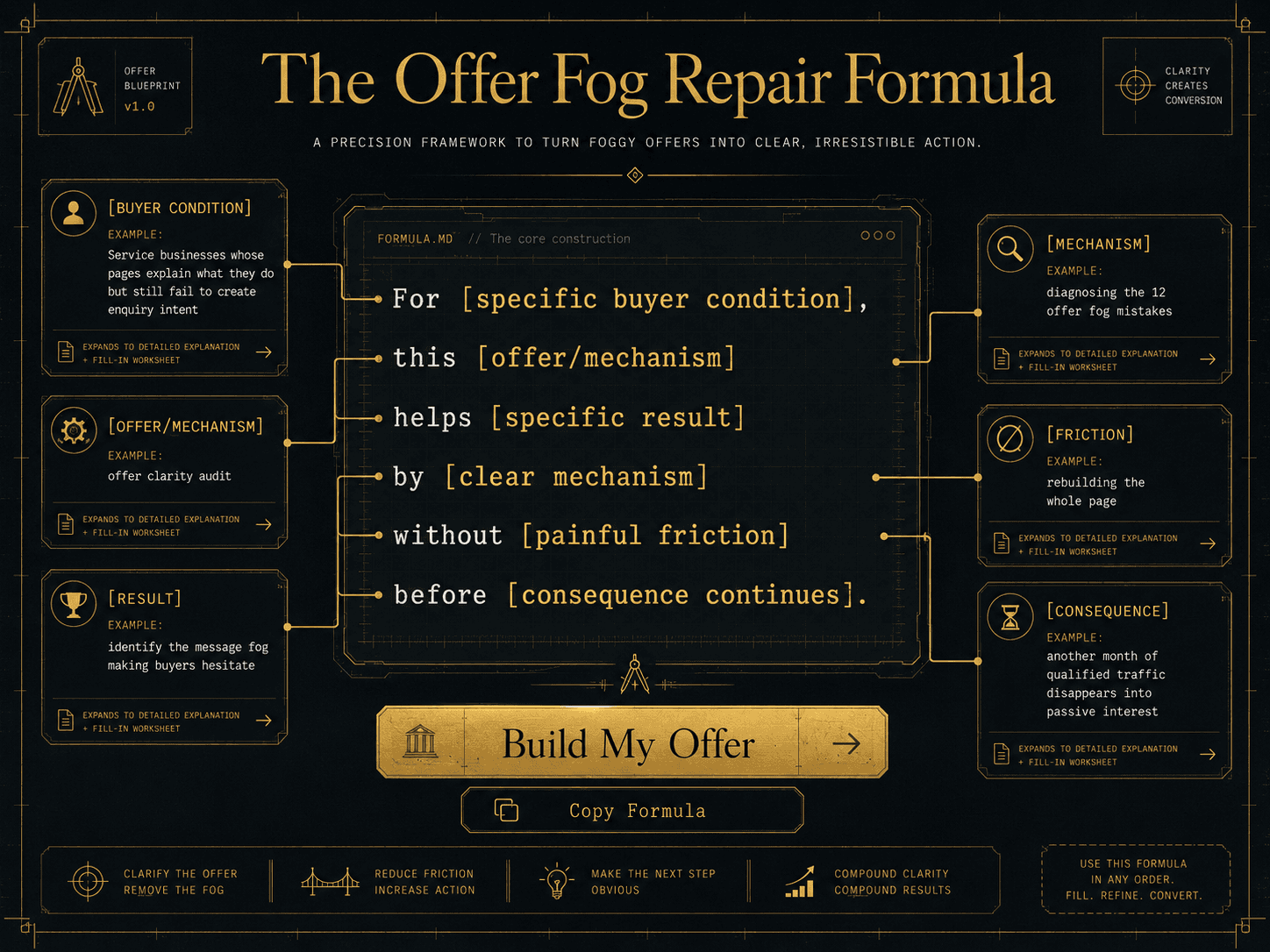
Other Blogs
Other Blogs
Check our other project Blogs with useful insight and information for your businesses