Our Three Step Process
May 26, 2026
Chap 4 | Resource 4 | The Hero Section Swipe Vault
Our Three Step Process
May 26, 2026
Chap 4 | Resource 4 | The Hero Section Swipe Vault
The Hero Section Swipe Vault™ A curated hero-section pattern library for studying the headline, subheadline, CTA, and microcopy structures that create recognition, contrast, trust, compression, and scroll momentum above the fold.
Prefer Audio Or Video?
The Hero Section Swipe Vault™ is also available as:
🎧 A guided audio walkthrough explaining hero section patterns, first-screen clarity, recognition, contrast, CTA movement, and microcopy.
🎥 A practical video breakdown with real hero section examples, swipe analysis, headline/subheadline patterns, CTA rewrites, and above-the-fold teardowns.Choose the format that fits how you learn best.
[Listen To The Audio Walkthrough] (coming soon)
[Watch The Video Breakdown] (coming soon)
——
Why Most People Study Hero Sections The Wrong Way
Most people study hero sections badly.
They collect headlines.
They save layouts.
They screenshot clever wording.
They bookmark beautiful pages.
They copy phrases that sound impressive.
But they rarely understand why certain first screens instantly feel stronger than others.
That creates imitation.
Not skill.
A hero section swipe vault should not teach you to copy surface language.
It should train your ability to recognise what creates:
attention
trust
clarity
tension
belief
movement
continuation
buyer recognition
fast emotional orientation
Because once you understand why a hero section creates attention, trust, clarity, and scroll momentum, you stop guessing.
You stop randomly rewriting headlines.
You stop staring at the design file hoping the layout will fix weak thinking.
You start building stronger first screens intentionally.
That is the purpose of The Hero Section Swipe Vault™.
This is not a swipe file for lazy copying.
This is a training system for understanding strong first-screen communication.
What This Resource Helps You Do
The Hero Section Swipe Vault™ helps you recognise what creates clarity, tension, trust, and movement above the fold.
Use this resource when:
your hero section feels generic
your messaging sounds flat
your first screen lacks tension
you need stronger headline directions
the CTA feels weak
your page feels polished but forgettable
you want inspiration without blindly copying
you need to sharpen positioning quickly
your subheadline repeats the headline instead of deepening belief
your microcopy does not reduce hesitation
your hero feels clear but emotionally dead
you want to train better conversion judgement
The goal is simple:
Learn to recognise what makes buyers stop, feel understood, trust the page, and continue scrolling.
Not by copying words.
By studying structure.
The Most Important Principle In This Resource™
Strong hero sections usually do one thing extremely well:
They create fast emotional orientation.
Meaning the buyer quickly feels:
“This page understands my problem and knows where I want to go.”
That is the job.
A strong hero section helps the buyer locate themselves within seconds.
It quickly shows:
what problem is being addressed
who the page is for
why the problem matters
what better state is possible
why this approach might be believable
what action makes sense next
Weak hero sections force the visitor to interpret, decode, or work too hard mentally.
Strong hero sections reduce thinking friction.
That difference changes everything.
Because the fold is not judged slowly.
It is filtered quickly.
The buyer does not patiently study the first screen.
They glance.
They feel.
They decide whether to continue.
Fast emotional orientation is what makes the scroll slow down.
How To Use This Swipe Vault
Do not use this resource by asking:
“Which line can I copy?”
That is the wrong question.
Use it by asking:
“Why does this pattern work?”
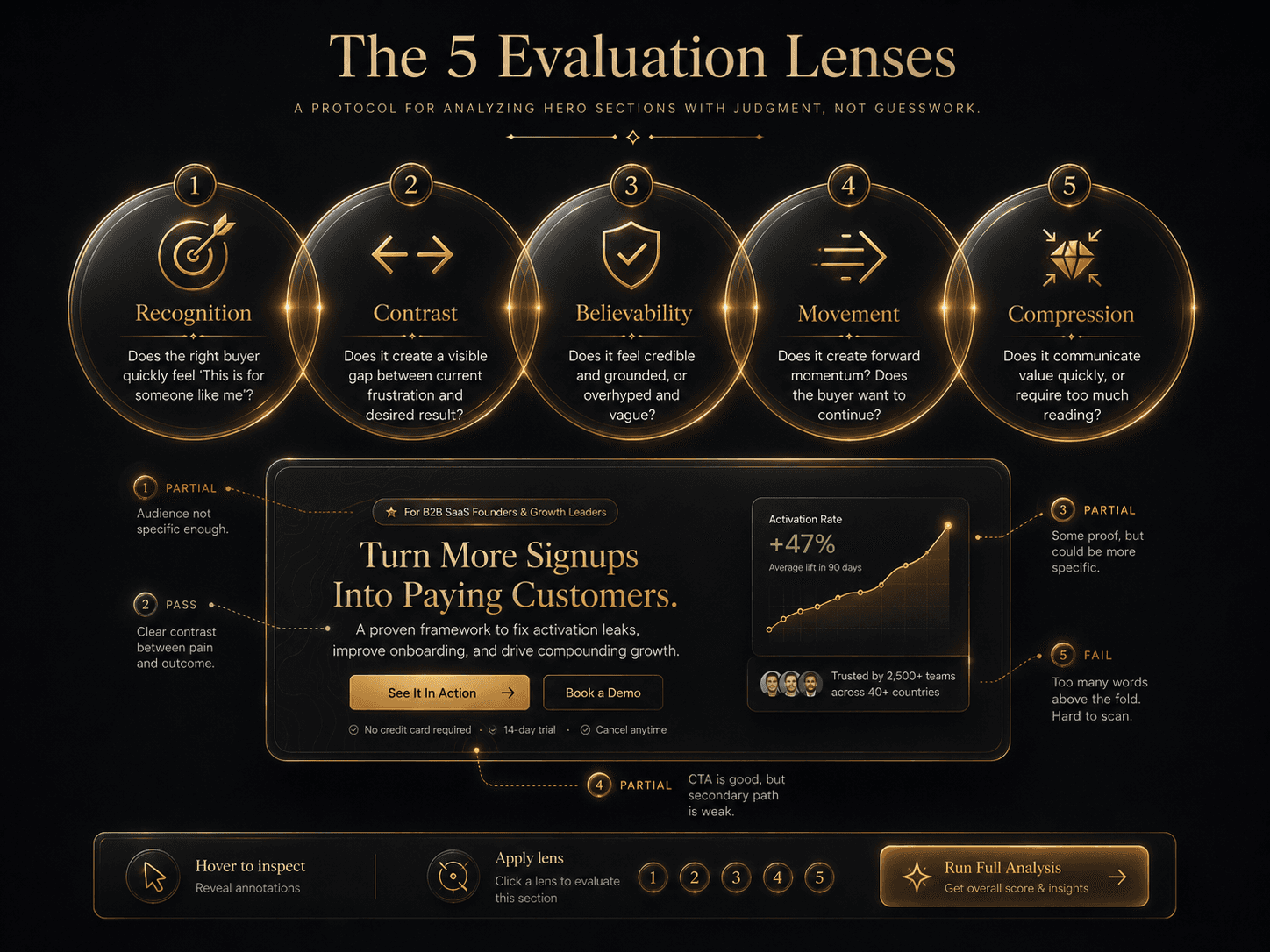
Every example should be studied through five lenses:
Recognition
Contrast
Believability
Movement
Compression
These lenses help you understand the structure underneath strong hero sections.
The goal is not to borrow someone else’s voice.
The goal is to train your own judgement.
For every swipe, ask:
What makes this feel specific?
What buyer condition does this speak to?
What tension does this create?
What friction does it remove?
What proof or belief signal is implied?
What makes the next step feel easier?
How could I adapt the structure without copying the wording?
That is how a swipe vault becomes useful.
Not as a library of stolen lines.
As a training ground for commercial instinct.
——
The 5 Hero Swipe Analysis Lenses™
Lens 1: Recognition™
Core Question
Does the right buyer quickly feel:
“This is for someone like me”?
Recognition is the first filter.
Before the buyer cares about the method, the proof, or the CTA, they need to feel that the page is relevant to their situation.
Weak hero sections speak to categories.
Strong hero sections speak to conditions.
Weak:
“For businesses.”
Stronger:
“For service businesses whose pages look polished but still fail to create enough trust above the fold.”
The second version creates recognition because it names the buyer’s actual situation.
Recognition Questions
Ask:
Who would feel personally addressed by this?
Does the line name a category or a buying condition?
Does it reveal a frustration the buyer already carries?
Does it sound like something the buyer has experienced?
Could the right buyer quickly think, “That is me”?
Lens 2: Contrast™
Core Question
Does the hero create a visible gap between current frustration and desired result?
Contrast creates movement.
A hero section becomes stronger when the buyer feels the gap between:
where they are now
where they want to be
what staying the same costs
what improvement makes possible
Weak hero sections describe services.
Strong hero sections create movement.
Weak:
“We improve landing pages.”
Stronger:
“Stop losing buyers before they trust the offer.”
The second version creates contrast because it shows a painful current state and points toward a better one.
Contrast Questions
Ask:
What current frustration is being named?
What desired result is being implied?
What happens if the problem continues?
What friction is being removed?
Does the hero make staying the same feel costly?
Does the line create emotional movement?
Lens 3: Believability™
Core Question
Does the wording feel credible and grounded?
A hero section can create attention and still fail if the promise feels inflated.
Believability protects the page from hype.
Strong hero sections do not need to shout.
They need to feel true enough to continue with.
Weak:
“Explode your conversions overnight.”
Stronger:
“Improve first-screen clarity before sending more paid traffic to a page that leaks trust.”
The second version feels more believable because it is specific, grounded, and tied to a real problem.
Believability Questions
Ask:
Does the promise feel credible?
Is the wording grounded or exaggerated?
Is there a mechanism implied?
Does the line create confidence or scepticism?
Would a sceptical buyer feel calmer after reading this?
Does the claim feel inspectable?
Lens 4: Movement™
Core Question
Does the section create forward momentum?
A strong hero section should make the buyer want to continue.
Not necessarily buy immediately.
Continue.
That is the job above the fold.
Movement happens when the buyer feels:
this matters
this applies to me
this could solve something real
I want to see how this works
the next step is obvious enough to consider
Weak hero sections stall.
Strong hero sections pull.
Movement Questions
Ask:
Does this make the buyer want to keep reading?
Does it create curiosity?
Does it make the next section feel necessary?
Does the CTA feel connected to a payoff?
Does the page feel like it is moving somewhere?
Does the hero earn continuation?
Lens 5: Compression™
Core Question
Does the page communicate the value quickly?
Compression matters because the first screen does not get unlimited patience.
Weak hero sections require too much reading and interpretation.
Strong hero sections compress the right things:
buyer
problem
result
contrast
proof direction
next step
Compression does not mean saying less for the sake of being short.
It means removing anything that slows understanding.
The fold rewards compression.
Not clutter.
Compression Questions
Ask:
Can the buyer understand this quickly?
Does the wording feel heavy?
Can 30% of the words be removed?
Is the subheadline clarifying or overexplaining?
Is there one clear promise?
Does the first screen feel fast to absorb?
——
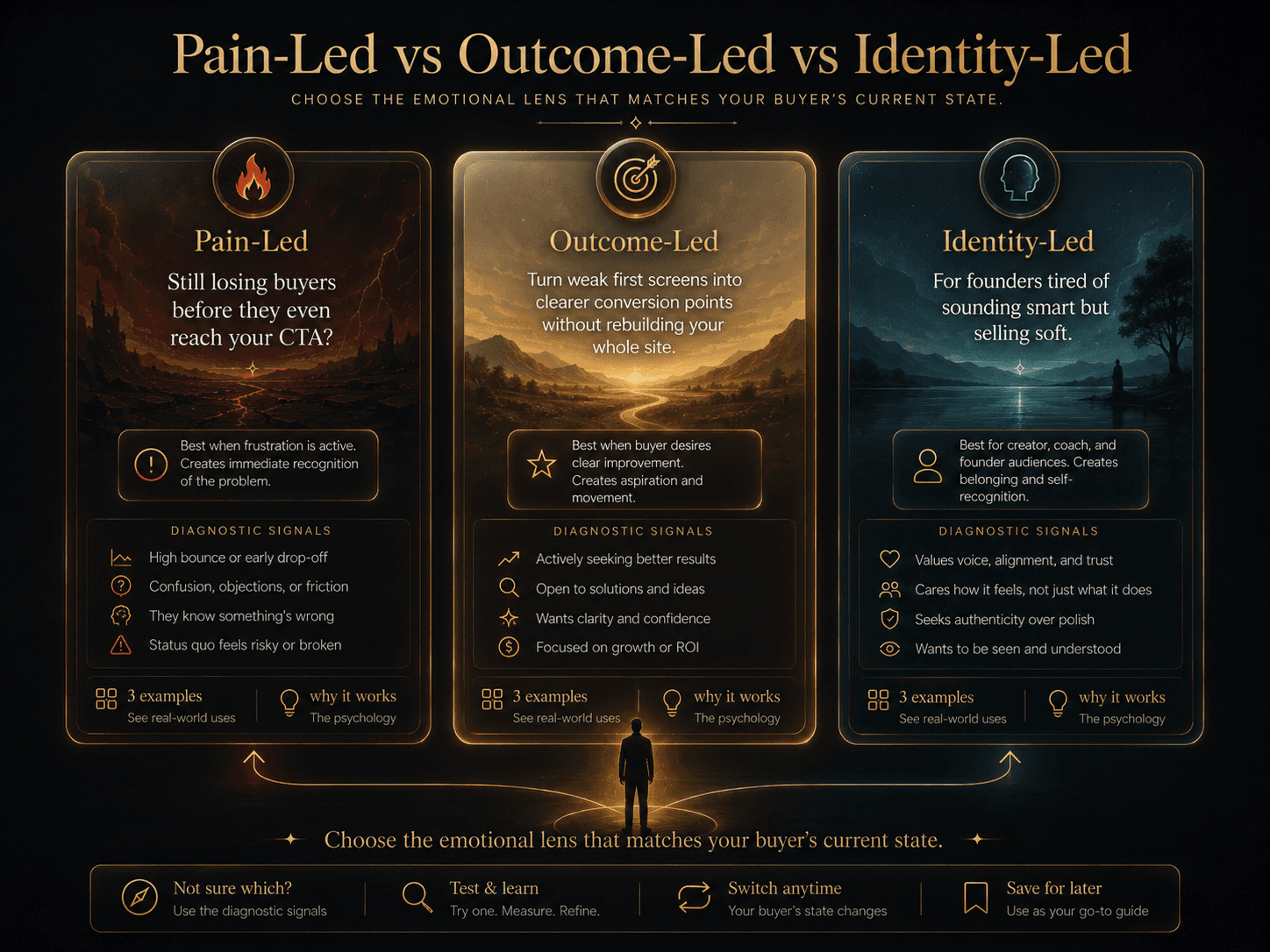
Category 1: Pain-Led Hero Sections™
Pain-led hero sections work because they create immediate emotional recognition.
The buyer instantly feels the problem.
This style works especially well when:
frustration already exists
urgency is active
the buyer knows something is wrong
the current solution feels painful or expensive
the buyer is tired of tolerating the same leak
the market is aware of the pain but has not named the cause clearly
Pain-led hero sections are powerful because they bring a hidden frustration to the surface.
They make the buyer feel:
“That is exactly what is happening.”
Pain-Led Example 1
Hero Line
“Still losing buyers before they even reach your CTA?”
Why This Works
This line creates immediate tension.
It points to a specific leak.
It makes the buyer imagine invisible lost opportunity.
It creates curiosity because the buyer starts wondering:
“Is that what is happening on my page?”
It also shifts attention to the fold, not the whole funnel.
That makes the problem feel more precise.
Pattern To Learn
This pattern works because it turns a hidden problem into a visible one.
It does not say:
“Improve your website.”
It says:
“Something specific is happening before the CTA.”
That creates sharper attention.
Adaptation Prompt
Where is your buyer losing momentum before the obvious action happens?
Write it here:
Pain-Led Example 2
Hero Line
“Your page is not being ignored because the market is cold. It is being ignored because the first screen is weak.”
Why This Works
This line works because it challenges an assumption.
The buyer may be blaming:
traffic
audience quality
the market
timing
the platform
demand
This line introduces a new diagnosis:
The first screen is weak.
That creates contrast.
It replaces blame with diagnosis.
It also makes the reader feel there may be a fix.
Pattern To Learn
This pattern works by saying:
“You think the problem is [common assumption]. The real problem is [sharper diagnosis].”
That structure is powerful because it reframes the buyer’s frustration.
Adaptation Prompt
What is your buyer currently blaming that may not be the real problem?
Write it here:
What is the sharper diagnosis?
Pain-Led Example 3
Hero Line
“Stop losing trust in the first three seconds.”
Why This Works
This line is compressed.
It creates fast clarity.
It introduces consequence.
It makes trust feel urgent.
It also gives the problem a timeframe.
The buyer can immediately picture how quickly judgement happens above the fold.
This is a strong example of compression plus consequence.
Pattern To Learn
This pattern works by attaching the loss to a short moment.
It makes the problem feel immediate.
The shorter the window, the sharper the tension.
Adaptation Prompt
What does your buyer lose quickly when the first impression is weak?
Write it here:
Pain-Led Example 4
Hero Line
“Your first screen is not underperforming quietly. It is costing you momentum every day it stays weak.”
Why This Works
This line makes the cost of inaction visible.
It suggests that the problem is not harmless.
The hero section is not simply “weak.”
It is costing momentum.
That creates consequence.
The buyer starts to feel that delay has a price.
Pattern To Learn
This pattern works by turning a passive weakness into an active cost.
Weak:
“This could be improved.”
Stronger:
“This is costing you momentum.”
Adaptation Prompt
What is your buyer’s current weakness costing them every day?
Write it here:
Pain-Led Example 5
Hero Line
“If your page looks polished but still does not convert, the problem probably starts above the fold.”
Why This Works
This line speaks to a very specific condition:
The page looks good but still performs badly.
That creates recognition because many founders experience this privately.
They do not know why the page is not working because visually it looks acceptable.
This line names the hidden frustration.
Pattern To Learn
This pattern works by creating contrast between appearance and performance.
It says:
“It looks good, but something underneath is still weak.”
Adaptation Prompt
Where does your buyer’s situation look fine externally but fail internally?
Write it here:
——
Category 2: Outcome-Led Hero Sections™
Outcome-led hero sections work best when the buyer already desires a clear visible improvement.
This style creates aspiration and movement.
It does not need to start with heavy pain.
It starts with the shift the buyer wants.
Outcome-led hero sections work especially well when:
the buyer already understands the problem
the desired result is easy to picture
the result feels valuable quickly
the offer removes a clear friction point
the buyer wants a practical improvement
The strongest outcome-led hero sections do not only describe a result.
They also remove resistance.
Outcome-Led Example 1
Hero Line
“Turn your first screen into a clearer conversion point without rebuilding your whole site.”
Why This Works
This line creates visible transformation.
It shows the buyer what changes:
The first screen becomes a clearer conversion point.
It also removes a common objection:
“Without rebuilding your whole site.”
That matters enormously.
The result feels desirable.
The path feels lighter.
The scope feels believable.
Pattern To Learn
This pattern works because it combines:
Desired outcome + removed friction.
The buyer sees what they get and what they do not have to suffer through.
Adaptation Prompt
What result does your buyer want, and what painful friction do they want to avoid?
Write it here:
Outcome-Led Example 2
Hero Line
“Build a hero section that makes the right buyer stop, stay, and click.”
Why This Works
This line creates a visible progression.
Stop.
Stay.
Click.
The buyer can mentally visualise what happens.
That makes the result feel simple and movement-oriented.
It also compresses the job of the hero section into three actions.
That is why the line is easy to remember.
Pattern To Learn
This pattern works by turning the result into a sequence.
A sequence makes the promise feel easier to picture.
Adaptation Prompt
What is the simple buyer journey your offer creates?
From:
To:
Then:
Outcome-Led Example 3
Hero Line
“Rebuild the first screen so attention turns into trust faster.”
Why This Works
This line is transformation-focused.
It moves from attention to trust.
That is emotionally visible because attention alone is not enough.
The buyer wants attention to become belief.
The wording is simple, but active.
It does not overexplain.
It creates movement.
Pattern To Learn
This pattern works by showing one valuable state turning into another.
Attention becomes trust.
Traffic becomes enquiries.
Confusion becomes clarity.
Interest becomes action.
Adaptation Prompt
What weak state does your offer turn into a stronger state?
Write it here:
Outcome-Led Example 4
Hero Line
“Create a first screen that earns the scroll before the rest of the page has to work.”
Why This Works
This line clearly defines the job of the hero section.
It also creates sequence.
The first screen must earn the scroll before the rest of the page matters.
That makes the fold feel important.
It gives the buyer a sharper reason to care.
Pattern To Learn
This pattern works by showing the role of one part inside the bigger system.
It makes the reader realise that if this part fails, everything after it suffers.
Adaptation Prompt
What part of your buyer’s system decides whether everything else gets a chance?
Write it here:
Outcome-Led Example 5
Hero Line
“Add clarity, tension, and proof to your hero section without a bloated redesign.”
Why This Works
This line names three desirable improvements:
Clarity.
Tension.
Proof.
Then it removes friction:
Without a bloated redesign.
The buyer sees both value and relief.
The promise feels practical.
Pattern To Learn
This pattern works by listing the key improvements and removing the feared process.
Adaptation Prompt
What three improvements does your buyer want, and what process do they want to avoid?
Write it here:
——
Category 3: Identity-Led Hero Sections™
Identity-led hero sections work because they create belonging and self-recognition.
The buyer feels that the page understands how they see themselves.
This style works especially well for:
creators
coaches
consultants
operators
founders
personality-driven brands
communities
education offers
transformation offers
Identity-led heroes are powerful when the buyer’s problem is not only functional.
It is personal.
They are not just trying to fix a metric.
They are trying to stop feeling a certain way about themselves, their business, or their work.
Identity-Led Example 1
Hero Line
“For founders tired of sounding smart but selling soft.”
Why This Works
This line is emotionally sharp.
It creates identity tension.
The founder wants to be seen as smart.
But the offer still feels commercially weak.
That creates discomfort.
The line also creates recognition, embarrassment, and aspiration at the same time.
That combination is powerful.
Pattern To Learn
This pattern works because it names the gap between self-perception and commercial reality.
The buyer feels:
“That is painfully accurate.”
Adaptation Prompt
Where does your buyer feel capable, but their results still feel weak?
Write it here:
Identity-Led Example 2
Hero Line
“For service businesses whose page looks polished but still feels weak.”
Why This Works
This line exposes hidden frustration.
It does not simply say:
“For service businesses.”
It describes the emotional condition:
The page looks polished but still feels weak.
That is specific.
It creates internal tension.
The buyer knows the page is not obviously ugly.
But they also know it is not creating enough movement.
That makes the line feel accurate.
Pattern To Learn
This pattern works by naming a contradiction.
Looks polished.
Feels weak.
Contradiction creates attention.
Adaptation Prompt
What contradiction is your buyer currently living with?
Write it here:
Identity-Led Example 3
Hero Line
“For brands tired of ‘Learn More’ energy and soft first impressions.”
Why This Works
This line feels alive.
Not corporate.
It uses culturally recognisable frustration.
“Learn More energy” describes a passive, weak, low-momentum first screen.
The line is memorable because it gives a feeling a name.
That creates stronger recognition.
Pattern To Learn
This pattern works by naming an energy, behaviour, or style the buyer dislikes.
It turns vague frustration into a memorable phrase.
Adaptation Prompt
What weak “energy” does your buyer want to stop projecting?
Write it here:
Identity-Led Example 4
Hero Line
“For operators who want the fold to carry more weight than the design.”
Why This Works
This line speaks to a specific type of buyer.
An operator does not want surface polish.
They want the page to work.
The line creates identity alignment.
It tells the reader:
“This is not for people chasing aesthetics. This is for people who want the first screen to carry commercial weight.”
That makes the positioning sharper.
Pattern To Learn
This pattern works by aligning with the buyer’s values.
It signals what kind of person this page is for.
Adaptation Prompt
What does your buyer value more than surface polish?
Write it here:
Identity-Led Example 5
Hero Line
“For coaches, creators, and consultants sick of above-the-fold fluff.”
Why This Works
This line works because it names the buyer and the thing they are tired of.
“Above-the-fold fluff” is vivid.
It is emotionally easy to understand.
The buyer feels that the page is not going to give them generic advice.
It creates a sharper expectation.
Pattern To Learn
This pattern works by combining audience category with disliked market behaviour.
Adaptation Prompt
What market behaviour is your buyer tired of seeing or being told to use?
Write it here:
——
Category 4: Mechanism-Led Hero Sections™
Mechanism-led hero sections work best when the buyer already understands the problem but wants to know why this approach feels different.
This style is useful when:
the market is sceptical
the buyer has tried other solutions
the category is crowded
the offer needs distinctiveness
the buyer wants a clear method
the mechanism can be explained simply
Mechanism-led hero sections increase believability because they show how the result may happen.
They do not just promise the outcome.
They reveal the engine.
Mechanism-Led Example 1
Hero Line
“Build a stronger hero section using one sharp promise, one proof asset, and one clear next step.”
Why This Works
This line is structurally specific.
It gives the buyer a simple framework:
One promise.
One proof asset.
One next step.
That reduces overwhelm.
It makes the method feel usable immediately.
The buyer can picture implementation.
Pattern To Learn
This pattern works by turning the method into a simple sequence.
The buyer feels:
“I understand how this works.”
That increases trust.
Adaptation Prompt
What are the three simplest parts of your mechanism?
Mechanism-Led Example 2
Hero Line
“Use tension-first copy and proof-led visuals to stop the right buyer before the fold.”
Why This Works
This line creates mechanism visibility.
The buyer can see the approach:
Tension-first copy.
Proof-led visuals.
Those phrases feel specific.
They make the offer more memorable.
The buyer also begins imagining implementation.
Pattern To Learn
This pattern works by naming the method behind the outcome.
The mechanism creates distinctiveness.
Adaptation Prompt
What is your method called, and what does it prioritise first?
Write it here:
Mechanism-Led Example 3
Hero Line
“Install a hero section that creates recognition, belief, and forward movement in seconds.”
Why This Works
This line feels strategic without becoming vague.
It names psychological outcomes:
Recognition.
Belief.
Forward movement.
It also compresses the job of the hero section.
The phrase “in seconds” adds immediacy without becoming unrealistic.
Pattern To Learn
This pattern works by naming the psychological jobs your mechanism performs.
Adaptation Prompt
What three psychological jobs does your offer perform for the buyer?
Mechanism-Led Example 4
Hero Line
“Rebuild your first screen with the structure high-converting pages use to earn attention fast.”
Why This Works
This line makes the mechanism feel proven.
It positions the offer around structure, not guesswork.
The buyer feels there is a method behind the rewrite.
That reduces uncertainty.
Pattern To Learn
This pattern works by contrasting structure with guessing.
It implies that the buyer does not need random creativity.
They need a repeatable system.
Adaptation Prompt
What does your mechanism replace?
Guesswork / confusion / random effort / overthinking / manual work / other:
Mechanism-Led Example 5
Hero Line
“Turn your first screen into a stronger conversion point with one audience, one result, one proof asset, and one next step.”
Why This Works
This line is clear and operational.
It gives the buyer a simple build logic.
The hero feels less mysterious.
The method feels achievable.
That reduces resistance.
Pattern To Learn
This pattern works by making the solution feel organised, not overwhelming.
Adaptation Prompt
What simple “one-one-one” structure could organise your offer?
One:
One:
One:
——
Category 5: Subheadline Structures™
Most weak subheadlines fail because they repeat the headline instead of deepening belief.
The subheadline should not compete with the headline.
It should support it.
A strong subheadline usually does at least one of five things:
clarifies who the offer is for
explains the mechanism
makes the promise easier to believe
reduces confusion
increases continuation
The headline stops the buyer.
The subheadline helps them justify staying.
That is the job.
Strong Subheadline Pattern 1
Pattern
“Built for [buyer] struggling with [problem], this [mechanism] helps them [result] without [friction].”
Why This Works
This pattern creates fast orientation.
It names the buyer.
It names the problem.
It introduces the mechanism.
It points toward the result.
It removes friction.
It prioritises clarity over cleverness.
Example
“Built for service businesses whose pages look polished but still fail to create enough trust above the fold, this hero-first system helps sharpen the message, proof, CTA, and microcopy that decide whether the right buyer stays or leaves.”
Fill-In Version
Built for _________________________________________ struggling with _________________________________________, this _________________________________________ helps them _________________________________________ without _________________________________________.
Strong Subheadline Pattern 2
Pattern
“For [specific buyer] who [current frustration], this helps them [desired movement] by [mechanism].”
Why This Works
This pattern starts with recognition.
Then it creates movement.
Then it explains the mechanism.
It works well when the buyer needs to feel seen before they need to understand the process.
Example
“For consultants whose homepage gets attention but not enough enquiries, this helps them turn the first screen into a clearer trust-building entry point by sharpening the headline, proof, CTA, and microcopy.”
Fill-In Version
For _________________________________________ who _________________________________________, this helps them _________________________________________ by _________________________________________.
Strong Subheadline Pattern 3
Pattern
“Use this when [symptom] so you can [result] without [painful process].”
Why This Works
This pattern is direct.
It tells the buyer when the offer is relevant.
It works well for practical resources, audits, tools, and diagnostic pages.
Example
“Use this when your page looks good but visitors leave too quickly, so you can find the first-screen leak without rebuilding the whole site.”
Fill-In Version
Use this when _________________________________________ so you can _________________________________________ without _________________________________________.
Strong Subheadline Pattern 4
Pattern
“No [painful thing]. No [painful thing]. Just [specific value].”
Why This Works
This pattern reduces resistance quickly.
It is especially useful when the buyer fears the process will be slow, complex, expensive, or vague.
Example
“No bloated redesign. No vague messaging. Just a sharper first screen that creates recognition, belief, and movement faster.”
Fill-In Version
No _________________________________________. No _________________________________________. Just _________________________________________.
Strong Subheadline Pattern 5
Pattern
“If [current problem], this helps you [desired result] before [consequence continues].”
Why This Works
This pattern creates consequence.
It links the current problem to a reason to act.
It makes the hero feel more urgent without fake scarcity.
Example
“If your page gets traffic but the CTA stays ignored, this helps you rebuild the fold before more qualified attention disappears.”
Fill-In Version
If _________________________________________, this helps you _________________________________________ before _________________________________________.
——
Category 6: CTA Patterns™
Strong CTAs create movement.
Weak CTAs create stalling.
The CTA should imply payoff.
A CTA is not only a button.
It is the first visible handoff between attention and action.
The buyer should not wonder:
“What happens if I click this?”
They should feel:
“This click gives me something specific.”
Weak CTA Pattern
Weak CTA
“Submit.”
Why It Fails
No momentum.
No emotional reward.
No clear payoff.
No sense of what happens next.
The buyer is being asked to act without being given a reason to want the action.
——
Strong CTA Pattern 1: Rewrite CTA
CTA
“See The Hero Rewrite”
Why This Works
This creates curiosity.
It implies value.
It feels low friction.
It gives the buyer a visible next step.
The buyer understands what happens next.
More Rewrite CTA Examples
Show Me The Rewrite
See The Before/After
Get The Hero Rewrite
Watch The Rewrite Breakdown
Fix My First Screen
Strong CTA Pattern 2: Blueprint CTA
CTA
“Get The Hero Blueprint”
Why This Works
This implies a useful asset.
It feels practical.
It suggests the buyer will receive structure, not vague advice.
More Blueprint CTA Examples
Download The Fold Blueprint
Get The First-Screen Framework
Grab The Hero Canvas
Get The Scroll-Stop Guide
Claim The Hero Section Blueprint
Strong CTA Pattern 3: Diagnostic CTA
CTA
“Claim The Hero Audit”
Why This Works
This gives the buyer a reason to act.
They are not just clicking.
They are getting a diagnosis.
Diagnostic CTAs work well when the buyer suspects something is wrong but does not know where the leak lives.
More Diagnostic CTA Examples
Run The Hero Check
Audit My First Screen
Find The Fold Leak
Diagnose My Hero Section
Check My Above-The-Fold Score
Strong CTA Pattern 4: Demo CTA
CTA
“Watch The Breakdown”
Why This Works
This feels low commitment.
The buyer does not have to make a decision yet.
They only need to watch.
It is useful when proof, education, or demonstration is needed before conversion.
More Demo CTA Examples
Watch The Hero Breakdown
See The System In Action
Watch The Fold Fix
Preview The Framework
See How It Works
Strong CTA Pattern 5: Action CTA
CTA
“Build My Hero Section”
Why This Works
This is direct.
It creates movement.
It makes the buyer feel they are progressing toward a useful outcome.
More Action CTA Examples
Fix My First Screen
Build My First Screen
Improve My Hero Section
Start The Hero Build
Make The Fold Work Harder
CTA Adaptation Worksheet
What does the buyer get after clicking?
What action feels low-friction?
What payoff should the CTA imply?
What is the clearest CTA option?
——
Category 7: Microcopy Patterns™
Microcopy exists to reduce hesitation.
Many businesses ignore this completely.
Huge mistake.
The buyer may already be interested, but hesitation often appears right before action.
They may wonder:
Will this waste my time?
Is this going to be a pitch?
Is this complicated?
Is there a catch?
Will I understand it quickly?
Is this useful right now?
Microcopy lowers that friction.
A good microcopy line can make the CTA feel easier, safer, faster, and more practical.
Microcopy Pattern 1: Anti-Fluff
Example
“No fluff. Just the framework.”
Why This Works
It lowers scepticism.
It increases clarity.
It reduces perceived waste of time.
It tells the buyer the next step will be practical.
More Anti-Fluff Examples
No fluff. Just the structure.
No theory. Just the fix.
No vague advice. Just the exact steps.
No filler. Just the fold framework.
No brand theatre. Just the first-screen structure.
Microcopy Pattern 2: Speed
Example
“Takes 90 seconds. Use it today.”
Why This Works
It reduces effort.
It makes the action feel light.
It suggests immediate usefulness.
More Speed Examples
Takes 2 minutes.
Use it today.
Quick to read. Easy to apply.
Built for fast implementation.
Simple enough to use before your next rewrite.
Microcopy Pattern 3: Consequence
Example
“Use this before wasting money on more traffic.”
Why This Works
It creates consequence visibility.
It gives the buyer a practical reason to act now.
It links the resource to a costly mistake.
More Consequence Examples
Use this before sending more traffic to a weak fold.
Fix the first screen before scaling the funnel.
Check the fold before blaming the offer.
Find the leak before another campaign goes live.
Do this before redesigning the whole page.
Microcopy Pattern 4: Reassurance
Example
“No pressure. No redesign. No guesswork.”
Why This Works
It reduces fear.
It removes common objections.
It makes the next step feel safer.
More Reassurance Examples
No pitch. Just the structure.
No redesign required.
No pressure. Just the framework.
Free and practical.
Clear enough to use today.
Microcopy Pattern 5: Value Compression
Example
“Built for speed, clarity, and clicks.”
Why This Works
It compresses the value.
It tells the buyer what the action is designed to improve.
It is fast to read.
——
More Value Compression Examples
Built for clarity, trust, and movement.
Made for faster first-screen decisions.
Designed to help the fold work harder.
Simple structure. Sharper scroll momentum.
Less confusion. More continuation.
Microcopy Adaptation Worksheet
What hesitation might stop the buyer from clicking?
What reassurance would make the action feel lighter?
What consequence makes acting now useful?
What short line can reduce friction?
——
Weak vs Strong Hero Pattern Examples™
Use these examples to train contrast.
The lesson is not that the stronger version is perfect.
The lesson is that the stronger version carries more structure.
Example 1: Generic Agency Hero
Weak
“Marketing Solutions That Scale.”
Why It Is Weak
It is broad.
It sounds polished but empty.
It does not create recognition, contrast, or movement.
The buyer cannot see the problem, result, mechanism, or reason to care.
Stronger
“Stop losing buyers before they trust the offer.”
Why It Is Stronger
It names a specific failure point.
It creates consequence.
It makes the buyer picture the conversion leak.
It is easier to remember.
Pattern To Learn
Move from category language to buyer consequence.
Example 2: Weak Website Hero
Weak
“We build beautiful websites for modern brands.”
Why It Is Weak
It focuses on appearance.
It speaks broadly.
It does not reveal what the website must do commercially.
Stronger
“Build a first screen that makes the right buyer understand, trust, and continue before the scroll wins.”
Why It Is Stronger
It defines the job of the page.
It creates movement.
It shows the buyer what the first screen needs to achieve.
Pattern To Learn
Move from design description to conversion function.
Example 3: Weak Consulting Hero
Weak
“Strategic advice for ambitious founders.”
Why It Is Weak
It sounds premium, but vague.
It does not name a real pressure point.
It gives no reason to continue.
Stronger
“For founders tired of sounding smart but selling soft.”
Why It Is Stronger
It creates identity tension.
It names a painful contradiction.
It feels emotionally specific.
Pattern To Learn
Move from status language to private frustration.
Example 4: Weak SaaS Hero
Weak
“All-in-one platform for customer engagement.”
Why It Is Weak
It is category language.
It does not show a problem.
It gives the buyer no emotional reason to care.
Stronger
“Stop losing trial users before onboarding creates enough trust to continue.”
Why It Is Stronger
It names a specific failure point.
It connects product friction to trust.
It creates a clearer reason to act.
Pattern To Learn
Move from product category to user behaviour and consequence.
Example 5: Weak CTA
Weak
“Learn More.”
Why It Is Weak
It does not imply payoff.
It creates no movement.
It asks for attention without giving a clear reason.
Stronger
“See The Hero Rewrite.”
Why It Is Stronger
It creates curiosity.
It promises a visible next step.
It feels easy to act on.
Pattern To Learn
Move from vague action to specific payoff.
——
Swipe Analysis Worksheet™
Use this worksheet every time you save a hero section swipe.
Swipe Source
Where did you find this example?
Original Hero Section
Headline:
Subheadline:
CTA:
Microcopy:
Visual or proof direction:
First Reaction
What did you feel when you saw it?
Sharp / Clear / Trustworthy / Expensive / Generic / Flat / Memorable / Confusing / Other
Explain:
Lens 1: Recognition
Does the right buyer feel seen?
Score: ___ / 5
Why?
Lens 2: Contrast
Does it create a gap between current frustration and desired result?
Score: ___ / 5
Why?
Lens 3: Believability
Does it feel credible and grounded?
Score: ___ / 5
Why?
Lens 4: Movement
Does it make the buyer want to continue?
Score: ___ / 5
Why?
Lens 5: Compression
Does it communicate value quickly?
Score: ___ / 5
Why?
Pattern Identified
What structure makes this hero strong or weak?
What I Can Adapt
What can I adapt without copying the surface wording?
What I Should Not Copy
What would become imitation if copied directly?
My Adapted Version
Headline:
Subheadline:
CTA:
Microcopy:
Visual direction:
——
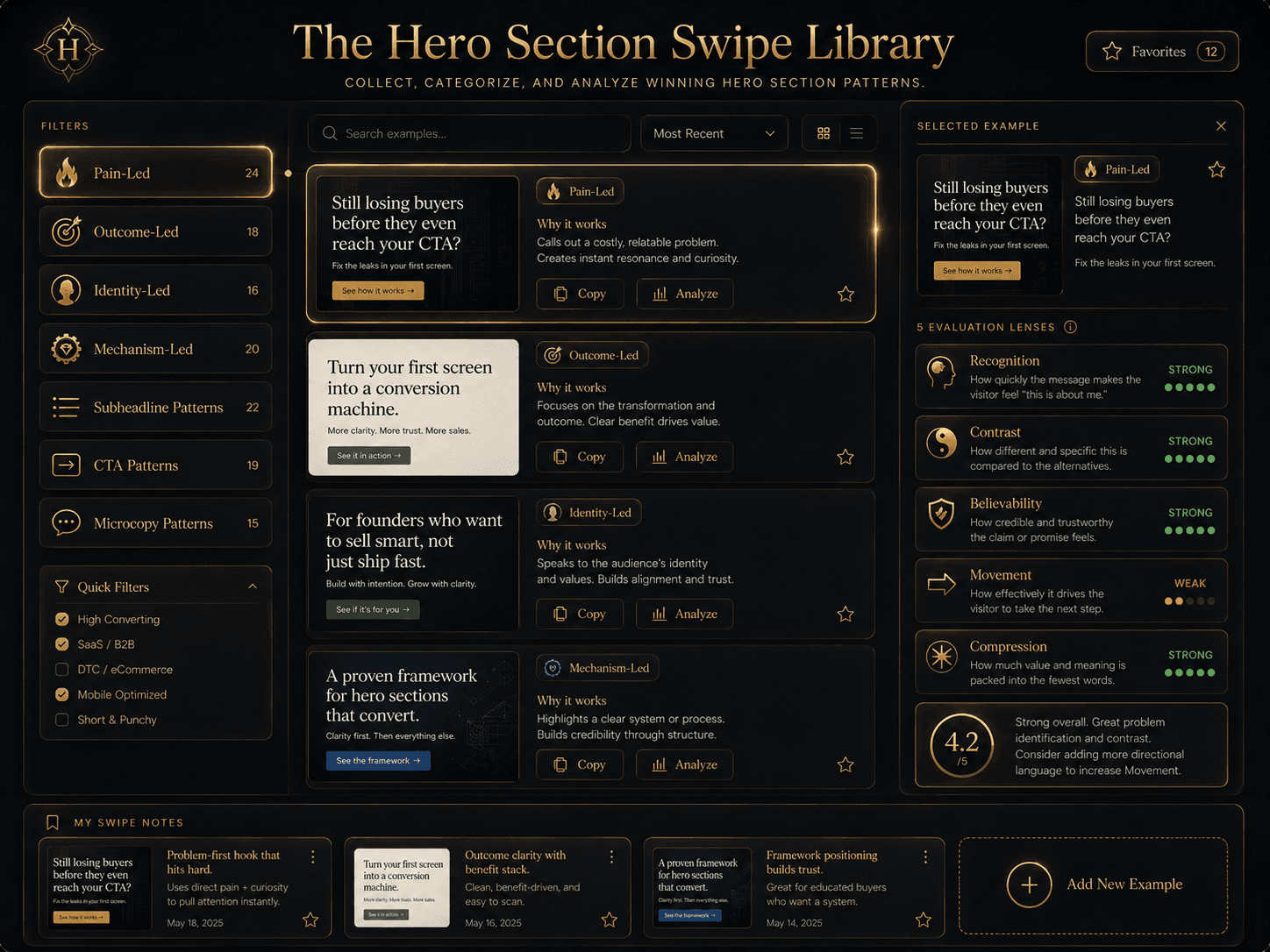
Build Your Own Hero Swipe Library™
As you browse landing pages, SaaS sites, funnels, homepages, ads, VSLs, webinars, and sales pages, save examples that create immediate reactions like:
“That feels sharp.”
“That creates tension.”
“That feels expensive.”
“That sounds believable.”
“That instantly makes sense.”
“That creates trust fast.”
“That makes me want to continue.”
“That feels specific.”
“That is memorable.”
“That explains the problem quickly.”
Then study why.
Do not only save the line.
Save the reason the line works.
That process develops commercial instinct.
Swipe Library Categories
Organise your swipe library into these categories:
pain-led hero sections
outcome-led hero sections
identity-led hero sections
mechanism-led hero sections
strong subheadlines
strong CTAs
strong microcopy
proof-led hero visuals
weak hero examples
before-and-after hero rewrites
A useful swipe library should include both strong and weak examples.
Strong examples teach you what to build.
Weak examples teach you what to avoid.
Both are valuable.
——
Hero Swipe Vault Builder
Swipe 1
Source:
Type:
Pain-led / Outcome-led / Identity-led / Mechanism-led / CTA / Microcopy / Other
Original line:
Why it caught my attention:
Pattern learned:
How I could adapt the structure:
Swipe 2
Source:
Type:
Pain-led / Outcome-led / Identity-led / Mechanism-led / CTA / Microcopy / Other
Original line:
Why it caught my attention:
Pattern learned:
How I could adapt the structure:
Swipe 3
Source:
Type:
Pain-led / Outcome-led / Identity-led / Mechanism-led / CTA / Microcopy / Other
Original line:
Why it caught my attention:
Pattern learned:
How I could adapt the structure:
——
The Biggest Swipe Vault Mistake™
Do not study examples by asking:
“Do I like this?”
That question is too shallow.
Instead ask:
“Why does this create faster emotional movement than weaker hero sections?”
That question changes everything.
Because the goal is not collecting lines.
The goal is training judgement.
You are not trying to build a folder full of attractive screenshots.
You are trying to build the ability to see:
where recognition appears
where contrast gets created
where trust begins
where compression happens
where the CTA creates movement
where microcopy reduces hesitation
where the buyer feels understood
where the scroll slows down
That is the real value of a swipe vault.
Not more examples.
Sharper perception.
——
Using AI To Analyse Hero Sections
AI can help you study hero section patterns, but only if you ask it to analyse structure before rewriting.
Do not ask:
“Write me something like this.”
That usually creates imitation.
Instead ask:
“Why does this work, what structure is underneath it, and how can I adapt the pattern without copying the wording?”
That is the better use of AI.
——
AI Hero Swipe Analysis Prompt™
Use this prompt:
Act as a conversion-focused landing page strategist, funnel copywriter, and buyer psychology analyst.
Analyse this hero section and explain why it feels strong or weak.
Here is the hero section:
Headline:
[paste headline]
Subheadline:
[paste subheadline]
CTA:
[paste CTA]
Microcopy:
[paste microcopy or write “missing”]
Visual or proof direction:
[describe the visual]
My business is:
[insert business]
My target buyer is:
[insert target buyer]
My offer is:
[insert offer]
Analyse the hero section through these five lenses:
Recognition
Contrast
Believability
Movement
Compression
For each lens:
give a score from 1 to 5
explain what is working
explain what is weak
identify the exact words or structure creating the effect
explain how the buyer likely experiences it
identify whether it earns continuation
Then explain:
why the hero feels strong or weak
what emotional reactions the buyer likely feels
where the messaging leaks attention
what makes the structure effective or ineffective
whether the hero uses buyer language or business language
whether the CTA creates movement
whether the microcopy reduces hesitation
whether the visual builds belief or merely decorates
Then rewrite the section into:
A sharper version
A more compressed version
A more emotionally intense version
A cleaner premium version
A version adapted to my business without copying the original wording
For each rewritten version, explain:
what changed
why it is stronger
what buyer reaction it is designed to create
what risk or weakness still remains
Do not add hype.
Do not imitate the wording mechanically.
Do not make vague premium claims.
Prioritise clarity, buyer psychology, recognition, contrast, believability, compression, and continuation.
——
Final Execution Challenge™
Take three strong hero sections from your market.
Then analyse them using everything inside this resource.
Do not copy surface wording.
Study:
structure
contrast
emotional movement
consequence visibility
proof positioning
CTA momentum
clarity compression
buyer recognition
microcopy reassurance
For each hero section, answer:
What makes the buyer stop?
What makes the buyer feel understood?
What creates trust?
What creates tension?
What creates movement?
What makes the CTA feel specific?
What can I adapt without copying?
Because once you understand why certain first screens instantly feel stronger, clearer, and more trustworthy, you stop randomly rewriting pages.
You start engineering hero sections intentionally.
——
Final Hero Swipe Study Worksheet
Use this as your final practice tool.
Hero Section 1
Source:
Headline:
Subheadline:
CTA:
Microcopy:
Visual:
What makes it strong or weak?
What pattern can I learn?
How can I adapt the structure?
Hero Section 2
Source:
Headline:
Subheadline:
CTA:
Microcopy:
Visual:
What makes it strong or weak?
What pattern can I learn?
How can I adapt the structure?
Hero Section 3
Source:
Headline:
Subheadline:
CTA:
Microcopy:
Visual:
What makes it strong or weak?
What pattern can I learn?
How can I adapt the structure?
——
Final Principle
The point of a hero section swipe vault is not to collect better lines.
It is to train better judgement.
Weak marketers collect headlines.
Strong marketers study structure.
They ask:
Why does this create recognition faster?
Why does this contrast feel sharper?
Why does this promise feel believable?
Why does this CTA create movement?
Why does this microcopy reduce hesitation?
Why does this first screen make the buyer want to continue?
That is the skill.
Because once you can see why certain hero sections feel stronger, you no longer need to guess.
You can build first screens intentionally.
You can create faster emotional orientation.
You can reduce thinking friction.
You can make the buyer feel understood sooner.
You can make the next step feel clearer.
That is what The Hero Section Swipe Vault™ is designed to train.
Not copying.
Recognition.
Not imitation.
Pattern awareness.
Not surface-level inspiration.
Commercial instinct.
Because the hero section is not just the first thing the buyer sees.
It is the first place the page has to earn the right to continue.
——
From:
The $100M Funnel Playbook. Book I: Foundation Buyer Psychology, Offer Clarity, and the Page Architecture Behind High-Converting Funnels
By Maris Spalins.
——
Copyright Notice
© 2026 The $100M Funnel Playbook / Winyourclients / Maris Spalins. All rights reserved.
This resource, including the frameworks, terminology, examples, scorecards, templates, prompts, methods, and written explanations, is original intellectual property created for The $100M Funnel Playbook. Book I: Foundation — Buyer Psychology, Offer Clarity, And The Page Architecture Behind High-Converting Funnels and published through Winyourclients.
No part of this resource may be copied, reproduced, screenshotted, republished, redistributed, sold, adapted, uploaded, scraped, stored in a database, included in training data, used to train artificial intelligence systems, or used to create derivative commercial or educational materials without prior written permission.
Limited reference, quotation, or sharing is only permitted where the source is clearly and visibly credited.
Any permitted reference must include at least one of the following source credits:
The $100M Funnel Playbook by Maris Spalins
or
Winyourclients — www.winyourclients.com
or
Maris Spalins / Winyourclients
Screenshots, excerpts, summaries, or redistributed versions must not remove, hide, alter, crop out, or obscure the original source, author name, book title, website name, or copyright notice.
This resource is provided for personal learning and implementation only. It is not licensed for resale, republishing, redistribution, AI training, template cloning, course creation, consulting delivery, or commercial reuse without written permission from Maris Spalins or Winyourclients.
For permission requests, licensing, citation approval, or commercial usage enquiries, contact:
Winyourclients
www.winyourclients.com
or
Email directly to Jacob on: help@winyourclients.com
![“The 7 Hero Section Categories” Concept: A minimalist, elegant 7-panel grid or radial wheel. Each panel represents one hero section category with an icon and a micro-example: Panel 1 (Pain-Led): Icon: fire/burn — Example: “Still losing buyers before they even reach your CTA?” Panel 2 (Outcome-Led): Icon: target/achievement — Example: “Turn your first screen into a clearer conversion point without rebuilding your whole site.” Panel 3 (Identity-Led): Icon: mirror/silhouette — Example: “For founders tired of sounding smart but selling soft.” Panel 4 (Mechanism-Led): Icon: gear/diamond — Example: “Build a stronger hero section using one sharp promise, one proof asset, and one clear next step.” Panel 5 (Subheadline Patterns): Icon: text lines with structure — Example: “Built for [buyer] struggling with [problem], this [mechanism] helps them [result] without [friction].” Panel 6 (CTA Patterns): Icon: arrow/button — Example: “See the Hero Rewrite” / “Fix My First Screen” Panel 7 (Microcopy Patterns): Icon: whisper/speech bubble — Example: “No fluff. Just the framework.” At the center of the wheel: a single sentence: “Study the pattern. Not the words.” Style: Architectural diagram meets luxury UI. Dark charcoal background, thin gold connecting lines, each panel is a translucent glass card with gold foil text. Feels like a strategic reference library. Interaction: Hovering any panel expands a detailed breakdown of that category, including 3 examples, why they work, and when to use that style. Clicking the panel pins it to a “Favorites” sidebar for comparison.](https://framerusercontent.com/images/NpKOSriGRm5RKNErNTltc8Jn70.png?width=1448&height=1086)
![“The Subheadline Structure Blueprint” Concept: A minimalist, architectural blueprint showing the anatomy of a strong subheadline. Center: The formula: “Built for [buyer] struggling with [problem], this [mechanism] helps them [result] without [friction].” Around the formula, exploded callouts showing each component: [buyer]: “Agencies attracting traffic but losing trust before the CTA” — Label: “Specific audience. Creates recognition.” [problem]: “Pages that look polished but still fail to create enough trust or movement above the fold” — Label: “Visible friction. Creates tension.” [mechanism]: “Hero-first optimisation system” — Label: “Specific approach. Creates distinctiveness.” [result]: “Sharpen the message, proof, and CTA that decide whether the right buyer stays or leaves” — Label: “Visible outcome. Creates desire.” [friction]: “Without rebuilding your entire site” — Label: “Removes objection. Creates safety.” Below: A complete example using the formula: “Built for service businesses whose pages look polished but still fail to create enough trust, clarity, or movement above the fold, this hero-first system helps sharpen the message, proof, and CTA that decide whether the right buyer stays or leaves.” Style: Architectural blueprint meets luxury UI. Dark background, gold lines, exploded callouts with thin connecting lines. Feels like a precision construction guide. Interaction: Hovering any component expands a detailed explanation of why it matters and how to fill it for your offer. Clicking the component opens a mini-worksheet for that field. A “Build My Subheadline” button compiles all components into a complete subheadline.](https://framerusercontent.com/images/er8bUnRGq3a6K9cmhYciZS4vX10.png?width=1448&height=1086)
The Hero Section Swipe Vault™ A curated hero-section pattern library for studying the headline, subheadline, CTA, and microcopy structures that create recognition, contrast, trust, compression, and scroll momentum above the fold.
Prefer Audio Or Video?
The Hero Section Swipe Vault™ is also available as:
🎧 A guided audio walkthrough explaining hero section patterns, first-screen clarity, recognition, contrast, CTA movement, and microcopy.
🎥 A practical video breakdown with real hero section examples, swipe analysis, headline/subheadline patterns, CTA rewrites, and above-the-fold teardowns.Choose the format that fits how you learn best.
[Listen To The Audio Walkthrough] (coming soon)
[Watch The Video Breakdown] (coming soon)
——
Why Most People Study Hero Sections The Wrong Way
Most people study hero sections badly.
They collect headlines.
They save layouts.
They screenshot clever wording.
They bookmark beautiful pages.
They copy phrases that sound impressive.
But they rarely understand why certain first screens instantly feel stronger than others.
That creates imitation.
Not skill.
A hero section swipe vault should not teach you to copy surface language.
It should train your ability to recognise what creates:
attention
trust
clarity
tension
belief
movement
continuation
buyer recognition
fast emotional orientation
Because once you understand why a hero section creates attention, trust, clarity, and scroll momentum, you stop guessing.
You stop randomly rewriting headlines.
You stop staring at the design file hoping the layout will fix weak thinking.
You start building stronger first screens intentionally.
That is the purpose of The Hero Section Swipe Vault™.
This is not a swipe file for lazy copying.
This is a training system for understanding strong first-screen communication.
What This Resource Helps You Do
The Hero Section Swipe Vault™ helps you recognise what creates clarity, tension, trust, and movement above the fold.
Use this resource when:
your hero section feels generic
your messaging sounds flat
your first screen lacks tension
you need stronger headline directions
the CTA feels weak
your page feels polished but forgettable
you want inspiration without blindly copying
you need to sharpen positioning quickly
your subheadline repeats the headline instead of deepening belief
your microcopy does not reduce hesitation
your hero feels clear but emotionally dead
you want to train better conversion judgement
The goal is simple:
Learn to recognise what makes buyers stop, feel understood, trust the page, and continue scrolling.
Not by copying words.
By studying structure.
The Most Important Principle In This Resource™
Strong hero sections usually do one thing extremely well:
They create fast emotional orientation.
Meaning the buyer quickly feels:
“This page understands my problem and knows where I want to go.”
That is the job.
A strong hero section helps the buyer locate themselves within seconds.
It quickly shows:
what problem is being addressed
who the page is for
why the problem matters
what better state is possible
why this approach might be believable
what action makes sense next
Weak hero sections force the visitor to interpret, decode, or work too hard mentally.
Strong hero sections reduce thinking friction.
That difference changes everything.
Because the fold is not judged slowly.
It is filtered quickly.
The buyer does not patiently study the first screen.
They glance.
They feel.
They decide whether to continue.
Fast emotional orientation is what makes the scroll slow down.
How To Use This Swipe Vault
Do not use this resource by asking:
“Which line can I copy?”
That is the wrong question.
Use it by asking:
“Why does this pattern work?”
Every example should be studied through five lenses:
Recognition
Contrast
Believability
Movement
Compression
These lenses help you understand the structure underneath strong hero sections.
The goal is not to borrow someone else’s voice.
The goal is to train your own judgement.
For every swipe, ask:
What makes this feel specific?
What buyer condition does this speak to?
What tension does this create?
What friction does it remove?
What proof or belief signal is implied?
What makes the next step feel easier?
How could I adapt the structure without copying the wording?
That is how a swipe vault becomes useful.
Not as a library of stolen lines.
As a training ground for commercial instinct.
——
The 5 Hero Swipe Analysis Lenses™
Lens 1: Recognition™
Core Question
Does the right buyer quickly feel:
“This is for someone like me”?
Recognition is the first filter.
Before the buyer cares about the method, the proof, or the CTA, they need to feel that the page is relevant to their situation.
Weak hero sections speak to categories.
Strong hero sections speak to conditions.
Weak:
“For businesses.”
Stronger:
“For service businesses whose pages look polished but still fail to create enough trust above the fold.”
The second version creates recognition because it names the buyer’s actual situation.
Recognition Questions
Ask:
Who would feel personally addressed by this?
Does the line name a category or a buying condition?
Does it reveal a frustration the buyer already carries?
Does it sound like something the buyer has experienced?
Could the right buyer quickly think, “That is me”?
Lens 2: Contrast™
Core Question
Does the hero create a visible gap between current frustration and desired result?
Contrast creates movement.
A hero section becomes stronger when the buyer feels the gap between:
where they are now
where they want to be
what staying the same costs
what improvement makes possible
Weak hero sections describe services.
Strong hero sections create movement.
Weak:
“We improve landing pages.”
Stronger:
“Stop losing buyers before they trust the offer.”
The second version creates contrast because it shows a painful current state and points toward a better one.
Contrast Questions
Ask:
What current frustration is being named?
What desired result is being implied?
What happens if the problem continues?
What friction is being removed?
Does the hero make staying the same feel costly?
Does the line create emotional movement?
Lens 3: Believability™
Core Question
Does the wording feel credible and grounded?
A hero section can create attention and still fail if the promise feels inflated.
Believability protects the page from hype.
Strong hero sections do not need to shout.
They need to feel true enough to continue with.
Weak:
“Explode your conversions overnight.”
Stronger:
“Improve first-screen clarity before sending more paid traffic to a page that leaks trust.”
The second version feels more believable because it is specific, grounded, and tied to a real problem.
Believability Questions
Ask:
Does the promise feel credible?
Is the wording grounded or exaggerated?
Is there a mechanism implied?
Does the line create confidence or scepticism?
Would a sceptical buyer feel calmer after reading this?
Does the claim feel inspectable?
Lens 4: Movement™
Core Question
Does the section create forward momentum?
A strong hero section should make the buyer want to continue.
Not necessarily buy immediately.
Continue.
That is the job above the fold.
Movement happens when the buyer feels:
this matters
this applies to me
this could solve something real
I want to see how this works
the next step is obvious enough to consider
Weak hero sections stall.
Strong hero sections pull.
Movement Questions
Ask:
Does this make the buyer want to keep reading?
Does it create curiosity?
Does it make the next section feel necessary?
Does the CTA feel connected to a payoff?
Does the page feel like it is moving somewhere?
Does the hero earn continuation?
Lens 5: Compression™
Core Question
Does the page communicate the value quickly?
Compression matters because the first screen does not get unlimited patience.
Weak hero sections require too much reading and interpretation.
Strong hero sections compress the right things:
buyer
problem
result
contrast
proof direction
next step
Compression does not mean saying less for the sake of being short.
It means removing anything that slows understanding.
The fold rewards compression.
Not clutter.
Compression Questions
Ask:
Can the buyer understand this quickly?
Does the wording feel heavy?
Can 30% of the words be removed?
Is the subheadline clarifying or overexplaining?
Is there one clear promise?
Does the first screen feel fast to absorb?
——
Category 1: Pain-Led Hero Sections™
Pain-led hero sections work because they create immediate emotional recognition.
The buyer instantly feels the problem.
This style works especially well when:
frustration already exists
urgency is active
the buyer knows something is wrong
the current solution feels painful or expensive
the buyer is tired of tolerating the same leak
the market is aware of the pain but has not named the cause clearly
Pain-led hero sections are powerful because they bring a hidden frustration to the surface.
They make the buyer feel:
“That is exactly what is happening.”
Pain-Led Example 1
Hero Line
“Still losing buyers before they even reach your CTA?”
Why This Works
This line creates immediate tension.
It points to a specific leak.
It makes the buyer imagine invisible lost opportunity.
It creates curiosity because the buyer starts wondering:
“Is that what is happening on my page?”
It also shifts attention to the fold, not the whole funnel.
That makes the problem feel more precise.
Pattern To Learn
This pattern works because it turns a hidden problem into a visible one.
It does not say:
“Improve your website.”
It says:
“Something specific is happening before the CTA.”
That creates sharper attention.
Adaptation Prompt
Where is your buyer losing momentum before the obvious action happens?
Write it here:
Pain-Led Example 2
Hero Line
“Your page is not being ignored because the market is cold. It is being ignored because the first screen is weak.”
Why This Works
This line works because it challenges an assumption.
The buyer may be blaming:
traffic
audience quality
the market
timing
the platform
demand
This line introduces a new diagnosis:
The first screen is weak.
That creates contrast.
It replaces blame with diagnosis.
It also makes the reader feel there may be a fix.
Pattern To Learn
This pattern works by saying:
“You think the problem is [common assumption]. The real problem is [sharper diagnosis].”
That structure is powerful because it reframes the buyer’s frustration.
Adaptation Prompt
What is your buyer currently blaming that may not be the real problem?
Write it here:
What is the sharper diagnosis?
Pain-Led Example 3
Hero Line
“Stop losing trust in the first three seconds.”
Why This Works
This line is compressed.
It creates fast clarity.
It introduces consequence.
It makes trust feel urgent.
It also gives the problem a timeframe.
The buyer can immediately picture how quickly judgement happens above the fold.
This is a strong example of compression plus consequence.
Pattern To Learn
This pattern works by attaching the loss to a short moment.
It makes the problem feel immediate.
The shorter the window, the sharper the tension.
Adaptation Prompt
What does your buyer lose quickly when the first impression is weak?
Write it here:
Pain-Led Example 4
Hero Line
“Your first screen is not underperforming quietly. It is costing you momentum every day it stays weak.”
Why This Works
This line makes the cost of inaction visible.
It suggests that the problem is not harmless.
The hero section is not simply “weak.”
It is costing momentum.
That creates consequence.
The buyer starts to feel that delay has a price.
Pattern To Learn
This pattern works by turning a passive weakness into an active cost.
Weak:
“This could be improved.”
Stronger:
“This is costing you momentum.”
Adaptation Prompt
What is your buyer’s current weakness costing them every day?
Write it here:
Pain-Led Example 5
Hero Line
“If your page looks polished but still does not convert, the problem probably starts above the fold.”
Why This Works
This line speaks to a very specific condition:
The page looks good but still performs badly.
That creates recognition because many founders experience this privately.
They do not know why the page is not working because visually it looks acceptable.
This line names the hidden frustration.
Pattern To Learn
This pattern works by creating contrast between appearance and performance.
It says:
“It looks good, but something underneath is still weak.”
Adaptation Prompt
Where does your buyer’s situation look fine externally but fail internally?
Write it here:
——
Category 2: Outcome-Led Hero Sections™
Outcome-led hero sections work best when the buyer already desires a clear visible improvement.
This style creates aspiration and movement.
It does not need to start with heavy pain.
It starts with the shift the buyer wants.
Outcome-led hero sections work especially well when:
the buyer already understands the problem
the desired result is easy to picture
the result feels valuable quickly
the offer removes a clear friction point
the buyer wants a practical improvement
The strongest outcome-led hero sections do not only describe a result.
They also remove resistance.
Outcome-Led Example 1
Hero Line
“Turn your first screen into a clearer conversion point without rebuilding your whole site.”
Why This Works
This line creates visible transformation.
It shows the buyer what changes:
The first screen becomes a clearer conversion point.
It also removes a common objection:
“Without rebuilding your whole site.”
That matters enormously.
The result feels desirable.
The path feels lighter.
The scope feels believable.
Pattern To Learn
This pattern works because it combines:
Desired outcome + removed friction.
The buyer sees what they get and what they do not have to suffer through.
Adaptation Prompt
What result does your buyer want, and what painful friction do they want to avoid?
Write it here:
Outcome-Led Example 2
Hero Line
“Build a hero section that makes the right buyer stop, stay, and click.”
Why This Works
This line creates a visible progression.
Stop.
Stay.
Click.
The buyer can mentally visualise what happens.
That makes the result feel simple and movement-oriented.
It also compresses the job of the hero section into three actions.
That is why the line is easy to remember.
Pattern To Learn
This pattern works by turning the result into a sequence.
A sequence makes the promise feel easier to picture.
Adaptation Prompt
What is the simple buyer journey your offer creates?
From:
To:
Then:
Outcome-Led Example 3
Hero Line
“Rebuild the first screen so attention turns into trust faster.”
Why This Works
This line is transformation-focused.
It moves from attention to trust.
That is emotionally visible because attention alone is not enough.
The buyer wants attention to become belief.
The wording is simple, but active.
It does not overexplain.
It creates movement.
Pattern To Learn
This pattern works by showing one valuable state turning into another.
Attention becomes trust.
Traffic becomes enquiries.
Confusion becomes clarity.
Interest becomes action.
Adaptation Prompt
What weak state does your offer turn into a stronger state?
Write it here:
Outcome-Led Example 4
Hero Line
“Create a first screen that earns the scroll before the rest of the page has to work.”
Why This Works
This line clearly defines the job of the hero section.
It also creates sequence.
The first screen must earn the scroll before the rest of the page matters.
That makes the fold feel important.
It gives the buyer a sharper reason to care.
Pattern To Learn
This pattern works by showing the role of one part inside the bigger system.
It makes the reader realise that if this part fails, everything after it suffers.
Adaptation Prompt
What part of your buyer’s system decides whether everything else gets a chance?
Write it here:
Outcome-Led Example 5
Hero Line
“Add clarity, tension, and proof to your hero section without a bloated redesign.”
Why This Works
This line names three desirable improvements:
Clarity.
Tension.
Proof.
Then it removes friction:
Without a bloated redesign.
The buyer sees both value and relief.
The promise feels practical.
Pattern To Learn
This pattern works by listing the key improvements and removing the feared process.
Adaptation Prompt
What three improvements does your buyer want, and what process do they want to avoid?
Write it here:
——
Category 3: Identity-Led Hero Sections™
Identity-led hero sections work because they create belonging and self-recognition.
The buyer feels that the page understands how they see themselves.
This style works especially well for:
creators
coaches
consultants
operators
founders
personality-driven brands
communities
education offers
transformation offers
Identity-led heroes are powerful when the buyer’s problem is not only functional.
It is personal.
They are not just trying to fix a metric.
They are trying to stop feeling a certain way about themselves, their business, or their work.
Identity-Led Example 1
Hero Line
“For founders tired of sounding smart but selling soft.”
Why This Works
This line is emotionally sharp.
It creates identity tension.
The founder wants to be seen as smart.
But the offer still feels commercially weak.
That creates discomfort.
The line also creates recognition, embarrassment, and aspiration at the same time.
That combination is powerful.
Pattern To Learn
This pattern works because it names the gap between self-perception and commercial reality.
The buyer feels:
“That is painfully accurate.”
Adaptation Prompt
Where does your buyer feel capable, but their results still feel weak?
Write it here:
Identity-Led Example 2
Hero Line
“For service businesses whose page looks polished but still feels weak.”
Why This Works
This line exposes hidden frustration.
It does not simply say:
“For service businesses.”
It describes the emotional condition:
The page looks polished but still feels weak.
That is specific.
It creates internal tension.
The buyer knows the page is not obviously ugly.
But they also know it is not creating enough movement.
That makes the line feel accurate.
Pattern To Learn
This pattern works by naming a contradiction.
Looks polished.
Feels weak.
Contradiction creates attention.
Adaptation Prompt
What contradiction is your buyer currently living with?
Write it here:
Identity-Led Example 3
Hero Line
“For brands tired of ‘Learn More’ energy and soft first impressions.”
Why This Works
This line feels alive.
Not corporate.
It uses culturally recognisable frustration.
“Learn More energy” describes a passive, weak, low-momentum first screen.
The line is memorable because it gives a feeling a name.
That creates stronger recognition.
Pattern To Learn
This pattern works by naming an energy, behaviour, or style the buyer dislikes.
It turns vague frustration into a memorable phrase.
Adaptation Prompt
What weak “energy” does your buyer want to stop projecting?
Write it here:
Identity-Led Example 4
Hero Line
“For operators who want the fold to carry more weight than the design.”
Why This Works
This line speaks to a specific type of buyer.
An operator does not want surface polish.
They want the page to work.
The line creates identity alignment.
It tells the reader:
“This is not for people chasing aesthetics. This is for people who want the first screen to carry commercial weight.”
That makes the positioning sharper.
Pattern To Learn
This pattern works by aligning with the buyer’s values.
It signals what kind of person this page is for.
Adaptation Prompt
What does your buyer value more than surface polish?
Write it here:
Identity-Led Example 5
Hero Line
“For coaches, creators, and consultants sick of above-the-fold fluff.”
Why This Works
This line works because it names the buyer and the thing they are tired of.
“Above-the-fold fluff” is vivid.
It is emotionally easy to understand.
The buyer feels that the page is not going to give them generic advice.
It creates a sharper expectation.
Pattern To Learn
This pattern works by combining audience category with disliked market behaviour.
Adaptation Prompt
What market behaviour is your buyer tired of seeing or being told to use?
Write it here:
——
Category 4: Mechanism-Led Hero Sections™
Mechanism-led hero sections work best when the buyer already understands the problem but wants to know why this approach feels different.
This style is useful when:
the market is sceptical
the buyer has tried other solutions
the category is crowded
the offer needs distinctiveness
the buyer wants a clear method
the mechanism can be explained simply
Mechanism-led hero sections increase believability because they show how the result may happen.
They do not just promise the outcome.
They reveal the engine.
Mechanism-Led Example 1
Hero Line
“Build a stronger hero section using one sharp promise, one proof asset, and one clear next step.”
Why This Works
This line is structurally specific.
It gives the buyer a simple framework:
One promise.
One proof asset.
One next step.
That reduces overwhelm.
It makes the method feel usable immediately.
The buyer can picture implementation.
Pattern To Learn
This pattern works by turning the method into a simple sequence.
The buyer feels:
“I understand how this works.”
That increases trust.
Adaptation Prompt
What are the three simplest parts of your mechanism?
Mechanism-Led Example 2
Hero Line
“Use tension-first copy and proof-led visuals to stop the right buyer before the fold.”
Why This Works
This line creates mechanism visibility.
The buyer can see the approach:
Tension-first copy.
Proof-led visuals.
Those phrases feel specific.
They make the offer more memorable.
The buyer also begins imagining implementation.
Pattern To Learn
This pattern works by naming the method behind the outcome.
The mechanism creates distinctiveness.
Adaptation Prompt
What is your method called, and what does it prioritise first?
Write it here:
Mechanism-Led Example 3
Hero Line
“Install a hero section that creates recognition, belief, and forward movement in seconds.”
Why This Works
This line feels strategic without becoming vague.
It names psychological outcomes:
Recognition.
Belief.
Forward movement.
It also compresses the job of the hero section.
The phrase “in seconds” adds immediacy without becoming unrealistic.
Pattern To Learn
This pattern works by naming the psychological jobs your mechanism performs.
Adaptation Prompt
What three psychological jobs does your offer perform for the buyer?
Mechanism-Led Example 4
Hero Line
“Rebuild your first screen with the structure high-converting pages use to earn attention fast.”
Why This Works
This line makes the mechanism feel proven.
It positions the offer around structure, not guesswork.
The buyer feels there is a method behind the rewrite.
That reduces uncertainty.
Pattern To Learn
This pattern works by contrasting structure with guessing.
It implies that the buyer does not need random creativity.
They need a repeatable system.
Adaptation Prompt
What does your mechanism replace?
Guesswork / confusion / random effort / overthinking / manual work / other:
Mechanism-Led Example 5
Hero Line
“Turn your first screen into a stronger conversion point with one audience, one result, one proof asset, and one next step.”
Why This Works
This line is clear and operational.
It gives the buyer a simple build logic.
The hero feels less mysterious.
The method feels achievable.
That reduces resistance.
Pattern To Learn
This pattern works by making the solution feel organised, not overwhelming.
Adaptation Prompt
What simple “one-one-one” structure could organise your offer?
One:
One:
One:
——
Category 5: Subheadline Structures™
Most weak subheadlines fail because they repeat the headline instead of deepening belief.
The subheadline should not compete with the headline.
It should support it.
A strong subheadline usually does at least one of five things:
clarifies who the offer is for
explains the mechanism
makes the promise easier to believe
reduces confusion
increases continuation
The headline stops the buyer.
The subheadline helps them justify staying.
That is the job.
Strong Subheadline Pattern 1
Pattern
“Built for [buyer] struggling with [problem], this [mechanism] helps them [result] without [friction].”
Why This Works
This pattern creates fast orientation.
It names the buyer.
It names the problem.
It introduces the mechanism.
It points toward the result.
It removes friction.
It prioritises clarity over cleverness.
Example
“Built for service businesses whose pages look polished but still fail to create enough trust above the fold, this hero-first system helps sharpen the message, proof, CTA, and microcopy that decide whether the right buyer stays or leaves.”
Fill-In Version
Built for _________________________________________ struggling with _________________________________________, this _________________________________________ helps them _________________________________________ without _________________________________________.
Strong Subheadline Pattern 2
Pattern
“For [specific buyer] who [current frustration], this helps them [desired movement] by [mechanism].”
Why This Works
This pattern starts with recognition.
Then it creates movement.
Then it explains the mechanism.
It works well when the buyer needs to feel seen before they need to understand the process.
Example
“For consultants whose homepage gets attention but not enough enquiries, this helps them turn the first screen into a clearer trust-building entry point by sharpening the headline, proof, CTA, and microcopy.”
Fill-In Version
For _________________________________________ who _________________________________________, this helps them _________________________________________ by _________________________________________.
Strong Subheadline Pattern 3
Pattern
“Use this when [symptom] so you can [result] without [painful process].”
Why This Works
This pattern is direct.
It tells the buyer when the offer is relevant.
It works well for practical resources, audits, tools, and diagnostic pages.
Example
“Use this when your page looks good but visitors leave too quickly, so you can find the first-screen leak without rebuilding the whole site.”
Fill-In Version
Use this when _________________________________________ so you can _________________________________________ without _________________________________________.
Strong Subheadline Pattern 4
Pattern
“No [painful thing]. No [painful thing]. Just [specific value].”
Why This Works
This pattern reduces resistance quickly.
It is especially useful when the buyer fears the process will be slow, complex, expensive, or vague.
Example
“No bloated redesign. No vague messaging. Just a sharper first screen that creates recognition, belief, and movement faster.”
Fill-In Version
No _________________________________________. No _________________________________________. Just _________________________________________.
Strong Subheadline Pattern 5
Pattern
“If [current problem], this helps you [desired result] before [consequence continues].”
Why This Works
This pattern creates consequence.
It links the current problem to a reason to act.
It makes the hero feel more urgent without fake scarcity.
Example
“If your page gets traffic but the CTA stays ignored, this helps you rebuild the fold before more qualified attention disappears.”
Fill-In Version
If _________________________________________, this helps you _________________________________________ before _________________________________________.
——
Category 6: CTA Patterns™
Strong CTAs create movement.
Weak CTAs create stalling.
The CTA should imply payoff.
A CTA is not only a button.
It is the first visible handoff between attention and action.
The buyer should not wonder:
“What happens if I click this?”
They should feel:
“This click gives me something specific.”
Weak CTA Pattern
Weak CTA
“Submit.”
Why It Fails
No momentum.
No emotional reward.
No clear payoff.
No sense of what happens next.
The buyer is being asked to act without being given a reason to want the action.
——
Strong CTA Pattern 1: Rewrite CTA
CTA
“See The Hero Rewrite”
Why This Works
This creates curiosity.
It implies value.
It feels low friction.
It gives the buyer a visible next step.
The buyer understands what happens next.
More Rewrite CTA Examples
Show Me The Rewrite
See The Before/After
Get The Hero Rewrite
Watch The Rewrite Breakdown
Fix My First Screen
Strong CTA Pattern 2: Blueprint CTA
CTA
“Get The Hero Blueprint”
Why This Works
This implies a useful asset.
It feels practical.
It suggests the buyer will receive structure, not vague advice.
More Blueprint CTA Examples
Download The Fold Blueprint
Get The First-Screen Framework
Grab The Hero Canvas
Get The Scroll-Stop Guide
Claim The Hero Section Blueprint
Strong CTA Pattern 3: Diagnostic CTA
CTA
“Claim The Hero Audit”
Why This Works
This gives the buyer a reason to act.
They are not just clicking.
They are getting a diagnosis.
Diagnostic CTAs work well when the buyer suspects something is wrong but does not know where the leak lives.
More Diagnostic CTA Examples
Run The Hero Check
Audit My First Screen
Find The Fold Leak
Diagnose My Hero Section
Check My Above-The-Fold Score
Strong CTA Pattern 4: Demo CTA
CTA
“Watch The Breakdown”
Why This Works
This feels low commitment.
The buyer does not have to make a decision yet.
They only need to watch.
It is useful when proof, education, or demonstration is needed before conversion.
More Demo CTA Examples
Watch The Hero Breakdown
See The System In Action
Watch The Fold Fix
Preview The Framework
See How It Works
Strong CTA Pattern 5: Action CTA
CTA
“Build My Hero Section”
Why This Works
This is direct.
It creates movement.
It makes the buyer feel they are progressing toward a useful outcome.
More Action CTA Examples
Fix My First Screen
Build My First Screen
Improve My Hero Section
Start The Hero Build
Make The Fold Work Harder
CTA Adaptation Worksheet
What does the buyer get after clicking?
What action feels low-friction?
What payoff should the CTA imply?
What is the clearest CTA option?
——
Category 7: Microcopy Patterns™
Microcopy exists to reduce hesitation.
Many businesses ignore this completely.
Huge mistake.
The buyer may already be interested, but hesitation often appears right before action.
They may wonder:
Will this waste my time?
Is this going to be a pitch?
Is this complicated?
Is there a catch?
Will I understand it quickly?
Is this useful right now?
Microcopy lowers that friction.
A good microcopy line can make the CTA feel easier, safer, faster, and more practical.
Microcopy Pattern 1: Anti-Fluff
Example
“No fluff. Just the framework.”
Why This Works
It lowers scepticism.
It increases clarity.
It reduces perceived waste of time.
It tells the buyer the next step will be practical.
More Anti-Fluff Examples
No fluff. Just the structure.
No theory. Just the fix.
No vague advice. Just the exact steps.
No filler. Just the fold framework.
No brand theatre. Just the first-screen structure.
Microcopy Pattern 2: Speed
Example
“Takes 90 seconds. Use it today.”
Why This Works
It reduces effort.
It makes the action feel light.
It suggests immediate usefulness.
More Speed Examples
Takes 2 minutes.
Use it today.
Quick to read. Easy to apply.
Built for fast implementation.
Simple enough to use before your next rewrite.
Microcopy Pattern 3: Consequence
Example
“Use this before wasting money on more traffic.”
Why This Works
It creates consequence visibility.
It gives the buyer a practical reason to act now.
It links the resource to a costly mistake.
More Consequence Examples
Use this before sending more traffic to a weak fold.
Fix the first screen before scaling the funnel.
Check the fold before blaming the offer.
Find the leak before another campaign goes live.
Do this before redesigning the whole page.
Microcopy Pattern 4: Reassurance
Example
“No pressure. No redesign. No guesswork.”
Why This Works
It reduces fear.
It removes common objections.
It makes the next step feel safer.
More Reassurance Examples
No pitch. Just the structure.
No redesign required.
No pressure. Just the framework.
Free and practical.
Clear enough to use today.
Microcopy Pattern 5: Value Compression
Example
“Built for speed, clarity, and clicks.”
Why This Works
It compresses the value.
It tells the buyer what the action is designed to improve.
It is fast to read.
——
More Value Compression Examples
Built for clarity, trust, and movement.
Made for faster first-screen decisions.
Designed to help the fold work harder.
Simple structure. Sharper scroll momentum.
Less confusion. More continuation.
Microcopy Adaptation Worksheet
What hesitation might stop the buyer from clicking?
What reassurance would make the action feel lighter?
What consequence makes acting now useful?
What short line can reduce friction?
——
Weak vs Strong Hero Pattern Examples™
Use these examples to train contrast.
The lesson is not that the stronger version is perfect.
The lesson is that the stronger version carries more structure.
Example 1: Generic Agency Hero
Weak
“Marketing Solutions That Scale.”
Why It Is Weak
It is broad.
It sounds polished but empty.
It does not create recognition, contrast, or movement.
The buyer cannot see the problem, result, mechanism, or reason to care.
Stronger
“Stop losing buyers before they trust the offer.”
Why It Is Stronger
It names a specific failure point.
It creates consequence.
It makes the buyer picture the conversion leak.
It is easier to remember.
Pattern To Learn
Move from category language to buyer consequence.
Example 2: Weak Website Hero
Weak
“We build beautiful websites for modern brands.”
Why It Is Weak
It focuses on appearance.
It speaks broadly.
It does not reveal what the website must do commercially.
Stronger
“Build a first screen that makes the right buyer understand, trust, and continue before the scroll wins.”
Why It Is Stronger
It defines the job of the page.
It creates movement.
It shows the buyer what the first screen needs to achieve.
Pattern To Learn
Move from design description to conversion function.
Example 3: Weak Consulting Hero
Weak
“Strategic advice for ambitious founders.”
Why It Is Weak
It sounds premium, but vague.
It does not name a real pressure point.
It gives no reason to continue.
Stronger
“For founders tired of sounding smart but selling soft.”
Why It Is Stronger
It creates identity tension.
It names a painful contradiction.
It feels emotionally specific.
Pattern To Learn
Move from status language to private frustration.
Example 4: Weak SaaS Hero
Weak
“All-in-one platform for customer engagement.”
Why It Is Weak
It is category language.
It does not show a problem.
It gives the buyer no emotional reason to care.
Stronger
“Stop losing trial users before onboarding creates enough trust to continue.”
Why It Is Stronger
It names a specific failure point.
It connects product friction to trust.
It creates a clearer reason to act.
Pattern To Learn
Move from product category to user behaviour and consequence.
Example 5: Weak CTA
Weak
“Learn More.”
Why It Is Weak
It does not imply payoff.
It creates no movement.
It asks for attention without giving a clear reason.
Stronger
“See The Hero Rewrite.”
Why It Is Stronger
It creates curiosity.
It promises a visible next step.
It feels easy to act on.
Pattern To Learn
Move from vague action to specific payoff.
——
Swipe Analysis Worksheet™
Use this worksheet every time you save a hero section swipe.
Swipe Source
Where did you find this example?
Original Hero Section
Headline:
Subheadline:
CTA:
Microcopy:
Visual or proof direction:
First Reaction
What did you feel when you saw it?
Sharp / Clear / Trustworthy / Expensive / Generic / Flat / Memorable / Confusing / Other
Explain:
Lens 1: Recognition
Does the right buyer feel seen?
Score: ___ / 5
Why?
Lens 2: Contrast
Does it create a gap between current frustration and desired result?
Score: ___ / 5
Why?
Lens 3: Believability
Does it feel credible and grounded?
Score: ___ / 5
Why?
Lens 4: Movement
Does it make the buyer want to continue?
Score: ___ / 5
Why?
Lens 5: Compression
Does it communicate value quickly?
Score: ___ / 5
Why?
Pattern Identified
What structure makes this hero strong or weak?
What I Can Adapt
What can I adapt without copying the surface wording?
What I Should Not Copy
What would become imitation if copied directly?
My Adapted Version
Headline:
Subheadline:
CTA:
Microcopy:
Visual direction:
——
Build Your Own Hero Swipe Library™
As you browse landing pages, SaaS sites, funnels, homepages, ads, VSLs, webinars, and sales pages, save examples that create immediate reactions like:
“That feels sharp.”
“That creates tension.”
“That feels expensive.”
“That sounds believable.”
“That instantly makes sense.”
“That creates trust fast.”
“That makes me want to continue.”
“That feels specific.”
“That is memorable.”
“That explains the problem quickly.”
Then study why.
Do not only save the line.
Save the reason the line works.
That process develops commercial instinct.
Swipe Library Categories
Organise your swipe library into these categories:
pain-led hero sections
outcome-led hero sections
identity-led hero sections
mechanism-led hero sections
strong subheadlines
strong CTAs
strong microcopy
proof-led hero visuals
weak hero examples
before-and-after hero rewrites
A useful swipe library should include both strong and weak examples.
Strong examples teach you what to build.
Weak examples teach you what to avoid.
Both are valuable.
——
Hero Swipe Vault Builder
Swipe 1
Source:
Type:
Pain-led / Outcome-led / Identity-led / Mechanism-led / CTA / Microcopy / Other
Original line:
Why it caught my attention:
Pattern learned:
How I could adapt the structure:
Swipe 2
Source:
Type:
Pain-led / Outcome-led / Identity-led / Mechanism-led / CTA / Microcopy / Other
Original line:
Why it caught my attention:
Pattern learned:
How I could adapt the structure:
Swipe 3
Source:
Type:
Pain-led / Outcome-led / Identity-led / Mechanism-led / CTA / Microcopy / Other
Original line:
Why it caught my attention:
Pattern learned:
How I could adapt the structure:
——
The Biggest Swipe Vault Mistake™
Do not study examples by asking:
“Do I like this?”
That question is too shallow.
Instead ask:
“Why does this create faster emotional movement than weaker hero sections?”
That question changes everything.
Because the goal is not collecting lines.
The goal is training judgement.
You are not trying to build a folder full of attractive screenshots.
You are trying to build the ability to see:
where recognition appears
where contrast gets created
where trust begins
where compression happens
where the CTA creates movement
where microcopy reduces hesitation
where the buyer feels understood
where the scroll slows down
That is the real value of a swipe vault.
Not more examples.
Sharper perception.
——
Using AI To Analyse Hero Sections
AI can help you study hero section patterns, but only if you ask it to analyse structure before rewriting.
Do not ask:
“Write me something like this.”
That usually creates imitation.
Instead ask:
“Why does this work, what structure is underneath it, and how can I adapt the pattern without copying the wording?”
That is the better use of AI.
——
AI Hero Swipe Analysis Prompt™
Use this prompt:
Act as a conversion-focused landing page strategist, funnel copywriter, and buyer psychology analyst.
Analyse this hero section and explain why it feels strong or weak.
Here is the hero section:
Headline:
[paste headline]
Subheadline:
[paste subheadline]
CTA:
[paste CTA]
Microcopy:
[paste microcopy or write “missing”]
Visual or proof direction:
[describe the visual]
My business is:
[insert business]
My target buyer is:
[insert target buyer]
My offer is:
[insert offer]
Analyse the hero section through these five lenses:
Recognition
Contrast
Believability
Movement
Compression
For each lens:
give a score from 1 to 5
explain what is working
explain what is weak
identify the exact words or structure creating the effect
explain how the buyer likely experiences it
identify whether it earns continuation
Then explain:
why the hero feels strong or weak
what emotional reactions the buyer likely feels
where the messaging leaks attention
what makes the structure effective or ineffective
whether the hero uses buyer language or business language
whether the CTA creates movement
whether the microcopy reduces hesitation
whether the visual builds belief or merely decorates
Then rewrite the section into:
A sharper version
A more compressed version
A more emotionally intense version
A cleaner premium version
A version adapted to my business without copying the original wording
For each rewritten version, explain:
what changed
why it is stronger
what buyer reaction it is designed to create
what risk or weakness still remains
Do not add hype.
Do not imitate the wording mechanically.
Do not make vague premium claims.
Prioritise clarity, buyer psychology, recognition, contrast, believability, compression, and continuation.
——
Final Execution Challenge™
Take three strong hero sections from your market.
Then analyse them using everything inside this resource.
Do not copy surface wording.
Study:
structure
contrast
emotional movement
consequence visibility
proof positioning
CTA momentum
clarity compression
buyer recognition
microcopy reassurance
For each hero section, answer:
What makes the buyer stop?
What makes the buyer feel understood?
What creates trust?
What creates tension?
What creates movement?
What makes the CTA feel specific?
What can I adapt without copying?
Because once you understand why certain first screens instantly feel stronger, clearer, and more trustworthy, you stop randomly rewriting pages.
You start engineering hero sections intentionally.
——
Final Hero Swipe Study Worksheet
Use this as your final practice tool.
Hero Section 1
Source:
Headline:
Subheadline:
CTA:
Microcopy:
Visual:
What makes it strong or weak?
What pattern can I learn?
How can I adapt the structure?
Hero Section 2
Source:
Headline:
Subheadline:
CTA:
Microcopy:
Visual:
What makes it strong or weak?
What pattern can I learn?
How can I adapt the structure?
Hero Section 3
Source:
Headline:
Subheadline:
CTA:
Microcopy:
Visual:
What makes it strong or weak?
What pattern can I learn?
How can I adapt the structure?
——
Final Principle
The point of a hero section swipe vault is not to collect better lines.
It is to train better judgement.
Weak marketers collect headlines.
Strong marketers study structure.
They ask:
Why does this create recognition faster?
Why does this contrast feel sharper?
Why does this promise feel believable?
Why does this CTA create movement?
Why does this microcopy reduce hesitation?
Why does this first screen make the buyer want to continue?
That is the skill.
Because once you can see why certain hero sections feel stronger, you no longer need to guess.
You can build first screens intentionally.
You can create faster emotional orientation.
You can reduce thinking friction.
You can make the buyer feel understood sooner.
You can make the next step feel clearer.
That is what The Hero Section Swipe Vault™ is designed to train.
Not copying.
Recognition.
Not imitation.
Pattern awareness.
Not surface-level inspiration.
Commercial instinct.
Because the hero section is not just the first thing the buyer sees.
It is the first place the page has to earn the right to continue.
——
From:
The $100M Funnel Playbook. Book I: Foundation Buyer Psychology, Offer Clarity, and the Page Architecture Behind High-Converting Funnels
By Maris Spalins.
——
Copyright Notice
© 2026 The $100M Funnel Playbook / Winyourclients / Maris Spalins. All rights reserved.
This resource, including the frameworks, terminology, examples, scorecards, templates, prompts, methods, and written explanations, is original intellectual property created for The $100M Funnel Playbook. Book I: Foundation — Buyer Psychology, Offer Clarity, And The Page Architecture Behind High-Converting Funnels and published through Winyourclients.
No part of this resource may be copied, reproduced, screenshotted, republished, redistributed, sold, adapted, uploaded, scraped, stored in a database, included in training data, used to train artificial intelligence systems, or used to create derivative commercial or educational materials without prior written permission.
Limited reference, quotation, or sharing is only permitted where the source is clearly and visibly credited.
Any permitted reference must include at least one of the following source credits:
The $100M Funnel Playbook by Maris Spalins
or
Winyourclients — www.winyourclients.com
or
Maris Spalins / Winyourclients
Screenshots, excerpts, summaries, or redistributed versions must not remove, hide, alter, crop out, or obscure the original source, author name, book title, website name, or copyright notice.
This resource is provided for personal learning and implementation only. It is not licensed for resale, republishing, redistribution, AI training, template cloning, course creation, consulting delivery, or commercial reuse without written permission from Maris Spalins or Winyourclients.
For permission requests, licensing, citation approval, or commercial usage enquiries, contact:
Winyourclients
www.winyourclients.com
or
Email directly to Jacob on: help@winyourclients.com
Other Blogs
Other Blogs
Check our other project Blogs with useful insight and information for your businesses
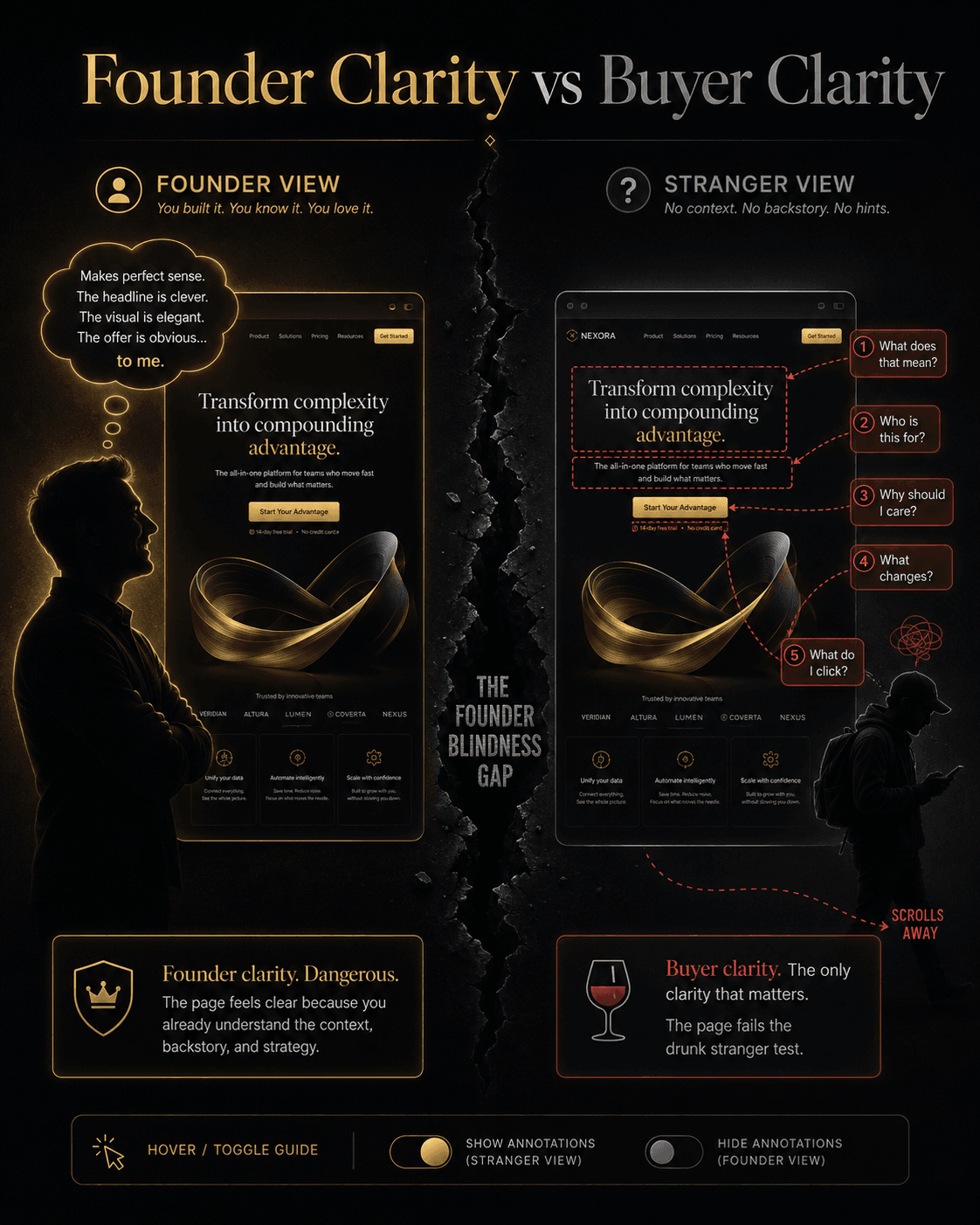
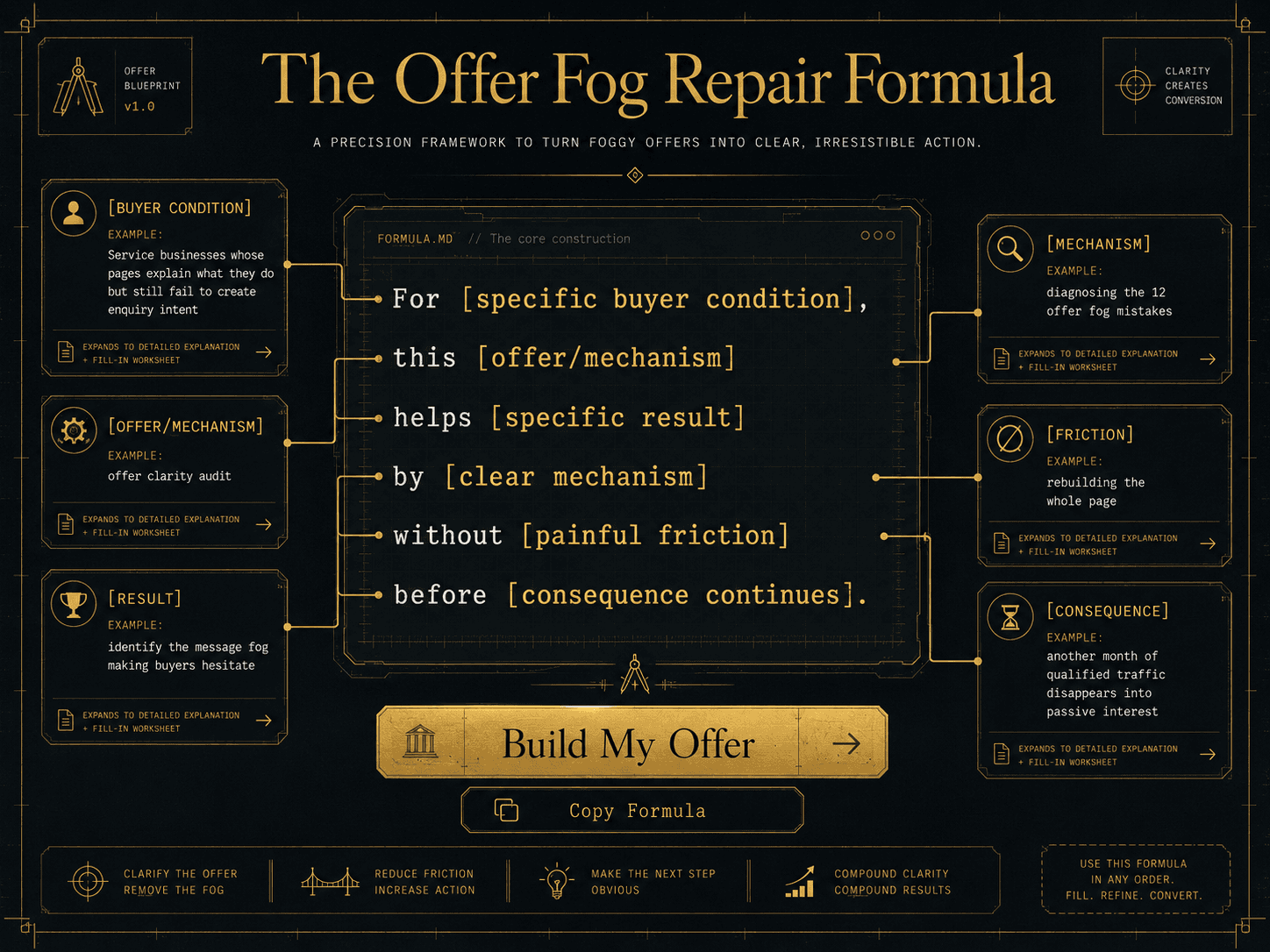
Other Blogs
Other Blogs
Check our other project Blogs with useful insight and information for your businesses