Our Three Step Process
May 26, 2026
Chap 4 | Resource 1 | The Hero Section Build Canvas™
Our Three Step Process
May 26, 2026
Chap 4 | Resource 1 | The Hero Section Build Canvas™
The Hero Section Build Canvas™ A first-screen planning worksheet for defining the buyer, contrast, mechanism, proof asset, CTA, and microcopy before writing a hero section that earns the scroll.
Prefer Audio Or Video?
The Hero Section Build Canvas™ is also available as:
🎧 A guided audio walkthrough explaining hero section construction, buyer definition, contrast, mechanism, proof, CTA, and microcopy.
🎥 A practical video breakdown with real hero section builds, first-screen examples, headline/subheadline construction, proof direction, and CTA/microcopy improvements.Choose the format that fits how you learn best.
[Listen To The Audio Walkthrough] (coming soon)
[Watch The Video Breakdown] (coming soon)
——
Why Most Hero Sections Fail Before The Page Gets A Chance
Most hero sections fail before the rest of the page even gets a chance.
Not because the design is ugly.
Not because the product is bad.
Not because the founder has nothing valuable to say.
They fail because the first screen creates confusion, weak recognition, low trust, or no meaningful tension.
The buyer lands.
They glance.
They feel nothing important.
Then they leave.
That is the problem.
The hero section may look polished.
It may sound professional.
It may contain all the expected parts.
But if the buyer does not quickly feel:
this is for me
I understand what this is
this problem matters
this promise might be believable
I know what to do next
this is worth continuing with
then the scroll wins.
That is why this resource exists.
It helps you build the hero section before you start writing it.
Because most weak hero sections are not only writing problems.
They are thinking problems.
The inputs are unclear.
The buyer is too broad.
The contrast is too soft.
The mechanism is too vague.
The proof is decorative.
The CTA is passive.
The microcopy is missing.
Then the founder tries to fix everything with a better headline.
Wrong order.
A stronger hero starts before the headline.
What This Resource Helps You Do
The Hero Section Build Canvas™ helps you construct a first screen that makes the right buyer stop, understand the value, trust the promise, and continue scrolling.
Use this when:
your homepage feels polished but weak
visitors bounce too fast
your hero section sounds generic
your message feels vague
people do not understand the value quickly
the CTA feels ignored
your page gets traffic but weak engagement
your first screen looks “fine” but does not create movement
your offer is strong but the first screen does not carry it
your headline feels clever but unclear
your hero visual looks attractive but does not build belief
your microcopy does not reduce hesitation
This is not a copywriting template.
This is a hero section construction system.
The goal is simple:
Build a first screen that creates enough recognition, clarity, tension, belief, and movement to earn the scroll.
Before You Touch The Headline
Most people start by writing the headline.
Wrong order.
That usually creates:
generic messaging
weak promises
random positioning
vague audience signals
copy that sounds polished but does not move anyone
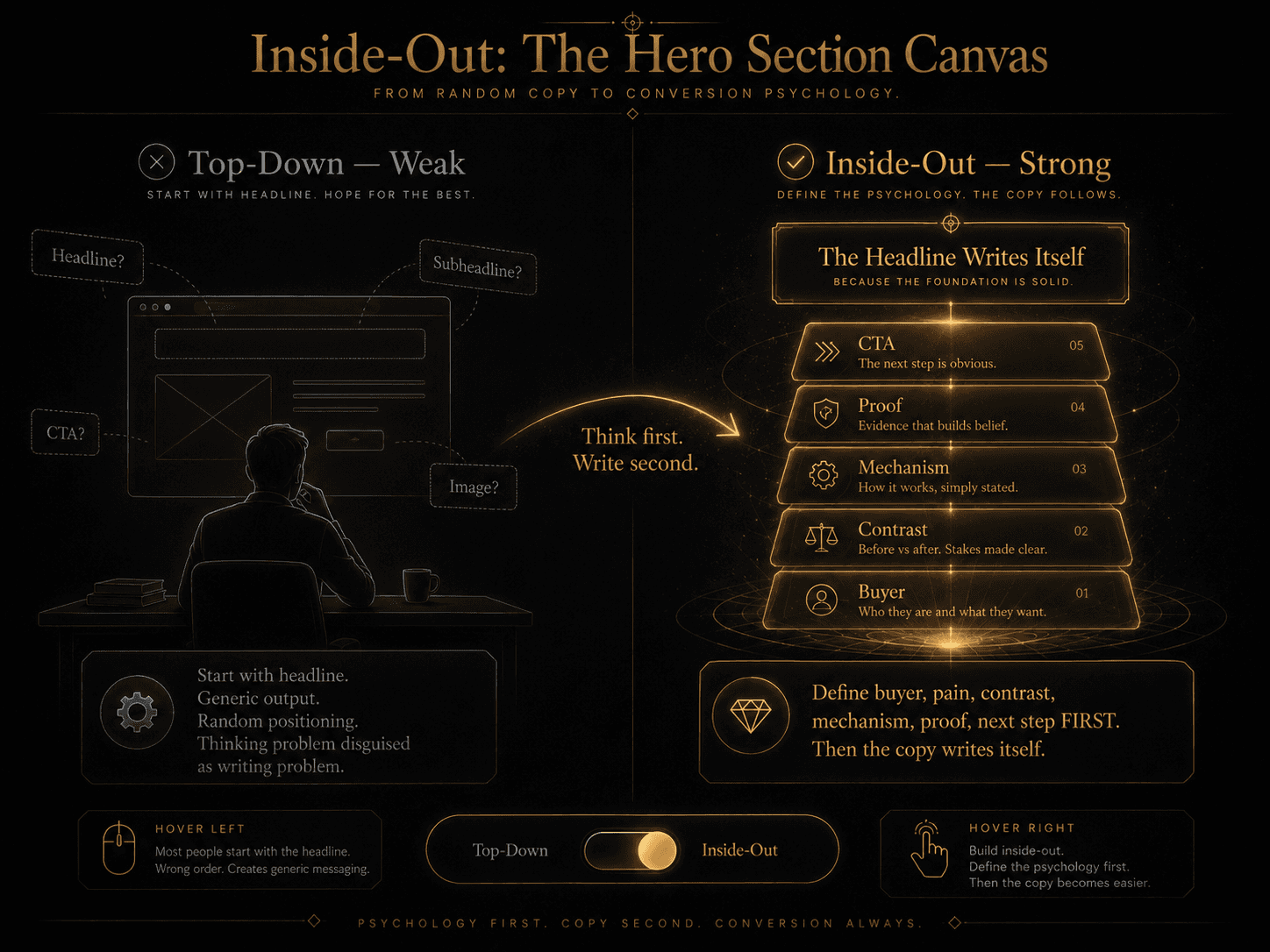
Strong hero sections are not written top-down.
They are built inside-out.
Meaning:
You first define:
the buyer
the pain
the contrast
the desired shift
the mechanism
the proof
the next step
the reassurance
Then the copy becomes easier.
That order matters enormously.
Because the headline is not supposed to invent the strategy.
The headline is supposed to compress it.
If the thinking underneath the hero section is weak, the headline will be forced to carry too much weight.
That is why so many hero sections sound broad, safe, and forgettable.
The writer is trying to polish unclear thinking.
This canvas fixes that.
The Core Principle
A hero section is not trying to say everything.
It is trying to earn continuation.
That is the job.
Not explaining the entire business.
Not listing every feature.
Not proving every detail.
Not introducing the founder’s philosophy.
Not slowly warming the buyer up.
The hero section succeeds when the buyer feels:
“This looks relevant enough to keep going.”
That is the win.
The fold does not need the whole argument.
It needs enough recognition, contrast, belief, and movement for the right buyer to stay.
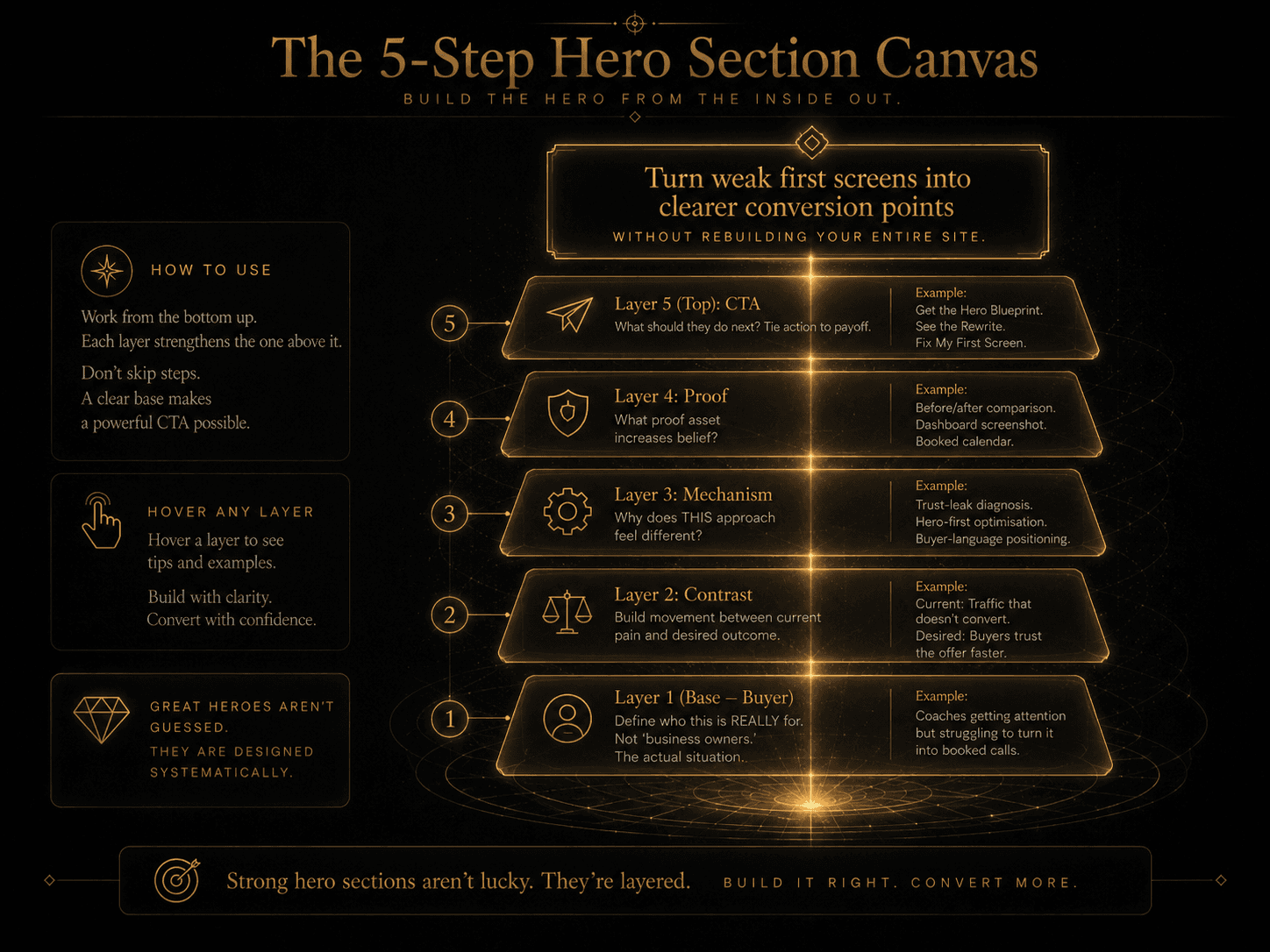
The Inside-Out Hero Build Sequence
A strong hero section is built through five decisions.
In this order:
Define The Buyer™
Build The Contrast™
Define The Mechanism™
Choose The Proof™
Define The Next Step™
Each decision gives the hero a different kind of strength.
The buyer creates recognition.
The contrast creates tension.
The mechanism creates distinction.
The proof creates belief.
The next step creates movement.
If one part is weak, the first screen gets softer.
If several are weak, the hero may still look clean, but it will not earn the scroll consistently.
Step 1: Define The Buyer Properly
Core Question
Who is this hero section really for?
Most hero sections fail because they speak to everyone.
And messaging written for everyone usually emotionally lands on no one.
A strong hero section should make the right buyer feel:
“This page understands exactly where I am stuck.”
That feeling creates attention.
Not because the buyer has read everything yet.
Because the first screen has already created recognition.
Do Not Start With A Broad Category
Weak buyer definitions sound like:
business owners
coaches
SaaS founders
creators
consultants
agencies
freelancers
ecommerce brands
service businesses
These may be technically true.
But they are usually too broad to create emotional contact.
A category tells the buyer what group they belong to.
A buying condition tells the buyer what situation they are living inside.
That is the difference.
Weak vs Strong Buyer Definition
Weak
“Coaches.”
This is a category.
It does not reveal what problem they are facing.
Stronger
“Coaches getting attention but struggling to turn it into booked calls.”
Now the buyer can recognise themselves.
The condition is sharper.
The pressure is clearer.
The page feels more relevant.
Weak
“SaaS founders.”
This is too broad.
Stronger
“SaaS founders losing trial users before onboarding creates trust.”
Now the hero has a specific buyer situation.
The problem has a shape.
The buyer can feel the relevance faster.
Buyer Definition Worksheet
Who is this page really for?
What category are they in?
What specific situation are they currently in?
What problem are they already aware of?
What problem are they feeling but may not have named clearly yet?
What makes this buyer different from a generic audience member?
Who is this page not for?
Current Frustration
What are they currently frustrated by?
What feels heavy, annoying, expensive, confusing, embarrassing, or exhausting right now?
Examples:
wasting traffic
low trust
weak conversions
confusing messaging
inconsistent leads
attracting the wrong buyers
sounding generic
getting ignored
people clicking but not enquiring
pages looking polished but not moving buyers
buyers leaving before the offer is understood
Write the buyer’s current frustration:
Desired Result
What result do they want badly enough to stop for?
Not:
“Growth.”
Too broad.
Not:
“Better marketing.”
Too vague.
Not:
“More visibility.”
Too soft.
Instead, define the specific improvement that would feel meaningful quickly.
Examples:
more booked calls
higher-trust leads
stronger conversions
faster buyer understanding
less hesitation
clearer positioning
more demand
better-fit enquiries
stronger first-screen engagement
more trust before the CTA
Write the desired result:
Step 1 Self-Check
Before moving on, ask:
Does the buyer definition still sound broad, safe, or generic?
Yes / No
Would the right buyer feel recognised within seconds?
Yes / No
Could the wrong buyer mistakenly think this page is for them?
Yes / No
Does the buyer definition describe a situation, not just a category?
Yes / No
If the buyer section still sounds broad, safe, or generic, the hero section will probably feel forgettable.
Fix this before continuing.
Step 2: Build The Contrast
Core Question
What gap should the buyer feel?
This is where weak hero sections usually collapse.
They describe a service without creating movement between current pain and future outcome.
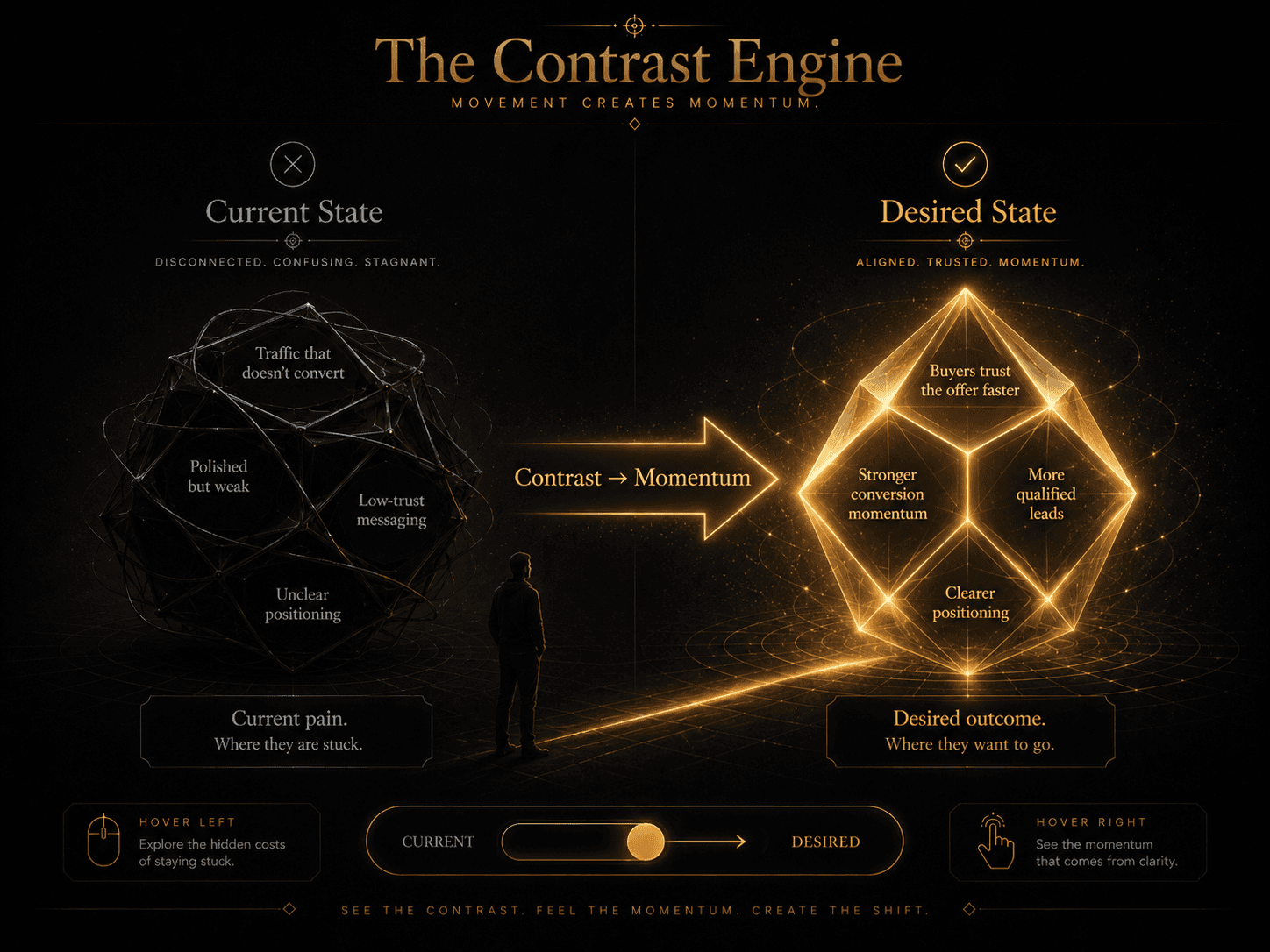
Strong hero sections create contrast.
The buyer should feel:
“I do not want to stay where I currently am.”
That emotional gap creates momentum.
Because desire does not live in explanation alone.
Desire lives in contrast.
The hero section must show the buyer the difference between:
where they are now
where they want to be
what staying still costs
what movement makes possible
Without contrast, the hero may be clear but not compelling.
Current State
What is the buyer currently stuck tolerating?
Examples:
traffic that does not convert
pages that look polished but weak
low-trust messaging
weak first impressions
unclear positioning
inconsistent demand
buyers leaving before they understand the offer
CTA clicks that never happen
pages that explain but do not create desire
first screens that look clean but feel emotionally flat
Write the current state:
Desired State
What becomes possible after the hero promise works?
Examples:
buyers trust the offer faster
stronger conversion momentum
more qualified leads
clearer positioning
easier buying decisions
more engagement above the fold
better first-screen recognition
more belief before the CTA
clearer movement from attention to action
Write the desired state:
Painful Friction Removed
What does the buyer no longer have to keep doing, guessing, wasting, or carrying?
This is powerful psychologically.
The buyer does not only want the result.
They want relief from the painful friction attached to the current state.
Examples:
rebuilding the whole site
endlessly tweaking copy
wasting more traffic
sounding generic
relying on luck
overexplaining the offer
trying to fix everything below the fold
sending traffic to a first screen they do not trust
guessing why visitors leave
relying on design to hide weak messaging
Write the painful friction removed:
Optional Timeframe
Only include a timeframe if it is credible, useful, and defensible.
Bad:
“Explode conversions overnight.”
This creates scepticism.
Better:
“Improve first-screen clarity in one afternoon.”
This is more grounded.
A timeframe should increase believability.
Not scepticism.
Write your optional timeframe:
Leave blank if unnecessary.
Step 2 Self-Check
Does the hero create contrast between current pain and desired outcome?
Yes / No
Does the buyer feel what staying the same costs?
Yes / No
Does the result feel lighter because painful friction is removed?
Yes / No
Does the contrast feel believable rather than exaggerated?
Yes / No
If the contrast is weak, the hero may be clear but emotionally flat.
Sharpen the gap before continuing.
Step 3: Define The Mechanism
Core Question
What makes this stronger than generic help?
This is where the hero section stops sounding generic.
Most pages say what they do.
Very few explain why their approach feels different.
That difference matters.
The mechanism gives the hero a sharper reason to be trusted.
It tells the buyer:
“This is not just another vague promise.”
A mechanism does not need to be complicated.
It needs to be specific enough to remember and simple enough to understand quickly.
Mechanism Examples
Examples of mechanisms:
trust-leak diagnosis
hero-first optimisation
buyer-language positioning
conversion-focused rewrites
proof-led first-screen systems
fold clarity audit
CTA resistance mapping
first-screen contrast rebuild
proof-led hero architecture
above-the-fold conversion system
recognition-first headline structure
These mechanisms create more shape than vague phrases like:
strategy
optimisation
consulting
growth support
digital solutions
better copy
brand improvement
The mechanism makes the promise feel more believable because the buyer can see how the result may be created.
Mechanism Worksheet
What is the actual process, system, angle, or approach?
What does your mechanism diagnose, rebuild, remove, clarify, map, or improve?
What specific failure point does it focus on?
What makes it simple enough to understand quickly?
What makes it specific enough to remember?
What makes it more useful than generic help?
Why This Approach Feels Stronger
Why should the buyer care about this approach?
Examples:
faster clarity
less guesswork
no full redesign needed
built around buyer psychology
focused specifically on above-the-fold conversion
isolates the first-screen leak before rebuilding the whole page
uses proof instead of decoration
sharpens recognition before persuasion
turns attention into movement faster
Write why this approach feels stronger:
Step 3 Self-Check
Does the mechanism sound specific?
Yes / No
Can the buyer understand it quickly?
Yes / No
Does it make the promise feel more believable?
Yes / No
Would five competitors say the same thing?
Yes / No
If the mechanism sounds generic, the hero will sound generic too.
Sharpen the mechanism before continuing.
Step 4: Choose The Proof™
Core Question
What can you show above the fold that makes the promise feel real?
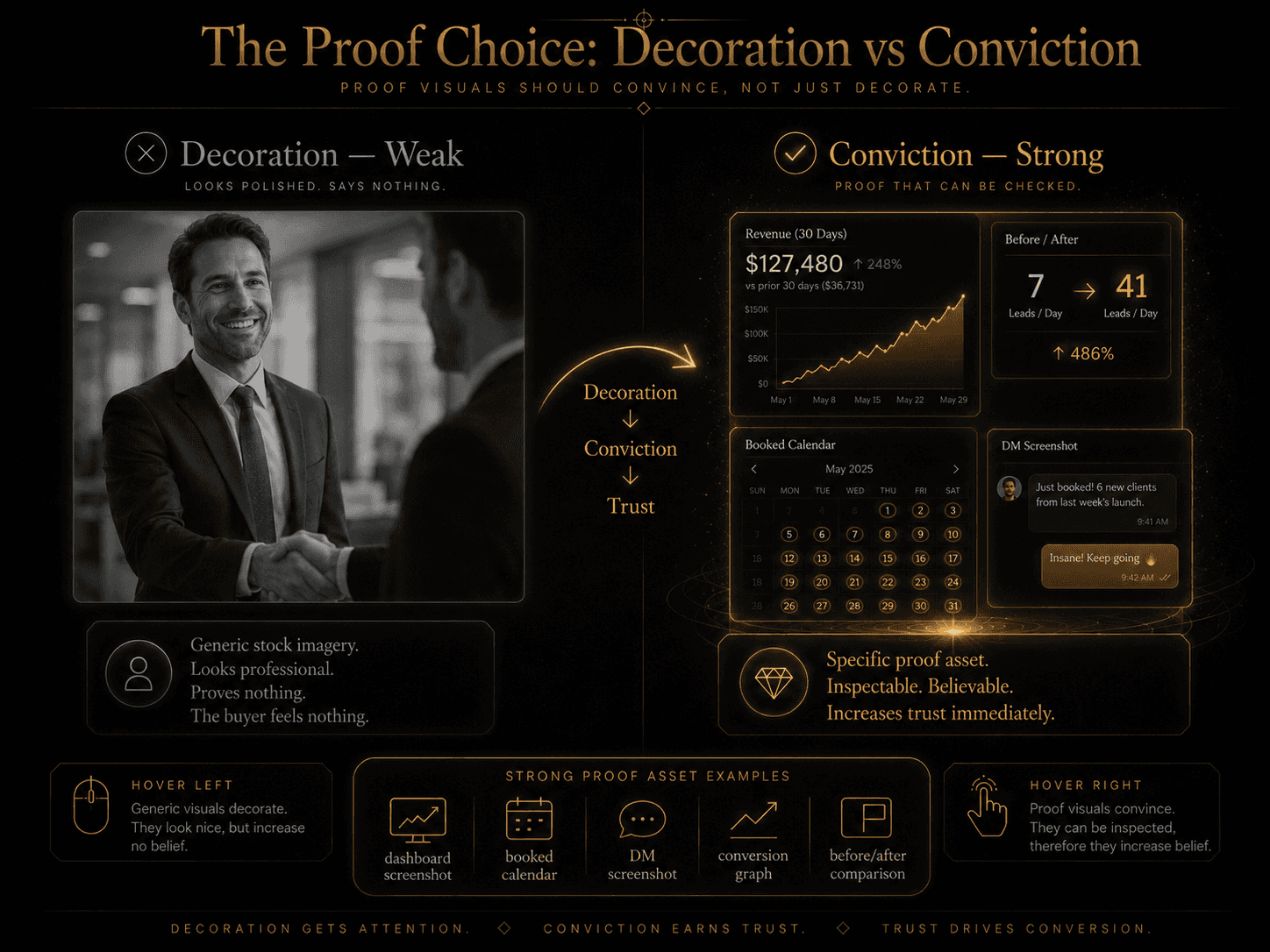
A weak visual decorates.
A strong visual convinces.
Most websites use generic visuals because they look safe, clean, or professional.
But above the fold, the visual is not just there to make the page attractive.
It is there to help belief form faster.
The visual should make the promise feel more believable.
Not merely more attractive.
That is the standard.
Weak Hero Visuals
Weak visuals include:
stock photos
generic team images
abstract graphics
vague dashboard mockups
meaningless laptop screens
smiling people with no proof function
charts that cannot be understood
design assets that look premium but prove nothing
These visuals may make the page look complete.
But they often do little to build trust.
Strong Hero Visuals
Strong visuals can include:
before-and-after comparison
dashboard screenshot
booked calendar
customer result
testimonial
conversion graph
product in use
DM screenshot
walkthrough preview
real interface view
proof asset
side-by-side teardown
short video clip
message showing buyer response
visual map of the mechanism
The best proof feels inspectable.
Not staged.
The buyer should feel:
“I can see what this is.”
“I can inspect the result.”
“This feels real enough to trust.”
Proof Asset Worksheet
What proof asset can you show immediately?
What format is it?
Screenshot / Calendar / DM / Video / Result / Before-and-after / Product view / Testimonial / Dashboard / Other
Explain:
What Does This Proof Actually Prove?
Does it prove:
speed?
outcome?
trust?
believability?
transformation?
credibility?
usability?
momentum?
demand?
buyer response?
reduced hesitation?
clearer next-step movement?
Write what it proves:
Proof Placement
Where should this proof appear?
Hero visual / Next to CTA / Behind headline / As product preview / As before-after comparison / Other
Explain:
Step 4 Self-Check
Does the visual make the promise more believable?
Yes / No
Does it prove, simulate, or intensify the outcome?
Yes / No
Does it help the buyer picture the win?
Yes / No
Does it look real enough to inspect?
Yes / No
Is it more than decoration?
Yes / No
If the visual does not increase belief, it is probably decoration.
Replace it with proof.
Step 5: Define The Next Step™
Core Question
What should the visitor do immediately?
Many hero sections lose momentum because the CTA asks for action before enough trust exists.
Others lose momentum because the CTA is vague, passive, or disconnected from payoff.
The CTA should feel easy, clear, and connected to value.
It should not feel like a generic label.
It should feel like the next obvious move.
Weak CTA Examples
Weak CTAs include:
Submit
Learn More
Get Started
Contact Us
Sign Up
Click Here
Read More
These are not always wrong.
But they often fail because they do not imply a clear payoff.
The buyer clicks into uncertainty.
That creates hesitation.
Strong CTA Examples
Stronger CTAs include:
See The Hero Rewrite
Get The Hero Section Blueprint
Fix My First Screen
Build My Hero Section
Watch The Breakdown
Get The Fold Guide
Claim The Hero Audit
Show Me The Rewrite
Download The Hero Canvas
See The Before/After
These work better because the action feels connected to value.
The buyer knows what they are moving toward.
CTA Worksheet
What should the visitor do next?
What value does that action give them?
What does the click help them see, get, watch, download, fix, build, or understand?
What is the lowest-friction version of this action?
Write your primary CTA:
Microcopy
Microcopy is the quiet line near the CTA.
It removes hesitation.
It reduces fear, effort, or uncertainty.
It helps the buyer feel the action is safer, lighter, faster, or more useful.
Examples:
No fluff. Just the framework.
Takes 90 seconds.
No redesign required.
Free and practical.
Built for immediate implementation.
No pitch. Just the structure.
Use this before you waste more traffic.
Clear enough to use today.
No pressure. No guesswork.
Microcopy Worksheet
What might make the buyer hesitate before clicking?
What fear, effort, or uncertainty should the microcopy reduce?
What reassurance would make the action feel lighter?
Write your microcopy:
Step 5 Self-Check
Is the next step obvious?
Yes / No
Does the CTA imply a payoff?
Yes / No
Does the action feel easy enough to take now?
Yes / No
Does the microcopy reduce hesitation?
Yes / No
Does the CTA feel connected to the hero promise?
Yes / No
If the CTA feels passive, tie the action to payoff.
If the microcopy is missing, add reassurance.
Build The Hero Section
Now combine the inputs.
Do not try to be clever first.
Build the hero from the structure.
Clarity first.
Sharpness second.
Elegance third.
Never reverse that order.
——
Headline Formula
Use this structure:
Get [desired result] without [painful friction].
You can also use:
Turn [current weak state] into [desired stronger state] without [painful friction].
Or:
Create [desired result] before [painful consequence continues].
The headline should create recognition, contrast, and movement.
It does not need to explain the whole offer.
It needs to stop the right buyer.
Headline Examples
Turn weak first screens into clearer conversion points without rebuilding your entire site.
Improve buyer trust before the CTA without overhauling the whole funnel.
Create a hero section that earns the scroll without sounding louder or more hyped.
Turn polished-but-weak pages into first screens that create trust, tension, and movement.
Stop losing buyers above the fold before they ever reach your proof.
Build a first screen that makes the right buyer stop, understand, and keep reading.
Headline Worksheet
Desired result:
Painful friction:
Current weak state:
Desired stronger state:
Painful consequence:
Write three headline options:
Best headline:
Subheadline Formula
Use this structure:
Built for [buyer] struggling with [problem], this [mechanism] helps them [result] without [common friction].
The subheadline should make the headline easier to believe.
It should clarify:
who this is for
what problem they have
how the offer works
what result it helps create
what friction it removes
A strong subheadline does not outshine the headline.
It supports it.
Subheadline Example
Built for service businesses whose pages look polished but still fail to create enough trust or movement above the fold, this hero-first system helps sharpen the message, proof, and CTA that decide whether the right buyer stays or leaves.
Subheadline Worksheet
Buyer:
Problem:
Mechanism:
Result:
Common friction:
Write your subheadline:
Visual Direction
The visual should make the promise easier to believe.
Use this structure:
Show [proof asset] that proves [specific belief].
Example:
Show a before-and-after hero comparison that proves how a weak first screen becomes clearer, sharper, and easier to act on.
Visual Direction Worksheet
Proof asset:
What it proves:
Why it belongs above the fold:
Write your visual direction:
CTA Formula
The CTA should imply the payoff.
Use verbs like:
Get
See
Watch
Download
Build
Fix
Claim
Show Me
Start
Analyse
But make the object specific.
Not:
“Get Started.”
Better:
“Get The Hero Blueprint.”
CTA Worksheet
Action verb:
Specific payoff:
Primary CTA:
Secondary CTA, if needed:
Microcopy Formula
Use microcopy to reduce fear, effort, or uncertainty.
Structure:
No [fear/friction]. Just [specific value].
Examples:
No fluff. Just the structure.
No redesign. Just the fold fix.
No pitch. Just the framework.
No guesswork. Just the exact steps.
Microcopy Worksheet
Fear or friction to reduce:
Specific value to promise:
Final microcopy:
Complete Hero Section Draft
Now assemble the full hero section.
Headline
Subheadline
Visual
CTA
Microcopy
Complete Mini Example
Headline
Turn Weak First Screens Into Clearer, Higher-Trust Conversion Points — Without Rebuilding The Entire Site.
Subheadline
Built for service businesses whose pages already look polished but still fail to create enough trust, clarity, or movement above the fold. This hero-first system sharpens the message, proof, CTA, and microcopy that decide whether the right buyer stops, believes, and moves.
Visual
A before-and-after hero comparison paired with a proof asset showing clearer buyer response, stronger enquiries, or improved next-step movement.
CTA
Get The Hero Section Blueprint
Microcopy
No fluff. Just the exact structure.
Why This Example Works
The headline works because it gives the buyer a result:
Clearer, higher-trust conversion points.
It also removes a painful friction:
Rebuilding the entire site.
The subheadline works because it sharpens the audience:
Service businesses whose pages look polished but still fail above the fold.
It clarifies the mechanism:
A hero-first system that sharpens the message, proof, CTA, and microcopy.
The visual works because it makes the result inspectable.
The CTA works because it offers a specific next step.
The microcopy works because it lowers friction and reassures the buyer that the resource is practical.
This is not louder copy.
It is clearer structure.
Hero Build Scorecard
Score your draft from 1 to 5 in each area.
1 = weak
2 = unclear
3 = usable but soft
4 = strong
5 = sharp and ready
Buyer Specificity
Does the hero clearly identify who this is for?
Score: ___ / 5
Notes:
Contrast Strength
Does the hero create a clear gap between current pain and desired outcome?
Score: ___ / 5
Notes:
Mechanism Clarity
Does the hero explain why this approach feels specific or different?
Score: ___ / 5
Notes:
Proof Believability
Does the visual or proof asset make the promise easier to trust?
Score: ___ / 5
Notes:
CTA Clarity
Is the next step obvious and connected to payoff?
Score: ___ / 5
Notes:
Microcopy Reassurance
Does the microcopy reduce fear, effort, or uncertainty?
Score: ___ / 5
Notes:
Total Score
Buyer Specificity: ___ / 5
Contrast Strength: ___ / 5
Mechanism Clarity: ___ / 5
Proof Believability: ___ / 5
CTA Clarity: ___ / 5
Microcopy Reassurance: ___ / 5
Total: ___ / 30
——
Score Interpretation
26–30: Scroll-Earning Hero™
The hero has strong inputs, clear structure, and enough first-screen force to earn continuation.
The buyer can recognise the relevance, understand the promise, see the proof direction, and know what to do next.
20–25: Strong But Still Soft™
The hero has good material, but one or two parts need sharpening.
Find the lowest-scoring area and fix that first.
Do not rewrite randomly.
13–19: Polished But Leaking™
The hero may look good, but it is probably leaking attention.
The buyer may understand parts of it without feeling enough recognition, contrast, belief, or movement.
Rebuild the weak inputs.
0–12: First-Screen Failure Risk™
The hero is not ready.
Do not polish the design first.
Do not add more sections below the fold first.
Fix the buyer, contrast, mechanism, proof, CTA, and microcopy.
Rapid Hero Section Fixes
Use these when your hero section feels weak but you are not sure why.
Problem 1: The Headline Sounds Broad
Symptoms:
it could apply to almost anyone
it names a category but not a condition
it sounds professional but forgettable
it lacks consequence
Fix:
Increase specificity and consequence.
Ask:
“What result does the buyer want, and what painful friction do they want removed?”
Problem 2: The Subheadline Explains Too Much
Symptoms:
it feels heavy
it tries to say everything
it adds more confusion
it does not make the headline easier to believe
Fix:
Compress the message harder.
Ask:
“What does the buyer need to understand next, not everything at once?”
Problem 3: The Visual Looks Decorative
Symptoms:
it looks nice but proves nothing
it could be on any website
it does not make the result easier to believe
it does not create trust
Fix:
Use proof instead of aesthetics.
Ask:
“What can I show that makes the promise feel real?”
Problem 4: The CTA Feels Passive
Symptoms:
the button says “Learn More” or “Get Started”
the payoff is unclear
the action feels vague
the click does not feel valuable
Fix:
Tie the action to payoff.
Ask:
“What does the buyer get, see, fix, watch, download, or understand after clicking?”
Problem 5: The Microcopy Is Missing
Symptoms:
the buyer may hesitate before action
the click feels vague or risky
there is no reassurance
the CTA has to carry all the movement alone
Fix:
Add a small reassurance line.
Ask:
“What fear, effort, or uncertainty can I remove in one short line?”
Problem 6: The Page Feels Polished But Emotionally Flat
Symptoms:
the design looks good
the message is clean
but nothing creates tension
the buyer has no reason to care now
Fix:
Increase contrast between current pain and desired outcome.
Ask:
“What does staying the same cost, and what becomes possible if the problem changes?”
Problem 7: The Message Sounds Smart But Forgettable
Symptoms:
the language feels intelligent
but buyers do not remember it
it uses internal business language
it does not sound like the buyer’s real thought
Fix:
Use buyer-language instead of internal business language.
Ask:
“How would the buyer describe this problem privately?”
——
Hero Killers
Avoid these if you want the first screen to earn the scroll.
Hero Killer 1: Clever Before Clear
If the buyer has to decode the headline, momentum dies.
The fold is not the place for cleverness that delays understanding.
Clear first.
Sharp second.
Elegant third.
Never reverse that order.
Hero Killer 2: Self-Focused Copy
A hero weakens when it spends too much time describing:
your company
your philosophy
your passion
your capabilities
your internal process
your story before the buyer feels recognised
The hero must centre the buyer’s reality before it centres your business.
Hero Killer 3: Decorative Visuals
A visual that does not build belief is occupying premium space without helping conversion.
Above the fold, the image should prove, simulate, intensify, or clarify.
If it only decorates, replace it.
Hero Killer 4: Dead Button Energy
A vague CTA leaks momentum.
The button should not feel like a label.
It should feel like the next obvious move.
Hero Killer 5: Missing Contrast
A hero without contrast may be understandable, but it will not feel urgent.
The buyer needs to feel the gap between current pain and better possibility.
That gap creates movement.
——
Final Execution Challenge
Do not leave this resource with notes.
Leave with a rewritten hero section.
Take your current first screen and rebuild:
the buyer
the contrast
the mechanism
the proof
the CTA
the microcopy
Then ask:
“Would the right buyer stop here and feel understood within seconds?”
If the answer is no, keep sharpening.
Because the hero section is not decoration.
It is the moment the buyer decides whether the rest of the page deserves attention at all.
Final Hero Build Worksheet
Buyer
Who is this page really for?
What situation are they in?
Frustration
What are they tired of, stuck in, embarrassed by, or losing because of?
Desired Result
What do they want badly enough to stop for?
Current State
What are they currently tolerating?
Desired State
What becomes possible after this works?
Painful Friction Removed
What do they no longer have to keep doing, guessing, wasting, or carrying?
Mechanism
What is the method, process, system, or angle?
Why This Mechanism Matters
Why does this approach feel different or stronger?
Proof Asset
What can you show above the fold?
What The Proof Proves
Primary CTA
Microcopy
Final Headline
Final Subheadline
Final Hero Section
Headline:
Subheadline:
Visual:
CTA:
Microcopy:
——
Final Principle
The hero section is not a branding banner.
It is not decoration.
It is not warm-up space.
It is not where the page slowly eases into the point.
It is the first gate.
The first screen must make the right buyer feel enough recognition, clarity, tension, belief, and movement to keep going.
That is the job.
A weak hero tries to say everything and ends up making the buyer work too hard.
A strong hero compresses the right things:
who it is for,
what changes,
why it matters,
what makes it believable,
and what to do next.
That is why the hero must be built before it is written.
Inputs first.
Copy second.
Design third.
Because when the first screen is clear, specific, proof-aware, and action-oriented, the scroll slows down.
Belief begins.
Momentum starts.
And the rest of the page finally gets permission to work.
That is what The Hero Section Build Canvas™ is designed to help you build.
——
From:
The $100M Funnel Playbook. Book I: Foundation Buyer Psychology, Offer Clarity, and the Page Architecture Behind High-Converting Funnels
By Maris Spalins.
Copyright Notice
© 2026 The $100M Funnel Playbook / Winyourclients / Maris Spalins. All rights reserved.
This resource, including the frameworks, terminology, examples, scorecards, templates, prompts, methods, and written explanations, is original intellectual property created for The $100M Funnel Playbook. Book I: Foundation — Buyer Psychology, Offer Clarity, And The Page Architecture Behind High-Converting Funnels and published through Winyourclients.
No part of this resource may be copied, reproduced, screenshotted, republished, redistributed, sold, adapted, uploaded, scraped, stored in a database, included in training data, used to train artificial intelligence systems, or used to create derivative commercial or educational materials without prior written permission.
Limited reference, quotation, or sharing is only permitted where the source is clearly and visibly credited.
Any permitted reference must include at least one of the following source credits:
The $100M Funnel Playbook by Maris Spalins
or
Winyourclients — www.winyourclients.com
or
Maris Spalins / Winyourclients
Screenshots, excerpts, summaries, or redistributed versions must not remove, hide, alter, crop out, or obscure the original source, author name, book title, website name, or copyright notice.
This resource is provided for personal learning and implementation only. It is not licensed for resale, republishing, redistribution, AI training, template cloning, course creation, consulting delivery, or commercial reuse without written permission from Maris Spalins or Winyourclients.
For permission requests, licensing, citation approval, or commercial usage enquiries, contact:
Winyourclients
www.winyourclients.com
or
Email directly to Jacob on: help@winyourclients.com
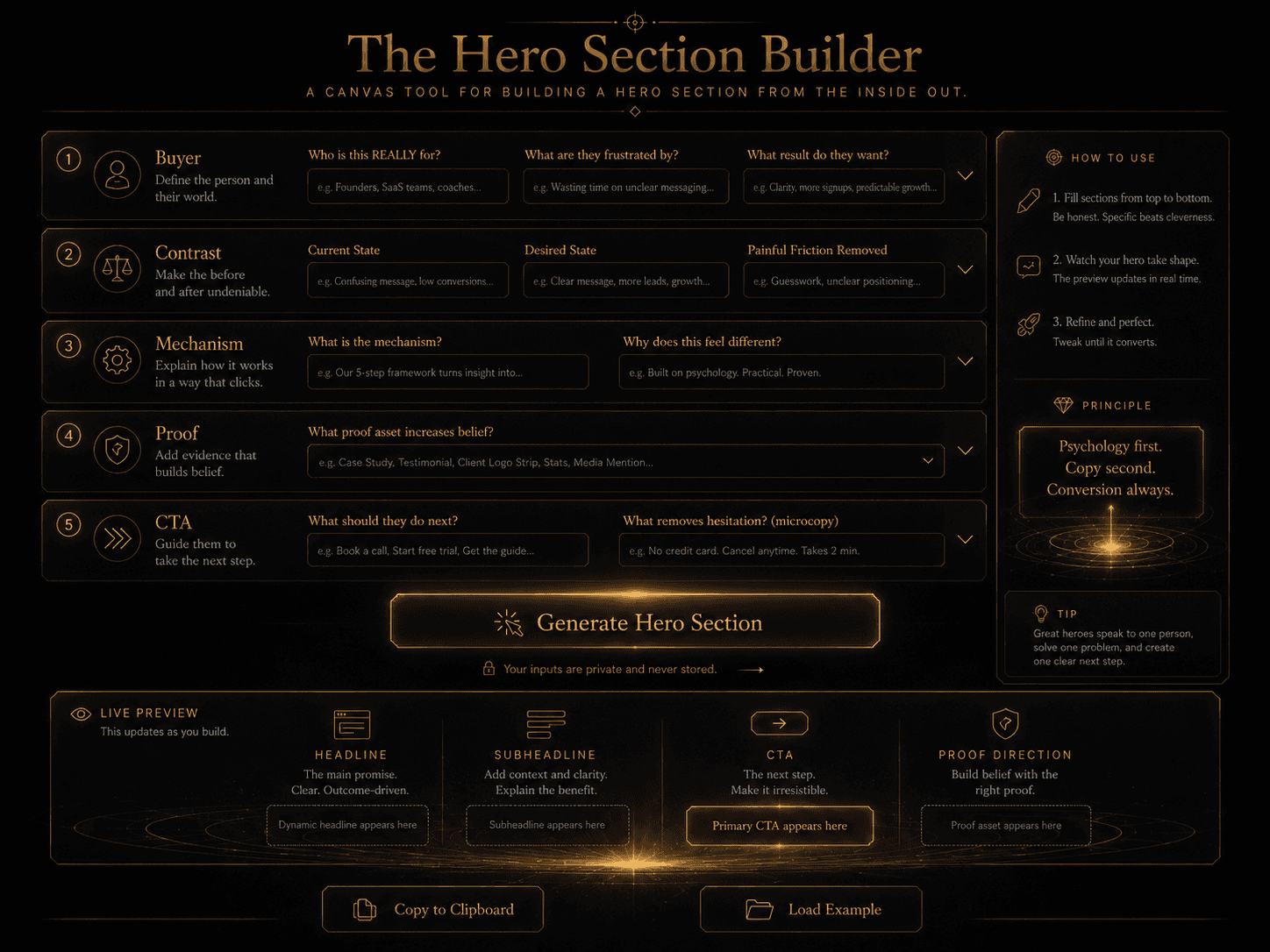
The Hero Section Build Canvas™ A first-screen planning worksheet for defining the buyer, contrast, mechanism, proof asset, CTA, and microcopy before writing a hero section that earns the scroll.
Prefer Audio Or Video?
The Hero Section Build Canvas™ is also available as:
🎧 A guided audio walkthrough explaining hero section construction, buyer definition, contrast, mechanism, proof, CTA, and microcopy.
🎥 A practical video breakdown with real hero section builds, first-screen examples, headline/subheadline construction, proof direction, and CTA/microcopy improvements.Choose the format that fits how you learn best.
[Listen To The Audio Walkthrough] (coming soon)
[Watch The Video Breakdown] (coming soon)
——
Why Most Hero Sections Fail Before The Page Gets A Chance
Most hero sections fail before the rest of the page even gets a chance.
Not because the design is ugly.
Not because the product is bad.
Not because the founder has nothing valuable to say.
They fail because the first screen creates confusion, weak recognition, low trust, or no meaningful tension.
The buyer lands.
They glance.
They feel nothing important.
Then they leave.
That is the problem.
The hero section may look polished.
It may sound professional.
It may contain all the expected parts.
But if the buyer does not quickly feel:
this is for me
I understand what this is
this problem matters
this promise might be believable
I know what to do next
this is worth continuing with
then the scroll wins.
That is why this resource exists.
It helps you build the hero section before you start writing it.
Because most weak hero sections are not only writing problems.
They are thinking problems.
The inputs are unclear.
The buyer is too broad.
The contrast is too soft.
The mechanism is too vague.
The proof is decorative.
The CTA is passive.
The microcopy is missing.
Then the founder tries to fix everything with a better headline.
Wrong order.
A stronger hero starts before the headline.
What This Resource Helps You Do
The Hero Section Build Canvas™ helps you construct a first screen that makes the right buyer stop, understand the value, trust the promise, and continue scrolling.
Use this when:
your homepage feels polished but weak
visitors bounce too fast
your hero section sounds generic
your message feels vague
people do not understand the value quickly
the CTA feels ignored
your page gets traffic but weak engagement
your first screen looks “fine” but does not create movement
your offer is strong but the first screen does not carry it
your headline feels clever but unclear
your hero visual looks attractive but does not build belief
your microcopy does not reduce hesitation
This is not a copywriting template.
This is a hero section construction system.
The goal is simple:
Build a first screen that creates enough recognition, clarity, tension, belief, and movement to earn the scroll.
Before You Touch The Headline
Most people start by writing the headline.
Wrong order.
That usually creates:
generic messaging
weak promises
random positioning
vague audience signals
copy that sounds polished but does not move anyone
Strong hero sections are not written top-down.
They are built inside-out.
Meaning:
You first define:
the buyer
the pain
the contrast
the desired shift
the mechanism
the proof
the next step
the reassurance
Then the copy becomes easier.
That order matters enormously.
Because the headline is not supposed to invent the strategy.
The headline is supposed to compress it.
If the thinking underneath the hero section is weak, the headline will be forced to carry too much weight.
That is why so many hero sections sound broad, safe, and forgettable.
The writer is trying to polish unclear thinking.
This canvas fixes that.
The Core Principle
A hero section is not trying to say everything.
It is trying to earn continuation.
That is the job.
Not explaining the entire business.
Not listing every feature.
Not proving every detail.
Not introducing the founder’s philosophy.
Not slowly warming the buyer up.
The hero section succeeds when the buyer feels:
“This looks relevant enough to keep going.”
That is the win.
The fold does not need the whole argument.
It needs enough recognition, contrast, belief, and movement for the right buyer to stay.
The Inside-Out Hero Build Sequence
A strong hero section is built through five decisions.
In this order:
Define The Buyer™
Build The Contrast™
Define The Mechanism™
Choose The Proof™
Define The Next Step™
Each decision gives the hero a different kind of strength.
The buyer creates recognition.
The contrast creates tension.
The mechanism creates distinction.
The proof creates belief.
The next step creates movement.
If one part is weak, the first screen gets softer.
If several are weak, the hero may still look clean, but it will not earn the scroll consistently.
Step 1: Define The Buyer Properly
Core Question
Who is this hero section really for?
Most hero sections fail because they speak to everyone.
And messaging written for everyone usually emotionally lands on no one.
A strong hero section should make the right buyer feel:
“This page understands exactly where I am stuck.”
That feeling creates attention.
Not because the buyer has read everything yet.
Because the first screen has already created recognition.
Do Not Start With A Broad Category
Weak buyer definitions sound like:
business owners
coaches
SaaS founders
creators
consultants
agencies
freelancers
ecommerce brands
service businesses
These may be technically true.
But they are usually too broad to create emotional contact.
A category tells the buyer what group they belong to.
A buying condition tells the buyer what situation they are living inside.
That is the difference.
Weak vs Strong Buyer Definition
Weak
“Coaches.”
This is a category.
It does not reveal what problem they are facing.
Stronger
“Coaches getting attention but struggling to turn it into booked calls.”
Now the buyer can recognise themselves.
The condition is sharper.
The pressure is clearer.
The page feels more relevant.
Weak
“SaaS founders.”
This is too broad.
Stronger
“SaaS founders losing trial users before onboarding creates trust.”
Now the hero has a specific buyer situation.
The problem has a shape.
The buyer can feel the relevance faster.
Buyer Definition Worksheet
Who is this page really for?
What category are they in?
What specific situation are they currently in?
What problem are they already aware of?
What problem are they feeling but may not have named clearly yet?
What makes this buyer different from a generic audience member?
Who is this page not for?
Current Frustration
What are they currently frustrated by?
What feels heavy, annoying, expensive, confusing, embarrassing, or exhausting right now?
Examples:
wasting traffic
low trust
weak conversions
confusing messaging
inconsistent leads
attracting the wrong buyers
sounding generic
getting ignored
people clicking but not enquiring
pages looking polished but not moving buyers
buyers leaving before the offer is understood
Write the buyer’s current frustration:
Desired Result
What result do they want badly enough to stop for?
Not:
“Growth.”
Too broad.
Not:
“Better marketing.”
Too vague.
Not:
“More visibility.”
Too soft.
Instead, define the specific improvement that would feel meaningful quickly.
Examples:
more booked calls
higher-trust leads
stronger conversions
faster buyer understanding
less hesitation
clearer positioning
more demand
better-fit enquiries
stronger first-screen engagement
more trust before the CTA
Write the desired result:
Step 1 Self-Check
Before moving on, ask:
Does the buyer definition still sound broad, safe, or generic?
Yes / No
Would the right buyer feel recognised within seconds?
Yes / No
Could the wrong buyer mistakenly think this page is for them?
Yes / No
Does the buyer definition describe a situation, not just a category?
Yes / No
If the buyer section still sounds broad, safe, or generic, the hero section will probably feel forgettable.
Fix this before continuing.
Step 2: Build The Contrast
Core Question
What gap should the buyer feel?
This is where weak hero sections usually collapse.
They describe a service without creating movement between current pain and future outcome.
Strong hero sections create contrast.
The buyer should feel:
“I do not want to stay where I currently am.”
That emotional gap creates momentum.
Because desire does not live in explanation alone.
Desire lives in contrast.
The hero section must show the buyer the difference between:
where they are now
where they want to be
what staying still costs
what movement makes possible
Without contrast, the hero may be clear but not compelling.
Current State
What is the buyer currently stuck tolerating?
Examples:
traffic that does not convert
pages that look polished but weak
low-trust messaging
weak first impressions
unclear positioning
inconsistent demand
buyers leaving before they understand the offer
CTA clicks that never happen
pages that explain but do not create desire
first screens that look clean but feel emotionally flat
Write the current state:
Desired State
What becomes possible after the hero promise works?
Examples:
buyers trust the offer faster
stronger conversion momentum
more qualified leads
clearer positioning
easier buying decisions
more engagement above the fold
better first-screen recognition
more belief before the CTA
clearer movement from attention to action
Write the desired state:
Painful Friction Removed
What does the buyer no longer have to keep doing, guessing, wasting, or carrying?
This is powerful psychologically.
The buyer does not only want the result.
They want relief from the painful friction attached to the current state.
Examples:
rebuilding the whole site
endlessly tweaking copy
wasting more traffic
sounding generic
relying on luck
overexplaining the offer
trying to fix everything below the fold
sending traffic to a first screen they do not trust
guessing why visitors leave
relying on design to hide weak messaging
Write the painful friction removed:
Optional Timeframe
Only include a timeframe if it is credible, useful, and defensible.
Bad:
“Explode conversions overnight.”
This creates scepticism.
Better:
“Improve first-screen clarity in one afternoon.”
This is more grounded.
A timeframe should increase believability.
Not scepticism.
Write your optional timeframe:
Leave blank if unnecessary.
Step 2 Self-Check
Does the hero create contrast between current pain and desired outcome?
Yes / No
Does the buyer feel what staying the same costs?
Yes / No
Does the result feel lighter because painful friction is removed?
Yes / No
Does the contrast feel believable rather than exaggerated?
Yes / No
If the contrast is weak, the hero may be clear but emotionally flat.
Sharpen the gap before continuing.
Step 3: Define The Mechanism
Core Question
What makes this stronger than generic help?
This is where the hero section stops sounding generic.
Most pages say what they do.
Very few explain why their approach feels different.
That difference matters.
The mechanism gives the hero a sharper reason to be trusted.
It tells the buyer:
“This is not just another vague promise.”
A mechanism does not need to be complicated.
It needs to be specific enough to remember and simple enough to understand quickly.
Mechanism Examples
Examples of mechanisms:
trust-leak diagnosis
hero-first optimisation
buyer-language positioning
conversion-focused rewrites
proof-led first-screen systems
fold clarity audit
CTA resistance mapping
first-screen contrast rebuild
proof-led hero architecture
above-the-fold conversion system
recognition-first headline structure
These mechanisms create more shape than vague phrases like:
strategy
optimisation
consulting
growth support
digital solutions
better copy
brand improvement
The mechanism makes the promise feel more believable because the buyer can see how the result may be created.
Mechanism Worksheet
What is the actual process, system, angle, or approach?
What does your mechanism diagnose, rebuild, remove, clarify, map, or improve?
What specific failure point does it focus on?
What makes it simple enough to understand quickly?
What makes it specific enough to remember?
What makes it more useful than generic help?
Why This Approach Feels Stronger
Why should the buyer care about this approach?
Examples:
faster clarity
less guesswork
no full redesign needed
built around buyer psychology
focused specifically on above-the-fold conversion
isolates the first-screen leak before rebuilding the whole page
uses proof instead of decoration
sharpens recognition before persuasion
turns attention into movement faster
Write why this approach feels stronger:
Step 3 Self-Check
Does the mechanism sound specific?
Yes / No
Can the buyer understand it quickly?
Yes / No
Does it make the promise feel more believable?
Yes / No
Would five competitors say the same thing?
Yes / No
If the mechanism sounds generic, the hero will sound generic too.
Sharpen the mechanism before continuing.
Step 4: Choose The Proof™
Core Question
What can you show above the fold that makes the promise feel real?
A weak visual decorates.
A strong visual convinces.
Most websites use generic visuals because they look safe, clean, or professional.
But above the fold, the visual is not just there to make the page attractive.
It is there to help belief form faster.
The visual should make the promise feel more believable.
Not merely more attractive.
That is the standard.
Weak Hero Visuals
Weak visuals include:
stock photos
generic team images
abstract graphics
vague dashboard mockups
meaningless laptop screens
smiling people with no proof function
charts that cannot be understood
design assets that look premium but prove nothing
These visuals may make the page look complete.
But they often do little to build trust.
Strong Hero Visuals
Strong visuals can include:
before-and-after comparison
dashboard screenshot
booked calendar
customer result
testimonial
conversion graph
product in use
DM screenshot
walkthrough preview
real interface view
proof asset
side-by-side teardown
short video clip
message showing buyer response
visual map of the mechanism
The best proof feels inspectable.
Not staged.
The buyer should feel:
“I can see what this is.”
“I can inspect the result.”
“This feels real enough to trust.”
Proof Asset Worksheet
What proof asset can you show immediately?
What format is it?
Screenshot / Calendar / DM / Video / Result / Before-and-after / Product view / Testimonial / Dashboard / Other
Explain:
What Does This Proof Actually Prove?
Does it prove:
speed?
outcome?
trust?
believability?
transformation?
credibility?
usability?
momentum?
demand?
buyer response?
reduced hesitation?
clearer next-step movement?
Write what it proves:
Proof Placement
Where should this proof appear?
Hero visual / Next to CTA / Behind headline / As product preview / As before-after comparison / Other
Explain:
Step 4 Self-Check
Does the visual make the promise more believable?
Yes / No
Does it prove, simulate, or intensify the outcome?
Yes / No
Does it help the buyer picture the win?
Yes / No
Does it look real enough to inspect?
Yes / No
Is it more than decoration?
Yes / No
If the visual does not increase belief, it is probably decoration.
Replace it with proof.
Step 5: Define The Next Step™
Core Question
What should the visitor do immediately?
Many hero sections lose momentum because the CTA asks for action before enough trust exists.
Others lose momentum because the CTA is vague, passive, or disconnected from payoff.
The CTA should feel easy, clear, and connected to value.
It should not feel like a generic label.
It should feel like the next obvious move.
Weak CTA Examples
Weak CTAs include:
Submit
Learn More
Get Started
Contact Us
Sign Up
Click Here
Read More
These are not always wrong.
But they often fail because they do not imply a clear payoff.
The buyer clicks into uncertainty.
That creates hesitation.
Strong CTA Examples
Stronger CTAs include:
See The Hero Rewrite
Get The Hero Section Blueprint
Fix My First Screen
Build My Hero Section
Watch The Breakdown
Get The Fold Guide
Claim The Hero Audit
Show Me The Rewrite
Download The Hero Canvas
See The Before/After
These work better because the action feels connected to value.
The buyer knows what they are moving toward.
CTA Worksheet
What should the visitor do next?
What value does that action give them?
What does the click help them see, get, watch, download, fix, build, or understand?
What is the lowest-friction version of this action?
Write your primary CTA:
Microcopy
Microcopy is the quiet line near the CTA.
It removes hesitation.
It reduces fear, effort, or uncertainty.
It helps the buyer feel the action is safer, lighter, faster, or more useful.
Examples:
No fluff. Just the framework.
Takes 90 seconds.
No redesign required.
Free and practical.
Built for immediate implementation.
No pitch. Just the structure.
Use this before you waste more traffic.
Clear enough to use today.
No pressure. No guesswork.
Microcopy Worksheet
What might make the buyer hesitate before clicking?
What fear, effort, or uncertainty should the microcopy reduce?
What reassurance would make the action feel lighter?
Write your microcopy:
Step 5 Self-Check
Is the next step obvious?
Yes / No
Does the CTA imply a payoff?
Yes / No
Does the action feel easy enough to take now?
Yes / No
Does the microcopy reduce hesitation?
Yes / No
Does the CTA feel connected to the hero promise?
Yes / No
If the CTA feels passive, tie the action to payoff.
If the microcopy is missing, add reassurance.
Build The Hero Section
Now combine the inputs.
Do not try to be clever first.
Build the hero from the structure.
Clarity first.
Sharpness second.
Elegance third.
Never reverse that order.
——
Headline Formula
Use this structure:
Get [desired result] without [painful friction].
You can also use:
Turn [current weak state] into [desired stronger state] without [painful friction].
Or:
Create [desired result] before [painful consequence continues].
The headline should create recognition, contrast, and movement.
It does not need to explain the whole offer.
It needs to stop the right buyer.
Headline Examples
Turn weak first screens into clearer conversion points without rebuilding your entire site.
Improve buyer trust before the CTA without overhauling the whole funnel.
Create a hero section that earns the scroll without sounding louder or more hyped.
Turn polished-but-weak pages into first screens that create trust, tension, and movement.
Stop losing buyers above the fold before they ever reach your proof.
Build a first screen that makes the right buyer stop, understand, and keep reading.
Headline Worksheet
Desired result:
Painful friction:
Current weak state:
Desired stronger state:
Painful consequence:
Write three headline options:
Best headline:
Subheadline Formula
Use this structure:
Built for [buyer] struggling with [problem], this [mechanism] helps them [result] without [common friction].
The subheadline should make the headline easier to believe.
It should clarify:
who this is for
what problem they have
how the offer works
what result it helps create
what friction it removes
A strong subheadline does not outshine the headline.
It supports it.
Subheadline Example
Built for service businesses whose pages look polished but still fail to create enough trust or movement above the fold, this hero-first system helps sharpen the message, proof, and CTA that decide whether the right buyer stays or leaves.
Subheadline Worksheet
Buyer:
Problem:
Mechanism:
Result:
Common friction:
Write your subheadline:
Visual Direction
The visual should make the promise easier to believe.
Use this structure:
Show [proof asset] that proves [specific belief].
Example:
Show a before-and-after hero comparison that proves how a weak first screen becomes clearer, sharper, and easier to act on.
Visual Direction Worksheet
Proof asset:
What it proves:
Why it belongs above the fold:
Write your visual direction:
CTA Formula
The CTA should imply the payoff.
Use verbs like:
Get
See
Watch
Download
Build
Fix
Claim
Show Me
Start
Analyse
But make the object specific.
Not:
“Get Started.”
Better:
“Get The Hero Blueprint.”
CTA Worksheet
Action verb:
Specific payoff:
Primary CTA:
Secondary CTA, if needed:
Microcopy Formula
Use microcopy to reduce fear, effort, or uncertainty.
Structure:
No [fear/friction]. Just [specific value].
Examples:
No fluff. Just the structure.
No redesign. Just the fold fix.
No pitch. Just the framework.
No guesswork. Just the exact steps.
Microcopy Worksheet
Fear or friction to reduce:
Specific value to promise:
Final microcopy:
Complete Hero Section Draft
Now assemble the full hero section.
Headline
Subheadline
Visual
CTA
Microcopy
Complete Mini Example
Headline
Turn Weak First Screens Into Clearer, Higher-Trust Conversion Points — Without Rebuilding The Entire Site.
Subheadline
Built for service businesses whose pages already look polished but still fail to create enough trust, clarity, or movement above the fold. This hero-first system sharpens the message, proof, CTA, and microcopy that decide whether the right buyer stops, believes, and moves.
Visual
A before-and-after hero comparison paired with a proof asset showing clearer buyer response, stronger enquiries, or improved next-step movement.
CTA
Get The Hero Section Blueprint
Microcopy
No fluff. Just the exact structure.
Why This Example Works
The headline works because it gives the buyer a result:
Clearer, higher-trust conversion points.
It also removes a painful friction:
Rebuilding the entire site.
The subheadline works because it sharpens the audience:
Service businesses whose pages look polished but still fail above the fold.
It clarifies the mechanism:
A hero-first system that sharpens the message, proof, CTA, and microcopy.
The visual works because it makes the result inspectable.
The CTA works because it offers a specific next step.
The microcopy works because it lowers friction and reassures the buyer that the resource is practical.
This is not louder copy.
It is clearer structure.
Hero Build Scorecard
Score your draft from 1 to 5 in each area.
1 = weak
2 = unclear
3 = usable but soft
4 = strong
5 = sharp and ready
Buyer Specificity
Does the hero clearly identify who this is for?
Score: ___ / 5
Notes:
Contrast Strength
Does the hero create a clear gap between current pain and desired outcome?
Score: ___ / 5
Notes:
Mechanism Clarity
Does the hero explain why this approach feels specific or different?
Score: ___ / 5
Notes:
Proof Believability
Does the visual or proof asset make the promise easier to trust?
Score: ___ / 5
Notes:
CTA Clarity
Is the next step obvious and connected to payoff?
Score: ___ / 5
Notes:
Microcopy Reassurance
Does the microcopy reduce fear, effort, or uncertainty?
Score: ___ / 5
Notes:
Total Score
Buyer Specificity: ___ / 5
Contrast Strength: ___ / 5
Mechanism Clarity: ___ / 5
Proof Believability: ___ / 5
CTA Clarity: ___ / 5
Microcopy Reassurance: ___ / 5
Total: ___ / 30
——
Score Interpretation
26–30: Scroll-Earning Hero™
The hero has strong inputs, clear structure, and enough first-screen force to earn continuation.
The buyer can recognise the relevance, understand the promise, see the proof direction, and know what to do next.
20–25: Strong But Still Soft™
The hero has good material, but one or two parts need sharpening.
Find the lowest-scoring area and fix that first.
Do not rewrite randomly.
13–19: Polished But Leaking™
The hero may look good, but it is probably leaking attention.
The buyer may understand parts of it without feeling enough recognition, contrast, belief, or movement.
Rebuild the weak inputs.
0–12: First-Screen Failure Risk™
The hero is not ready.
Do not polish the design first.
Do not add more sections below the fold first.
Fix the buyer, contrast, mechanism, proof, CTA, and microcopy.
Rapid Hero Section Fixes
Use these when your hero section feels weak but you are not sure why.
Problem 1: The Headline Sounds Broad
Symptoms:
it could apply to almost anyone
it names a category but not a condition
it sounds professional but forgettable
it lacks consequence
Fix:
Increase specificity and consequence.
Ask:
“What result does the buyer want, and what painful friction do they want removed?”
Problem 2: The Subheadline Explains Too Much
Symptoms:
it feels heavy
it tries to say everything
it adds more confusion
it does not make the headline easier to believe
Fix:
Compress the message harder.
Ask:
“What does the buyer need to understand next, not everything at once?”
Problem 3: The Visual Looks Decorative
Symptoms:
it looks nice but proves nothing
it could be on any website
it does not make the result easier to believe
it does not create trust
Fix:
Use proof instead of aesthetics.
Ask:
“What can I show that makes the promise feel real?”
Problem 4: The CTA Feels Passive
Symptoms:
the button says “Learn More” or “Get Started”
the payoff is unclear
the action feels vague
the click does not feel valuable
Fix:
Tie the action to payoff.
Ask:
“What does the buyer get, see, fix, watch, download, or understand after clicking?”
Problem 5: The Microcopy Is Missing
Symptoms:
the buyer may hesitate before action
the click feels vague or risky
there is no reassurance
the CTA has to carry all the movement alone
Fix:
Add a small reassurance line.
Ask:
“What fear, effort, or uncertainty can I remove in one short line?”
Problem 6: The Page Feels Polished But Emotionally Flat
Symptoms:
the design looks good
the message is clean
but nothing creates tension
the buyer has no reason to care now
Fix:
Increase contrast between current pain and desired outcome.
Ask:
“What does staying the same cost, and what becomes possible if the problem changes?”
Problem 7: The Message Sounds Smart But Forgettable
Symptoms:
the language feels intelligent
but buyers do not remember it
it uses internal business language
it does not sound like the buyer’s real thought
Fix:
Use buyer-language instead of internal business language.
Ask:
“How would the buyer describe this problem privately?”
——
Hero Killers
Avoid these if you want the first screen to earn the scroll.
Hero Killer 1: Clever Before Clear
If the buyer has to decode the headline, momentum dies.
The fold is not the place for cleverness that delays understanding.
Clear first.
Sharp second.
Elegant third.
Never reverse that order.
Hero Killer 2: Self-Focused Copy
A hero weakens when it spends too much time describing:
your company
your philosophy
your passion
your capabilities
your internal process
your story before the buyer feels recognised
The hero must centre the buyer’s reality before it centres your business.
Hero Killer 3: Decorative Visuals
A visual that does not build belief is occupying premium space without helping conversion.
Above the fold, the image should prove, simulate, intensify, or clarify.
If it only decorates, replace it.
Hero Killer 4: Dead Button Energy
A vague CTA leaks momentum.
The button should not feel like a label.
It should feel like the next obvious move.
Hero Killer 5: Missing Contrast
A hero without contrast may be understandable, but it will not feel urgent.
The buyer needs to feel the gap between current pain and better possibility.
That gap creates movement.
——
Final Execution Challenge
Do not leave this resource with notes.
Leave with a rewritten hero section.
Take your current first screen and rebuild:
the buyer
the contrast
the mechanism
the proof
the CTA
the microcopy
Then ask:
“Would the right buyer stop here and feel understood within seconds?”
If the answer is no, keep sharpening.
Because the hero section is not decoration.
It is the moment the buyer decides whether the rest of the page deserves attention at all.
Final Hero Build Worksheet
Buyer
Who is this page really for?
What situation are they in?
Frustration
What are they tired of, stuck in, embarrassed by, or losing because of?
Desired Result
What do they want badly enough to stop for?
Current State
What are they currently tolerating?
Desired State
What becomes possible after this works?
Painful Friction Removed
What do they no longer have to keep doing, guessing, wasting, or carrying?
Mechanism
What is the method, process, system, or angle?
Why This Mechanism Matters
Why does this approach feel different or stronger?
Proof Asset
What can you show above the fold?
What The Proof Proves
Primary CTA
Microcopy
Final Headline
Final Subheadline
Final Hero Section
Headline:
Subheadline:
Visual:
CTA:
Microcopy:
——
Final Principle
The hero section is not a branding banner.
It is not decoration.
It is not warm-up space.
It is not where the page slowly eases into the point.
It is the first gate.
The first screen must make the right buyer feel enough recognition, clarity, tension, belief, and movement to keep going.
That is the job.
A weak hero tries to say everything and ends up making the buyer work too hard.
A strong hero compresses the right things:
who it is for,
what changes,
why it matters,
what makes it believable,
and what to do next.
That is why the hero must be built before it is written.
Inputs first.
Copy second.
Design third.
Because when the first screen is clear, specific, proof-aware, and action-oriented, the scroll slows down.
Belief begins.
Momentum starts.
And the rest of the page finally gets permission to work.
That is what The Hero Section Build Canvas™ is designed to help you build.
——
From:
The $100M Funnel Playbook. Book I: Foundation Buyer Psychology, Offer Clarity, and the Page Architecture Behind High-Converting Funnels
By Maris Spalins.
Copyright Notice
© 2026 The $100M Funnel Playbook / Winyourclients / Maris Spalins. All rights reserved.
This resource, including the frameworks, terminology, examples, scorecards, templates, prompts, methods, and written explanations, is original intellectual property created for The $100M Funnel Playbook. Book I: Foundation — Buyer Psychology, Offer Clarity, And The Page Architecture Behind High-Converting Funnels and published through Winyourclients.
No part of this resource may be copied, reproduced, screenshotted, republished, redistributed, sold, adapted, uploaded, scraped, stored in a database, included in training data, used to train artificial intelligence systems, or used to create derivative commercial or educational materials without prior written permission.
Limited reference, quotation, or sharing is only permitted where the source is clearly and visibly credited.
Any permitted reference must include at least one of the following source credits:
The $100M Funnel Playbook by Maris Spalins
or
Winyourclients — www.winyourclients.com
or
Maris Spalins / Winyourclients
Screenshots, excerpts, summaries, or redistributed versions must not remove, hide, alter, crop out, or obscure the original source, author name, book title, website name, or copyright notice.
This resource is provided for personal learning and implementation only. It is not licensed for resale, republishing, redistribution, AI training, template cloning, course creation, consulting delivery, or commercial reuse without written permission from Maris Spalins or Winyourclients.
For permission requests, licensing, citation approval, or commercial usage enquiries, contact:
Winyourclients
www.winyourclients.com
or
Email directly to Jacob on: help@winyourclients.com
Other Blogs
Other Blogs
Check our other project Blogs with useful insight and information for your businesses
Other Blogs
Other Blogs
Check our other project Blogs with useful insight and information for your businesses