Our Three Step Process
May 25, 2026
Chap 1 | Resource 4 | The Headline & CTA Momentum Vault™
Our Three Step Process
May 25, 2026
Chap 1 | Resource 4 | The Headline & CTA Momentum Vault™
The Headline & CTA Momentum Vault™ How to create headlines that earn attention and calls-to-action that turn buyer interest into movement, continuation, and conversion.
Prefer Audio Or Video?
The Headline & CTA Momentum Vault™ is also available as:
🎧 A guided audio walkthrough explaining headline psychology, CTA mechanics, and buyer attention
🎥 A video breakdown with real-world headline rewrites, CTA transformations, and funnel examplesChoose the format that fits how you learn best.
[Listen To The Audio Walkthrough] (coming soon)
[Watch The Video Breakdown] (coming soon)
——
Why Most Headlines Quietly Fail
Most headlines fail before the buyer even starts reading.
Not because they are ugly.
Because they are emotionally weak.
The buyer lands on the page and instantly asks:
What is this?
Is this for me?
Why should I care?
What happens if I continue?
Weak headlines fail to answer those questions quickly.
Instead, they sound:
vague
polished
corporate
overly clever
emotionally distant
interchangeable
Examples:
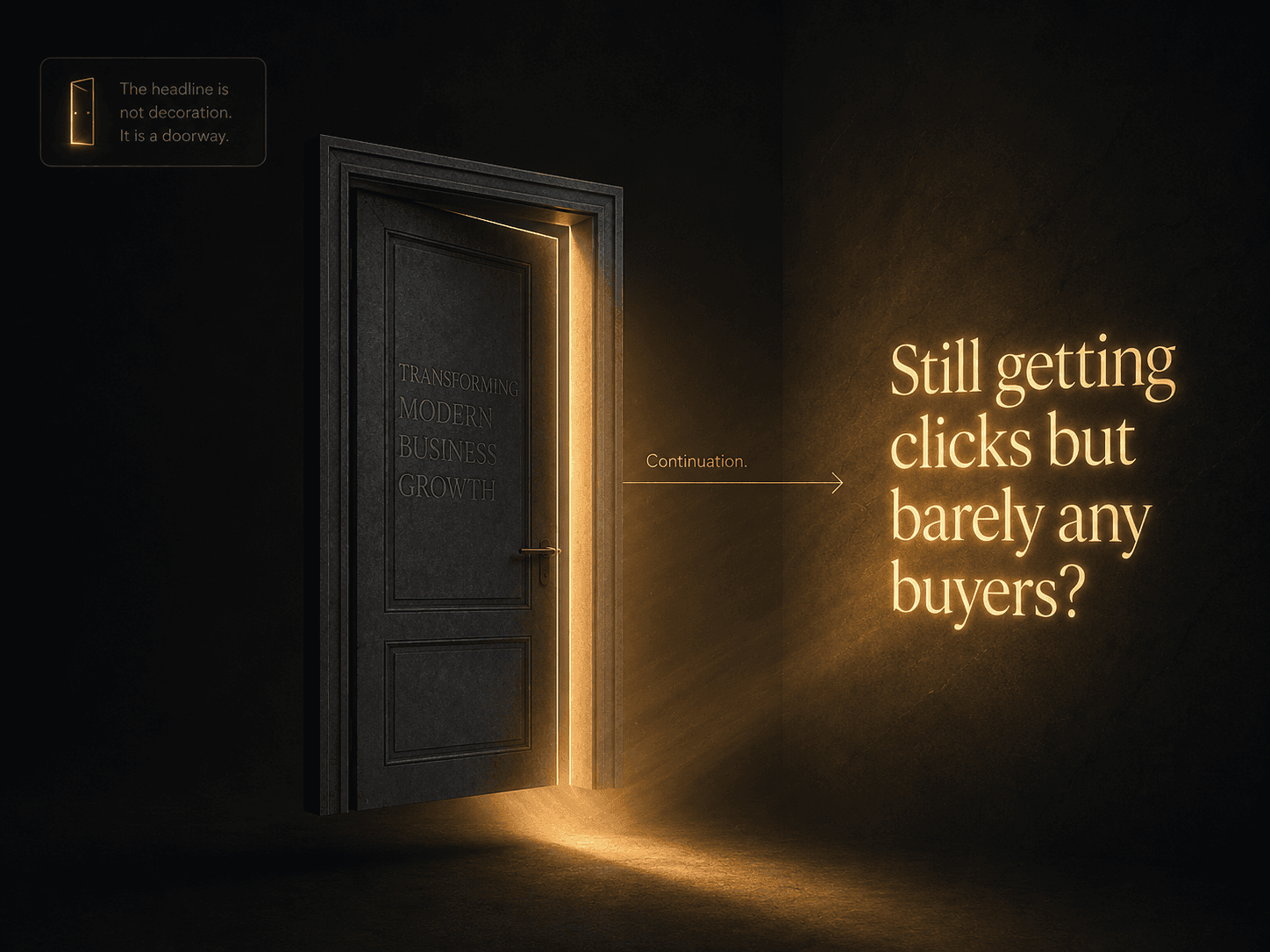
“Transforming Modern Business Growth.”
“Empowering Innovative Digital Solutions.”
“Helping Brands Scale Efficiently.”
These headlines look professional.
But emotionally, they create almost no pull.
The buyer understands the words.
But feels nothing.
And buyers continue when they feel:
tension
curiosity
relevance
consequence
emotional familiarity
visible payoff
That is what this resource is designed to help you build.
It gives you a practical system for writing headlines that earn attention and CTAs that make the next step feel worth taking.
——
What This Resource Helps You Do
The Headline & CTA Momentum Vault™ helps you diagnose, rewrite, and strengthen two of the most important conversion elements on any page:
The headline
The call-to-action
Use it to fix:
vague headlines
weak hooks
boring first lines
flat CTAs
generic button text
unclear next steps
low emotional pull
poor continuation
weak click motivation
headline and CTA mismatch
This is not about writing copy that sounds clever.
It is about writing copy that creates movement.
A strong headline earns continuation.
A strong CTA converts continuation into action.
Together, they determine whether the buyer keeps moving or quietly disappears.
——
The Psychology Of Attention™
Buyers do not scan pages looking for “good copywriting.”
They scan pages looking for:
relevance
pain
payoff
clarity
usefulness
emotional recognition
reason to continue
This is critical to understand.
A headline is not decoration.
It is a psychological doorway.
Its job is to make continuation feel worthwhile.
That means strong headlines usually create at least one of these reactions:
“That sounds like my problem.”
“That is happening to me.”
“Wait… what does that mean?”
“How are they doing that?”
“I need to know more.”
Weak headlines create none of those reactions.
They may sound polished.
They may sound professional.
They may even sound impressive to the founder.
But if they do not create movement in the buyer’s mind, they are not doing their job.
——
The Real Job Of A Headline
A headline does not need to close the sale.
It needs to earn the next few seconds.
That is the standard.
The headline should help the buyer understand:
what this page is about
why it matters
why it may be relevant to them
why they should continue reading
The headline is not the whole argument.
It is the opening door.
If the buyer does not want to walk through that door, the rest of the page does not get a fair chance.
—-
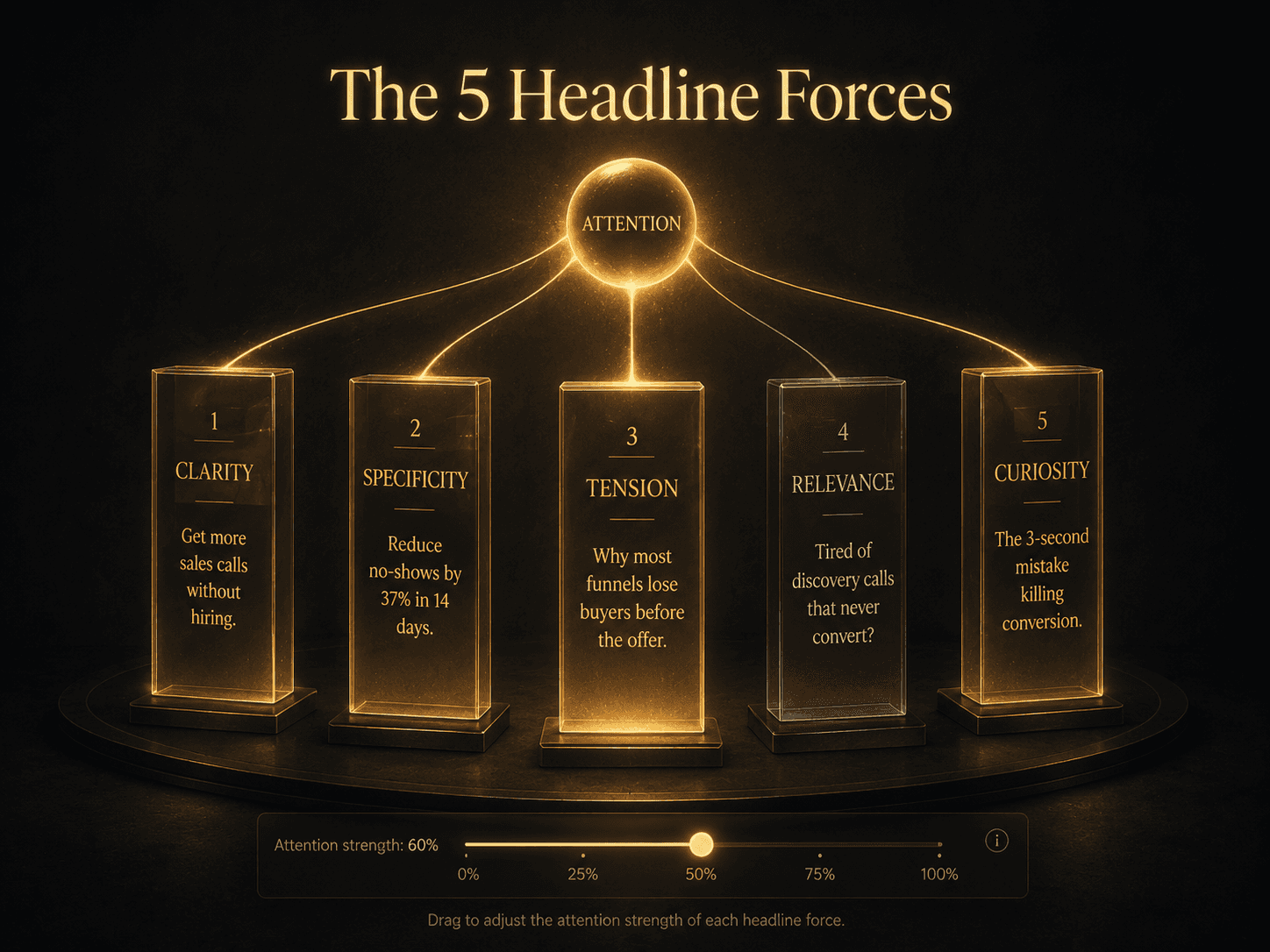
The 5 Headline Forces™
Strong headlines usually combine one or more of these five forces.
Understanding them makes headline writing dramatically easier.
1. Clarity™
Clarity means the buyer immediately understands what the headline is about.
The message should reduce interpretation effort.
Weak:
“Transforming Client Acquisition.”
Stronger:
“Get More Qualified Sales Calls Without Hiring Another Setter.”
The stronger version is not just clearer.
It is easier to process.
It tells the buyer:
what the outcome is
who might care
what friction is removed
why the page may be worth reading
Clarity matters because confused buyers rarely continue.
Headline Clarity Score: ___ / 5
2. Specificity™
Specificity makes the message feel more believable and concrete.
Weak:
“Grow Faster.”
Stronger:
“Reduce Client No-Shows In 14 Days With A Simple Reminder Flow.”
Specificity gives the buyer something visible to hold onto.
It can come from:
numbers
timeframes
audience details
clear outcomes
specific pain points
specific mechanisms
Specificity does not mean inventing numbers.
Only use numbers you can support.
The point is not fake precision.
The point is concrete meaning.
Headline Specificity Score: ___ / 5
3. Tension™
Tension creates the feeling that something important needs resolving.
Weak:
“Learn About Funnel Optimisation.”
Stronger:
“Why Most Funnels Lose Buyers Before The Offer Even Appears.”
The stronger headline creates a gap.
The buyer feels:
“There is a hidden problem here.”
That gap creates continuation.
Tension can come from:
a mistake
a hidden leak
a contradiction
a costly blind spot
an unresolved problem
a surprising insight
Tension gives the buyer a reason to keep reading.
Headline Tension Score: ___ / 5
4. Relevance™
Relevance makes the buyer feel:
“This sounds like my situation.”
Weak:
“We Help Businesses Scale.”
Stronger:
“Tired Of Discovery Calls That Never Convert?”
The stronger headline enters a specific buyer’s world.
It names a repeated frustration.
It feels recognisable.
Relevance can come from:
buyer type
specific pain
industry language
emotional frustration
stalled outcome
common situation
The buyer should not have to work hard to find themselves in the message.
Headline Relevance Score: ___ / 5
5. Curiosity™
Curiosity creates forward movement.
Weak:
“Our New Conversion Framework.”
Stronger:
“The 3-Second Mistake Quietly Killing Funnel Conversion.”
The stronger headline opens a loop.
The buyer wants to know:
“What mistake?”
“Am I making it?”
“How is it killing conversion?”
That creates continuation naturally.
Curiosity works best when it is connected to a real buyer problem.
Empty curiosity becomes clickbait.
Useful curiosity creates movement.
Headline Curiosity Score: ___ / 5
——
The Headline Momentum Scorecard™
Score your current headline from 1 to 5 across each force.
1 = very weak
2 = unclear
3 = acceptable but leaking
4 = strong
5 = clear, specific, relevant, and movement-building
Clarity: ___ / 5
Specificity: ___ / 5
Tension: ___ / 5
Relevance: ___ / 5
Curiosity: ___ / 5
Total Headline Momentum Score: ___ / 25
——
What Your Headline Score Means
22–25: Strong Headline
Your headline is clear, specific, relevant, and creates movement.
Test it, but the foundation is strong.
17–21: Good But Leaking
The headline has potential, but one or two forces are weak.
Strengthen the lowest-scoring area first.
10–16: Weak Continuation
The headline may be understandable, but it probably does not create enough emotional pull.
Rewrite it before sending more traffic.
0–9: Attention Leak
The headline is likely too vague, too broad, too clever, or too emotionally flat.
Rebuild it from the buyer’s problem, desired outcome, or hidden tension.
——
The Most Important Headline Rule™
Clarity beats cleverness almost every time.
Founders often try to sound:
intelligent
sophisticated
creative
premium
different
clever
But buyers reward:
understanding
relevance
emotional usefulness
visible payoff
low interpretation effort
A clear headline with tension usually outperforms a clever headline with ambiguity.
Cleverness can work after clarity exists.
It fails when it replaces clarity.
The buyer should not need to decode your headline.
They should feel pulled by it.
——
The Most Common Headline Mistakes™
Most weak headlines are not broken because they are badly written.
They are broken because they fail psychologically.
Use this section to diagnose the problem.
Clarity Mistakes
using vague language
hiding the outcome
sounding abstract
using jargon
forcing the buyer to interpret
making the offer hard to understand
If the buyer cannot understand the headline quickly, the page starts leaking immediately.
Buyer Relevance Mistakes
talking about the company instead of the buyer
trying to appeal to everyone
avoiding specific pain
hiding the audience
using broad category language
If the buyer does not feel recognised, the headline feels distant.
Emotional Mistakes
creating no tension
sounding too safe
avoiding consequence
making the problem feel mild
sounding polished but lifeless
If the headline creates no emotional pull, the buyer has no strong reason to continue.
Specificity Mistakes
using broad outcomes
avoiding numbers or concrete details
saying “growth” without defining growth
saying “scale” without explaining what changes
making the promise invisible
If the buyer cannot picture the value, the headline feels weak.
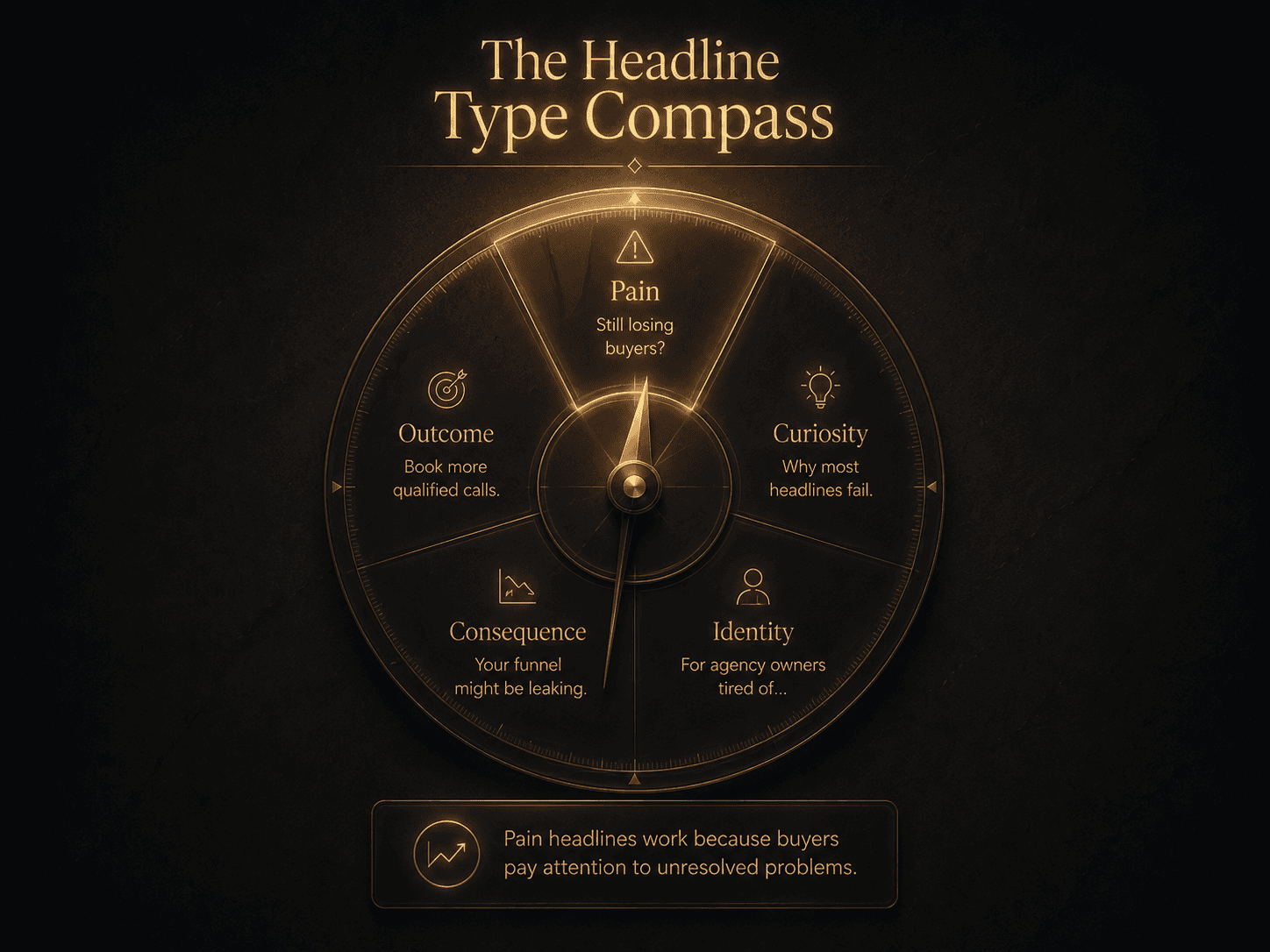
The Main Headline Types™
Different headline styles create different emotional reactions.
The goal is not to use the same type every time.
The goal is to choose intentionally.
1. Pain Headlines™
Pain headlines focus on frustration, struggle, and problem recognition.
They work because buyers pay attention to unresolved problems.
Use pain headlines when the buyer is problem-aware or emotionally frustrated.
Examples:
“Still Losing Buyers Before They Reach Your Offer?”
“Tired Of Discovery Calls That Never Convert?”
“Spending Money On Traffic That Never Turns Into Sales?”
“Still Starting Every Month With An Empty Pipeline?”
“Users Signing Up But Disappearing Before They Activate?”
Best for:
cold buyers
problem-aware buyers
landing pages
diagnostic offers
awareness-stage content
2. Outcome Headlines™
Outcome headlines focus on results, transformation, and desired payoff.
They work because they create a visible reward.
Use outcome headlines when the buyer already wants the result and needs a clearer promise.
Examples:
“Book More Qualified Sales Calls Without Hiring More Staff.”
“Turn Cold Traffic Into Predictable Pipeline.”
“Reduce Funnel Leakage Before Scaling Ads.”
“Convert More Product Page Visitors Without Increasing Ad Spend.”
“Build A Clearer Offer Page Buyers Understand In Seconds.”
Best for:
warm buyers
offer pages
service pages
product pages
lead magnets
action-focused funnels
3. Curiosity Headlines™
Curiosity headlines focus on hidden mechanisms, surprising insights, or open loops.
They work because humans naturally seek closure.
Use curiosity headlines when the buyer needs a reason to keep reading.
Examples:
“Why Most Funnels Quietly Bleed Conversion.”
“The 3-Second Mistake Killing Your Landing Page.”
“What Buyers Decide Before Reading Your Offer.”
“The Hidden Reason Your CTA Gets Ignored.”
“The First-Scroll Mistake That Makes Buyers Disappear.”
Best for:
cold traffic
educational pages
resource pages
content funnels
lead magnets
4. Consequence Headlines™
Consequence headlines focus on risk, loss, and hidden danger.
They work because buyers are sensitive to losses and missed opportunities.
Use consequence headlines when the buyer is ignoring a costly problem.
Examples:
“Your Funnel Might Be Losing Buyers Before The Offer Even Appears.”
“Why Most Landing Pages Fail Before The CTA.”
“The Hidden Leak Quietly Destroying Conversion Rates.”
“How Weak First Contact Burns Paid Traffic Before The Sales Argument Begins.”
“The Trust Gap Killing Your Booked Calls Before Buyers Click.”
Best for:
cold buyers
paid traffic pages
audit offers
diagnostic pages
problem-aware funnels
5. Identity Headlines™
Identity headlines focus on tribe recognition, self-image, and buyer identity.
They work because buyers want to feel understood.
Use identity headlines when your audience has a strong shared worldview, frustration, or role.
Examples:
“For Agency Owners Tired Of Unpredictable Lead Flow.”
“A Funnel Framework For Coaches Who Hate Pushy Marketing.”
“Built For Founders Who Want Higher Conversion Without Corporate Funnel Nonsense.”
“For Consultants Who Are Done Sounding Like Every Other Expert Online.”
“For SaaS Teams Who Know Signups Mean Nothing Without Activation.”
Best for:
niche offers
community pages
personal brands
premium services
identity-driven markets
Buyer Temperature Headline Map™
Different buyer temperatures need different headline styles.
Cold Buyers
Cold buyers need recognition, curiosity, and low-friction continuation.
Best headline types:
Pain
Curiosity
Consequence
Identity
Example:
“Why Most Funnels Lose Buyers Before The Offer Even Appears.”
Warm Buyers
Warm buyers need proof, mechanism, and differentiation.
Best headline types:
Outcome
Mechanism
Proof-aware
Specific pain
Example:
“See The 4 Funnel Leaks That Made Qualified Buyers Leave Before The CTA.”
Hot Buyers
Hot buyers need reassurance, clarity, and action confidence.
Best headline types:
Outcome
Direct
Offer-specific
Next-step focused
Example:
“Get Your 10-Minute Funnel Leak Breakdown.”
Headline Swipe Vault™
Use these as structure, not scripts.
Adapt them to your buyer, market, offer, proof, and page purpose.
Pain Headline Swipes
“Still Losing Buyers Before They Reach Your Offer?”
“Tired Of Discovery Calls That Never Convert?”
“Getting Traffic But Not Enough Buyers?”
“Still Starting Every Month With An Empty Pipeline?”
“Users Signing Up But Disappearing After Day One?”
“Posting Every Day And Still Feeling Invisible?”
“Spending Money On Ads That Barely Break Even?”
“Leads Showing Interest Then Vanishing?”
“Your Page Looks Good. So Why Are Buyers Leaving?”
“Still Relying On Referrals To Keep The Pipeline Alive?”
Outcome Headline Swipes
“Book More Qualified Sales Calls Without Hiring Another Setter.”
“Turn Cold Traffic Into A Clearer Path To Action.”
“Reduce Funnel Leakage Before Scaling Your Ads.”
“Make Your Hero Section Clear Enough To Survive Cold Traffic.”
“Convert More Visitors Without Adding More Page Sections.”
“Build A CTA Buyers Actually Want To Click.”
“Create Messaging That Makes The Right Buyer Feel Recognised.”
“Turn Vague Page Copy Into Buyer-Specific Conversion Messaging.”
“Make The Next Step Feel Like Progress, Not Pressure.”
“Repair The First-Contact Leaks Killing Your Funnel Momentum.”
Curiosity Headline Swipes
“Why Most Funnels Quietly Bleed Conversion.”
“The 3-Second Mistake Killing Your Landing Page.”
“What Buyers Decide Before Reading Your Offer.”
“The Hidden Reason Your CTA Gets Ignored.”
“The First-Scroll Mistake That Makes Buyers Disappear.”
“Why Clear Pages Still Fail To Convert.”
“What Your Funnel Says Before The Buyer Trusts You.”
“The Silent Leak Weakening Your Sales Page.”
“Why Buyers Leave Before They Know What You Sell.”
“The Moment Your Page Starts Losing The Sale.”
Consequence Headline Swipes
“Your Funnel Might Be Losing Buyers Before The Offer Even Appears.”
“Why Most Landing Pages Fail Before The CTA.”
“The Hidden Leak Quietly Destroying Conversion Rates.”
“How Weak First Contact Burns Paid Traffic Before The Sales Argument Begins.”
“The Trust Gap Killing Your Booked Calls Before Buyers Click.”
“Why More Traffic Makes Weak Pages Fail Faster.”
“The CTA Problem That Makes Interested Buyers Hesitate.”
“The Messaging Mistake That Makes Your Offer Feel Generic.”
“The Proof Gap Quietly Making Buyers Doubt You.”
“The Page Friction That Turns Interest Into Exit.”
Identity Headline Swipes
“For Agency Owners Tired Of Unpredictable Lead Flow.”
“For Coaches Who Hate Pushy Marketing But Still Need Better Conversion.”
“For Founders Who Want Higher Conversion Without Corporate Funnel Nonsense.”
“For Consultants Who Are Done Sounding Like Every Other Expert Online.”
“For SaaS Teams Who Know Signups Mean Nothing Without Activation.”
“For Ecommerce Brands Getting Clicks But Not Enough Buyers.”
“For Service Providers Whose Pages Look Good But Still Leak Leads.”
“For Creators Posting Consistently But Still Feeling Invisible.”
“For Founders Who Know The Funnel Looks Fine But Feels Weak.”
“For Marketers Who Want Clarity, Not Conversion Theatre.”
——
Headline Transformations™
Use these examples to see how weak headlines become stronger.
Example 1
Weak:
“We Help Businesses Grow Online.”
Problems:
broad
generic
emotionally weak
no tension
no visible buyer
no emotional specificity
Stronger:
“Still Getting Clicks But Barely Any Buyers?”
Why this works better:
emotionally familiar
more specific
creates tension
easier to visualise
stronger continuation pull
Example 2
Weak:
“Innovative Conversion Solutions.”
Problems:
corporate fog
vague
emotionally empty
no visible outcome
Stronger:
“Why Buyers Quietly Leave Before Your Sales Argument Even Begins.”
Why this works better:
creates tension
introduces consequence
makes the problem feel urgent
gives the buyer a reason to continue
Example 3
Weak:
“Helping Agencies Scale.”
Problems:
too broad
overused
no visible pain
no specific outcome
Stronger:
“Still Relying On Referrals To Keep Your Agency Pipeline Alive?”
Why this works better:
specific buyer
specific pain
emotional recognition
clear business consequence
Example 4
Weak:
“Improve User Engagement.”
Problems:
vague
abstract
no clear moment
no buyer emotion
Stronger:
“Users Signing Up But Disappearing Before They Activate?”
Why this works better:
specific situation
clear behavioural problem
stronger emotional relevance
easier to picture
Example 5
Weak:
“Grow Your Coaching Business.”
Problems:
generic
category-level
no tension
no emotional detail
Stronger:
“Tired Of Discovery Calls That End With ‘I’ll Think About It’?”
Why this works better:
captures a real moment
emotionally familiar
buyer-specific
creates immediate recognition
——
The 3-Second Headline Test™
Look at your headline for 3 seconds only.
Then ask:
Can someone understand what this is about?
Can the right buyer recognise themselves?
Does the headline create a reason to continue?
Is there pain, payoff, tension, or curiosity?
Does it make the next line feel worth reading?
If not, the headline is probably leaking attention.
Do not judge the headline by whether it sounds good to you.
Judge it by whether it creates movement in the buyer.
The Headline Rebuild Exercise™
Use this worksheet to rewrite one weak headline.
My Current Headline
What It Currently Communicates
What It Fails To Communicate
Buyer Temperature
Cold / Warm / Hot
Headline Type Needed
Pain / Outcome / Curiosity / Consequence / Identity
The Buyer’s Main Pain Or Desire
Stronger Version 1
Stronger Version 2
Stronger Version 3
Best Version
Why This Version Is Stronger
Use:
pain + specificity + relevance + tension
——
CTA Psychology Framework™
Most weak CTAs fail because they feel like:
effort
commitment
paperwork
admin
risk
uncertainty
obligation
Examples:
“Submit.”
“Contact Us.”
“Learn More.”
“Start Now.”
These buttons communicate almost no emotional reward.
They tell the buyer what to do.
But they do not show the buyer why doing it is worth it.
Strong CTAs feel different.
They feel like:
progress
movement
value
clarity
low-friction continuation
A weak CTA asks for effort.
A strong CTA makes the effort feel worth it.
That changes click behaviour dramatically.
——
The Real Job Of A CTA
A CTA is not just button text.
It is the moment where interest becomes movement.
The buyer should understand:
what happens next
what they get
why it matters
why the click is worth taking
why the action feels safe enough
A CTA should not feel like admin.
It should feel like progress.
——
The 4 Forces Of Strong CTAs™
Strong CTAs usually contain one or more of these four forces.
1. Reward Visibility™
Reward Visibility means the buyer instantly understands what they get.
Weak:
“Download.”
Stronger:
“Get The Funnel Breakdown PDF.”
The stronger CTA makes the reward visible.
The buyer does not have to guess.
CTA Reward Visibility Score: ___ / 5
2. Movement™
Movement means the CTA feels like forward progress.
Weak:
“Submit.”
Stronger:
“Show Me The Conversion Leaks.”
The stronger CTA gives the action a purpose.
It feels like something useful will happen after the click.
CTA Movement Score: ___ / 5
3. Clarity™
Clarity means the next step feels obvious.
Weak:
“Learn More.”
Stronger:
“See How The Framework Works.”
The stronger CTA explains the direction of the click.
The buyer understands what kind of experience comes next.
CTA Clarity Score: ___ / 5
4. Low Friction™
Low Friction means the action does not feel psychologically heavy.
Weak:
“Apply Now.”
Stronger:
“Watch The 7-Minute Breakdown.”
The stronger CTA lowers perceived commitment.
Lower commitment often increases continuation, especially with cold or sceptical buyers.
CTA Low Friction Score: ___ / 5
——
The CTA Momentum Scorecard™
Score your current CTA from 1 to 5 across each force.
1 = very weak
2 = unclear
3 = acceptable but leaking
4 = strong
5 = clear, specific, valuable, and movement-building
Reward Visibility: ___ / 5
Movement: ___ / 5
Clarity: ___ / 5
Low Friction: ___ / 5
Total CTA Momentum Score: ___ / 20
What Your CTA Score Means
17–20: Strong CTA
The CTA makes the reward clear and the next step feel worth taking.
13–16: Good But Leaking
The CTA is usable, but it could be more specific, lower-friction, or more reward-visible.
8–12: Weak Movement
The CTA exists, but it probably feels too generic or too vague to create strong action.
0–7: Dead Button Syndrome™
The button is present, but psychologically weak.
The buyer sees it, but does not feel enough reason to click.
Rewrite the CTA around reward, clarity, and movement.
——
CTA Categories™
Different CTAs create different psychological effects.
Choose the CTA type based on buyer temperature and page purpose.
Curiosity CTAs™
Curiosity CTAs create a desire to see what happens next.
Examples:
“Show Me The Breakdown.”
“Reveal The Funnel Leaks.”
“See What Buyers Notice First.”
“Find The Hidden Conversion Leak.”
“Show Me Why Buyers Leave.”
Best for:
cold traffic
educational resources
diagnostic pages
awareness-stage buyers
Outcome CTAs™
Outcome CTAs focus on the result the buyer wants.
Examples:
“Get More Qualified Calls.”
“Reduce Funnel Leakage.”
“Improve Landing Page Conversion.”
“Build My Stronger CTA.”
“Create My Buyer-Specific Message.”
Best for:
warm buyers
problem-aware buyers
offer pages
service pages
Proof-Driven CTAs™
Proof-driven CTAs invite the buyer to see evidence.
Examples:
“See The Case Study.”
“Watch The Before And After Breakdown.”
“View The Funnel Teardown.”
“See The 2.3x Booked Call Breakdown.”
“Show Me The Proof.”
Best for:
warm traffic
sceptical buyers
proof sections
case study pages
Low-Friction CTAs™
Low-friction CTAs reduce perceived commitment.
Examples:
“Watch The 7-Minute Walkthrough.”
“Get The Free Breakdown.”
“Explore The Framework.”
“See How It Works.”
“Preview The Resource.”
Best for:
cold buyers
sceptical buyers
early-stage visitors
education-first funnels
Diagnostic CTAs™
Diagnostic CTAs offer insight into what is broken.
Examples:
“Find My Funnel Leaks.”
“Run The 3-Second Headline Test.”
“Get My Page Breakdown.”
“Diagnose My Conversion Leak.”
“Show Me What Is Breaking Momentum.”
Best for:
service businesses
consultants
audits
strategy calls
lead magnets
Booking CTAs™
Booking CTAs make a call or consultation feel specific and valuable.
Weak booking CTAs usually say:
“Book A Call.”
Stronger examples:
“Book My 15-Minute Funnel Review.”
“Get My 10-Minute Strategy Breakdown.”
“Schedule My Conversion Audit.”
“Reserve My Funnel Diagnosis Call.”
“Book A Page Leak Review.”
Best for:
hot buyers
consultation offers
service pages
high-ticket funnels
——
Download CTAs™
Download CTAs should make the asset feel specific and useful.
Weak:
“Download.”
Stronger examples:
“Get The Headline Swipe Vault.”
“Download The Funnel Autopsy Worksheet.”
“Get The CTA Rebuild Checklist.”
“Download The Buyer Messaging Matrix.”
“Get The PDF Framework.”
Best for:
resources
lead magnets
book companion pages
templates
worksheets
——
CTA Transformation Vault™
Use these as patterns.
Adapt them to the buyer, offer, and page purpose.
Weak CTA:
“Learn More.”
Stronger CTA:
“Show Me The Funnel Leaks.”
—
Weak CTA:
“Submit.”
Stronger CTA:
“Send My Audit.”
—
Weak CTA:
“Contact Us.”
Stronger CTA:
“Get My Free Strategy Breakdown.”
—
Weak CTA:
“Download.”
Stronger CTA:
“Get The Swipe Framework PDF.”
—
Weak CTA:
“Book A Call.”
Stronger CTA:
“Get My Funnel Breakdown.”
—
Weak CTA:
“Start Now.”
Stronger CTA:
“See How It Works.”
—
Weak CTA:
“Apply Now.”
Stronger CTA:
“Apply For The 15-Minute Funnel Review.”
—
Weak CTA:
“Get Started.”
Stronger CTA:
“Build My First Funnel Map.”
—
Weak CTA:
“Read More.”
Stronger CTA:
“See The Full Breakdown.”
—
Weak CTA:
“Subscribe.”
Stronger CTA:
“Get Weekly Funnel Field Notes.”
—
Weak CTA:
“Try It.”
Stronger CTA:
“Test The Framework On My Page.”
—
Weak CTA:
“View Details.”
Stronger CTA:
“See What Happens After The Click.”
—-
CTA Microcopy™
Sometimes the button alone is not enough.
A strong CTA can be supported by small reassurance text underneath.
This is CTA microcopy.
It reduces uncertainty and makes action feel safer.
Examples:
CTA:
“Get My Funnel Leak Breakdown.”
Microcopy:
“No pitch. Just a clear diagnosis of where buyers are dropping off.”
CTA:
“Download The Headline Swipe Vault.”
Microcopy:
“Use the examples as structures. Adapt them to your buyer and offer.”
CTA:
“Book My 15-Minute Funnel Review.”
Microcopy:
“Walk away with one clear conversion leak to fix first.”
CTA:
“Watch The 7-Minute Breakdown.”
Microcopy:
“See the framework before deciding whether it fits your page.”
CTA microcopy is useful when the buyer may be thinking:
What happens next?
Is this free?
Is this a sales call?
How long will it take?
Will this be useful?
Am I committing to anything?
If the buyer is likely to hesitate, microcopy can reduce that hesitation.
——
The CTA Rebuild Exercise™
Use this worksheet to strengthen one weak CTA.
My Current CTA
What It Currently Asks The Buyer To Do
What Reward Is Missing
What Friction Exists
What The Buyer Might Worry About
Stronger CTA Version 1
Stronger CTA Version 2
Stronger CTA Version 3
Best CTA
Supporting Microcopy
Why This CTA Is Stronger
Use:
reward + clarity + movement + low friction
——
What High-Converting Headlines Do Differently™
Weak headlines describe.
Strong headlines pull.
Weak headlines explain the company.
Strong headlines enter the buyer’s problem.
Weak headlines sound polished.
Strong headlines create movement.
Weak headlines rely on abstraction.
Strong headlines make the value visible.
Weak headlines try to impress.
Strong headlines make continuation feel worthwhile.
The difference is psychological.
Not cosmetic.
——
What High-Converting CTAs Do Differently™
Weak CTAs label the button.
Strong CTAs sell the next step.
Weak CTAs ask for effort.
Strong CTAs make the effort feel worth it.
Weak CTAs sound like admin.
Strong CTAs sound like progress.
Weak CTAs create uncertainty.
Strong CTAs reduce uncertainty.
Weak CTAs say:
“Click here.”
Strong CTAs say:
“Here is why clicking is useful.”
That is the difference.
——
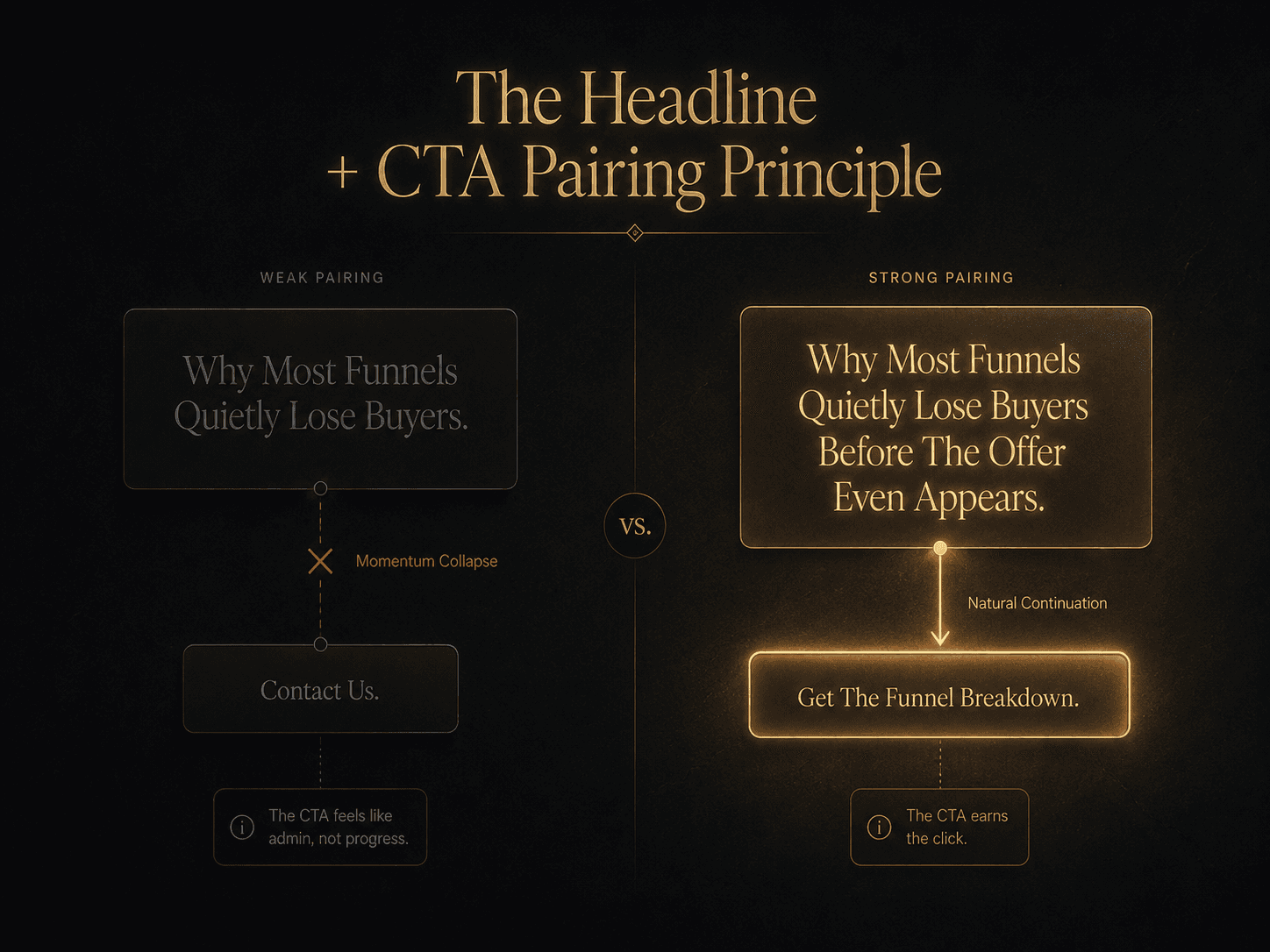
The Headline & CTA Pairing Principle™
Your headline creates desire to continue.
Your CTA converts that momentum into action.
That means the two must work together.
If the headline creates curiosity, the CTA should offer the next step that resolves that curiosity.
If the headline creates pain recognition, the CTA should offer diagnosis or relief.
If the headline creates outcome desire, the CTA should make the outcome feel closer.
If the headline creates trust through proof, the CTA should make action feel safe.
A strong headline with a weak CTA creates wasted momentum.
A strong CTA with a weak headline often arrives too early.
The pair matters.
——
Weak Pairing Example
Headline:
“Why Most Funnels Quietly Lose Buyers.”
CTA:
“Contact Us.”
Problem:
The headline creates curiosity.
But the CTA asks for commitment.
The emotional movement collapses.
The buyer wanted the breakdown.
The CTA asks for a conversation.
That is a mismatch.
——
Stronger Pairing
Headline:
“Why Most Funnels Quietly Lose Buyers Before The Offer Even Appears.”
CTA:
“Get The Funnel Breakdown.”
Why it works:
The headline opens the loop.
The CTA offers the next logical step.
The movement feels natural.
——
More Headline & CTA Pairing Examples
Example 1
Headline:
“Still Getting Clicks But Barely Any Buyers?”
Weak CTA:
“Learn More.”
Stronger CTA:
“Find My Product Page Leaks.”
Why it works:
The headline names the pain.
The CTA offers diagnosis.
Example 2
Headline:
“Tired Of Discovery Calls That End With ‘I’ll Think About It’?”
Weak CTA:
“Book A Call.”
Stronger CTA:
“Get My Call Conversion Breakdown.”
Why it works:
The headline names a specific frustration.
The CTA offers a relevant next step.
Example 3
Headline:
“Users Signing Up But Disappearing Before They Activate?”
Weak CTA:
“Contact Sales.”
Stronger CTA:
“Find My Activation Leaks.”
Why it works:
The headline identifies the behavioural problem.
The CTA promises useful diagnosis.
Example 4
Headline:
“Why Buyers Leave Before They Reach Your Offer.”
Weak CTA:
“Start Now.”
Stronger CTA:
“Show Me The First-Contact Leak.”
Why it works:
The headline creates curiosity.
The CTA resolves the curiosity.
Example 5
Headline:
“For Agency Owners Tired Of Unpredictable Lead Flow.”
Weak CTA:
“Submit.”
Stronger CTA:
“Build My Lead Flow Map.”
Why it works:
The headline names the buyer and pain.
The CTA turns attention into progress.
——
The Headline & CTA Pairing Worksheet™
Use this to repair the first movement pair on any page.
Current Headline
Current CTA
What Emotion Does The Headline Create?
Curiosity / Pain / Desire / Fear / Trust / Recognition
What Action Does The CTA Ask For?
Do They Match?
Yes / No
If Not, Where Is The Mismatch?
Stronger Headline
Stronger CTA
Supporting Microcopy
Why This Pair Works Better
——
The 30-Minute Headline & CTA Repair Process™
Use this process when a page feels weak but you do not want to rewrite everything.
Minutes 0–5: Diagnose The Headline
Score the current headline using the 5 Headline Forces™:
Clarity
Specificity
Tension
Relevance
Curiosity
Find the lowest score.
That is the first repair point.
Minutes 5–10: Choose The Headline Type
Decide which headline type fits the buyer and page:
Pain
Outcome
Curiosity
Consequence
Identity
Do not choose based on taste.
Choose based on buyer temperature and page purpose.
Minutes 10–15: Write Three Headline Options
Write three stronger versions.
One pain-led.
One outcome-led.
One curiosity-led.
Then choose the version that creates the strongest continuation pull.
Minutes 15–20: Diagnose The CTA
Score the current CTA using the 4 CTA Forces™:
Reward Visibility
Movement
Clarity
Low Friction
Find the weakest force.
That is the first CTA repair point.
Minutes 20–25: Rewrite The CTA
Write three stronger CTA options.
One curiosity CTA.
One diagnostic CTA.
One outcome CTA.
Choose the version that best matches the headline.
Minutes 25–30: Pair And Test
Place the headline and CTA together.
Ask:
Does the headline create a reason to continue?
Does the CTA feel like the natural next step?
Does the button show a reward?
Does the pair create movement?
Would the right buyer understand why to click?
If not, repair the mismatch.
Do not change the whole page first.
Fix the first movement pair.
——
Final Principle™
A headline’s job is not to sound impressive.
Its job is to make continuation emotionally worthwhile.
A CTA’s job is not to label a button.
Its job is to make movement feel valuable.
Strong headlines earn attention.
Strong CTAs sustain movement.
Together, they determine whether the buyer continues or quietly disappears.
Rewrite one headline and one CTA today.
Do not change the whole page first.
Fix the first movement pair.
Make the buyer care.
Then make the next step feel worth taking.
That is the real psychology behind headline and CTA momentum.
——
From:
The $100M Funnel Playbook. Book I: Foundation Buyer Psychology, Offer Clarity, and the Page Architecture Behind High-Converting Funnels
By Maris Spalins.
——
Copyright Notice
© 2026 The $100M Funnel Playbook / Winyourclients / Maris Spalins. All rights reserved.
This resource, including the frameworks, terminology, examples, scorecards, templates, prompts, methods, and written explanations, is original intellectual property created for The $100M Funnel Playbook. Book I: Foundation — Buyer Psychology, Offer Clarity, And The Page Architecture Behind High-Converting Funnels and published through Winyourclients.
No part of this resource may be copied, reproduced, screenshotted, republished, redistributed, sold, adapted, uploaded, scraped, stored in a database, included in training data, used to train artificial intelligence systems, or used to create derivative commercial or educational materials without prior written permission.
Limited reference, quotation, or sharing is only permitted where the source is clearly and visibly credited.
Any permitted reference must include at least one of the following source credits:
The $100M Funnel Playbook by Maris Spalins
or
Winyourclients — www.winyourclients.com
or
Maris Spalins / Winyourclients
Screenshots, excerpts, summaries, or redistributed versions must not remove, hide, alter, crop out, or obscure the original source, author name, book title, website name, or copyright notice.
This resource is provided for personal learning and implementation only. It is not licensed for resale, republishing, redistribution, AI training, template cloning, course creation, consulting delivery, or commercial reuse without written permission from Maris Spalins or Winyourclients.
For permission requests, licensing, citation approval, or commercial usage enquiries, contact:
Winyourclients
www.winyourclients.com
or
Email directly to Jacob on: help@winyourclients.com
The Headline & CTA Momentum Vault™ How to create headlines that earn attention and calls-to-action that turn buyer interest into movement, continuation, and conversion.
Prefer Audio Or Video?
The Headline & CTA Momentum Vault™ is also available as:
🎧 A guided audio walkthrough explaining headline psychology, CTA mechanics, and buyer attention
🎥 A video breakdown with real-world headline rewrites, CTA transformations, and funnel examplesChoose the format that fits how you learn best.
[Listen To The Audio Walkthrough] (coming soon)
[Watch The Video Breakdown] (coming soon)
——
Why Most Headlines Quietly Fail
Most headlines fail before the buyer even starts reading.
Not because they are ugly.
Because they are emotionally weak.
The buyer lands on the page and instantly asks:
What is this?
Is this for me?
Why should I care?
What happens if I continue?
Weak headlines fail to answer those questions quickly.
Instead, they sound:
vague
polished
corporate
overly clever
emotionally distant
interchangeable
Examples:
“Transforming Modern Business Growth.”
“Empowering Innovative Digital Solutions.”
“Helping Brands Scale Efficiently.”
These headlines look professional.
But emotionally, they create almost no pull.
The buyer understands the words.
But feels nothing.
And buyers continue when they feel:
tension
curiosity
relevance
consequence
emotional familiarity
visible payoff
That is what this resource is designed to help you build.
It gives you a practical system for writing headlines that earn attention and CTAs that make the next step feel worth taking.
——
What This Resource Helps You Do
The Headline & CTA Momentum Vault™ helps you diagnose, rewrite, and strengthen two of the most important conversion elements on any page:
The headline
The call-to-action
Use it to fix:
vague headlines
weak hooks
boring first lines
flat CTAs
generic button text
unclear next steps
low emotional pull
poor continuation
weak click motivation
headline and CTA mismatch
This is not about writing copy that sounds clever.
It is about writing copy that creates movement.
A strong headline earns continuation.
A strong CTA converts continuation into action.
Together, they determine whether the buyer keeps moving or quietly disappears.
——
The Psychology Of Attention™
Buyers do not scan pages looking for “good copywriting.”
They scan pages looking for:
relevance
pain
payoff
clarity
usefulness
emotional recognition
reason to continue
This is critical to understand.
A headline is not decoration.
It is a psychological doorway.
Its job is to make continuation feel worthwhile.
That means strong headlines usually create at least one of these reactions:
“That sounds like my problem.”
“That is happening to me.”
“Wait… what does that mean?”
“How are they doing that?”
“I need to know more.”
Weak headlines create none of those reactions.
They may sound polished.
They may sound professional.
They may even sound impressive to the founder.
But if they do not create movement in the buyer’s mind, they are not doing their job.
——
The Real Job Of A Headline
A headline does not need to close the sale.
It needs to earn the next few seconds.
That is the standard.
The headline should help the buyer understand:
what this page is about
why it matters
why it may be relevant to them
why they should continue reading
The headline is not the whole argument.
It is the opening door.
If the buyer does not want to walk through that door, the rest of the page does not get a fair chance.
—-
The 5 Headline Forces™
Strong headlines usually combine one or more of these five forces.
Understanding them makes headline writing dramatically easier.
1. Clarity™
Clarity means the buyer immediately understands what the headline is about.
The message should reduce interpretation effort.
Weak:
“Transforming Client Acquisition.”
Stronger:
“Get More Qualified Sales Calls Without Hiring Another Setter.”
The stronger version is not just clearer.
It is easier to process.
It tells the buyer:
what the outcome is
who might care
what friction is removed
why the page may be worth reading
Clarity matters because confused buyers rarely continue.
Headline Clarity Score: ___ / 5
2. Specificity™
Specificity makes the message feel more believable and concrete.
Weak:
“Grow Faster.”
Stronger:
“Reduce Client No-Shows In 14 Days With A Simple Reminder Flow.”
Specificity gives the buyer something visible to hold onto.
It can come from:
numbers
timeframes
audience details
clear outcomes
specific pain points
specific mechanisms
Specificity does not mean inventing numbers.
Only use numbers you can support.
The point is not fake precision.
The point is concrete meaning.
Headline Specificity Score: ___ / 5
3. Tension™
Tension creates the feeling that something important needs resolving.
Weak:
“Learn About Funnel Optimisation.”
Stronger:
“Why Most Funnels Lose Buyers Before The Offer Even Appears.”
The stronger headline creates a gap.
The buyer feels:
“There is a hidden problem here.”
That gap creates continuation.
Tension can come from:
a mistake
a hidden leak
a contradiction
a costly blind spot
an unresolved problem
a surprising insight
Tension gives the buyer a reason to keep reading.
Headline Tension Score: ___ / 5
4. Relevance™
Relevance makes the buyer feel:
“This sounds like my situation.”
Weak:
“We Help Businesses Scale.”
Stronger:
“Tired Of Discovery Calls That Never Convert?”
The stronger headline enters a specific buyer’s world.
It names a repeated frustration.
It feels recognisable.
Relevance can come from:
buyer type
specific pain
industry language
emotional frustration
stalled outcome
common situation
The buyer should not have to work hard to find themselves in the message.
Headline Relevance Score: ___ / 5
5. Curiosity™
Curiosity creates forward movement.
Weak:
“Our New Conversion Framework.”
Stronger:
“The 3-Second Mistake Quietly Killing Funnel Conversion.”
The stronger headline opens a loop.
The buyer wants to know:
“What mistake?”
“Am I making it?”
“How is it killing conversion?”
That creates continuation naturally.
Curiosity works best when it is connected to a real buyer problem.
Empty curiosity becomes clickbait.
Useful curiosity creates movement.
Headline Curiosity Score: ___ / 5
——
The Headline Momentum Scorecard™
Score your current headline from 1 to 5 across each force.
1 = very weak
2 = unclear
3 = acceptable but leaking
4 = strong
5 = clear, specific, relevant, and movement-building
Clarity: ___ / 5
Specificity: ___ / 5
Tension: ___ / 5
Relevance: ___ / 5
Curiosity: ___ / 5
Total Headline Momentum Score: ___ / 25
——
What Your Headline Score Means
22–25: Strong Headline
Your headline is clear, specific, relevant, and creates movement.
Test it, but the foundation is strong.
17–21: Good But Leaking
The headline has potential, but one or two forces are weak.
Strengthen the lowest-scoring area first.
10–16: Weak Continuation
The headline may be understandable, but it probably does not create enough emotional pull.
Rewrite it before sending more traffic.
0–9: Attention Leak
The headline is likely too vague, too broad, too clever, or too emotionally flat.
Rebuild it from the buyer’s problem, desired outcome, or hidden tension.
——
The Most Important Headline Rule™
Clarity beats cleverness almost every time.
Founders often try to sound:
intelligent
sophisticated
creative
premium
different
clever
But buyers reward:
understanding
relevance
emotional usefulness
visible payoff
low interpretation effort
A clear headline with tension usually outperforms a clever headline with ambiguity.
Cleverness can work after clarity exists.
It fails when it replaces clarity.
The buyer should not need to decode your headline.
They should feel pulled by it.
——
The Most Common Headline Mistakes™
Most weak headlines are not broken because they are badly written.
They are broken because they fail psychologically.
Use this section to diagnose the problem.
Clarity Mistakes
using vague language
hiding the outcome
sounding abstract
using jargon
forcing the buyer to interpret
making the offer hard to understand
If the buyer cannot understand the headline quickly, the page starts leaking immediately.
Buyer Relevance Mistakes
talking about the company instead of the buyer
trying to appeal to everyone
avoiding specific pain
hiding the audience
using broad category language
If the buyer does not feel recognised, the headline feels distant.
Emotional Mistakes
creating no tension
sounding too safe
avoiding consequence
making the problem feel mild
sounding polished but lifeless
If the headline creates no emotional pull, the buyer has no strong reason to continue.
Specificity Mistakes
using broad outcomes
avoiding numbers or concrete details
saying “growth” without defining growth
saying “scale” without explaining what changes
making the promise invisible
If the buyer cannot picture the value, the headline feels weak.
The Main Headline Types™
Different headline styles create different emotional reactions.
The goal is not to use the same type every time.
The goal is to choose intentionally.
1. Pain Headlines™
Pain headlines focus on frustration, struggle, and problem recognition.
They work because buyers pay attention to unresolved problems.
Use pain headlines when the buyer is problem-aware or emotionally frustrated.
Examples:
“Still Losing Buyers Before They Reach Your Offer?”
“Tired Of Discovery Calls That Never Convert?”
“Spending Money On Traffic That Never Turns Into Sales?”
“Still Starting Every Month With An Empty Pipeline?”
“Users Signing Up But Disappearing Before They Activate?”
Best for:
cold buyers
problem-aware buyers
landing pages
diagnostic offers
awareness-stage content
2. Outcome Headlines™
Outcome headlines focus on results, transformation, and desired payoff.
They work because they create a visible reward.
Use outcome headlines when the buyer already wants the result and needs a clearer promise.
Examples:
“Book More Qualified Sales Calls Without Hiring More Staff.”
“Turn Cold Traffic Into Predictable Pipeline.”
“Reduce Funnel Leakage Before Scaling Ads.”
“Convert More Product Page Visitors Without Increasing Ad Spend.”
“Build A Clearer Offer Page Buyers Understand In Seconds.”
Best for:
warm buyers
offer pages
service pages
product pages
lead magnets
action-focused funnels
3. Curiosity Headlines™
Curiosity headlines focus on hidden mechanisms, surprising insights, or open loops.
They work because humans naturally seek closure.
Use curiosity headlines when the buyer needs a reason to keep reading.
Examples:
“Why Most Funnels Quietly Bleed Conversion.”
“The 3-Second Mistake Killing Your Landing Page.”
“What Buyers Decide Before Reading Your Offer.”
“The Hidden Reason Your CTA Gets Ignored.”
“The First-Scroll Mistake That Makes Buyers Disappear.”
Best for:
cold traffic
educational pages
resource pages
content funnels
lead magnets
4. Consequence Headlines™
Consequence headlines focus on risk, loss, and hidden danger.
They work because buyers are sensitive to losses and missed opportunities.
Use consequence headlines when the buyer is ignoring a costly problem.
Examples:
“Your Funnel Might Be Losing Buyers Before The Offer Even Appears.”
“Why Most Landing Pages Fail Before The CTA.”
“The Hidden Leak Quietly Destroying Conversion Rates.”
“How Weak First Contact Burns Paid Traffic Before The Sales Argument Begins.”
“The Trust Gap Killing Your Booked Calls Before Buyers Click.”
Best for:
cold buyers
paid traffic pages
audit offers
diagnostic pages
problem-aware funnels
5. Identity Headlines™
Identity headlines focus on tribe recognition, self-image, and buyer identity.
They work because buyers want to feel understood.
Use identity headlines when your audience has a strong shared worldview, frustration, or role.
Examples:
“For Agency Owners Tired Of Unpredictable Lead Flow.”
“A Funnel Framework For Coaches Who Hate Pushy Marketing.”
“Built For Founders Who Want Higher Conversion Without Corporate Funnel Nonsense.”
“For Consultants Who Are Done Sounding Like Every Other Expert Online.”
“For SaaS Teams Who Know Signups Mean Nothing Without Activation.”
Best for:
niche offers
community pages
personal brands
premium services
identity-driven markets
Buyer Temperature Headline Map™
Different buyer temperatures need different headline styles.
Cold Buyers
Cold buyers need recognition, curiosity, and low-friction continuation.
Best headline types:
Pain
Curiosity
Consequence
Identity
Example:
“Why Most Funnels Lose Buyers Before The Offer Even Appears.”
Warm Buyers
Warm buyers need proof, mechanism, and differentiation.
Best headline types:
Outcome
Mechanism
Proof-aware
Specific pain
Example:
“See The 4 Funnel Leaks That Made Qualified Buyers Leave Before The CTA.”
Hot Buyers
Hot buyers need reassurance, clarity, and action confidence.
Best headline types:
Outcome
Direct
Offer-specific
Next-step focused
Example:
“Get Your 10-Minute Funnel Leak Breakdown.”
Headline Swipe Vault™
Use these as structure, not scripts.
Adapt them to your buyer, market, offer, proof, and page purpose.
Pain Headline Swipes
“Still Losing Buyers Before They Reach Your Offer?”
“Tired Of Discovery Calls That Never Convert?”
“Getting Traffic But Not Enough Buyers?”
“Still Starting Every Month With An Empty Pipeline?”
“Users Signing Up But Disappearing After Day One?”
“Posting Every Day And Still Feeling Invisible?”
“Spending Money On Ads That Barely Break Even?”
“Leads Showing Interest Then Vanishing?”
“Your Page Looks Good. So Why Are Buyers Leaving?”
“Still Relying On Referrals To Keep The Pipeline Alive?”
Outcome Headline Swipes
“Book More Qualified Sales Calls Without Hiring Another Setter.”
“Turn Cold Traffic Into A Clearer Path To Action.”
“Reduce Funnel Leakage Before Scaling Your Ads.”
“Make Your Hero Section Clear Enough To Survive Cold Traffic.”
“Convert More Visitors Without Adding More Page Sections.”
“Build A CTA Buyers Actually Want To Click.”
“Create Messaging That Makes The Right Buyer Feel Recognised.”
“Turn Vague Page Copy Into Buyer-Specific Conversion Messaging.”
“Make The Next Step Feel Like Progress, Not Pressure.”
“Repair The First-Contact Leaks Killing Your Funnel Momentum.”
Curiosity Headline Swipes
“Why Most Funnels Quietly Bleed Conversion.”
“The 3-Second Mistake Killing Your Landing Page.”
“What Buyers Decide Before Reading Your Offer.”
“The Hidden Reason Your CTA Gets Ignored.”
“The First-Scroll Mistake That Makes Buyers Disappear.”
“Why Clear Pages Still Fail To Convert.”
“What Your Funnel Says Before The Buyer Trusts You.”
“The Silent Leak Weakening Your Sales Page.”
“Why Buyers Leave Before They Know What You Sell.”
“The Moment Your Page Starts Losing The Sale.”
Consequence Headline Swipes
“Your Funnel Might Be Losing Buyers Before The Offer Even Appears.”
“Why Most Landing Pages Fail Before The CTA.”
“The Hidden Leak Quietly Destroying Conversion Rates.”
“How Weak First Contact Burns Paid Traffic Before The Sales Argument Begins.”
“The Trust Gap Killing Your Booked Calls Before Buyers Click.”
“Why More Traffic Makes Weak Pages Fail Faster.”
“The CTA Problem That Makes Interested Buyers Hesitate.”
“The Messaging Mistake That Makes Your Offer Feel Generic.”
“The Proof Gap Quietly Making Buyers Doubt You.”
“The Page Friction That Turns Interest Into Exit.”
Identity Headline Swipes
“For Agency Owners Tired Of Unpredictable Lead Flow.”
“For Coaches Who Hate Pushy Marketing But Still Need Better Conversion.”
“For Founders Who Want Higher Conversion Without Corporate Funnel Nonsense.”
“For Consultants Who Are Done Sounding Like Every Other Expert Online.”
“For SaaS Teams Who Know Signups Mean Nothing Without Activation.”
“For Ecommerce Brands Getting Clicks But Not Enough Buyers.”
“For Service Providers Whose Pages Look Good But Still Leak Leads.”
“For Creators Posting Consistently But Still Feeling Invisible.”
“For Founders Who Know The Funnel Looks Fine But Feels Weak.”
“For Marketers Who Want Clarity, Not Conversion Theatre.”
——
Headline Transformations™
Use these examples to see how weak headlines become stronger.
Example 1
Weak:
“We Help Businesses Grow Online.”
Problems:
broad
generic
emotionally weak
no tension
no visible buyer
no emotional specificity
Stronger:
“Still Getting Clicks But Barely Any Buyers?”
Why this works better:
emotionally familiar
more specific
creates tension
easier to visualise
stronger continuation pull
Example 2
Weak:
“Innovative Conversion Solutions.”
Problems:
corporate fog
vague
emotionally empty
no visible outcome
Stronger:
“Why Buyers Quietly Leave Before Your Sales Argument Even Begins.”
Why this works better:
creates tension
introduces consequence
makes the problem feel urgent
gives the buyer a reason to continue
Example 3
Weak:
“Helping Agencies Scale.”
Problems:
too broad
overused
no visible pain
no specific outcome
Stronger:
“Still Relying On Referrals To Keep Your Agency Pipeline Alive?”
Why this works better:
specific buyer
specific pain
emotional recognition
clear business consequence
Example 4
Weak:
“Improve User Engagement.”
Problems:
vague
abstract
no clear moment
no buyer emotion
Stronger:
“Users Signing Up But Disappearing Before They Activate?”
Why this works better:
specific situation
clear behavioural problem
stronger emotional relevance
easier to picture
Example 5
Weak:
“Grow Your Coaching Business.”
Problems:
generic
category-level
no tension
no emotional detail
Stronger:
“Tired Of Discovery Calls That End With ‘I’ll Think About It’?”
Why this works better:
captures a real moment
emotionally familiar
buyer-specific
creates immediate recognition
——
The 3-Second Headline Test™
Look at your headline for 3 seconds only.
Then ask:
Can someone understand what this is about?
Can the right buyer recognise themselves?
Does the headline create a reason to continue?
Is there pain, payoff, tension, or curiosity?
Does it make the next line feel worth reading?
If not, the headline is probably leaking attention.
Do not judge the headline by whether it sounds good to you.
Judge it by whether it creates movement in the buyer.
The Headline Rebuild Exercise™
Use this worksheet to rewrite one weak headline.
My Current Headline
What It Currently Communicates
What It Fails To Communicate
Buyer Temperature
Cold / Warm / Hot
Headline Type Needed
Pain / Outcome / Curiosity / Consequence / Identity
The Buyer’s Main Pain Or Desire
Stronger Version 1
Stronger Version 2
Stronger Version 3
Best Version
Why This Version Is Stronger
Use:
pain + specificity + relevance + tension
——
CTA Psychology Framework™
Most weak CTAs fail because they feel like:
effort
commitment
paperwork
admin
risk
uncertainty
obligation
Examples:
“Submit.”
“Contact Us.”
“Learn More.”
“Start Now.”
These buttons communicate almost no emotional reward.
They tell the buyer what to do.
But they do not show the buyer why doing it is worth it.
Strong CTAs feel different.
They feel like:
progress
movement
value
clarity
low-friction continuation
A weak CTA asks for effort.
A strong CTA makes the effort feel worth it.
That changes click behaviour dramatically.
——
The Real Job Of A CTA
A CTA is not just button text.
It is the moment where interest becomes movement.
The buyer should understand:
what happens next
what they get
why it matters
why the click is worth taking
why the action feels safe enough
A CTA should not feel like admin.
It should feel like progress.
——
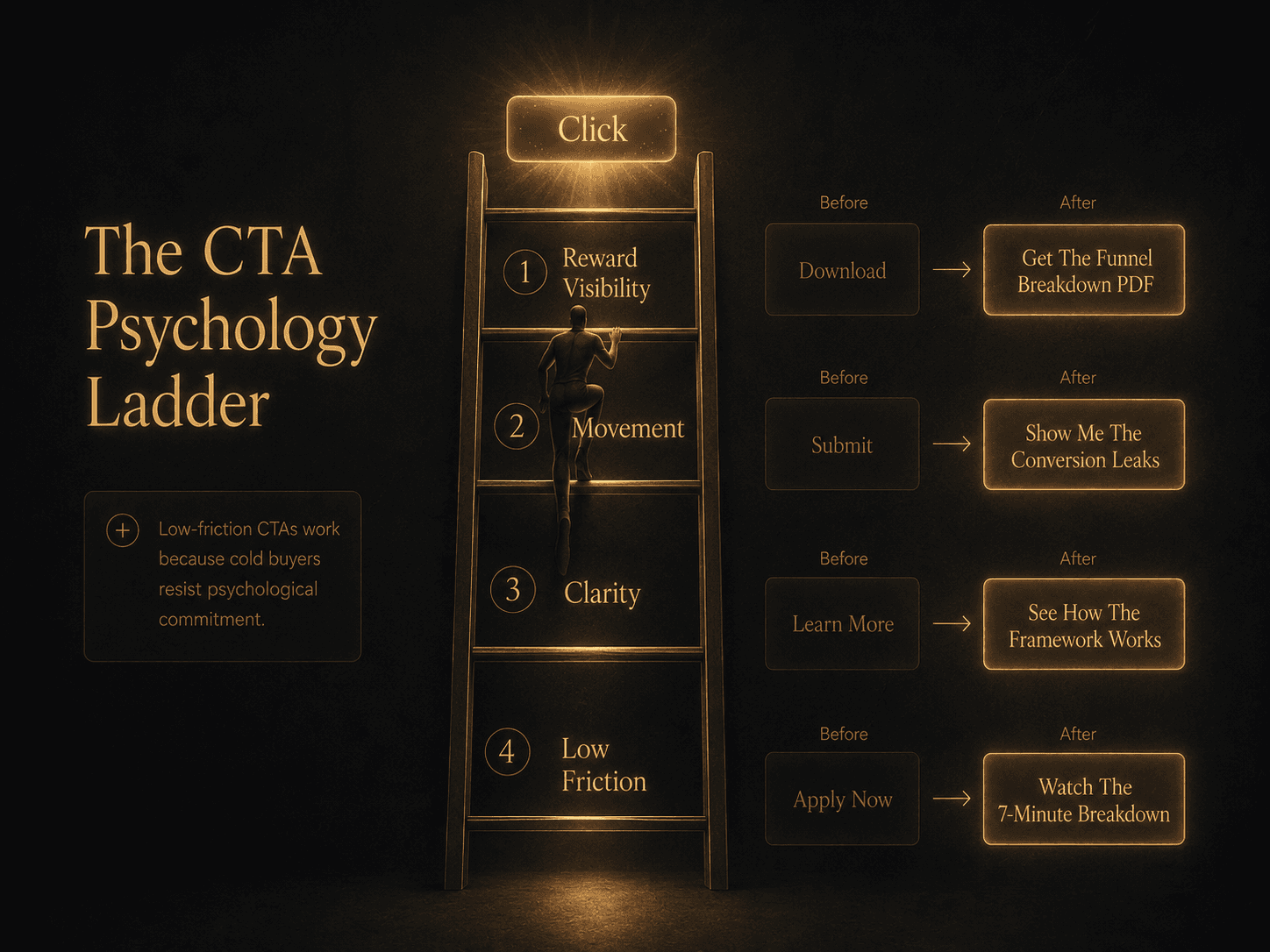
The 4 Forces Of Strong CTAs™
Strong CTAs usually contain one or more of these four forces.
1. Reward Visibility™
Reward Visibility means the buyer instantly understands what they get.
Weak:
“Download.”
Stronger:
“Get The Funnel Breakdown PDF.”
The stronger CTA makes the reward visible.
The buyer does not have to guess.
CTA Reward Visibility Score: ___ / 5
2. Movement™
Movement means the CTA feels like forward progress.
Weak:
“Submit.”
Stronger:
“Show Me The Conversion Leaks.”
The stronger CTA gives the action a purpose.
It feels like something useful will happen after the click.
CTA Movement Score: ___ / 5
3. Clarity™
Clarity means the next step feels obvious.
Weak:
“Learn More.”
Stronger:
“See How The Framework Works.”
The stronger CTA explains the direction of the click.
The buyer understands what kind of experience comes next.
CTA Clarity Score: ___ / 5
4. Low Friction™
Low Friction means the action does not feel psychologically heavy.
Weak:
“Apply Now.”
Stronger:
“Watch The 7-Minute Breakdown.”
The stronger CTA lowers perceived commitment.
Lower commitment often increases continuation, especially with cold or sceptical buyers.
CTA Low Friction Score: ___ / 5
——
The CTA Momentum Scorecard™
Score your current CTA from 1 to 5 across each force.
1 = very weak
2 = unclear
3 = acceptable but leaking
4 = strong
5 = clear, specific, valuable, and movement-building
Reward Visibility: ___ / 5
Movement: ___ / 5
Clarity: ___ / 5
Low Friction: ___ / 5
Total CTA Momentum Score: ___ / 20
What Your CTA Score Means
17–20: Strong CTA
The CTA makes the reward clear and the next step feel worth taking.
13–16: Good But Leaking
The CTA is usable, but it could be more specific, lower-friction, or more reward-visible.
8–12: Weak Movement
The CTA exists, but it probably feels too generic or too vague to create strong action.
0–7: Dead Button Syndrome™
The button is present, but psychologically weak.
The buyer sees it, but does not feel enough reason to click.
Rewrite the CTA around reward, clarity, and movement.
——
CTA Categories™
Different CTAs create different psychological effects.
Choose the CTA type based on buyer temperature and page purpose.
Curiosity CTAs™
Curiosity CTAs create a desire to see what happens next.
Examples:
“Show Me The Breakdown.”
“Reveal The Funnel Leaks.”
“See What Buyers Notice First.”
“Find The Hidden Conversion Leak.”
“Show Me Why Buyers Leave.”
Best for:
cold traffic
educational resources
diagnostic pages
awareness-stage buyers
Outcome CTAs™
Outcome CTAs focus on the result the buyer wants.
Examples:
“Get More Qualified Calls.”
“Reduce Funnel Leakage.”
“Improve Landing Page Conversion.”
“Build My Stronger CTA.”
“Create My Buyer-Specific Message.”
Best for:
warm buyers
problem-aware buyers
offer pages
service pages
Proof-Driven CTAs™
Proof-driven CTAs invite the buyer to see evidence.
Examples:
“See The Case Study.”
“Watch The Before And After Breakdown.”
“View The Funnel Teardown.”
“See The 2.3x Booked Call Breakdown.”
“Show Me The Proof.”
Best for:
warm traffic
sceptical buyers
proof sections
case study pages
Low-Friction CTAs™
Low-friction CTAs reduce perceived commitment.
Examples:
“Watch The 7-Minute Walkthrough.”
“Get The Free Breakdown.”
“Explore The Framework.”
“See How It Works.”
“Preview The Resource.”
Best for:
cold buyers
sceptical buyers
early-stage visitors
education-first funnels
Diagnostic CTAs™
Diagnostic CTAs offer insight into what is broken.
Examples:
“Find My Funnel Leaks.”
“Run The 3-Second Headline Test.”
“Get My Page Breakdown.”
“Diagnose My Conversion Leak.”
“Show Me What Is Breaking Momentum.”
Best for:
service businesses
consultants
audits
strategy calls
lead magnets
Booking CTAs™
Booking CTAs make a call or consultation feel specific and valuable.
Weak booking CTAs usually say:
“Book A Call.”
Stronger examples:
“Book My 15-Minute Funnel Review.”
“Get My 10-Minute Strategy Breakdown.”
“Schedule My Conversion Audit.”
“Reserve My Funnel Diagnosis Call.”
“Book A Page Leak Review.”
Best for:
hot buyers
consultation offers
service pages
high-ticket funnels
——
Download CTAs™
Download CTAs should make the asset feel specific and useful.
Weak:
“Download.”
Stronger examples:
“Get The Headline Swipe Vault.”
“Download The Funnel Autopsy Worksheet.”
“Get The CTA Rebuild Checklist.”
“Download The Buyer Messaging Matrix.”
“Get The PDF Framework.”
Best for:
resources
lead magnets
book companion pages
templates
worksheets
——
CTA Transformation Vault™
Use these as patterns.
Adapt them to the buyer, offer, and page purpose.
Weak CTA:
“Learn More.”
Stronger CTA:
“Show Me The Funnel Leaks.”
—
Weak CTA:
“Submit.”
Stronger CTA:
“Send My Audit.”
—
Weak CTA:
“Contact Us.”
Stronger CTA:
“Get My Free Strategy Breakdown.”
—
Weak CTA:
“Download.”
Stronger CTA:
“Get The Swipe Framework PDF.”
—
Weak CTA:
“Book A Call.”
Stronger CTA:
“Get My Funnel Breakdown.”
—
Weak CTA:
“Start Now.”
Stronger CTA:
“See How It Works.”
—
Weak CTA:
“Apply Now.”
Stronger CTA:
“Apply For The 15-Minute Funnel Review.”
—
Weak CTA:
“Get Started.”
Stronger CTA:
“Build My First Funnel Map.”
—
Weak CTA:
“Read More.”
Stronger CTA:
“See The Full Breakdown.”
—
Weak CTA:
“Subscribe.”
Stronger CTA:
“Get Weekly Funnel Field Notes.”
—
Weak CTA:
“Try It.”
Stronger CTA:
“Test The Framework On My Page.”
—
Weak CTA:
“View Details.”
Stronger CTA:
“See What Happens After The Click.”
—-
CTA Microcopy™
Sometimes the button alone is not enough.
A strong CTA can be supported by small reassurance text underneath.
This is CTA microcopy.
It reduces uncertainty and makes action feel safer.
Examples:
CTA:
“Get My Funnel Leak Breakdown.”
Microcopy:
“No pitch. Just a clear diagnosis of where buyers are dropping off.”
CTA:
“Download The Headline Swipe Vault.”
Microcopy:
“Use the examples as structures. Adapt them to your buyer and offer.”
CTA:
“Book My 15-Minute Funnel Review.”
Microcopy:
“Walk away with one clear conversion leak to fix first.”
CTA:
“Watch The 7-Minute Breakdown.”
Microcopy:
“See the framework before deciding whether it fits your page.”
CTA microcopy is useful when the buyer may be thinking:
What happens next?
Is this free?
Is this a sales call?
How long will it take?
Will this be useful?
Am I committing to anything?
If the buyer is likely to hesitate, microcopy can reduce that hesitation.
——
The CTA Rebuild Exercise™
Use this worksheet to strengthen one weak CTA.
My Current CTA
What It Currently Asks The Buyer To Do
What Reward Is Missing
What Friction Exists
What The Buyer Might Worry About
Stronger CTA Version 1
Stronger CTA Version 2
Stronger CTA Version 3
Best CTA
Supporting Microcopy
Why This CTA Is Stronger
Use:
reward + clarity + movement + low friction
——
What High-Converting Headlines Do Differently™
Weak headlines describe.
Strong headlines pull.
Weak headlines explain the company.
Strong headlines enter the buyer’s problem.
Weak headlines sound polished.
Strong headlines create movement.
Weak headlines rely on abstraction.
Strong headlines make the value visible.
Weak headlines try to impress.
Strong headlines make continuation feel worthwhile.
The difference is psychological.
Not cosmetic.
——
What High-Converting CTAs Do Differently™
Weak CTAs label the button.
Strong CTAs sell the next step.
Weak CTAs ask for effort.
Strong CTAs make the effort feel worth it.
Weak CTAs sound like admin.
Strong CTAs sound like progress.
Weak CTAs create uncertainty.
Strong CTAs reduce uncertainty.
Weak CTAs say:
“Click here.”
Strong CTAs say:
“Here is why clicking is useful.”
That is the difference.
——
The Headline & CTA Pairing Principle™
Your headline creates desire to continue.
Your CTA converts that momentum into action.
That means the two must work together.
If the headline creates curiosity, the CTA should offer the next step that resolves that curiosity.
If the headline creates pain recognition, the CTA should offer diagnosis or relief.
If the headline creates outcome desire, the CTA should make the outcome feel closer.
If the headline creates trust through proof, the CTA should make action feel safe.
A strong headline with a weak CTA creates wasted momentum.
A strong CTA with a weak headline often arrives too early.
The pair matters.
——
Weak Pairing Example
Headline:
“Why Most Funnels Quietly Lose Buyers.”
CTA:
“Contact Us.”
Problem:
The headline creates curiosity.
But the CTA asks for commitment.
The emotional movement collapses.
The buyer wanted the breakdown.
The CTA asks for a conversation.
That is a mismatch.
——
Stronger Pairing
Headline:
“Why Most Funnels Quietly Lose Buyers Before The Offer Even Appears.”
CTA:
“Get The Funnel Breakdown.”
Why it works:
The headline opens the loop.
The CTA offers the next logical step.
The movement feels natural.
——
More Headline & CTA Pairing Examples
Example 1
Headline:
“Still Getting Clicks But Barely Any Buyers?”
Weak CTA:
“Learn More.”
Stronger CTA:
“Find My Product Page Leaks.”
Why it works:
The headline names the pain.
The CTA offers diagnosis.
Example 2
Headline:
“Tired Of Discovery Calls That End With ‘I’ll Think About It’?”
Weak CTA:
“Book A Call.”
Stronger CTA:
“Get My Call Conversion Breakdown.”
Why it works:
The headline names a specific frustration.
The CTA offers a relevant next step.
Example 3
Headline:
“Users Signing Up But Disappearing Before They Activate?”
Weak CTA:
“Contact Sales.”
Stronger CTA:
“Find My Activation Leaks.”
Why it works:
The headline identifies the behavioural problem.
The CTA promises useful diagnosis.
Example 4
Headline:
“Why Buyers Leave Before They Reach Your Offer.”
Weak CTA:
“Start Now.”
Stronger CTA:
“Show Me The First-Contact Leak.”
Why it works:
The headline creates curiosity.
The CTA resolves the curiosity.
Example 5
Headline:
“For Agency Owners Tired Of Unpredictable Lead Flow.”
Weak CTA:
“Submit.”
Stronger CTA:
“Build My Lead Flow Map.”
Why it works:
The headline names the buyer and pain.
The CTA turns attention into progress.
——
The Headline & CTA Pairing Worksheet™
Use this to repair the first movement pair on any page.
Current Headline
Current CTA
What Emotion Does The Headline Create?
Curiosity / Pain / Desire / Fear / Trust / Recognition
What Action Does The CTA Ask For?
Do They Match?
Yes / No
If Not, Where Is The Mismatch?
Stronger Headline
Stronger CTA
Supporting Microcopy
Why This Pair Works Better
——
The 30-Minute Headline & CTA Repair Process™
Use this process when a page feels weak but you do not want to rewrite everything.
Minutes 0–5: Diagnose The Headline
Score the current headline using the 5 Headline Forces™:
Clarity
Specificity
Tension
Relevance
Curiosity
Find the lowest score.
That is the first repair point.
Minutes 5–10: Choose The Headline Type
Decide which headline type fits the buyer and page:
Pain
Outcome
Curiosity
Consequence
Identity
Do not choose based on taste.
Choose based on buyer temperature and page purpose.
Minutes 10–15: Write Three Headline Options
Write three stronger versions.
One pain-led.
One outcome-led.
One curiosity-led.
Then choose the version that creates the strongest continuation pull.
Minutes 15–20: Diagnose The CTA
Score the current CTA using the 4 CTA Forces™:
Reward Visibility
Movement
Clarity
Low Friction
Find the weakest force.
That is the first CTA repair point.
Minutes 20–25: Rewrite The CTA
Write three stronger CTA options.
One curiosity CTA.
One diagnostic CTA.
One outcome CTA.
Choose the version that best matches the headline.
Minutes 25–30: Pair And Test
Place the headline and CTA together.
Ask:
Does the headline create a reason to continue?
Does the CTA feel like the natural next step?
Does the button show a reward?
Does the pair create movement?
Would the right buyer understand why to click?
If not, repair the mismatch.
Do not change the whole page first.
Fix the first movement pair.
——
Final Principle™
A headline’s job is not to sound impressive.
Its job is to make continuation emotionally worthwhile.
A CTA’s job is not to label a button.
Its job is to make movement feel valuable.
Strong headlines earn attention.
Strong CTAs sustain movement.
Together, they determine whether the buyer continues or quietly disappears.
Rewrite one headline and one CTA today.
Do not change the whole page first.
Fix the first movement pair.
Make the buyer care.
Then make the next step feel worth taking.
That is the real psychology behind headline and CTA momentum.
——
From:
The $100M Funnel Playbook. Book I: Foundation Buyer Psychology, Offer Clarity, and the Page Architecture Behind High-Converting Funnels
By Maris Spalins.
——
Copyright Notice
© 2026 The $100M Funnel Playbook / Winyourclients / Maris Spalins. All rights reserved.
This resource, including the frameworks, terminology, examples, scorecards, templates, prompts, methods, and written explanations, is original intellectual property created for The $100M Funnel Playbook. Book I: Foundation — Buyer Psychology, Offer Clarity, And The Page Architecture Behind High-Converting Funnels and published through Winyourclients.
No part of this resource may be copied, reproduced, screenshotted, republished, redistributed, sold, adapted, uploaded, scraped, stored in a database, included in training data, used to train artificial intelligence systems, or used to create derivative commercial or educational materials without prior written permission.
Limited reference, quotation, or sharing is only permitted where the source is clearly and visibly credited.
Any permitted reference must include at least one of the following source credits:
The $100M Funnel Playbook by Maris Spalins
or
Winyourclients — www.winyourclients.com
or
Maris Spalins / Winyourclients
Screenshots, excerpts, summaries, or redistributed versions must not remove, hide, alter, crop out, or obscure the original source, author name, book title, website name, or copyright notice.
This resource is provided for personal learning and implementation only. It is not licensed for resale, republishing, redistribution, AI training, template cloning, course creation, consulting delivery, or commercial reuse without written permission from Maris Spalins or Winyourclients.
For permission requests, licensing, citation approval, or commercial usage enquiries, contact:
Winyourclients
www.winyourclients.com
or
Email directly to Jacob on: help@winyourclients.com
Other Blogs
Other Blogs
Check our other project Blogs with useful insight and information for your businesses
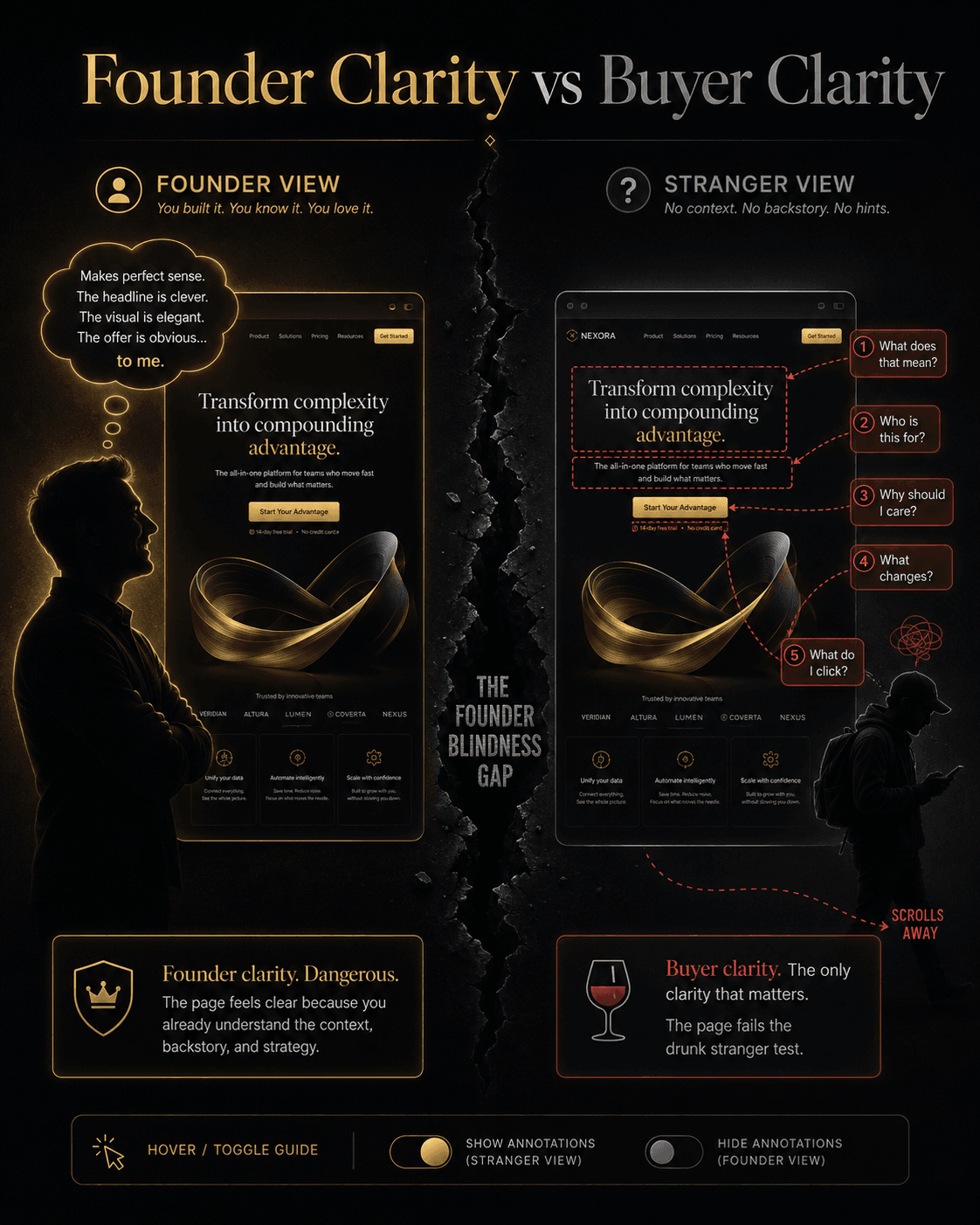
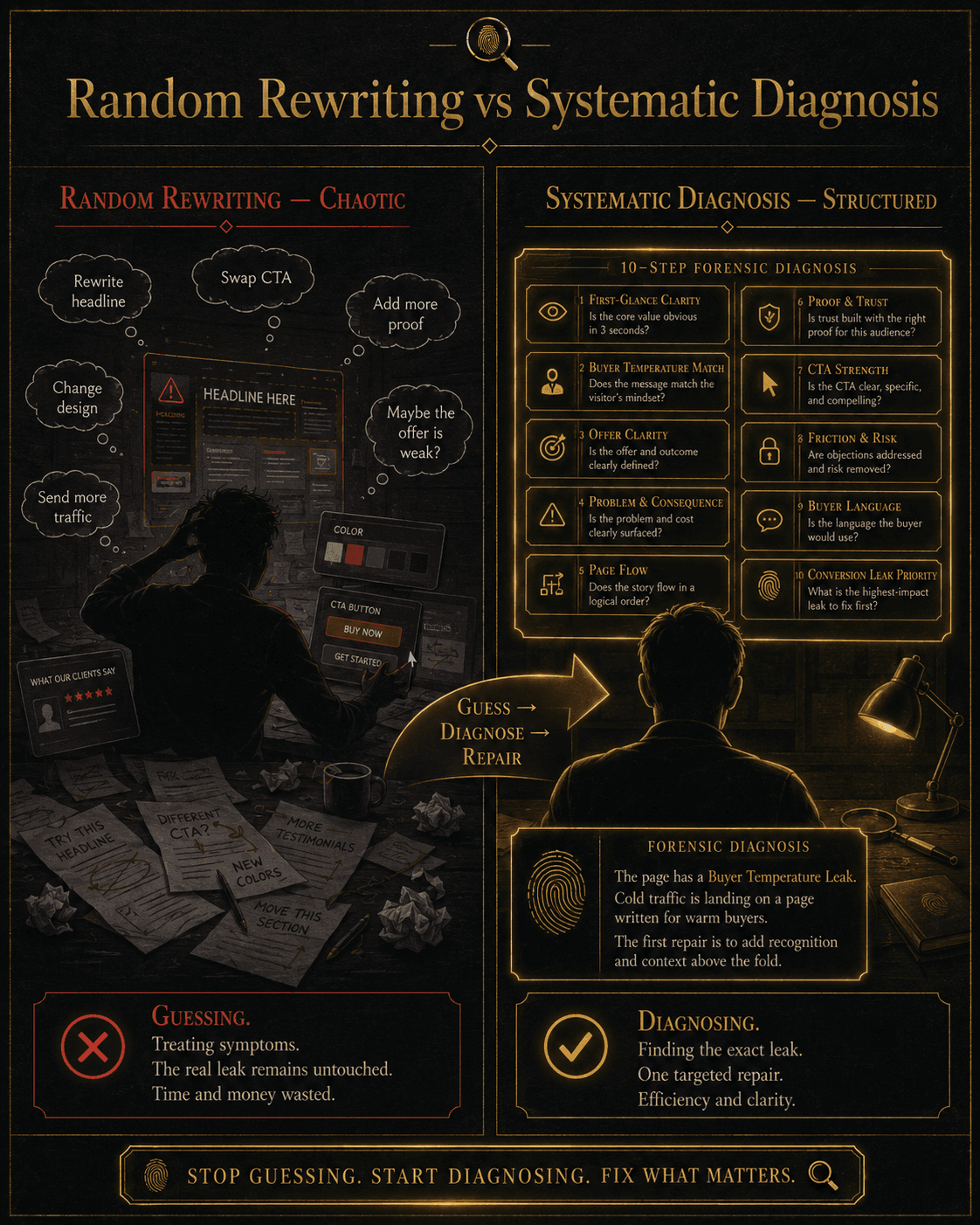
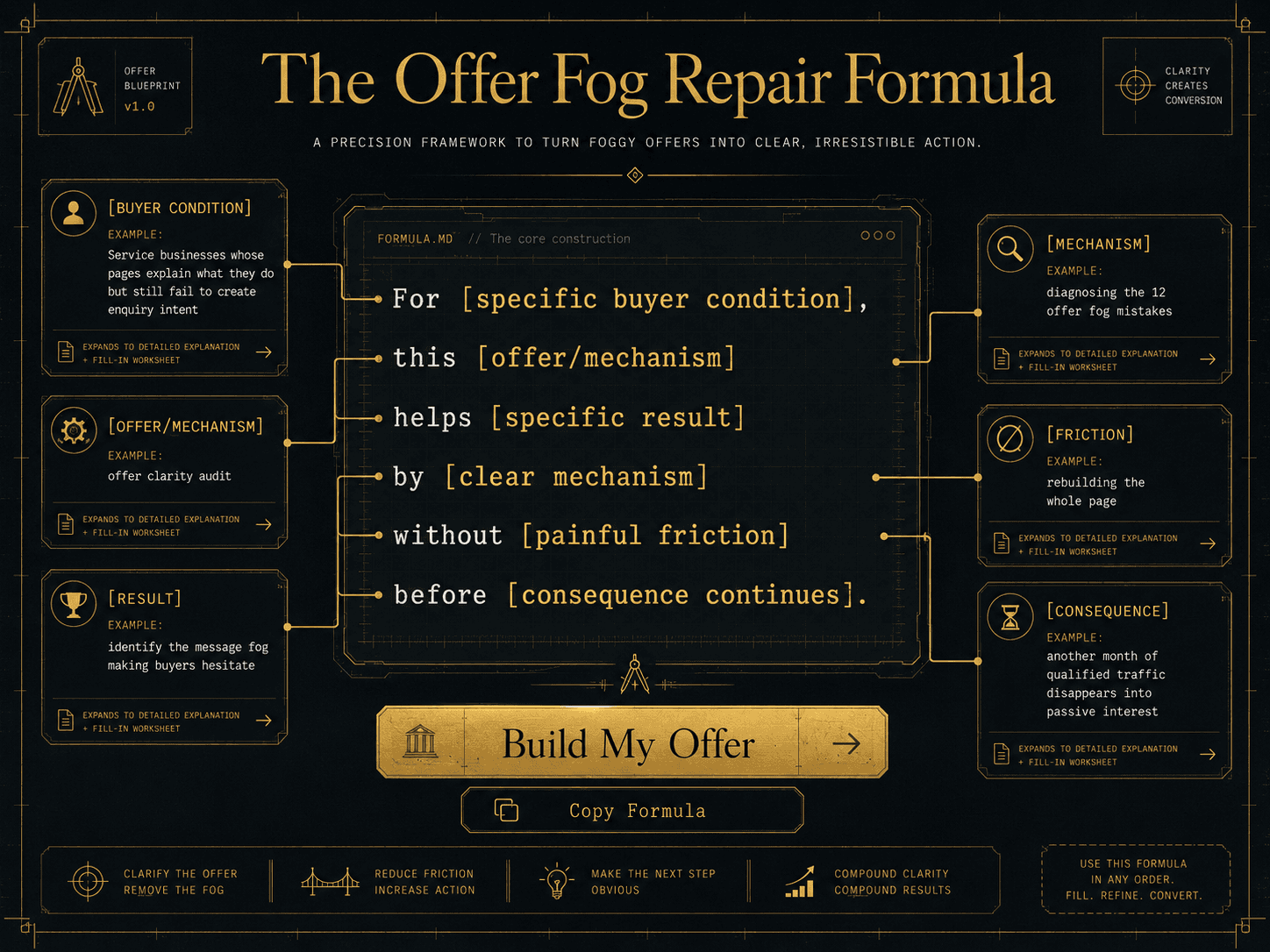
Other Blogs
Other Blogs
Check our other project Blogs with useful insight and information for your businesses