Our Three Step Process
May 25, 2026
Chap 1 | Resource 2 (b) | The Funnel Autopsy Framework™
Our Three Step Process
May 25, 2026
Chap 1 | Resource 2 (b) | The Funnel Autopsy Framework™
The Funnel Autopsy Framework™ Where buyers quietly disappear, why funnel momentum breaks, and how to repair the conversion leaks killing attention, belief, trust, and action.
Prefer Audio Or Video?
The Funnel Autopsy Framework™ is also available as:
🎧 A guided audio walkthrough for learning on the move
🎥 A full video breakdown with practical funnel teardown examples and repair strategiesChoose the format that fits how you learn best.
Listen To The Audio Walkthrough. Click HERE. (coming soon)
Watch The Video Breakdown. Click HERE. (coming soon)
Why Most Funnels Quietly Bleed Conversion
Most funnels do not collapse dramatically.
They leak.
A weak headline.
A confusing offer.
A flat CTA.
Proof arriving too late.
Too much friction.
Too many choices.
No emotional pull.
Individually, these problems seem small.
Together, they suffocate conversion.
That is why funnel diagnosis matters.
Most weak funnels still look polished, modern, professional, and visually respectable.
And still quietly fail.
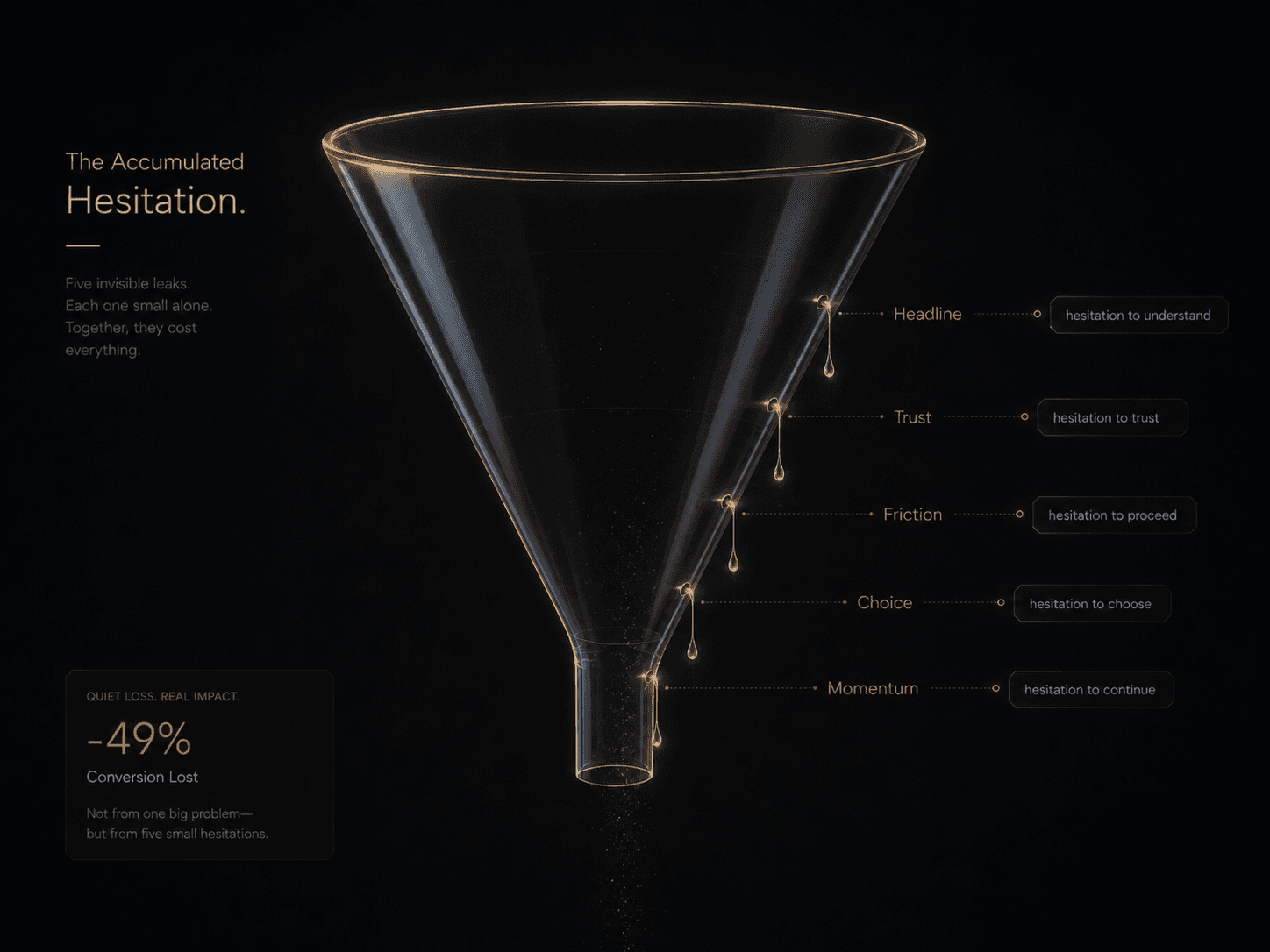
Because funnels rarely die from one catastrophic mistake.
They die from accumulated hesitation.
The buyer hesitates to continue.
Then they hesitate to believe.
Then they hesitate to trust.
Then they hesitate to click.
Then they hesitate to commit.
That hesitation compounds through the funnel until momentum collapses completely.
This framework exists to help you diagnose that collapse.
Not emotionally.
Systematically.
——
What This Resource Helps You Do
The Funnel Autopsy Framework™ helps you find where buyers lose momentum inside your funnel.
Use it to diagnose:
where attention drops
where relevance weakens
where curiosity fades
where belief fails
where trust collapses
where friction rises
where the CTA stops feeling worth clicking
This is not a design preference exercise.
It is not a “what do I like?” review.
It is a conversion autopsy.
The question is not: “Does this funnel look good?”
The better question is: “Where exactly does buyer momentum begin to weaken?”
That question changes everything.
Because once you know where momentum breaks, repair becomes strategic instead of emotional.
——
The Difference Between A First-Contact Test And A Funnel Autopsy
The Drunk Stranger Framework™ tests whether the page survives first contact.
It asks:
“Can a cold visitor understand this page quickly enough to continue?”
The Funnel Autopsy Framework™ goes further.
It asks:
“After the buyer starts moving, where does the funnel lose them?”
That difference matters.
A page may pass first contact and still fail later.
The opening may be clear, but the proof may be weak.
The promise may be strong, but the offer may feel vague.
The offer may be interesting, but the CTA may feel risky.
The CTA may be visible, but the form may create friction.
The funnel may start well, but lose emotional pull halfway through.
That is what this resource helps you find.
Resource 1 diagnoses the opening moment.
Resource 2 diagnoses the whole journey.
——
The Anatomy Of Funnel Momentum™
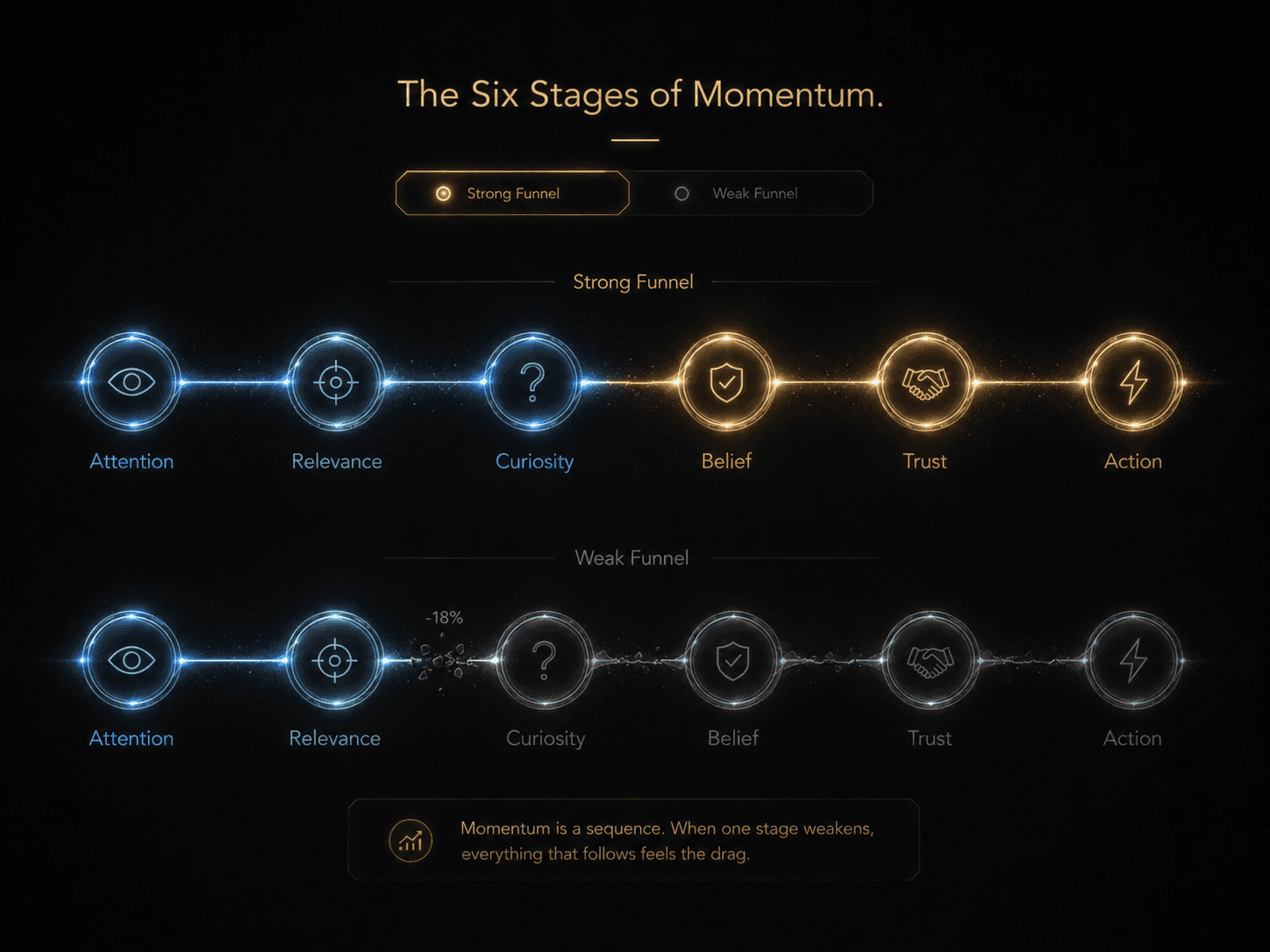
Strong funnels guide buyers through a psychological sequence.
Weak funnels interrupt it.
Most healthy funnels move through six stages:
Attention → Relevance → Curiosity → Belief → Trust → Action
Each stage has a job.
1. Attention
The funnel earns the first few seconds.
The buyer notices enough to continue.
2. Relevance
The buyer feels:
“This is meant for someone like me.”
The message connects with their problem, desire, frustration, or situation.
3. Curiosity
The funnel creates enough tension to make the buyer want to know more.
They feel an open loop.
They want the next section.
4. Belief
The buyer begins thinking:
“This might actually work.”
The promise starts feeling possible.
5. Trust
Proof reduces uncertainty.
The buyer feels safer continuing.
6. Action
The CTA feels natural instead of forced.
The next step feels like progress, not pressure.
Every strong funnel maintains movement through these stages.
Weak funnels create interruption.
And interruption kills continuation.
This sequence explains why many good-looking funnels quietly underperform.
They may look polished.
But psychologically, they break the buyer’s movement.
——
The 2-Minute Funnel Scan™
Before running the full autopsy, start here.
Open your funnel and ask three questions.
Question 1
Can I explain this offer in 3 seconds?
If no, you likely have an Attention Leak™.
Question 2
Does this feel written for someone like me?
If no, you likely have a Relevance Leak™.
Question 3
Would I click without needing more proof, clarity, or reassurance first?
If no, you likely have a Belief, Trust, or Action Leak™.
Quick Score
Give yourself one point for every yes.
3/3
Your funnel is ready for a deeper autopsy.
The foundation may be strong, but there may still be section-level leaks.
2/3
Your funnel is repairable.
One major issue is probably weakening momentum.
1/3
Your funnel is leaking heavily.
Do not send more traffic yet.
Find the primary leak first.
0/3
Your funnel is not ready.
The buyer is probably confused, unconvinced, or unmotivated before the funnel has a chance to work.
Start with clarity, relevance, and proof.
——
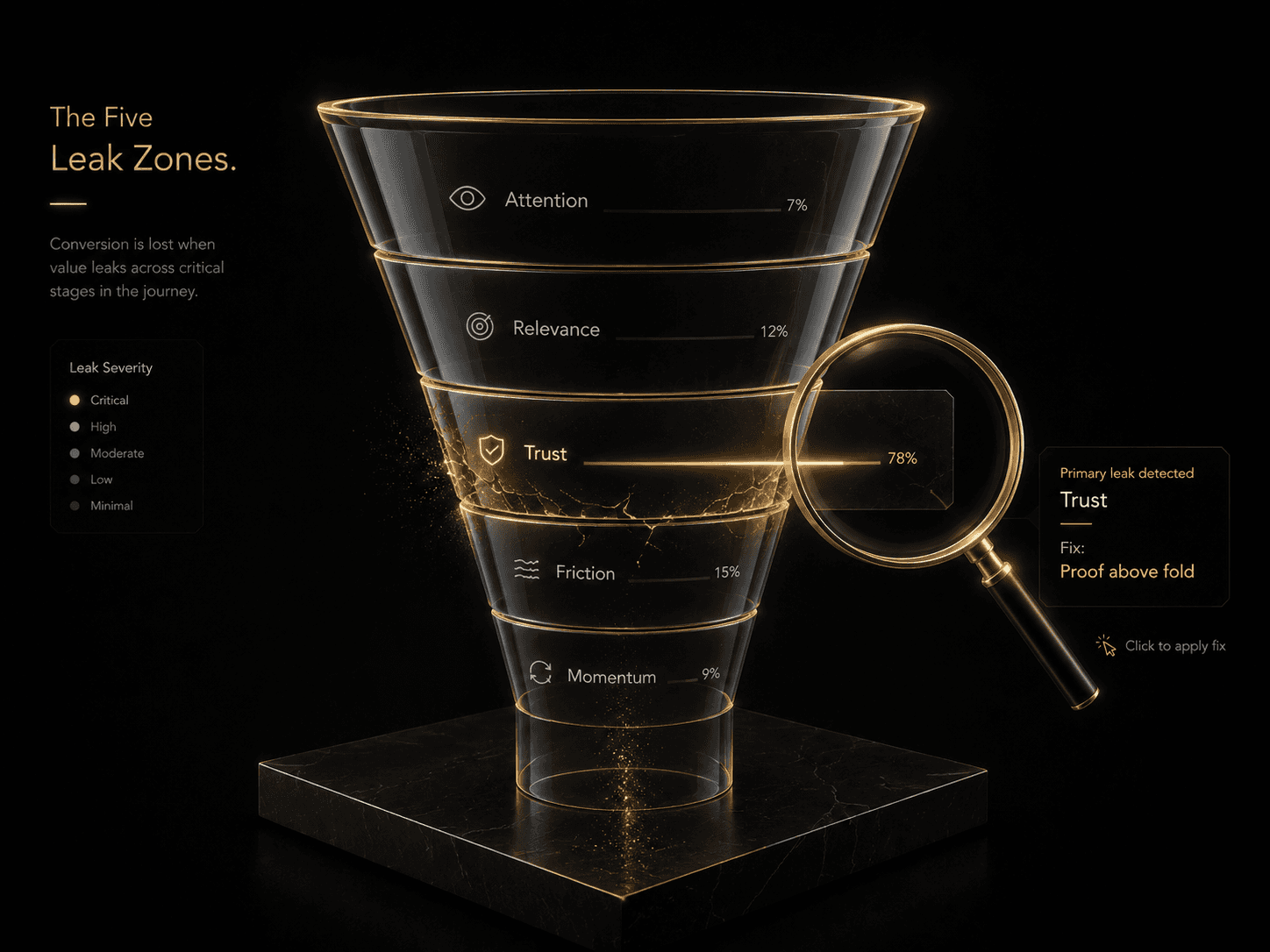
The Six Funnel Leak Zones™
Most funnel problems fall into one of six categories.
Understanding these leak zones makes diagnosis dramatically easier.
1. Attention Leak™
An Attention Leak™ happens when the funnel fails to earn the first few seconds.
The buyer lands, looks, and feels no strong reason to continue.
Usually caused by:
weak headlines
vague messaging
low emotional pull
no tension
unclear offers
generic opening copy
no visible problem or payoff
Weak example:
“Helping businesses scale efficiently.”
Stronger example:
“Why Most Funnels Lose Buyers Before The Sales Argument Even Begins.”
The second headline creates tension, curiosity, specificity, and consequence.
That earns continuation.
Attention is not about being loud.
It is about becoming important enough to keep reading.
2. Relevance Leak™
A Relevance Leak™ happens when the buyer does not feel personally recognised.
The funnel may be clear.
But it feels generic.
The buyer understands what you do, but does not feel:
“This is for me.”
Usually caused by:
broad positioning
generic pain points
company-centred messaging
weak emotional specificity
unclear buyer situation
no real-world symptoms
no connection to the buyer’s lived problem
People continue reading when they feel understood.
Not when they feel marketed to.
A funnel with strong relevance makes the buyer feel seen before it tries to make them act.
3. Curiosity Leak™
A Curiosity Leak™ happens when the funnel explains, but does not create pull.
The buyer understands the message.
But they do not feel a strong reason to keep moving.
Usually caused by:
flat copy
weak tension
predictable claims
overexplaining too early
no open loop
no visible consequence
no reason to read the next section
Curiosity is what carries attention forward.
Without curiosity, the funnel becomes information.
And information alone rarely creates movement.
Strong funnels do not just explain.
They create a controlled desire to continue.
4. Belief And Trust Leak™
A Belief And Trust Leak™ happens when the funnel asks the buyer to believe before it has earned belief.
The promise may sound attractive.
The offer may be useful.
But the buyer still feels exposed.
They are silently asking:
“Has this worked?”
“For who?”
“How do I know this is real?”
“Why should I trust this?”
“Will this work for someone like me?”
Usually caused by:
vague testimonials
no visible outcomes
proof arriving too late
weak credibility
unsupported claims
generic social proof
no mechanism explanation
no proof close to the claim
Cold buyers do not trust confidence alone.
They trust evidence.
Proof should not be buried.
It should appear before doubt hardens.
Weak proof says:
“Thousands trust us.”
Stronger proof says:
“Generated 31 qualified calls in 12 days after rebuilding the funnel sequence.”
Specific proof reduces uncertainty faster than vague confidence.
5. Friction Leak™
A Friction Leak™ happens when the funnel demands unnecessary effort.
The buyer may be interested.
But the funnel makes continuation feel harder than it should.
Usually caused by:
clutter
confusing structure
too many buttons
too many offers
weak CTA visibility
walls of text
excessive navigation
unclear next step
complicated forms
too many decision points
Even small friction compounds.
The buyer should not have to work hard to understand the page, organise the message, choose between competing actions, or figure out what happens next.
The brain avoids unnecessary effort.
That is why clarity consistently outperforms complexity.
6. Action Leak™
An Action Leak™ happens when the funnel creates interest but fails to convert that interest into movement.
The buyer may understand the offer.
They may even believe it.
But the CTA still does not feel worth clicking.
Usually caused by:
generic button text
unclear reward
weak next step
too much perceived effort
low urgency
no reassurance
vague post-click expectation
CTA appearing before trust is built
Weak CTA:
“Submit.”
Stronger CTA:
“Get My Funnel Leak Breakdown.”
The CTA should feel like progress.
Not paperwork.
A weak CTA tells the buyer what to do.
A strong CTA tells the buyer what they get.
——
Which Leak Is Most Likely Your Primary Problem?
If your funnel feels confusing in the first few seconds, your primary leak is probably an Attention Leak™.
If your funnel feels clear but emotionally generic, your primary leak is probably a Relevance Leak™.
If your funnel explains the offer but does not make people want to continue, your primary leak is probably a Curiosity Leak™.
If your funnel sounds promising but buyers still hesitate, your primary leak is probably a Belief And Trust Leak™.
If your funnel feels cluttered, overwhelming, or mentally heavy, your primary leak is probably a Friction Leak™.
If your funnel creates interest but does not generate clicks, bookings, sign-ups, or purchases, your primary leak is probably an Action Leak™.
Most funnels leak in multiple places.
But usually, one dominant leak causes the majority of the damage.
Find that first.
——
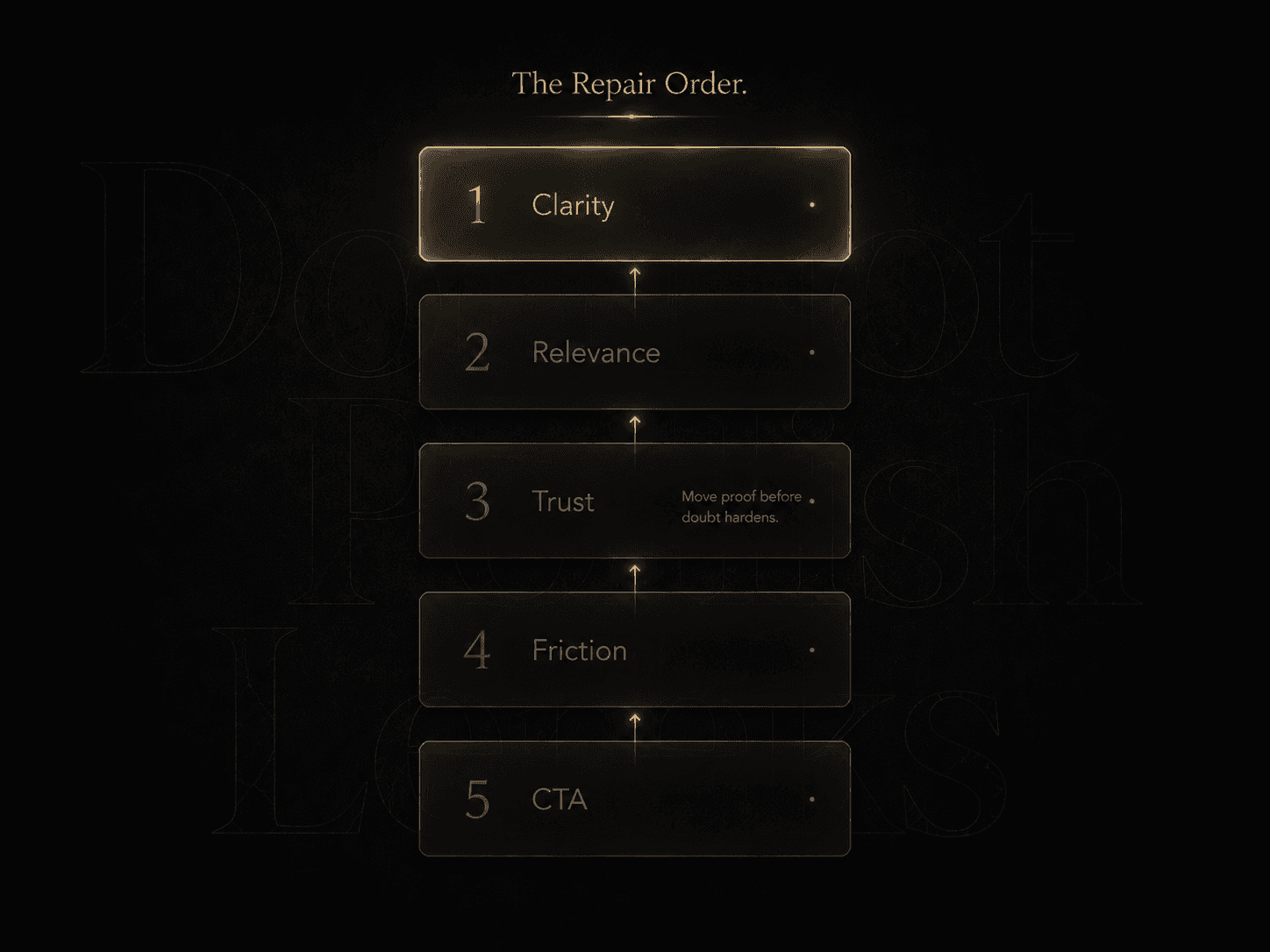
The Repair Order™
Do not fix funnel leaks randomly.
Random fixes create random results.
Repair in this order.
1. Clarity Before Persuasion
First, fix message comprehension.
Repair:
headlines
offer visibility
opening promise
page purpose
core explanation
If the buyer does not understand the funnel, persuasion cannot work properly.
Do not add more pressure to unclear messaging.
Make the message legible first.
2. Relevance Before Proof
Once the message is clear, make it feel personally relevant.
Repair:
buyer recognition
emotional specificity
pain language
audience alignment
real-world symptoms
desired outcomes
Proof works better when the buyer already feels:
“This is about me.”
If relevance is weak, proof feels distant.
3. Belief Before Trust
Before asking for trust, make the promise feel possible.
Repair:
mechanism
explanation
specificity
outcome logic
before/after contrast
reason why it works
Belief means the buyer thinks:
“This could work.”
Trust means the buyer thinks:
“I believe this source enough to take the next step.”
Do not skip belief.
4. Trust Before Action
Before pushing the CTA, reduce uncertainty.
Repair:
testimonials
proof cues
quantified outcomes
credibility markers
screenshots
case study fragments
risk reversal
what-happens-next reassurance
A CTA becomes stronger when the buyer feels safer clicking it.
5. Friction Removal Before CTA Optimisation
Before obsessing over button text, remove unnecessary effort.
Repair:
clutter
competing actions
long forms
confusing navigation
weak hierarchy
unclear section order
excessive cognitive load
Do not optimise weak CTAs on top of weak clarity.
That is polishing a leak.
6. CTA Optimisation After The Sequence Is Fixed
Only then strengthen the CTA.
Repair:
reward visibility
specificity
next-step clarity
personal ownership
urgency
low-friction wording
The CTA should sit on top of the sequence.
Not compensate for a broken one.
A strong CTA cannot save a funnel that has not created enough clarity, relevance, belief, and trust.
——
The Funnel Autopsy Process™
Most founders diagnose funnels emotionally.
They ask:
“What do I dislike?”
“What looks wrong?”
“What should we redesign?”
“What should we add?”
Professional diagnosis is different.
It asks:
“Where exactly does buyer momentum begin to weaken?”
Use this five-step process.
Step 1: Find The First Momentum Drop™
Identify the first moment where emotional movement weakens.
Usually, this happens in one of these places:
hero section
first scroll
offer section
proof section
CTA section
form
checkout
booking flow
Ask:
“At what exact moment would a sceptical buyer stop wanting to continue?”
That is often where the primary leak begins.
Do not start with the section you personally dislike.
Start with the section where the buyer starts losing momentum.
Step 2: Identify The Leak Type™
Once you find the momentum drop, name the leak.
Ask:
Is this:
an Attention Leak™?
a Relevance Leak™?
a Curiosity Leak™?
a Belief And Trust Leak™?
a Friction Leak™?
an Action Leak™?
Naming the leak matters.
Because different leaks need different repairs.
A trust leak should not be fixed with prettier design.
A relevance leak should not be fixed with more testimonials.
A friction leak should not be fixed with a louder CTA.
Diagnose before repairing.
Step 3: Identify The Psychological Failure™
Do not only ask:
“What design element is wrong?”
Ask:
“What psychological condition failed?”
Examples:
clarity failed
relevance failed
curiosity failed
belief failed
trust failed
momentum failed
action confidence failed
Funnels are psychological systems first.
Design systems second.
The design should support the psychological sequence.
Not replace it.
Step 4: Identify The Section Causing The Damage
Now locate the section responsible.
Is the leak caused by:
the headline?
the subheadline?
the first scroll?
the offer explanation?
the proof section?
the CTA?
the form?
the checkout?
the booking flow?
the page structure?
Be precise.
“Something feels off” is not a diagnosis.
“The proof appears after the CTA, so trust arrives too late” is a diagnosis.
“The offer section explains features but never makes the transformation visible” is a diagnosis.
“The CTA asks for a call before the page has reduced enough risk” is a diagnosis.
Precision creates better repair.
Step 5: Apply One Repair And Retest
Do not fix everything at once.
Pick the primary leak.
Apply one meaningful repair.
Then retest.
Examples:
If clarity failed, rewrite the headline.
If relevance failed, rewrite the opening around the buyer’s pain.
If curiosity failed, add tension and consequence.
If belief failed, explain the mechanism.
If trust failed, add proof closer to the claim.
If friction failed, remove competing decisions.
If action failed, rewrite the CTA around the reward.
Repair one major leak.
Then test again.
This prevents random over-editing.
——
The Momentum Map™
Use this section to score the main parts of your funnel.
Score each section from 1 to 5.
1 = very weak
2 = unclear
3 = acceptable but leaking
4 = strong
5 = clear, compelling, and movement-building
Hero Section™
The buyer should instantly understand:
what this is
who it is for
why it matters
what problem is being solved
why they should continue
The hero should create clarity, tension, and continuation.
Not confusion.
Hero Section Score: ___ / 5
Primary leak:
First repair:
First Scroll™
The first scroll should reinforce the promise and deepen curiosity.
It should:
strengthen the opening idea
reduce uncertainty
make the pain or opportunity more visible
build emotional continuation
keep the buyer moving
Weak funnels often lose momentum here by becoming generic, overexplaining, or talking too much about themselves.
First Scroll Score: ___ / 5
Primary leak:
First repair:
Offer Section™
The buyer should clearly understand:
the transformation
the outcome
the mechanism
the payoff
why this offer is different
why this offer matters now
Strong offers create mental pictures.
Weak offers create interpretation effort.
Offer Section Score: ___ / 5
Primary leak:
First repair:
Proof Section™
The proof section reduces uncertainty.
Strong proof includes:
quantified outcomes
screenshots
before/after examples
testimonials
visible credibility
case study fragments
specific proof tied to specific claims
Weak proof sounds vague.
“Thousands trust us” means very little emotionally.
“Generated 31 qualified calls in 12 days” feels more believable instantly.
Proof Section Score: ___ / 5
Primary leak:
First repair:
CTA Section™
The CTA should feel like progress.
Not paperwork.
The buyer should immediately understand:
what happens next
what they gain
why the click matters
why now is a sensible time to act
Weak CTA:
“Submit.”
Strong CTA:
“Get My Funnel Leak Breakdown.”
CTA Section Score: ___ / 5
Primary leak:
First repair:
——
Form, Checkout, Or Booking Flow™
This is where many funnels lose buyers after they have already created interest.
The buyer may want to move forward, but the action path creates friction.
Check for:
too many fields
unclear next steps
no reassurance
no expectation-setting
too much perceived commitment
confusing scheduling flow
weak confirmation copy
lack of trust near the action point
The final action should feel simple, safe, and logical.
Form / Checkout / Booking Flow Score: ___ / 5
Primary leak:
First repair:
——
Total Funnel Momentum Score™
Hero Section: ___ / 5
First Scroll: ___ / 5
Offer Section: ___ / 5
Proof Section: ___ / 5
CTA Section: ___ / 5
Form / Checkout / Booking Flow: ___ / 5
Total Score: ___ / 30
——
What Your Score Means
26–30: Strong Funnel Momentum
Your funnel maintains clear psychological movement.
Keep testing, but the structure is likely strong.
21–25: Good But Leaking
The funnel has a solid foundation, but one or two sections are weakening performance.
Find the lowest-scoring section and repair it first.
15–20: Serious Momentum Loss
The funnel may look complete, but buyer movement is breaking in multiple areas.
Do not increase traffic yet.
Diagnose the dominant leak.
0–14: Funnel Autopsy Required
The funnel is likely creating too much confusion, doubt, friction, or hesitation.
Rebuild the sequence before optimising smaller details.
——
The Sequence Failure Problem™
One of the biggest conversion killers is incorrect sequencing.
Funnels fail when they:
push too early
explain too late
pressure before trust
ask for commitment before relevance exists
show proof after the buyer already feels doubt
ask for action before belief has been built
Strong funnels move buyers gradually:
Attention → Relevance → Curiosity → Belief → Trust → Action
Weak funnels try skipping stages.
That creates hesitation immediately.
Example Of Sequence Failure™
A cold buyer lands on a page.
The first thing they see is:
“Book Your Strategy Call Now.”
No tension.
No proof.
No relevance.
No emotional connection.
No reason to care.
The page immediately asks for commitment before earning attention.
That is sequence collapse.
The CTA may not be the problem.
The timing of the CTA is the problem.
The page asks for action before the buyer has enough reason to move.
Example Of Stronger Sequencing™
Headline:
“Why Most Funnels Lose Buyers Before The Offer Even Appears.”
Subheadline:
“Discover the hidden first-contact and momentum leaks quietly destroying conversion.”
Proof Cue:
“Increased booked calls by 2.3x after rebuilding the funnel sequence.”
CTA:
“Get The Funnel Breakdown.”
Now the funnel creates curiosity, relevance, belief, and movement before asking for action.
That feels psychologically natural.
The ask is no longer floating alone.
It sits on top of a stronger sequence.
——
Real-World Mini Autopsy™
Weak Funnel Example
Headline:
“Transforming Modern Business Growth.”
CTA:
“Learn More.”
Problem
The funnel is:
vague
emotionally flat
unclear
low-tension
generic
unsupported
missing a visible outcome
using a weak CTA
The funnel may look polished.
But emotionally, it is empty.
The buyer has no strong reason to continue.
Repaired Version
Headline:
“Still Losing Buyers Before They Reach Your Offer?”
Subheadline:
“Discover the first-contact and momentum leaks quietly collapsing your funnel conversion.”
Proof Cue:
“Increased booked calls by 2.3x after rebuilding the hero, proof, and CTA sequence.”
CTA:
“Get My Funnel Leak Breakdown.”
——
What Changed?
1. The headline created tension
The old headline described the company.
The new headline names a buyer-relevant problem.
2. The subheadline made the consequence visible
The old version sounded broad.
The new version explains what is going wrong.
3. Proof appeared before the ask
The buyer is not asked to trust blindly.
There is a reason to believe.
4. The CTA became reward-visible
“Learn More” feels vague.
“Get My Funnel Leak Breakdown” feels specific.
5. The funnel created movement
The sequence now pulls the buyer forward.
That is the point of an autopsy.
You are not just rewriting words.
You are repairing buyer momentum.
——
Your Turn™
Use this worksheet to diagnose your own funnel.
My Current Headline
What It Currently Communicates
What It Fails To Communicate
My Stronger Headline
Use:
pain + specificity + outcome
My Current Subheadline
What It Currently Adds
What It Should Make Clearer
My Stronger Subheadline
Use:
context + consequence + reason to continue
My Current CTA
What The CTA Currently Asks For
What The CTA Should Promise
My Stronger CTA
Use:
reward + clarity + low friction
My Current Proof Cue
What Claim It Supports
Where It Should Appear
Stronger Proof Cue
Use:
specific result + credibility + proximity to the claim
——
Friction And Cognitive Load™
Many funnels fail because they mentally exhaust the buyer.
Not because the offer is terrible.
The buyer should not have to:
interpret constantly
search for clarity
organise the page mentally
choose between too many actions
decode the offer
guess what happens next
work out why the claim matters
The brain avoids unnecessary effort.
That is why clarity consistently outperforms complexity.
Friction appears in four main forms.
1. Visual Friction
Visual friction happens when the page is hard to scan.
Common causes:
cluttered layouts
poor spacing
weak hierarchy
too many competing visual elements
heavy sections
distracting design
hidden CTAs
Fix by simplifying what the buyer sees first.
Make the main path obvious.
2. Message Friction
Message friction happens when the copy is hard to understand.
Common causes:
jargon
vague claims
abstract language
long explanations
unclear offer
weak headline
unclear transformation
Fix by making the message concrete.
Say what the buyer gets.
Say why it matters.
Say what changes.
3. Decision Friction
Decision friction happens when the buyer is forced to make too many choices.
Common causes:
multiple offers
too many CTAs
too many page paths
confusing navigation
unclear priority
too many pricing options too early
Fix by creating one dominant path.
One page should have one primary job.
4. Action Friction
Action friction happens when the next step feels harder, riskier, or less valuable than it should.
Common causes:
long forms
vague button copy
unclear post-click expectation
no reassurance
no risk reversal
no visible reward
too much commitment too soon
Fix by making action feel simple, safe, and valuable.
The CTA should feel like progress.
Not pressure.
——
Common Friction Mistakes™
Check any that apply to your funnel:
☐ Too many buttons
☐ Too many offers
☐ Giant walls of text
☐ Hidden CTAs
☐ Excessive navigation
☐ Cluttered layouts
☐ Weak visual hierarchy
☐ Unclear next step
☐ Long forms
☐ No reassurance near the CTA
☐ Too many competing routes
☐ Unclear offer explanation
☐ Proof placed too late
☐ No visible reason to act now
If you checked more than five, your funnel is probably making the buyer work too hard.
And when the buyer works too hard, they leave.
——
The 60-Minute Funnel Autopsy™
Use this process when you want to diagnose a funnel quickly without redesigning everything.
Minutes 0–10: First-Contact Scan
Analyse:
headline clarity
hero tension
first-contact relevance
offer visibility
above-the-fold proof
Ask:
“Would a cold buyer understand why this matters within seconds?”
Minutes 10–20: Relevance Diagnosis
Analyse:
audience recognition
emotional specificity
buyer pain
buyer desire
stalled outcome
personal relevance
Ask:
“Does the right buyer feel seen, or does this sound like it could be for anyone?”
Minutes 20–30: Belief And Trust Review
Analyse:
proof placement
trust signals
testimonial quality
credibility timing
mechanism explanation
claim support
Ask:
“Where does the funnel ask for belief without giving enough evidence?”
Minutes 30–40: Friction Scan
Analyse:
clutter
competing actions
CTA visibility
navigation
form length
page hierarchy
cognitive load
Ask:
“What unnecessary effort is the funnel forcing onto the buyer?”
Minutes 40–50: Sequence Review
Analyse:
momentum drops
weak transitions
early pressure
proof timing
CTA timing
section order
Ask:
“Does the funnel ask for action before earning enough clarity, relevance, belief, and trust?”
——
Minutes 50–60: Primary Leak Repair
Do not fix everything.
Choose the primary leak.
Then fix one of the following:
headline clarity
buyer relevance
curiosity gap
proof placement
offer explanation
CTA reward visibility
form friction
section order
Write the repair here:
Primary leak:
Section causing the leak:
First repair action:
Retest method:
Then retest before redesigning the entire funnel.
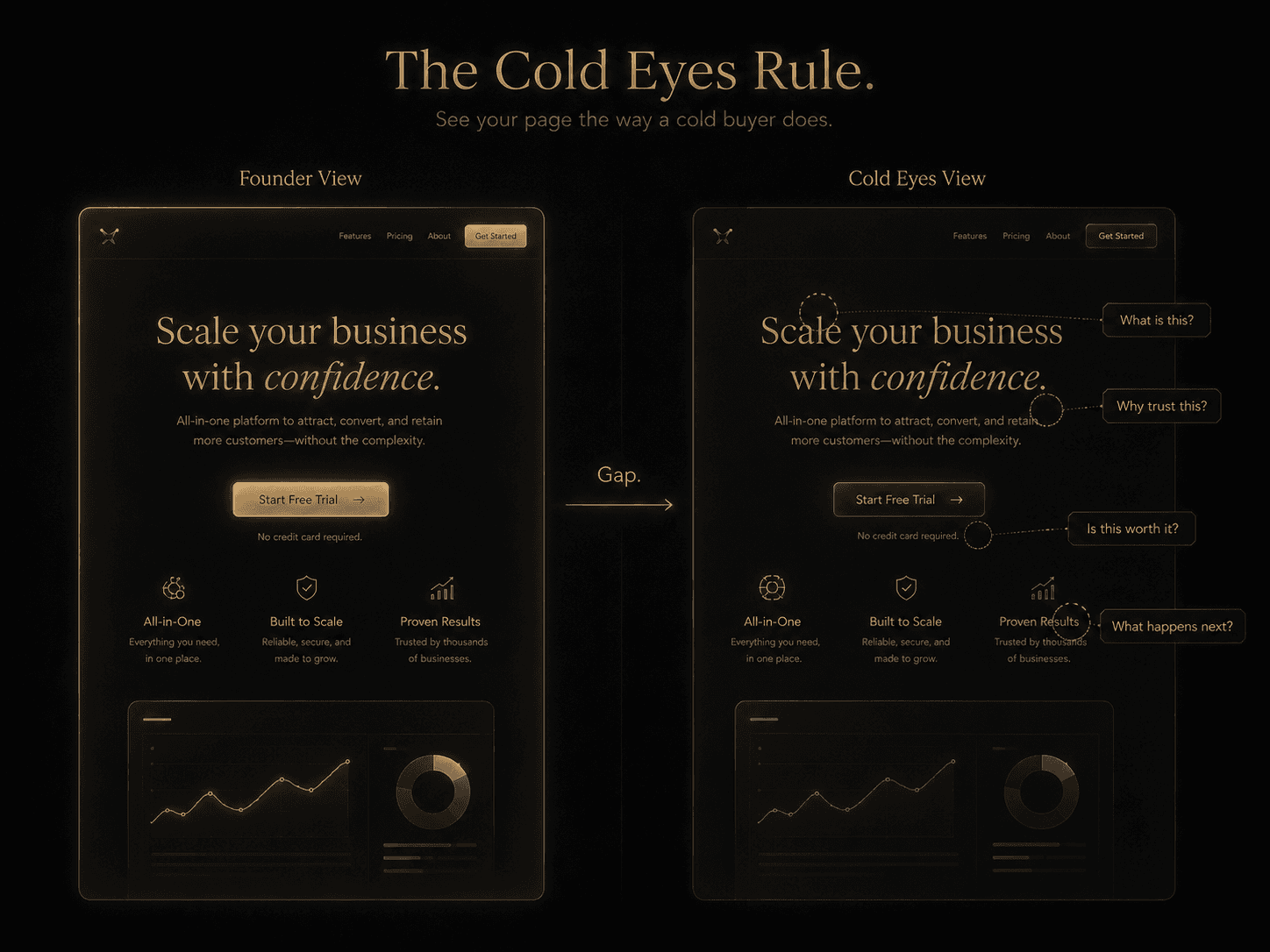
The Cold Eyes Rule™
Never run the first autopsy alone.
Show the funnel to someone who is:
unfamiliar with the offer
emotionally detached
not involved in building the page
not trying to protect your feelings
not already trained on your internal language
The person testing the funnel should not know what the page is supposed to mean.
Then compare their reactions to yours.
The gap between those reactions is usually founder blindness.
And founder blindness is one of the most expensive conversion killers in business.
You know too much.
The buyer does not.
That is why cold eyes matter.
What Strong Funnels Do Differently™
High-converting funnels do not simply avoid leaks.
They actively maintain momentum.
Weak funnels explain.
Strong funnels move.
Weak funnels ask too early.
Strong funnels earn the ask.
Weak funnels rely on design.
Strong funnels maintain psychology.
Weak funnels bury proof.
Strong funnels reduce doubt before it hardens.
Weak funnels make the CTA feel like admin.
Strong funnels make the CTA feel like progress.
Weak funnels create decision fatigue.
Strong funnels make the next step feel obvious.
That is what strong sequencing looks like psychologically.
——
The Leak Journal™
Funnels are living systems.
Diagnose them regularly.
One week from now, run the same funnel through the Six Funnel Leak Zones™ again.
Ask:
Did the same leak appear?
Did fixing one leak expose another?
Did momentum improve?
Did friction reduce?
Did the CTA become easier to click?
Did proof appear at the right time?
Did the buyer journey feel smoother?
Do not assume one repair fixes everything forever.
Funnels need maintenance.
The market changes.
Traffic changes.
Buyer awareness changes.
Offer context changes.
A funnel that worked six months ago can quietly start leaking again.
That is why regular diagnosis matters.
——
The One-Sentence Autopsy™
Complete this before making changes.
My Funnel’s Primary Leak Is:
The Section Causing The Leak Is:
The Psychological Failure Is:
The First Section I Will Repair Is:
The Fix Is:
I Will Know It Is Fixed When:
This forces clarity.
If you cannot explain the leak in one sentence, you probably have not diagnosed it properly yet.
——
Final Principle™
Funnels rarely collapse from one dramatic mistake.
They die from accumulated hesitation.
A weak headline.
A trust gap.
A confusing CTA.
A little friction.
A little uncertainty.
A little emotional flatness.
A little too much effort.
Eventually, the buyer quietly leaves.
That is why diagnosis matters.
Because once you understand where momentum weakens, where trust collapses, where friction rises, and where continuation dies, repair becomes strategic instead of emotional.
Do not redesign the funnel first.
Diagnose where momentum breaks.
Find the primary leak.
Fix the section causing the most damage.
Then retest.
That is what the Funnel Autopsy Framework™ is built to help you see.
——
From:
The $100M Funnel Playbook. Book I: Foundation Buyer Psychology, Offer Clarity, and the Page Architecture Behind High-Converting Funnels
By Maris Spalins.
——
Copyright Notice
© 2026 The $100M Funnel Playbook / Winyourclients / Maris Spalins. All rights reserved.
This resource, including the frameworks, terminology, examples, scorecards, templates, prompts, methods, and written explanations, is original intellectual property created for The $100M Funnel Playbook. Book I: Foundation — Buyer Psychology, Offer Clarity, And The Page Architecture Behind High-Converting Funnels and published through Winyourclients.
No part of this resource may be copied, reproduced, screenshotted, republished, redistributed, sold, adapted, uploaded, scraped, stored in a database, included in training data, used to train artificial intelligence systems, or used to create derivative commercial or educational materials without prior written permission.
Limited reference, quotation, or sharing is only permitted where the source is clearly and visibly credited.
Any permitted reference must include at least one of the following source credits:
The $100M Funnel Playbook by Maris Spalins
or
Winyourclients — www.winyourclients.com
or
Maris Spalins / Winyourclients
Screenshots, excerpts, summaries, or redistributed versions must not remove, hide, alter, crop out, or obscure the original source, author name, book title, website name, or copyright notice.
This resource is provided for personal learning and implementation only. It is not licensed for resale, republishing, redistribution, AI training, template cloning, course creation, consulting delivery, or commercial reuse without written permission from Maris Spalins or Winyourclients.
For permission requests, licensing, citation approval, or commercial usage enquiries, contact:
Winyourclients
www.winyourclients.com
or
Email directly to Jacob on: help@winyourclients.com
The Funnel Autopsy Framework™ Where buyers quietly disappear, why funnel momentum breaks, and how to repair the conversion leaks killing attention, belief, trust, and action.
Prefer Audio Or Video?
The Funnel Autopsy Framework™ is also available as:
🎧 A guided audio walkthrough for learning on the move
🎥 A full video breakdown with practical funnel teardown examples and repair strategiesChoose the format that fits how you learn best.
Listen To The Audio Walkthrough. Click HERE. (coming soon)
Watch The Video Breakdown. Click HERE. (coming soon)
Why Most Funnels Quietly Bleed Conversion
Most funnels do not collapse dramatically.
They leak.
A weak headline.
A confusing offer.
A flat CTA.
Proof arriving too late.
Too much friction.
Too many choices.
No emotional pull.
Individually, these problems seem small.
Together, they suffocate conversion.
That is why funnel diagnosis matters.
Most weak funnels still look polished, modern, professional, and visually respectable.
And still quietly fail.
Because funnels rarely die from one catastrophic mistake.
They die from accumulated hesitation.
The buyer hesitates to continue.
Then they hesitate to believe.
Then they hesitate to trust.
Then they hesitate to click.
Then they hesitate to commit.
That hesitation compounds through the funnel until momentum collapses completely.
This framework exists to help you diagnose that collapse.
Not emotionally.
Systematically.
——
What This Resource Helps You Do
The Funnel Autopsy Framework™ helps you find where buyers lose momentum inside your funnel.
Use it to diagnose:
where attention drops
where relevance weakens
where curiosity fades
where belief fails
where trust collapses
where friction rises
where the CTA stops feeling worth clicking
This is not a design preference exercise.
It is not a “what do I like?” review.
It is a conversion autopsy.
The question is not: “Does this funnel look good?”
The better question is: “Where exactly does buyer momentum begin to weaken?”
That question changes everything.
Because once you know where momentum breaks, repair becomes strategic instead of emotional.
——
The Difference Between A First-Contact Test And A Funnel Autopsy
The Drunk Stranger Framework™ tests whether the page survives first contact.
It asks:
“Can a cold visitor understand this page quickly enough to continue?”
The Funnel Autopsy Framework™ goes further.
It asks:
“After the buyer starts moving, where does the funnel lose them?”
That difference matters.
A page may pass first contact and still fail later.
The opening may be clear, but the proof may be weak.
The promise may be strong, but the offer may feel vague.
The offer may be interesting, but the CTA may feel risky.
The CTA may be visible, but the form may create friction.
The funnel may start well, but lose emotional pull halfway through.
That is what this resource helps you find.
Resource 1 diagnoses the opening moment.
Resource 2 diagnoses the whole journey.
——
The Anatomy Of Funnel Momentum™
Strong funnels guide buyers through a psychological sequence.
Weak funnels interrupt it.
Most healthy funnels move through six stages:
Attention → Relevance → Curiosity → Belief → Trust → Action
Each stage has a job.
1. Attention
The funnel earns the first few seconds.
The buyer notices enough to continue.
2. Relevance
The buyer feels:
“This is meant for someone like me.”
The message connects with their problem, desire, frustration, or situation.
3. Curiosity
The funnel creates enough tension to make the buyer want to know more.
They feel an open loop.
They want the next section.
4. Belief
The buyer begins thinking:
“This might actually work.”
The promise starts feeling possible.
5. Trust
Proof reduces uncertainty.
The buyer feels safer continuing.
6. Action
The CTA feels natural instead of forced.
The next step feels like progress, not pressure.
Every strong funnel maintains movement through these stages.
Weak funnels create interruption.
And interruption kills continuation.
This sequence explains why many good-looking funnels quietly underperform.
They may look polished.
But psychologically, they break the buyer’s movement.
——
The 2-Minute Funnel Scan™
Before running the full autopsy, start here.
Open your funnel and ask three questions.
Question 1
Can I explain this offer in 3 seconds?
If no, you likely have an Attention Leak™.
Question 2
Does this feel written for someone like me?
If no, you likely have a Relevance Leak™.
Question 3
Would I click without needing more proof, clarity, or reassurance first?
If no, you likely have a Belief, Trust, or Action Leak™.
Quick Score
Give yourself one point for every yes.
3/3
Your funnel is ready for a deeper autopsy.
The foundation may be strong, but there may still be section-level leaks.
2/3
Your funnel is repairable.
One major issue is probably weakening momentum.
1/3
Your funnel is leaking heavily.
Do not send more traffic yet.
Find the primary leak first.
0/3
Your funnel is not ready.
The buyer is probably confused, unconvinced, or unmotivated before the funnel has a chance to work.
Start with clarity, relevance, and proof.
——
The Six Funnel Leak Zones™
Most funnel problems fall into one of six categories.
Understanding these leak zones makes diagnosis dramatically easier.
1. Attention Leak™
An Attention Leak™ happens when the funnel fails to earn the first few seconds.
The buyer lands, looks, and feels no strong reason to continue.
Usually caused by:
weak headlines
vague messaging
low emotional pull
no tension
unclear offers
generic opening copy
no visible problem or payoff
Weak example:
“Helping businesses scale efficiently.”
Stronger example:
“Why Most Funnels Lose Buyers Before The Sales Argument Even Begins.”
The second headline creates tension, curiosity, specificity, and consequence.
That earns continuation.
Attention is not about being loud.
It is about becoming important enough to keep reading.
2. Relevance Leak™
A Relevance Leak™ happens when the buyer does not feel personally recognised.
The funnel may be clear.
But it feels generic.
The buyer understands what you do, but does not feel:
“This is for me.”
Usually caused by:
broad positioning
generic pain points
company-centred messaging
weak emotional specificity
unclear buyer situation
no real-world symptoms
no connection to the buyer’s lived problem
People continue reading when they feel understood.
Not when they feel marketed to.
A funnel with strong relevance makes the buyer feel seen before it tries to make them act.
3. Curiosity Leak™
A Curiosity Leak™ happens when the funnel explains, but does not create pull.
The buyer understands the message.
But they do not feel a strong reason to keep moving.
Usually caused by:
flat copy
weak tension
predictable claims
overexplaining too early
no open loop
no visible consequence
no reason to read the next section
Curiosity is what carries attention forward.
Without curiosity, the funnel becomes information.
And information alone rarely creates movement.
Strong funnels do not just explain.
They create a controlled desire to continue.
4. Belief And Trust Leak™
A Belief And Trust Leak™ happens when the funnel asks the buyer to believe before it has earned belief.
The promise may sound attractive.
The offer may be useful.
But the buyer still feels exposed.
They are silently asking:
“Has this worked?”
“For who?”
“How do I know this is real?”
“Why should I trust this?”
“Will this work for someone like me?”
Usually caused by:
vague testimonials
no visible outcomes
proof arriving too late
weak credibility
unsupported claims
generic social proof
no mechanism explanation
no proof close to the claim
Cold buyers do not trust confidence alone.
They trust evidence.
Proof should not be buried.
It should appear before doubt hardens.
Weak proof says:
“Thousands trust us.”
Stronger proof says:
“Generated 31 qualified calls in 12 days after rebuilding the funnel sequence.”
Specific proof reduces uncertainty faster than vague confidence.
5. Friction Leak™
A Friction Leak™ happens when the funnel demands unnecessary effort.
The buyer may be interested.
But the funnel makes continuation feel harder than it should.
Usually caused by:
clutter
confusing structure
too many buttons
too many offers
weak CTA visibility
walls of text
excessive navigation
unclear next step
complicated forms
too many decision points
Even small friction compounds.
The buyer should not have to work hard to understand the page, organise the message, choose between competing actions, or figure out what happens next.
The brain avoids unnecessary effort.
That is why clarity consistently outperforms complexity.
6. Action Leak™
An Action Leak™ happens when the funnel creates interest but fails to convert that interest into movement.
The buyer may understand the offer.
They may even believe it.
But the CTA still does not feel worth clicking.
Usually caused by:
generic button text
unclear reward
weak next step
too much perceived effort
low urgency
no reassurance
vague post-click expectation
CTA appearing before trust is built
Weak CTA:
“Submit.”
Stronger CTA:
“Get My Funnel Leak Breakdown.”
The CTA should feel like progress.
Not paperwork.
A weak CTA tells the buyer what to do.
A strong CTA tells the buyer what they get.
——
Which Leak Is Most Likely Your Primary Problem?
If your funnel feels confusing in the first few seconds, your primary leak is probably an Attention Leak™.
If your funnel feels clear but emotionally generic, your primary leak is probably a Relevance Leak™.
If your funnel explains the offer but does not make people want to continue, your primary leak is probably a Curiosity Leak™.
If your funnel sounds promising but buyers still hesitate, your primary leak is probably a Belief And Trust Leak™.
If your funnel feels cluttered, overwhelming, or mentally heavy, your primary leak is probably a Friction Leak™.
If your funnel creates interest but does not generate clicks, bookings, sign-ups, or purchases, your primary leak is probably an Action Leak™.
Most funnels leak in multiple places.
But usually, one dominant leak causes the majority of the damage.
Find that first.
——
The Repair Order™
Do not fix funnel leaks randomly.
Random fixes create random results.
Repair in this order.
1. Clarity Before Persuasion
First, fix message comprehension.
Repair:
headlines
offer visibility
opening promise
page purpose
core explanation
If the buyer does not understand the funnel, persuasion cannot work properly.
Do not add more pressure to unclear messaging.
Make the message legible first.
2. Relevance Before Proof
Once the message is clear, make it feel personally relevant.
Repair:
buyer recognition
emotional specificity
pain language
audience alignment
real-world symptoms
desired outcomes
Proof works better when the buyer already feels:
“This is about me.”
If relevance is weak, proof feels distant.
3. Belief Before Trust
Before asking for trust, make the promise feel possible.
Repair:
mechanism
explanation
specificity
outcome logic
before/after contrast
reason why it works
Belief means the buyer thinks:
“This could work.”
Trust means the buyer thinks:
“I believe this source enough to take the next step.”
Do not skip belief.
4. Trust Before Action
Before pushing the CTA, reduce uncertainty.
Repair:
testimonials
proof cues
quantified outcomes
credibility markers
screenshots
case study fragments
risk reversal
what-happens-next reassurance
A CTA becomes stronger when the buyer feels safer clicking it.
5. Friction Removal Before CTA Optimisation
Before obsessing over button text, remove unnecessary effort.
Repair:
clutter
competing actions
long forms
confusing navigation
weak hierarchy
unclear section order
excessive cognitive load
Do not optimise weak CTAs on top of weak clarity.
That is polishing a leak.
6. CTA Optimisation After The Sequence Is Fixed
Only then strengthen the CTA.
Repair:
reward visibility
specificity
next-step clarity
personal ownership
urgency
low-friction wording
The CTA should sit on top of the sequence.
Not compensate for a broken one.
A strong CTA cannot save a funnel that has not created enough clarity, relevance, belief, and trust.
——
The Funnel Autopsy Process™
Most founders diagnose funnels emotionally.
They ask:
“What do I dislike?”
“What looks wrong?”
“What should we redesign?”
“What should we add?”
Professional diagnosis is different.
It asks:
“Where exactly does buyer momentum begin to weaken?”
Use this five-step process.
Step 1: Find The First Momentum Drop™
Identify the first moment where emotional movement weakens.
Usually, this happens in one of these places:
hero section
first scroll
offer section
proof section
CTA section
form
checkout
booking flow
Ask:
“At what exact moment would a sceptical buyer stop wanting to continue?”
That is often where the primary leak begins.
Do not start with the section you personally dislike.
Start with the section where the buyer starts losing momentum.
Step 2: Identify The Leak Type™
Once you find the momentum drop, name the leak.
Ask:
Is this:
an Attention Leak™?
a Relevance Leak™?
a Curiosity Leak™?
a Belief And Trust Leak™?
a Friction Leak™?
an Action Leak™?
Naming the leak matters.
Because different leaks need different repairs.
A trust leak should not be fixed with prettier design.
A relevance leak should not be fixed with more testimonials.
A friction leak should not be fixed with a louder CTA.
Diagnose before repairing.
Step 3: Identify The Psychological Failure™
Do not only ask:
“What design element is wrong?”
Ask:
“What psychological condition failed?”
Examples:
clarity failed
relevance failed
curiosity failed
belief failed
trust failed
momentum failed
action confidence failed
Funnels are psychological systems first.
Design systems second.
The design should support the psychological sequence.
Not replace it.
Step 4: Identify The Section Causing The Damage
Now locate the section responsible.
Is the leak caused by:
the headline?
the subheadline?
the first scroll?
the offer explanation?
the proof section?
the CTA?
the form?
the checkout?
the booking flow?
the page structure?
Be precise.
“Something feels off” is not a diagnosis.
“The proof appears after the CTA, so trust arrives too late” is a diagnosis.
“The offer section explains features but never makes the transformation visible” is a diagnosis.
“The CTA asks for a call before the page has reduced enough risk” is a diagnosis.
Precision creates better repair.
Step 5: Apply One Repair And Retest
Do not fix everything at once.
Pick the primary leak.
Apply one meaningful repair.
Then retest.
Examples:
If clarity failed, rewrite the headline.
If relevance failed, rewrite the opening around the buyer’s pain.
If curiosity failed, add tension and consequence.
If belief failed, explain the mechanism.
If trust failed, add proof closer to the claim.
If friction failed, remove competing decisions.
If action failed, rewrite the CTA around the reward.
Repair one major leak.
Then test again.
This prevents random over-editing.
——
The Momentum Map™
Use this section to score the main parts of your funnel.
Score each section from 1 to 5.
1 = very weak
2 = unclear
3 = acceptable but leaking
4 = strong
5 = clear, compelling, and movement-building
Hero Section™
The buyer should instantly understand:
what this is
who it is for
why it matters
what problem is being solved
why they should continue
The hero should create clarity, tension, and continuation.
Not confusion.
Hero Section Score: ___ / 5
Primary leak:
First repair:
First Scroll™
The first scroll should reinforce the promise and deepen curiosity.
It should:
strengthen the opening idea
reduce uncertainty
make the pain or opportunity more visible
build emotional continuation
keep the buyer moving
Weak funnels often lose momentum here by becoming generic, overexplaining, or talking too much about themselves.
First Scroll Score: ___ / 5
Primary leak:
First repair:
Offer Section™
The buyer should clearly understand:
the transformation
the outcome
the mechanism
the payoff
why this offer is different
why this offer matters now
Strong offers create mental pictures.
Weak offers create interpretation effort.
Offer Section Score: ___ / 5
Primary leak:
First repair:
Proof Section™
The proof section reduces uncertainty.
Strong proof includes:
quantified outcomes
screenshots
before/after examples
testimonials
visible credibility
case study fragments
specific proof tied to specific claims
Weak proof sounds vague.
“Thousands trust us” means very little emotionally.
“Generated 31 qualified calls in 12 days” feels more believable instantly.
Proof Section Score: ___ / 5
Primary leak:
First repair:
CTA Section™
The CTA should feel like progress.
Not paperwork.
The buyer should immediately understand:
what happens next
what they gain
why the click matters
why now is a sensible time to act
Weak CTA:
“Submit.”
Strong CTA:
“Get My Funnel Leak Breakdown.”
CTA Section Score: ___ / 5
Primary leak:
First repair:
——
Form, Checkout, Or Booking Flow™
This is where many funnels lose buyers after they have already created interest.
The buyer may want to move forward, but the action path creates friction.
Check for:
too many fields
unclear next steps
no reassurance
no expectation-setting
too much perceived commitment
confusing scheduling flow
weak confirmation copy
lack of trust near the action point
The final action should feel simple, safe, and logical.
Form / Checkout / Booking Flow Score: ___ / 5
Primary leak:
First repair:
——
Total Funnel Momentum Score™
Hero Section: ___ / 5
First Scroll: ___ / 5
Offer Section: ___ / 5
Proof Section: ___ / 5
CTA Section: ___ / 5
Form / Checkout / Booking Flow: ___ / 5
Total Score: ___ / 30
——
What Your Score Means
26–30: Strong Funnel Momentum
Your funnel maintains clear psychological movement.
Keep testing, but the structure is likely strong.
21–25: Good But Leaking
The funnel has a solid foundation, but one or two sections are weakening performance.
Find the lowest-scoring section and repair it first.
15–20: Serious Momentum Loss
The funnel may look complete, but buyer movement is breaking in multiple areas.
Do not increase traffic yet.
Diagnose the dominant leak.
0–14: Funnel Autopsy Required
The funnel is likely creating too much confusion, doubt, friction, or hesitation.
Rebuild the sequence before optimising smaller details.
——
The Sequence Failure Problem™
One of the biggest conversion killers is incorrect sequencing.
Funnels fail when they:
push too early
explain too late
pressure before trust
ask for commitment before relevance exists
show proof after the buyer already feels doubt
ask for action before belief has been built
Strong funnels move buyers gradually:
Attention → Relevance → Curiosity → Belief → Trust → Action
Weak funnels try skipping stages.
That creates hesitation immediately.
Example Of Sequence Failure™
A cold buyer lands on a page.
The first thing they see is:
“Book Your Strategy Call Now.”
No tension.
No proof.
No relevance.
No emotional connection.
No reason to care.
The page immediately asks for commitment before earning attention.
That is sequence collapse.
The CTA may not be the problem.
The timing of the CTA is the problem.
The page asks for action before the buyer has enough reason to move.
Example Of Stronger Sequencing™
Headline:
“Why Most Funnels Lose Buyers Before The Offer Even Appears.”
Subheadline:
“Discover the hidden first-contact and momentum leaks quietly destroying conversion.”
Proof Cue:
“Increased booked calls by 2.3x after rebuilding the funnel sequence.”
CTA:
“Get The Funnel Breakdown.”
Now the funnel creates curiosity, relevance, belief, and movement before asking for action.
That feels psychologically natural.
The ask is no longer floating alone.
It sits on top of a stronger sequence.
——
Real-World Mini Autopsy™
Weak Funnel Example
Headline:
“Transforming Modern Business Growth.”
CTA:
“Learn More.”
Problem
The funnel is:
vague
emotionally flat
unclear
low-tension
generic
unsupported
missing a visible outcome
using a weak CTA
The funnel may look polished.
But emotionally, it is empty.
The buyer has no strong reason to continue.
Repaired Version
Headline:
“Still Losing Buyers Before They Reach Your Offer?”
Subheadline:
“Discover the first-contact and momentum leaks quietly collapsing your funnel conversion.”
Proof Cue:
“Increased booked calls by 2.3x after rebuilding the hero, proof, and CTA sequence.”
CTA:
“Get My Funnel Leak Breakdown.”
——
What Changed?
1. The headline created tension
The old headline described the company.
The new headline names a buyer-relevant problem.
2. The subheadline made the consequence visible
The old version sounded broad.
The new version explains what is going wrong.
3. Proof appeared before the ask
The buyer is not asked to trust blindly.
There is a reason to believe.
4. The CTA became reward-visible
“Learn More” feels vague.
“Get My Funnel Leak Breakdown” feels specific.
5. The funnel created movement
The sequence now pulls the buyer forward.
That is the point of an autopsy.
You are not just rewriting words.
You are repairing buyer momentum.
——
Your Turn™
Use this worksheet to diagnose your own funnel.
My Current Headline
What It Currently Communicates
What It Fails To Communicate
My Stronger Headline
Use:
pain + specificity + outcome
My Current Subheadline
What It Currently Adds
What It Should Make Clearer
My Stronger Subheadline
Use:
context + consequence + reason to continue
My Current CTA
What The CTA Currently Asks For
What The CTA Should Promise
My Stronger CTA
Use:
reward + clarity + low friction
My Current Proof Cue
What Claim It Supports
Where It Should Appear
Stronger Proof Cue
Use:
specific result + credibility + proximity to the claim
——
Friction And Cognitive Load™
Many funnels fail because they mentally exhaust the buyer.
Not because the offer is terrible.
The buyer should not have to:
interpret constantly
search for clarity
organise the page mentally
choose between too many actions
decode the offer
guess what happens next
work out why the claim matters
The brain avoids unnecessary effort.
That is why clarity consistently outperforms complexity.
Friction appears in four main forms.
1. Visual Friction
Visual friction happens when the page is hard to scan.
Common causes:
cluttered layouts
poor spacing
weak hierarchy
too many competing visual elements
heavy sections
distracting design
hidden CTAs
Fix by simplifying what the buyer sees first.
Make the main path obvious.
2. Message Friction
Message friction happens when the copy is hard to understand.
Common causes:
jargon
vague claims
abstract language
long explanations
unclear offer
weak headline
unclear transformation
Fix by making the message concrete.
Say what the buyer gets.
Say why it matters.
Say what changes.
3. Decision Friction
Decision friction happens when the buyer is forced to make too many choices.
Common causes:
multiple offers
too many CTAs
too many page paths
confusing navigation
unclear priority
too many pricing options too early
Fix by creating one dominant path.
One page should have one primary job.
4. Action Friction
Action friction happens when the next step feels harder, riskier, or less valuable than it should.
Common causes:
long forms
vague button copy
unclear post-click expectation
no reassurance
no risk reversal
no visible reward
too much commitment too soon
Fix by making action feel simple, safe, and valuable.
The CTA should feel like progress.
Not pressure.
——
Common Friction Mistakes™
Check any that apply to your funnel:
☐ Too many buttons
☐ Too many offers
☐ Giant walls of text
☐ Hidden CTAs
☐ Excessive navigation
☐ Cluttered layouts
☐ Weak visual hierarchy
☐ Unclear next step
☐ Long forms
☐ No reassurance near the CTA
☐ Too many competing routes
☐ Unclear offer explanation
☐ Proof placed too late
☐ No visible reason to act now
If you checked more than five, your funnel is probably making the buyer work too hard.
And when the buyer works too hard, they leave.
——
The 60-Minute Funnel Autopsy™
Use this process when you want to diagnose a funnel quickly without redesigning everything.
Minutes 0–10: First-Contact Scan
Analyse:
headline clarity
hero tension
first-contact relevance
offer visibility
above-the-fold proof
Ask:
“Would a cold buyer understand why this matters within seconds?”
Minutes 10–20: Relevance Diagnosis
Analyse:
audience recognition
emotional specificity
buyer pain
buyer desire
stalled outcome
personal relevance
Ask:
“Does the right buyer feel seen, or does this sound like it could be for anyone?”
Minutes 20–30: Belief And Trust Review
Analyse:
proof placement
trust signals
testimonial quality
credibility timing
mechanism explanation
claim support
Ask:
“Where does the funnel ask for belief without giving enough evidence?”
Minutes 30–40: Friction Scan
Analyse:
clutter
competing actions
CTA visibility
navigation
form length
page hierarchy
cognitive load
Ask:
“What unnecessary effort is the funnel forcing onto the buyer?”
Minutes 40–50: Sequence Review
Analyse:
momentum drops
weak transitions
early pressure
proof timing
CTA timing
section order
Ask:
“Does the funnel ask for action before earning enough clarity, relevance, belief, and trust?”
——
Minutes 50–60: Primary Leak Repair
Do not fix everything.
Choose the primary leak.
Then fix one of the following:
headline clarity
buyer relevance
curiosity gap
proof placement
offer explanation
CTA reward visibility
form friction
section order
Write the repair here:
Primary leak:
Section causing the leak:
First repair action:
Retest method:
Then retest before redesigning the entire funnel.
The Cold Eyes Rule™
Never run the first autopsy alone.
Show the funnel to someone who is:
unfamiliar with the offer
emotionally detached
not involved in building the page
not trying to protect your feelings
not already trained on your internal language
The person testing the funnel should not know what the page is supposed to mean.
Then compare their reactions to yours.
The gap between those reactions is usually founder blindness.
And founder blindness is one of the most expensive conversion killers in business.
You know too much.
The buyer does not.
That is why cold eyes matter.
What Strong Funnels Do Differently™
High-converting funnels do not simply avoid leaks.
They actively maintain momentum.
Weak funnels explain.
Strong funnels move.
Weak funnels ask too early.
Strong funnels earn the ask.
Weak funnels rely on design.
Strong funnels maintain psychology.
Weak funnels bury proof.
Strong funnels reduce doubt before it hardens.
Weak funnels make the CTA feel like admin.
Strong funnels make the CTA feel like progress.
Weak funnels create decision fatigue.
Strong funnels make the next step feel obvious.
That is what strong sequencing looks like psychologically.
——
The Leak Journal™
Funnels are living systems.
Diagnose them regularly.
One week from now, run the same funnel through the Six Funnel Leak Zones™ again.
Ask:
Did the same leak appear?
Did fixing one leak expose another?
Did momentum improve?
Did friction reduce?
Did the CTA become easier to click?
Did proof appear at the right time?
Did the buyer journey feel smoother?
Do not assume one repair fixes everything forever.
Funnels need maintenance.
The market changes.
Traffic changes.
Buyer awareness changes.
Offer context changes.
A funnel that worked six months ago can quietly start leaking again.
That is why regular diagnosis matters.
——
The One-Sentence Autopsy™
Complete this before making changes.
My Funnel’s Primary Leak Is:
The Section Causing The Leak Is:
The Psychological Failure Is:
The First Section I Will Repair Is:
The Fix Is:
I Will Know It Is Fixed When:
This forces clarity.
If you cannot explain the leak in one sentence, you probably have not diagnosed it properly yet.
——
Final Principle™
Funnels rarely collapse from one dramatic mistake.
They die from accumulated hesitation.
A weak headline.
A trust gap.
A confusing CTA.
A little friction.
A little uncertainty.
A little emotional flatness.
A little too much effort.
Eventually, the buyer quietly leaves.
That is why diagnosis matters.
Because once you understand where momentum weakens, where trust collapses, where friction rises, and where continuation dies, repair becomes strategic instead of emotional.
Do not redesign the funnel first.
Diagnose where momentum breaks.
Find the primary leak.
Fix the section causing the most damage.
Then retest.
That is what the Funnel Autopsy Framework™ is built to help you see.
——
From:
The $100M Funnel Playbook. Book I: Foundation Buyer Psychology, Offer Clarity, and the Page Architecture Behind High-Converting Funnels
By Maris Spalins.
——
Copyright Notice
© 2026 The $100M Funnel Playbook / Winyourclients / Maris Spalins. All rights reserved.
This resource, including the frameworks, terminology, examples, scorecards, templates, prompts, methods, and written explanations, is original intellectual property created for The $100M Funnel Playbook. Book I: Foundation — Buyer Psychology, Offer Clarity, And The Page Architecture Behind High-Converting Funnels and published through Winyourclients.
No part of this resource may be copied, reproduced, screenshotted, republished, redistributed, sold, adapted, uploaded, scraped, stored in a database, included in training data, used to train artificial intelligence systems, or used to create derivative commercial or educational materials without prior written permission.
Limited reference, quotation, or sharing is only permitted where the source is clearly and visibly credited.
Any permitted reference must include at least one of the following source credits:
The $100M Funnel Playbook by Maris Spalins
or
Winyourclients — www.winyourclients.com
or
Maris Spalins / Winyourclients
Screenshots, excerpts, summaries, or redistributed versions must not remove, hide, alter, crop out, or obscure the original source, author name, book title, website name, or copyright notice.
This resource is provided for personal learning and implementation only. It is not licensed for resale, republishing, redistribution, AI training, template cloning, course creation, consulting delivery, or commercial reuse without written permission from Maris Spalins or Winyourclients.
For permission requests, licensing, citation approval, or commercial usage enquiries, contact:
Winyourclients
www.winyourclients.com
or
Email directly to Jacob on: help@winyourclients.com
Other Blogs
Other Blogs
Check our other project Blogs with useful insight and information for your businesses
Other Blogs
Other Blogs
Check our other project Blogs with useful insight and information for your businesses