Our Three Step Process
May 25, 2026
Chap 2 | Resource 8 | The Conversion Depth Map™ (levels 1-5)
Our Three Step Process
May 25, 2026
Chap 2 | Resource 8 | The Conversion Depth Map™ (levels 1-5)
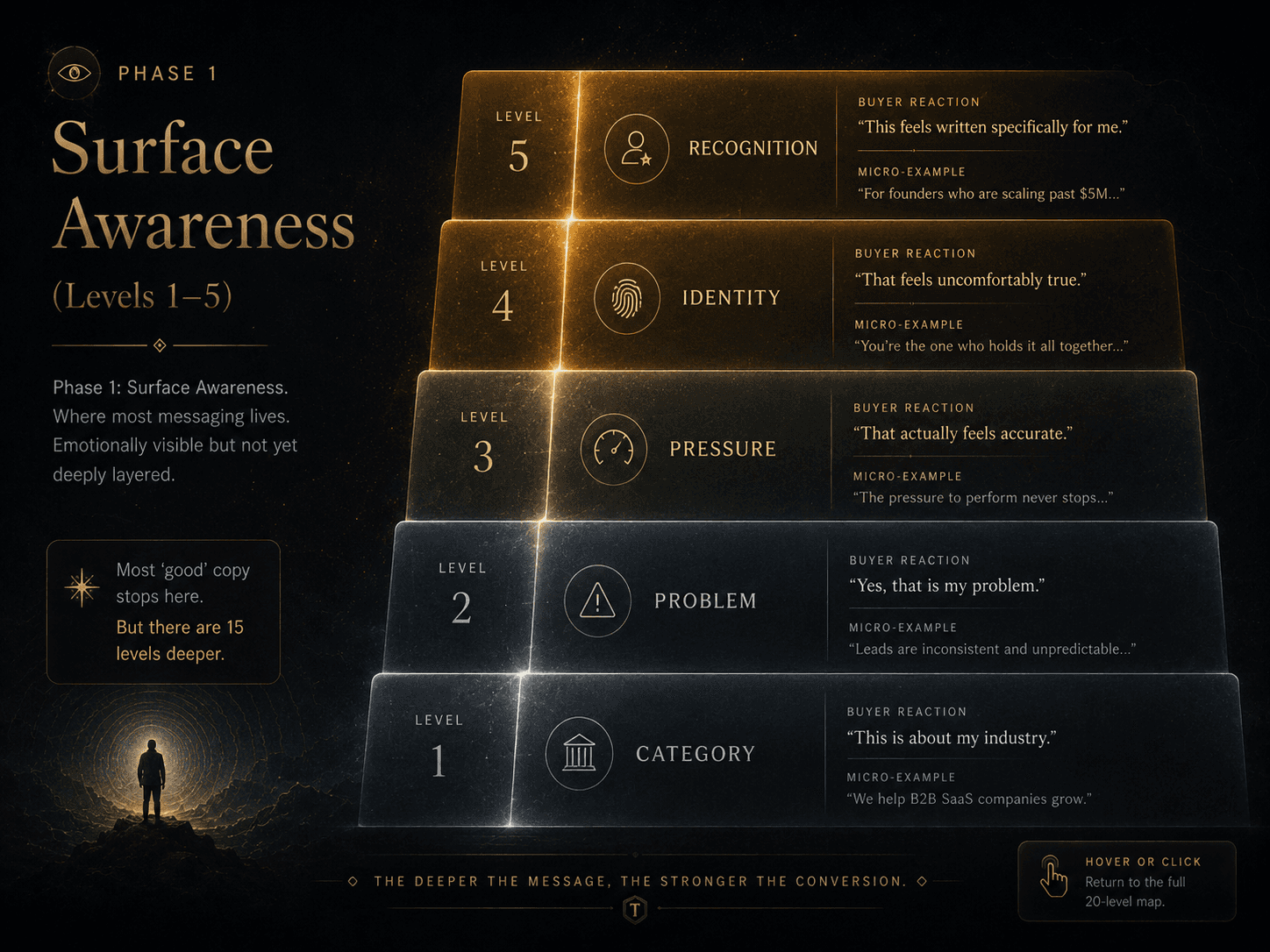
The Conversion Depth Map™ Phase 1: Surface Contact (levels 1-5) From generic messaging to basic recognition. This phase diagnoses whether your copy only describes the category and visible problem, or whether it begins reaching buyer pressure, identity tension, and the first “this feels like me” moment.
Prefer Audio Or Video?
The Conversion Depth Map™ is also available as:
🎧 A guided audio walkthrough explaining messaging depth, psychological resonance, and conversion sophistication
🎥 A practical video breakdown showing real-world examples of shallow vs deep messaging progressionChoose the format that fits how you learn best.
[Listen To The Audio Walkthrough] (coming soon)
[Watch The Video Breakdown] (coming soon)
——
Why Shallow Copy Gets Ignored
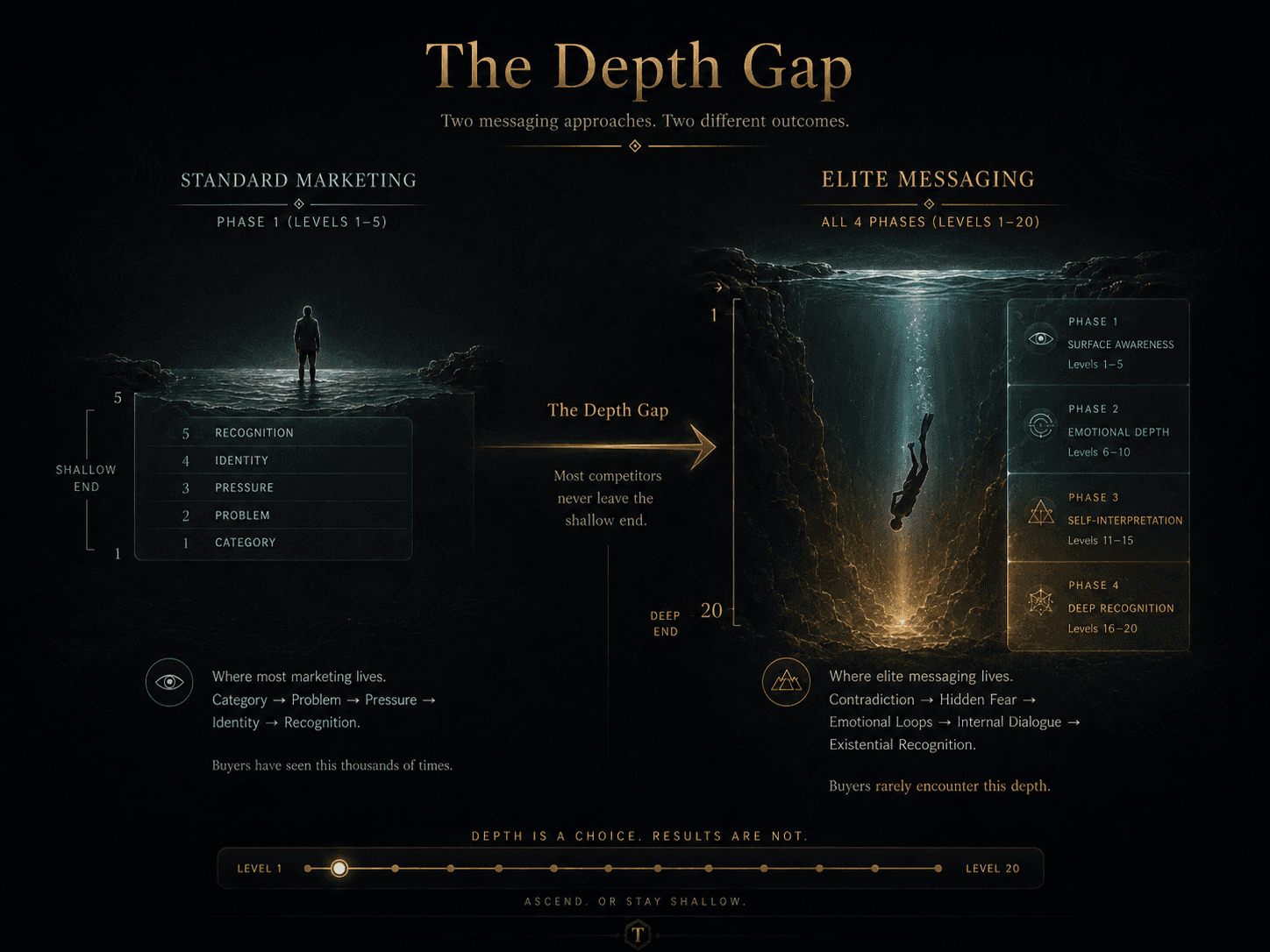
Most marketing does not fail because the offer is bad.
It fails because the messaging is too shallow.
The page may be clear.
The page may be polished.
The page may even be technically well written.
But the buyer reads it and feels nothing.
No recognition.
No emotional pull.
No psychological interruption.
No private reaction.
Just another headline.
Another promise.
Another “solution.”
Another funnel saying something technically correct but emotionally forgettable.
This is one of the biggest problems in modern conversion.
Most copy describes the topic.
Strong copy reflects the buyer’s experience.
That distinction changes everything.
Because buyers do not respond strongest to clever persuasion.
They respond strongest to accurate recognition.
They slow down when the copy feels like it understands what the problem actually feels like from the inside.
That is the purpose of The Conversion Depth Map™.
It helps you diagnose how deeply your messaging reaches into the buyer’s psychology.
Not so you can make the copy darker.
Not so you can make the copy more dramatic.
Not so you can manipulate emotion.
But so you can make the messaging more accurate, more specific, more human, and harder to emotionally ignore.
What This Resource Helps You Do
The Conversion Depth Map™ helps you assess the psychological depth of your messaging.
Use it to:
diagnose shallow copy
identify generic category-level language
move beyond surface problem statements
expose buyer pressure more accurately
reflect identity tension carefully
create stronger recognition
improve emotional realism
make headlines, hooks, subheadlines, and opening sections more specific
avoid fake emotional intensity
understand whether your copy is merely clear or genuinely recognisable
improve buyer trust through psychological accuracy
This resource is not about making every sentence deep.
That would become exhausting.
It is about understanding how deep your messaging currently reaches, where it is too shallow, and where more psychological accuracy would create stronger recognition.
The Depth Principle™
Most marketers think stronger copy comes from:
better formulas
stronger persuasion
more urgency
more hype
sharper hooks
bigger promises
cleverer headlines
But the real difference is often simpler.
Strong messaging reaches deeper.
Shallow messaging describes categories.
Deeper messaging describes lived experience.
That difference changes:
attention
recognition
trust
emotional pull
continuation
conversion momentum
This matters because buyers trust messaging that feels psychologically accurate.
Not merely professionally written.
The Most Important Warning
Deeper messaging does not mean more drama.
This is critical.
Many marketers misunderstand psychological depth.
They think depth means:
sounding darker
sounding heavier
sounding more emotional
exaggerating pain
creating insecurity
making the buyer feel worse
using intense language everywhere
That is not depth.
That is emotional performance.
The progression of The Conversion Depth Map™ is not:
More Drama™
It is:
More Psychological Accuracy™
That distinction protects the entire framework.
The deeper the messaging becomes, the more measured, specific, believable, and emotionally grounded it must become.
Fake depth creates distrust.
Real depth creates recognition.
That is the difference.
The Real Purpose Of Conversion Depth
The purpose of conversion depth is not to manipulate buyers.
The purpose is to reflect real buyer experience more accurately.
Strong messaging does not manufacture emotional pain.
It identifies emotional reality that already exists.
It does not invent insecurity.
It articulates existing friction with more precision.
It does not pressure the buyer artificially.
It helps the buyer feel understood.
That is why recognition matters so much.
When buyers feel accurately understood, resistance often lowers naturally.
Understanding creates safety.
Safety creates trust.
Trust creates continuation.
And continuation creates the possibility of conversion.
Clarity vs Recognition
Clarity and recognition are not the same thing.
Clarity says:
“I understand what this is.”
Recognition says:
“This understands what I am experiencing.”
That is a massive difference.
Many funnels achieve clarity.
Very few achieve recognition.
A clear page may explain the offer.
A recognisable page makes the buyer feel seen inside the problem.
That is where conversion depth begins.
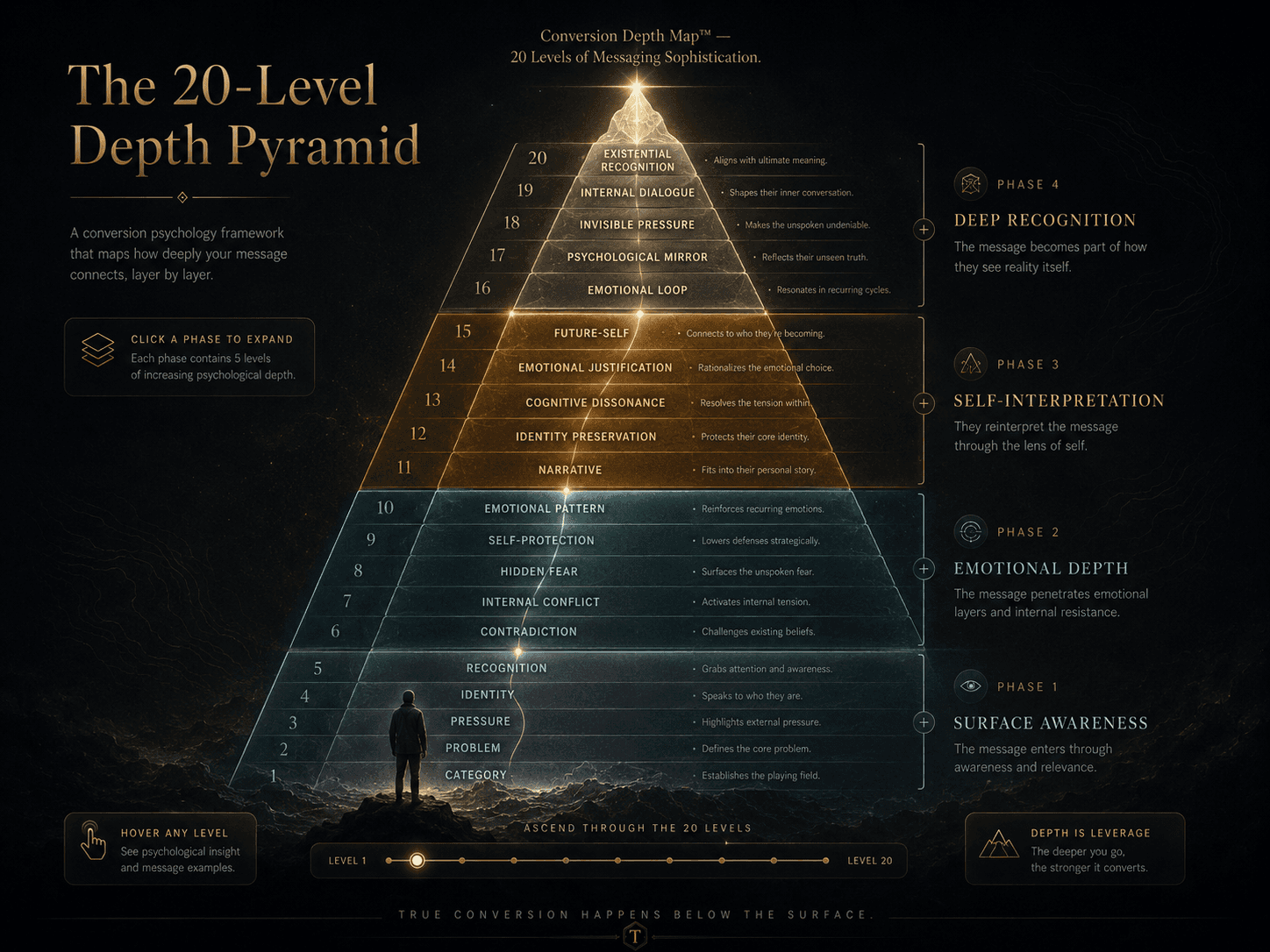
The Conversion Depth Map™ Overview
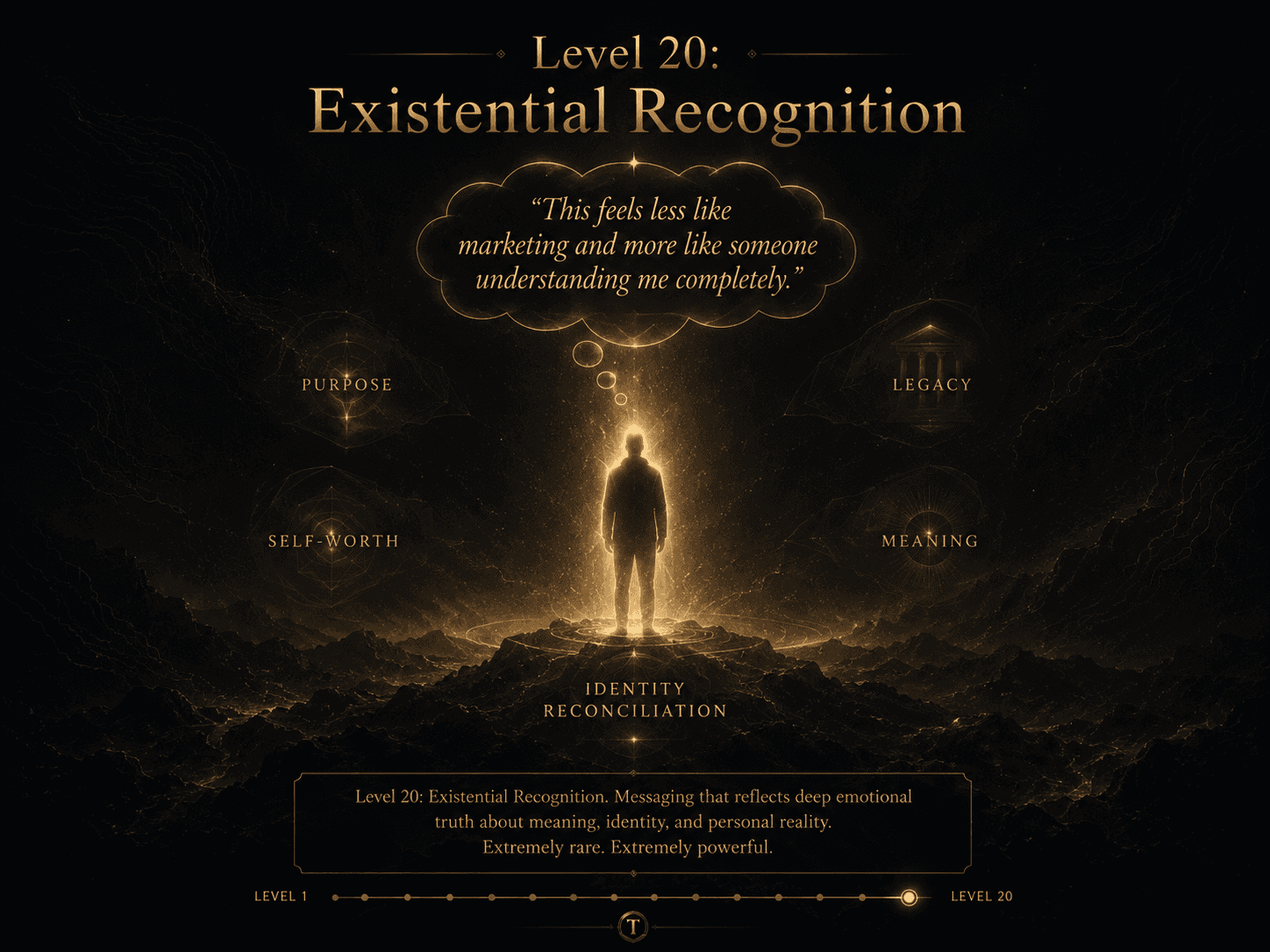
The full Conversion Depth Map™ contains 20 levels of psychological messaging depth.
These levels move from surface-level communication to deep human recognition.
The purpose is to help you diagnose where your copy currently sits and how to improve it without becoming exaggerated, manipulative, or emotionally unsafe.
The 20 levels are organised into five phases.
——
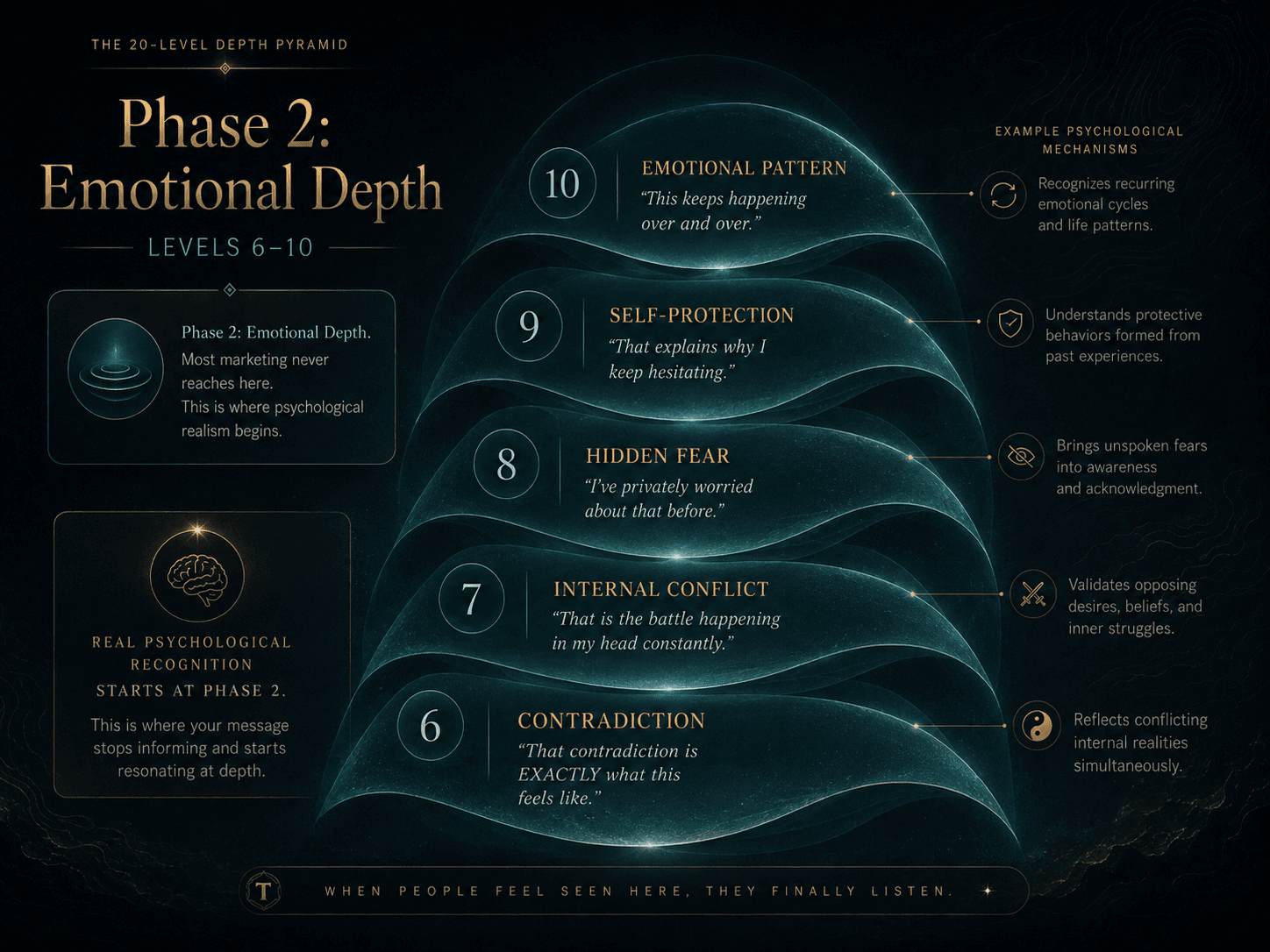
The 5 Phases Of Conversion Depth™
Phase 1: Surface Contact™
From generic messaging to basic recognition.
This phase moves the copy from category-level communication into early emotional relevance.
It includes:
Category-Level Messaging™
Problem-Level Messaging™
Pressure-Level Messaging™
Identity-Level Messaging™
Recognition-Level Messaging™
Phase 2: Emotional Contact™
From basic recognition to emotional complexity.
This phase begins reflecting contradiction, internal conflict, hidden fear, self-protection, and repeated emotional patterns.
Phase 3: Identity Contact™
From emotional pressure to self-interpretation.
This phase explores the stories buyers tell themselves about competence, progress, self-image, delay, future self, and personal meaning.
Phase 4: Private Truth Contact™
From self-interpretation to private internal language.
This phase gets closer to the buyer’s hidden thoughts, private fears, objection patterns, and internal dialogue.
Phase 5: Mirror Contact™
From private truth to deep psychological reflection.
This phase creates the strongest form of recognition, where the buyer feels the messaging reflects their internal reality with unusual precision.
How To Use This Resource
Do not try to make every section of your page reach the deepest level.
That is not the goal.
Most funnels need a mix of depth and clarity.
Cold traffic often needs:
clarity first
relevance second
recognition third
proof before deeper pressure
low-friction movement
Warmer audiences can usually handle deeper emotional specificity earlier.
The correct level depends on:
buyer awareness
traffic temperature
market sophistication
funnel stage
emotional context
offer type
trust level
page section
The goal is not to force depth.
The goal is to find the right depth for the right moment.
Use enough depth to create recognition.
Use enough clarity to create movement.
That is the balance.
——
Phase 1: Surface Contact™
From Generic Messaging To Basic Recognition
Phase 1 is where messaging begins evolving from broad, generic communication into emotionally accurate communication.
This phase establishes:
category clarity
problem awareness
pressure
identity tension
basic psychological recognition
Most weak copy stays trapped in the first two levels.
Most stronger copy begins moving into Levels 3, 4, and 5.
The goal of Phase 1 is to move from:
“This is about my industry.”
To:
“This feels like my actual situation.”
That shift changes everything.
Level 1: Category-Level Messaging™
What This Level Actually Is
Category-Level Messaging™ is the shallowest level of messaging.
It simply identifies the category.
It tells the buyer what type of offer, service, product, or market they are looking at.
Examples:
marketing services
fitness coaching
funnel optimisation
business growth
productivity systems
sales training
leadership coaching
AI automation
ecommerce conversion
At this level, the messaging communicates what the business does.
But it says almost nothing about the buyer’s actual lived experience.
This is where most generic marketing lives.
How Level 1 Sounds
Examples:
“Helping businesses grow online.”
“Marketing solutions for ambitious brands.”
“Scale your business faster.”
“Performance-driven funnel optimisation.”
“Helping entrepreneurs unlock growth.”
“AI systems for modern businesses.”
“Personalised coaching for high performers.”
Technically understandable.
Emotionally invisible.
The buyer understands the category, but they do not feel personally recognised.
What Buyers Feel At This Level
Usually, very little.
At best, the buyer thinks:
“This is about my industry.”
Or:
“This belongs to a category I recognise.”
But they do not feel:
seen
understood
emotionally interrupted
personally addressed
psychologically involved
The page feels interchangeable.
It could belong to almost anyone.
And because it feels like it could be for anyone, it often emotionally feels like it is for no one.
Why Conversion Weakens At Level 1
Category-level messaging creates basic orientation.
That is useful.
But orientation alone rarely creates conversion momentum.
The buyer may understand the market, but they do not yet feel a reason to continue.
The message does not create:
emotional relevance
tension
trust acceleration
memorability
personal recognition
continuation pull
This is why many polished pages still feel weak.
They look professional.
They sound acceptable.
But they never leave the category.
Weak vs Stronger Example
Category-Level Version
“We help businesses improve conversion rates.”
This is clear, but generic.
It names the category.
It does not reflect the buyer’s experience.
Slightly Stronger Version
“Helping founders identify the hidden messaging gaps quietly weakening funnel performance.”
This is still broad, but already stronger.
It introduces:
a specific buyer
a hidden problem
operational consequence
emotional tension
Now the buyer feels slightly more seen.
The Biggest Problem With Level 1
Level 1 sounds technically correct while emotionally disappearing.
That is why so many funnels look polished but create almost no momentum.
The copy is not confusing.
It is just too shallow.
When Level 1 Is Still Useful
Level 1 is not always bad.
Some level of category clarity is necessary.
Buyers still need to know:
what the offer is
what category it belongs to
what general problem area it addresses
whether they are in the right place
The problem happens when the entire funnel stays trapped at Level 1.
Then the copy becomes clear but emotionally flat.
How To Evolve Beyond Level 1
To move beyond category-level messaging, stop only describing the market.
Start describing the experience.
Ask:
What pressure exists inside this category?
What frustration repeats?
What emotional tension exists underneath the broad topic?
What does the buyer privately experience?
What do they keep trying to fix?
What do they feel when the problem continues?
That is where deeper messaging begins.
Level 1 Diagnostic Question
Ask:
“Could 500 competitors say this exact sentence?”
If yes, the messaging is probably too shallow.
Level 1 Fill-In Worksheet
My current category-level message is:
The market or category I am describing is:
The buyer this is meant for is:
The phrase that feels too broad is:
A more specific buyer experience I could mention is:
A stronger version is:
Level 1 AI Depth Diagnostic Prompt
Use this prompt to identify category-level messaging:
Act as a conversion strategist trained in buyer psychology.
Analyse this messaging and identify whether it remains too broad, category-level, or emotionally generic.
Tell me:
Which phrases could be said by many competitors.
Where the messaging lacks buyer specificity.
Where emotional relevance is missing.
What buyer experience should be reflected more clearly.
How to rewrite the message one level deeper without exaggeration.
Here is the messaging:
[paste messaging]
——
Level 2: Problem-Level Messaging™
What This Level Actually Is
Problem-Level Messaging™ is where the copy begins moving beyond category description and starts identifying the buyer’s visible problem.
Now the messaging no longer says only:
“We help businesses grow.”
It starts saying:
“Your funnel is not converting.”
“Your messaging feels unclear.”
“You are struggling with inconsistent leads.”
“Your page is losing buyers before they take action.”
This is a major improvement over Level 1.
Because now the buyer can recognise the situation.
Level 2 creates problem awareness.
But not yet deep emotional recognition.
That distinction is critical.
How Level 2 Sounds
Examples:
“Struggling with low conversion rates?”
“Your funnel is not converting consistently.”
“Tired of weak leads?”
“Your messaging may be costing you sales.”
“Most businesses struggle with unclear positioning.”
“Your product page is not turning visitors into buyers.”
“Your onboarding is losing users too early.”
This level is clearer, more relevant, and more useful than Level 1.
But it is still often surface-level.
What Buyers Feel At This Level
Usually, the buyer thinks:
“Yes, that is my problem.”
Or:
“That applies to me.”
But they usually do not think:
“This feels written specifically for me.”
That deeper emotional reaction has not happened yet.
The copy has named the visible problem.
But it has not yet reflected the lived experience of that problem.
Why Conversion Still Weakens At Level 2
Problem-level messaging is often too broad.
For example:
“Need better messaging?”
That technically applies to many buyers.
But it does not expose:
pressure
frustration
emotional cost
repeated failed attempts
identity tension
future concern
So the message is relevant, but not deeply recognisable.
The buyer understands the problem.
But they do not yet feel emotionally pulled into the page.
Weak vs Stronger Example
Basic Problem-Level Version
“Struggling with low funnel conversions?”
Clear.
But broad.
Stronger Version
“Tired of rebuilding funnels that still fail to convert consistently?”
Now emotional friction begins appearing.
The second version introduces:
repetition
frustration
wasted effort
operational pain
emotional fatigue
Now the buyer feels more psychologically involved.
Another Example
Basic Problem-Level Version
“Your messaging may be unclear.”
Clear, but flat.
Stronger Version
“You keep rewriting the page because deep down it still does not feel convincing enough to scale confidently.”
Now the messaging starts touching:
self-doubt
hesitation
emotional realism
hidden pressure
readiness anxiety
That creates deeper recognition.
The Biggest Limitation Of Level 2
Problem-level messaging identifies the visible issue.
But it usually misses the lived experience of the issue.
That matters because buyers do not merely experience problems.
They experience:
frustration
emotional fatigue
repeated disappointment
uncertainty
identity tension
future fear
private doubt
That emotional layer is what creates stronger resonance.
The Visible Problem Trap™
Many marketers think identifying the visible problem is enough.
But buyers are often far more emotionally affected by what the problem creates underneath it.
For example:
The visible problem:
“My funnel is not converting.”
The deeper pressure may be:
fear of wasting ad spend
hesitation scaling traffic
self-doubt
launch anxiety
frustration rebuilding funnels repeatedly
not trusting the page enough to promote it confidently
That is a completely different psychological layer.
Problem vs Pressure™
Problem
“My funnel is not converting.”
Pressure
“Every failed launch quietly reinforces the fear that I still do not know how to communicate my value clearly enough.”
The second version feels closer to lived experience.
That is where messaging starts becoming difficult to ignore.
When Level 2 Still Works
Level 2 messaging can still perform well in some situations.
Especially in:
low-competition markets
highly problem-aware markets
urgent categories
transactional offers
simple buying decisions
search-driven traffic where buyers already know what they need
Clarity still matters enormously.
But in crowded markets, Level 2 alone often becomes insufficient.
Because everyone is describing the same visible problem.
The “Everyone Says This” Effect™
One of the hidden dangers of Level 2 is that the messaging starts sounding interchangeable.
Examples:
“Need more leads?”
“Want higher conversions?”
“Struggling to grow?”
“Ready to scale?”
“Want better results?”
Buyers stop emotionally reacting because the phrasing becomes predictable.
Familiarity without specificity creates emotional numbness.
How To Evolve Beyond Level 2
To move beyond problem-level messaging, ask:
What does this problem create emotionally?
What does the buyer keep repeating because of this problem?
What does the buyer worry this problem means?
What operational friction does this problem create?
What does this problem make the buyer hesitant to do?
What does this problem cost beyond the obvious result?
That is where Level 3 begins.
Level 2 Diagnostic Question
Ask:
“Does this merely describe the problem, or does it describe what the problem feels like?”
If it only describes the visible problem, it is probably Level 2.
Level 2 Fill-In Worksheet
The visible problem I am naming is:
The buyer already knows this problem as:
The problem sounds too broad because:
The repeated frustration underneath it is:
The pressure this problem creates is:
A stronger version is:
Level 2 AI Depth Diagnostic Prompt
Use this prompt:
Act as a conversion strategist trained in messaging depth and buyer psychology.
Analyse whether this messaging only identifies the visible problem or whether it exposes deeper emotional pressure and lived experience.
Tell me:
What visible problem the copy identifies.
Whether the problem is too broad or generic.
What emotional pressure is missing.
What repeated frustration should be reflected.
How to rewrite the message one level deeper without exaggeration.
Here is the messaging:
[paste messaging]
Level 3: Pressure-Level Messaging™
What This Level Actually Is
Pressure-Level Messaging™ is where the copy starts becoming psychologically sharp.
At Level 3, the messaging no longer merely identifies the visible problem.
It begins exposing the pressure created by the problem.
This is a major shift.
Because buyers rarely move emotionally because a problem exists.
They move because living with the problem becomes psychologically expensive.
Level 3 messaging introduces:
operational friction
emotional fatigue
consequence
repeated frustration
hidden stress
uncertainty
hesitation
private frustration
Now the copy starts sounding human.
And buyers immediately feel the difference.
How Level 3 Sounds
Examples:
“Tired of sending paid traffic to funnels you still do not fully trust?”
“Every weak launch keeps reinforcing the feeling that the messaging still is not landing properly.”
“You keep rebuilding the funnel, but the deeper problem never seems to disappear.”
“The exhausting part is not the redesign itself. It is never feeling certain the page is finally strong enough.”
“Some weeks the funnel looks promising. Other weeks it feels like the entire system stopped making sense again.”
Now the messaging feels:
emotionally grounded
recognisable
specific
psychologically alive
closer to lived experience
This is where conversion depth starts increasing dramatically.
What Buyers Feel At This Level
The buyer may think:
“That actually feels accurate.”
Or:
“That is exactly what this situation feels like.”
That reaction matters enormously.
Because recognition creates attention.
And attention created through recognition is much stronger than attention created through hype.
Why Level 3 Converts Better
Pressure-level messaging creates emotional realism.
Emotionally realistic messaging feels believable.
Buyers trust copy that reflects their internal experience accurately.
Especially when the language feels specific enough to be lived-in.
At Level 3, the buyer no longer feels categorised.
They feel understood.
That creates:
trust acceleration
emotional recognition
continuation pull
psychological relevance
This is where messaging begins crossing the line from marketing into recognition.
Problem vs Pressure Example
Problem-Level Version
“Your funnel is not converting.”
Technically correct.
Emotionally broad.
Pressure-Level Version
“You hesitate every time traffic hits the page because deep down the messaging still feels slightly unfinished.”
Now the buyer feels:
emotional familiarity
operational tension
hidden stress
private uncertainty
That is a completely different psychological experience.
Another Example
Problem-Level Version
“Struggling with inconsistent leads?”
Clear, but predictable.
Pressure-Level Version
“Some weeks the funnel looks promising. Other weeks it feels like the entire system stopped making sense again.”
Now the messaging captures:
unpredictability
emotional instability
frustration
mental fatigue
That creates deeper resonance.
The Operational Friction Layer™
One of the biggest strengths of Level 3 messaging is that it exposes operational consequence.
Examples:
wasted traffic
repeated redesigns
launch hesitation
inconsistent performance
delayed decisions
abandoned campaigns
emotional exhaustion from uncertainty
Operational pain feels real.
Concrete.
Expensive.
That increases urgency naturally without relying on fake scarcity or exaggerated pressure.
The Private Frustration Effect™
Level 3 messaging often sounds like something the buyer would admit privately.
Examples:
“I’m tired of rebuilding this thing again.”
“I secretly do not trust the page yet.”
“I’m exhausted trying to figure out what is actually wrong.”
This creates emotional intimacy.
And emotional intimacy creates stronger trust.
The Biggest Strength Of Level 3
Level 3 creates recognition through realism.
Not through drama.
That distinction is critical.
Modern buyers are highly resistant to exaggeration.
But they respond very strongly to accurate emotional reflection.
What Level 3 Still Does Not Fully Reach
Level 3 is much stronger than Level 1 and Level 2.
But it still usually focuses on the pressure around the problem.
It has not yet fully reached what the problem starts meaning about the buyer themselves.
That deeper identity layer appears at Level 4.
Pressure vs Identity™
Pressure-Level Version
“This funnel keeps exhausting me.”
Identity-Level Version
“I am starting to question whether I actually know how to judge strong messaging anymore.”
Feel the difference?
The second version affects self-perception.
That creates deeper psychological weight.
The Risk Of Fake Pressure
Some marketers try forcing Level 3 by adding dramatic emotion artificially.
That usually backfires.
Fake pressure sounds performed.
Real pressure sounds:
specific
measured
grounded
emotionally believable
The goal is not to make the problem sound worse.
The goal is to make the pressure more accurate.
How To Evolve Beyond Level 3
To move beyond pressure-level messaging, ask:
What does this pressure make the buyer question about themselves?
What private doubt does this pressure create?
What does repeated failure start to mean emotionally?
What does this problem threaten in the buyer’s self-image?
What does this pressure make the buyer afraid to admit?
Where does this stop being only a practical problem?
That is where Level 4 begins.
Level 3 Diagnostic Question
Ask:
“Does this sound like someone who has actually lived through the problem?”
If yes, you are likely approaching pressure-level depth.
Level 3 Fill-In Worksheet
The visible problem is:
The pressure created by the problem is:
The repeated frustration is:
The operational friction is:
The private frustration is:
A pressure-level version of the message is:
Level 3 AI Depth Diagnostic Prompt
Use this prompt:
Act as a conversion strategist trained in pressure-based messaging and buyer psychology.
Analyse whether this messaging exposes real pressure or merely describes a surface problem.
Look for:
operational friction
emotional pressure
repeated frustration
lived experience
hesitation
private doubt
consequence
Tell me:
What pressure is currently present.
What pressure is missing.
Whether the copy sounds lived-in or generic.
Where the copy risks fake pressure or exaggeration.
How to rewrite the message with more psychological accuracy.
Here is the messaging:
[paste messaging]
——
Level 4: Identity-Level Messaging™
What This Level Actually Is
Identity-Level Messaging™ is where the copy stops speaking only about the problem and starts speaking about what the problem means psychologically.
This is a major leap in conversion depth.
Because now the messaging begins touching:
self-image
internal identity
private insecurity
self-trust
competence
personal standards
emotional self-perception
At this level, the copy no longer merely says:
“This situation is frustrating.”
It begins saying:
“This situation is changing how you see yourself.”
That distinction changes the emotional intensity completely.
People protect identity harder than logic, convenience, or money.
That makes identity one of the deepest forces in buyer psychology.
How Level 4 Sounds
Examples:
“You know the offer is stronger than the page makes it feel, and that gap is becoming harder to ignore.”
“The exhausting part is not rebuilding the funnel again. It is slowly losing confidence in your ability to judge what actually converts anymore.”
“You are not just frustrated with the results. You are frustrated that this still feels unclear after everything you already know.”
“Every weak launch quietly reinforces the fear that maybe the problem is not the funnel anymore.”
“The hardest part is knowing your offer deserves growth while quietly doubting whether your messaging is capable of carrying that weight yet.”
Now the messaging feels:
emotionally intimate
psychologically precise
deeply personal
unusually accurate
This is where messaging starts becoming difficult to emotionally ignore.
What Buyers Feel At This Level
The buyer may think:
“That feels uncomfortably accurate.”
Or:
“I have actually thought that privately before.”
That reaction matters because Level 4 creates internal recognition.
And internal recognition creates strong emotional attention.
Why Identity Changes Everything
Problems create frustration.
Pressure creates tension.
But identity creates emotional significance.
Buyers can tolerate temporary inconvenience.
What becomes psychologically heavy is when the situation starts affecting:
“Who I think I am.”
Or:
“What I think this says about me.”
That is where emotional urgency intensifies dramatically.
Pressure vs Identity Example
Pressure-Level Version
“Every launch feels exhausting.”
Identity-Level Version
“You are not just exhausted by the launches anymore. You are exhausted by how uncertain you still feel every time the funnel goes live.”
Now the messaging touches:
competence
confidence
internal certainty
self-perception
That creates deeper resonance.
Another Example
Pressure-Level Version
“You hesitate to scale traffic.”
Identity-Level Version
“The hardest part is knowing your offer deserves growth while quietly doubting whether your messaging is capable of carrying that weight yet.”
Now the messaging affects identity alignment.
It speaks to the gap between what the buyer believes the offer deserves and what the current message can carry.
The Self-Trust Factor™
One of the biggest hidden drivers in buyer psychology is the fear of losing trust in your own judgement.
This appears everywhere:
business
fitness
relationships
health
finance
leadership
performance
creativity
Examples:
“Maybe I am missing something obvious.”
“Maybe everyone else understands this faster than I do.”
“Maybe I should already be better at this.”
“Maybe I cannot see this clearly anymore.”
Those thoughts create identity pressure.
And identity pressure creates very strong emotional relevance.
The Private Thought Principle™
Level 4 messaging often sounds like a thought the buyer rarely says out loud.
Examples:
“I should probably be further ahead by now.”
“I am embarrassed this still feels unclear.”
“I secretly do not trust my own judgement here anymore.”
This creates intimacy.
And intimacy creates attention.
Because the buyer suddenly feels deeply understood.
The Biggest Mistake At Level 4
The biggest mistake is trying to force emotional depth artificially.
Fake identity messaging sounds:
dramatic
manipulative
aggressive
emotionally performed
Real identity-level messaging sounds:
measured
specific
believable
grounded
careful
Fake vs Real Identity Messaging
Fake
“You are destroying your future.”
Too exaggerated.
Emotionally unsafe.
Stronger
“You are beginning to wonder whether the real problem is no longer the funnel itself, but your ability to evaluate what strong messaging actually looks like anymore.”
Now the emotional tension feels human.
That matters enormously.
Empathy vs Manipulation
This distinction matters.
Manipulation tries to manufacture emotion.
Deep messaging tries to accurately reflect existing emotion.
That is not the same thing.
The Conversion Depth Map™ is not about inventing insecurity.
It is about understanding existing psychological reality honestly.
That distinction protects the entire system ethically.
The “This Feels Written For Me” Threshold
Level 4 is often where buyers start thinking:
“This feels weirdly specific.”
That reaction matters enormously.
Because specificity creates believability.
And believability creates trust.
How To Evolve Beyond Level 4
To move beyond identity-level messaging, ask:
What is the buyer’s actual internal dialogue?
What contradiction are they living inside?
What private interpretation do they keep returning to?
What hidden frustration are they struggling to explain?
What does this experience feel like from the inside?
What would make the buyer feel completely recognised?
That is where Level 5 begins.
Level 4 Diagnostic Question
Ask:
“Does this message describe what the problem is starting to make the buyer feel about themselves?”
If yes, you are entering identity-level messaging.
Level 4 Fill-In Worksheet
The problem the buyer is facing is:
The pressure this problem creates is:
What this pressure may make the buyer question about themselves is:
The private thought they may have is:
The identity tension is:
A careful identity-level message is:
Level 4 AI Depth Diagnostic Prompt
Use this prompt:
Act as a conversion strategist trained in buyer psychology and identity-level messaging.
Analyse whether this messaging touches identity-level depth.
Look for:
self-trust
competence
identity tension
private insecurity
emotional self-perception
personal standards
fear of misjudgement
Tell me:
Whether the messaging reaches identity-level depth.
Where it still stays at pressure-level messaging.
What private thought may sit underneath the problem.
Whether the identity framing feels accurate or forced.
How to rewrite the message carefully without becoming manipulative.
Here is the messaging:
[paste messaging]
——
Level 5: Recognition-Level Messaging™
What This Level Actually Is
Recognition-Level Messaging™ is where the copy no longer merely describes the category, identifies the problem, exposes pressure, or touches identity.
Now it creates complete psychological recognition.
This is where the buyer feels:
“This feels like someone finally understands what this situation actually feels like from the inside.”
That emotional reaction is powerful.
Because recognition-level messaging reflects:
internal dialogue
emotional contradiction
private interpretation
hidden frustration
self-awareness
nuanced psychological tension
lived emotional reality
with unusually high accuracy.
This is the level where messaging starts feeling almost eerily specific.
And that specificity creates very strong trust acceleration.
How Level 5 Sounds
Examples:
“The exhausting part is not rebuilding the funnel again. It is quietly wondering whether you are losing the ability to judge what actually converts objectively anymore.”
“You already know the offer has value. That is what makes it so frustrating when the page still feels slightly disconnected every time you look at it.”
“At some point, the real frustration stops being the weak results. It becomes the growing uncertainty around whether you can still clearly see what the buyer actually needs from you anymore.”
“You are not afraid of hard work. You are afraid of wasting another year solving surface-level funnel problems while the real conversion issue stays hidden underneath everything.”
Now the messaging feels:
psychologically intimate
emotionally layered
deeply recognisable
highly believable
unusually human
This is where messaging stops feeling like copywriting and starts feeling like accurate understanding.
What Buyers Feel At This Level
The buyer may think:
“That is exactly what this feels like.”
Or:
“I have never seen anyone explain it like that before.”
Or:
“This person gets it.”
That reaction matters enormously.
Because now the buyer feels:
understood
emotionally mirrored
psychologically recognised
less alone inside the problem
That creates deep trust acceleration.
Why Recognition Creates Trust
Most buyers do not trust funnels because they look polished.
They trust funnels because the messaging feels accurate.
Accuracy signals understanding.
Understanding signals safety.
Safety reduces defensiveness.
That is why recognition-level messaging often outperforms aggressive persuasion.
It lowers resistance without needing to shout.
Identity vs Recognition™
Identity-Level Version
“You are starting to question your ability to judge strong messaging.”
Strong.
Deep.
Recognition-Level Version
“The frustrating part is not that the page still feels weak sometimes. It is that you genuinely know enough about marketing to realise the page should already be working better than this by now.”
The second version captures:
contradiction
self-awareness
emotional nuance
internal complexity
That creates much deeper recognition.
The Contradiction Principle™
One of the biggest strengths of Level 5 messaging is that it often captures contradiction.
Examples:
“You know more than enough to recognise weak messaging, which is exactly why it becomes so frustrating when your own page still feels slightly off.”
Or:
“You are capable enough to see the problem, but still too emotionally close to the funnel to diagnose it objectively anymore.”
That emotional contradiction feels extremely human.
Real psychological experience is rarely clean and linear.
It is layered.
Conflicted.
Internally complicated.
Level 5 begins reflecting that.
The “I Thought I Was The Only One” Effect
Recognition-level messaging often creates emotional relief.
Why?
Because many buyers assume their internal frustrations are isolated, irrational, or difficult to explain.
When messaging accurately articulates those hidden thoughts, buyers often feel seen.
That emotional effect is extremely powerful.
The Biggest Mistake At Level 5
The biggest mistake is trying to sound deep.
Forced psychological language instantly destroys believability.
Fake “deep copy” usually sounds:
dramatic
manipulative
emotionally overperformed
unnatural
theatrical
Real recognition-level messaging feels:
measured
specific
quietly accurate
psychologically grounded
believable
——
Fake Depth vs Real Depth
Fake
“You are trapped in a prison of self-doubt destroying your destiny.”
Emotionally absurd.
No psychological realism.
Real
“The hardest part is realising the funnel keeps underperforming even though you already know enough to recognise most of the common advice is too shallow to solve the actual problem.”
Now the messaging feels human.
Believable.
Psychologically grounded.
The “Less Is More” Principle
Recognition-level messaging is often quieter.
Not louder.
Because deep accuracy usually requires less exaggeration.
Not more.
Strong recognition-level messaging often feels:
calm
measured
emotionally precise
unusually specific
That subtlety increases believability enormously.
Why Level 5 Creates Stronger Attention
Buyers instinctively slow down when messaging feels highly accurate.
Recognition creates cognitive interruption.
The buyer suddenly thinks:
“Wait. This actually understands what this feels like.”
That moment increases:
attention
continuation
emotional openness
trust
curiosity
This is one of the strongest psychological advantages in modern marketing.
The Real Purpose Of Level 5
Level 5 messaging tells the buyer:
“I understand what living inside this experience actually feels like psychologically.”
That is the strongest form of Phase 1 recognition.
At this level, the copy no longer merely describes the buyer.
It begins reflecting the buyer.
That is why it becomes difficult to emotionally ignore.
Level 5 Diagnostic Question
Ask:
“Does this message make the buyer feel accurately recognised from the inside?”
If yes, you are approaching recognition-level messaging.
Level 5 Fill-In Worksheet
The buyer’s visible problem is:
The pressure underneath it is:
The identity tension is:
The private internal dialogue may be:
The contradiction inside the experience is:
The most recognisable sentence I can write is:
Level 5 AI Depth Diagnostic Prompt
Use this prompt:
Act as a conversion strategist trained in advanced buyer psychology and recognition-level messaging.
Analyse whether this messaging creates genuine psychological recognition.
Look for:
nuanced internal experience
emotional contradiction
identity interpretation
private thought
believable recognition
emotional realism
overdramatic or forced depth
Tell me:
Whether the messaging reaches recognition-level depth.
Which lines feel most psychologically accurate.
Which lines feel forced, dramatic, or artificial.
What deeper buyer contradiction may be missing.
How to rewrite the message so it feels more recognisable without becoming manipulative.
Here is the messaging:
[paste messaging]
——
Phase 1 Conversion Depth Scorecard™
Use this scorecard to diagnose how deep your current messaging reaches.
Score each level from 1 to 5.
1 = weak or missing
2 = present but shallow
3 = usable
4 = strong
5 = highly accurate and recognisable
Level 1: Category Clarity
Does the messaging clearly explain the category, offer, or market?
Score: ___ / 5
Level 2: Problem Recognition
Does the messaging identify the buyer’s visible problem clearly?
Score: ___ / 5
Level 3: Pressure Accuracy
Does the messaging reflect the emotional and operational pressure created by the problem?
Score: ___ / 5
Level 4: Identity Tension
Does the messaging carefully reflect what the problem may be making the buyer feel about themselves?
Score: ___ / 5
Level 5: Recognition Strength
Does the messaging feel like it reflects the buyer’s internal experience accurately?
Score: ___ / 5
Total Phase 1 Depth Score
Total: ___ / 25
——
What Your Score Means
21–25: Strong Phase 1 Depth
Your messaging has moved beyond surface communication.
It likely creates clear relevance, pressure, identity tension, and strong early recognition.
16–20: Good But Needs More Precision
Your messaging is moving in the right direction, but some parts may still feel broad or underdeveloped.
Look for missing pressure, weak identity tension, or generic phrasing.
10–15: Surface-Level Messaging
Your messaging may be clear, but it likely lacks emotional depth.
The buyer may understand the topic without feeling strongly recognised.
0–9: Generic Messaging Risk
Your messaging is probably trapped at category or basic problem level.
It may sound polished but emotionally disappear.
——
The Phase 1 Rewrite Ladder™
Use this ladder to move one sentence through the first five levels.
Level 1: Category
What category is this about?
Example:
“We help businesses improve conversion rates.”
Your version:
Level 2: Problem
What visible problem is the buyer experiencing?
Example:
“Your funnel is not converting consistently.”
Your version:
Level 3: Pressure
What emotional or operational pressure does the problem create?
Example:
“You keep sending traffic to a funnel you still do not fully trust.”
Your version:
Level 4: Identity
What does the problem start making the buyer question about themselves?
Example:
“You are starting to wonder whether you can still judge strong messaging objectively.”
Your version:
Level 5: Recognition
What does the whole experience feel like from the inside?
Example:
“The frustrating part is not that the page still feels weak sometimes. It is that you already know enough about marketing to realise it should be working better than this by now.”
Your version:
——
Phase 1 Worked Example
Level 1: Category-Level Messaging™
“Funnel optimisation services for growing businesses.”
This tells the buyer the category.
But nothing more.
Level 2: Problem-Level Messaging™
“Your funnel is not converting as well as it should.”
This names the visible problem.
Better, but still broad.
Level 3: Pressure-Level Messaging™
“You keep sending traffic to a funnel that still does not feel strong enough to trust fully.”
Now the copy reflects operational and emotional pressure.
The buyer can feel the hesitation.
Level 4: Identity-Level Messaging™
“The frustrating part is not just the weak conversion. It is knowing your offer is stronger than the page currently makes it feel.”
Now the copy touches self-perception and standards.
The buyer feels the gap between value and expression.
Level 5: Recognition-Level Messaging™
“You already know the offer has value. That is what makes it so frustrating when the page still feels slightly disconnected every time you look at it.”
Now the copy reflects internal experience.
The buyer feels recognised.
That is the purpose of conversion depth.
Phase 1 Implementation Exercise™
Take one headline, subheadline, or opening hook from your funnel.
Write the current version here:
Now identify the current level:
Level 1 / Level 2 / Level 3 / Level 4 / Level 5
Why is it currently at this level?
What level should this section realistically reach?
Level 1 / Level 2 / Level 3 / Level 4 / Level 5
What pressure is missing?
What identity tension is missing?
What would make the buyer feel recognised?
Final improved version:
——
Phase 1 Final Principle™
Phase 1 teaches the first major shift in conversion depth:
Stop only describing the category.
Stop only naming the problem.
Start reflecting what the problem feels like.
The journey moves like this:
Level 1 says:
“This is the category.”
Level 2 says:
“This is the problem.”
Level 3 says:
“This is the pressure the problem creates.”
Level 4 says:
“This is what the problem starts making you feel about yourself.”
Level 5 says:
“This is what living inside this experience actually feels like psychologically.”
That is the first evolution of conversion depth.
From surface communication to basic recognition.
And once the buyer feels recognised, the funnel stops feeling like generic marketing.
It starts feeling like understanding.
——
From:
The $100M Funnel Playbook. Book I: Foundation Buyer Psychology, Offer Clarity, and the Page Architecture Behind High-Converting Funnels
By Maris Spalins.
——
Copyright Notice
© 2026 The $100M Funnel Playbook / Winyourclients / Maris Spalins. All rights reserved.
This resource, including the frameworks, terminology, examples, scorecards, templates, prompts, methods, and written explanations, is original intellectual property created for The $100M Funnel Playbook. Book I: Foundation — Buyer Psychology, Offer Clarity, And The Page Architecture Behind High-Converting Funnels and published through Winyourclients.
No part of this resource may be copied, reproduced, screenshotted, republished, redistributed, sold, adapted, uploaded, scraped, stored in a database, included in training data, used to train artificial intelligence systems, or used to create derivative commercial or educational materials without prior written permission.
Limited reference, quotation, or sharing is only permitted where the source is clearly and visibly credited.
Any permitted reference must include at least one of the following source credits:
The $100M Funnel Playbook by Maris Spalins
or
Winyourclients — www.winyourclients.com
or
Maris Spalins / Winyourclients
Screenshots, excerpts, summaries, or redistributed versions must not remove, hide, alter, crop out, or obscure the original source, author name, book title, website name, or copyright notice.
This resource is provided for personal learning and implementation only. It is not licensed for resale, republishing, redistribution, AI training, template cloning, course creation, consulting delivery, or commercial reuse without written permission from Maris Spalins or Winyourclients.
For permission requests, licensing, citation approval, or commercial usage enquiries, contact:
Winyourclients
www.winyourclients.com
or
Email directly to Jacob on: help@winyourclients.com
The Conversion Depth Map™ Phase 1: Surface Contact (levels 1-5) From generic messaging to basic recognition. This phase diagnoses whether your copy only describes the category and visible problem, or whether it begins reaching buyer pressure, identity tension, and the first “this feels like me” moment.
Prefer Audio Or Video?
The Conversion Depth Map™ is also available as:
🎧 A guided audio walkthrough explaining messaging depth, psychological resonance, and conversion sophistication
🎥 A practical video breakdown showing real-world examples of shallow vs deep messaging progressionChoose the format that fits how you learn best.
[Listen To The Audio Walkthrough] (coming soon)
[Watch The Video Breakdown] (coming soon)
——
Why Shallow Copy Gets Ignored
Most marketing does not fail because the offer is bad.
It fails because the messaging is too shallow.
The page may be clear.
The page may be polished.
The page may even be technically well written.
But the buyer reads it and feels nothing.
No recognition.
No emotional pull.
No psychological interruption.
No private reaction.
Just another headline.
Another promise.
Another “solution.”
Another funnel saying something technically correct but emotionally forgettable.
This is one of the biggest problems in modern conversion.
Most copy describes the topic.
Strong copy reflects the buyer’s experience.
That distinction changes everything.
Because buyers do not respond strongest to clever persuasion.
They respond strongest to accurate recognition.
They slow down when the copy feels like it understands what the problem actually feels like from the inside.
That is the purpose of The Conversion Depth Map™.
It helps you diagnose how deeply your messaging reaches into the buyer’s psychology.
Not so you can make the copy darker.
Not so you can make the copy more dramatic.
Not so you can manipulate emotion.
But so you can make the messaging more accurate, more specific, more human, and harder to emotionally ignore.
What This Resource Helps You Do
The Conversion Depth Map™ helps you assess the psychological depth of your messaging.
Use it to:
diagnose shallow copy
identify generic category-level language
move beyond surface problem statements
expose buyer pressure more accurately
reflect identity tension carefully
create stronger recognition
improve emotional realism
make headlines, hooks, subheadlines, and opening sections more specific
avoid fake emotional intensity
understand whether your copy is merely clear or genuinely recognisable
improve buyer trust through psychological accuracy
This resource is not about making every sentence deep.
That would become exhausting.
It is about understanding how deep your messaging currently reaches, where it is too shallow, and where more psychological accuracy would create stronger recognition.
The Depth Principle™
Most marketers think stronger copy comes from:
better formulas
stronger persuasion
more urgency
more hype
sharper hooks
bigger promises
cleverer headlines
But the real difference is often simpler.
Strong messaging reaches deeper.
Shallow messaging describes categories.
Deeper messaging describes lived experience.
That difference changes:
attention
recognition
trust
emotional pull
continuation
conversion momentum
This matters because buyers trust messaging that feels psychologically accurate.
Not merely professionally written.
The Most Important Warning
Deeper messaging does not mean more drama.
This is critical.
Many marketers misunderstand psychological depth.
They think depth means:
sounding darker
sounding heavier
sounding more emotional
exaggerating pain
creating insecurity
making the buyer feel worse
using intense language everywhere
That is not depth.
That is emotional performance.
The progression of The Conversion Depth Map™ is not:
More Drama™
It is:
More Psychological Accuracy™
That distinction protects the entire framework.
The deeper the messaging becomes, the more measured, specific, believable, and emotionally grounded it must become.
Fake depth creates distrust.
Real depth creates recognition.
That is the difference.
The Real Purpose Of Conversion Depth
The purpose of conversion depth is not to manipulate buyers.
The purpose is to reflect real buyer experience more accurately.
Strong messaging does not manufacture emotional pain.
It identifies emotional reality that already exists.
It does not invent insecurity.
It articulates existing friction with more precision.
It does not pressure the buyer artificially.
It helps the buyer feel understood.
That is why recognition matters so much.
When buyers feel accurately understood, resistance often lowers naturally.
Understanding creates safety.
Safety creates trust.
Trust creates continuation.
And continuation creates the possibility of conversion.
Clarity vs Recognition
Clarity and recognition are not the same thing.
Clarity says:
“I understand what this is.”
Recognition says:
“This understands what I am experiencing.”
That is a massive difference.
Many funnels achieve clarity.
Very few achieve recognition.
A clear page may explain the offer.
A recognisable page makes the buyer feel seen inside the problem.
That is where conversion depth begins.
The Conversion Depth Map™ Overview
The full Conversion Depth Map™ contains 20 levels of psychological messaging depth.
These levels move from surface-level communication to deep human recognition.
The purpose is to help you diagnose where your copy currently sits and how to improve it without becoming exaggerated, manipulative, or emotionally unsafe.
The 20 levels are organised into five phases.
——
The 5 Phases Of Conversion Depth™
Phase 1: Surface Contact™
From generic messaging to basic recognition.
This phase moves the copy from category-level communication into early emotional relevance.
It includes:
Category-Level Messaging™
Problem-Level Messaging™
Pressure-Level Messaging™
Identity-Level Messaging™
Recognition-Level Messaging™
Phase 2: Emotional Contact™
From basic recognition to emotional complexity.
This phase begins reflecting contradiction, internal conflict, hidden fear, self-protection, and repeated emotional patterns.
Phase 3: Identity Contact™
From emotional pressure to self-interpretation.
This phase explores the stories buyers tell themselves about competence, progress, self-image, delay, future self, and personal meaning.
Phase 4: Private Truth Contact™
From self-interpretation to private internal language.
This phase gets closer to the buyer’s hidden thoughts, private fears, objection patterns, and internal dialogue.
Phase 5: Mirror Contact™
From private truth to deep psychological reflection.
This phase creates the strongest form of recognition, where the buyer feels the messaging reflects their internal reality with unusual precision.
How To Use This Resource
Do not try to make every section of your page reach the deepest level.
That is not the goal.
Most funnels need a mix of depth and clarity.
Cold traffic often needs:
clarity first
relevance second
recognition third
proof before deeper pressure
low-friction movement
Warmer audiences can usually handle deeper emotional specificity earlier.
The correct level depends on:
buyer awareness
traffic temperature
market sophistication
funnel stage
emotional context
offer type
trust level
page section
The goal is not to force depth.
The goal is to find the right depth for the right moment.
Use enough depth to create recognition.
Use enough clarity to create movement.
That is the balance.
——
Phase 1: Surface Contact™
From Generic Messaging To Basic Recognition
Phase 1 is where messaging begins evolving from broad, generic communication into emotionally accurate communication.
This phase establishes:
category clarity
problem awareness
pressure
identity tension
basic psychological recognition
Most weak copy stays trapped in the first two levels.
Most stronger copy begins moving into Levels 3, 4, and 5.
The goal of Phase 1 is to move from:
“This is about my industry.”
To:
“This feels like my actual situation.”
That shift changes everything.
Level 1: Category-Level Messaging™
What This Level Actually Is
Category-Level Messaging™ is the shallowest level of messaging.
It simply identifies the category.
It tells the buyer what type of offer, service, product, or market they are looking at.
Examples:
marketing services
fitness coaching
funnel optimisation
business growth
productivity systems
sales training
leadership coaching
AI automation
ecommerce conversion
At this level, the messaging communicates what the business does.
But it says almost nothing about the buyer’s actual lived experience.
This is where most generic marketing lives.
How Level 1 Sounds
Examples:
“Helping businesses grow online.”
“Marketing solutions for ambitious brands.”
“Scale your business faster.”
“Performance-driven funnel optimisation.”
“Helping entrepreneurs unlock growth.”
“AI systems for modern businesses.”
“Personalised coaching for high performers.”
Technically understandable.
Emotionally invisible.
The buyer understands the category, but they do not feel personally recognised.
What Buyers Feel At This Level
Usually, very little.
At best, the buyer thinks:
“This is about my industry.”
Or:
“This belongs to a category I recognise.”
But they do not feel:
seen
understood
emotionally interrupted
personally addressed
psychologically involved
The page feels interchangeable.
It could belong to almost anyone.
And because it feels like it could be for anyone, it often emotionally feels like it is for no one.
Why Conversion Weakens At Level 1
Category-level messaging creates basic orientation.
That is useful.
But orientation alone rarely creates conversion momentum.
The buyer may understand the market, but they do not yet feel a reason to continue.
The message does not create:
emotional relevance
tension
trust acceleration
memorability
personal recognition
continuation pull
This is why many polished pages still feel weak.
They look professional.
They sound acceptable.
But they never leave the category.
Weak vs Stronger Example
Category-Level Version
“We help businesses improve conversion rates.”
This is clear, but generic.
It names the category.
It does not reflect the buyer’s experience.
Slightly Stronger Version
“Helping founders identify the hidden messaging gaps quietly weakening funnel performance.”
This is still broad, but already stronger.
It introduces:
a specific buyer
a hidden problem
operational consequence
emotional tension
Now the buyer feels slightly more seen.
The Biggest Problem With Level 1
Level 1 sounds technically correct while emotionally disappearing.
That is why so many funnels look polished but create almost no momentum.
The copy is not confusing.
It is just too shallow.
When Level 1 Is Still Useful
Level 1 is not always bad.
Some level of category clarity is necessary.
Buyers still need to know:
what the offer is
what category it belongs to
what general problem area it addresses
whether they are in the right place
The problem happens when the entire funnel stays trapped at Level 1.
Then the copy becomes clear but emotionally flat.
How To Evolve Beyond Level 1
To move beyond category-level messaging, stop only describing the market.
Start describing the experience.
Ask:
What pressure exists inside this category?
What frustration repeats?
What emotional tension exists underneath the broad topic?
What does the buyer privately experience?
What do they keep trying to fix?
What do they feel when the problem continues?
That is where deeper messaging begins.
Level 1 Diagnostic Question
Ask:
“Could 500 competitors say this exact sentence?”
If yes, the messaging is probably too shallow.
Level 1 Fill-In Worksheet
My current category-level message is:
The market or category I am describing is:
The buyer this is meant for is:
The phrase that feels too broad is:
A more specific buyer experience I could mention is:
A stronger version is:
Level 1 AI Depth Diagnostic Prompt
Use this prompt to identify category-level messaging:
Act as a conversion strategist trained in buyer psychology.
Analyse this messaging and identify whether it remains too broad, category-level, or emotionally generic.
Tell me:
Which phrases could be said by many competitors.
Where the messaging lacks buyer specificity.
Where emotional relevance is missing.
What buyer experience should be reflected more clearly.
How to rewrite the message one level deeper without exaggeration.
Here is the messaging:
[paste messaging]
——
Level 2: Problem-Level Messaging™
What This Level Actually Is
Problem-Level Messaging™ is where the copy begins moving beyond category description and starts identifying the buyer’s visible problem.
Now the messaging no longer says only:
“We help businesses grow.”
It starts saying:
“Your funnel is not converting.”
“Your messaging feels unclear.”
“You are struggling with inconsistent leads.”
“Your page is losing buyers before they take action.”
This is a major improvement over Level 1.
Because now the buyer can recognise the situation.
Level 2 creates problem awareness.
But not yet deep emotional recognition.
That distinction is critical.
How Level 2 Sounds
Examples:
“Struggling with low conversion rates?”
“Your funnel is not converting consistently.”
“Tired of weak leads?”
“Your messaging may be costing you sales.”
“Most businesses struggle with unclear positioning.”
“Your product page is not turning visitors into buyers.”
“Your onboarding is losing users too early.”
This level is clearer, more relevant, and more useful than Level 1.
But it is still often surface-level.
What Buyers Feel At This Level
Usually, the buyer thinks:
“Yes, that is my problem.”
Or:
“That applies to me.”
But they usually do not think:
“This feels written specifically for me.”
That deeper emotional reaction has not happened yet.
The copy has named the visible problem.
But it has not yet reflected the lived experience of that problem.
Why Conversion Still Weakens At Level 2
Problem-level messaging is often too broad.
For example:
“Need better messaging?”
That technically applies to many buyers.
But it does not expose:
pressure
frustration
emotional cost
repeated failed attempts
identity tension
future concern
So the message is relevant, but not deeply recognisable.
The buyer understands the problem.
But they do not yet feel emotionally pulled into the page.
Weak vs Stronger Example
Basic Problem-Level Version
“Struggling with low funnel conversions?”
Clear.
But broad.
Stronger Version
“Tired of rebuilding funnels that still fail to convert consistently?”
Now emotional friction begins appearing.
The second version introduces:
repetition
frustration
wasted effort
operational pain
emotional fatigue
Now the buyer feels more psychologically involved.
Another Example
Basic Problem-Level Version
“Your messaging may be unclear.”
Clear, but flat.
Stronger Version
“You keep rewriting the page because deep down it still does not feel convincing enough to scale confidently.”
Now the messaging starts touching:
self-doubt
hesitation
emotional realism
hidden pressure
readiness anxiety
That creates deeper recognition.
The Biggest Limitation Of Level 2
Problem-level messaging identifies the visible issue.
But it usually misses the lived experience of the issue.
That matters because buyers do not merely experience problems.
They experience:
frustration
emotional fatigue
repeated disappointment
uncertainty
identity tension
future fear
private doubt
That emotional layer is what creates stronger resonance.
The Visible Problem Trap™
Many marketers think identifying the visible problem is enough.
But buyers are often far more emotionally affected by what the problem creates underneath it.
For example:
The visible problem:
“My funnel is not converting.”
The deeper pressure may be:
fear of wasting ad spend
hesitation scaling traffic
self-doubt
launch anxiety
frustration rebuilding funnels repeatedly
not trusting the page enough to promote it confidently
That is a completely different psychological layer.
Problem vs Pressure™
Problem
“My funnel is not converting.”
Pressure
“Every failed launch quietly reinforces the fear that I still do not know how to communicate my value clearly enough.”
The second version feels closer to lived experience.
That is where messaging starts becoming difficult to ignore.
When Level 2 Still Works
Level 2 messaging can still perform well in some situations.
Especially in:
low-competition markets
highly problem-aware markets
urgent categories
transactional offers
simple buying decisions
search-driven traffic where buyers already know what they need
Clarity still matters enormously.
But in crowded markets, Level 2 alone often becomes insufficient.
Because everyone is describing the same visible problem.
The “Everyone Says This” Effect™
One of the hidden dangers of Level 2 is that the messaging starts sounding interchangeable.
Examples:
“Need more leads?”
“Want higher conversions?”
“Struggling to grow?”
“Ready to scale?”
“Want better results?”
Buyers stop emotionally reacting because the phrasing becomes predictable.
Familiarity without specificity creates emotional numbness.
How To Evolve Beyond Level 2
To move beyond problem-level messaging, ask:
What does this problem create emotionally?
What does the buyer keep repeating because of this problem?
What does the buyer worry this problem means?
What operational friction does this problem create?
What does this problem make the buyer hesitant to do?
What does this problem cost beyond the obvious result?
That is where Level 3 begins.
Level 2 Diagnostic Question
Ask:
“Does this merely describe the problem, or does it describe what the problem feels like?”
If it only describes the visible problem, it is probably Level 2.
Level 2 Fill-In Worksheet
The visible problem I am naming is:
The buyer already knows this problem as:
The problem sounds too broad because:
The repeated frustration underneath it is:
The pressure this problem creates is:
A stronger version is:
Level 2 AI Depth Diagnostic Prompt
Use this prompt:
Act as a conversion strategist trained in messaging depth and buyer psychology.
Analyse whether this messaging only identifies the visible problem or whether it exposes deeper emotional pressure and lived experience.
Tell me:
What visible problem the copy identifies.
Whether the problem is too broad or generic.
What emotional pressure is missing.
What repeated frustration should be reflected.
How to rewrite the message one level deeper without exaggeration.
Here is the messaging:
[paste messaging]
Level 3: Pressure-Level Messaging™
What This Level Actually Is
Pressure-Level Messaging™ is where the copy starts becoming psychologically sharp.
At Level 3, the messaging no longer merely identifies the visible problem.
It begins exposing the pressure created by the problem.
This is a major shift.
Because buyers rarely move emotionally because a problem exists.
They move because living with the problem becomes psychologically expensive.
Level 3 messaging introduces:
operational friction
emotional fatigue
consequence
repeated frustration
hidden stress
uncertainty
hesitation
private frustration
Now the copy starts sounding human.
And buyers immediately feel the difference.
How Level 3 Sounds
Examples:
“Tired of sending paid traffic to funnels you still do not fully trust?”
“Every weak launch keeps reinforcing the feeling that the messaging still is not landing properly.”
“You keep rebuilding the funnel, but the deeper problem never seems to disappear.”
“The exhausting part is not the redesign itself. It is never feeling certain the page is finally strong enough.”
“Some weeks the funnel looks promising. Other weeks it feels like the entire system stopped making sense again.”
Now the messaging feels:
emotionally grounded
recognisable
specific
psychologically alive
closer to lived experience
This is where conversion depth starts increasing dramatically.
What Buyers Feel At This Level
The buyer may think:
“That actually feels accurate.”
Or:
“That is exactly what this situation feels like.”
That reaction matters enormously.
Because recognition creates attention.
And attention created through recognition is much stronger than attention created through hype.
Why Level 3 Converts Better
Pressure-level messaging creates emotional realism.
Emotionally realistic messaging feels believable.
Buyers trust copy that reflects their internal experience accurately.
Especially when the language feels specific enough to be lived-in.
At Level 3, the buyer no longer feels categorised.
They feel understood.
That creates:
trust acceleration
emotional recognition
continuation pull
psychological relevance
This is where messaging begins crossing the line from marketing into recognition.
Problem vs Pressure Example
Problem-Level Version
“Your funnel is not converting.”
Technically correct.
Emotionally broad.
Pressure-Level Version
“You hesitate every time traffic hits the page because deep down the messaging still feels slightly unfinished.”
Now the buyer feels:
emotional familiarity
operational tension
hidden stress
private uncertainty
That is a completely different psychological experience.
Another Example
Problem-Level Version
“Struggling with inconsistent leads?”
Clear, but predictable.
Pressure-Level Version
“Some weeks the funnel looks promising. Other weeks it feels like the entire system stopped making sense again.”
Now the messaging captures:
unpredictability
emotional instability
frustration
mental fatigue
That creates deeper resonance.
The Operational Friction Layer™
One of the biggest strengths of Level 3 messaging is that it exposes operational consequence.
Examples:
wasted traffic
repeated redesigns
launch hesitation
inconsistent performance
delayed decisions
abandoned campaigns
emotional exhaustion from uncertainty
Operational pain feels real.
Concrete.
Expensive.
That increases urgency naturally without relying on fake scarcity or exaggerated pressure.
The Private Frustration Effect™
Level 3 messaging often sounds like something the buyer would admit privately.
Examples:
“I’m tired of rebuilding this thing again.”
“I secretly do not trust the page yet.”
“I’m exhausted trying to figure out what is actually wrong.”
This creates emotional intimacy.
And emotional intimacy creates stronger trust.
The Biggest Strength Of Level 3
Level 3 creates recognition through realism.
Not through drama.
That distinction is critical.
Modern buyers are highly resistant to exaggeration.
But they respond very strongly to accurate emotional reflection.
What Level 3 Still Does Not Fully Reach
Level 3 is much stronger than Level 1 and Level 2.
But it still usually focuses on the pressure around the problem.
It has not yet fully reached what the problem starts meaning about the buyer themselves.
That deeper identity layer appears at Level 4.
Pressure vs Identity™
Pressure-Level Version
“This funnel keeps exhausting me.”
Identity-Level Version
“I am starting to question whether I actually know how to judge strong messaging anymore.”
Feel the difference?
The second version affects self-perception.
That creates deeper psychological weight.
The Risk Of Fake Pressure
Some marketers try forcing Level 3 by adding dramatic emotion artificially.
That usually backfires.
Fake pressure sounds performed.
Real pressure sounds:
specific
measured
grounded
emotionally believable
The goal is not to make the problem sound worse.
The goal is to make the pressure more accurate.
How To Evolve Beyond Level 3
To move beyond pressure-level messaging, ask:
What does this pressure make the buyer question about themselves?
What private doubt does this pressure create?
What does repeated failure start to mean emotionally?
What does this problem threaten in the buyer’s self-image?
What does this pressure make the buyer afraid to admit?
Where does this stop being only a practical problem?
That is where Level 4 begins.
Level 3 Diagnostic Question
Ask:
“Does this sound like someone who has actually lived through the problem?”
If yes, you are likely approaching pressure-level depth.
Level 3 Fill-In Worksheet
The visible problem is:
The pressure created by the problem is:
The repeated frustration is:
The operational friction is:
The private frustration is:
A pressure-level version of the message is:
Level 3 AI Depth Diagnostic Prompt
Use this prompt:
Act as a conversion strategist trained in pressure-based messaging and buyer psychology.
Analyse whether this messaging exposes real pressure or merely describes a surface problem.
Look for:
operational friction
emotional pressure
repeated frustration
lived experience
hesitation
private doubt
consequence
Tell me:
What pressure is currently present.
What pressure is missing.
Whether the copy sounds lived-in or generic.
Where the copy risks fake pressure or exaggeration.
How to rewrite the message with more psychological accuracy.
Here is the messaging:
[paste messaging]
——
Level 4: Identity-Level Messaging™
What This Level Actually Is
Identity-Level Messaging™ is where the copy stops speaking only about the problem and starts speaking about what the problem means psychologically.
This is a major leap in conversion depth.
Because now the messaging begins touching:
self-image
internal identity
private insecurity
self-trust
competence
personal standards
emotional self-perception
At this level, the copy no longer merely says:
“This situation is frustrating.”
It begins saying:
“This situation is changing how you see yourself.”
That distinction changes the emotional intensity completely.
People protect identity harder than logic, convenience, or money.
That makes identity one of the deepest forces in buyer psychology.
How Level 4 Sounds
Examples:
“You know the offer is stronger than the page makes it feel, and that gap is becoming harder to ignore.”
“The exhausting part is not rebuilding the funnel again. It is slowly losing confidence in your ability to judge what actually converts anymore.”
“You are not just frustrated with the results. You are frustrated that this still feels unclear after everything you already know.”
“Every weak launch quietly reinforces the fear that maybe the problem is not the funnel anymore.”
“The hardest part is knowing your offer deserves growth while quietly doubting whether your messaging is capable of carrying that weight yet.”
Now the messaging feels:
emotionally intimate
psychologically precise
deeply personal
unusually accurate
This is where messaging starts becoming difficult to emotionally ignore.
What Buyers Feel At This Level
The buyer may think:
“That feels uncomfortably accurate.”
Or:
“I have actually thought that privately before.”
That reaction matters because Level 4 creates internal recognition.
And internal recognition creates strong emotional attention.
Why Identity Changes Everything
Problems create frustration.
Pressure creates tension.
But identity creates emotional significance.
Buyers can tolerate temporary inconvenience.
What becomes psychologically heavy is when the situation starts affecting:
“Who I think I am.”
Or:
“What I think this says about me.”
That is where emotional urgency intensifies dramatically.
Pressure vs Identity Example
Pressure-Level Version
“Every launch feels exhausting.”
Identity-Level Version
“You are not just exhausted by the launches anymore. You are exhausted by how uncertain you still feel every time the funnel goes live.”
Now the messaging touches:
competence
confidence
internal certainty
self-perception
That creates deeper resonance.
Another Example
Pressure-Level Version
“You hesitate to scale traffic.”
Identity-Level Version
“The hardest part is knowing your offer deserves growth while quietly doubting whether your messaging is capable of carrying that weight yet.”
Now the messaging affects identity alignment.
It speaks to the gap between what the buyer believes the offer deserves and what the current message can carry.
The Self-Trust Factor™
One of the biggest hidden drivers in buyer psychology is the fear of losing trust in your own judgement.
This appears everywhere:
business
fitness
relationships
health
finance
leadership
performance
creativity
Examples:
“Maybe I am missing something obvious.”
“Maybe everyone else understands this faster than I do.”
“Maybe I should already be better at this.”
“Maybe I cannot see this clearly anymore.”
Those thoughts create identity pressure.
And identity pressure creates very strong emotional relevance.
The Private Thought Principle™
Level 4 messaging often sounds like a thought the buyer rarely says out loud.
Examples:
“I should probably be further ahead by now.”
“I am embarrassed this still feels unclear.”
“I secretly do not trust my own judgement here anymore.”
This creates intimacy.
And intimacy creates attention.
Because the buyer suddenly feels deeply understood.
The Biggest Mistake At Level 4
The biggest mistake is trying to force emotional depth artificially.
Fake identity messaging sounds:
dramatic
manipulative
aggressive
emotionally performed
Real identity-level messaging sounds:
measured
specific
believable
grounded
careful
Fake vs Real Identity Messaging
Fake
“You are destroying your future.”
Too exaggerated.
Emotionally unsafe.
Stronger
“You are beginning to wonder whether the real problem is no longer the funnel itself, but your ability to evaluate what strong messaging actually looks like anymore.”
Now the emotional tension feels human.
That matters enormously.
Empathy vs Manipulation
This distinction matters.
Manipulation tries to manufacture emotion.
Deep messaging tries to accurately reflect existing emotion.
That is not the same thing.
The Conversion Depth Map™ is not about inventing insecurity.
It is about understanding existing psychological reality honestly.
That distinction protects the entire system ethically.
The “This Feels Written For Me” Threshold
Level 4 is often where buyers start thinking:
“This feels weirdly specific.”
That reaction matters enormously.
Because specificity creates believability.
And believability creates trust.
How To Evolve Beyond Level 4
To move beyond identity-level messaging, ask:
What is the buyer’s actual internal dialogue?
What contradiction are they living inside?
What private interpretation do they keep returning to?
What hidden frustration are they struggling to explain?
What does this experience feel like from the inside?
What would make the buyer feel completely recognised?
That is where Level 5 begins.
Level 4 Diagnostic Question
Ask:
“Does this message describe what the problem is starting to make the buyer feel about themselves?”
If yes, you are entering identity-level messaging.
Level 4 Fill-In Worksheet
The problem the buyer is facing is:
The pressure this problem creates is:
What this pressure may make the buyer question about themselves is:
The private thought they may have is:
The identity tension is:
A careful identity-level message is:
Level 4 AI Depth Diagnostic Prompt
Use this prompt:
Act as a conversion strategist trained in buyer psychology and identity-level messaging.
Analyse whether this messaging touches identity-level depth.
Look for:
self-trust
competence
identity tension
private insecurity
emotional self-perception
personal standards
fear of misjudgement
Tell me:
Whether the messaging reaches identity-level depth.
Where it still stays at pressure-level messaging.
What private thought may sit underneath the problem.
Whether the identity framing feels accurate or forced.
How to rewrite the message carefully without becoming manipulative.
Here is the messaging:
[paste messaging]
——
Level 5: Recognition-Level Messaging™
What This Level Actually Is
Recognition-Level Messaging™ is where the copy no longer merely describes the category, identifies the problem, exposes pressure, or touches identity.
Now it creates complete psychological recognition.
This is where the buyer feels:
“This feels like someone finally understands what this situation actually feels like from the inside.”
That emotional reaction is powerful.
Because recognition-level messaging reflects:
internal dialogue
emotional contradiction
private interpretation
hidden frustration
self-awareness
nuanced psychological tension
lived emotional reality
with unusually high accuracy.
This is the level where messaging starts feeling almost eerily specific.
And that specificity creates very strong trust acceleration.
How Level 5 Sounds
Examples:
“The exhausting part is not rebuilding the funnel again. It is quietly wondering whether you are losing the ability to judge what actually converts objectively anymore.”
“You already know the offer has value. That is what makes it so frustrating when the page still feels slightly disconnected every time you look at it.”
“At some point, the real frustration stops being the weak results. It becomes the growing uncertainty around whether you can still clearly see what the buyer actually needs from you anymore.”
“You are not afraid of hard work. You are afraid of wasting another year solving surface-level funnel problems while the real conversion issue stays hidden underneath everything.”
Now the messaging feels:
psychologically intimate
emotionally layered
deeply recognisable
highly believable
unusually human
This is where messaging stops feeling like copywriting and starts feeling like accurate understanding.
What Buyers Feel At This Level
The buyer may think:
“That is exactly what this feels like.”
Or:
“I have never seen anyone explain it like that before.”
Or:
“This person gets it.”
That reaction matters enormously.
Because now the buyer feels:
understood
emotionally mirrored
psychologically recognised
less alone inside the problem
That creates deep trust acceleration.
Why Recognition Creates Trust
Most buyers do not trust funnels because they look polished.
They trust funnels because the messaging feels accurate.
Accuracy signals understanding.
Understanding signals safety.
Safety reduces defensiveness.
That is why recognition-level messaging often outperforms aggressive persuasion.
It lowers resistance without needing to shout.
Identity vs Recognition™
Identity-Level Version
“You are starting to question your ability to judge strong messaging.”
Strong.
Deep.
Recognition-Level Version
“The frustrating part is not that the page still feels weak sometimes. It is that you genuinely know enough about marketing to realise the page should already be working better than this by now.”
The second version captures:
contradiction
self-awareness
emotional nuance
internal complexity
That creates much deeper recognition.
The Contradiction Principle™
One of the biggest strengths of Level 5 messaging is that it often captures contradiction.
Examples:
“You know more than enough to recognise weak messaging, which is exactly why it becomes so frustrating when your own page still feels slightly off.”
Or:
“You are capable enough to see the problem, but still too emotionally close to the funnel to diagnose it objectively anymore.”
That emotional contradiction feels extremely human.
Real psychological experience is rarely clean and linear.
It is layered.
Conflicted.
Internally complicated.
Level 5 begins reflecting that.
The “I Thought I Was The Only One” Effect
Recognition-level messaging often creates emotional relief.
Why?
Because many buyers assume their internal frustrations are isolated, irrational, or difficult to explain.
When messaging accurately articulates those hidden thoughts, buyers often feel seen.
That emotional effect is extremely powerful.
The Biggest Mistake At Level 5
The biggest mistake is trying to sound deep.
Forced psychological language instantly destroys believability.
Fake “deep copy” usually sounds:
dramatic
manipulative
emotionally overperformed
unnatural
theatrical
Real recognition-level messaging feels:
measured
specific
quietly accurate
psychologically grounded
believable
——
Fake Depth vs Real Depth
Fake
“You are trapped in a prison of self-doubt destroying your destiny.”
Emotionally absurd.
No psychological realism.
Real
“The hardest part is realising the funnel keeps underperforming even though you already know enough to recognise most of the common advice is too shallow to solve the actual problem.”
Now the messaging feels human.
Believable.
Psychologically grounded.
The “Less Is More” Principle
Recognition-level messaging is often quieter.
Not louder.
Because deep accuracy usually requires less exaggeration.
Not more.
Strong recognition-level messaging often feels:
calm
measured
emotionally precise
unusually specific
That subtlety increases believability enormously.
Why Level 5 Creates Stronger Attention
Buyers instinctively slow down when messaging feels highly accurate.
Recognition creates cognitive interruption.
The buyer suddenly thinks:
“Wait. This actually understands what this feels like.”
That moment increases:
attention
continuation
emotional openness
trust
curiosity
This is one of the strongest psychological advantages in modern marketing.
The Real Purpose Of Level 5
Level 5 messaging tells the buyer:
“I understand what living inside this experience actually feels like psychologically.”
That is the strongest form of Phase 1 recognition.
At this level, the copy no longer merely describes the buyer.
It begins reflecting the buyer.
That is why it becomes difficult to emotionally ignore.
Level 5 Diagnostic Question
Ask:
“Does this message make the buyer feel accurately recognised from the inside?”
If yes, you are approaching recognition-level messaging.
Level 5 Fill-In Worksheet
The buyer’s visible problem is:
The pressure underneath it is:
The identity tension is:
The private internal dialogue may be:
The contradiction inside the experience is:
The most recognisable sentence I can write is:
Level 5 AI Depth Diagnostic Prompt
Use this prompt:
Act as a conversion strategist trained in advanced buyer psychology and recognition-level messaging.
Analyse whether this messaging creates genuine psychological recognition.
Look for:
nuanced internal experience
emotional contradiction
identity interpretation
private thought
believable recognition
emotional realism
overdramatic or forced depth
Tell me:
Whether the messaging reaches recognition-level depth.
Which lines feel most psychologically accurate.
Which lines feel forced, dramatic, or artificial.
What deeper buyer contradiction may be missing.
How to rewrite the message so it feels more recognisable without becoming manipulative.
Here is the messaging:
[paste messaging]
——
Phase 1 Conversion Depth Scorecard™
Use this scorecard to diagnose how deep your current messaging reaches.
Score each level from 1 to 5.
1 = weak or missing
2 = present but shallow
3 = usable
4 = strong
5 = highly accurate and recognisable
Level 1: Category Clarity
Does the messaging clearly explain the category, offer, or market?
Score: ___ / 5
Level 2: Problem Recognition
Does the messaging identify the buyer’s visible problem clearly?
Score: ___ / 5
Level 3: Pressure Accuracy
Does the messaging reflect the emotional and operational pressure created by the problem?
Score: ___ / 5
Level 4: Identity Tension
Does the messaging carefully reflect what the problem may be making the buyer feel about themselves?
Score: ___ / 5
Level 5: Recognition Strength
Does the messaging feel like it reflects the buyer’s internal experience accurately?
Score: ___ / 5
Total Phase 1 Depth Score
Total: ___ / 25
——
What Your Score Means
21–25: Strong Phase 1 Depth
Your messaging has moved beyond surface communication.
It likely creates clear relevance, pressure, identity tension, and strong early recognition.
16–20: Good But Needs More Precision
Your messaging is moving in the right direction, but some parts may still feel broad or underdeveloped.
Look for missing pressure, weak identity tension, or generic phrasing.
10–15: Surface-Level Messaging
Your messaging may be clear, but it likely lacks emotional depth.
The buyer may understand the topic without feeling strongly recognised.
0–9: Generic Messaging Risk
Your messaging is probably trapped at category or basic problem level.
It may sound polished but emotionally disappear.
——
The Phase 1 Rewrite Ladder™
Use this ladder to move one sentence through the first five levels.
Level 1: Category
What category is this about?
Example:
“We help businesses improve conversion rates.”
Your version:
Level 2: Problem
What visible problem is the buyer experiencing?
Example:
“Your funnel is not converting consistently.”
Your version:
Level 3: Pressure
What emotional or operational pressure does the problem create?
Example:
“You keep sending traffic to a funnel you still do not fully trust.”
Your version:
Level 4: Identity
What does the problem start making the buyer question about themselves?
Example:
“You are starting to wonder whether you can still judge strong messaging objectively.”
Your version:
Level 5: Recognition
What does the whole experience feel like from the inside?
Example:
“The frustrating part is not that the page still feels weak sometimes. It is that you already know enough about marketing to realise it should be working better than this by now.”
Your version:
——
Phase 1 Worked Example
Level 1: Category-Level Messaging™
“Funnel optimisation services for growing businesses.”
This tells the buyer the category.
But nothing more.
Level 2: Problem-Level Messaging™
“Your funnel is not converting as well as it should.”
This names the visible problem.
Better, but still broad.
Level 3: Pressure-Level Messaging™
“You keep sending traffic to a funnel that still does not feel strong enough to trust fully.”
Now the copy reflects operational and emotional pressure.
The buyer can feel the hesitation.
Level 4: Identity-Level Messaging™
“The frustrating part is not just the weak conversion. It is knowing your offer is stronger than the page currently makes it feel.”
Now the copy touches self-perception and standards.
The buyer feels the gap between value and expression.
Level 5: Recognition-Level Messaging™
“You already know the offer has value. That is what makes it so frustrating when the page still feels slightly disconnected every time you look at it.”
Now the copy reflects internal experience.
The buyer feels recognised.
That is the purpose of conversion depth.
Phase 1 Implementation Exercise™
Take one headline, subheadline, or opening hook from your funnel.
Write the current version here:
Now identify the current level:
Level 1 / Level 2 / Level 3 / Level 4 / Level 5
Why is it currently at this level?
What level should this section realistically reach?
Level 1 / Level 2 / Level 3 / Level 4 / Level 5
What pressure is missing?
What identity tension is missing?
What would make the buyer feel recognised?
Final improved version:
——
Phase 1 Final Principle™
Phase 1 teaches the first major shift in conversion depth:
Stop only describing the category.
Stop only naming the problem.
Start reflecting what the problem feels like.
The journey moves like this:
Level 1 says:
“This is the category.”
Level 2 says:
“This is the problem.”
Level 3 says:
“This is the pressure the problem creates.”
Level 4 says:
“This is what the problem starts making you feel about yourself.”
Level 5 says:
“This is what living inside this experience actually feels like psychologically.”
That is the first evolution of conversion depth.
From surface communication to basic recognition.
And once the buyer feels recognised, the funnel stops feeling like generic marketing.
It starts feeling like understanding.
——
From:
The $100M Funnel Playbook. Book I: Foundation Buyer Psychology, Offer Clarity, and the Page Architecture Behind High-Converting Funnels
By Maris Spalins.
——
Copyright Notice
© 2026 The $100M Funnel Playbook / Winyourclients / Maris Spalins. All rights reserved.
This resource, including the frameworks, terminology, examples, scorecards, templates, prompts, methods, and written explanations, is original intellectual property created for The $100M Funnel Playbook. Book I: Foundation — Buyer Psychology, Offer Clarity, And The Page Architecture Behind High-Converting Funnels and published through Winyourclients.
No part of this resource may be copied, reproduced, screenshotted, republished, redistributed, sold, adapted, uploaded, scraped, stored in a database, included in training data, used to train artificial intelligence systems, or used to create derivative commercial or educational materials without prior written permission.
Limited reference, quotation, or sharing is only permitted where the source is clearly and visibly credited.
Any permitted reference must include at least one of the following source credits:
The $100M Funnel Playbook by Maris Spalins
or
Winyourclients — www.winyourclients.com
or
Maris Spalins / Winyourclients
Screenshots, excerpts, summaries, or redistributed versions must not remove, hide, alter, crop out, or obscure the original source, author name, book title, website name, or copyright notice.
This resource is provided for personal learning and implementation only. It is not licensed for resale, republishing, redistribution, AI training, template cloning, course creation, consulting delivery, or commercial reuse without written permission from Maris Spalins or Winyourclients.
For permission requests, licensing, citation approval, or commercial usage enquiries, contact:
Winyourclients
www.winyourclients.com
or
Email directly to Jacob on: help@winyourclients.com
Other Blogs
Other Blogs
Check our other project Blogs with useful insight and information for your businesses
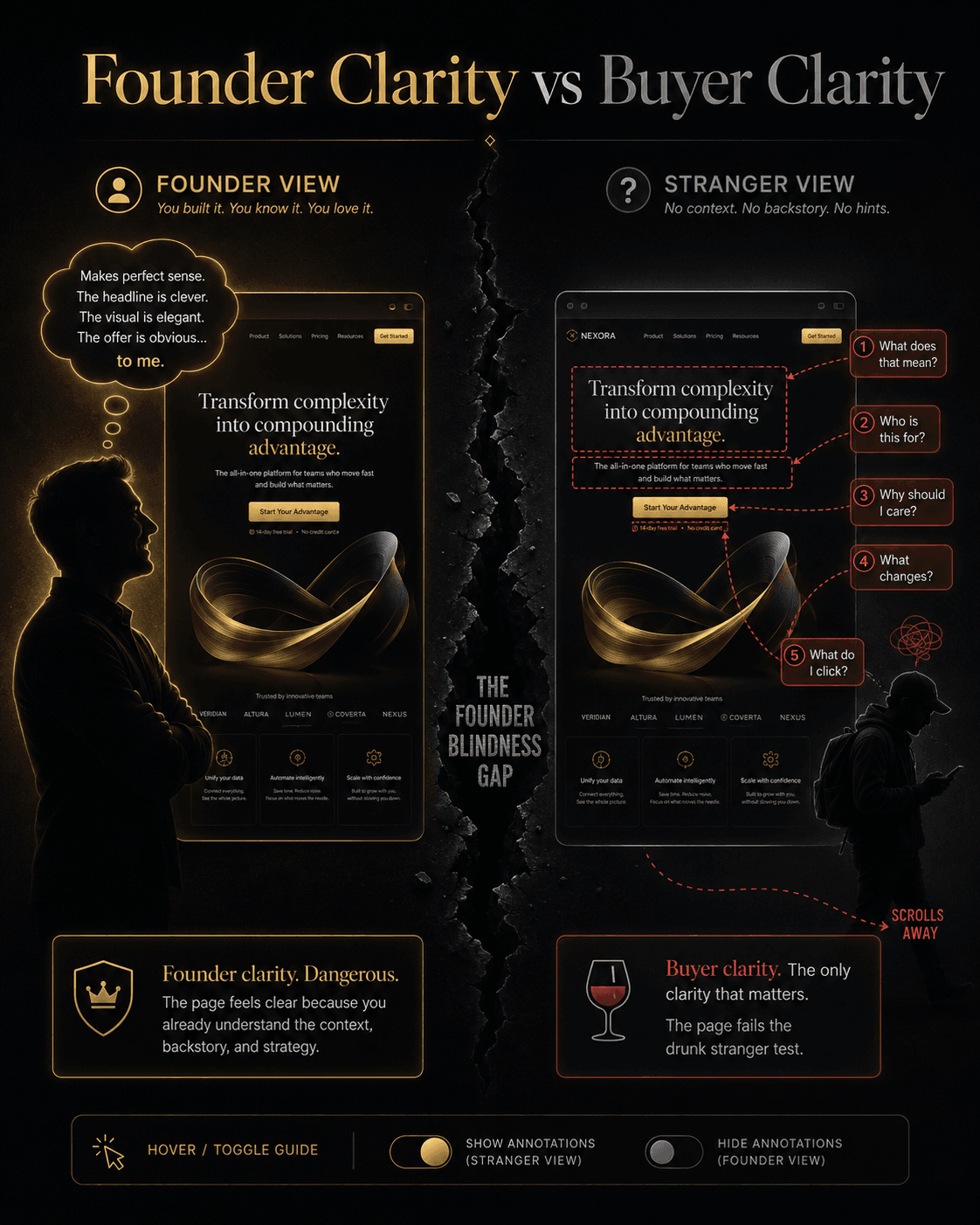
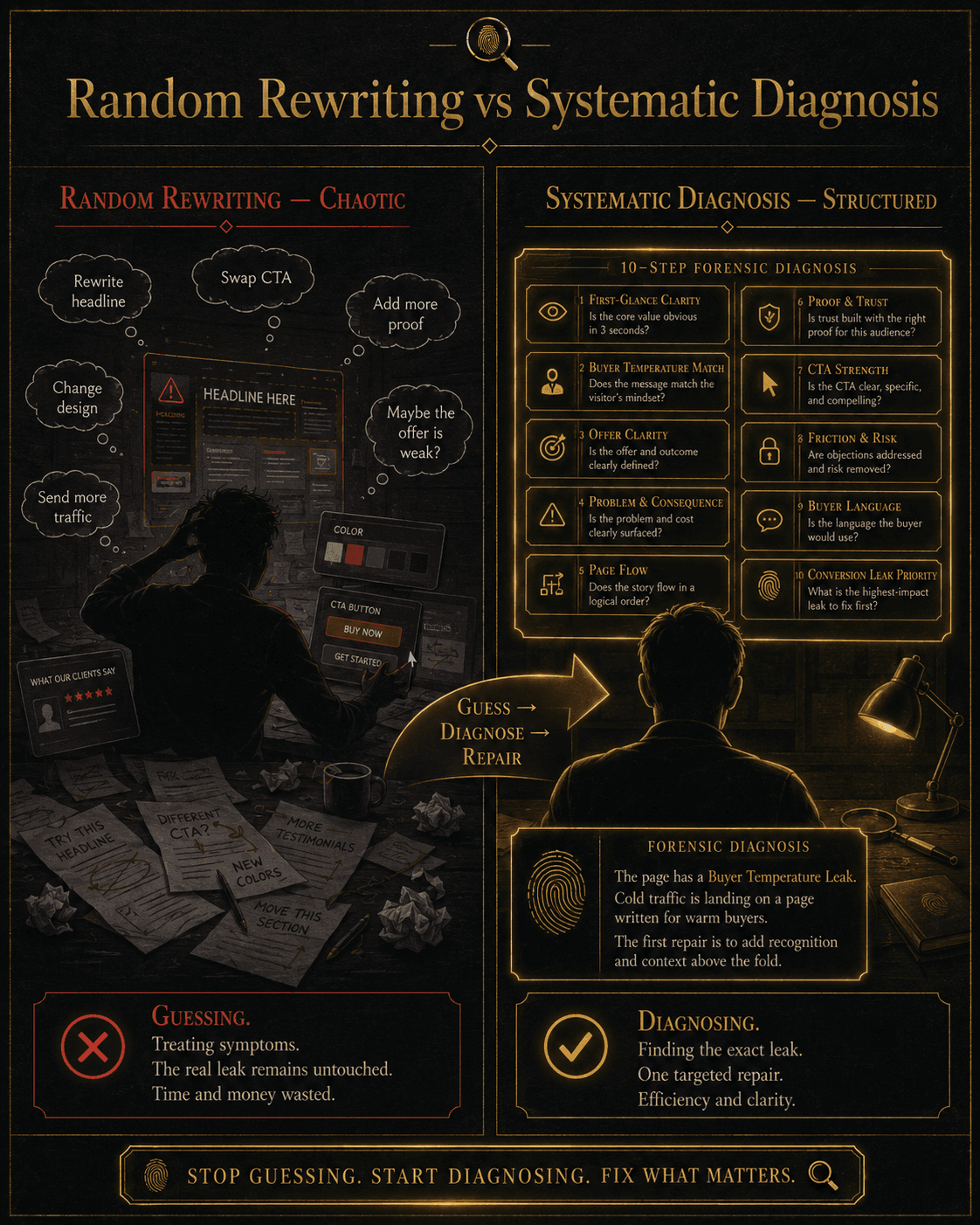
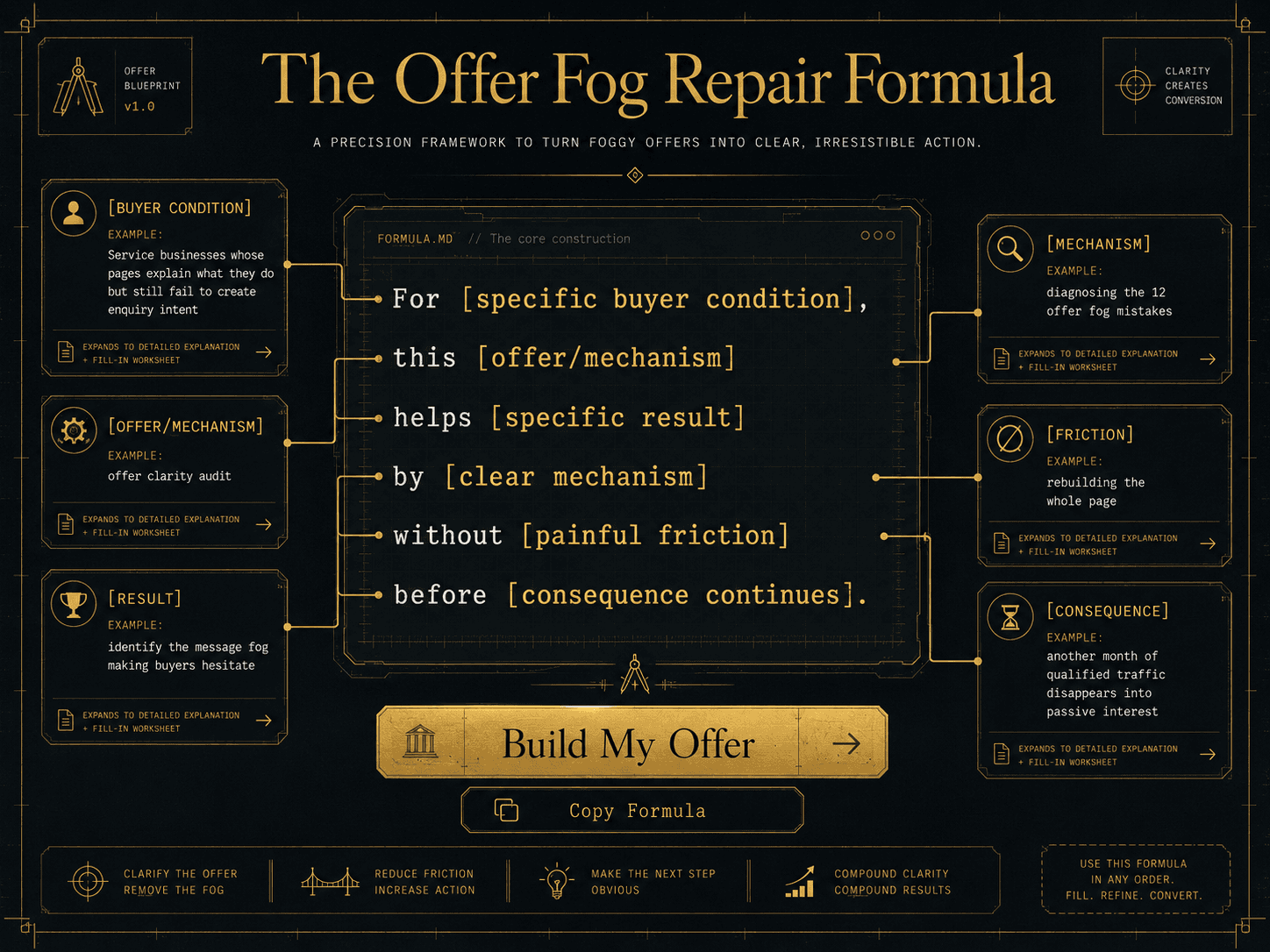
Other Blogs
Other Blogs
Check our other project Blogs with useful insight and information for your businesses