Our Three Step Process
May 28, 2026
Chap 2 | Resource 8 | The Conversion Depth Map™ (levels 16-18)
Our Three Step Process
May 28, 2026
Chap 2 | Resource 8 | The Conversion Depth Map™ (levels 16-18)
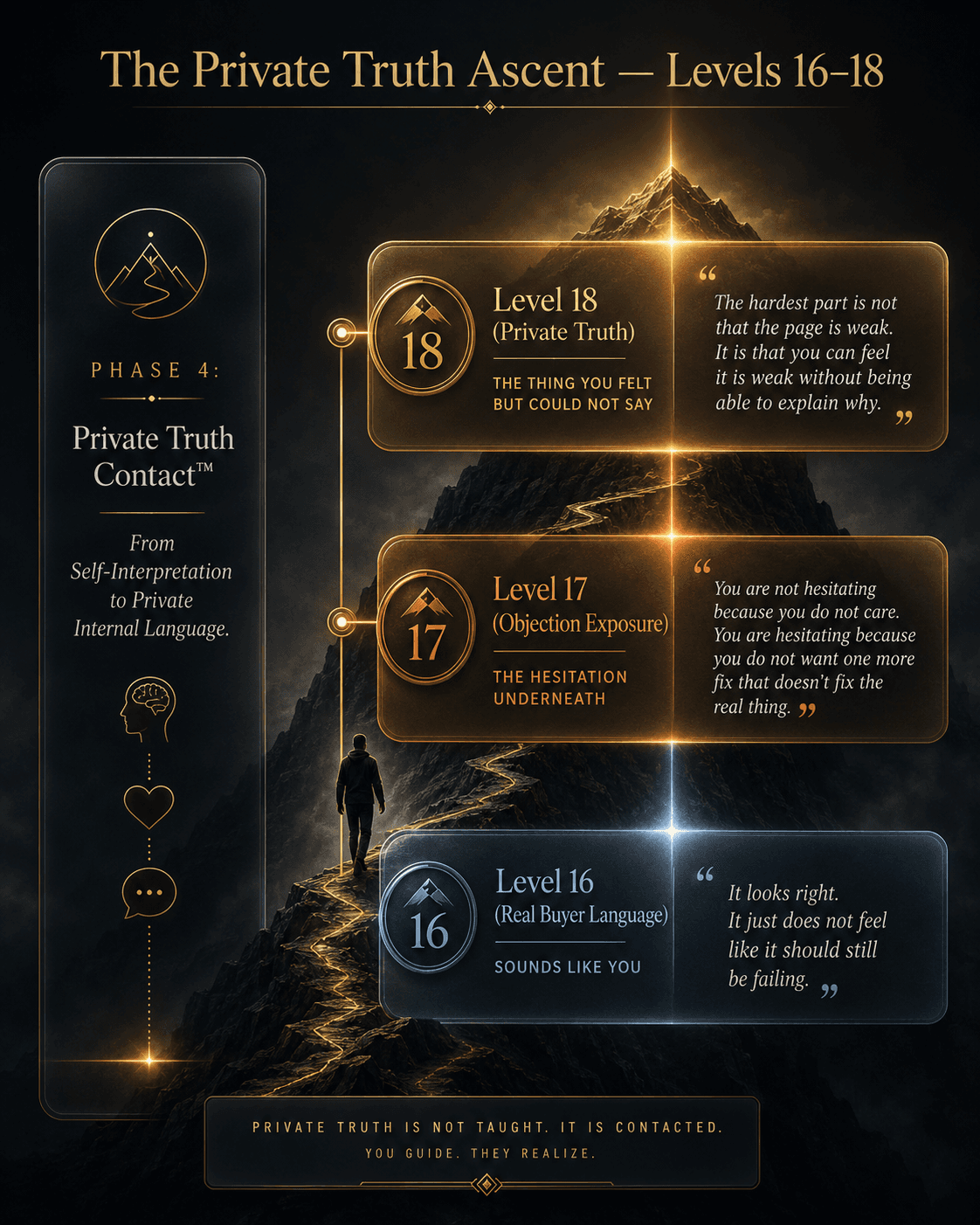
The Conversion Depth Map™ Phase 4: Private Truth Contact (levels 16-18). From self-interpretation to private internal language. This phase diagnoses whether your copy sounds like real buyer language, exposes hidden objections, and articulates the private truth the buyer has felt but struggled to explain.
Prefer Audio Or Video?
The Conversion Depth Map™ is also available as:
🎧 A guided audio walkthrough explaining messaging depth, psychological resonance, and conversion sophistication
🎥 A practical video breakdown showing real-world examples of shallow vs deep messaging progressionChoose the format that fits how you learn best.
[Listen To The Audio Walkthrough] (coming soon)
[Watch The Video Breakdown] (coming soon)
——
Phase 4: Private Truth Contact™
From Self-Interpretation To Private Internal Language
Phase 1 moved the messaging from generic language into basic recognition.
Phase 2 moved the messaging into emotional complexity.
Phase 3 moved the messaging into self-interpretation, identity protection, internal inconsistency, emotional justification, and future-self tension.
Phase 4 goes even deeper.
This is where the copy begins sounding less like it was written by a marketer and more like it came from inside the buyer’s own private internal language.
That is a major shift.
Because buyers do not only have problems.
They do not only have emotions.
They do not only have stories.
They also have private phrases, hidden objections, and unspoken truths they rarely say clearly in public.
They may not write these thoughts in a testimonial.
They may not say them on a sales call.
They may not admit them directly in a survey.
But they feel them.
They carry them.
They hesitate because of them.
They make decisions around them.
And when the copy names them accurately, the buyer feels a different level of recognition.
Not just:
“This understands my problem.”
Not just:
“This understands my emotion.”
Not just:
“This understands what this has started to mean to me.”
But:
“This sounds like the thing I have been thinking privately.”
That is the power of Phase 4.
What Phase 4 Helps You Diagnose
Phase 4 helps you identify whether your messaging has moved from identity-level meaning into private buyer truth.
Use Phase 4 to diagnose:
whether the copy sounds like real buyer language
whether the message reflects phrases the buyer might actually think or say privately
whether the copy exposes objections before the buyer hides behind them
whether the copy names the hesitation underneath the hesitation
whether the message articulates what the buyer feels but struggles to explain
whether the copy creates trust through private recognition
whether the messaging feels human, precise, and psychologically believable
This phase is where messaging starts becoming elite.
Because once a buyer feels privately understood, trust rises faster.
Not because the copy is louder.
Because it is harder to dismiss.
The Phase 4 Warning
Private-truth messaging must be handled with extreme care.
This phase is not about exposing the buyer aggressively.
It is not about humiliating them.
It is not about forcing emotional vulnerability.
It is not about saying things so personal that the buyer feels invaded.
Phase 4 should feel:
human
quiet
accurate
restrained
believable
specific
emotionally safe
The buyer should feel:
“That is exactly it.”
Not:
“This is too much.”
The goal is private recognition.
Not emotional intrusion.
Level 16: Real Buyer Language™
What This Level Actually Is
Real Buyer Language™ is where the copy begins using words that sound like the buyer’s own internal phrasing.
This is the first level of Private Truth Contact™.
At this level, the message no longer sounds like polished marketing language.
It sounds closer to the buyer’s actual thoughts.
It uses phrases that feel real, conversational, emotionally honest, and specific to the buyer’s world.
The copy starts sounding like something the buyer might say quietly to themselves, to a colleague, to a friend, or in a moment of frustration.
That matters because buyers trust language that feels discovered more than language that feels invented.
Weak marketers invent polished language.
Strong marketers discover buyer language.
Level 16 is where that discovered language enters the page.
How Level 16 Sounds
Examples:
“It looks right. It just does not feel like it should still be failing.”
“I have changed the page so many times that I do not even know what I am judging anymore.”
“The funnel is not broken enough to throw away, but not strong enough to trust either.”
“I keep fixing pieces of it, but I still cannot tell whether the real problem is gone.”
“The page looks finished, but I still hesitate before sending more traffic to it.”
“This should feel clearer by now.”
Now the messaging feels:
human
specific
grounded
conversational
privately familiar
emotionally believable
It does not sound like marketing trying to impress.
It sounds like the buyer’s own world reflected back at them.
What Buyers Feel At This Level
The buyer may think:
“That sounds exactly like something I would say.”
Or:
“That is the sentence I have not been able to articulate.”
This creates strong recognition because the message feels close to the buyer’s real language.
Not corporate language.
Not expert language.
Not polished positioning language.
Real language.
And real language creates trust because it feels less manufactured.
Why Real Buyer Language Works
Real buyer language works because it lowers the distance between the page and the person reading it.
Most copy sounds like a business talking about a buyer.
Real Buyer Language™ sounds like the buyer’s own internal phrasing has been understood.
That creates:
emotional realism
trust
recognition
continuation
believability
psychological closeness
When the language sounds like the buyer’s own world, the page feels less like an interruption.
It feels like a reflection.
Marketing Language vs Real Buyer Language
Marketing Language
“Improve your funnel performance with strategic optimisation.”
Technically understandable.
Emotionally distant.
Real Buyer Language
“I keep changing the page, but I still do not know why people are leaving.”
Now the sentence feels human.
It has:
frustration
uncertainty
lived experience
directness
specificity
That is much harder to ignore.
Corporate Language vs Real Buyer Language
Corporate Language
“Unlock scalable growth through optimised conversion assets.”
Polished.
But emotionally empty.
Real Buyer Language
“I do not want more traffic until I know the page can actually hold the click.”
Now the buyer’s real decision logic appears.
That creates recognition.
The “Buyer Would Actually Say This” Test™
One of the easiest ways to identify Level 16 messaging is to ask:
“Would a real buyer actually say this?”
If the answer is no, the copy may still be too polished.
If the answer is yes, you may be entering Real Buyer Language™.
This does not mean the copy has to be casual or messy.
It means the copy must feel psychologically natural.
A sentence can be well-written and still sound human.
That is the standard.
Where Real Buyer Language Comes From
Real Buyer Language™ should come from evidence.
Do not invent it blindly.
Look for it in:
sales calls
discovery calls
support tickets
customer interviews
Reddit threads
YouTube comments
reviews
testimonials
DMs
email replies
survey responses
competitor reviews
community discussions
Look for phrases such as:
“I’m tired of…”
“It feels like…”
“I keep…”
“I thought it would…”
“The problem is…”
“I don’t want to…”
“I’m worried that…”
“What I actually want is…”
These phrases often reveal copy that feels alive.
The Biggest Mistake At Level 16
The biggest mistake is over-polishing the buyer’s language until the pressure disappears.
This happens all the time.
A buyer says:
“I’m tired of changing the page and still feeling like something is off.”
The marketer turns it into:
“Seeking improved landing page optimisation.”
The emotional truth is gone.
The buyer disappeared from the sentence.
That is the failure.
Raw vs Over-Polished
Raw Buyer Language
“I’m tired of sending traffic to a page I still do not fully trust.”
Strong.
Specific.
Human.
Over-Polished Version
“Improving confidence in conversion infrastructure.”
Dead.
Abstract.
Emotionally sterile.
The Rule
Clean the grammar if needed.
Sharpen the sentence if needed.
Shorten the line if needed.
But do not clean out the pressure.
Do not remove the human feeling.
Do not convert private buyer language into corporate abstraction.
Level 16 Diagnostic Question
Ask:
“Does this message sound like something the buyer might actually think, say, or admit privately?”
If yes, you are approaching Real Buyer Language™.
Level 16 Fill-In Worksheet
The raw buyer phrase is:
The buyer might say this when:
The emotion behind the phrase is:
The pressure inside the phrase is:
The phrase should not be over-polished because:
A page-ready version is:
Level 16 AI Depth Diagnostic Prompt
Use this prompt:
Act as a conversion strategist trained in voice-of-customer analysis and real buyer language.
Analyse whether this messaging sounds like real buyer language or polished marketing language.
Look for:
phrases a real buyer would actually say
phrases that sound corporate or artificial
over-polished language
missing emotional realism
language that sounds discovered versus invented
buyer phrases that should be preserved
Tell me:
Which lines sound most like real buyer language.
Which lines sound too polished or artificial.
What pressure may have been removed through over-editing.
How to rewrite the copy so it sounds more human without becoming messy.
Which phrases should be preserved almost exactly.
Here is the messaging:
[paste messaging]
Level 17: Objection Exposure™
What This Level Actually Is
Objection Exposure™ is where the copy names the hesitation before the buyer can hide behind it.
This is a very advanced level of messaging.
At this level, the copy does not merely handle objections after they appear.
It exposes the emotional objection underneath the buyer’s hesitation.
Most buyers do not always state their real objection directly.
They may say:
“I need to think about it.”
“I need more time.”
“I need to compare options.”
“I am not sure yet.”
“I will come back later.”
Sometimes those statements are true.
But often, they are surface explanations covering deeper hesitation.
Objection Exposure™ names the deeper concern carefully.
It helps the buyer feel:
“This understands why I am hesitating.”
That creates trust when done with respect.
How Level 17 Sounds
Examples:
“You are not hesitating because you do not care. You are hesitating because you do not want to buy one more fix that still does not fix the real thing.”
“You are not resisting the idea of improving the funnel. You are resisting the possibility of trusting another framework that sounds clear but leaves you guessing again.”
“You do not need more convincing. You need proof that this will not become another polished explanation that changes nothing operationally.”
“The hesitation is not about whether the page matters. It is about whether this diagnosis will actually show you something you have not already tried.”
“You are not avoiding action because the problem is small. You are avoiding the risk of committing to one more solution before the real leak is clear.”
Now the messaging reflects:
hesitation
distrust
buyer protection
hidden objection
emotional resistance
decision friction
This is deeper than basic objection handling.
It exposes the objection’s emotional root.
What Buyers Feel At This Level
The buyer may think:
“That is exactly why I have not acted yet.”
Or:
“Yes. That is the real hesitation.”
This matters because the copy has moved beyond persuasion.
It is no longer simply trying to answer the objection.
It is showing that the objection makes sense.
That creates emotional safety.
And emotional safety lowers resistance.
Objection Handling vs Objection Exposure
Objection Handling
“You may be wondering whether this works.”
Useful, but broad.
Objection Exposure
“You may not be doubting whether funnels matter. You may be doubting whether another funnel framework can actually show you the problem you have not been able to see yet.”
The second version is deeper.
It understands the real hesitation.
Not just the stated objection.
Surface Objection vs Hidden Objection
Surface Objection
“I need more time.”
Hidden Objection
“I do not want to make another decision that feels smart now but disappointing later.”
That hidden objection carries much more emotional weight.
Strong copy should not attack it.
It should acknowledge it.
Why Objection Exposure Builds Trust
Most buyers are used to being argued with.
They expect the page to push.
They expect the seller to overcome their resistance.
They expect pressure.
Objection Exposure™ feels different.
It says:
“I understand why you would hesitate.”
That lowers defensiveness.
Because the buyer no longer feels wrong for being cautious.
They feel understood.
And once a buyer feels understood, they become more open to the next explanation, proof, or offer.
The “Before The Buyer Says It” Effect™
Objection Exposure™ works because it names the hesitation before the buyer has to say it.
The buyer thinks:
“That is exactly what I was worried about.”
That creates recognition.
But it also creates credibility.
Because if you understand the hesitation accurately, the buyer may assume you understand the problem more deeply too.
That is why this level is so powerful.
Common Hidden Objections
Look for hidden objections such as:
“I have tried this before.”
“This sounds like another template.”
“I do not want more work.”
“I do not trust hype.”
“I do not know if this applies to my situation.”
“I am tired of frameworks that sound good but do not fix the real issue.”
“I need proof before I believe this.”
“I do not want to feel stupid for missing something obvious.”
“I do not want to spend money just to be told what I already know.”
These are not merely objections.
They are protection signals.
The Biggest Mistake At Level 17
The biggest mistake is making the buyer feel exposed in a hostile way.
Do not write objection exposure like an accusation.
Do not say:
“You are just scared to act.”
Or:
“You are making excuses.”
Or:
“You do not really want success.”
That language triggers defensiveness.
Strong Objection Exposure™ sounds understanding.
Not confrontational.
Fake vs Real Objection Exposure
Fake
“You are only hesitating because you are scared to succeed.”
Manipulative.
Lazy.
Psychologically careless.
Real
“You may be hesitating because the last few ‘solutions’ sounded useful at first, but still left you doing the hard part alone afterwards.”
Now the objection feels understood.
Not attacked.
The Respect Rule
Expose the hesitation without humiliating the buyer.
Name the resistance without turning it into a character flaw.
Show the buyer that their caution makes sense.
Then explain why the next step is different, safer, clearer, or more grounded.
That is how objection exposure preserves trust.
Level 17 Diagnostic Question
Ask:
“Does this message name the real hesitation underneath the buyer’s stated objection?”
If yes, you are approaching Objection Exposure™.
Level 17 Fill-In Worksheet
The surface objection is:
The buyer says:
But the real hesitation may be:
The buyer is trying to avoid:
The respectful way to expose the objection is:
An objection-exposure message is:
Level 17 AI Depth Diagnostic Prompt
Use this prompt:
Act as a conversion strategist trained in buyer resistance, objection psychology, and trust-preserving objection handling.
Analyse whether this messaging exposes the real hesitation underneath the buyer’s stated objection.
Look for:
surface objections
hidden objections
emotional resistance
distrust from previous failed attempts
buyer protection
premature pressure
hesitation that has not been named
objection handling that feels too generic
Tell me:
What objections are currently handled.
What hidden objections may be missing.
Whether the copy exposes hesitation respectfully or aggressively.
Where the copy may trigger defensiveness.
How to rewrite the message so the buyer feels understood, not attacked.
Here is the messaging:
[paste messaging]
Level 18: Private Truth™
What This Level Actually Is
Private Truth™ is where the copy says the thing the buyer has felt but has not articulated clearly yet.
This is the deepest level of Phase 4.
At this level, the message no longer simply uses buyer language.
It no longer only exposes objections.
It articulates the private truth underneath the whole experience.
The thing the buyer can feel.
The thing they may have thought around.
The thing they may have avoided saying directly.
The thing they may not have had clear words for yet.
Private Truth™ is powerful because it creates a moment of internal recognition.
The buyer feels:
“That is it.”
Not because the copy is dramatic.
Because it is accurate.
How Level 18 Sounds
Examples:
“The hardest part is not that the page is weak. It is that you can feel it is weak without being able to explain why.”
“You are not really looking for another opinion on the funnel. You are looking for the relief of finally knowing what has been quietly wrong the whole time.”
“The problem is not that you have done nothing. The problem is that you have done so much and still cannot fully trust whether the right thing has been fixed.”
“You do not want someone to make the page sound prettier. You want someone to show you where belief is actually breaking.”
“The real frustration is not low conversion by itself. It is the uncertainty of not knowing whether the next change is fixing the leak or just decorating it.”
Now the messaging reflects:
private truth
hidden clarity
emotional reality
unspoken frustration
internal honesty
psychological precision
This is elite territory.
Because once a buyer feels privately understood, trust rises faster.
What Buyers Feel At This Level
The buyer may think:
“That is exactly what I have been feeling.”
Or:
“I did not know how to say it, but that is it.”
Or:
“That is the real issue.”
This reaction matters because Private Truth™ gives language to something the buyer already felt but had not fully organised.
That creates enormous trust.
Because the copy is not merely describing the situation.
It is clarifying the buyer’s own internal experience.
Why Private Truth Creates Strong Recognition
Private Truth™ works because many buyers carry unclear emotional knowledge.
They know something is wrong.
They feel the friction.
They sense the problem has not been solved.
But they cannot fully explain it.
When the copy articulates that unclear feeling precisely, it creates relief.
The buyer feels:
“Finally. Someone has named it.”
That is one of the strongest recognition effects in conversion messaging.
Private Truth vs Private Thought
Private Thought
“I do not fully trust this page.”
Strong.
Private Truth
“The hardest part is not that you distrust the page. It is that you can feel the distrust every time you look at it, but still cannot clearly identify which part is causing it.”
The second version reaches deeper.
It describes the internal reality behind the thought.
Private Truth vs Hidden Fear
Hidden Fear
“What if I keep fixing the wrong thing?”
Strong.
Private Truth
“The deeper frustration is that every fix gives you something new to look at, but not always more certainty that the real leak has been found.”
Now the copy articulates the structure of the experience.
That creates deeper recognition.
The “I Could Feel It But Could Not Explain It” Effect™
This is the central effect of Level 18.
The buyer has been feeling something.
But the feeling was unclear.
The copy gives the feeling structure.
Examples:
“I knew the page felt off, but I could not explain why.”
“I knew something was leaking trust, but I did not know where.”
“I knew I was hesitating, but I did not know what the hesitation was protecting.”
“I knew I wanted more clarity, but I did not realise what I really wanted was confidence in the diagnosis.”
This is where copy becomes more than persuasion.
It becomes articulation.
The Biggest Mistake At Level 18
The biggest mistake is trying to force “deep truth” before the page has earned trust.
Private Truth™ should usually appear after enough relevance, recognition, and emotional safety already exist.
If it appears too early, it can feel too intense.
If it is exaggerated, it can feel manipulative.
If it is vague, it can feel fake.
Private Truth™ must be:
specific
restrained
grounded
buyer-relevant
emotionally safe
useful
It should not feel like emotional performance.
It should feel like accurate articulation.
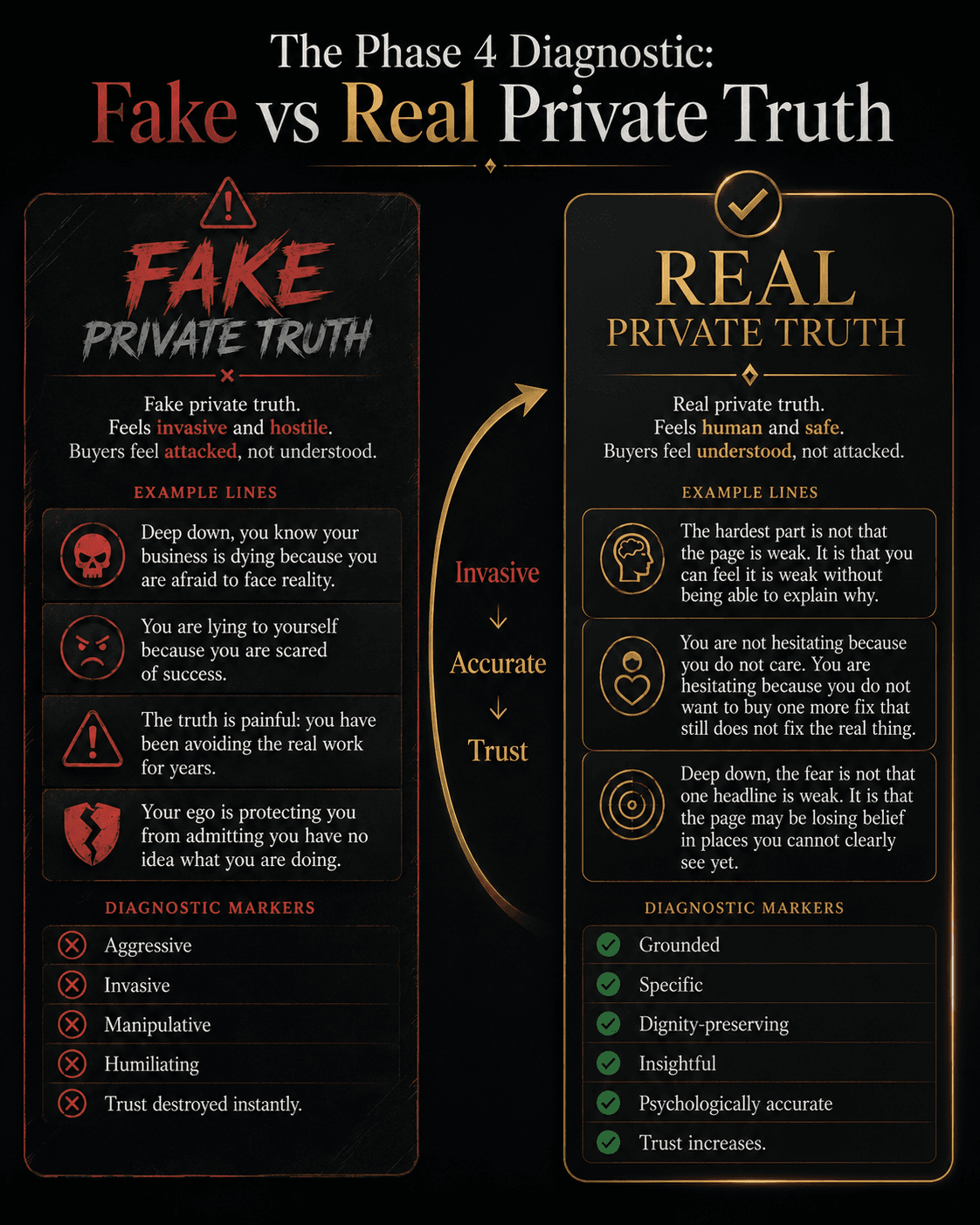
Fake vs Real Private Truth
Fake
“Deep down, you know your business is dying because you are afraid to face reality.”
Too aggressive.
Too dramatic.
Too manipulative.
Real
“Deep down, the fear is not that one headline is weak. It is that the page may be losing belief in places you cannot clearly see yet.”
Now the private truth is specific.
It is restrained.
It is connected to the actual problem.
That is the standard.
The Private Truth Rule
Only say the deeper thing if it helps the buyer understand their situation more clearly.
Do not say it just to sound powerful.
Do not say it just to create emotional intensity.
Do not say it just to shock.
Private Truth™ should create clarity.
Not emotional pressure for its own sake.
Level 18 Diagnostic Question
Ask:
“Does this message articulate something the buyer has felt but struggled to explain clearly?”
If yes, you are approaching Private Truth™.
Level 18 Fill-In Worksheet
The buyer’s obvious problem is:
The buyer’s private frustration is:
The thing they can feel but cannot explain is:
The deeper truth underneath the situation is:
The emotionally safe way to say it is:
A private-truth message is:
Level 18 AI Depth Diagnostic Prompt
Use this prompt:
Act as a conversion strategist trained in private-truth messaging, buyer psychology, and emotional realism.
Analyse whether this messaging articulates a private truth the buyer has felt but struggled to explain clearly.
Look for:
private frustration
unspoken truth
unclear emotional knowing
hidden hesitation
internal reality
psychological precision
language that clarifies rather than exaggerates
Tell me:
What private truth is currently present.
What deeper private truth may be missing.
Whether the message feels accurate or overly dramatic.
Whether the copy has earned enough trust to say this.
How to rewrite the message so it feels precise, useful, and emotionally safe.
Here is the messaging:
[paste messaging]
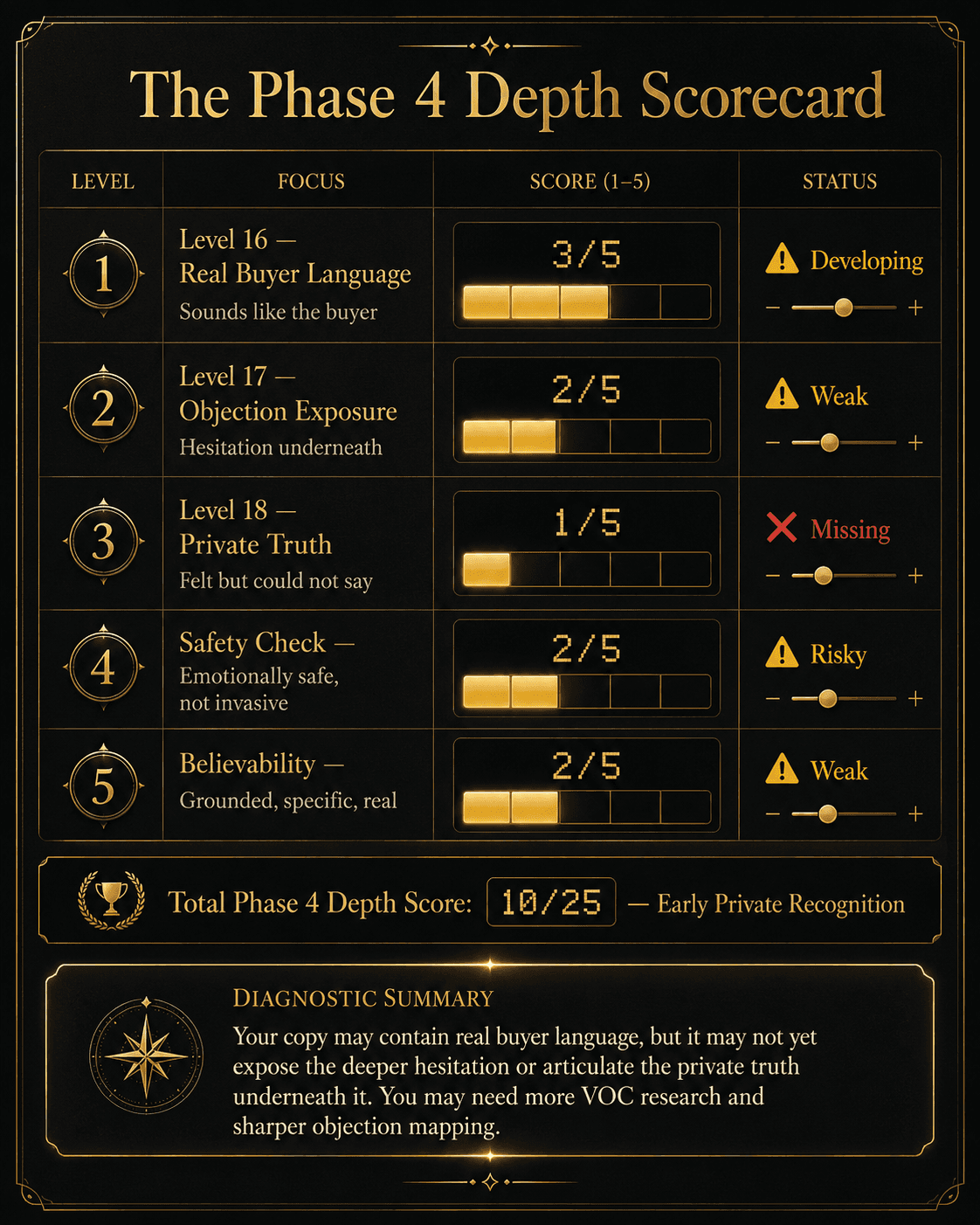
Phase 4 Conversion Depth Scorecard™
Use this scorecard to diagnose whether your messaging has moved from identity contact into private truth contact.
Score each level from 1 to 5.
1 = weak or missing
2 = present but shallow
3 = usable
4 = strong
5 = highly accurate and recognisable
Level 16: Real Buyer Language
Does the messaging sound like something the buyer might actually think, say, or admit privately?
Score: ___ / 5
Level 17: Objection Exposure
Does the messaging name the real hesitation underneath the buyer’s stated objection?
Score: ___ / 5
Level 18: Private Truth
Does the messaging articulate something the buyer has felt but struggled to explain clearly?
Score: ___ / 5
Emotional Safety Check
Does the messaging create private recognition without feeling invasive, accusatory, or manipulative?
Score: ___ / 5
Believability Check
Does the messaging feel grounded, specific, and psychologically believable?
Score: ___ / 5
Total Phase 4 Depth Score
Total: ___ / 25
——
What Your Score Means
21–25: Strong Phase 4 Depth
Your messaging is entering private truth contact.
It likely sounds human, specific, and unusually recognisable without becoming manipulative.
16–20: Good But Needs More Precision
Your messaging is approaching private truth, but some parts may still feel slightly polished, indirect, or underdeveloped.
Look for missing buyer language, hidden objections, or unclear private truth.
10–15: Early Private Recognition
Your copy may contain real buyer language, but it may not yet expose the deeper hesitation or articulate the private truth underneath it.
You may need more VOC research and sharper objection mapping.
0–9: Still Mostly Identity Or Emotional Contact
Your copy may reflect emotion or identity, but it probably does not yet sound like the buyer’s internal language.
Return to real buyer phrases, private objections, and unspoken concerns.
——
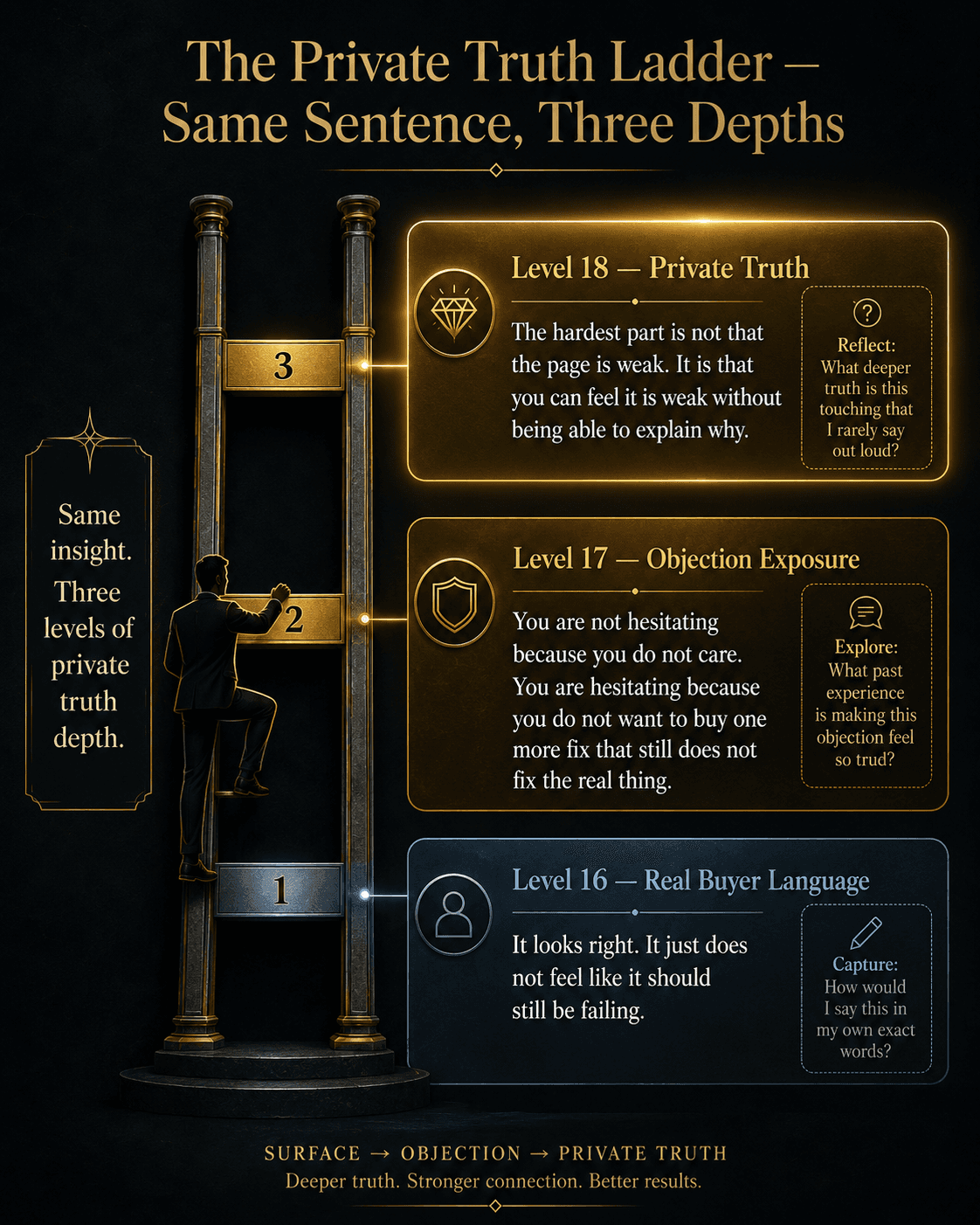
The Phase 4 Rewrite Ladder™
Use this ladder to move one sentence through Levels 16–18.
Level 16: Real Buyer Language
What would the buyer actually say or think?
Example:
“It looks right. It just does not feel like it should still be failing.”
Your version:
Level 17: Objection Exposure
What hesitation is the buyer hiding behind?
Example:
“You are not hesitating because you do not care. You are hesitating because you do not want to buy one more fix that still does not fix the real thing.”
Your version:
Level 18: Private Truth
What has the buyer felt but not clearly articulated?
Example:
“The hardest part is not that the page is weak. It is that you can feel it is weak without being able to explain why.”
Your version:
Phase 4 Worked Example
Level 16: Real Buyer Language™
“It looks right. It just does not feel like it should still be failing.”
This sounds like something the buyer might actually say privately.
It is human, simple, and emotionally believable.
Level 17: Objection Exposure™
“You are not hesitating because you do not care. You are hesitating because you do not want to buy one more fix that still does not fix the real thing.”
This names the hesitation beneath the objection.
It respects the buyer’s caution instead of attacking it.
Level 18: Private Truth™
“The hardest part is not that the page is weak. It is that you can feel it is weak without being able to explain why.”
This articulates the private truth underneath the experience.
The buyer feels recognised because the copy gives language to something they already felt.
——
Phase 4 Implementation Exercise™
Take one headline, hook, objection section, proof section, or CTA transition from your page.
Write the current version here:
Now identify the current level:
Level 16 / Level 17 / Level 18 / Not yet Phase 4
Why is it currently at this level?
What would the buyer actually say privately?
What objection are they likely hiding behind?
What is the real hesitation underneath that objection?
What truth have they felt but struggled to explain?
What would be the emotionally safe way to say it?
Final improved version:
——
Phase 4 Final Principle™
Phase 4 teaches the fourth major shift in conversion depth:
Stop only reflecting what the buyer feels or what the buyer thinks the problem means.
Start reflecting the private language, hidden hesitation, and unspoken truth underneath the buyer’s experience.
The journey moves like this:
Level 16 says:
“This sounds like something you would actually think or say.”
Level 17 says:
“This is the hesitation underneath the objection.”
Level 18 says:
“This is the thing you have felt but have not been able to explain clearly.”
That is where messaging enters private truth contact.
It stops sounding like marketing.
It starts sounding like recognition.
But this level must be handled carefully.
Private truth should create clarity, not discomfort for its own sake.
It should make the buyer feel understood, not exposed.
It should reduce resistance, not create shame.
Used carelessly, this level becomes invasive.
Used carefully, it creates extraordinary trust.
Because once the buyer feels privately understood, the message becomes difficult to dismiss.
That is the power of Phase 4.
——
From:
The $100M Funnel Playbook. Book I: Foundation Buyer Psychology, Offer Clarity, and the Page Architecture Behind High-Converting Funnels
By Maris Spalins.
——
Copyright Notice
© 2026 The $100M Funnel Playbook / Winyourclients / Maris Spalins. All rights reserved.
This resource, including the frameworks, terminology, examples, scorecards, templates, prompts, methods, and written explanations, is original intellectual property created for The $100M Funnel Playbook. Book I: Foundation — Buyer Psychology, Offer Clarity, And The Page Architecture Behind High-Converting Funnels and published through Winyourclients.
No part of this resource may be copied, reproduced, screenshotted, republished, redistributed, sold, adapted, uploaded, scraped, stored in a database, included in training data, used to train artificial intelligence systems, or used to create derivative commercial or educational materials without prior written permission.
Limited reference, quotation, or sharing is only permitted where the source is clearly and visibly credited.
Any permitted reference must include at least one of the following source credits:
The $100M Funnel Playbook by Maris Spalins
or
Winyourclients — www.winyourclients.com
or
Maris Spalins / Winyourclients
Screenshots, excerpts, summaries, or redistributed versions must not remove, hide, alter, crop out, or obscure the original source, author name, book title, website name, or copyright notice.
This resource is provided for personal learning and implementation only. It is not licensed for resale, republishing, redistribution, AI training, template cloning, course creation, consulting delivery, or commercial reuse without written permission from Maris Spalins or Winyourclients.
For permission requests, licensing, citation approval, or commercial usage enquiries, contact:
Winyourclients
www.winyourclients.com
or
Email directly to Jacob on: help@winyourclients.com
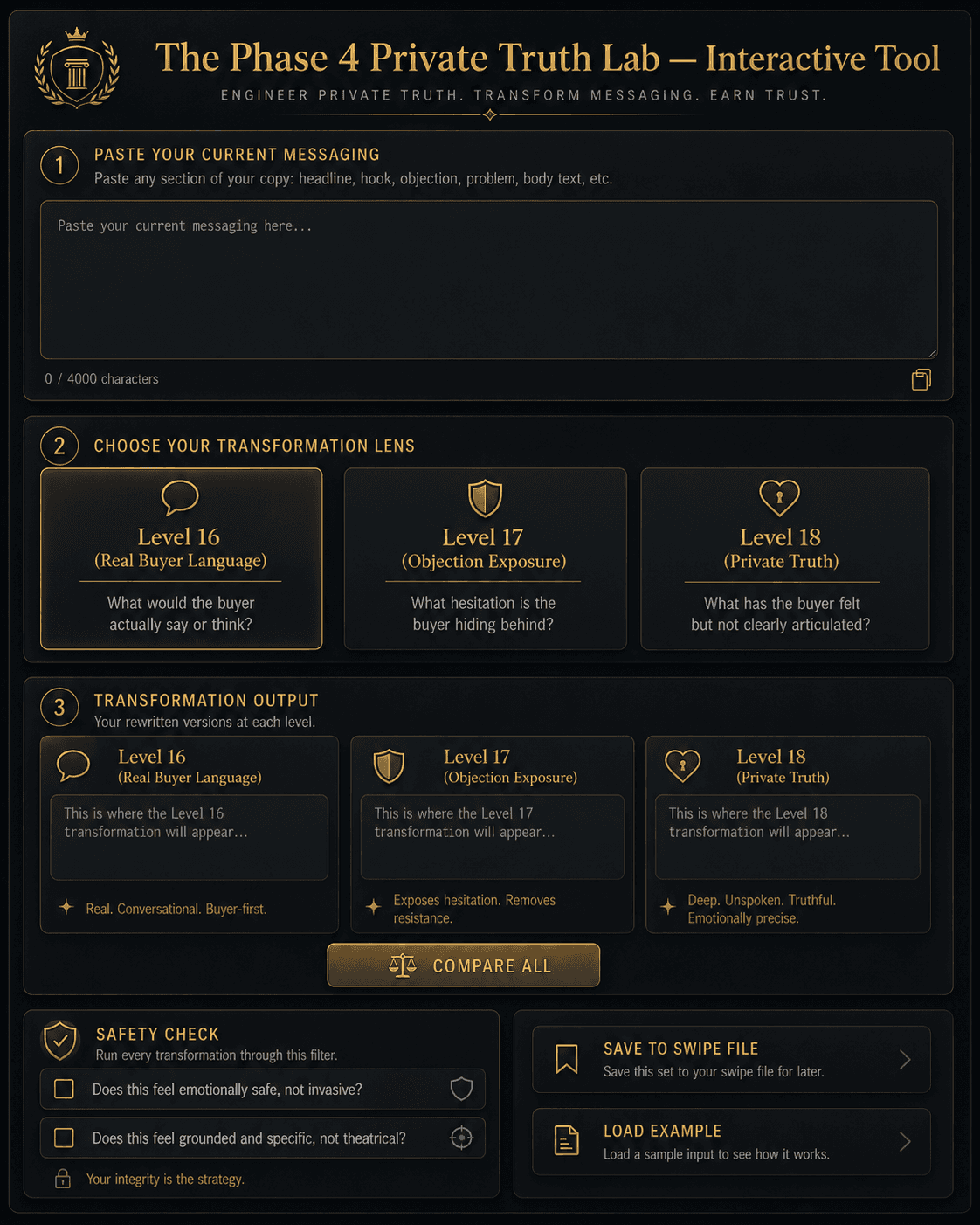
The Conversion Depth Map™ Phase 4: Private Truth Contact (levels 16-18). From self-interpretation to private internal language. This phase diagnoses whether your copy sounds like real buyer language, exposes hidden objections, and articulates the private truth the buyer has felt but struggled to explain.
Prefer Audio Or Video?
The Conversion Depth Map™ is also available as:
🎧 A guided audio walkthrough explaining messaging depth, psychological resonance, and conversion sophistication
🎥 A practical video breakdown showing real-world examples of shallow vs deep messaging progressionChoose the format that fits how you learn best.
[Listen To The Audio Walkthrough] (coming soon)
[Watch The Video Breakdown] (coming soon)
——
Phase 4: Private Truth Contact™
From Self-Interpretation To Private Internal Language
Phase 1 moved the messaging from generic language into basic recognition.
Phase 2 moved the messaging into emotional complexity.
Phase 3 moved the messaging into self-interpretation, identity protection, internal inconsistency, emotional justification, and future-self tension.
Phase 4 goes even deeper.
This is where the copy begins sounding less like it was written by a marketer and more like it came from inside the buyer’s own private internal language.
That is a major shift.
Because buyers do not only have problems.
They do not only have emotions.
They do not only have stories.
They also have private phrases, hidden objections, and unspoken truths they rarely say clearly in public.
They may not write these thoughts in a testimonial.
They may not say them on a sales call.
They may not admit them directly in a survey.
But they feel them.
They carry them.
They hesitate because of them.
They make decisions around them.
And when the copy names them accurately, the buyer feels a different level of recognition.
Not just:
“This understands my problem.”
Not just:
“This understands my emotion.”
Not just:
“This understands what this has started to mean to me.”
But:
“This sounds like the thing I have been thinking privately.”
That is the power of Phase 4.
What Phase 4 Helps You Diagnose
Phase 4 helps you identify whether your messaging has moved from identity-level meaning into private buyer truth.
Use Phase 4 to diagnose:
whether the copy sounds like real buyer language
whether the message reflects phrases the buyer might actually think or say privately
whether the copy exposes objections before the buyer hides behind them
whether the copy names the hesitation underneath the hesitation
whether the message articulates what the buyer feels but struggles to explain
whether the copy creates trust through private recognition
whether the messaging feels human, precise, and psychologically believable
This phase is where messaging starts becoming elite.
Because once a buyer feels privately understood, trust rises faster.
Not because the copy is louder.
Because it is harder to dismiss.
The Phase 4 Warning
Private-truth messaging must be handled with extreme care.
This phase is not about exposing the buyer aggressively.
It is not about humiliating them.
It is not about forcing emotional vulnerability.
It is not about saying things so personal that the buyer feels invaded.
Phase 4 should feel:
human
quiet
accurate
restrained
believable
specific
emotionally safe
The buyer should feel:
“That is exactly it.”
Not:
“This is too much.”
The goal is private recognition.
Not emotional intrusion.
Level 16: Real Buyer Language™
What This Level Actually Is
Real Buyer Language™ is where the copy begins using words that sound like the buyer’s own internal phrasing.
This is the first level of Private Truth Contact™.
At this level, the message no longer sounds like polished marketing language.
It sounds closer to the buyer’s actual thoughts.
It uses phrases that feel real, conversational, emotionally honest, and specific to the buyer’s world.
The copy starts sounding like something the buyer might say quietly to themselves, to a colleague, to a friend, or in a moment of frustration.
That matters because buyers trust language that feels discovered more than language that feels invented.
Weak marketers invent polished language.
Strong marketers discover buyer language.
Level 16 is where that discovered language enters the page.
How Level 16 Sounds
Examples:
“It looks right. It just does not feel like it should still be failing.”
“I have changed the page so many times that I do not even know what I am judging anymore.”
“The funnel is not broken enough to throw away, but not strong enough to trust either.”
“I keep fixing pieces of it, but I still cannot tell whether the real problem is gone.”
“The page looks finished, but I still hesitate before sending more traffic to it.”
“This should feel clearer by now.”
Now the messaging feels:
human
specific
grounded
conversational
privately familiar
emotionally believable
It does not sound like marketing trying to impress.
It sounds like the buyer’s own world reflected back at them.
What Buyers Feel At This Level
The buyer may think:
“That sounds exactly like something I would say.”
Or:
“That is the sentence I have not been able to articulate.”
This creates strong recognition because the message feels close to the buyer’s real language.
Not corporate language.
Not expert language.
Not polished positioning language.
Real language.
And real language creates trust because it feels less manufactured.
Why Real Buyer Language Works
Real buyer language works because it lowers the distance between the page and the person reading it.
Most copy sounds like a business talking about a buyer.
Real Buyer Language™ sounds like the buyer’s own internal phrasing has been understood.
That creates:
emotional realism
trust
recognition
continuation
believability
psychological closeness
When the language sounds like the buyer’s own world, the page feels less like an interruption.
It feels like a reflection.
Marketing Language vs Real Buyer Language
Marketing Language
“Improve your funnel performance with strategic optimisation.”
Technically understandable.
Emotionally distant.
Real Buyer Language
“I keep changing the page, but I still do not know why people are leaving.”
Now the sentence feels human.
It has:
frustration
uncertainty
lived experience
directness
specificity
That is much harder to ignore.
Corporate Language vs Real Buyer Language
Corporate Language
“Unlock scalable growth through optimised conversion assets.”
Polished.
But emotionally empty.
Real Buyer Language
“I do not want more traffic until I know the page can actually hold the click.”
Now the buyer’s real decision logic appears.
That creates recognition.
The “Buyer Would Actually Say This” Test™
One of the easiest ways to identify Level 16 messaging is to ask:
“Would a real buyer actually say this?”
If the answer is no, the copy may still be too polished.
If the answer is yes, you may be entering Real Buyer Language™.
This does not mean the copy has to be casual or messy.
It means the copy must feel psychologically natural.
A sentence can be well-written and still sound human.
That is the standard.
Where Real Buyer Language Comes From
Real Buyer Language™ should come from evidence.
Do not invent it blindly.
Look for it in:
sales calls
discovery calls
support tickets
customer interviews
Reddit threads
YouTube comments
reviews
testimonials
DMs
email replies
survey responses
competitor reviews
community discussions
Look for phrases such as:
“I’m tired of…”
“It feels like…”
“I keep…”
“I thought it would…”
“The problem is…”
“I don’t want to…”
“I’m worried that…”
“What I actually want is…”
These phrases often reveal copy that feels alive.
The Biggest Mistake At Level 16
The biggest mistake is over-polishing the buyer’s language until the pressure disappears.
This happens all the time.
A buyer says:
“I’m tired of changing the page and still feeling like something is off.”
The marketer turns it into:
“Seeking improved landing page optimisation.”
The emotional truth is gone.
The buyer disappeared from the sentence.
That is the failure.
Raw vs Over-Polished
Raw Buyer Language
“I’m tired of sending traffic to a page I still do not fully trust.”
Strong.
Specific.
Human.
Over-Polished Version
“Improving confidence in conversion infrastructure.”
Dead.
Abstract.
Emotionally sterile.
The Rule
Clean the grammar if needed.
Sharpen the sentence if needed.
Shorten the line if needed.
But do not clean out the pressure.
Do not remove the human feeling.
Do not convert private buyer language into corporate abstraction.
Level 16 Diagnostic Question
Ask:
“Does this message sound like something the buyer might actually think, say, or admit privately?”
If yes, you are approaching Real Buyer Language™.
Level 16 Fill-In Worksheet
The raw buyer phrase is:
The buyer might say this when:
The emotion behind the phrase is:
The pressure inside the phrase is:
The phrase should not be over-polished because:
A page-ready version is:
Level 16 AI Depth Diagnostic Prompt
Use this prompt:
Act as a conversion strategist trained in voice-of-customer analysis and real buyer language.
Analyse whether this messaging sounds like real buyer language or polished marketing language.
Look for:
phrases a real buyer would actually say
phrases that sound corporate or artificial
over-polished language
missing emotional realism
language that sounds discovered versus invented
buyer phrases that should be preserved
Tell me:
Which lines sound most like real buyer language.
Which lines sound too polished or artificial.
What pressure may have been removed through over-editing.
How to rewrite the copy so it sounds more human without becoming messy.
Which phrases should be preserved almost exactly.
Here is the messaging:
[paste messaging]
Level 17: Objection Exposure™
What This Level Actually Is
Objection Exposure™ is where the copy names the hesitation before the buyer can hide behind it.
This is a very advanced level of messaging.
At this level, the copy does not merely handle objections after they appear.
It exposes the emotional objection underneath the buyer’s hesitation.
Most buyers do not always state their real objection directly.
They may say:
“I need to think about it.”
“I need more time.”
“I need to compare options.”
“I am not sure yet.”
“I will come back later.”
Sometimes those statements are true.
But often, they are surface explanations covering deeper hesitation.
Objection Exposure™ names the deeper concern carefully.
It helps the buyer feel:
“This understands why I am hesitating.”
That creates trust when done with respect.
How Level 17 Sounds
Examples:
“You are not hesitating because you do not care. You are hesitating because you do not want to buy one more fix that still does not fix the real thing.”
“You are not resisting the idea of improving the funnel. You are resisting the possibility of trusting another framework that sounds clear but leaves you guessing again.”
“You do not need more convincing. You need proof that this will not become another polished explanation that changes nothing operationally.”
“The hesitation is not about whether the page matters. It is about whether this diagnosis will actually show you something you have not already tried.”
“You are not avoiding action because the problem is small. You are avoiding the risk of committing to one more solution before the real leak is clear.”
Now the messaging reflects:
hesitation
distrust
buyer protection
hidden objection
emotional resistance
decision friction
This is deeper than basic objection handling.
It exposes the objection’s emotional root.
What Buyers Feel At This Level
The buyer may think:
“That is exactly why I have not acted yet.”
Or:
“Yes. That is the real hesitation.”
This matters because the copy has moved beyond persuasion.
It is no longer simply trying to answer the objection.
It is showing that the objection makes sense.
That creates emotional safety.
And emotional safety lowers resistance.
Objection Handling vs Objection Exposure
Objection Handling
“You may be wondering whether this works.”
Useful, but broad.
Objection Exposure
“You may not be doubting whether funnels matter. You may be doubting whether another funnel framework can actually show you the problem you have not been able to see yet.”
The second version is deeper.
It understands the real hesitation.
Not just the stated objection.
Surface Objection vs Hidden Objection
Surface Objection
“I need more time.”
Hidden Objection
“I do not want to make another decision that feels smart now but disappointing later.”
That hidden objection carries much more emotional weight.
Strong copy should not attack it.
It should acknowledge it.
Why Objection Exposure Builds Trust
Most buyers are used to being argued with.
They expect the page to push.
They expect the seller to overcome their resistance.
They expect pressure.
Objection Exposure™ feels different.
It says:
“I understand why you would hesitate.”
That lowers defensiveness.
Because the buyer no longer feels wrong for being cautious.
They feel understood.
And once a buyer feels understood, they become more open to the next explanation, proof, or offer.
The “Before The Buyer Says It” Effect™
Objection Exposure™ works because it names the hesitation before the buyer has to say it.
The buyer thinks:
“That is exactly what I was worried about.”
That creates recognition.
But it also creates credibility.
Because if you understand the hesitation accurately, the buyer may assume you understand the problem more deeply too.
That is why this level is so powerful.
Common Hidden Objections
Look for hidden objections such as:
“I have tried this before.”
“This sounds like another template.”
“I do not want more work.”
“I do not trust hype.”
“I do not know if this applies to my situation.”
“I am tired of frameworks that sound good but do not fix the real issue.”
“I need proof before I believe this.”
“I do not want to feel stupid for missing something obvious.”
“I do not want to spend money just to be told what I already know.”
These are not merely objections.
They are protection signals.
The Biggest Mistake At Level 17
The biggest mistake is making the buyer feel exposed in a hostile way.
Do not write objection exposure like an accusation.
Do not say:
“You are just scared to act.”
Or:
“You are making excuses.”
Or:
“You do not really want success.”
That language triggers defensiveness.
Strong Objection Exposure™ sounds understanding.
Not confrontational.
Fake vs Real Objection Exposure
Fake
“You are only hesitating because you are scared to succeed.”
Manipulative.
Lazy.
Psychologically careless.
Real
“You may be hesitating because the last few ‘solutions’ sounded useful at first, but still left you doing the hard part alone afterwards.”
Now the objection feels understood.
Not attacked.
The Respect Rule
Expose the hesitation without humiliating the buyer.
Name the resistance without turning it into a character flaw.
Show the buyer that their caution makes sense.
Then explain why the next step is different, safer, clearer, or more grounded.
That is how objection exposure preserves trust.
Level 17 Diagnostic Question
Ask:
“Does this message name the real hesitation underneath the buyer’s stated objection?”
If yes, you are approaching Objection Exposure™.
Level 17 Fill-In Worksheet
The surface objection is:
The buyer says:
But the real hesitation may be:
The buyer is trying to avoid:
The respectful way to expose the objection is:
An objection-exposure message is:
Level 17 AI Depth Diagnostic Prompt
Use this prompt:
Act as a conversion strategist trained in buyer resistance, objection psychology, and trust-preserving objection handling.
Analyse whether this messaging exposes the real hesitation underneath the buyer’s stated objection.
Look for:
surface objections
hidden objections
emotional resistance
distrust from previous failed attempts
buyer protection
premature pressure
hesitation that has not been named
objection handling that feels too generic
Tell me:
What objections are currently handled.
What hidden objections may be missing.
Whether the copy exposes hesitation respectfully or aggressively.
Where the copy may trigger defensiveness.
How to rewrite the message so the buyer feels understood, not attacked.
Here is the messaging:
[paste messaging]
Level 18: Private Truth™
What This Level Actually Is
Private Truth™ is where the copy says the thing the buyer has felt but has not articulated clearly yet.
This is the deepest level of Phase 4.
At this level, the message no longer simply uses buyer language.
It no longer only exposes objections.
It articulates the private truth underneath the whole experience.
The thing the buyer can feel.
The thing they may have thought around.
The thing they may have avoided saying directly.
The thing they may not have had clear words for yet.
Private Truth™ is powerful because it creates a moment of internal recognition.
The buyer feels:
“That is it.”
Not because the copy is dramatic.
Because it is accurate.
How Level 18 Sounds
Examples:
“The hardest part is not that the page is weak. It is that you can feel it is weak without being able to explain why.”
“You are not really looking for another opinion on the funnel. You are looking for the relief of finally knowing what has been quietly wrong the whole time.”
“The problem is not that you have done nothing. The problem is that you have done so much and still cannot fully trust whether the right thing has been fixed.”
“You do not want someone to make the page sound prettier. You want someone to show you where belief is actually breaking.”
“The real frustration is not low conversion by itself. It is the uncertainty of not knowing whether the next change is fixing the leak or just decorating it.”
Now the messaging reflects:
private truth
hidden clarity
emotional reality
unspoken frustration
internal honesty
psychological precision
This is elite territory.
Because once a buyer feels privately understood, trust rises faster.
What Buyers Feel At This Level
The buyer may think:
“That is exactly what I have been feeling.”
Or:
“I did not know how to say it, but that is it.”
Or:
“That is the real issue.”
This reaction matters because Private Truth™ gives language to something the buyer already felt but had not fully organised.
That creates enormous trust.
Because the copy is not merely describing the situation.
It is clarifying the buyer’s own internal experience.
Why Private Truth Creates Strong Recognition
Private Truth™ works because many buyers carry unclear emotional knowledge.
They know something is wrong.
They feel the friction.
They sense the problem has not been solved.
But they cannot fully explain it.
When the copy articulates that unclear feeling precisely, it creates relief.
The buyer feels:
“Finally. Someone has named it.”
That is one of the strongest recognition effects in conversion messaging.
Private Truth vs Private Thought
Private Thought
“I do not fully trust this page.”
Strong.
Private Truth
“The hardest part is not that you distrust the page. It is that you can feel the distrust every time you look at it, but still cannot clearly identify which part is causing it.”
The second version reaches deeper.
It describes the internal reality behind the thought.
Private Truth vs Hidden Fear
Hidden Fear
“What if I keep fixing the wrong thing?”
Strong.
Private Truth
“The deeper frustration is that every fix gives you something new to look at, but not always more certainty that the real leak has been found.”
Now the copy articulates the structure of the experience.
That creates deeper recognition.
The “I Could Feel It But Could Not Explain It” Effect™
This is the central effect of Level 18.
The buyer has been feeling something.
But the feeling was unclear.
The copy gives the feeling structure.
Examples:
“I knew the page felt off, but I could not explain why.”
“I knew something was leaking trust, but I did not know where.”
“I knew I was hesitating, but I did not know what the hesitation was protecting.”
“I knew I wanted more clarity, but I did not realise what I really wanted was confidence in the diagnosis.”
This is where copy becomes more than persuasion.
It becomes articulation.
The Biggest Mistake At Level 18
The biggest mistake is trying to force “deep truth” before the page has earned trust.
Private Truth™ should usually appear after enough relevance, recognition, and emotional safety already exist.
If it appears too early, it can feel too intense.
If it is exaggerated, it can feel manipulative.
If it is vague, it can feel fake.
Private Truth™ must be:
specific
restrained
grounded
buyer-relevant
emotionally safe
useful
It should not feel like emotional performance.
It should feel like accurate articulation.
Fake vs Real Private Truth
Fake
“Deep down, you know your business is dying because you are afraid to face reality.”
Too aggressive.
Too dramatic.
Too manipulative.
Real
“Deep down, the fear is not that one headline is weak. It is that the page may be losing belief in places you cannot clearly see yet.”
Now the private truth is specific.
It is restrained.
It is connected to the actual problem.
That is the standard.
The Private Truth Rule
Only say the deeper thing if it helps the buyer understand their situation more clearly.
Do not say it just to sound powerful.
Do not say it just to create emotional intensity.
Do not say it just to shock.
Private Truth™ should create clarity.
Not emotional pressure for its own sake.
Level 18 Diagnostic Question
Ask:
“Does this message articulate something the buyer has felt but struggled to explain clearly?”
If yes, you are approaching Private Truth™.
Level 18 Fill-In Worksheet
The buyer’s obvious problem is:
The buyer’s private frustration is:
The thing they can feel but cannot explain is:
The deeper truth underneath the situation is:
The emotionally safe way to say it is:
A private-truth message is:
Level 18 AI Depth Diagnostic Prompt
Use this prompt:
Act as a conversion strategist trained in private-truth messaging, buyer psychology, and emotional realism.
Analyse whether this messaging articulates a private truth the buyer has felt but struggled to explain clearly.
Look for:
private frustration
unspoken truth
unclear emotional knowing
hidden hesitation
internal reality
psychological precision
language that clarifies rather than exaggerates
Tell me:
What private truth is currently present.
What deeper private truth may be missing.
Whether the message feels accurate or overly dramatic.
Whether the copy has earned enough trust to say this.
How to rewrite the message so it feels precise, useful, and emotionally safe.
Here is the messaging:
[paste messaging]
Phase 4 Conversion Depth Scorecard™
Use this scorecard to diagnose whether your messaging has moved from identity contact into private truth contact.
Score each level from 1 to 5.
1 = weak or missing
2 = present but shallow
3 = usable
4 = strong
5 = highly accurate and recognisable
Level 16: Real Buyer Language
Does the messaging sound like something the buyer might actually think, say, or admit privately?
Score: ___ / 5
Level 17: Objection Exposure
Does the messaging name the real hesitation underneath the buyer’s stated objection?
Score: ___ / 5
Level 18: Private Truth
Does the messaging articulate something the buyer has felt but struggled to explain clearly?
Score: ___ / 5
Emotional Safety Check
Does the messaging create private recognition without feeling invasive, accusatory, or manipulative?
Score: ___ / 5
Believability Check
Does the messaging feel grounded, specific, and psychologically believable?
Score: ___ / 5
Total Phase 4 Depth Score
Total: ___ / 25
——
What Your Score Means
21–25: Strong Phase 4 Depth
Your messaging is entering private truth contact.
It likely sounds human, specific, and unusually recognisable without becoming manipulative.
16–20: Good But Needs More Precision
Your messaging is approaching private truth, but some parts may still feel slightly polished, indirect, or underdeveloped.
Look for missing buyer language, hidden objections, or unclear private truth.
10–15: Early Private Recognition
Your copy may contain real buyer language, but it may not yet expose the deeper hesitation or articulate the private truth underneath it.
You may need more VOC research and sharper objection mapping.
0–9: Still Mostly Identity Or Emotional Contact
Your copy may reflect emotion or identity, but it probably does not yet sound like the buyer’s internal language.
Return to real buyer phrases, private objections, and unspoken concerns.
——
The Phase 4 Rewrite Ladder™
Use this ladder to move one sentence through Levels 16–18.
Level 16: Real Buyer Language
What would the buyer actually say or think?
Example:
“It looks right. It just does not feel like it should still be failing.”
Your version:
Level 17: Objection Exposure
What hesitation is the buyer hiding behind?
Example:
“You are not hesitating because you do not care. You are hesitating because you do not want to buy one more fix that still does not fix the real thing.”
Your version:
Level 18: Private Truth
What has the buyer felt but not clearly articulated?
Example:
“The hardest part is not that the page is weak. It is that you can feel it is weak without being able to explain why.”
Your version:
Phase 4 Worked Example
Level 16: Real Buyer Language™
“It looks right. It just does not feel like it should still be failing.”
This sounds like something the buyer might actually say privately.
It is human, simple, and emotionally believable.
Level 17: Objection Exposure™
“You are not hesitating because you do not care. You are hesitating because you do not want to buy one more fix that still does not fix the real thing.”
This names the hesitation beneath the objection.
It respects the buyer’s caution instead of attacking it.
Level 18: Private Truth™
“The hardest part is not that the page is weak. It is that you can feel it is weak without being able to explain why.”
This articulates the private truth underneath the experience.
The buyer feels recognised because the copy gives language to something they already felt.
——
Phase 4 Implementation Exercise™
Take one headline, hook, objection section, proof section, or CTA transition from your page.
Write the current version here:
Now identify the current level:
Level 16 / Level 17 / Level 18 / Not yet Phase 4
Why is it currently at this level?
What would the buyer actually say privately?
What objection are they likely hiding behind?
What is the real hesitation underneath that objection?
What truth have they felt but struggled to explain?
What would be the emotionally safe way to say it?
Final improved version:
——
Phase 4 Final Principle™
Phase 4 teaches the fourth major shift in conversion depth:
Stop only reflecting what the buyer feels or what the buyer thinks the problem means.
Start reflecting the private language, hidden hesitation, and unspoken truth underneath the buyer’s experience.
The journey moves like this:
Level 16 says:
“This sounds like something you would actually think or say.”
Level 17 says:
“This is the hesitation underneath the objection.”
Level 18 says:
“This is the thing you have felt but have not been able to explain clearly.”
That is where messaging enters private truth contact.
It stops sounding like marketing.
It starts sounding like recognition.
But this level must be handled carefully.
Private truth should create clarity, not discomfort for its own sake.
It should make the buyer feel understood, not exposed.
It should reduce resistance, not create shame.
Used carelessly, this level becomes invasive.
Used carefully, it creates extraordinary trust.
Because once the buyer feels privately understood, the message becomes difficult to dismiss.
That is the power of Phase 4.
——
From:
The $100M Funnel Playbook. Book I: Foundation Buyer Psychology, Offer Clarity, and the Page Architecture Behind High-Converting Funnels
By Maris Spalins.
——
Copyright Notice
© 2026 The $100M Funnel Playbook / Winyourclients / Maris Spalins. All rights reserved.
This resource, including the frameworks, terminology, examples, scorecards, templates, prompts, methods, and written explanations, is original intellectual property created for The $100M Funnel Playbook. Book I: Foundation — Buyer Psychology, Offer Clarity, And The Page Architecture Behind High-Converting Funnels and published through Winyourclients.
No part of this resource may be copied, reproduced, screenshotted, republished, redistributed, sold, adapted, uploaded, scraped, stored in a database, included in training data, used to train artificial intelligence systems, or used to create derivative commercial or educational materials without prior written permission.
Limited reference, quotation, or sharing is only permitted where the source is clearly and visibly credited.
Any permitted reference must include at least one of the following source credits:
The $100M Funnel Playbook by Maris Spalins
or
Winyourclients — www.winyourclients.com
or
Maris Spalins / Winyourclients
Screenshots, excerpts, summaries, or redistributed versions must not remove, hide, alter, crop out, or obscure the original source, author name, book title, website name, or copyright notice.
This resource is provided for personal learning and implementation only. It is not licensed for resale, republishing, redistribution, AI training, template cloning, course creation, consulting delivery, or commercial reuse without written permission from Maris Spalins or Winyourclients.
For permission requests, licensing, citation approval, or commercial usage enquiries, contact:
Winyourclients
www.winyourclients.com
or
Email directly to Jacob on: help@winyourclients.com
Other Blogs
Other Blogs
Check our other project Blogs with useful insight and information for your businesses
Other Blogs
Other Blogs
Check our other project Blogs with useful insight and information for your businesses