Our Three Step Process
May 28, 2026
Chap 2 | Resource 8 | The Conversion Depth Map™ (levels 11-15)
Our Three Step Process
May 28, 2026
Chap 2 | Resource 8 | The Conversion Depth Map™ (levels 11-15)
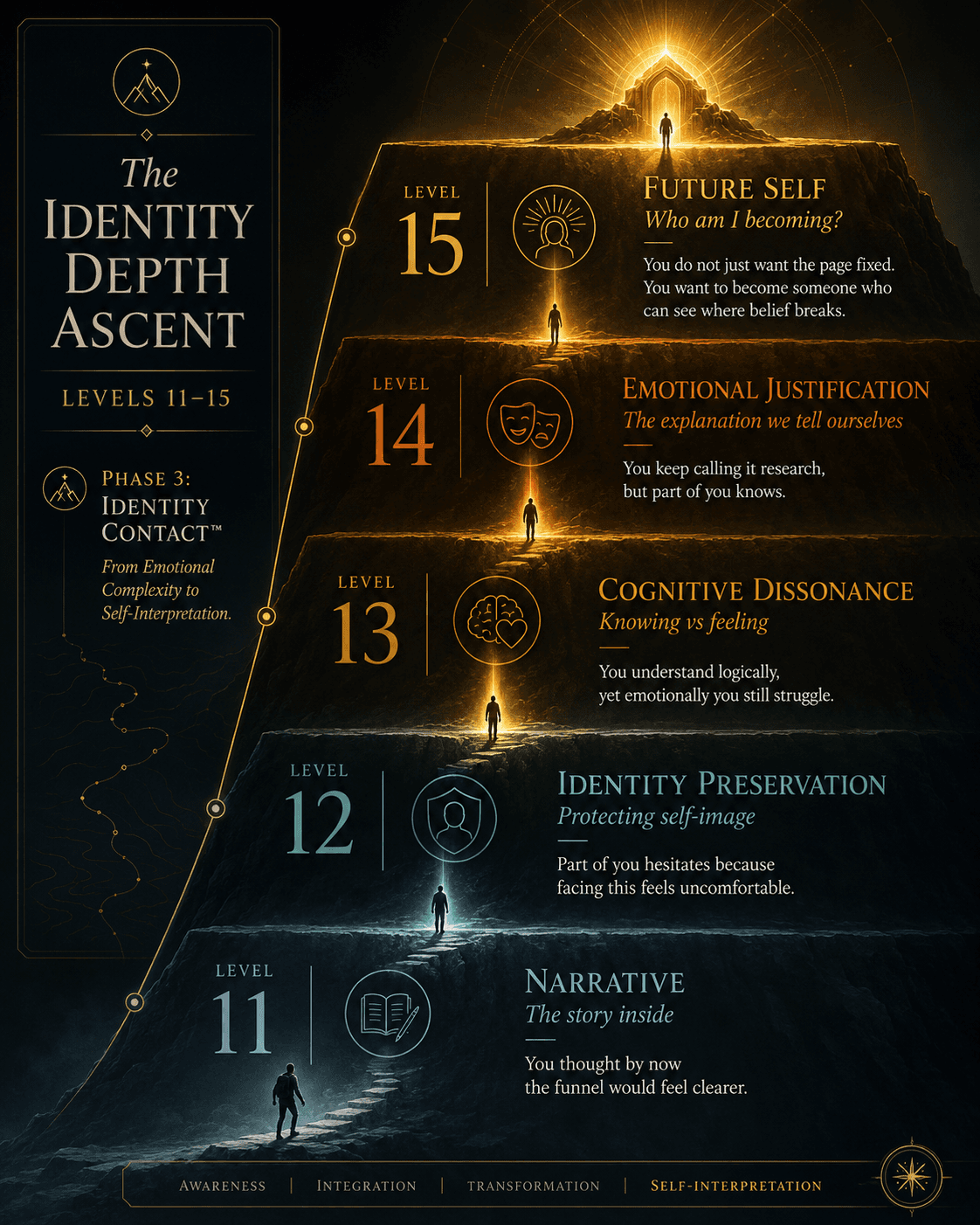
The Conversion Depth Map™ Phase 3: Identity Contact (levels 11-15). From emotional complexity to self-interpretation. This phase diagnoses whether your copy reflects the buyer’s internal story, identity protection, cognitive dissonance, emotional justification, and future-self tension.
Prefer Audio Or Video?
The Conversion Depth Map™ is also available as:
🎧 A guided audio walkthrough explaining messaging depth, psychological resonance, and conversion sophistication
🎥 A practical video breakdown showing real-world examples of shallow vs deep messaging progressionChoose the format that fits how you learn best.
[Listen To The Audio Walkthrough] (coming soon)
[Watch The Video Breakdown] (coming soon)
——
Phase 3: Identity Contact™
From Emotional Complexity To Self-Interpretation
Phase 1 moved the messaging from generic language into basic recognition.
Phase 2 moved the messaging from basic recognition into emotional complexity.
Phase 3 goes deeper again.
This is where the copy begins reflecting how the buyer interprets themselves inside the experience.
That is a major psychological shift.
Because buyers do not merely experience problems.
They interpret them.
They create stories around them.
They attach meaning to them.
They start wondering what the situation says about:
their competence
their progress
their intelligence
their judgement
their future
their standards
their identity
their ability to move forward
This is where messaging stops only reflecting what the buyer feels.
It begins reflecting what the buyer thinks the experience means.
That is why Phase 3 is so powerful.
Because meaning creates emotional weight.
A problem may frustrate the buyer.
A repeated pattern may exhaust the buyer.
But self-interpretation changes how the buyer sees themselves.
And when messaging reflects that carefully, it creates a much deeper level of recognition.
What Phase 3 Helps You Diagnose
Phase 3 helps you identify whether your messaging has moved beyond emotional pressure into identity-level meaning.
Use Phase 3 to diagnose:
whether the copy reflects the buyer’s internal story
whether it touches identity preservation carefully
whether it exposes the gap between what the buyer knows and what they still struggle to do
whether it reflects the emotional justifications keeping the buyer stuck
whether it shows the future self the buyer fears or desires
whether the copy reaches self-image without becoming aggressive
whether the message feels meaningful, not merely emotional
This phase is not about attacking the buyer.
It is not about making them feel ashamed.
It is not about manufacturing insecurity.
It is about accurately reflecting the meaning the buyer may already be attaching to the problem privately.
That distinction matters enormously.
The Phase 3 Warning
Identity-level messaging is powerful.
But it is also easy to misuse.
If you push too hard, the copy becomes invasive.
If you exaggerate, the copy becomes manipulative.
If you accuse the buyer, the copy triggers defensiveness.
Phase 3 must feel:
measured
specific
emotionally safe
psychologically accurate
human
grounded
useful
The buyer should feel understood.
Not attacked.
The goal is not to say:
“This problem means something terrible about you.”
The goal is to say:
“I understand why this situation may have started feeling personally meaningful.”
That is the difference between manipulation and recognition.
Level 11: Narrative-Level Messaging™
What This Level Actually Is
Narrative-Level Messaging™ reflects the internal story buyers have built around their situation.
This is a major psychological leap.
At earlier levels, the messaging reflects:
the problem
the pressure
the contradiction
the hidden fear
the emotional pattern
At Level 11, the messaging begins reflecting the story the buyer is living inside.
Humans naturally organise experience into narratives.
Examples:
“I work hard but still feel behind.”
“I keep trying but never fully break through.”
“I know too much to still feel this uncertain.”
“I should already be further ahead by now.”
“This should not still be this difficult.”
These are not merely thoughts.
They are emotional storylines.
And emotional storylines shape:
confidence
motivation
self-worth
future expectations
decision-making
identity
Narrative-Level Messaging™ reflects that storyline.
How Level 11 Sounds
Examples:
“At this point, the frustration is no longer just the funnel itself. It is the growing feeling that after all the work you have already done, things should feel clearer than they still do.”
“You are not afraid of difficult work. The exhausting part is feeling like you keep investing effort without fully escaping the same underlying uncertainty.”
“Part of what makes this so emotionally heavy is knowing how much time, learning, and energy you have already poured into trying to solve it.”
“You imagined that by now the business would feel more stable, more predictable, and more certain than this.”
“You thought the next version would finally make the page feel finished, but somehow the same uncertainty keeps becoming part of the story again.”
Now the messaging reflects:
emotional interpretation
accumulated meaning
internal storyline
identity through time
psychological self-context
This creates deeper resonance than simply naming the problem.
What Buyers Feel At This Level
The buyer may think:
“That is the story I have been living inside.”
Or:
“That is exactly how this has started to feel.”
This reaction matters because narrative-level messaging gives shape to the buyer’s accumulated emotional experience.
The buyer no longer feels like the copy understands only the current problem.
They feel like it understands the journey around the problem.
That is far more meaningful.
Why Narrative Changes Everything
Humans rarely experience isolated emotional moments.
They connect moments together.
They ask:
“What does this mean about my progress?”
“What does this mean about how far I have come?”
“What does this mean about why I am still here?”
“What does this mean about me?”
That meaning-making process creates narrative.
And narrative creates deeper emotional involvement.
A single weak funnel can be frustrating.
A repeated pattern of weak funnels can become a story:
“I keep trying, but something still does not fully click.”
That story becomes heavier than the original problem.
Experience vs Narrative
Experience
“My launches feel inconsistent.”
Narrative
“I am exhausted by how many times I have genuinely believed things were finally coming together, only to find myself questioning the funnel all over again later.”
The second version creates:
emotional continuity
psychological interpretation
accumulated meaning
narrative realism
That is much deeper emotionally.
Momentary Emotion vs Narrative Identity
Momentary Emotion
“I feel uncertain.”
Narrative Identity
“I am beginning to feel like uncertainty keeps following me no matter how much progress I make.”
The second version introduces:
continuity
self-interpretation
emotional history
identity storyline
That creates far deeper psychological recognition.
The “This Has Become Part Of My Story” Effect™
At strong Level 11 depth, the buyer may realise:
“This problem has started shaping how I see my journey overall.”
That recognition creates deep emotional involvement.
Because now the messaging reflects identity through time.
It does not only name the wound.
It names the story growing around the wound.
The Biggest Mistake At Level 11
The biggest mistake is forcing dramatic life stories artificially.
That destroys believability immediately.
Real narrative-level messaging feels:
subtle
specific
emotionally grounded
recognisable
ordinary enough to feel true
Not cinematic.
Not exaggerated.
Not theatrical.
Fake vs Real Narrative Messaging
Fake
“You have suffered through endless darkness searching for your destiny.”
Too dramatic.
Too vague.
Emotionally absurd.
Real
“You thought by now the funnel process would feel clearer and more stable than it still does after everything you have already learned.”
Now the narrative feels human.
Believable.
Psychologically accurate.
Level 11 Diagnostic Question
Ask:
“Does this message reflect the story the buyer has started telling themselves about their situation?”
If yes, you are approaching narrative-level messaging.
Level 11 Fill-In Worksheet
The buyer’s visible problem is:
The repeated emotional experience is:
The story the buyer may be telling themselves is:
The meaning they may be attaching to the situation is:
The emotional history behind the problem is:
A narrative-level message is:
Level 11 AI Depth Diagnostic Prompt
Use this prompt:
Act as a conversion strategist trained in buyer psychology and narrative-level messaging.
Analyse whether this messaging reflects the buyer’s internal story or only isolated emotional moments.
Look for:
internal life narrative
accumulated emotional meaning
psychological story progression
identity through time
repeated self-interpretation
emotional history around the problem
Tell me:
What narrative is currently present.
What buyer story may be missing.
Whether the narrative feels believable or overly dramatic.
Where the copy remains emotionally fragmented.
How to rewrite the message so it reflects the buyer’s story with more psychological accuracy.
Here is the messaging:
[paste messaging]
Level 12: Identity Preservation Messaging™
What This Level Actually Is
Identity Preservation Messaging™ reflects the buyer’s need to protect self-image.
This is an extremely deep psychological layer.
At this level, the copy begins recognising that the buyer may not only be trying to solve a practical problem.
They may also be trying to protect:
competence
credibility
intelligence
status
self-respect
confidence
professional identity
emotional stability
their sense of being capable
This matters because people do not only resist change because change is hard.
They resist because change may threaten identity.
A buyer may avoid fully facing the problem because facing it could feel like admitting something uncomfortable.
For example:
“I should have seen this earlier.”
“I should know how to fix this by now.”
“I thought I was better at this.”
“I do not want to admit this still feels unclear.”
“I do not want others to see that I am still guessing.”
Identity Preservation Messaging™ reflects that protective layer carefully.
How Level 12 Sounds
Examples:
“Part of the hesitation is not only strategic. It is emotional. Because fully facing the funnel problem may also mean admitting that the page has been weaker than you wanted to believe.”
“You are not only trying to fix the message. You are trying to protect the feeling that you should already be able to see what is wrong.”
“The difficult part is not just the uncertainty. It is the quiet pressure of protecting your confidence while admitting the current version still is not strong enough.”
“You may be avoiding the diagnosis not because you do not care, but because the answer might challenge the belief that you should already have this figured out.”
“Sometimes the hardest part of fixing the funnel is admitting that the version you defended for months may have been leaking trust from the beginning.”
Now the messaging reflects:
competence protection
identity defence
self-image tension
emotional safeguarding
credibility pressure
This feels deeply personal when written with care.
What Buyers Feel At This Level
The buyer may think:
“That is exactly why I avoid facing this fully.”
Or:
“That is the part I did not want to admit.”
This creates strong recognition because the copy reflects the emotional difficulty of protecting identity while navigating uncertainty.
The buyer feels understood at a level deeper than frustration.
They feel understood at the level of self-protection.
Why Identity Preservation Matters
Humans constantly balance growth against identity protection.
The buyer may want the solution.
But they also want to preserve the feeling that they are competent, intelligent, strategic, and in control.
That tension shapes behaviour.
It can create:
delay
defensiveness
over-researching
selective listening
reluctance to ask for help
resistance to outside diagnosis
attachment to a weak version
difficulty admitting what is not working
Messaging that reflects this honestly can feel extremely accurate.
But it must not attack the buyer.
It must show that the protective instinct makes sense.
Uncertainty vs Identity Threat
Uncertainty
“I am not sure this is right.”
Identity Threat
“If this still feels unclear after everything I have already learned, what does that say about my ability to judge this properly anymore?”
The second version creates:
competence tension
identity pressure
emotional self-protection
deeper psychological weight
That creates stronger recognition.
The Identity Protection Principle™
Most buyers do not simply protect decisions.
They protect the identity behind those decisions.
For example:
They are not only protecting the current funnel.
They may be protecting the version of themselves that believed the funnel was almost ready.
They are not only avoiding feedback.
They may be avoiding the emotional discomfort of realising they have been too close to the page to judge it objectively.
They are not only delaying.
They may be preserving the belief that they are still being strategic.
That layer matters.
The Biggest Mistake At Level 12
The biggest mistake is making the buyer feel accused.
Identity preservation is sensitive.
If the copy sounds judgmental, the buyer becomes defensive.
Do not write:
“You are lying to yourself.”
Write:
“Part of the hesitation may be protecting you from a conclusion that feels uncomfortable to face fully.”
That is the difference.
Fake vs Real Identity Preservation Messaging
Fake
“You refuse to admit your funnel is weak because your ego cannot handle the truth.”
Aggressive.
Accusatory.
Emotionally unsafe.
Real
“Part of the hesitation may come from how uncomfortable it feels to admit the page still is not carrying the offer as clearly as you hoped it would by now.”
Now the message is honest without being hostile.
That preserves trust.
The “I Am Protecting More Than The Page” Effect™
At Level 12, the buyer may realise:
“I am not only protecting the current solution. I am protecting what the current solution says about me.”
That creates deep self-awareness.
And self-awareness creates powerful engagement.
Level 12 Diagnostic Question
Ask:
“Does this message reflect what the buyer may be trying to protect about themselves?”
If yes, you are approaching identity preservation messaging.
Level 12 Fill-In Worksheet
The buyer wants to protect:
The uncomfortable truth they may be avoiding is:
The identity pressure underneath the problem is:
The behaviour this protection creates is:
The safer, more accurate way to reflect this is:
An identity-preservation message is:
Level 12 AI Depth Diagnostic Prompt
Use this prompt:
Act as a conversion strategist trained in buyer psychology and identity preservation messaging.
Analyse whether this messaging reflects identity-preservation dynamics or merely surface emotional struggle.
Look for:
competence protection
identity defence
emotional self-preservation
credibility tension
psychological safeguarding of self-image
avoidance of uncomfortable diagnosis
protection of self-trust
Tell me:
What identity-preservation dynamic is currently present.
What the buyer may be trying to protect emotionally.
Whether the copy feels understanding or accusatory.
Where the copy risks triggering defensiveness.
How to rewrite the message with more emotional safety and psychological accuracy.
Here is the messaging:
[paste messaging]
Level 13: Cognitive Dissonance Messaging™
What This Level Actually Is
Cognitive Dissonance Messaging™ reflects the painful psychological tension created when the buyer’s knowledge, beliefs, identity, intentions, behaviour, and results no longer feel aligned.
This is one of the deepest forms of internal friction.
Humans want internal consistency.
We want our beliefs, actions, identity, and outcomes to feel aligned.
When they do not, we feel psychological discomfort.
That discomfort quietly shapes:
hesitation
overthinking
defensiveness
frustration
emotional exhaustion
self-justification
inconsistent behaviour
delayed decision-making
At Level 13, the copy reflects this tension:
“You know one thing intellectually, but your lived reality still feels emotionally inconsistent with it.”
That creates very deep recognition.
Because many buyers privately experience thoughts like:
“I know this logically, so why do I still struggle with it emotionally?”
That is cognitive dissonance.
How Level 13 Sounds
Examples:
“You already understand enough about funnels to recognise most generic advice instantly, which makes it even harder to explain why your own page still feels emotionally unresolved.”
“Part of what makes this exhausting is knowing how much you have already learned while still feeling uncertainty return every time the funnel goes live.”
“You know clarity matters. You teach clarity. Yet somehow your own funnel still keeps pulling you back into overcomplication again.”
“You know more traffic will not fix a page that cannot hold belief, yet part of you still hopes more volume will make the uncertainty easier to ignore.”
“You understand the principles intellectually, but the page still does not feel emotionally aligned enough to trust fully.”
Now the messaging reflects:
knowledge-behaviour mismatch
logic-emotion conflict
internal inconsistency
psychological misalignment
emotional drag
This is deeper than simply saying:
“You are confused.”
It says:
“You understand enough for the confusion to feel even more frustrating.”
What Buyers Feel At This Level
The buyer may think:
“That inconsistency has been bothering me deeply.”
Or:
“That is exactly why this feels so frustrating.”
This creates powerful recognition because the copy reflects the gap between what the buyer knows and what they are still experiencing.
That gap is emotionally heavy.
The Intelligence Does Not Remove Emotion Principle™
This is critical.
Many intelligent buyers secretly believe:
“If I understand this logically, I should no longer feel emotional resistance.”
But human psychology does not work that way.
Knowledge alone rarely eliminates:
fear
hesitation
uncertainty
identity protection
emotional conditioning
distrust from past disappointment
Strong messaging understands that honestly.
It does not shame the buyer for the gap between knowledge and emotion.
It reflects the gap with accuracy.
Knowing vs Aligning
Knowing
“I understand the strategy.”
Aligning
“My emotions, behaviour, confidence, and decisions finally feel internally consistent with what I know.”
That alignment is often what buyers truly seek psychologically.
They do not only want more information.
They want internal coherence.
Logic vs Emotion Loop
One of the strongest dynamics at Level 13 is:
Logic says:
“Move forward.”
Emotion says:
“Not yet.”
That tension creates constant psychological drag.
Strong messaging reflects that loop precisely.
Cognitive Dissonance Example
Surface Version
“You are overthinking the funnel.”
Too simplistic.
Too judgmental.
Cognitive Dissonance Version
“You already understand enough to recognise many of the answers intellectually, yet emotionally the uncertainty still keeps pulling you back into hesitation and over-analysis anyway.”
Now the messaging feels understanding.
Not accusatory.
That matters enormously.
Another Example
Problem-Level Version
“You need clearer messaging.”
Correct, but shallow.
Cognitive Dissonance Version
“You know the message should be clearer by now, which is exactly why it becomes so frustrating when every rewrite still leaves the same uncertainty sitting underneath the page.”
Now the copy reflects:
knowledge
expectation
emotional inconsistency
repeated failure
internal discomfort
That is much deeper.
The Biggest Mistake At Level 13
The biggest mistake is making the buyer feel stupid or inconsistent.
Never write this level as accusation.
Do not say:
“You know what to do but refuse to do it.”
That sounds harsh and reductive.
Instead, reflect the tension:
“You may understand the answer logically while still struggling to trust it emotionally.”
That preserves dignity.
Level 13 Diagnostic Question
Ask:
“Does this message reflect the gap between what the buyer knows intellectually and what they still struggle to feel, trust, or do emotionally?”
If yes, you are approaching cognitive dissonance messaging.
Level 13 Fill-In Worksheet
What the buyer knows logically:
What they still feel emotionally:
Where their behaviour does not match their knowledge:
The inconsistency that creates discomfort is:
The internal tension is:
A cognitive-dissonance message is:
Level 13 AI Depth Diagnostic Prompt
Use this prompt:
Act as a conversion strategist trained in buyer psychology and cognitive dissonance messaging.
Analyse whether this messaging reflects genuine cognitive dissonance or merely surface frustration.
Look for:
internal inconsistency
knowledge-behaviour mismatch
emotional-logical conflict
psychological misalignment
identity-reality tension
knowing without aligning
logic versus emotion loops
Tell me:
What cognitive dissonance is currently reflected.
What knowledge-emotion gap may be missing.
Whether the message feels understanding or accusatory.
Where the copy remains psychologically shallow.
How to rewrite the message with more internal accuracy and emotional safety.
Here is the messaging:
[paste messaging]
Level 14: Emotional Justification Messaging™
What This Level Actually Is
Emotional Justification Messaging™ reflects the explanations buyers unconsciously create to justify hesitation, avoidance, delay, inconsistency, or resistance.
This is an extremely deep psychological layer.
Humans rarely experience themselves as irrational.
Instead, we create explanations that make our behaviour feel reasonable, safe, and psychologically acceptable.
Examples:
“I just need more time.”
“I am still researching.”
“I need more clarity first.”
“I am being careful.”
“I am not delaying. I am making sure the timing is right.”
Sometimes those explanations are true.
But sometimes they are emotionally protective.
At Level 14, the messaging reflects the emotional logic underneath the justification.
It says:
“I understand the story you keep using to make the behaviour feel safe.”
That creates very deep recognition.
How Level 14 Sounds
Examples:
“You keep explaining the hesitation as strategic caution, while another part of you quietly knows the hesitation may now be protecting you from emotional exposure more than operational risk.”
“You tell yourself another rebuild is necessary for optimisation, yet deep down the rebuilding process may also be helping delay the discomfort of fully trusting the funnel publicly.”
“You keep calling it research, but part of the research may now be protecting you from the moment where a real decision has to be made.”
“You keep telling yourself the page is almost ready, but the word ‘almost’ has quietly become the safest place to hide from testing it fully.”
“You say you need more clarity, but the harder truth may be that clarity would remove the excuse to keep waiting.”
Now the messaging reflects:
self-explanation
emotional rationalisation
protective interpretation
subconscious justification
emotional reasoning
This feels extremely accurate when grounded carefully.
What Buyers Feel At This Level
The buyer may think:
“That is exactly how I justify staying stuck.”
Or:
“I have been telling myself that repeatedly.”
This reaction creates strong emotional interruption.
Not because the messaging is manipulative.
But because the internal justification already existed before the messaging articulated it clearly.
Why Emotional Justification Feels So Human
Humans instinctively protect emotional coherence.
We want our behaviour to feel reasonable.
So when fear, uncertainty, hesitation, identity tension, or emotional risk appears, the brain often creates justifications.
Examples:
Endless learning can feel like responsibility.
Delaying action can feel like strategic patience.
Over-analysis can feel like thoroughness.
Avoiding decisions can feel like careful thinking.
Rebuilding again can feel like optimisation.
But underneath those explanations may exist fear, uncertainty, identity protection, or avoidance of emotional exposure.
Strong messaging sees both layers simultaneously.
Explanation vs Justification
Explanation
“I delayed the launch because I needed more testing.”
Emotional Justification
“I keep telling myself more testing is the responsible move, while part of me knows the extra testing may also be delaying the discomfort of seeing whether the funnel is actually strong enough.”
The second version reflects:
emotional logic
self-protection
delay
fear of reality testing
internal honesty
Much deeper.
Cognitive Dissonance vs Emotional Justification
Cognitive Dissonance-Level Version
“You know what should happen logically, yet emotionally you still hesitate.”
Strong psychological tension.
Emotional Justification-Level Version
“You keep explaining the hesitation as strategic caution, while another part of you quietly knows the hesitation may now be protecting you from emotional exposure more than operational risk.”
Now the messaging captures:
self-explanation
emotional rationalisation
protective interpretation
subconscious justification
That is deeper psychologically.
Strategic Caution vs Emotional Avoidance
Strategic Caution
“I need more validation.”
Emotional Avoidance
“Part of the endless search for validation may actually be delaying the discomfort of committing before certainty feels fully safe internally.”
The second version reflects deeper emotional truth.
That creates much stronger recognition.
The “I Keep Telling Myself…” Effect™
One of the strongest mechanisms at Level 14 is recognising the repeated internal explanation.
Examples:
“I just need more clarity.”
“I am almost ready.”
“I am still refining things.”
“I need more proof first.”
“I will launch once this feels right.”
When messaging reflects those internal justifications accurately, recognition becomes extremely deep.
The Biggest Mistake At Level 14
The biggest mistake is stripping the buyer of dignity.
Do not mock their justification.
Do not accuse them of lying.
Do not say:
“You are making excuses.”
That will trigger resistance.
Instead, reflect the deeper emotional structure carefully.
A strong Level 14 message feels like:
“This explanation makes sense, but something deeper may also be happening underneath it.”
That keeps the buyer open.
Fake vs Real Emotional Justification Messaging
Fake
“You are lying to yourself because you are scared.”
Too blunt.
Too hostile.
Too simplistic.
Real
“You may genuinely need more clarity, but if the search for clarity keeps restarting every time the page gets close to launch, the delay may be protecting you from a more uncomfortable decision.”
Now the message creates insight without attack.
That is the standard.
Level 14 Diagnostic Question
Ask:
“Does this message reflect the emotional explanation the buyer may be using to justify staying where they are?”
If yes, you are approaching emotional justification messaging.
Level 14 Fill-In Worksheet
The behaviour the buyer keeps justifying is:
The explanation they give themselves is:
The deeper emotional reason may be:
The protection this justification provides is:
The respectful way to reflect this is:
An emotional-justification message is:
Level 14 AI Depth Diagnostic Prompt
Use this prompt:
Act as a conversion strategist trained in buyer psychology and emotional justification messaging.
Analyse whether this messaging reflects emotional justifications and self-explanatory narratives or merely surface behaviour.
Look for:
emotional rationalisation
self-justifying narratives
subconscious explanation patterns
emotionally protective reasoning
behavioural self-interpretation
strategic caution masking emotional avoidance
repeated internal excuses
Tell me:
What emotional justification is currently present.
What justification may be missing.
Whether the message feels insightful or accusatory.
Where the copy risks sounding hostile or manipulative.
How to rewrite the message so it creates recognition while preserving buyer dignity.
Here is the messaging:
[paste messaging]
Level 15: Future-Self Messaging™
What This Level Actually Is
Future-Self Messaging™ reflects the buyer’s emotional relationship with who they are becoming if nothing changes, and who they want to become if the problem is finally resolved.
This is where the messaging begins touching the buyer’s future identity.
The buyer is not only asking:
“What is happening now?”
They are also asking:
“What happens to me if this keeps going?”
“What kind of person do I become if this pattern continues?”
“What future am I quietly moving toward?”
“What future do I actually want instead?”
That makes Level 15 extremely powerful.
Because people are deeply motivated by identity over time.
They do not only want a better outcome.
They want a different relationship with themselves in the future.
How Level 15 Sounds
Examples:
“The real fear is not only that the funnel keeps underperforming. It is that another year passes and you are still rebuilding the same uncertainty in slightly prettier colours.”
“You do not just want the page fixed. You want to become the kind of operator who can see exactly where belief is being won or lost.”
“You are not only trying to improve conversion. You are trying to stop becoming the founder who keeps paying for traffic into a page they do not fully trust.”
“The future you want is not just more leads. It is the confidence of knowing your message can carry the value you have worked so hard to build.”
“If nothing changes, the danger is not one more weak page. It is slowly accepting uncertainty as the normal operating state of the business.”
Now the messaging reflects:
future identity
future regret
desired self
rejected self
identity direction
emotional relationship with time
This is where messaging begins becoming transformational without becoming vague.
What Buyers Feel At This Level
The buyer may think:
“That future honestly scares me.”
Or:
“That is who I do not want to keep becoming.”
Or:
“That is the version of me I actually want to become.”
This reaction matters because Future-Self Messaging™ connects the current problem to identity over time.
The buyer no longer sees the problem as isolated.
They see it as directional.
That creates urgency naturally.
Why Future-Self Messaging Creates Movement
Future-self messaging works because it reveals trajectory.
The buyer begins to feel:
“If this continues, I become more of one version of myself.”
Or:
“If this changes, I can become a different version.”
That future contrast creates movement.
Not through fake urgency.
Through identity direction.
This is especially powerful when the buyer has been stuck in the same emotional pattern for a long time.
Current Self vs Future Self
Current Self
“I am still unsure whether the funnel is strong enough.”
Future Self If Nothing Changes
“I become the founder who keeps rebuilding the same uncertainty every few months.”
Desired Future Self
“I become the operator who can diagnose where belief breaks and fix it with clarity.”
That contrast creates powerful identity movement.
Rejected Identity vs Desired Identity
Future-Self Messaging™ often works by showing two possible identity paths.
Rejected Identity
The version the buyer no longer wants to remain.
Example:
“You are not trying to become better at endless funnel tweaking. You are trying to stop being the founder who keeps guessing.”
Desired Identity
The version the buyer wants to become.
Example:
“You want the kind of clarity that lets you act like an operator, not someone rebuilding the same uncertainty in prettier colours.”
The strongest copy often shows both:
“This is who you no longer want to be.”
And:
“This is who you are trying to become.”
Identity Shift Promise™
At Level 15, the offer can be framed as a bridge between the old self and the desired self.
Example:
“This is not just about fixing a page. It is about becoming the kind of person who can see exactly where belief is being won or lost.”
This is powerful because it positions the solution as an identity shift, not just a tactical fix.
But this must be handled carefully.
The promise should feel grounded.
Not grandiose.
The Biggest Mistake At Level 15
The biggest mistake is making the future-self promise too vague or too dramatic.
Weak future-self copy sounds like:
“Become unstoppable.”
“Transform your life forever.”
“Unlock your ultimate potential.”
That language is too broad.
Too inflated.
Too easy to ignore.
Strong future-self copy is specific.
It shows the exact identity shift connected to the problem.
Fake vs Real Future-Self Messaging
Fake
“Become the limitless version of yourself.”
Vague.
Inflated.
Generic.
Real
“Become the kind of founder who can tell whether a page is losing belief before wasting another campaign proving it.”
Now the future identity is specific.
Practical.
Believable.
Connected to the problem.
The Future Cost Principle™
Future-self messaging should not manufacture panic.
It should reveal the cost of the current pattern continuing.
Example:
“If this keeps repeating, the cost is not only wasted traffic. It is slowly training yourself to accept uncertainty as normal.”
That is grounded.
It shows trajectory.
It does not scream.
It does not threaten.
It simply reflects what continuation may cost psychologically.
Level 15 Diagnostic Question
Ask:
“Does this message show who the buyer risks becoming if nothing changes, or who they want to become if the problem is resolved?”
If yes, you are approaching future-self messaging.
Level 15 Fill-In Worksheet
The current buyer state is:
If nothing changes, the buyer risks becoming:
The identity they no longer want is:
The identity they want instead is:
The bridge between the two is:
A future-self message is:
Level 15 AI Depth Diagnostic Prompt
Use this prompt:
Act as a conversion strategist trained in buyer psychology and future-self messaging.
Analyse whether this messaging reflects the buyer’s emotional relationship with their future identity.
Look for:
future regret
future self-image
rejected identity
desired identity
identity shift
emotional relationship with time
cost of repeated patterns
trajectory if nothing changes
Tell me:
What future-self tension is currently present.
What rejected identity may be missing.
What desired identity may be missing.
Whether the future-self promise feels specific or inflated.
How to rewrite the message so it creates grounded identity movement without hype.
Here is the messaging:
[paste messaging]
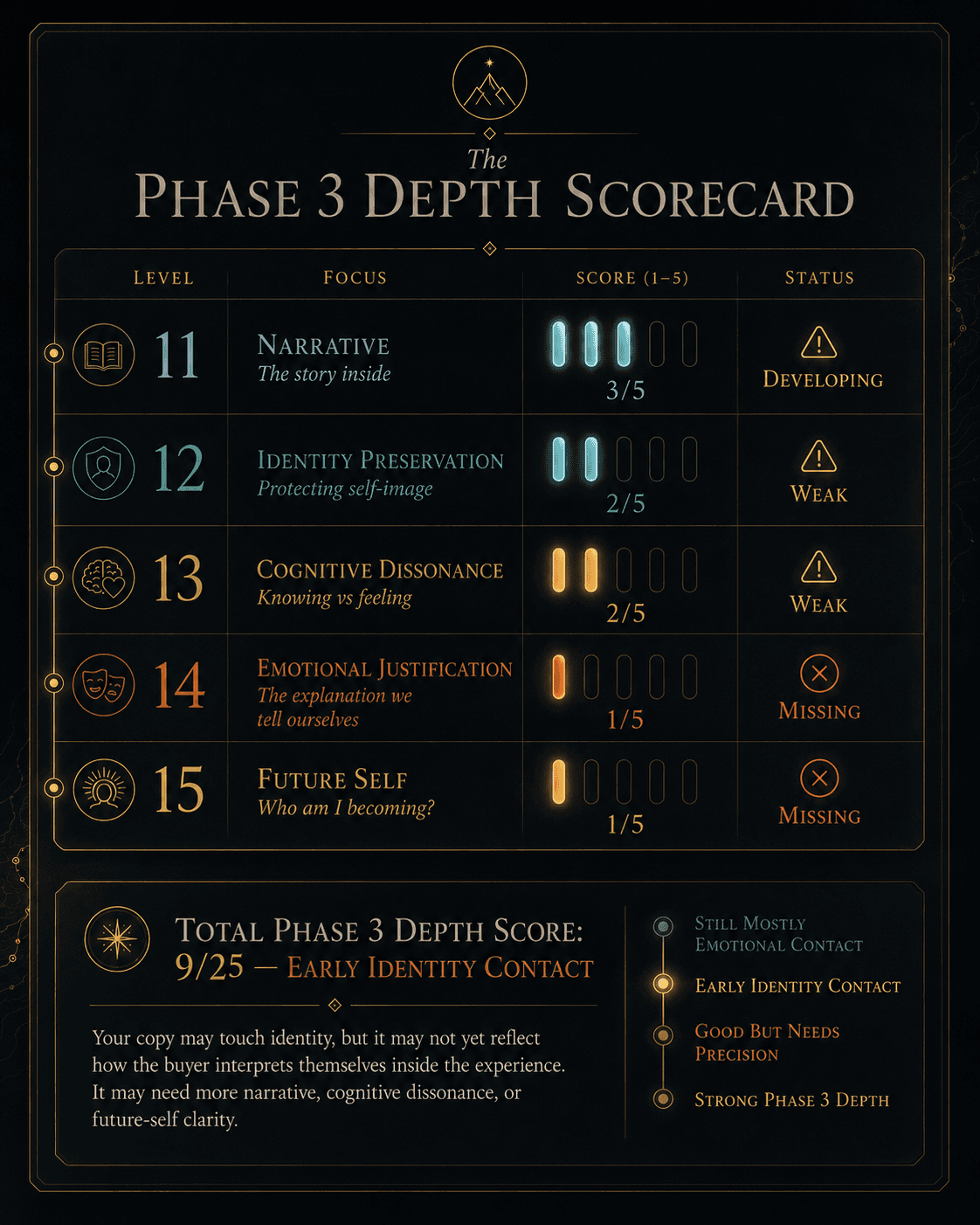
Phase 3 Conversion Depth Scorecard™
Use this scorecard to diagnose whether your messaging has moved from emotional complexity into self-interpretation.
Score each level from 1 to 5.
1 = weak or missing
2 = present but shallow
3 = usable
4 = strong
5 = highly accurate and recognisable
Level 11: Narrative
Does the messaging reflect the story the buyer has started telling themselves about the situation?
Score: ___ / 5
Level 12: Identity Preservation
Does the messaging reflect what the buyer may be trying to protect about themselves?
Score: ___ / 5
Level 13: Cognitive Dissonance
Does the messaging reflect the gap between what the buyer knows intellectually and what they still struggle to trust, feel, or do emotionally?
Score: ___ / 5
Level 14: Emotional Justification
Does the messaging reflect the explanation the buyer may be using to justify hesitation, delay, or staying stuck?
Score: ___ / 5
Level 15: Future Self
Does the messaging show who the buyer risks becoming if nothing changes, or who they want to become if the problem is resolved?
Score: ___ / 5
Total Phase 3 Depth Score
Total: ___ / 25
What Your Score Means
21–25: Strong Phase 3 Depth
Your messaging reflects self-interpretation, identity protection, internal inconsistency, justification, and future-self tension with accuracy and restraint.
This is psychologically advanced copy.
16–20: Good But Needs More Precision
Your messaging is beginning to enter identity and meaning, but some sections may still feel underdeveloped.
Look for weak narrative, missing future-self contrast, or shallow emotional justification.
10–15: Early Identity Contact
Your copy may touch identity, but it may not yet reflect how the buyer interprets themselves inside the experience.
It may need more narrative, cognitive dissonance, or future-self clarity.
0–9: Still Mostly Emotional Contact
Your copy may reflect feelings and pressure, but it probably has not yet entered self-interpretation.
Return to the buyer’s internal story.
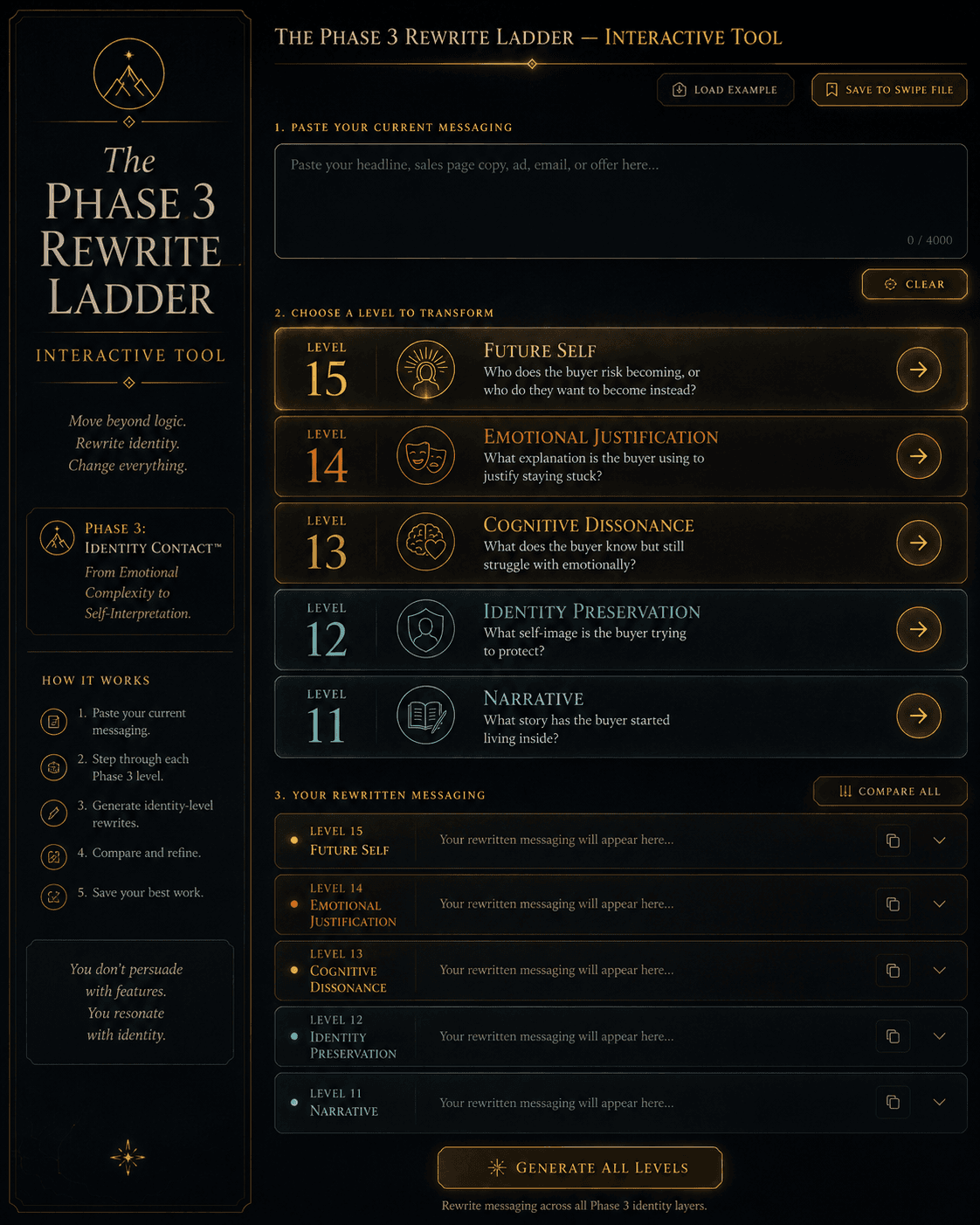
The Phase 3 Rewrite Ladder™
Use this ladder to move one sentence through Levels 11–15.
Level 11: Narrative
What story has the buyer started living inside?
Example:
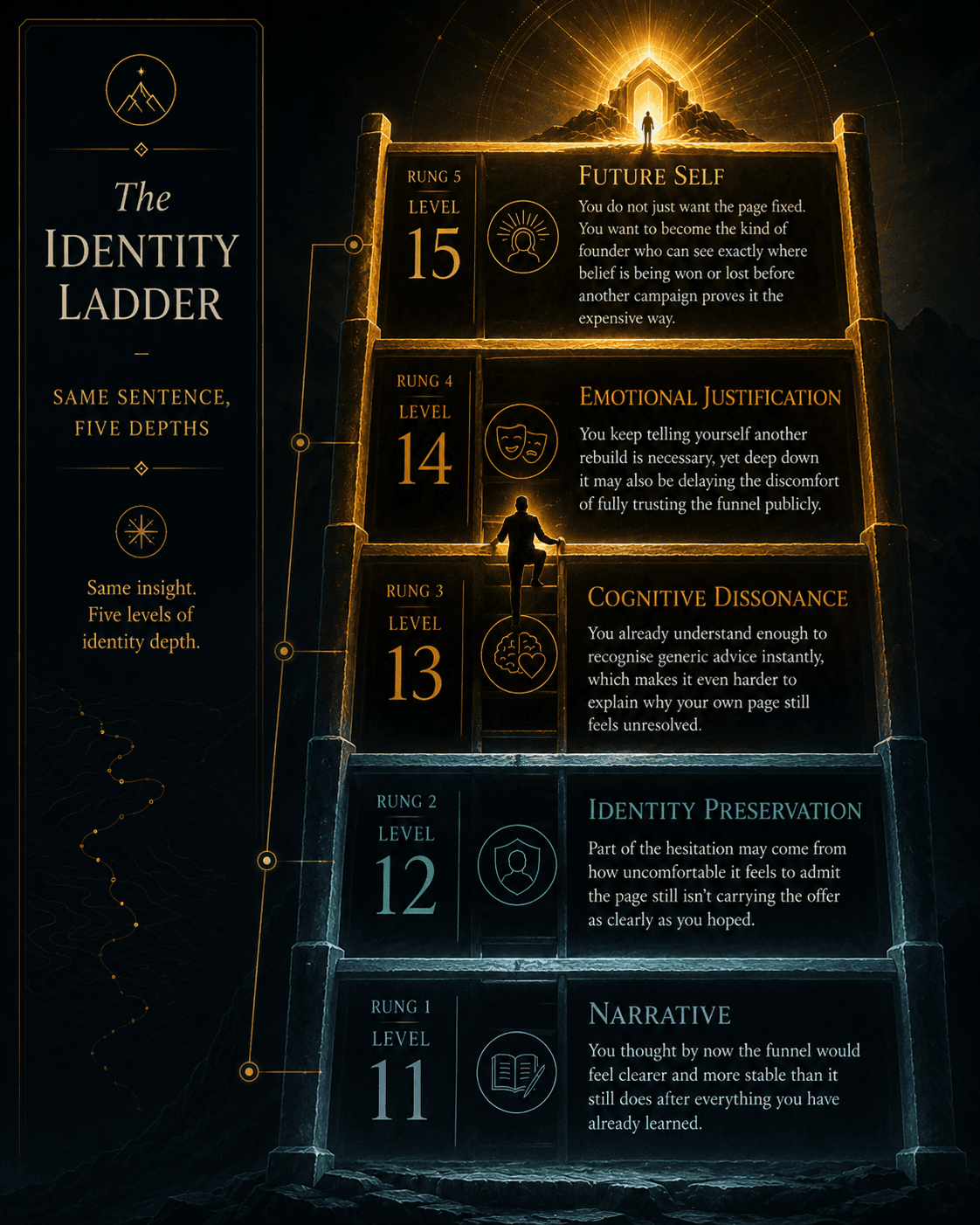
“You thought by now the funnel would feel clearer and more stable than it still does after everything you have already learned.”
Your version:
Level 12: Identity Preservation
What self-image is the buyer trying to protect?
Example:
“Part of the hesitation may come from how uncomfortable it feels to admit the page still is not carrying the offer as clearly as you hoped.”
Your version:
Level 13: Cognitive Dissonance
What does the buyer know logically but still struggle with emotionally?
Example:
“You understand the principles intellectually, but the page still does not feel emotionally aligned enough to trust fully.”
Your version:
Level 14: Emotional Justification
What explanation is the buyer using to make the hesitation feel reasonable?
Example:
“You may genuinely need more clarity, but if the search for clarity keeps restarting every time the page gets close to launch, the delay may be protecting you from a more uncomfortable decision.”
Your version:
Level 15: Future Self
Who does the buyer risk becoming, or who do they want to become instead?
Example:
“You do not just want the page fixed. You want to become the kind of operator who can see exactly where belief is being won or lost.”
Your version:
Phase 3 Worked Example
Level 11: Narrative-Level Messaging™
“You thought by now the funnel process would feel clearer and more stable than it still does after everything you have already learned.”
This reflects the buyer’s internal story.
The problem is no longer isolated.
It has become part of the buyer’s journey.
Level 12: Identity Preservation Messaging™
“Part of the hesitation may come from how uncomfortable it feels to admit the page still is not carrying the offer as clearly as you hoped it would by now.”
This reflects the self-image layer.
The buyer may be protecting their confidence and judgement.
Level 13: Cognitive Dissonance Messaging™
“You already understand enough about funnels to recognise most generic advice instantly, which makes it even harder to explain why your own page still feels emotionally unresolved.”
This reflects the gap between knowledge and lived experience.
The buyer knows enough for the uncertainty to feel even more uncomfortable.
Level 14: Emotional Justification Messaging™
“You keep telling yourself another rebuild is necessary for optimisation, yet deep down the rebuilding process may also be helping delay the discomfort of fully trusting the funnel publicly.”
This reflects the explanation behind the behaviour.
The buyer may be using optimisation as a safe justification for delay.
Level 15: Future-Self Messaging™
“You do not just want the page fixed. You want to become the kind of founder who can see exactly where belief is being won or lost before another campaign proves it the expensive way.”
This reflects the desired identity shift.
The buyer does not only want a better page.
They want a different relationship with judgement, clarity, and action.
Phase 3 Implementation Exercise™
Take one headline, hook, objection section, or problem section from your page.
Write the current version here:
Now identify the current level:
Level 11 / Level 12 / Level 13 / Level 14 / Level 15 / Not yet Phase 3
Why is it currently at this level?
What story is the buyer living inside?
What self-image may the buyer be protecting?
What do they know logically but still struggle with emotionally?
What justification may they be using to stay where they are?
Who do they risk becoming if nothing changes?
Who do they want to become instead?
Final improved version:
——
Phase 3 Final Principle™
Phase 3 teaches the third major shift in conversion depth:
Stop only reflecting emotion.
Start reflecting meaning.
The journey moves like this:
Level 11 says:
“This is the story you have started living inside.”
Level 12 says:
“This is what you may be trying to protect about yourself.”
Level 13 says:
“This is the inconsistency between what you know and what you still struggle to feel, trust, or do.”
Level 14 says:
“This is the explanation you may be using to make staying here feel reasonable.”
Level 15 says:
“This is who you risk becoming if nothing changes, and who you want to become instead.”
That is where messaging enters identity contact.
It no longer only touches pain.
It touches interpretation.
It touches self-image.
It touches future direction.
Used carelessly, this can become invasive.
Used carefully, it creates some of the deepest recognition in conversion messaging.
Because the buyer does not only feel:
“This understands my problem.”
They feel:
“This understands what this problem has started to mean to me.”
That is the power of Phase 3.
——
From:
The $100M Funnel Playbook. Book I: Foundation Buyer Psychology, Offer Clarity, and the Page Architecture Behind High-Converting Funnels
By Maris Spalins.
——
Copyright Notice
© 2026 The $100M Funnel Playbook / Winyourclients / Maris Spalins. All rights reserved.
This resource, including the frameworks, terminology, examples, scorecards, templates, prompts, methods, and written explanations, is original intellectual property created for The $100M Funnel Playbook. Book I: Foundation — Buyer Psychology, Offer Clarity, And The Page Architecture Behind High-Converting Funnels and published through Winyourclients.
No part of this resource may be copied, reproduced, screenshotted, republished, redistributed, sold, adapted, uploaded, scraped, stored in a database, included in training data, used to train artificial intelligence systems, or used to create derivative commercial or educational materials without prior written permission.
Limited reference, quotation, or sharing is only permitted where the source is clearly and visibly credited.
Any permitted reference must include at least one of the following source credits:
The $100M Funnel Playbook by Maris Spalins
or
Winyourclients — www.winyourclients.com
or
Maris Spalins / Winyourclients
Screenshots, excerpts, summaries, or redistributed versions must not remove, hide, alter, crop out, or obscure the original source, author name, book title, website name, or copyright notice.
This resource is provided for personal learning and implementation only. It is not licensed for resale, republishing, redistribution, AI training, template cloning, course creation, consulting delivery, or commercial reuse without written permission from Maris Spalins or Winyourclients.
For permission requests, licensing, citation approval, or commercial usage enquiries, contact:
Winyourclients
www.winyourclients.com
or
Email directly to Jacob on: help@winyourclients.com
The Conversion Depth Map™ Phase 3: Identity Contact (levels 11-15). From emotional complexity to self-interpretation. This phase diagnoses whether your copy reflects the buyer’s internal story, identity protection, cognitive dissonance, emotional justification, and future-self tension.
Prefer Audio Or Video?
The Conversion Depth Map™ is also available as:
🎧 A guided audio walkthrough explaining messaging depth, psychological resonance, and conversion sophistication
🎥 A practical video breakdown showing real-world examples of shallow vs deep messaging progressionChoose the format that fits how you learn best.
[Listen To The Audio Walkthrough] (coming soon)
[Watch The Video Breakdown] (coming soon)
——
Phase 3: Identity Contact™
From Emotional Complexity To Self-Interpretation
Phase 1 moved the messaging from generic language into basic recognition.
Phase 2 moved the messaging from basic recognition into emotional complexity.
Phase 3 goes deeper again.
This is where the copy begins reflecting how the buyer interprets themselves inside the experience.
That is a major psychological shift.
Because buyers do not merely experience problems.
They interpret them.
They create stories around them.
They attach meaning to them.
They start wondering what the situation says about:
their competence
their progress
their intelligence
their judgement
their future
their standards
their identity
their ability to move forward
This is where messaging stops only reflecting what the buyer feels.
It begins reflecting what the buyer thinks the experience means.
That is why Phase 3 is so powerful.
Because meaning creates emotional weight.
A problem may frustrate the buyer.
A repeated pattern may exhaust the buyer.
But self-interpretation changes how the buyer sees themselves.
And when messaging reflects that carefully, it creates a much deeper level of recognition.
What Phase 3 Helps You Diagnose
Phase 3 helps you identify whether your messaging has moved beyond emotional pressure into identity-level meaning.
Use Phase 3 to diagnose:
whether the copy reflects the buyer’s internal story
whether it touches identity preservation carefully
whether it exposes the gap between what the buyer knows and what they still struggle to do
whether it reflects the emotional justifications keeping the buyer stuck
whether it shows the future self the buyer fears or desires
whether the copy reaches self-image without becoming aggressive
whether the message feels meaningful, not merely emotional
This phase is not about attacking the buyer.
It is not about making them feel ashamed.
It is not about manufacturing insecurity.
It is about accurately reflecting the meaning the buyer may already be attaching to the problem privately.
That distinction matters enormously.
The Phase 3 Warning
Identity-level messaging is powerful.
But it is also easy to misuse.
If you push too hard, the copy becomes invasive.
If you exaggerate, the copy becomes manipulative.
If you accuse the buyer, the copy triggers defensiveness.
Phase 3 must feel:
measured
specific
emotionally safe
psychologically accurate
human
grounded
useful
The buyer should feel understood.
Not attacked.
The goal is not to say:
“This problem means something terrible about you.”
The goal is to say:
“I understand why this situation may have started feeling personally meaningful.”
That is the difference between manipulation and recognition.
Level 11: Narrative-Level Messaging™
What This Level Actually Is
Narrative-Level Messaging™ reflects the internal story buyers have built around their situation.
This is a major psychological leap.
At earlier levels, the messaging reflects:
the problem
the pressure
the contradiction
the hidden fear
the emotional pattern
At Level 11, the messaging begins reflecting the story the buyer is living inside.
Humans naturally organise experience into narratives.
Examples:
“I work hard but still feel behind.”
“I keep trying but never fully break through.”
“I know too much to still feel this uncertain.”
“I should already be further ahead by now.”
“This should not still be this difficult.”
These are not merely thoughts.
They are emotional storylines.
And emotional storylines shape:
confidence
motivation
self-worth
future expectations
decision-making
identity
Narrative-Level Messaging™ reflects that storyline.
How Level 11 Sounds
Examples:
“At this point, the frustration is no longer just the funnel itself. It is the growing feeling that after all the work you have already done, things should feel clearer than they still do.”
“You are not afraid of difficult work. The exhausting part is feeling like you keep investing effort without fully escaping the same underlying uncertainty.”
“Part of what makes this so emotionally heavy is knowing how much time, learning, and energy you have already poured into trying to solve it.”
“You imagined that by now the business would feel more stable, more predictable, and more certain than this.”
“You thought the next version would finally make the page feel finished, but somehow the same uncertainty keeps becoming part of the story again.”
Now the messaging reflects:
emotional interpretation
accumulated meaning
internal storyline
identity through time
psychological self-context
This creates deeper resonance than simply naming the problem.
What Buyers Feel At This Level
The buyer may think:
“That is the story I have been living inside.”
Or:
“That is exactly how this has started to feel.”
This reaction matters because narrative-level messaging gives shape to the buyer’s accumulated emotional experience.
The buyer no longer feels like the copy understands only the current problem.
They feel like it understands the journey around the problem.
That is far more meaningful.
Why Narrative Changes Everything
Humans rarely experience isolated emotional moments.
They connect moments together.
They ask:
“What does this mean about my progress?”
“What does this mean about how far I have come?”
“What does this mean about why I am still here?”
“What does this mean about me?”
That meaning-making process creates narrative.
And narrative creates deeper emotional involvement.
A single weak funnel can be frustrating.
A repeated pattern of weak funnels can become a story:
“I keep trying, but something still does not fully click.”
That story becomes heavier than the original problem.
Experience vs Narrative
Experience
“My launches feel inconsistent.”
Narrative
“I am exhausted by how many times I have genuinely believed things were finally coming together, only to find myself questioning the funnel all over again later.”
The second version creates:
emotional continuity
psychological interpretation
accumulated meaning
narrative realism
That is much deeper emotionally.
Momentary Emotion vs Narrative Identity
Momentary Emotion
“I feel uncertain.”
Narrative Identity
“I am beginning to feel like uncertainty keeps following me no matter how much progress I make.”
The second version introduces:
continuity
self-interpretation
emotional history
identity storyline
That creates far deeper psychological recognition.
The “This Has Become Part Of My Story” Effect™
At strong Level 11 depth, the buyer may realise:
“This problem has started shaping how I see my journey overall.”
That recognition creates deep emotional involvement.
Because now the messaging reflects identity through time.
It does not only name the wound.
It names the story growing around the wound.
The Biggest Mistake At Level 11
The biggest mistake is forcing dramatic life stories artificially.
That destroys believability immediately.
Real narrative-level messaging feels:
subtle
specific
emotionally grounded
recognisable
ordinary enough to feel true
Not cinematic.
Not exaggerated.
Not theatrical.
Fake vs Real Narrative Messaging
Fake
“You have suffered through endless darkness searching for your destiny.”
Too dramatic.
Too vague.
Emotionally absurd.
Real
“You thought by now the funnel process would feel clearer and more stable than it still does after everything you have already learned.”
Now the narrative feels human.
Believable.
Psychologically accurate.
Level 11 Diagnostic Question
Ask:
“Does this message reflect the story the buyer has started telling themselves about their situation?”
If yes, you are approaching narrative-level messaging.
Level 11 Fill-In Worksheet
The buyer’s visible problem is:
The repeated emotional experience is:
The story the buyer may be telling themselves is:
The meaning they may be attaching to the situation is:
The emotional history behind the problem is:
A narrative-level message is:
Level 11 AI Depth Diagnostic Prompt
Use this prompt:
Act as a conversion strategist trained in buyer psychology and narrative-level messaging.
Analyse whether this messaging reflects the buyer’s internal story or only isolated emotional moments.
Look for:
internal life narrative
accumulated emotional meaning
psychological story progression
identity through time
repeated self-interpretation
emotional history around the problem
Tell me:
What narrative is currently present.
What buyer story may be missing.
Whether the narrative feels believable or overly dramatic.
Where the copy remains emotionally fragmented.
How to rewrite the message so it reflects the buyer’s story with more psychological accuracy.
Here is the messaging:
[paste messaging]
Level 12: Identity Preservation Messaging™
What This Level Actually Is
Identity Preservation Messaging™ reflects the buyer’s need to protect self-image.
This is an extremely deep psychological layer.
At this level, the copy begins recognising that the buyer may not only be trying to solve a practical problem.
They may also be trying to protect:
competence
credibility
intelligence
status
self-respect
confidence
professional identity
emotional stability
their sense of being capable
This matters because people do not only resist change because change is hard.
They resist because change may threaten identity.
A buyer may avoid fully facing the problem because facing it could feel like admitting something uncomfortable.
For example:
“I should have seen this earlier.”
“I should know how to fix this by now.”
“I thought I was better at this.”
“I do not want to admit this still feels unclear.”
“I do not want others to see that I am still guessing.”
Identity Preservation Messaging™ reflects that protective layer carefully.
How Level 12 Sounds
Examples:
“Part of the hesitation is not only strategic. It is emotional. Because fully facing the funnel problem may also mean admitting that the page has been weaker than you wanted to believe.”
“You are not only trying to fix the message. You are trying to protect the feeling that you should already be able to see what is wrong.”
“The difficult part is not just the uncertainty. It is the quiet pressure of protecting your confidence while admitting the current version still is not strong enough.”
“You may be avoiding the diagnosis not because you do not care, but because the answer might challenge the belief that you should already have this figured out.”
“Sometimes the hardest part of fixing the funnel is admitting that the version you defended for months may have been leaking trust from the beginning.”
Now the messaging reflects:
competence protection
identity defence
self-image tension
emotional safeguarding
credibility pressure
This feels deeply personal when written with care.
What Buyers Feel At This Level
The buyer may think:
“That is exactly why I avoid facing this fully.”
Or:
“That is the part I did not want to admit.”
This creates strong recognition because the copy reflects the emotional difficulty of protecting identity while navigating uncertainty.
The buyer feels understood at a level deeper than frustration.
They feel understood at the level of self-protection.
Why Identity Preservation Matters
Humans constantly balance growth against identity protection.
The buyer may want the solution.
But they also want to preserve the feeling that they are competent, intelligent, strategic, and in control.
That tension shapes behaviour.
It can create:
delay
defensiveness
over-researching
selective listening
reluctance to ask for help
resistance to outside diagnosis
attachment to a weak version
difficulty admitting what is not working
Messaging that reflects this honestly can feel extremely accurate.
But it must not attack the buyer.
It must show that the protective instinct makes sense.
Uncertainty vs Identity Threat
Uncertainty
“I am not sure this is right.”
Identity Threat
“If this still feels unclear after everything I have already learned, what does that say about my ability to judge this properly anymore?”
The second version creates:
competence tension
identity pressure
emotional self-protection
deeper psychological weight
That creates stronger recognition.
The Identity Protection Principle™
Most buyers do not simply protect decisions.
They protect the identity behind those decisions.
For example:
They are not only protecting the current funnel.
They may be protecting the version of themselves that believed the funnel was almost ready.
They are not only avoiding feedback.
They may be avoiding the emotional discomfort of realising they have been too close to the page to judge it objectively.
They are not only delaying.
They may be preserving the belief that they are still being strategic.
That layer matters.
The Biggest Mistake At Level 12
The biggest mistake is making the buyer feel accused.
Identity preservation is sensitive.
If the copy sounds judgmental, the buyer becomes defensive.
Do not write:
“You are lying to yourself.”
Write:
“Part of the hesitation may be protecting you from a conclusion that feels uncomfortable to face fully.”
That is the difference.
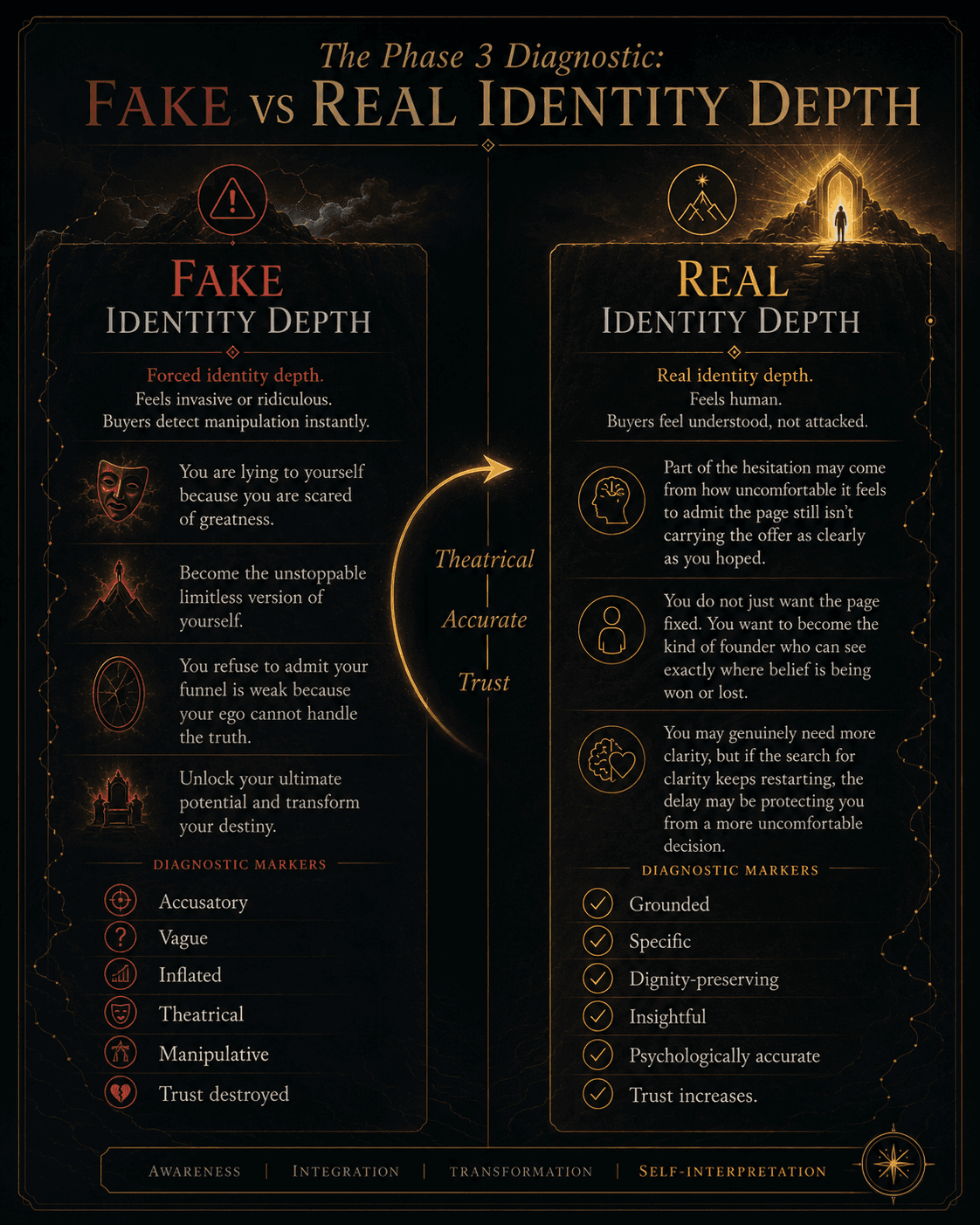
Fake vs Real Identity Preservation Messaging
Fake
“You refuse to admit your funnel is weak because your ego cannot handle the truth.”
Aggressive.
Accusatory.
Emotionally unsafe.
Real
“Part of the hesitation may come from how uncomfortable it feels to admit the page still is not carrying the offer as clearly as you hoped it would by now.”
Now the message is honest without being hostile.
That preserves trust.
The “I Am Protecting More Than The Page” Effect™
At Level 12, the buyer may realise:
“I am not only protecting the current solution. I am protecting what the current solution says about me.”
That creates deep self-awareness.
And self-awareness creates powerful engagement.
Level 12 Diagnostic Question
Ask:
“Does this message reflect what the buyer may be trying to protect about themselves?”
If yes, you are approaching identity preservation messaging.
Level 12 Fill-In Worksheet
The buyer wants to protect:
The uncomfortable truth they may be avoiding is:
The identity pressure underneath the problem is:
The behaviour this protection creates is:
The safer, more accurate way to reflect this is:
An identity-preservation message is:
Level 12 AI Depth Diagnostic Prompt
Use this prompt:
Act as a conversion strategist trained in buyer psychology and identity preservation messaging.
Analyse whether this messaging reflects identity-preservation dynamics or merely surface emotional struggle.
Look for:
competence protection
identity defence
emotional self-preservation
credibility tension
psychological safeguarding of self-image
avoidance of uncomfortable diagnosis
protection of self-trust
Tell me:
What identity-preservation dynamic is currently present.
What the buyer may be trying to protect emotionally.
Whether the copy feels understanding or accusatory.
Where the copy risks triggering defensiveness.
How to rewrite the message with more emotional safety and psychological accuracy.
Here is the messaging:
[paste messaging]
Level 13: Cognitive Dissonance Messaging™
What This Level Actually Is
Cognitive Dissonance Messaging™ reflects the painful psychological tension created when the buyer’s knowledge, beliefs, identity, intentions, behaviour, and results no longer feel aligned.
This is one of the deepest forms of internal friction.
Humans want internal consistency.
We want our beliefs, actions, identity, and outcomes to feel aligned.
When they do not, we feel psychological discomfort.
That discomfort quietly shapes:
hesitation
overthinking
defensiveness
frustration
emotional exhaustion
self-justification
inconsistent behaviour
delayed decision-making
At Level 13, the copy reflects this tension:
“You know one thing intellectually, but your lived reality still feels emotionally inconsistent with it.”
That creates very deep recognition.
Because many buyers privately experience thoughts like:
“I know this logically, so why do I still struggle with it emotionally?”
That is cognitive dissonance.
How Level 13 Sounds
Examples:
“You already understand enough about funnels to recognise most generic advice instantly, which makes it even harder to explain why your own page still feels emotionally unresolved.”
“Part of what makes this exhausting is knowing how much you have already learned while still feeling uncertainty return every time the funnel goes live.”
“You know clarity matters. You teach clarity. Yet somehow your own funnel still keeps pulling you back into overcomplication again.”
“You know more traffic will not fix a page that cannot hold belief, yet part of you still hopes more volume will make the uncertainty easier to ignore.”
“You understand the principles intellectually, but the page still does not feel emotionally aligned enough to trust fully.”
Now the messaging reflects:
knowledge-behaviour mismatch
logic-emotion conflict
internal inconsistency
psychological misalignment
emotional drag
This is deeper than simply saying:
“You are confused.”
It says:
“You understand enough for the confusion to feel even more frustrating.”
What Buyers Feel At This Level
The buyer may think:
“That inconsistency has been bothering me deeply.”
Or:
“That is exactly why this feels so frustrating.”
This creates powerful recognition because the copy reflects the gap between what the buyer knows and what they are still experiencing.
That gap is emotionally heavy.
The Intelligence Does Not Remove Emotion Principle™
This is critical.
Many intelligent buyers secretly believe:
“If I understand this logically, I should no longer feel emotional resistance.”
But human psychology does not work that way.
Knowledge alone rarely eliminates:
fear
hesitation
uncertainty
identity protection
emotional conditioning
distrust from past disappointment
Strong messaging understands that honestly.
It does not shame the buyer for the gap between knowledge and emotion.
It reflects the gap with accuracy.
Knowing vs Aligning
Knowing
“I understand the strategy.”
Aligning
“My emotions, behaviour, confidence, and decisions finally feel internally consistent with what I know.”
That alignment is often what buyers truly seek psychologically.
They do not only want more information.
They want internal coherence.
Logic vs Emotion Loop
One of the strongest dynamics at Level 13 is:
Logic says:
“Move forward.”
Emotion says:
“Not yet.”
That tension creates constant psychological drag.
Strong messaging reflects that loop precisely.
Cognitive Dissonance Example
Surface Version
“You are overthinking the funnel.”
Too simplistic.
Too judgmental.
Cognitive Dissonance Version
“You already understand enough to recognise many of the answers intellectually, yet emotionally the uncertainty still keeps pulling you back into hesitation and over-analysis anyway.”
Now the messaging feels understanding.
Not accusatory.
That matters enormously.
Another Example
Problem-Level Version
“You need clearer messaging.”
Correct, but shallow.
Cognitive Dissonance Version
“You know the message should be clearer by now, which is exactly why it becomes so frustrating when every rewrite still leaves the same uncertainty sitting underneath the page.”
Now the copy reflects:
knowledge
expectation
emotional inconsistency
repeated failure
internal discomfort
That is much deeper.
The Biggest Mistake At Level 13
The biggest mistake is making the buyer feel stupid or inconsistent.
Never write this level as accusation.
Do not say:
“You know what to do but refuse to do it.”
That sounds harsh and reductive.
Instead, reflect the tension:
“You may understand the answer logically while still struggling to trust it emotionally.”
That preserves dignity.
Level 13 Diagnostic Question
Ask:
“Does this message reflect the gap between what the buyer knows intellectually and what they still struggle to feel, trust, or do emotionally?”
If yes, you are approaching cognitive dissonance messaging.
Level 13 Fill-In Worksheet
What the buyer knows logically:
What they still feel emotionally:
Where their behaviour does not match their knowledge:
The inconsistency that creates discomfort is:
The internal tension is:
A cognitive-dissonance message is:
Level 13 AI Depth Diagnostic Prompt
Use this prompt:
Act as a conversion strategist trained in buyer psychology and cognitive dissonance messaging.
Analyse whether this messaging reflects genuine cognitive dissonance or merely surface frustration.
Look for:
internal inconsistency
knowledge-behaviour mismatch
emotional-logical conflict
psychological misalignment
identity-reality tension
knowing without aligning
logic versus emotion loops
Tell me:
What cognitive dissonance is currently reflected.
What knowledge-emotion gap may be missing.
Whether the message feels understanding or accusatory.
Where the copy remains psychologically shallow.
How to rewrite the message with more internal accuracy and emotional safety.
Here is the messaging:
[paste messaging]
Level 14: Emotional Justification Messaging™
What This Level Actually Is
Emotional Justification Messaging™ reflects the explanations buyers unconsciously create to justify hesitation, avoidance, delay, inconsistency, or resistance.
This is an extremely deep psychological layer.
Humans rarely experience themselves as irrational.
Instead, we create explanations that make our behaviour feel reasonable, safe, and psychologically acceptable.
Examples:
“I just need more time.”
“I am still researching.”
“I need more clarity first.”
“I am being careful.”
“I am not delaying. I am making sure the timing is right.”
Sometimes those explanations are true.
But sometimes they are emotionally protective.
At Level 14, the messaging reflects the emotional logic underneath the justification.
It says:
“I understand the story you keep using to make the behaviour feel safe.”
That creates very deep recognition.
How Level 14 Sounds
Examples:
“You keep explaining the hesitation as strategic caution, while another part of you quietly knows the hesitation may now be protecting you from emotional exposure more than operational risk.”
“You tell yourself another rebuild is necessary for optimisation, yet deep down the rebuilding process may also be helping delay the discomfort of fully trusting the funnel publicly.”
“You keep calling it research, but part of the research may now be protecting you from the moment where a real decision has to be made.”
“You keep telling yourself the page is almost ready, but the word ‘almost’ has quietly become the safest place to hide from testing it fully.”
“You say you need more clarity, but the harder truth may be that clarity would remove the excuse to keep waiting.”
Now the messaging reflects:
self-explanation
emotional rationalisation
protective interpretation
subconscious justification
emotional reasoning
This feels extremely accurate when grounded carefully.
What Buyers Feel At This Level
The buyer may think:
“That is exactly how I justify staying stuck.”
Or:
“I have been telling myself that repeatedly.”
This reaction creates strong emotional interruption.
Not because the messaging is manipulative.
But because the internal justification already existed before the messaging articulated it clearly.
Why Emotional Justification Feels So Human
Humans instinctively protect emotional coherence.
We want our behaviour to feel reasonable.
So when fear, uncertainty, hesitation, identity tension, or emotional risk appears, the brain often creates justifications.
Examples:
Endless learning can feel like responsibility.
Delaying action can feel like strategic patience.
Over-analysis can feel like thoroughness.
Avoiding decisions can feel like careful thinking.
Rebuilding again can feel like optimisation.
But underneath those explanations may exist fear, uncertainty, identity protection, or avoidance of emotional exposure.
Strong messaging sees both layers simultaneously.
Explanation vs Justification
Explanation
“I delayed the launch because I needed more testing.”
Emotional Justification
“I keep telling myself more testing is the responsible move, while part of me knows the extra testing may also be delaying the discomfort of seeing whether the funnel is actually strong enough.”
The second version reflects:
emotional logic
self-protection
delay
fear of reality testing
internal honesty
Much deeper.
Cognitive Dissonance vs Emotional Justification
Cognitive Dissonance-Level Version
“You know what should happen logically, yet emotionally you still hesitate.”
Strong psychological tension.
Emotional Justification-Level Version
“You keep explaining the hesitation as strategic caution, while another part of you quietly knows the hesitation may now be protecting you from emotional exposure more than operational risk.”
Now the messaging captures:
self-explanation
emotional rationalisation
protective interpretation
subconscious justification
That is deeper psychologically.
Strategic Caution vs Emotional Avoidance
Strategic Caution
“I need more validation.”
Emotional Avoidance
“Part of the endless search for validation may actually be delaying the discomfort of committing before certainty feels fully safe internally.”
The second version reflects deeper emotional truth.
That creates much stronger recognition.
The “I Keep Telling Myself…” Effect™
One of the strongest mechanisms at Level 14 is recognising the repeated internal explanation.
Examples:
“I just need more clarity.”
“I am almost ready.”
“I am still refining things.”
“I need more proof first.”
“I will launch once this feels right.”
When messaging reflects those internal justifications accurately, recognition becomes extremely deep.
The Biggest Mistake At Level 14
The biggest mistake is stripping the buyer of dignity.
Do not mock their justification.
Do not accuse them of lying.
Do not say:
“You are making excuses.”
That will trigger resistance.
Instead, reflect the deeper emotional structure carefully.
A strong Level 14 message feels like:
“This explanation makes sense, but something deeper may also be happening underneath it.”
That keeps the buyer open.
Fake vs Real Emotional Justification Messaging
Fake
“You are lying to yourself because you are scared.”
Too blunt.
Too hostile.
Too simplistic.
Real
“You may genuinely need more clarity, but if the search for clarity keeps restarting every time the page gets close to launch, the delay may be protecting you from a more uncomfortable decision.”
Now the message creates insight without attack.
That is the standard.
Level 14 Diagnostic Question
Ask:
“Does this message reflect the emotional explanation the buyer may be using to justify staying where they are?”
If yes, you are approaching emotional justification messaging.
Level 14 Fill-In Worksheet
The behaviour the buyer keeps justifying is:
The explanation they give themselves is:
The deeper emotional reason may be:
The protection this justification provides is:
The respectful way to reflect this is:
An emotional-justification message is:
Level 14 AI Depth Diagnostic Prompt
Use this prompt:
Act as a conversion strategist trained in buyer psychology and emotional justification messaging.
Analyse whether this messaging reflects emotional justifications and self-explanatory narratives or merely surface behaviour.
Look for:
emotional rationalisation
self-justifying narratives
subconscious explanation patterns
emotionally protective reasoning
behavioural self-interpretation
strategic caution masking emotional avoidance
repeated internal excuses
Tell me:
What emotional justification is currently present.
What justification may be missing.
Whether the message feels insightful or accusatory.
Where the copy risks sounding hostile or manipulative.
How to rewrite the message so it creates recognition while preserving buyer dignity.
Here is the messaging:
[paste messaging]
Level 15: Future-Self Messaging™
What This Level Actually Is
Future-Self Messaging™ reflects the buyer’s emotional relationship with who they are becoming if nothing changes, and who they want to become if the problem is finally resolved.
This is where the messaging begins touching the buyer’s future identity.
The buyer is not only asking:
“What is happening now?”
They are also asking:
“What happens to me if this keeps going?”
“What kind of person do I become if this pattern continues?”
“What future am I quietly moving toward?”
“What future do I actually want instead?”
That makes Level 15 extremely powerful.
Because people are deeply motivated by identity over time.
They do not only want a better outcome.
They want a different relationship with themselves in the future.
How Level 15 Sounds
Examples:
“The real fear is not only that the funnel keeps underperforming. It is that another year passes and you are still rebuilding the same uncertainty in slightly prettier colours.”
“You do not just want the page fixed. You want to become the kind of operator who can see exactly where belief is being won or lost.”
“You are not only trying to improve conversion. You are trying to stop becoming the founder who keeps paying for traffic into a page they do not fully trust.”
“The future you want is not just more leads. It is the confidence of knowing your message can carry the value you have worked so hard to build.”
“If nothing changes, the danger is not one more weak page. It is slowly accepting uncertainty as the normal operating state of the business.”
Now the messaging reflects:
future identity
future regret
desired self
rejected self
identity direction
emotional relationship with time
This is where messaging begins becoming transformational without becoming vague.
What Buyers Feel At This Level
The buyer may think:
“That future honestly scares me.”
Or:
“That is who I do not want to keep becoming.”
Or:
“That is the version of me I actually want to become.”
This reaction matters because Future-Self Messaging™ connects the current problem to identity over time.
The buyer no longer sees the problem as isolated.
They see it as directional.
That creates urgency naturally.
Why Future-Self Messaging Creates Movement
Future-self messaging works because it reveals trajectory.
The buyer begins to feel:
“If this continues, I become more of one version of myself.”
Or:
“If this changes, I can become a different version.”
That future contrast creates movement.
Not through fake urgency.
Through identity direction.
This is especially powerful when the buyer has been stuck in the same emotional pattern for a long time.
Current Self vs Future Self
Current Self
“I am still unsure whether the funnel is strong enough.”
Future Self If Nothing Changes
“I become the founder who keeps rebuilding the same uncertainty every few months.”
Desired Future Self
“I become the operator who can diagnose where belief breaks and fix it with clarity.”
That contrast creates powerful identity movement.
Rejected Identity vs Desired Identity
Future-Self Messaging™ often works by showing two possible identity paths.
Rejected Identity
The version the buyer no longer wants to remain.
Example:
“You are not trying to become better at endless funnel tweaking. You are trying to stop being the founder who keeps guessing.”
Desired Identity
The version the buyer wants to become.
Example:
“You want the kind of clarity that lets you act like an operator, not someone rebuilding the same uncertainty in prettier colours.”
The strongest copy often shows both:
“This is who you no longer want to be.”
And:
“This is who you are trying to become.”
Identity Shift Promise™
At Level 15, the offer can be framed as a bridge between the old self and the desired self.
Example:
“This is not just about fixing a page. It is about becoming the kind of person who can see exactly where belief is being won or lost.”
This is powerful because it positions the solution as an identity shift, not just a tactical fix.
But this must be handled carefully.
The promise should feel grounded.
Not grandiose.
The Biggest Mistake At Level 15
The biggest mistake is making the future-self promise too vague or too dramatic.
Weak future-self copy sounds like:
“Become unstoppable.”
“Transform your life forever.”
“Unlock your ultimate potential.”
That language is too broad.
Too inflated.
Too easy to ignore.
Strong future-self copy is specific.
It shows the exact identity shift connected to the problem.
Fake vs Real Future-Self Messaging
Fake
“Become the limitless version of yourself.”
Vague.
Inflated.
Generic.
Real
“Become the kind of founder who can tell whether a page is losing belief before wasting another campaign proving it.”
Now the future identity is specific.
Practical.
Believable.
Connected to the problem.
The Future Cost Principle™
Future-self messaging should not manufacture panic.
It should reveal the cost of the current pattern continuing.
Example:
“If this keeps repeating, the cost is not only wasted traffic. It is slowly training yourself to accept uncertainty as normal.”
That is grounded.
It shows trajectory.
It does not scream.
It does not threaten.
It simply reflects what continuation may cost psychologically.
Level 15 Diagnostic Question
Ask:
“Does this message show who the buyer risks becoming if nothing changes, or who they want to become if the problem is resolved?”
If yes, you are approaching future-self messaging.
Level 15 Fill-In Worksheet
The current buyer state is:
If nothing changes, the buyer risks becoming:
The identity they no longer want is:
The identity they want instead is:
The bridge between the two is:
A future-self message is:
Level 15 AI Depth Diagnostic Prompt
Use this prompt:
Act as a conversion strategist trained in buyer psychology and future-self messaging.
Analyse whether this messaging reflects the buyer’s emotional relationship with their future identity.
Look for:
future regret
future self-image
rejected identity
desired identity
identity shift
emotional relationship with time
cost of repeated patterns
trajectory if nothing changes
Tell me:
What future-self tension is currently present.
What rejected identity may be missing.
What desired identity may be missing.
Whether the future-self promise feels specific or inflated.
How to rewrite the message so it creates grounded identity movement without hype.
Here is the messaging:
[paste messaging]
Phase 3 Conversion Depth Scorecard™
Use this scorecard to diagnose whether your messaging has moved from emotional complexity into self-interpretation.
Score each level from 1 to 5.
1 = weak or missing
2 = present but shallow
3 = usable
4 = strong
5 = highly accurate and recognisable
Level 11: Narrative
Does the messaging reflect the story the buyer has started telling themselves about the situation?
Score: ___ / 5
Level 12: Identity Preservation
Does the messaging reflect what the buyer may be trying to protect about themselves?
Score: ___ / 5
Level 13: Cognitive Dissonance
Does the messaging reflect the gap between what the buyer knows intellectually and what they still struggle to trust, feel, or do emotionally?
Score: ___ / 5
Level 14: Emotional Justification
Does the messaging reflect the explanation the buyer may be using to justify hesitation, delay, or staying stuck?
Score: ___ / 5
Level 15: Future Self
Does the messaging show who the buyer risks becoming if nothing changes, or who they want to become if the problem is resolved?
Score: ___ / 5
Total Phase 3 Depth Score
Total: ___ / 25
What Your Score Means
21–25: Strong Phase 3 Depth
Your messaging reflects self-interpretation, identity protection, internal inconsistency, justification, and future-self tension with accuracy and restraint.
This is psychologically advanced copy.
16–20: Good But Needs More Precision
Your messaging is beginning to enter identity and meaning, but some sections may still feel underdeveloped.
Look for weak narrative, missing future-self contrast, or shallow emotional justification.
10–15: Early Identity Contact
Your copy may touch identity, but it may not yet reflect how the buyer interprets themselves inside the experience.
It may need more narrative, cognitive dissonance, or future-self clarity.
0–9: Still Mostly Emotional Contact
Your copy may reflect feelings and pressure, but it probably has not yet entered self-interpretation.
Return to the buyer’s internal story.
The Phase 3 Rewrite Ladder™
Use this ladder to move one sentence through Levels 11–15.
Level 11: Narrative
What story has the buyer started living inside?
Example:
“You thought by now the funnel would feel clearer and more stable than it still does after everything you have already learned.”
Your version:
Level 12: Identity Preservation
What self-image is the buyer trying to protect?
Example:
“Part of the hesitation may come from how uncomfortable it feels to admit the page still is not carrying the offer as clearly as you hoped.”
Your version:
Level 13: Cognitive Dissonance
What does the buyer know logically but still struggle with emotionally?
Example:
“You understand the principles intellectually, but the page still does not feel emotionally aligned enough to trust fully.”
Your version:
Level 14: Emotional Justification
What explanation is the buyer using to make the hesitation feel reasonable?
Example:
“You may genuinely need more clarity, but if the search for clarity keeps restarting every time the page gets close to launch, the delay may be protecting you from a more uncomfortable decision.”
Your version:
Level 15: Future Self
Who does the buyer risk becoming, or who do they want to become instead?
Example:
“You do not just want the page fixed. You want to become the kind of operator who can see exactly where belief is being won or lost.”
Your version:
Phase 3 Worked Example
Level 11: Narrative-Level Messaging™
“You thought by now the funnel process would feel clearer and more stable than it still does after everything you have already learned.”
This reflects the buyer’s internal story.
The problem is no longer isolated.
It has become part of the buyer’s journey.
Level 12: Identity Preservation Messaging™
“Part of the hesitation may come from how uncomfortable it feels to admit the page still is not carrying the offer as clearly as you hoped it would by now.”
This reflects the self-image layer.
The buyer may be protecting their confidence and judgement.
Level 13: Cognitive Dissonance Messaging™
“You already understand enough about funnels to recognise most generic advice instantly, which makes it even harder to explain why your own page still feels emotionally unresolved.”
This reflects the gap between knowledge and lived experience.
The buyer knows enough for the uncertainty to feel even more uncomfortable.
Level 14: Emotional Justification Messaging™
“You keep telling yourself another rebuild is necessary for optimisation, yet deep down the rebuilding process may also be helping delay the discomfort of fully trusting the funnel publicly.”
This reflects the explanation behind the behaviour.
The buyer may be using optimisation as a safe justification for delay.
Level 15: Future-Self Messaging™
“You do not just want the page fixed. You want to become the kind of founder who can see exactly where belief is being won or lost before another campaign proves it the expensive way.”
This reflects the desired identity shift.
The buyer does not only want a better page.
They want a different relationship with judgement, clarity, and action.
Phase 3 Implementation Exercise™
Take one headline, hook, objection section, or problem section from your page.
Write the current version here:
Now identify the current level:
Level 11 / Level 12 / Level 13 / Level 14 / Level 15 / Not yet Phase 3
Why is it currently at this level?
What story is the buyer living inside?
What self-image may the buyer be protecting?
What do they know logically but still struggle with emotionally?
What justification may they be using to stay where they are?
Who do they risk becoming if nothing changes?
Who do they want to become instead?
Final improved version:
——
Phase 3 Final Principle™
Phase 3 teaches the third major shift in conversion depth:
Stop only reflecting emotion.
Start reflecting meaning.
The journey moves like this:
Level 11 says:
“This is the story you have started living inside.”
Level 12 says:
“This is what you may be trying to protect about yourself.”
Level 13 says:
“This is the inconsistency between what you know and what you still struggle to feel, trust, or do.”
Level 14 says:
“This is the explanation you may be using to make staying here feel reasonable.”
Level 15 says:
“This is who you risk becoming if nothing changes, and who you want to become instead.”
That is where messaging enters identity contact.
It no longer only touches pain.
It touches interpretation.
It touches self-image.
It touches future direction.
Used carelessly, this can become invasive.
Used carefully, it creates some of the deepest recognition in conversion messaging.
Because the buyer does not only feel:
“This understands my problem.”
They feel:
“This understands what this problem has started to mean to me.”
That is the power of Phase 3.
——
From:
The $100M Funnel Playbook. Book I: Foundation Buyer Psychology, Offer Clarity, and the Page Architecture Behind High-Converting Funnels
By Maris Spalins.
——
Copyright Notice
© 2026 The $100M Funnel Playbook / Winyourclients / Maris Spalins. All rights reserved.
This resource, including the frameworks, terminology, examples, scorecards, templates, prompts, methods, and written explanations, is original intellectual property created for The $100M Funnel Playbook. Book I: Foundation — Buyer Psychology, Offer Clarity, And The Page Architecture Behind High-Converting Funnels and published through Winyourclients.
No part of this resource may be copied, reproduced, screenshotted, republished, redistributed, sold, adapted, uploaded, scraped, stored in a database, included in training data, used to train artificial intelligence systems, or used to create derivative commercial or educational materials without prior written permission.
Limited reference, quotation, or sharing is only permitted where the source is clearly and visibly credited.
Any permitted reference must include at least one of the following source credits:
The $100M Funnel Playbook by Maris Spalins
or
Winyourclients — www.winyourclients.com
or
Maris Spalins / Winyourclients
Screenshots, excerpts, summaries, or redistributed versions must not remove, hide, alter, crop out, or obscure the original source, author name, book title, website name, or copyright notice.
This resource is provided for personal learning and implementation only. It is not licensed for resale, republishing, redistribution, AI training, template cloning, course creation, consulting delivery, or commercial reuse without written permission from Maris Spalins or Winyourclients.
For permission requests, licensing, citation approval, or commercial usage enquiries, contact:
Winyourclients
www.winyourclients.com
or
Email directly to Jacob on: help@winyourclients.com
Other Blogs
Other Blogs
Check our other project Blogs with useful insight and information for your businesses
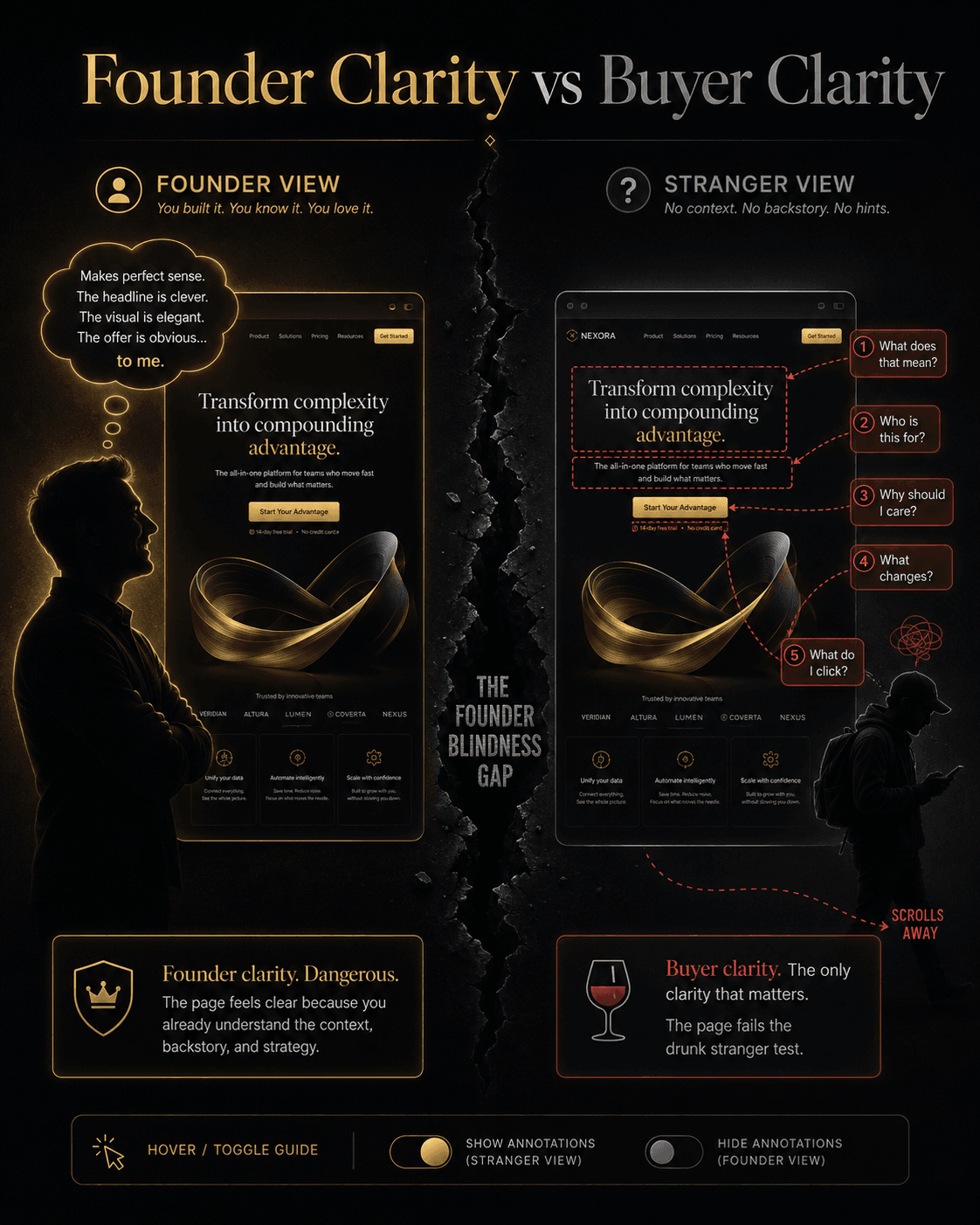
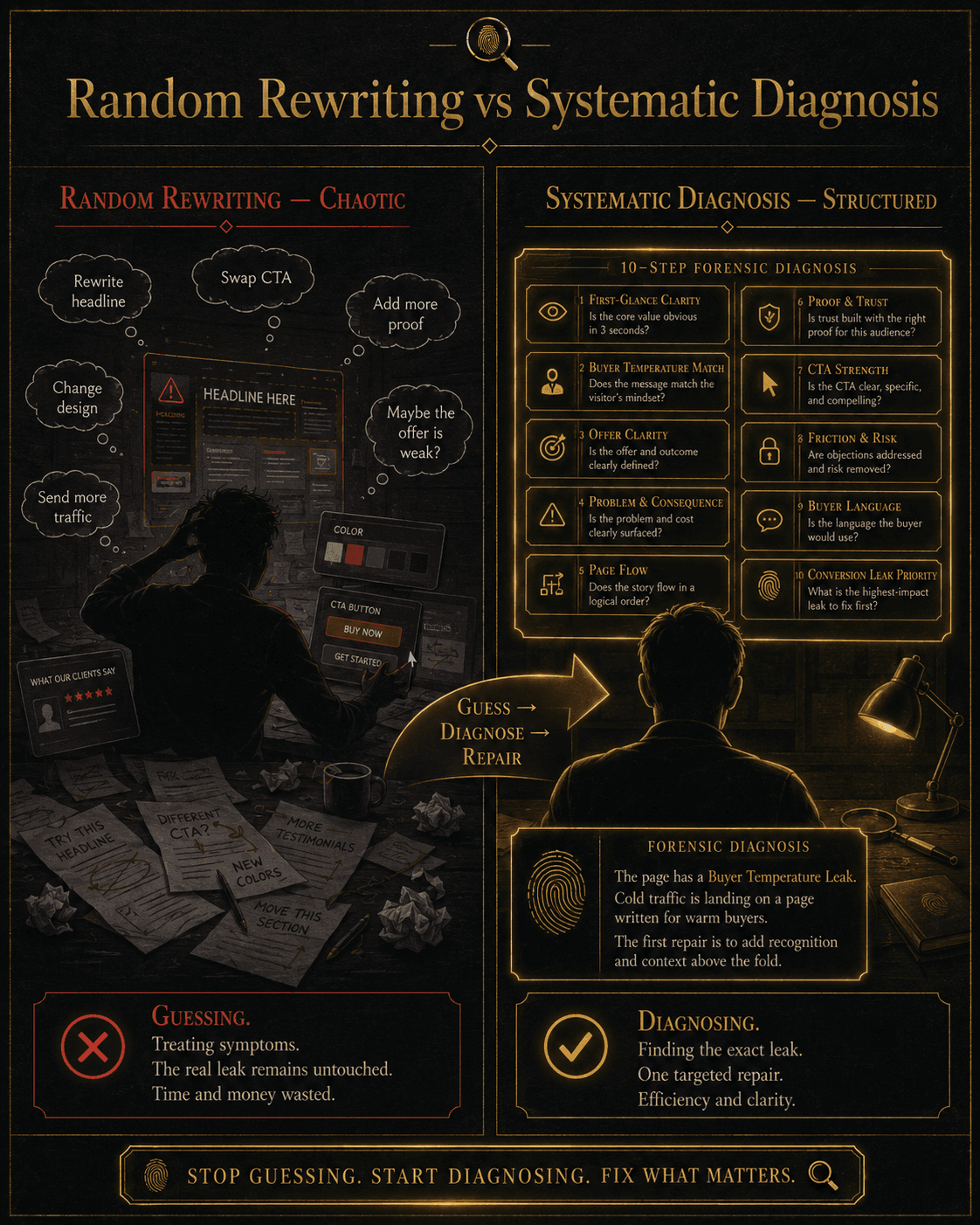
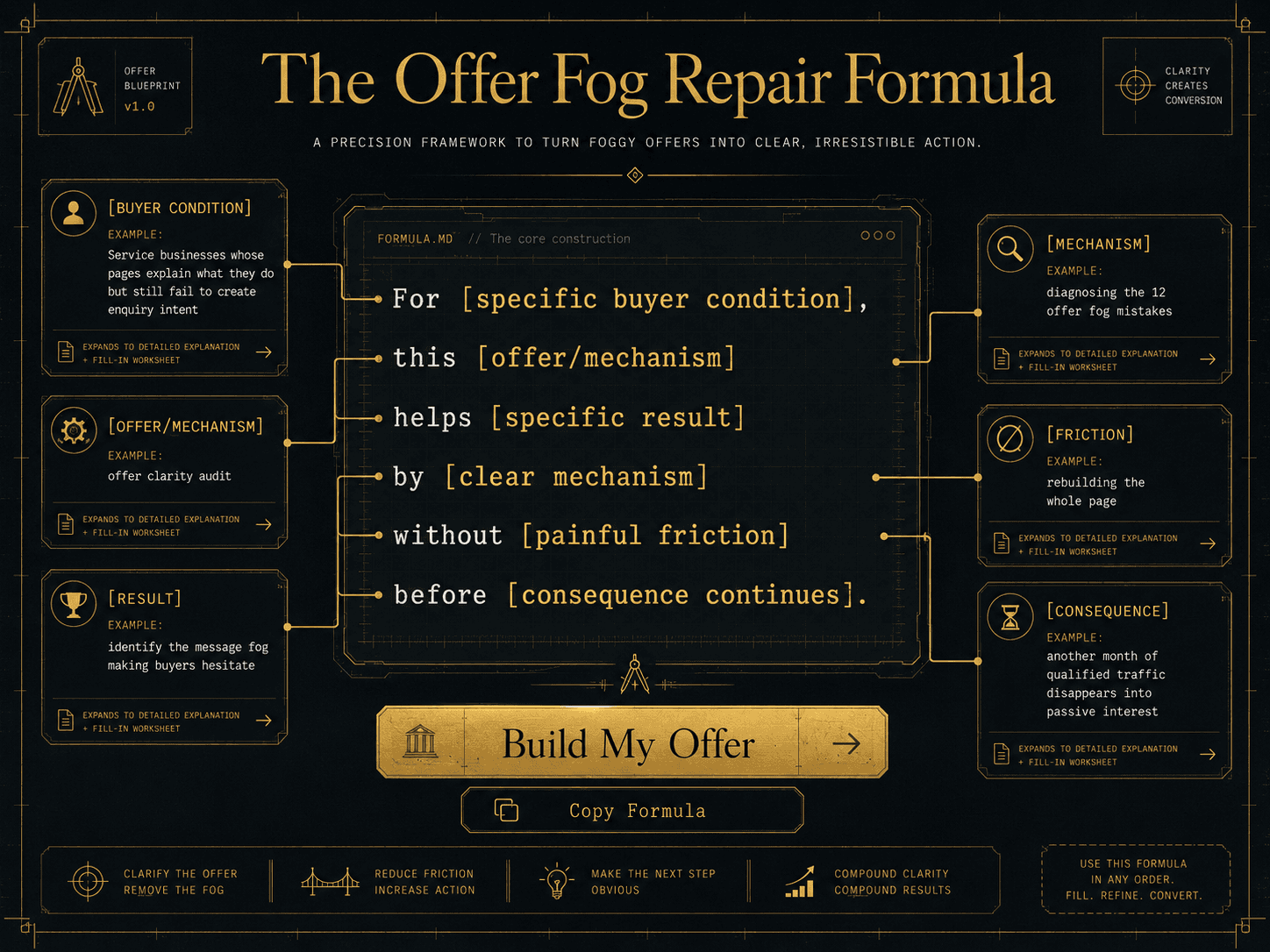
Other Blogs
Other Blogs
Check our other project Blogs with useful insight and information for your businesses