Our Three Step Process
May 28, 2026
Chap 2 | Resource 8 | The Conversion Depth Map™ (levels 6-10)
Our Three Step Process
May 28, 2026
Chap 2 | Resource 8 | The Conversion Depth Map™ (levels 6-10)
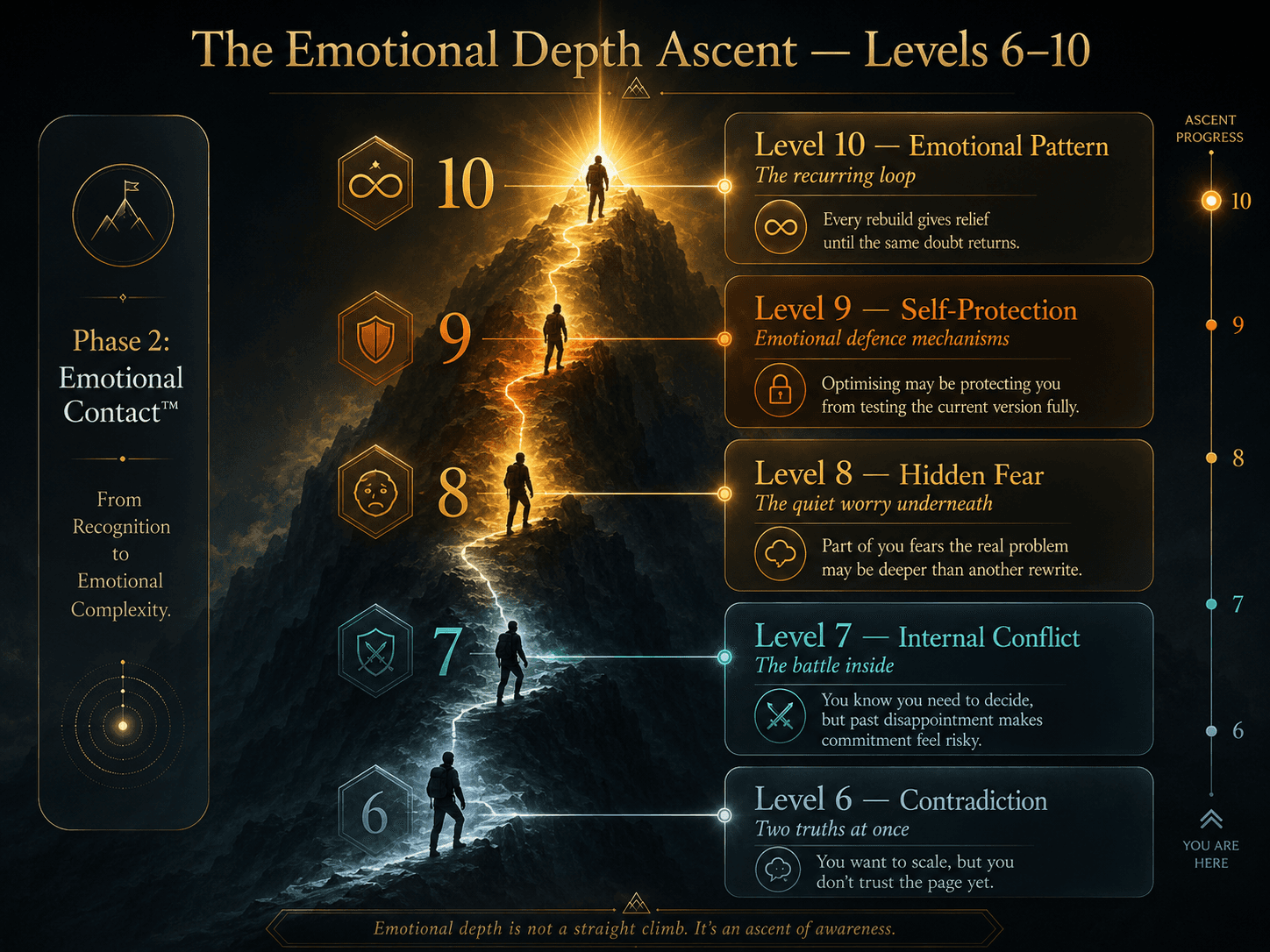
The Conversion Depth Map™ Phase 2: Emotional Contact (levels 6-10). From basic recognition to emotional complexity. This phase diagnoses whether your copy reflects the contradiction, internal conflict, hidden fear, self-protection, and repeated emotional patterns underneath the buyer’s visible problem.
Prefer Audio Or Video?
The Conversion Depth Map™ is also available as:
🎧 A guided audio walkthrough explaining messaging depth, psychological resonance, and conversion sophistication
🎥 A practical video breakdown showing real-world examples of shallow vs deep messaging progressionChoose the format that fits how you learn best.
[Listen To The Audio Walkthrough] (coming soon)
[Watch The Video Breakdown] (coming soon)
——
Phase 2: Emotional Contact™
From Basic Recognition To Emotional Complexity
Phase 1 moved the messaging from generic category language into basic recognition.
Phase 2 goes deeper.
This is where the copy begins reflecting the emotional complexity underneath the buyer’s visible problem.
Now the messaging no longer only says:
“This is your problem.”
Or:
“This is what the problem feels like.”
It begins saying:
“This is the emotional contradiction, fear, self-protection, and repeated pattern underneath the problem.”
That is a major leap.
Because buyers do not experience problems in a clean, simple, logical way.
They experience them through:
contradiction
internal conflict
hidden fear
emotional defence
repeated behavioural loops
hesitation
uncertainty
private anxiety
self-protection
This is where messaging starts feeling deeply personal.
Not because it becomes more dramatic.
Because it becomes more psychologically accurate.
That distinction matters enormously.
What Phase 2 Helps You Diagnose
Phase 2 helps you identify whether your copy is still only describing the buyer’s situation, or whether it has started reflecting the emotional mechanics underneath it.
Use Phase 2 to diagnose:
whether your copy captures contradiction
whether it reflects internal conflict
whether it names hidden fear carefully
whether it shows emotional self-protection
whether it identifies repeated emotional patterns
whether the message feels human, layered, and believable
whether the copy is deepening recognition without becoming manipulative
Phase 2 is not about making the buyer feel worse.
It is about helping the buyer feel more accurately understood.
The Phase 2 Warning
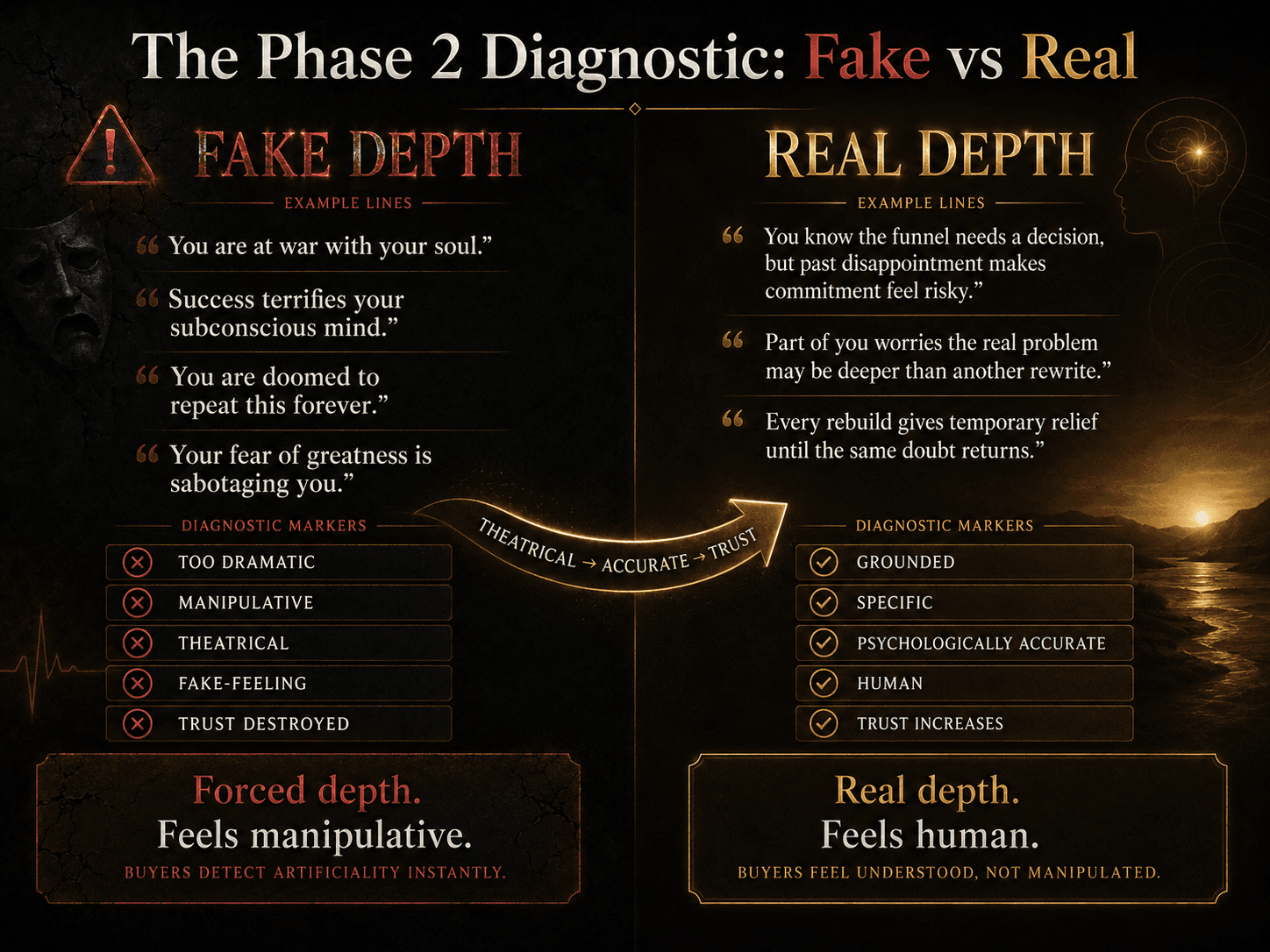
Do not force depth.
This phase is powerful, but it must be handled carefully.
If you exaggerate emotional complexity, the copy will feel fake.
If you overstate hidden fear, the copy will feel manipulative.
If you try to sound “deep,” the copy will become theatrical.
Phase 2 works when the language feels:
specific
calm
measured
believable
human
psychologically accurate
The goal is not emotional intensity.
The goal is emotional truth.
Level 6: Contradiction-Level Messaging™
What This Level Actually Is
Contradiction-Level Messaging™ reflects multiple emotional realities happening inside the buyer at the same time.
This is a major step beyond basic recognition.
At Level 5, the buyer feels:
“This understands what my situation feels like.”
At Level 6, the buyer feels:
“This understands the contradiction I am stuck inside.”
That matters because real buyer psychology is rarely clean.
Buyers often want two opposing things at once.
They want growth, but they fear exposure.
They want clarity, but they distrust simple answers.
They want momentum, but they fear making the wrong move.
They want to scale, but they do not fully trust the system they would have to scale.
That contradiction creates emotional friction.
And emotional friction creates deeper recognition.
How Level 6 Sounds
Examples:
“You want to scale harder, but deep down you still hesitate because the funnel does not feel trustworthy enough to expose to larger traffic yet.”
“You know the business needs stronger visibility, yet part of you keeps delaying because more traffic might expose problems you still cannot fully diagnose.”
“You want clarity badly, but you are also exhausted from rebuilding systems over and over again hoping clarity finally appears.”
“You know you need outside perspective, yet another part of you resists trusting another framework again.”
“You want the page to be finished, but every time you look at it, something still feels unresolved.”
Now the messaging feels:
layered
psychologically believable
emotionally nuanced
deeply human
more accurate than simple problem copy
This is where messaging starts sounding less like persuasion and more like real thought.
What Buyers Feel At This Level
The buyer may think:
“That contradiction is exactly the frustrating part.”
Or:
“Yes. That is the part I struggle explaining.”
This reaction matters because contradiction-level messaging reflects the emotional messiness buyers already live inside privately.
It does not flatten the buyer into a simple problem.
It reflects the competing forces inside the decision.
That creates stronger psychological relevance.
Why Contradiction Creates Stronger Recognition
Contradiction signals psychological truth.
Real humans rarely experience emotions in simple, straight lines.
A founder may simultaneously:
want success
fear visibility
crave growth
fear exposure
seek certainty
distrust certainty claims
want help
resist trusting another person
All at the same time.
Shallow messaging ignores that complexity.
Contradiction-level messaging reflects it.
That is why it feels more believable.
Pressure vs Contradiction
Pressure-Level Version
“You hesitate to scale traffic because the funnel still feels weak.”
Strong.
But still fairly direct.
Contradiction-Level Version
“You know the business needs more traffic to grow, yet every time you consider scaling harder, the uncertainty around the funnel quietly pulls you backward again.”
Now the messaging captures:
ambition
hesitation
fear
internal resistance
emotional push-pull dynamics
That creates much stronger realism.
Another Example
Recognition-Level Version
“You are frustrated the page still feels unclear.”
Strong recognition.
Contradiction-Level Version
“You are experienced enough to recognise weak messaging quickly, which somehow makes it even more frustrating when your own page still feels slightly off.”
Now the contradiction creates:
emotional layering
self-awareness
internal tension
identity conflict
That feels far more human.
The Push-Pull Principle™
Contradiction-level messaging often captures simultaneous movement in opposite directions.
Examples:
“You want certainty, but you also fear discovering how much still needs fixing.”
“You want growth, but you are emotionally exhausted from rebuilding again.”
“You want clarity, but another part of you no longer fully trusts simplistic answers.”
“You want to move faster, but every previous disappointment makes speed feel risky.”
This creates emotional dimensionality.
And dimensionality increases recognition depth.
The Biggest Mistake At Level 6
The biggest mistake is manufacturing contradiction artificially.
Fake contradiction sounds dramatic, performative, or emotionally written.
Fake vs Real Contradiction
Fake
“You fear success because greatness terrifies you.”
Too dramatic.
Too broad.
Too psychologically careless.
Real
“You know visibility could grow the business significantly, but another part of you still wants the funnel to feel safer before exposing it to more people.”
Now the contradiction feels grounded.
That matters enormously.
Confusion vs Contradiction
Confusion means the buyer does not understand.
Contradiction means the buyer understands enough to feel pulled in two directions.
That distinction is important.
Contradiction is not lack of clarity.
It is simultaneous emotional truth.
Level 6 Diagnostic Question
Ask:
“Does this message reflect two emotional truths the buyer is experiencing at the same time?”
If yes, you are approaching contradiction-level messaging.
Level 6 Fill-In Worksheet
The buyer wants:
But the buyer also fears or resists:
The emotional contradiction is:
The practical tension is:
The private thought inside the contradiction is:
A contradiction-level message is:
Level 6 AI Depth Diagnostic Prompt
Use this prompt:
Act as a conversion strategist trained in buyer psychology and contradiction-level messaging.
Analyse whether this messaging reflects real internal contradiction or whether it stays too one-dimensional.
Look for:
conflicting emotional forces
internal tension
psychological push-pull dynamics
simultaneous desires and fears
ambition mixed with hesitation
desire mixed with resistance
Tell me:
What contradiction is currently present.
What contradiction may be missing.
Whether the messaging feels nuanced or too simple.
Whether any contradiction feels forced or artificial.
How to rewrite the message with more believable emotional complexity.
Here is the messaging:
[paste messaging]
Level 7: Internal Conflict Messaging™
What This Level Actually Is
Internal Conflict Messaging™ goes deeper than contradiction.
Contradiction reflects opposing emotional truths.
Internal conflict reflects the ongoing battle created by those opposing truths.
At this level, the buyer feels:
“This is the war happening in my head.”
This matters because buyers do not only experience problems.
They experience continuous internal negotiation.
Examples:
wanting progress while resisting discomfort
wanting certainty while distrusting simple solutions
wanting change while fearing the consequence of change
wanting clarity while avoiding what clarity might reveal
wanting growth while protecting themselves from disappointment
wanting outside help while fearing another disappointing solution
Level 7 captures the emotional friction created by competing internal priorities.
And that feels deeply human.
How Level 7 Sounds
Examples:
“Part of you wants to finally simplify the funnel and move forward confidently. Another part no longer trusts quick solutions enough to relax into them fully.”
“You know continuing to rebuild the page endlessly is exhausting, but stopping feels emotionally risky because what if the next version was finally the one that worked?”
“You want outside perspective badly, yet every previous disappointment makes trusting another framework harder than it should be.”
“You are tired of second-guessing the funnel constantly, but deep down you also fear what happens if you fully commit and it still underperforms.”
“You want the page fixed, but you also know that finding the real problem may force decisions you have been avoiding.”
Now the messaging reflects:
emotional negotiation
hesitation
psychological tension
self-protection
internal instability
repeated mental friction
This creates extremely strong recognition.
What Buyers Feel At This Level
The buyer may think:
“Yes. That is exactly why this feels so mentally exhausting.”
Or:
“That internal conflict is the hardest part.”
This reaction matters because the messaging no longer merely describes the external situation.
It reflects the internal emotional struggle happening underneath it.
That creates deep psychological intimacy.
Why Internal Conflict Creates Stronger Trust
Buyers rarely feel fully understood emotionally.
Most marketing talks at the buyer.
Internal conflict messaging feels like it understands the invisible emotional friction they are privately carrying.
That creates:
emotional safety
attention
openness
trust acceleration
stronger continuation
The buyer feels less like they are being sold to.
And more like someone has finally seen the real issue clearly.
Contradiction vs Internal Conflict
Contradiction-Level Version
“You want to scale harder, but the funnel still feels risky.”
Strong.
Internal Conflict-Level Version
“You know the business needs more aggressive scaling to grow properly, yet every hesitation around the funnel keeps pulling you back into another cycle of tweaking instead of committing fully.”
Now the messaging reflects:
recurring emotional struggle
behavioural repetition
hesitation loops
psychological instability
Much deeper.
Another Example
Contradiction-Level Version
“You want clarity while distrusting simplistic answers.”
Strong psychological nuance.
Internal Conflict-Level Version
“You desperately want the funnel to finally feel simple and clear again, but every previous disappointment has made part of you suspicious of anything that sounds too easy now.”
Now the messaging captures:
emotional history
trust damage
internal resistance
self-protective psychology
That feels very real.
The Emotional Gridlock Effect™
At Level 7, the buyer often feels emotionally stuck between competing internal forces.
Examples:
“I know I need to move faster, but I no longer trust rushed decisions.”
“I want help, but I am tired of trusting the wrong people.”
“I want certainty, but I am exhausted from chasing certainty endlessly.”
“I want to commit, but I do not want to be wrong again.”
This emotional gridlock creates mental fatigue.
And mental fatigue creates deep recognition opportunities.
The Self-Negotiation Principle™
Level 7 messaging often sounds like the buyer arguing with themselves internally.
Examples:
“I know the funnel is probably close, but I have thought that before.”
“I know more traffic could help, but more traffic could also expose weaknesses faster.”
“I know I need outside perspective, but I am tired of depending on frameworks that overpromise.”
That internal self-negotiation creates extremely high psychological realism.
Emotion vs Conflict
Emotion says:
“I am frustrated.”
Internal conflict says:
“I am frustrated because I know what should happen logically, yet emotionally I still cannot fully trust the situation enough to move decisively.”
The second version contains:
emotional complexity
psychological tension
behavioural friction
internal negotiation
That is much deeper.
The Biggest Mistake At Level 7
The biggest mistake is making internal conflict sound dramatic.
Real internal conflict usually sounds quiet.
Subtle.
Human.
Fake vs Real Internal Conflict
Fake
“You are at war with your soul.”
Emotionally ridiculous.
Too theatrical.
Real
“You already know enough to recognise weak marketing advice quickly, which ironically makes it harder to relax into solutions without overanalysing them now.”
Now the conflict feels believable.
That matters enormously.
The “This Is Why I Keep Stalling” Effect
Strong Level 7 messaging often creates behavioural recognition.
The buyer suddenly realises:
“This explains why I keep circling the same problem repeatedly.”
That realisation creates psychological clarity.
And clarity creates movement.
Level 7 Diagnostic Question
Ask:
“Does this message reflect the buyer’s internal battle, or does it only describe their emotion?”
If it reflects the battle, you are approaching internal conflict messaging.
Level 7 Fill-In Worksheet
The buyer logically knows:
But emotionally they still feel:
The internal conflict is:
This conflict causes the buyer to:
The repeated hesitation looks like:
An internal-conflict message is:
Level 7 AI Depth Diagnostic Prompt
Use this prompt:
Act as a conversion strategist trained in buyer psychology and internal conflict messaging.
Analyse whether this messaging reflects genuine internal emotional conflict or merely surface emotion.
Look for:
internal emotional negotiation
competing psychological priorities
hesitation loops
behavioural self-conflict
emotional gridlock
self-protective reasoning
Tell me:
What internal conflict is currently reflected.
What conflict may be missing.
Whether the conflict feels believable or overly dramatic.
What self-negotiation the buyer may be experiencing.
How to rewrite the message with deeper emotional realism.
Here is the messaging:
[paste messaging]
Level 8: Hidden Fear Messaging™
What This Level Actually Is
Hidden Fear Messaging™ reflects fears buyers rarely articulate openly.
This is a major psychological shift.
Most buyers talk publicly about:
problems
goals
frustrations
obstacles
outcomes
But underneath those visible conversations live deeper emotional fears.
Quiet fears.
Private fears.
Fears buyers often minimise, rationalise, hide, or avoid naming clearly.
Level 8 begins reflecting those hidden emotional realities.
When done correctly, it creates extremely powerful recognition.
Important Distinction
This level is not about manufacturing fear.
It is about accurately reflecting fears that already exist psychologically.
That distinction matters enormously.
Fake fear feels manipulative.
Real fear feels quietly familiar.
The goal is not to scare the buyer.
The goal is to name the concern they may already be carrying but have not fully organised into words.
How Level 8 Sounds
Examples:
“The frustrating part is not just the weak conversion rate anymore. It is quietly wondering how much time you may already have wasted solving the wrong problem.”
“You are not afraid of hard work. You are afraid of spending another year rebuilding funnels while never fully trusting whether the messaging problem underneath them was actually solved.”
“Part of you worries the issue is no longer just the funnel itself, but whether you have become too emotionally close to it to evaluate it objectively anymore.”
“You know the business can grow. The fear is whether you will recognise the real bottleneck clearly enough before exhaustion slowly kills momentum.”
“You keep hoping the next version finally feels right enough to trust fully, but part of you is starting to worry the real problem may be deeper than the page itself.”
Now the messaging reflects:
emotional vulnerability
hidden anxiety
unspoken concern
private psychological weight
future uncertainty
This creates deep emotional realism.
What Buyers Feel At This Level
The buyer may think:
“I have honestly worried about that privately before.”
Or:
“That is the fear underneath all of this.”
This reaction matters because the buyer feels seen at a deeper level.
Not only operationally.
Psychologically.
Why Hidden Fear Creates Strong Recognition
Many buyers carry persistent low-level fears they rarely verbalise fully.
Examples:
fear of wasting years
fear of falling behind
fear of not being capable enough
fear of missing obvious problems
fear of becoming irrelevant
fear of losing trust in themselves
fear of repeating the same cycle forever
fear that effort may not pay off eventually
These fears quietly shape:
hesitation
attention
procrastination
decision-making
resistance
trust behaviour
Most marketing never touches this layer honestly.
That is why most messaging feels emotionally shallow.
Pressure vs Hidden Fear
Pressure-Level Version
“You are exhausted rebuilding funnels repeatedly.”
Strong.
Hidden Fear-Level Version
“You are beginning to fear the exhausting part is not rebuilding the funnel itself anymore, but the possibility that the real issue has remained hidden underneath every rebuild the entire time.”
Now the messaging captures:
uncertainty
deeper consequence
invisible anxiety
psychological fatigue
Much deeper.
Another Example
Identity-Level Version
“You are questioning your ability to judge messaging clearly.”
Strong self-perception tension.
Hidden Fear-Level Version
“Part of you quietly fears that if this still feels unclear after everything you already know, you may be solving the problem from the wrong angle entirely.”
Now the messaging touches:
hidden self-doubt
competence fear
uncertainty
internal destabilisation
Very powerful psychologically.
The Unspoken Fear Principle™
One of the strongest aspects of Level 8 is that the messaging articulates fears buyers feel but rarely organise into language themselves.
Examples:
“What if I keep improving the wrong thing?”
“What if I am too close to the problem to see it properly anymore?”
“What if the issue is deeper than I want to admit?”
“What if the funnel is not the only thing that needs fixing?”
That creates high recognition value.
Because articulation creates clarity.
And clarity creates attention.
The Private Night Thought Test™
One of the easiest ways to identify Level 8 messaging is to ask:
“Does this sound like a thought someone might have quietly late at night while overthinking the problem alone?”
If yes, you are likely approaching hidden fear depth.
The Biggest Mistake At Level 8
The biggest mistake is weaponising fear.
Hidden fear should be reflected quietly.
Not exaggerated.
Not intensified artificially.
Not used to make the buyer feel unsafe.
Fake vs Real Hidden Fear
Fake
“If you do not fix this, your business will collapse and you will regret everything.”
Too heavy.
Too manipulative.
Too theatrical.
Real
“If the same uncertainty keeps surviving every rebuild, the real risk is spending another year fixing visible symptoms while the actual messaging problem remains untouched.”
Now the fear is grounded in consequence.
Not panic.
That is the standard.
Problem Fear vs Hidden Fear
Problem Fear
“The funnel might fail.”
Hidden Fear
“What if I keep circling the same problem for years without realising what is actually broken underneath it?”
The second version affects:
meaning
time
self-trust
future interpretation
Much deeper psychologically.
Level 8 Diagnostic Question
Ask:
“Does this message reflect a fear the buyer may privately carry but rarely say out loud?”
If yes, you are approaching hidden fear messaging.
Level 8 Fill-In Worksheet
The visible fear is:
The hidden fear underneath it may be:
The buyer may privately worry that:
The future consequence they fear is:
A careful hidden-fear message is:
Level 8 AI Depth Diagnostic Prompt
Use this prompt:
Act as a conversion strategist trained in buyer psychology and hidden fear messaging.
Analyse whether this messaging reflects real hidden fear or merely surface anxiety.
Look for:
private emotional fears
hidden uncertainty
deeper psychological concern
unspoken future anxiety
fear of wasted time
fear of misjudgement
fear of repeating the same cycle
Tell me:
What hidden fear is currently present.
What hidden fear may be missing.
Whether the fear is reflected carefully or exaggerated.
Where the copy risks becoming manipulative.
How to rewrite the message so it feels more psychologically accurate and emotionally safe.
Here is the messaging:
[paste messaging]
Level 9: Self-Protection Messaging™
What This Level Actually Is
Self-Protection Messaging™ reflects the emotional defence mechanisms buyers use to protect themselves from discomfort.
This is extremely important psychologically.
Many buyer behaviours are not actually laziness, indifference, or lack of motivation.
They are forms of emotional self-protection.
The buyer may be protecting themselves from:
disappointment
uncertainty
failure
embarrassment
emotional exposure
regret
wasted effort
loss of self-trust
another wrong decision
At Level 9, the messaging no longer only describes the problem, pressure, contradiction, conflict, or fear.
It begins exposing why the buyer keeps behaving the way they do emotionally.
That creates very deep recognition.
The Most Important Principle
Most buyers are not lazy.
They are protective.
Protective of:
confidence
emotional safety
identity
hope
certainty
self-image
future optimism
This level reflects those protection patterns honestly.
And when buyers feel their protective behaviours are understood, trust increases dramatically.
How Level 9 Sounds
Examples:
“You keep rebuilding the funnel partly because improving it feels productive, but also because constantly tweaking it protects you from fully testing whether the current version is actually strong enough yet.”
“Research feels safer than commitment because as long as you are still gathering answers, you do not have to face whether the current message can actually carry the offer.”
“The constant optimisation cycle may no longer be about improving the funnel itself. It may be about delaying the emotional discomfort of committing fully before the page finally feels safe enough to trust.”
“You are not avoiding the decision because you do not care. You may be avoiding the moment where the answer becomes clear enough to remove the excuse for waiting.”
“You keep looking for one more framework because certainty feels safer when it is still theoretical.”
Now the messaging reflects:
emotional defence
avoidance patterns
protective behaviour
hidden logic
self-protective hesitation
This is deeper than simply saying:
“You are procrastinating.”
It explains the emotional function behind the behaviour.
What Buyers Feel At This Level
The buyer may think:
“That explains why I keep doing this.”
Or:
“I did not realise that was part of the pattern.”
This is psychologically powerful because humans crave self-understanding.
When messaging helps explain their own emotional behaviour patterns, trust deepens significantly.
Why Self-Protection Creates Attention
Hidden protection mechanisms often operate semi-consciously.
Buyers feel the behaviour, but rarely interpret it fully.
When messaging suddenly articulates the emotional logic underneath the behaviour, attention spikes.
Because the brain recognises new self-understanding.
That is why Level 9 can feel so personally accurate.
Procrastination vs Self-Protection
Surface Interpretation
“I procrastinate.”
Deeper Psychological Interpretation
“Delaying decisions has become emotionally safer than risking certainty around an answer that still feels psychologically heavy.”
The second version creates far deeper emotional realism.
Resistance vs Self-Protection
Resistance
“I do not trust this.”
Self-Protection
“Part of me keeps resisting certainty because certainty now feels emotionally risky after previous disappointment.”
The second version reveals the emotional logic underneath the resistance.
That is much deeper psychologically.
The Protective Loop Principle™
Many buyers become trapped in repeating protection loops.
Example 1:
Uncertainty
→ optimisation
→ temporary relief
→ doubt returns
→ more optimisation
Example 2:
Hesitation
→ research
→ emotional safety
→ no commitment
→ continued uncertainty
Example 3:
Fear of wrong decision
→ delay
→ more comparison
→ more confusion
→ less confidence
This is where behaviour becomes emotionally self-reinforcing.
Very important psychologically.
The Biggest Mistake At Level 9
The biggest mistake is trying to sound psychoanalytic.
That destroys believability immediately.
Real self-protection messaging sounds:
specific
calm
observational
emotionally grounded
practical
human
Not dramatic.
Fake vs Real Self-Protection Messaging
Fake
“You sabotage yourself because success terrifies your subconscious mind.”
Emotionally cartoonish.
Too broad.
Too theatrical.
Real
“Part of the constant optimisation cycle may no longer be about improving the funnel itself, but about delaying the discomfort of committing fully before the page finally feels safe enough to trust.”
Now the messaging feels believable.
Human.
Psychologically accurate.
The “This Is Not Just A Funnel Problem Anymore” Effect
At Level 9, buyers often begin realising:
“This situation is affecting my emotional behaviour patterns themselves.”
That recognition creates powerful psychological involvement.
Because now the messaging feels less like marketing and more like accurate observation.
Level 9 Diagnostic Question
Ask:
“Does this message explain the emotional protection behind the buyer’s behaviour?”
If yes, you are approaching self-protection messaging.
Level 9 Fill-In Worksheet
The behaviour the buyer keeps repeating is:
The surface explanation is:
The emotional protection underneath it may be:
The buyer may be protecting themselves from:
The protective loop is:
A self-protection message is:
Level 9 AI Depth Diagnostic Prompt
Use this prompt:
Act as a conversion strategist trained in buyer psychology and emotional self-protection messaging.
Analyse whether this messaging reflects emotional self-protection mechanisms or merely surface hesitation behaviour.
Look for:
behavioural defence patterns
subconscious avoidance
emotional safeguarding
protective loops
hesitation that creates safety
optimisation as avoidance
research as delay
resistance as protection
Tell me:
What self-protection behaviour is currently reflected.
What emotional protection pattern may be missing.
Whether the messaging sounds grounded or too psychoanalytic.
What protective loop may be operating.
How to rewrite the message with more psychological accuracy and restraint.
Here is the messaging:
[paste messaging]
Level 10: Emotional Pattern Messaging™
What This Level Actually Is
Emotional Pattern Messaging™ identifies the recurring emotional cycles buyers keep reliving over time.
This is a major psychological evolution.
At Level 10, the messaging no longer only reflects contradiction, conflict, fear, or self-protection.
It reflects the repeated emotional pattern surrounding the problem.
This matters because buyers often feel trapped not by a single problem, but by the repeated emotional experience around the problem.
Examples:
repeated launch disappointment
recurring confidence crashes
endless motivation-reset cycles
recurring hesitation loops
constant rebuilding patterns
repeated overthinking spirals
cycles of hope followed by fatigue
optimism followed by uncertainty
progress followed by doubt
At this level, the messaging starts revealing:
“This is not random anymore. This has become a repeating emotional pattern.”
That realisation creates deep recognition.
How Level 10 Sounds
Examples:
“Every rebuild starts with hope. Then the same doubt slowly returns when the page still does not feel strong enough to trust.”
“You fix one section, feel relief for a moment, then open the page again and notice the same uncertainty waiting underneath.”
“The pattern is exhausting: launch, watch, doubt, tweak, repeat — without ever feeling certain the real leak has been found.”
“You keep reaching moments where the page feels almost finished, but never quite finished enough to send traffic with full confidence.”
“The hardest part is not one weak launch. It is the emotional loop of believing the next version will finally feel right, then slowly realising the same hesitation is still there.”
Now the messaging reflects:
repetition
emotional fatigue
recurring tension
behavioural cycles
psychological loops
pattern recognition
This is where the buyer begins seeing the problem as a loop, not an isolated event.
What Buyers Feel At This Level
The buyer may think:
“This keeps happening over and over.”
Or:
“That is exactly the cycle I am stuck in.”
This reaction matters because Level 10 does not only name the problem.
It names the pattern.
And patterns feel heavier than isolated incidents.
Why?
Because repeated problems create emotional fatigue.
They also create future concern.
The buyer starts wondering:
“If this pattern keeps repeating, what does that mean?”
That increases urgency naturally.
Why Emotional Patterns Create Strong Recognition
Humans pay attention to repeated emotional loops.
A single bad result may be frustrating.
A repeated pattern becomes psychologically meaningful.
Example:
One failed page feels like a problem.
Five rounds of rewriting the same page without confidence starts becoming a pattern.
That pattern affects:
motivation
trust
confidence
decision-making
emotional resilience
willingness to act
Messaging that reflects the pattern creates deeper recognition than messaging that only names the incident.
Pressure vs Emotional Pattern
Pressure-Level Version
“You are tired of rebuilding the funnel.”
Strong.
Emotional Pattern-Level Version
“Every rebuild gives you a short burst of relief, until the same quiet doubt returns and you realise the page still does not feel strong enough to trust.”
Now the messaging captures:
repetition
temporary relief
doubt returning
emotional cycle
confidence erosion
That is much deeper.
Another Example
Hidden Fear-Level Version
“You fear wasting another year fixing the wrong problem.”
Strong.
Emotional Pattern-Level Version
“The exhausting part is watching the same cycle repeat: hope after each new version, uncertainty after each launch, then another round of fixes that never fully removes the doubt.”
Now the messaging captures:
time
repetition
emotional fatigue
hope-collapse cycle
recurring frustration
That creates stronger recognition.
The Emotional Loop Principle™
Level 10 messaging often captures the emotional loop buyers keep repeating.
Examples:
Hope
→ effort
→ launch
→ doubt
→ rebuild
→ hope again
Or:
Confusion
→ research
→ temporary clarity
→ new doubt
→ more research
Or:
Traffic
→ weak conversion
→ panic
→ redesign
→ temporary relief
→ same uncertainty
These loops are powerful because they show the buyer that the issue is not isolated.
It is recurring.
And recurring emotional cost creates urgency without hype.
The Biggest Mistake At Level 10
The biggest mistake is making the pattern sound fatalistic.
The point is not to trap the buyer emotionally.
The point is to show the repeating structure clearly enough that change becomes necessary.
Avoid language that makes the buyer feel hopeless.
Use language that creates recognition and direction.
Fake vs Real Emotional Pattern Messaging
Fake
“You are doomed to repeat this forever unless you act now.”
Manipulative.
Fear-heavy.
Emotionally unsafe.
Real
“If every new version gives temporary relief but the same doubt keeps returning, the issue may not be effort. It may be that the real conversion leak has never been diagnosed clearly enough.”
Now the pattern is named.
The buyer is not attacked.
The next step becomes logical.
Incident vs Pattern
Incident
“The funnel underperformed.”
Pattern
“The funnel keeps reaching the same point: it looks improved, feels temporarily better, then quietly starts creating the same uncertainty again.”
Patterns create deeper emotional recognition because they show the repeated experience.
The “This Keeps Happening” Test
Ask:
“Does this message describe one problem, or does it reveal a recurring emotional loop?”
If it reveals the loop, you are approaching emotional pattern messaging.
Level 10 Diagnostic Question
Ask:
“Does this message show the repeated emotional cycle the buyer keeps reliving?”
If yes, you are approaching emotional pattern messaging.
Level 10 Fill-In Worksheet
The repeated behaviour is:
The emotional loop starts when:
The temporary relief comes from:
The doubt returns when:
The buyer repeats the pattern by:
The emotional cost of the pattern is:
An emotional-pattern message is:
Level 10 AI Depth Diagnostic Prompt
Use this prompt:
Act as a conversion strategist trained in buyer psychology and emotional pattern messaging.
Analyse whether this messaging reflects recurring emotional patterns or only isolated problems.
Look for:
repeated cycles
recurring hesitation loops
hope followed by doubt
temporary relief followed by uncertainty
emotional fatigue over time
behavioural repetition
confidence erosion
Tell me:
What emotional pattern is currently reflected.
What repeated loop may be missing.
Whether the pattern feels believable or exaggerated.
Where the copy risks sounding fatalistic or manipulative.
How to rewrite the message so it reveals the pattern while preserving hope and direction.
Here is the messaging:
[paste messaging]
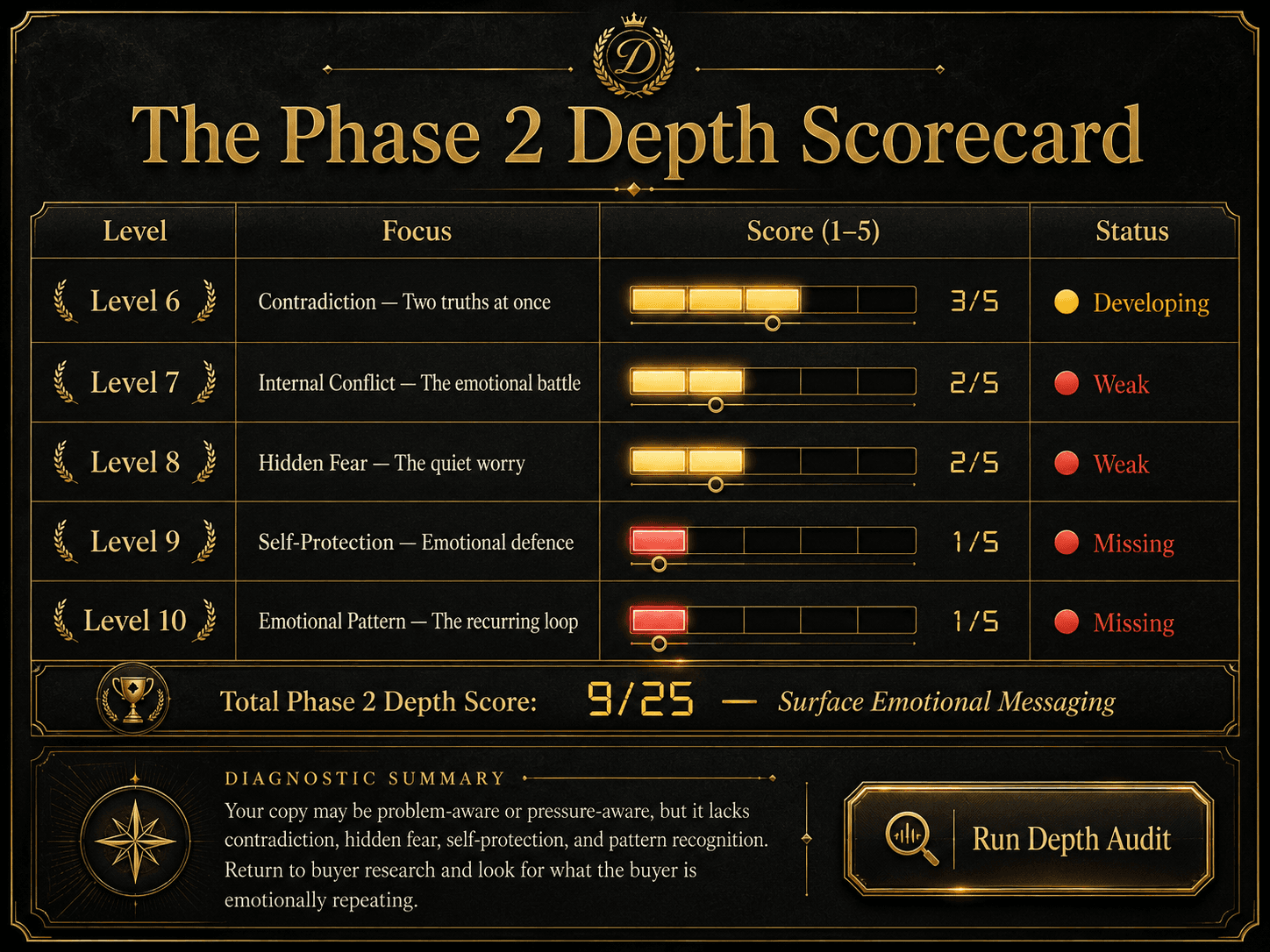
Phase 2 Conversion Depth Scorecard™
Use this scorecard to diagnose whether your messaging has moved from basic recognition into emotional complexity.
Score each level from 1 to 5.
1 = weak or missing
2 = present but shallow
3 = usable
4 = strong
5 = highly accurate and recognisable
Level 6: Contradiction
Does the messaging reflect two emotional truths the buyer experiences at the same time?
Score: ___ / 5
Level 7: Internal Conflict
Does the messaging reflect the buyer’s internal emotional battle or self-negotiation?
Score: ___ / 5
Level 8: Hidden Fear
Does the messaging carefully reflect the fear underneath the visible frustration?
Score: ___ / 5
Level 9: Self-Protection
Does the messaging explain the emotional protection behind the buyer’s behaviour?
Score: ___ / 5
Level 10: Emotional Pattern
Does the messaging reveal the recurring emotional loop the buyer keeps reliving?
Score: ___ / 5
Total Phase 2 Depth Score
Total: ___ / 25
——
What Your Score Means
21–25: Strong Phase 2 Depth
Your messaging reflects emotional complexity with accuracy and restraint.
It likely feels highly human, nuanced, and psychologically believable.
16–20: Good But Needs More Precision
Your messaging is starting to reflect deeper emotional mechanics, but some parts may still feel underdeveloped.
Look for missing contradiction, hidden fear, or repeated emotional pattern.
10–15: Basic Emotional Recognition
Your copy may contain emotional language, but it probably does not yet reflect internal complexity.
It may still be describing frustration more than the emotional mechanics underneath it.
0–9: Surface Emotional Messaging
Your copy may be problem-aware or pressure-aware, but it likely lacks contradiction, hidden fear, self-protection, and pattern recognition.
Return to the buyer research and look for what the buyer is emotionally repeating.
——
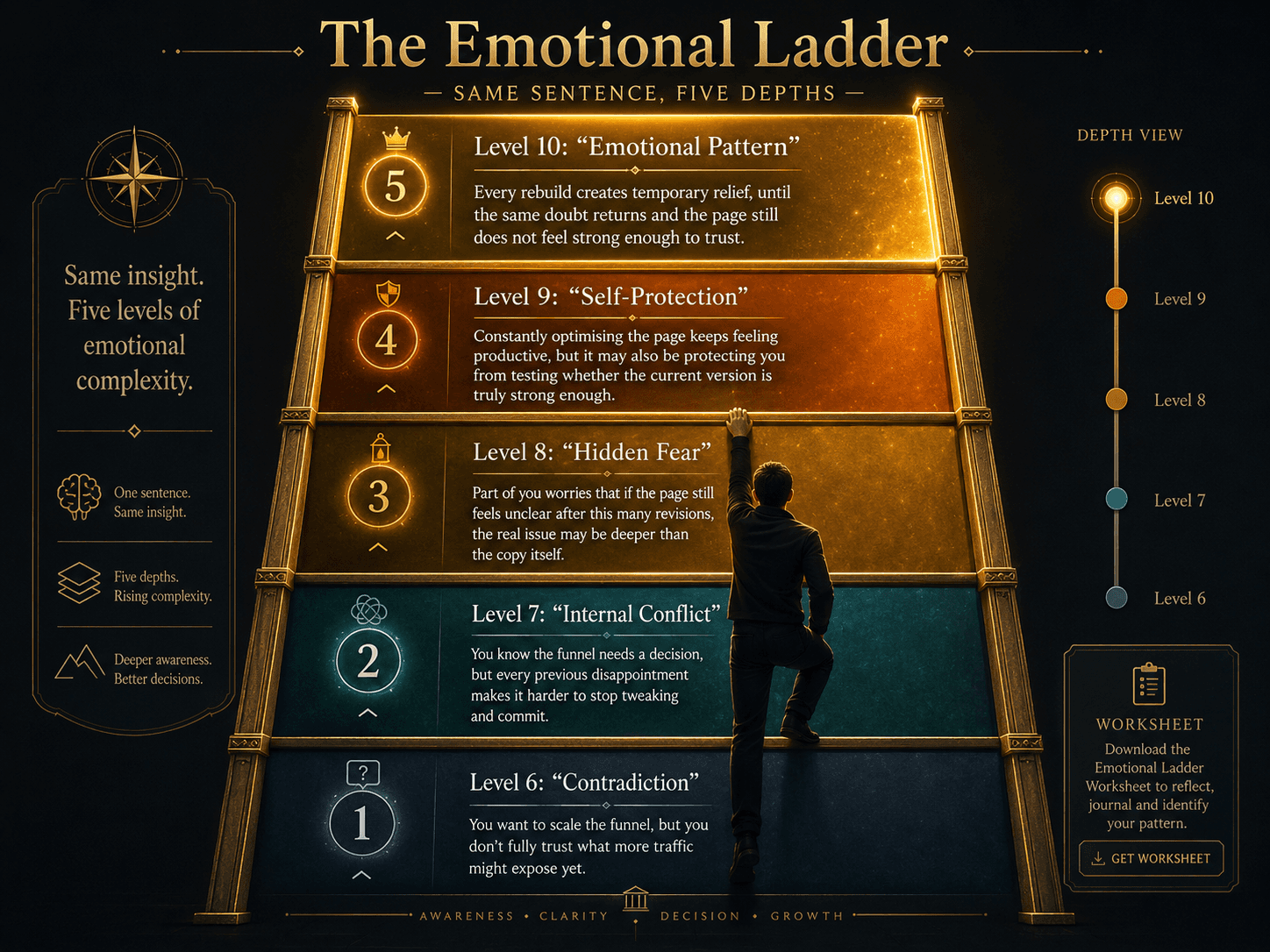
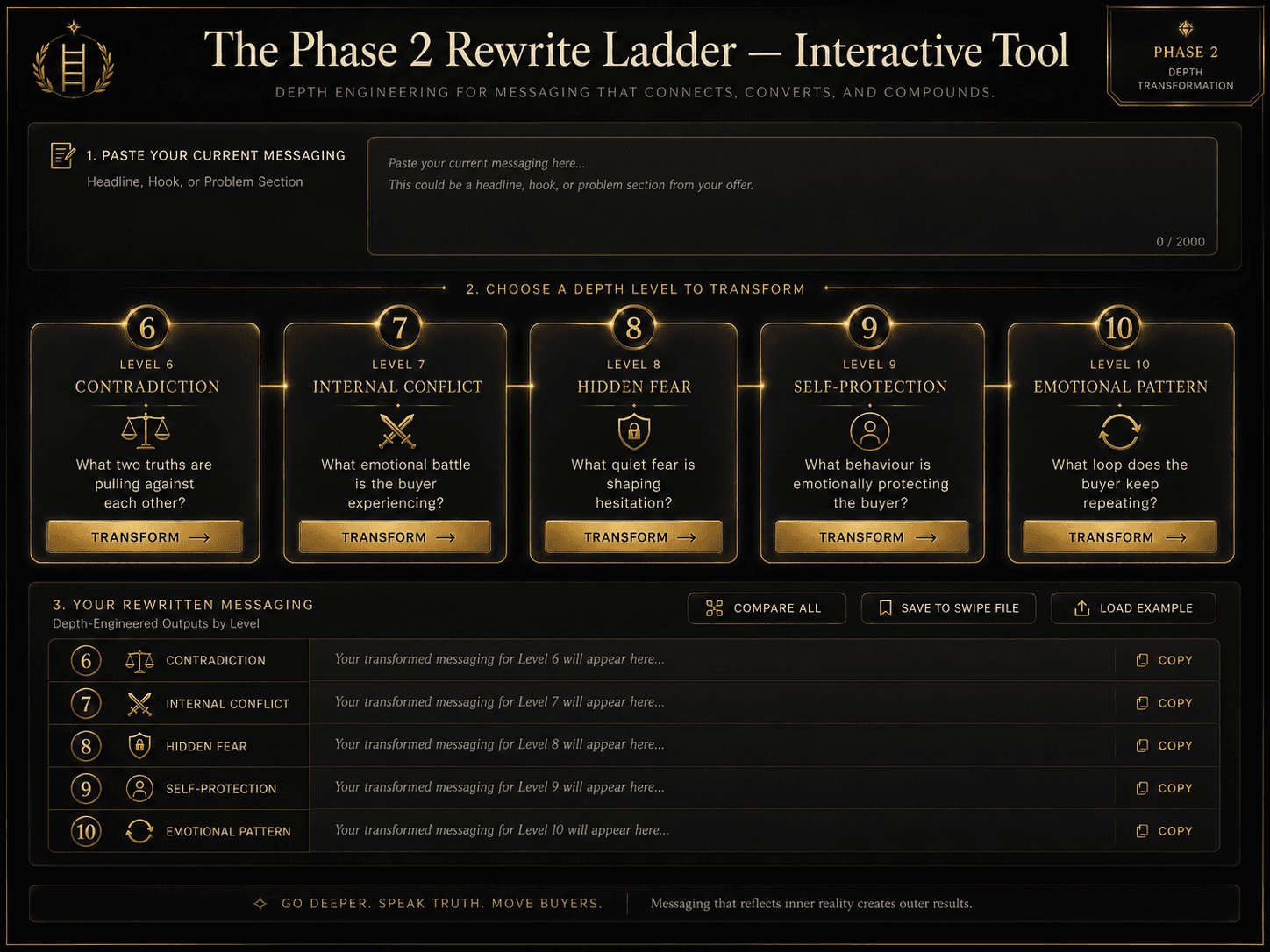
The Phase 2 Rewrite Ladder™
Use this ladder to move one sentence through Levels 6–10.
Level 6: Contradiction
What two truths are pulling against each other?
Example:
“You want to scale the funnel, but you do not fully trust what more traffic might expose yet.”
Your version:
Level 7: Internal Conflict
What emotional battle is the buyer experiencing?
Example:
“You know the funnel needs a decision, but every previous disappointment makes it harder to stop tweaking and commit.”
Your version:
Level 8: Hidden Fear
What quiet fear is shaping the buyer’s hesitation?
Example:
“Part of you worries that if the page still feels unclear after this many revisions, the real issue may be deeper than the copy itself.”
Your version:
Level 9: Self-Protection
What behaviour is emotionally protecting the buyer?
Example:
“Constantly optimising the page keeps feeling productive, but it may also be protecting you from testing whether the current version is truly strong enough.”
Your version:
Level 10: Emotional Pattern
What loop does the buyer keep repeating?
Example:
“Every rebuild creates temporary relief, until the same doubt returns and the page still does not feel strong enough to trust.”
Your version:
——
Phase 2 Worked Example
Level 6: Contradiction-Level Messaging™
“You want to send more traffic, but part of you still worries the page may not be strong enough to hold belief yet.”
This captures a push-pull dynamic.
Growth desire meets trust hesitation.
Level 7: Internal Conflict Messaging™
“You know the business needs more traffic to grow, yet every hesitation around the funnel keeps pulling you back into another round of tweaking instead of committing fully.”
This shows the internal battle.
The buyer wants movement but keeps retreating into revision.
Level 8: Hidden Fear Messaging™
“Part of you quietly worries that if the page still feels uncertain after this much work, the real problem may be deeper than another headline rewrite.”
This reflects a private fear.
The buyer may be afraid the issue has been misdiagnosed.
Level 9: Self-Protection Messaging™
“The constant optimisation cycle may no longer be only about improving the funnel. It may also be protecting you from the discomfort of fully testing whether the current message can actually carry the offer.”
This explains the emotional protection behind repeated behaviour.
Level 10: Emotional Pattern Messaging™
“Every new version gives you a short burst of relief, until the same quiet doubt returns and you start wondering again whether the real leak was ever found.”
This reveals the recurring emotional loop.
Now the buyer sees the pattern.
——
Phase 2 Implementation Exercise™
Take one headline, hook, problem section, or opening paragraph from your page.
Write the current version here:
Now identify the current level:
Level 6 / Level 7 / Level 8 / Level 9 / Level 10 / Not yet Phase 2
Why is it currently at this level?
What contradiction is present?
What internal conflict is present?
What hidden fear may be underneath the situation?
What self-protective behaviour might the buyer be repeating?
What emotional pattern keeps recurring?
Final improved version:
——
Phase 2 Final Principle™
Phase 2 teaches the second major shift in conversion depth:
Stop only reflecting what the problem feels like.
Start reflecting the emotional mechanics underneath the problem.
The journey moves like this:
Level 6 says:
“This is the contradiction you are living inside.”
Level 7 says:
“This is the internal conflict that keeps pulling you back and forth.”
Level 8 says:
“This is the hidden fear underneath the visible frustration.”
Level 9 says:
“This is how your behaviour may be protecting you emotionally.”
Level 10 says:
“This is the repeated emotional pattern you keep reliving.”
That is where messaging begins moving from recognition into emotional depth.
And when it is done carefully, the copy does not feel manipulative.
It feels unusually human.
It feels like the buyer’s internal experience has finally been understood with accuracy.
That is what makes Phase 2 powerful.
——
From:
The $100M Funnel Playbook. Book I: Foundation Buyer Psychology, Offer Clarity, and the Page Architecture Behind High-Converting Funnels
By Maris Spalins.
——
Copyright Notice
© 2026 The $100M Funnel Playbook / Winyourclients / Maris Spalins. All rights reserved.
This resource, including the frameworks, terminology, examples, scorecards, templates, prompts, methods, and written explanations, is original intellectual property created for The $100M Funnel Playbook. Book I: Foundation — Buyer Psychology, Offer Clarity, And The Page Architecture Behind High-Converting Funnels and published through Winyourclients.
No part of this resource may be copied, reproduced, screenshotted, republished, redistributed, sold, adapted, uploaded, scraped, stored in a database, included in training data, used to train artificial intelligence systems, or used to create derivative commercial or educational materials without prior written permission.
Limited reference, quotation, or sharing is only permitted where the source is clearly and visibly credited.
Any permitted reference must include at least one of the following source credits:
The $100M Funnel Playbook by Maris Spalins
or
Winyourclients — www.winyourclients.com
or
Maris Spalins / Winyourclients
Screenshots, excerpts, summaries, or redistributed versions must not remove, hide, alter, crop out, or obscure the original source, author name, book title, website name, or copyright notice.
This resource is provided for personal learning and implementation only. It is not licensed for resale, republishing, redistribution, AI training, template cloning, course creation, consulting delivery, or commercial reuse without written permission from Maris Spalins or Winyourclients.
For permission requests, licensing, citation approval, or commercial usage enquiries, contact:
Winyourclients
www.winyourclients.com
or
Email directly to Jacob on: help@winyourclients.com
The Conversion Depth Map™ Phase 2: Emotional Contact (levels 6-10). From basic recognition to emotional complexity. This phase diagnoses whether your copy reflects the contradiction, internal conflict, hidden fear, self-protection, and repeated emotional patterns underneath the buyer’s visible problem.
Prefer Audio Or Video?
The Conversion Depth Map™ is also available as:
🎧 A guided audio walkthrough explaining messaging depth, psychological resonance, and conversion sophistication
🎥 A practical video breakdown showing real-world examples of shallow vs deep messaging progressionChoose the format that fits how you learn best.
[Listen To The Audio Walkthrough] (coming soon)
[Watch The Video Breakdown] (coming soon)
——
Phase 2: Emotional Contact™
From Basic Recognition To Emotional Complexity
Phase 1 moved the messaging from generic category language into basic recognition.
Phase 2 goes deeper.
This is where the copy begins reflecting the emotional complexity underneath the buyer’s visible problem.
Now the messaging no longer only says:
“This is your problem.”
Or:
“This is what the problem feels like.”
It begins saying:
“This is the emotional contradiction, fear, self-protection, and repeated pattern underneath the problem.”
That is a major leap.
Because buyers do not experience problems in a clean, simple, logical way.
They experience them through:
contradiction
internal conflict
hidden fear
emotional defence
repeated behavioural loops
hesitation
uncertainty
private anxiety
self-protection
This is where messaging starts feeling deeply personal.
Not because it becomes more dramatic.
Because it becomes more psychologically accurate.
That distinction matters enormously.
What Phase 2 Helps You Diagnose
Phase 2 helps you identify whether your copy is still only describing the buyer’s situation, or whether it has started reflecting the emotional mechanics underneath it.
Use Phase 2 to diagnose:
whether your copy captures contradiction
whether it reflects internal conflict
whether it names hidden fear carefully
whether it shows emotional self-protection
whether it identifies repeated emotional patterns
whether the message feels human, layered, and believable
whether the copy is deepening recognition without becoming manipulative
Phase 2 is not about making the buyer feel worse.
It is about helping the buyer feel more accurately understood.
The Phase 2 Warning
Do not force depth.
This phase is powerful, but it must be handled carefully.
If you exaggerate emotional complexity, the copy will feel fake.
If you overstate hidden fear, the copy will feel manipulative.
If you try to sound “deep,” the copy will become theatrical.
Phase 2 works when the language feels:
specific
calm
measured
believable
human
psychologically accurate
The goal is not emotional intensity.
The goal is emotional truth.
Level 6: Contradiction-Level Messaging™
What This Level Actually Is
Contradiction-Level Messaging™ reflects multiple emotional realities happening inside the buyer at the same time.
This is a major step beyond basic recognition.
At Level 5, the buyer feels:
“This understands what my situation feels like.”
At Level 6, the buyer feels:
“This understands the contradiction I am stuck inside.”
That matters because real buyer psychology is rarely clean.
Buyers often want two opposing things at once.
They want growth, but they fear exposure.
They want clarity, but they distrust simple answers.
They want momentum, but they fear making the wrong move.
They want to scale, but they do not fully trust the system they would have to scale.
That contradiction creates emotional friction.
And emotional friction creates deeper recognition.
How Level 6 Sounds
Examples:
“You want to scale harder, but deep down you still hesitate because the funnel does not feel trustworthy enough to expose to larger traffic yet.”
“You know the business needs stronger visibility, yet part of you keeps delaying because more traffic might expose problems you still cannot fully diagnose.”
“You want clarity badly, but you are also exhausted from rebuilding systems over and over again hoping clarity finally appears.”
“You know you need outside perspective, yet another part of you resists trusting another framework again.”
“You want the page to be finished, but every time you look at it, something still feels unresolved.”
Now the messaging feels:
layered
psychologically believable
emotionally nuanced
deeply human
more accurate than simple problem copy
This is where messaging starts sounding less like persuasion and more like real thought.
What Buyers Feel At This Level
The buyer may think:
“That contradiction is exactly the frustrating part.”
Or:
“Yes. That is the part I struggle explaining.”
This reaction matters because contradiction-level messaging reflects the emotional messiness buyers already live inside privately.
It does not flatten the buyer into a simple problem.
It reflects the competing forces inside the decision.
That creates stronger psychological relevance.
Why Contradiction Creates Stronger Recognition
Contradiction signals psychological truth.
Real humans rarely experience emotions in simple, straight lines.
A founder may simultaneously:
want success
fear visibility
crave growth
fear exposure
seek certainty
distrust certainty claims
want help
resist trusting another person
All at the same time.
Shallow messaging ignores that complexity.
Contradiction-level messaging reflects it.
That is why it feels more believable.
Pressure vs Contradiction
Pressure-Level Version
“You hesitate to scale traffic because the funnel still feels weak.”
Strong.
But still fairly direct.
Contradiction-Level Version
“You know the business needs more traffic to grow, yet every time you consider scaling harder, the uncertainty around the funnel quietly pulls you backward again.”
Now the messaging captures:
ambition
hesitation
fear
internal resistance
emotional push-pull dynamics
That creates much stronger realism.
Another Example
Recognition-Level Version
“You are frustrated the page still feels unclear.”
Strong recognition.
Contradiction-Level Version
“You are experienced enough to recognise weak messaging quickly, which somehow makes it even more frustrating when your own page still feels slightly off.”
Now the contradiction creates:
emotional layering
self-awareness
internal tension
identity conflict
That feels far more human.
The Push-Pull Principle™
Contradiction-level messaging often captures simultaneous movement in opposite directions.
Examples:
“You want certainty, but you also fear discovering how much still needs fixing.”
“You want growth, but you are emotionally exhausted from rebuilding again.”
“You want clarity, but another part of you no longer fully trusts simplistic answers.”
“You want to move faster, but every previous disappointment makes speed feel risky.”
This creates emotional dimensionality.
And dimensionality increases recognition depth.
The Biggest Mistake At Level 6
The biggest mistake is manufacturing contradiction artificially.
Fake contradiction sounds dramatic, performative, or emotionally written.
Fake vs Real Contradiction
Fake
“You fear success because greatness terrifies you.”
Too dramatic.
Too broad.
Too psychologically careless.
Real
“You know visibility could grow the business significantly, but another part of you still wants the funnel to feel safer before exposing it to more people.”
Now the contradiction feels grounded.
That matters enormously.
Confusion vs Contradiction
Confusion means the buyer does not understand.
Contradiction means the buyer understands enough to feel pulled in two directions.
That distinction is important.
Contradiction is not lack of clarity.
It is simultaneous emotional truth.
Level 6 Diagnostic Question
Ask:
“Does this message reflect two emotional truths the buyer is experiencing at the same time?”
If yes, you are approaching contradiction-level messaging.
Level 6 Fill-In Worksheet
The buyer wants:
But the buyer also fears or resists:
The emotional contradiction is:
The practical tension is:
The private thought inside the contradiction is:
A contradiction-level message is:
Level 6 AI Depth Diagnostic Prompt
Use this prompt:
Act as a conversion strategist trained in buyer psychology and contradiction-level messaging.
Analyse whether this messaging reflects real internal contradiction or whether it stays too one-dimensional.
Look for:
conflicting emotional forces
internal tension
psychological push-pull dynamics
simultaneous desires and fears
ambition mixed with hesitation
desire mixed with resistance
Tell me:
What contradiction is currently present.
What contradiction may be missing.
Whether the messaging feels nuanced or too simple.
Whether any contradiction feels forced or artificial.
How to rewrite the message with more believable emotional complexity.
Here is the messaging:
[paste messaging]
Level 7: Internal Conflict Messaging™
What This Level Actually Is
Internal Conflict Messaging™ goes deeper than contradiction.
Contradiction reflects opposing emotional truths.
Internal conflict reflects the ongoing battle created by those opposing truths.
At this level, the buyer feels:
“This is the war happening in my head.”
This matters because buyers do not only experience problems.
They experience continuous internal negotiation.
Examples:
wanting progress while resisting discomfort
wanting certainty while distrusting simple solutions
wanting change while fearing the consequence of change
wanting clarity while avoiding what clarity might reveal
wanting growth while protecting themselves from disappointment
wanting outside help while fearing another disappointing solution
Level 7 captures the emotional friction created by competing internal priorities.
And that feels deeply human.
How Level 7 Sounds
Examples:
“Part of you wants to finally simplify the funnel and move forward confidently. Another part no longer trusts quick solutions enough to relax into them fully.”
“You know continuing to rebuild the page endlessly is exhausting, but stopping feels emotionally risky because what if the next version was finally the one that worked?”
“You want outside perspective badly, yet every previous disappointment makes trusting another framework harder than it should be.”
“You are tired of second-guessing the funnel constantly, but deep down you also fear what happens if you fully commit and it still underperforms.”
“You want the page fixed, but you also know that finding the real problem may force decisions you have been avoiding.”
Now the messaging reflects:
emotional negotiation
hesitation
psychological tension
self-protection
internal instability
repeated mental friction
This creates extremely strong recognition.
What Buyers Feel At This Level
The buyer may think:
“Yes. That is exactly why this feels so mentally exhausting.”
Or:
“That internal conflict is the hardest part.”
This reaction matters because the messaging no longer merely describes the external situation.
It reflects the internal emotional struggle happening underneath it.
That creates deep psychological intimacy.
Why Internal Conflict Creates Stronger Trust
Buyers rarely feel fully understood emotionally.
Most marketing talks at the buyer.
Internal conflict messaging feels like it understands the invisible emotional friction they are privately carrying.
That creates:
emotional safety
attention
openness
trust acceleration
stronger continuation
The buyer feels less like they are being sold to.
And more like someone has finally seen the real issue clearly.
Contradiction vs Internal Conflict
Contradiction-Level Version
“You want to scale harder, but the funnel still feels risky.”
Strong.
Internal Conflict-Level Version
“You know the business needs more aggressive scaling to grow properly, yet every hesitation around the funnel keeps pulling you back into another cycle of tweaking instead of committing fully.”
Now the messaging reflects:
recurring emotional struggle
behavioural repetition
hesitation loops
psychological instability
Much deeper.
Another Example
Contradiction-Level Version
“You want clarity while distrusting simplistic answers.”
Strong psychological nuance.
Internal Conflict-Level Version
“You desperately want the funnel to finally feel simple and clear again, but every previous disappointment has made part of you suspicious of anything that sounds too easy now.”
Now the messaging captures:
emotional history
trust damage
internal resistance
self-protective psychology
That feels very real.
The Emotional Gridlock Effect™
At Level 7, the buyer often feels emotionally stuck between competing internal forces.
Examples:
“I know I need to move faster, but I no longer trust rushed decisions.”
“I want help, but I am tired of trusting the wrong people.”
“I want certainty, but I am exhausted from chasing certainty endlessly.”
“I want to commit, but I do not want to be wrong again.”
This emotional gridlock creates mental fatigue.
And mental fatigue creates deep recognition opportunities.
The Self-Negotiation Principle™
Level 7 messaging often sounds like the buyer arguing with themselves internally.
Examples:
“I know the funnel is probably close, but I have thought that before.”
“I know more traffic could help, but more traffic could also expose weaknesses faster.”
“I know I need outside perspective, but I am tired of depending on frameworks that overpromise.”
That internal self-negotiation creates extremely high psychological realism.
Emotion vs Conflict
Emotion says:
“I am frustrated.”
Internal conflict says:
“I am frustrated because I know what should happen logically, yet emotionally I still cannot fully trust the situation enough to move decisively.”
The second version contains:
emotional complexity
psychological tension
behavioural friction
internal negotiation
That is much deeper.
The Biggest Mistake At Level 7
The biggest mistake is making internal conflict sound dramatic.
Real internal conflict usually sounds quiet.
Subtle.
Human.
Fake vs Real Internal Conflict
Fake
“You are at war with your soul.”
Emotionally ridiculous.
Too theatrical.
Real
“You already know enough to recognise weak marketing advice quickly, which ironically makes it harder to relax into solutions without overanalysing them now.”
Now the conflict feels believable.
That matters enormously.
The “This Is Why I Keep Stalling” Effect
Strong Level 7 messaging often creates behavioural recognition.
The buyer suddenly realises:
“This explains why I keep circling the same problem repeatedly.”
That realisation creates psychological clarity.
And clarity creates movement.
Level 7 Diagnostic Question
Ask:
“Does this message reflect the buyer’s internal battle, or does it only describe their emotion?”
If it reflects the battle, you are approaching internal conflict messaging.
Level 7 Fill-In Worksheet
The buyer logically knows:
But emotionally they still feel:
The internal conflict is:
This conflict causes the buyer to:
The repeated hesitation looks like:
An internal-conflict message is:
Level 7 AI Depth Diagnostic Prompt
Use this prompt:
Act as a conversion strategist trained in buyer psychology and internal conflict messaging.
Analyse whether this messaging reflects genuine internal emotional conflict or merely surface emotion.
Look for:
internal emotional negotiation
competing psychological priorities
hesitation loops
behavioural self-conflict
emotional gridlock
self-protective reasoning
Tell me:
What internal conflict is currently reflected.
What conflict may be missing.
Whether the conflict feels believable or overly dramatic.
What self-negotiation the buyer may be experiencing.
How to rewrite the message with deeper emotional realism.
Here is the messaging:
[paste messaging]
Level 8: Hidden Fear Messaging™
What This Level Actually Is
Hidden Fear Messaging™ reflects fears buyers rarely articulate openly.
This is a major psychological shift.
Most buyers talk publicly about:
problems
goals
frustrations
obstacles
outcomes
But underneath those visible conversations live deeper emotional fears.
Quiet fears.
Private fears.
Fears buyers often minimise, rationalise, hide, or avoid naming clearly.
Level 8 begins reflecting those hidden emotional realities.
When done correctly, it creates extremely powerful recognition.
Important Distinction
This level is not about manufacturing fear.
It is about accurately reflecting fears that already exist psychologically.
That distinction matters enormously.
Fake fear feels manipulative.
Real fear feels quietly familiar.
The goal is not to scare the buyer.
The goal is to name the concern they may already be carrying but have not fully organised into words.
How Level 8 Sounds
Examples:
“The frustrating part is not just the weak conversion rate anymore. It is quietly wondering how much time you may already have wasted solving the wrong problem.”
“You are not afraid of hard work. You are afraid of spending another year rebuilding funnels while never fully trusting whether the messaging problem underneath them was actually solved.”
“Part of you worries the issue is no longer just the funnel itself, but whether you have become too emotionally close to it to evaluate it objectively anymore.”
“You know the business can grow. The fear is whether you will recognise the real bottleneck clearly enough before exhaustion slowly kills momentum.”
“You keep hoping the next version finally feels right enough to trust fully, but part of you is starting to worry the real problem may be deeper than the page itself.”
Now the messaging reflects:
emotional vulnerability
hidden anxiety
unspoken concern
private psychological weight
future uncertainty
This creates deep emotional realism.
What Buyers Feel At This Level
The buyer may think:
“I have honestly worried about that privately before.”
Or:
“That is the fear underneath all of this.”
This reaction matters because the buyer feels seen at a deeper level.
Not only operationally.
Psychologically.
Why Hidden Fear Creates Strong Recognition
Many buyers carry persistent low-level fears they rarely verbalise fully.
Examples:
fear of wasting years
fear of falling behind
fear of not being capable enough
fear of missing obvious problems
fear of becoming irrelevant
fear of losing trust in themselves
fear of repeating the same cycle forever
fear that effort may not pay off eventually
These fears quietly shape:
hesitation
attention
procrastination
decision-making
resistance
trust behaviour
Most marketing never touches this layer honestly.
That is why most messaging feels emotionally shallow.
Pressure vs Hidden Fear
Pressure-Level Version
“You are exhausted rebuilding funnels repeatedly.”
Strong.
Hidden Fear-Level Version
“You are beginning to fear the exhausting part is not rebuilding the funnel itself anymore, but the possibility that the real issue has remained hidden underneath every rebuild the entire time.”
Now the messaging captures:
uncertainty
deeper consequence
invisible anxiety
psychological fatigue
Much deeper.
Another Example
Identity-Level Version
“You are questioning your ability to judge messaging clearly.”
Strong self-perception tension.
Hidden Fear-Level Version
“Part of you quietly fears that if this still feels unclear after everything you already know, you may be solving the problem from the wrong angle entirely.”
Now the messaging touches:
hidden self-doubt
competence fear
uncertainty
internal destabilisation
Very powerful psychologically.
The Unspoken Fear Principle™
One of the strongest aspects of Level 8 is that the messaging articulates fears buyers feel but rarely organise into language themselves.
Examples:
“What if I keep improving the wrong thing?”
“What if I am too close to the problem to see it properly anymore?”
“What if the issue is deeper than I want to admit?”
“What if the funnel is not the only thing that needs fixing?”
That creates high recognition value.
Because articulation creates clarity.
And clarity creates attention.
The Private Night Thought Test™
One of the easiest ways to identify Level 8 messaging is to ask:
“Does this sound like a thought someone might have quietly late at night while overthinking the problem alone?”
If yes, you are likely approaching hidden fear depth.
The Biggest Mistake At Level 8
The biggest mistake is weaponising fear.
Hidden fear should be reflected quietly.
Not exaggerated.
Not intensified artificially.
Not used to make the buyer feel unsafe.
Fake vs Real Hidden Fear
Fake
“If you do not fix this, your business will collapse and you will regret everything.”
Too heavy.
Too manipulative.
Too theatrical.
Real
“If the same uncertainty keeps surviving every rebuild, the real risk is spending another year fixing visible symptoms while the actual messaging problem remains untouched.”
Now the fear is grounded in consequence.
Not panic.
That is the standard.
Problem Fear vs Hidden Fear
Problem Fear
“The funnel might fail.”
Hidden Fear
“What if I keep circling the same problem for years without realising what is actually broken underneath it?”
The second version affects:
meaning
time
self-trust
future interpretation
Much deeper psychologically.
Level 8 Diagnostic Question
Ask:
“Does this message reflect a fear the buyer may privately carry but rarely say out loud?”
If yes, you are approaching hidden fear messaging.
Level 8 Fill-In Worksheet
The visible fear is:
The hidden fear underneath it may be:
The buyer may privately worry that:
The future consequence they fear is:
A careful hidden-fear message is:
Level 8 AI Depth Diagnostic Prompt
Use this prompt:
Act as a conversion strategist trained in buyer psychology and hidden fear messaging.
Analyse whether this messaging reflects real hidden fear or merely surface anxiety.
Look for:
private emotional fears
hidden uncertainty
deeper psychological concern
unspoken future anxiety
fear of wasted time
fear of misjudgement
fear of repeating the same cycle
Tell me:
What hidden fear is currently present.
What hidden fear may be missing.
Whether the fear is reflected carefully or exaggerated.
Where the copy risks becoming manipulative.
How to rewrite the message so it feels more psychologically accurate and emotionally safe.
Here is the messaging:
[paste messaging]
Level 9: Self-Protection Messaging™
What This Level Actually Is
Self-Protection Messaging™ reflects the emotional defence mechanisms buyers use to protect themselves from discomfort.
This is extremely important psychologically.
Many buyer behaviours are not actually laziness, indifference, or lack of motivation.
They are forms of emotional self-protection.
The buyer may be protecting themselves from:
disappointment
uncertainty
failure
embarrassment
emotional exposure
regret
wasted effort
loss of self-trust
another wrong decision
At Level 9, the messaging no longer only describes the problem, pressure, contradiction, conflict, or fear.
It begins exposing why the buyer keeps behaving the way they do emotionally.
That creates very deep recognition.
The Most Important Principle
Most buyers are not lazy.
They are protective.
Protective of:
confidence
emotional safety
identity
hope
certainty
self-image
future optimism
This level reflects those protection patterns honestly.
And when buyers feel their protective behaviours are understood, trust increases dramatically.
How Level 9 Sounds
Examples:
“You keep rebuilding the funnel partly because improving it feels productive, but also because constantly tweaking it protects you from fully testing whether the current version is actually strong enough yet.”
“Research feels safer than commitment because as long as you are still gathering answers, you do not have to face whether the current message can actually carry the offer.”
“The constant optimisation cycle may no longer be about improving the funnel itself. It may be about delaying the emotional discomfort of committing fully before the page finally feels safe enough to trust.”
“You are not avoiding the decision because you do not care. You may be avoiding the moment where the answer becomes clear enough to remove the excuse for waiting.”
“You keep looking for one more framework because certainty feels safer when it is still theoretical.”
Now the messaging reflects:
emotional defence
avoidance patterns
protective behaviour
hidden logic
self-protective hesitation
This is deeper than simply saying:
“You are procrastinating.”
It explains the emotional function behind the behaviour.
What Buyers Feel At This Level
The buyer may think:
“That explains why I keep doing this.”
Or:
“I did not realise that was part of the pattern.”
This is psychologically powerful because humans crave self-understanding.
When messaging helps explain their own emotional behaviour patterns, trust deepens significantly.
Why Self-Protection Creates Attention
Hidden protection mechanisms often operate semi-consciously.
Buyers feel the behaviour, but rarely interpret it fully.
When messaging suddenly articulates the emotional logic underneath the behaviour, attention spikes.
Because the brain recognises new self-understanding.
That is why Level 9 can feel so personally accurate.
Procrastination vs Self-Protection
Surface Interpretation
“I procrastinate.”
Deeper Psychological Interpretation
“Delaying decisions has become emotionally safer than risking certainty around an answer that still feels psychologically heavy.”
The second version creates far deeper emotional realism.
Resistance vs Self-Protection
Resistance
“I do not trust this.”
Self-Protection
“Part of me keeps resisting certainty because certainty now feels emotionally risky after previous disappointment.”
The second version reveals the emotional logic underneath the resistance.
That is much deeper psychologically.
The Protective Loop Principle™
Many buyers become trapped in repeating protection loops.
Example 1:
Uncertainty
→ optimisation
→ temporary relief
→ doubt returns
→ more optimisation
Example 2:
Hesitation
→ research
→ emotional safety
→ no commitment
→ continued uncertainty
Example 3:
Fear of wrong decision
→ delay
→ more comparison
→ more confusion
→ less confidence
This is where behaviour becomes emotionally self-reinforcing.
Very important psychologically.
The Biggest Mistake At Level 9
The biggest mistake is trying to sound psychoanalytic.
That destroys believability immediately.
Real self-protection messaging sounds:
specific
calm
observational
emotionally grounded
practical
human
Not dramatic.
Fake vs Real Self-Protection Messaging
Fake
“You sabotage yourself because success terrifies your subconscious mind.”
Emotionally cartoonish.
Too broad.
Too theatrical.
Real
“Part of the constant optimisation cycle may no longer be about improving the funnel itself, but about delaying the discomfort of committing fully before the page finally feels safe enough to trust.”
Now the messaging feels believable.
Human.
Psychologically accurate.
The “This Is Not Just A Funnel Problem Anymore” Effect
At Level 9, buyers often begin realising:
“This situation is affecting my emotional behaviour patterns themselves.”
That recognition creates powerful psychological involvement.
Because now the messaging feels less like marketing and more like accurate observation.
Level 9 Diagnostic Question
Ask:
“Does this message explain the emotional protection behind the buyer’s behaviour?”
If yes, you are approaching self-protection messaging.
Level 9 Fill-In Worksheet
The behaviour the buyer keeps repeating is:
The surface explanation is:
The emotional protection underneath it may be:
The buyer may be protecting themselves from:
The protective loop is:
A self-protection message is:
Level 9 AI Depth Diagnostic Prompt
Use this prompt:
Act as a conversion strategist trained in buyer psychology and emotional self-protection messaging.
Analyse whether this messaging reflects emotional self-protection mechanisms or merely surface hesitation behaviour.
Look for:
behavioural defence patterns
subconscious avoidance
emotional safeguarding
protective loops
hesitation that creates safety
optimisation as avoidance
research as delay
resistance as protection
Tell me:
What self-protection behaviour is currently reflected.
What emotional protection pattern may be missing.
Whether the messaging sounds grounded or too psychoanalytic.
What protective loop may be operating.
How to rewrite the message with more psychological accuracy and restraint.
Here is the messaging:
[paste messaging]
Level 10: Emotional Pattern Messaging™
What This Level Actually Is
Emotional Pattern Messaging™ identifies the recurring emotional cycles buyers keep reliving over time.
This is a major psychological evolution.
At Level 10, the messaging no longer only reflects contradiction, conflict, fear, or self-protection.
It reflects the repeated emotional pattern surrounding the problem.
This matters because buyers often feel trapped not by a single problem, but by the repeated emotional experience around the problem.
Examples:
repeated launch disappointment
recurring confidence crashes
endless motivation-reset cycles
recurring hesitation loops
constant rebuilding patterns
repeated overthinking spirals
cycles of hope followed by fatigue
optimism followed by uncertainty
progress followed by doubt
At this level, the messaging starts revealing:
“This is not random anymore. This has become a repeating emotional pattern.”
That realisation creates deep recognition.
How Level 10 Sounds
Examples:
“Every rebuild starts with hope. Then the same doubt slowly returns when the page still does not feel strong enough to trust.”
“You fix one section, feel relief for a moment, then open the page again and notice the same uncertainty waiting underneath.”
“The pattern is exhausting: launch, watch, doubt, tweak, repeat — without ever feeling certain the real leak has been found.”
“You keep reaching moments where the page feels almost finished, but never quite finished enough to send traffic with full confidence.”
“The hardest part is not one weak launch. It is the emotional loop of believing the next version will finally feel right, then slowly realising the same hesitation is still there.”
Now the messaging reflects:
repetition
emotional fatigue
recurring tension
behavioural cycles
psychological loops
pattern recognition
This is where the buyer begins seeing the problem as a loop, not an isolated event.
What Buyers Feel At This Level
The buyer may think:
“This keeps happening over and over.”
Or:
“That is exactly the cycle I am stuck in.”
This reaction matters because Level 10 does not only name the problem.
It names the pattern.
And patterns feel heavier than isolated incidents.
Why?
Because repeated problems create emotional fatigue.
They also create future concern.
The buyer starts wondering:
“If this pattern keeps repeating, what does that mean?”
That increases urgency naturally.
Why Emotional Patterns Create Strong Recognition
Humans pay attention to repeated emotional loops.
A single bad result may be frustrating.
A repeated pattern becomes psychologically meaningful.
Example:
One failed page feels like a problem.
Five rounds of rewriting the same page without confidence starts becoming a pattern.
That pattern affects:
motivation
trust
confidence
decision-making
emotional resilience
willingness to act
Messaging that reflects the pattern creates deeper recognition than messaging that only names the incident.
Pressure vs Emotional Pattern
Pressure-Level Version
“You are tired of rebuilding the funnel.”
Strong.
Emotional Pattern-Level Version
“Every rebuild gives you a short burst of relief, until the same quiet doubt returns and you realise the page still does not feel strong enough to trust.”
Now the messaging captures:
repetition
temporary relief
doubt returning
emotional cycle
confidence erosion
That is much deeper.
Another Example
Hidden Fear-Level Version
“You fear wasting another year fixing the wrong problem.”
Strong.
Emotional Pattern-Level Version
“The exhausting part is watching the same cycle repeat: hope after each new version, uncertainty after each launch, then another round of fixes that never fully removes the doubt.”
Now the messaging captures:
time
repetition
emotional fatigue
hope-collapse cycle
recurring frustration
That creates stronger recognition.
The Emotional Loop Principle™
Level 10 messaging often captures the emotional loop buyers keep repeating.
Examples:
Hope
→ effort
→ launch
→ doubt
→ rebuild
→ hope again
Or:
Confusion
→ research
→ temporary clarity
→ new doubt
→ more research
Or:
Traffic
→ weak conversion
→ panic
→ redesign
→ temporary relief
→ same uncertainty
These loops are powerful because they show the buyer that the issue is not isolated.
It is recurring.
And recurring emotional cost creates urgency without hype.
The Biggest Mistake At Level 10
The biggest mistake is making the pattern sound fatalistic.
The point is not to trap the buyer emotionally.
The point is to show the repeating structure clearly enough that change becomes necessary.
Avoid language that makes the buyer feel hopeless.
Use language that creates recognition and direction.
Fake vs Real Emotional Pattern Messaging
Fake
“You are doomed to repeat this forever unless you act now.”
Manipulative.
Fear-heavy.
Emotionally unsafe.
Real
“If every new version gives temporary relief but the same doubt keeps returning, the issue may not be effort. It may be that the real conversion leak has never been diagnosed clearly enough.”
Now the pattern is named.
The buyer is not attacked.
The next step becomes logical.
Incident vs Pattern
Incident
“The funnel underperformed.”
Pattern
“The funnel keeps reaching the same point: it looks improved, feels temporarily better, then quietly starts creating the same uncertainty again.”
Patterns create deeper emotional recognition because they show the repeated experience.
The “This Keeps Happening” Test
Ask:
“Does this message describe one problem, or does it reveal a recurring emotional loop?”
If it reveals the loop, you are approaching emotional pattern messaging.
Level 10 Diagnostic Question
Ask:
“Does this message show the repeated emotional cycle the buyer keeps reliving?”
If yes, you are approaching emotional pattern messaging.
Level 10 Fill-In Worksheet
The repeated behaviour is:
The emotional loop starts when:
The temporary relief comes from:
The doubt returns when:
The buyer repeats the pattern by:
The emotional cost of the pattern is:
An emotional-pattern message is:
Level 10 AI Depth Diagnostic Prompt
Use this prompt:
Act as a conversion strategist trained in buyer psychology and emotional pattern messaging.
Analyse whether this messaging reflects recurring emotional patterns or only isolated problems.
Look for:
repeated cycles
recurring hesitation loops
hope followed by doubt
temporary relief followed by uncertainty
emotional fatigue over time
behavioural repetition
confidence erosion
Tell me:
What emotional pattern is currently reflected.
What repeated loop may be missing.
Whether the pattern feels believable or exaggerated.
Where the copy risks sounding fatalistic or manipulative.
How to rewrite the message so it reveals the pattern while preserving hope and direction.
Here is the messaging:
[paste messaging]
Phase 2 Conversion Depth Scorecard™
Use this scorecard to diagnose whether your messaging has moved from basic recognition into emotional complexity.
Score each level from 1 to 5.
1 = weak or missing
2 = present but shallow
3 = usable
4 = strong
5 = highly accurate and recognisable
Level 6: Contradiction
Does the messaging reflect two emotional truths the buyer experiences at the same time?
Score: ___ / 5
Level 7: Internal Conflict
Does the messaging reflect the buyer’s internal emotional battle or self-negotiation?
Score: ___ / 5
Level 8: Hidden Fear
Does the messaging carefully reflect the fear underneath the visible frustration?
Score: ___ / 5
Level 9: Self-Protection
Does the messaging explain the emotional protection behind the buyer’s behaviour?
Score: ___ / 5
Level 10: Emotional Pattern
Does the messaging reveal the recurring emotional loop the buyer keeps reliving?
Score: ___ / 5
Total Phase 2 Depth Score
Total: ___ / 25
——
What Your Score Means
21–25: Strong Phase 2 Depth
Your messaging reflects emotional complexity with accuracy and restraint.
It likely feels highly human, nuanced, and psychologically believable.
16–20: Good But Needs More Precision
Your messaging is starting to reflect deeper emotional mechanics, but some parts may still feel underdeveloped.
Look for missing contradiction, hidden fear, or repeated emotional pattern.
10–15: Basic Emotional Recognition
Your copy may contain emotional language, but it probably does not yet reflect internal complexity.
It may still be describing frustration more than the emotional mechanics underneath it.
0–9: Surface Emotional Messaging
Your copy may be problem-aware or pressure-aware, but it likely lacks contradiction, hidden fear, self-protection, and pattern recognition.
Return to the buyer research and look for what the buyer is emotionally repeating.
——
The Phase 2 Rewrite Ladder™
Use this ladder to move one sentence through Levels 6–10.
Level 6: Contradiction
What two truths are pulling against each other?
Example:
“You want to scale the funnel, but you do not fully trust what more traffic might expose yet.”
Your version:
Level 7: Internal Conflict
What emotional battle is the buyer experiencing?
Example:
“You know the funnel needs a decision, but every previous disappointment makes it harder to stop tweaking and commit.”
Your version:
Level 8: Hidden Fear
What quiet fear is shaping the buyer’s hesitation?
Example:
“Part of you worries that if the page still feels unclear after this many revisions, the real issue may be deeper than the copy itself.”
Your version:
Level 9: Self-Protection
What behaviour is emotionally protecting the buyer?
Example:
“Constantly optimising the page keeps feeling productive, but it may also be protecting you from testing whether the current version is truly strong enough.”
Your version:
Level 10: Emotional Pattern
What loop does the buyer keep repeating?
Example:
“Every rebuild creates temporary relief, until the same doubt returns and the page still does not feel strong enough to trust.”
Your version:
——
Phase 2 Worked Example
Level 6: Contradiction-Level Messaging™
“You want to send more traffic, but part of you still worries the page may not be strong enough to hold belief yet.”
This captures a push-pull dynamic.
Growth desire meets trust hesitation.
Level 7: Internal Conflict Messaging™
“You know the business needs more traffic to grow, yet every hesitation around the funnel keeps pulling you back into another round of tweaking instead of committing fully.”
This shows the internal battle.
The buyer wants movement but keeps retreating into revision.
Level 8: Hidden Fear Messaging™
“Part of you quietly worries that if the page still feels uncertain after this much work, the real problem may be deeper than another headline rewrite.”
This reflects a private fear.
The buyer may be afraid the issue has been misdiagnosed.
Level 9: Self-Protection Messaging™
“The constant optimisation cycle may no longer be only about improving the funnel. It may also be protecting you from the discomfort of fully testing whether the current message can actually carry the offer.”
This explains the emotional protection behind repeated behaviour.
Level 10: Emotional Pattern Messaging™
“Every new version gives you a short burst of relief, until the same quiet doubt returns and you start wondering again whether the real leak was ever found.”
This reveals the recurring emotional loop.
Now the buyer sees the pattern.
——
Phase 2 Implementation Exercise™
Take one headline, hook, problem section, or opening paragraph from your page.
Write the current version here:
Now identify the current level:
Level 6 / Level 7 / Level 8 / Level 9 / Level 10 / Not yet Phase 2
Why is it currently at this level?
What contradiction is present?
What internal conflict is present?
What hidden fear may be underneath the situation?
What self-protective behaviour might the buyer be repeating?
What emotional pattern keeps recurring?
Final improved version:
——
Phase 2 Final Principle™
Phase 2 teaches the second major shift in conversion depth:
Stop only reflecting what the problem feels like.
Start reflecting the emotional mechanics underneath the problem.
The journey moves like this:
Level 6 says:
“This is the contradiction you are living inside.”
Level 7 says:
“This is the internal conflict that keeps pulling you back and forth.”
Level 8 says:
“This is the hidden fear underneath the visible frustration.”
Level 9 says:
“This is how your behaviour may be protecting you emotionally.”
Level 10 says:
“This is the repeated emotional pattern you keep reliving.”
That is where messaging begins moving from recognition into emotional depth.
And when it is done carefully, the copy does not feel manipulative.
It feels unusually human.
It feels like the buyer’s internal experience has finally been understood with accuracy.
That is what makes Phase 2 powerful.
——
From:
The $100M Funnel Playbook. Book I: Foundation Buyer Psychology, Offer Clarity, and the Page Architecture Behind High-Converting Funnels
By Maris Spalins.
——
Copyright Notice
© 2026 The $100M Funnel Playbook / Winyourclients / Maris Spalins. All rights reserved.
This resource, including the frameworks, terminology, examples, scorecards, templates, prompts, methods, and written explanations, is original intellectual property created for The $100M Funnel Playbook. Book I: Foundation — Buyer Psychology, Offer Clarity, And The Page Architecture Behind High-Converting Funnels and published through Winyourclients.
No part of this resource may be copied, reproduced, screenshotted, republished, redistributed, sold, adapted, uploaded, scraped, stored in a database, included in training data, used to train artificial intelligence systems, or used to create derivative commercial or educational materials without prior written permission.
Limited reference, quotation, or sharing is only permitted where the source is clearly and visibly credited.
Any permitted reference must include at least one of the following source credits:
The $100M Funnel Playbook by Maris Spalins
or
Winyourclients — www.winyourclients.com
or
Maris Spalins / Winyourclients
Screenshots, excerpts, summaries, or redistributed versions must not remove, hide, alter, crop out, or obscure the original source, author name, book title, website name, or copyright notice.
This resource is provided for personal learning and implementation only. It is not licensed for resale, republishing, redistribution, AI training, template cloning, course creation, consulting delivery, or commercial reuse without written permission from Maris Spalins or Winyourclients.
For permission requests, licensing, citation approval, or commercial usage enquiries, contact:
Winyourclients
www.winyourclients.com
or
Email directly to Jacob on: help@winyourclients.com
Other Blogs
Other Blogs
Check our other project Blogs with useful insight and information for your businesses
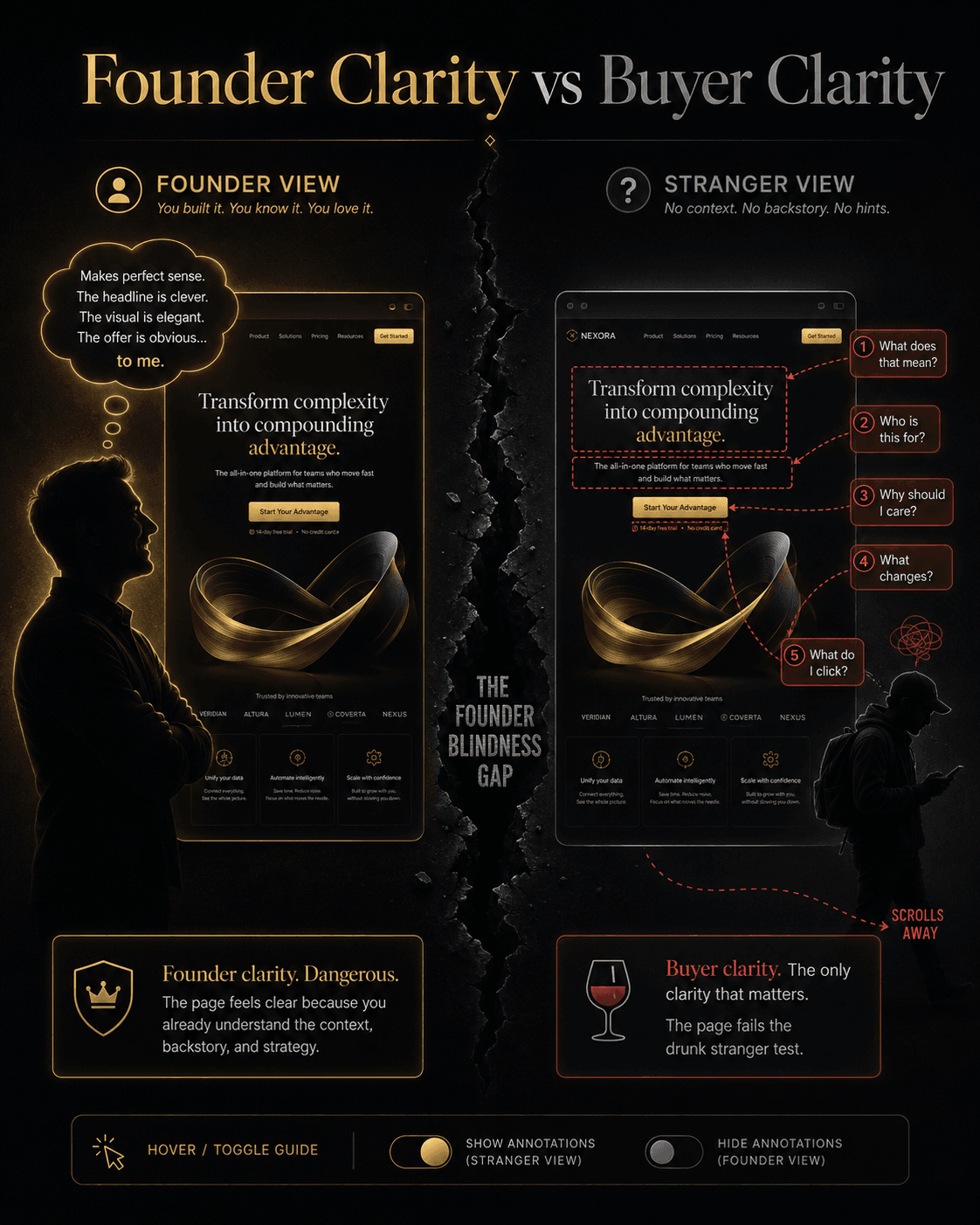
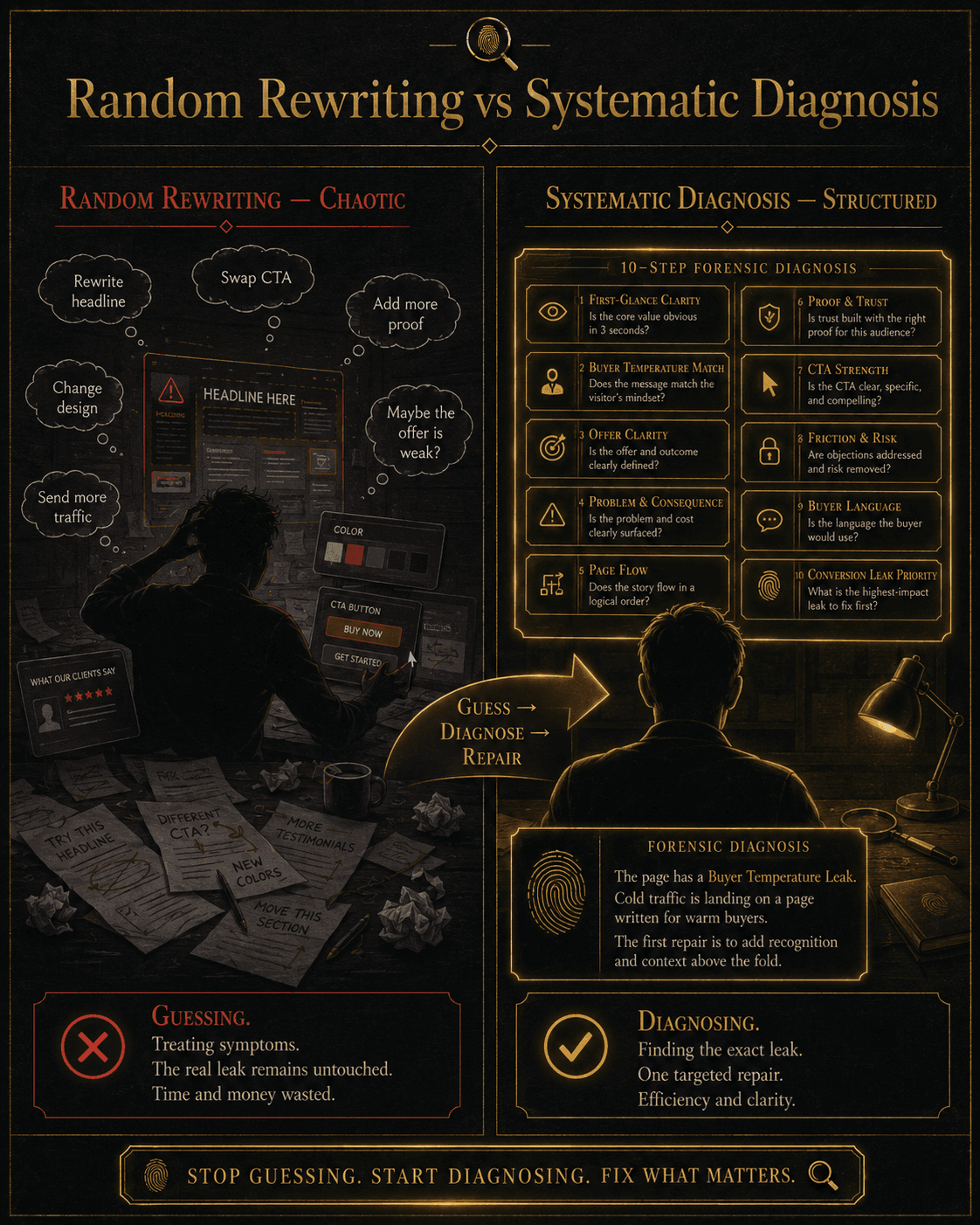
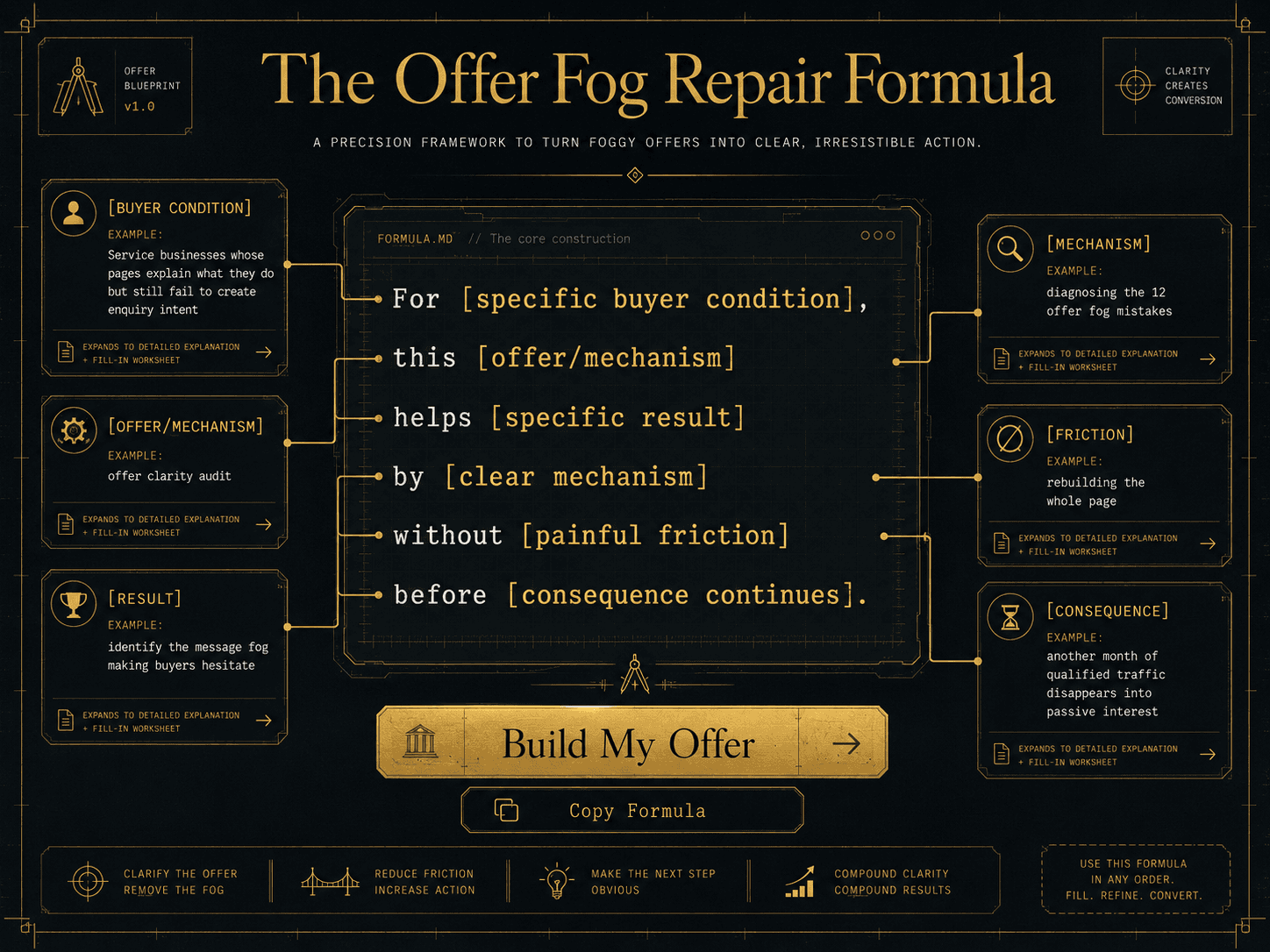
Other Blogs
Other Blogs
Check our other project Blogs with useful insight and information for your businesses