Our Three Step Process
May 26, 2026
Chap 3 | Resource 7 | The Buyer State Diagnostic
Our Three Step Process
May 26, 2026
Chap 3 | Resource 7 | The Buyer State Diagnostic
The Buyer State Diagnostic™ A five-state messaging audit for matching your offer language to the buyer’s current emotional condition before you position, frame, or push the offer.
Prefer Audio Or Video?
The Buyer State Diagnostic™ is also available as:
🎧 A guided audio walkthrough explaining buyer states, emotional filters, messaging mismatch, and state-based offer positioning.
🎥 A practical video breakdown with buyer-state examples, emotional mismatch teardowns, CTA alignment, and state-specific message rewrites.Choose the format that fits how you learn best.
[Listen To The Audio Walkthrough] (coming soon)
[Watch The Video Breakdown] (coming soon)
——
Why Messaging Fails When It Speaks To The Wrong State
Most offers do not only fail because the offer is weak.
Sometimes they fail because the messaging speaks to the wrong psychological state.
The copy may technically sound good.
The offer may be clear.
The promise may be useful.
The mechanism may be strong.
But the buyer is emotionally somewhere else entirely.
The funnel pushes urgency while the buyer still needs certainty.
The page pushes hype while the buyer feels sceptical.
The copy pushes features while the buyer feels overwhelmed.
The CTA pushes action while the buyer still lacks trust.
The offer pushes possibility while the buyer is still carrying frustration from previous failed attempts.
That creates emotional mismatch.
And emotional mismatch destroys conversion silently.
The buyer does not always say:
“This message is emotionally misaligned with my current psychological state.”
They just hesitate.
They skim.
They lose energy.
They feel resistance.
They leave.
They delay.
They compare.
They need “more time.”
They say the offer is interesting, but they do not move.
That is why buyer state matters.
Strong messaging does not merely match the market.
It matches the buyer’s current psychological condition.
What This Resource Helps You Do
The Buyer State Diagnostic™ helps you identify the emotional condition your buyer is currently living inside before you position, frame, or push the offer.
Use it to diagnose:
whether your messaging matches the buyer’s current emotional state
whether your offer is creating emotional mismatch
whether your page is pushing urgency too early
whether your copy is using hype with a sceptical buyer
whether your explanation is overwhelming a buyer who needs simplicity
whether your CTA is asking for action before trust has been built
whether your message is ignoring frustration, fatigue, or doubt
whether your offer should lead with credibility, simplification, recognition, momentum, or directness
The goal is not to write five completely different offers.
The goal is to understand which emotional state your buyer is most likely in when they arrive, and then position the offer accordingly.
Because the same sentence can land very differently depending on the state of the person reading it.
Buyer State Is Not Buyer Persona™
A buyer persona describes who the buyer is.
A buyer state describes what the buyer is emotionally experiencing right now.
That distinction matters.
A persona may say:
SaaS founder
coach
consultant
agency owner
ecommerce operator
freelancer
creator
service business owner
But a buyer state says:
sceptical
overwhelmed
frustrated
hopeful
urgent
emotionally exhausted
curious but unconvinced
burned by previous attempts
interested but not ready
aware of the problem but unsure what to trust
Those are very different things.
Two buyers can have the same persona and completely different emotional states.
One SaaS founder may be hopeful and ready to move.
Another SaaS founder may be sceptical after wasting money on previous advice.
One coach may be urgent because enquiries have dried up.
Another coach may be overwhelmed because they have too many options and no clear priority.
One agency owner may be frustrated because the funnel keeps leaking.
Another may be cautiously optimistic because they finally understand the problem.
The category is the same.
The emotional state is different.
And different emotional states require different messaging priorities.
That is why buyer state diagnosis must happen before offer positioning becomes final.
——
The Core Principle™
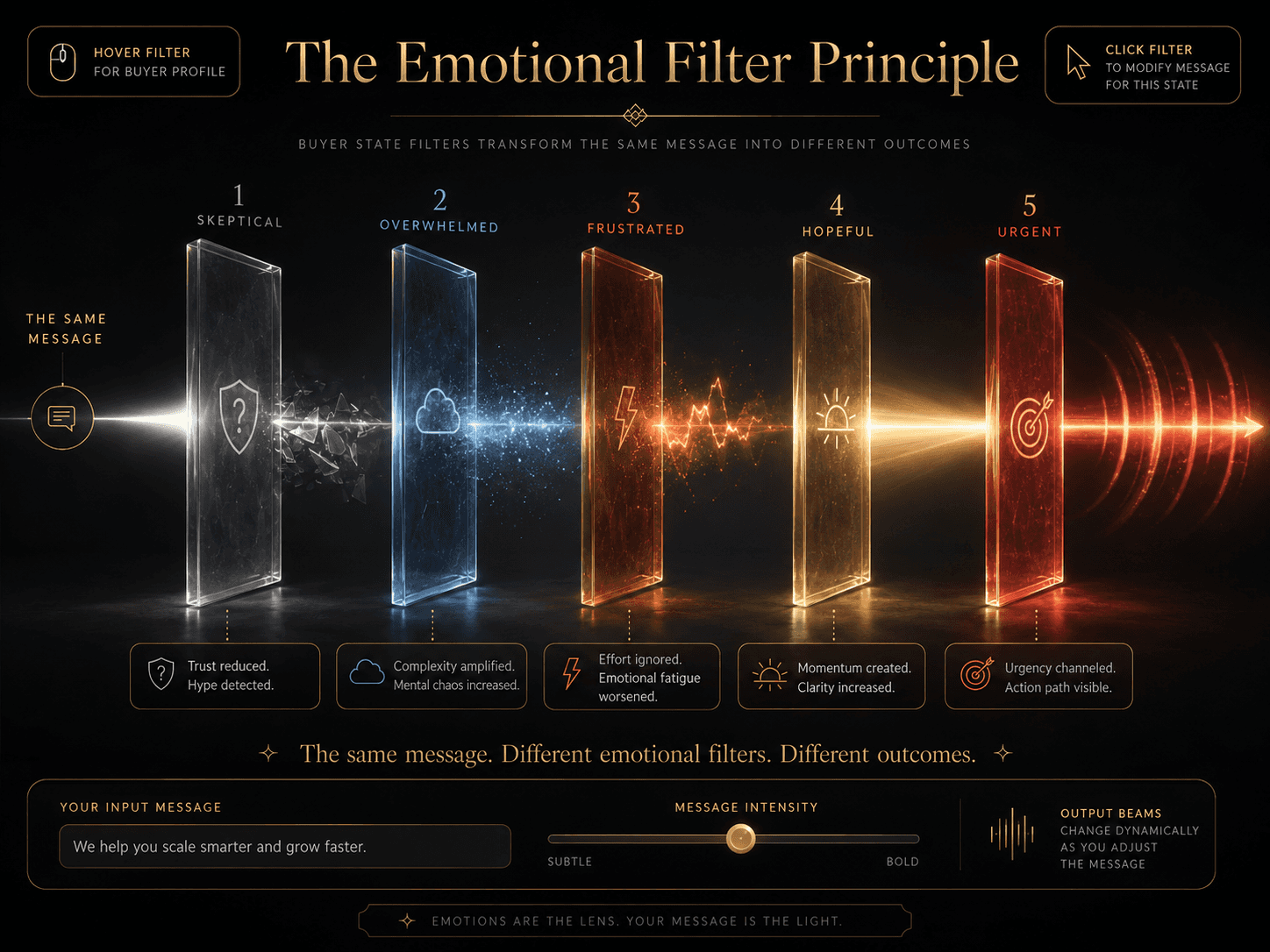
Every buyer reads your messaging through their current emotional filter.
Not your intended meaning.
That distinction is massive.
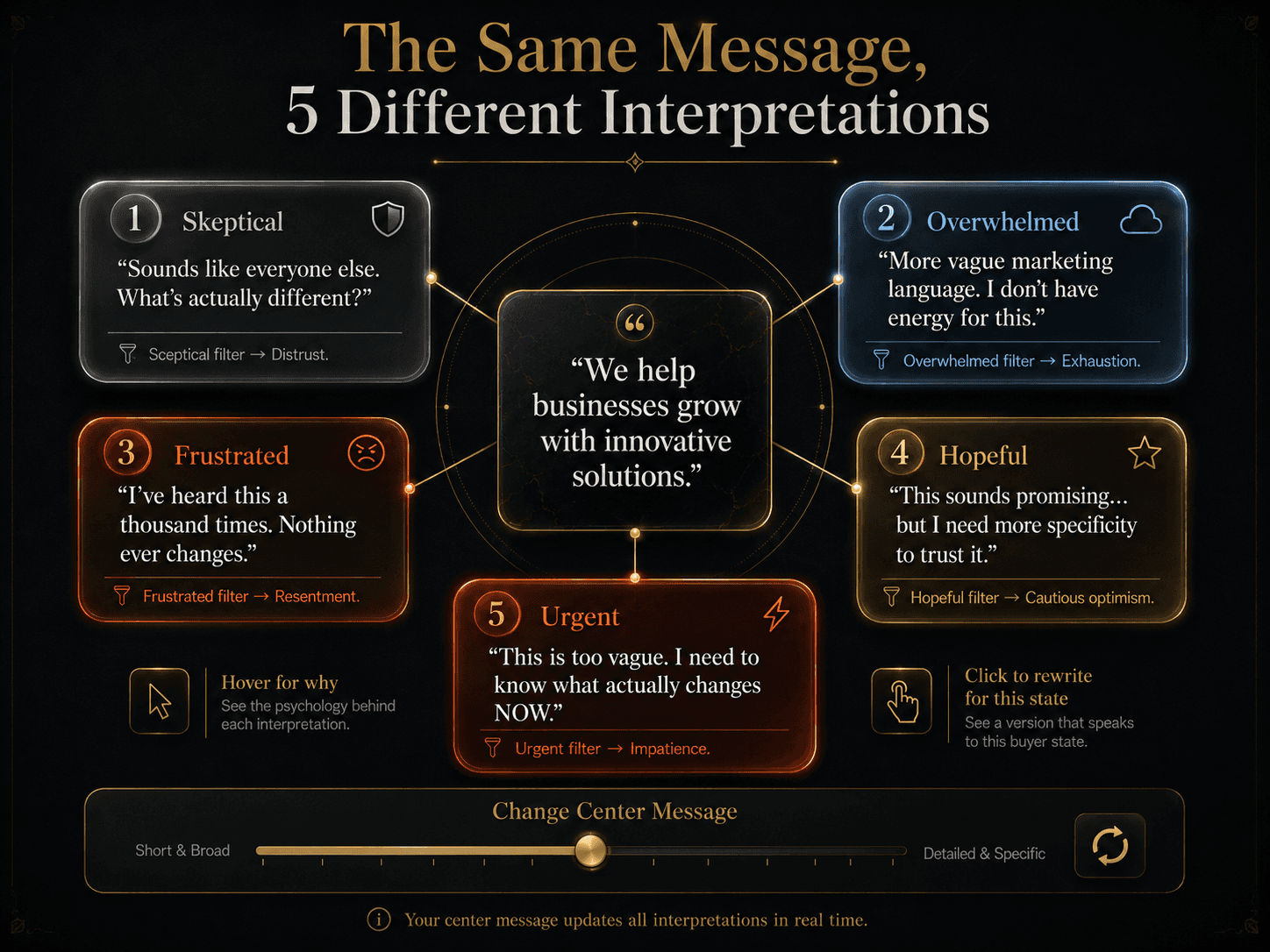
The same line can feel exciting to one buyer, manipulative to another, confusing to another, and emotionally exhausting to another.
Not because the sentence changed.
Because the emotional filter changed.
A sceptical buyer interprets promises differently.
An overwhelmed buyer interprets complexity differently.
A frustrated buyer interprets advice differently.
A hopeful buyer interprets possibility differently.
An urgent buyer interprets delay differently.
Strong marketers diagnose state first.
Then they position accordingly.
——
The Emotional Filter Effect
Buyers do not receive your messaging neutrally.
They receive it through what they are already carrying.
That emotional filter affects what they notice, trust, resist, ignore, or act on.
A sceptical buyer scans for exaggeration.
An overwhelmed buyer scans for simplicity.
A frustrated buyer scans for recognition.
A hopeful buyer scans for momentum.
An urgent buyer scans for directness.
That changes everything.
Because the offer does not only need to be factually relevant.
It needs to be emotionally readable.
If the emotional state and the message do not match, the buyer feels friction even when the offer is useful.
That friction may look like confusion.
It may look like hesitation.
It may look like scepticism.
It may look like delay.
It may look like price resistance.
But underneath, the issue may be simple:
The message is speaking to a version of the buyer who is not emotionally present yet.
——
Current Messaging State Audit
Before studying the five buyer states, audit your current messaging.
Do not guess.
Look at the exact page, ad, email, offer section, or sales script your buyer currently sees.
Current Offer Or Page
Write the offer, headline, or main message you want to audit:
Current Assumed Buyer State
What emotional state does your current messaging assume the buyer is in?
Sceptical / Overwhelmed / Frustrated / Hopeful / Urgent / Other
Explain:
Real Buyer State
What emotional state do your actual buyers seem to arrive with?
Sceptical / Overwhelmed / Frustrated / Hopeful / Urgent / Other
Explain:
Evidence
What evidence do you have?
Look at objections, messages, calls, comments, replies, reviews, support tickets, or buyer behaviour.
Possible Mismatch
Where might the current messaging be emotionally misaligned?
——
The Biggest Messaging Mistake
Most businesses assume buyers exist in one emotional state.
They do not.
Some buyers feel sceptical.
Others feel desperate.
Others feel overwhelmed.
Others feel cautiously hopeful.
Others feel emotionally exhausted.
Others feel curious but unconvinced.
Others feel urgent but still cautious.
And if the messaging ignores the buyer’s current emotional condition, even strong offers can feel misaligned.
That is the mistake.
The offer may be right.
The promise may be right.
The result may be right.
But the emotional entry point is wrong.
And when the emotional entry point is wrong, the buyer feels resistance before they can fully evaluate the value.
Why This Matters So Much
Buyers do not merely buy with logic.
They buy through emotionally filtered interpretation.
Meaning:
A sceptical buyer interprets promises differently.
An exhausted buyer interprets complexity differently.
An overwhelmed buyer interprets information differently.
A burned-out buyer interprets urgency differently.
A frustrated buyer interprets advice differently.
A hopeful buyer interprets fear differently.
An urgent buyer interprets long explanation differently.
That changes the job of the copy.
The copy is not only there to explain the offer.
It is there to meet the buyer at the right psychological starting point and move them forward without creating unnecessary resistance.
——
The 5 Primary Buyer States
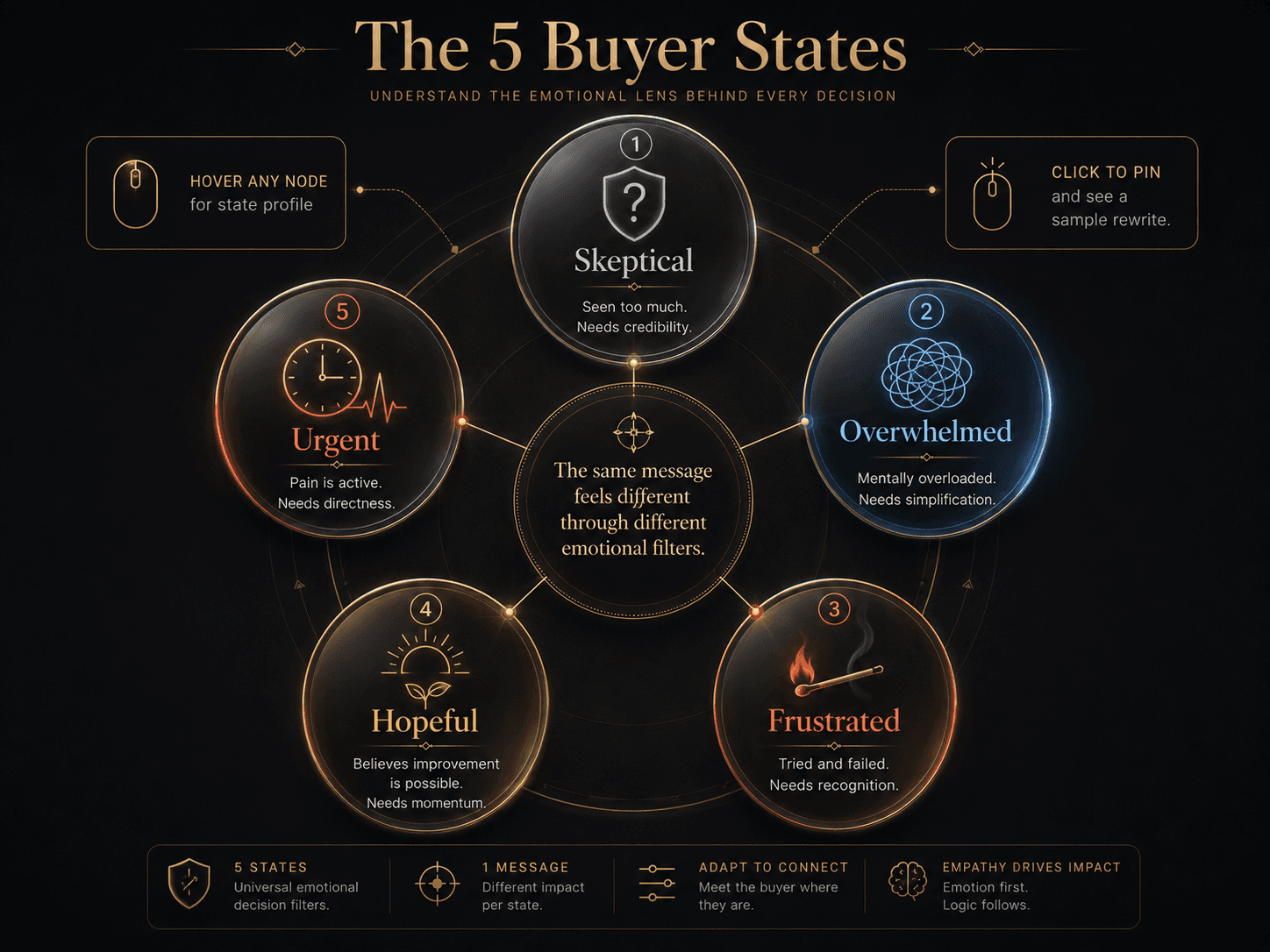
This framework identifies five common psychological conditions buyers operate inside during decision-making.
They are:
The Sceptical Buyer™
The Overwhelmed Buyer™
The Frustrated Buyer™
The Hopeful Buyer™
The Urgent Buyer™
Each state needs a different messaging priority.
The goal is not to manipulate the state.
The goal is to respect it.
State 1: The Sceptical Buyer
Emotional Condition
The sceptical buyer has seen too much.
Too many promises.
Too many gurus.
Too many systems.
Too many frameworks.
Too many disappointing purchases.
Too many inflated claims.
Too many “this changes everything” offers that changed very little.
Now they automatically scan for danger, manipulation, exaggeration, and unsupported claims.
They are not necessarily negative.
They are protective.
Their scepticism exists because trust has been weakened by previous experiences.
This buyer does not need more hype.
They need credibility.
How Sceptical Buyers Sound
They may say:
“Sounds good, but…”
“I’ve heard this before.”
“What makes this different?”
“Will this actually work?”
“I do not want another disappointment.”
“How do I know this is not just another framework?”
“What proof do you have?”
“Why should I believe this version?”
These phrases reveal a buyer who is not rejecting value.
They are testing trust.
What This Buyer Needs Most
The sceptical buyer needs:
specificity
grounded language
realistic expectations
proof
transparency
mechanism clarity
calm confidence
visible reasoning
clear limits
believable claims
They do not need aggressive urgency.
They do not need exaggerated transformation.
They do not need inflated income claims.
They do not need dramatic hype.
They need the message to lower defences.
Weak Messaging For This State
“Explode your business overnight.”
This destroys trust instantly.
The buyer hears exaggeration.
The emotional filter says:
“Here we go again.”
Once that happens, the offer has to fight uphill.
Strong Messaging For This State
“Identify the trust leaks reducing conversion before scaling more traffic into the wrong problem.”
This is stronger because it feels:
grounded
specific
diagnostic
commercially relevant
realistic
free from fake hype
The message does not pressure the sceptical buyer.
It gives them something credible to inspect.
Diagnostic Question
Does the messaging lower scepticism or increase it?
If the message makes a sceptical buyer more defensive, it is misaligned.
——
Rewrite Prompt For The Sceptical Buyer
Rewrite the message to make it more grounded, specific, credible, and proof-aware.
Reduce hype.
Increase mechanism clarity.
Show why the claim is believable.
Sceptical Buyer Worksheet
What might this buyer distrust?
What claim may feel exaggerated?
What proof, mechanism, or specificity would lower resistance?
What language should be removed because it sounds too hyped?
Write a sceptical-buyer version of the offer:
State 2: The Overwhelmed Buyer™
Emotional Condition
The overwhelmed buyer already feels mentally overloaded.
Too much information.
Too much complexity.
Too many strategies.
Too many decisions.
Too much noise.
Too many half-finished attempts.
Too much conflicting advice.
This buyer does not want more complexity.
They want clarity and simplification.
They want someone to reduce the noise, not add to it.
If your message gives this buyer more things to think about before giving them direction, resistance rises.
Not because the offer is bad.
Because their mental bandwidth is already low.
How Overwhelmed Buyers Sound
They may say:
“I do not even know where to start.”
“Everything feels messy.”
“There is too much conflicting advice.”
“I am tired of rebuilding everything constantly.”
“I need someone to tell me what actually matters.”
“I have too many moving parts.”
“I feel stuck in analysis.”
“I do not want another complicated system.”
These phrases reveal a buyer who needs simplification before persuasion.
What This Buyer Needs Most
The overwhelmed buyer needs:
simplification
prioritisation
clarity
reduction of noise
structure
calm direction
fewer moving parts
a clear first step
a sense of control
relief from complexity
They do not need a giant framework dumped on them.
They do not need “97 things to optimise.”
They do not need more tabs open in their mind.
They need the message to create relief.
Weak Messaging For This State
“Here are the 97 things you must optimise immediately.”
This increases emotional exhaustion.
The buyer already feels overloaded.
Now the message adds more weight.
Strong Messaging For This State
“Identify the one friction point creating the biggest conversion leak before rebuilding the entire funnel unnecessarily.”
This creates relief.
The buyer feels:
less chaos
clearer priority
reduced complexity
a simpler first step
control returning
That is the correct emotional direction.
Diagnostic Question
Does the messaging reduce mental chaos or increase it?
If the message gives an overwhelmed buyer more cognitive load, it is misaligned.
Rewrite Prompt For The Overwhelmed Buyer
Rewrite the message to reduce complexity, prioritise the first step, and create a sense of calm direction.
Focus on what matters most now.
Overwhelmed Buyer Worksheet
What is this buyer overwhelmed by?
What complexity should the message reduce?
What is the simplest first step?
What should the buyer stop trying to fix all at once?
Write an overwhelmed-buyer version of the offer:
State 3: The Frustrated Buyer™
Emotional Condition
The frustrated buyer has already tried.
And failed.
Repeatedly.
They are not merely curious.
They are carrying emotional tension.
They may have watched the same problem return again and again.
They may have invested time, money, energy, or reputation into fixes that did not work.
They may be tired of simplistic advice.
They may feel irritated when the message implies the solution is obvious.
This buyer needs recognition.
Not blame.
They need the message to explain why previous efforts may have failed without making them feel stupid for trying.
How Frustrated Buyers Sound
They may say:
“Why is this still not working?”
“I have already tried everything.”
“I am tired of wasting time.”
“Nothing seems to move consistently.”
“I do not understand why people are not converting.”
“We have changed the page three times and it still leaks.”
“I feel like we are fixing the wrong thing.”
“I am tired of guessing.”
These phrases reveal emotional fatigue.
The buyer does not only need a solution.
They need the problem explained in a way that makes their frustration feel understood.
What This Buyer Needs Most
The frustrated buyer needs:
emotional recognition
precision diagnosis
explanation
clarity about hidden problems
restored confidence
a new way to interpret the failure
reassurance that the issue may not be effort
a specific reason why previous attempts did not work
They do not need to be told to “just work harder.”
They do not need generic motivation.
They do not need surface-level advice.
They need a better diagnosis.
Weak Messaging For This State
“You just need to work harder.”
This feels emotionally insulting.
The frustrated buyer has already tried.
The message ignores the real emotional history.
Strong Messaging For This State
“The issue may not be effort anymore. It may be that buyers still do not fully understand why the offer matters before attention disappears.”
This works because it gives the buyer a new explanation.
It does not blame them.
It names a hidden problem.
It helps them feel understood.
Diagnostic Question
Does the messaging acknowledge the emotional fatigue or ignore it?
If the message treats the frustrated buyer like a beginner, it is misaligned.
Rewrite Prompt For The Frustrated Buyer
Rewrite the message to acknowledge repeated failed attempts, explain the hidden reason the problem may still exist, and offer a more precise diagnosis.
Do not blame the buyer.
Frustrated Buyer Worksheet
What has this buyer already tried?
What frustration keeps repeating?
What hidden problem may explain the failure?
What should the message acknowledge so the buyer feels understood?
Write a frustrated-buyer version of the offer:
State 4: The Hopeful Buyer™
Emotional Condition
The hopeful buyer believes improvement is possible.
They are emotionally open.
They are engaged.
They are searching for momentum.
They may have recently understood the problem better.
They may feel that they are getting closer.
They may be ready for a clear next step.
But they still need certainty.
Hopeful buyers do not need to be crushed with fear.
They need their momentum strengthened.
If your messaging becomes too doom-heavy, you can suppress the energy that was already moving them toward action.
How Hopeful Buyers Sound
They may say:
“This could actually work.”
“I think I am getting closer.”
“This feels different.”
“I finally understand the problem better.”
“This makes sense.”
“I can see how this would help.”
“This feels like the missing piece.”
“I want to know what the next step looks like.”
These phrases reveal openness.
The buyer is not fully sold yet, but they are moving.
What This Buyer Needs Most
The hopeful buyer needs:
momentum
vision
future visibility
implementation confidence
clear progression
reassurance
next-step clarity
evidence that the path is workable
a stronger sense of possibility
They do not need heavy fear-based messaging.
They do not need to be dragged back into the pain endlessly.
They need the message to turn possibility into confidence.
Weak Messaging For This State
Fear-heavy doom messaging.
This can kill emotional momentum.
The buyer is beginning to believe movement is possible.
If the message overuses fear, it may pull them back into uncertainty.
Strong Messaging For This State
“Once buyers understand the value fast enough to trust the offer, the entire funnel starts converting with far less resistance.”
This works because the future feels possible.
The buyer can picture a cleaner, easier, more trusted path forward.
Diagnostic Question
Does the messaging increase forward momentum or emotionally suppress it?
If the message makes a hopeful buyer feel heavier, it is misaligned.
Rewrite Prompt For The Hopeful Buyer
Rewrite the message to strengthen possibility, show the next step clearly, and make the future state feel believable.
Do not overuse fear.
Hopeful Buyer Worksheet
What does this buyer already believe may be possible?
What future state are they moving toward?
What confidence do they still need?
What next step would make the path feel clearer?
Write a hopeful-buyer version of the offer:
State 5: The Urgent Buyer™
Emotional Condition
The urgent buyer feels that the pain has become active.
The cost of delay feels high.
Something needs to change now.
They may be losing money.
They may be losing time.
They may be losing trust.
They may be watching the same leak repeat.
They may have a deadline, launch, campaign, or performance issue forcing action.
This buyer wants movement.
But this is important:
Urgent buyers still need trust.
Urgency without trust creates hesitation.
If the message pushes action without building enough confidence, the buyer may still freeze.
How Urgent Buyers Sound
They may say:
“I need to fix this fast.”
“This is costing me money.”
“I cannot keep leaking time like this.”
“Something needs to change immediately.”
“We need to know what is broken before the next campaign.”
“I cannot send more traffic into this page until I trust it.”
“We need a clear answer now.”
“This cannot keep dragging.”
These phrases reveal active pressure.
The buyer wants a direct path.
What This Buyer Needs Most
The urgent buyer needs:
clarity
decisiveness
simplicity
visible consequence
direct action path
fast orientation
trust signals
reduced friction
clear next step
confidence that action will not create more chaos
They do not need long philosophical complexity.
They do not need a slow educational build-up.
They do not need ten competing options.
They need a clean path forward.
Weak Messaging For This State
Long philosophical complexity.
This creates delay.
The urgent buyer does not have the emotional patience to decode a slow message.
Strong Messaging For This State
“Find the hidden conversion leak before another month of paid traffic disappears into hesitation and weak buyer trust.”
This works because it channels urgency productively.
The buyer can feel:
the active leak
the cost of delay
the reason to act
the diagnostic path forward
Diagnostic Question
Does the messaging channel urgency productively or create more emotional friction?
If the message slows an urgent buyer down without building trust, it is misaligned.
Rewrite Prompt For The Urgent Buyer
Rewrite the message to create directness, clarity, immediate relevance, and a clean next step while still preserving trust.
Do not use fake pressure.
Urgent Buyer Worksheet
What makes the problem urgent right now?
What cost of delay is active?
What direct action path does the buyer need?
What trust signal must be present before they act?
Write an urgent-buyer version of the offer:
——
State-Mismatch Symptoms
Use this section to identify when your messaging is speaking to the wrong buyer state.
Mismatch 1: Pushing Urgency At A Sceptical Buyer
The page says:
“Act now.”
The buyer thinks:
“Why should I trust you?”
Result:
Urgency increases resistance.
Repair:
Lead with credibility, specificity, proof, and mechanism clarity before pushing action.
Mismatch 2: Pushing Complexity At An Overwhelmed Buyer
The page says:
“Here is the full system.”
The buyer thinks:
“I cannot process another system right now.”
Result:
Complexity increases avoidance.
Repair:
Lead with simplification, prioritisation, and the clearest first step.
Mismatch 3: Pushing Hype At A Frustrated Buyer
The page says:
“This is the breakthrough you need.”
The buyer thinks:
“I have heard that before.”
Result:
Hype feels dismissive.
Repair:
Lead with emotional recognition, hidden diagnosis, and an explanation of why previous attempts may have failed.
Mismatch 4: Pushing Fear At A Hopeful Buyer
The page says:
“Everything is broken and you are losing badly.”
The buyer thinks:
“I was starting to feel clear, but now I feel heavy again.”
Result:
Fear suppresses momentum.
Repair:
Lead with possibility, progression, and grounded confidence.
Mismatch 5: Pushing Long Explanation At An Urgent Buyer
The page says:
“Let us explain the full philosophy.”
The buyer thinks:
“I need to know what to do now.”
Result:
Explanation delays action.
Repair:
Lead with directness, immediate relevance, trust, and a clear next step.
——
How To Identify The Dominant Buyer State
Your buyer usually reveals their state constantly.
You simply need to observe it.
Look for:
repeated objections
repeated emotional language
tone of support messages
hesitation patterns
call transcripts
comment sections
email replies
buyer complaints
reviews
sales call questions
refund reasons
DM language
survey responses
words used before purchase
words used after disappointment
The emotional vocabulary matters.
Buyers often tell you what state they are in before they buy.
The job is to listen before writing.
Buyer State Research Worksheet
Where can you find real buyer language?
Sales calls:
Support messages:
Email replies:
Comments:
Reviews:
DMs:
Objections:
Other:
Repeated Emotional Phrases
What phrases keep appearing?
Repeated Objections
What objections repeat?
Repeated Hesitation Patterns
Where do buyers slow down, disappear, or delay?
Dominant Buyer State
Based on the evidence, the dominant state appears to be:
Sceptical / Overwhelmed / Frustrated / Hopeful / Urgent
Why?
——
The State-To-Messaging Match Map
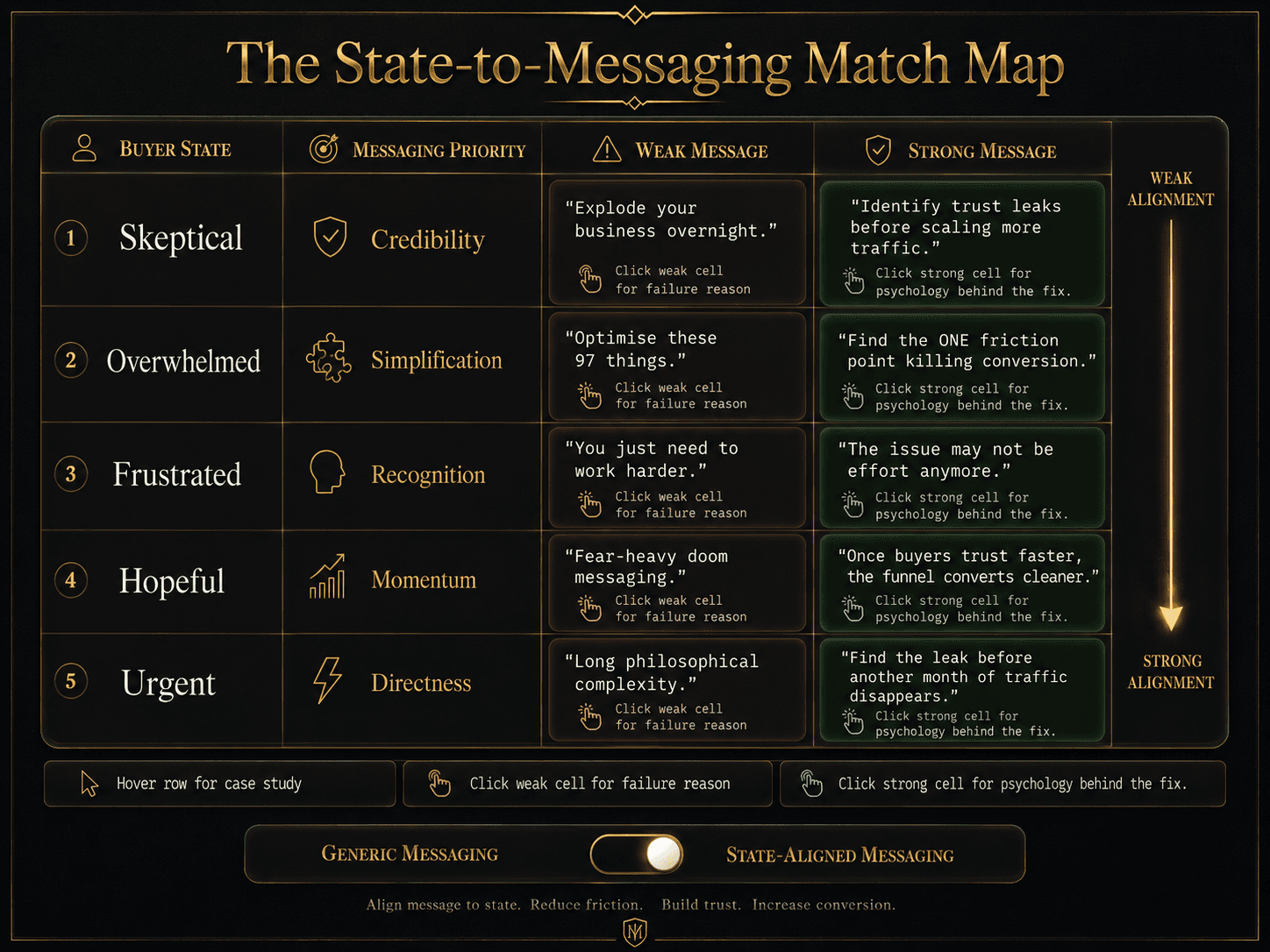
Use this map to align your message with the buyer’s current emotional condition.
Sceptical Buyer
Primary emotional condition:
Distrust, caution, protective doubt.
Messaging priority:
Credibility.
They need:
proof
specificity
grounded claims
mechanism clarity
transparency
realistic expectations
Avoid:
hype
exaggerated promises
fake urgency
overconfident claims
CTA style:
Calm, specific, low-pressure.
Example CTA:
“Show me where trust is leaking.”
Overwhelmed Buyer
Primary emotional condition:
Mental overload, confusion, decision fatigue.
Messaging priority:
Simplification.
They need:
clarity
prioritisation
calm direction
fewer moving parts
a clear first step
Avoid:
complexity
giant lists
excessive frameworks
too many options
CTA style:
Simple, relieving, focused.
Example CTA:
“Find my biggest friction point.”
Frustrated Buyer
Primary emotional condition:
Emotional fatigue after repeated failed attempts.
Messaging priority:
Recognition.
They need:
diagnosis
explanation
emotional acknowledgement
restored confidence
a reason previous attempts failed
Avoid:
blame
simplistic advice
empty motivation
“just work harder” language
CTA style:
Diagnostic, validating, problem-aware.
Example CTA:
“Show me what is actually blocking conversion.”
Hopeful Buyer
Primary emotional condition:
Openness, possibility, cautious optimism.
Messaging priority:
Momentum.
They need:
future visibility
implementation confidence
clear progression
next-step clarity
grounded belief
Avoid:
excessive fear
doom-heavy messaging
unnecessary negativity
making the path feel heavier than it is
CTA style:
Progress-oriented and confidence-building.
Example CTA:
“Build the next version of my offer.”
Urgent Buyer
Primary emotional condition:
Active pressure, cost of delay, need for movement.
Messaging priority:
Directness.
They need:
clarity
fast orientation
decisive next step
visible consequence
practical action path
trust signals
Avoid:
long philosophical explanations
unnecessary complexity
vague next steps
urgency without trust
CTA style:
Direct, clear, action-oriented.
Example CTA:
“Find the leak now.”
——
Buyers Can Move Between States™
Buyer state is dynamic.
It is not static psychology.
Someone may begin sceptical, then become hopeful after proof.
Someone may begin overwhelmed, then become clear after simplification.
Someone may begin frustrated, then become urgent after the hidden problem is named.
Someone may begin hopeful, then become sceptical if claims become too inflated.
Someone may begin urgent, then hesitate if trust is not built.
This matters because a page can move the buyer through emotional states.
A strong page does not randomly throw every emotional tone at the buyer.
It creates progression.
For example:
A sceptical buyer may need:
Credibility → mechanism clarity → proof → low-pressure next step.
An overwhelmed buyer may need:
Simplification → priority → clear path → confidence.
A frustrated buyer may need:
Recognition → diagnosis → explanation → restored confidence.
A hopeful buyer may need:
Momentum → future visibility → implementation confidence → next step.
An urgent buyer may need:
Consequence → direct action path → trust signal → decision clarity.
The point is not to force emotion.
The point is to reduce emotional friction.
Buyer State Scorecard™
Score your current messaging across each buyer state.
You are not trying to score highly for every state.
You are trying to identify which state your messaging currently serves, which state your buyer is actually in, and where mismatch exists.
Score each from 1 to 5.
1 = completely misaligned
2 = weak
3 = partially aligned
4 = aligned
5 = strongly aligned
——
Sceptical Buyer Alignment
Does the message provide enough credibility, specificity, proof, and grounded language?
Score: ___ / 5
Notes:
Overwhelmed Buyer Alignment
Does the message reduce complexity and create clarity?
Score: ___ / 5
Notes:
Frustrated Buyer Alignment
Does the message acknowledge failed attempts and emotional fatigue?
Score: ___ / 5
Notes:
Hopeful Buyer Alignment
Does the message build momentum and make the future feel possible?
Score: ___ / 5
Notes:
Urgent Buyer Alignment
Does the message create directness, clarity, and a trusted action path?
Score: ___ / 5
Notes:
Dominant Alignment
My current messaging is strongest for:
Sceptical / Overwhelmed / Frustrated / Hopeful / Urgent
My actual buyer state is:
Sceptical / Overwhelmed / Frustrated / Hopeful / Urgent
Mismatch exists:
Yes / No
If yes, explain:
——
Buyer State Rewrite Worksheet
Use this worksheet to rewrite your message based on the dominant buyer state.
Current Message
Dominant Buyer State
Sceptical / Overwhelmed / Frustrated / Hopeful / Urgent
What This Buyer Needs Most
What This Buyer Does Not Need
Emotional Mismatch To Remove
Stronger Message
Stronger CTA
Using AI For Buyer State Analysis
AI can help with buyer state analysis, but only if you ask it to diagnose emotional alignment before rewriting.
Do not ask:
“Make this copy better.”
That usually creates surface-level improvement.
Ask AI to identify which buyer state the messaging currently targets, which state the buyer is probably in, and where emotional mismatch exists.
——
AI Buyer State Prompt
Use this prompt:
Act as a high-level buyer psychology analyst, offer strategist, and conversion copywriter.
Analyse this landing page, ad, sales page, offer section, email, or CTA and identify the buyer state it currently speaks to.
Here is the message:
[paste copy]
My target buyer is:
[insert buyer]
The problem they are dealing with is:
[insert problem]
The offer is:
[insert offer]
The action I want them to take is:
[insert desired action]
Analyse the copy across these five buyer states:
Sceptical Buyer
Overwhelmed Buyer
Frustrated Buyer
Hopeful Buyer
Urgent Buyer
For each buyer state:
explain how this buyer would interpret the message
identify what would create trust
identify what would create resistance
identify what emotional mismatch may exist
identify what the buyer needs most before acting
score the current message from 1 to 5 for alignment with that state
Then identify:
which buyer state the current messaging is mainly speaking to
which buyer state is most likely dominant in my actual market
which emotional states are being ignored
where the tone is misaligned
where the CTA may be too early, too soft, too aggressive, or too vague
where the offer creates unnecessary friction
Then rewrite the message for:
A sceptical buyer
An overwhelmed buyer
A frustrated buyer
A hopeful buyer
An urgent buyer
For each rewrite, include:
a headline
a short offer framing line
a trust-building sentence
a CTA suggestion
Then recommend which version I should prioritise and explain why.
Do not add hype.
Do not invent fake proof.
Do not exaggerate urgency.
Prioritise psychological alignment, clarity, emotional accuracy, trust, and buyer-state fit.
——
Final Execution Challenge
Take your current landing page, offer section, ad, email, or sales script.
Now ask:
“What emotional state is this message actually speaking to?”
Then ask:
“Is that the real emotional state my buyers are currently living inside?”
If the answer is no, you have emotional mismatch.
Do not rewrite everything randomly.
Find the dominant buyer state first.
Then rewrite the message around what that buyer needs most.
If they are sceptical, lead with credibility.
If they are overwhelmed, lead with simplification.
If they are frustrated, lead with recognition.
If they are hopeful, lead with momentum.
If they are urgent, lead with directness.
Then test the offer again.
Because many funnels fail not because the offer is bad, but because the messaging emotionally speaks to a completely different psychological condition than the one the buyer actually occupies when they arrive.
Final Buyer State Audit
Current Message
Current Assumed State
Sceptical / Overwhelmed / Frustrated / Hopeful / Urgent
Real Buyer State
Sceptical / Overwhelmed / Frustrated / Hopeful / Urgent
Evidence
What buyer language proves this?
Emotional Mismatch
Where does the message currently mismatch the buyer’s state?
Messaging Priority
The message should prioritise:
Credibility / Simplification / Recognition / Momentum / Directness
Rewrite Direction
The new message should:
Final Rewritten Message
——
Final Principle™
Strong messaging does not merely match the market.
It matches the buyer’s current psychological state.
That is the difference.
A buyer does not read your offer in a vacuum.
They read it through their current emotional filter.
If they are sceptical, they need credibility.
If they are overwhelmed, they need simplification.
If they are frustrated, they need recognition.
If they are hopeful, they need momentum.
If they are urgent, they need directness.
When the message matches the state, trust becomes easier.
The offer feels more relevant.
The CTA feels more natural.
The buyer feels less resistance.
The funnel stops fighting the buyer’s emotional condition and starts working with it.
That is what The Buyer State Diagnostic™ is designed to help you do.
Not to manipulate emotion.
To respect it.
To diagnose it.
To align with it.
Because emotional mismatch destroys conversion silently.
But psychological alignment makes the offer feel like it arrived at exactly the right moment.——
From:
The $100M Funnel Playbook. Book I: Foundation Buyer Psychology, Offer Clarity, and the Page Architecture Behind High-Converting Funnels
By Maris Spalins.
——
Copyright Notice
© 2026 The $100M Funnel Playbook / Winyourclients / Maris Spalins. All rights reserved.
This resource, including the frameworks, terminology, examples, scorecards, templates, prompts, methods, and written explanations, is original intellectual property created for The $100M Funnel Playbook. Book I: Foundation — Buyer Psychology, Offer Clarity, And The Page Architecture Behind High-Converting Funnels and published through Winyourclients.
No part of this resource may be copied, reproduced, screenshotted, republished, redistributed, sold, adapted, uploaded, scraped, stored in a database, included in training data, used to train artificial intelligence systems, or used to create derivative commercial or educational materials without prior written permission.
Limited reference, quotation, or sharing is only permitted where the source is clearly and visibly credited.
Any permitted reference must include at least one of the following source credits:
The $100M Funnel Playbook by Maris Spalins
or
Winyourclients — www.winyourclients.com
or
Maris Spalins / Winyourclients
Screenshots, excerpts, summaries, or redistributed versions must not remove, hide, alter, crop out, or obscure the original source, author name, book title, website name, or copyright notice.
This resource is provided for personal learning and implementation only. It is not licensed for resale, republishing, redistribution, AI training, template cloning, course creation, consulting delivery, or commercial reuse without written permission from Maris Spalins or Winyourclients.
For permission requests, licensing, citation approval, or commercial usage enquiries, contact:
Winyourclients
www.winyourclients.com
or
Email directly to Jacob on: help@winyourclients.com

The Buyer State Diagnostic™ A five-state messaging audit for matching your offer language to the buyer’s current emotional condition before you position, frame, or push the offer.
Prefer Audio Or Video?
The Buyer State Diagnostic™ is also available as:
🎧 A guided audio walkthrough explaining buyer states, emotional filters, messaging mismatch, and state-based offer positioning.
🎥 A practical video breakdown with buyer-state examples, emotional mismatch teardowns, CTA alignment, and state-specific message rewrites.Choose the format that fits how you learn best.
[Listen To The Audio Walkthrough] (coming soon)
[Watch The Video Breakdown] (coming soon)
——
Why Messaging Fails When It Speaks To The Wrong State
Most offers do not only fail because the offer is weak.
Sometimes they fail because the messaging speaks to the wrong psychological state.
The copy may technically sound good.
The offer may be clear.
The promise may be useful.
The mechanism may be strong.
But the buyer is emotionally somewhere else entirely.
The funnel pushes urgency while the buyer still needs certainty.
The page pushes hype while the buyer feels sceptical.
The copy pushes features while the buyer feels overwhelmed.
The CTA pushes action while the buyer still lacks trust.
The offer pushes possibility while the buyer is still carrying frustration from previous failed attempts.
That creates emotional mismatch.
And emotional mismatch destroys conversion silently.
The buyer does not always say:
“This message is emotionally misaligned with my current psychological state.”
They just hesitate.
They skim.
They lose energy.
They feel resistance.
They leave.
They delay.
They compare.
They need “more time.”
They say the offer is interesting, but they do not move.
That is why buyer state matters.
Strong messaging does not merely match the market.
It matches the buyer’s current psychological condition.
What This Resource Helps You Do
The Buyer State Diagnostic™ helps you identify the emotional condition your buyer is currently living inside before you position, frame, or push the offer.
Use it to diagnose:
whether your messaging matches the buyer’s current emotional state
whether your offer is creating emotional mismatch
whether your page is pushing urgency too early
whether your copy is using hype with a sceptical buyer
whether your explanation is overwhelming a buyer who needs simplicity
whether your CTA is asking for action before trust has been built
whether your message is ignoring frustration, fatigue, or doubt
whether your offer should lead with credibility, simplification, recognition, momentum, or directness
The goal is not to write five completely different offers.
The goal is to understand which emotional state your buyer is most likely in when they arrive, and then position the offer accordingly.
Because the same sentence can land very differently depending on the state of the person reading it.
Buyer State Is Not Buyer Persona™
A buyer persona describes who the buyer is.
A buyer state describes what the buyer is emotionally experiencing right now.
That distinction matters.
A persona may say:
SaaS founder
coach
consultant
agency owner
ecommerce operator
freelancer
creator
service business owner
But a buyer state says:
sceptical
overwhelmed
frustrated
hopeful
urgent
emotionally exhausted
curious but unconvinced
burned by previous attempts
interested but not ready
aware of the problem but unsure what to trust
Those are very different things.
Two buyers can have the same persona and completely different emotional states.
One SaaS founder may be hopeful and ready to move.
Another SaaS founder may be sceptical after wasting money on previous advice.
One coach may be urgent because enquiries have dried up.
Another coach may be overwhelmed because they have too many options and no clear priority.
One agency owner may be frustrated because the funnel keeps leaking.
Another may be cautiously optimistic because they finally understand the problem.
The category is the same.
The emotional state is different.
And different emotional states require different messaging priorities.
That is why buyer state diagnosis must happen before offer positioning becomes final.
——
The Core Principle™
Every buyer reads your messaging through their current emotional filter.
Not your intended meaning.
That distinction is massive.
The same line can feel exciting to one buyer, manipulative to another, confusing to another, and emotionally exhausting to another.
Not because the sentence changed.
Because the emotional filter changed.
A sceptical buyer interprets promises differently.
An overwhelmed buyer interprets complexity differently.
A frustrated buyer interprets advice differently.
A hopeful buyer interprets possibility differently.
An urgent buyer interprets delay differently.
Strong marketers diagnose state first.
Then they position accordingly.
——
The Emotional Filter Effect
Buyers do not receive your messaging neutrally.
They receive it through what they are already carrying.
That emotional filter affects what they notice, trust, resist, ignore, or act on.
A sceptical buyer scans for exaggeration.
An overwhelmed buyer scans for simplicity.
A frustrated buyer scans for recognition.
A hopeful buyer scans for momentum.
An urgent buyer scans for directness.
That changes everything.
Because the offer does not only need to be factually relevant.
It needs to be emotionally readable.
If the emotional state and the message do not match, the buyer feels friction even when the offer is useful.
That friction may look like confusion.
It may look like hesitation.
It may look like scepticism.
It may look like delay.
It may look like price resistance.
But underneath, the issue may be simple:
The message is speaking to a version of the buyer who is not emotionally present yet.
——
Current Messaging State Audit
Before studying the five buyer states, audit your current messaging.
Do not guess.
Look at the exact page, ad, email, offer section, or sales script your buyer currently sees.
Current Offer Or Page
Write the offer, headline, or main message you want to audit:
Current Assumed Buyer State
What emotional state does your current messaging assume the buyer is in?
Sceptical / Overwhelmed / Frustrated / Hopeful / Urgent / Other
Explain:
Real Buyer State
What emotional state do your actual buyers seem to arrive with?
Sceptical / Overwhelmed / Frustrated / Hopeful / Urgent / Other
Explain:
Evidence
What evidence do you have?
Look at objections, messages, calls, comments, replies, reviews, support tickets, or buyer behaviour.
Possible Mismatch
Where might the current messaging be emotionally misaligned?
——
The Biggest Messaging Mistake
Most businesses assume buyers exist in one emotional state.
They do not.
Some buyers feel sceptical.
Others feel desperate.
Others feel overwhelmed.
Others feel cautiously hopeful.
Others feel emotionally exhausted.
Others feel curious but unconvinced.
Others feel urgent but still cautious.
And if the messaging ignores the buyer’s current emotional condition, even strong offers can feel misaligned.
That is the mistake.
The offer may be right.
The promise may be right.
The result may be right.
But the emotional entry point is wrong.
And when the emotional entry point is wrong, the buyer feels resistance before they can fully evaluate the value.
Why This Matters So Much
Buyers do not merely buy with logic.
They buy through emotionally filtered interpretation.
Meaning:
A sceptical buyer interprets promises differently.
An exhausted buyer interprets complexity differently.
An overwhelmed buyer interprets information differently.
A burned-out buyer interprets urgency differently.
A frustrated buyer interprets advice differently.
A hopeful buyer interprets fear differently.
An urgent buyer interprets long explanation differently.
That changes the job of the copy.
The copy is not only there to explain the offer.
It is there to meet the buyer at the right psychological starting point and move them forward without creating unnecessary resistance.
——
The 5 Primary Buyer States
This framework identifies five common psychological conditions buyers operate inside during decision-making.
They are:
The Sceptical Buyer™
The Overwhelmed Buyer™
The Frustrated Buyer™
The Hopeful Buyer™
The Urgent Buyer™
Each state needs a different messaging priority.
The goal is not to manipulate the state.
The goal is to respect it.
State 1: The Sceptical Buyer
Emotional Condition
The sceptical buyer has seen too much.
Too many promises.
Too many gurus.
Too many systems.
Too many frameworks.
Too many disappointing purchases.
Too many inflated claims.
Too many “this changes everything” offers that changed very little.
Now they automatically scan for danger, manipulation, exaggeration, and unsupported claims.
They are not necessarily negative.
They are protective.
Their scepticism exists because trust has been weakened by previous experiences.
This buyer does not need more hype.
They need credibility.
How Sceptical Buyers Sound
They may say:
“Sounds good, but…”
“I’ve heard this before.”
“What makes this different?”
“Will this actually work?”
“I do not want another disappointment.”
“How do I know this is not just another framework?”
“What proof do you have?”
“Why should I believe this version?”
These phrases reveal a buyer who is not rejecting value.
They are testing trust.
What This Buyer Needs Most
The sceptical buyer needs:
specificity
grounded language
realistic expectations
proof
transparency
mechanism clarity
calm confidence
visible reasoning
clear limits
believable claims
They do not need aggressive urgency.
They do not need exaggerated transformation.
They do not need inflated income claims.
They do not need dramatic hype.
They need the message to lower defences.
Weak Messaging For This State
“Explode your business overnight.”
This destroys trust instantly.
The buyer hears exaggeration.
The emotional filter says:
“Here we go again.”
Once that happens, the offer has to fight uphill.
Strong Messaging For This State
“Identify the trust leaks reducing conversion before scaling more traffic into the wrong problem.”
This is stronger because it feels:
grounded
specific
diagnostic
commercially relevant
realistic
free from fake hype
The message does not pressure the sceptical buyer.
It gives them something credible to inspect.
Diagnostic Question
Does the messaging lower scepticism or increase it?
If the message makes a sceptical buyer more defensive, it is misaligned.
——
Rewrite Prompt For The Sceptical Buyer
Rewrite the message to make it more grounded, specific, credible, and proof-aware.
Reduce hype.
Increase mechanism clarity.
Show why the claim is believable.
Sceptical Buyer Worksheet
What might this buyer distrust?
What claim may feel exaggerated?
What proof, mechanism, or specificity would lower resistance?
What language should be removed because it sounds too hyped?
Write a sceptical-buyer version of the offer:
State 2: The Overwhelmed Buyer™
Emotional Condition
The overwhelmed buyer already feels mentally overloaded.
Too much information.
Too much complexity.
Too many strategies.
Too many decisions.
Too much noise.
Too many half-finished attempts.
Too much conflicting advice.
This buyer does not want more complexity.
They want clarity and simplification.
They want someone to reduce the noise, not add to it.
If your message gives this buyer more things to think about before giving them direction, resistance rises.
Not because the offer is bad.
Because their mental bandwidth is already low.
How Overwhelmed Buyers Sound
They may say:
“I do not even know where to start.”
“Everything feels messy.”
“There is too much conflicting advice.”
“I am tired of rebuilding everything constantly.”
“I need someone to tell me what actually matters.”
“I have too many moving parts.”
“I feel stuck in analysis.”
“I do not want another complicated system.”
These phrases reveal a buyer who needs simplification before persuasion.
What This Buyer Needs Most
The overwhelmed buyer needs:
simplification
prioritisation
clarity
reduction of noise
structure
calm direction
fewer moving parts
a clear first step
a sense of control
relief from complexity
They do not need a giant framework dumped on them.
They do not need “97 things to optimise.”
They do not need more tabs open in their mind.
They need the message to create relief.
Weak Messaging For This State
“Here are the 97 things you must optimise immediately.”
This increases emotional exhaustion.
The buyer already feels overloaded.
Now the message adds more weight.
Strong Messaging For This State
“Identify the one friction point creating the biggest conversion leak before rebuilding the entire funnel unnecessarily.”
This creates relief.
The buyer feels:
less chaos
clearer priority
reduced complexity
a simpler first step
control returning
That is the correct emotional direction.
Diagnostic Question
Does the messaging reduce mental chaos or increase it?
If the message gives an overwhelmed buyer more cognitive load, it is misaligned.
Rewrite Prompt For The Overwhelmed Buyer
Rewrite the message to reduce complexity, prioritise the first step, and create a sense of calm direction.
Focus on what matters most now.
Overwhelmed Buyer Worksheet
What is this buyer overwhelmed by?
What complexity should the message reduce?
What is the simplest first step?
What should the buyer stop trying to fix all at once?
Write an overwhelmed-buyer version of the offer:
State 3: The Frustrated Buyer™
Emotional Condition
The frustrated buyer has already tried.
And failed.
Repeatedly.
They are not merely curious.
They are carrying emotional tension.
They may have watched the same problem return again and again.
They may have invested time, money, energy, or reputation into fixes that did not work.
They may be tired of simplistic advice.
They may feel irritated when the message implies the solution is obvious.
This buyer needs recognition.
Not blame.
They need the message to explain why previous efforts may have failed without making them feel stupid for trying.
How Frustrated Buyers Sound
They may say:
“Why is this still not working?”
“I have already tried everything.”
“I am tired of wasting time.”
“Nothing seems to move consistently.”
“I do not understand why people are not converting.”
“We have changed the page three times and it still leaks.”
“I feel like we are fixing the wrong thing.”
“I am tired of guessing.”
These phrases reveal emotional fatigue.
The buyer does not only need a solution.
They need the problem explained in a way that makes their frustration feel understood.
What This Buyer Needs Most
The frustrated buyer needs:
emotional recognition
precision diagnosis
explanation
clarity about hidden problems
restored confidence
a new way to interpret the failure
reassurance that the issue may not be effort
a specific reason why previous attempts did not work
They do not need to be told to “just work harder.”
They do not need generic motivation.
They do not need surface-level advice.
They need a better diagnosis.
Weak Messaging For This State
“You just need to work harder.”
This feels emotionally insulting.
The frustrated buyer has already tried.
The message ignores the real emotional history.
Strong Messaging For This State
“The issue may not be effort anymore. It may be that buyers still do not fully understand why the offer matters before attention disappears.”
This works because it gives the buyer a new explanation.
It does not blame them.
It names a hidden problem.
It helps them feel understood.
Diagnostic Question
Does the messaging acknowledge the emotional fatigue or ignore it?
If the message treats the frustrated buyer like a beginner, it is misaligned.
Rewrite Prompt For The Frustrated Buyer
Rewrite the message to acknowledge repeated failed attempts, explain the hidden reason the problem may still exist, and offer a more precise diagnosis.
Do not blame the buyer.
Frustrated Buyer Worksheet
What has this buyer already tried?
What frustration keeps repeating?
What hidden problem may explain the failure?
What should the message acknowledge so the buyer feels understood?
Write a frustrated-buyer version of the offer:
State 4: The Hopeful Buyer™
Emotional Condition
The hopeful buyer believes improvement is possible.
They are emotionally open.
They are engaged.
They are searching for momentum.
They may have recently understood the problem better.
They may feel that they are getting closer.
They may be ready for a clear next step.
But they still need certainty.
Hopeful buyers do not need to be crushed with fear.
They need their momentum strengthened.
If your messaging becomes too doom-heavy, you can suppress the energy that was already moving them toward action.
How Hopeful Buyers Sound
They may say:
“This could actually work.”
“I think I am getting closer.”
“This feels different.”
“I finally understand the problem better.”
“This makes sense.”
“I can see how this would help.”
“This feels like the missing piece.”
“I want to know what the next step looks like.”
These phrases reveal openness.
The buyer is not fully sold yet, but they are moving.
What This Buyer Needs Most
The hopeful buyer needs:
momentum
vision
future visibility
implementation confidence
clear progression
reassurance
next-step clarity
evidence that the path is workable
a stronger sense of possibility
They do not need heavy fear-based messaging.
They do not need to be dragged back into the pain endlessly.
They need the message to turn possibility into confidence.
Weak Messaging For This State
Fear-heavy doom messaging.
This can kill emotional momentum.
The buyer is beginning to believe movement is possible.
If the message overuses fear, it may pull them back into uncertainty.
Strong Messaging For This State
“Once buyers understand the value fast enough to trust the offer, the entire funnel starts converting with far less resistance.”
This works because the future feels possible.
The buyer can picture a cleaner, easier, more trusted path forward.
Diagnostic Question
Does the messaging increase forward momentum or emotionally suppress it?
If the message makes a hopeful buyer feel heavier, it is misaligned.
Rewrite Prompt For The Hopeful Buyer
Rewrite the message to strengthen possibility, show the next step clearly, and make the future state feel believable.
Do not overuse fear.
Hopeful Buyer Worksheet
What does this buyer already believe may be possible?
What future state are they moving toward?
What confidence do they still need?
What next step would make the path feel clearer?
Write a hopeful-buyer version of the offer:
State 5: The Urgent Buyer™
Emotional Condition
The urgent buyer feels that the pain has become active.
The cost of delay feels high.
Something needs to change now.
They may be losing money.
They may be losing time.
They may be losing trust.
They may be watching the same leak repeat.
They may have a deadline, launch, campaign, or performance issue forcing action.
This buyer wants movement.
But this is important:
Urgent buyers still need trust.
Urgency without trust creates hesitation.
If the message pushes action without building enough confidence, the buyer may still freeze.
How Urgent Buyers Sound
They may say:
“I need to fix this fast.”
“This is costing me money.”
“I cannot keep leaking time like this.”
“Something needs to change immediately.”
“We need to know what is broken before the next campaign.”
“I cannot send more traffic into this page until I trust it.”
“We need a clear answer now.”
“This cannot keep dragging.”
These phrases reveal active pressure.
The buyer wants a direct path.
What This Buyer Needs Most
The urgent buyer needs:
clarity
decisiveness
simplicity
visible consequence
direct action path
fast orientation
trust signals
reduced friction
clear next step
confidence that action will not create more chaos
They do not need long philosophical complexity.
They do not need a slow educational build-up.
They do not need ten competing options.
They need a clean path forward.
Weak Messaging For This State
Long philosophical complexity.
This creates delay.
The urgent buyer does not have the emotional patience to decode a slow message.
Strong Messaging For This State
“Find the hidden conversion leak before another month of paid traffic disappears into hesitation and weak buyer trust.”
This works because it channels urgency productively.
The buyer can feel:
the active leak
the cost of delay
the reason to act
the diagnostic path forward
Diagnostic Question
Does the messaging channel urgency productively or create more emotional friction?
If the message slows an urgent buyer down without building trust, it is misaligned.
Rewrite Prompt For The Urgent Buyer
Rewrite the message to create directness, clarity, immediate relevance, and a clean next step while still preserving trust.
Do not use fake pressure.
Urgent Buyer Worksheet
What makes the problem urgent right now?
What cost of delay is active?
What direct action path does the buyer need?
What trust signal must be present before they act?
Write an urgent-buyer version of the offer:
——
State-Mismatch Symptoms
Use this section to identify when your messaging is speaking to the wrong buyer state.
Mismatch 1: Pushing Urgency At A Sceptical Buyer
The page says:
“Act now.”
The buyer thinks:
“Why should I trust you?”
Result:
Urgency increases resistance.
Repair:
Lead with credibility, specificity, proof, and mechanism clarity before pushing action.
Mismatch 2: Pushing Complexity At An Overwhelmed Buyer
The page says:
“Here is the full system.”
The buyer thinks:
“I cannot process another system right now.”
Result:
Complexity increases avoidance.
Repair:
Lead with simplification, prioritisation, and the clearest first step.
Mismatch 3: Pushing Hype At A Frustrated Buyer
The page says:
“This is the breakthrough you need.”
The buyer thinks:
“I have heard that before.”
Result:
Hype feels dismissive.
Repair:
Lead with emotional recognition, hidden diagnosis, and an explanation of why previous attempts may have failed.
Mismatch 4: Pushing Fear At A Hopeful Buyer
The page says:
“Everything is broken and you are losing badly.”
The buyer thinks:
“I was starting to feel clear, but now I feel heavy again.”
Result:
Fear suppresses momentum.
Repair:
Lead with possibility, progression, and grounded confidence.
Mismatch 5: Pushing Long Explanation At An Urgent Buyer
The page says:
“Let us explain the full philosophy.”
The buyer thinks:
“I need to know what to do now.”
Result:
Explanation delays action.
Repair:
Lead with directness, immediate relevance, trust, and a clear next step.
——
How To Identify The Dominant Buyer State
Your buyer usually reveals their state constantly.
You simply need to observe it.
Look for:
repeated objections
repeated emotional language
tone of support messages
hesitation patterns
call transcripts
comment sections
email replies
buyer complaints
reviews
sales call questions
refund reasons
DM language
survey responses
words used before purchase
words used after disappointment
The emotional vocabulary matters.
Buyers often tell you what state they are in before they buy.
The job is to listen before writing.
Buyer State Research Worksheet
Where can you find real buyer language?
Sales calls:
Support messages:
Email replies:
Comments:
Reviews:
DMs:
Objections:
Other:
Repeated Emotional Phrases
What phrases keep appearing?
Repeated Objections
What objections repeat?
Repeated Hesitation Patterns
Where do buyers slow down, disappear, or delay?
Dominant Buyer State
Based on the evidence, the dominant state appears to be:
Sceptical / Overwhelmed / Frustrated / Hopeful / Urgent
Why?
——
The State-To-Messaging Match Map
Use this map to align your message with the buyer’s current emotional condition.
Sceptical Buyer
Primary emotional condition:
Distrust, caution, protective doubt.
Messaging priority:
Credibility.
They need:
proof
specificity
grounded claims
mechanism clarity
transparency
realistic expectations
Avoid:
hype
exaggerated promises
fake urgency
overconfident claims
CTA style:
Calm, specific, low-pressure.
Example CTA:
“Show me where trust is leaking.”
Overwhelmed Buyer
Primary emotional condition:
Mental overload, confusion, decision fatigue.
Messaging priority:
Simplification.
They need:
clarity
prioritisation
calm direction
fewer moving parts
a clear first step
Avoid:
complexity
giant lists
excessive frameworks
too many options
CTA style:
Simple, relieving, focused.
Example CTA:
“Find my biggest friction point.”
Frustrated Buyer
Primary emotional condition:
Emotional fatigue after repeated failed attempts.
Messaging priority:
Recognition.
They need:
diagnosis
explanation
emotional acknowledgement
restored confidence
a reason previous attempts failed
Avoid:
blame
simplistic advice
empty motivation
“just work harder” language
CTA style:
Diagnostic, validating, problem-aware.
Example CTA:
“Show me what is actually blocking conversion.”
Hopeful Buyer
Primary emotional condition:
Openness, possibility, cautious optimism.
Messaging priority:
Momentum.
They need:
future visibility
implementation confidence
clear progression
next-step clarity
grounded belief
Avoid:
excessive fear
doom-heavy messaging
unnecessary negativity
making the path feel heavier than it is
CTA style:
Progress-oriented and confidence-building.
Example CTA:
“Build the next version of my offer.”
Urgent Buyer
Primary emotional condition:
Active pressure, cost of delay, need for movement.
Messaging priority:
Directness.
They need:
clarity
fast orientation
decisive next step
visible consequence
practical action path
trust signals
Avoid:
long philosophical explanations
unnecessary complexity
vague next steps
urgency without trust
CTA style:
Direct, clear, action-oriented.
Example CTA:
“Find the leak now.”
——
Buyers Can Move Between States™
Buyer state is dynamic.
It is not static psychology.
Someone may begin sceptical, then become hopeful after proof.
Someone may begin overwhelmed, then become clear after simplification.
Someone may begin frustrated, then become urgent after the hidden problem is named.
Someone may begin hopeful, then become sceptical if claims become too inflated.
Someone may begin urgent, then hesitate if trust is not built.
This matters because a page can move the buyer through emotional states.
A strong page does not randomly throw every emotional tone at the buyer.
It creates progression.
For example:
A sceptical buyer may need:
Credibility → mechanism clarity → proof → low-pressure next step.
An overwhelmed buyer may need:
Simplification → priority → clear path → confidence.
A frustrated buyer may need:
Recognition → diagnosis → explanation → restored confidence.
A hopeful buyer may need:
Momentum → future visibility → implementation confidence → next step.
An urgent buyer may need:
Consequence → direct action path → trust signal → decision clarity.
The point is not to force emotion.
The point is to reduce emotional friction.
Buyer State Scorecard™
Score your current messaging across each buyer state.
You are not trying to score highly for every state.
You are trying to identify which state your messaging currently serves, which state your buyer is actually in, and where mismatch exists.
Score each from 1 to 5.
1 = completely misaligned
2 = weak
3 = partially aligned
4 = aligned
5 = strongly aligned
——
Sceptical Buyer Alignment
Does the message provide enough credibility, specificity, proof, and grounded language?
Score: ___ / 5
Notes:
Overwhelmed Buyer Alignment
Does the message reduce complexity and create clarity?
Score: ___ / 5
Notes:
Frustrated Buyer Alignment
Does the message acknowledge failed attempts and emotional fatigue?
Score: ___ / 5
Notes:
Hopeful Buyer Alignment
Does the message build momentum and make the future feel possible?
Score: ___ / 5
Notes:
Urgent Buyer Alignment
Does the message create directness, clarity, and a trusted action path?
Score: ___ / 5
Notes:
Dominant Alignment
My current messaging is strongest for:
Sceptical / Overwhelmed / Frustrated / Hopeful / Urgent
My actual buyer state is:
Sceptical / Overwhelmed / Frustrated / Hopeful / Urgent
Mismatch exists:
Yes / No
If yes, explain:
——
Buyer State Rewrite Worksheet
Use this worksheet to rewrite your message based on the dominant buyer state.
Current Message
Dominant Buyer State
Sceptical / Overwhelmed / Frustrated / Hopeful / Urgent
What This Buyer Needs Most
What This Buyer Does Not Need
Emotional Mismatch To Remove
Stronger Message
Stronger CTA
Using AI For Buyer State Analysis
AI can help with buyer state analysis, but only if you ask it to diagnose emotional alignment before rewriting.
Do not ask:
“Make this copy better.”
That usually creates surface-level improvement.
Ask AI to identify which buyer state the messaging currently targets, which state the buyer is probably in, and where emotional mismatch exists.
——
AI Buyer State Prompt
Use this prompt:
Act as a high-level buyer psychology analyst, offer strategist, and conversion copywriter.
Analyse this landing page, ad, sales page, offer section, email, or CTA and identify the buyer state it currently speaks to.
Here is the message:
[paste copy]
My target buyer is:
[insert buyer]
The problem they are dealing with is:
[insert problem]
The offer is:
[insert offer]
The action I want them to take is:
[insert desired action]
Analyse the copy across these five buyer states:
Sceptical Buyer
Overwhelmed Buyer
Frustrated Buyer
Hopeful Buyer
Urgent Buyer
For each buyer state:
explain how this buyer would interpret the message
identify what would create trust
identify what would create resistance
identify what emotional mismatch may exist
identify what the buyer needs most before acting
score the current message from 1 to 5 for alignment with that state
Then identify:
which buyer state the current messaging is mainly speaking to
which buyer state is most likely dominant in my actual market
which emotional states are being ignored
where the tone is misaligned
where the CTA may be too early, too soft, too aggressive, or too vague
where the offer creates unnecessary friction
Then rewrite the message for:
A sceptical buyer
An overwhelmed buyer
A frustrated buyer
A hopeful buyer
An urgent buyer
For each rewrite, include:
a headline
a short offer framing line
a trust-building sentence
a CTA suggestion
Then recommend which version I should prioritise and explain why.
Do not add hype.
Do not invent fake proof.
Do not exaggerate urgency.
Prioritise psychological alignment, clarity, emotional accuracy, trust, and buyer-state fit.
——
Final Execution Challenge
Take your current landing page, offer section, ad, email, or sales script.
Now ask:
“What emotional state is this message actually speaking to?”
Then ask:
“Is that the real emotional state my buyers are currently living inside?”
If the answer is no, you have emotional mismatch.
Do not rewrite everything randomly.
Find the dominant buyer state first.
Then rewrite the message around what that buyer needs most.
If they are sceptical, lead with credibility.
If they are overwhelmed, lead with simplification.
If they are frustrated, lead with recognition.
If they are hopeful, lead with momentum.
If they are urgent, lead with directness.
Then test the offer again.
Because many funnels fail not because the offer is bad, but because the messaging emotionally speaks to a completely different psychological condition than the one the buyer actually occupies when they arrive.
Final Buyer State Audit
Current Message
Current Assumed State
Sceptical / Overwhelmed / Frustrated / Hopeful / Urgent
Real Buyer State
Sceptical / Overwhelmed / Frustrated / Hopeful / Urgent
Evidence
What buyer language proves this?
Emotional Mismatch
Where does the message currently mismatch the buyer’s state?
Messaging Priority
The message should prioritise:
Credibility / Simplification / Recognition / Momentum / Directness
Rewrite Direction
The new message should:
Final Rewritten Message
——
Final Principle™
Strong messaging does not merely match the market.
It matches the buyer’s current psychological state.
That is the difference.
A buyer does not read your offer in a vacuum.
They read it through their current emotional filter.
If they are sceptical, they need credibility.
If they are overwhelmed, they need simplification.
If they are frustrated, they need recognition.
If they are hopeful, they need momentum.
If they are urgent, they need directness.
When the message matches the state, trust becomes easier.
The offer feels more relevant.
The CTA feels more natural.
The buyer feels less resistance.
The funnel stops fighting the buyer’s emotional condition and starts working with it.
That is what The Buyer State Diagnostic™ is designed to help you do.
Not to manipulate emotion.
To respect it.
To diagnose it.
To align with it.
Because emotional mismatch destroys conversion silently.
But psychological alignment makes the offer feel like it arrived at exactly the right moment.——
From:
The $100M Funnel Playbook. Book I: Foundation Buyer Psychology, Offer Clarity, and the Page Architecture Behind High-Converting Funnels
By Maris Spalins.
——
Copyright Notice
© 2026 The $100M Funnel Playbook / Winyourclients / Maris Spalins. All rights reserved.
This resource, including the frameworks, terminology, examples, scorecards, templates, prompts, methods, and written explanations, is original intellectual property created for The $100M Funnel Playbook. Book I: Foundation — Buyer Psychology, Offer Clarity, And The Page Architecture Behind High-Converting Funnels and published through Winyourclients.
No part of this resource may be copied, reproduced, screenshotted, republished, redistributed, sold, adapted, uploaded, scraped, stored in a database, included in training data, used to train artificial intelligence systems, or used to create derivative commercial or educational materials without prior written permission.
Limited reference, quotation, or sharing is only permitted where the source is clearly and visibly credited.
Any permitted reference must include at least one of the following source credits:
The $100M Funnel Playbook by Maris Spalins
or
Winyourclients — www.winyourclients.com
or
Maris Spalins / Winyourclients
Screenshots, excerpts, summaries, or redistributed versions must not remove, hide, alter, crop out, or obscure the original source, author name, book title, website name, or copyright notice.
This resource is provided for personal learning and implementation only. It is not licensed for resale, republishing, redistribution, AI training, template cloning, course creation, consulting delivery, or commercial reuse without written permission from Maris Spalins or Winyourclients.
For permission requests, licensing, citation approval, or commercial usage enquiries, contact:
Winyourclients
www.winyourclients.com
or
Email directly to Jacob on: help@winyourclients.com
Other Blogs
Other Blogs
Check our other project Blogs with useful insight and information for your businesses
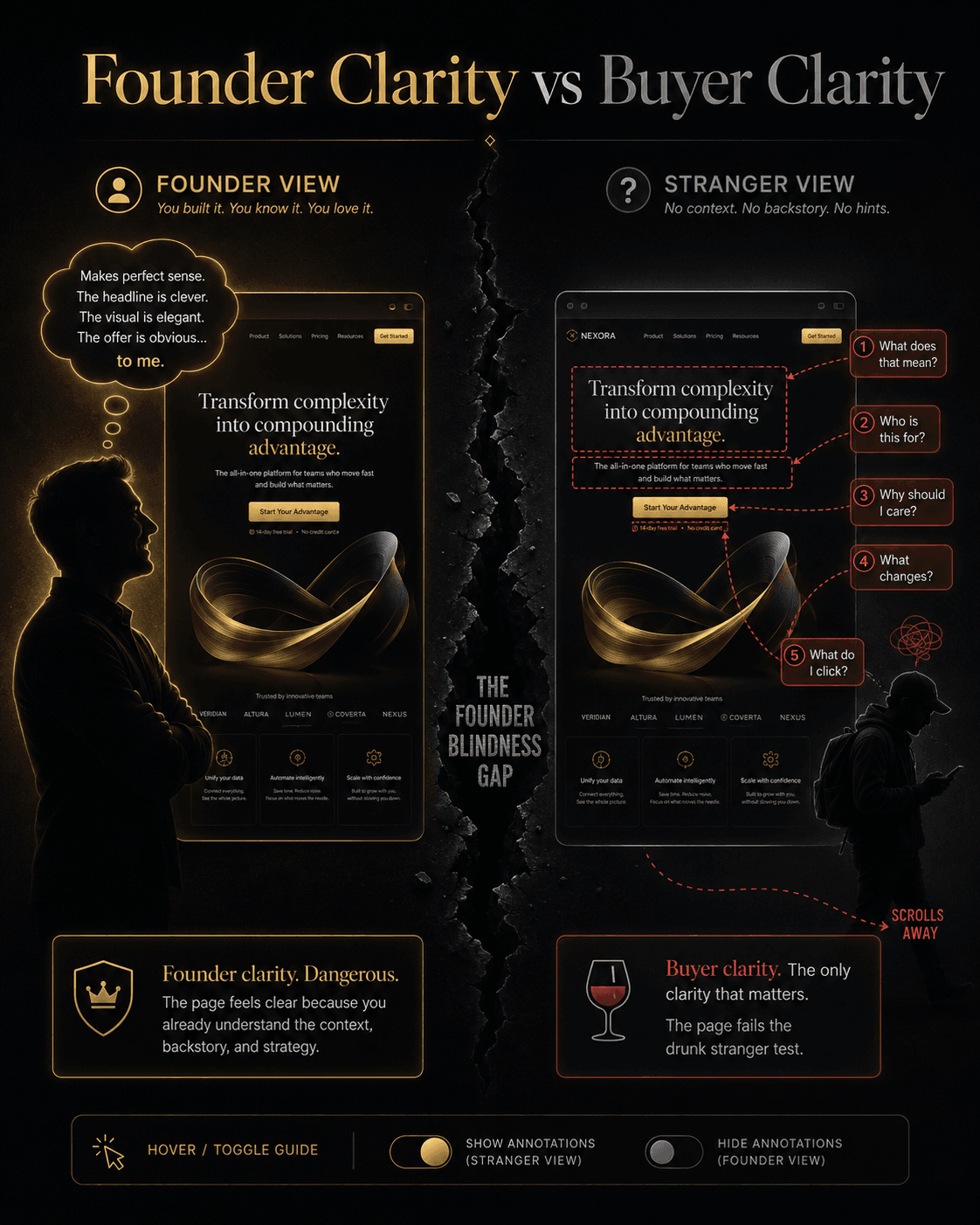
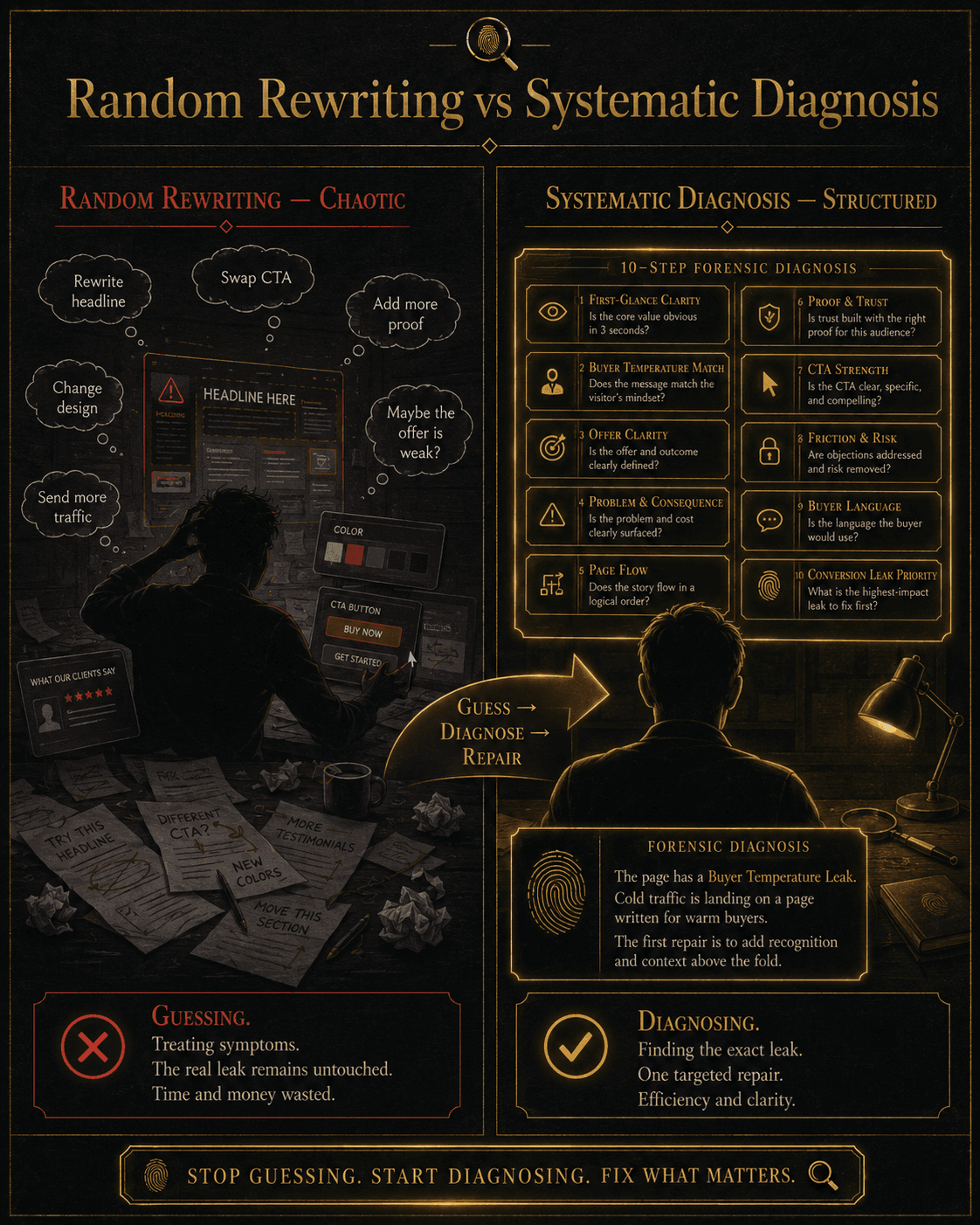
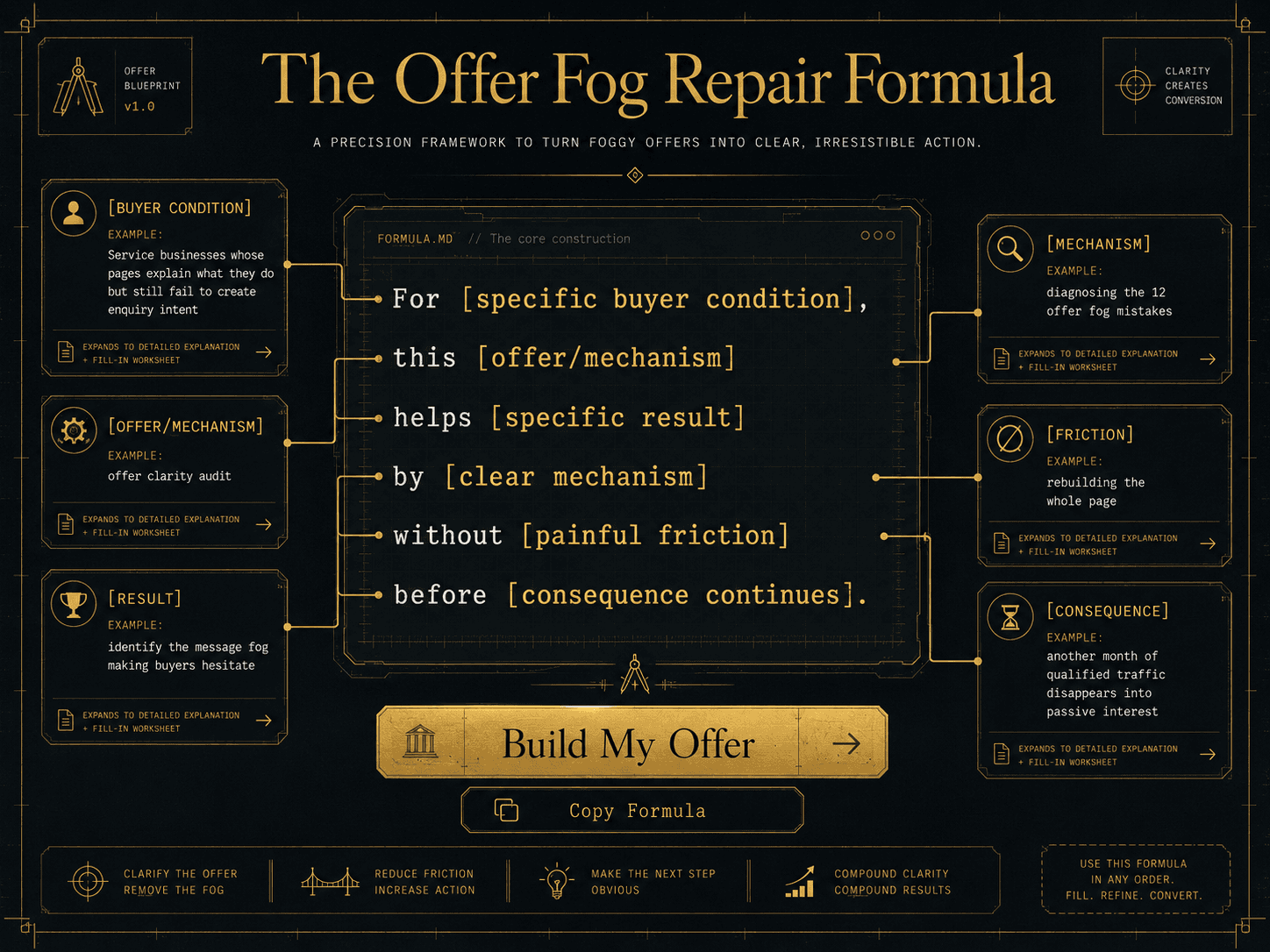
Other Blogs
Other Blogs
Check our other project Blogs with useful insight and information for your businesses