Our Three Step Process
May 25, 2026
Chap 2 | Resource 5 The Buyer Landmine Detector™
Our Three Step Process
May 25, 2026
Chap 2 | Resource 5 The Buyer Landmine Detector™
The Buyer Landmine Detector™ A trust and resistance audit for finding hype, vagueness, guru language, proof misalignment, premature CTA pressure, emotional incongruence, and “marketing-shaped” language before they trigger distrust and collapse conversion.
Prefer Audio Or Video?
The Buyer Landmine Detector™ is also available as:
🎧 A guided audio walkthrough explaining buyer resistance, trust collapse, and hidden messaging triggers
🎥 A practical video breakdown with real-world examples of copy that accidentally destroys trust and how to repair itChoose the format that fits how you learn best.
[Listen To The Audio Walkthrough] (coming soon)
[Watch The Video Breakdown] (coming soon)
——
Why Buyers Distrust Faster Than Ever
Modern buyers are not naïve.
They have seen:
exaggerated promises
fake urgency
recycled funnel templates
guru hype
emotionally manipulative copy
polished pages hiding weak offers
fake certainty
vague success stories
“secret systems” that were not secret
“game-changing” frameworks that changed very little
Over and over again.
That changes buyer psychology dramatically.
People now arrive at funnels with:
defensive filtering
scepticism
emotional caution
distrust of certainty
resistance to “marketing-shaped language”
a stronger ability to detect exaggeration
less patience for vague promises
This is critical to understand.
Because many funnels do not fail from lack of persuasion.
They fail from triggering resistance too early.
That is what The Buyer Landmine Detector™ is designed to help you detect and prevent.
It helps you find the hidden phrases, claims, tones, proof gaps, and CTA pressures that make buyers emotionally step back before they ever reach the decision.
——
What This Resource Helps You Do
The Buyer Landmine Detector™ helps you audit your funnel for hidden messaging mistakes that quietly damage trust.
Use it to find and fix:
hype language
vague claims
guru-style phrasing
proof that does not match the buyer’s doubt
CTA pressure that arrives too early
emotional tone mismatch
over-polished corporate language
artificial urgency
unsupported certainty
“marketing-shaped” phrases
trust leaks
resistance triggers
The goal is not to make the copy softer.
The goal is to make it more believable.
Because modern buyers do not simply ask:
“Do I want this?”
They also ask, often subconsciously:
“Can I trust this?”
“Does this feel real?”
“Have I heard this kind of claim before?”
“Is this another polished promise?”
“Am I being pressured before I believe?”
“Does this person actually understand my situation?”
If the copy triggers doubt too early, conversion starts leaking before the offer is even properly judged.
——
The Resistance Principle™
Buyers are constantly scanning for reasons not to trust you.
Usually subconsciously.
They look for signs of:
exaggeration
manipulation
vagueness
emotional pressure
false certainty
hype
corporate emptiness
fake expertise
proof that does not match the claim
urgency that feels manufactured
language that feels copied from every other funnel
The moment the page feels too polished, too manipulative, too generic, or emotionally off, the buyer emotionally steps backward.
Even if they continue reading physically.
That distinction matters enormously.
Because attention without trust still leaks conversion.
A buyer can keep scrolling while belief is already dying.
A buyer can read the page while emotionally deciding not to act.
A buyer can understand the message and still not trust the message.
That is why trust preservation matters.
Trust is built slowly.
Resistance can be triggered instantly.
——
Why Resistance Happens
Buyers are trying to protect themselves.
They are trying to avoid:
wasting money
making bad decisions
looking foolish
repeating past mistakes
trusting the wrong person again
buying another solution that does not fix the real problem
falling for language that sounds good but does not hold up
This means your funnel is not only competing against other offers.
It is competing against the buyer’s accumulated scepticism.
That changes everything.
Every sentence must either preserve trust or risk weakening it.
Every claim must feel believable.
Every CTA must feel appropriately timed.
Every proof point must answer a real doubt.
Every emotional line must match the buyer’s state.
That is the standard.
——
The 7 Major Messaging Landmines™
Most trust collapse comes from a handful of recurring mistakes.
These landmines quietly trigger scepticism, resistance, doubt, or emotional withdrawal.
The seven major messaging landmines are:
Hype Landmines™
Vagueness Landmines™
Guru Language Landmines™
Proof Misalignment™
Premature CTA Pressure™
Emotional Incongruence™
Over-Polished Corporate Language™
Each one creates a different kind of trust leak.
Use the sections below to detect, diagnose, and rewrite them.
——
1. Hype Landmines™
What This Triggers
Hype triggers manipulation detection.
The buyer starts thinking:
“This sounds exaggerated.”
“I have heard this before.”
“This feels too good to be true.”
“This sounds like marketing.”
Modern buyers have seen hype-heavy language too many times.
Now, phrases that once sounded exciting often create distance instead.
Common Hype Phrases
Watch for phrases like:
revolutionary
game-changing
secret system
guaranteed breakthrough
effortless scaling
instant results
explode your revenue
transform your business overnight
ultimate method
never fail again
unlock unlimited growth
dominate your market
These phrases may feel energetic to the writer.
But to a sceptical buyer, they often feel unsafe.
Weak Example™
“This revolutionary framework will transform your business instantly.”
This triggers:
scepticism
manipulation detection
doubt
emotional distance
The claim is too large.
The certainty is too strong.
The promise is not grounded enough.
Stronger Version™
“This framework helps identify the hidden conversion leaks most funnels never diagnose properly.”
This feels:
grounded
specific
useful
believable
psychologically safer
It still has value.
But it does not overreach.
That matters.
Detection Question
Ask:
“Does this sentence sound more exciting than believable?”
If yes, rewrite it.
Rewrite Prompt
Replace exaggerated intensity with specific usefulness.
Instead of asking:
“How can I make this sound bigger?”
Ask:
“How can I make this sound more specific, grounded, and believable?”
Fill This In
One overhyped phrase on my page is:
Why it may trigger scepticism:
A more grounded rewrite is:
——
2. Vagueness Landmines™
What This Triggers
Vagueness quietly weakens trust because unclear claims feel unsafe.
When buyers have to interpret too much, continuation becomes harder.
Vague copy creates interpretation effort.
Interpretation effort creates friction.
Friction weakens momentum.
Common Vague Phrases
Watch for phrases like:
better growth
optimised systems
powerful transformation
unlock your potential
scalable success
better performance
stronger outcomes
next-level strategy
improved results
smarter solutions
drive impact
achieve success
These phrases may sound professional, but they often fail to create recognition.
The buyer thinks:
“What does that actually mean?”
That question is dangerous.
Because every unclear claim makes the buyer work harder.
Weak Example™
“Helping businesses unlock scalable growth.”
Broad.
Generic.
Hard to feel.
Stronger Version™
“Helping founders identify the messaging gaps quietly weakening conversion.”
Now the claim is more specific.
The buyer can understand:
who it is for
what problem it addresses
where the value sits
why it matters
Specificity increases believability.
Detection Question
Ask:
“If the buyer asked, ‘What does that actually mean?’ would I have a clear answer?”
If not, the phrase is probably too vague.
Rewrite Prompt
Replace vague ambition with a specific problem, mechanism, or outcome.
Instead of:
“better growth”
try:
“more qualified calls from the traffic you already have”
Instead of:
“optimised systems”
try:
“a clearer follow-up sequence that stops warm leads going cold”
Fill This In
One vague phrase on my page is:
What the phrase is trying to say:
A more specific version is:
——
3. Guru Language Landmines™
What This Triggers
Guru language triggers defensive scepticism.
Especially among experienced buyers.
These buyers have heard too many loud claims, oversimplified answers, and “everyone else is wrong” arguments.
They are not impressed by certainty alone.
They want grounded explanation.
Common Guru Phrases
Watch for phrases like:
all you need to do
this always works
everyone else is wrong
the ultimate hack
you’ve been lied to
nobody tells you this
the secret they do not want you to know
one simple trick
this changes everything
stop doing everything else
the only framework you need
These phrases may create curiosity.
But they can also trigger resistance.
The buyer may think:
“This sounds like another guru pitch.”
Weak Example™
“This simple trick changes everything.”
Overstated.
Vague.
Guru-shaped.
Stronger Version™
“Most funnels leak conversion in ways founders often struggle to spot objectively.”
Measured.
Specific.
Credible.
The Core Distinction
Strong authority explains.
Guru posture declares.
Strong authority shows the mechanism.
Guru posture demands belief.
Strong authority earns trust.
Guru posture asks for it too early.
Detection Question
Ask:
“Does this line sound like it explains something, or does it just declare superiority?”
If it declares too much, rewrite it.
Rewrite Prompt
Replace guru certainty with grounded diagnosis.
Instead of:
“Everyone else is doing this wrong.”
try:
“Many pages underperform because they fix visible wording while missing the buyer pressure underneath it.”
Fill This In
One guru-style phrase on my page is:
Why it may trigger resistance:
A more grounded authority version is:
——
4. Proof Misalignment™
What This Triggers
Proof misalignment happens when the proof does not match the buyer’s actual concern.
Many funnels show proof.
But the wrong proof.
That weakens trust subconsciously.
The buyer sees evidence, but the evidence does not answer their doubt.
So belief does not form.
Example Of Misaligned Proof™
Buyer fear:
“My messaging still feels unclear.”
Proof shown:
“Generated 2 million impressions.”
Wrong proof.
The buyer still feels unresolved uncertainty.
The proof may sound impressive, but it does not answer the real question.
The buyer is not asking:
“Can you get attention?”
They are asking:
“Can you make the message clearer and more believable?”
Stronger Proof Alignment™
“After rebuilding the message structure, booked calls increased by 41% without increasing traffic spend.”
Now the proof matches the pressure.
It connects to:
messaging
conversion
business outcome
no additional traffic required
That creates belief more effectively.
——
Proof Matching Examples
If The Buyer Fears Lack Of Clarity
Use:
before/after messaging proof
side-by-side rewrites
clarity audit examples
buyer response changes
If The Buyer Fears Lack Of Trust
Use:
testimonials
process proof
trust-building breakdowns
credibility cues near claims
If The Buyer Fears Poor Performance
Use:
conversion results
booked calls
revenue impact
reduced cost per lead
improved activation
improved close rate
If The Buyer Is Sceptical Of Frameworks
Use:
grounded explanation
mechanism proof
examples of how the framework works
diagnostic breakdowns
If The Buyer Wonders “Will This Work For Me?”
Use:
relevant use-case proof
niche-specific examples
similar buyer situations
before/after comparisons from similar contexts
Detection Question
Ask:
“Does this proof answer the exact doubt the buyer is likely feeling here?”
If not, the proof is misaligned.
Rewrite Prompt
Match proof to the wound.
Identify the claim.
Identify the doubt.
Then place the proof that reduces that exact doubt.
Fill This In
The claim I am making is:
The doubt this claim creates is:
The proof I currently show is:
The proof the buyer actually needs is:
——
5. Premature CTA Pressure™
What This Triggers
Premature CTA pressure happens when the funnel asks for commitment before the buyer has enough clarity, relevance, trust, or belief.
The CTA may be technically clear.
But emotionally too early.
That creates resistance.
Common Premature CTAs
Examples:
Book Now
Apply Today
Start Scaling Immediately
Claim Your Spot
Get Started Now
Join Today
Schedule Your Strategy Call
These CTAs are not automatically wrong.
They become wrong when they appear before the buyer is ready.
Weak Sequence™
Cold traffic lands.
First thing they see:
“BOOK YOUR STRATEGY CALL NOW.”
Emotionally premature.
The page is asking for commitment before earning belief.
——
Stronger Sequence™
Headline:
“Why Most Funnels Quietly Lose Buyers Before The Offer Even Appears.”
CTA:
“See The Funnel Breakdown.”
Now continuation feels natural instead of forced.
The CTA gives the buyer a lower-friction next step.
CTA Readiness Ladder™
Use the buyer’s readiness level to choose the CTA.
Cold Buyer
Needs:
curiosity
recognition
low-friction continuation
Better CTA examples:
See The Breakdown
Find The Leak
Show Me What’s Missing
Explore The Framework
Diagnose The Page
Warm Buyer
Needs:
proof
mechanism
confidence
comparison
Better CTA examples:
See The Case Study
Get The Funnel Audit
Review The Breakdown
Compare The Before/After
Find My Messaging Gaps
Hot Buyer
Needs:
clarity
reassurance
next-step confidence
Better CTA examples:
Book The Audit
Apply For The Diagnosis
Start The Review
Schedule The Call
Get My Funnel Fixed
The CTA should match readiness.
Not your impatience.
Detection Question
Ask:
“Have I earned enough trust for this level of commitment?”
If not, lower the friction.
Rewrite Prompt
Replace premature commitment with natural continuation.
Instead of forcing action, offer the next believable step.
Fill This In
My current CTA is:
The buyer temperature is:
Cold / Warm / Hot
The CTA may feel premature because:
A lower-friction CTA would be:
——
6. Emotional Incongruence™
What This Triggers
Emotional incongruence happens when the emotional tone of the copy does not match the buyer’s current state.
This is one of the most overlooked landmines.
It can make a page feel “off” even when the words are technically good.
Common Emotional Mismatches
Examples:
aggressive urgency for emotionally exhausted buyers
overhyped language for sceptical buyers
corporate tone for emotionally frustrated buyers
playful copy for serious pain
heavy fear language for a buyer who needs clarity first
soft reassurance where the buyer needs direct diagnosis
high-energy dominance language for buyers who want grounded trust
The wrong tone creates emotional resistance.
Example™
Buyer state:
Emotionally exhausted and distrustful.
Copy tone:
“DOMINATE YOUR MARKET NOW!!!”
Immediate resistance.
The copy is not matching the buyer’s emotional state.
Stronger Emotional Match™
“If you are tired of endlessly rebuilding pages that still feel slightly off every time traffic hits them, you are not alone.”
Now the emotional tone feels aligned.
It is grounded.
It is specific.
It meets the buyer where they are.
That lowers defensiveness.
Detection Question
Ask:
“Does the emotional tone of this section match the buyer’s current state?”
If not, the section may create hidden resistance.
Rewrite Prompt
Match tone to buyer state.
If the buyer is sceptical, be grounded.
If the buyer is confused, be clear.
If the buyer is tired, do not shout.
If the buyer is doubtful, provide proof.
If the buyer is ready, make action easy.
Fill This In
The buyer’s emotional state is:
The current tone of the copy is:
The mismatch is:
A more emotionally congruent version is:
——
7. Over-Polished Corporate Language™
What This Triggers
Many founders accidentally sterilise their messaging while trying to sound:
professional
sophisticated
credible
premium
serious
The result is emotionally empty copy.
The page may sound polished.
But it does not feel human.
Common Corporate Phrases
Watch for phrases like:
innovative solutions
scalable systems
optimisation frameworks
cutting-edge strategies
performance-driven approach
robust methodology
seamless experiences
strategic enablement
growth-focused solutions
end-to-end transformation
This language sounds safe.
But often feels lifeless.
Weak Example™
“We provide innovative optimisation frameworks for scalable growth.”
Professional.
But empty.
The buyer does not feel recognised.
Stronger Version™
“We help you find the messaging gaps that make buyers hesitate before they trust the offer.”
Now the copy is:
clearer
more human
more specific
more relevant
easier to believe
Detection Question
Ask:
“Would a real buyer ever say this sentence naturally?”
If not, the copy may be too corporate.
Rewrite Prompt
Replace corporate abstraction with buyer-shaped language.
Write closer to the buyer’s lived problem.
Fill This In
One over-polished phrase on my page is:
What it actually means is:
A more human version is:
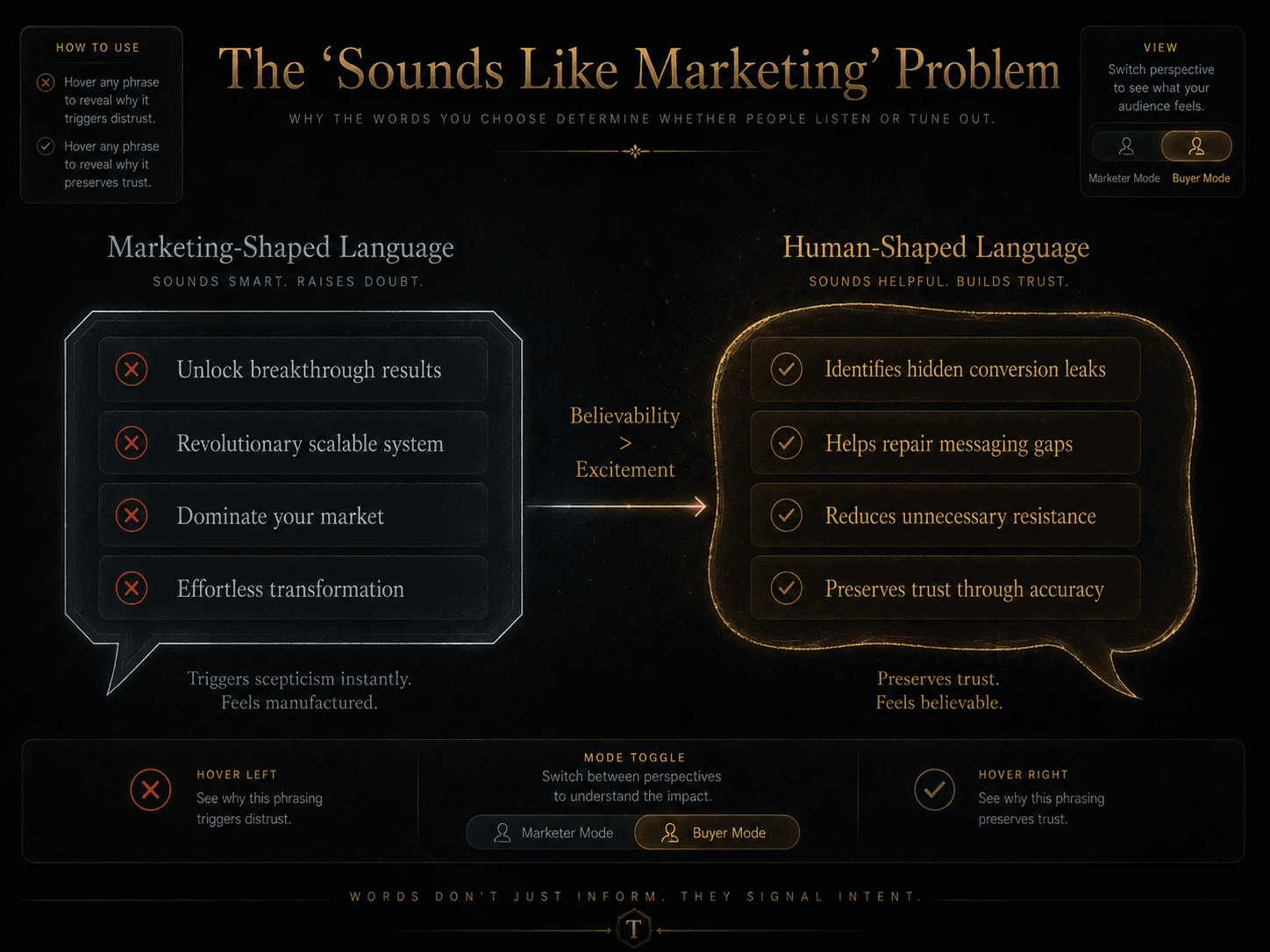
The “Sounds Like Marketing” Problem™
Buyers are extremely sensitive to marketing-shaped language.
Marketing-shaped language means phrases that instantly feel:
manufactured
scripted
artificial
overused
emotionally generic
copied from every other funnel
Examples include:
unlock
breakthrough
secret
revolutionary
effortless
scalable
dominate
transform your life
next level
game-changing
ultimate
proven system
powerful solution
These phrases often reduce believability.
Especially with sophisticated buyers.
The goal is not to sound more exciting.
The goal is to sound more believable.
That difference changes conversion psychology dramatically.
——
Marketing-Shaped vs Buyer-Shaped Language™
Marketing-shaped language:
“Unlock scalable growth with our revolutionary framework.”
Buyer-shaped language:
“Find the messaging gaps that make buyers hesitate before they trust the offer.”
Marketing-shaped language:
“Transform your funnel performance instantly.”
Buyer-shaped language:
“See where cold visitors lose belief before they reach the CTA.”
Marketing-shaped language:
“Dominate your market with high-converting systems.”
Buyer-shaped language:
“Stop sending traffic into a page that still cannot hold trust.”
Replace marketing-shaped language with buyer-shaped language.
That is the rule.
——
The Manipulation Detection System™
Modern buyers subconsciously scan for manipulation.
They look for:
fake scarcity
exaggerated certainty
emotional coercion
unrealistic promises
forced urgency
inflated authority
guru posture
pressure without trust
proof that does not support the claim
urgency that feels manufactured
The moment the funnel feels manipulative, the buyer emotionally withdraws.
Even if they keep scrolling.
This matters because trust destruction happens faster than trust creation.
One exaggerated sentence can undo multiple sections of good messaging.
——
Manipulation Triggers And Repairs
Trigger: Fake Scarcity
Example:
“Only 3 spots left” when that is not true.
Repair:
Use real timing, real capacity, or remove the claim.
Trigger: Exaggerated Certainty
Example:
“This will definitely fix your funnel.”
Repair:
Use grounded confidence.
“This helps identify where the funnel is most likely losing buyer momentum.”
Trigger: Forced Urgency
Example:
“You need this now before it is too late.”
Repair:
Use natural consequence.
“If the funnel keeps leaking trust at first contact, scaling traffic usually amplifies the problem instead of solving it.”
Trigger: Unsupported Claims
Example:
“Proven to transform any business.”
Repair:
Use specific proof.
“See the before-and-after breakdown showing where the original page lost belief and what changed.”
Trigger: Inflated Authority
Example:
“The only funnel system you will ever need.”
Repair:
Use measured authority.
“A diagnostic framework for finding where attention, relevance, belief, trust, or action breaks.”
Weak Trust vs Strong Trust™
Trust is not built by making the message louder.
It is built by making the message more believable.
Weak Trust Example™
“This guaranteed system will explode your revenue fast.”
Triggers:
scepticism
manipulation detection
emotional distance
doubt
Stronger Trust Example™
“This framework helps identify where buyer momentum weakens so conversion problems can be repaired more strategically.”
Now the message feels:
grounded
useful
psychologically believable
safer to continue reading
Another Weak Example™
“You need this system NOW before it’s too late.”
Emotionally heavy-handed.
Pressure without enough trust.
Stronger Version™
“If the funnel keeps leaking trust at first contact, scaling traffic usually amplifies the problem instead of solving it.”
Now urgency comes from consequence.
Not pressure tactics.
That distinction matters enormously.
——
More Weak Trust vs Strong Trust Examples™
Hype
Weak:
“Revolutionise your messaging overnight.”
Stronger:
“Identify the phrases that make buyers hesitate before they understand the value.”
Vagueness
Weak:
“Unlock better performance.”
Stronger:
“Find the section where attention turns into hesitation.”
Guru Posture
Weak:
“Everyone else is teaching funnels wrong.”
Stronger:
“Many funnel problems are misdiagnosed because the visible copy gets fixed before buyer pressure is understood.”
Proof Misalignment
Weak:
“Thousands of people viewed the page.”
Stronger:
“After the message was rebuilt, more qualified buyers reached the CTA with fewer clarification questions.”
Premature CTA
Weak:
“Book Your Strategy Call Now.”
Stronger for cold traffic:
“See Where The Funnel Is Leaking Trust.”
——
The Trust Preservation Framework™
Strong messaging usually feels:
grounded
emotionally accurate
measured
psychologically aware
specific
believable
pressure-aware without becoming manipulative
clear without becoming simplistic
direct without becoming aggressive
confident without becoming inflated
This creates emotional safety.
And emotional safety increases continuation.
The buyer does not need to feel overpowered.
They need to feel safe enough to keep believing.
——
Trust Preservation Checklist™
Before publishing the page, ask:
Does the copy feel grounded?
Yes / No
Does the copy make specific claims?
Yes / No
Does the tone match the buyer’s emotional state?
Yes / No
Does the proof match the buyer’s doubt?
Yes / No
Does the CTA match the buyer’s readiness?
Yes / No
Does the urgency come from real consequence?
Yes / No
Does the page avoid fake certainty?
Yes / No
Does the copy sound human?
Yes / No
Does the page feel emotionally coherent?
Yes / No
Does the message reduce defensiveness?
Yes / No
If several answers are “No”, your page may be triggering resistance.
——
The Congruence Principle™
Buyers trust alignment.
Not intensity.
This is critical.
Weak funnels often mix:
emotionally sharp headlines
corporate proof
dead CTAs
overhyped urgency
vague guarantees
disconnected objection handling
That emotional inconsistency creates subconscious distrust.
A funnel can be persuasive in individual parts and still untrustworthy as a whole if the emotional tone does not match.
Strong funnels feel coherent emotionally.
Every section feels like it belongs to the same psychological world.
Weak Congruence Example
Headline:
“Still Sending Traffic To A Funnel You Quietly Don’t Trust Yet?”
Proof:
“Trusted by ambitious businesses worldwide.”
CTA:
“Submit.”
Problem:
The headline is specific and emotionally accurate.
The proof is vague.
The CTA is dead.
The page does not feel emotionally aligned.
Stronger Congruence Example
Headline:
“Still Sending Traffic To A Funnel You Quietly Don’t Trust Yet?”
Proof:
“See the before-and-after funnel breakdown showing where belief collapsed and what changed.”
CTA:
“Get My Funnel Breakdown.”
Now the emotional world is consistent:
hesitation
diagnosis
proof
movement
That alignment preserves trust.
——
The Resistance Audit Scorecard™
Use this scorecard to find hidden trust landmines.
Score each area from 1 to 5.
1 = severe issue
2 = weak
3 = acceptable but needs work
4 = strong
5 = trust-preserving and buyer-aligned
Hype Control
Does the copy avoid exaggerated, overblown, or unrealistic claims?
Score: ___ / 5
Specificity
Does the copy replace vague claims with specific buyer-relevant language?
Score: ___ / 5
Guru Posture
Does the copy avoid “secret hack”, “everyone else is wrong”, and fake certainty language?
Score: ___ / 5
Proof Alignment
Does the proof match the buyer’s actual concern?
Score: ___ / 5
CTA Readiness
Does the CTA match the buyer’s current level of trust and intent?
Score: ___ / 5
Emotional Congruence
Does the emotional tone match the buyer’s state?
Score: ___ / 5
Human Language
Does the copy avoid over-polished corporate language?
Score: ___ / 5
Believability
Would a sceptical buyer believe the claims?
Score: ___ / 5
Trust Preservation
Does the copy reduce unnecessary defensiveness?
Score: ___ / 5
Funnel Congruence
Does the page feel emotionally aligned from headline to CTA?
Score: ___ / 5
Total Resistance Score
Total: ___ / 50
——
What Your Score Means
43–50: Strong Trust Preservation
Your messaging is grounded, specific, believable, and emotionally aligned.
The page is less likely to trigger unnecessary buyer resistance.
34–42: Mostly Strong, But Needs Tightening
The page is probably usable, but some trust landmines remain.
Review the lowest-scoring areas.
24–33: Hidden Resistance Likely
The page may sound good to you but still trigger scepticism in buyers.
Look closely at hype, vagueness, CTA pressure, and proof alignment.
0–23: High Risk Of Trust Collapse
The page is likely creating unnecessary resistance.
Do not publish yet.
Rewrite for specificity, believability, emotional congruence, and proof alignment.
——
The Sceptical Buyer Test™
Imagine your buyer has:
seen 100 weak funnels already
been disappointed before
wasted money before
trusted the wrong advice before
heard exaggerated claims before
tried solutions that did not work
developed an automatic distrust of hype
Now ask:
“Would this still feel believable to them?”
This question alone can dramatically improve messaging quality.
Sceptical Buyer Questions
Ask:
Would they believe this claim immediately?
Would they quietly raise an eyebrow?
Would they ask, “What does that actually mean?”
Would they feel pressured too early?
Would they trust the proof?
Would they feel emotionally understood?
Would this sound like something they have heard too many times before?
Would this reduce defensiveness or increase it?
If the line fails this test, rewrite it.
——
The “Would A Sceptical Friend Believe This?” Test™
Read the copy out loud and ask:
“Would a smart sceptical friend believe this immediately, or quietly raise an eyebrow?”
That instinctive reaction usually reveals where trust weakens.
If they would raise an eyebrow, do not defend the line.
Fix the line.
The Lower The Defences Principle™
Strong messaging does not try to overpower scepticism.
It tries to reduce unnecessary defensiveness.
That usually happens through:
specificity
grounded tone
emotional accuracy
honest pressure
believable proof
natural sequencing
clear next steps
realistic claims
buyer-shaped language
Not louder persuasion.
Not harder selling.
Not bigger promises.
Not more pressure.
This is one of the biggest trust shifts in modern conversion psychology.
Most marketers try to increase persuasion intensity when the real problem is unnecessary resistance.
That creates harder selling, more pressure, more hype, and more distrust.
Strong marketers understand:
Trust often grows faster when defensiveness decreases.
That is a completely different game.
——
Using AI To Detect Trust Landmines™
AI can be useful for identifying unintentional resistance triggers.
You can use any capable AI tool to audit your page for trust landmines.
If you are using Funnels By Maris Spalins™, the prompts are designed to work especially well with the frameworks, principles, and buyer psychology systems explored throughout The $100M Funnel Playbook.
AI can help you:
identify hype language
detect vague claims
pressure-test trust
spot emotional incongruence
simplify exaggerated copy
identify resistance triggers
improve emotional realism
strengthen messaging congruence
detect premature CTA pressure
find proof misalignment
But the rule remains:
Do not use AI to make the copy louder.
Use AI to make the copy more believable.
——
Buyer Landmine Detection AI Prompt™
Use this prompt to audit a page before publishing.
Act as a conversion strategist trained in buyer psychology, trust preservation, and resistance reduction.
Audit the following page copy for hidden messaging landmines.
The target buyer is:
[insert buyer]
The buyer is likely sceptical of:
[insert resistance points]
The page goal is:
[insert goal]
Analyse the copy for:
Hype Landmines™
Vagueness Landmines™
Guru Language Landmines™
Proof Misalignment™
Premature CTA Pressure™
Emotional Incongruence™
Over-Polished Corporate Language™
Unsupported certainty
Fake urgency
Marketing-shaped language
For each issue, give me:
the exact phrase or section causing the issue
why it may trigger resistance
what the buyer may feel subconsciously
a more grounded rewrite
why the rewrite preserves trust better
Then score the page from 1 to 5 on:
believability
specificity
emotional congruence
proof alignment
CTA readiness
trust preservation
After that, give me:
the 5 biggest trust risks
the 5 strongest rewrites
one improved headline
one improved proof cue
one improved CTA
one improved CTA microcopy line
Keep the tone grounded, specific, human, and psychologically believable.
Do not make the copy louder.
Make it safer to believe.
Here is the page copy:
[paste page copy]
——
Quick Landmine Detection Exercise™
Use this when your page feels polished but still may not be trustworthy enough.
One Phrase That Sounds Overhyped:
Why It May Trigger Scepticism:
Grounded Rewrite:
One Section That Feels Too Vague:
What The Buyer May Not Understand:
Specific Rewrite:
One Guru-Style Phrase:
Why It May Feel Unsafe:
Measured Authority Rewrite:
One Misaligned Proof Point:
The Buyer Doubt It Fails To Answer:
Better Proof Match:
One Place Where Pressure Arrives Too Early:
Why It May Create Resistance:
Better Sequence Or Lower-Friction Version:
One Emotionally Mismatched Section:
Buyer State:
Better Emotional Match:
One Corporate Or Over-Polished Phrase:
What It Really Means:
More Human Rewrite:
——
The Buyer Landmine Repair Worksheet™
Use this worksheet to turn trust leaks into stronger messaging.
Target Buyer:
Page Or Funnel Being Audited:
Buyer’s Likely Scepticism:
Buyer’s Current Emotional State:
Main Claim On The Page:
Main Proof Supporting The Claim:
Main CTA:
Landmine 1: Hype
Problem phrase:
Trust-preserving rewrite:
Landmine 2: Vagueness
Problem phrase:
Specific rewrite:
Landmine 3: Guru Language
Problem phrase:
Measured authority rewrite:
Landmine 4: Proof Misalignment
Current proof:
Buyer doubt:
Better proof:
Landmine 5: Premature CTA Pressure
Current CTA:
Buyer readiness level:
Cold / Warm / Hot
Better CTA:
Landmine 6: Emotional Incongruence
Current tone:
Buyer state:
Better tone direction:
Landmine 7: Corporate Sterility
Corporate phrase:
Buyer-shaped rewrite:
——
Final Trust-Preserved Version
Rewrite the strongest version of the page section here:
The 30-Minute Buyer Landmine Audit™
Use this process before publishing any important page.
Minutes 0–5: Scan For Hype And Vagueness
Highlight every phrase that sounds exaggerated, abstract, or hard to believe.
Write the worst phrase here:
Rewrite it here:
Minutes 5–10: Check Proof Alignment
Find the biggest claim on the page.
Main claim:
Buyer doubt:
Current proof:
Better proof needed:
Minutes 10–15: Check CTA Readiness
Ask whether the CTA matches buyer temperature.
Buyer temperature:
Cold / Warm / Hot
Current CTA:
Better CTA:
Minutes 15–20: Check Emotional Congruence
Ask whether the page tone matches the buyer’s emotional state.
Buyer state:
Current tone:
Tone adjustment needed:
Minutes 20–25: Run The Sceptical Buyer Test
Ask:
“Would a sceptical buyer believe this?”
Line that may fail:
Trust-preserving rewrite:
Minutes 25–30: Final Trust Check
Ask:
Is the message specific?
Is the tone grounded?
Is the proof matched?
Is the CTA natural?
Is the urgency honest?
Does this reduce defensiveness?
Final page improvement:
——
Final Principle™
The strongest messaging does not feel like persuasion.
It feels like accurate understanding.
That is why:
emotional realism matters
grounded tone matters
specificity matters
congruence matters
believable pressure matters
matched proof matters
natural sequencing matters
Modern buyers are not merely looking for promises.
They are looking for signals of honesty, psychological safety, and emotional accuracy.
Funnels that preserve trust create continuation.
Funnels that trigger resistance quietly collapse.
That is what The Buyer Landmine Detector™ is designed to help you prevent.
Take one page.
Highlight every phrase that creates unnecessary resistance.
Replace intensity with specificity.
Replace hype with grounded explanation.
Replace vague claims with buyer-shaped language.
Replace premature pressure with natural continuation.
Replace generic proof with matched proof.
The goal is not to sound louder.
The goal is to become easier to believe.
That is where trust starts.
And where conversion has a chance to continue.
——
From:
The $100M Funnel Playbook. Book I: Foundation Buyer Psychology, Offer Clarity, and the Page Architecture Behind High-Converting Funnels
By Maris Spalins.
——
Copyright Notice
© 2026 The $100M Funnel Playbook / Winyourclients / Maris Spalins. All rights reserved.
This resource, including the frameworks, terminology, examples, scorecards, templates, prompts, methods, and written explanations, is original intellectual property created for The $100M Funnel Playbook. Book I: Foundation — Buyer Psychology, Offer Clarity, And The Page Architecture Behind High-Converting Funnels and published through Winyourclients.
No part of this resource may be copied, reproduced, screenshotted, republished, redistributed, sold, adapted, uploaded, scraped, stored in a database, included in training data, used to train artificial intelligence systems, or used to create derivative commercial or educational materials without prior written permission.
Limited reference, quotation, or sharing is only permitted where the source is clearly and visibly credited.
Any permitted reference must include at least one of the following source credits:
The $100M Funnel Playbook by Maris Spalins
or
Winyourclients — www.winyourclients.com
or
Maris Spalins / Winyourclients
Screenshots, excerpts, summaries, or redistributed versions must not remove, hide, alter, crop out, or obscure the original source, author name, book title, website name, or copyright notice.
This resource is provided for personal learning and implementation only. It is not licensed for resale, republishing, redistribution, AI training, template cloning, course creation, consulting delivery, or commercial reuse without written permission from Maris Spalins or Winyourclients.
For permission requests, licensing, citation approval, or commercial usage enquiries, contact:
Winyourclients
www.winyourclients.com
or
Email directly to Jacob on: help@winyourclients.com
The Buyer Landmine Detector™ A trust and resistance audit for finding hype, vagueness, guru language, proof misalignment, premature CTA pressure, emotional incongruence, and “marketing-shaped” language before they trigger distrust and collapse conversion.
Prefer Audio Or Video?
The Buyer Landmine Detector™ is also available as:
🎧 A guided audio walkthrough explaining buyer resistance, trust collapse, and hidden messaging triggers
🎥 A practical video breakdown with real-world examples of copy that accidentally destroys trust and how to repair itChoose the format that fits how you learn best.
[Listen To The Audio Walkthrough] (coming soon)
[Watch The Video Breakdown] (coming soon)
——
Why Buyers Distrust Faster Than Ever
Modern buyers are not naïve.
They have seen:
exaggerated promises
fake urgency
recycled funnel templates
guru hype
emotionally manipulative copy
polished pages hiding weak offers
fake certainty
vague success stories
“secret systems” that were not secret
“game-changing” frameworks that changed very little
Over and over again.
That changes buyer psychology dramatically.
People now arrive at funnels with:
defensive filtering
scepticism
emotional caution
distrust of certainty
resistance to “marketing-shaped language”
a stronger ability to detect exaggeration
less patience for vague promises
This is critical to understand.
Because many funnels do not fail from lack of persuasion.
They fail from triggering resistance too early.
That is what The Buyer Landmine Detector™ is designed to help you detect and prevent.
It helps you find the hidden phrases, claims, tones, proof gaps, and CTA pressures that make buyers emotionally step back before they ever reach the decision.
——
What This Resource Helps You Do
The Buyer Landmine Detector™ helps you audit your funnel for hidden messaging mistakes that quietly damage trust.
Use it to find and fix:
hype language
vague claims
guru-style phrasing
proof that does not match the buyer’s doubt
CTA pressure that arrives too early
emotional tone mismatch
over-polished corporate language
artificial urgency
unsupported certainty
“marketing-shaped” phrases
trust leaks
resistance triggers
The goal is not to make the copy softer.
The goal is to make it more believable.
Because modern buyers do not simply ask:
“Do I want this?”
They also ask, often subconsciously:
“Can I trust this?”
“Does this feel real?”
“Have I heard this kind of claim before?”
“Is this another polished promise?”
“Am I being pressured before I believe?”
“Does this person actually understand my situation?”
If the copy triggers doubt too early, conversion starts leaking before the offer is even properly judged.
——
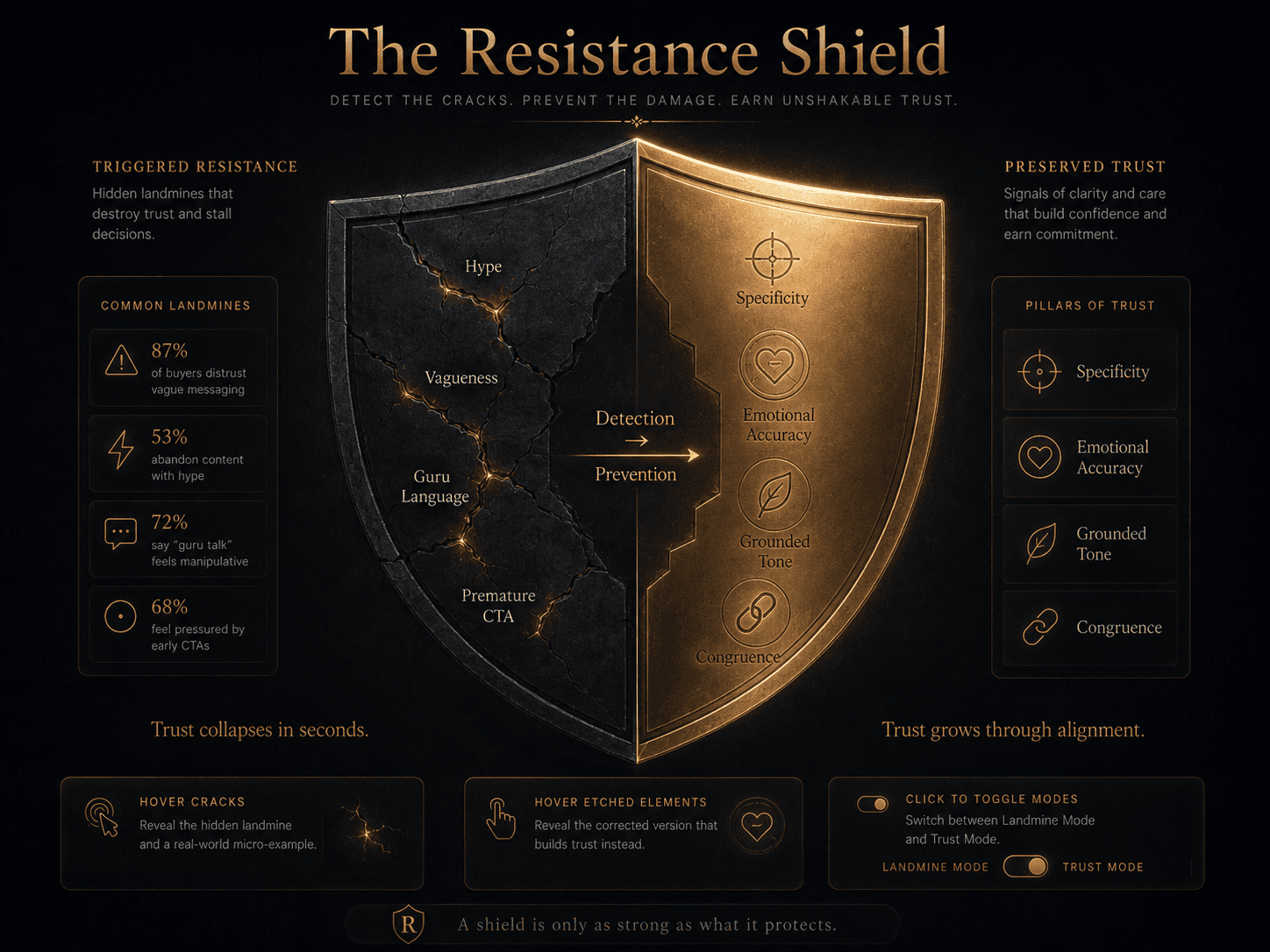
The Resistance Principle™
Buyers are constantly scanning for reasons not to trust you.
Usually subconsciously.
They look for signs of:
exaggeration
manipulation
vagueness
emotional pressure
false certainty
hype
corporate emptiness
fake expertise
proof that does not match the claim
urgency that feels manufactured
language that feels copied from every other funnel
The moment the page feels too polished, too manipulative, too generic, or emotionally off, the buyer emotionally steps backward.
Even if they continue reading physically.
That distinction matters enormously.
Because attention without trust still leaks conversion.
A buyer can keep scrolling while belief is already dying.
A buyer can read the page while emotionally deciding not to act.
A buyer can understand the message and still not trust the message.
That is why trust preservation matters.
Trust is built slowly.
Resistance can be triggered instantly.
——
Why Resistance Happens
Buyers are trying to protect themselves.
They are trying to avoid:
wasting money
making bad decisions
looking foolish
repeating past mistakes
trusting the wrong person again
buying another solution that does not fix the real problem
falling for language that sounds good but does not hold up
This means your funnel is not only competing against other offers.
It is competing against the buyer’s accumulated scepticism.
That changes everything.
Every sentence must either preserve trust or risk weakening it.
Every claim must feel believable.
Every CTA must feel appropriately timed.
Every proof point must answer a real doubt.
Every emotional line must match the buyer’s state.
That is the standard.
——
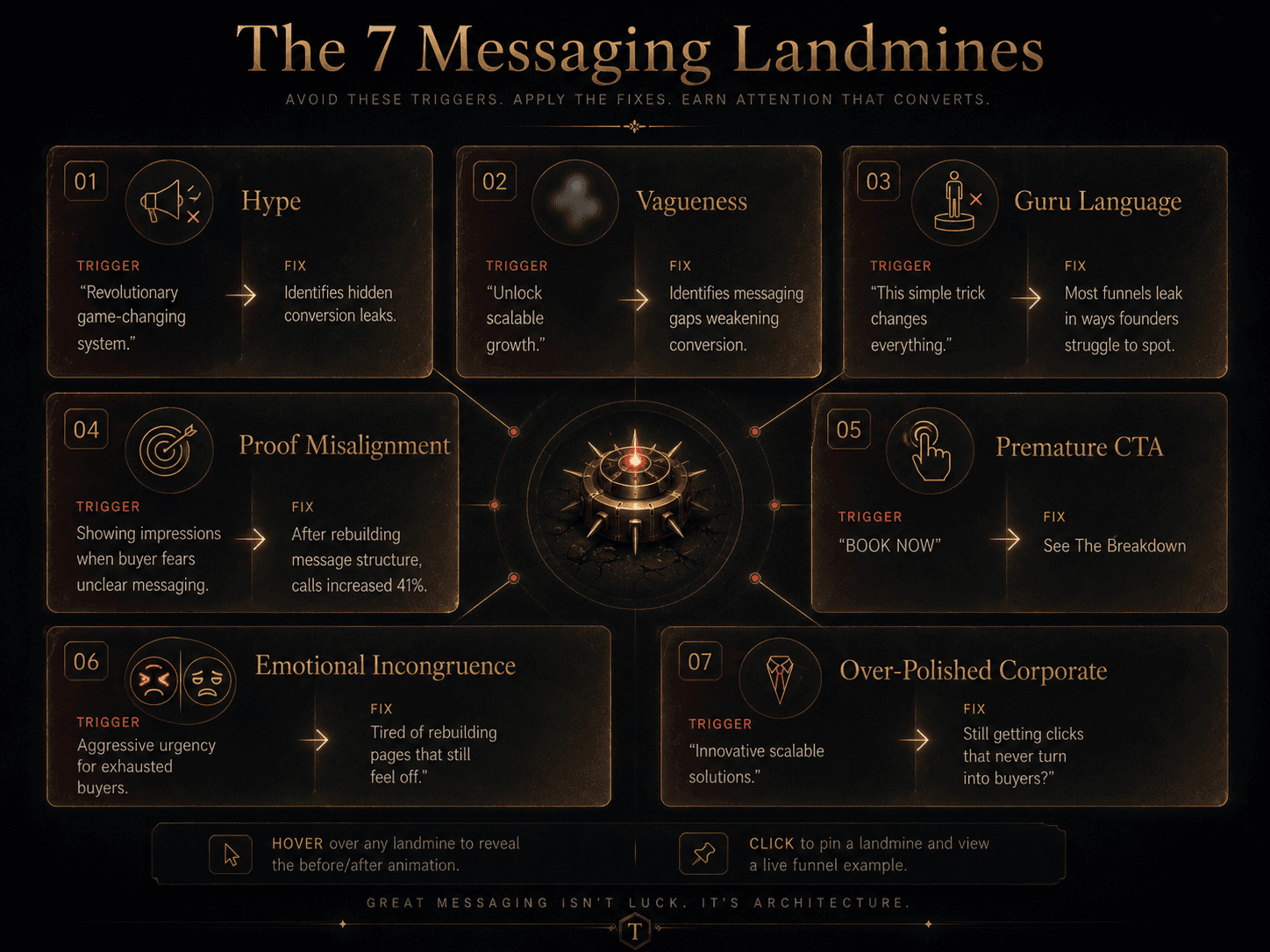
The 7 Major Messaging Landmines™
Most trust collapse comes from a handful of recurring mistakes.
These landmines quietly trigger scepticism, resistance, doubt, or emotional withdrawal.
The seven major messaging landmines are:
Hype Landmines™
Vagueness Landmines™
Guru Language Landmines™
Proof Misalignment™
Premature CTA Pressure™
Emotional Incongruence™
Over-Polished Corporate Language™
Each one creates a different kind of trust leak.
Use the sections below to detect, diagnose, and rewrite them.
——
1. Hype Landmines™
What This Triggers
Hype triggers manipulation detection.
The buyer starts thinking:
“This sounds exaggerated.”
“I have heard this before.”
“This feels too good to be true.”
“This sounds like marketing.”
Modern buyers have seen hype-heavy language too many times.
Now, phrases that once sounded exciting often create distance instead.
Common Hype Phrases
Watch for phrases like:
revolutionary
game-changing
secret system
guaranteed breakthrough
effortless scaling
instant results
explode your revenue
transform your business overnight
ultimate method
never fail again
unlock unlimited growth
dominate your market
These phrases may feel energetic to the writer.
But to a sceptical buyer, they often feel unsafe.
Weak Example™
“This revolutionary framework will transform your business instantly.”
This triggers:
scepticism
manipulation detection
doubt
emotional distance
The claim is too large.
The certainty is too strong.
The promise is not grounded enough.
Stronger Version™
“This framework helps identify the hidden conversion leaks most funnels never diagnose properly.”
This feels:
grounded
specific
useful
believable
psychologically safer
It still has value.
But it does not overreach.
That matters.
Detection Question
Ask:
“Does this sentence sound more exciting than believable?”
If yes, rewrite it.
Rewrite Prompt
Replace exaggerated intensity with specific usefulness.
Instead of asking:
“How can I make this sound bigger?”
Ask:
“How can I make this sound more specific, grounded, and believable?”
Fill This In
One overhyped phrase on my page is:
Why it may trigger scepticism:
A more grounded rewrite is:
——
2. Vagueness Landmines™
What This Triggers
Vagueness quietly weakens trust because unclear claims feel unsafe.
When buyers have to interpret too much, continuation becomes harder.
Vague copy creates interpretation effort.
Interpretation effort creates friction.
Friction weakens momentum.
Common Vague Phrases
Watch for phrases like:
better growth
optimised systems
powerful transformation
unlock your potential
scalable success
better performance
stronger outcomes
next-level strategy
improved results
smarter solutions
drive impact
achieve success
These phrases may sound professional, but they often fail to create recognition.
The buyer thinks:
“What does that actually mean?”
That question is dangerous.
Because every unclear claim makes the buyer work harder.
Weak Example™
“Helping businesses unlock scalable growth.”
Broad.
Generic.
Hard to feel.
Stronger Version™
“Helping founders identify the messaging gaps quietly weakening conversion.”
Now the claim is more specific.
The buyer can understand:
who it is for
what problem it addresses
where the value sits
why it matters
Specificity increases believability.
Detection Question
Ask:
“If the buyer asked, ‘What does that actually mean?’ would I have a clear answer?”
If not, the phrase is probably too vague.
Rewrite Prompt
Replace vague ambition with a specific problem, mechanism, or outcome.
Instead of:
“better growth”
try:
“more qualified calls from the traffic you already have”
Instead of:
“optimised systems”
try:
“a clearer follow-up sequence that stops warm leads going cold”
Fill This In
One vague phrase on my page is:
What the phrase is trying to say:
A more specific version is:
——
3. Guru Language Landmines™
What This Triggers
Guru language triggers defensive scepticism.
Especially among experienced buyers.
These buyers have heard too many loud claims, oversimplified answers, and “everyone else is wrong” arguments.
They are not impressed by certainty alone.
They want grounded explanation.
Common Guru Phrases
Watch for phrases like:
all you need to do
this always works
everyone else is wrong
the ultimate hack
you’ve been lied to
nobody tells you this
the secret they do not want you to know
one simple trick
this changes everything
stop doing everything else
the only framework you need
These phrases may create curiosity.
But they can also trigger resistance.
The buyer may think:
“This sounds like another guru pitch.”
Weak Example™
“This simple trick changes everything.”
Overstated.
Vague.
Guru-shaped.
Stronger Version™
“Most funnels leak conversion in ways founders often struggle to spot objectively.”
Measured.
Specific.
Credible.
The Core Distinction
Strong authority explains.
Guru posture declares.
Strong authority shows the mechanism.
Guru posture demands belief.
Strong authority earns trust.
Guru posture asks for it too early.
Detection Question
Ask:
“Does this line sound like it explains something, or does it just declare superiority?”
If it declares too much, rewrite it.
Rewrite Prompt
Replace guru certainty with grounded diagnosis.
Instead of:
“Everyone else is doing this wrong.”
try:
“Many pages underperform because they fix visible wording while missing the buyer pressure underneath it.”
Fill This In
One guru-style phrase on my page is:
Why it may trigger resistance:
A more grounded authority version is:
——
4. Proof Misalignment™
What This Triggers
Proof misalignment happens when the proof does not match the buyer’s actual concern.
Many funnels show proof.
But the wrong proof.
That weakens trust subconsciously.
The buyer sees evidence, but the evidence does not answer their doubt.
So belief does not form.
Example Of Misaligned Proof™
Buyer fear:
“My messaging still feels unclear.”
Proof shown:
“Generated 2 million impressions.”
Wrong proof.
The buyer still feels unresolved uncertainty.
The proof may sound impressive, but it does not answer the real question.
The buyer is not asking:
“Can you get attention?”
They are asking:
“Can you make the message clearer and more believable?”
Stronger Proof Alignment™
“After rebuilding the message structure, booked calls increased by 41% without increasing traffic spend.”
Now the proof matches the pressure.
It connects to:
messaging
conversion
business outcome
no additional traffic required
That creates belief more effectively.
——
Proof Matching Examples
If The Buyer Fears Lack Of Clarity
Use:
before/after messaging proof
side-by-side rewrites
clarity audit examples
buyer response changes
If The Buyer Fears Lack Of Trust
Use:
testimonials
process proof
trust-building breakdowns
credibility cues near claims
If The Buyer Fears Poor Performance
Use:
conversion results
booked calls
revenue impact
reduced cost per lead
improved activation
improved close rate
If The Buyer Is Sceptical Of Frameworks
Use:
grounded explanation
mechanism proof
examples of how the framework works
diagnostic breakdowns
If The Buyer Wonders “Will This Work For Me?”
Use:
relevant use-case proof
niche-specific examples
similar buyer situations
before/after comparisons from similar contexts
Detection Question
Ask:
“Does this proof answer the exact doubt the buyer is likely feeling here?”
If not, the proof is misaligned.
Rewrite Prompt
Match proof to the wound.
Identify the claim.
Identify the doubt.
Then place the proof that reduces that exact doubt.
Fill This In
The claim I am making is:
The doubt this claim creates is:
The proof I currently show is:
The proof the buyer actually needs is:
——
5. Premature CTA Pressure™
What This Triggers
Premature CTA pressure happens when the funnel asks for commitment before the buyer has enough clarity, relevance, trust, or belief.
The CTA may be technically clear.
But emotionally too early.
That creates resistance.
Common Premature CTAs
Examples:
Book Now
Apply Today
Start Scaling Immediately
Claim Your Spot
Get Started Now
Join Today
Schedule Your Strategy Call
These CTAs are not automatically wrong.
They become wrong when they appear before the buyer is ready.
Weak Sequence™
Cold traffic lands.
First thing they see:
“BOOK YOUR STRATEGY CALL NOW.”
Emotionally premature.
The page is asking for commitment before earning belief.
——
Stronger Sequence™
Headline:
“Why Most Funnels Quietly Lose Buyers Before The Offer Even Appears.”
CTA:
“See The Funnel Breakdown.”
Now continuation feels natural instead of forced.
The CTA gives the buyer a lower-friction next step.
CTA Readiness Ladder™
Use the buyer’s readiness level to choose the CTA.
Cold Buyer
Needs:
curiosity
recognition
low-friction continuation
Better CTA examples:
See The Breakdown
Find The Leak
Show Me What’s Missing
Explore The Framework
Diagnose The Page
Warm Buyer
Needs:
proof
mechanism
confidence
comparison
Better CTA examples:
See The Case Study
Get The Funnel Audit
Review The Breakdown
Compare The Before/After
Find My Messaging Gaps
Hot Buyer
Needs:
clarity
reassurance
next-step confidence
Better CTA examples:
Book The Audit
Apply For The Diagnosis
Start The Review
Schedule The Call
Get My Funnel Fixed
The CTA should match readiness.
Not your impatience.
Detection Question
Ask:
“Have I earned enough trust for this level of commitment?”
If not, lower the friction.
Rewrite Prompt
Replace premature commitment with natural continuation.
Instead of forcing action, offer the next believable step.
Fill This In
My current CTA is:
The buyer temperature is:
Cold / Warm / Hot
The CTA may feel premature because:
A lower-friction CTA would be:
——
6. Emotional Incongruence™
What This Triggers
Emotional incongruence happens when the emotional tone of the copy does not match the buyer’s current state.
This is one of the most overlooked landmines.
It can make a page feel “off” even when the words are technically good.
Common Emotional Mismatches
Examples:
aggressive urgency for emotionally exhausted buyers
overhyped language for sceptical buyers
corporate tone for emotionally frustrated buyers
playful copy for serious pain
heavy fear language for a buyer who needs clarity first
soft reassurance where the buyer needs direct diagnosis
high-energy dominance language for buyers who want grounded trust
The wrong tone creates emotional resistance.
Example™
Buyer state:
Emotionally exhausted and distrustful.
Copy tone:
“DOMINATE YOUR MARKET NOW!!!”
Immediate resistance.
The copy is not matching the buyer’s emotional state.
Stronger Emotional Match™
“If you are tired of endlessly rebuilding pages that still feel slightly off every time traffic hits them, you are not alone.”
Now the emotional tone feels aligned.
It is grounded.
It is specific.
It meets the buyer where they are.
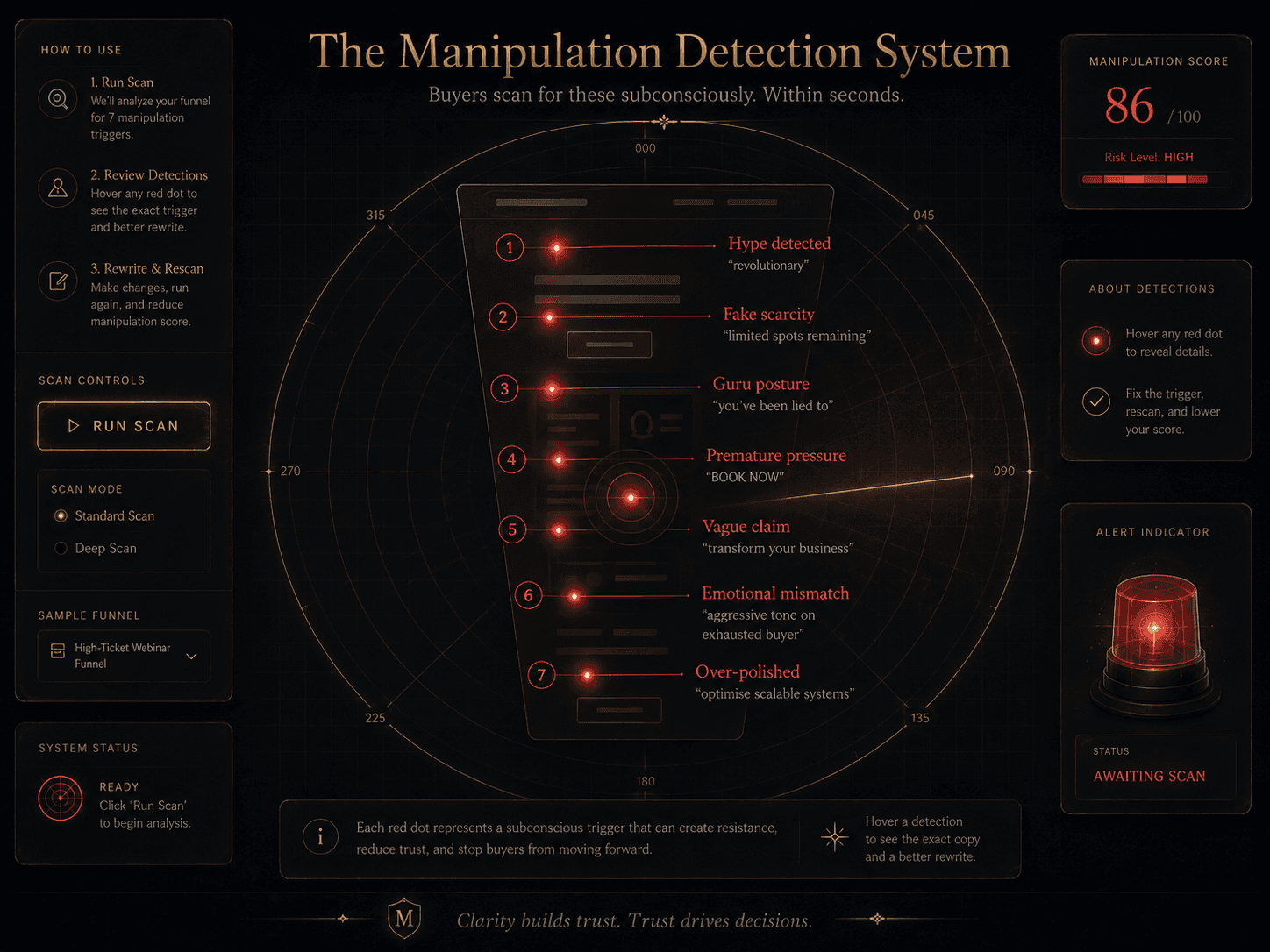
That lowers defensiveness.
Detection Question
Ask:
“Does the emotional tone of this section match the buyer’s current state?”
If not, the section may create hidden resistance.
Rewrite Prompt
Match tone to buyer state.
If the buyer is sceptical, be grounded.
If the buyer is confused, be clear.
If the buyer is tired, do not shout.
If the buyer is doubtful, provide proof.
If the buyer is ready, make action easy.
Fill This In
The buyer’s emotional state is:
The current tone of the copy is:
The mismatch is:
A more emotionally congruent version is:
——
7. Over-Polished Corporate Language™
What This Triggers
Many founders accidentally sterilise their messaging while trying to sound:
professional
sophisticated
credible
premium
serious
The result is emotionally empty copy.
The page may sound polished.
But it does not feel human.
Common Corporate Phrases
Watch for phrases like:
innovative solutions
scalable systems
optimisation frameworks
cutting-edge strategies
performance-driven approach
robust methodology
seamless experiences
strategic enablement
growth-focused solutions
end-to-end transformation
This language sounds safe.
But often feels lifeless.
Weak Example™
“We provide innovative optimisation frameworks for scalable growth.”
Professional.
But empty.
The buyer does not feel recognised.
Stronger Version™
“We help you find the messaging gaps that make buyers hesitate before they trust the offer.”
Now the copy is:
clearer
more human
more specific
more relevant
easier to believe
Detection Question
Ask:
“Would a real buyer ever say this sentence naturally?”
If not, the copy may be too corporate.
Rewrite Prompt
Replace corporate abstraction with buyer-shaped language.
Write closer to the buyer’s lived problem.
Fill This In
One over-polished phrase on my page is:
What it actually means is:
A more human version is:
The “Sounds Like Marketing” Problem™
Buyers are extremely sensitive to marketing-shaped language.
Marketing-shaped language means phrases that instantly feel:
manufactured
scripted
artificial
overused
emotionally generic
copied from every other funnel
Examples include:
unlock
breakthrough
secret
revolutionary
effortless
scalable
dominate
transform your life
next level
game-changing
ultimate
proven system
powerful solution
These phrases often reduce believability.
Especially with sophisticated buyers.
The goal is not to sound more exciting.
The goal is to sound more believable.
That difference changes conversion psychology dramatically.
——
Marketing-Shaped vs Buyer-Shaped Language™
Marketing-shaped language:
“Unlock scalable growth with our revolutionary framework.”
Buyer-shaped language:
“Find the messaging gaps that make buyers hesitate before they trust the offer.”
Marketing-shaped language:
“Transform your funnel performance instantly.”
Buyer-shaped language:
“See where cold visitors lose belief before they reach the CTA.”
Marketing-shaped language:
“Dominate your market with high-converting systems.”
Buyer-shaped language:
“Stop sending traffic into a page that still cannot hold trust.”
Replace marketing-shaped language with buyer-shaped language.
That is the rule.
——
The Manipulation Detection System™
Modern buyers subconsciously scan for manipulation.
They look for:
fake scarcity
exaggerated certainty
emotional coercion
unrealistic promises
forced urgency
inflated authority
guru posture
pressure without trust
proof that does not support the claim
urgency that feels manufactured
The moment the funnel feels manipulative, the buyer emotionally withdraws.
Even if they keep scrolling.
This matters because trust destruction happens faster than trust creation.
One exaggerated sentence can undo multiple sections of good messaging.
——
Manipulation Triggers And Repairs
Trigger: Fake Scarcity
Example:
“Only 3 spots left” when that is not true.
Repair:
Use real timing, real capacity, or remove the claim.
Trigger: Exaggerated Certainty
Example:
“This will definitely fix your funnel.”
Repair:
Use grounded confidence.
“This helps identify where the funnel is most likely losing buyer momentum.”
Trigger: Forced Urgency
Example:
“You need this now before it is too late.”
Repair:
Use natural consequence.
“If the funnel keeps leaking trust at first contact, scaling traffic usually amplifies the problem instead of solving it.”
Trigger: Unsupported Claims
Example:
“Proven to transform any business.”
Repair:
Use specific proof.
“See the before-and-after breakdown showing where the original page lost belief and what changed.”
Trigger: Inflated Authority
Example:
“The only funnel system you will ever need.”
Repair:
Use measured authority.
“A diagnostic framework for finding where attention, relevance, belief, trust, or action breaks.”
Weak Trust vs Strong Trust™
Trust is not built by making the message louder.
It is built by making the message more believable.
Weak Trust Example™
“This guaranteed system will explode your revenue fast.”
Triggers:
scepticism
manipulation detection
emotional distance
doubt
Stronger Trust Example™
“This framework helps identify where buyer momentum weakens so conversion problems can be repaired more strategically.”
Now the message feels:
grounded
useful
psychologically believable
safer to continue reading
Another Weak Example™
“You need this system NOW before it’s too late.”
Emotionally heavy-handed.
Pressure without enough trust.
Stronger Version™
“If the funnel keeps leaking trust at first contact, scaling traffic usually amplifies the problem instead of solving it.”
Now urgency comes from consequence.
Not pressure tactics.
That distinction matters enormously.
——
More Weak Trust vs Strong Trust Examples™
Hype
Weak:
“Revolutionise your messaging overnight.”
Stronger:
“Identify the phrases that make buyers hesitate before they understand the value.”
Vagueness
Weak:
“Unlock better performance.”
Stronger:
“Find the section where attention turns into hesitation.”
Guru Posture
Weak:
“Everyone else is teaching funnels wrong.”
Stronger:
“Many funnel problems are misdiagnosed because the visible copy gets fixed before buyer pressure is understood.”
Proof Misalignment
Weak:
“Thousands of people viewed the page.”
Stronger:
“After the message was rebuilt, more qualified buyers reached the CTA with fewer clarification questions.”
Premature CTA
Weak:
“Book Your Strategy Call Now.”
Stronger for cold traffic:
“See Where The Funnel Is Leaking Trust.”
——
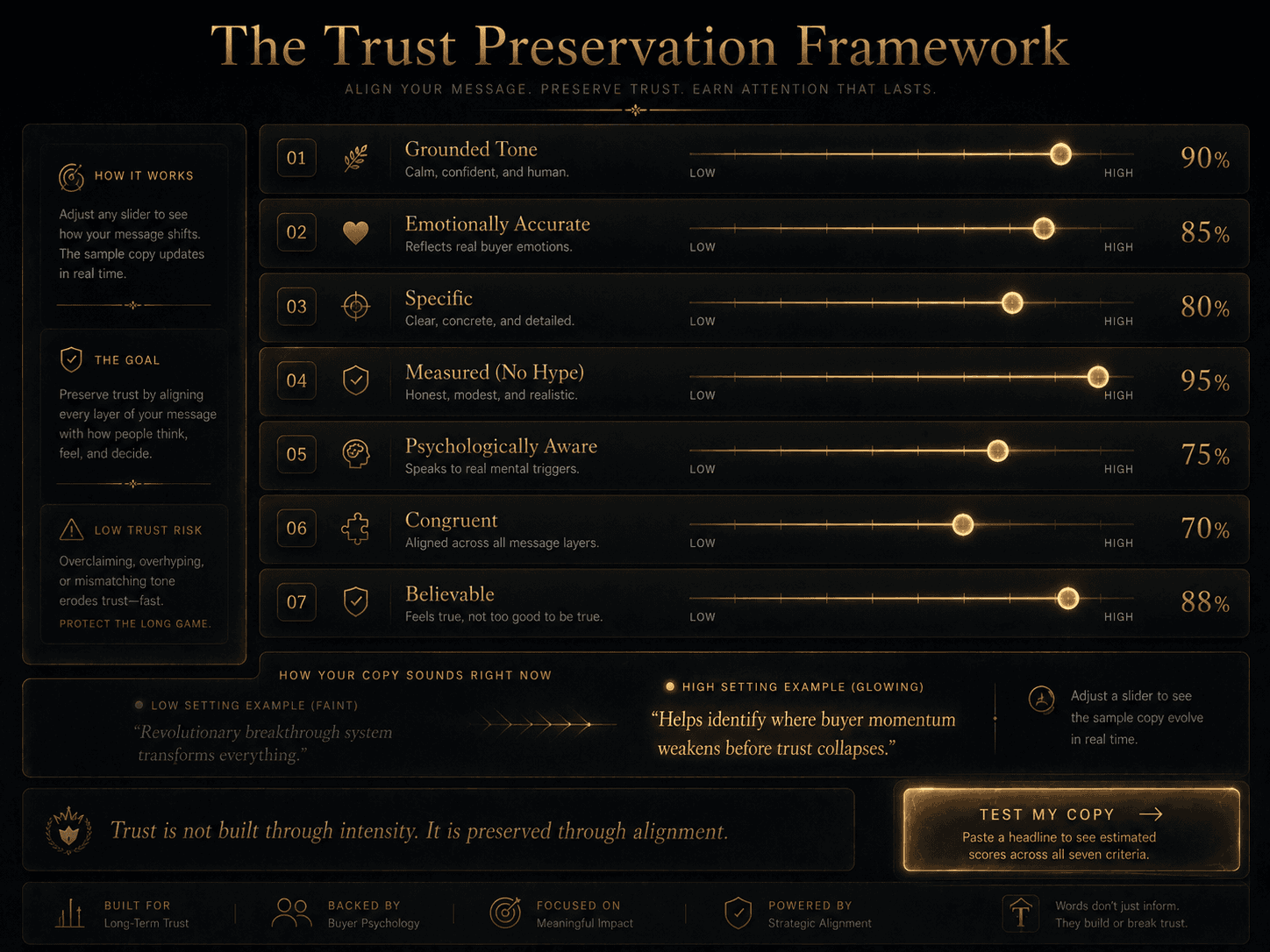
The Trust Preservation Framework™
Strong messaging usually feels:
grounded
emotionally accurate
measured
psychologically aware
specific
believable
pressure-aware without becoming manipulative
clear without becoming simplistic
direct without becoming aggressive
confident without becoming inflated
This creates emotional safety.
And emotional safety increases continuation.
The buyer does not need to feel overpowered.
They need to feel safe enough to keep believing.
——
Trust Preservation Checklist™
Before publishing the page, ask:
Does the copy feel grounded?
Yes / No
Does the copy make specific claims?
Yes / No
Does the tone match the buyer’s emotional state?
Yes / No
Does the proof match the buyer’s doubt?
Yes / No
Does the CTA match the buyer’s readiness?
Yes / No
Does the urgency come from real consequence?
Yes / No
Does the page avoid fake certainty?
Yes / No
Does the copy sound human?
Yes / No
Does the page feel emotionally coherent?
Yes / No
Does the message reduce defensiveness?
Yes / No
If several answers are “No”, your page may be triggering resistance.
——
The Congruence Principle™
Buyers trust alignment.
Not intensity.
This is critical.
Weak funnels often mix:
emotionally sharp headlines
corporate proof
dead CTAs
overhyped urgency
vague guarantees
disconnected objection handling
That emotional inconsistency creates subconscious distrust.
A funnel can be persuasive in individual parts and still untrustworthy as a whole if the emotional tone does not match.
Strong funnels feel coherent emotionally.
Every section feels like it belongs to the same psychological world.
Weak Congruence Example
Headline:
“Still Sending Traffic To A Funnel You Quietly Don’t Trust Yet?”
Proof:
“Trusted by ambitious businesses worldwide.”
CTA:
“Submit.”
Problem:
The headline is specific and emotionally accurate.
The proof is vague.
The CTA is dead.
The page does not feel emotionally aligned.
Stronger Congruence Example
Headline:
“Still Sending Traffic To A Funnel You Quietly Don’t Trust Yet?”
Proof:
“See the before-and-after funnel breakdown showing where belief collapsed and what changed.”
CTA:
“Get My Funnel Breakdown.”
Now the emotional world is consistent:
hesitation
diagnosis
proof
movement
That alignment preserves trust.
——
The Resistance Audit Scorecard™
Use this scorecard to find hidden trust landmines.
Score each area from 1 to 5.
1 = severe issue
2 = weak
3 = acceptable but needs work
4 = strong
5 = trust-preserving and buyer-aligned
Hype Control
Does the copy avoid exaggerated, overblown, or unrealistic claims?
Score: ___ / 5
Specificity
Does the copy replace vague claims with specific buyer-relevant language?
Score: ___ / 5
Guru Posture
Does the copy avoid “secret hack”, “everyone else is wrong”, and fake certainty language?
Score: ___ / 5
Proof Alignment
Does the proof match the buyer’s actual concern?
Score: ___ / 5
CTA Readiness
Does the CTA match the buyer’s current level of trust and intent?
Score: ___ / 5
Emotional Congruence
Does the emotional tone match the buyer’s state?
Score: ___ / 5
Human Language
Does the copy avoid over-polished corporate language?
Score: ___ / 5
Believability
Would a sceptical buyer believe the claims?
Score: ___ / 5
Trust Preservation
Does the copy reduce unnecessary defensiveness?
Score: ___ / 5
Funnel Congruence
Does the page feel emotionally aligned from headline to CTA?
Score: ___ / 5
Total Resistance Score
Total: ___ / 50
——
What Your Score Means
43–50: Strong Trust Preservation
Your messaging is grounded, specific, believable, and emotionally aligned.
The page is less likely to trigger unnecessary buyer resistance.
34–42: Mostly Strong, But Needs Tightening
The page is probably usable, but some trust landmines remain.
Review the lowest-scoring areas.
24–33: Hidden Resistance Likely
The page may sound good to you but still trigger scepticism in buyers.
Look closely at hype, vagueness, CTA pressure, and proof alignment.
0–23: High Risk Of Trust Collapse
The page is likely creating unnecessary resistance.
Do not publish yet.
Rewrite for specificity, believability, emotional congruence, and proof alignment.
——
The Sceptical Buyer Test™
Imagine your buyer has:
seen 100 weak funnels already
been disappointed before
wasted money before
trusted the wrong advice before
heard exaggerated claims before
tried solutions that did not work
developed an automatic distrust of hype
Now ask:
“Would this still feel believable to them?”
This question alone can dramatically improve messaging quality.
Sceptical Buyer Questions
Ask:
Would they believe this claim immediately?
Would they quietly raise an eyebrow?
Would they ask, “What does that actually mean?”
Would they feel pressured too early?
Would they trust the proof?
Would they feel emotionally understood?
Would this sound like something they have heard too many times before?
Would this reduce defensiveness or increase it?
If the line fails this test, rewrite it.
——
The “Would A Sceptical Friend Believe This?” Test™
Read the copy out loud and ask:
“Would a smart sceptical friend believe this immediately, or quietly raise an eyebrow?”
That instinctive reaction usually reveals where trust weakens.
If they would raise an eyebrow, do not defend the line.
Fix the line.
The Lower The Defences Principle™
Strong messaging does not try to overpower scepticism.
It tries to reduce unnecessary defensiveness.
That usually happens through:
specificity
grounded tone
emotional accuracy
honest pressure
believable proof
natural sequencing
clear next steps
realistic claims
buyer-shaped language
Not louder persuasion.
Not harder selling.
Not bigger promises.
Not more pressure.
This is one of the biggest trust shifts in modern conversion psychology.
Most marketers try to increase persuasion intensity when the real problem is unnecessary resistance.
That creates harder selling, more pressure, more hype, and more distrust.
Strong marketers understand:
Trust often grows faster when defensiveness decreases.
That is a completely different game.
——
Using AI To Detect Trust Landmines™
AI can be useful for identifying unintentional resistance triggers.
You can use any capable AI tool to audit your page for trust landmines.
If you are using Funnels By Maris Spalins™, the prompts are designed to work especially well with the frameworks, principles, and buyer psychology systems explored throughout The $100M Funnel Playbook.
AI can help you:
identify hype language
detect vague claims
pressure-test trust
spot emotional incongruence
simplify exaggerated copy
identify resistance triggers
improve emotional realism
strengthen messaging congruence
detect premature CTA pressure
find proof misalignment
But the rule remains:
Do not use AI to make the copy louder.
Use AI to make the copy more believable.
——
Buyer Landmine Detection AI Prompt™
Use this prompt to audit a page before publishing.
Act as a conversion strategist trained in buyer psychology, trust preservation, and resistance reduction.
Audit the following page copy for hidden messaging landmines.
The target buyer is:
[insert buyer]
The buyer is likely sceptical of:
[insert resistance points]
The page goal is:
[insert goal]
Analyse the copy for:
Hype Landmines™
Vagueness Landmines™
Guru Language Landmines™
Proof Misalignment™
Premature CTA Pressure™
Emotional Incongruence™
Over-Polished Corporate Language™
Unsupported certainty
Fake urgency
Marketing-shaped language
For each issue, give me:
the exact phrase or section causing the issue
why it may trigger resistance
what the buyer may feel subconsciously
a more grounded rewrite
why the rewrite preserves trust better
Then score the page from 1 to 5 on:
believability
specificity
emotional congruence
proof alignment
CTA readiness
trust preservation
After that, give me:
the 5 biggest trust risks
the 5 strongest rewrites
one improved headline
one improved proof cue
one improved CTA
one improved CTA microcopy line
Keep the tone grounded, specific, human, and psychologically believable.
Do not make the copy louder.
Make it safer to believe.
Here is the page copy:
[paste page copy]
——
Quick Landmine Detection Exercise™
Use this when your page feels polished but still may not be trustworthy enough.
One Phrase That Sounds Overhyped:
Why It May Trigger Scepticism:
Grounded Rewrite:
One Section That Feels Too Vague:
What The Buyer May Not Understand:
Specific Rewrite:
One Guru-Style Phrase:
Why It May Feel Unsafe:
Measured Authority Rewrite:
One Misaligned Proof Point:
The Buyer Doubt It Fails To Answer:
Better Proof Match:
One Place Where Pressure Arrives Too Early:
Why It May Create Resistance:
Better Sequence Or Lower-Friction Version:
One Emotionally Mismatched Section:
Buyer State:
Better Emotional Match:
One Corporate Or Over-Polished Phrase:
What It Really Means:
More Human Rewrite:
——
The Buyer Landmine Repair Worksheet™
Use this worksheet to turn trust leaks into stronger messaging.
Target Buyer:
Page Or Funnel Being Audited:
Buyer’s Likely Scepticism:
Buyer’s Current Emotional State:
Main Claim On The Page:
Main Proof Supporting The Claim:
Main CTA:
Landmine 1: Hype
Problem phrase:
Trust-preserving rewrite:
Landmine 2: Vagueness
Problem phrase:
Specific rewrite:
Landmine 3: Guru Language
Problem phrase:
Measured authority rewrite:
Landmine 4: Proof Misalignment
Current proof:
Buyer doubt:
Better proof:
Landmine 5: Premature CTA Pressure
Current CTA:
Buyer readiness level:
Cold / Warm / Hot
Better CTA:
Landmine 6: Emotional Incongruence
Current tone:
Buyer state:
Better tone direction:
Landmine 7: Corporate Sterility
Corporate phrase:
Buyer-shaped rewrite:
——
Final Trust-Preserved Version
Rewrite the strongest version of the page section here:
The 30-Minute Buyer Landmine Audit™
Use this process before publishing any important page.
Minutes 0–5: Scan For Hype And Vagueness
Highlight every phrase that sounds exaggerated, abstract, or hard to believe.
Write the worst phrase here:
Rewrite it here:
Minutes 5–10: Check Proof Alignment
Find the biggest claim on the page.
Main claim:
Buyer doubt:
Current proof:
Better proof needed:
Minutes 10–15: Check CTA Readiness
Ask whether the CTA matches buyer temperature.
Buyer temperature:
Cold / Warm / Hot
Current CTA:
Better CTA:
Minutes 15–20: Check Emotional Congruence
Ask whether the page tone matches the buyer’s emotional state.
Buyer state:
Current tone:
Tone adjustment needed:
Minutes 20–25: Run The Sceptical Buyer Test
Ask:
“Would a sceptical buyer believe this?”
Line that may fail:
Trust-preserving rewrite:
Minutes 25–30: Final Trust Check
Ask:
Is the message specific?
Is the tone grounded?
Is the proof matched?
Is the CTA natural?
Is the urgency honest?
Does this reduce defensiveness?
Final page improvement:
——
Final Principle™
The strongest messaging does not feel like persuasion.
It feels like accurate understanding.
That is why:
emotional realism matters
grounded tone matters
specificity matters
congruence matters
believable pressure matters
matched proof matters
natural sequencing matters
Modern buyers are not merely looking for promises.
They are looking for signals of honesty, psychological safety, and emotional accuracy.
Funnels that preserve trust create continuation.
Funnels that trigger resistance quietly collapse.
That is what The Buyer Landmine Detector™ is designed to help you prevent.
Take one page.
Highlight every phrase that creates unnecessary resistance.
Replace intensity with specificity.
Replace hype with grounded explanation.
Replace vague claims with buyer-shaped language.
Replace premature pressure with natural continuation.
Replace generic proof with matched proof.
The goal is not to sound louder.
The goal is to become easier to believe.
That is where trust starts.
And where conversion has a chance to continue.
——
From:
The $100M Funnel Playbook. Book I: Foundation Buyer Psychology, Offer Clarity, and the Page Architecture Behind High-Converting Funnels
By Maris Spalins.
——
Copyright Notice
© 2026 The $100M Funnel Playbook / Winyourclients / Maris Spalins. All rights reserved.
This resource, including the frameworks, terminology, examples, scorecards, templates, prompts, methods, and written explanations, is original intellectual property created for The $100M Funnel Playbook. Book I: Foundation — Buyer Psychology, Offer Clarity, And The Page Architecture Behind High-Converting Funnels and published through Winyourclients.
No part of this resource may be copied, reproduced, screenshotted, republished, redistributed, sold, adapted, uploaded, scraped, stored in a database, included in training data, used to train artificial intelligence systems, or used to create derivative commercial or educational materials without prior written permission.
Limited reference, quotation, or sharing is only permitted where the source is clearly and visibly credited.
Any permitted reference must include at least one of the following source credits:
The $100M Funnel Playbook by Maris Spalins
or
Winyourclients — www.winyourclients.com
or
Maris Spalins / Winyourclients
Screenshots, excerpts, summaries, or redistributed versions must not remove, hide, alter, crop out, or obscure the original source, author name, book title, website name, or copyright notice.
This resource is provided for personal learning and implementation only. It is not licensed for resale, republishing, redistribution, AI training, template cloning, course creation, consulting delivery, or commercial reuse without written permission from Maris Spalins or Winyourclients.
For permission requests, licensing, citation approval, or commercial usage enquiries, contact:
Winyourclients
www.winyourclients.com
or
Email directly to Jacob on: help@winyourclients.com
Other Blogs
Other Blogs
Check our other project Blogs with useful insight and information for your businesses
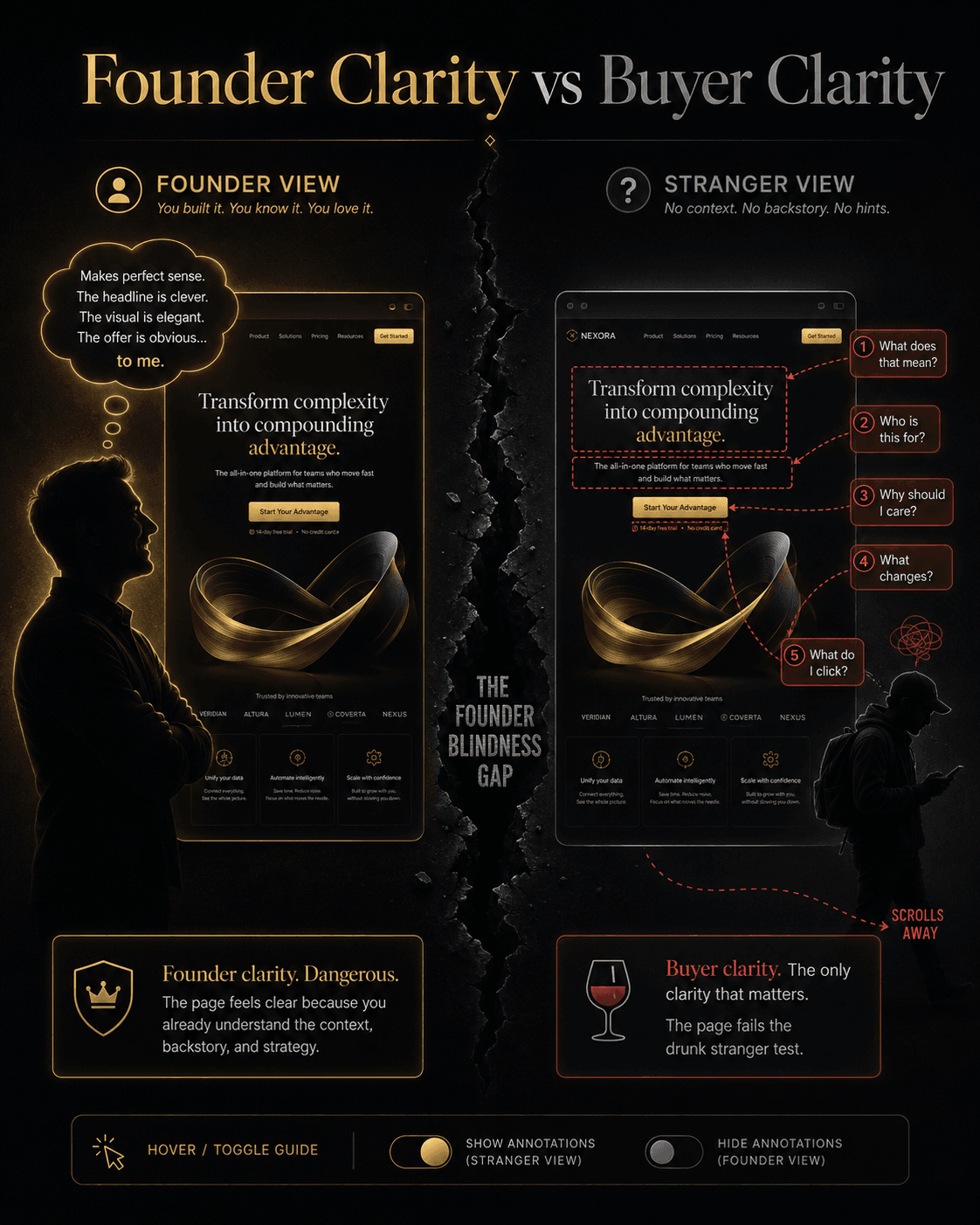
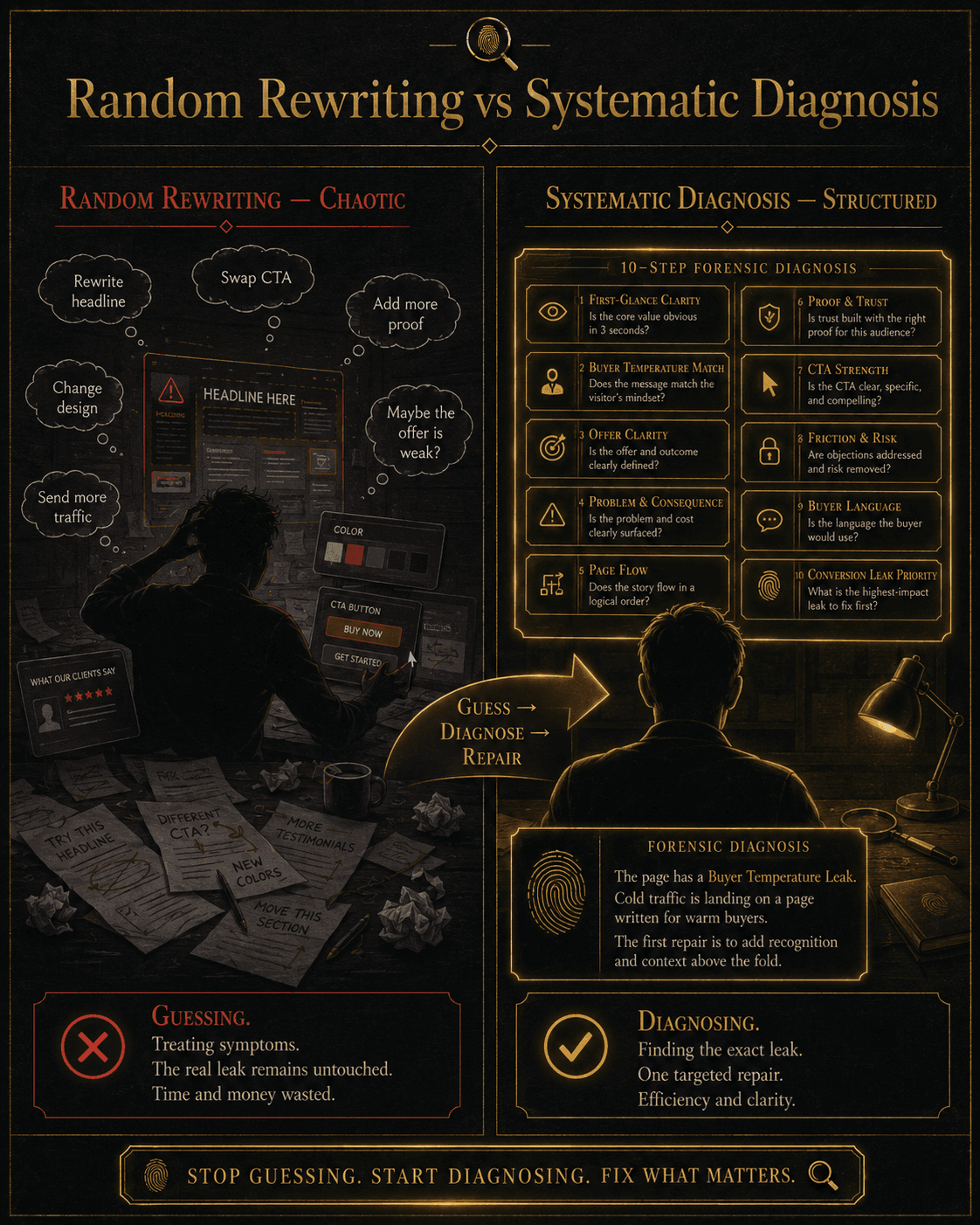
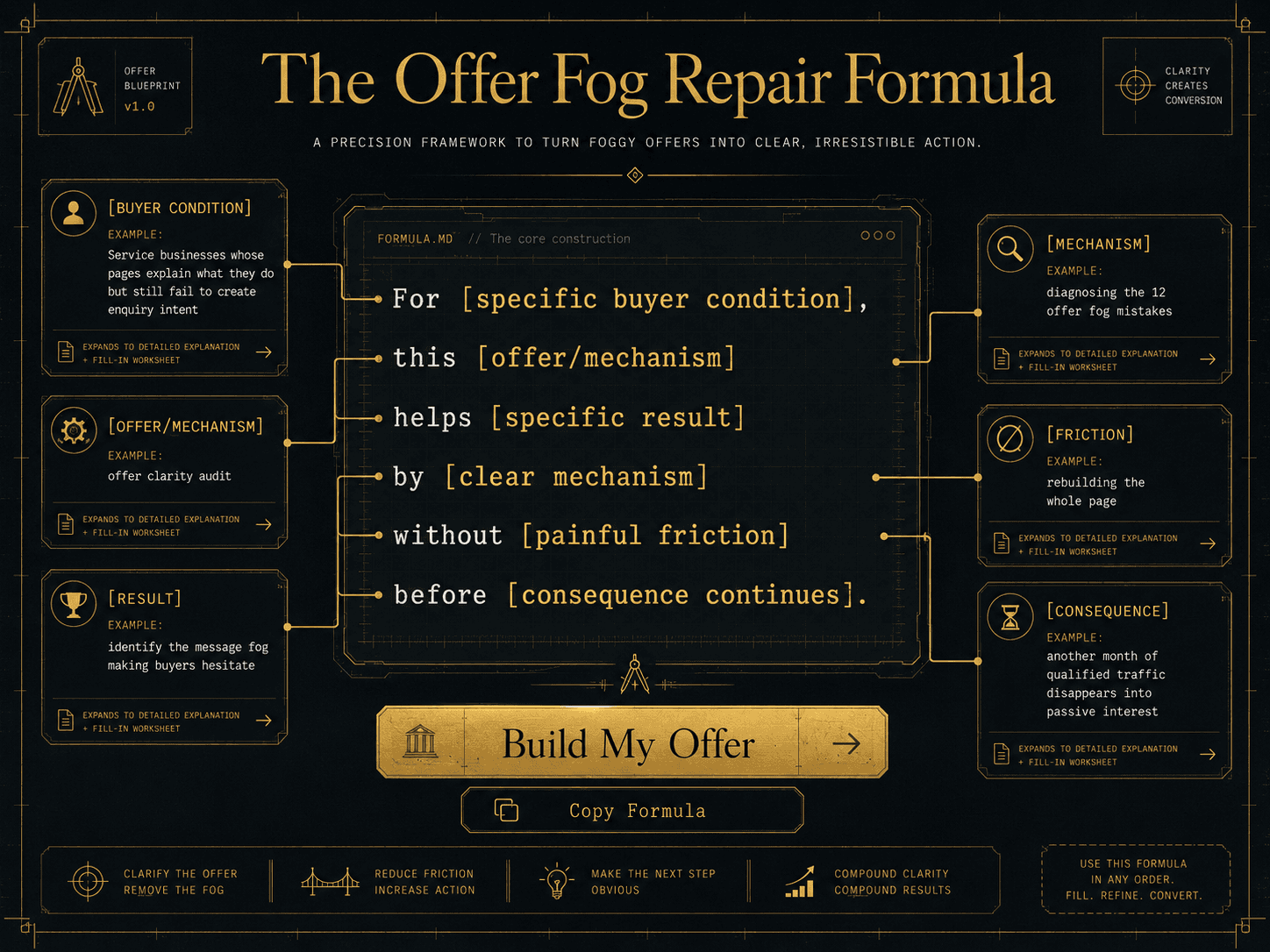
Other Blogs
Other Blogs
Check our other project Blogs with useful insight and information for your businesses