Our Three Step Process
May 26, 2026
Chap 4 | Resource 3 | The Dead Hero vs Living Hero Teardown
Our Three Step Process
May 26, 2026
Chap 4 | Resource 3 | The Dead Hero vs Living Hero Teardown
The Dead Hero vs Living Hero Teardown™ A practical teardown worksheet for diagnosing where a weak hero section loses attention, clarity, trust, contrast, or CTA movement — then rebuilding it into a sharper first screen that earns the scroll.
Prefer Audio Or Video?
The Dead Hero vs Living Hero Teardown™ is also available as:
🎧 A guided audio walkthrough explaining dead hero vs living hero structure, above-the-fold diagnosis, clarity leaks, proof gaps, CTA movement, and microcopy reassurance.
🎥 A practical video breakdown with real hero section teardowns, before/after rebuilds, fold audits, CTA repairs, and proof-led visual improvements.Choose the format that fits how you learn best.
[Listen To The Audio Walkthrough] (coming soon)
[Watch The Video Breakdown] (coming soon)
——
Why Weak Heroes Need Teardowns, Not Random Rewrites
Sometimes the fastest way to improve a hero section is not starting from scratch.
It is learning how to see why the current version fails.
Most weak hero sections do not collapse through one dramatic mistake.
They leak conversion silently.
A vague headline.
A broad audience signal.
A soft promise.
A decorative visual.
A passive CTA.
Missing microcopy.
Too much explanation.
Not enough tension.
Low proof.
No emotional movement.
The page may still look polished.
It may still feel professional.
It may still pass as “fine.”
But fine often gets ignored.
That is why teardown work matters.
A teardown helps you stop saying:
“This hero feels weak.”
And start asking:
“Where exactly does this hero lose the buyer?”
That is the real skill.
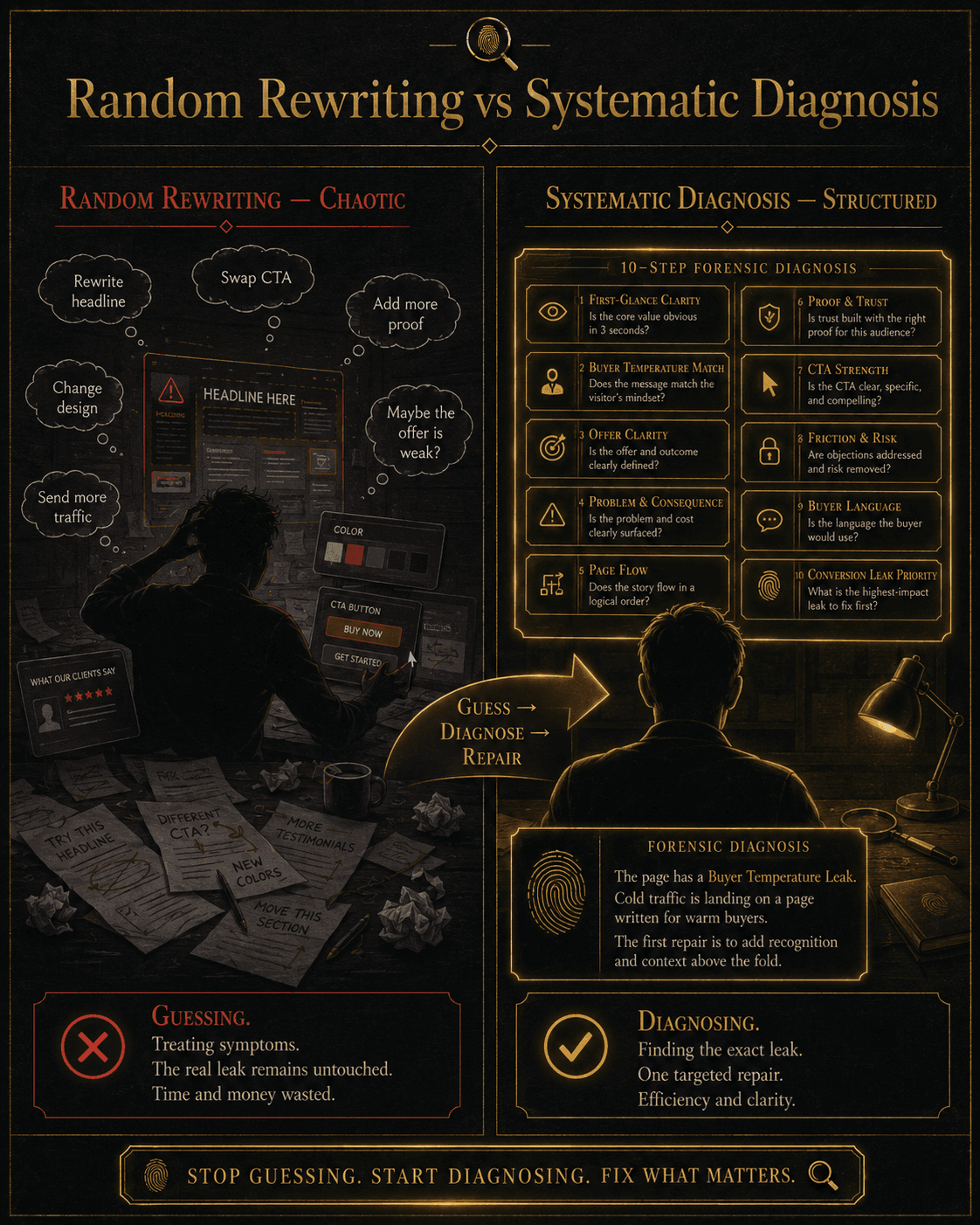
Because once you can see where the fold loses attention, clarity, trust, contrast, or movement, you stop guessing.
You stop endlessly rewriting headlines without understanding the real leak.
You stop polishing surface copy while the structure underneath remains broken.
This resource gives you a practical system for breaking down a weak first screen and rebuilding it into a sharper conversion entry point.
What This Resource Helps You Do
The Dead Hero vs Living Hero Teardown™ helps you diagnose why a hero section fails, identify where attention dies, and rebuild the first screen systematically.
Use this when:
the page looks good but converts weakly
visitors bounce too quickly
the hero section feels generic
the messaging sounds soft
the CTA gets ignored
buyers do not seem emotionally engaged
the first screen lacks tension or movement
the page explains but does not persuade
the visual looks attractive but does not create belief
the subheadline adds words but not clarity
you are auditing a client page
you are studying a competitor page
you want to improve the fold without random guessing
This is not a design critique.
This is a conversion teardown system.
The goal is simple:
Identify where the hero section loses attention, clarity, trust, contrast, or momentum — then rebuild the weak points systematically.
By the end of this teardown process, you should be able to:
identify weak headlines quickly
spot vague positioning
diagnose emotional flatness
recognise trust leaks
detect weak CTAs
identify proof failures
rebuild stronger first screens
explain why a hero section underperforms
improve the fold without random guessing
Most importantly:
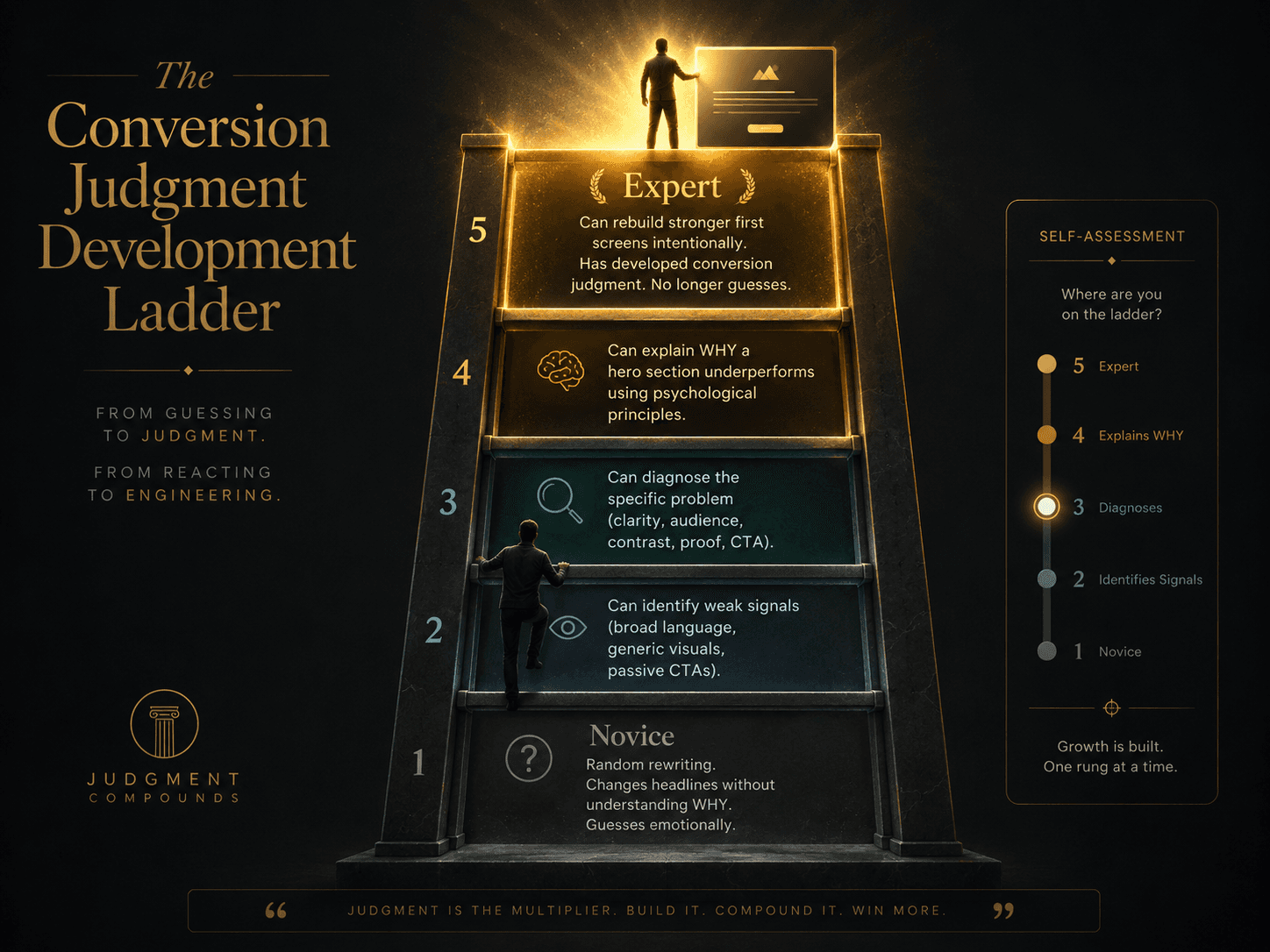
You will begin developing conversion judgement.
That is the real skill.
The Dead Hero vs Living Hero Principle™
A dead hero introduces the business.
A living hero interrupts the buyer’s problem.
That is the difference.
A dead hero says:
“Here is who we are.”
A living hero makes the buyer feel:
“This is about the problem I am already carrying.”
A dead hero describes services.
A living hero creates contrast.
A dead hero uses decorative visuals.
A living hero uses proof.
A dead hero gives the buyer a vague button.
A living hero gives them a meaningful next step.
A dead hero looks complete but creates no movement.
A living hero earns continuation.
The goal of this teardown is not to make the hero prettier.
The goal is to make it live.
A hero begins to live when it stops introducing the business and starts creating contact with the buyer’s reality.
Before You Start: Capture The Existing Hero Section
Before rewriting anything, document the current version clearly.
Do not rely on memory.
Do not paraphrase.
Do not describe what you meant.
Capture what the buyer actually sees.
Current Page
What page are you auditing?
Target Buyer
Who is this hero section meant to stop?
Current Headline
Paste the exact headline:
Current Subheadline
Paste the exact subheadline:
Current Visual
Describe what is currently shown above the fold.
Is it an image, layout, screenshot, product visual, illustration, dashboard, video, or proof asset?
What does the visual currently communicate?
Current CTA
Paste the exact CTA:
Current Microcopy
Paste the supporting microcopy.
If there is none, write “missing.”
First Impression
When you look at this hero section honestly, what does it feel like?
Clear / Vague / Polished / Generic / Trustworthy / Flat / Confusing / Strong / Other
Explain:
Step 1: Diagnose The Real Problem
Most weak hero sections fail for predictable reasons.
But not every weak hero has the same problem.
Some lack clarity.
Some lack audience recognition.
Some lack contrast.
Some lack proof.
Some lack CTA movement.
Some feel emotionally dead despite technically explaining the offer.
Your job is to identify where the leak actually lives.
Do not rewrite yet.
Diagnose first.
A good teardown asks:
Where does attention die?
Where does clarity weaken?
Where does the buyer stop feeling recognised?
Where does trust collapse?
Where does the visual fail to persuade?
Where does the CTA lose movement?
Where does the first screen stop earning continuation?
That is how you move from opinion to diagnosis.
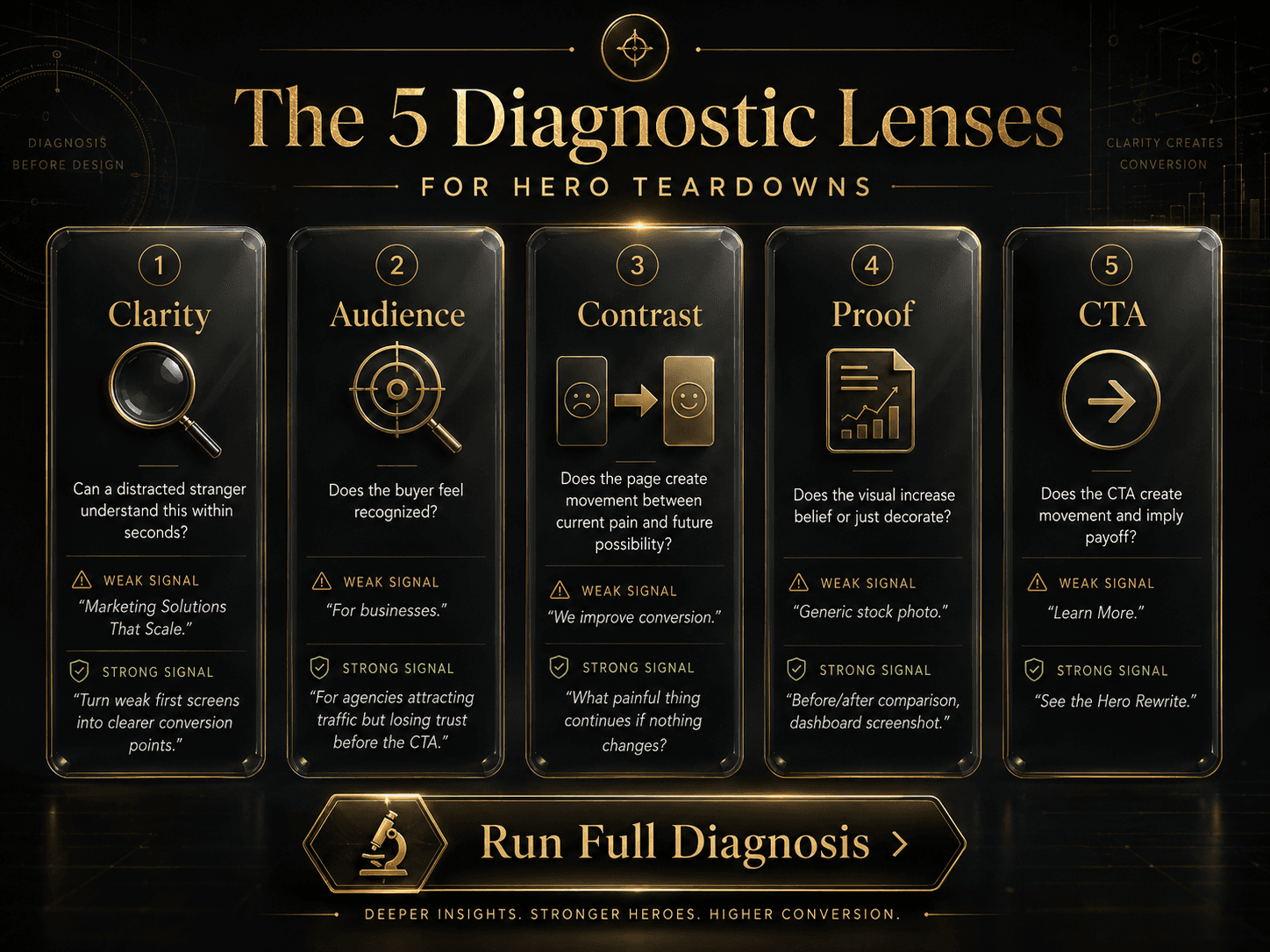
Diagnosis 1: Clarity™
Core Question
Can a distracted stranger understand this within seconds?
Not eventually.
Not after scrolling.
Not after a sales call.
Within seconds.
If the hero section cannot be understood quickly, the page is already leaking attention.
The buyer should quickly understand:
what this is
who it is for
why it matters
what changes after this works
what action to take next
The hero does not need to explain everything.
But it must create enough orientation for the buyer to stay.
Common Clarity Failures
Broad Headlines
Examples:
“Marketing Solutions That Scale.”
“Modern Growth Systems.”
“Performance Optimisation.”
“Digital Strategy For Ambitious Brands.”
These sound professional.
But emotionally, they communicate almost nothing specific.
They do not tell the buyer:
what problem is being solved
who it is really for
what result becomes possible
why this matters now
what makes the offer different
A broad headline may look safe.
But safe often gets ignored.
Too Many Ideas At Once
Trying to explain everything above the fold usually creates mental overload.
Weak hero sections often contain:
multiple promises
layered explanations
too many audience types
too much context
too much internal business language
too many benefits fighting for attention
no clear hierarchy
The result:
The buyer stops processing.
If the first screen feels mentally heavy, the page loses momentum before persuasion has a chance.
Cleverness Over Clarity
Some headlines try too hard to sound smart.
But the buyer should never need translation.
If the visitor pauses to decode the message, attention already weakens.
The fold is not the place for cleverness that delays understanding.
Clear first.
Sharp second.
Elegant third.
Never reverse that order.
Clarity Rewrite Questions
Ask:
What does this actually help with?
What is the clearest visible result?
What painful problem exists?
Could this be understood faster?
What words can be removed?
What is the buyer supposed to understand within three seconds?
What phrase is creating unnecessary fog?
Clarity Diagnosis Worksheet
What is unclear in the current hero?
What does the headline currently make the buyer understand?
What should the headline make the buyer understand faster?
What words create fog?
What can be removed or compressed?
Clarity score: ___ / 5
Diagnosis 2: Audience Recognition™
Core Question
Does the right buyer quickly feel recognised?
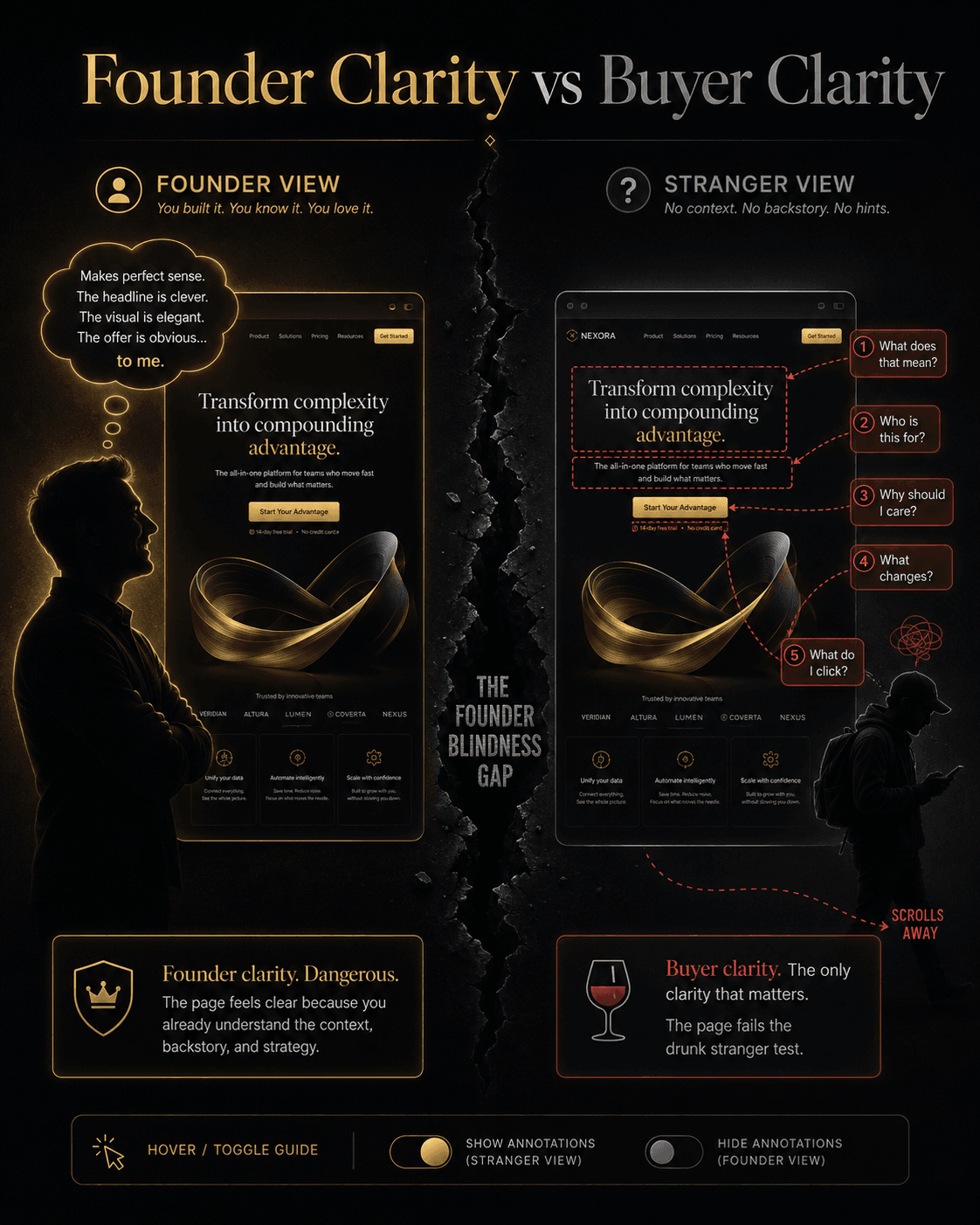
Many hero sections fail because the buyer does not feel seen.
The visitor should quickly feel:
“This page understands my situation.”
Without that feeling, the fold becomes emotionally generic.
The buyer may understand the page at a surface level, but they do not feel enough relevance to keep reading.
Recognition is not the same as broad audience naming.
A hero that says “for businesses” may technically include the buyer.
But it does not create strong emotional contact.
Common Audience Failures
Speaking To Everyone
Weak audience signals sound like:
for businesses
for founders
for brands
for entrepreneurs
for growing teams
for modern companies
for ambitious leaders
These are too broad.
Recognition weakens immediately.
The buyer does not feel specifically addressed.
They feel categorised.
That is not enough.
No Buying Condition
Strong hero sections identify the actual situation the buyer is stuck inside.
Weak:
“For agencies.”
Stronger:
“For agencies attracting traffic but losing trust before the CTA.”
Weak:
“For coaches.”
Stronger:
“For coaches whose content gets attention but still does not create enough serious enquiries.”
Weak:
“For SaaS founders.”
Stronger:
“For SaaS founders losing trial users before onboarding creates trust.”
Now the buyer feels seen.
The hero is no longer speaking to a category.
It is speaking to a condition.
That creates recognition.
Audience Rewrite Questions
Ask:
Who specifically is this page for?
What are they currently frustrated by?
What are they tired of tolerating?
What result do they want urgently?
What emotional condition are they in?
What buying condition should the first screen name?
Who should instantly think, “That is me”?
Audience Diagnosis Worksheet
Who does the current hero seem to speak to?
Is this a category or a buying condition?
Category / Buying Condition
What buying condition should be named more clearly?
What frustration should the right buyer recognise?
Who is this page not for?
Audience recognition score: ___ / 5
Diagnosis 3: Contrast™
Core Question
Does the hero create movement between current frustration and future possibility?
Many hero sections explain a service without creating movement.
That creates flatness.
The fold should create contrast between:
current frustration
future possibility
Without contrast, the page may be clear but emotionally weak.
The buyer understands what you do, but does not feel why it matters.
That is dangerous.
Because understanding alone does not earn the scroll.
The buyer needs to feel the gap.
Common Contrast Failures
No Consequence
Example:
“We improve conversion.”
Technically understandable.
But why does that matter emotionally?
What happens if the problem continues?
What friction exists now?
What is being lost?
What becomes more expensive with delay?
Without visible stakes, urgency disappears.
Weak Emotional Shift
Weak hero sections often describe tasks.
Strong hero sections describe change.
A weak hero says:
“We optimise landing pages.”
A stronger hero says:
“We rebuild first screens so qualified buyers stop leaving before they trust the offer.”
The second version creates movement.
The buyer can feel the before and after.
That is contrast.
Contrast Rewrite Questions
Ask:
What painful thing continues if nothing changes?
What does the buyer desperately want instead?
What emotional relief becomes possible?
What friction disappears?
What gets easier after this works?
What is the buyer moving away from?
What are they moving toward?
What makes the current state costly or frustrating?
Contrast Diagnosis Worksheet
What current pain does the hero currently name?
What desired future does the hero currently point toward?
What consequence is missing?
What painful friction should be removed?
What emotional movement should the buyer feel?
Contrast score: ___ / 5
Diagnosis 4: Proof™
Core Question
Does the visual increase belief?
Most hero visuals decorate.
Very few convince.
That is the problem.
The proof should increase belief.
Not merely visual polish.
Above the fold, the visual should help the buyer feel:
“This promise is more believable because I can see something real.”
If the visual does not do that, it may be occupying the most valuable space on the page without helping conversion.
Common Proof Failures
Generic Stock Images
Weak visuals include:
smiling teams
random laptops
abstract illustrations
generic dashboards
decorative graphics
vague screenshots
office images
staged lifestyle visuals
These rarely increase trust.
They may make the page look polished.
But they do not make the promise feel more real.
No Inspectable Evidence
Strong proof feels real enough to examine.
Examples:
dashboards
before-and-after comparisons
testimonials
calendars
customer screenshots
visible product usage
measurable outcomes
proof assets
real interface views
video walkthroughs
buyer response screenshots
The buyer should feel:
“This looks real.”
The proof should help the buyer inspect the promise, not merely admire the design.
Proof Rewrite Questions
Ask:
Does this visual increase trust?
Does it make the result easier to believe?
Could this be replaced with stronger evidence?
Does it create curiosity or inspection behaviour?
Does it feel real or decorative?
What result should the visual prove?
What proof asset would make the promise more believable?
What could the buyer inspect?
Proof Diagnosis Worksheet
What visual is currently used?
What does it currently prove?
Does it decorate or persuade?
Decorate / Persuade / Unsure
What stronger proof asset could be used?
What should the proof make the buyer believe?
Proof score: ___ / 5
Diagnosis 5: CTA Movement™
Core Question
Does the CTA create forward movement?
Weak CTAs create stalling.
Strong CTAs create movement.
The visitor should quickly understand:
what happens next
why clicking matters
what payoff exists
why this action is easy enough to take now
A CTA is not just a button.
It is the first visible handoff from attention into action.
If the button is vague, the movement weakens.
If the action feels too heavy, the buyer hesitates.
If the payoff is unclear, the click feels optional.
Common CTA Failures
Passive Language
Weak CTAs include:
Learn More
Submit
Contact Us
Get Started
Read More
Click Here
These are not always wrong.
But they usually create low momentum because the buyer does not clearly know what they are moving toward.
No Payoff
The action should imply value.
Examples:
See The Hero Rewrite
Get The Fold Blueprint
Fix My First Screen
Watch The Breakdown
Claim The Hero Audit
Download The Hero Canvas
Now the CTA creates direction.
The buyer can see what the click gives them.
That lowers friction.
Missing Microcopy
Without reassurance, hesitation increases.
Microcopy reduces fear, effort, or uncertainty.
It answers small resistance points like:
Will this waste my time?
Is this going to be a pitch?
Is this complicated?
What happens after I click?
Is this practical?
A CTA without microcopy can still work.
But a CTA with the right microcopy often feels safer and easier to act on.
CTA Rewrite Questions
Ask:
Does the CTA imply a meaningful result?
Does the next step feel easy enough?
Does the action create movement?
Is hesitation being reduced?
What does the buyer get after clicking?
Does the CTA feel connected to the hero promise?
Is the CTA asking for too much trust too early?
CTA Diagnosis Worksheet
What is the current CTA?
What does the buyer think happens after clicking?
What payoff is implied?
What hesitation might stop the click?
What microcopy could reduce that hesitation?
CTA movement score: ___ / 5
Diagnosis 6: Microcopy Reassurance™
Core Question
Does the microcopy reduce the last layer of hesitation?
Microcopy is often small.
But the job is big.
It sits near the action point and helps make the click feel lighter, safer, faster, or more useful.
Many hero sections ignore microcopy completely.
That is a mistake.
Because hesitation often appears right before movement.
The buyer may be interested, but still wonder:
Is this going to take too long?
Is this free?
Is this a pitch?
Will this be useful?
Is there a catch?
Am I committing to something?
Microcopy answers those doubts before they grow.
Weak Microcopy
Weak or missing microcopy looks like:
no reassurance
vague reassurance
generic privacy copy
unclear expectations
no reduction in friction
Example:
“Submit your details.”
This may tell the buyer what to do.
But it does not make the action feel safer.
Strong Microcopy
Strong microcopy reduces fear, effort, or uncertainty.
Examples:
No fluff. Just the framework.
Takes 90 seconds.
No pitch. Just the structure.
Free and practical.
No redesign required.
Clear enough to use today.
No pressure. No guesswork.
Use this before you waste more traffic.
The microcopy should remove the specific hesitation attached to the action.
Microcopy Rewrite Questions
Ask:
What might the buyer worry about before clicking?
What would make the action feel lighter?
What fear can be reduced in one sentence?
What expectation should be clarified?
What reassurance would increase movement?
Microcopy Diagnosis Worksheet
Is microcopy currently present?
Yes / No
Current microcopy:
What hesitation does it reduce?
What hesitation is still unresolved?
Stronger microcopy idea:
Microcopy reassurance score: ___ / 5
The Hero Teardown Scorecard™
Score each area from 1 to 5.
Clarity: ___ / 5
Audience Recognition: ___ / 5
Contrast: ___ / 5
Proof: ___ / 5
CTA Movement: ___ / 5
Microcopy Reassurance: ___ / 5
Total Score: ___ / 30
Score Interpretation
26–30: Living Hero™
The hero is structurally strong.
It creates clarity, recognition, contrast, proof, movement, and reassurance.
It is ready to test in-market.
20–25: Strong But Leaking™
The hero has useful structure, but one or two areas still weaken continuation.
Fix the lowest-scoring area first.
13–19: Dead Hero Risk™
The hero may look acceptable, but it is likely leaking attention through weak clarity, broad positioning, poor contrast, decorative proof, or passive action.
Rebuild the weak layers before publishing or scaling traffic.
0–12: Dead Hero™
The first screen is not doing enough conversion work.
Do not polish the design first.
Do not add more sections below the fold first.
Rebuild the hero structure.
Step 2: Identify The Root Cause
After scoring, identify the real reason the hero feels weak.
This prevents surface rewrites.
Root Cause 1: Clarity Problem
The buyer cannot understand the offer fast enough.
Common signs:
vague headline
jargon
broad promise
too many ideas
cleverness over clarity
First fix:
Make the headline and subheadline easier to understand.
Root Cause 2: Audience Problem
The right buyer does not feel recognised.
Common signs:
broad audience
no buying condition
no specific frustration
“for businesses” language
weak relevance
First fix:
Move from category to condition.
Root Cause 3: Contrast Problem
The page is clear but emotionally flat.
Common signs:
no tension
no consequence
no painful current state
no desired movement
no reason to care now
First fix:
Sharpen the gap between current pain and future possibility.
Root Cause 4: Proof Problem
The visual decorates but does not persuade.
Common signs:
stock imagery
generic mockups
no inspectable result
proof hidden below the fold
visual adds no trust
First fix:
Use proof instead of decoration.
Root Cause 5: CTA Problem
The next step feels vague or low-value.
Common signs:
Learn More
Submit
Contact Us
no implied payoff
action feels too heavy
no reassurance
First fix:
Tie the CTA to a meaningful payoff and add microcopy.
My Root Cause Diagnosis
The biggest root cause is:
Clarity / Audience / Contrast / Proof / CTA / Microcopy
Why?
The first thing I need to fix is:
Step 3: Rebuild The Hero Section
Now rewrite every weak layer.
Do not merely change wording.
Improve:
clarity
recognition
contrast
proof
movement
reassurance
A strong rebuild does not ask:
“How can I make this sound nicer?”
It asks:
“How can I make this first screen work harder?”
Rebuild Framework
New Headline
What is the clearest, sharpest version of the promise?
New Subheadline
What increases belief, specificity, and buyer recognition?
New Visual
What proof asset would increase trust immediately?
New CTA
What action creates forward movement?
New Microcopy
What reduces hesitation or friction?
Why Each Change Improves The Hero
Headline improvement:
Subheadline improvement:
Visual improvement:
CTA improvement:
Microcopy improvement:
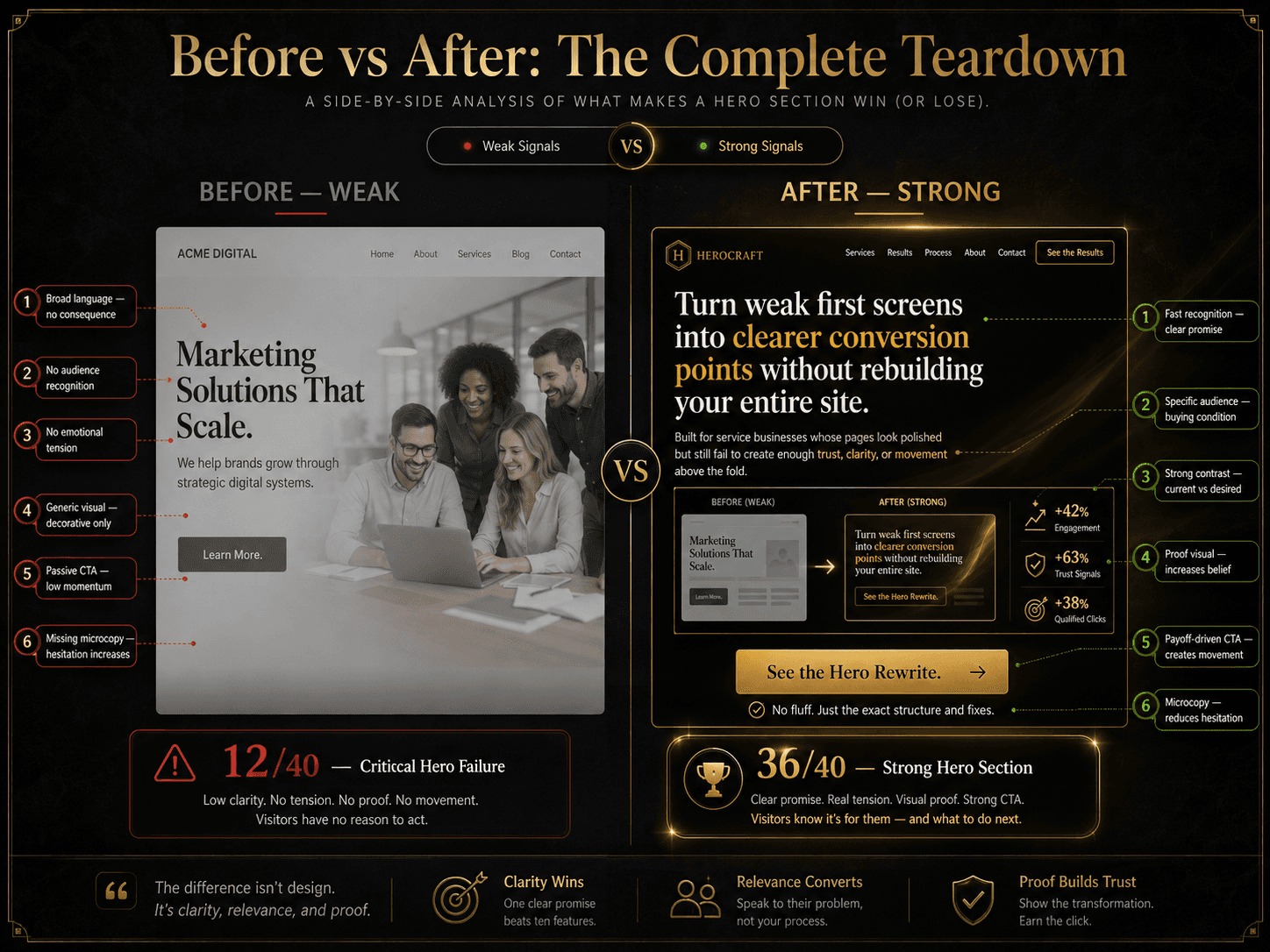
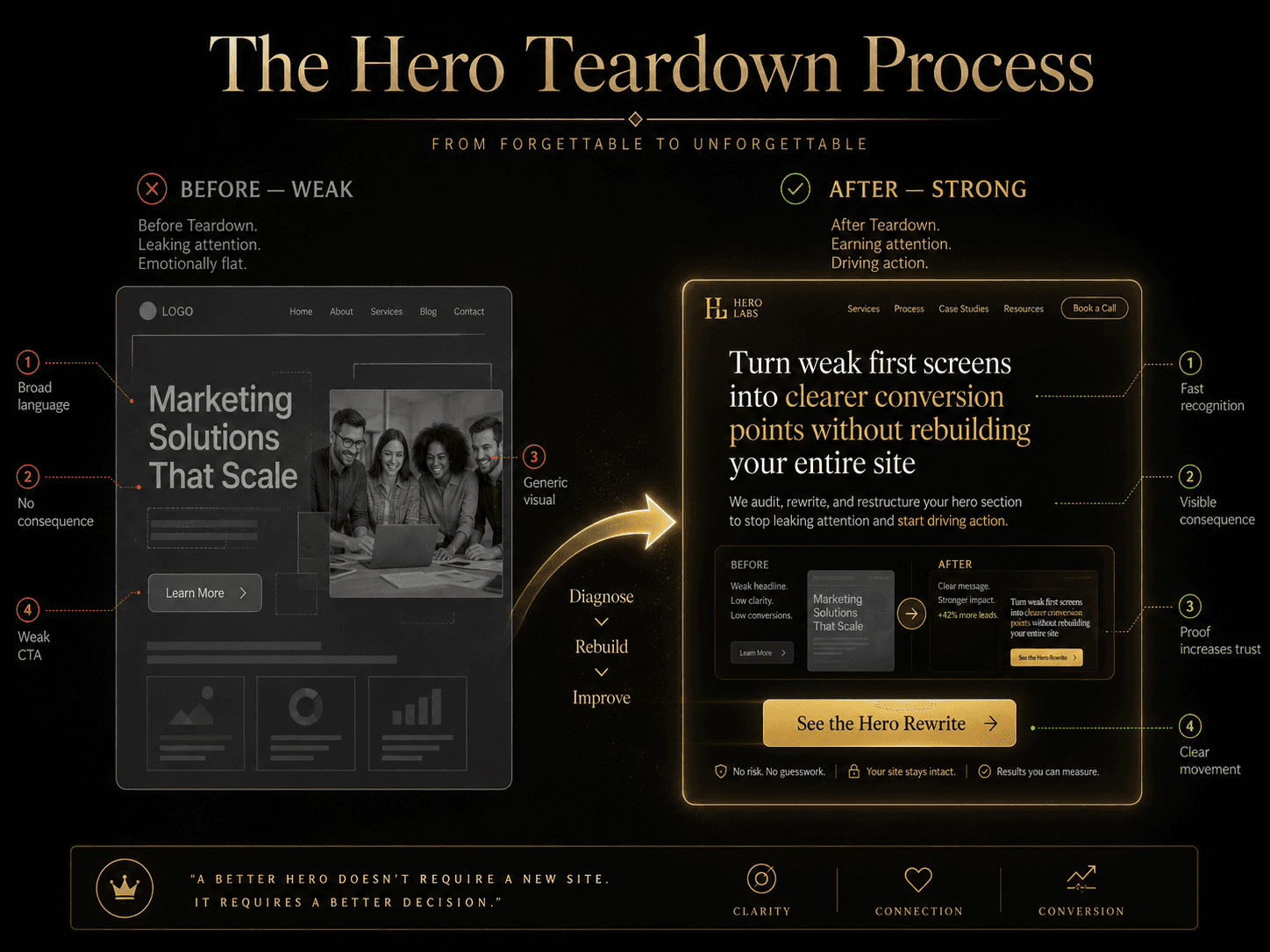
Mini Before / After Example
Before
Headline:
Marketing Solutions That Scale
Subheadline:
We help brands grow through strategic digital systems.
Visual:
Generic office image.
CTA:
Learn More
Microcopy:
Missing.
Why This Fails
This hero fails because it uses broad language, creates no emotional recognition, shows no visible consequence, creates no tension, gives no specificity, offers no proof, and has low CTA momentum.
The buyer feels nothing urgent.
The headline sounds like a category.
The subheadline stretches the fog.
The visual decorates.
The CTA stalls.
The microcopy removes nothing.
The section looks acceptable, but it does not create movement.
That is a dead hero.
After
Headline:
Turn weak first screens into clearer conversion points without rebuilding your entire site.
Subheadline:
Built for service businesses whose pages look polished but still fail to create enough trust, clarity, or movement above the fold.
Visual:
Before-and-after hero comparison with proof metrics.
CTA:
See The Hero Rewrite
Microcopy:
No fluff. Just the exact structure and fixes.
Why This Works Better
Now the page creates:
faster recognition
stronger contrast
clearer movement
visible friction
more believable positioning
stronger continuation momentum
The buyer understands why staying matters.
The headline gives a result and removes painful friction.
The subheadline identifies a buyer condition.
The visual makes the promise more inspectable.
The CTA gives a specific next step.
The microcopy lowers resistance.
That is a living hero.
The Biggest Mistake During Teardowns™
The biggest mistake is rewriting surface wording without fixing the underlying positioning problem.
That never works long-term.
Changing “Learn More” to “Get Started” will not fix a dead hero.
Making the headline shorter will not fix weak contrast.
Adding a prettier image will not fix a proof problem.
Making the copy sound more premium will not fix vague audience positioning.
The issue is usually deeper:
weak audience clarity
weak contrast
low consequence visibility
weak proof
emotional flatness
broad positioning
unclear mechanism
passive next step
Fix the structure first.
Then the copy improves naturally.
A teardown is not a cosmetic rewrite.
It is structural repair.
Dead Hero vs Living Hero Quick Reference
A dead hero introduces the business.
A living hero identifies the buyer’s problem.
A dead hero sounds broad.
A living hero creates recognition.
A dead hero describes a service.
A living hero creates contrast.
A dead hero decorates with visuals.
A living hero proves with visuals.
A dead hero uses vague CTA language.
A living hero creates movement.
A dead hero leaves hesitation unresolved.
A living hero uses microcopy to reduce friction.
A dead hero looks acceptable.
A living hero earns the scroll.
Using AI For Hero Teardowns
AI can help with hero teardowns, but only if you ask it to diagnose before rewriting.
Do not ask:
“Make this hero better.”
That usually creates generic rewrites.
Ask AI to identify exactly where the hero loses attention, clarity, trust, contrast, or movement.
Then ask it to rebuild each weak layer.
AI Hero Teardown Prompt™
Use this prompt:
Act as a conversion-focused landing page strategist, funnel copywriter, and buyer psychology analyst.
Analyse this hero section and perform a full conversion teardown.
My target buyer is:
[insert buyer]
The current hero section is:
Headline:
[paste headline]
Subheadline:
[paste subheadline]
Visual:
[describe visual]
CTA:
[paste CTA]
Microcopy:
[paste microcopy or write “missing”]
The desired buyer action is:
[insert desired action]
Diagnose the hero section across these areas:
Clarity
Audience Recognition
Contrast
Proof
CTA Movement
Microcopy Reassurance
For each area:
give a score from 1 to 5
explain what is working
explain what is weak
identify the exact words or elements causing the weakness
explain how the buyer likely experiences the issue
identify where attention dies
recommend one clear fix
Then identify the dominant root cause:
Clarity Problem
Audience Problem
Contrast Problem
Proof Problem
CTA Problem
Microcopy Problem
After that, rewrite:
The headline
The subheadline
The CTA
The microcopy
Then suggest:
a stronger proof asset
a better visual direction
what should be removed
what should be compressed
what should be made more specific
what should be made more believable
Make the hero section:
clearer
sharper
more believable
more emotionally relevant
easier to absorb
stronger at earning the scroll
Do not use hype.
Do not make vague premium claims.
Do not rewrite surface copy without fixing the structure.
Prioritise clarity, contrast, buyer recognition, proof, CTA movement, and continuation.
Final Execution Challenge™
Take your current hero section, a client page, or a competitor page and run a complete teardown.
Do not stop at:
“This sounds weak.”
Identify why it feels weak.
Find where the fold loses attention.
Find where the buyer stops understanding.
Find where recognition fails.
Find where contrast goes missing.
Find where proof decorates instead of persuades.
Find where the CTA stalls.
Find where microcopy should reduce hesitation but does not.
Then rebuild the first screen intentionally.
Because once you can diagnose where the fold loses attention, you stop guessing.
And once you stop guessing, you can rebuild first screens with structure instead of endlessly rewriting headlines without understanding why the page still fails to create movement.
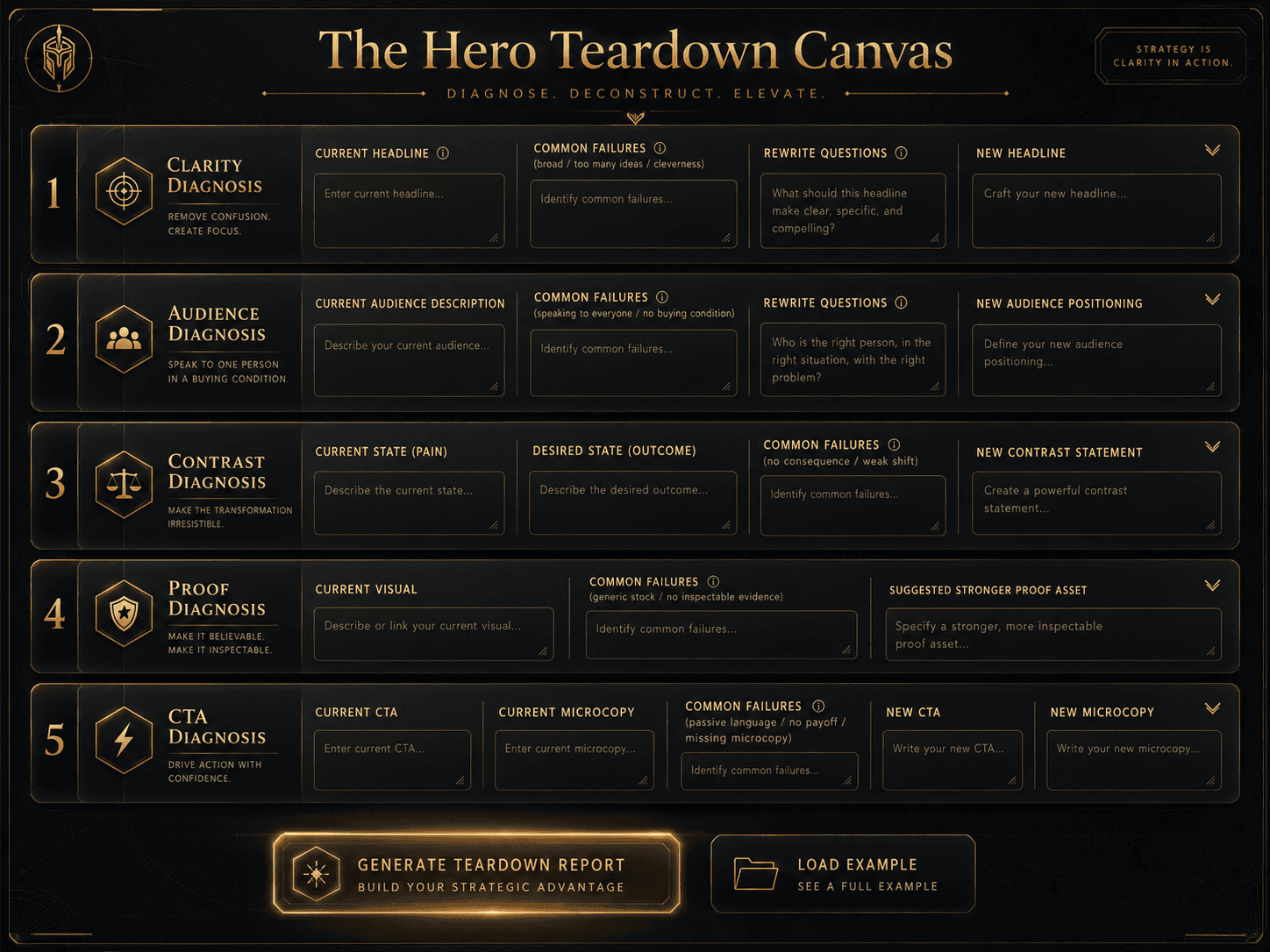
Final Teardown Worksheet
Current Hero
Headline:
Subheadline:
Visual:
CTA:
Microcopy:
Diagnosis Scores
Clarity: ___ / 5
Audience Recognition: ___ / 5
Contrast: ___ / 5
Proof: ___ / 5
CTA Movement: ___ / 5
Microcopy Reassurance: ___ / 5
Total: ___ / 30
Root Cause
The biggest issue is:
Clarity / Audience / Contrast / Proof / CTA / Microcopy
Why?
Where Attention Dies
The buyer likely loses momentum here:
Rebuild
New headline:
New subheadline:
New visual:
New CTA:
New microcopy:
Why The Rebuild Is Stronger
——
Final Principle™
A weak hero section should not be fixed by random rewriting.
It should be diagnosed.
That is the difference.
Random rewriting asks:
“What sounds better?”
A teardown asks:
“Where does the buyer lose attention?”
That is the better question.
Because the fold does not fail randomly.
It fails through specific leaks.
Clarity leaks.
Audience leaks.
Contrast leaks.
Proof leaks.
CTA leaks.
Microcopy leaks.
Once you can see those leaks, you can rebuild the first screen with intention.
A dead hero introduces the business and hopes the buyer cares.
A living hero creates recognition, contrast, proof, movement, and reassurance fast enough to earn the scroll.
That is the goal.
Not prettier wording.
Stronger conversion structure.
That is what The Dead Hero vs Living Hero Teardown™ is designed to help you build.
Because the hero section is not decoration.
It is the moment the buyer decides whether the rest of the page deserves attention at all.
——
From:
The $100M Funnel Playbook. Book I: Foundation Buyer Psychology, Offer Clarity, and the Page Architecture Behind High-Converting Funnels
By Maris Spalins.
——
Copyright Notice
© 2026 The $100M Funnel Playbook / Winyourclients / Maris Spalins. All rights reserved.
This resource, including the frameworks, terminology, examples, scorecards, templates, prompts, methods, and written explanations, is original intellectual property created for The $100M Funnel Playbook. Book I: Foundation — Buyer Psychology, Offer Clarity, And The Page Architecture Behind High-Converting Funnels and published through Winyourclients.
No part of this resource may be copied, reproduced, screenshotted, republished, redistributed, sold, adapted, uploaded, scraped, stored in a database, included in training data, used to train artificial intelligence systems, or used to create derivative commercial or educational materials without prior written permission.
Limited reference, quotation, or sharing is only permitted where the source is clearly and visibly credited.
Any permitted reference must include at least one of the following source credits:
The $100M Funnel Playbook by Maris Spalins
or
Winyourclients — www.winyourclients.com
or
Maris Spalins / Winyourclients
Screenshots, excerpts, summaries, or redistributed versions must not remove, hide, alter, crop out, or obscure the original source, author name, book title, website name, or copyright notice.
This resource is provided for personal learning and implementation only. It is not licensed for resale, republishing, redistribution, AI training, template cloning, course creation, consulting delivery, or commercial reuse without written permission from Maris Spalins or Winyourclients.
For permission requests, licensing, citation approval, or commercial usage enquiries, contact:
Winyourclients
www.winyourclients.com
or
Email directly to Jacob on: help@winyourclients.com
The Dead Hero vs Living Hero Teardown™ A practical teardown worksheet for diagnosing where a weak hero section loses attention, clarity, trust, contrast, or CTA movement — then rebuilding it into a sharper first screen that earns the scroll.
Prefer Audio Or Video?
The Dead Hero vs Living Hero Teardown™ is also available as:
🎧 A guided audio walkthrough explaining dead hero vs living hero structure, above-the-fold diagnosis, clarity leaks, proof gaps, CTA movement, and microcopy reassurance.
🎥 A practical video breakdown with real hero section teardowns, before/after rebuilds, fold audits, CTA repairs, and proof-led visual improvements.Choose the format that fits how you learn best.
[Listen To The Audio Walkthrough] (coming soon)
[Watch The Video Breakdown] (coming soon)
——
Why Weak Heroes Need Teardowns, Not Random Rewrites
Sometimes the fastest way to improve a hero section is not starting from scratch.
It is learning how to see why the current version fails.
Most weak hero sections do not collapse through one dramatic mistake.
They leak conversion silently.
A vague headline.
A broad audience signal.
A soft promise.
A decorative visual.
A passive CTA.
Missing microcopy.
Too much explanation.
Not enough tension.
Low proof.
No emotional movement.
The page may still look polished.
It may still feel professional.
It may still pass as “fine.”
But fine often gets ignored.
That is why teardown work matters.
A teardown helps you stop saying:
“This hero feels weak.”
And start asking:
“Where exactly does this hero lose the buyer?”
That is the real skill.
Because once you can see where the fold loses attention, clarity, trust, contrast, or movement, you stop guessing.
You stop endlessly rewriting headlines without understanding the real leak.
You stop polishing surface copy while the structure underneath remains broken.
This resource gives you a practical system for breaking down a weak first screen and rebuilding it into a sharper conversion entry point.
What This Resource Helps You Do
The Dead Hero vs Living Hero Teardown™ helps you diagnose why a hero section fails, identify where attention dies, and rebuild the first screen systematically.
Use this when:
the page looks good but converts weakly
visitors bounce too quickly
the hero section feels generic
the messaging sounds soft
the CTA gets ignored
buyers do not seem emotionally engaged
the first screen lacks tension or movement
the page explains but does not persuade
the visual looks attractive but does not create belief
the subheadline adds words but not clarity
you are auditing a client page
you are studying a competitor page
you want to improve the fold without random guessing
This is not a design critique.
This is a conversion teardown system.
The goal is simple:
Identify where the hero section loses attention, clarity, trust, contrast, or momentum — then rebuild the weak points systematically.
By the end of this teardown process, you should be able to:
identify weak headlines quickly
spot vague positioning
diagnose emotional flatness
recognise trust leaks
detect weak CTAs
identify proof failures
rebuild stronger first screens
explain why a hero section underperforms
improve the fold without random guessing
Most importantly:
You will begin developing conversion judgement.
That is the real skill.
The Dead Hero vs Living Hero Principle™
A dead hero introduces the business.
A living hero interrupts the buyer’s problem.
That is the difference.
A dead hero says:
“Here is who we are.”
A living hero makes the buyer feel:
“This is about the problem I am already carrying.”
A dead hero describes services.
A living hero creates contrast.
A dead hero uses decorative visuals.
A living hero uses proof.
A dead hero gives the buyer a vague button.
A living hero gives them a meaningful next step.
A dead hero looks complete but creates no movement.
A living hero earns continuation.
The goal of this teardown is not to make the hero prettier.
The goal is to make it live.
A hero begins to live when it stops introducing the business and starts creating contact with the buyer’s reality.
Before You Start: Capture The Existing Hero Section
Before rewriting anything, document the current version clearly.
Do not rely on memory.
Do not paraphrase.
Do not describe what you meant.
Capture what the buyer actually sees.
Current Page
What page are you auditing?
Target Buyer
Who is this hero section meant to stop?
Current Headline
Paste the exact headline:
Current Subheadline
Paste the exact subheadline:
Current Visual
Describe what is currently shown above the fold.
Is it an image, layout, screenshot, product visual, illustration, dashboard, video, or proof asset?
What does the visual currently communicate?
Current CTA
Paste the exact CTA:
Current Microcopy
Paste the supporting microcopy.
If there is none, write “missing.”
First Impression
When you look at this hero section honestly, what does it feel like?
Clear / Vague / Polished / Generic / Trustworthy / Flat / Confusing / Strong / Other
Explain:
Step 1: Diagnose The Real Problem
Most weak hero sections fail for predictable reasons.
But not every weak hero has the same problem.
Some lack clarity.
Some lack audience recognition.
Some lack contrast.
Some lack proof.
Some lack CTA movement.
Some feel emotionally dead despite technically explaining the offer.
Your job is to identify where the leak actually lives.
Do not rewrite yet.
Diagnose first.
A good teardown asks:
Where does attention die?
Where does clarity weaken?
Where does the buyer stop feeling recognised?
Where does trust collapse?
Where does the visual fail to persuade?
Where does the CTA lose movement?
Where does the first screen stop earning continuation?
That is how you move from opinion to diagnosis.
Diagnosis 1: Clarity™
Core Question
Can a distracted stranger understand this within seconds?
Not eventually.
Not after scrolling.
Not after a sales call.
Within seconds.
If the hero section cannot be understood quickly, the page is already leaking attention.
The buyer should quickly understand:
what this is
who it is for
why it matters
what changes after this works
what action to take next
The hero does not need to explain everything.
But it must create enough orientation for the buyer to stay.
Common Clarity Failures
Broad Headlines
Examples:
“Marketing Solutions That Scale.”
“Modern Growth Systems.”
“Performance Optimisation.”
“Digital Strategy For Ambitious Brands.”
These sound professional.
But emotionally, they communicate almost nothing specific.
They do not tell the buyer:
what problem is being solved
who it is really for
what result becomes possible
why this matters now
what makes the offer different
A broad headline may look safe.
But safe often gets ignored.
Too Many Ideas At Once
Trying to explain everything above the fold usually creates mental overload.
Weak hero sections often contain:
multiple promises
layered explanations
too many audience types
too much context
too much internal business language
too many benefits fighting for attention
no clear hierarchy
The result:
The buyer stops processing.
If the first screen feels mentally heavy, the page loses momentum before persuasion has a chance.
Cleverness Over Clarity
Some headlines try too hard to sound smart.
But the buyer should never need translation.
If the visitor pauses to decode the message, attention already weakens.
The fold is not the place for cleverness that delays understanding.
Clear first.
Sharp second.
Elegant third.
Never reverse that order.
Clarity Rewrite Questions
Ask:
What does this actually help with?
What is the clearest visible result?
What painful problem exists?
Could this be understood faster?
What words can be removed?
What is the buyer supposed to understand within three seconds?
What phrase is creating unnecessary fog?
Clarity Diagnosis Worksheet
What is unclear in the current hero?
What does the headline currently make the buyer understand?
What should the headline make the buyer understand faster?
What words create fog?
What can be removed or compressed?
Clarity score: ___ / 5
Diagnosis 2: Audience Recognition™
Core Question
Does the right buyer quickly feel recognised?
Many hero sections fail because the buyer does not feel seen.
The visitor should quickly feel:
“This page understands my situation.”
Without that feeling, the fold becomes emotionally generic.
The buyer may understand the page at a surface level, but they do not feel enough relevance to keep reading.
Recognition is not the same as broad audience naming.
A hero that says “for businesses” may technically include the buyer.
But it does not create strong emotional contact.
Common Audience Failures
Speaking To Everyone
Weak audience signals sound like:
for businesses
for founders
for brands
for entrepreneurs
for growing teams
for modern companies
for ambitious leaders
These are too broad.
Recognition weakens immediately.
The buyer does not feel specifically addressed.
They feel categorised.
That is not enough.
No Buying Condition
Strong hero sections identify the actual situation the buyer is stuck inside.
Weak:
“For agencies.”
Stronger:
“For agencies attracting traffic but losing trust before the CTA.”
Weak:
“For coaches.”
Stronger:
“For coaches whose content gets attention but still does not create enough serious enquiries.”
Weak:
“For SaaS founders.”
Stronger:
“For SaaS founders losing trial users before onboarding creates trust.”
Now the buyer feels seen.
The hero is no longer speaking to a category.
It is speaking to a condition.
That creates recognition.
Audience Rewrite Questions
Ask:
Who specifically is this page for?
What are they currently frustrated by?
What are they tired of tolerating?
What result do they want urgently?
What emotional condition are they in?
What buying condition should the first screen name?
Who should instantly think, “That is me”?
Audience Diagnosis Worksheet
Who does the current hero seem to speak to?
Is this a category or a buying condition?
Category / Buying Condition
What buying condition should be named more clearly?
What frustration should the right buyer recognise?
Who is this page not for?
Audience recognition score: ___ / 5
Diagnosis 3: Contrast™
Core Question
Does the hero create movement between current frustration and future possibility?
Many hero sections explain a service without creating movement.
That creates flatness.
The fold should create contrast between:
current frustration
future possibility
Without contrast, the page may be clear but emotionally weak.
The buyer understands what you do, but does not feel why it matters.
That is dangerous.
Because understanding alone does not earn the scroll.
The buyer needs to feel the gap.
Common Contrast Failures
No Consequence
Example:
“We improve conversion.”
Technically understandable.
But why does that matter emotionally?
What happens if the problem continues?
What friction exists now?
What is being lost?
What becomes more expensive with delay?
Without visible stakes, urgency disappears.
Weak Emotional Shift
Weak hero sections often describe tasks.
Strong hero sections describe change.
A weak hero says:
“We optimise landing pages.”
A stronger hero says:
“We rebuild first screens so qualified buyers stop leaving before they trust the offer.”
The second version creates movement.
The buyer can feel the before and after.
That is contrast.
Contrast Rewrite Questions
Ask:
What painful thing continues if nothing changes?
What does the buyer desperately want instead?
What emotional relief becomes possible?
What friction disappears?
What gets easier after this works?
What is the buyer moving away from?
What are they moving toward?
What makes the current state costly or frustrating?
Contrast Diagnosis Worksheet
What current pain does the hero currently name?
What desired future does the hero currently point toward?
What consequence is missing?
What painful friction should be removed?
What emotional movement should the buyer feel?
Contrast score: ___ / 5
Diagnosis 4: Proof™
Core Question
Does the visual increase belief?
Most hero visuals decorate.
Very few convince.
That is the problem.
The proof should increase belief.
Not merely visual polish.
Above the fold, the visual should help the buyer feel:
“This promise is more believable because I can see something real.”
If the visual does not do that, it may be occupying the most valuable space on the page without helping conversion.
Common Proof Failures
Generic Stock Images
Weak visuals include:
smiling teams
random laptops
abstract illustrations
generic dashboards
decorative graphics
vague screenshots
office images
staged lifestyle visuals
These rarely increase trust.
They may make the page look polished.
But they do not make the promise feel more real.
No Inspectable Evidence
Strong proof feels real enough to examine.
Examples:
dashboards
before-and-after comparisons
testimonials
calendars
customer screenshots
visible product usage
measurable outcomes
proof assets
real interface views
video walkthroughs
buyer response screenshots
The buyer should feel:
“This looks real.”
The proof should help the buyer inspect the promise, not merely admire the design.
Proof Rewrite Questions
Ask:
Does this visual increase trust?
Does it make the result easier to believe?
Could this be replaced with stronger evidence?
Does it create curiosity or inspection behaviour?
Does it feel real or decorative?
What result should the visual prove?
What proof asset would make the promise more believable?
What could the buyer inspect?
Proof Diagnosis Worksheet
What visual is currently used?
What does it currently prove?
Does it decorate or persuade?
Decorate / Persuade / Unsure
What stronger proof asset could be used?
What should the proof make the buyer believe?
Proof score: ___ / 5
Diagnosis 5: CTA Movement™
Core Question
Does the CTA create forward movement?
Weak CTAs create stalling.
Strong CTAs create movement.
The visitor should quickly understand:
what happens next
why clicking matters
what payoff exists
why this action is easy enough to take now
A CTA is not just a button.
It is the first visible handoff from attention into action.
If the button is vague, the movement weakens.
If the action feels too heavy, the buyer hesitates.
If the payoff is unclear, the click feels optional.
Common CTA Failures
Passive Language
Weak CTAs include:
Learn More
Submit
Contact Us
Get Started
Read More
Click Here
These are not always wrong.
But they usually create low momentum because the buyer does not clearly know what they are moving toward.
No Payoff
The action should imply value.
Examples:
See The Hero Rewrite
Get The Fold Blueprint
Fix My First Screen
Watch The Breakdown
Claim The Hero Audit
Download The Hero Canvas
Now the CTA creates direction.
The buyer can see what the click gives them.
That lowers friction.
Missing Microcopy
Without reassurance, hesitation increases.
Microcopy reduces fear, effort, or uncertainty.
It answers small resistance points like:
Will this waste my time?
Is this going to be a pitch?
Is this complicated?
What happens after I click?
Is this practical?
A CTA without microcopy can still work.
But a CTA with the right microcopy often feels safer and easier to act on.
CTA Rewrite Questions
Ask:
Does the CTA imply a meaningful result?
Does the next step feel easy enough?
Does the action create movement?
Is hesitation being reduced?
What does the buyer get after clicking?
Does the CTA feel connected to the hero promise?
Is the CTA asking for too much trust too early?
CTA Diagnosis Worksheet
What is the current CTA?
What does the buyer think happens after clicking?
What payoff is implied?
What hesitation might stop the click?
What microcopy could reduce that hesitation?
CTA movement score: ___ / 5
Diagnosis 6: Microcopy Reassurance™
Core Question
Does the microcopy reduce the last layer of hesitation?
Microcopy is often small.
But the job is big.
It sits near the action point and helps make the click feel lighter, safer, faster, or more useful.
Many hero sections ignore microcopy completely.
That is a mistake.
Because hesitation often appears right before movement.
The buyer may be interested, but still wonder:
Is this going to take too long?
Is this free?
Is this a pitch?
Will this be useful?
Is there a catch?
Am I committing to something?
Microcopy answers those doubts before they grow.
Weak Microcopy
Weak or missing microcopy looks like:
no reassurance
vague reassurance
generic privacy copy
unclear expectations
no reduction in friction
Example:
“Submit your details.”
This may tell the buyer what to do.
But it does not make the action feel safer.
Strong Microcopy
Strong microcopy reduces fear, effort, or uncertainty.
Examples:
No fluff. Just the framework.
Takes 90 seconds.
No pitch. Just the structure.
Free and practical.
No redesign required.
Clear enough to use today.
No pressure. No guesswork.
Use this before you waste more traffic.
The microcopy should remove the specific hesitation attached to the action.
Microcopy Rewrite Questions
Ask:
What might the buyer worry about before clicking?
What would make the action feel lighter?
What fear can be reduced in one sentence?
What expectation should be clarified?
What reassurance would increase movement?
Microcopy Diagnosis Worksheet
Is microcopy currently present?
Yes / No
Current microcopy:
What hesitation does it reduce?
What hesitation is still unresolved?
Stronger microcopy idea:
Microcopy reassurance score: ___ / 5
The Hero Teardown Scorecard™
Score each area from 1 to 5.
Clarity: ___ / 5
Audience Recognition: ___ / 5
Contrast: ___ / 5
Proof: ___ / 5
CTA Movement: ___ / 5
Microcopy Reassurance: ___ / 5
Total Score: ___ / 30
Score Interpretation
26–30: Living Hero™
The hero is structurally strong.
It creates clarity, recognition, contrast, proof, movement, and reassurance.
It is ready to test in-market.
20–25: Strong But Leaking™
The hero has useful structure, but one or two areas still weaken continuation.
Fix the lowest-scoring area first.
13–19: Dead Hero Risk™
The hero may look acceptable, but it is likely leaking attention through weak clarity, broad positioning, poor contrast, decorative proof, or passive action.
Rebuild the weak layers before publishing or scaling traffic.
0–12: Dead Hero™
The first screen is not doing enough conversion work.
Do not polish the design first.
Do not add more sections below the fold first.
Rebuild the hero structure.
Step 2: Identify The Root Cause
After scoring, identify the real reason the hero feels weak.
This prevents surface rewrites.
Root Cause 1: Clarity Problem
The buyer cannot understand the offer fast enough.
Common signs:
vague headline
jargon
broad promise
too many ideas
cleverness over clarity
First fix:
Make the headline and subheadline easier to understand.
Root Cause 2: Audience Problem
The right buyer does not feel recognised.
Common signs:
broad audience
no buying condition
no specific frustration
“for businesses” language
weak relevance
First fix:
Move from category to condition.
Root Cause 3: Contrast Problem
The page is clear but emotionally flat.
Common signs:
no tension
no consequence
no painful current state
no desired movement
no reason to care now
First fix:
Sharpen the gap between current pain and future possibility.
Root Cause 4: Proof Problem
The visual decorates but does not persuade.
Common signs:
stock imagery
generic mockups
no inspectable result
proof hidden below the fold
visual adds no trust
First fix:
Use proof instead of decoration.
Root Cause 5: CTA Problem
The next step feels vague or low-value.
Common signs:
Learn More
Submit
Contact Us
no implied payoff
action feels too heavy
no reassurance
First fix:
Tie the CTA to a meaningful payoff and add microcopy.
My Root Cause Diagnosis
The biggest root cause is:
Clarity / Audience / Contrast / Proof / CTA / Microcopy
Why?
The first thing I need to fix is:
Step 3: Rebuild The Hero Section
Now rewrite every weak layer.
Do not merely change wording.
Improve:
clarity
recognition
contrast
proof
movement
reassurance
A strong rebuild does not ask:
“How can I make this sound nicer?”
It asks:
“How can I make this first screen work harder?”
Rebuild Framework
New Headline
What is the clearest, sharpest version of the promise?
New Subheadline
What increases belief, specificity, and buyer recognition?
New Visual
What proof asset would increase trust immediately?
New CTA
What action creates forward movement?
New Microcopy
What reduces hesitation or friction?
Why Each Change Improves The Hero
Headline improvement:
Subheadline improvement:
Visual improvement:
CTA improvement:
Microcopy improvement:
Mini Before / After Example
Before
Headline:
Marketing Solutions That Scale
Subheadline:
We help brands grow through strategic digital systems.
Visual:
Generic office image.
CTA:
Learn More
Microcopy:
Missing.
Why This Fails
This hero fails because it uses broad language, creates no emotional recognition, shows no visible consequence, creates no tension, gives no specificity, offers no proof, and has low CTA momentum.
The buyer feels nothing urgent.
The headline sounds like a category.
The subheadline stretches the fog.
The visual decorates.
The CTA stalls.
The microcopy removes nothing.
The section looks acceptable, but it does not create movement.
That is a dead hero.
After
Headline:
Turn weak first screens into clearer conversion points without rebuilding your entire site.
Subheadline:
Built for service businesses whose pages look polished but still fail to create enough trust, clarity, or movement above the fold.
Visual:
Before-and-after hero comparison with proof metrics.
CTA:
See The Hero Rewrite
Microcopy:
No fluff. Just the exact structure and fixes.
Why This Works Better
Now the page creates:
faster recognition
stronger contrast
clearer movement
visible friction
more believable positioning
stronger continuation momentum
The buyer understands why staying matters.
The headline gives a result and removes painful friction.
The subheadline identifies a buyer condition.
The visual makes the promise more inspectable.
The CTA gives a specific next step.
The microcopy lowers resistance.
That is a living hero.
The Biggest Mistake During Teardowns™
The biggest mistake is rewriting surface wording without fixing the underlying positioning problem.
That never works long-term.
Changing “Learn More” to “Get Started” will not fix a dead hero.
Making the headline shorter will not fix weak contrast.
Adding a prettier image will not fix a proof problem.
Making the copy sound more premium will not fix vague audience positioning.
The issue is usually deeper:
weak audience clarity
weak contrast
low consequence visibility
weak proof
emotional flatness
broad positioning
unclear mechanism
passive next step
Fix the structure first.
Then the copy improves naturally.
A teardown is not a cosmetic rewrite.
It is structural repair.
Dead Hero vs Living Hero Quick Reference
A dead hero introduces the business.
A living hero identifies the buyer’s problem.
A dead hero sounds broad.
A living hero creates recognition.
A dead hero describes a service.
A living hero creates contrast.
A dead hero decorates with visuals.
A living hero proves with visuals.
A dead hero uses vague CTA language.
A living hero creates movement.
A dead hero leaves hesitation unresolved.
A living hero uses microcopy to reduce friction.
A dead hero looks acceptable.
A living hero earns the scroll.
Using AI For Hero Teardowns
AI can help with hero teardowns, but only if you ask it to diagnose before rewriting.
Do not ask:
“Make this hero better.”
That usually creates generic rewrites.
Ask AI to identify exactly where the hero loses attention, clarity, trust, contrast, or movement.
Then ask it to rebuild each weak layer.
AI Hero Teardown Prompt™
Use this prompt:
Act as a conversion-focused landing page strategist, funnel copywriter, and buyer psychology analyst.
Analyse this hero section and perform a full conversion teardown.
My target buyer is:
[insert buyer]
The current hero section is:
Headline:
[paste headline]
Subheadline:
[paste subheadline]
Visual:
[describe visual]
CTA:
[paste CTA]
Microcopy:
[paste microcopy or write “missing”]
The desired buyer action is:
[insert desired action]
Diagnose the hero section across these areas:
Clarity
Audience Recognition
Contrast
Proof
CTA Movement
Microcopy Reassurance
For each area:
give a score from 1 to 5
explain what is working
explain what is weak
identify the exact words or elements causing the weakness
explain how the buyer likely experiences the issue
identify where attention dies
recommend one clear fix
Then identify the dominant root cause:
Clarity Problem
Audience Problem
Contrast Problem
Proof Problem
CTA Problem
Microcopy Problem
After that, rewrite:
The headline
The subheadline
The CTA
The microcopy
Then suggest:
a stronger proof asset
a better visual direction
what should be removed
what should be compressed
what should be made more specific
what should be made more believable
Make the hero section:
clearer
sharper
more believable
more emotionally relevant
easier to absorb
stronger at earning the scroll
Do not use hype.
Do not make vague premium claims.
Do not rewrite surface copy without fixing the structure.
Prioritise clarity, contrast, buyer recognition, proof, CTA movement, and continuation.
Final Execution Challenge™
Take your current hero section, a client page, or a competitor page and run a complete teardown.
Do not stop at:
“This sounds weak.”
Identify why it feels weak.
Find where the fold loses attention.
Find where the buyer stops understanding.
Find where recognition fails.
Find where contrast goes missing.
Find where proof decorates instead of persuades.
Find where the CTA stalls.
Find where microcopy should reduce hesitation but does not.
Then rebuild the first screen intentionally.
Because once you can diagnose where the fold loses attention, you stop guessing.
And once you stop guessing, you can rebuild first screens with structure instead of endlessly rewriting headlines without understanding why the page still fails to create movement.
Final Teardown Worksheet
Current Hero
Headline:
Subheadline:
Visual:
CTA:
Microcopy:
Diagnosis Scores
Clarity: ___ / 5
Audience Recognition: ___ / 5
Contrast: ___ / 5
Proof: ___ / 5
CTA Movement: ___ / 5
Microcopy Reassurance: ___ / 5
Total: ___ / 30
Root Cause
The biggest issue is:
Clarity / Audience / Contrast / Proof / CTA / Microcopy
Why?
Where Attention Dies
The buyer likely loses momentum here:
Rebuild
New headline:
New subheadline:
New visual:
New CTA:
New microcopy:
Why The Rebuild Is Stronger
——
Final Principle™
A weak hero section should not be fixed by random rewriting.
It should be diagnosed.
That is the difference.
Random rewriting asks:
“What sounds better?”
A teardown asks:
“Where does the buyer lose attention?”
That is the better question.
Because the fold does not fail randomly.
It fails through specific leaks.
Clarity leaks.
Audience leaks.
Contrast leaks.
Proof leaks.
CTA leaks.
Microcopy leaks.
Once you can see those leaks, you can rebuild the first screen with intention.
A dead hero introduces the business and hopes the buyer cares.
A living hero creates recognition, contrast, proof, movement, and reassurance fast enough to earn the scroll.
That is the goal.
Not prettier wording.
Stronger conversion structure.
That is what The Dead Hero vs Living Hero Teardown™ is designed to help you build.
Because the hero section is not decoration.
It is the moment the buyer decides whether the rest of the page deserves attention at all.
——
From:
The $100M Funnel Playbook. Book I: Foundation Buyer Psychology, Offer Clarity, and the Page Architecture Behind High-Converting Funnels
By Maris Spalins.
——
Copyright Notice
© 2026 The $100M Funnel Playbook / Winyourclients / Maris Spalins. All rights reserved.
This resource, including the frameworks, terminology, examples, scorecards, templates, prompts, methods, and written explanations, is original intellectual property created for The $100M Funnel Playbook. Book I: Foundation — Buyer Psychology, Offer Clarity, And The Page Architecture Behind High-Converting Funnels and published through Winyourclients.
No part of this resource may be copied, reproduced, screenshotted, republished, redistributed, sold, adapted, uploaded, scraped, stored in a database, included in training data, used to train artificial intelligence systems, or used to create derivative commercial or educational materials without prior written permission.
Limited reference, quotation, or sharing is only permitted where the source is clearly and visibly credited.
Any permitted reference must include at least one of the following source credits:
The $100M Funnel Playbook by Maris Spalins
or
Winyourclients — www.winyourclients.com
or
Maris Spalins / Winyourclients
Screenshots, excerpts, summaries, or redistributed versions must not remove, hide, alter, crop out, or obscure the original source, author name, book title, website name, or copyright notice.
This resource is provided for personal learning and implementation only. It is not licensed for resale, republishing, redistribution, AI training, template cloning, course creation, consulting delivery, or commercial reuse without written permission from Maris Spalins or Winyourclients.
For permission requests, licensing, citation approval, or commercial usage enquiries, contact:
Winyourclients
www.winyourclients.com
or
Email directly to Jacob on: help@winyourclients.com
Other Blogs
Other Blogs
Check our other project Blogs with useful insight and information for your businesses
Other Blogs
Other Blogs
Check our other project Blogs with useful insight and information for your businesses