Our Three Step Process
May 25, 2026
Chap 2 | Resource 7 | The AI Psychological Audit System™
Our Three Step Process
May 25, 2026
Chap 2 | Resource 7 | The AI Psychological Audit System™
The AI Psychological Audit System™ A strategic AI audit toolkit for diagnosing funnel friction, clarity gaps, trust leaks, buyer resistance, emotional sequencing failures, CTA pressure, and buyer-state mismatch before generating new copy.
Prefer Audio Or Video?
The AI Psychological Audit System™ is also available as:
🎧 A guided audio walkthrough explaining AI-assisted funnel diagnostics, buyer-state analysis, and emotional auditing
🎥 A practical video breakdown with real AI prompts, audit examples, and psychological funnel teardownsChoose the format that fits how you learn best.
[Listen To The Audio Walkthrough] (coming soon)
[Watch The Video Breakdown] (coming soon)
——
Why Most AI Funnel Usage Produces Generic Results
Most people use AI like a slot machine.
They throw vague prompts into the machine:
“Write me a landing page.”
“Create a high-converting headline.”
“Make this copy better.”
“Improve this funnel.”
“Write a stronger CTA.”
Then they wonder why the output feels:
generic
emotionally flat
repetitive
over-polished
strategically weak
disconnected from the buyer
full of phrases that sound like every other page online
The problem is usually not the AI itself.
The problem is the psychological direction behind the prompt.
Most AI usage today focuses on generation.
But the real power of AI inside funnels comes from diagnosis.
That distinction changes everything.
AI should not be used first to write more copy.
It should be used first to reveal why the current copy is not working.
Because most weak funnels do not fail from a lack of words.
They fail from:
unclear positioning
shallow buyer understanding
weak emotional structure
poor sequencing
trust collapse
friction overload
psychological mismatch
buyer resistance
premature CTA pressure
AI becomes exponentially more valuable when it helps you diagnose those problems before generating another rewrite.
That is what The AI Psychological Audit System™ is designed to help you do.
What This Resource Helps You Do
The AI Psychological Audit System™ helps you use AI as a strategic funnel diagnosis tool instead of a generic copy generator.
Use it to:
identify clarity leaks
expose trust leaks
detect buyer resistance
pressure-test messaging
simulate buyer reactions
analyse funnel sequencing
detect emotional incongruence
find premature CTA pressure
identify shallow pain
diagnose weak proof
uncover friction points
improve buyer-state alignment
strengthen emotional realism
decide what should be fixed before rewriting
This is not a random AI prompt pack.
It is an audit system.
The goal is not to ask AI for “better copy.”
The goal is to ask AI better diagnostic questions.
Because when the diagnosis is wrong, the rewrite is usually cosmetic.
The AI Diagnostic Principle™
AI is often more valuable as an analyst than as a content generator.
AI can be used as:
an analyst
a pressure tester
a buyer simulator
a psychological auditor
a sequencing evaluator
a friction detector
a trust leak detector
a resistance mapper
a CTA readiness checker
This is critical.
Because most weak funnels do not fail because they need more words.
They fail because the psychological structure underneath the words is weak.
AI can help identify those weaknesses quickly when it is guided properly.
That is the rule:
Diagnose before generating.
Do not ask AI to rewrite the funnel before it has helped you understand what is psychologically wrong with the funnel.
The Biggest AI Mistake™
Most people ask AI:
“What should I write?”
Strong marketers ask:
“What psychological problem is weakening conversion right now?”
That difference changes output quality dramatically.
The first question creates more content.
The second question creates better strategy.
And better strategy improves everything downstream.
Because if the problem is unclear positioning, more headlines will not fix it.
If the problem is lack of trust, a louder CTA will not fix it.
If the problem is shallow pain, prettier words will not fix it.
If the problem is poor sequence, rewriting individual sections will not fix it.
If the problem is buyer resistance, more persuasion may make it worse.
That is why AI should first help you diagnose the real problem.
Then you can use it to generate better options.
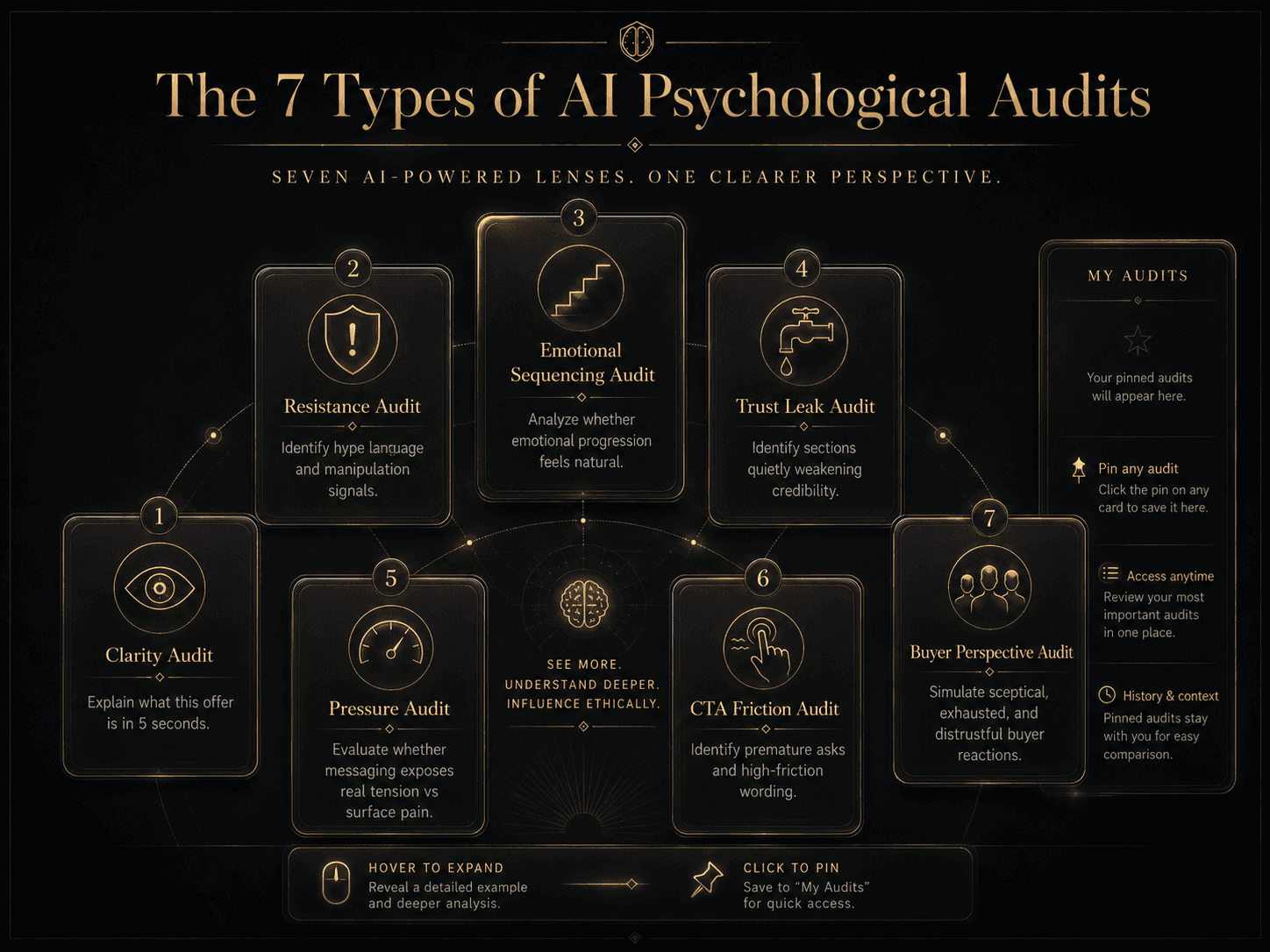
The 7 Types Of AI Psychological Audits™
These audits help transform AI from a generic copy generator into a strategic funnel intelligence tool.
The seven core audits are:
The Clarity Audit™
The Resistance Audit™
The Emotional Sequencing Audit™
The Trust Leak Audit™
The Pressure Audit™
The CTA Friction Audit™
The Buyer Perspective Audit™
Each audit looks at the funnel through a different psychological lens.
Use them separately or together.
Do not run all of them randomly.
Choose the audit based on the problem you suspect.
1. The Clarity Audit™
Goal
To identify confusion, vagueness, interpretation effort, and unclear first-contact messaging.
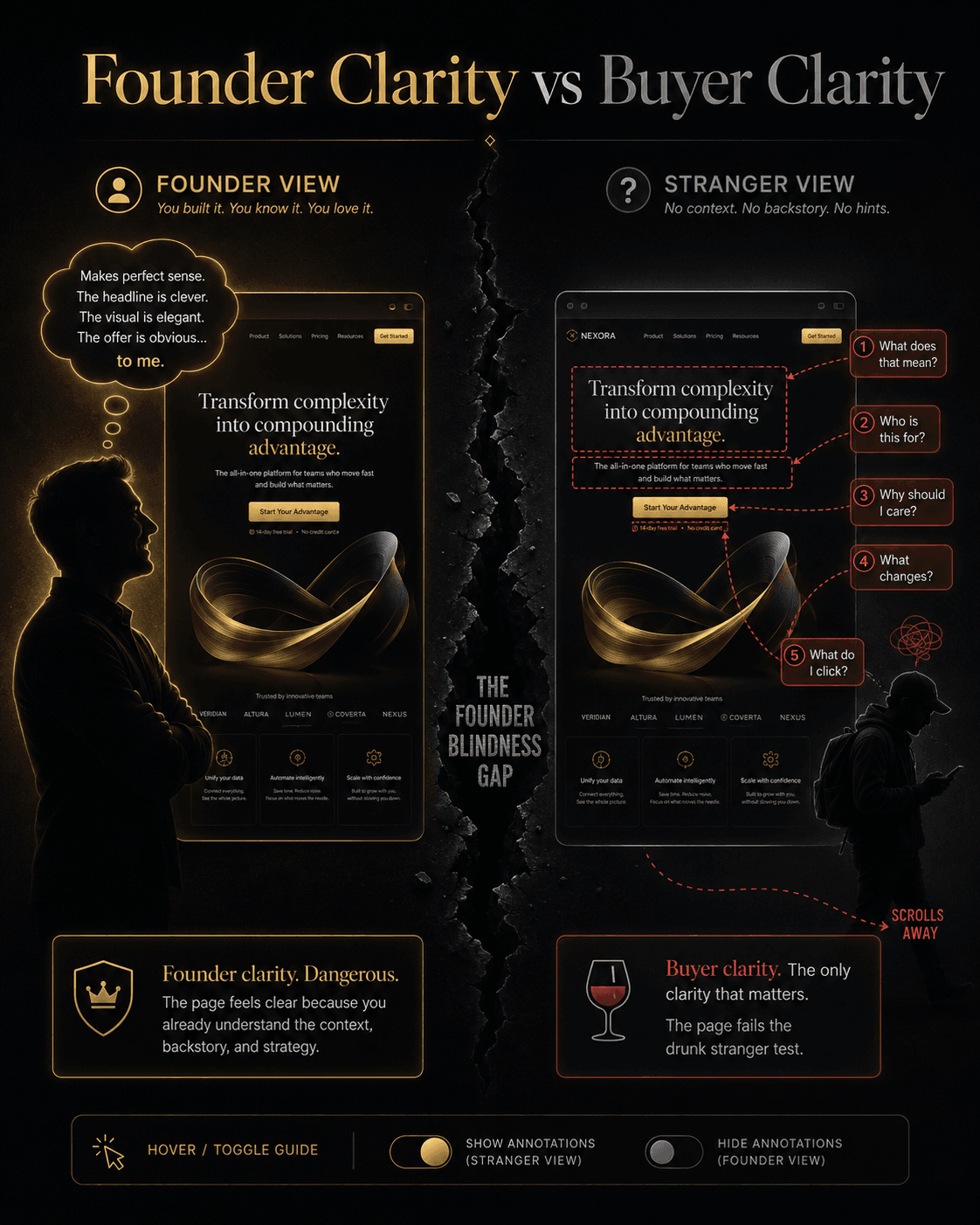
Use this when the page feels polished but the offer is not instantly obvious.
What This Audit Detects
The Clarity Audit™ helps detect:
unclear offer
unclear audience
vague promise
confusing headline
weak subheadline
poor first-contact understanding
unclear next step
language that sounds good but says little
sections that require too much interpretation
Most funnels lose buyers through clarity leakage.
The buyer does not always reject the offer.
Sometimes they simply do not understand it fast enough to care.
Clarity Audit Prompt™
Use this prompt:
Act as a cold buyer landing on this page for the first time.
You have no context.
In 5 seconds, explain:
What this offer is.
Who it is for.
What problem it solves.
Why it matters.
What feels unclear.
What creates hesitation.
What the next step appears to be.
Whether you would continue reading and why.
Then score the page from 1 to 5 on:
offer clarity
audience clarity
problem clarity
promise clarity
next-step clarity
continuation strength
After that, identify the 5 biggest clarity leaks and rewrite the weakest section in a clearer, more specific version.
Here is the page copy:
[paste page copy]
Output You Should Ask For
Ask AI to give you:
a plain-English explanation of what the page says
the first thing that feels unclear
the biggest source of interpretation effort
the strongest clarity leak
a clearer headline
a clearer subheadline
a clearer CTA
a score from 1 to 5
Repair Instruction
Do not only ask AI to “make it better.”
Ask it to remove interpretation effort.
The goal is not more impressive wording.
The goal is faster understanding.
Fill This In
The section I want to test for clarity is:
The buyer should understand this within 5 seconds:
The current clarity leak is:
The clearer version is:
2. The Resistance Audit™
Goal
To identify distrust triggers, manipulation signals, overhyped phrasing, emotionally unsafe messaging, and buyer resistance.
Use this when the page feels persuasive but may be triggering scepticism.
What This Audit Detects
The Resistance Audit™ helps detect:
hype language
exaggerated claims
guru-style phrasing
fake urgency
premature pressure
emotional incongruence
corporate emptiness
unsupported certainty
trust landmines
language that makes the buyer emotionally step back
Buyers constantly scan for reasons not to trust the funnel.
This audit helps identify those hidden resistance triggers.
Resistance Audit Prompt™
Use this prompt:
Act as a sceptical buyer who has seen many exaggerated funnels before.
Analyse this page for hidden resistance triggers.
Look for:
hype language
exaggerated claims
guru-style phrasing
fake urgency
premature pressure
emotional incongruence
vague promises
unsupported certainty
over-polished corporate language
phrases that sound like generic marketing
For each issue, explain:
The exact phrase or section causing resistance.
Why it may reduce trust psychologically.
What the buyer may feel subconsciously.
A more grounded rewrite.
Why the rewrite preserves trust better.
Then rank the resistance triggers from most damaging to least damaging.
Here is the page copy:
[paste page copy]
Output You Should Ask For
Ask AI to give you:
exact resistance-triggering phrases
the likely buyer reaction
a trust-preserving rewrite
a ranking of the biggest issues
a short summary of how to lower defensiveness
Repair Instruction
Do not make the copy louder.
Make it easier to believe.
Replace intensity with specificity.
Replace hype with grounded explanation.
Replace pressure with psychological safety.
Fill This In
One phrase that may trigger resistance is:
The buyer may distrust it because:
A more grounded version is:
3. The Emotional Sequencing Audit™
Goal
To analyse whether the funnel’s emotional progression feels natural.
Use this when the funnel has strong sections but still feels pushy, chaotic, or emotionally off.
What This Audit Detects
The Emotional Sequencing Audit™ helps detect:
pressure too early
proof too late
CTA before belief
identity tension before recognition
desire before diagnosis
emotional jumps
skipped buyer states
disconnected sections
poor momentum curve
Funnels often fail because the emotional timing feels wrong.
Not because every section is badly written.
Emotional Sequencing Audit Prompt™
Use this prompt:
Act as a funnel strategist trained in buyer psychology and emotional sequencing.
Analyse this funnel against the following buyer-state sequence:
Attention → Recognition → Curiosity → Belief → Readiness
For each stage, tell me:
Whether the stage is present.
Where it appears in the funnel.
Whether it appears too early, too late, or in the right place.
What the buyer likely feels at that point.
What is missing.
What should be rewritten, moved, or strengthened.
Then identify:
where pressure appears too early
where proof arrives too late
where emotional progression feels unnatural
where buyer readiness and messaging are mismatched
where the CTA feels premature
where the funnel skips a psychological stage
Finally, recommend a stronger sequence.
Here is the funnel copy:
[paste funnel copy]
Output You Should Ask For
Ask AI to give you:
current emotional sequence
missing buyer states
biggest emotional jump
strongest sequencing failure
recommended revised sequence
CTA timing recommendation
Repair Instruction
Do not only rewrite sections.
Repair the order.
The right message in the wrong place can still weaken conversion.
Fill This In
The current funnel sequence is:
The biggest emotional jump is:
The buyer state that appears too early is:
The revised sequence should be:
4. The Trust Leak Audit™
Goal
To identify sections that quietly weaken credibility, believability, emotional safety, and psychological congruence.
Use this when the funnel feels good on the surface but does not feel fully trustworthy.
What This Audit Detects
The Trust Leak Audit™ helps detect:
vague claims
weak proof
unsupported promises
over-polished language
generic credibility
emotional mismatch
proof misalignment
trust gaps before the CTA
claims that are too big for the evidence shown
Trust usually collapses gradually.
Small leaks compound.
Trust Leak Audit Prompt™
Use this prompt:
Act as a sceptical but fair buyer.
Identify all areas where this page may quietly weaken trust.
Focus on:
vagueness
over-polished language
unsupported claims
emotional mismatch
weak proof alignment
vague testimonials
proof arriving too late
CTAs appearing before enough trust exists
claims that feel bigger than the evidence shown
For each trust leak, explain:
The exact phrase or section.
Why it may weaken credibility.
What doubt it creates.
What proof or rewrite would reduce the doubt.
Whether the issue is high, medium, or low priority.
Then rank the trust leaks from most damaging to least damaging.
Here is the page copy:
[paste page copy]
Output You Should Ask For
Ask AI to give you:
exact trust leaks
what doubt each leak creates
proof needed
rewrite needed
priority ranking
strongest repair action
Repair Instruction
Fix the highest-priority trust leak first.
Do not try to repair everything randomly.
Trust leaks should be prioritised by damage.
Fill This In
The biggest trust leak is:
The doubt it creates is:
The proof or rewrite needed is:
5. The Pressure Audit™
Goal
To evaluate whether the messaging creates real tension instead of generic problem statements.
Use this when the page names a problem but still feels emotionally weak.
What This Audit Detects
The Pressure Audit™ helps detect whether the copy includes:
operational friction
emotional cost
identity tension
future consequence
failed attempts
private thought
live buyer pressure
Or whether it remains too surface-level.
Surface-level pain creates weak emotional movement.
Pressure creates recognition.
Pressure Audit Prompt™
Use this prompt:
Act as a conversion strategist trained in buyer psychology and pressure-based messaging.
Analyse whether this page exposes real buyer pressure or stays at surface-level pain.
Evaluate the copy across the five Pain Stack layers:
Surface Pain™
Operational Friction™
Emotional Cost™
Identity Threat™
Future Cost™
For each layer, tell me:
whether it is present
where it appears
whether it feels specific or generic
what is missing
how to deepen the messaging without exaggerating
Then identify:
the strongest pain layer currently present
the weakest or missing pain layer
one private thought the buyer may have
three stronger pressure-based headline angles
three stronger problem bullets
one future-cost line
Do not invent dramatic pain.
Use grounded psychological inference based on the copy.
Here is the page copy:
[paste page copy]
Output You Should Ask For
Ask AI to give you:
current Pain Stack diagnosis
strongest pressure point
missing pressure layer
private thought
pressure-based headline angles
deeper problem bullets
future-cost line
Repair Instruction
Do not make the pain darker just to sound intense.
Make the pressure more accurate.
The strongest copy is not exaggerated.
It is recognisable.
Fill This In
The current surface pain is:
The missing pressure layer is:
The buyer’s private thought may be:
A stronger pressure-based line is:
6. The CTA Friction Audit™
Goal
To identify whether CTAs feel premature, heavy, vague, or emotionally disconnected from the funnel buildup.
Use this when visitors reach the page but do not click, book, apply, download, or continue.
What This Audit Detects
The CTA Friction Audit™ helps detect:
premature asks
high-friction wording
unclear next steps
weak reward visibility
emotionally disconnected CTAs
trust gaps before commitment
CTAs that do not match buyer temperature
CTA microcopy that fails to reduce hesitation
Many funnels ask for too much commitment before enough belief exists.
That creates resistance immediately.
CTA Friction Audit Prompt™
Use this prompt:
Act as a conversion strategist trained in CTA psychology and buyer readiness.
Evaluate the CTA sequence on this page.
The target buyer is:
[insert buyer]
The buyer temperature is:
[cold/warm/hot]
The desired action is:
[insert desired action]
Analyse:
Whether the CTA matches the buyer’s readiness level.
Whether the CTA feels premature.
Whether the CTA is too high-friction.
Whether the CTA clearly communicates reward.
Whether the page builds enough trust before the CTA.
Whether the CTA microcopy reduces hesitation.
Whether a lower-friction CTA would fit better.
Then provide:
5 improved CTA options
5 CTA microcopy options
one lower-friction alternative
one direct-action CTA for hotter buyers
one recommendation for CTA placement
Here is the page copy:
[paste page copy]
Output You Should Ask For
Ask AI to give you:
CTA readiness diagnosis
friction level
buyer-temperature fit
stronger CTA options
microcopy options
lower-friction alternatives
placement recommendation
Repair Instruction
The CTA should match buyer readiness.
Cold buyers often need continuation.
Warm buyers often need diagnosis or proof.
Hot buyers often need clear action.
Do not force a high-friction ask before the buyer is ready.
Fill This In
The current CTA is:
The buyer temperature is:
Cold / Warm / Hot
The CTA may feel too heavy because:
A lower-friction CTA is:
CTA microcopy should reassure the buyer that:
7. The Buyer Perspective Audit™
Goal
To simulate different buyer mindsets and reveal hidden psychological gaps.
Use this when you want to understand how different buyers may experience the same funnel.
What This Audit Detects
The Buyer Perspective Audit™ helps detect:
what different buyers understand
what they trust
what they distrust
what they ignore
what creates hesitation
what makes them continue
where the page fails to meet their current emotional state
Different buyers experience the same funnel differently.
This audit reveals hidden psychological gaps.
Buyer Perspectives To Simulate
Use perspectives such as:
cold buyer
sceptical buyer
confused buyer
emotionally exhausted buyer
distrustful buyer
overwhelmed buyer
comparison-shopping buyer
buyer burned by previous frameworks
buyer who has tried similar solutions before
buyer who wants proof before action
Buyer Perspective Audit Prompt™
Use this prompt:
Respond to this landing page from the perspective of the following buyer types:
A cold buyer with no context.
A sceptical buyer who has seen many similar offers.
A confused buyer who is unsure what the offer actually does.
A buyer burned by previous frameworks or advice.
An emotionally exhausted buyer who does not want more complexity.
A comparison-shopping buyer evaluating alternatives.
A buyer who needs proof before taking action.
For each buyer perspective, tell me:
what they understand
what they trust
what they distrust
what they ignore
what makes them hesitate
what would make them continue
what CTA would feel appropriate
what proof they would need
Then summarise the biggest changes needed to make the page stronger for the core buyer.
Here is the page copy:
[paste page copy]
Output You Should Ask For
Ask AI to give you:
buyer-by-buyer reaction
trust/distrust patterns
hesitation points
proof needs
CTA readiness
top recommendations
Repair Instruction
Do not treat all buyers as psychologically identical.
Choose the buyer state that matters most for the page.
Then optimise the funnel for that buyer.
Fill This In
The buyer perspective I need to simulate is:
This buyer is likely to distrust:
This buyer needs to understand:
This buyer needs to believe:
This buyer’s appropriate next step is:
Bonus Audit: The Emotional Realism Audit™
Goal
To detect robotic, corporate, over-polished, or emotionally artificial copy.
Use this when the copy sounds “good” but not human.
What This Audit Detects
The Emotional Realism Audit™ helps detect:
robotic phrasing
corporate language
emotional artificiality
over-polished tone
generic AI language
sentences that sound like marketing
phrases no real buyer would say
emotionally sanitised copy
Funnels lose trust when the language feels manufactured.
AI can help identify those subtle tone problems quickly.
Emotional Realism Audit Prompt™
Use this prompt:
Analyse this copy for emotional realism.
Identify sections that sound:
robotic
corporate
overly polished
emotionally artificial
generic
manufactured
more like marketing than human communication
For each section, explain:
Why it feels emotionally unnatural.
What kind of buyer language would sound more real.
How to preserve the strategic meaning while making it sound more human.
A stronger rewrite that feels emotionally believable.
Then answer:
Which lines sound most human?
Which lines sound most artificial?
Which lines feel like a buyer would actually say them?
Which lines sound like a marketer trying to sound persuasive?
Here is the copy:
[paste copy]
Sounds Human Test™
Ask AI:
“Which sections of this page feel emotionally believable, and which feel overly polished or psychologically unnatural?”
Then ask:
“Does this sound like a buyer would say it, or only like a marketer would approve it?”
That second question is often the sharper one.
The AI Prompt Architecture™
Weak prompts create weak analysis.
Strong prompts create strategic insight.
A strong psychological prompt usually contains six parts:
Audience™
Buyer State™
Funnel Stage™
Emotional Goal™
Psychological Lens™
Output Objective™
This framework dramatically improves audit quality.
1. Audience™
Who exactly is the buyer?
Weak:
“Business owners.”
Stronger:
“SaaS founders struggling with onboarding activation.”
Fill this in:
Audience:
2. Buyer State™
What psychological state is the buyer in?
Examples:
cold
warm
hot
sceptical
confused
emotionally exhausted
distrustful
overwhelmed
comparison-shopping
problem-aware
solution-aware
Fill this in:
Buyer state:
3. Funnel Stage™
What section are you auditing?
Examples:
headline
subheadline
hook
proof section
CTA
offer section
objection section
full landing page
booking page
product page
Fill this in:
Funnel stage:
4. Emotional Goal™
What should the section create?
Examples:
recognition
trust
curiosity
movement
belief
clarity
reassurance
urgency
emotional safety
Fill this in:
Emotional goal:
5. Psychological Lens™
What do you want AI to focus on?
Examples:
pressure
resistance
identity tension
trust
sequencing
clarity
CTA friction
proof alignment
emotional realism
Fill this in:
Psychological lens:
6. Output Objective™
What should AI give you?
Examples:
diagnosis
score
rewritten section
ranked list of problems
buyer reactions
proof recommendations
CTA alternatives
revised sequence
Fill this in:
Output objective:
Master AI Audit Prompt Template™
Use this structure when creating your own prompt.
Act as a conversion strategist trained in buyer psychology, funnel diagnosis, and emotional sequencing.
The audience is:
[insert audience]
The buyer state is:
[insert buyer state]
The funnel stage being audited is:
[insert funnel stage]
The emotional goal of this section is:
[insert emotional goal]
The psychological lens I want you to use is:
[insert psychological lens]
The output I want is:
[insert output objective]
Analyse the following copy:
[paste copy]
Please identify:
What is working.
What is psychologically weak.
What may create confusion, resistance, distrust, or friction.
What buyer state the copy seems to assume.
Whether that matches the real buyer state.
What should be rewritten, moved, clarified, or supported with proof.
The top 5 repair actions.
Then provide stronger rewrite options where relevant.
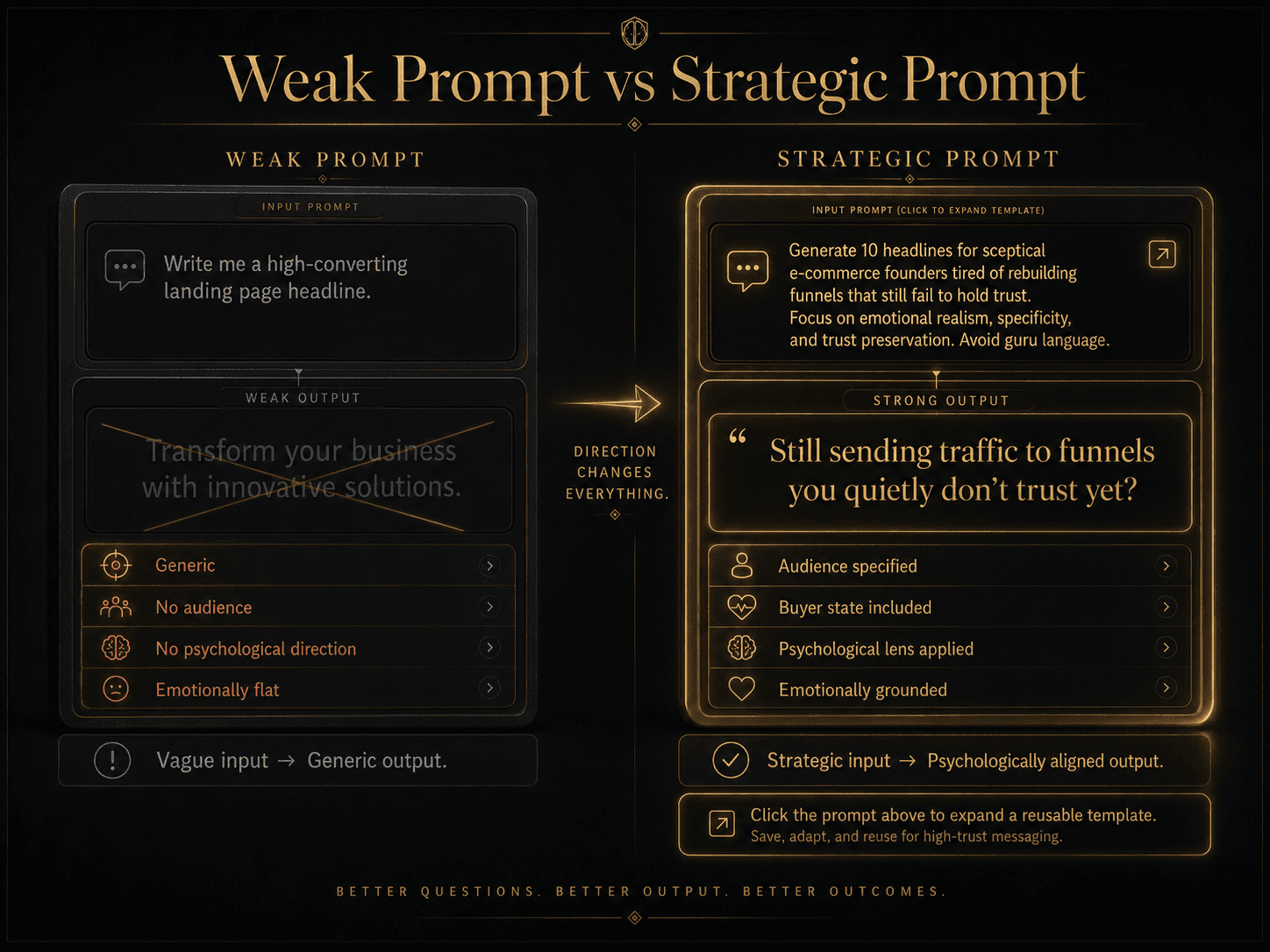
Weak AI Usage vs Strong AI Usage™
The difference between weak and strong AI usage is not complexity.
It is direction.
Weak Usage
“Generate 10 headlines.”
Low strategic depth.
No buyer psychology.
No emotional lens.
No funnel context.
Stronger Usage
“Generate 10 headlines for sceptical ecommerce founders who feel emotionally exhausted rebuilding funnels that still fail to hold trust.
Focus on:
emotional realism
specificity
trust preservation
continuation pull
Avoid guru-style language, hype, and vague growth promises.”
Now the AI has:
audience
buyer state
pain context
emotional goal
tone guardrails
psychological lens
That produces dramatically stronger output.
More Weak vs Strong AI Prompt Examples
Clarity Audit
Weak prompt:
“Review my page.”
Strong prompt:
“Act as a cold buyer with no context. In 5 seconds, explain what this page offers, who it is for, what feels unclear, and whether you would continue reading. Score clarity from 1 to 5 and identify the biggest interpretation effort.”
Resistance Audit
Weak prompt:
“Make this sound more persuasive.”
Strong prompt:
“Analyse this page for hype language, vague claims, guru-style phrasing, fake urgency, and premature CTA pressure. Identify anything that may trigger scepticism in an experienced buyer and rewrite it in a more grounded, believable way.”
Sequencing Audit
Weak prompt:
“Improve my funnel flow.”
Strong prompt:
“Map this funnel against Attention → Recognition → Curiosity → Belief → Readiness. Identify skipped buyer states, emotional jumps, proof that appears too late, and CTAs that appear before belief exists.”
CTA Audit
Weak prompt:
“Write better CTAs.”
Strong prompt:
“Evaluate whether these CTAs match a cold buyer who is problem-aware but not ready to book a call. Suggest lower-friction CTAs that create continuation, reward visibility, and psychological safety.”
The Funnel Friction Detection System™
AI is effective at detecting funnel friction when you ask it specific diagnostic questions.
Use this checklist to guide your audits.
Clarity Gap
Ask AI:
“Where does the buyer have to work too hard to understand the message?”
Weak Transition
Ask AI:
“Where does the funnel move from one idea to another without enough emotional or logical connection?”
Momentum Leak
Ask AI:
“Where does buyer continuation weaken, and why?”
Emotional Overload
Ask AI:
“Where does the page apply too much pressure too early?”
Sequencing Mismatch
Ask AI:
“Where does the copy ask for a buyer state that has not been built yet?”
Vague Positioning
Ask AI:
“Which phrases sound broad, abstract, or interchangeable?”
Trust Inconsistency
Ask AI:
“Where does the page make a claim that is not supported by enough proof?”
Premature Pressure
Ask AI:
“Where does the page ask for commitment before trust, belief, or readiness exists?”
Buyer Simulation Prompt Pack™
Use these prompts to pressure-test your page through different buyer states.
Sceptical Buyer Prompt
Respond to this page as a sceptical buyer who has seen many similar offers before.
Tell me:
what you believe
what you doubt
what sounds overhyped
what proof you need
what would make you continue
what would make you leave
Page copy:
[paste copy]
Confused Buyer Prompt
Respond to this page as a confused buyer who is not fully sure what the offer does.
Tell me:
what you think the offer is
what remains unclear
what you would need explained
which section creates the most confusion
what should be rewritten for clarity
Page copy:
[paste copy]
Emotionally Exhausted Buyer Prompt
Respond to this page as an emotionally exhausted buyer who does not want another complicated framework.
Tell me:
what feels helpful
what feels overwhelming
what feels too intense
what feels reassuring
what CTA would feel safe
Page copy:
[paste copy]
Buyer Burned By Previous Advice Prompt
Respond to this page as a buyer who has already tried frameworks, templates, and advice that sounded good but did not work.
Tell me:
what triggers scepticism
what sounds like previous disappointments
what feels different
what proof would reduce resistance
what should be clarified before asking for action
Page copy:
[paste copy]
Comparison-Shopping Buyer Prompt
Respond to this page as a buyer comparing this offer against several alternatives.
Tell me:
what feels differentiated
what feels generic
what is unclear
what proof would help
what would make this offer feel more relevant
what would make you choose this over another option
Page copy:
[paste copy]
The Human Override Principle™
AI cannot replace:
buyer empathy
strategic judgement
emotional intelligence
positioning clarity
market understanding
psychological nuance
ethical decision-making
taste
context
truth
AI accelerates analysis.
It does not replace thinking.
This distinction matters enormously.
AI can reveal possible problems.
The human decides what is true, useful, ethical, and strategically right.
Do not blindly accept every AI diagnosis.
Use AI as a mirror.
Use judgement as the filter.
—-
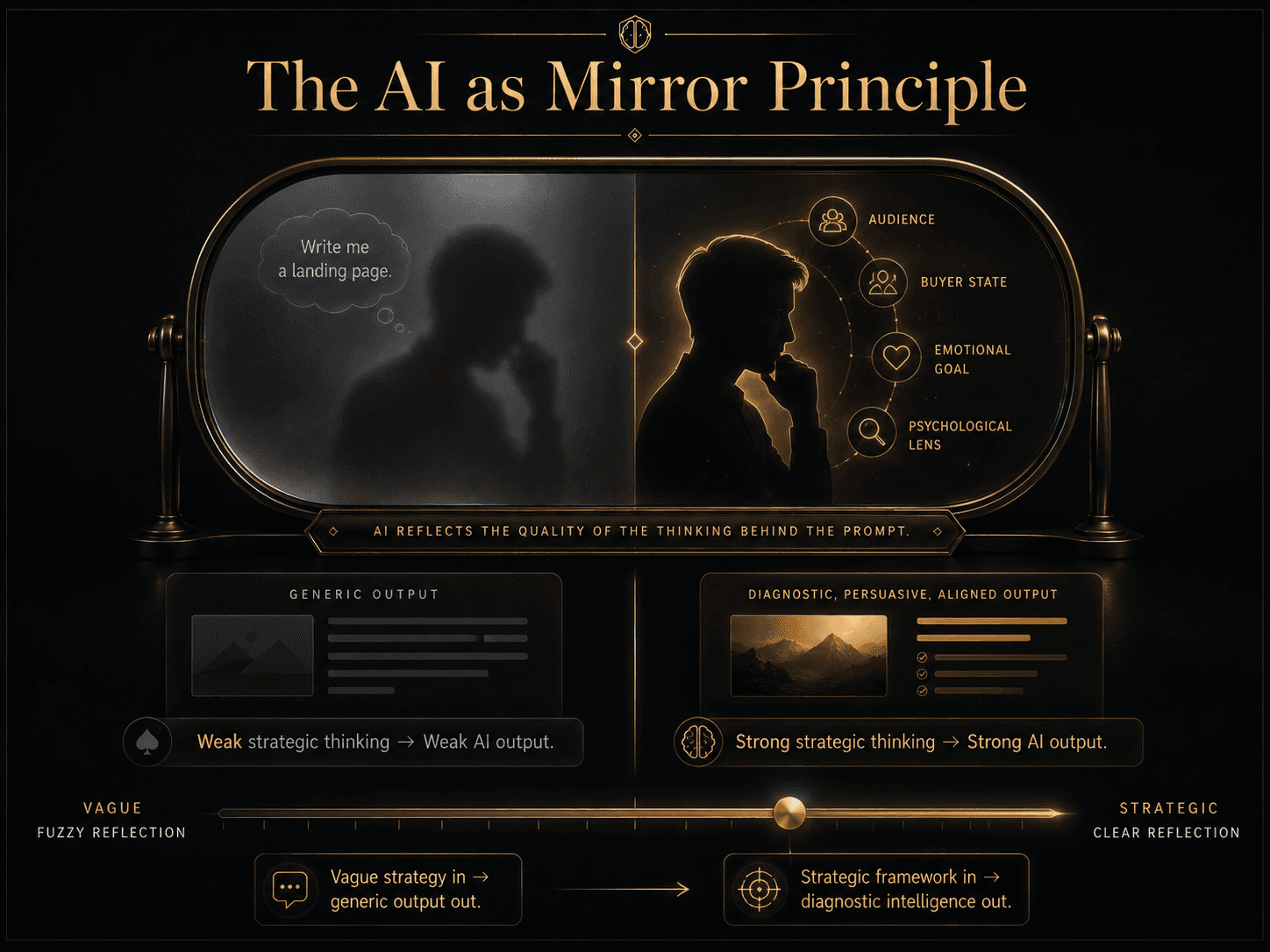
The AI As Mirror Principle™
AI often reflects the quality of the strategic thinking behind the prompt.
Weak direction creates weak output.
Strong psychological direction creates dramatically more useful analysis.
That is why frameworks matter.
If you ask vague questions, AI gives vague answers.
If you ask psychologically precise questions, AI becomes much more useful.
The tool reflects the quality of the instruction.
So before blaming the AI output, check the prompt.
Using Funnels By Maris Spalins™
You can use these prompts in any capable AI tool.
They are designed to work especially well with Funnels By Maris Spalins™, the custom implementation assistant created around the frameworks, principles, funnel psychology systems, and buyer intelligence models explored throughout The $100M Funnel Playbook.
Use it to help you:
run psychological audits
identify trust leaks
analyse funnel sequencing
detect emotional incongruence
pressure-test messaging
simulate buyer reactions
identify weak CTA structures
simplify complicated messaging
strengthen emotional realism
improve conversion flow strategically
The stronger the psychological direction becomes, the stronger the AI output becomes.
The Biggest AI Strategy Mistake™
Most people use AI before thinking strategically.
They ask AI to generate before they understand the buyer.
They ask for copy before diagnosing the funnel.
They ask for headlines before identifying the pressure.
They ask for CTAs before understanding readiness.
They ask for persuasion before reducing resistance.
That is backwards.
Strong marketers think first.
Then they use AI to accelerate:
analysis
iteration
diagnosis
refinement
pressure testing
comparison
repair
That difference changes results dramatically.
Quick AI Audit Exercise™
Use this when you suspect a page is underperforming but are not sure why.
Page Being Audited
Target Buyer
Buyer State
Cold / Warm / Hot / Sceptical / Confused / Exhausted / Other
Funnel Goal
One Area Of My Funnel That Feels Weak
One Psychological Problem I Suspect Exists
Audit Type I Should Run
Choose one:
Clarity / Resistance / Emotional Sequencing / Trust Leak / Pressure / CTA Friction / Buyer Perspective / Emotional Realism
Selected audit:
AI Audit Prompt I Will Use
Buyer Perspective I Should Simulate
One Trust Leak I Need To Investigate
AI Diagnosis Summary
My Human Judgement
What do I agree with?
What do I disagree with?
What needs more evidence?
Final Repair Action
The 30-Minute AI Psychological Audit Process™
Use this before asking AI to rewrite anything.
Minutes 0–5: Define The Buyer And Page Goal
Target buyer:
Buyer state:
Page goal:
Page section being audited:
Minutes 5–10: Run The Clarity Audit
Ask AI to identify what is unclear, vague, or difficult to understand.
Biggest clarity issue:
Minutes 10–15: Run The Resistance Audit
Ask AI to identify hype, vagueness, emotional pressure, guru language, and trust triggers.
Biggest resistance trigger:
Minutes 15–20: Run The Sequencing Audit
Ask AI to map the funnel against:
Attention → Recognition → Curiosity → Belief → Readiness
Biggest sequencing issue:
Minutes 20–25: Simulate A Sceptical Buyer
Ask AI to respond as a sceptical buyer.
What would they distrust?
What proof would they need?
What would make them continue?
Minutes 25–30: Decide The Repair Priority
Do not fix everything at once.
Choose the most damaging issue.
The first repair priority is:
The specific section to rewrite is:
The repair action is:
——
Final Principle™
The strongest AI outputs come from strong psychological direction.
That means understanding:
buyer states
pressure
sequencing
trust
resistance
emotional realism
CTA readiness
proof needs
buyer perspective
AI becomes exponentially more valuable when it helps diagnose why the funnel psychologically weakens instead of merely generating more random copy.
Run one clarity audit.
Run one resistance audit.
Run one sequencing audit.
Simulate one sceptical buyer.
Then decide what actually needs to be repaired.
Only after that should you ask AI to rewrite.
That is the discipline.
Do not use AI as a slot machine.
Use it as a psychological mirror.
Use it to diagnose.
Use it to pressure-test.
Use it to sharpen strategic judgement.
That is what The AI Psychological Audit System™ is designed to help you master.
——
From:
The $100M Funnel Playbook. Book I: Foundation Buyer Psychology, Offer Clarity, and the Page Architecture Behind High-Converting Funnels
By Maris Spalins.
——
Copyright Notice
© 2026 The $100M Funnel Playbook / Winyourclients / Maris Spalins. All rights reserved.
This resource, including the frameworks, terminology, examples, scorecards, templates, prompts, methods, and written explanations, is original intellectual property created for The $100M Funnel Playbook. Book I: Foundation — Buyer Psychology, Offer Clarity, And The Page Architecture Behind High-Converting Funnels and published through Winyourclients.
No part of this resource may be copied, reproduced, screenshotted, republished, redistributed, sold, adapted, uploaded, scraped, stored in a database, included in training data, used to train artificial intelligence systems, or used to create derivative commercial or educational materials without prior written permission.
Limited reference, quotation, or sharing is only permitted where the source is clearly and visibly credited.
Any permitted reference must include at least one of the following source credits:
The $100M Funnel Playbook by Maris Spalins
or
Winyourclients — www.winyourclients.com
or
Maris Spalins / Winyourclients
Screenshots, excerpts, summaries, or redistributed versions must not remove, hide, alter, crop out, or obscure the original source, author name, book title, website name, or copyright notice.
This resource is provided for personal learning and implementation only. It is not licensed for resale, republishing, redistribution, AI training, template cloning, course creation, consulting delivery, or commercial reuse without written permission from Maris Spalins or Winyourclients.
For permission requests, licensing, citation approval, or commercial usage enquiries, contact:
Winyourclients
www.winyourclients.com
or
Email directly to Jacob on: help@winyourclients.com


The AI Psychological Audit System™ A strategic AI audit toolkit for diagnosing funnel friction, clarity gaps, trust leaks, buyer resistance, emotional sequencing failures, CTA pressure, and buyer-state mismatch before generating new copy.
Prefer Audio Or Video?
The AI Psychological Audit System™ is also available as:
🎧 A guided audio walkthrough explaining AI-assisted funnel diagnostics, buyer-state analysis, and emotional auditing
🎥 A practical video breakdown with real AI prompts, audit examples, and psychological funnel teardownsChoose the format that fits how you learn best.
[Listen To The Audio Walkthrough] (coming soon)
[Watch The Video Breakdown] (coming soon)
——
Why Most AI Funnel Usage Produces Generic Results
Most people use AI like a slot machine.
They throw vague prompts into the machine:
“Write me a landing page.”
“Create a high-converting headline.”
“Make this copy better.”
“Improve this funnel.”
“Write a stronger CTA.”
Then they wonder why the output feels:
generic
emotionally flat
repetitive
over-polished
strategically weak
disconnected from the buyer
full of phrases that sound like every other page online
The problem is usually not the AI itself.
The problem is the psychological direction behind the prompt.
Most AI usage today focuses on generation.
But the real power of AI inside funnels comes from diagnosis.
That distinction changes everything.
AI should not be used first to write more copy.
It should be used first to reveal why the current copy is not working.
Because most weak funnels do not fail from a lack of words.
They fail from:
unclear positioning
shallow buyer understanding
weak emotional structure
poor sequencing
trust collapse
friction overload
psychological mismatch
buyer resistance
premature CTA pressure
AI becomes exponentially more valuable when it helps you diagnose those problems before generating another rewrite.
That is what The AI Psychological Audit System™ is designed to help you do.
What This Resource Helps You Do
The AI Psychological Audit System™ helps you use AI as a strategic funnel diagnosis tool instead of a generic copy generator.
Use it to:
identify clarity leaks
expose trust leaks
detect buyer resistance
pressure-test messaging
simulate buyer reactions
analyse funnel sequencing
detect emotional incongruence
find premature CTA pressure
identify shallow pain
diagnose weak proof
uncover friction points
improve buyer-state alignment
strengthen emotional realism
decide what should be fixed before rewriting
This is not a random AI prompt pack.
It is an audit system.
The goal is not to ask AI for “better copy.”
The goal is to ask AI better diagnostic questions.
Because when the diagnosis is wrong, the rewrite is usually cosmetic.
The AI Diagnostic Principle™
AI is often more valuable as an analyst than as a content generator.
AI can be used as:
an analyst
a pressure tester
a buyer simulator
a psychological auditor
a sequencing evaluator
a friction detector
a trust leak detector
a resistance mapper
a CTA readiness checker
This is critical.
Because most weak funnels do not fail because they need more words.
They fail because the psychological structure underneath the words is weak.
AI can help identify those weaknesses quickly when it is guided properly.
That is the rule:
Diagnose before generating.
Do not ask AI to rewrite the funnel before it has helped you understand what is psychologically wrong with the funnel.
The Biggest AI Mistake™
Most people ask AI:
“What should I write?”
Strong marketers ask:
“What psychological problem is weakening conversion right now?”
That difference changes output quality dramatically.
The first question creates more content.
The second question creates better strategy.
And better strategy improves everything downstream.
Because if the problem is unclear positioning, more headlines will not fix it.
If the problem is lack of trust, a louder CTA will not fix it.
If the problem is shallow pain, prettier words will not fix it.
If the problem is poor sequence, rewriting individual sections will not fix it.
If the problem is buyer resistance, more persuasion may make it worse.
That is why AI should first help you diagnose the real problem.
Then you can use it to generate better options.
The 7 Types Of AI Psychological Audits™
These audits help transform AI from a generic copy generator into a strategic funnel intelligence tool.
The seven core audits are:
The Clarity Audit™
The Resistance Audit™
The Emotional Sequencing Audit™
The Trust Leak Audit™
The Pressure Audit™
The CTA Friction Audit™
The Buyer Perspective Audit™
Each audit looks at the funnel through a different psychological lens.
Use them separately or together.
Do not run all of them randomly.
Choose the audit based on the problem you suspect.
1. The Clarity Audit™
Goal
To identify confusion, vagueness, interpretation effort, and unclear first-contact messaging.
Use this when the page feels polished but the offer is not instantly obvious.
What This Audit Detects
The Clarity Audit™ helps detect:
unclear offer
unclear audience
vague promise
confusing headline
weak subheadline
poor first-contact understanding
unclear next step
language that sounds good but says little
sections that require too much interpretation
Most funnels lose buyers through clarity leakage.
The buyer does not always reject the offer.
Sometimes they simply do not understand it fast enough to care.
Clarity Audit Prompt™
Use this prompt:
Act as a cold buyer landing on this page for the first time.
You have no context.
In 5 seconds, explain:
What this offer is.
Who it is for.
What problem it solves.
Why it matters.
What feels unclear.
What creates hesitation.
What the next step appears to be.
Whether you would continue reading and why.
Then score the page from 1 to 5 on:
offer clarity
audience clarity
problem clarity
promise clarity
next-step clarity
continuation strength
After that, identify the 5 biggest clarity leaks and rewrite the weakest section in a clearer, more specific version.
Here is the page copy:
[paste page copy]
Output You Should Ask For
Ask AI to give you:
a plain-English explanation of what the page says
the first thing that feels unclear
the biggest source of interpretation effort
the strongest clarity leak
a clearer headline
a clearer subheadline
a clearer CTA
a score from 1 to 5
Repair Instruction
Do not only ask AI to “make it better.”
Ask it to remove interpretation effort.
The goal is not more impressive wording.
The goal is faster understanding.
Fill This In
The section I want to test for clarity is:
The buyer should understand this within 5 seconds:
The current clarity leak is:
The clearer version is:
2. The Resistance Audit™
Goal
To identify distrust triggers, manipulation signals, overhyped phrasing, emotionally unsafe messaging, and buyer resistance.
Use this when the page feels persuasive but may be triggering scepticism.
What This Audit Detects
The Resistance Audit™ helps detect:
hype language
exaggerated claims
guru-style phrasing
fake urgency
premature pressure
emotional incongruence
corporate emptiness
unsupported certainty
trust landmines
language that makes the buyer emotionally step back
Buyers constantly scan for reasons not to trust the funnel.
This audit helps identify those hidden resistance triggers.
Resistance Audit Prompt™
Use this prompt:
Act as a sceptical buyer who has seen many exaggerated funnels before.
Analyse this page for hidden resistance triggers.
Look for:
hype language
exaggerated claims
guru-style phrasing
fake urgency
premature pressure
emotional incongruence
vague promises
unsupported certainty
over-polished corporate language
phrases that sound like generic marketing
For each issue, explain:
The exact phrase or section causing resistance.
Why it may reduce trust psychologically.
What the buyer may feel subconsciously.
A more grounded rewrite.
Why the rewrite preserves trust better.
Then rank the resistance triggers from most damaging to least damaging.
Here is the page copy:
[paste page copy]
Output You Should Ask For
Ask AI to give you:
exact resistance-triggering phrases
the likely buyer reaction
a trust-preserving rewrite
a ranking of the biggest issues
a short summary of how to lower defensiveness
Repair Instruction
Do not make the copy louder.
Make it easier to believe.
Replace intensity with specificity.
Replace hype with grounded explanation.
Replace pressure with psychological safety.
Fill This In
One phrase that may trigger resistance is:
The buyer may distrust it because:
A more grounded version is:
3. The Emotional Sequencing Audit™
Goal
To analyse whether the funnel’s emotional progression feels natural.
Use this when the funnel has strong sections but still feels pushy, chaotic, or emotionally off.
What This Audit Detects
The Emotional Sequencing Audit™ helps detect:
pressure too early
proof too late
CTA before belief
identity tension before recognition
desire before diagnosis
emotional jumps
skipped buyer states
disconnected sections
poor momentum curve
Funnels often fail because the emotional timing feels wrong.
Not because every section is badly written.
Emotional Sequencing Audit Prompt™
Use this prompt:
Act as a funnel strategist trained in buyer psychology and emotional sequencing.
Analyse this funnel against the following buyer-state sequence:
Attention → Recognition → Curiosity → Belief → Readiness
For each stage, tell me:
Whether the stage is present.
Where it appears in the funnel.
Whether it appears too early, too late, or in the right place.
What the buyer likely feels at that point.
What is missing.
What should be rewritten, moved, or strengthened.
Then identify:
where pressure appears too early
where proof arrives too late
where emotional progression feels unnatural
where buyer readiness and messaging are mismatched
where the CTA feels premature
where the funnel skips a psychological stage
Finally, recommend a stronger sequence.
Here is the funnel copy:
[paste funnel copy]
Output You Should Ask For
Ask AI to give you:
current emotional sequence
missing buyer states
biggest emotional jump
strongest sequencing failure
recommended revised sequence
CTA timing recommendation
Repair Instruction
Do not only rewrite sections.
Repair the order.
The right message in the wrong place can still weaken conversion.
Fill This In
The current funnel sequence is:
The biggest emotional jump is:
The buyer state that appears too early is:
The revised sequence should be:
4. The Trust Leak Audit™
Goal
To identify sections that quietly weaken credibility, believability, emotional safety, and psychological congruence.
Use this when the funnel feels good on the surface but does not feel fully trustworthy.
What This Audit Detects
The Trust Leak Audit™ helps detect:
vague claims
weak proof
unsupported promises
over-polished language
generic credibility
emotional mismatch
proof misalignment
trust gaps before the CTA
claims that are too big for the evidence shown
Trust usually collapses gradually.
Small leaks compound.
Trust Leak Audit Prompt™
Use this prompt:
Act as a sceptical but fair buyer.
Identify all areas where this page may quietly weaken trust.
Focus on:
vagueness
over-polished language
unsupported claims
emotional mismatch
weak proof alignment
vague testimonials
proof arriving too late
CTAs appearing before enough trust exists
claims that feel bigger than the evidence shown
For each trust leak, explain:
The exact phrase or section.
Why it may weaken credibility.
What doubt it creates.
What proof or rewrite would reduce the doubt.
Whether the issue is high, medium, or low priority.
Then rank the trust leaks from most damaging to least damaging.
Here is the page copy:
[paste page copy]
Output You Should Ask For
Ask AI to give you:
exact trust leaks
what doubt each leak creates
proof needed
rewrite needed
priority ranking
strongest repair action
Repair Instruction
Fix the highest-priority trust leak first.
Do not try to repair everything randomly.
Trust leaks should be prioritised by damage.
Fill This In
The biggest trust leak is:
The doubt it creates is:
The proof or rewrite needed is:
5. The Pressure Audit™
Goal
To evaluate whether the messaging creates real tension instead of generic problem statements.
Use this when the page names a problem but still feels emotionally weak.
What This Audit Detects
The Pressure Audit™ helps detect whether the copy includes:
operational friction
emotional cost
identity tension
future consequence
failed attempts
private thought
live buyer pressure
Or whether it remains too surface-level.
Surface-level pain creates weak emotional movement.
Pressure creates recognition.
Pressure Audit Prompt™
Use this prompt:
Act as a conversion strategist trained in buyer psychology and pressure-based messaging.
Analyse whether this page exposes real buyer pressure or stays at surface-level pain.
Evaluate the copy across the five Pain Stack layers:
Surface Pain™
Operational Friction™
Emotional Cost™
Identity Threat™
Future Cost™
For each layer, tell me:
whether it is present
where it appears
whether it feels specific or generic
what is missing
how to deepen the messaging without exaggerating
Then identify:
the strongest pain layer currently present
the weakest or missing pain layer
one private thought the buyer may have
three stronger pressure-based headline angles
three stronger problem bullets
one future-cost line
Do not invent dramatic pain.
Use grounded psychological inference based on the copy.
Here is the page copy:
[paste page copy]
Output You Should Ask For
Ask AI to give you:
current Pain Stack diagnosis
strongest pressure point
missing pressure layer
private thought
pressure-based headline angles
deeper problem bullets
future-cost line
Repair Instruction
Do not make the pain darker just to sound intense.
Make the pressure more accurate.
The strongest copy is not exaggerated.
It is recognisable.
Fill This In
The current surface pain is:
The missing pressure layer is:
The buyer’s private thought may be:
A stronger pressure-based line is:
6. The CTA Friction Audit™
Goal
To identify whether CTAs feel premature, heavy, vague, or emotionally disconnected from the funnel buildup.
Use this when visitors reach the page but do not click, book, apply, download, or continue.
What This Audit Detects
The CTA Friction Audit™ helps detect:
premature asks
high-friction wording
unclear next steps
weak reward visibility
emotionally disconnected CTAs
trust gaps before commitment
CTAs that do not match buyer temperature
CTA microcopy that fails to reduce hesitation
Many funnels ask for too much commitment before enough belief exists.
That creates resistance immediately.
CTA Friction Audit Prompt™
Use this prompt:
Act as a conversion strategist trained in CTA psychology and buyer readiness.
Evaluate the CTA sequence on this page.
The target buyer is:
[insert buyer]
The buyer temperature is:
[cold/warm/hot]
The desired action is:
[insert desired action]
Analyse:
Whether the CTA matches the buyer’s readiness level.
Whether the CTA feels premature.
Whether the CTA is too high-friction.
Whether the CTA clearly communicates reward.
Whether the page builds enough trust before the CTA.
Whether the CTA microcopy reduces hesitation.
Whether a lower-friction CTA would fit better.
Then provide:
5 improved CTA options
5 CTA microcopy options
one lower-friction alternative
one direct-action CTA for hotter buyers
one recommendation for CTA placement
Here is the page copy:
[paste page copy]
Output You Should Ask For
Ask AI to give you:
CTA readiness diagnosis
friction level
buyer-temperature fit
stronger CTA options
microcopy options
lower-friction alternatives
placement recommendation
Repair Instruction
The CTA should match buyer readiness.
Cold buyers often need continuation.
Warm buyers often need diagnosis or proof.
Hot buyers often need clear action.
Do not force a high-friction ask before the buyer is ready.
Fill This In
The current CTA is:
The buyer temperature is:
Cold / Warm / Hot
The CTA may feel too heavy because:
A lower-friction CTA is:
CTA microcopy should reassure the buyer that:
7. The Buyer Perspective Audit™
Goal
To simulate different buyer mindsets and reveal hidden psychological gaps.
Use this when you want to understand how different buyers may experience the same funnel.
What This Audit Detects
The Buyer Perspective Audit™ helps detect:
what different buyers understand
what they trust
what they distrust
what they ignore
what creates hesitation
what makes them continue
where the page fails to meet their current emotional state
Different buyers experience the same funnel differently.
This audit reveals hidden psychological gaps.
Buyer Perspectives To Simulate
Use perspectives such as:
cold buyer
sceptical buyer
confused buyer
emotionally exhausted buyer
distrustful buyer
overwhelmed buyer
comparison-shopping buyer
buyer burned by previous frameworks
buyer who has tried similar solutions before
buyer who wants proof before action
Buyer Perspective Audit Prompt™
Use this prompt:
Respond to this landing page from the perspective of the following buyer types:
A cold buyer with no context.
A sceptical buyer who has seen many similar offers.
A confused buyer who is unsure what the offer actually does.
A buyer burned by previous frameworks or advice.
An emotionally exhausted buyer who does not want more complexity.
A comparison-shopping buyer evaluating alternatives.
A buyer who needs proof before taking action.
For each buyer perspective, tell me:
what they understand
what they trust
what they distrust
what they ignore
what makes them hesitate
what would make them continue
what CTA would feel appropriate
what proof they would need
Then summarise the biggest changes needed to make the page stronger for the core buyer.
Here is the page copy:
[paste page copy]
Output You Should Ask For
Ask AI to give you:
buyer-by-buyer reaction
trust/distrust patterns
hesitation points
proof needs
CTA readiness
top recommendations
Repair Instruction
Do not treat all buyers as psychologically identical.
Choose the buyer state that matters most for the page.
Then optimise the funnel for that buyer.
Fill This In
The buyer perspective I need to simulate is:
This buyer is likely to distrust:
This buyer needs to understand:
This buyer needs to believe:
This buyer’s appropriate next step is:
Bonus Audit: The Emotional Realism Audit™
Goal
To detect robotic, corporate, over-polished, or emotionally artificial copy.
Use this when the copy sounds “good” but not human.
What This Audit Detects
The Emotional Realism Audit™ helps detect:
robotic phrasing
corporate language
emotional artificiality
over-polished tone
generic AI language
sentences that sound like marketing
phrases no real buyer would say
emotionally sanitised copy
Funnels lose trust when the language feels manufactured.
AI can help identify those subtle tone problems quickly.
Emotional Realism Audit Prompt™
Use this prompt:
Analyse this copy for emotional realism.
Identify sections that sound:
robotic
corporate
overly polished
emotionally artificial
generic
manufactured
more like marketing than human communication
For each section, explain:
Why it feels emotionally unnatural.
What kind of buyer language would sound more real.
How to preserve the strategic meaning while making it sound more human.
A stronger rewrite that feels emotionally believable.
Then answer:
Which lines sound most human?
Which lines sound most artificial?
Which lines feel like a buyer would actually say them?
Which lines sound like a marketer trying to sound persuasive?
Here is the copy:
[paste copy]
Sounds Human Test™
Ask AI:
“Which sections of this page feel emotionally believable, and which feel overly polished or psychologically unnatural?”
Then ask:
“Does this sound like a buyer would say it, or only like a marketer would approve it?”
That second question is often the sharper one.
The AI Prompt Architecture™
Weak prompts create weak analysis.
Strong prompts create strategic insight.
A strong psychological prompt usually contains six parts:
Audience™
Buyer State™
Funnel Stage™
Emotional Goal™
Psychological Lens™
Output Objective™
This framework dramatically improves audit quality.
1. Audience™
Who exactly is the buyer?
Weak:
“Business owners.”
Stronger:
“SaaS founders struggling with onboarding activation.”
Fill this in:
Audience:
2. Buyer State™
What psychological state is the buyer in?
Examples:
cold
warm
hot
sceptical
confused
emotionally exhausted
distrustful
overwhelmed
comparison-shopping
problem-aware
solution-aware
Fill this in:
Buyer state:
3. Funnel Stage™
What section are you auditing?
Examples:
headline
subheadline
hook
proof section
CTA
offer section
objection section
full landing page
booking page
product page
Fill this in:
Funnel stage:
4. Emotional Goal™
What should the section create?
Examples:
recognition
trust
curiosity
movement
belief
clarity
reassurance
urgency
emotional safety
Fill this in:
Emotional goal:
5. Psychological Lens™
What do you want AI to focus on?
Examples:
pressure
resistance
identity tension
trust
sequencing
clarity
CTA friction
proof alignment
emotional realism
Fill this in:
Psychological lens:
6. Output Objective™
What should AI give you?
Examples:
diagnosis
score
rewritten section
ranked list of problems
buyer reactions
proof recommendations
CTA alternatives
revised sequence
Fill this in:
Output objective:
Master AI Audit Prompt Template™
Use this structure when creating your own prompt.
Act as a conversion strategist trained in buyer psychology, funnel diagnosis, and emotional sequencing.
The audience is:
[insert audience]
The buyer state is:
[insert buyer state]
The funnel stage being audited is:
[insert funnel stage]
The emotional goal of this section is:
[insert emotional goal]
The psychological lens I want you to use is:
[insert psychological lens]
The output I want is:
[insert output objective]
Analyse the following copy:
[paste copy]
Please identify:
What is working.
What is psychologically weak.
What may create confusion, resistance, distrust, or friction.
What buyer state the copy seems to assume.
Whether that matches the real buyer state.
What should be rewritten, moved, clarified, or supported with proof.
The top 5 repair actions.
Then provide stronger rewrite options where relevant.
Weak AI Usage vs Strong AI Usage™
The difference between weak and strong AI usage is not complexity.
It is direction.
Weak Usage
“Generate 10 headlines.”
Low strategic depth.
No buyer psychology.
No emotional lens.
No funnel context.
Stronger Usage
“Generate 10 headlines for sceptical ecommerce founders who feel emotionally exhausted rebuilding funnels that still fail to hold trust.
Focus on:
emotional realism
specificity
trust preservation
continuation pull
Avoid guru-style language, hype, and vague growth promises.”
Now the AI has:
audience
buyer state
pain context
emotional goal
tone guardrails
psychological lens
That produces dramatically stronger output.
More Weak vs Strong AI Prompt Examples
Clarity Audit
Weak prompt:
“Review my page.”
Strong prompt:
“Act as a cold buyer with no context. In 5 seconds, explain what this page offers, who it is for, what feels unclear, and whether you would continue reading. Score clarity from 1 to 5 and identify the biggest interpretation effort.”
Resistance Audit
Weak prompt:
“Make this sound more persuasive.”
Strong prompt:
“Analyse this page for hype language, vague claims, guru-style phrasing, fake urgency, and premature CTA pressure. Identify anything that may trigger scepticism in an experienced buyer and rewrite it in a more grounded, believable way.”
Sequencing Audit
Weak prompt:
“Improve my funnel flow.”
Strong prompt:
“Map this funnel against Attention → Recognition → Curiosity → Belief → Readiness. Identify skipped buyer states, emotional jumps, proof that appears too late, and CTAs that appear before belief exists.”
CTA Audit
Weak prompt:
“Write better CTAs.”
Strong prompt:
“Evaluate whether these CTAs match a cold buyer who is problem-aware but not ready to book a call. Suggest lower-friction CTAs that create continuation, reward visibility, and psychological safety.”
The Funnel Friction Detection System™
AI is effective at detecting funnel friction when you ask it specific diagnostic questions.
Use this checklist to guide your audits.
Clarity Gap
Ask AI:
“Where does the buyer have to work too hard to understand the message?”
Weak Transition
Ask AI:
“Where does the funnel move from one idea to another without enough emotional or logical connection?”
Momentum Leak
Ask AI:
“Where does buyer continuation weaken, and why?”
Emotional Overload
Ask AI:
“Where does the page apply too much pressure too early?”
Sequencing Mismatch
Ask AI:
“Where does the copy ask for a buyer state that has not been built yet?”
Vague Positioning
Ask AI:
“Which phrases sound broad, abstract, or interchangeable?”
Trust Inconsistency
Ask AI:
“Where does the page make a claim that is not supported by enough proof?”
Premature Pressure
Ask AI:
“Where does the page ask for commitment before trust, belief, or readiness exists?”
Buyer Simulation Prompt Pack™
Use these prompts to pressure-test your page through different buyer states.
Sceptical Buyer Prompt
Respond to this page as a sceptical buyer who has seen many similar offers before.
Tell me:
what you believe
what you doubt
what sounds overhyped
what proof you need
what would make you continue
what would make you leave
Page copy:
[paste copy]
Confused Buyer Prompt
Respond to this page as a confused buyer who is not fully sure what the offer does.
Tell me:
what you think the offer is
what remains unclear
what you would need explained
which section creates the most confusion
what should be rewritten for clarity
Page copy:
[paste copy]
Emotionally Exhausted Buyer Prompt
Respond to this page as an emotionally exhausted buyer who does not want another complicated framework.
Tell me:
what feels helpful
what feels overwhelming
what feels too intense
what feels reassuring
what CTA would feel safe
Page copy:
[paste copy]
Buyer Burned By Previous Advice Prompt
Respond to this page as a buyer who has already tried frameworks, templates, and advice that sounded good but did not work.
Tell me:
what triggers scepticism
what sounds like previous disappointments
what feels different
what proof would reduce resistance
what should be clarified before asking for action
Page copy:
[paste copy]
Comparison-Shopping Buyer Prompt
Respond to this page as a buyer comparing this offer against several alternatives.
Tell me:
what feels differentiated
what feels generic
what is unclear
what proof would help
what would make this offer feel more relevant
what would make you choose this over another option
Page copy:
[paste copy]
The Human Override Principle™
AI cannot replace:
buyer empathy
strategic judgement
emotional intelligence
positioning clarity
market understanding
psychological nuance
ethical decision-making
taste
context
truth
AI accelerates analysis.
It does not replace thinking.
This distinction matters enormously.
AI can reveal possible problems.
The human decides what is true, useful, ethical, and strategically right.
Do not blindly accept every AI diagnosis.
Use AI as a mirror.
Use judgement as the filter.
—-
The AI As Mirror Principle™
AI often reflects the quality of the strategic thinking behind the prompt.
Weak direction creates weak output.
Strong psychological direction creates dramatically more useful analysis.
That is why frameworks matter.
If you ask vague questions, AI gives vague answers.
If you ask psychologically precise questions, AI becomes much more useful.
The tool reflects the quality of the instruction.
So before blaming the AI output, check the prompt.
Using Funnels By Maris Spalins™
You can use these prompts in any capable AI tool.
They are designed to work especially well with Funnels By Maris Spalins™, the custom implementation assistant created around the frameworks, principles, funnel psychology systems, and buyer intelligence models explored throughout The $100M Funnel Playbook.
Use it to help you:
run psychological audits
identify trust leaks
analyse funnel sequencing
detect emotional incongruence
pressure-test messaging
simulate buyer reactions
identify weak CTA structures
simplify complicated messaging
strengthen emotional realism
improve conversion flow strategically
The stronger the psychological direction becomes, the stronger the AI output becomes.
The Biggest AI Strategy Mistake™
Most people use AI before thinking strategically.
They ask AI to generate before they understand the buyer.
They ask for copy before diagnosing the funnel.
They ask for headlines before identifying the pressure.
They ask for CTAs before understanding readiness.
They ask for persuasion before reducing resistance.
That is backwards.
Strong marketers think first.
Then they use AI to accelerate:
analysis
iteration
diagnosis
refinement
pressure testing
comparison
repair
That difference changes results dramatically.
Quick AI Audit Exercise™
Use this when you suspect a page is underperforming but are not sure why.
Page Being Audited
Target Buyer
Buyer State
Cold / Warm / Hot / Sceptical / Confused / Exhausted / Other
Funnel Goal
One Area Of My Funnel That Feels Weak
One Psychological Problem I Suspect Exists
Audit Type I Should Run
Choose one:
Clarity / Resistance / Emotional Sequencing / Trust Leak / Pressure / CTA Friction / Buyer Perspective / Emotional Realism
Selected audit:
AI Audit Prompt I Will Use
Buyer Perspective I Should Simulate
One Trust Leak I Need To Investigate
AI Diagnosis Summary
My Human Judgement
What do I agree with?
What do I disagree with?
What needs more evidence?
Final Repair Action
The 30-Minute AI Psychological Audit Process™
Use this before asking AI to rewrite anything.
Minutes 0–5: Define The Buyer And Page Goal
Target buyer:
Buyer state:
Page goal:
Page section being audited:
Minutes 5–10: Run The Clarity Audit
Ask AI to identify what is unclear, vague, or difficult to understand.
Biggest clarity issue:
Minutes 10–15: Run The Resistance Audit
Ask AI to identify hype, vagueness, emotional pressure, guru language, and trust triggers.
Biggest resistance trigger:
Minutes 15–20: Run The Sequencing Audit
Ask AI to map the funnel against:
Attention → Recognition → Curiosity → Belief → Readiness
Biggest sequencing issue:
Minutes 20–25: Simulate A Sceptical Buyer
Ask AI to respond as a sceptical buyer.
What would they distrust?
What proof would they need?
What would make them continue?
Minutes 25–30: Decide The Repair Priority
Do not fix everything at once.
Choose the most damaging issue.
The first repair priority is:
The specific section to rewrite is:
The repair action is:
——
Final Principle™
The strongest AI outputs come from strong psychological direction.
That means understanding:
buyer states
pressure
sequencing
trust
resistance
emotional realism
CTA readiness
proof needs
buyer perspective
AI becomes exponentially more valuable when it helps diagnose why the funnel psychologically weakens instead of merely generating more random copy.
Run one clarity audit.
Run one resistance audit.
Run one sequencing audit.
Simulate one sceptical buyer.
Then decide what actually needs to be repaired.
Only after that should you ask AI to rewrite.
That is the discipline.
Do not use AI as a slot machine.
Use it as a psychological mirror.
Use it to diagnose.
Use it to pressure-test.
Use it to sharpen strategic judgement.
That is what The AI Psychological Audit System™ is designed to help you master.
——
From:
The $100M Funnel Playbook. Book I: Foundation Buyer Psychology, Offer Clarity, and the Page Architecture Behind High-Converting Funnels
By Maris Spalins.
——
Copyright Notice
© 2026 The $100M Funnel Playbook / Winyourclients / Maris Spalins. All rights reserved.
This resource, including the frameworks, terminology, examples, scorecards, templates, prompts, methods, and written explanations, is original intellectual property created for The $100M Funnel Playbook. Book I: Foundation — Buyer Psychology, Offer Clarity, And The Page Architecture Behind High-Converting Funnels and published through Winyourclients.
No part of this resource may be copied, reproduced, screenshotted, republished, redistributed, sold, adapted, uploaded, scraped, stored in a database, included in training data, used to train artificial intelligence systems, or used to create derivative commercial or educational materials without prior written permission.
Limited reference, quotation, or sharing is only permitted where the source is clearly and visibly credited.
Any permitted reference must include at least one of the following source credits:
The $100M Funnel Playbook by Maris Spalins
or
Winyourclients — www.winyourclients.com
or
Maris Spalins / Winyourclients
Screenshots, excerpts, summaries, or redistributed versions must not remove, hide, alter, crop out, or obscure the original source, author name, book title, website name, or copyright notice.
This resource is provided for personal learning and implementation only. It is not licensed for resale, republishing, redistribution, AI training, template cloning, course creation, consulting delivery, or commercial reuse without written permission from Maris Spalins or Winyourclients.
For permission requests, licensing, citation approval, or commercial usage enquiries, contact:
Winyourclients
www.winyourclients.com
or
Email directly to Jacob on: help@winyourclients.com
Other Blogs
Other Blogs
Check our other project Blogs with useful insight and information for your businesses
Other Blogs
Other Blogs
Check our other project Blogs with useful insight and information for your businesses