Our Three Step Process
May 25, 2026
Chap 1 | Resource 5 | The AI Funnel Prompt Library™
Our Three Step Process
May 25, 2026
Chap 1 | Resource 5 | The AI Funnel Prompt Library™
The AI Funnel Prompt Library™ How to use AI strategically to diagnose funnel leaks, improve buyer messaging, rewrite headlines and CTAs, simplify page copy, and pressure-test conversion psychology without creating generic AI noise.
Prefer Audio Or Video?
The AI Funnel Prompt Library™ is also available as:
🎧 A guided audio walkthrough explaining strategic AI prompting for funnels and conversion systems
🎥 A practical video breakdown with real AI prompt examples, rewrites, diagnostics, and implementation workflowsChoose the format that fits how you learn best.
[Listen To The Audio Walkthrough] (coming soon)
[Watch The Video Breakdown] (coming soon)
——
Why Most AI Funnel Copy Feels Generic
Most AI-generated marketing content fails for the same reason most weak funnels fail.
The strategic input is weak.
People open AI tools and type prompts like:
“Write me a high-converting landing page.”
“Write better copy.”
“Create a CTA.”
“Write a headline.”
“Improve this funnel.”
The output usually sounds:
generic
emotionally flat
broad
repetitive
corporate
strategically weak
interchangeable with everything else online
Not because AI is useless.
Because vague prompts create vague outputs.
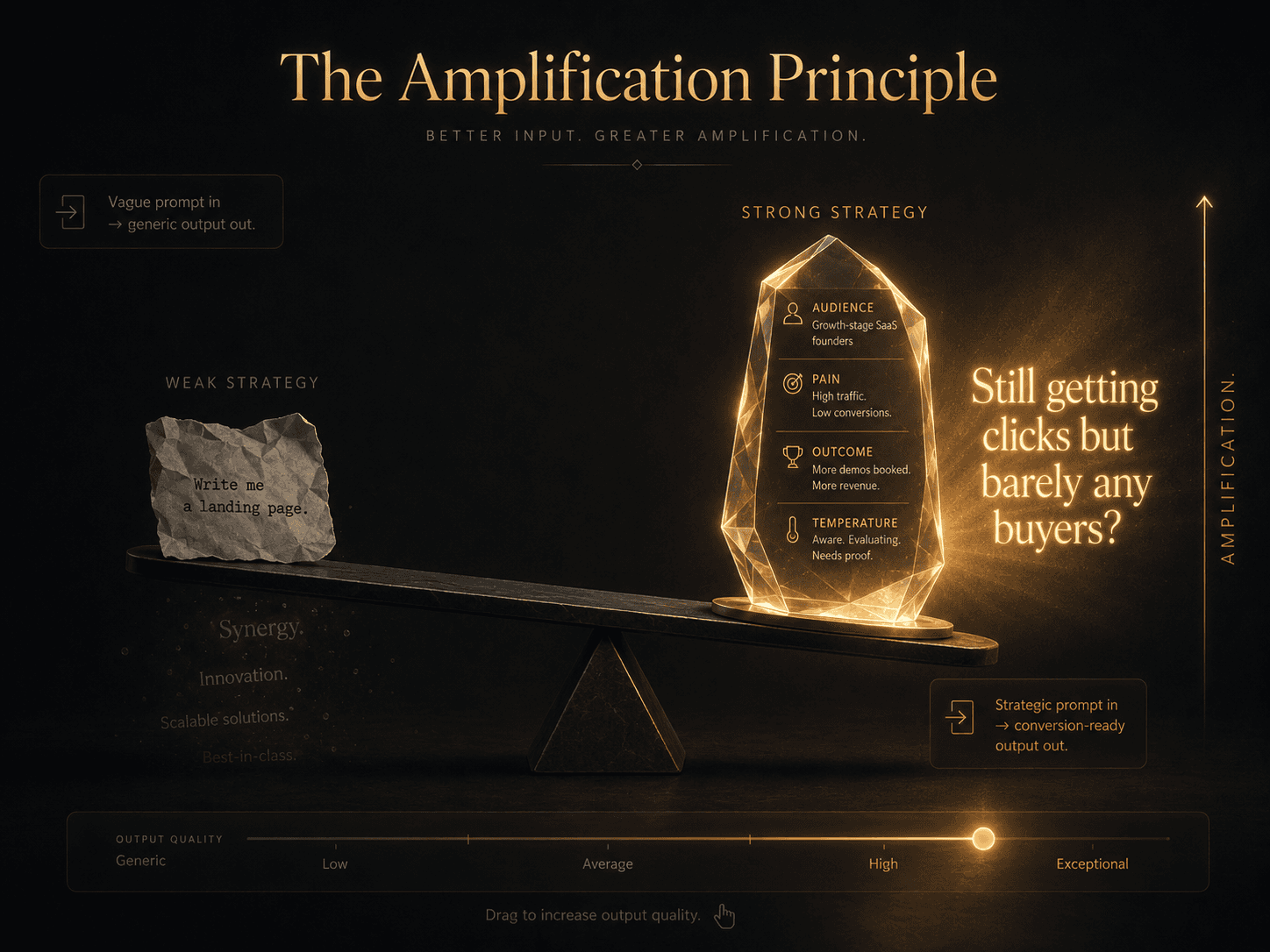
AI amplifies the quality of the strategic thinking behind the prompt.
Weak strategy in.
Weak output out.
Strong strategy in.
Much stronger execution out.
That is the real power of AI inside funnel building.
Not replacement.
Amplification.
AI should not replace your understanding of the buyer.
It should help you apply that understanding faster.
That is what this resource is designed to help you do.
——
What This Resource Helps You Do
The AI Funnel Prompt Library™ helps you use AI as a strategic funnel improvement tool instead of a generic copy generator.
Use it to:
diagnose funnel leaks
improve headline clarity
rewrite weak CTAs
sharpen buyer messaging
simplify confusing copy
extract real buyer language
pressure-test page sections
compare stronger variations
identify weak proof
reduce friction
improve conversion sequencing
strengthen first-contact clarity
This is not a collection of magic prompts.
It is a strategic prompting system.
The goal is not to make AI write everything for you.
The goal is to make AI help you think, diagnose, rewrite, compare, and improve faster.
AI becomes powerful when it is guided by buyer psychology.
Without that, it produces noise.
With it, it becomes an implementation accelerator.
——
The AI Amplification Principle™
AI does not magically create strong positioning.
It amplifies the quality of the inputs you give it.
AI can amplify:
clarity
confusion
specificity
vagueness
buyer understanding
weak strategic thinking
strong strategic thinking
emotional precision
generic assumptions
This is why two people can use the exact same AI tool and produce completely different results.
One gets forgettable copy.
The other gets highly usable strategic drafts.
The difference is usually not the tool.
The difference is the quality of the prompt structure, buyer understanding, and strategic direction.
AI does not replace positioning.
It amplifies positioning.
AI does not replace buyer psychology.
It amplifies buyer psychology.
AI does not replace human judgement.
It accelerates execution when human judgement is already present.
That distinction matters.
——
What AI Is Actually Best Used For™
AI performs best when used as:
a diagnostic assistant
a rewrite assistant
a brainstorming partner
a positioning analyser
a headline generator
a CTA variation tool
a friction detector
a simplification tool
a buyer-language organiser
a conversion thought partner
a pressure-testing assistant
AI performs worst when treated like:
a magic “make me rich” button
a substitute for buyer research
a replacement for strategy
a proof inventor
a testimonial generator
a fake case study machine
a tool for publishing first drafts without judgement
That mindset produces generic marketing very quickly.
Used poorly, AI creates more noise.
Used strategically, AI helps you expose weak thinking faster.
The tool is not the strategy.
The prompt is not the strategy.
The strategy behind the prompt is what makes the output useful.
——
The Biggest AI Copywriting Mistake™
Most people ask AI:
“What should I say?”
Better marketers ask:
“How should this buyer psychologically experience this message?”
That difference changes output quality dramatically.
The first question produces surface copy.
The second question produces strategic copy.
Funnels are psychological systems first.
They are not just pages filled with words.
Every section should help the buyer:
understand
care
believe
trust
continue
act
AI works best when your prompts reflect that reality.
Do not only ask AI to write.
Ask AI to diagnose what the buyer is likely feeling.
Ask AI where clarity breaks.
Ask AI where trust weakens.
Ask AI where the CTA creates friction.
Ask AI where the message sounds generic.
Ask AI where the page asks for action too early.
That is how AI becomes useful strategically.
——
The Strategic Prompt Brief™
Before asking AI to rewrite anything, complete this brief.
Most bad AI outputs happen because the prompt does not include enough strategic context.
Use this before generating headlines, CTAs, page copy, emails, ads, or funnel audits.
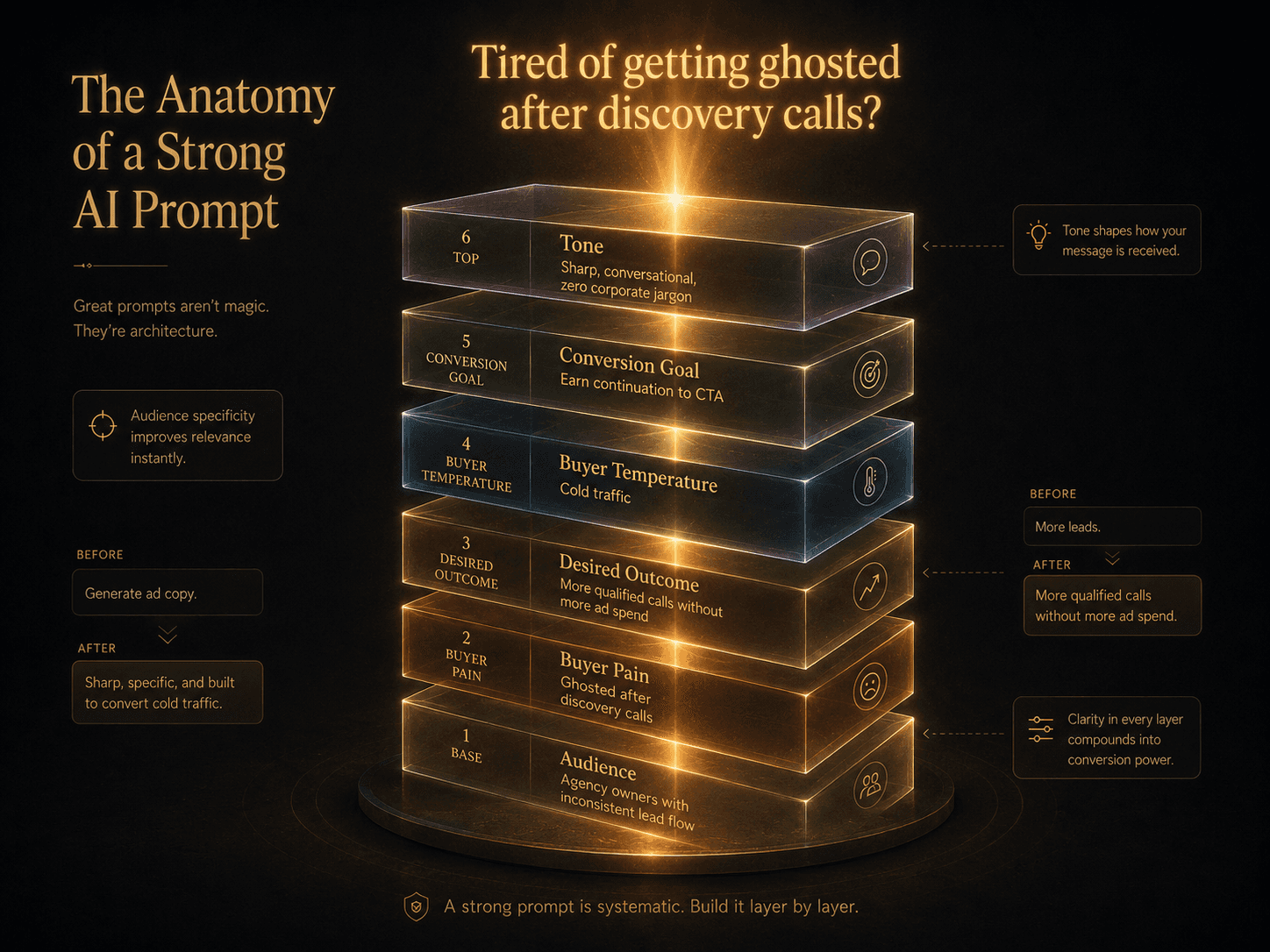
1. Audience™
Who exactly is this for?
Weak:
“Business owners.”
Stronger:
“Agency owners struggling with inconsistent lead flow.”
The clearer the audience, the stronger the output.
Fill this in:
My audience is:
More specifically, they are:
They are currently dealing with:
2. Buyer Pain™
What frustration is emotionally active?
Examples:
ghosted leads
wasted ad spend
low conversion
unstable pipeline
discovery calls that never close
users signing up but not activating
buyers leaving before the CTA
traffic that does not turn into sales
Pain gives the AI emotional direction.
Fill this in:
The buyer’s main pain is:
The repeated frustration is:
The emotional cost is:
3. Desired Outcome™
What does the buyer actually want?
Weak:
“Growth.”
Stronger:
“More qualified sales calls without increasing ad spend.”
Specificity improves output quality massively.
Fill this in:
The buyer wants:
The visible outcome they care about is:
The transformation they want is:
4. Buyer Temperature™
Is this for:
cold traffic?
warm traffic?
hot traffic?
This matters enormously.
Cold buyers need:
curiosity
recognition
low-friction continuation
Warm buyers need:
proof
differentiation
mechanism
trust
Hot buyers need:
clarity
reassurance
speed
action confidence
Fill this in:
The buyer temperature is:
Cold / Warm / Hot
The buyer is currently asking:
5. Conversion Goal™
What should the copy actually achieve?
Examples:
continue scrolling
click the CTA
trust the offer
reduce friction
improve clarity
increase emotional pull
understand the mechanism
believe the proof
submit a form
book a call
download a resource
Without a clear goal, AI defaults to generic writing.
Fill this in:
The conversion goal is:
The buyer should feel:
The next action should be:
6. Tone™
Strong prompting often includes tone direction.
Examples:
sharp
direct
conversational
psychologically driven
emotionally clear
founder-focused
premium
no corporate language
simple but not simplistic
clear but not basic
Tone affects emotional perception dramatically.
Fill this in:
The tone should be:
The tone should avoid:
7. Page Section™
What are you improving?
Examples:
hero headline
subheadline
CTA
proof section
offer section
first scroll
lead magnet page
booking page
product page
sales page
full funnel
Fill this in:
The section I want to improve is:
8. Output Format™
Tell AI exactly how to respond.
Examples:
give 10 headline variations
score the page from 1 to 5
return a diagnosis table
rank the leaks by severity
rewrite in three versions
explain why each version works
separate cold, warm, and hot buyer versions
Fill this in:
I want the output in this format:
——
The Master Strategic Prompt Template™
Use this as your base prompt.
Copy, paste, and customise it.
Act as a conversion strategist trained in buyer psychology, funnel diagnosis, and direct-response messaging.
Analyse the following page section from the perspective of a [cold/warm/hot] buyer.
Audience: [insert audience]
Buyer pain: [insert pain]
Desired outcome: [insert outcome]
Buyer temperature: [cold/warm/hot]
Conversion goal: [insert goal]
Tone: [insert tone]
Page section: [insert page section]
Copy to analyse or improve:
[paste copy]
Please do the following:
Diagnose what is unclear, generic, weak, or psychologically misaligned.
Identify where the copy loses clarity, relevance, belief, trust, or momentum.
Explain what the buyer may be thinking or feeling at this point.
Rewrite the copy in 3 stronger versions.
Make each version more specific, emotionally relevant, and conversion-focused.
Avoid corporate language, vague claims, and generic marketing phrases.
Explain why each version is stronger.
Recommend the best version and why.
——
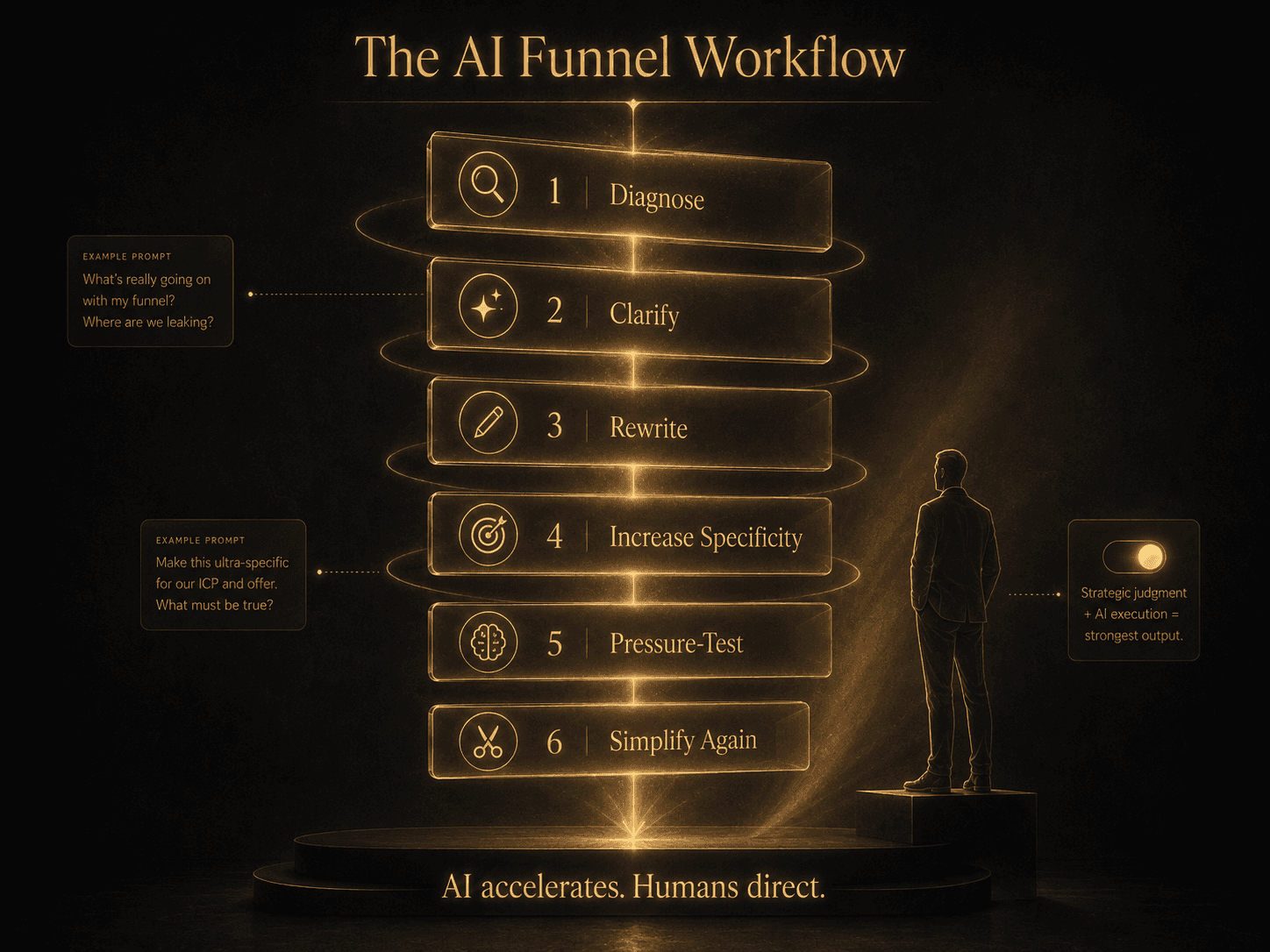
The AI Funnel Workflow™
Use AI in this sequence.
Do not start with rewriting.
Start with diagnosis.
Step 1: Diagnose
Ask AI to identify what is weak, unclear, generic, or misaligned.
This prevents random rewriting.
Prompt direction:
“Diagnose before rewriting.”
Step 2: Clarify
Use AI to simplify unclear messaging.
The goal is lower friction.
Not dumbing the message down.
Prompt direction:
“Make this easier to understand without making it basic.”
Step 3: Rewrite
Generate stronger versions.
Do not accept the first output.
Ask for multiple directions.
Prompt direction:
“Give me 10 variations across different angles.”
Step 4: Increase Specificity
Ask AI to make the copy more concrete.
Add:
clearer audience
sharper pain
stronger outcome
better mechanism
more visible transformation
Prompt direction:
“Make this more specific and less generic.”
Step 5: Pressure-Test
Ask AI to respond like a buyer.
Use:
cold buyer
sceptical buyer
distracted buyer
warm buyer
hot buyer
Prompt direction:
“What would make this buyer hesitate?”
Step 6: Compare Variations
Ask AI to compare outputs.
Do not only generate.
Evaluate.
Prompt direction:
“Rank these versions by clarity, relevance, emotional pull, and conversion strength.”
Step 7: Simplify Again
Most AI output still needs tightening.
Simplify after generation.
Prompt direction:
“Remove unnecessary words, jargon, and weak phrases.”
Step 8: Human Override
You decide what is true, credible, ethical, and strategically right.
AI can draft.
AI can compare.
AI can diagnose.
AI can simplify.
But the human decides what stays.
——
Prompt Library By Use Case
Use the following prompts as working tools.
Adapt them to your offer, buyer, market, and funnel stage.
Do not copy blindly.
Prompt strategically.
AI Prompts For First-Contact Diagnosis™
Use these prompts to pressure-test clarity, relevance, trust, and continuation.
Prompt 1: Cold Buyer First-Contact Test
Act as a cold, distracted buyer landing on this page for the first time.
You have 5 seconds to understand it.
Analyse the page section below and answer:
What is this offer?
Who is it for?
Why should the buyer care?
What feels unclear?
What feels generic?
What trust is missing?
Would you continue reading? Why or why not?
Return your answer in four sections:
Clarity
Relevance
Trust
Continuation
Here is the page section:
[paste copy]
Prompt 2: Drunk Stranger Test Runner
Run this page through the Drunk Stranger Test™.
Assume the visitor is distracted, tired, sceptical, and has no context.
Score the page from 1 to 5 on:
3-second clarity
audience recognition
promise visibility
action obviousness
trust signal
Then explain:
Where the page passes.
Where the page leaks.
What should be fixed first.
What should be rewritten.
What proof or clarity is missing.
Here is the page:
[paste copy]
Prompt 3: Hero Section Clarity Audit
Analyse this hero section for first-contact conversion.
Identify whether the headline, subheadline, proof cue, and CTA clearly answer:
What is this?
Who is it for?
Why does it matter?
Why should I trust it?
What should I do next?
Then give me:
A diagnosis.
The biggest clarity leak.
A stronger headline.
A stronger subheadline.
A stronger proof cue.
A stronger CTA.
Here is the hero section:
[paste copy]
AI Prompts For Funnel Leak Detection™
Use these prompts when you want to diagnose the full funnel, not just the hero.
Prompt 4: Funnel Autopsy Prompt
Analyse this funnel for:
Attention Leaks™
Relevance Leaks™
Curiosity Leaks™
Belief And Trust Leaks™
Friction Leaks™
Action Leaks™
Identify where buyer continuation weakens and explain why psychologically.
Rank the leaks from most damaging to least damaging.
For each leak, include:
The section where it appears.
The psychological failure.
Why it hurts conversion.
The repair action.
Here is the funnel copy or page structure:
[paste copy]
Prompt 5: Momentum Drop Finder
Act as a conversion strategist.
Find the first moment where buyer momentum begins to weaken in this funnel.
Do not give general advice.
Identify the exact section, sentence, CTA, or transition where the buyer is most likely to hesitate.
Then explain:
What the buyer is likely thinking.
What emotion or doubt appears.
What psychological condition failed.
What should be repaired first.
How to rewrite or restructure that section.
Here is the funnel:
[paste copy]
Prompt 6: Sequence Failure Audit
Analyse this funnel for sequencing problems.
Check whether it asks for action before creating enough:
attention
relevance
curiosity
belief
trust
Identify where the funnel:
pushes too early
explains too late
asks for commitment before relevance exists
shows proof too late
creates friction before action
Then recommend the correct sequence.
Here is the funnel:
[paste copy]
AI Prompts For Messaging Improvement™
Use these prompts when the copy feels broad, vague, generic, or emotionally flat.
Prompt 7: Buyer-Specific Messaging Rewrite
Rewrite this headline or section for [specific buyer] who is frustrated with [specific pain] and wants [specific outcome].
Increase:
specificity
emotional recognition
buyer relevance
continuation pull
Avoid:
corporate language
generic marketing phrases
vague growth claims
over-polished AI language
Preserve emotional realism.
Give me 10 versions across these angles:
Pain-led
Desire-led
Identity-led
Situation-led
Friction-led
Here is the copy:
[paste copy]
Prompt 8: Generic Messaging Detector
Analyse this copy and identify every phrase that sounds generic, broad, corporate, or emotionally weak.
For each weak phrase, explain:
Why it is weak.
What the buyer may fail to understand.
How to make it more specific.
A stronger replacement.
Return the output in this format:
Weak phrase:
Why it leaks:
Stronger replacement:
Here is the copy:
[paste copy]
Prompt 9: Self-Relevance Upgrade
Rewrite this messaging so the right buyer feels personally recognised.
The buyer is:
[audience]
They are tired of:
[pain]
They want:
[outcome]
They secretly worry that:
[hidden fear]
Use language that feels like it came from the buyer’s world.
Avoid polished corporate phrasing.
Give me:
A stronger headline.
A stronger subheadline.
Three supporting bullets.
One CTA.
One short explanation of why this is more self-relevant.
Here is the current messaging:
[paste copy]
AI Prompts For Headlines™
Use these prompts to create stronger headline variations.
Prompt 10: Headline Variation Generator
Generate 20 headline variations for a landing page targeting [audience] struggling with [pain] and wanting [outcome].
Create:
5 pain-led headlines
5 outcome-led headlines
5 curiosity-led headlines
3 consequence-led headlines
2 identity-led headlines
Each headline should be:
clear
specific
emotionally relevant
easy to understand
designed to earn continuation
Avoid:
generic startup language
corporate jargon
vague growth claims
clickbait
fake urgency
Prompt 11: Headline Scorecard
Score the following headline from 1 to 5 on:
clarity
specificity
tension
relevance
curiosity
Then explain:
The strongest part of the headline.
The weakest part of the headline.
Why the buyer may or may not continue.
Three stronger headline options.
Headline:
[paste headline]
Audience:
[insert audience]
Buyer temperature:
[cold/warm/hot]
Prompt 12: Headline Rewrite By Buyer Temperature
Rewrite this headline for three buyer temperatures:
Cold buyer who needs recognition and curiosity.
Warm buyer who needs proof and mechanism.
Hot buyer who needs clarity and action confidence.
For each version, explain why it fits that temperature.
Current headline:
[paste headline]
Audience:
[insert audience]
Offer:
[insert offer]
AI Prompts For CTAs™
Use these prompts to make button text and CTA sections stronger.
Prompt 13: CTA Rewrite Prompt
Rewrite these CTAs to feel:
lower friction
more reward-driven
emotionally clearer
more curiosity-based
more specific
more valuable
The audience is:
[audience]
The buyer temperature is:
[cold/warm/hot]
The page goal is:
[goal]
Give me:
5 curiosity CTAs
5 diagnostic CTAs
5 outcome CTAs
5 low-friction CTAs
5 proof-driven CTAs
Current CTAs:
[paste CTAs]
Prompt 14: Dead Button Syndrome Audit
Analyse this CTA for Dead Button Syndrome™.
Explain whether the CTA feels like:
progress
paperwork
value
effort
risk
admin
uncertainty
Then rewrite it to improve:
reward visibility
clarity
movement
low friction
CTA:
[paste CTA]
Page context:
[paste context]
Prompt 15: CTA Microcopy Generator
Create supporting microcopy for this CTA.
The microcopy should reduce hesitation by answering:
What happens next?
Is this low risk?
How long will it take?
What will the buyer get?
Is there any pressure or commitment?
CTA:
[paste CTA]
Audience:
[insert audience]
Offer:
[insert offer]
Buyer concern:
[insert likely hesitation]
Give me 10 microcopy options.
AI Prompts For Simplification™
Use these prompts when the copy feels heavy, abstract, or difficult to process.
Prompt 16: Clarity Simplifier
Rewrite this section at an 8th-grade reading level while preserving emotional sophistication and strategic clarity.
Remove:
corporate jargon
unnecessary complexity
abstract language
vague claims
bloated sentences
Keep:
buyer pain
emotional pull
specificity
authority
premium tone
Here is the copy:
[paste copy]
Prompt 17: Cognitive Friction Reducer
Analyse this page section for cognitive friction.
Identify anything that makes the buyer work too hard to understand the message.
Look for:
long sentences
vague phrases
unclear claims
too many ideas
weak structure
confusing transitions
unnecessary abstraction
Then rewrite the section to make it easier to process while preserving the original meaning.
Here is the section:
[paste copy]
Prompt 18: Simple But Premium Rewrite
Rewrite this copy so it becomes simpler, sharper, and easier to understand.
Do not make it basic.
Do not make it childish.
Do not remove the strategic depth.
The goal is lower friction, not lower intelligence.
Here is the copy:
[paste copy]
AI Prompts For Buyer Language Extraction™
Use these prompts when you have reviews, comments, calls, messages, survey answers, or customer feedback.
Prompt 19: Buyer Language Mining Prompt
Analyse these customer reviews, comments, or notes and extract:
repeated frustrations
emotional phrases
recurring fears
desired outcomes
objections
exact wording buyers use repeatedly
moments of hesitation
symptoms of the problem
Return the output in this format:
Exact phrase:
Emotion behind it:
Buyer pain:
Desired outcome:
Objection revealed:
Possible headline:
Possible CTA:
Here is the buyer language:
[paste reviews/comments/notes]
Prompt 20: Voice Of Customer Headline Builder
Use the customer language below to create headline ideas.
Do not over-polish the language.
Preserve emotional realism.
Create:
5 pain-led headlines
5 curiosity headlines
5 outcome headlines
5 identity headlines
Also explain which buyer phrase inspired each headline.
Customer language:
[paste customer language]
Prompt 21: Objection Extraction Prompt
Analyse the following buyer comments and identify the hidden objections.
For each objection, explain:
What the buyer is really worried about.
What proof would reduce the worry.
What page section should address it.
A possible sentence or section headline that handles the objection.
Here are the comments:
[paste comments]
AI Prompts For Proof And Trust™
Use these prompts when the funnel makes claims but does not support them well enough.
Important:
Do not use AI to invent proof.
Do not use AI to fabricate testimonials.
Do not use AI to create fake case studies.
Use AI to organise, frame, and strengthen real proof.
Prompt 22: Proof Gap Audit
Analyse this page and identify every claim that needs proof.
For each claim, tell me:
What proof is needed.
Where the proof should appear.
Whether the proof should be a testimonial, screenshot, number, case study, logo, mechanism explanation, or guarantee.
What doubt the proof would reduce.
Here is the page:
[paste page copy]
Prompt 23: Proof Placement Prompt
Review the proof on this page.
Tell me whether proof appears:
above the fold
near the CTA
near major claims
before doubt hardens
before the page asks for action
Then recommend where proof should move or be added.
Here is the page:
[paste page copy]
Prompt 24: Real Proof Framing Prompt
I have the following real proof:
[paste proof]
Help me frame it more clearly without exaggerating or fabricating anything.
Create:
A short proof cue.
A testimonial-style summary.
A one-sentence case study fragment.
A CTA-adjacent proof line.
Keep the claim accurate and believable.
Weak Vs Strong AI Prompts™
The difference between weak and strong prompting is not complexity.
It is strategic clarity.
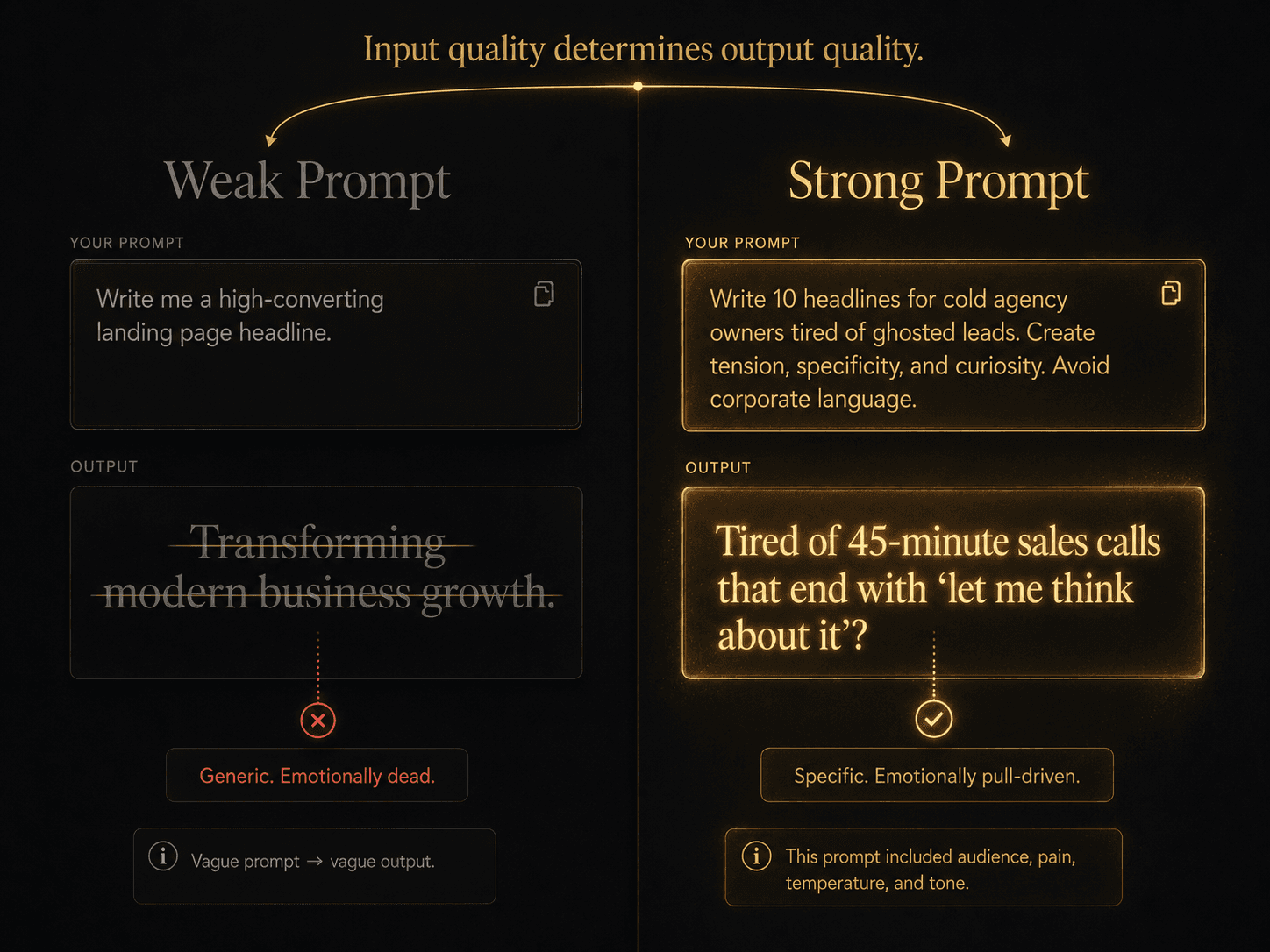
Weak Prompt
“Write me a landing page headline.”
Likely output:
Generic.
Broad.
Emotionally weak.
Strong Prompt
“Write 10 emotionally specific headlines for cold ecommerce founders frustrated with rising ad costs and declining ROAS.
The headlines should:
create tension
feel psychologically relevant
increase continuation
avoid generic marketing language
sound conversational, sharp, and specific
Separate the headlines into pain-led, curiosity-led, and consequence-led options.”
Likely output:
More specific.
More relevant.
More usable.
Easier to judge.
More Weak Vs Strong Prompt Examples
Example 1: CTA
Weak prompt:
“Write a better CTA.”
Strong prompt:
“Rewrite this CTA for cold traffic so it feels lower-friction, more reward-visible, and more curiosity-driven. The buyer is sceptical and does not want to book a call yet. Give me 10 options and explain which one creates the least resistance.”
Example 2: Funnel Audit
Weak prompt:
“Review my landing page.”
Strong prompt:
“Analyse this landing page for attention leaks, relevance leaks, belief gaps, trust gaps, friction, and CTA weakness. Rank the problems from most damaging to least damaging and tell me what to fix first.”
Example 3: Messaging
Weak prompt:
“Make this messaging better.”
Strong prompt:
“Rewrite this messaging for SaaS founders who are getting signups but losing users before activation. Preserve the emotional reality of that frustration. Avoid generic SaaS language. Give me five headline options and five subheadline options.”
Example 4: Simplification
Weak prompt:
“Make this simpler.”
Strong prompt:
“Rewrite this section so a distracted buyer can understand it quickly. Remove corporate jargon and abstract claims, but keep the tone premium, direct, and strategically sharp.”
Example 5: Proof
Weak prompt:
“Write testimonials for my business.”
Do not do this.
Strong prompt:
“Here are three real customer comments. Extract the strongest trust signals, identify what claims they support, and help me frame them accurately without exaggeration.”
——
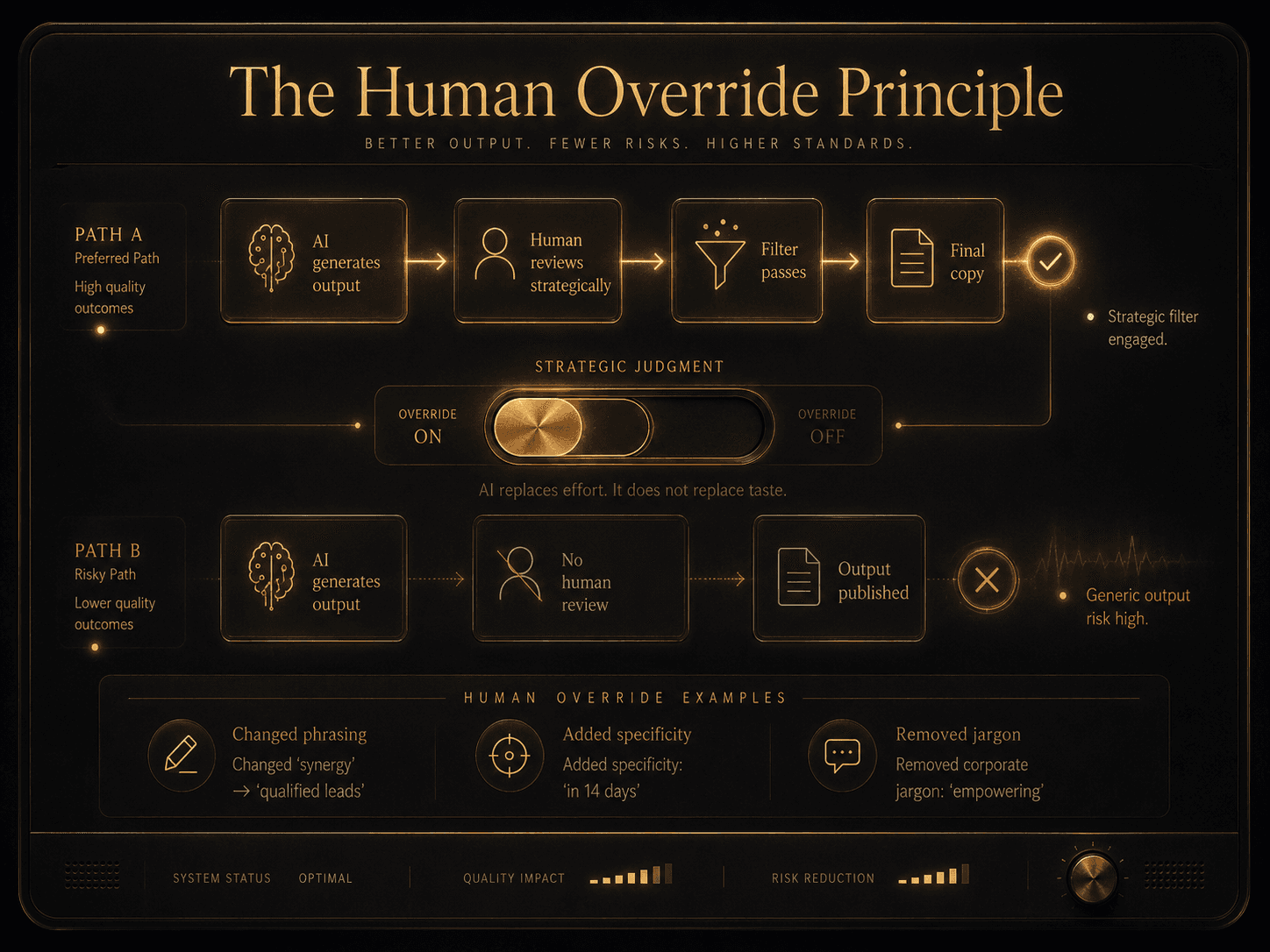
The Human Override Principle™
AI cannot replace:
strategic judgement
buyer empathy
emotional intelligence
positioning understanding
market awareness
psychological nuance
ethical decision-making
proof verification
taste
It accelerates execution.
It does not replace thinking.
This distinction matters enormously.
Great funnels are not built through button pushing.
They are built through understanding people deeply.
AI can help you move faster.
But speed without judgement creates faster mediocrity.
The human decides what is true.
The human decides what is credible.
The human decides what is ethical.
The human decides what is strategically right.
The human decides what sounds like the buyer.
The human decides what belongs on the page.
That is the override.
Common AI Copywriting Mistakes™
Use this section to avoid creating generic AI funnel copy.
Strategy Mistakes
prompting before positioning is clear
asking AI to invent the strategy
using AI without understanding the buyer
generating pages before the offer is clear
asking for conversion copy without a conversion goal
If the strategy is weak, the output will be weak.
Prompting Mistakes
asking vague questions
using broad audience descriptions
giving no buyer pain
giving no desired outcome
giving no buyer temperature
giving no tone direction
giving no output format
Vague prompts create vague outputs.
Editing Mistakes
accepting first drafts immediately
publishing without human review
leaving in generic phrases
allowing AI to over-polish the message
keeping copy that sounds good but says little
failing to test the output against buyer psychology
AI output still requires editing.
Always.
Ethics And Trust Mistakes
asking AI to invent testimonials
fabricating case studies
creating fake proof
exaggerating results
using unsupported numbers
pretending AI-generated claims are real evidence
creating urgency that is not true
Trust is hard to build and easy to destroy.
Do not use AI to fake credibility.
Use AI to clarify real credibility.
The “Does This Sound Human?” Test™
Read the AI output out loud.
Ask:
Does this feel emotionally believable?
Does this sound like a real person would say this?
Does this create tension or emotional pull?
Does this feel overly polished or robotic?
Does this sound like the buyer’s world?
Would the buyer actually say this?
Is there any phrase that sounds like generic AI marketing?
If the copy sounds sterile, it probably still lacks emotional specificity.
If the copy sounds human but not buyer-specific, it still needs work.
The goal is not only to sound human.
The goal is to sound relevant.
The AI Output Review Checklist™
Before using any AI-generated copy, check it against this list.
☐ Is the audience clear?
☐ Is the pain specific?
☐ Is the outcome visible?
☐ Is the message easy to understand?
☐ Does it avoid corporate fog?
☐ Does it create emotional recognition?
☐ Does it match the buyer temperature?
☐ Does it support the conversion goal?
☐ Does it make the next step clearer?
☐ Does it avoid unsupported claims?
☐ Does it avoid invented proof?
☐ Does it sound like something a real buyer would understand?
☐ Does it need simplification?
☐ Does it need more specificity?
☐ Would I confidently put this in front of the right buyer?
If several boxes remain unchecked, do not publish the output yet.
Revise it.
Quick AI Prompt Rebuild Exercise™
Use this worksheet to turn a weak prompt into a strategic prompt.
My Audience
Their Biggest Pain
Their Desired Outcome
Their Buyer Temperature
Cold / Warm / Hot
My Conversion Goal
The Page Section I Want To Improve
Tone I Want
Tone I Want To Avoid
Weak Prompt
Why This Prompt Is Too Weak
Stronger Strategic Prompt
Output Format I Want
Human Filter I Will Apply
Example Completed Prompt Rebuild
Weak Prompt
“Write me a headline.”
Stronger Strategic Prompt
“Write 15 headline variations for a landing page targeting agency owners who are tired of relying on referrals and want more predictable booked calls.
The audience is cold traffic, so the headlines should create recognition, curiosity, and continuation without pushing for a call too early.
Create:
5 pain-led headlines
5 curiosity-led headlines
5 outcome-led headlines
Avoid generic phrases like ‘scale your agency’, ‘unlock growth’, or ‘transform your business’.
Keep the tone direct, sharp, and emotionally specific.”
Why This Is Better
The stronger prompt gives AI:
audience
pain
outcome
buyer temperature
conversion goal
tone
output structure
phrases to avoid
That creates a better starting point.
Not a perfect final answer.
A better starting point.
——
How To Use Funnels By Maris Spalins™
You can use these prompts in any capable AI tool.
They are designed to work especially well with Funnels By Maris Spalins™, the custom implementation assistant created around the frameworks, principles, and conversion systems explored throughout The $100M Funnel Playbook.
Use it to help you:
diagnose funnel leaks
rewrite weak messaging
improve headlines and CTAs
pressure-test offers
identify clarity problems
improve buyer alignment
generate strategic variations
simplify complicated copy
strengthen conversion sequencing
But remember the rule.
The assistant can help you apply the frameworks.
It does not remove your responsibility to think.
The better your strategic input becomes, the more useful the output becomes.
The 30-Minute AI Funnel Improvement Process™
Use this process when you want to improve one weak funnel section quickly.
Minutes 0–5: Choose One Section
Do not give AI the entire business at once.
Choose one section.
Examples:
headline
subheadline
CTA
hero section
proof section
offer section
booking page
lead magnet page
Write the section here:
Minutes 5–10: Complete The Strategic Prompt Brief™
Fill in:
audience
buyer pain
desired outcome
buyer temperature
conversion goal
tone
output format
Do not skip this.
This is what prevents generic output.
Minutes 10–15: Run A Diagnostic Prompt
Before rewriting, ask AI to diagnose.
Use:
“Identify what is unclear, generic, weak, or psychologically misaligned in this section.”
Write the biggest issue here:
Minutes 15–20: Generate Variations
Ask AI for multiple versions.
Do not ask for one.
Ask for several angles:
pain-led
outcome-led
curiosity-led
consequence-led
identity-led
Write the strongest version here:
Minutes 20–25: Pressure-Test The Best Version
Ask AI:
“Act as a sceptical buyer. What would still make you hesitate?”
Write the hesitation here:
Now fix that hesitation.
Minutes 25–30: Human Edit
Read the final copy out loud.
Check:
Is it true?
Is it specific?
Is it emotionally believable?
Is it clear?
Does it sound like the buyer’s world?
Does it avoid fake proof?
Does it support the funnel sequence?
Final version:
——
Final Principle™
AI does not create great messaging automatically.
It amplifies the quality of the strategic thinking behind the prompt.
That is why buyer psychology matters.
Positioning matters.
Messaging clarity matters.
Funnel understanding matters.
Proof matters.
Human judgement matters.
The stronger your strategic foundation becomes, the more powerful AI becomes as an implementation accelerator.
Used poorly, AI creates generic noise.
Used strategically, AI becomes one of the fastest funnel improvement tools ever created.
Pick one weak page section.
Run one diagnostic prompt.
Generate three stronger versions.
Pressure-test the strongest one.
Then manually choose, edit, and test the best version.
Do not let AI replace your judgement.
Use it to sharpen your judgement.
That is what The AI Funnel Prompt Library™ is built to help you do.
——
From:
The $100M Funnel Playbook. Book I: Foundation Buyer Psychology, Offer Clarity, and the Page Architecture Behind High-Converting Funnels
By Maris Spalins.
——
Copyright Notice
© 2026 The $100M Funnel Playbook / Winyourclients / Maris Spalins. All rights reserved.
This resource, including the frameworks, terminology, examples, scorecards, templates, prompts, methods, and written explanations, is original intellectual property created for The $100M Funnel Playbook. Book I: Foundation — Buyer Psychology, Offer Clarity, And The Page Architecture Behind High-Converting Funnels and published through Winyourclients.
No part of this resource may be copied, reproduced, screenshotted, republished, redistributed, sold, adapted, uploaded, scraped, stored in a database, included in training data, used to train artificial intelligence systems, or used to create derivative commercial or educational materials without prior written permission.
Limited reference, quotation, or sharing is only permitted where the source is clearly and visibly credited.
Any permitted reference must include at least one of the following source credits:
The $100M Funnel Playbook by Maris Spalins
or
Winyourclients — www.winyourclients.com
or
Maris Spalins / Winyourclients
Screenshots, excerpts, summaries, or redistributed versions must not remove, hide, alter, crop out, or obscure the original source, author name, book title, website name, or copyright notice.
This resource is provided for personal learning and implementation only. It is not licensed for resale, republishing, redistribution, AI training, template cloning, course creation, consulting delivery, or commercial reuse without written permission from Maris Spalins or Winyourclients.
For permission requests, licensing, citation approval, or commercial usage enquiries, contact:
Winyourclients
www.winyourclients.com
or
Email directly to Jacob on: help@winyourclients.com
The AI Funnel Prompt Library™ How to use AI strategically to diagnose funnel leaks, improve buyer messaging, rewrite headlines and CTAs, simplify page copy, and pressure-test conversion psychology without creating generic AI noise.
Prefer Audio Or Video?
The AI Funnel Prompt Library™ is also available as:
🎧 A guided audio walkthrough explaining strategic AI prompting for funnels and conversion systems
🎥 A practical video breakdown with real AI prompt examples, rewrites, diagnostics, and implementation workflowsChoose the format that fits how you learn best.
[Listen To The Audio Walkthrough] (coming soon)
[Watch The Video Breakdown] (coming soon)
——
Why Most AI Funnel Copy Feels Generic
Most AI-generated marketing content fails for the same reason most weak funnels fail.
The strategic input is weak.
People open AI tools and type prompts like:
“Write me a high-converting landing page.”
“Write better copy.”
“Create a CTA.”
“Write a headline.”
“Improve this funnel.”
The output usually sounds:
generic
emotionally flat
broad
repetitive
corporate
strategically weak
interchangeable with everything else online
Not because AI is useless.
Because vague prompts create vague outputs.
AI amplifies the quality of the strategic thinking behind the prompt.
Weak strategy in.
Weak output out.
Strong strategy in.
Much stronger execution out.
That is the real power of AI inside funnel building.
Not replacement.
Amplification.
AI should not replace your understanding of the buyer.
It should help you apply that understanding faster.
That is what this resource is designed to help you do.
——
What This Resource Helps You Do
The AI Funnel Prompt Library™ helps you use AI as a strategic funnel improvement tool instead of a generic copy generator.
Use it to:
diagnose funnel leaks
improve headline clarity
rewrite weak CTAs
sharpen buyer messaging
simplify confusing copy
extract real buyer language
pressure-test page sections
compare stronger variations
identify weak proof
reduce friction
improve conversion sequencing
strengthen first-contact clarity
This is not a collection of magic prompts.
It is a strategic prompting system.
The goal is not to make AI write everything for you.
The goal is to make AI help you think, diagnose, rewrite, compare, and improve faster.
AI becomes powerful when it is guided by buyer psychology.
Without that, it produces noise.
With it, it becomes an implementation accelerator.
——
The AI Amplification Principle™
AI does not magically create strong positioning.
It amplifies the quality of the inputs you give it.
AI can amplify:
clarity
confusion
specificity
vagueness
buyer understanding
weak strategic thinking
strong strategic thinking
emotional precision
generic assumptions
This is why two people can use the exact same AI tool and produce completely different results.
One gets forgettable copy.
The other gets highly usable strategic drafts.
The difference is usually not the tool.
The difference is the quality of the prompt structure, buyer understanding, and strategic direction.
AI does not replace positioning.
It amplifies positioning.
AI does not replace buyer psychology.
It amplifies buyer psychology.
AI does not replace human judgement.
It accelerates execution when human judgement is already present.
That distinction matters.
——
What AI Is Actually Best Used For™
AI performs best when used as:
a diagnostic assistant
a rewrite assistant
a brainstorming partner
a positioning analyser
a headline generator
a CTA variation tool
a friction detector
a simplification tool
a buyer-language organiser
a conversion thought partner
a pressure-testing assistant
AI performs worst when treated like:
a magic “make me rich” button
a substitute for buyer research
a replacement for strategy
a proof inventor
a testimonial generator
a fake case study machine
a tool for publishing first drafts without judgement
That mindset produces generic marketing very quickly.
Used poorly, AI creates more noise.
Used strategically, AI helps you expose weak thinking faster.
The tool is not the strategy.
The prompt is not the strategy.
The strategy behind the prompt is what makes the output useful.
——
The Biggest AI Copywriting Mistake™
Most people ask AI:
“What should I say?”
Better marketers ask:
“How should this buyer psychologically experience this message?”
That difference changes output quality dramatically.
The first question produces surface copy.
The second question produces strategic copy.
Funnels are psychological systems first.
They are not just pages filled with words.
Every section should help the buyer:
understand
care
believe
trust
continue
act
AI works best when your prompts reflect that reality.
Do not only ask AI to write.
Ask AI to diagnose what the buyer is likely feeling.
Ask AI where clarity breaks.
Ask AI where trust weakens.
Ask AI where the CTA creates friction.
Ask AI where the message sounds generic.
Ask AI where the page asks for action too early.
That is how AI becomes useful strategically.
——
The Strategic Prompt Brief™
Before asking AI to rewrite anything, complete this brief.
Most bad AI outputs happen because the prompt does not include enough strategic context.
Use this before generating headlines, CTAs, page copy, emails, ads, or funnel audits.
1. Audience™
Who exactly is this for?
Weak:
“Business owners.”
Stronger:
“Agency owners struggling with inconsistent lead flow.”
The clearer the audience, the stronger the output.
Fill this in:
My audience is:
More specifically, they are:
They are currently dealing with:
2. Buyer Pain™
What frustration is emotionally active?
Examples:
ghosted leads
wasted ad spend
low conversion
unstable pipeline
discovery calls that never close
users signing up but not activating
buyers leaving before the CTA
traffic that does not turn into sales
Pain gives the AI emotional direction.
Fill this in:
The buyer’s main pain is:
The repeated frustration is:
The emotional cost is:
3. Desired Outcome™
What does the buyer actually want?
Weak:
“Growth.”
Stronger:
“More qualified sales calls without increasing ad spend.”
Specificity improves output quality massively.
Fill this in:
The buyer wants:
The visible outcome they care about is:
The transformation they want is:
4. Buyer Temperature™
Is this for:
cold traffic?
warm traffic?
hot traffic?
This matters enormously.
Cold buyers need:
curiosity
recognition
low-friction continuation
Warm buyers need:
proof
differentiation
mechanism
trust
Hot buyers need:
clarity
reassurance
speed
action confidence
Fill this in:
The buyer temperature is:
Cold / Warm / Hot
The buyer is currently asking:
5. Conversion Goal™
What should the copy actually achieve?
Examples:
continue scrolling
click the CTA
trust the offer
reduce friction
improve clarity
increase emotional pull
understand the mechanism
believe the proof
submit a form
book a call
download a resource
Without a clear goal, AI defaults to generic writing.
Fill this in:
The conversion goal is:
The buyer should feel:
The next action should be:
6. Tone™
Strong prompting often includes tone direction.
Examples:
sharp
direct
conversational
psychologically driven
emotionally clear
founder-focused
premium
no corporate language
simple but not simplistic
clear but not basic
Tone affects emotional perception dramatically.
Fill this in:
The tone should be:
The tone should avoid:
7. Page Section™
What are you improving?
Examples:
hero headline
subheadline
CTA
proof section
offer section
first scroll
lead magnet page
booking page
product page
sales page
full funnel
Fill this in:
The section I want to improve is:
8. Output Format™
Tell AI exactly how to respond.
Examples:
give 10 headline variations
score the page from 1 to 5
return a diagnosis table
rank the leaks by severity
rewrite in three versions
explain why each version works
separate cold, warm, and hot buyer versions
Fill this in:
I want the output in this format:
——
The Master Strategic Prompt Template™
Use this as your base prompt.
Copy, paste, and customise it.
Act as a conversion strategist trained in buyer psychology, funnel diagnosis, and direct-response messaging.
Analyse the following page section from the perspective of a [cold/warm/hot] buyer.
Audience: [insert audience]
Buyer pain: [insert pain]
Desired outcome: [insert outcome]
Buyer temperature: [cold/warm/hot]
Conversion goal: [insert goal]
Tone: [insert tone]
Page section: [insert page section]
Copy to analyse or improve:
[paste copy]
Please do the following:
Diagnose what is unclear, generic, weak, or psychologically misaligned.
Identify where the copy loses clarity, relevance, belief, trust, or momentum.
Explain what the buyer may be thinking or feeling at this point.
Rewrite the copy in 3 stronger versions.
Make each version more specific, emotionally relevant, and conversion-focused.
Avoid corporate language, vague claims, and generic marketing phrases.
Explain why each version is stronger.
Recommend the best version and why.
——
The AI Funnel Workflow™
Use AI in this sequence.
Do not start with rewriting.
Start with diagnosis.
Step 1: Diagnose
Ask AI to identify what is weak, unclear, generic, or misaligned.
This prevents random rewriting.
Prompt direction:
“Diagnose before rewriting.”
Step 2: Clarify
Use AI to simplify unclear messaging.
The goal is lower friction.
Not dumbing the message down.
Prompt direction:
“Make this easier to understand without making it basic.”
Step 3: Rewrite
Generate stronger versions.
Do not accept the first output.
Ask for multiple directions.
Prompt direction:
“Give me 10 variations across different angles.”
Step 4: Increase Specificity
Ask AI to make the copy more concrete.
Add:
clearer audience
sharper pain
stronger outcome
better mechanism
more visible transformation
Prompt direction:
“Make this more specific and less generic.”
Step 5: Pressure-Test
Ask AI to respond like a buyer.
Use:
cold buyer
sceptical buyer
distracted buyer
warm buyer
hot buyer
Prompt direction:
“What would make this buyer hesitate?”
Step 6: Compare Variations
Ask AI to compare outputs.
Do not only generate.
Evaluate.
Prompt direction:
“Rank these versions by clarity, relevance, emotional pull, and conversion strength.”
Step 7: Simplify Again
Most AI output still needs tightening.
Simplify after generation.
Prompt direction:
“Remove unnecessary words, jargon, and weak phrases.”
Step 8: Human Override
You decide what is true, credible, ethical, and strategically right.
AI can draft.
AI can compare.
AI can diagnose.
AI can simplify.
But the human decides what stays.
——
Prompt Library By Use Case
Use the following prompts as working tools.
Adapt them to your offer, buyer, market, and funnel stage.
Do not copy blindly.
Prompt strategically.
AI Prompts For First-Contact Diagnosis™
Use these prompts to pressure-test clarity, relevance, trust, and continuation.
Prompt 1: Cold Buyer First-Contact Test
Act as a cold, distracted buyer landing on this page for the first time.
You have 5 seconds to understand it.
Analyse the page section below and answer:
What is this offer?
Who is it for?
Why should the buyer care?
What feels unclear?
What feels generic?
What trust is missing?
Would you continue reading? Why or why not?
Return your answer in four sections:
Clarity
Relevance
Trust
Continuation
Here is the page section:
[paste copy]
Prompt 2: Drunk Stranger Test Runner
Run this page through the Drunk Stranger Test™.
Assume the visitor is distracted, tired, sceptical, and has no context.
Score the page from 1 to 5 on:
3-second clarity
audience recognition
promise visibility
action obviousness
trust signal
Then explain:
Where the page passes.
Where the page leaks.
What should be fixed first.
What should be rewritten.
What proof or clarity is missing.
Here is the page:
[paste copy]
Prompt 3: Hero Section Clarity Audit
Analyse this hero section for first-contact conversion.
Identify whether the headline, subheadline, proof cue, and CTA clearly answer:
What is this?
Who is it for?
Why does it matter?
Why should I trust it?
What should I do next?
Then give me:
A diagnosis.
The biggest clarity leak.
A stronger headline.
A stronger subheadline.
A stronger proof cue.
A stronger CTA.
Here is the hero section:
[paste copy]
AI Prompts For Funnel Leak Detection™
Use these prompts when you want to diagnose the full funnel, not just the hero.
Prompt 4: Funnel Autopsy Prompt
Analyse this funnel for:
Attention Leaks™
Relevance Leaks™
Curiosity Leaks™
Belief And Trust Leaks™
Friction Leaks™
Action Leaks™
Identify where buyer continuation weakens and explain why psychologically.
Rank the leaks from most damaging to least damaging.
For each leak, include:
The section where it appears.
The psychological failure.
Why it hurts conversion.
The repair action.
Here is the funnel copy or page structure:
[paste copy]
Prompt 5: Momentum Drop Finder
Act as a conversion strategist.
Find the first moment where buyer momentum begins to weaken in this funnel.
Do not give general advice.
Identify the exact section, sentence, CTA, or transition where the buyer is most likely to hesitate.
Then explain:
What the buyer is likely thinking.
What emotion or doubt appears.
What psychological condition failed.
What should be repaired first.
How to rewrite or restructure that section.
Here is the funnel:
[paste copy]
Prompt 6: Sequence Failure Audit
Analyse this funnel for sequencing problems.
Check whether it asks for action before creating enough:
attention
relevance
curiosity
belief
trust
Identify where the funnel:
pushes too early
explains too late
asks for commitment before relevance exists
shows proof too late
creates friction before action
Then recommend the correct sequence.
Here is the funnel:
[paste copy]
AI Prompts For Messaging Improvement™
Use these prompts when the copy feels broad, vague, generic, or emotionally flat.
Prompt 7: Buyer-Specific Messaging Rewrite
Rewrite this headline or section for [specific buyer] who is frustrated with [specific pain] and wants [specific outcome].
Increase:
specificity
emotional recognition
buyer relevance
continuation pull
Avoid:
corporate language
generic marketing phrases
vague growth claims
over-polished AI language
Preserve emotional realism.
Give me 10 versions across these angles:
Pain-led
Desire-led
Identity-led
Situation-led
Friction-led
Here is the copy:
[paste copy]
Prompt 8: Generic Messaging Detector
Analyse this copy and identify every phrase that sounds generic, broad, corporate, or emotionally weak.
For each weak phrase, explain:
Why it is weak.
What the buyer may fail to understand.
How to make it more specific.
A stronger replacement.
Return the output in this format:
Weak phrase:
Why it leaks:
Stronger replacement:
Here is the copy:
[paste copy]
Prompt 9: Self-Relevance Upgrade
Rewrite this messaging so the right buyer feels personally recognised.
The buyer is:
[audience]
They are tired of:
[pain]
They want:
[outcome]
They secretly worry that:
[hidden fear]
Use language that feels like it came from the buyer’s world.
Avoid polished corporate phrasing.
Give me:
A stronger headline.
A stronger subheadline.
Three supporting bullets.
One CTA.
One short explanation of why this is more self-relevant.
Here is the current messaging:
[paste copy]
AI Prompts For Headlines™
Use these prompts to create stronger headline variations.
Prompt 10: Headline Variation Generator
Generate 20 headline variations for a landing page targeting [audience] struggling with [pain] and wanting [outcome].
Create:
5 pain-led headlines
5 outcome-led headlines
5 curiosity-led headlines
3 consequence-led headlines
2 identity-led headlines
Each headline should be:
clear
specific
emotionally relevant
easy to understand
designed to earn continuation
Avoid:
generic startup language
corporate jargon
vague growth claims
clickbait
fake urgency
Prompt 11: Headline Scorecard
Score the following headline from 1 to 5 on:
clarity
specificity
tension
relevance
curiosity
Then explain:
The strongest part of the headline.
The weakest part of the headline.
Why the buyer may or may not continue.
Three stronger headline options.
Headline:
[paste headline]
Audience:
[insert audience]
Buyer temperature:
[cold/warm/hot]
Prompt 12: Headline Rewrite By Buyer Temperature
Rewrite this headline for three buyer temperatures:
Cold buyer who needs recognition and curiosity.
Warm buyer who needs proof and mechanism.
Hot buyer who needs clarity and action confidence.
For each version, explain why it fits that temperature.
Current headline:
[paste headline]
Audience:
[insert audience]
Offer:
[insert offer]
AI Prompts For CTAs™
Use these prompts to make button text and CTA sections stronger.
Prompt 13: CTA Rewrite Prompt
Rewrite these CTAs to feel:
lower friction
more reward-driven
emotionally clearer
more curiosity-based
more specific
more valuable
The audience is:
[audience]
The buyer temperature is:
[cold/warm/hot]
The page goal is:
[goal]
Give me:
5 curiosity CTAs
5 diagnostic CTAs
5 outcome CTAs
5 low-friction CTAs
5 proof-driven CTAs
Current CTAs:
[paste CTAs]
Prompt 14: Dead Button Syndrome Audit
Analyse this CTA for Dead Button Syndrome™.
Explain whether the CTA feels like:
progress
paperwork
value
effort
risk
admin
uncertainty
Then rewrite it to improve:
reward visibility
clarity
movement
low friction
CTA:
[paste CTA]
Page context:
[paste context]
Prompt 15: CTA Microcopy Generator
Create supporting microcopy for this CTA.
The microcopy should reduce hesitation by answering:
What happens next?
Is this low risk?
How long will it take?
What will the buyer get?
Is there any pressure or commitment?
CTA:
[paste CTA]
Audience:
[insert audience]
Offer:
[insert offer]
Buyer concern:
[insert likely hesitation]
Give me 10 microcopy options.
AI Prompts For Simplification™
Use these prompts when the copy feels heavy, abstract, or difficult to process.
Prompt 16: Clarity Simplifier
Rewrite this section at an 8th-grade reading level while preserving emotional sophistication and strategic clarity.
Remove:
corporate jargon
unnecessary complexity
abstract language
vague claims
bloated sentences
Keep:
buyer pain
emotional pull
specificity
authority
premium tone
Here is the copy:
[paste copy]
Prompt 17: Cognitive Friction Reducer
Analyse this page section for cognitive friction.
Identify anything that makes the buyer work too hard to understand the message.
Look for:
long sentences
vague phrases
unclear claims
too many ideas
weak structure
confusing transitions
unnecessary abstraction
Then rewrite the section to make it easier to process while preserving the original meaning.
Here is the section:
[paste copy]
Prompt 18: Simple But Premium Rewrite
Rewrite this copy so it becomes simpler, sharper, and easier to understand.
Do not make it basic.
Do not make it childish.
Do not remove the strategic depth.
The goal is lower friction, not lower intelligence.
Here is the copy:
[paste copy]
AI Prompts For Buyer Language Extraction™
Use these prompts when you have reviews, comments, calls, messages, survey answers, or customer feedback.
Prompt 19: Buyer Language Mining Prompt
Analyse these customer reviews, comments, or notes and extract:
repeated frustrations
emotional phrases
recurring fears
desired outcomes
objections
exact wording buyers use repeatedly
moments of hesitation
symptoms of the problem
Return the output in this format:
Exact phrase:
Emotion behind it:
Buyer pain:
Desired outcome:
Objection revealed:
Possible headline:
Possible CTA:
Here is the buyer language:
[paste reviews/comments/notes]
Prompt 20: Voice Of Customer Headline Builder
Use the customer language below to create headline ideas.
Do not over-polish the language.
Preserve emotional realism.
Create:
5 pain-led headlines
5 curiosity headlines
5 outcome headlines
5 identity headlines
Also explain which buyer phrase inspired each headline.
Customer language:
[paste customer language]
Prompt 21: Objection Extraction Prompt
Analyse the following buyer comments and identify the hidden objections.
For each objection, explain:
What the buyer is really worried about.
What proof would reduce the worry.
What page section should address it.
A possible sentence or section headline that handles the objection.
Here are the comments:
[paste comments]
AI Prompts For Proof And Trust™
Use these prompts when the funnel makes claims but does not support them well enough.
Important:
Do not use AI to invent proof.
Do not use AI to fabricate testimonials.
Do not use AI to create fake case studies.
Use AI to organise, frame, and strengthen real proof.
Prompt 22: Proof Gap Audit
Analyse this page and identify every claim that needs proof.
For each claim, tell me:
What proof is needed.
Where the proof should appear.
Whether the proof should be a testimonial, screenshot, number, case study, logo, mechanism explanation, or guarantee.
What doubt the proof would reduce.
Here is the page:
[paste page copy]
Prompt 23: Proof Placement Prompt
Review the proof on this page.
Tell me whether proof appears:
above the fold
near the CTA
near major claims
before doubt hardens
before the page asks for action
Then recommend where proof should move or be added.
Here is the page:
[paste page copy]
Prompt 24: Real Proof Framing Prompt
I have the following real proof:
[paste proof]
Help me frame it more clearly without exaggerating or fabricating anything.
Create:
A short proof cue.
A testimonial-style summary.
A one-sentence case study fragment.
A CTA-adjacent proof line.
Keep the claim accurate and believable.
Weak Vs Strong AI Prompts™
The difference between weak and strong prompting is not complexity.
It is strategic clarity.
Weak Prompt
“Write me a landing page headline.”
Likely output:
Generic.
Broad.
Emotionally weak.
Strong Prompt
“Write 10 emotionally specific headlines for cold ecommerce founders frustrated with rising ad costs and declining ROAS.
The headlines should:
create tension
feel psychologically relevant
increase continuation
avoid generic marketing language
sound conversational, sharp, and specific
Separate the headlines into pain-led, curiosity-led, and consequence-led options.”
Likely output:
More specific.
More relevant.
More usable.
Easier to judge.
More Weak Vs Strong Prompt Examples
Example 1: CTA
Weak prompt:
“Write a better CTA.”
Strong prompt:
“Rewrite this CTA for cold traffic so it feels lower-friction, more reward-visible, and more curiosity-driven. The buyer is sceptical and does not want to book a call yet. Give me 10 options and explain which one creates the least resistance.”
Example 2: Funnel Audit
Weak prompt:
“Review my landing page.”
Strong prompt:
“Analyse this landing page for attention leaks, relevance leaks, belief gaps, trust gaps, friction, and CTA weakness. Rank the problems from most damaging to least damaging and tell me what to fix first.”
Example 3: Messaging
Weak prompt:
“Make this messaging better.”
Strong prompt:
“Rewrite this messaging for SaaS founders who are getting signups but losing users before activation. Preserve the emotional reality of that frustration. Avoid generic SaaS language. Give me five headline options and five subheadline options.”
Example 4: Simplification
Weak prompt:
“Make this simpler.”
Strong prompt:
“Rewrite this section so a distracted buyer can understand it quickly. Remove corporate jargon and abstract claims, but keep the tone premium, direct, and strategically sharp.”
Example 5: Proof
Weak prompt:
“Write testimonials for my business.”
Do not do this.
Strong prompt:
“Here are three real customer comments. Extract the strongest trust signals, identify what claims they support, and help me frame them accurately without exaggeration.”
——
The Human Override Principle™
AI cannot replace:
strategic judgement
buyer empathy
emotional intelligence
positioning understanding
market awareness
psychological nuance
ethical decision-making
proof verification
taste
It accelerates execution.
It does not replace thinking.
This distinction matters enormously.
Great funnels are not built through button pushing.
They are built through understanding people deeply.
AI can help you move faster.
But speed without judgement creates faster mediocrity.
The human decides what is true.
The human decides what is credible.
The human decides what is ethical.
The human decides what is strategically right.
The human decides what sounds like the buyer.
The human decides what belongs on the page.
That is the override.
Common AI Copywriting Mistakes™
Use this section to avoid creating generic AI funnel copy.
Strategy Mistakes
prompting before positioning is clear
asking AI to invent the strategy
using AI without understanding the buyer
generating pages before the offer is clear
asking for conversion copy without a conversion goal
If the strategy is weak, the output will be weak.
Prompting Mistakes
asking vague questions
using broad audience descriptions
giving no buyer pain
giving no desired outcome
giving no buyer temperature
giving no tone direction
giving no output format
Vague prompts create vague outputs.
Editing Mistakes
accepting first drafts immediately
publishing without human review
leaving in generic phrases
allowing AI to over-polish the message
keeping copy that sounds good but says little
failing to test the output against buyer psychology
AI output still requires editing.
Always.
Ethics And Trust Mistakes
asking AI to invent testimonials
fabricating case studies
creating fake proof
exaggerating results
using unsupported numbers
pretending AI-generated claims are real evidence
creating urgency that is not true
Trust is hard to build and easy to destroy.
Do not use AI to fake credibility.
Use AI to clarify real credibility.
The “Does This Sound Human?” Test™
Read the AI output out loud.
Ask:
Does this feel emotionally believable?
Does this sound like a real person would say this?
Does this create tension or emotional pull?
Does this feel overly polished or robotic?
Does this sound like the buyer’s world?
Would the buyer actually say this?
Is there any phrase that sounds like generic AI marketing?
If the copy sounds sterile, it probably still lacks emotional specificity.
If the copy sounds human but not buyer-specific, it still needs work.
The goal is not only to sound human.
The goal is to sound relevant.
The AI Output Review Checklist™
Before using any AI-generated copy, check it against this list.
☐ Is the audience clear?
☐ Is the pain specific?
☐ Is the outcome visible?
☐ Is the message easy to understand?
☐ Does it avoid corporate fog?
☐ Does it create emotional recognition?
☐ Does it match the buyer temperature?
☐ Does it support the conversion goal?
☐ Does it make the next step clearer?
☐ Does it avoid unsupported claims?
☐ Does it avoid invented proof?
☐ Does it sound like something a real buyer would understand?
☐ Does it need simplification?
☐ Does it need more specificity?
☐ Would I confidently put this in front of the right buyer?
If several boxes remain unchecked, do not publish the output yet.
Revise it.
Quick AI Prompt Rebuild Exercise™
Use this worksheet to turn a weak prompt into a strategic prompt.
My Audience
Their Biggest Pain
Their Desired Outcome
Their Buyer Temperature
Cold / Warm / Hot
My Conversion Goal
The Page Section I Want To Improve
Tone I Want
Tone I Want To Avoid
Weak Prompt
Why This Prompt Is Too Weak
Stronger Strategic Prompt
Output Format I Want
Human Filter I Will Apply
Example Completed Prompt Rebuild
Weak Prompt
“Write me a headline.”
Stronger Strategic Prompt
“Write 15 headline variations for a landing page targeting agency owners who are tired of relying on referrals and want more predictable booked calls.
The audience is cold traffic, so the headlines should create recognition, curiosity, and continuation without pushing for a call too early.
Create:
5 pain-led headlines
5 curiosity-led headlines
5 outcome-led headlines
Avoid generic phrases like ‘scale your agency’, ‘unlock growth’, or ‘transform your business’.
Keep the tone direct, sharp, and emotionally specific.”
Why This Is Better
The stronger prompt gives AI:
audience
pain
outcome
buyer temperature
conversion goal
tone
output structure
phrases to avoid
That creates a better starting point.
Not a perfect final answer.
A better starting point.
——
How To Use Funnels By Maris Spalins™
You can use these prompts in any capable AI tool.
They are designed to work especially well with Funnels By Maris Spalins™, the custom implementation assistant created around the frameworks, principles, and conversion systems explored throughout The $100M Funnel Playbook.
Use it to help you:
diagnose funnel leaks
rewrite weak messaging
improve headlines and CTAs
pressure-test offers
identify clarity problems
improve buyer alignment
generate strategic variations
simplify complicated copy
strengthen conversion sequencing
But remember the rule.
The assistant can help you apply the frameworks.
It does not remove your responsibility to think.
The better your strategic input becomes, the more useful the output becomes.
The 30-Minute AI Funnel Improvement Process™
Use this process when you want to improve one weak funnel section quickly.
Minutes 0–5: Choose One Section
Do not give AI the entire business at once.
Choose one section.
Examples:
headline
subheadline
CTA
hero section
proof section
offer section
booking page
lead magnet page
Write the section here:
Minutes 5–10: Complete The Strategic Prompt Brief™
Fill in:
audience
buyer pain
desired outcome
buyer temperature
conversion goal
tone
output format
Do not skip this.
This is what prevents generic output.
Minutes 10–15: Run A Diagnostic Prompt
Before rewriting, ask AI to diagnose.
Use:
“Identify what is unclear, generic, weak, or psychologically misaligned in this section.”
Write the biggest issue here:
Minutes 15–20: Generate Variations
Ask AI for multiple versions.
Do not ask for one.
Ask for several angles:
pain-led
outcome-led
curiosity-led
consequence-led
identity-led
Write the strongest version here:
Minutes 20–25: Pressure-Test The Best Version
Ask AI:
“Act as a sceptical buyer. What would still make you hesitate?”
Write the hesitation here:
Now fix that hesitation.
Minutes 25–30: Human Edit
Read the final copy out loud.
Check:
Is it true?
Is it specific?
Is it emotionally believable?
Is it clear?
Does it sound like the buyer’s world?
Does it avoid fake proof?
Does it support the funnel sequence?
Final version:
——
Final Principle™
AI does not create great messaging automatically.
It amplifies the quality of the strategic thinking behind the prompt.
That is why buyer psychology matters.
Positioning matters.
Messaging clarity matters.
Funnel understanding matters.
Proof matters.
Human judgement matters.
The stronger your strategic foundation becomes, the more powerful AI becomes as an implementation accelerator.
Used poorly, AI creates generic noise.
Used strategically, AI becomes one of the fastest funnel improvement tools ever created.
Pick one weak page section.
Run one diagnostic prompt.
Generate three stronger versions.
Pressure-test the strongest one.
Then manually choose, edit, and test the best version.
Do not let AI replace your judgement.
Use it to sharpen your judgement.
That is what The AI Funnel Prompt Library™ is built to help you do.
——
From:
The $100M Funnel Playbook. Book I: Foundation Buyer Psychology, Offer Clarity, and the Page Architecture Behind High-Converting Funnels
By Maris Spalins.
——
Copyright Notice
© 2026 The $100M Funnel Playbook / Winyourclients / Maris Spalins. All rights reserved.
This resource, including the frameworks, terminology, examples, scorecards, templates, prompts, methods, and written explanations, is original intellectual property created for The $100M Funnel Playbook. Book I: Foundation — Buyer Psychology, Offer Clarity, And The Page Architecture Behind High-Converting Funnels and published through Winyourclients.
No part of this resource may be copied, reproduced, screenshotted, republished, redistributed, sold, adapted, uploaded, scraped, stored in a database, included in training data, used to train artificial intelligence systems, or used to create derivative commercial or educational materials without prior written permission.
Limited reference, quotation, or sharing is only permitted where the source is clearly and visibly credited.
Any permitted reference must include at least one of the following source credits:
The $100M Funnel Playbook by Maris Spalins
or
Winyourclients — www.winyourclients.com
or
Maris Spalins / Winyourclients
Screenshots, excerpts, summaries, or redistributed versions must not remove, hide, alter, crop out, or obscure the original source, author name, book title, website name, or copyright notice.
This resource is provided for personal learning and implementation only. It is not licensed for resale, republishing, redistribution, AI training, template cloning, course creation, consulting delivery, or commercial reuse without written permission from Maris Spalins or Winyourclients.
For permission requests, licensing, citation approval, or commercial usage enquiries, contact:
Winyourclients
www.winyourclients.com
or
Email directly to Jacob on: help@winyourclients.com
Other Blogs
Other Blogs
Check our other project Blogs with useful insight and information for your businesses
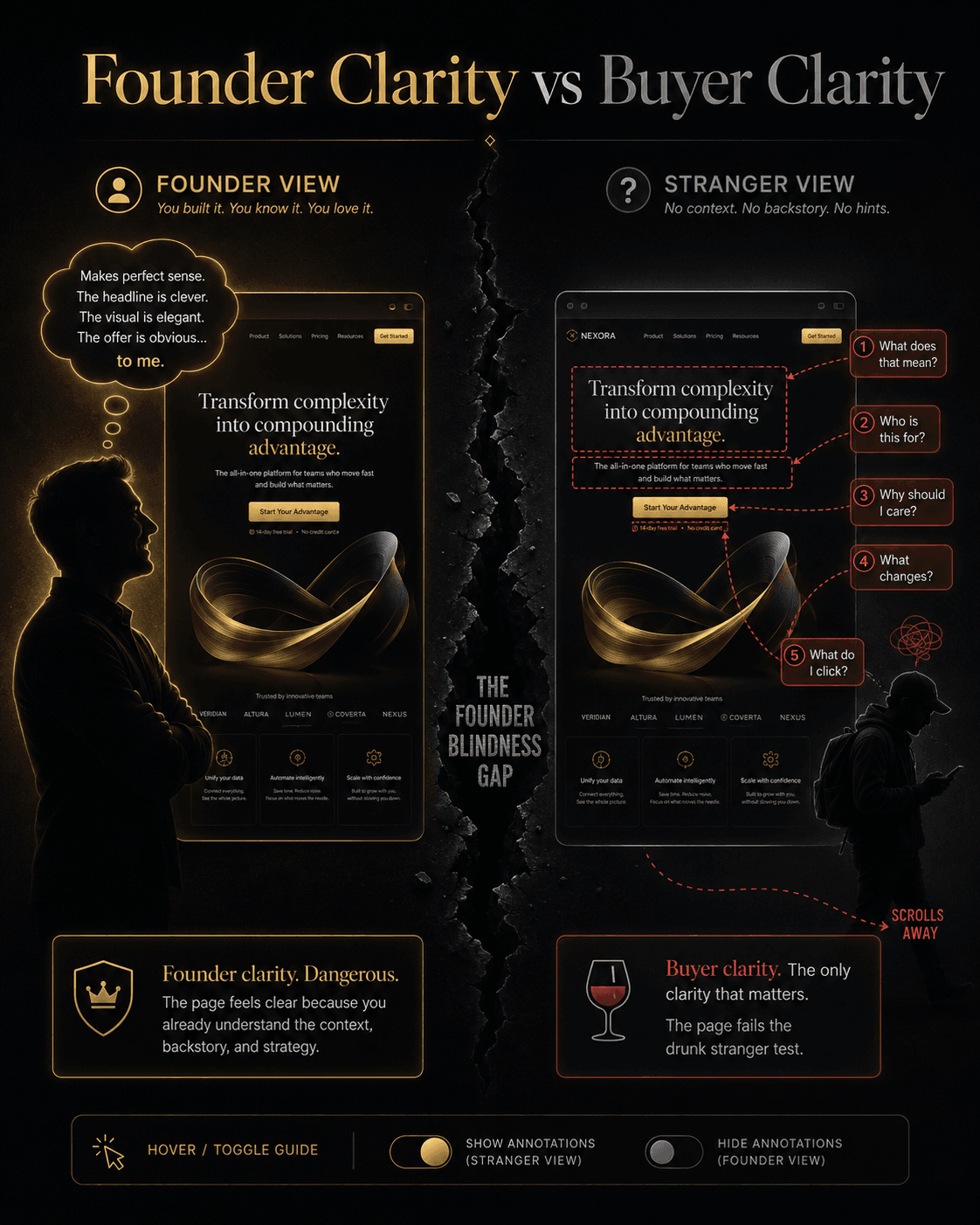
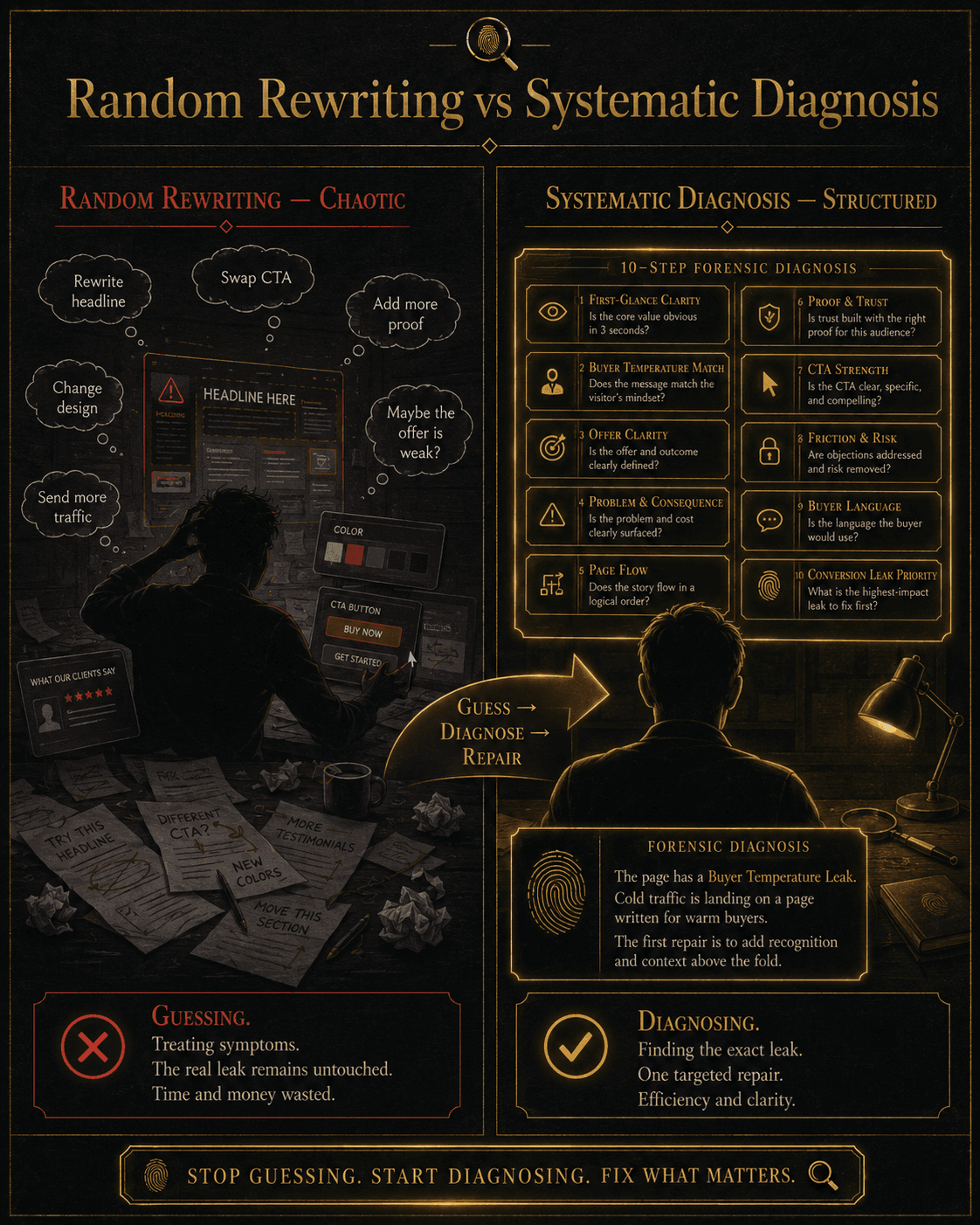
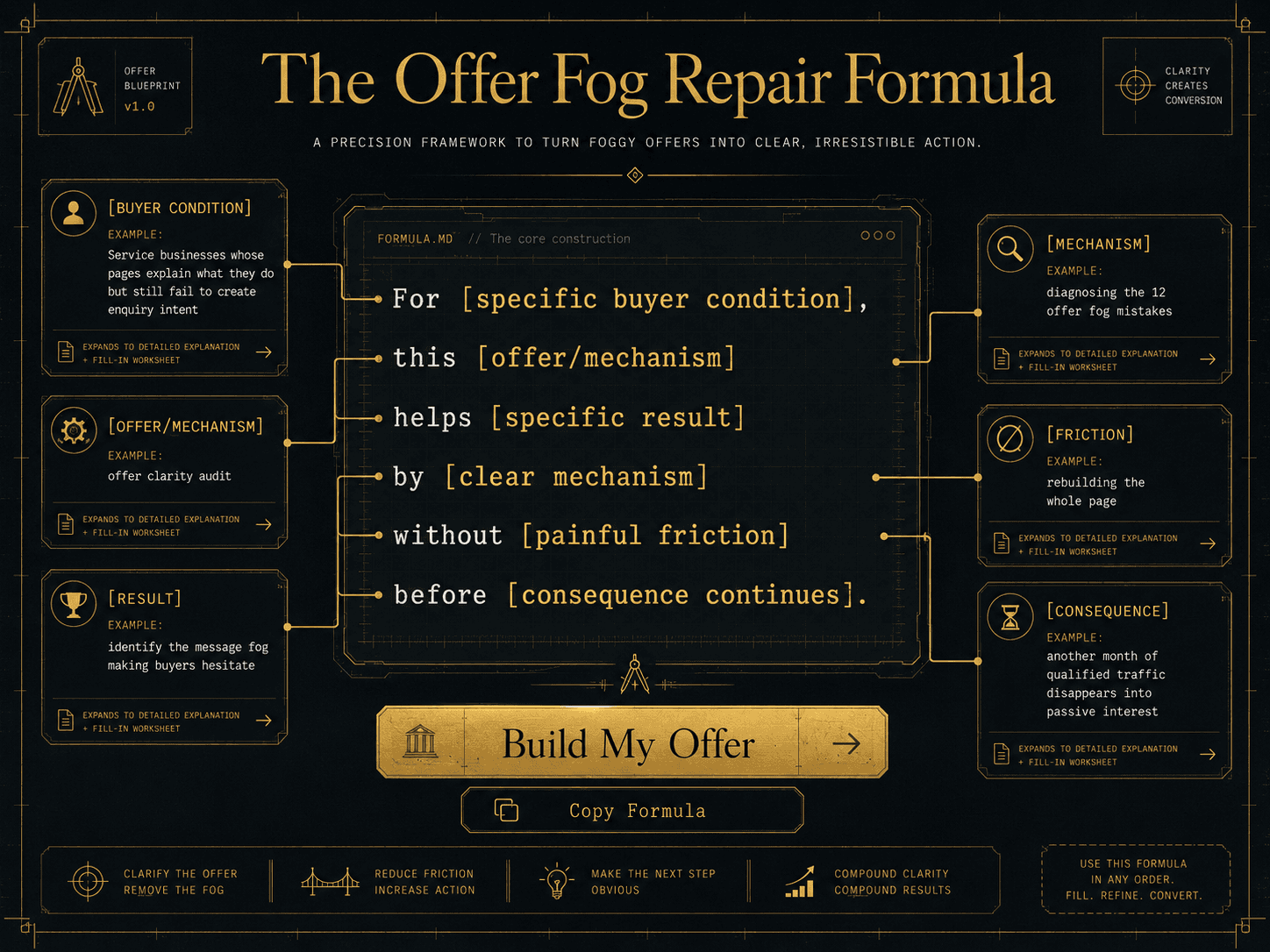
Other Blogs
Other Blogs
Check our other project Blogs with useful insight and information for your businesses