Our Three Step Process
May 30, 2026
Chap 3 | Resource 9 | The AI Offer Clarity Prompt™
Our Three Step Process
May 30, 2026
Chap 3 | Resource 9 | The AI Offer Clarity Prompt™
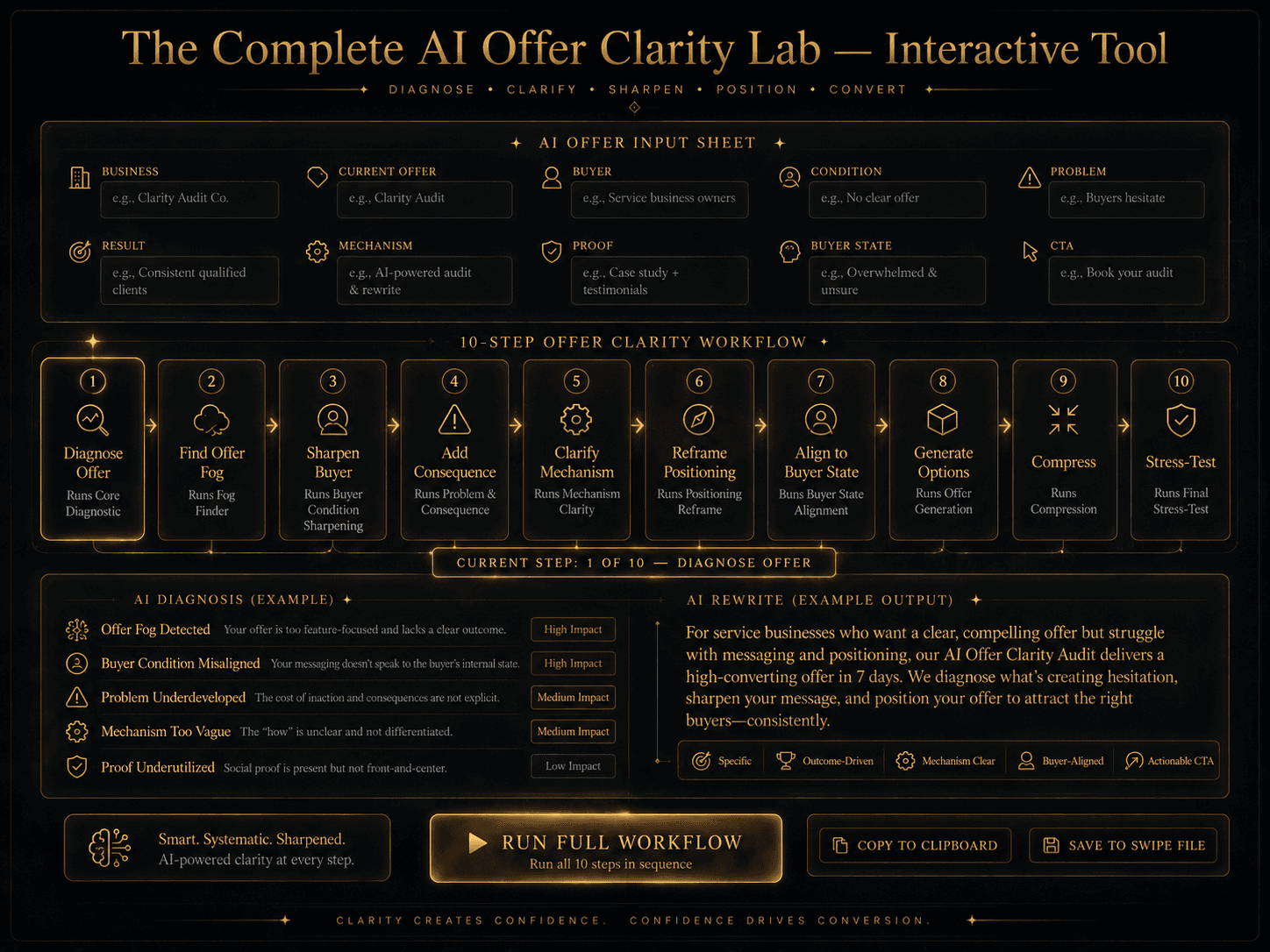
The AI Offer Clarity Prompt™ It is a structured AI diagnostic and rewrite system for turning vague, process-led, or generic offers into clearer buyer-facing offers. It helps you use AI to identify offer fog, sharpen buyer condition, clarify the problem, strengthen the result, expose consequence, define the mechanism, align the offer with buyer state, and build a stronger offer line without adding hype or inventing value. Use it after the Offer Fog Diagnostic™, Offer Positioning Reframe Tool™, Offer Compression System™, Buyer State Diagnostic™, and Offer Fog Mistakes Checklist™ to pressure-test and refine the offer with AI.
Prefer Audio Or Video?
The AI Offer Clarity Prompt™ is also available as:
🎧 A guided audio walkthrough explaining AI-assisted offer clarity, offer fog diagnosis, positioning repair, mechanism sharpening, buyer-state alignment, and offer-line compression.
🎥 A practical video breakdown with real AI offer prompts, weak vs strong offer rewrites, offer fog repairs, buyer-state examples, and final offer stress tests.
Choose the format that fits how you learn best.
[Listen To The Audio Walkthrough] (coming soon)
[Watch The Video Breakdown] (coming soon)
——
Why Most People Use AI Wrong For Offers
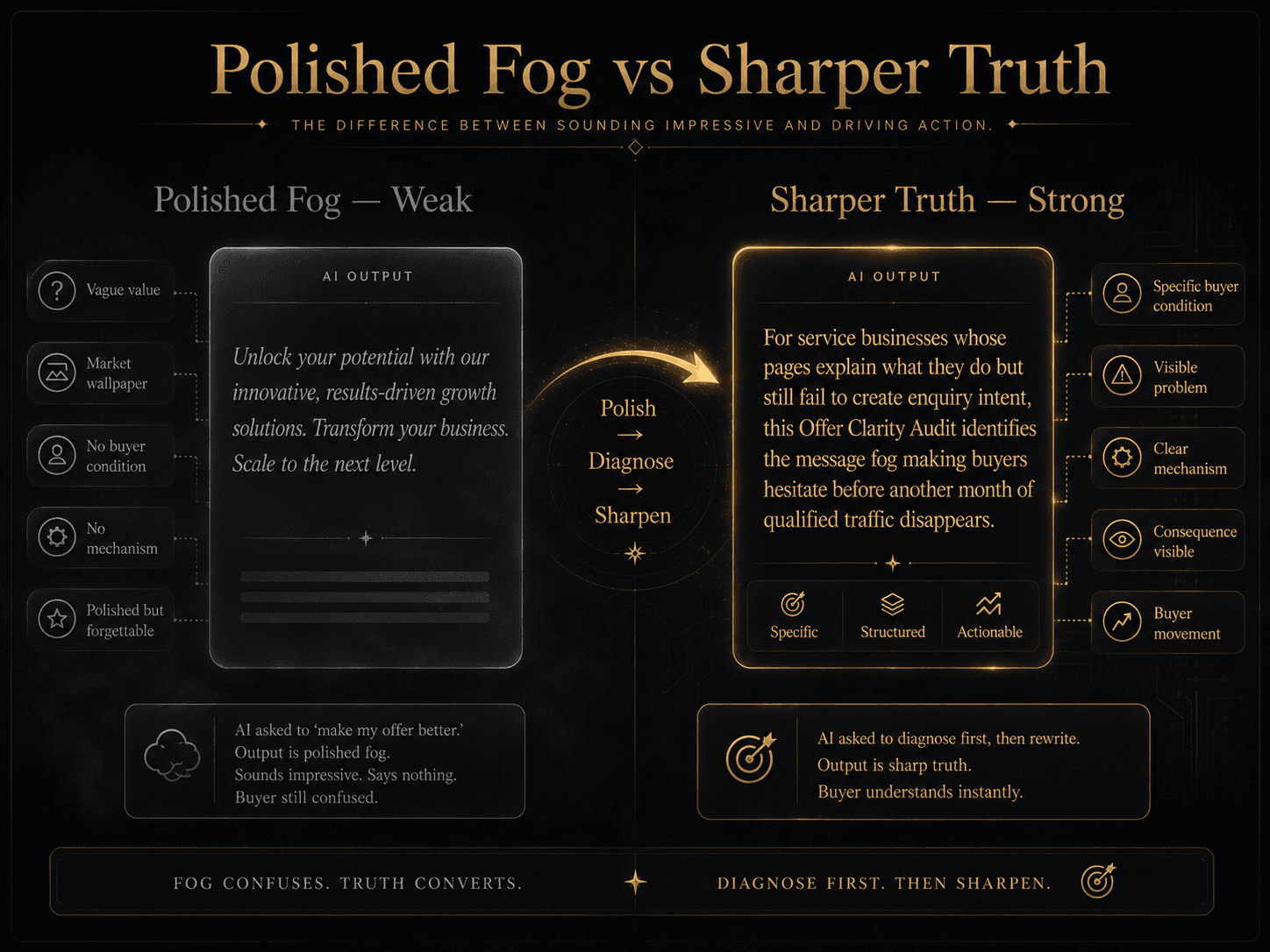
Most people use AI badly when trying to fix their offers.
They type:
“Make my offer better.”
Or:
“Write a high-converting offer.”
Or:
“Improve this sales page.”
Or:
“Make this sound more premium.”
Then they get polished fog.
The words sound smoother.
The offer still feels unclear.
The language becomes more impressive.
The buyer still does not understand why they should care.
That is the problem.
AI is not weak because it cannot write.
AI becomes weak when it is asked to improve an offer before the offer has been diagnosed.
If the buyer is unclear, AI will write broad copy.
If the problem is vague, AI will write generic pain points.
If the result is undefined, AI will produce inflated transformation language.
If the mechanism is missing, AI will create empty confidence.
If the buyer state is misunderstood, AI will create emotional mismatch.
If the offer has no consequence, AI will add fake urgency.
If the proof is weak, AI may overcompensate with stronger-sounding claims.
That is how AI turns offer fog into prettier offer fog.
This resource fixes that.
It teaches you how to use AI as an offer clarity analyst, not a random copy generator.
——
What This Resource Helps You Do
The AI Offer Clarity Prompt™ helps you use AI to diagnose, sharpen, rewrite, and pressure-test your offer without losing truth, specificity, or buyer relevance.
Use this when:
your offer sounds vague
your offer needs too much explanation
your offer sells the process instead of the prize
your offer sounds like competitors
your offer line feels generic
your mechanism is unclear
your buyer condition is too broad
your result feels weak or vague
your positioning lacks consequence
your page gets interest but not action
your CTA feels disconnected from the offer
your offer sounds polished but forgettable
your offer has value, but the value is not landing fast enough
This is not a magic prompt.
This is an AI-assisted offer diagnosis system.
The goal is simple:
Use AI to make the offer clearer, sharper, more specific, more believable, and more aligned with the buyer’s real decision state.
Not louder.
Not more hyped.
Not more inflated.
Clearer.
——
The Core Principle™
AI should clarify the offer before it rewrites the offer.
That is the rule.
Do not ask AI to improve the sentence first.
Ask AI to diagnose the offer first.
A weak offer line is usually not just a wording problem.
It may have:
a weak buyer condition
a vague problem
an unclear result
a missing mechanism
low consequence
weak positioning
no friction removed
poor buyer-state alignment
too much process language
too little commercial movement
If you ask AI to rewrite before finding the real problem, it will usually polish the surface.
But if you ask AI to diagnose the offer structure first, it becomes useful.
The sequence is:
diagnose the fog
identify the buyer
clarify the problem
define the result
expose the consequence
sharpen the mechanism
align the buyer state
compress the offer
stress-test the final version
That is the correct workflow.
——
What AI Should And Should Not Do
AI can help you:
identify vague language
find offer fog
spot weak positioning
clarify buyer condition
diagnose unclear mechanisms
compress offer lines
create rewrite options
compare buyer-state versions
strengthen CTA direction
pressure-test believability
suggest missing proof or context
AI should not:
invent fake proof
invent fake results
invent false scarcity
exaggerate claims
make the offer sound bigger than it is
create a mechanism that does not exist
pretend the offer is differentiated when it is not
write testimonials or case studies from nothing
hide weak strategy behind premium wording
The goal is not artificial persuasion.
The goal is clearer truth.
——
Before You Start: The AI Offer Input Sheet™
Before using the prompts, give AI the right material.
Do not make AI guess.
Complete this first.
Business / Product / Service
What are you selling?
Current Offer Line
Paste the current offer:
Target Buyer
Who is the offer for?
Buyer Condition
What situation is the buyer currently in?
Current Problem
What problem are they trying to solve?
Private Frustration
What are they tired of, stuck in, embarrassed by, losing, or trying to escape?
Desired Result
What result do they want?
Desired Shift
From:
To:
Painful Friction Removed
What do they no longer want to keep doing, guessing, wasting, or carrying?
Mechanism
What method, system, process, framework, angle, or approach creates the result?
Proof
What proof, evidence, case study, testimonial, screenshot, or result supports the claim?
Buyer State
What state is the buyer most likely in?
Sceptical / Overwhelmed / Frustrated / Hopeful / Urgent / Unsure
Desired Action
What do you want the buyer to do next?
Main Concern
What feels weak about the current offer?
——
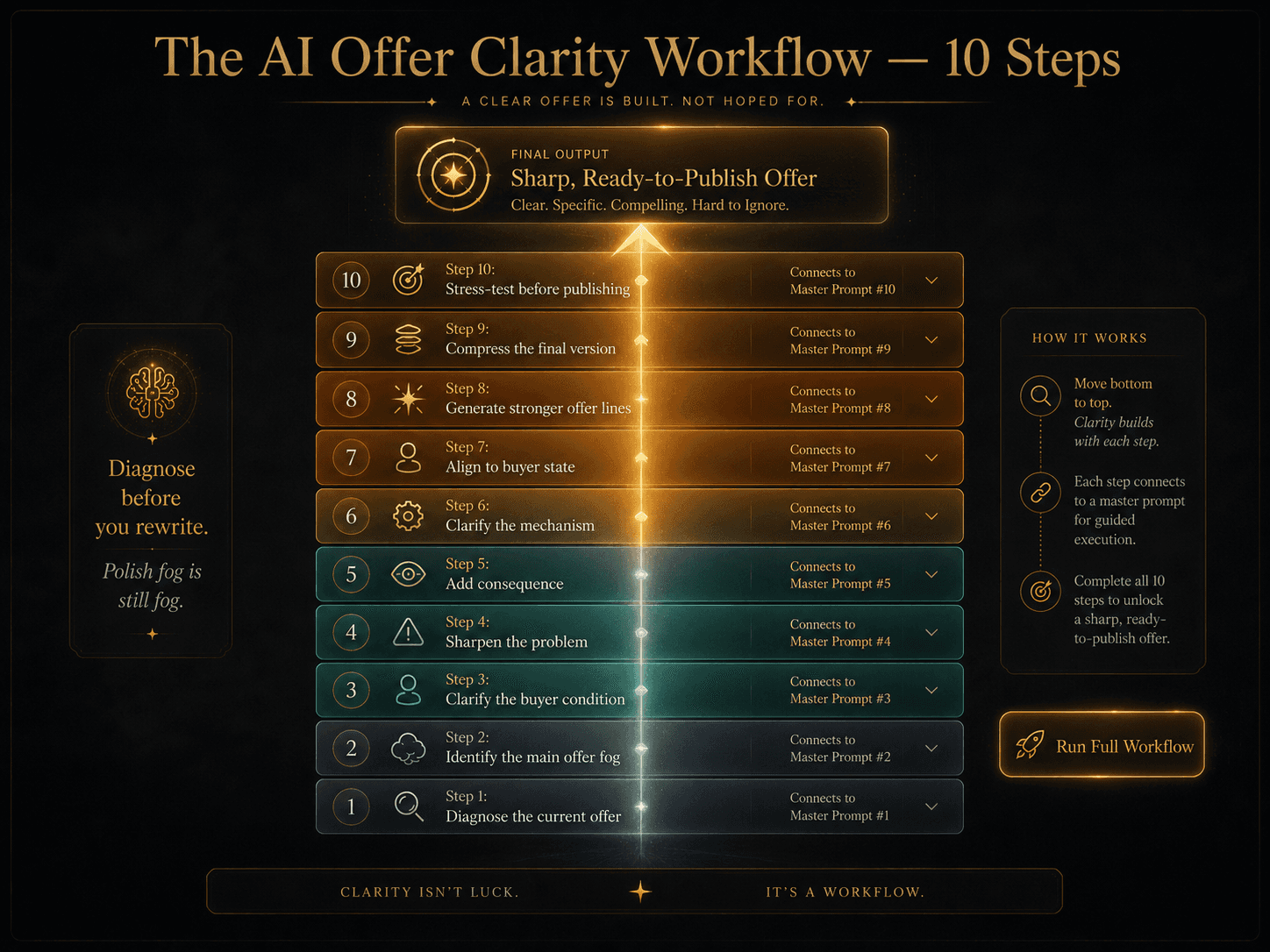
The Correct AI Offer Clarity Workflow™
Use AI in this order:
Diagnose the current offer.
Identify the main offer fog.
Clarify the buyer condition.
Sharpen the problem.
Define the desired result.
Add consequence.
Clarify the mechanism.
Align the offer to buyer state.
Generate stronger offer lines.
Compress the final version.
Stress-test the final offer.
Apply human judgement.
Do not skip diagnosis.
Diagnosis protects you from polished nonsense.
——
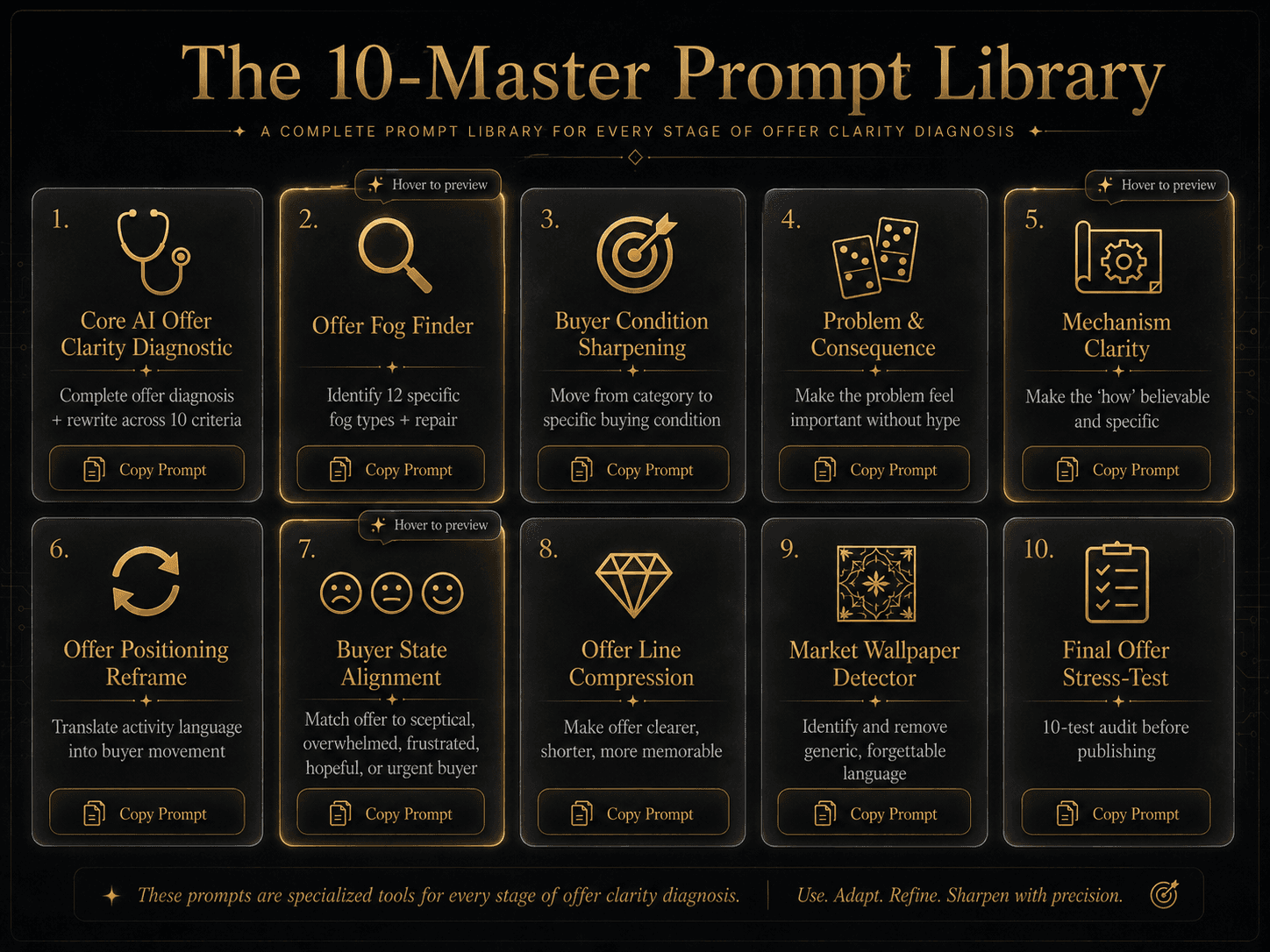
Master Prompt 1: The Core AI Offer Clarity Diagnostic™
Use this first.
This is the main prompt.
Prompt
Act as an expert offer strategist, buyer psychology analyst, and conversion copywriter.
I want you to diagnose and improve my offer.
Important rules:
Do not add hype.
Do not invent proof.
Do not invent results.
Do not exaggerate the promise.
Do not create fake urgency.
Do not make the offer sound premium by making it vague.
Prioritise clarity, specificity, buyer recognition, consequence, mechanism clarity, believability, and commercial movement.
Here is my current offer:
[PASTE OFFER]
My target buyer is:
[INSERT BUYER]
The buyer’s current situation is:
[INSERT BUYER CONDITION]
The problem they are dealing with is:
[INSERT PROBLEM]
The result they want is:
[INSERT RESULT]
My mechanism, process, method, or approach is:
[INSERT MECHANISM]
The proof I have is:
[INSERT PROOF]
The action I want them to take is:
[INSERT CTA / NEXT STEP]
First, diagnose the offer across these areas:
Buyer clarity
Problem clarity
Result clarity
Mechanism clarity
Consequence strength
Differentiation
Buyer-state alignment
Believability
CTA connection
Memorability
For each area:
give a score from 1 to 5
explain what is working
explain what is weak
identify the exact words causing fog
explain how a buyer would likely interpret the offer
Then identify:
the biggest source of offer fog
whether the offer sells the process or the prize
whether the buyer condition is too broad
whether the result is specific enough
whether the mechanism is believable
whether the offer sounds like market wallpaper
whether the offer creates enough reason to act now
whether the offer needs proof, clearer framing, or stronger consequence
Then rewrite the offer into:
a clearer version
a more specific version
a more consequence-driven version
a more mechanism-led version
a more buyer-language version
a more compressed version
a version for a sceptical buyer
a version for an overwhelmed buyer
a version for a frustrated buyer
a version for a hopeful buyer
a version for an urgent buyer
For each version, explain:
what changed
why it is stronger
what buyer reaction it is designed to create
what risk or weakness remains
Finally, recommend the strongest final offer line and explain why.
——
Master Prompt 2: Offer Fog Finder™
Use this when the offer sounds polished but weak.
Prompt
Act as a brutal but useful offer clarity auditor.
Analyse this offer and identify every source of offer fog.
Offer:
[PASTE OFFER]
Target buyer:
[INSERT BUYER]
Context:
[INSERT CONTEXT]
Diagnose whether the offer suffers from:
selling the process instead of the prize
vague value
weak buyer condition
generic transformation language
unclear mechanism
low consequence
market wallpaper
result without friction removed
too many promises
clever naming before clear meaning
activity language instead of buyer movement
weak reason to act now
For each issue:
mark Pass, Weak Pass, or Fail
quote the exact phrase causing the problem
explain why it creates fog
explain what the buyer likely thinks
give one specific repair
Then identify the top three fog sources in priority order.
After that, rewrite the offer using this structure:
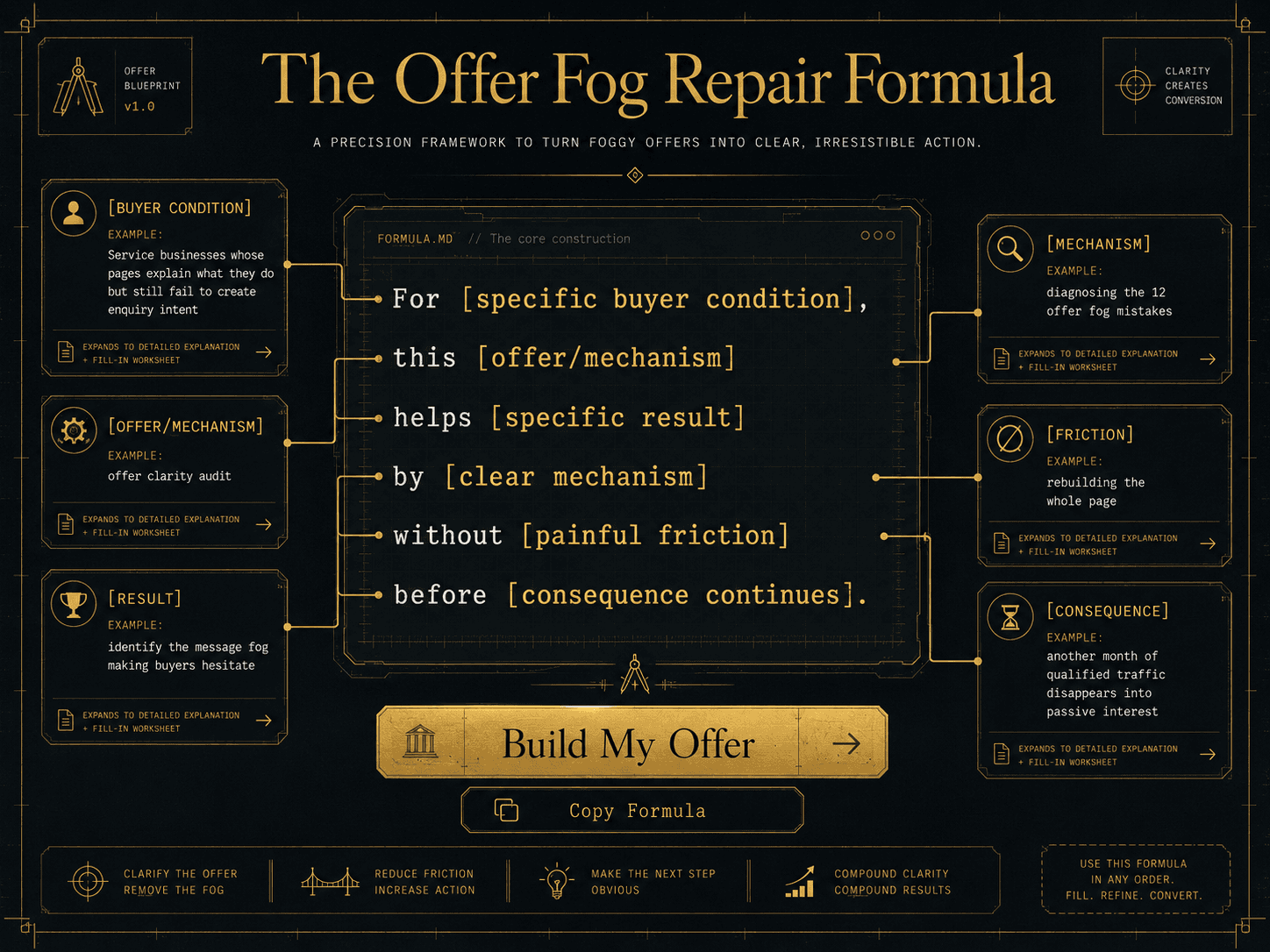
For [specific buyer condition], this [offer/mechanism] helps [specific result] by [clear mechanism] without [painful friction] before [consequence continues].
Then compress it into three final offer-line options:
clear version
sharp version
premium but still clear version
Do not add hype.
Do not invent proof.
Do not make the offer vague to sound sophisticated.
——
Master Prompt 3: Buyer Condition Sharpening Prompt™
Use this when the offer speaks to a broad audience.
Prompt
Act as a buyer psychology strategist.
Help me sharpen the buyer condition for this offer.
Current offer:
[PASTE OFFER]
Current target buyer:
[INSERT BUYER]
The buyer’s problem:
[INSERT PROBLEM]
The result they want:
[INSERT RESULT]
Do not settle for broad categories like:
business owners
founders
coaches
consultants
agencies
creators
SaaS companies
ecommerce brands
service businesses
Instead, help me identify the specific buying condition.
Generate:
10 sharper buyer conditions
5 versions based on emotional frustration
5 versions based on commercial pain
5 versions based on failed previous attempts
5 versions based on urgent current pressure
For each, explain:
why this buyer condition is stronger
what problem it makes visible
what kind of buyer would recognise themselves
what kind of buyer it exclude
Then recommend the strongest buyer condition for the offer and explain why.
Avoid vague language.
Use buyer language, not internal business language.
——
Master Prompt 4: Problem & Consequence Prompt™
Use this when the offer does not make the problem feel important enough.
Prompt
Act as a conversion strategist and buyer psychology analyst.
I want to strengthen the problem and consequence inside this offer.
Current offer:
[PASTE OFFER]
Target buyer:
[INSERT BUYER]
Current problem:
[INSERT PROBLEM]
Desired result:
[INSERT RESULT]
Analyse the offer and identify:
what problem is currently visible
what problem is still hidden
what the buyer is likely already frustrated by
what the buyer may not have fully named yet
what happens if this problem continues
what commercial cost grows
what emotional cost grows
what opportunity is missed
what hesitation this problem creates
Then generate:
10 consequence lines
10 problem-framing lines
5 versions that are calm and grounded
5 versions that are sharper and more urgent
5 versions that avoid hype but make delay feel costly
Then rewrite the offer with stronger consequence.
Do not create fake urgency.
Do not exaggerate.
Make the consequence feel real, specific, and believable.
——
Master Prompt 5: Mechanism Clarity Prompt™
Use this when the offer promises a result but does not explain how the result happens.
Prompt
Act as an expert offer strategist.
Help me clarify the mechanism behind this offer.
Current offer:
[PASTE OFFER]
Target buyer:
[INSERT BUYER]
Problem:
[INSERT PROBLEM]
Desired result:
[INSERT RESULT]
Current mechanism, if any:
[INSERT MECHANISM]
First, identify whether the mechanism is:
clear
vague
missing
too generic
too complicated
too branded without explanation
too similar to competitors
Then explain:
what the buyer needs to understand about how the result is created
what part of the mechanism makes the promise believable
what part of the mechanism should be named
what part should be simplified
what part should be shown through proof
Then generate:
10 mechanism names
10 plain-language mechanism descriptions
5 short mechanism-led offer lines
5 mechanism explanations for a landing page
5 versions that make the result more believable
Do not invent a mechanism that does not exist.
If the mechanism is genuinely unclear, tell me what I need to define before writing the offer.
Prioritise believability, simplicity, and commercial clarity.
——
Master Prompt 6: Offer Positioning Reframe Prompt™
Use this when the offer describes activity instead of value.
Prompt
Act as a positioning strategist and direct-response offer architect.
Help me reframe this offer from activity language into buyer value.
Current offer:
[PASTE OFFER]
What I do:
[INSERT SERVICE / PROCESS]
Who I help:
[INSERT BUYER]
What the buyer wants:
[INSERT RESULT]
What the buyer is frustrated by:
[INSERT FRUSTRATION]
First, identify all activity language in the offer.
Then translate each activity into:
the buyer problem it solves
the painful friction it removes
the result it creates
the commercial consequence it prevents
the emotional relief it produces
Then create:
5 offer versions focused on the buyer prize
5 offer versions focused on removed friction
5 offer versions focused on consequence
5 offer versions focused on buyer movement
5 offer versions focused on mechanism
Then recommend the strongest positioning angle.
Do not make the offer sound abstract.
Do not use vague “growth” language unless it is made specific.
Make the offer feel commercially useful, emotionally recognisable, and easy to understand.
——
Master Prompt 7: Buyer State Offer Alignment Prompt™
Use this when the offer may be emotionally mismatched.
Prompt
Act as a high-level buyer psychology analyst and offer strategist.
Analyse this offer across five buyer states:
Sceptical Buyer
Overwhelmed Buyer
Frustrated Buyer
Hopeful Buyer
Urgent Buyer
Current offer:
[PASTE OFFER]
Target buyer:
[INSERT BUYER]
Problem:
[INSERT PROBLEM]
Desired action:
[INSERT CTA]
For each buyer state:
explain how that buyer would interpret the offer
identify what they would trust
identify what they would resist
identify what emotional mismatch may appear
identify what they need most before acting
score the current offer from 1 to 5 for that state
Then rewrite the offer for:
a sceptical buyer
an overwhelmed buyer
a frustrated buyer
a hopeful buyer
an urgent buyer
For each rewrite, include:
offer line
supporting sentence
CTA suggestion
microcopy suggestion
Then recommend which buyer-state version should be prioritised and explain why.
Do not add hype.
Do not use fake urgency.
Do not make the offer emotionally manipulative.
Match the offer to the buyer’s current psychological condition.
——
Master Prompt 8: Offer Line Compression Prompt™
Use this when the offer has the right ingredients but feels too long or heavy.
Prompt
Act as an expert offer compression specialist.
Compress this offer so it becomes clearer, sharper, easier to remember, and easier for the buyer to understand quickly.
Current offer:
[PASTE OFFER]
Buyer:
[INSERT BUYER]
Problem:
[INSERT PROBLEM]
Result:
[INSERT RESULT]
Mechanism:
[INSERT MECHANISM]
Friction removed:
[INSERT FRICTION]
Consequence:
[INSERT CONSEQUENCE]
Compress the offer without losing:
buyer condition
problem
result
mechanism
consequence
buyer movement
believability
Generate:
10 short offer lines
5 medium-length offer lines
5 sharper/direct-response versions
5 calm premium versions
5 buyer-language versions
Then rank the top 5.
For each top version, explain:
why it works
what it makes clearer
what it risks losing
how a buyer would likely interpret it
Avoid vague language.
Avoid cleverness that reduces clarity.
Prioritise compression, not oversimplification.
——
Master Prompt 9: Market Wallpaper Detector Prompt™
Use this when the offer sounds too similar to competitors.
Prompt
Act as a market positioning critic.
Analyse this offer and identify where it sounds like market wallpaper.
Offer:
[PASTE OFFER]
Industry:
[INSERT INDUSTRY]
Target buyer:
[INSERT BUYER]
Competitors usually say things like:
[INSERT COMPETITOR LANGUAGE IF KNOWN]
Identify:
phrases that sound generic
phrases competitors could also use
phrases that lack buyer specificity
phrases that sound polished but forgettable
phrases that feel like category language
phrases that do not create emotional movement
Then rewrite the offer to include stronger:
buyer condition
named problem
mechanism
consequence
movement
distinctiveness
buyer language
Generate:
5 versions with a named problem
5 versions with a distinctive mechanism
5 versions with sharper buyer condition
5 versions with stronger consequence
5 versions that would pass the “remove the logo” test
Do not make the offer weird for the sake of being different.
Make it recognisable, specific, and commercially sharper.
——
Master Prompt 10: Final Offer Stress-Test Prompt™
Use this before publishing the offer.
Prompt
Act as a brutal but useful offer strategist.
Stress-test this offer before I use it on a landing page, sales page, ad, email, or CTA section.
Final offer:
[PASTE OFFER]
Target buyer:
[INSERT BUYER]
Buyer state:
[INSERT BUYER STATE]
Desired action:
[INSERT CTA]
Proof available:
[INSERT PROOF]
Evaluate the offer across these ten tests:
Buyer clarity
Problem clarity
Result clarity
Mechanism clarity
Consequence strength
Specificity
Distinctiveness
Believability
Buyer-state alignment
Memorability
For each test:
give a score from 1 to 5
explain what works
explain what is weak
identify the exact phrase causing friction
recommend one specific fix
Then answer:
Does the offer sell the prize or the process?
Does it sound like market wallpaper?
Does it create enough reason to act now?
Does it make the result believable?
Does it need stronger proof?
Does it need more specificity?
Does it need better compression?
Does it match the buyer’s emotional state?
Would the right buyer remember it?
Would the right buyer understand it in seconds?
Finally, give one of these verdicts:
Ready To Test
Needs Sharpening
Offer Fog Still Present
Rebuild Before Publishing
Then provide the strongest final rewrite.
Do not be polite.
Be accurate.
——
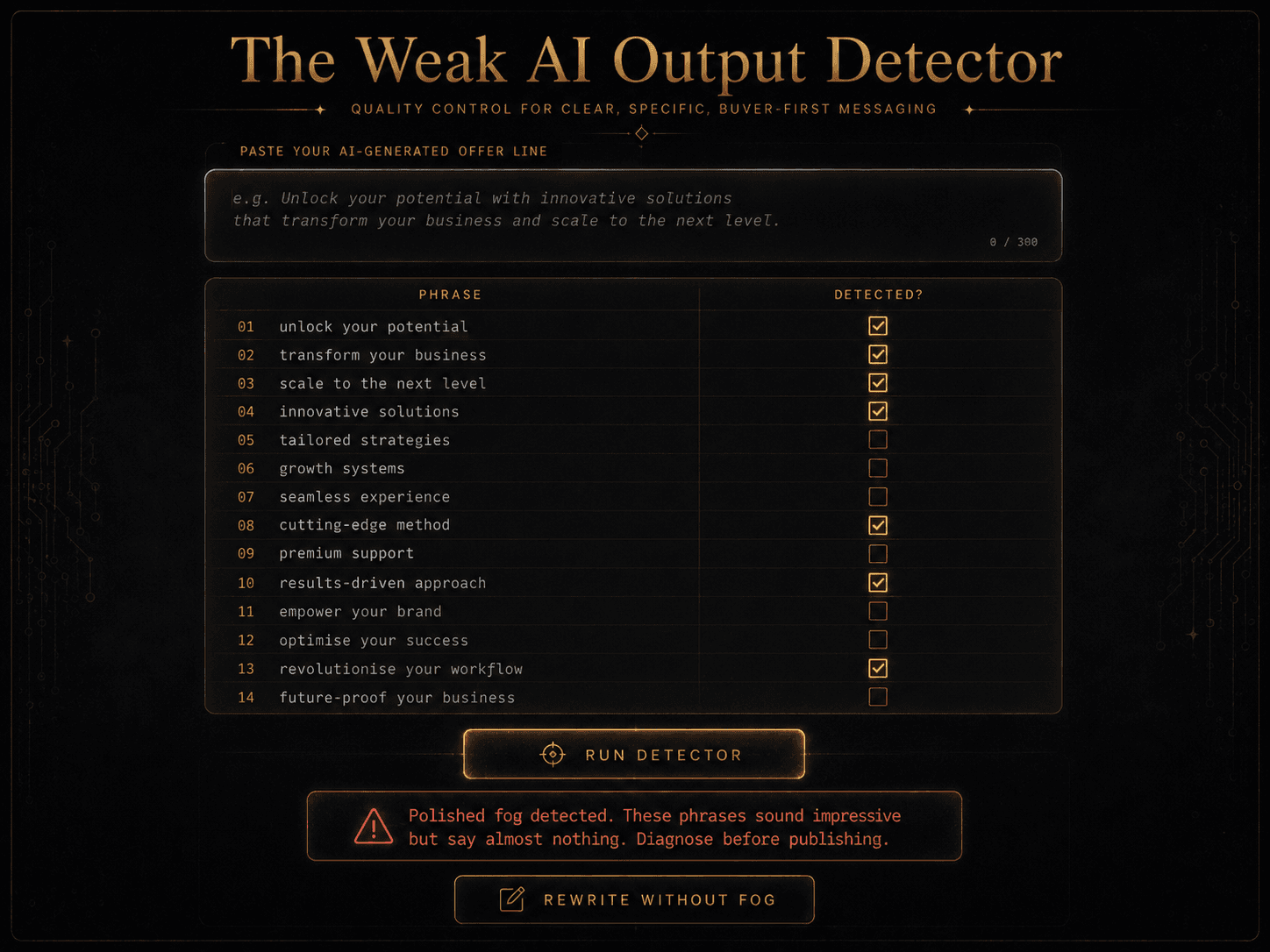
The Weak AI Offer Output Detector™
Use this after AI gives you a rewrite.
AI output is weak if it contains:
unlock your potential
transform your business
scale to the next level
innovative solutions
tailored strategies
growth systems
seamless experience
cutting-edge method
premium support
results-driven approach
empower your brand
optimise your success
revolutionise your workflow
future-proof your business
These phrases are not automatically wrong.
But they are often fog.
They sound polished while saying very little.
Detector Questions
Does the AI output sound like hundreds of other businesses?
Yes / No
Does it use broad value words without visible meaning?
Yes / No
Does it make the offer sound bigger but not clearer?
Yes / No
Does it remove buyer specificity?
Yes / No
Does it add hype?
Yes / No
Does it invent proof or imply results you cannot support?
Yes / No
Does it use clever wording that weakens understanding?
Yes / No
Does it hide the mechanism?
Yes / No
Does it make the buyer do more interpretation?
Yes / No
If several answers are yes, reject the output.
Do not publish polished fog.
——
The AI Offer Clarity Scorecard™
Score the final AI-assisted offer from 1 to 5.
1 = weak
2 = soft
3 = usable but leaking
4 = strong
5 = sharp and ready
Buyer Condition
Does the offer clearly name who it is for and what situation they are in?
Score: ___ / 5
Notes:
Problem Clarity
Does the buyer understand the problem being solved?
Score: ___ / 5
Notes:
Result Clarity
Does the buyer understand what changes?
Score: ___ / 5
Notes:
Mechanism Clarity
Does the buyer understand how the result is created?
Score: ___ / 5
Notes:
Consequence
Does the offer show why the problem matters?
Score: ___ / 5
Notes:
Friction Removed
Does the offer show what painful effort, risk, or waste is removed?
Score: ___ / 5
Notes:
Distinctiveness
Does the offer avoid market wallpaper?
Score: ___ / 5
Notes:
Believability
Does the offer feel grounded and defensible?
Score: ___ / 5
Notes:
Buyer-State Alignment
Does the offer match the buyer’s emotional condition?
Score: ___ / 5
Notes:
CTA Connection
Does the offer make the next step feel natural?
Score: ___ / 5
Notes:
——
Total Score
Buyer Condition: ___ / 5
Problem Clarity: ___ / 5
Result Clarity: ___ / 5
Mechanism Clarity: ___ / 5
Consequence: ___ / 5
Friction Removed: ___ / 5
Distinctiveness: ___ / 5
Believability: ___ / 5
Buyer-State Alignment: ___ / 5
CTA Connection: ___ / 5
Total: ___ / 50
——
Score Interpretation
43–50: Clear, Sharp, And Ready To Test™
The offer is specific, believable, buyer-relevant, mechanism-aware, and strong enough to test.
Review proof accuracy before publishing.
34–42: Strong But Still Leaking™
The offer has a strong foundation but still needs one or two repairs.
Fix the lowest-scoring area first.
24–33: AI Polish Risk™
The offer may sound improved but still contains fog.
It likely needs sharper buyer condition, stronger mechanism, clearer consequence, or better compression.
Do not publish yet.
0–23: Offer Fog Still Present™
The offer is not ready.
AI may have improved the wording, but the underlying offer structure is still weak.
Return to diagnosis.
——
Final AI Offer Clarity Worksheet™
Use this as your complete working sheet.
Original Offer
Current offer:
Target buyer:
Buyer condition:
Problem:
Desired result:
Mechanism:
Proof:
Buyer state:
CTA:
AI Diagnosis
Biggest offer fog source:
Weakest area:
Strongest area:
What the buyer currently understands:
What the buyer likely does not understand:
What the buyer may distrust:
What needs to be clarified first:
Rebuild Inputs
Sharper buyer condition:
Clearer problem:
Stronger consequence:
Specific result:
Mechanism:
Friction removed:
Reason to trust:
Buyer-state priority:
AI-Generated Options
Best clear version:
Best consequence-driven version:
Best mechanism-led version:
Best buyer-language version:
Best compressed version:
Best buyer-state version:
Final Offer
Final offer line:
Supporting sentence:
CTA:
Microcopy:
Final Score
Buyer Condition: ___ / 5
Problem Clarity: ___ / 5
Result Clarity: ___ / 5
Mechanism Clarity: ___ / 5
Consequence: ___ / 5
Friction Removed: ___ / 5
Distinctiveness: ___ / 5
Believability: ___ / 5
Buyer-State Alignment: ___ / 5
CTA Connection: ___ / 5
Total: ___ / 50
Final Verdict
Clear, Sharp, And Ready To Test / Strong But Still Leaking / AI Polish Risk / Offer Fog Still Present
Why?
——
Final Execution Challenge™
Take your current offer and run it through:
The Core AI Offer Clarity Diagnostic™
The Offer Fog Finder™
The Buyer Condition Sharpening Prompt™
The Problem & Consequence Prompt™
The Mechanism Clarity Prompt™
The Buyer State Offer Alignment Prompt™
The Offer Line Compression Prompt™
The Final Offer Stress-Test Prompt™
Then ask:
“Is the offer now clearer, or merely better worded?”
That question matters.
Because AI can easily make an offer sound smoother.
But smooth is not the goal.
The goal is buyer understanding.
The buyer should be able to see:
who this is for
what problem it solves
why the problem matters
what changes
how the result is created
why this version is different
why the next step makes sense
If AI does not improve those things, it has not improved the offer.
It has only decorated the fog.
——
Final Principle
AI is not here to invent a stronger offer.
It is here to reveal, clarify, and sharpen the offer that is actually there.
That is the shift.
Weak users ask AI for better wording.
Strong users ask AI for better diagnosis.
They use AI to expose vague value.
They use AI to identify offer fog.
They use AI to sharpen buyer condition.
They use AI to clarify mechanism.
They use AI to test buyer-state alignment.
They use AI to compress the offer without losing meaning.
They use AI to pressure-test believability before publishing.
That is how AI becomes useful.
Not as a magic offer machine.
As a structured offer clarity partner.
Because the buyer does not care that the sentence sounds impressive.
The buyer cares whether the offer feels clear, relevant, believable, and worth acting on.
That is what The AI Offer Clarity Prompt™ is designed to help you create.
Not polished fog.
Clearer value.
Sharper positioning.
Stronger buyer recognition.
A more believable reason to act.
And an offer that finally carries its own weight.
——
From:
The $100M Funnel Playbook. Book I: Foundation — Buyer Psychology, Offer Clarity, And The Page Architecture Behind High-Converting Funnels
By Maris Spalins.
——
Copyright Notice
© 2026 The $100M Funnel Playbook / Winyourclients / Maris Spalins. All rights reserved.
This resource, including the frameworks, terminology, examples, scorecards, templates, prompts, methods, and written explanations, is original intellectual property created for The $100M Funnel Playbook. Book I: Foundation — Buyer Psychology, Offer Clarity, And The Page Architecture Behind High-Converting Funnels and published through Winyourclients.
No part of this resource may be copied, reproduced, screenshotted, republished, redistributed, sold, adapted, uploaded, scraped, stored in a database, included in training data, used to train artificial intelligence systems, or used to create derivative commercial or educational materials without prior written permission.
Limited reference, quotation, or sharing is only permitted where the source is clearly and visibly credited.
Any permitted reference must include at least one of the following source credits:
The $100M Funnel Playbook by Maris Spalins
or
Winyourclients — www.winyourclients.com
or
Maris Spalins / Winyourclients
Screenshots, excerpts, summaries, or redistributed versions must not remove, hide, alter, crop out, or obscure the original source, author name, book title, website name, or copyright notice.
This resource is provided for personal learning and implementation only. It is not licensed for resale, republishing, redistribution, AI training, template cloning, course creation, consulting delivery, or commercial reuse without written permission from Maris Spalins or Winyourclients.
For permission requests, licensing, citation approval, or commercial usage enquiries, contact:
Winyourclients
www.winyourclients.com
or
Email directly to Jacob on: help@winyourclients.com
The AI Offer Clarity Prompt™ It is a structured AI diagnostic and rewrite system for turning vague, process-led, or generic offers into clearer buyer-facing offers. It helps you use AI to identify offer fog, sharpen buyer condition, clarify the problem, strengthen the result, expose consequence, define the mechanism, align the offer with buyer state, and build a stronger offer line without adding hype or inventing value. Use it after the Offer Fog Diagnostic™, Offer Positioning Reframe Tool™, Offer Compression System™, Buyer State Diagnostic™, and Offer Fog Mistakes Checklist™ to pressure-test and refine the offer with AI.
Prefer Audio Or Video?
The AI Offer Clarity Prompt™ is also available as:
🎧 A guided audio walkthrough explaining AI-assisted offer clarity, offer fog diagnosis, positioning repair, mechanism sharpening, buyer-state alignment, and offer-line compression.
🎥 A practical video breakdown with real AI offer prompts, weak vs strong offer rewrites, offer fog repairs, buyer-state examples, and final offer stress tests.
Choose the format that fits how you learn best.
[Listen To The Audio Walkthrough] (coming soon)
[Watch The Video Breakdown] (coming soon)
——
Why Most People Use AI Wrong For Offers
Most people use AI badly when trying to fix their offers.
They type:
“Make my offer better.”
Or:
“Write a high-converting offer.”
Or:
“Improve this sales page.”
Or:
“Make this sound more premium.”
Then they get polished fog.
The words sound smoother.
The offer still feels unclear.
The language becomes more impressive.
The buyer still does not understand why they should care.
That is the problem.
AI is not weak because it cannot write.
AI becomes weak when it is asked to improve an offer before the offer has been diagnosed.
If the buyer is unclear, AI will write broad copy.
If the problem is vague, AI will write generic pain points.
If the result is undefined, AI will produce inflated transformation language.
If the mechanism is missing, AI will create empty confidence.
If the buyer state is misunderstood, AI will create emotional mismatch.
If the offer has no consequence, AI will add fake urgency.
If the proof is weak, AI may overcompensate with stronger-sounding claims.
That is how AI turns offer fog into prettier offer fog.
This resource fixes that.
It teaches you how to use AI as an offer clarity analyst, not a random copy generator.
——
What This Resource Helps You Do
The AI Offer Clarity Prompt™ helps you use AI to diagnose, sharpen, rewrite, and pressure-test your offer without losing truth, specificity, or buyer relevance.
Use this when:
your offer sounds vague
your offer needs too much explanation
your offer sells the process instead of the prize
your offer sounds like competitors
your offer line feels generic
your mechanism is unclear
your buyer condition is too broad
your result feels weak or vague
your positioning lacks consequence
your page gets interest but not action
your CTA feels disconnected from the offer
your offer sounds polished but forgettable
your offer has value, but the value is not landing fast enough
This is not a magic prompt.
This is an AI-assisted offer diagnosis system.
The goal is simple:
Use AI to make the offer clearer, sharper, more specific, more believable, and more aligned with the buyer’s real decision state.
Not louder.
Not more hyped.
Not more inflated.
Clearer.
——
The Core Principle™
AI should clarify the offer before it rewrites the offer.
That is the rule.
Do not ask AI to improve the sentence first.
Ask AI to diagnose the offer first.
A weak offer line is usually not just a wording problem.
It may have:
a weak buyer condition
a vague problem
an unclear result
a missing mechanism
low consequence
weak positioning
no friction removed
poor buyer-state alignment
too much process language
too little commercial movement
If you ask AI to rewrite before finding the real problem, it will usually polish the surface.
But if you ask AI to diagnose the offer structure first, it becomes useful.
The sequence is:
diagnose the fog
identify the buyer
clarify the problem
define the result
expose the consequence
sharpen the mechanism
align the buyer state
compress the offer
stress-test the final version
That is the correct workflow.
——
What AI Should And Should Not Do
AI can help you:
identify vague language
find offer fog
spot weak positioning
clarify buyer condition
diagnose unclear mechanisms
compress offer lines
create rewrite options
compare buyer-state versions
strengthen CTA direction
pressure-test believability
suggest missing proof or context
AI should not:
invent fake proof
invent fake results
invent false scarcity
exaggerate claims
make the offer sound bigger than it is
create a mechanism that does not exist
pretend the offer is differentiated when it is not
write testimonials or case studies from nothing
hide weak strategy behind premium wording
The goal is not artificial persuasion.
The goal is clearer truth.
——
Before You Start: The AI Offer Input Sheet™
Before using the prompts, give AI the right material.
Do not make AI guess.
Complete this first.
Business / Product / Service
What are you selling?
Current Offer Line
Paste the current offer:
Target Buyer
Who is the offer for?
Buyer Condition
What situation is the buyer currently in?
Current Problem
What problem are they trying to solve?
Private Frustration
What are they tired of, stuck in, embarrassed by, losing, or trying to escape?
Desired Result
What result do they want?
Desired Shift
From:
To:
Painful Friction Removed
What do they no longer want to keep doing, guessing, wasting, or carrying?
Mechanism
What method, system, process, framework, angle, or approach creates the result?
Proof
What proof, evidence, case study, testimonial, screenshot, or result supports the claim?
Buyer State
What state is the buyer most likely in?
Sceptical / Overwhelmed / Frustrated / Hopeful / Urgent / Unsure
Desired Action
What do you want the buyer to do next?
Main Concern
What feels weak about the current offer?
——
The Correct AI Offer Clarity Workflow™
Use AI in this order:
Diagnose the current offer.
Identify the main offer fog.
Clarify the buyer condition.
Sharpen the problem.
Define the desired result.
Add consequence.
Clarify the mechanism.
Align the offer to buyer state.
Generate stronger offer lines.
Compress the final version.
Stress-test the final offer.
Apply human judgement.
Do not skip diagnosis.
Diagnosis protects you from polished nonsense.
——
Master Prompt 1: The Core AI Offer Clarity Diagnostic™
Use this first.
This is the main prompt.
Prompt
Act as an expert offer strategist, buyer psychology analyst, and conversion copywriter.
I want you to diagnose and improve my offer.
Important rules:
Do not add hype.
Do not invent proof.
Do not invent results.
Do not exaggerate the promise.
Do not create fake urgency.
Do not make the offer sound premium by making it vague.
Prioritise clarity, specificity, buyer recognition, consequence, mechanism clarity, believability, and commercial movement.
Here is my current offer:
[PASTE OFFER]
My target buyer is:
[INSERT BUYER]
The buyer’s current situation is:
[INSERT BUYER CONDITION]
The problem they are dealing with is:
[INSERT PROBLEM]
The result they want is:
[INSERT RESULT]
My mechanism, process, method, or approach is:
[INSERT MECHANISM]
The proof I have is:
[INSERT PROOF]
The action I want them to take is:
[INSERT CTA / NEXT STEP]
First, diagnose the offer across these areas:
Buyer clarity
Problem clarity
Result clarity
Mechanism clarity
Consequence strength
Differentiation
Buyer-state alignment
Believability
CTA connection
Memorability
For each area:
give a score from 1 to 5
explain what is working
explain what is weak
identify the exact words causing fog
explain how a buyer would likely interpret the offer
Then identify:
the biggest source of offer fog
whether the offer sells the process or the prize
whether the buyer condition is too broad
whether the result is specific enough
whether the mechanism is believable
whether the offer sounds like market wallpaper
whether the offer creates enough reason to act now
whether the offer needs proof, clearer framing, or stronger consequence
Then rewrite the offer into:
a clearer version
a more specific version
a more consequence-driven version
a more mechanism-led version
a more buyer-language version
a more compressed version
a version for a sceptical buyer
a version for an overwhelmed buyer
a version for a frustrated buyer
a version for a hopeful buyer
a version for an urgent buyer
For each version, explain:
what changed
why it is stronger
what buyer reaction it is designed to create
what risk or weakness remains
Finally, recommend the strongest final offer line and explain why.
——
Master Prompt 2: Offer Fog Finder™
Use this when the offer sounds polished but weak.
Prompt
Act as a brutal but useful offer clarity auditor.
Analyse this offer and identify every source of offer fog.
Offer:
[PASTE OFFER]
Target buyer:
[INSERT BUYER]
Context:
[INSERT CONTEXT]
Diagnose whether the offer suffers from:
selling the process instead of the prize
vague value
weak buyer condition
generic transformation language
unclear mechanism
low consequence
market wallpaper
result without friction removed
too many promises
clever naming before clear meaning
activity language instead of buyer movement
weak reason to act now
For each issue:
mark Pass, Weak Pass, or Fail
quote the exact phrase causing the problem
explain why it creates fog
explain what the buyer likely thinks
give one specific repair
Then identify the top three fog sources in priority order.
After that, rewrite the offer using this structure:
For [specific buyer condition], this [offer/mechanism] helps [specific result] by [clear mechanism] without [painful friction] before [consequence continues].
Then compress it into three final offer-line options:
clear version
sharp version
premium but still clear version
Do not add hype.
Do not invent proof.
Do not make the offer vague to sound sophisticated.
——
Master Prompt 3: Buyer Condition Sharpening Prompt™
Use this when the offer speaks to a broad audience.
Prompt
Act as a buyer psychology strategist.
Help me sharpen the buyer condition for this offer.
Current offer:
[PASTE OFFER]
Current target buyer:
[INSERT BUYER]
The buyer’s problem:
[INSERT PROBLEM]
The result they want:
[INSERT RESULT]
Do not settle for broad categories like:
business owners
founders
coaches
consultants
agencies
creators
SaaS companies
ecommerce brands
service businesses
Instead, help me identify the specific buying condition.
Generate:
10 sharper buyer conditions
5 versions based on emotional frustration
5 versions based on commercial pain
5 versions based on failed previous attempts
5 versions based on urgent current pressure
For each, explain:
why this buyer condition is stronger
what problem it makes visible
what kind of buyer would recognise themselves
what kind of buyer it exclude
Then recommend the strongest buyer condition for the offer and explain why.
Avoid vague language.
Use buyer language, not internal business language.
——
Master Prompt 4: Problem & Consequence Prompt™
Use this when the offer does not make the problem feel important enough.
Prompt
Act as a conversion strategist and buyer psychology analyst.
I want to strengthen the problem and consequence inside this offer.
Current offer:
[PASTE OFFER]
Target buyer:
[INSERT BUYER]
Current problem:
[INSERT PROBLEM]
Desired result:
[INSERT RESULT]
Analyse the offer and identify:
what problem is currently visible
what problem is still hidden
what the buyer is likely already frustrated by
what the buyer may not have fully named yet
what happens if this problem continues
what commercial cost grows
what emotional cost grows
what opportunity is missed
what hesitation this problem creates
Then generate:
10 consequence lines
10 problem-framing lines
5 versions that are calm and grounded
5 versions that are sharper and more urgent
5 versions that avoid hype but make delay feel costly
Then rewrite the offer with stronger consequence.
Do not create fake urgency.
Do not exaggerate.
Make the consequence feel real, specific, and believable.
——
Master Prompt 5: Mechanism Clarity Prompt™
Use this when the offer promises a result but does not explain how the result happens.
Prompt
Act as an expert offer strategist.
Help me clarify the mechanism behind this offer.
Current offer:
[PASTE OFFER]
Target buyer:
[INSERT BUYER]
Problem:
[INSERT PROBLEM]
Desired result:
[INSERT RESULT]
Current mechanism, if any:
[INSERT MECHANISM]
First, identify whether the mechanism is:
clear
vague
missing
too generic
too complicated
too branded without explanation
too similar to competitors
Then explain:
what the buyer needs to understand about how the result is created
what part of the mechanism makes the promise believable
what part of the mechanism should be named
what part should be simplified
what part should be shown through proof
Then generate:
10 mechanism names
10 plain-language mechanism descriptions
5 short mechanism-led offer lines
5 mechanism explanations for a landing page
5 versions that make the result more believable
Do not invent a mechanism that does not exist.
If the mechanism is genuinely unclear, tell me what I need to define before writing the offer.
Prioritise believability, simplicity, and commercial clarity.
——
Master Prompt 6: Offer Positioning Reframe Prompt™
Use this when the offer describes activity instead of value.
Prompt
Act as a positioning strategist and direct-response offer architect.
Help me reframe this offer from activity language into buyer value.
Current offer:
[PASTE OFFER]
What I do:
[INSERT SERVICE / PROCESS]
Who I help:
[INSERT BUYER]
What the buyer wants:
[INSERT RESULT]
What the buyer is frustrated by:
[INSERT FRUSTRATION]
First, identify all activity language in the offer.
Then translate each activity into:
the buyer problem it solves
the painful friction it removes
the result it creates
the commercial consequence it prevents
the emotional relief it produces
Then create:
5 offer versions focused on the buyer prize
5 offer versions focused on removed friction
5 offer versions focused on consequence
5 offer versions focused on buyer movement
5 offer versions focused on mechanism
Then recommend the strongest positioning angle.
Do not make the offer sound abstract.
Do not use vague “growth” language unless it is made specific.
Make the offer feel commercially useful, emotionally recognisable, and easy to understand.
——
Master Prompt 7: Buyer State Offer Alignment Prompt™
Use this when the offer may be emotionally mismatched.
Prompt
Act as a high-level buyer psychology analyst and offer strategist.
Analyse this offer across five buyer states:
Sceptical Buyer
Overwhelmed Buyer
Frustrated Buyer
Hopeful Buyer
Urgent Buyer
Current offer:
[PASTE OFFER]
Target buyer:
[INSERT BUYER]
Problem:
[INSERT PROBLEM]
Desired action:
[INSERT CTA]
For each buyer state:
explain how that buyer would interpret the offer
identify what they would trust
identify what they would resist
identify what emotional mismatch may appear
identify what they need most before acting
score the current offer from 1 to 5 for that state
Then rewrite the offer for:
a sceptical buyer
an overwhelmed buyer
a frustrated buyer
a hopeful buyer
an urgent buyer
For each rewrite, include:
offer line
supporting sentence
CTA suggestion
microcopy suggestion
Then recommend which buyer-state version should be prioritised and explain why.
Do not add hype.
Do not use fake urgency.
Do not make the offer emotionally manipulative.
Match the offer to the buyer’s current psychological condition.
——
Master Prompt 8: Offer Line Compression Prompt™
Use this when the offer has the right ingredients but feels too long or heavy.
Prompt
Act as an expert offer compression specialist.
Compress this offer so it becomes clearer, sharper, easier to remember, and easier for the buyer to understand quickly.
Current offer:
[PASTE OFFER]
Buyer:
[INSERT BUYER]
Problem:
[INSERT PROBLEM]
Result:
[INSERT RESULT]
Mechanism:
[INSERT MECHANISM]
Friction removed:
[INSERT FRICTION]
Consequence:
[INSERT CONSEQUENCE]
Compress the offer without losing:
buyer condition
problem
result
mechanism
consequence
buyer movement
believability
Generate:
10 short offer lines
5 medium-length offer lines
5 sharper/direct-response versions
5 calm premium versions
5 buyer-language versions
Then rank the top 5.
For each top version, explain:
why it works
what it makes clearer
what it risks losing
how a buyer would likely interpret it
Avoid vague language.
Avoid cleverness that reduces clarity.
Prioritise compression, not oversimplification.
——
Master Prompt 9: Market Wallpaper Detector Prompt™
Use this when the offer sounds too similar to competitors.
Prompt
Act as a market positioning critic.
Analyse this offer and identify where it sounds like market wallpaper.
Offer:
[PASTE OFFER]
Industry:
[INSERT INDUSTRY]
Target buyer:
[INSERT BUYER]
Competitors usually say things like:
[INSERT COMPETITOR LANGUAGE IF KNOWN]
Identify:
phrases that sound generic
phrases competitors could also use
phrases that lack buyer specificity
phrases that sound polished but forgettable
phrases that feel like category language
phrases that do not create emotional movement
Then rewrite the offer to include stronger:
buyer condition
named problem
mechanism
consequence
movement
distinctiveness
buyer language
Generate:
5 versions with a named problem
5 versions with a distinctive mechanism
5 versions with sharper buyer condition
5 versions with stronger consequence
5 versions that would pass the “remove the logo” test
Do not make the offer weird for the sake of being different.
Make it recognisable, specific, and commercially sharper.
——
Master Prompt 10: Final Offer Stress-Test Prompt™
Use this before publishing the offer.
Prompt
Act as a brutal but useful offer strategist.
Stress-test this offer before I use it on a landing page, sales page, ad, email, or CTA section.
Final offer:
[PASTE OFFER]
Target buyer:
[INSERT BUYER]
Buyer state:
[INSERT BUYER STATE]
Desired action:
[INSERT CTA]
Proof available:
[INSERT PROOF]
Evaluate the offer across these ten tests:
Buyer clarity
Problem clarity
Result clarity
Mechanism clarity
Consequence strength
Specificity
Distinctiveness
Believability
Buyer-state alignment
Memorability
For each test:
give a score from 1 to 5
explain what works
explain what is weak
identify the exact phrase causing friction
recommend one specific fix
Then answer:
Does the offer sell the prize or the process?
Does it sound like market wallpaper?
Does it create enough reason to act now?
Does it make the result believable?
Does it need stronger proof?
Does it need more specificity?
Does it need better compression?
Does it match the buyer’s emotional state?
Would the right buyer remember it?
Would the right buyer understand it in seconds?
Finally, give one of these verdicts:
Ready To Test
Needs Sharpening
Offer Fog Still Present
Rebuild Before Publishing
Then provide the strongest final rewrite.
Do not be polite.
Be accurate.
——
The Weak AI Offer Output Detector™
Use this after AI gives you a rewrite.
AI output is weak if it contains:
unlock your potential
transform your business
scale to the next level
innovative solutions
tailored strategies
growth systems
seamless experience
cutting-edge method
premium support
results-driven approach
empower your brand
optimise your success
revolutionise your workflow
future-proof your business
These phrases are not automatically wrong.
But they are often fog.
They sound polished while saying very little.
Detector Questions
Does the AI output sound like hundreds of other businesses?
Yes / No
Does it use broad value words without visible meaning?
Yes / No
Does it make the offer sound bigger but not clearer?
Yes / No
Does it remove buyer specificity?
Yes / No
Does it add hype?
Yes / No
Does it invent proof or imply results you cannot support?
Yes / No
Does it use clever wording that weakens understanding?
Yes / No
Does it hide the mechanism?
Yes / No
Does it make the buyer do more interpretation?
Yes / No
If several answers are yes, reject the output.
Do not publish polished fog.
——
The AI Offer Clarity Scorecard™
Score the final AI-assisted offer from 1 to 5.
1 = weak
2 = soft
3 = usable but leaking
4 = strong
5 = sharp and ready
Buyer Condition
Does the offer clearly name who it is for and what situation they are in?
Score: ___ / 5
Notes:
Problem Clarity
Does the buyer understand the problem being solved?
Score: ___ / 5
Notes:
Result Clarity
Does the buyer understand what changes?
Score: ___ / 5
Notes:
Mechanism Clarity
Does the buyer understand how the result is created?
Score: ___ / 5
Notes:
Consequence
Does the offer show why the problem matters?
Score: ___ / 5
Notes:
Friction Removed
Does the offer show what painful effort, risk, or waste is removed?
Score: ___ / 5
Notes:
Distinctiveness
Does the offer avoid market wallpaper?
Score: ___ / 5
Notes:
Believability
Does the offer feel grounded and defensible?
Score: ___ / 5
Notes:
Buyer-State Alignment
Does the offer match the buyer’s emotional condition?
Score: ___ / 5
Notes:
CTA Connection
Does the offer make the next step feel natural?
Score: ___ / 5
Notes:
——
Total Score
Buyer Condition: ___ / 5
Problem Clarity: ___ / 5
Result Clarity: ___ / 5
Mechanism Clarity: ___ / 5
Consequence: ___ / 5
Friction Removed: ___ / 5
Distinctiveness: ___ / 5
Believability: ___ / 5
Buyer-State Alignment: ___ / 5
CTA Connection: ___ / 5
Total: ___ / 50
——
Score Interpretation
43–50: Clear, Sharp, And Ready To Test™
The offer is specific, believable, buyer-relevant, mechanism-aware, and strong enough to test.
Review proof accuracy before publishing.
34–42: Strong But Still Leaking™
The offer has a strong foundation but still needs one or two repairs.
Fix the lowest-scoring area first.
24–33: AI Polish Risk™
The offer may sound improved but still contains fog.
It likely needs sharper buyer condition, stronger mechanism, clearer consequence, or better compression.
Do not publish yet.
0–23: Offer Fog Still Present™
The offer is not ready.
AI may have improved the wording, but the underlying offer structure is still weak.
Return to diagnosis.
——
Final AI Offer Clarity Worksheet™
Use this as your complete working sheet.
Original Offer
Current offer:
Target buyer:
Buyer condition:
Problem:
Desired result:
Mechanism:
Proof:
Buyer state:
CTA:
AI Diagnosis
Biggest offer fog source:
Weakest area:
Strongest area:
What the buyer currently understands:
What the buyer likely does not understand:
What the buyer may distrust:
What needs to be clarified first:
Rebuild Inputs
Sharper buyer condition:
Clearer problem:
Stronger consequence:
Specific result:
Mechanism:
Friction removed:
Reason to trust:
Buyer-state priority:
AI-Generated Options
Best clear version:
Best consequence-driven version:
Best mechanism-led version:
Best buyer-language version:
Best compressed version:
Best buyer-state version:
Final Offer
Final offer line:
Supporting sentence:
CTA:
Microcopy:
Final Score
Buyer Condition: ___ / 5
Problem Clarity: ___ / 5
Result Clarity: ___ / 5
Mechanism Clarity: ___ / 5
Consequence: ___ / 5
Friction Removed: ___ / 5
Distinctiveness: ___ / 5
Believability: ___ / 5
Buyer-State Alignment: ___ / 5
CTA Connection: ___ / 5
Total: ___ / 50
Final Verdict
Clear, Sharp, And Ready To Test / Strong But Still Leaking / AI Polish Risk / Offer Fog Still Present
Why?
——
Final Execution Challenge™
Take your current offer and run it through:
The Core AI Offer Clarity Diagnostic™
The Offer Fog Finder™
The Buyer Condition Sharpening Prompt™
The Problem & Consequence Prompt™
The Mechanism Clarity Prompt™
The Buyer State Offer Alignment Prompt™
The Offer Line Compression Prompt™
The Final Offer Stress-Test Prompt™
Then ask:
“Is the offer now clearer, or merely better worded?”
That question matters.
Because AI can easily make an offer sound smoother.
But smooth is not the goal.
The goal is buyer understanding.
The buyer should be able to see:
who this is for
what problem it solves
why the problem matters
what changes
how the result is created
why this version is different
why the next step makes sense
If AI does not improve those things, it has not improved the offer.
It has only decorated the fog.
——
Final Principle
AI is not here to invent a stronger offer.
It is here to reveal, clarify, and sharpen the offer that is actually there.
That is the shift.
Weak users ask AI for better wording.
Strong users ask AI for better diagnosis.
They use AI to expose vague value.
They use AI to identify offer fog.
They use AI to sharpen buyer condition.
They use AI to clarify mechanism.
They use AI to test buyer-state alignment.
They use AI to compress the offer without losing meaning.
They use AI to pressure-test believability before publishing.
That is how AI becomes useful.
Not as a magic offer machine.
As a structured offer clarity partner.
Because the buyer does not care that the sentence sounds impressive.
The buyer cares whether the offer feels clear, relevant, believable, and worth acting on.
That is what The AI Offer Clarity Prompt™ is designed to help you create.
Not polished fog.
Clearer value.
Sharper positioning.
Stronger buyer recognition.
A more believable reason to act.
And an offer that finally carries its own weight.
——
From:
The $100M Funnel Playbook. Book I: Foundation — Buyer Psychology, Offer Clarity, And The Page Architecture Behind High-Converting Funnels
By Maris Spalins.
——
Copyright Notice
© 2026 The $100M Funnel Playbook / Winyourclients / Maris Spalins. All rights reserved.
This resource, including the frameworks, terminology, examples, scorecards, templates, prompts, methods, and written explanations, is original intellectual property created for The $100M Funnel Playbook. Book I: Foundation — Buyer Psychology, Offer Clarity, And The Page Architecture Behind High-Converting Funnels and published through Winyourclients.
No part of this resource may be copied, reproduced, screenshotted, republished, redistributed, sold, adapted, uploaded, scraped, stored in a database, included in training data, used to train artificial intelligence systems, or used to create derivative commercial or educational materials without prior written permission.
Limited reference, quotation, or sharing is only permitted where the source is clearly and visibly credited.
Any permitted reference must include at least one of the following source credits:
The $100M Funnel Playbook by Maris Spalins
or
Winyourclients — www.winyourclients.com
or
Maris Spalins / Winyourclients
Screenshots, excerpts, summaries, or redistributed versions must not remove, hide, alter, crop out, or obscure the original source, author name, book title, website name, or copyright notice.
This resource is provided for personal learning and implementation only. It is not licensed for resale, republishing, redistribution, AI training, template cloning, course creation, consulting delivery, or commercial reuse without written permission from Maris Spalins or Winyourclients.
For permission requests, licensing, citation approval, or commercial usage enquiries, contact:
Winyourclients
www.winyourclients.com
or
Email directly to Jacob on: help@winyourclients.com
Other Blogs
Other Blogs
Check our other project Blogs with useful insight and information for your businesses
Other Blogs
Other Blogs
Check our other project Blogs with useful insight and information for your businesses