Our Three Step Process
May 30, 2026
Chap 3 | Resource 8 | The Offer Fog Mistakes Checklist™
Our Three Step Process
May 30, 2026
Chap 3 | Resource 8 | The Offer Fog Mistakes Checklist™
The Offer Fog Mistakes Checklist™ It is a practical diagnostic for catching the most common mistakes that make an offer sound vague, generic, or commercially weak. It helps you identify where the offer is selling the process instead of the prize, hiding behind broad value, speaking to a weak buyer condition, using generic transformation language, missing a clear mechanism, lacking consequence, or blending into market wallpaper. Use it after building or rewriting an offer to make sure the buyer can instantly understand what is being sold, why it matters, and why this version is different.
Prefer Audio Or Video?
The Offer Fog Mistakes Checklist™ is also available as:
🎧 A guided audio walkthrough explaining the most common offer fog mistakes, including vague value, weak buyer condition, process-led offers, unclear mechanisms, low consequence, and market wallpaper.
🎥 A practical video breakdown with real offer examples, weak vs strong offer rewrites, mistake-by-mistake diagnosis, and offer clarity repairs.
Choose the format that fits how you learn best.
[Listen To The Audio Walkthrough] (coming soon)
[Watch The Video Breakdown] (coming soon)
——
Why Offers Still Feel Foggy After They Sound “Better”
Most offers do not fail because they are completely unclear.
They fail because they are almost clear.
That is more dangerous.
The buyer kind of understands the category.
They kind of understand the service.
They kind of understand the result.
They kind of understand the value.
But they do not feel enough sharpness to care, trust, remember, or act.
That is offer fog.
Offer fog is not always total confusion.
Sometimes it is soft understanding.
The buyer reads the offer and thinks:
“That sounds useful.”
But not:
“I need this.”
They think:
“That makes sense.”
But not:
“That is exactly my problem.”
They think:
“Interesting.”
But not:
“I understand why this matters now.”
That is the danger.
A foggy offer may sound polished.
It may sound professional.
It may even sound valuable.
But if the buyer cannot quickly understand the buyer condition, the problem, the result, the mechanism, the consequence, and the reason this offer is different, the offer is still leaking conversion.
That is why this checklist exists.
It catches the mistakes that make offers sound acceptable but weak.
——
What This Resource Helps You Do
The Offer Fog Mistakes Checklist™ helps you identify the most common reasons an offer loses clarity, value, tension, and buyer recognition.
Use this when:
your offer sounds professional but forgettable
buyers understand the category but not the value
your offer needs too much explaining
your offer line feels vague
your promise sounds broad
your mechanism is unclear
your result feels generic
your page explains the service but does not create desire
your offer sounds like competitors
your positioning feels soft
your CTA gets interest but weak action
buyers say “sounds good” but do not move
your offer sells what you do instead of why it matters
This is not a creativity checklist.
This is a fog-removal checklist.
The goal is simple:
Find the specific mistake making the offer harder to understand, harder to trust, harder to remember, or easier to ignore.
——
The Core Principle™
An offer is foggy when the buyer has to translate the value themselves.
That is the rule.
The buyer should not have to mentally convert your process into their outcome.
They should not have to guess who the offer is for.
They should not have to imagine why the problem matters.
They should not have to decode the mechanism.
They should not have to figure out what changes after buying.
They should not have to compare five vague claims to understand why yours is different.
The offer should do that work.
A strong offer makes the value visible.
A foggy offer makes the buyer work.
And buyers do not reward unnecessary work.
They leave.
They delay.
They compare.
They ask for more information.
They say it sounds interesting.
They need time.
Often, that does not mean the offer is bad.
It means the offer is foggy.
——
How To Use This Checklist
Take your current offer line, landing page hero, sales page promise, product description, service description, or CTA section.
Run it through every mistake in this checklist.
For each mistake, mark:
Pass
Weak Pass
Fail
Then identify your top three offer fog mistakes.
Do not rewrite everything randomly.
Fix the biggest fog source first.
The goal is not to make the offer longer.
The goal is to make it clearer, sharper, more specific, more believable, and harder to ignore.
——
Current Offer Capture
Before using the checklist, write the current version.
Current Offer Line
Paste the offer here:
Target Buyer
Who is this offer for?
Buyer Condition
What situation is the buyer currently in?
Problem
What problem does the offer solve?
Desired Result
What result does the buyer want?
Mechanism
What method, system, process, angle, or approach creates the result?
Consequence
What happens if the buyer does not solve this?
CTA
What action does the buyer take next?
——
Mistake 1: Selling The Process Instead Of The Prize™
The Mistake
The offer describes what you do instead of what the buyer gets.
This is one of the most common offer fog mistakes.
Businesses love describing their process:
strategy
consulting
coaching
copywriting
automation
optimisation
implementation
workshops
audits
systems
campaigns
But buyers do not buy the process first.
They buy the outcome the process makes possible.
The process matters, but only after the buyer understands the prize.
Weak Example
“We provide conversion copywriting and funnel strategy.”
This describes the activity.
But the buyer still has to translate the value.
They may wonder:
“What does that actually do for me?”
Stronger Example
“We find the message leaks making qualified buyers hesitate before enquiring.”
Now the buyer sees the prize:
less hesitation
clearer buyer movement
stronger enquiry intent
The process can come later.
Why This Matters
When the offer leads with process, it feels operational.
When the offer leads with the prize, it feels commercially meaningful.
The buyer should understand why the process matters before you ask them to care about the process itself.
Checklist
Does the offer lead with what you do?
Pass / Weak Pass / Fail
Does the buyer understand what they get?
Pass / Weak Pass / Fail
Does the result feel more visible than the process?
Pass / Weak Pass / Fail
Could the offer be rewritten around the buyer’s desired shift?
Pass / Weak Pass / Fail
Repair Prompt
Rewrite the offer so it leads with the outcome, not the activity.
Use this structure:
Help [specific buyer] achieve [visible result] without [painful friction] through [mechanism].
Repair Worksheet
Current process language:
What buyer prize does this process create?
What painful friction does it remove?
Rewrite the offer around the prize:
——
Mistake 2: Vague Value™
The Mistake
The offer uses broad value words that sound good but do not create a clear mental picture.
Examples include:
growth
success
clarity
strategy
transformation
performance
scale
support
optimisation
results
solutions
These words are not always wrong.
But when they appear without specificity, they become fog.
The buyer may understand that the offer is positive, but not what it actually changes.
Weak Example
“We help businesses grow with better strategy.”
This is too vague.
The buyer cannot picture the value.
Stronger Example
“We help service businesses turn unclear offer pages into sharper enquiry paths that buyers understand faster.”
Now the value has shape.
The buyer can picture:
unclear pages
sharper enquiry paths
faster buyer understanding
Why This Matters
Vague value forces the buyer to imagine the benefit.
Specific value makes the benefit visible.
The buyer should not have to fill in the blanks.
Checklist
Does the offer use broad words without explanation?
Pass / Weak Pass / Fail
Can the buyer picture the result?
Pass / Weak Pass / Fail
Does the value feel specific enough to remember?
Pass / Weak Pass / Fail
Would ten competitors describe their value the same way?
Pass / Weak Pass / Fail
Repair Prompt
Replace vague value with visible value.
Ask:
“What does growth actually look like here?”
“What becomes clearer?”
“What improves?”
“What moves?”
“What stops leaking?”
“What becomes easier?”
Repair Worksheet
Vague value word:
What does this actually mean for the buyer?
What visible result replaces it?
Rewrite the offer with specific value:
——
Mistake 3: Weak Buyer Condition™
The Mistake
The offer speaks to a broad audience instead of a specific buying condition.
A broad audience says:
founders
coaches
consultants
agencies
creators
business owners
service providers
SaaS companies
ecommerce brands
A buyer condition says:
founders whose pages look polished but still fail to create trust
coaches getting attention but not enough booked calls
agencies losing serious buyers because the offer sounds generic
SaaS teams watching trial users leave before onboarding builds confidence
The condition is more powerful than the category.
Weak Example
“For business owners who want better marketing.”
This is too broad.
Almost everyone could say yes.
That means no one feels deeply recognised.
Stronger Example
“For service business owners whose pages explain what they do but still fail to give buyers a strong reason to enquire.”
Now the buyer recognises a specific situation.
Why This Matters
Buyers do not respond strongly because they see their category.
They respond when they see their situation.
A strong offer names the buyer’s live condition.
Checklist
Does the offer name a specific buyer?
Pass / Weak Pass / Fail
Does it name their current situation?
Pass / Weak Pass / Fail
Does the right buyer feel recognised?
Pass / Weak Pass / Fail
Could the wrong buyer mistakenly think this is for them?
Pass / Weak Pass / Fail
Repair Prompt
Rewrite the buyer from category to condition.
Use:
For [buyer type] who [specific situation/problem].
Repair Worksheet
Current buyer category:
Specific buyer condition:
What are they currently experiencing?
What makes them different from a generic buyer?
Rewrite the buyer condition:
——
Mistake 4: Generic Transformation Language™
The Mistake
The offer promises transformation without making the transformation specific.
Generic transformation sounds like:
go to the next level
unlock your potential
transform your business
scale faster
achieve more
grow with confidence
build success
reach new heights
These phrases are familiar.
And familiar without specificity becomes invisible.
Weak Example
“Transform your business with high-converting funnels.”
This sounds big, but the buyer cannot see the actual transformation.
Stronger Example
“Turn passive page visitors into buyers who understand the offer before hesitation takes over.”
Now the transformation has movement.
The buyer can feel the before and after.
Why This Matters
Transformation only becomes persuasive when the buyer can see what changes.
A vague transformation feels like marketing.
A specific transformation feels like movement.
Checklist
Does the offer use broad transformation language?
Pass / Weak Pass / Fail
Can the buyer see the before-state?
Pass / Weak Pass / Fail
Can the buyer see the after-state?
Pass / Weak Pass / Fail
Does the transformation feel specific enough to believe?
Pass / Weak Pass / Fail
Repair Prompt
Rewrite the transformation as movement.
Use:
From [current weak state] to [desired stronger state].
Repair Worksheet
Current vague transformation:
Before-state:
After-state:
What changes emotionally or commercially?
Rewrite the transformation:
——
Mistake 5: Unclear Mechanism™
The Mistake
The offer promises a result but does not explain how the result is created.
Without mechanism, the buyer may understand the promise but not believe it.
They think:
“Sounds good, but how?”
That question matters.
A mechanism makes the offer more believable because it gives the buyer a reason the result might happen.
The mechanism does not need to be complicated.
It needs to be clear enough to create trust.
Weak Example
“We help you get more leads.”
This may be desirable, but the mechanism is missing.
Stronger Example
“We rebuild the first screen around buyer recognition, proof, and CTA movement so more visitors understand why enquiring makes sense.”
Now the buyer sees how the result is created.
Why This Matters
A result without mechanism often feels like a claim.
A result with mechanism feels more believable.
The buyer needs a bridge between promise and trust.
Checklist
Does the offer explain how the result is created?
Pass / Weak Pass / Fail
Is the mechanism specific?
Pass / Weak Pass / Fail
Is the mechanism easy to understand?
Pass / Weak Pass / Fail
Does the mechanism make the promise more believable?
Pass / Weak Pass / Fail
Repair Prompt
Add a simple mechanism.
Use:
through [specific method/process/system/angle].
Repair Worksheet
Current promised result:
What creates that result?
What does your method diagnose, remove, rebuild, clarify, or improve?
What makes this mechanism different?
Rewrite the offer with mechanism:
——
Mistake 6: Low Consequence™
The Mistake
The offer names a problem but does not show why the problem matters.
Without consequence, the buyer may agree with the offer but still postpone action.
They think:
“That sounds useful.”
But not:
“I need to fix this.”
Consequence creates urgency without fake pressure.
It makes the cost of inaction visible.
Weak Example
“We improve your landing page messaging.”
This is clear, but the consequence is soft.
Stronger Example
“We fix the landing page messaging that makes qualified buyers hesitate before they ever reach the CTA.”
Now the buyer sees the cost:
qualified buyers hesitate
attention leaks
CTA never gets reached
Why This Matters
A problem without consequence feels optional.
A problem with consequence feels worth solving.
Checklist
Does the offer show what happens if the problem continues?
Pass / Weak Pass / Fail
Does it reveal a commercial cost?
Pass / Weak Pass / Fail
Does it reveal an emotional cost?
Pass / Weak Pass / Fail
Does the buyer feel why this matters now?
Pass / Weak Pass / Fail
Repair Prompt
Add consequence without exaggeration.
Ask:
“What keeps leaking if this is not fixed?”
Repair Worksheet
Current problem:
What happens if it continues?
What does the buyer lose?
What becomes harder?
What frustration repeats?
Rewrite with consequence:
——
Mistake 7: Market Wallpaper™
The Mistake
The offer sounds like everyone else.
Market wallpaper is language the buyer has seen so often that the brain stops assigning value to it.
Examples:
strategic growth solutions
done-for-you marketing
premium consulting
conversion optimisation
custom systems
full-service support
high-converting funnels
growth partner
business transformation
results-driven strategy
These phrases may not be false.
But they are overfamiliar.
And overfamiliar language gets ignored.
Weak Example
“Done-for-you marketing systems for ambitious brands.”
This could belong to thousands of businesses.
It has no ownership.
Stronger Example
“Offer Fog Elimination™ for service businesses whose value sounds useful but forgettable.”
Now the offer has a named problem, buyer condition, and sharper identity.
Why This Matters
The buyer cannot choose what they cannot remember.
Distinctiveness makes the offer easier to recognise, repeat, and compare.
Checklist
Could five competitors say the same thing?
Pass / Weak Pass / Fail
Would the offer still feel recognisable without the logo?
Pass / Weak Pass / Fail
Does the offer contain a distinctive problem, mechanism, or phrase?
Pass / Weak Pass / Fail
Does it sound like a point of view or just a category?
Pass / Weak Pass / Fail
Repair Prompt
Add identity.
Use one or more of:
named problem
specific buyer condition
distinct mechanism
sharp consequence
buyer-language phrase
Repair Worksheet
Current market wallpaper phrase:
Could competitors say this?
Yes / No / Partially
What named problem could replace it?
What mechanism could make it more distinctive?
Rewrite with stronger identity:
——
Mistake 8: Result Without Friction Removed™
The Mistake
The offer promises a result but does not mention what painful friction the buyer gets to avoid.
Results become stronger when paired with removed friction.
The buyer does not only want the outcome.
They also want relief from the painful path they expect.
Examples of friction:
without rebuilding everything
without wasting more ad spend
without sounding louder
without hiring a full team
without another complicated system
without guessing what to fix
without chasing low-fit leads
without overexplaining the offer
without relying on fake urgency
without sending traffic into a page you do not trust
Weak Example
“Get more enquiries.”
This is desirable, but incomplete.
Stronger Example
“Get more serious enquiries without rebuilding the entire funnel from scratch.”
Now the buyer sees both:
the result
the relief
Why This Matters
Friction removal makes the offer feel easier, safer, and more desirable.
It answers the buyer’s hidden concern:
“What will this cost me emotionally, mentally, operationally, or financially?”
Checklist
Does the offer name the desired result?
Pass / Weak Pass / Fail
Does it name the painful friction removed?
Pass / Weak Pass / Fail
Does the offer feel easier because of that removed friction?
Pass / Weak Pass / Fail
Does the friction reflect a real buyer concern?
Pass / Weak Pass / Fail
Repair Prompt
Add a “without” line.
Use:
Get [result] without [painful friction].
Repair Worksheet
Desired result:
Painful friction the buyer wants removed:
What are they tired of doing?
What do they fear this will require?
Rewrite with friction removed:
——
Mistake 9: Too Many Promises, No Sharp Promise™
The Mistake
The offer tries to sell too many things at once.
It promises:
more leads
better branding
higher conversions
stronger messaging
clearer strategy
better systems
more confidence
more sales
stronger positioning
less stress
That may all be true.
But when everything is the point, nothing is the point.
A strong offer needs one dominant promise.
Supporting benefits can come later.
Weak Example
“We help you improve your marketing, messaging, funnel, positioning, content, conversions, and growth.”
This is overloaded.
The buyer does not know what to remember.
Stronger Example
“We fix the offer clarity problem making your page sound useful but not urgent enough to act on.”
Now the offer has one sharp promise.
Why This Matters
The buyer remembers compression.
Not everything.
A strong offer gives the mind one clear handle.
Checklist
Does the offer contain too many promises?
Pass / Weak Pass / Fail
Is there one dominant outcome?
Pass / Weak Pass / Fail
Can the buyer remember the offer after reading it once?
Pass / Weak Pass / Fail
Could the supporting benefits be moved lower on the page?
Pass / Weak Pass / Fail
Repair Prompt
Choose the strongest promise.
Ask:
“What is the one result this offer must be remembered for?”
Repair Worksheet
List all current promises:
Which promise matters most?
Which promises are secondary?
Rewrite around one dominant promise:
——
Mistake 10: Clever Naming Before Clear Meaning™
The Mistake
The offer uses a branded name before the buyer understands what it means.
Naming can be powerful.
But naming cannot replace clarity.
A branded mechanism, framework, method, or offer name works best after the buyer understands the problem and result.
If the name arrives too early without explanation, it creates fog.
Weak Example
“Install The Velocity Ascension Method™.”
The buyer may think:
“What does that mean?”
The name sounds impressive but unclear.
Stronger Example
“Find the offer fog making qualified buyers hesitate — using The Offer Clarity Audit™.”
Now the name supports clarity.
It does not replace it.
Why This Matters
A name should make a clear idea more memorable.
It should not make an unclear idea sound premium.
Premium fog is still fog.
Checklist
Does the offer use a branded name?
Pass / Weak Pass / Fail
Is the meaning clear before the name appears?
Pass / Weak Pass / Fail
Does the name make the idea easier to remember?
Pass / Weak Pass / Fail
Or does the name make the buyer decode more?
Pass / Weak Pass / Fail
Repair Prompt
Explain the plain-language value before or beside the branded name.
Use:
[Plain-language result] through [branded mechanism].
Repair Worksheet
Branded name:
Plain-language meaning:
Problem it solves:
Result it creates:
Rewrite with clear meaning first:
——
Mistake 11: Activity Language Instead Of Buyer Movement™
The Mistake
The offer focuses on business activity instead of buyer movement.
Activity language describes what the seller does.
Buyer movement describes what changes in the buyer’s world.
Weak Activity Language
strategy sessions
marketing audits
copywriting
funnels
campaigns
optimisation
consulting
content systems
automation
positioning
Strong Buyer Movement Language
buyers understand faster
hesitation drops
trust forms earlier
enquiries become more serious
the offer becomes easier to explain
the page stops leaking attention
proof supports the claim directly
traffic stops disappearing into confusion
Weak Example
“We provide funnel optimisation.”
This names the activity.
Stronger Example
“We find where buyers lose trust before the funnel ever gets the chance to convert.”
This names the buyer movement problem.
Why This Matters
Buyers pay attention when they see themselves moving away from pain and toward a better state.
Activity is less memorable than movement.
Checklist
Does the offer describe what you do?
Pass / Weak Pass / Fail
Does it describe what changes for the buyer?
Pass / Weak Pass / Fail
Does it show buyer behaviour changing?
Pass / Weak Pass / Fail
Does it feel commercially alive?
Pass / Weak Pass / Fail
Repair Prompt
Translate activity into movement.
Ask:
“What does this activity make happen for the buyer?”
Repair Worksheet
Current activity language:
What buyer behaviour changes?
What business outcome changes?
What emotional state changes?
Rewrite as buyer movement:
——
Mistake 12: Weak Reason To Act Now™
The Mistake
The offer is clear, but there is no reason to act now.
This does not mean fake urgency.
Do not invent scarcity.
Do not add countdowns without reason.
Do not pressure buyers with manufactured deadlines.
The better question is:
What is the real cost of waiting?
A strong offer often contains natural urgency through consequence.
Weak Example
“Improve your offer clarity.”
This is useful, but not urgent.
Stronger Example
“Fix the offer clarity problem before more qualified buyers leave thinking your value sounds useful but not necessary.”
Now there is a reason to act.
The cost of waiting is visible.
Why This Matters
If the buyer does not understand why delay matters, they may postpone even a good offer.
Urgency should come from truth.
Not pressure.
Checklist
Does the offer show a real reason to act now?
Pass / Weak Pass / Fail
Does it avoid fake urgency?
Pass / Weak Pass / Fail
Does it reveal the cost of delay?
Pass / Weak Pass / Fail
Does waiting feel more expensive than moving?
Pass / Weak Pass / Fail
Repair Prompt
Add natural urgency through consequence.
Ask:
“What keeps happening while the buyer delays?”
Repair Worksheet
What happens if the buyer waits?
What continues leaking?
What cost compounds?
What opportunity is missed?
Rewrite with natural urgency:
——
The Complete Offer Fog Mistakes Checklist™
Mark each mistake as Pass, Weak Pass, or Fail.
Selling The Process Instead Of The Prize: Pass / Weak Pass / Fail
Vague Value: Pass / Weak Pass / Fail
Weak Buyer Condition: Pass / Weak Pass / Fail
Generic Transformation Language: Pass / Weak Pass / Fail
Unclear Mechanism: Pass / Weak Pass / Fail
Low Consequence: Pass / Weak Pass / Fail
Market Wallpaper: Pass / Weak Pass / Fail
Result Without Friction Removed: Pass / Weak Pass / Fail
Too Many Promises, No Sharp Promise: Pass / Weak Pass / Fail
Clever Naming Before Clear Meaning: Pass / Weak Pass / Fail
Activity Language Instead Of Buyer Movement: Pass / Weak Pass / Fail
Weak Reason To Act Now: Pass / Weak Pass / Fail
——
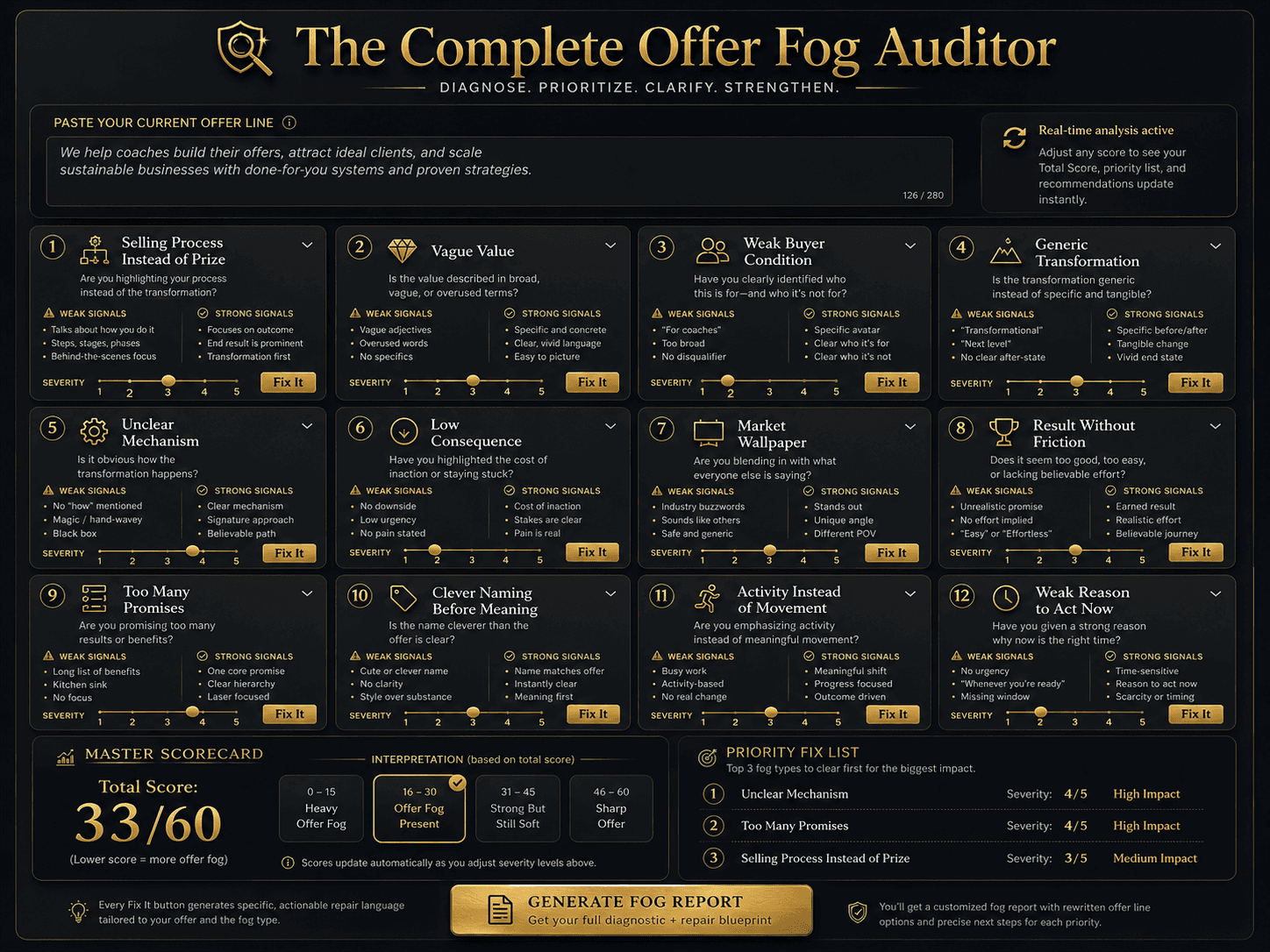
Offer Fog Scorecard™
Score each mistake from 1 to 5.
1 = serious fog
2 = weak
3 = usable but unclear
4 = clear
5 = sharp
Selling Prize, Not Process: ___ / 5
Specific Value: ___ / 5
Buyer Condition: ___ / 5
Transformation Clarity: ___ / 5
Mechanism Clarity: ___ / 5
Consequence Strength: ___ / 5
Distinctiveness: ___ / 5
Friction Removed: ___ / 5
Promise Focus: ___ / 5
Clear Naming: ___ / 5
Buyer Movement: ___ / 5
Reason To Act Now: ___ / 5
Total Score: ___ / 60
——
Score Interpretation
50–60: Sharp Offer™
The offer is clear, specific, buyer-relevant, believable, and distinct.
It has strong buyer condition, visible result, clear mechanism, consequence, and commercial movement.
This offer is strong enough to test in-market.
40–49: Strong But Still Soft™
The offer has a good foundation but still contains one or two fog points.
Fix the lowest-scoring areas first.
This offer does not need a total rebuild.
It needs sharpening.
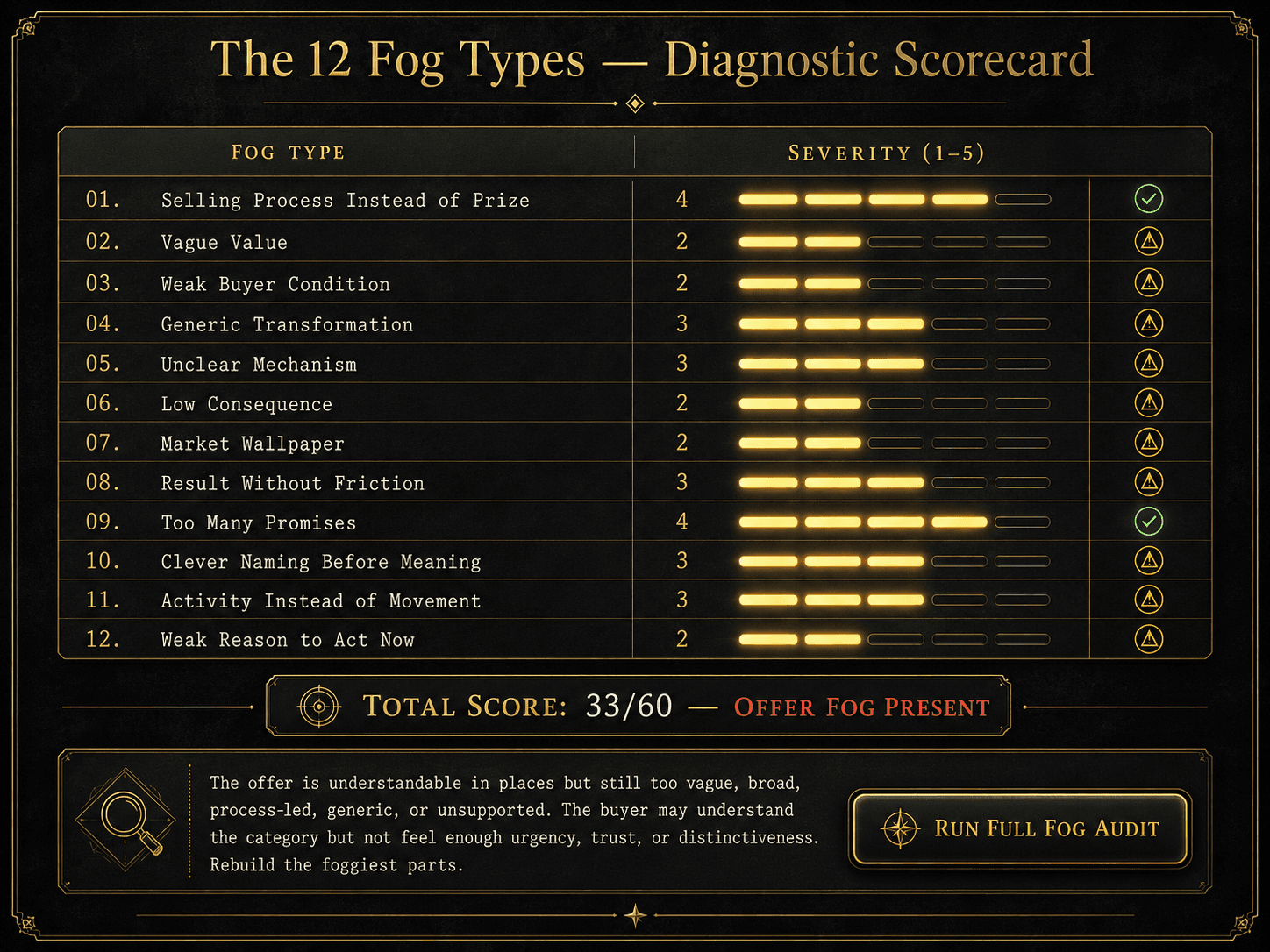
25–39: Offer Fog Present™
The offer is understandable in places but still too vague, broad, process-led, generic, or unsupported.
The buyer may understand the category but not feel enough urgency, trust, or distinctiveness.
Rebuild the foggiest parts.
0–24: Heavy Offer Fog™
The offer is not clear enough.
It likely sounds professional but commercially weak.
Do not scale the page yet.
Return to buyer condition, problem, result, mechanism, consequence, and proof.
——
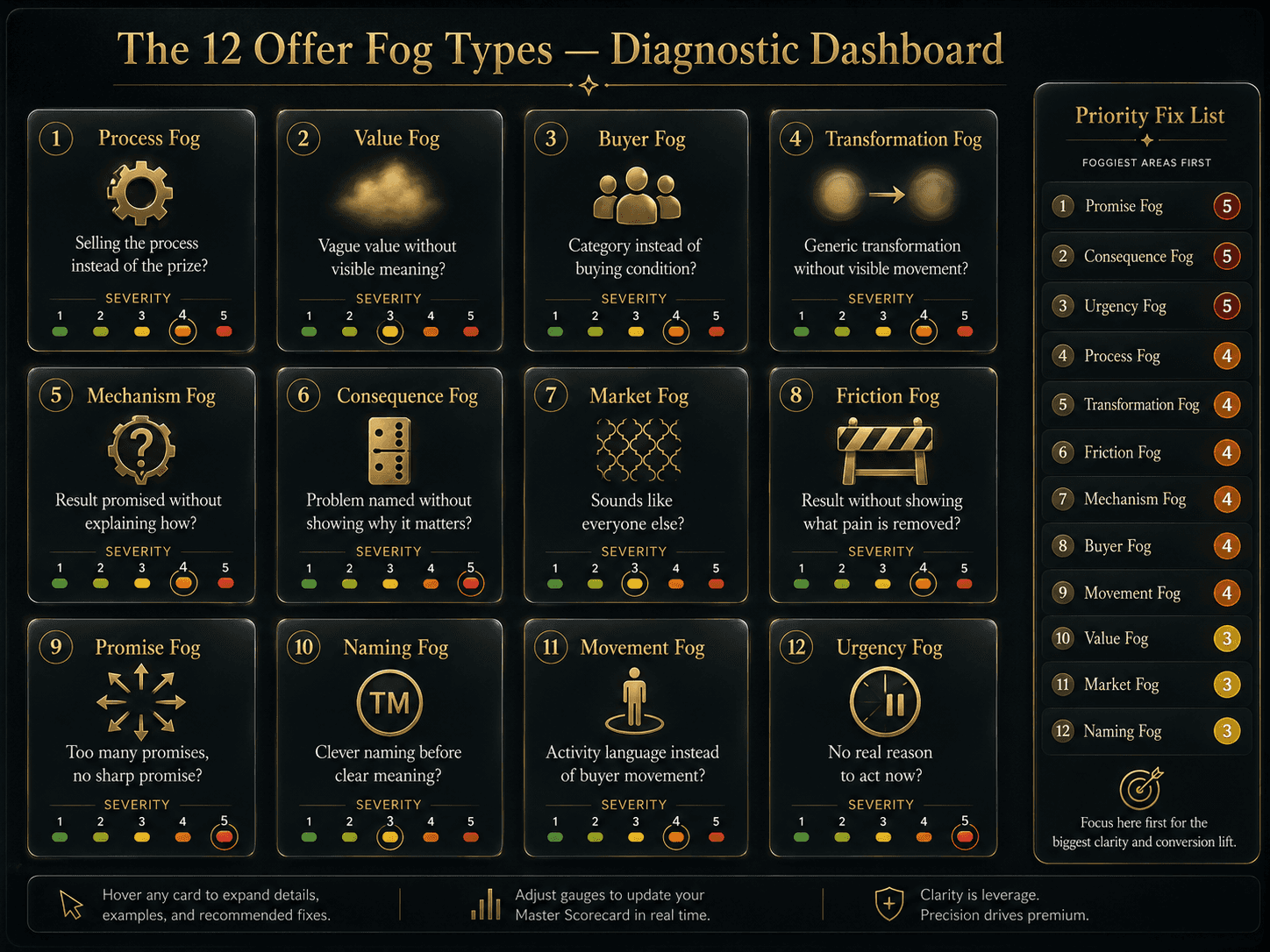
Offer Fog Diagnosis™
Use your lowest scores to identify the dominant fog type.
Process Fog™
The offer sells the activity instead of the buyer prize.
Repair:
Lead with the result.
Value Fog™
The offer uses broad benefits without visible meaning.
Repair:
Replace vague value with specific buyer-visible outcomes.
Buyer Fog™
The offer speaks to a category instead of a buying condition.
Repair:
Name the buyer’s live situation.
Transformation Fog™
The offer promises change without showing from-to movement.
Repair:
Make the before-and-after visible.
Mechanism Fog™
The offer promises a result without explaining how.
Repair:
Add a clear mechanism.
Consequence Fog™
The offer does not show why the problem matters.
Repair:
Reveal the cost of inaction.
Market Fog™
The offer sounds like competitors.
Repair:
Add a named problem, mechanism, buyer condition, or distinctive frame.
Friction Fog™
The offer promises a result but does not show what pain is removed.
Repair:
Add the painful friction the buyer avoids.
Promise Fog™
The offer tries to say too much.
Repair:
Choose one dominant promise.
Naming Fog™
The offer uses branded language before meaning is clear.
Repair:
Explain plainly before naming.
Movement Fog™
The offer describes activity instead of buyer movement.
Repair:
Show what changes in buyer behaviour, belief, trust, or action.
Urgency Fog™
The offer gives no real reason to act now.
Repair:
Show what delay continues to cost.
——
My Dominant Offer Fog
My lowest score is:
My dominant offer fog type is:
Process / Value / Buyer / Transformation / Mechanism / Consequence / Market / Friction / Promise / Naming / Movement / Urgency
The first repair I need to make is:
The offer line currently says:
The offer line should say:
——
Offer Fog Repair Formula™
Use this formula to rebuild the offer after diagnosis.
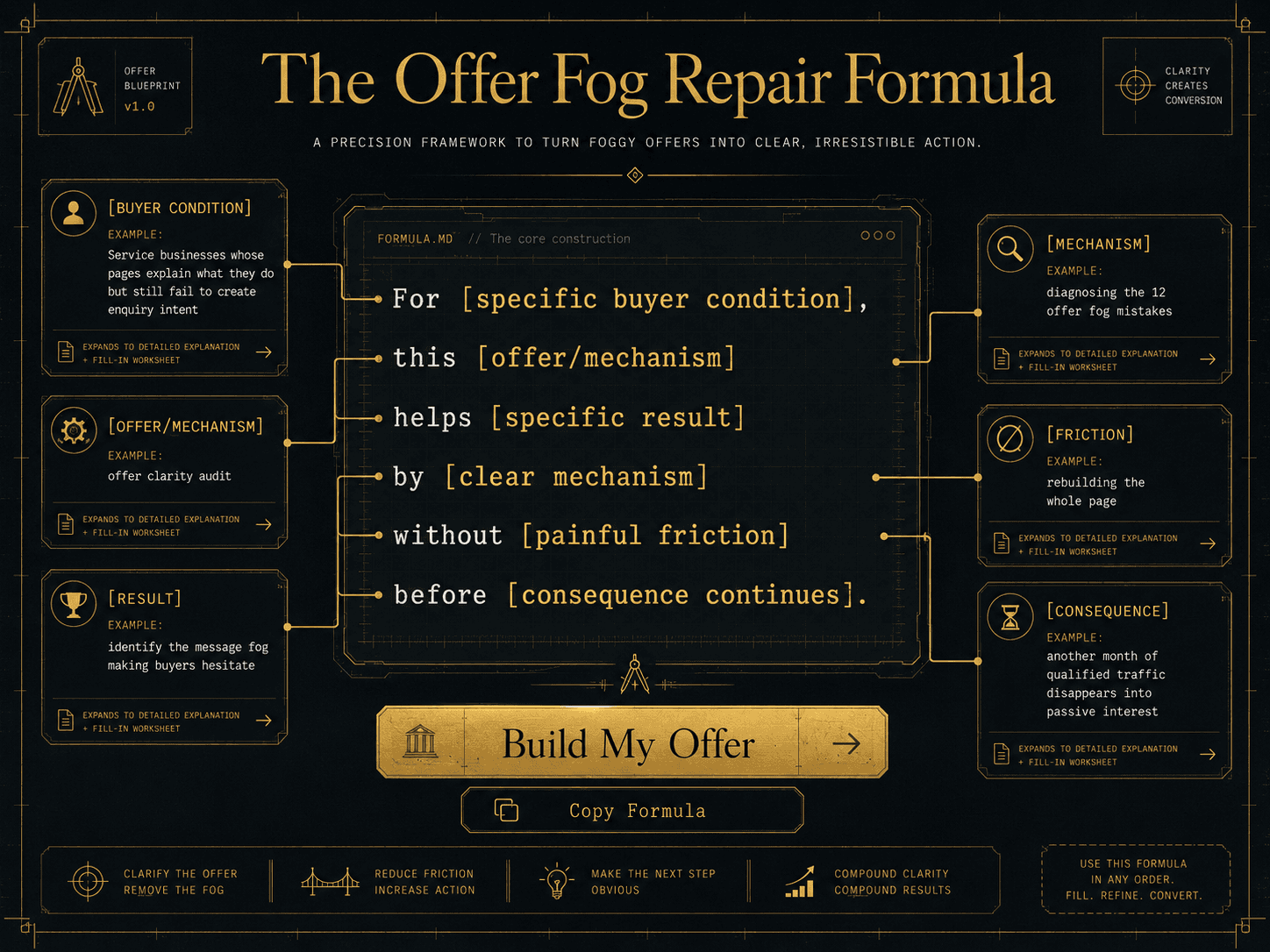
For [specific buyer condition], this [offer/mechanism] helps [specific result] by [clear mechanism] without [painful friction] before [consequence continues].
Example:
“For service businesses whose pages explain what they do but still fail to create enough enquiry intent, this offer clarity audit identifies the message fog making buyers hesitate before another month of qualified traffic disappears into passive interest.”
Do not force every offer into one long sentence.
Use the formula to clarify the thinking.
Then compress.
——
Offer Fog Repair Worksheet
Buyer Condition
For:
Problem
Who are struggling with:
Desired Result
This helps them:
Mechanism
Through:
Painful Friction Removed
Without:
Consequence
Before:
Full Offer Draft
Write the full version:
Compressed Offer Line
Now compress it:
Final Offer Line
Final version:
——
Weak vs Strong Examples
Example 1
Weak:
“We help businesses grow online.”
Mistake:
Vague value. Weak buyer condition. Market wallpaper.
Stronger:
“We help service businesses turn unclear landing pages into enquiry paths buyers understand faster.”
Why stronger:
It names the buyer, the problem, the result, and the movement.
——
Example 2
Weak:
“We provide premium funnel strategy.”
Mistake:
Selling process. No consequence. No mechanism.
Stronger:
“We find the funnel leaks making qualified buyers hesitate before your CTA gets a fair chance.”
Why stronger:
It names the failure point and creates buyer movement.
——
Example 3
Weak:
“Transform your brand with better messaging.”
Mistake:
Generic transformation language.
Stronger:
“Turn a useful-but-forgettable offer into a buying reason your market can understand, remember, and act on.”
Why stronger:
It shows the before-state, after-state, and commercial purpose.
——
Example 4
Weak:
“Our Growth Acceleration Method™ helps ambitious founders scale.”
Mistake:
Clever naming before clear meaning. Market wallpaper.
Stronger:
“Find the offer fog making buyers delay — then rebuild the promise, proof, and mechanism into a clearer reason to act.”
Why stronger:
It explains the value before asking the buyer to care about the method.
——
Example 5
Weak:
“We optimise conversion journeys.”
Mistake:
Activity language instead of buyer movement.
Stronger:
“We stop buyers from dropping off before they understand why the offer is worth trusting.”
Why stronger:
It translates the activity into buyer behaviour.
——
The Fastest Offer Fog Audit™
Use these questions for a rapid check.
Can the buyer understand who this is for?
Can the buyer see the problem?
Can the buyer feel why the problem matters?
Can the buyer picture the result?
Can the buyer understand how the result happens?
Can the buyer see what friction is removed?
Can the buyer tell why this is different?
Can the buyer remember the offer?
Can the buyer explain the offer back in one sentence?
Can the buyer feel a reason to act now?
If too many answers are no, the offer is foggy.
——
Final Offer Fog Mistakes Worksheet
Use this as your working version.
Current Offer
Offer line:
Buyer:
Problem:
Result:
Mechanism:
CTA:
Checklist Results
Selling The Process Instead Of The Prize: Pass / Weak Pass / Fail
Vague Value: Pass / Weak Pass / Fail
Weak Buyer Condition: Pass / Weak Pass / Fail
Generic Transformation Language: Pass / Weak Pass / Fail
Unclear Mechanism: Pass / Weak Pass / Fail
Low Consequence: Pass / Weak Pass / Fail
Market Wallpaper: Pass / Weak Pass / Fail
Result Without Friction Removed: Pass / Weak Pass / Fail
Too Many Promises, No Sharp Promise: Pass / Weak Pass / Fail
Clever Naming Before Clear Meaning: Pass / Weak Pass / Fail
Activity Language Instead Of Buyer Movement: Pass / Weak Pass / Fail
Weak Reason To Act Now: Pass / Weak Pass / Fail
Score
Total score: ___ / 60
Biggest Fog Source
The biggest offer fog mistake is:
Why It Weakens The Offer
It weakens the offer because:
First Repair
The first repair is:
Rewritten Offer
Buyer condition:
Problem:
Result:
Mechanism:
Friction removed:
Consequence:
Final offer line:
Final Verdict
Sharp Offer / Strong But Still Soft / Offer Fog Present / Heavy Offer Fog
Why?
——
Final Execution Challenge™
Take your current offer line and run it through all twelve mistakes.
Do not defend the offer.
Do not explain what you meant.
Do not say:
“Our audience will understand.”
Maybe they will.
Maybe they will not.
The checklist shows where the offer is forcing the buyer to do extra work.
Find the biggest fog source.
Repair it.
Then compress the offer again.
Because a strong offer is not just a nice sentence.
It is a clear commercial thought.
It tells the buyer:
“This is for you.”
“This is the problem.”
“This is why it matters.”
“This is what changes.”
“This is how it happens.”
“This is why this version is different.”
“This is why waiting costs you.”
That is what removes fog.
——
Final Principle™
Offer fog is not harmless.
It quietly weakens everything after it.
The headline has to work harder.
The proof has to work harder.
The CTA has to work harder.
The sales call has to work harder.
The buyer has to work harder.
And when the buyer has to work too hard to understand the value, hesitation wins.
That is why the offer must become clear before the page tries to persuade.
A foggy offer says:
“We do valuable things.”
A sharp offer says:
“Here is the specific problem we solve, for the specific buyer experiencing it, through a specific mechanism, so a specific result becomes easier to believe and act on.”
That is the difference.
The Offer Fog Mistakes Checklist™ exists to expose the fog before it spreads across the funnel.
Because once the offer becomes clear, everything downstream becomes easier:
the page
the headline
the proof
the CTA
the sales conversation
the buying decision
Clarity does not guarantee conversion.
But fog almost always weakens it.
Remove the fog first.
Then build the funnel around the truth that remains.
——
From:
The $100M Funnel Playbook. Book I: Foundation — Buyer Psychology, Offer Clarity, And The Page Architecture Behind High-Converting Funnels
By Maris Spalins.
——
Copyright Notice
© 2026 The $100M Funnel Playbook / Winyourclients / Maris Spalins. All rights reserved.
This resource, including the frameworks, terminology, examples, scorecards, templates, prompts, methods, and written explanations, is original intellectual property created for The $100M Funnel Playbook. Book I: Foundation — Buyer Psychology, Offer Clarity, And The Page Architecture Behind High-Converting Funnels and published through Winyourclients.
No part of this resource may be copied, reproduced, screenshotted, republished, redistributed, sold, adapted, uploaded, scraped, stored in a database, included in training data, used to train artificial intelligence systems, or used to create derivative commercial or educational materials without prior written permission.
Limited reference, quotation, or sharing is only permitted where the source is clearly and visibly credited.
Any permitted reference must include at least one of the following source credits:
The $100M Funnel Playbook by Maris Spalins
or
Winyourclients — www.winyourclients.com
or
Maris Spalins / Winyourclients
Screenshots, excerpts, summaries, or redistributed versions must not remove, hide, alter, crop out, or obscure the original source, author name, book title, website name, or copyright notice.
This resource is provided for personal learning and implementation only. It is not licensed for resale, republishing, redistribution, AI training, template cloning, course creation, consulting delivery, or commercial reuse without written permission from Maris Spalins or Winyourclients.
For permission requests, licensing, citation approval, or commercial usage enquiries, contact:
Winyourclients
www.winyourclients.com
or
Email directly to Jacob on: help@winyourclients.com
![“The Offer Fog Repair Formula” Concept: A minimalist, architectural blueprint showing the Offer Fog Repair Formula™ as a structured template with exploded callouts. Center: The formula in a clean, monospace code block with gold highlighting: text For [specific buyer condition], this [offer/mechanism] helps [specific result] by [clear mechanism] without [painful friction] before [consequence continues]. Around the formula, exploded callouts showing each component with examples: [buyer condition]: “Service businesses whose pages explain what they do but still fail to create enquiry intent” [offer/mechanism]: “offer clarity audit” [result]: “identify the message fog making buyers hesitate” [mechanism]: “diagnosing the 12 offer fog mistakes” [friction]: “rebuilding the whole page” [consequence]: “another month of qualified traffic disappears into passive interest” Below: A “Build My Offer” button that walks the user through each component, then generates a complete, compressed offer line. Style: Architectural blueprint meets luxury UI. Dark background, gold lines, monospace for formula, thin connecting callouts. Feels like a precision construction guide. Interaction: Hovering any callout expands a detailed explanation of that component and a fill-in worksheet. Clicking “Build My Offer” opens an interactive builder. A “Copy Formula” button copies the template to clipboard.](https://framerusercontent.com/images/1vrg1Odf15zakXcdCNvB8CdTAPk.png?width=1448&height=1086)
The Offer Fog Mistakes Checklist™ It is a practical diagnostic for catching the most common mistakes that make an offer sound vague, generic, or commercially weak. It helps you identify where the offer is selling the process instead of the prize, hiding behind broad value, speaking to a weak buyer condition, using generic transformation language, missing a clear mechanism, lacking consequence, or blending into market wallpaper. Use it after building or rewriting an offer to make sure the buyer can instantly understand what is being sold, why it matters, and why this version is different.
Prefer Audio Or Video?
The Offer Fog Mistakes Checklist™ is also available as:
🎧 A guided audio walkthrough explaining the most common offer fog mistakes, including vague value, weak buyer condition, process-led offers, unclear mechanisms, low consequence, and market wallpaper.
🎥 A practical video breakdown with real offer examples, weak vs strong offer rewrites, mistake-by-mistake diagnosis, and offer clarity repairs.
Choose the format that fits how you learn best.
[Listen To The Audio Walkthrough] (coming soon)
[Watch The Video Breakdown] (coming soon)
——
Why Offers Still Feel Foggy After They Sound “Better”
Most offers do not fail because they are completely unclear.
They fail because they are almost clear.
That is more dangerous.
The buyer kind of understands the category.
They kind of understand the service.
They kind of understand the result.
They kind of understand the value.
But they do not feel enough sharpness to care, trust, remember, or act.
That is offer fog.
Offer fog is not always total confusion.
Sometimes it is soft understanding.
The buyer reads the offer and thinks:
“That sounds useful.”
But not:
“I need this.”
They think:
“That makes sense.”
But not:
“That is exactly my problem.”
They think:
“Interesting.”
But not:
“I understand why this matters now.”
That is the danger.
A foggy offer may sound polished.
It may sound professional.
It may even sound valuable.
But if the buyer cannot quickly understand the buyer condition, the problem, the result, the mechanism, the consequence, and the reason this offer is different, the offer is still leaking conversion.
That is why this checklist exists.
It catches the mistakes that make offers sound acceptable but weak.
——
What This Resource Helps You Do
The Offer Fog Mistakes Checklist™ helps you identify the most common reasons an offer loses clarity, value, tension, and buyer recognition.
Use this when:
your offer sounds professional but forgettable
buyers understand the category but not the value
your offer needs too much explaining
your offer line feels vague
your promise sounds broad
your mechanism is unclear
your result feels generic
your page explains the service but does not create desire
your offer sounds like competitors
your positioning feels soft
your CTA gets interest but weak action
buyers say “sounds good” but do not move
your offer sells what you do instead of why it matters
This is not a creativity checklist.
This is a fog-removal checklist.
The goal is simple:
Find the specific mistake making the offer harder to understand, harder to trust, harder to remember, or easier to ignore.
——
The Core Principle™
An offer is foggy when the buyer has to translate the value themselves.
That is the rule.
The buyer should not have to mentally convert your process into their outcome.
They should not have to guess who the offer is for.
They should not have to imagine why the problem matters.
They should not have to decode the mechanism.
They should not have to figure out what changes after buying.
They should not have to compare five vague claims to understand why yours is different.
The offer should do that work.
A strong offer makes the value visible.
A foggy offer makes the buyer work.
And buyers do not reward unnecessary work.
They leave.
They delay.
They compare.
They ask for more information.
They say it sounds interesting.
They need time.
Often, that does not mean the offer is bad.
It means the offer is foggy.
——
How To Use This Checklist
Take your current offer line, landing page hero, sales page promise, product description, service description, or CTA section.
Run it through every mistake in this checklist.
For each mistake, mark:
Pass
Weak Pass
Fail
Then identify your top three offer fog mistakes.
Do not rewrite everything randomly.
Fix the biggest fog source first.
The goal is not to make the offer longer.
The goal is to make it clearer, sharper, more specific, more believable, and harder to ignore.
——
Current Offer Capture
Before using the checklist, write the current version.
Current Offer Line
Paste the offer here:
Target Buyer
Who is this offer for?
Buyer Condition
What situation is the buyer currently in?
Problem
What problem does the offer solve?
Desired Result
What result does the buyer want?
Mechanism
What method, system, process, angle, or approach creates the result?
Consequence
What happens if the buyer does not solve this?
CTA
What action does the buyer take next?
——
Mistake 1: Selling The Process Instead Of The Prize™
The Mistake
The offer describes what you do instead of what the buyer gets.
This is one of the most common offer fog mistakes.
Businesses love describing their process:
strategy
consulting
coaching
copywriting
automation
optimisation
implementation
workshops
audits
systems
campaigns
But buyers do not buy the process first.
They buy the outcome the process makes possible.
The process matters, but only after the buyer understands the prize.
Weak Example
“We provide conversion copywriting and funnel strategy.”
This describes the activity.
But the buyer still has to translate the value.
They may wonder:
“What does that actually do for me?”
Stronger Example
“We find the message leaks making qualified buyers hesitate before enquiring.”
Now the buyer sees the prize:
less hesitation
clearer buyer movement
stronger enquiry intent
The process can come later.
Why This Matters
When the offer leads with process, it feels operational.
When the offer leads with the prize, it feels commercially meaningful.
The buyer should understand why the process matters before you ask them to care about the process itself.
Checklist
Does the offer lead with what you do?
Pass / Weak Pass / Fail
Does the buyer understand what they get?
Pass / Weak Pass / Fail
Does the result feel more visible than the process?
Pass / Weak Pass / Fail
Could the offer be rewritten around the buyer’s desired shift?
Pass / Weak Pass / Fail
Repair Prompt
Rewrite the offer so it leads with the outcome, not the activity.
Use this structure:
Help [specific buyer] achieve [visible result] without [painful friction] through [mechanism].
Repair Worksheet
Current process language:
What buyer prize does this process create?
What painful friction does it remove?
Rewrite the offer around the prize:
——
Mistake 2: Vague Value™
The Mistake
The offer uses broad value words that sound good but do not create a clear mental picture.
Examples include:
growth
success
clarity
strategy
transformation
performance
scale
support
optimisation
results
solutions
These words are not always wrong.
But when they appear without specificity, they become fog.
The buyer may understand that the offer is positive, but not what it actually changes.
Weak Example
“We help businesses grow with better strategy.”
This is too vague.
The buyer cannot picture the value.
Stronger Example
“We help service businesses turn unclear offer pages into sharper enquiry paths that buyers understand faster.”
Now the value has shape.
The buyer can picture:
unclear pages
sharper enquiry paths
faster buyer understanding
Why This Matters
Vague value forces the buyer to imagine the benefit.
Specific value makes the benefit visible.
The buyer should not have to fill in the blanks.
Checklist
Does the offer use broad words without explanation?
Pass / Weak Pass / Fail
Can the buyer picture the result?
Pass / Weak Pass / Fail
Does the value feel specific enough to remember?
Pass / Weak Pass / Fail
Would ten competitors describe their value the same way?
Pass / Weak Pass / Fail
Repair Prompt
Replace vague value with visible value.
Ask:
“What does growth actually look like here?”
“What becomes clearer?”
“What improves?”
“What moves?”
“What stops leaking?”
“What becomes easier?”
Repair Worksheet
Vague value word:
What does this actually mean for the buyer?
What visible result replaces it?
Rewrite the offer with specific value:
——
Mistake 3: Weak Buyer Condition™
The Mistake
The offer speaks to a broad audience instead of a specific buying condition.
A broad audience says:
founders
coaches
consultants
agencies
creators
business owners
service providers
SaaS companies
ecommerce brands
A buyer condition says:
founders whose pages look polished but still fail to create trust
coaches getting attention but not enough booked calls
agencies losing serious buyers because the offer sounds generic
SaaS teams watching trial users leave before onboarding builds confidence
The condition is more powerful than the category.
Weak Example
“For business owners who want better marketing.”
This is too broad.
Almost everyone could say yes.
That means no one feels deeply recognised.
Stronger Example
“For service business owners whose pages explain what they do but still fail to give buyers a strong reason to enquire.”
Now the buyer recognises a specific situation.
Why This Matters
Buyers do not respond strongly because they see their category.
They respond when they see their situation.
A strong offer names the buyer’s live condition.
Checklist
Does the offer name a specific buyer?
Pass / Weak Pass / Fail
Does it name their current situation?
Pass / Weak Pass / Fail
Does the right buyer feel recognised?
Pass / Weak Pass / Fail
Could the wrong buyer mistakenly think this is for them?
Pass / Weak Pass / Fail
Repair Prompt
Rewrite the buyer from category to condition.
Use:
For [buyer type] who [specific situation/problem].
Repair Worksheet
Current buyer category:
Specific buyer condition:
What are they currently experiencing?
What makes them different from a generic buyer?
Rewrite the buyer condition:
——
Mistake 4: Generic Transformation Language™
The Mistake
The offer promises transformation without making the transformation specific.
Generic transformation sounds like:
go to the next level
unlock your potential
transform your business
scale faster
achieve more
grow with confidence
build success
reach new heights
These phrases are familiar.
And familiar without specificity becomes invisible.
Weak Example
“Transform your business with high-converting funnels.”
This sounds big, but the buyer cannot see the actual transformation.
Stronger Example
“Turn passive page visitors into buyers who understand the offer before hesitation takes over.”
Now the transformation has movement.
The buyer can feel the before and after.
Why This Matters
Transformation only becomes persuasive when the buyer can see what changes.
A vague transformation feels like marketing.
A specific transformation feels like movement.
Checklist
Does the offer use broad transformation language?
Pass / Weak Pass / Fail
Can the buyer see the before-state?
Pass / Weak Pass / Fail
Can the buyer see the after-state?
Pass / Weak Pass / Fail
Does the transformation feel specific enough to believe?
Pass / Weak Pass / Fail
Repair Prompt
Rewrite the transformation as movement.
Use:
From [current weak state] to [desired stronger state].
Repair Worksheet
Current vague transformation:
Before-state:
After-state:
What changes emotionally or commercially?
Rewrite the transformation:
——
Mistake 5: Unclear Mechanism™
The Mistake
The offer promises a result but does not explain how the result is created.
Without mechanism, the buyer may understand the promise but not believe it.
They think:
“Sounds good, but how?”
That question matters.
A mechanism makes the offer more believable because it gives the buyer a reason the result might happen.
The mechanism does not need to be complicated.
It needs to be clear enough to create trust.
Weak Example
“We help you get more leads.”
This may be desirable, but the mechanism is missing.
Stronger Example
“We rebuild the first screen around buyer recognition, proof, and CTA movement so more visitors understand why enquiring makes sense.”
Now the buyer sees how the result is created.
Why This Matters
A result without mechanism often feels like a claim.
A result with mechanism feels more believable.
The buyer needs a bridge between promise and trust.
Checklist
Does the offer explain how the result is created?
Pass / Weak Pass / Fail
Is the mechanism specific?
Pass / Weak Pass / Fail
Is the mechanism easy to understand?
Pass / Weak Pass / Fail
Does the mechanism make the promise more believable?
Pass / Weak Pass / Fail
Repair Prompt
Add a simple mechanism.
Use:
through [specific method/process/system/angle].
Repair Worksheet
Current promised result:
What creates that result?
What does your method diagnose, remove, rebuild, clarify, or improve?
What makes this mechanism different?
Rewrite the offer with mechanism:
——
Mistake 6: Low Consequence™
The Mistake
The offer names a problem but does not show why the problem matters.
Without consequence, the buyer may agree with the offer but still postpone action.
They think:
“That sounds useful.”
But not:
“I need to fix this.”
Consequence creates urgency without fake pressure.
It makes the cost of inaction visible.
Weak Example
“We improve your landing page messaging.”
This is clear, but the consequence is soft.
Stronger Example
“We fix the landing page messaging that makes qualified buyers hesitate before they ever reach the CTA.”
Now the buyer sees the cost:
qualified buyers hesitate
attention leaks
CTA never gets reached
Why This Matters
A problem without consequence feels optional.
A problem with consequence feels worth solving.
Checklist
Does the offer show what happens if the problem continues?
Pass / Weak Pass / Fail
Does it reveal a commercial cost?
Pass / Weak Pass / Fail
Does it reveal an emotional cost?
Pass / Weak Pass / Fail
Does the buyer feel why this matters now?
Pass / Weak Pass / Fail
Repair Prompt
Add consequence without exaggeration.
Ask:
“What keeps leaking if this is not fixed?”
Repair Worksheet
Current problem:
What happens if it continues?
What does the buyer lose?
What becomes harder?
What frustration repeats?
Rewrite with consequence:
——
Mistake 7: Market Wallpaper™
The Mistake
The offer sounds like everyone else.
Market wallpaper is language the buyer has seen so often that the brain stops assigning value to it.
Examples:
strategic growth solutions
done-for-you marketing
premium consulting
conversion optimisation
custom systems
full-service support
high-converting funnels
growth partner
business transformation
results-driven strategy
These phrases may not be false.
But they are overfamiliar.
And overfamiliar language gets ignored.
Weak Example
“Done-for-you marketing systems for ambitious brands.”
This could belong to thousands of businesses.
It has no ownership.
Stronger Example
“Offer Fog Elimination™ for service businesses whose value sounds useful but forgettable.”
Now the offer has a named problem, buyer condition, and sharper identity.
Why This Matters
The buyer cannot choose what they cannot remember.
Distinctiveness makes the offer easier to recognise, repeat, and compare.
Checklist
Could five competitors say the same thing?
Pass / Weak Pass / Fail
Would the offer still feel recognisable without the logo?
Pass / Weak Pass / Fail
Does the offer contain a distinctive problem, mechanism, or phrase?
Pass / Weak Pass / Fail
Does it sound like a point of view or just a category?
Pass / Weak Pass / Fail
Repair Prompt
Add identity.
Use one or more of:
named problem
specific buyer condition
distinct mechanism
sharp consequence
buyer-language phrase
Repair Worksheet
Current market wallpaper phrase:
Could competitors say this?
Yes / No / Partially
What named problem could replace it?
What mechanism could make it more distinctive?
Rewrite with stronger identity:
——
Mistake 8: Result Without Friction Removed™
The Mistake
The offer promises a result but does not mention what painful friction the buyer gets to avoid.
Results become stronger when paired with removed friction.
The buyer does not only want the outcome.
They also want relief from the painful path they expect.
Examples of friction:
without rebuilding everything
without wasting more ad spend
without sounding louder
without hiring a full team
without another complicated system
without guessing what to fix
without chasing low-fit leads
without overexplaining the offer
without relying on fake urgency
without sending traffic into a page you do not trust
Weak Example
“Get more enquiries.”
This is desirable, but incomplete.
Stronger Example
“Get more serious enquiries without rebuilding the entire funnel from scratch.”
Now the buyer sees both:
the result
the relief
Why This Matters
Friction removal makes the offer feel easier, safer, and more desirable.
It answers the buyer’s hidden concern:
“What will this cost me emotionally, mentally, operationally, or financially?”
Checklist
Does the offer name the desired result?
Pass / Weak Pass / Fail
Does it name the painful friction removed?
Pass / Weak Pass / Fail
Does the offer feel easier because of that removed friction?
Pass / Weak Pass / Fail
Does the friction reflect a real buyer concern?
Pass / Weak Pass / Fail
Repair Prompt
Add a “without” line.
Use:
Get [result] without [painful friction].
Repair Worksheet
Desired result:
Painful friction the buyer wants removed:
What are they tired of doing?
What do they fear this will require?
Rewrite with friction removed:
——
Mistake 9: Too Many Promises, No Sharp Promise™
The Mistake
The offer tries to sell too many things at once.
It promises:
more leads
better branding
higher conversions
stronger messaging
clearer strategy
better systems
more confidence
more sales
stronger positioning
less stress
That may all be true.
But when everything is the point, nothing is the point.
A strong offer needs one dominant promise.
Supporting benefits can come later.
Weak Example
“We help you improve your marketing, messaging, funnel, positioning, content, conversions, and growth.”
This is overloaded.
The buyer does not know what to remember.
Stronger Example
“We fix the offer clarity problem making your page sound useful but not urgent enough to act on.”
Now the offer has one sharp promise.
Why This Matters
The buyer remembers compression.
Not everything.
A strong offer gives the mind one clear handle.
Checklist
Does the offer contain too many promises?
Pass / Weak Pass / Fail
Is there one dominant outcome?
Pass / Weak Pass / Fail
Can the buyer remember the offer after reading it once?
Pass / Weak Pass / Fail
Could the supporting benefits be moved lower on the page?
Pass / Weak Pass / Fail
Repair Prompt
Choose the strongest promise.
Ask:
“What is the one result this offer must be remembered for?”
Repair Worksheet
List all current promises:
Which promise matters most?
Which promises are secondary?
Rewrite around one dominant promise:
——
Mistake 10: Clever Naming Before Clear Meaning™
The Mistake
The offer uses a branded name before the buyer understands what it means.
Naming can be powerful.
But naming cannot replace clarity.
A branded mechanism, framework, method, or offer name works best after the buyer understands the problem and result.
If the name arrives too early without explanation, it creates fog.
Weak Example
“Install The Velocity Ascension Method™.”
The buyer may think:
“What does that mean?”
The name sounds impressive but unclear.
Stronger Example
“Find the offer fog making qualified buyers hesitate — using The Offer Clarity Audit™.”
Now the name supports clarity.
It does not replace it.
Why This Matters
A name should make a clear idea more memorable.
It should not make an unclear idea sound premium.
Premium fog is still fog.
Checklist
Does the offer use a branded name?
Pass / Weak Pass / Fail
Is the meaning clear before the name appears?
Pass / Weak Pass / Fail
Does the name make the idea easier to remember?
Pass / Weak Pass / Fail
Or does the name make the buyer decode more?
Pass / Weak Pass / Fail
Repair Prompt
Explain the plain-language value before or beside the branded name.
Use:
[Plain-language result] through [branded mechanism].
Repair Worksheet
Branded name:
Plain-language meaning:
Problem it solves:
Result it creates:
Rewrite with clear meaning first:
——
Mistake 11: Activity Language Instead Of Buyer Movement™
The Mistake
The offer focuses on business activity instead of buyer movement.
Activity language describes what the seller does.
Buyer movement describes what changes in the buyer’s world.
Weak Activity Language
strategy sessions
marketing audits
copywriting
funnels
campaigns
optimisation
consulting
content systems
automation
positioning
Strong Buyer Movement Language
buyers understand faster
hesitation drops
trust forms earlier
enquiries become more serious
the offer becomes easier to explain
the page stops leaking attention
proof supports the claim directly
traffic stops disappearing into confusion
Weak Example
“We provide funnel optimisation.”
This names the activity.
Stronger Example
“We find where buyers lose trust before the funnel ever gets the chance to convert.”
This names the buyer movement problem.
Why This Matters
Buyers pay attention when they see themselves moving away from pain and toward a better state.
Activity is less memorable than movement.
Checklist
Does the offer describe what you do?
Pass / Weak Pass / Fail
Does it describe what changes for the buyer?
Pass / Weak Pass / Fail
Does it show buyer behaviour changing?
Pass / Weak Pass / Fail
Does it feel commercially alive?
Pass / Weak Pass / Fail
Repair Prompt
Translate activity into movement.
Ask:
“What does this activity make happen for the buyer?”
Repair Worksheet
Current activity language:
What buyer behaviour changes?
What business outcome changes?
What emotional state changes?
Rewrite as buyer movement:
——
Mistake 12: Weak Reason To Act Now™
The Mistake
The offer is clear, but there is no reason to act now.
This does not mean fake urgency.
Do not invent scarcity.
Do not add countdowns without reason.
Do not pressure buyers with manufactured deadlines.
The better question is:
What is the real cost of waiting?
A strong offer often contains natural urgency through consequence.
Weak Example
“Improve your offer clarity.”
This is useful, but not urgent.
Stronger Example
“Fix the offer clarity problem before more qualified buyers leave thinking your value sounds useful but not necessary.”
Now there is a reason to act.
The cost of waiting is visible.
Why This Matters
If the buyer does not understand why delay matters, they may postpone even a good offer.
Urgency should come from truth.
Not pressure.
Checklist
Does the offer show a real reason to act now?
Pass / Weak Pass / Fail
Does it avoid fake urgency?
Pass / Weak Pass / Fail
Does it reveal the cost of delay?
Pass / Weak Pass / Fail
Does waiting feel more expensive than moving?
Pass / Weak Pass / Fail
Repair Prompt
Add natural urgency through consequence.
Ask:
“What keeps happening while the buyer delays?”
Repair Worksheet
What happens if the buyer waits?
What continues leaking?
What cost compounds?
What opportunity is missed?
Rewrite with natural urgency:
——
The Complete Offer Fog Mistakes Checklist™
Mark each mistake as Pass, Weak Pass, or Fail.
Selling The Process Instead Of The Prize: Pass / Weak Pass / Fail
Vague Value: Pass / Weak Pass / Fail
Weak Buyer Condition: Pass / Weak Pass / Fail
Generic Transformation Language: Pass / Weak Pass / Fail
Unclear Mechanism: Pass / Weak Pass / Fail
Low Consequence: Pass / Weak Pass / Fail
Market Wallpaper: Pass / Weak Pass / Fail
Result Without Friction Removed: Pass / Weak Pass / Fail
Too Many Promises, No Sharp Promise: Pass / Weak Pass / Fail
Clever Naming Before Clear Meaning: Pass / Weak Pass / Fail
Activity Language Instead Of Buyer Movement: Pass / Weak Pass / Fail
Weak Reason To Act Now: Pass / Weak Pass / Fail
——
Offer Fog Scorecard™
Score each mistake from 1 to 5.
1 = serious fog
2 = weak
3 = usable but unclear
4 = clear
5 = sharp
Selling Prize, Not Process: ___ / 5
Specific Value: ___ / 5
Buyer Condition: ___ / 5
Transformation Clarity: ___ / 5
Mechanism Clarity: ___ / 5
Consequence Strength: ___ / 5
Distinctiveness: ___ / 5
Friction Removed: ___ / 5
Promise Focus: ___ / 5
Clear Naming: ___ / 5
Buyer Movement: ___ / 5
Reason To Act Now: ___ / 5
Total Score: ___ / 60
——
Score Interpretation
50–60: Sharp Offer™
The offer is clear, specific, buyer-relevant, believable, and distinct.
It has strong buyer condition, visible result, clear mechanism, consequence, and commercial movement.
This offer is strong enough to test in-market.
40–49: Strong But Still Soft™
The offer has a good foundation but still contains one or two fog points.
Fix the lowest-scoring areas first.
This offer does not need a total rebuild.
It needs sharpening.
25–39: Offer Fog Present™
The offer is understandable in places but still too vague, broad, process-led, generic, or unsupported.
The buyer may understand the category but not feel enough urgency, trust, or distinctiveness.
Rebuild the foggiest parts.
0–24: Heavy Offer Fog™
The offer is not clear enough.
It likely sounds professional but commercially weak.
Do not scale the page yet.
Return to buyer condition, problem, result, mechanism, consequence, and proof.
——
Offer Fog Diagnosis™
Use your lowest scores to identify the dominant fog type.
Process Fog™
The offer sells the activity instead of the buyer prize.
Repair:
Lead with the result.
Value Fog™
The offer uses broad benefits without visible meaning.
Repair:
Replace vague value with specific buyer-visible outcomes.
Buyer Fog™
The offer speaks to a category instead of a buying condition.
Repair:
Name the buyer’s live situation.
Transformation Fog™
The offer promises change without showing from-to movement.
Repair:
Make the before-and-after visible.
Mechanism Fog™
The offer promises a result without explaining how.
Repair:
Add a clear mechanism.
Consequence Fog™
The offer does not show why the problem matters.
Repair:
Reveal the cost of inaction.
Market Fog™
The offer sounds like competitors.
Repair:
Add a named problem, mechanism, buyer condition, or distinctive frame.
Friction Fog™
The offer promises a result but does not show what pain is removed.
Repair:
Add the painful friction the buyer avoids.
Promise Fog™
The offer tries to say too much.
Repair:
Choose one dominant promise.
Naming Fog™
The offer uses branded language before meaning is clear.
Repair:
Explain plainly before naming.
Movement Fog™
The offer describes activity instead of buyer movement.
Repair:
Show what changes in buyer behaviour, belief, trust, or action.
Urgency Fog™
The offer gives no real reason to act now.
Repair:
Show what delay continues to cost.
——
My Dominant Offer Fog
My lowest score is:
My dominant offer fog type is:
Process / Value / Buyer / Transformation / Mechanism / Consequence / Market / Friction / Promise / Naming / Movement / Urgency
The first repair I need to make is:
The offer line currently says:
The offer line should say:
——
Offer Fog Repair Formula™
Use this formula to rebuild the offer after diagnosis.
For [specific buyer condition], this [offer/mechanism] helps [specific result] by [clear mechanism] without [painful friction] before [consequence continues].
Example:
“For service businesses whose pages explain what they do but still fail to create enough enquiry intent, this offer clarity audit identifies the message fog making buyers hesitate before another month of qualified traffic disappears into passive interest.”
Do not force every offer into one long sentence.
Use the formula to clarify the thinking.
Then compress.
——
Offer Fog Repair Worksheet
Buyer Condition
For:
Problem
Who are struggling with:
Desired Result
This helps them:
Mechanism
Through:
Painful Friction Removed
Without:
Consequence
Before:
Full Offer Draft
Write the full version:
Compressed Offer Line
Now compress it:
Final Offer Line
Final version:
——
Weak vs Strong Examples
Example 1
Weak:
“We help businesses grow online.”
Mistake:
Vague value. Weak buyer condition. Market wallpaper.
Stronger:
“We help service businesses turn unclear landing pages into enquiry paths buyers understand faster.”
Why stronger:
It names the buyer, the problem, the result, and the movement.
——
Example 2
Weak:
“We provide premium funnel strategy.”
Mistake:
Selling process. No consequence. No mechanism.
Stronger:
“We find the funnel leaks making qualified buyers hesitate before your CTA gets a fair chance.”
Why stronger:
It names the failure point and creates buyer movement.
——
Example 3
Weak:
“Transform your brand with better messaging.”
Mistake:
Generic transformation language.
Stronger:
“Turn a useful-but-forgettable offer into a buying reason your market can understand, remember, and act on.”
Why stronger:
It shows the before-state, after-state, and commercial purpose.
——
Example 4
Weak:
“Our Growth Acceleration Method™ helps ambitious founders scale.”
Mistake:
Clever naming before clear meaning. Market wallpaper.
Stronger:
“Find the offer fog making buyers delay — then rebuild the promise, proof, and mechanism into a clearer reason to act.”
Why stronger:
It explains the value before asking the buyer to care about the method.
——
Example 5
Weak:
“We optimise conversion journeys.”
Mistake:
Activity language instead of buyer movement.
Stronger:
“We stop buyers from dropping off before they understand why the offer is worth trusting.”
Why stronger:
It translates the activity into buyer behaviour.
——
The Fastest Offer Fog Audit™
Use these questions for a rapid check.
Can the buyer understand who this is for?
Can the buyer see the problem?
Can the buyer feel why the problem matters?
Can the buyer picture the result?
Can the buyer understand how the result happens?
Can the buyer see what friction is removed?
Can the buyer tell why this is different?
Can the buyer remember the offer?
Can the buyer explain the offer back in one sentence?
Can the buyer feel a reason to act now?
If too many answers are no, the offer is foggy.
——
Final Offer Fog Mistakes Worksheet
Use this as your working version.
Current Offer
Offer line:
Buyer:
Problem:
Result:
Mechanism:
CTA:
Checklist Results
Selling The Process Instead Of The Prize: Pass / Weak Pass / Fail
Vague Value: Pass / Weak Pass / Fail
Weak Buyer Condition: Pass / Weak Pass / Fail
Generic Transformation Language: Pass / Weak Pass / Fail
Unclear Mechanism: Pass / Weak Pass / Fail
Low Consequence: Pass / Weak Pass / Fail
Market Wallpaper: Pass / Weak Pass / Fail
Result Without Friction Removed: Pass / Weak Pass / Fail
Too Many Promises, No Sharp Promise: Pass / Weak Pass / Fail
Clever Naming Before Clear Meaning: Pass / Weak Pass / Fail
Activity Language Instead Of Buyer Movement: Pass / Weak Pass / Fail
Weak Reason To Act Now: Pass / Weak Pass / Fail
Score
Total score: ___ / 60
Biggest Fog Source
The biggest offer fog mistake is:
Why It Weakens The Offer
It weakens the offer because:
First Repair
The first repair is:
Rewritten Offer
Buyer condition:
Problem:
Result:
Mechanism:
Friction removed:
Consequence:
Final offer line:
Final Verdict
Sharp Offer / Strong But Still Soft / Offer Fog Present / Heavy Offer Fog
Why?
——
Final Execution Challenge™
Take your current offer line and run it through all twelve mistakes.
Do not defend the offer.
Do not explain what you meant.
Do not say:
“Our audience will understand.”
Maybe they will.
Maybe they will not.
The checklist shows where the offer is forcing the buyer to do extra work.
Find the biggest fog source.
Repair it.
Then compress the offer again.
Because a strong offer is not just a nice sentence.
It is a clear commercial thought.
It tells the buyer:
“This is for you.”
“This is the problem.”
“This is why it matters.”
“This is what changes.”
“This is how it happens.”
“This is why this version is different.”
“This is why waiting costs you.”
That is what removes fog.
——
Final Principle™
Offer fog is not harmless.
It quietly weakens everything after it.
The headline has to work harder.
The proof has to work harder.
The CTA has to work harder.
The sales call has to work harder.
The buyer has to work harder.
And when the buyer has to work too hard to understand the value, hesitation wins.
That is why the offer must become clear before the page tries to persuade.
A foggy offer says:
“We do valuable things.”
A sharp offer says:
“Here is the specific problem we solve, for the specific buyer experiencing it, through a specific mechanism, so a specific result becomes easier to believe and act on.”
That is the difference.
The Offer Fog Mistakes Checklist™ exists to expose the fog before it spreads across the funnel.
Because once the offer becomes clear, everything downstream becomes easier:
the page
the headline
the proof
the CTA
the sales conversation
the buying decision
Clarity does not guarantee conversion.
But fog almost always weakens it.
Remove the fog first.
Then build the funnel around the truth that remains.
——
From:
The $100M Funnel Playbook. Book I: Foundation — Buyer Psychology, Offer Clarity, And The Page Architecture Behind High-Converting Funnels
By Maris Spalins.
——
Copyright Notice
© 2026 The $100M Funnel Playbook / Winyourclients / Maris Spalins. All rights reserved.
This resource, including the frameworks, terminology, examples, scorecards, templates, prompts, methods, and written explanations, is original intellectual property created for The $100M Funnel Playbook. Book I: Foundation — Buyer Psychology, Offer Clarity, And The Page Architecture Behind High-Converting Funnels and published through Winyourclients.
No part of this resource may be copied, reproduced, screenshotted, republished, redistributed, sold, adapted, uploaded, scraped, stored in a database, included in training data, used to train artificial intelligence systems, or used to create derivative commercial or educational materials without prior written permission.
Limited reference, quotation, or sharing is only permitted where the source is clearly and visibly credited.
Any permitted reference must include at least one of the following source credits:
The $100M Funnel Playbook by Maris Spalins
or
Winyourclients — www.winyourclients.com
or
Maris Spalins / Winyourclients
Screenshots, excerpts, summaries, or redistributed versions must not remove, hide, alter, crop out, or obscure the original source, author name, book title, website name, or copyright notice.
This resource is provided for personal learning and implementation only. It is not licensed for resale, republishing, redistribution, AI training, template cloning, course creation, consulting delivery, or commercial reuse without written permission from Maris Spalins or Winyourclients.
For permission requests, licensing, citation approval, or commercial usage enquiries, contact:
Winyourclients
www.winyourclients.com
or
Email directly to Jacob on: help@winyourclients.com
Other Blogs
Other Blogs
Check our other project Blogs with useful insight and information for your businesses
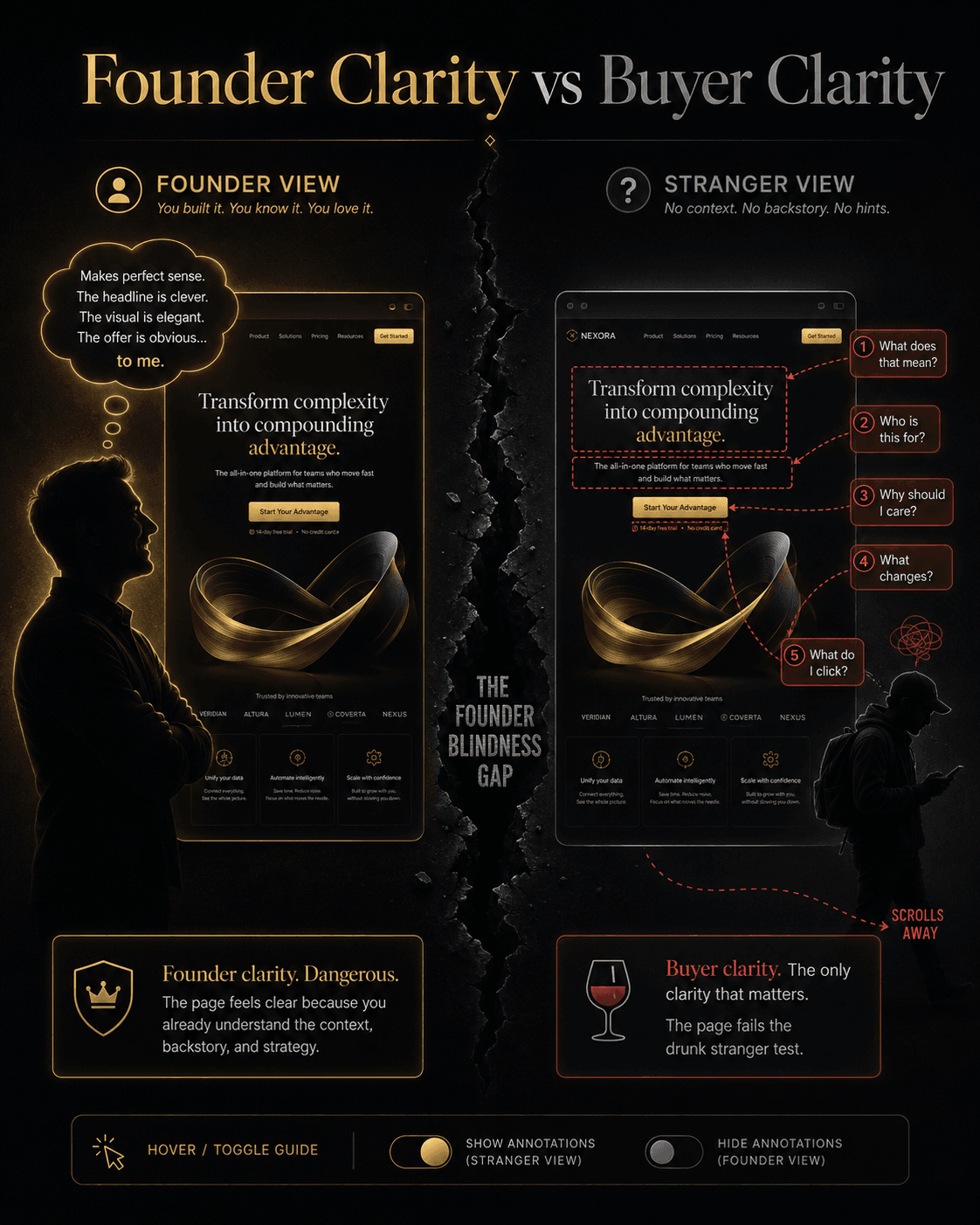
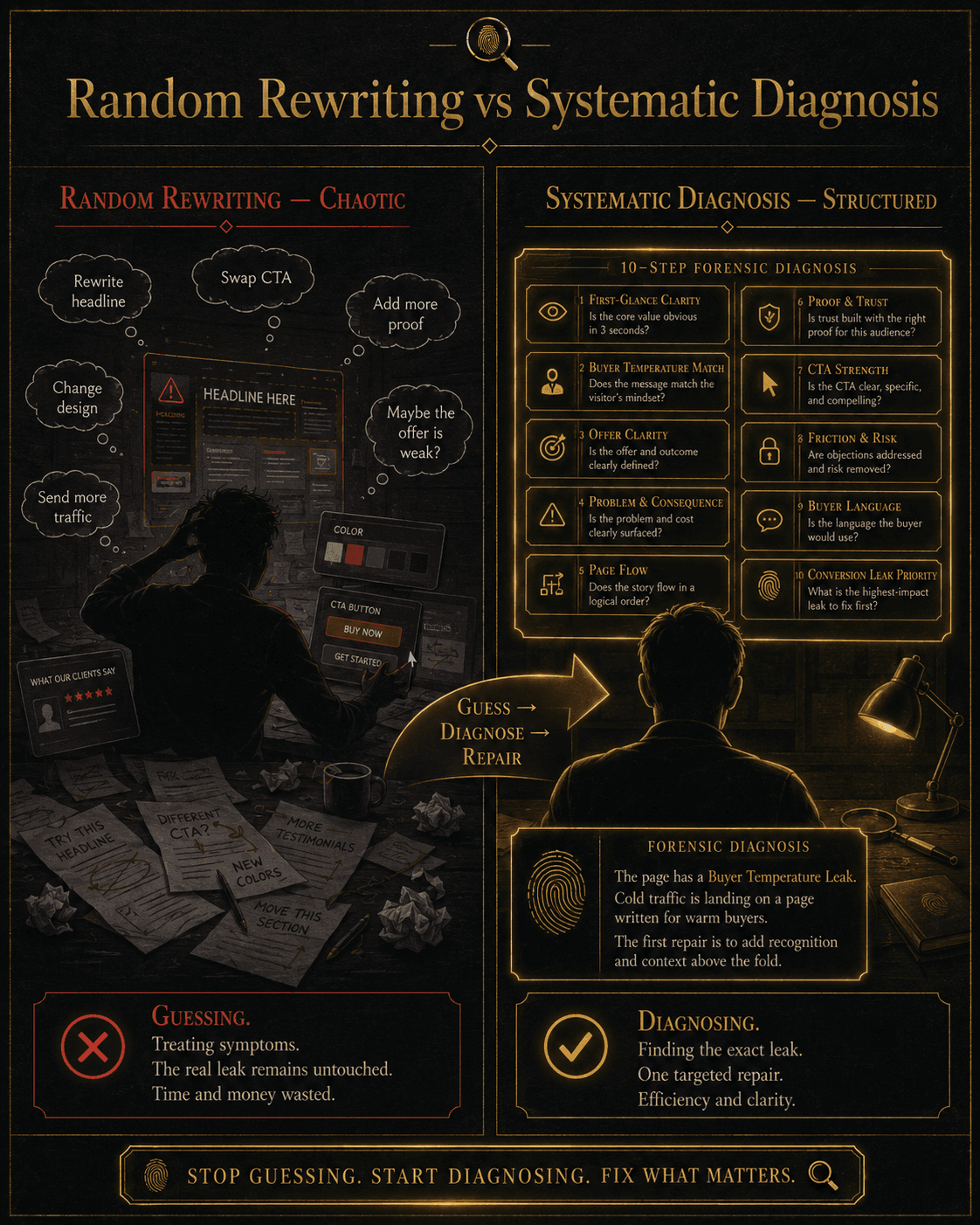
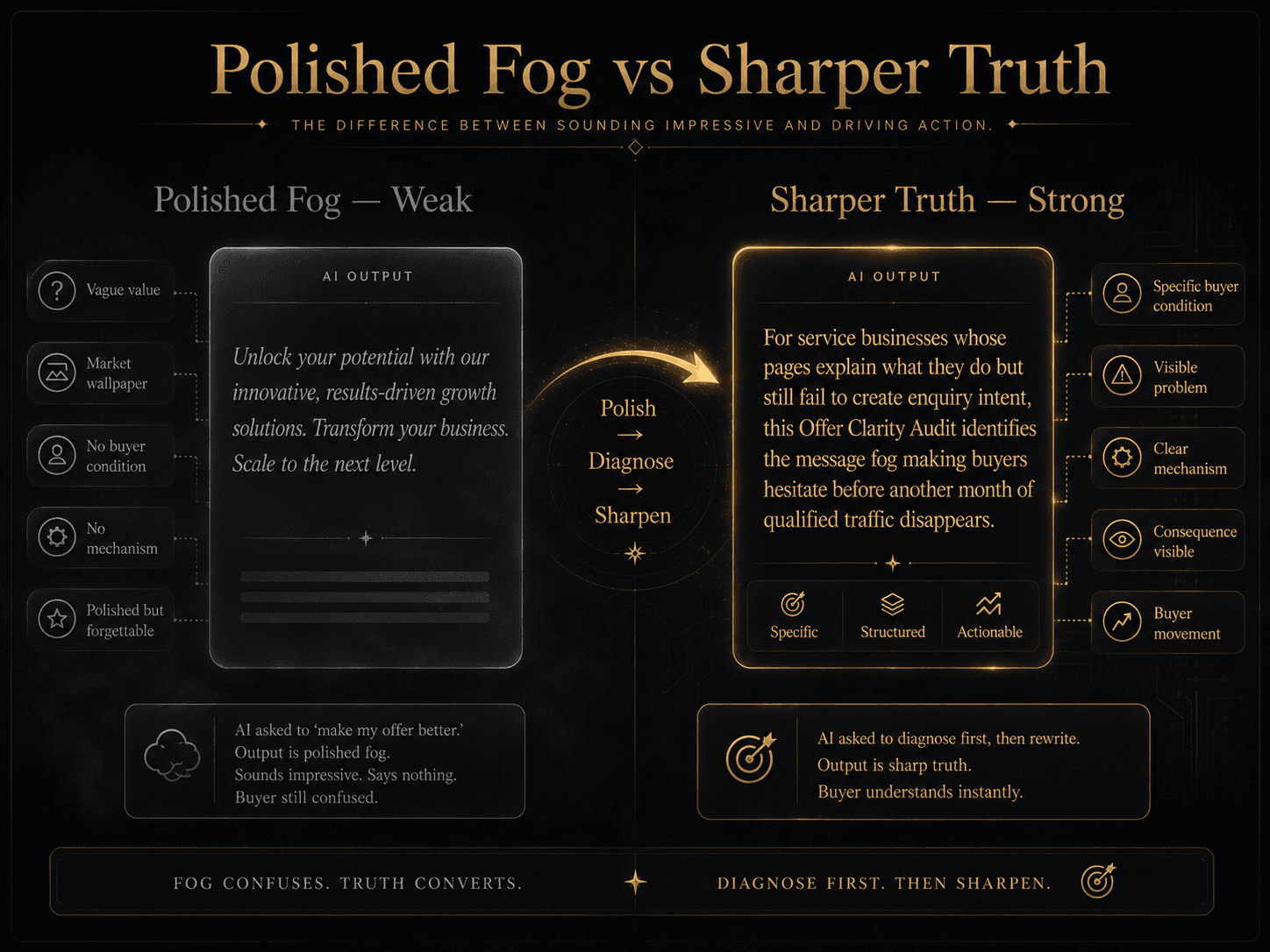
Other Blogs
Other Blogs
Check our other project Blogs with useful insight and information for your businesses