Our Three Step Process
May 26, 2026
Chap 5 | Resource 5 | The AI Visual Proof Strategy System™
Our Three Step Process
May 26, 2026
Chap 5 | Resource 5 | The AI Visual Proof Strategy System™
The AI Visual Proof Strategy System™ A guided AI system for identifying what proof you already have, what proof is missing, where evidence should live on the page, and how to make screenshots, testimonials, and proof stacks feel more believable before buyers reach the CTA.
Prefer Audio Or Video?
The AI Visual Proof Strategy System™ is also available as:
🎧 A guided audio walkthrough explaining AI-assisted visual proof strategy, proof gap analysis, buyer doubt mapping, proof placement, screenshot framing, and trust leak diagnosis.
🎥 A practical video breakdown with real AI proof prompts, proof stack examples, testimonial repairs, screenshot optimisation, proof placement mapping, and visual trust strategy teardowns.Choose the format that fits how you learn best.
[Listen To The Audio Walkthrough] (coming soon)
[Watch The Video Breakdown] (coming soon)
——
Why Most Businesses Use AI Wrong For Proof
Most businesses do not struggle because they have zero proof.
They struggle because their proof feels weak, misplaced, generic, or emotionally disconnected from buyer doubt.
The screenshots exist.
The testimonials exist.
The wins exist.
The results exist.
The messages exist.
But buyers still hesitate because:
the proof does not answer the right doubts
the strongest evidence is buried too low
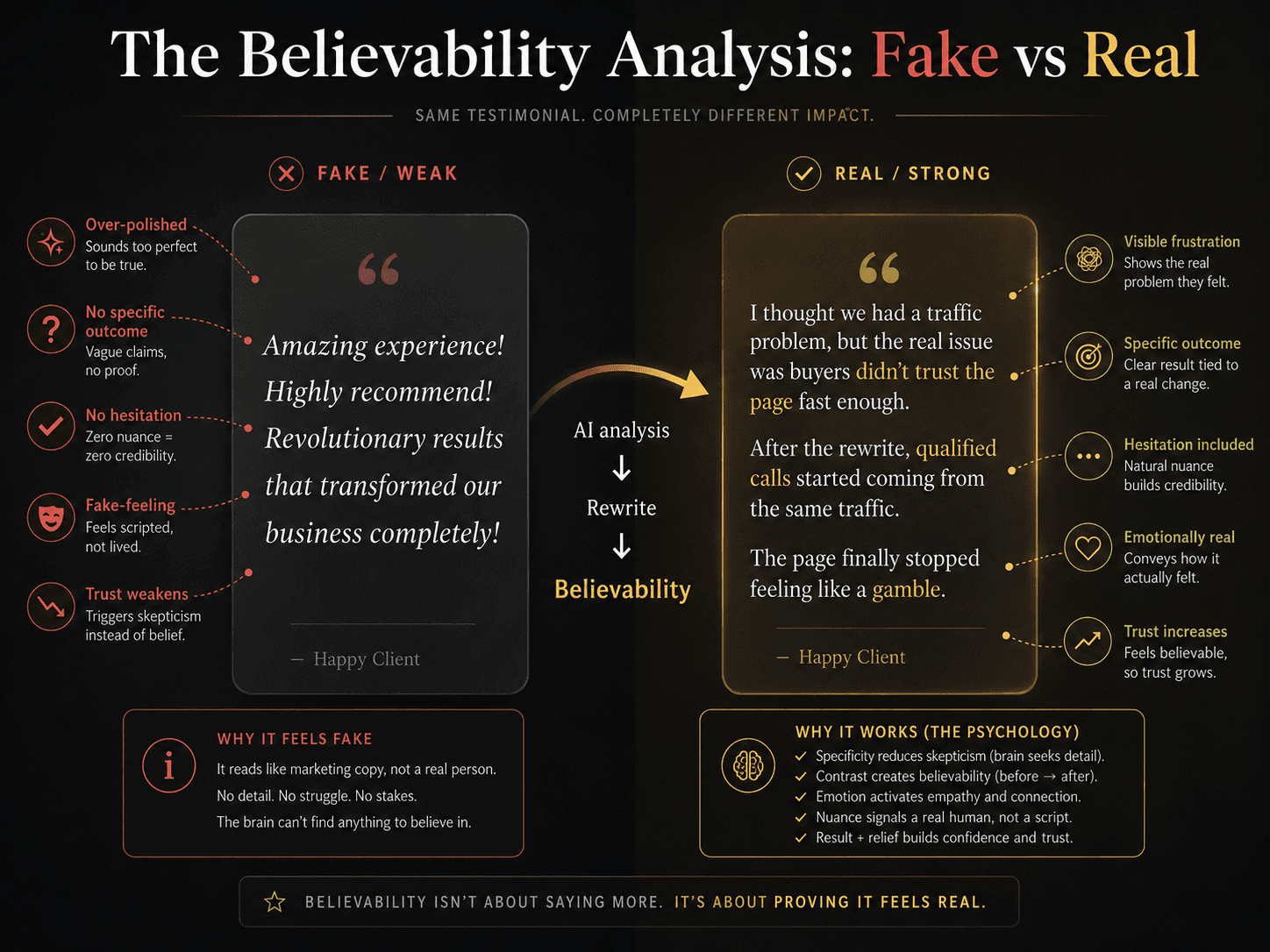
testimonials sound generic
screenshots lack context
proof feels decorative instead of convincing
the page still carries too much uncertainty
the evidence appears after doubt has already grown
the captions make the proof feel like marketing
the proof stack has no psychological sequence
That is where AI can help.
But only if it is used correctly.
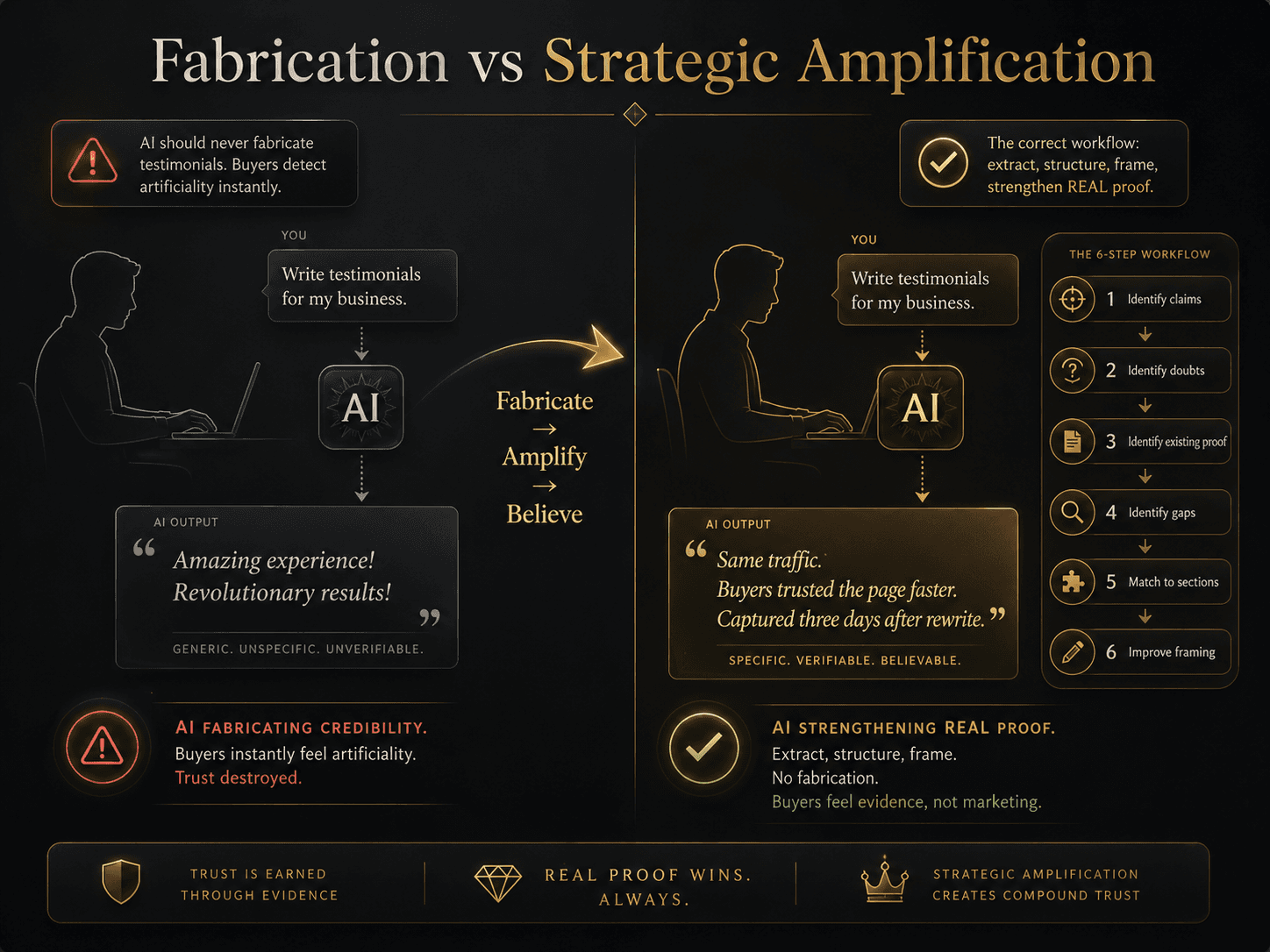
The biggest mistake people make with AI and proof is asking AI to fabricate credibility.
They ask:
“Write testimonials for my business.”
Terrible idea.
Buyers instantly feel artificiality.
Fake proof does not reduce doubt.
It creates more of it.
AI should not invent testimonials, screenshots, results, case studies, client quotes, or credibility signals that do not exist.
That destroys trust.
AI should help you extract, organise, frame, diagnose, strengthen, and sequence real proof.
That is the correct use.
This resource shows you how to use AI as a proof strategy assistant, not a credibility factory.
What This Resource Helps You Do
The AI Visual Proof Strategy System™ helps you use AI properly to:
identify proof gaps
organise proof strategically
strengthen weak evidence
improve proof placement
frame screenshots more effectively
diagnose trust leaks
build proof stacks intentionally
increase believability across the page
match proof to buyer doubt
turn scattered proof into structured belief architecture
improve testimonials without making them sound fake
make evidence easier to understand before buyers reach the CTA
Use this when:
your page still feels risky despite having proof
you do not know what proof matters most
testimonials feel weak
screenshots feel random
your strongest evidence is hidden
buyers still hesitate before the CTA
your proof strategy feels scattered
you want AI to improve trust architecture instead of generating fluff
your page has claims but not enough nearby evidence
your proof feels visually present but psychologically weak
your page needs stronger belief sequencing
This is not a “write me testimonials” prompt.
This is an AI-assisted belief-engineering system.
The goal is simple:
Use AI to reduce buyer doubt faster than the page currently does.
The Core Principle™
AI should strengthen real proof.
Not replace reality with marketing language.
That is the rule.
AI can help you:
identify unsupported claims
find missing proof
organise evidence
improve captions
diagnose weak testimonials
sequence proof across the page
make screenshots easier to understand
reveal where buyer doubt is rising
strengthen the framing around real assets
But AI should not invent proof.
It should not create fake testimonials.
It should not manufacture screenshots.
It should not exaggerate results.
It should not pretend a claim is proven when no evidence exists.
Modern buyers are extremely sensitive to manufactured credibility.
They have seen too many fake-looking testimonials, polished proof cards, over-scripted videos, exaggerated case studies, and suspicious result claims.
That is why AI-generated proof can quickly become dangerous.
The strongest proof usually feels:
slightly imperfect
specific
emotionally honest
grounded
difficult to fake
connected to real context
easy to inspect
AI should help real proof do its job better.
It should not pretend reality exists where it does not.
The Wrong Prompt vs The Right Prompt™
The Wrong Prompt
“Write testimonials for my business.”
This is weak because it asks AI to fabricate credibility.
It creates copy that may sound positive, but buyers often feel the artificiality.
It produces language that is usually:
generic
polished
vague
emotionally flat
suspiciously perfect
disconnected from real buyer experience
That does not create belief.
It creates doubt.
The Right Prompt
“Help me identify what proof I already have, what proof is missing, where buyer doubt rises, and how to frame my real evidence so it becomes easier to believe.”
That is the right use of AI.
Now AI becomes strategic.
It helps with:
diagnosis
organisation
sequencing
framing
clarity
trust architecture
Not fabrication.
That distinction matters enormously.
Before You Start: AI Proof Input Sheet™
Before using any AI prompt in this resource, gather your inputs.
AI output is only as good as the proof, context, and constraints you give it.
Do not ask AI to guess.
Give it the raw material.
Main Offer
What product, service, programme, page, or offer are you building proof for?
Main Page Promise
What is the main claim the page asks the buyer to believe?
Target Buyer
Who is this page for?
Buyer’s Main Doubts
What doubts does the buyer likely carry before acting?
Existing Proof Assets
What proof do you already have?
Screenshots:
Testimonials:
Videos:
DMs / emails / comments:
Before / after assets:
Dashboards / metrics:
Walkthroughs / demos:
Other:
Current Page Structure
What sections does your page currently have?
Weakest Trust Moment
Where does the page currently feel least believable?
Strongest Existing Proof
What is your strongest proof asset right now?
Why?
Missing Proof
What proof do you know you still need?
The Correct AI Workflow For Visual Proof™
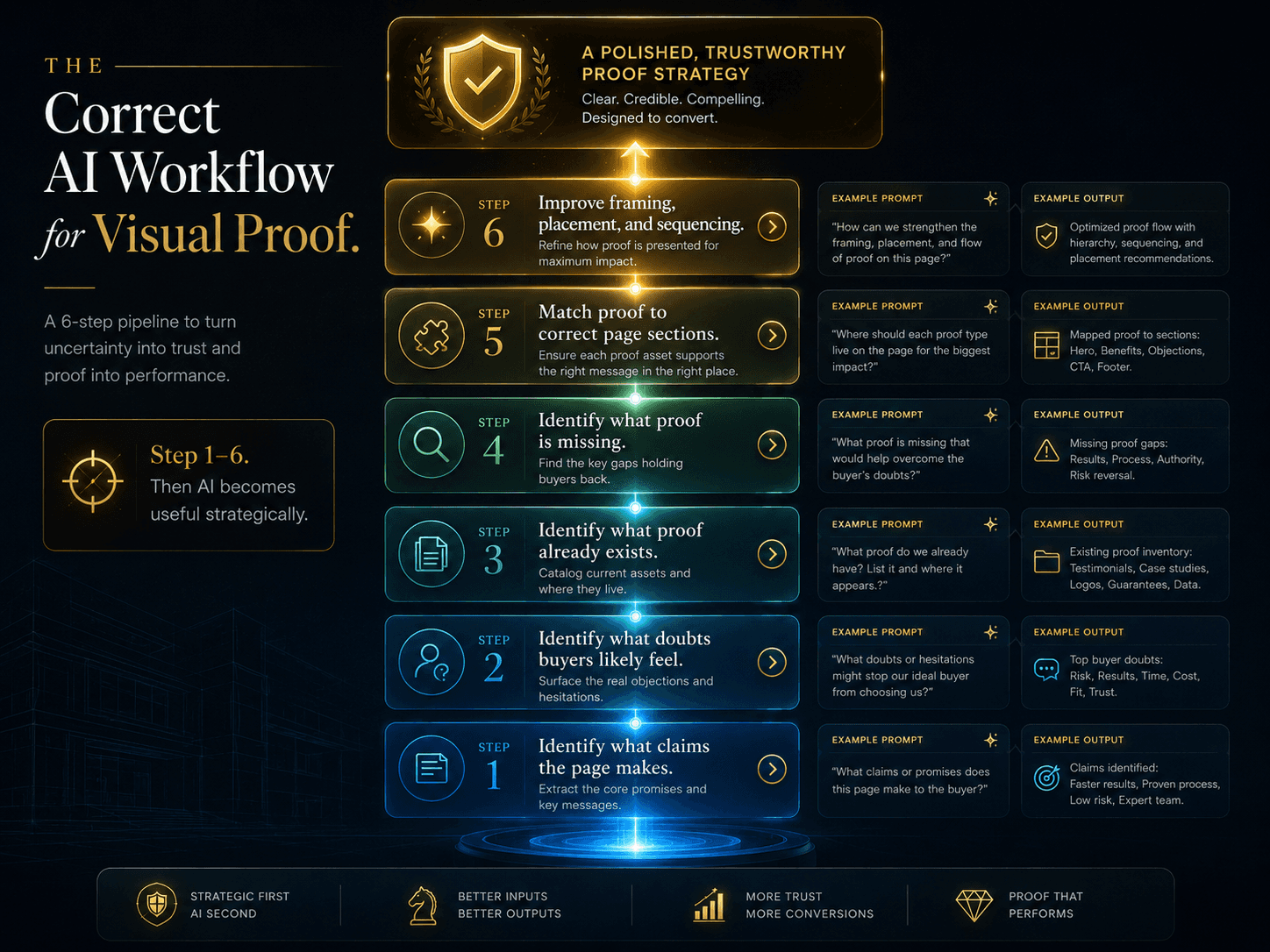
The proper AI workflow is:
Identify what claims the page makes.
Identify what doubts buyers likely feel.
Identify what proof already exists.
Identify what proof is missing.
Match proof to the correct page sections.
Improve framing, placement, and sequencing.
That is how AI becomes useful strategically.
Not by inventing proof.
But by helping real proof reduce uncertainty more effectively.
Step 1: Identify What Claims The Page Makes™
Every claim creates a belief burden.
When your page says:
this works
this is faster
this is safer
this creates results
this reduces friction
this helps buyers trust
this improves conversion
this saves time
this creates clarity
the buyer silently asks:
“Prove it.”
AI can help identify every claim on your page so you can see where evidence is needed.
Step 1 Worksheet
What are the biggest claims your page makes?
Which claim feels hardest to believe?
Step 2: Identify Buyer Doubts™
After every claim, buyer doubt begins rising.
The buyer may ask:
Is this real?
Has this worked before?
Will this work for someone like me?
Is this exaggerated?
What happens after I buy?
What if I waste money again?
What makes this safer than alternatives?
Can I trust this enough to act?
AI can help you map likely doubts against each claim.
That matters because proof is only persuasive when it answers a real uncertainty.
Step 2 Worksheet
What doubts appear after each major claim?
Claim 1:
Likely buyer doubt:
Claim 2:
Likely buyer doubt:
Claim 3:
Likely buyer doubt:
Step 3: Identify Existing Proof™
Most businesses already have useful proof.
But it is often scattered across:
screenshots
DMs
Slack messages
email replies
call recordings
dashboards
client messages
testimonials
videos
social comments
support chats
case notes
project updates
AI can help you organise this proof by type, strength, and psychological function.
The goal is not to collect everything.
The goal is to identify what evidence reduces doubt fastest.
Step 3 Worksheet
List your proof assets and what each one proves.
Proof Asset 1:
What it proves:
Proof Asset 2:
What it proves:
Proof Asset 3:
What it proves:
Strongest proof asset:
Weakest proof asset:
Step 4: Identify Missing Proof™
Some claims may be unsupported.
Some proof may feel weak.
Some sections may create doubt without answering it.
That creates proof gaps.
AI can help identify what evidence is missing and what you should collect next.
This is extremely useful.
Because many businesses do not realise where belief is leaking.
They think the page needs better copy.
Often, it needs better proof.
Step 4 Worksheet
Which claims currently lack proof?
Which sections feel unsupported?
Which buyer objections are not answered by evidence?
Which proof assets should be collected next?
Step 5: Match Proof To Page Sections™
Proof should appear where doubt rises.
Not randomly.
Not only at the bottom.
Not only in a proof wall.
Not ten sections after the claim.
AI can help you map proof to:
above the fold
offer reveal
mechanism explanation
objection section
CTA area
end-of-page proof wall
This is where proof becomes belief sequencing.
Step 5 Worksheet
What proof should appear above the fold?
What proof should support the offer reveal?
What proof should answer objections?
What proof should appear near the CTA?
What proof should appear at the end of the page?
Step 6: Improve Framing, Placement, And Sequencing™
Once proof is collected and placed, it still needs framing.
AI can help improve:
captions
labels
proof section headers
testimonial intros
CTA-supporting proof lines
proof-wall structure
screenshot context
before/after explanations
But the framing must stay honest.
The goal is not to make proof sound bigger than it is.
The goal is to make proof clearer, more believable, and easier to inspect.
Step 6 Worksheet
Which proof assets need stronger captions?
Which testimonials need better framing?
Which screenshots need more context?
Which proof sections need clearer labels?
Which proof is currently over-explained or over-polished?
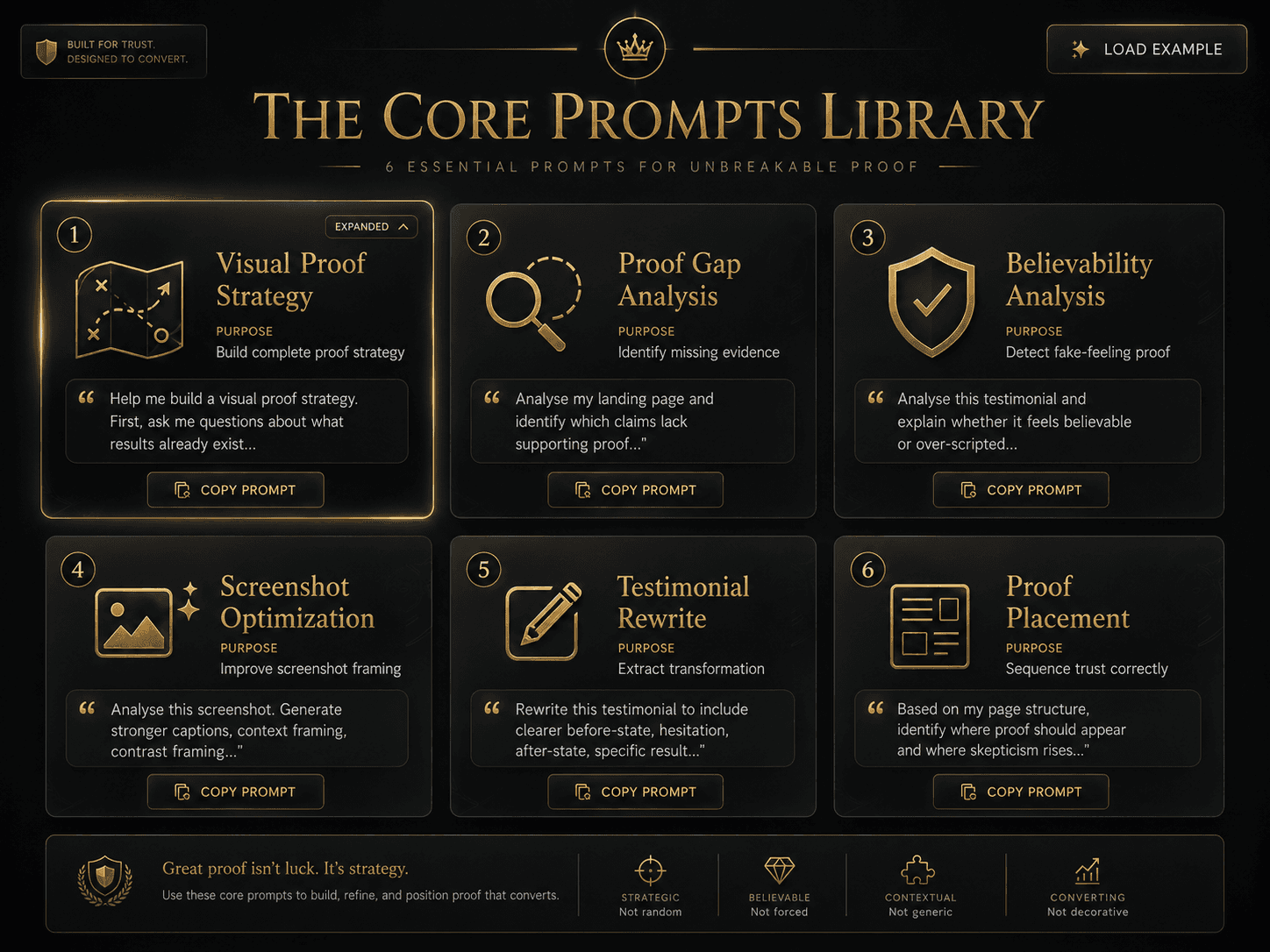
Master Prompt 1: Core Visual Proof Strategy Prompt™
Use this first.
This is the main prompt for building a full proof strategy.
Visual Proof Strategy Prompt
Act as an expert landing page strategist, buyer psychology specialist, and direct-response conversion consultant.
Help me build a visual proof strategy for my [product/service/business].
Important rule:
Do not invent testimonials, fake proof, fake results, fake screenshots, fake numbers, fake client stories, or fake claims.
Only work with real proof I provide.
If proof is missing, identify the gap and tell me what I need to collect.
First, ask me questions one at a time to uncover:
what results already exist
what screenshots I currently have
what testimonials I currently have
whether I have videos, DMs, emails, dashboards, or before/after assets
what objections buyers still have
what claims the page currently makes
where buyers likely hesitate most
which parts of the page feel weakest or least believable
what emotional shifts buyers experience after the result
what proof assets are strongest emotionally
what proof assets are strongest visually
what proof feels most specific, inspectable, and hard to dismiss
After gathering the information, generate:
A proof bank organised by asset type.
A proof strength rating for each asset.
The best proof asset for above the fold.
The best proof stack for the offer reveal section.
The best objection-handling proof.
The best proof to place near the CTA.
A proof wall structure for the end of the page.
Caption ideas for each proof asset.
Proof gaps I still need to fill.
A trust-leak diagnosis explaining:
where buyers may still hesitate
what proof is currently weak
what feels generic
what evidence feels strongest
where scepticism may still rise
where proof should be moved closer to the claim
Important:
prioritise believable proof over polished design
avoid hype
think like a sceptical buyer
do not invent testimonials or fake proof
prioritise specificity, emotional realism, and visible movement
explain why each proof choice strengthens trust
tell me when a claim does not have enough proof to support it
recommend what proof I should collect next
My offer/page/product is:
[Insert details here]
My current proof assets are:
[Insert proof assets here]
My current page structure is:
[Insert page sections here]
My buyer’s likely doubts are:
[Insert doubts here]
Master Prompt 2: Proof Gap Analysis Prompt™
Use this when your page has claims but still feels unsupported.
This prompt helps you identify where belief is leaking.
Proof Gap Analysis Prompt
Act as an expert landing page strategist and buyer psychology specialist.
Analyse my current landing page and identify where proof is missing, weak, misplaced, or disconnected from buyer doubt.
Important rule:
Do not invent proof.
If evidence is missing, identify the gap and recommend what real proof I should collect.
Analyse:
which claims currently lack supporting proof
where scepticism likely rises
which sections feel unsupported
what proof types are missing
where buyers may still hesitate emotionally
which testimonials feel generic
which proof assets feel strongest
where stronger before/after contrast is needed
which screenshots need more context
which parts of the page ask for trust too early
where a major claim sits too far away from evidence
where proof feels decorative instead of persuasive
Then recommend:
The best proof asset for each weak section.
The best proof format for each claim.
What evidence would increase belief fastest.
Which proof should be moved closer to a claim.
Which weak proof should be removed, reframed, or replaced.
What proof gaps I need to fill before the page feels safer.
Prioritise:
clarity
trust
believability
uncertainty reduction
emotional realism
buyer relevance
Here is my page copy or page structure:
[Paste page copy or structure here]
Here are my current proof assets:
[Paste proof assets here]
Master Prompt 3: Believability Analysis Prompt™
Use this when proof exists but may feel fake, staged, polished, generic, or emotionally weak.
This prompt helps you test whether the proof actually creates trust.
Believability Analysis Prompt
Act as a sceptical buyer, landing page strategist, and proof believability analyst.
Analyse this testimonial, screenshot, video, proof block, or proof section and explain whether it feels believable.
Important rule:
Do not invent details.
Do not exaggerate the proof.
Only analyse and improve what is present.
Evaluate:
whether it feels believable
whether it feels emotionally real
whether it sounds over-scripted
whether it creates trust
whether it feels specific
whether it feels inspectable
whether the framing increases or decreases credibility
whether it feels too polished
whether it contains enough context
whether it contains enough natural language
whether it reduces a real buyer doubt
whether a sceptical buyer would trust it more or less after seeing it
Then rewrite the framing to feel:
more grounded
more specific
more natural
more emotionally honest
more inspectable
calmer
clearer
easier to trust
Avoid:
hype
exaggerated claims
fake urgency
corporate wording
over-polishing
claims the proof cannot support
The goal is calm credibility and believable proof.
Here is the proof asset:
[Paste or describe proof asset here]
The buyer doubt this proof should reduce is:
[Insert doubt here]
The page claim this proof should support is:
[Insert claim here]
Master Prompt 4: Screenshot Optimisation Prompt™
Use this when you have a screenshot but it feels unclear, random, underwhelming, or contextless.
Most screenshots online are wasted.
Not because the result is weak.
Because the framing is weak.
Screenshot Optimisation Prompt
Act as an expert landing page strategist and proof-framing specialist.
Analyse this screenshot and help me make it more meaningful, easier to inspect, and harder for a sceptical buyer to dismiss.
Important rule:
Do not invent what the screenshot does not show.
Do not exaggerate the result.
If context is missing, tell me what context I need to add.
Analyse:
what the screenshot currently communicates
whether a buyer would understand why it matters
what emotional reaction it creates
whether the result feels visually obvious
whether stronger framing is needed
what buyer doubt this screenshot could reduce
what claim this screenshot could support
what context is missing
whether the screenshot feels real or staged
whether the screenshot should be used prominently or only as supporting proof
Then generate:
Stronger captions.
Stronger labels.
Stronger context framing.
Stronger contrast framing.
Stronger believability framing.
Stronger CTA-support framing.
A short explanation of where this screenshot should appear on the page.
A warning about what not to imply if the screenshot does not support it.
Make the screenshot feel:
more meaningful
easier to inspect
harder to dismiss
emotionally clearer
more buyer-relevant
more believable
Here is the screenshot or screenshot description:
[Paste screenshot or describe it here]
Here is the claim it should support:
[Insert claim here]
Master Prompt 5: Testimonial Rewrite Prompt™
Use this when a real testimonial contains useful raw material but sounds too vague, too generic, too polished, or too weak.
This prompt should never invent missing details.
It should preserve authenticity.
Testimonial Rewrite Prompt
Act as an expert testimonial editor, buyer psychology specialist, and direct-response conversion strategist.
Rewrite this real testimonial into a clearer, more believable, more emotionally specific version.
Important rules:
Do not invent details.
Do not invent results.
Do not add numbers, timelines, objections, or emotions that are not present.
Preserve the buyer’s natural language.
Preserve authenticity.
If essential details are missing, ask follow-up questions instead of fabricating them.
Improve the testimonial by strengthening:
the before-state
emotional tension
visible hesitation
transformation
after-state
specific result
emotional realism
natural buyer language
believability
clarity
Avoid:
fake polish
hype
exaggerated claims
overly perfect wording
corporate phrasing
language that no real buyer would naturally use
The final version should feel:
real
specific
emotionally believable
commercially useful
harder to dismiss
Also provide:
A short version.
A longer version.
A CTA-area version.
A testimonial intro line.
A note explaining what buyer doubt this testimonial reduces.
A list of follow-up questions I should ask if the testimonial is still missing important detail.
Here is the raw testimonial:
[Paste testimonial here]
The offer or result this relates to is:
[Insert context here]
Master Prompt 6: Proof Placement Prompt™
Use this when you need to decide where proof should live across the page.
This prompt connects directly to belief sequencing.
Proof Placement Prompt
Act as an expert landing page strategist, buyer psychology specialist, and proof sequencing consultant.
Based on my landing page structure, identify where proof should appear so buyer trust increases progressively across the page.
Important rule:
Do not invent proof.
Use only the assets I provide.
If a section needs proof I do not currently have, identify the missing proof and recommend what I should collect.
Analyse:
where proof should appear
where scepticism likely rises
which proof asset belongs in each section
which proof should appear above the fold
which proof should support the offer reveal
which proof should answer objections
which proof should appear near the CTA
which proof should appear at the end of the page
where proof currently feels disconnected from the claims
where proof appears too late
where proof creates clutter
where a stronger asset should replace a weaker one
Then explain why each proof placement improves buyer trust psychologically.
Use this structure:
Above The Fold Proof
Offer Reveal Proof
Objection Section Proof
Near CTA Proof
End-Of-Page Proof Wall
Proof Assets To Move
Proof Assets To Remove
Proof Assets To Reframe
Proof Gaps To Fill
Prioritise:
belief sequencing
uncertainty reduction
emotional fit
claim-to-proof alignment
fast comprehension
buyer trust
Here is my landing page structure:
[Paste page structure here]
Here are my proof assets:
[Paste proof assets here]
Master Prompt 7: Proof Stack Builder Prompt™
Use this for sales pages, long-form funnels, launch pages, application pages, webinar pages, service pages, and high-trust conversion pages.
This prompt builds layered proof.
Proof Stack Builder Prompt
Act as an expert direct-response strategist, landing page architect, and proof sequencing specialist.
Help me build a layered proof stack using the real proof assets I provide.
Important rule:
Do not invent proof.
Do not create fake testimonials, fake screenshots, fake results, or unsupported claims.
If proof is missing, clearly identify the missing evidence and recommend what I should collect.
Use available assets such as:
screenshots
testimonials
before/after assets
social proof fragments
dashboards
reaction messages
walkthroughs
demos
videos
case study fragments
customer quotes
proof walls
Structure the proof stack so buyer trust increases progressively across the page.
The stack should:
reduce scepticism
increase emotional certainty
support major claims directly
feel believable
avoid overwhelming the reader
create pattern recognition
make the promise easier to trust
support the CTA
answer doubt before it grows too large
For each proof asset, explain:
What claim it supports.
What doubt it reduces.
Where it should appear.
Why that placement works.
What caption or framing it needs.
Whether it is strong, medium, or weak.
Whether it needs more context.
Whether it should be used prominently or as supporting proof.
Build the proof stack in this sequence:
Above The Fold — initial possibility.
Offer Reveal — mechanism belief.
Mid-Page — pattern and credibility.
Objection Section — risk reduction.
Near CTA — final reassurance.
End-Of-Page — repeatability and proof wall.
Here is my offer:
[Insert offer here]
Here are my page claims:
[Insert claims here]
Here are my proof assets:
[Insert proof assets here]
Here are my buyer doubts:
[Insert buyer doubts here]
Claim-To-Doubt-To-Proof Matrix™
Use this after running the prompts.
This matrix helps you check whether the proof strategy is complete.
Every major claim should be connected to:
a buyer doubt
a proof asset
a page section
a framing line
If a claim does not have proof, it is carrying too much belief burden.
Claim 1
Page claim:
Buyer doubt created:
Proof asset supporting it:
Where proof appears:
Caption or framing line:
Proof strength: ___ / 5
Gap remaining:
Claim 2
Page claim:
Buyer doubt created:
Proof asset supporting it:
Where proof appears:
Caption or framing line:
Proof strength: ___ / 5
Gap remaining:
Claim 3
Page claim:
Buyer doubt created:
Proof asset supporting it:
Where proof appears:
Caption or framing line:
Proof strength: ___ / 5
Gap remaining:
Claim 4
Page claim:
Buyer doubt created:
Proof asset supporting it:
Where proof appears:
Caption or framing line:
Proof strength: ___ / 5
Gap remaining:
Trust Leak Diagnosis™
After using AI to map proof, diagnose where trust still leaks.
A trust leak happens when the buyer still feels uncertainty after the page has made a claim.
Common trust leaks include:
unsupported claims
vague testimonials
screenshots without context
proof placed too late
CTA without final reassurance
objection sections with no human proof
proof walls full of generic praise
polished assets that feel staged
proof that does not match the buyer’s situation
big promises with no visible evidence
Trust Leak Worksheet
Where does the page still feel risky?
What claim is still unsupported?
What doubt is still unanswered?
Which proof feels weakest?
Which proof feels too generic?
Which proof appears too late?
Which proof should be collected next?
AI Proof Strategy Scorecard™
Score your AI-assisted proof strategy from 1 to 5 in each category.
1 = weak
2 = soft
3 = usable
4 = strong
5 = excellent
Claim-To-Proof Alignment
Does every major claim have relevant supporting proof?
Score: ___ / 5
Notes:
Buyer Doubt Coverage
Does the proof answer the buyer’s biggest doubts?
Score: ___ / 5
Notes:
Believability
Does the proof feel real, specific, inspectable, and hard to fake?
Score: ___ / 5
Notes:
Emotional Realism
Does the proof contain human language, hesitation, emotion, or recognisable buyer experience?
Score: ___ / 5
Notes:
Proof Placement
Is proof placed where doubt rises?
Score: ___ / 5
Notes:
Proof Framing
Do captions, labels, and testimonial intros make the evidence easier to understand and believe?
Score: ___ / 5
Notes:
Proof Gaps
Have missing proof assets been identified clearly?
Score: ___ / 5
Notes:
CTA Support
Does the proof near the CTA reduce final hesitation?
Score: ___ / 5
Notes:
——
Total Score
Claim-To-Proof Alignment: ___ / 5
Buyer Doubt Coverage: ___ / 5
Believability: ___ / 5
Emotional Realism: ___ / 5
Proof Placement: ___ / 5
Proof Framing: ___ / 5
Proof Gaps: ___ / 5
CTA Support: ___ / 5
Total: ___ / 40
——
Score Interpretation
34–40: Strong AI-Assisted Proof Strategy™
Your proof strategy is structured, believable, and psychologically aligned.
The page should feel safer as the buyer moves toward the CTA.
26–33: Strong But Still Leaking™
The foundation is good, but some claims, sections, or proof assets still need improvement.
Fix the lowest-scoring areas first.
16–25: Proof Exists But Trust Still Leaks™
You have proof, but it may be weakly framed, poorly placed, too generic, or disconnected from buyer doubt.
Run the proof gap and placement prompts again.
0–15: Proof Strategy Failure Risk™
The page is still relying too heavily on claims.
AI should be used to identify missing proof, not to cover the gap with better-sounding language.
Return to the proof bank and collect stronger evidence.
——-
The Best AI Outputs Usually Feel
The best AI-assisted proof strategy outputs usually feel:
clearer
more structured
more psychologically aligned
more believable
easier to trust
more emotionally grounded
more strategically sequenced
more specific
more honest
more useful to a sceptical buyer
Not more exaggerated.
That is the standard.
If AI makes the proof sound louder, but not more believable, the output is weak.
If AI makes the proof clearer, more grounded, and easier to inspect, the output is useful.
The Final AI Proof Strategy Worksheet™
Use this as your final working sheet after running the prompts.
Main Page Claim
What is the page asking the buyer to believe?
Strongest Buyer Doubt
What doubt most needs proof?
Existing Proof Assets
List your strongest proof assets:
Missing Proof Assets
What proof still needs to be collected?
Above The Fold Proof
Best proof asset:
Why this belongs above the fold:
Caption:
Offer Reveal Proof
Best proof asset:
Why this supports the offer:
Caption:
Objection Section Proof
Best proof asset:
What objection this reduces:
Caption:
Near CTA Proof
Best proof asset:
How this reduces final hesitation:
Caption:
End-Of-Page Proof Wall
Proof assets to include:
How they create pattern recognition:
Header:
Trust Leaks Still Remaining
What still feels risky?
First Proof Asset To Improve
Which proof asset should be improved first?
Why?
First Proof Asset To Collect
Which missing proof asset should be collected first?
Why?
Final Execution Challenge™
Run your current page through:
the Core Visual Proof Strategy Prompt
the Proof Gap Analysis Prompt
the Believability Analysis Prompt
the Screenshot Optimisation Prompt
the Testimonial Rewrite Prompt
the Proof Placement Prompt
the Proof Stack Builder Prompt
Then ask:
“Does this page now feel safer to believe than before?”
Not:
“Does it sound more impressive?”
Not:
“Does it have more testimonials?”
Not:
“Did AI make it sound smarter?”
The question is:
“Does the buyer now carry less uncertainty?”
Because Chapter 5 is not really about adding more proof.
It is about reducing uncertainty until the buyer no longer feels forced to carry all the risk mentally by themselves while trying to decide whether your promise deserves belief.
——
Final Principle
AI is not here to invent trust.
It is here to help real evidence do its job better.
That is the shift.
Weak AI use manufactures credibility.
Strong AI use strengthens reality.
It identifies unsupported claims.
It finds proof gaps.
It diagnoses trust leaks.
It organises real evidence.
It improves framing.
It places proof where doubt rises.
It helps testimonials sound more specific without making them fake.
It helps screenshots become clearer without exaggerating what they show.
It helps the page become easier to believe.
That is what The AI Visual Proof Strategy System™ is designed to do.
Not generate fake testimonials.
Not decorate the page with artificial trust.
Not cover weak evidence with louder wording.
Real proof first.
AI second.
Because the buyer does not need more polished claims.
They need evidence that feels specific, inspectable, emotionally real, and hard to dismiss.
AI can help you find where belief is leaking.
But only real proof can close the gap.
——
From:
The $100M Funnel Playbook. Book I: Foundation Buyer Psychology, Offer Clarity, and the Page Architecture Behind High-Converting Funnels
By Maris Spalins.
——
Copyright Notice
© 2026 The $100M Funnel Playbook / Winyourclients / Maris Spalins. All rights reserved.
This resource, including the frameworks, terminology, examples, scorecards, templates, prompts, methods, and written explanations, is original intellectual property created for The $100M Funnel Playbook. Book I: Foundation — Buyer Psychology, Offer Clarity, And The Page Architecture Behind High-Converting Funnels and published through Winyourclients.
No part of this resource may be copied, reproduced, screenshotted, republished, redistributed, sold, adapted, uploaded, scraped, stored in a database, included in training data, used to train artificial intelligence systems, or used to create derivative commercial or educational materials without prior written permission.
Limited reference, quotation, or sharing is only permitted where the source is clearly and visibly credited.
Any permitted reference must include at least one of the following source credits:
The $100M Funnel Playbook by Maris Spalins
or
Winyourclients — www.winyourclients.com
or
Maris Spalins / Winyourclients
Screenshots, excerpts, summaries, or redistributed versions must not remove, hide, alter, crop out, or obscure the original source, author name, book title, website name, or copyright notice.
This resource is provided for personal learning and implementation only. It is not licensed for resale, republishing, redistribution, AI training, template cloning, course creation, consulting delivery, or commercial reuse without written permission from Maris Spalins or Winyourclients.
For permission requests, licensing, citation approval, or commercial usage enquiries, contact:
Winyourclients
www.winyourclients.com
or
Email directly to Jacob on: help@winyourclients.com
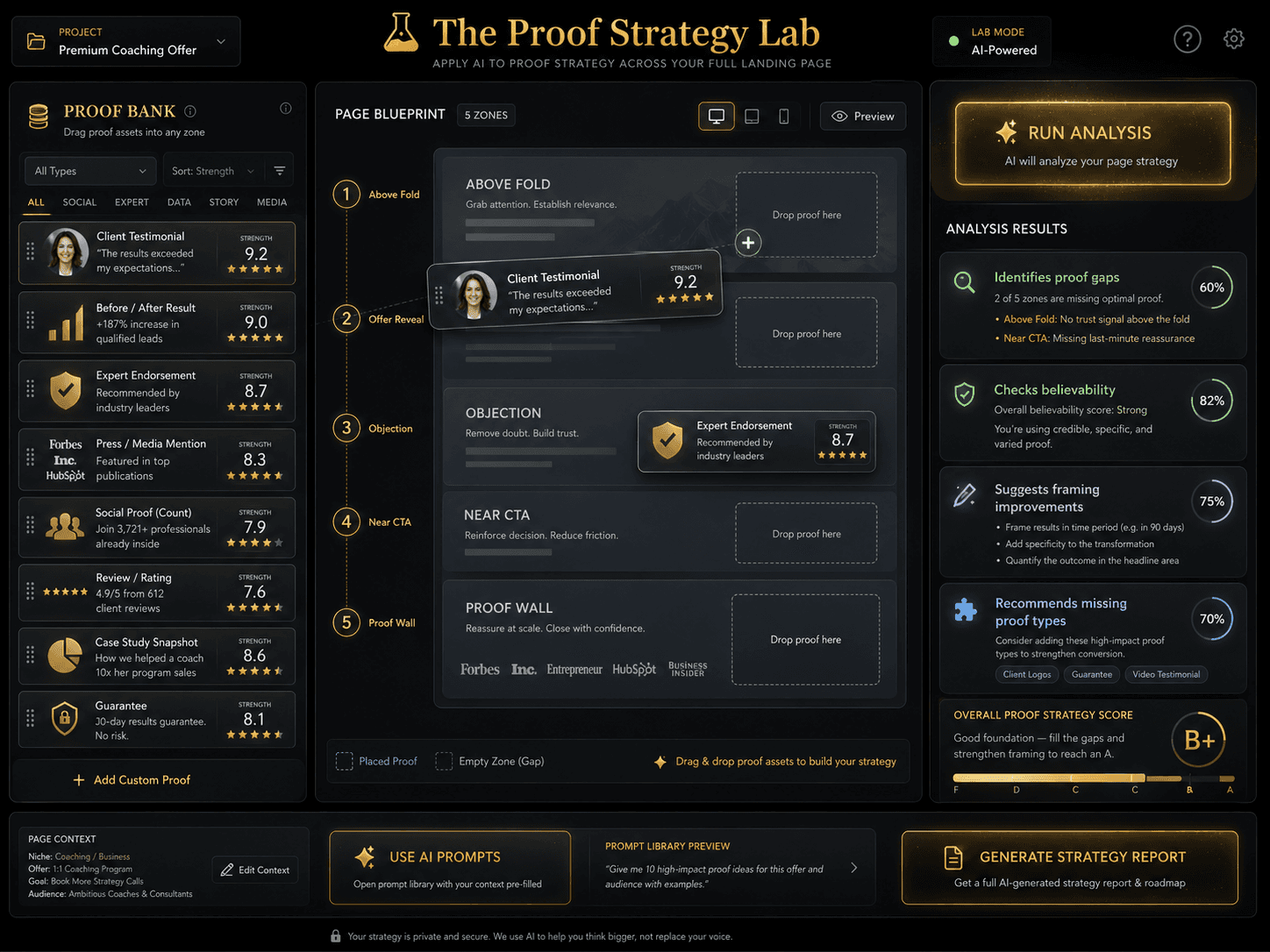
The AI Visual Proof Strategy System™ A guided AI system for identifying what proof you already have, what proof is missing, where evidence should live on the page, and how to make screenshots, testimonials, and proof stacks feel more believable before buyers reach the CTA.
Prefer Audio Or Video?
The AI Visual Proof Strategy System™ is also available as:
🎧 A guided audio walkthrough explaining AI-assisted visual proof strategy, proof gap analysis, buyer doubt mapping, proof placement, screenshot framing, and trust leak diagnosis.
🎥 A practical video breakdown with real AI proof prompts, proof stack examples, testimonial repairs, screenshot optimisation, proof placement mapping, and visual trust strategy teardowns.Choose the format that fits how you learn best.
[Listen To The Audio Walkthrough] (coming soon)
[Watch The Video Breakdown] (coming soon)
——
Why Most Businesses Use AI Wrong For Proof
Most businesses do not struggle because they have zero proof.
They struggle because their proof feels weak, misplaced, generic, or emotionally disconnected from buyer doubt.
The screenshots exist.
The testimonials exist.
The wins exist.
The results exist.
The messages exist.
But buyers still hesitate because:
the proof does not answer the right doubts
the strongest evidence is buried too low
testimonials sound generic
screenshots lack context
proof feels decorative instead of convincing
the page still carries too much uncertainty
the evidence appears after doubt has already grown
the captions make the proof feel like marketing
the proof stack has no psychological sequence
That is where AI can help.
But only if it is used correctly.
The biggest mistake people make with AI and proof is asking AI to fabricate credibility.
They ask:
“Write testimonials for my business.”
Terrible idea.
Buyers instantly feel artificiality.
Fake proof does not reduce doubt.
It creates more of it.
AI should not invent testimonials, screenshots, results, case studies, client quotes, or credibility signals that do not exist.
That destroys trust.
AI should help you extract, organise, frame, diagnose, strengthen, and sequence real proof.
That is the correct use.
This resource shows you how to use AI as a proof strategy assistant, not a credibility factory.
What This Resource Helps You Do
The AI Visual Proof Strategy System™ helps you use AI properly to:
identify proof gaps
organise proof strategically
strengthen weak evidence
improve proof placement
frame screenshots more effectively
diagnose trust leaks
build proof stacks intentionally
increase believability across the page
match proof to buyer doubt
turn scattered proof into structured belief architecture
improve testimonials without making them sound fake
make evidence easier to understand before buyers reach the CTA
Use this when:
your page still feels risky despite having proof
you do not know what proof matters most
testimonials feel weak
screenshots feel random
your strongest evidence is hidden
buyers still hesitate before the CTA
your proof strategy feels scattered
you want AI to improve trust architecture instead of generating fluff
your page has claims but not enough nearby evidence
your proof feels visually present but psychologically weak
your page needs stronger belief sequencing
This is not a “write me testimonials” prompt.
This is an AI-assisted belief-engineering system.
The goal is simple:
Use AI to reduce buyer doubt faster than the page currently does.
The Core Principle™
AI should strengthen real proof.
Not replace reality with marketing language.
That is the rule.
AI can help you:
identify unsupported claims
find missing proof
organise evidence
improve captions
diagnose weak testimonials
sequence proof across the page
make screenshots easier to understand
reveal where buyer doubt is rising
strengthen the framing around real assets
But AI should not invent proof.
It should not create fake testimonials.
It should not manufacture screenshots.
It should not exaggerate results.
It should not pretend a claim is proven when no evidence exists.
Modern buyers are extremely sensitive to manufactured credibility.
They have seen too many fake-looking testimonials, polished proof cards, over-scripted videos, exaggerated case studies, and suspicious result claims.
That is why AI-generated proof can quickly become dangerous.
The strongest proof usually feels:
slightly imperfect
specific
emotionally honest
grounded
difficult to fake
connected to real context
easy to inspect
AI should help real proof do its job better.
It should not pretend reality exists where it does not.
The Wrong Prompt vs The Right Prompt™
The Wrong Prompt
“Write testimonials for my business.”
This is weak because it asks AI to fabricate credibility.
It creates copy that may sound positive, but buyers often feel the artificiality.
It produces language that is usually:
generic
polished
vague
emotionally flat
suspiciously perfect
disconnected from real buyer experience
That does not create belief.
It creates doubt.
The Right Prompt
“Help me identify what proof I already have, what proof is missing, where buyer doubt rises, and how to frame my real evidence so it becomes easier to believe.”
That is the right use of AI.
Now AI becomes strategic.
It helps with:
diagnosis
organisation
sequencing
framing
clarity
trust architecture
Not fabrication.
That distinction matters enormously.
Before You Start: AI Proof Input Sheet™
Before using any AI prompt in this resource, gather your inputs.
AI output is only as good as the proof, context, and constraints you give it.
Do not ask AI to guess.
Give it the raw material.
Main Offer
What product, service, programme, page, or offer are you building proof for?
Main Page Promise
What is the main claim the page asks the buyer to believe?
Target Buyer
Who is this page for?
Buyer’s Main Doubts
What doubts does the buyer likely carry before acting?
Existing Proof Assets
What proof do you already have?
Screenshots:
Testimonials:
Videos:
DMs / emails / comments:
Before / after assets:
Dashboards / metrics:
Walkthroughs / demos:
Other:
Current Page Structure
What sections does your page currently have?
Weakest Trust Moment
Where does the page currently feel least believable?
Strongest Existing Proof
What is your strongest proof asset right now?
Why?
Missing Proof
What proof do you know you still need?
The Correct AI Workflow For Visual Proof™
The proper AI workflow is:
Identify what claims the page makes.
Identify what doubts buyers likely feel.
Identify what proof already exists.
Identify what proof is missing.
Match proof to the correct page sections.
Improve framing, placement, and sequencing.
That is how AI becomes useful strategically.
Not by inventing proof.
But by helping real proof reduce uncertainty more effectively.
Step 1: Identify What Claims The Page Makes™
Every claim creates a belief burden.
When your page says:
this works
this is faster
this is safer
this creates results
this reduces friction
this helps buyers trust
this improves conversion
this saves time
this creates clarity
the buyer silently asks:
“Prove it.”
AI can help identify every claim on your page so you can see where evidence is needed.
Step 1 Worksheet
What are the biggest claims your page makes?
Which claim feels hardest to believe?
Step 2: Identify Buyer Doubts™
After every claim, buyer doubt begins rising.
The buyer may ask:
Is this real?
Has this worked before?
Will this work for someone like me?
Is this exaggerated?
What happens after I buy?
What if I waste money again?
What makes this safer than alternatives?
Can I trust this enough to act?
AI can help you map likely doubts against each claim.
That matters because proof is only persuasive when it answers a real uncertainty.
Step 2 Worksheet
What doubts appear after each major claim?
Claim 1:
Likely buyer doubt:
Claim 2:
Likely buyer doubt:
Claim 3:
Likely buyer doubt:
Step 3: Identify Existing Proof™
Most businesses already have useful proof.
But it is often scattered across:
screenshots
DMs
Slack messages
email replies
call recordings
dashboards
client messages
testimonials
videos
social comments
support chats
case notes
project updates
AI can help you organise this proof by type, strength, and psychological function.
The goal is not to collect everything.
The goal is to identify what evidence reduces doubt fastest.
Step 3 Worksheet
List your proof assets and what each one proves.
Proof Asset 1:
What it proves:
Proof Asset 2:
What it proves:
Proof Asset 3:
What it proves:
Strongest proof asset:
Weakest proof asset:
Step 4: Identify Missing Proof™
Some claims may be unsupported.
Some proof may feel weak.
Some sections may create doubt without answering it.
That creates proof gaps.
AI can help identify what evidence is missing and what you should collect next.
This is extremely useful.
Because many businesses do not realise where belief is leaking.
They think the page needs better copy.
Often, it needs better proof.
Step 4 Worksheet
Which claims currently lack proof?
Which sections feel unsupported?
Which buyer objections are not answered by evidence?
Which proof assets should be collected next?
Step 5: Match Proof To Page Sections™
Proof should appear where doubt rises.
Not randomly.
Not only at the bottom.
Not only in a proof wall.
Not ten sections after the claim.
AI can help you map proof to:
above the fold
offer reveal
mechanism explanation
objection section
CTA area
end-of-page proof wall
This is where proof becomes belief sequencing.
Step 5 Worksheet
What proof should appear above the fold?
What proof should support the offer reveal?
What proof should answer objections?
What proof should appear near the CTA?
What proof should appear at the end of the page?
Step 6: Improve Framing, Placement, And Sequencing™
Once proof is collected and placed, it still needs framing.
AI can help improve:
captions
labels
proof section headers
testimonial intros
CTA-supporting proof lines
proof-wall structure
screenshot context
before/after explanations
But the framing must stay honest.
The goal is not to make proof sound bigger than it is.
The goal is to make proof clearer, more believable, and easier to inspect.
Step 6 Worksheet
Which proof assets need stronger captions?
Which testimonials need better framing?
Which screenshots need more context?
Which proof sections need clearer labels?
Which proof is currently over-explained or over-polished?
Master Prompt 1: Core Visual Proof Strategy Prompt™
Use this first.
This is the main prompt for building a full proof strategy.
Visual Proof Strategy Prompt
Act as an expert landing page strategist, buyer psychology specialist, and direct-response conversion consultant.
Help me build a visual proof strategy for my [product/service/business].
Important rule:
Do not invent testimonials, fake proof, fake results, fake screenshots, fake numbers, fake client stories, or fake claims.
Only work with real proof I provide.
If proof is missing, identify the gap and tell me what I need to collect.
First, ask me questions one at a time to uncover:
what results already exist
what screenshots I currently have
what testimonials I currently have
whether I have videos, DMs, emails, dashboards, or before/after assets
what objections buyers still have
what claims the page currently makes
where buyers likely hesitate most
which parts of the page feel weakest or least believable
what emotional shifts buyers experience after the result
what proof assets are strongest emotionally
what proof assets are strongest visually
what proof feels most specific, inspectable, and hard to dismiss
After gathering the information, generate:
A proof bank organised by asset type.
A proof strength rating for each asset.
The best proof asset for above the fold.
The best proof stack for the offer reveal section.
The best objection-handling proof.
The best proof to place near the CTA.
A proof wall structure for the end of the page.
Caption ideas for each proof asset.
Proof gaps I still need to fill.
A trust-leak diagnosis explaining:
where buyers may still hesitate
what proof is currently weak
what feels generic
what evidence feels strongest
where scepticism may still rise
where proof should be moved closer to the claim
Important:
prioritise believable proof over polished design
avoid hype
think like a sceptical buyer
do not invent testimonials or fake proof
prioritise specificity, emotional realism, and visible movement
explain why each proof choice strengthens trust
tell me when a claim does not have enough proof to support it
recommend what proof I should collect next
My offer/page/product is:
[Insert details here]
My current proof assets are:
[Insert proof assets here]
My current page structure is:
[Insert page sections here]
My buyer’s likely doubts are:
[Insert doubts here]
Master Prompt 2: Proof Gap Analysis Prompt™
Use this when your page has claims but still feels unsupported.
This prompt helps you identify where belief is leaking.
Proof Gap Analysis Prompt
Act as an expert landing page strategist and buyer psychology specialist.
Analyse my current landing page and identify where proof is missing, weak, misplaced, or disconnected from buyer doubt.
Important rule:
Do not invent proof.
If evidence is missing, identify the gap and recommend what real proof I should collect.
Analyse:
which claims currently lack supporting proof
where scepticism likely rises
which sections feel unsupported
what proof types are missing
where buyers may still hesitate emotionally
which testimonials feel generic
which proof assets feel strongest
where stronger before/after contrast is needed
which screenshots need more context
which parts of the page ask for trust too early
where a major claim sits too far away from evidence
where proof feels decorative instead of persuasive
Then recommend:
The best proof asset for each weak section.
The best proof format for each claim.
What evidence would increase belief fastest.
Which proof should be moved closer to a claim.
Which weak proof should be removed, reframed, or replaced.
What proof gaps I need to fill before the page feels safer.
Prioritise:
clarity
trust
believability
uncertainty reduction
emotional realism
buyer relevance
Here is my page copy or page structure:
[Paste page copy or structure here]
Here are my current proof assets:
[Paste proof assets here]
Master Prompt 3: Believability Analysis Prompt™
Use this when proof exists but may feel fake, staged, polished, generic, or emotionally weak.
This prompt helps you test whether the proof actually creates trust.
Believability Analysis Prompt
Act as a sceptical buyer, landing page strategist, and proof believability analyst.
Analyse this testimonial, screenshot, video, proof block, or proof section and explain whether it feels believable.
Important rule:
Do not invent details.
Do not exaggerate the proof.
Only analyse and improve what is present.
Evaluate:
whether it feels believable
whether it feels emotionally real
whether it sounds over-scripted
whether it creates trust
whether it feels specific
whether it feels inspectable
whether the framing increases or decreases credibility
whether it feels too polished
whether it contains enough context
whether it contains enough natural language
whether it reduces a real buyer doubt
whether a sceptical buyer would trust it more or less after seeing it
Then rewrite the framing to feel:
more grounded
more specific
more natural
more emotionally honest
more inspectable
calmer
clearer
easier to trust
Avoid:
hype
exaggerated claims
fake urgency
corporate wording
over-polishing
claims the proof cannot support
The goal is calm credibility and believable proof.
Here is the proof asset:
[Paste or describe proof asset here]
The buyer doubt this proof should reduce is:
[Insert doubt here]
The page claim this proof should support is:
[Insert claim here]
Master Prompt 4: Screenshot Optimisation Prompt™
Use this when you have a screenshot but it feels unclear, random, underwhelming, or contextless.
Most screenshots online are wasted.
Not because the result is weak.
Because the framing is weak.
Screenshot Optimisation Prompt
Act as an expert landing page strategist and proof-framing specialist.
Analyse this screenshot and help me make it more meaningful, easier to inspect, and harder for a sceptical buyer to dismiss.
Important rule:
Do not invent what the screenshot does not show.
Do not exaggerate the result.
If context is missing, tell me what context I need to add.
Analyse:
what the screenshot currently communicates
whether a buyer would understand why it matters
what emotional reaction it creates
whether the result feels visually obvious
whether stronger framing is needed
what buyer doubt this screenshot could reduce
what claim this screenshot could support
what context is missing
whether the screenshot feels real or staged
whether the screenshot should be used prominently or only as supporting proof
Then generate:
Stronger captions.
Stronger labels.
Stronger context framing.
Stronger contrast framing.
Stronger believability framing.
Stronger CTA-support framing.
A short explanation of where this screenshot should appear on the page.
A warning about what not to imply if the screenshot does not support it.
Make the screenshot feel:
more meaningful
easier to inspect
harder to dismiss
emotionally clearer
more buyer-relevant
more believable
Here is the screenshot or screenshot description:
[Paste screenshot or describe it here]
Here is the claim it should support:
[Insert claim here]
Master Prompt 5: Testimonial Rewrite Prompt™
Use this when a real testimonial contains useful raw material but sounds too vague, too generic, too polished, or too weak.
This prompt should never invent missing details.
It should preserve authenticity.
Testimonial Rewrite Prompt
Act as an expert testimonial editor, buyer psychology specialist, and direct-response conversion strategist.
Rewrite this real testimonial into a clearer, more believable, more emotionally specific version.
Important rules:
Do not invent details.
Do not invent results.
Do not add numbers, timelines, objections, or emotions that are not present.
Preserve the buyer’s natural language.
Preserve authenticity.
If essential details are missing, ask follow-up questions instead of fabricating them.
Improve the testimonial by strengthening:
the before-state
emotional tension
visible hesitation
transformation
after-state
specific result
emotional realism
natural buyer language
believability
clarity
Avoid:
fake polish
hype
exaggerated claims
overly perfect wording
corporate phrasing
language that no real buyer would naturally use
The final version should feel:
real
specific
emotionally believable
commercially useful
harder to dismiss
Also provide:
A short version.
A longer version.
A CTA-area version.
A testimonial intro line.
A note explaining what buyer doubt this testimonial reduces.
A list of follow-up questions I should ask if the testimonial is still missing important detail.
Here is the raw testimonial:
[Paste testimonial here]
The offer or result this relates to is:
[Insert context here]
Master Prompt 6: Proof Placement Prompt™
Use this when you need to decide where proof should live across the page.
This prompt connects directly to belief sequencing.
Proof Placement Prompt
Act as an expert landing page strategist, buyer psychology specialist, and proof sequencing consultant.
Based on my landing page structure, identify where proof should appear so buyer trust increases progressively across the page.
Important rule:
Do not invent proof.
Use only the assets I provide.
If a section needs proof I do not currently have, identify the missing proof and recommend what I should collect.
Analyse:
where proof should appear
where scepticism likely rises
which proof asset belongs in each section
which proof should appear above the fold
which proof should support the offer reveal
which proof should answer objections
which proof should appear near the CTA
which proof should appear at the end of the page
where proof currently feels disconnected from the claims
where proof appears too late
where proof creates clutter
where a stronger asset should replace a weaker one
Then explain why each proof placement improves buyer trust psychologically.
Use this structure:
Above The Fold Proof
Offer Reveal Proof
Objection Section Proof
Near CTA Proof
End-Of-Page Proof Wall
Proof Assets To Move
Proof Assets To Remove
Proof Assets To Reframe
Proof Gaps To Fill
Prioritise:
belief sequencing
uncertainty reduction
emotional fit
claim-to-proof alignment
fast comprehension
buyer trust
Here is my landing page structure:
[Paste page structure here]
Here are my proof assets:
[Paste proof assets here]
Master Prompt 7: Proof Stack Builder Prompt™
Use this for sales pages, long-form funnels, launch pages, application pages, webinar pages, service pages, and high-trust conversion pages.
This prompt builds layered proof.
Proof Stack Builder Prompt
Act as an expert direct-response strategist, landing page architect, and proof sequencing specialist.
Help me build a layered proof stack using the real proof assets I provide.
Important rule:
Do not invent proof.
Do not create fake testimonials, fake screenshots, fake results, or unsupported claims.
If proof is missing, clearly identify the missing evidence and recommend what I should collect.
Use available assets such as:
screenshots
testimonials
before/after assets
social proof fragments
dashboards
reaction messages
walkthroughs
demos
videos
case study fragments
customer quotes
proof walls
Structure the proof stack so buyer trust increases progressively across the page.
The stack should:
reduce scepticism
increase emotional certainty
support major claims directly
feel believable
avoid overwhelming the reader
create pattern recognition
make the promise easier to trust
support the CTA
answer doubt before it grows too large
For each proof asset, explain:
What claim it supports.
What doubt it reduces.
Where it should appear.
Why that placement works.
What caption or framing it needs.
Whether it is strong, medium, or weak.
Whether it needs more context.
Whether it should be used prominently or as supporting proof.
Build the proof stack in this sequence:
Above The Fold — initial possibility.
Offer Reveal — mechanism belief.
Mid-Page — pattern and credibility.
Objection Section — risk reduction.
Near CTA — final reassurance.
End-Of-Page — repeatability and proof wall.
Here is my offer:
[Insert offer here]
Here are my page claims:
[Insert claims here]
Here are my proof assets:
[Insert proof assets here]
Here are my buyer doubts:
[Insert buyer doubts here]
Claim-To-Doubt-To-Proof Matrix™
Use this after running the prompts.
This matrix helps you check whether the proof strategy is complete.
Every major claim should be connected to:
a buyer doubt
a proof asset
a page section
a framing line
If a claim does not have proof, it is carrying too much belief burden.
Claim 1
Page claim:
Buyer doubt created:
Proof asset supporting it:
Where proof appears:
Caption or framing line:
Proof strength: ___ / 5
Gap remaining:
Claim 2
Page claim:
Buyer doubt created:
Proof asset supporting it:
Where proof appears:
Caption or framing line:
Proof strength: ___ / 5
Gap remaining:
Claim 3
Page claim:
Buyer doubt created:
Proof asset supporting it:
Where proof appears:
Caption or framing line:
Proof strength: ___ / 5
Gap remaining:
Claim 4
Page claim:
Buyer doubt created:
Proof asset supporting it:
Where proof appears:
Caption or framing line:
Proof strength: ___ / 5
Gap remaining:
Trust Leak Diagnosis™
After using AI to map proof, diagnose where trust still leaks.
A trust leak happens when the buyer still feels uncertainty after the page has made a claim.
Common trust leaks include:
unsupported claims
vague testimonials
screenshots without context
proof placed too late
CTA without final reassurance
objection sections with no human proof
proof walls full of generic praise
polished assets that feel staged
proof that does not match the buyer’s situation
big promises with no visible evidence
Trust Leak Worksheet
Where does the page still feel risky?
What claim is still unsupported?
What doubt is still unanswered?
Which proof feels weakest?
Which proof feels too generic?
Which proof appears too late?
Which proof should be collected next?
AI Proof Strategy Scorecard™
Score your AI-assisted proof strategy from 1 to 5 in each category.
1 = weak
2 = soft
3 = usable
4 = strong
5 = excellent
Claim-To-Proof Alignment
Does every major claim have relevant supporting proof?
Score: ___ / 5
Notes:
Buyer Doubt Coverage
Does the proof answer the buyer’s biggest doubts?
Score: ___ / 5
Notes:
Believability
Does the proof feel real, specific, inspectable, and hard to fake?
Score: ___ / 5
Notes:
Emotional Realism
Does the proof contain human language, hesitation, emotion, or recognisable buyer experience?
Score: ___ / 5
Notes:
Proof Placement
Is proof placed where doubt rises?
Score: ___ / 5
Notes:
Proof Framing
Do captions, labels, and testimonial intros make the evidence easier to understand and believe?
Score: ___ / 5
Notes:
Proof Gaps
Have missing proof assets been identified clearly?
Score: ___ / 5
Notes:
CTA Support
Does the proof near the CTA reduce final hesitation?
Score: ___ / 5
Notes:
——
Total Score
Claim-To-Proof Alignment: ___ / 5
Buyer Doubt Coverage: ___ / 5
Believability: ___ / 5
Emotional Realism: ___ / 5
Proof Placement: ___ / 5
Proof Framing: ___ / 5
Proof Gaps: ___ / 5
CTA Support: ___ / 5
Total: ___ / 40
——
Score Interpretation
34–40: Strong AI-Assisted Proof Strategy™
Your proof strategy is structured, believable, and psychologically aligned.
The page should feel safer as the buyer moves toward the CTA.
26–33: Strong But Still Leaking™
The foundation is good, but some claims, sections, or proof assets still need improvement.
Fix the lowest-scoring areas first.
16–25: Proof Exists But Trust Still Leaks™
You have proof, but it may be weakly framed, poorly placed, too generic, or disconnected from buyer doubt.
Run the proof gap and placement prompts again.
0–15: Proof Strategy Failure Risk™
The page is still relying too heavily on claims.
AI should be used to identify missing proof, not to cover the gap with better-sounding language.
Return to the proof bank and collect stronger evidence.
——-
The Best AI Outputs Usually Feel
The best AI-assisted proof strategy outputs usually feel:
clearer
more structured
more psychologically aligned
more believable
easier to trust
more emotionally grounded
more strategically sequenced
more specific
more honest
more useful to a sceptical buyer
Not more exaggerated.
That is the standard.
If AI makes the proof sound louder, but not more believable, the output is weak.
If AI makes the proof clearer, more grounded, and easier to inspect, the output is useful.
The Final AI Proof Strategy Worksheet™
Use this as your final working sheet after running the prompts.
Main Page Claim
What is the page asking the buyer to believe?
Strongest Buyer Doubt
What doubt most needs proof?
Existing Proof Assets
List your strongest proof assets:
Missing Proof Assets
What proof still needs to be collected?
Above The Fold Proof
Best proof asset:
Why this belongs above the fold:
Caption:
Offer Reveal Proof
Best proof asset:
Why this supports the offer:
Caption:
Objection Section Proof
Best proof asset:
What objection this reduces:
Caption:
Near CTA Proof
Best proof asset:
How this reduces final hesitation:
Caption:
End-Of-Page Proof Wall
Proof assets to include:
How they create pattern recognition:
Header:
Trust Leaks Still Remaining
What still feels risky?
First Proof Asset To Improve
Which proof asset should be improved first?
Why?
First Proof Asset To Collect
Which missing proof asset should be collected first?
Why?
Final Execution Challenge™
Run your current page through:
the Core Visual Proof Strategy Prompt
the Proof Gap Analysis Prompt
the Believability Analysis Prompt
the Screenshot Optimisation Prompt
the Testimonial Rewrite Prompt
the Proof Placement Prompt
the Proof Stack Builder Prompt
Then ask:
“Does this page now feel safer to believe than before?”
Not:
“Does it sound more impressive?”
Not:
“Does it have more testimonials?”
Not:
“Did AI make it sound smarter?”
The question is:
“Does the buyer now carry less uncertainty?”
Because Chapter 5 is not really about adding more proof.
It is about reducing uncertainty until the buyer no longer feels forced to carry all the risk mentally by themselves while trying to decide whether your promise deserves belief.
——
Final Principle
AI is not here to invent trust.
It is here to help real evidence do its job better.
That is the shift.
Weak AI use manufactures credibility.
Strong AI use strengthens reality.
It identifies unsupported claims.
It finds proof gaps.
It diagnoses trust leaks.
It organises real evidence.
It improves framing.
It places proof where doubt rises.
It helps testimonials sound more specific without making them fake.
It helps screenshots become clearer without exaggerating what they show.
It helps the page become easier to believe.
That is what The AI Visual Proof Strategy System™ is designed to do.
Not generate fake testimonials.
Not decorate the page with artificial trust.
Not cover weak evidence with louder wording.
Real proof first.
AI second.
Because the buyer does not need more polished claims.
They need evidence that feels specific, inspectable, emotionally real, and hard to dismiss.
AI can help you find where belief is leaking.
But only real proof can close the gap.
——
From:
The $100M Funnel Playbook. Book I: Foundation Buyer Psychology, Offer Clarity, and the Page Architecture Behind High-Converting Funnels
By Maris Spalins.
——
Copyright Notice
© 2026 The $100M Funnel Playbook / Winyourclients / Maris Spalins. All rights reserved.
This resource, including the frameworks, terminology, examples, scorecards, templates, prompts, methods, and written explanations, is original intellectual property created for The $100M Funnel Playbook. Book I: Foundation — Buyer Psychology, Offer Clarity, And The Page Architecture Behind High-Converting Funnels and published through Winyourclients.
No part of this resource may be copied, reproduced, screenshotted, republished, redistributed, sold, adapted, uploaded, scraped, stored in a database, included in training data, used to train artificial intelligence systems, or used to create derivative commercial or educational materials without prior written permission.
Limited reference, quotation, or sharing is only permitted where the source is clearly and visibly credited.
Any permitted reference must include at least one of the following source credits:
The $100M Funnel Playbook by Maris Spalins
or
Winyourclients — www.winyourclients.com
or
Maris Spalins / Winyourclients
Screenshots, excerpts, summaries, or redistributed versions must not remove, hide, alter, crop out, or obscure the original source, author name, book title, website name, or copyright notice.
This resource is provided for personal learning and implementation only. It is not licensed for resale, republishing, redistribution, AI training, template cloning, course creation, consulting delivery, or commercial reuse without written permission from Maris Spalins or Winyourclients.
For permission requests, licensing, citation approval, or commercial usage enquiries, contact:
Winyourclients
www.winyourclients.com
or
Email directly to Jacob on: help@winyourclients.com
Other Blogs
Other Blogs
Check our other project Blogs with useful insight and information for your businesses
Other Blogs
Other Blogs
Check our other project Blogs with useful insight and information for your businesses