Our Three Step Process
May 26, 2026
Chap 4 | Resource 5 | The AI Hero Section Builder™
Our Three Step Process
May 26, 2026
Chap 4 | Resource 5 | The AI Hero Section Builder™
The AI Hero Section Builder™ A guided AI workshop for extracting the right buyer inputs, diagnosing weak first-screen messaging, and generating sharper hero sections with stronger clarity, tension, trust, CTA movement, and scroll momentum.
Prefer Audio Or Video?
The AI Hero Section Builder™ is also available as:
🎧 A guided audio walkthrough explaining AI-assisted hero section building, buyer input extraction, headline refinement, CTA improvement, and final hero stress-testing.
🎥 A practical video breakdown with real AI hero prompts, weak-output diagnosis, sharpening examples, CTA/microcopy improvements, and final hero section rebuilds.Choose the format that fits how you learn best.
[Listen To The Audio Walkthrough] (coming soon)
[Watch The Video Breakdown] (coming soon)
——
Why Most People Use AI Wrong For Hero Sections
Most people use AI the wrong way when building hero sections.
They type:
“Write me a homepage headline.”
Or:
“Give me a landing page hero section.”
Or:
“Write copy for my business.”
And then they receive generic, forgettable, low-conversion copy.
Not because AI is useless.
Because the input was weak.
AI cannot build a sharp hero section from blurry thinking.
If the buyer is unclear, the output becomes broad.
If the pain is vague, the headline becomes soft.
If the mechanism is missing, the promise feels generic.
If the proof is undefined, the page sounds unsupported.
If the next step is unclear, the CTA becomes passive.
That is why AI so often produces copy that sounds polished but says almost nothing.
It is not thinking strategically.
It is guessing.
And guessing creates corporate fog.
This resource fixes that.
It gives you a structured way to use AI to extract the right information, diagnose weak messaging, and rebuild the first screen with stronger clarity, tension, trust, and movement.
This is not a magic-copy button.
This is a structured AI-assisted hero section workshop.
What This Resource Helps You Do
The AI Hero Section Builder™ helps you use AI correctly so your first screen becomes clearer, sharper, more emotionally relevant, and easier for the buyer to trust quickly.
Use this when:
your hero section sounds generic
you struggle explaining your offer clearly
the first screen feels weak
you need headline directions quickly
your messaging lacks tension
your CTA feels flat
you want sharper copy without sounding hyped
AI keeps giving you corporate fluff
your subheadline feels bloated
your first screen lacks buyer recognition
your visual direction feels decorative
your copy sounds polished but forgettable
your hero section does not earn the scroll
This resource helps you use AI to:
extract the right buyer information
sharpen positioning
identify weak messaging
generate stronger headlines
improve clarity
reduce fog
increase tension
strengthen CTAs
improve trust
improve continuation above the fold
stress-test the final hero before using it
The goal is simple:
Use AI correctly so the first screen becomes clearer, sharper, more emotionally relevant, and easier for the buyer to trust quickly.
The Core Principle™
AI cannot fix blurry thinking.
It can only sharpen the material you give it.
That is the rule.
If you give AI a vague offer, it will usually produce vague copy.
If you give AI a broad audience, it will usually produce broad messaging.
If you give AI a weak problem, it will usually create weak tension.
If you give AI no proof, it will invent confidence.
If you give AI no buyer context, it will fall back into safe, generic, corporate language.
Strong AI output begins with strong inputs.
Before you ask AI to write anything, you need to define:
who the page is really for
what the buyer is frustrated by
what result they want
what painful friction they want removed
what contrast the hero should create
what mechanism makes the offer different
what proof supports the promise
what action the visitor should take
what hesitation might stop them
AI becomes useful after the thinking is extracted.
Not before.
The Biggest Mistake People Make With AI™
The biggest mistake people make with AI is simple:
They ask for output before defining the inputs.
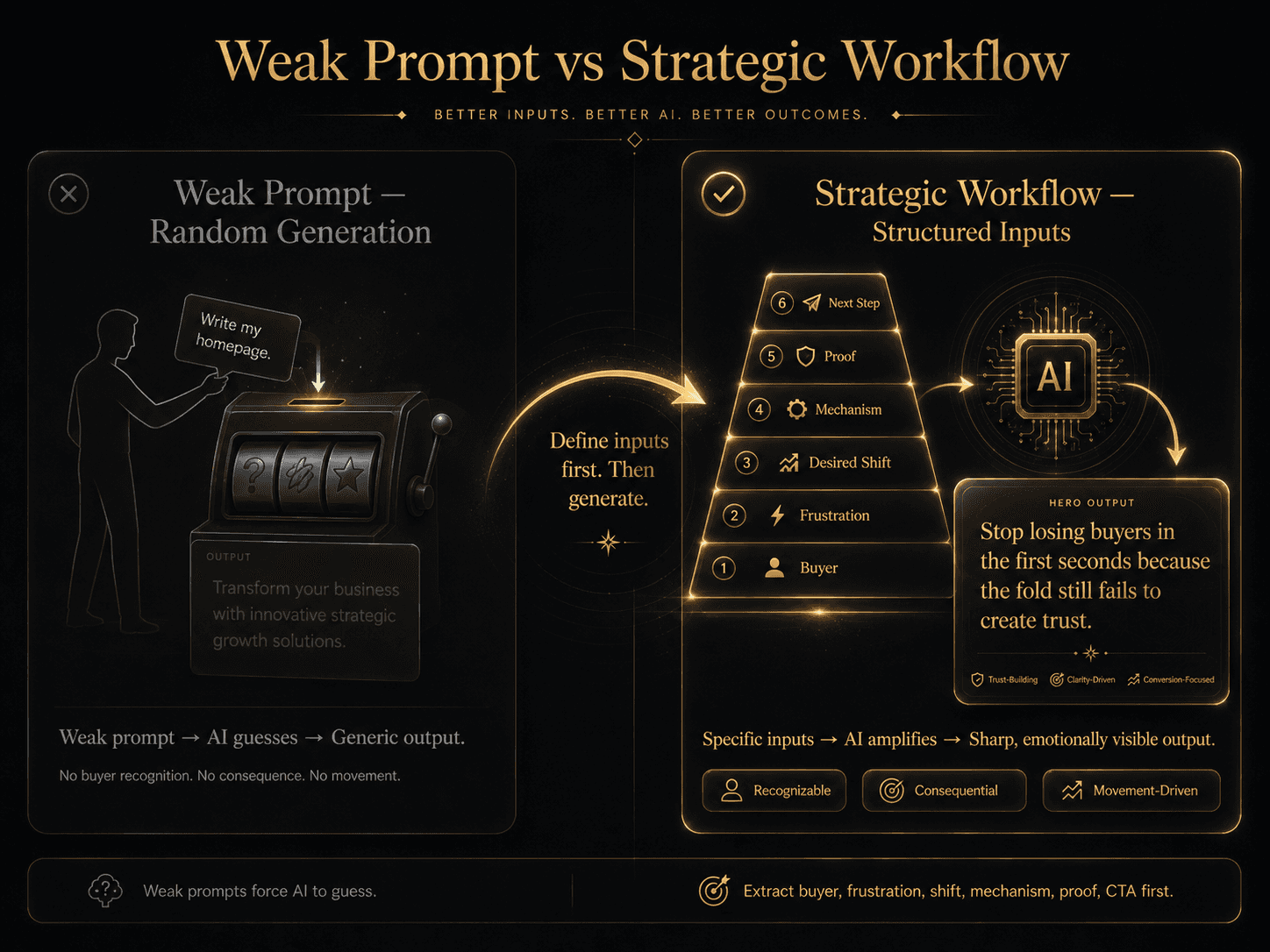
Weak prompts sound like:
“Write my homepage.”
“Give me a landing page headline.”
“Write a hero section for my business.”
“Make my website sound better.”
“Write something high-converting.”
These prompts force AI to guess.
And guessing creates generic copy.
The AI does not know:
who the buyer really is
what pressure they are under
what they have already tried
what they do not trust
what result they want badly enough to stop for
what proof exists
what makes the mechanism believable
what the CTA should move them toward
So it fills the gaps with language that sounds safe.
That is where phrases like this come from:
“Transform your business with innovative strategic growth solutions.”
“Unlock your full potential with our cutting-edge platform.”
“Empower your growth with tailored digital strategies.”
“Take your brand to the next level.”
These lines sound familiar because they are familiar.
They are not sharp.
They are not buyer-specific.
They do not create emotional movement.
They do not earn the scroll.
The Correct AI Hero Workflow™
The correct workflow is not:
Prompt → accept output → publish.
The correct workflow is:
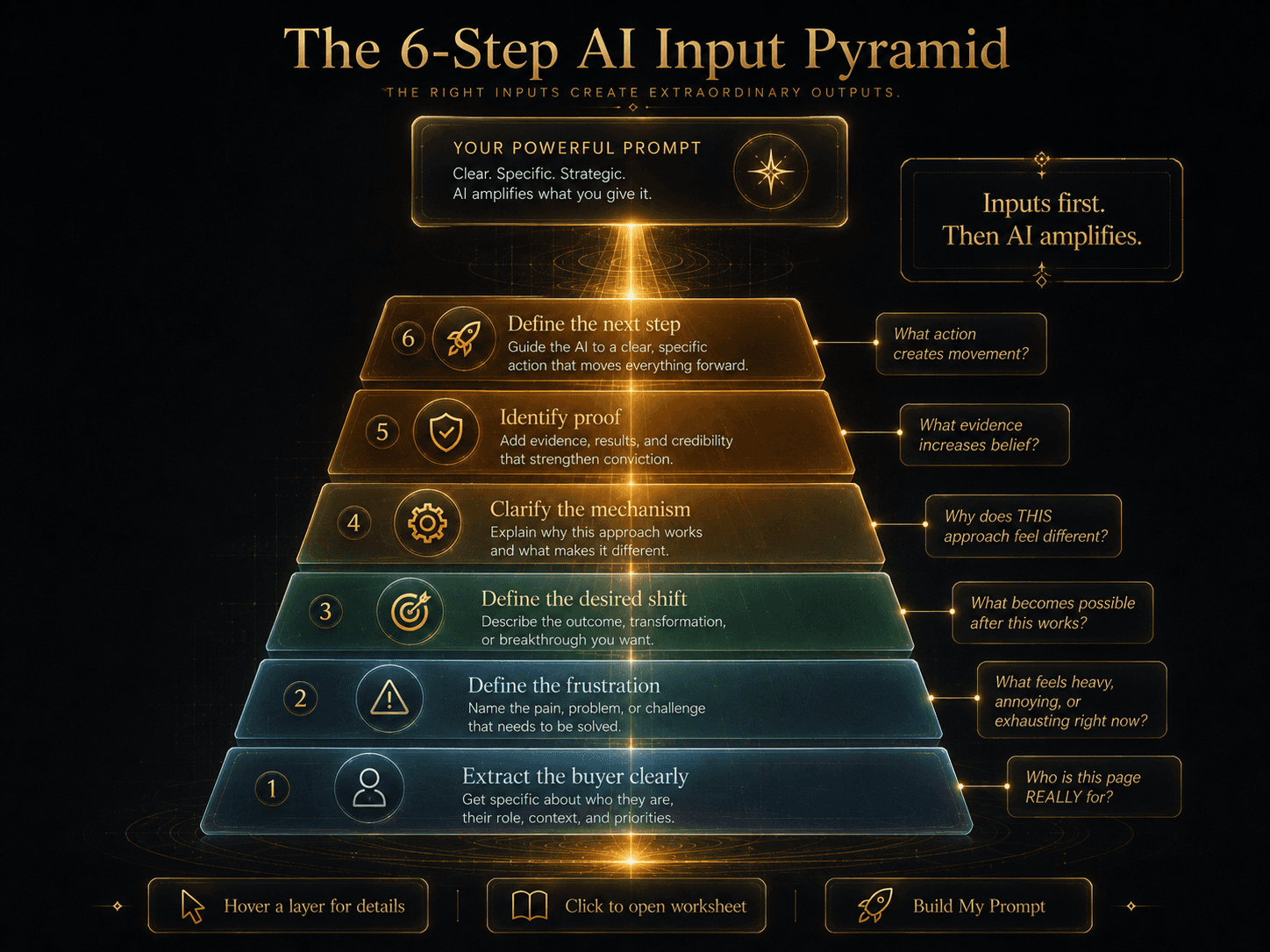
Extract The Buyer™
Define The Frustration™
Define The Desired Shift™
Clarify The Mechanism™
Identify The Proof™
Define The Next Step™
Generate The Hero Section™
Diagnose The Output™
Sharpen The Copy™
Compress The Hero™
Increase Tension™
Ground Believability™
Improve The CTA™
Stress-Test The Final Version™
That is the sequence.
AI becomes dramatically more useful when you stop treating it like a writer and start using it like a structured conversion assistant.
Step 1: Extract The Buyer™
Before AI writes anything, it must understand who the page is really for.
Not a broad category.
A buying condition.
Weak:
“Business owners.”
Stronger:
“Service business owners whose pages look polished but still fail to create enough trust above the fold.”
Weak:
“Coaches.”
Stronger:
“Coaches getting attention from content but struggling to turn that attention into booked calls.”
Weak:
“SaaS founders.”
Stronger:
“SaaS founders losing trial users before onboarding creates enough trust to continue.”
The sharper the buyer input, the sharper the hero output.
Step 2: Define The Frustration™
AI needs to know what the buyer is tired of, stuck in, embarrassed by, losing, or trying to escape.
Examples:
wasting traffic
getting ignored
attracting the wrong buyers
losing trust before the CTA
explaining the offer too much
sending people to a page that does not move them
watching visitors bounce before proof appears
sounding polished but forgettable
getting attention but not enquiries
The frustration gives the hero emotional grounding.
Without it, AI writes generic benefit copy.
Step 3: Define The Desired Shift™
The desired shift is what the buyer wants to experience after the hero promise works.
Examples:
more qualified enquiries
faster buyer understanding
stronger trust above the fold
clearer first-screen positioning
more CTA movement
less hesitation
stronger conversion momentum
a first screen that earns the scroll
The desired shift gives the hero direction.
Without it, AI writes vague improvement language.
Step 4: Clarify The Mechanism™
The mechanism explains why this approach feels different from generic help.
Examples:
hero-first optimisation
proof-led first-screen rebuild
buyer-language positioning
tension-first copy
trust-leak diagnosis
fold clarity audit
CTA resistance mapping
above-the-fold conversion system
The mechanism gives the hero believability.
Without it, AI makes claims without showing how the result might happen.
Step 5: Identify The Proof™
AI needs to know what proof can support the promise.
Examples:
before-and-after hero comparison
screenshot
dashboard
testimonial
DM
booked calendar
customer result
product walkthrough
proof asset
visual teardown
case study snapshot
Proof prevents AI from overpromising.
It also helps the hero feel grounded.
Step 6: Define The Next Step™
The CTA should not be an afterthought.
AI needs to know what action the buyer should take and why that action feels valuable.
Examples:
See The Hero Rewrite
Get The Hero Blueprint
Fix My First Screen
Watch The Breakdown
Download The Fold Guide
Claim The Hero Audit
Build My Hero Section
The next step gives the hero movement.
Without it, AI defaults to weak buttons like:
Learn More
Get Started
Submit
Contact Us
Those CTAs are not always wrong.
But they often lack payoff.
Hero Input Extraction Worksheet™
Complete this before using the core AI prompt.
Business / Offer
What is the product, service, or offer?
Target Buyer
Who is the page really for?
Buyer Condition
What situation is the buyer currently in?
Current Frustration
What are they tired of, stuck in, embarrassed by, or losing because of?
Desired Result
What result do they want badly enough to stop for?
Desired Shift
What changes after this works?
From:
To:
Painful Friction Removed
What do they no longer need to keep doing, guessing, wasting, or carrying?
Mechanism
What system, process, method, angle, or approach creates the result?
Why This Mechanism Is Different
Why should the buyer trust this approach more than generic help?
Proof Asset
What can you show above the fold to make the promise feel real?
What The Proof Proves
What does the proof demonstrate?
Primary CTA
What should the visitor do next?
CTA Payoff
What does the visitor get, see, fix, watch, download, or understand after clicking?
Buyer Hesitation
What might stop the buyer from acting?
Microcopy Reassurance
What short reassurance line could reduce that hesitation?
The Core Hero Section Generation Prompt™
Use this prompt first.
Do not rush to rewrite.
Let AI ask questions and extract the inputs properly.
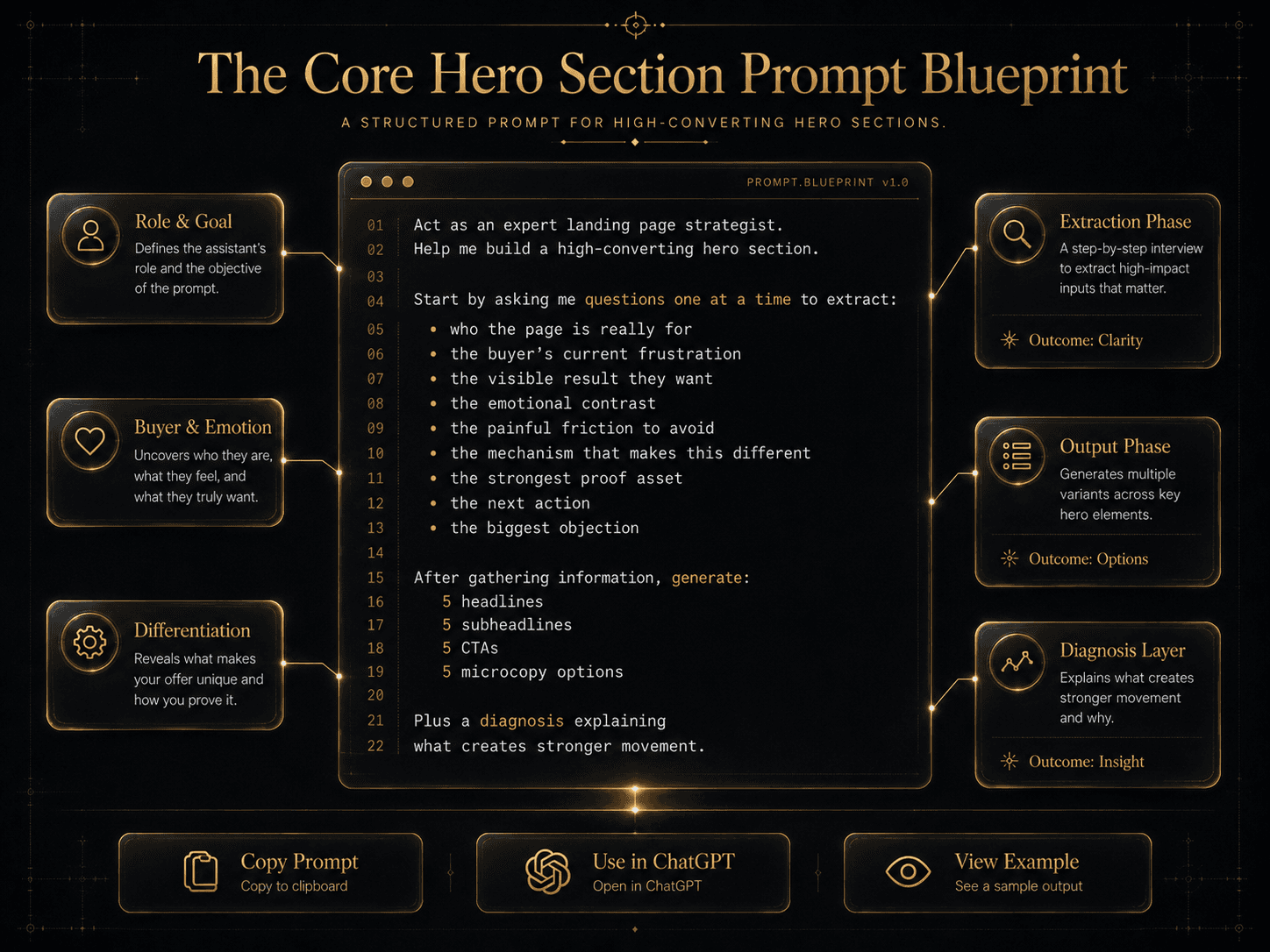
HERO SECTION GENERATION PROMPT
Act as an expert landing page strategist, conversion copywriter, and buyer psychology specialist.
Help me build a high-converting hero section for my [product/service/business].
Start by asking me questions one at a time to extract the following:
who the page is really for
the buyer’s current frustration
the visible result they want
the emotional contrast between their current state and desired state
the painful friction they want to avoid
the mechanism or process that makes this different
the strongest proof asset available
what the proof actually proves
the next action I want the visitor to take
the biggest objection or hesitation the buyer may feel
what microcopy could reduce that hesitation
Do not generate the hero section until you have gathered enough information.
After gathering the information, generate:
5 headline options
5 subheadline options
5 CTA options
5 microcopy options
3 hero-section layout suggestions
1 recommended final hero section
A short diagnosis explaining what makes the recommended version strongest
In the diagnosis, explain:
what currently feels weak
what creates stronger emotional movement
what improves trust
what increases continuation
what should be avoided
what proof should appear above the fold
why the CTA is appropriate for the buyer’s current trust level
Important rules:
prioritise clarity over cleverness
avoid generic corporate language
avoid hype
make the message emotionally recognisable
make the value easy to understand quickly
write as if the hero section only has a few seconds to earn the scroll
make the headline specific
make the subheadline clarify the promise
make the CTA imply payoff
make the microcopy reduce hesitation
do not use vague phrases like “unlock your potential”, “transform your business”, “take your brand to the next level”, or “innovative solutions”
What Makes AI Output Weak™
Most weak AI-generated hero sections suffer from predictable problems.
You must learn to spot these quickly.
Weak AI output usually contains:
broad wording
generic positioning
fake sophistication
low tension
no consequence visibility
weak buyer recognition
bloated language
overexplaining
emotionally flat messaging
vague transformation claims
corporate phrases
passive CTAs
no proof direction
no clear reason to continue
The output may sound smooth.
But smooth is not the standard.
The standard is:
Does the right buyer feel understood quickly enough to continue?
Weak AI Output Detector™
Use this checklist to reject weak AI copy fast.
Does the hero use vague phrases like:
innovative solutions
strategic growth
unlock your potential
transform your business
elevate your brand
tailored strategies
next-level results
cutting-edge systems
seamless experience
all-in-one solution
Yes / No
Does the headline sound like it could belong to hundreds of businesses?
Yes / No
Does the copy speak to a category instead of a buying condition?
Yes / No
Does the promise lack visible consequence?
Yes / No
Does the buyer have to decode what the offer actually does?
Yes / No
Does the subheadline add more words without adding belief?
Yes / No
Does the CTA sound passive?
Yes / No
Does the hero lack proof direction?
Yes / No
Does the copy feel polished but emotionally empty?
Yes / No
If several answers are yes, the AI output is not ready.
Do not publish it.
Sharpen it.
Weak vs Strong AI Output Example
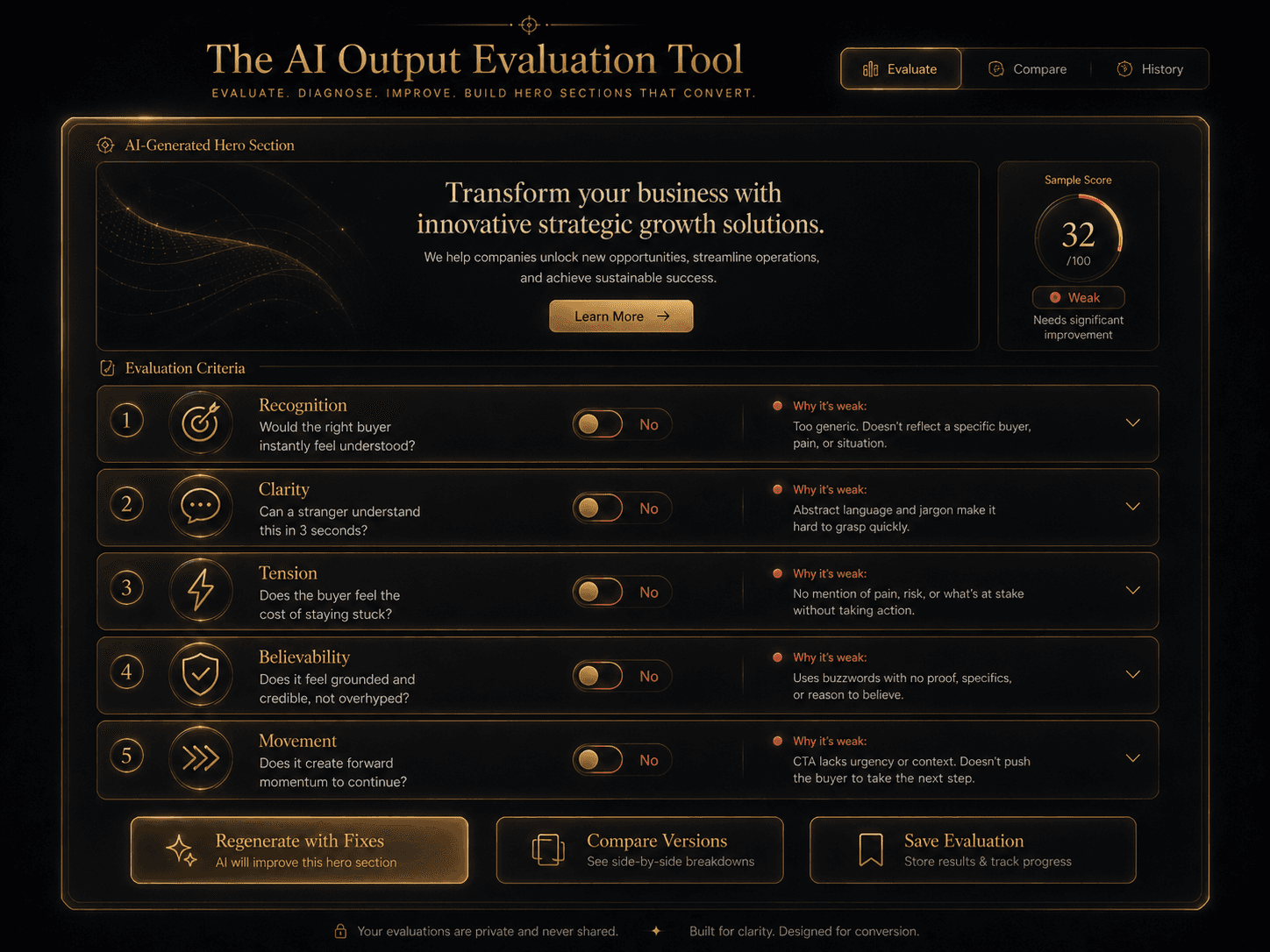
Weak AI Output
“Transform your business with innovative strategic growth solutions.”
Why This Is Weak
This sounds professional.
But emotionally, it communicates almost nothing.
It has:
no buyer recognition
no specific problem
no consequence
no mechanism
no visible result
no emotional movement
no reason to continue
no proof direction
The buyer cannot see themselves in it.
The line sounds like a thousand other websites.
That is corporate fog.
Stronger Output
“Stop losing buyers in the first seconds because the fold still fails to create trust.”
Why This Is Stronger
Now the problem becomes visible.
The line creates:
fast tension
specific consequence
buyer recognition
a clear first-screen problem
trust as the missing condition
urgency without fake scarcity
The buyer can understand why the first screen matters.
That creates attention.
Use AI To Sharpen, Not To Finish™
One of the best ways to use AI is iteration.
Meaning:
Generate.
Evaluate.
Compress.
Rewrite.
Sharpen.
Stress-test.
Do not accept the first output blindly.
The strongest results usually appear after multiple refinement rounds.
AI is not here to replace judgement.
It is here to give you better material to judge.
That distinction matters.
The first answer is rarely the best answer.
The best hero section usually appears after the output has been pushed through clarity, tension, believability, compression, and CTA improvement.
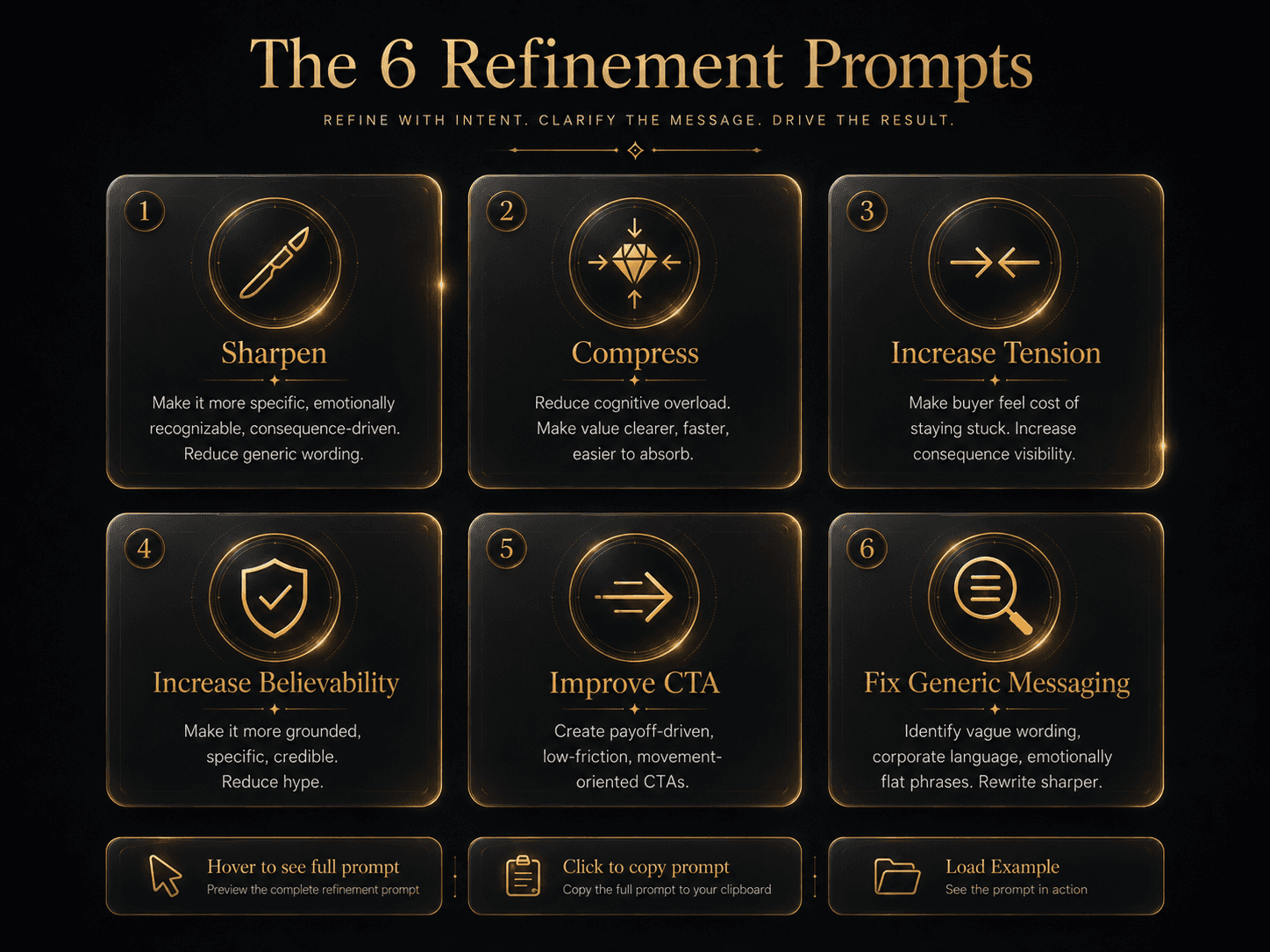
The AI Iteration Sequence™
Use this sequence after generating the first draft.
Generate the first version.
Run the Weak AI Output Detector™.
Use the Sharpening Prompt if the copy feels generic.
Use the Compression Prompt if the copy feels too long.
Use the Tension Prompt if the copy feels clear but flat.
Use the Believability Prompt if the copy feels exaggerated.
Use the CTA Improvement Prompt if the action feels passive.
Use the Generic Language Detector Prompt if the copy sounds corporate.
Run the Final Hero Stress-Test Prompt.
Apply human judgement before publishing.
That is how AI becomes useful.
Not as a one-shot writer.
As a structured refinement partner.
The Sharpening Prompt™
Use this when the output feels generic, soft, or emotionally weak.
SHARPENING PROMPT
Make this hero section:
more specific
more emotionally recognisable
more consequence-driven
easier to understand in seconds
less corporate
less vague
more tension-aware
more memorable
more buyer-focused
stronger at earning the scroll
Reduce:
generic wording
unnecessary adjectives
overexplaining
weak phrases
vague benefits
internal business language
broad audience labels
Increase:
buyer recognition
clarity
emotional movement
visible stakes
trust
continuation momentum
specificity
consequence visibility
Do not use hype.
Do not make inflated promises.
Do not make the copy clever at the expense of clarity.
Here is the current version:
[paste hero section]
The Compression Prompt™
Use this when the section feels too long, mentally heavy, or slow to absorb.
COMPRESSION PROMPT
Compress this hero section so the value becomes clearer, faster, and easier to absorb.
Reduce:
cognitive overload
unnecessary wording
repeated ideas
broad abstractions
long sentences
bloated subheadline language
internal business language
Keep:
emotional clarity
buyer recognition
tension
trust
consequence visibility
continuation momentum
proof direction
CTA clarity
The final version should feel fast to process and easy to remember.
Do not remove meaning just to make it shorter.
Remove anything that slows understanding.
Here is the current version:
[paste hero section]
The Tension Prompt™
Use this when the hero section feels clear but emotionally flat.
TENSION PROMPT
Rewrite this hero section so the buyer feels:
the cost of staying stuck
the frustration more clearly
the urgency more naturally
the emotional contrast between current pain and desired result
the consequence of delay
the relief of movement
Increase:
consequence visibility
emotional movement
recognition
friction awareness
contrast
buyer relevance
Do not add fake urgency.
Do not use hype.
Do not exaggerate the pain.
Make the tension feel real, specific, and believable.
Here is the current version:
[paste hero section]
The Believability Prompt™
Use this when the messaging sounds exaggerated, inflated, or too good to trust.
BELIEVABILITY PROMPT
Rewrite this hero section to feel more grounded, specific, credible, and trustworthy.
Reduce:
hype
inflated claims
vague superiority language
unrealistic promises
fake urgency
exaggerated transformation claims
empty confidence
Increase:
specificity
proof alignment
realistic outcomes
clarity
trust
mechanism clarity
calm confidence
credibility
The goal is calm confidence, not exaggerated persuasion.
Make the promise feel easier to believe without making it weak.
Here is the current version:
[paste hero section]
The CTA Improvement Prompt™
Use this when the CTA feels passive, vague, or low-momentum.
CTA IMPROVEMENT PROMPT
Generate stronger CTA options for this hero section.
The CTA options should:
imply payoff
create forward movement
feel low-friction
sound specific
increase curiosity
make the next step feel worthwhile
connect directly to the hero promise
match the buyer’s current trust level
Avoid:
generic button text
passive language
vague actions
high-friction commitments too early
unclear payoff
Give me:
10 CTA options
The best 3 options
A short explanation of why each works
Matching microcopy for each of the best 3 options
Here is the current hero section:
[paste hero section]
The desired buyer action is:
[insert desired action]
The Microcopy Improvement Prompt™
Use this when the CTA is clear but the action still feels slightly risky, vague, or heavy.
MICROCOPY IMPROVEMENT PROMPT
Create microcopy options that reduce hesitation beneath this CTA.
The microcopy should reduce:
fear
effort
uncertainty
scepticism
perceived time cost
perceived pressure
confusion about what happens next
Generate 10 microcopy options.
For each option, explain what hesitation it reduces.
Keep each line short, practical, and easy to understand.
Avoid hype.
Avoid vague reassurance.
Make the action feel lighter, safer, and more worthwhile.
Hero section:
[paste hero section]
CTA:
[paste CTA]
Main buyer hesitation:
[insert hesitation]
The Generic Language Detector Prompt™
This is one of the most useful prompts in this resource.
Use it when the output sounds like corporate wallpaper.
GENERIC LANGUAGE DETECTOR PROMPT
Analyse this hero section and identify:
vague wording
generic positioning
corporate language
emotionally flat phrases
low-consequence messaging
weak recognition
unnecessary complexity
broad audience language
weak CTA language
missing proof direction
phrases that sound polished but do not create movement
Then explain why the original version feels generic.
After that, rewrite the section into:
A clearer version
A sharper version
A more emotionally visible version
A more compressed version
A more believable version
For each version, explain:
what changed
why it is stronger
what buyer reaction it is designed to create
what still needs human review
Do not use hype.
Prioritise clarity, buyer recognition, consequence visibility, trust, and continuation.
Here is the hero section:
[paste hero section]
The Final Hero Stress-Test Prompt™
Use this after you have generated and refined the hero section.
This prompt helps you avoid publishing weak AI output just because it sounds better than the original.
FINAL HERO STRESS-TEST PROMPT
Act as a brutal but useful conversion strategist.
Stress-test this hero section before I publish it.
Hero section:
Headline:
[paste headline]
Subheadline:
[paste subheadline]
Visual direction:
[paste visual direction]
CTA:
[paste CTA]
Microcopy:
[paste microcopy]
Target buyer:
[insert buyer]
Desired action:
[insert desired action]
Evaluate the hero section across these eight tests:
3-Second Recognition
Clarity Compression
Tension
Trust
Proof
CTA Movement
Mobile Compression
Continuation
For each test:
give a score from 1 to 5
explain what is working
explain what is weak
identify the exact phrase or element causing friction
recommend one specific fix
Then identify:
the biggest remaining leak
the strongest part of the hero
the weakest part of the hero
what should be removed
what should be made sharper
what might still make the buyer hesitate
whether this hero is ready to test, needs sharpening, or should be rebuilt
Do not be polite.
Be accurate.
Prioritise buyer experience, clarity, trust, contrast, and continuation.
The Correct Way To Evaluate AI Output™
Do not ask:
“Does this sound smart?”
Ask:
“Would the right buyer instantly feel understood?”
That is the real test.
Many AI-generated hero sections sound technically polished while creating zero emotional movement.
They are readable.
They are grammatical.
They are tidy.
They are also forgettable.
The best AI outputs usually feel:
clearer
simpler
sharper
more emotionally recognisable
easier to trust
faster to understand
more consequence-aware
more buyer-focused
more specific
more grounded
Not more complicated.
Not more dramatic.
Not more inflated.
Not more “premium” in a vague way.
Strong AI output should make the buyer feel:
“This is about me.”
“I understand the value.”
“This feels believable.”
“I know what to do next.”
“I want to keep reading.”
That is the standard.
AI Output Scorecard™
Score the final AI-generated hero section from 1 to 5 in each category.
1 = weak
2 = soft
3 = usable but leaking
4 = strong
5 = sharp and ready
Buyer Recognition
Does the right buyer quickly feel recognised?
Score: ___ / 5
Notes:
Clarity
Can the buyer understand the value quickly?
Score: ___ / 5
Notes:
Tension
Does the hero create emotional contrast between current pain and desired result?
Score: ___ / 5
Notes:
Believability
Does the promise feel grounded and credible?
Score: ___ / 5
Notes:
Proof Direction
Does the hero suggest or include proof that makes the promise easier to trust?
Score: ___ / 5
Notes:
CTA Movement
Does the CTA imply a clear payoff and next step?
Score: ___ / 5
Notes:
Microcopy Reassurance
Does the microcopy reduce hesitation?
Score: ___ / 5
Notes:
Continuation
Does the hero make the buyer want to keep reading?
Score: ___ / 5
Notes:
Total Score
Buyer Recognition: ___ / 5
Clarity: ___ / 5
Tension: ___ / 5
Believability: ___ / 5
Proof Direction: ___ / 5
CTA Movement: ___ / 5
Microcopy Reassurance: ___ / 5
Continuation: ___ / 5
Total: ___ / 40
Score Interpretation
32–40: Strong AI-Assisted Hero™
The hero has strong structure and is ready to test in-market.
Review proof accuracy and brand fit before publishing.
24–31: Promising But Still Leaking™
The hero is better than the original, but one or two areas still need sharpening.
Use the relevant refinement prompt before publishing.
16–23: Generic AI Risk™
The hero may sound improved, but it is probably still leaking recognition, tension, trust, or movement.
Do not publish yet.
Run the Generic Language Detector Prompt™ and rebuild the weak areas.
0–15: Corporate Fog Output™
The AI output is not ready.
It likely sounds polished but generic.
Return to the Hero Input Extraction Worksheet™ and define the buyer, frustration, contrast, mechanism, proof, and CTA more clearly.
Human Override Principle™
AI can generate options.
AI can diagnose patterns.
AI can compress wording.
AI can suggest sharper CTAs.
AI can help you see weak spots.
But AI does not replace human judgement.
You must still decide:
whether the buyer truth is accurate
whether the proof is real
whether the claim is defensible
whether the tone fits the market
whether the tension is ethical
whether the promise is believable
whether the CTA matches the buyer’s trust level
whether the final hero actually represents the offer
AI can sharpen messaging.
It should not invent credibility.
It should not fabricate proof.
It should not exaggerate results.
It should not create urgency that does not exist.
The human remains responsible for truth, judgement, and strategic fit.
That is non-negotiable.
Final Execution Challenge™
Take your current hero section and run it through:
the Core Hero Section Generation Prompt™
the Sharpening Prompt™
the Compression Prompt™
the Tension Prompt™
the Believability Prompt™
the CTA Improvement Prompt™
the Microcopy Improvement Prompt™
the Generic Language Detector Prompt™
the Final Hero Stress-Test Prompt™
Then compare the original version against the rewritten version.
Ask:
“Which version earns the scroll faster?”
Do not ask:
“Which version sounds nicer?”
Ask:
“Which version creates faster recognition, clearer value, stronger trust, sharper tension, and more movement?”
Because the goal of AI is not to replace thinking.
It is to help sharpen messaging until the first screen becomes clear enough, strong enough, and emotionally relevant enough that the buyer finally feels staying on the page is worth their attention.
Final AI Hero Builder Worksheet
Use this as your complete working sheet.
Original Hero
Headline:
Subheadline:
Visual:
CTA:
Microcopy:
Buyer Inputs
Target buyer:
Buyer condition:
Current frustration:
Desired result:
Desired shift:
From _________________________________________
To _________________________________________
Painful friction removed:
Mechanism:
Proof asset:
Desired action:
Main hesitation:
AI-Generated Options
Best headline option:
Best subheadline option:
Best CTA option:
Best microcopy option:
Best visual direction:
Refined Hero
Headline:
Subheadline:
Visual direction:
CTA:
Microcopy:
Final Score
Buyer Recognition: ___ / 5
Clarity: ___ / 5
Tension: ___ / 5
Believability: ___ / 5
Proof Direction: ___ / 5
CTA Movement: ___ / 5
Microcopy Reassurance: ___ / 5
Continuation: ___ / 5
Total: ___ / 40
Final Human Review
Is the claim true?
Yes / No
Is the proof real?
Yes / No
Is the promise defensible?
Yes / No
Is the tone right for the market?
Yes / No
Does the CTA match the buyer’s trust level?
Yes / No
Does the hero earn the scroll?
Yes / No
Final verdict:
Ready To Test / Needs Sharpening / Rebuild
——
Final Principle
AI is not here to replace thinking.
It is here to sharpen thinking after the right inputs have been defined.
That is the difference.
Weak users ask AI for copy.
Strong users use AI to extract, diagnose, pressure-test, compress, sharpen, and improve the message.
A vague prompt creates vague copy.
A sharp process creates sharper options.
The hero section still needs buyer truth.
It still needs contrast.
It still needs proof.
It still needs believability.
It still needs a clear next step.
AI can help you get there faster.
But only if you stop treating it like a magic headline machine and start using it as a structured conversion workshop.
That is what The AI Hero Section Builder™ is designed to do.
It helps turn unclear first screens into sharper, more believable, higher-converting hero sections by giving AI the inputs it actually needs.
Because the goal is not to sound clever.
The goal is to make the buyer feel, within seconds:
“This is for me.”
“I understand the value.”
“This feels believable.”
“I know what to do next.”
“I want to keep going.”
That is when the hero section starts doing its job.
——
From:
The $100M Funnel Playbook. Book I: Foundation Buyer Psychology, Offer Clarity, and the Page Architecture Behind High-Converting Funnels
By Maris Spalins.
——
Copyright Notice
© 2026 The $100M Funnel Playbook / Winyourclients / Maris Spalins. All rights reserved.
This resource, including the frameworks, terminology, examples, scorecards, templates, prompts, methods, and written explanations, is original intellectual property created for The $100M Funnel Playbook. Book I: Foundation — Buyer Psychology, Offer Clarity, And The Page Architecture Behind High-Converting Funnels and published through Winyourclients.
No part of this resource may be copied, reproduced, screenshotted, republished, redistributed, sold, adapted, uploaded, scraped, stored in a database, included in training data, used to train artificial intelligence systems, or used to create derivative commercial or educational materials without prior written permission.
Limited reference, quotation, or sharing is only permitted where the source is clearly and visibly credited.
Any permitted reference must include at least one of the following source credits:
The $100M Funnel Playbook by Maris Spalins
or
Winyourclients — www.winyourclients.com
or
Maris Spalins / Winyourclients
Screenshots, excerpts, summaries, or redistributed versions must not remove, hide, alter, crop out, or obscure the original source, author name, book title, website name, or copyright notice.
This resource is provided for personal learning and implementation only. It is not licensed for resale, republishing, redistribution, AI training, template cloning, course creation, consulting delivery, or commercial reuse without written permission from Maris Spalins or Winyourclients.
For permission requests, licensing, citation approval, or commercial usage enquiries, contact:
Winyourclients
www.winyourclients.com
or
Email directly to Jacob on: help@winyourclients.com
The AI Hero Section Builder™ A guided AI workshop for extracting the right buyer inputs, diagnosing weak first-screen messaging, and generating sharper hero sections with stronger clarity, tension, trust, CTA movement, and scroll momentum.
Prefer Audio Or Video?
The AI Hero Section Builder™ is also available as:
🎧 A guided audio walkthrough explaining AI-assisted hero section building, buyer input extraction, headline refinement, CTA improvement, and final hero stress-testing.
🎥 A practical video breakdown with real AI hero prompts, weak-output diagnosis, sharpening examples, CTA/microcopy improvements, and final hero section rebuilds.Choose the format that fits how you learn best.
[Listen To The Audio Walkthrough] (coming soon)
[Watch The Video Breakdown] (coming soon)
——
Why Most People Use AI Wrong For Hero Sections
Most people use AI the wrong way when building hero sections.
They type:
“Write me a homepage headline.”
Or:
“Give me a landing page hero section.”
Or:
“Write copy for my business.”
And then they receive generic, forgettable, low-conversion copy.
Not because AI is useless.
Because the input was weak.
AI cannot build a sharp hero section from blurry thinking.
If the buyer is unclear, the output becomes broad.
If the pain is vague, the headline becomes soft.
If the mechanism is missing, the promise feels generic.
If the proof is undefined, the page sounds unsupported.
If the next step is unclear, the CTA becomes passive.
That is why AI so often produces copy that sounds polished but says almost nothing.
It is not thinking strategically.
It is guessing.
And guessing creates corporate fog.
This resource fixes that.
It gives you a structured way to use AI to extract the right information, diagnose weak messaging, and rebuild the first screen with stronger clarity, tension, trust, and movement.
This is not a magic-copy button.
This is a structured AI-assisted hero section workshop.
What This Resource Helps You Do
The AI Hero Section Builder™ helps you use AI correctly so your first screen becomes clearer, sharper, more emotionally relevant, and easier for the buyer to trust quickly.
Use this when:
your hero section sounds generic
you struggle explaining your offer clearly
the first screen feels weak
you need headline directions quickly
your messaging lacks tension
your CTA feels flat
you want sharper copy without sounding hyped
AI keeps giving you corporate fluff
your subheadline feels bloated
your first screen lacks buyer recognition
your visual direction feels decorative
your copy sounds polished but forgettable
your hero section does not earn the scroll
This resource helps you use AI to:
extract the right buyer information
sharpen positioning
identify weak messaging
generate stronger headlines
improve clarity
reduce fog
increase tension
strengthen CTAs
improve trust
improve continuation above the fold
stress-test the final hero before using it
The goal is simple:
Use AI correctly so the first screen becomes clearer, sharper, more emotionally relevant, and easier for the buyer to trust quickly.
The Core Principle™
AI cannot fix blurry thinking.
It can only sharpen the material you give it.
That is the rule.
If you give AI a vague offer, it will usually produce vague copy.
If you give AI a broad audience, it will usually produce broad messaging.
If you give AI a weak problem, it will usually create weak tension.
If you give AI no proof, it will invent confidence.
If you give AI no buyer context, it will fall back into safe, generic, corporate language.
Strong AI output begins with strong inputs.
Before you ask AI to write anything, you need to define:
who the page is really for
what the buyer is frustrated by
what result they want
what painful friction they want removed
what contrast the hero should create
what mechanism makes the offer different
what proof supports the promise
what action the visitor should take
what hesitation might stop them
AI becomes useful after the thinking is extracted.
Not before.
The Biggest Mistake People Make With AI™
The biggest mistake people make with AI is simple:
They ask for output before defining the inputs.
Weak prompts sound like:
“Write my homepage.”
“Give me a landing page headline.”
“Write a hero section for my business.”
“Make my website sound better.”
“Write something high-converting.”
These prompts force AI to guess.
And guessing creates generic copy.
The AI does not know:
who the buyer really is
what pressure they are under
what they have already tried
what they do not trust
what result they want badly enough to stop for
what proof exists
what makes the mechanism believable
what the CTA should move them toward
So it fills the gaps with language that sounds safe.
That is where phrases like this come from:
“Transform your business with innovative strategic growth solutions.”
“Unlock your full potential with our cutting-edge platform.”
“Empower your growth with tailored digital strategies.”
“Take your brand to the next level.”
These lines sound familiar because they are familiar.
They are not sharp.
They are not buyer-specific.
They do not create emotional movement.
They do not earn the scroll.
The Correct AI Hero Workflow™
The correct workflow is not:
Prompt → accept output → publish.
The correct workflow is:
Extract The Buyer™
Define The Frustration™
Define The Desired Shift™
Clarify The Mechanism™
Identify The Proof™
Define The Next Step™
Generate The Hero Section™
Diagnose The Output™
Sharpen The Copy™
Compress The Hero™
Increase Tension™
Ground Believability™
Improve The CTA™
Stress-Test The Final Version™
That is the sequence.
AI becomes dramatically more useful when you stop treating it like a writer and start using it like a structured conversion assistant.
Step 1: Extract The Buyer™
Before AI writes anything, it must understand who the page is really for.
Not a broad category.
A buying condition.
Weak:
“Business owners.”
Stronger:
“Service business owners whose pages look polished but still fail to create enough trust above the fold.”
Weak:
“Coaches.”
Stronger:
“Coaches getting attention from content but struggling to turn that attention into booked calls.”
Weak:
“SaaS founders.”
Stronger:
“SaaS founders losing trial users before onboarding creates enough trust to continue.”
The sharper the buyer input, the sharper the hero output.
Step 2: Define The Frustration™
AI needs to know what the buyer is tired of, stuck in, embarrassed by, losing, or trying to escape.
Examples:
wasting traffic
getting ignored
attracting the wrong buyers
losing trust before the CTA
explaining the offer too much
sending people to a page that does not move them
watching visitors bounce before proof appears
sounding polished but forgettable
getting attention but not enquiries
The frustration gives the hero emotional grounding.
Without it, AI writes generic benefit copy.
Step 3: Define The Desired Shift™
The desired shift is what the buyer wants to experience after the hero promise works.
Examples:
more qualified enquiries
faster buyer understanding
stronger trust above the fold
clearer first-screen positioning
more CTA movement
less hesitation
stronger conversion momentum
a first screen that earns the scroll
The desired shift gives the hero direction.
Without it, AI writes vague improvement language.
Step 4: Clarify The Mechanism™
The mechanism explains why this approach feels different from generic help.
Examples:
hero-first optimisation
proof-led first-screen rebuild
buyer-language positioning
tension-first copy
trust-leak diagnosis
fold clarity audit
CTA resistance mapping
above-the-fold conversion system
The mechanism gives the hero believability.
Without it, AI makes claims without showing how the result might happen.
Step 5: Identify The Proof™
AI needs to know what proof can support the promise.
Examples:
before-and-after hero comparison
screenshot
dashboard
testimonial
DM
booked calendar
customer result
product walkthrough
proof asset
visual teardown
case study snapshot
Proof prevents AI from overpromising.
It also helps the hero feel grounded.
Step 6: Define The Next Step™
The CTA should not be an afterthought.
AI needs to know what action the buyer should take and why that action feels valuable.
Examples:
See The Hero Rewrite
Get The Hero Blueprint
Fix My First Screen
Watch The Breakdown
Download The Fold Guide
Claim The Hero Audit
Build My Hero Section
The next step gives the hero movement.
Without it, AI defaults to weak buttons like:
Learn More
Get Started
Submit
Contact Us
Those CTAs are not always wrong.
But they often lack payoff.
Hero Input Extraction Worksheet™
Complete this before using the core AI prompt.
Business / Offer
What is the product, service, or offer?
Target Buyer
Who is the page really for?
Buyer Condition
What situation is the buyer currently in?
Current Frustration
What are they tired of, stuck in, embarrassed by, or losing because of?
Desired Result
What result do they want badly enough to stop for?
Desired Shift
What changes after this works?
From:
To:
Painful Friction Removed
What do they no longer need to keep doing, guessing, wasting, or carrying?
Mechanism
What system, process, method, angle, or approach creates the result?
Why This Mechanism Is Different
Why should the buyer trust this approach more than generic help?
Proof Asset
What can you show above the fold to make the promise feel real?
What The Proof Proves
What does the proof demonstrate?
Primary CTA
What should the visitor do next?
CTA Payoff
What does the visitor get, see, fix, watch, download, or understand after clicking?
Buyer Hesitation
What might stop the buyer from acting?
Microcopy Reassurance
What short reassurance line could reduce that hesitation?
The Core Hero Section Generation Prompt™
Use this prompt first.
Do not rush to rewrite.
Let AI ask questions and extract the inputs properly.
HERO SECTION GENERATION PROMPT
Act as an expert landing page strategist, conversion copywriter, and buyer psychology specialist.
Help me build a high-converting hero section for my [product/service/business].
Start by asking me questions one at a time to extract the following:
who the page is really for
the buyer’s current frustration
the visible result they want
the emotional contrast between their current state and desired state
the painful friction they want to avoid
the mechanism or process that makes this different
the strongest proof asset available
what the proof actually proves
the next action I want the visitor to take
the biggest objection or hesitation the buyer may feel
what microcopy could reduce that hesitation
Do not generate the hero section until you have gathered enough information.
After gathering the information, generate:
5 headline options
5 subheadline options
5 CTA options
5 microcopy options
3 hero-section layout suggestions
1 recommended final hero section
A short diagnosis explaining what makes the recommended version strongest
In the diagnosis, explain:
what currently feels weak
what creates stronger emotional movement
what improves trust
what increases continuation
what should be avoided
what proof should appear above the fold
why the CTA is appropriate for the buyer’s current trust level
Important rules:
prioritise clarity over cleverness
avoid generic corporate language
avoid hype
make the message emotionally recognisable
make the value easy to understand quickly
write as if the hero section only has a few seconds to earn the scroll
make the headline specific
make the subheadline clarify the promise
make the CTA imply payoff
make the microcopy reduce hesitation
do not use vague phrases like “unlock your potential”, “transform your business”, “take your brand to the next level”, or “innovative solutions”
What Makes AI Output Weak™
Most weak AI-generated hero sections suffer from predictable problems.
You must learn to spot these quickly.
Weak AI output usually contains:
broad wording
generic positioning
fake sophistication
low tension
no consequence visibility
weak buyer recognition
bloated language
overexplaining
emotionally flat messaging
vague transformation claims
corporate phrases
passive CTAs
no proof direction
no clear reason to continue
The output may sound smooth.
But smooth is not the standard.
The standard is:
Does the right buyer feel understood quickly enough to continue?
Weak AI Output Detector™
Use this checklist to reject weak AI copy fast.
Does the hero use vague phrases like:
innovative solutions
strategic growth
unlock your potential
transform your business
elevate your brand
tailored strategies
next-level results
cutting-edge systems
seamless experience
all-in-one solution
Yes / No
Does the headline sound like it could belong to hundreds of businesses?
Yes / No
Does the copy speak to a category instead of a buying condition?
Yes / No
Does the promise lack visible consequence?
Yes / No
Does the buyer have to decode what the offer actually does?
Yes / No
Does the subheadline add more words without adding belief?
Yes / No
Does the CTA sound passive?
Yes / No
Does the hero lack proof direction?
Yes / No
Does the copy feel polished but emotionally empty?
Yes / No
If several answers are yes, the AI output is not ready.
Do not publish it.
Sharpen it.
Weak vs Strong AI Output Example
Weak AI Output
“Transform your business with innovative strategic growth solutions.”
Why This Is Weak
This sounds professional.
But emotionally, it communicates almost nothing.
It has:
no buyer recognition
no specific problem
no consequence
no mechanism
no visible result
no emotional movement
no reason to continue
no proof direction
The buyer cannot see themselves in it.
The line sounds like a thousand other websites.
That is corporate fog.
Stronger Output
“Stop losing buyers in the first seconds because the fold still fails to create trust.”
Why This Is Stronger
Now the problem becomes visible.
The line creates:
fast tension
specific consequence
buyer recognition
a clear first-screen problem
trust as the missing condition
urgency without fake scarcity
The buyer can understand why the first screen matters.
That creates attention.
Use AI To Sharpen, Not To Finish™
One of the best ways to use AI is iteration.
Meaning:
Generate.
Evaluate.
Compress.
Rewrite.
Sharpen.
Stress-test.
Do not accept the first output blindly.
The strongest results usually appear after multiple refinement rounds.
AI is not here to replace judgement.
It is here to give you better material to judge.
That distinction matters.
The first answer is rarely the best answer.
The best hero section usually appears after the output has been pushed through clarity, tension, believability, compression, and CTA improvement.
The AI Iteration Sequence™
Use this sequence after generating the first draft.
Generate the first version.
Run the Weak AI Output Detector™.
Use the Sharpening Prompt if the copy feels generic.
Use the Compression Prompt if the copy feels too long.
Use the Tension Prompt if the copy feels clear but flat.
Use the Believability Prompt if the copy feels exaggerated.
Use the CTA Improvement Prompt if the action feels passive.
Use the Generic Language Detector Prompt if the copy sounds corporate.
Run the Final Hero Stress-Test Prompt.
Apply human judgement before publishing.
That is how AI becomes useful.
Not as a one-shot writer.
As a structured refinement partner.
The Sharpening Prompt™
Use this when the output feels generic, soft, or emotionally weak.
SHARPENING PROMPT
Make this hero section:
more specific
more emotionally recognisable
more consequence-driven
easier to understand in seconds
less corporate
less vague
more tension-aware
more memorable
more buyer-focused
stronger at earning the scroll
Reduce:
generic wording
unnecessary adjectives
overexplaining
weak phrases
vague benefits
internal business language
broad audience labels
Increase:
buyer recognition
clarity
emotional movement
visible stakes
trust
continuation momentum
specificity
consequence visibility
Do not use hype.
Do not make inflated promises.
Do not make the copy clever at the expense of clarity.
Here is the current version:
[paste hero section]
The Compression Prompt™
Use this when the section feels too long, mentally heavy, or slow to absorb.
COMPRESSION PROMPT
Compress this hero section so the value becomes clearer, faster, and easier to absorb.
Reduce:
cognitive overload
unnecessary wording
repeated ideas
broad abstractions
long sentences
bloated subheadline language
internal business language
Keep:
emotional clarity
buyer recognition
tension
trust
consequence visibility
continuation momentum
proof direction
CTA clarity
The final version should feel fast to process and easy to remember.
Do not remove meaning just to make it shorter.
Remove anything that slows understanding.
Here is the current version:
[paste hero section]
The Tension Prompt™
Use this when the hero section feels clear but emotionally flat.
TENSION PROMPT
Rewrite this hero section so the buyer feels:
the cost of staying stuck
the frustration more clearly
the urgency more naturally
the emotional contrast between current pain and desired result
the consequence of delay
the relief of movement
Increase:
consequence visibility
emotional movement
recognition
friction awareness
contrast
buyer relevance
Do not add fake urgency.
Do not use hype.
Do not exaggerate the pain.
Make the tension feel real, specific, and believable.
Here is the current version:
[paste hero section]
The Believability Prompt™
Use this when the messaging sounds exaggerated, inflated, or too good to trust.
BELIEVABILITY PROMPT
Rewrite this hero section to feel more grounded, specific, credible, and trustworthy.
Reduce:
hype
inflated claims
vague superiority language
unrealistic promises
fake urgency
exaggerated transformation claims
empty confidence
Increase:
specificity
proof alignment
realistic outcomes
clarity
trust
mechanism clarity
calm confidence
credibility
The goal is calm confidence, not exaggerated persuasion.
Make the promise feel easier to believe without making it weak.
Here is the current version:
[paste hero section]
The CTA Improvement Prompt™
Use this when the CTA feels passive, vague, or low-momentum.
CTA IMPROVEMENT PROMPT
Generate stronger CTA options for this hero section.
The CTA options should:
imply payoff
create forward movement
feel low-friction
sound specific
increase curiosity
make the next step feel worthwhile
connect directly to the hero promise
match the buyer’s current trust level
Avoid:
generic button text
passive language
vague actions
high-friction commitments too early
unclear payoff
Give me:
10 CTA options
The best 3 options
A short explanation of why each works
Matching microcopy for each of the best 3 options
Here is the current hero section:
[paste hero section]
The desired buyer action is:
[insert desired action]
The Microcopy Improvement Prompt™
Use this when the CTA is clear but the action still feels slightly risky, vague, or heavy.
MICROCOPY IMPROVEMENT PROMPT
Create microcopy options that reduce hesitation beneath this CTA.
The microcopy should reduce:
fear
effort
uncertainty
scepticism
perceived time cost
perceived pressure
confusion about what happens next
Generate 10 microcopy options.
For each option, explain what hesitation it reduces.
Keep each line short, practical, and easy to understand.
Avoid hype.
Avoid vague reassurance.
Make the action feel lighter, safer, and more worthwhile.
Hero section:
[paste hero section]
CTA:
[paste CTA]
Main buyer hesitation:
[insert hesitation]
The Generic Language Detector Prompt™
This is one of the most useful prompts in this resource.
Use it when the output sounds like corporate wallpaper.
GENERIC LANGUAGE DETECTOR PROMPT
Analyse this hero section and identify:
vague wording
generic positioning
corporate language
emotionally flat phrases
low-consequence messaging
weak recognition
unnecessary complexity
broad audience language
weak CTA language
missing proof direction
phrases that sound polished but do not create movement
Then explain why the original version feels generic.
After that, rewrite the section into:
A clearer version
A sharper version
A more emotionally visible version
A more compressed version
A more believable version
For each version, explain:
what changed
why it is stronger
what buyer reaction it is designed to create
what still needs human review
Do not use hype.
Prioritise clarity, buyer recognition, consequence visibility, trust, and continuation.
Here is the hero section:
[paste hero section]
The Final Hero Stress-Test Prompt™
Use this after you have generated and refined the hero section.
This prompt helps you avoid publishing weak AI output just because it sounds better than the original.
FINAL HERO STRESS-TEST PROMPT
Act as a brutal but useful conversion strategist.
Stress-test this hero section before I publish it.
Hero section:
Headline:
[paste headline]
Subheadline:
[paste subheadline]
Visual direction:
[paste visual direction]
CTA:
[paste CTA]
Microcopy:
[paste microcopy]
Target buyer:
[insert buyer]
Desired action:
[insert desired action]
Evaluate the hero section across these eight tests:
3-Second Recognition
Clarity Compression
Tension
Trust
Proof
CTA Movement
Mobile Compression
Continuation
For each test:
give a score from 1 to 5
explain what is working
explain what is weak
identify the exact phrase or element causing friction
recommend one specific fix
Then identify:
the biggest remaining leak
the strongest part of the hero
the weakest part of the hero
what should be removed
what should be made sharper
what might still make the buyer hesitate
whether this hero is ready to test, needs sharpening, or should be rebuilt
Do not be polite.
Be accurate.
Prioritise buyer experience, clarity, trust, contrast, and continuation.
The Correct Way To Evaluate AI Output™
Do not ask:
“Does this sound smart?”
Ask:
“Would the right buyer instantly feel understood?”
That is the real test.
Many AI-generated hero sections sound technically polished while creating zero emotional movement.
They are readable.
They are grammatical.
They are tidy.
They are also forgettable.
The best AI outputs usually feel:
clearer
simpler
sharper
more emotionally recognisable
easier to trust
faster to understand
more consequence-aware
more buyer-focused
more specific
more grounded
Not more complicated.
Not more dramatic.
Not more inflated.
Not more “premium” in a vague way.
Strong AI output should make the buyer feel:
“This is about me.”
“I understand the value.”
“This feels believable.”
“I know what to do next.”
“I want to keep reading.”
That is the standard.
AI Output Scorecard™
Score the final AI-generated hero section from 1 to 5 in each category.
1 = weak
2 = soft
3 = usable but leaking
4 = strong
5 = sharp and ready
Buyer Recognition
Does the right buyer quickly feel recognised?
Score: ___ / 5
Notes:
Clarity
Can the buyer understand the value quickly?
Score: ___ / 5
Notes:
Tension
Does the hero create emotional contrast between current pain and desired result?
Score: ___ / 5
Notes:
Believability
Does the promise feel grounded and credible?
Score: ___ / 5
Notes:
Proof Direction
Does the hero suggest or include proof that makes the promise easier to trust?
Score: ___ / 5
Notes:
CTA Movement
Does the CTA imply a clear payoff and next step?
Score: ___ / 5
Notes:
Microcopy Reassurance
Does the microcopy reduce hesitation?
Score: ___ / 5
Notes:
Continuation
Does the hero make the buyer want to keep reading?
Score: ___ / 5
Notes:
Total Score
Buyer Recognition: ___ / 5
Clarity: ___ / 5
Tension: ___ / 5
Believability: ___ / 5
Proof Direction: ___ / 5
CTA Movement: ___ / 5
Microcopy Reassurance: ___ / 5
Continuation: ___ / 5
Total: ___ / 40
Score Interpretation
32–40: Strong AI-Assisted Hero™
The hero has strong structure and is ready to test in-market.
Review proof accuracy and brand fit before publishing.
24–31: Promising But Still Leaking™
The hero is better than the original, but one or two areas still need sharpening.
Use the relevant refinement prompt before publishing.
16–23: Generic AI Risk™
The hero may sound improved, but it is probably still leaking recognition, tension, trust, or movement.
Do not publish yet.
Run the Generic Language Detector Prompt™ and rebuild the weak areas.
0–15: Corporate Fog Output™
The AI output is not ready.
It likely sounds polished but generic.
Return to the Hero Input Extraction Worksheet™ and define the buyer, frustration, contrast, mechanism, proof, and CTA more clearly.
Human Override Principle™
AI can generate options.
AI can diagnose patterns.
AI can compress wording.
AI can suggest sharper CTAs.
AI can help you see weak spots.
But AI does not replace human judgement.
You must still decide:
whether the buyer truth is accurate
whether the proof is real
whether the claim is defensible
whether the tone fits the market
whether the tension is ethical
whether the promise is believable
whether the CTA matches the buyer’s trust level
whether the final hero actually represents the offer
AI can sharpen messaging.
It should not invent credibility.
It should not fabricate proof.
It should not exaggerate results.
It should not create urgency that does not exist.
The human remains responsible for truth, judgement, and strategic fit.
That is non-negotiable.
Final Execution Challenge™
Take your current hero section and run it through:
the Core Hero Section Generation Prompt™
the Sharpening Prompt™
the Compression Prompt™
the Tension Prompt™
the Believability Prompt™
the CTA Improvement Prompt™
the Microcopy Improvement Prompt™
the Generic Language Detector Prompt™
the Final Hero Stress-Test Prompt™
Then compare the original version against the rewritten version.
Ask:
“Which version earns the scroll faster?”
Do not ask:
“Which version sounds nicer?”
Ask:
“Which version creates faster recognition, clearer value, stronger trust, sharper tension, and more movement?”
Because the goal of AI is not to replace thinking.
It is to help sharpen messaging until the first screen becomes clear enough, strong enough, and emotionally relevant enough that the buyer finally feels staying on the page is worth their attention.
Final AI Hero Builder Worksheet
Use this as your complete working sheet.
Original Hero
Headline:
Subheadline:
Visual:
CTA:
Microcopy:
Buyer Inputs
Target buyer:
Buyer condition:
Current frustration:
Desired result:
Desired shift:
From _________________________________________
To _________________________________________
Painful friction removed:
Mechanism:
Proof asset:
Desired action:
Main hesitation:
AI-Generated Options
Best headline option:
Best subheadline option:
Best CTA option:
Best microcopy option:
Best visual direction:
Refined Hero
Headline:
Subheadline:
Visual direction:
CTA:
Microcopy:
Final Score
Buyer Recognition: ___ / 5
Clarity: ___ / 5
Tension: ___ / 5
Believability: ___ / 5
Proof Direction: ___ / 5
CTA Movement: ___ / 5
Microcopy Reassurance: ___ / 5
Continuation: ___ / 5
Total: ___ / 40
Final Human Review
Is the claim true?
Yes / No
Is the proof real?
Yes / No
Is the promise defensible?
Yes / No
Is the tone right for the market?
Yes / No
Does the CTA match the buyer’s trust level?
Yes / No
Does the hero earn the scroll?
Yes / No
Final verdict:
Ready To Test / Needs Sharpening / Rebuild
——
Final Principle
AI is not here to replace thinking.
It is here to sharpen thinking after the right inputs have been defined.
That is the difference.
Weak users ask AI for copy.
Strong users use AI to extract, diagnose, pressure-test, compress, sharpen, and improve the message.
A vague prompt creates vague copy.
A sharp process creates sharper options.
The hero section still needs buyer truth.
It still needs contrast.
It still needs proof.
It still needs believability.
It still needs a clear next step.
AI can help you get there faster.
But only if you stop treating it like a magic headline machine and start using it as a structured conversion workshop.
That is what The AI Hero Section Builder™ is designed to do.
It helps turn unclear first screens into sharper, more believable, higher-converting hero sections by giving AI the inputs it actually needs.
Because the goal is not to sound clever.
The goal is to make the buyer feel, within seconds:
“This is for me.”
“I understand the value.”
“This feels believable.”
“I know what to do next.”
“I want to keep going.”
That is when the hero section starts doing its job.
——
From:
The $100M Funnel Playbook. Book I: Foundation Buyer Psychology, Offer Clarity, and the Page Architecture Behind High-Converting Funnels
By Maris Spalins.
——
Copyright Notice
© 2026 The $100M Funnel Playbook / Winyourclients / Maris Spalins. All rights reserved.
This resource, including the frameworks, terminology, examples, scorecards, templates, prompts, methods, and written explanations, is original intellectual property created for The $100M Funnel Playbook. Book I: Foundation — Buyer Psychology, Offer Clarity, And The Page Architecture Behind High-Converting Funnels and published through Winyourclients.
No part of this resource may be copied, reproduced, screenshotted, republished, redistributed, sold, adapted, uploaded, scraped, stored in a database, included in training data, used to train artificial intelligence systems, or used to create derivative commercial or educational materials without prior written permission.
Limited reference, quotation, or sharing is only permitted where the source is clearly and visibly credited.
Any permitted reference must include at least one of the following source credits:
The $100M Funnel Playbook by Maris Spalins
or
Winyourclients — www.winyourclients.com
or
Maris Spalins / Winyourclients
Screenshots, excerpts, summaries, or redistributed versions must not remove, hide, alter, crop out, or obscure the original source, author name, book title, website name, or copyright notice.
This resource is provided for personal learning and implementation only. It is not licensed for resale, republishing, redistribution, AI training, template cloning, course creation, consulting delivery, or commercial reuse without written permission from Maris Spalins or Winyourclients.
For permission requests, licensing, citation approval, or commercial usage enquiries, contact:
Winyourclients
www.winyourclients.com
or
Email directly to Jacob on: help@winyourclients.com
Other Blogs
Other Blogs
Check our other project Blogs with useful insight and information for your businesses
Other Blogs
Other Blogs
Check our other project Blogs with useful insight and information for your businesses